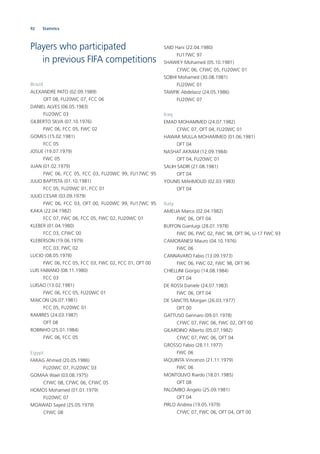
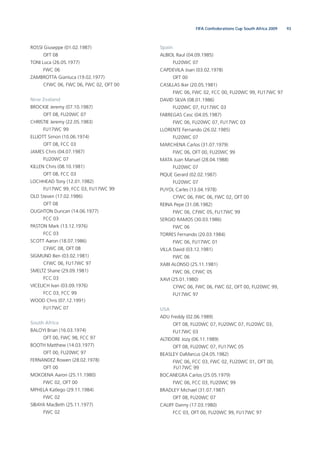
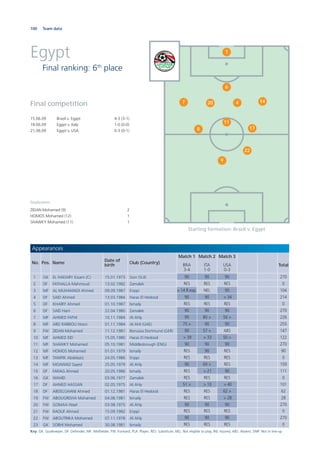
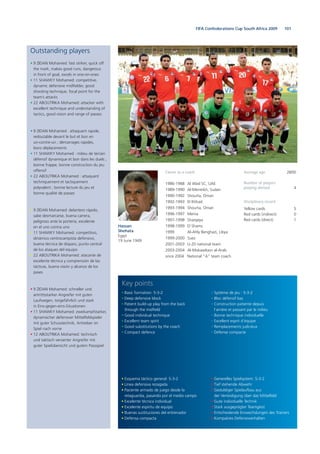
FIFA Confederations Cup
South Africa 2009
Technical Report
and Statistics
Rapport technique et statistiques
Informe técnico y estadísticas
Technischer Bericht und Statistik
3Contents
Foreword 4
Story of the tournament 9
Technical and tactical analysis 33
Trends and remarks 51
Refereeing report 61
Medical report 67
Statistics and team data 77
Results and ranking 78
Venues and stadiums 79
Match telegrams 80
Official FIFA awards 84
General statistics 86
Referees and assistant referees 97
Team data 98
FIFA delegation 114
Technical Study Group/Editorial 116
Table of
contents
4 Foreword
The FIFA Confederations Cup 2009 has already taken
its place in our organisation’s history as fans from around the
world took the chance to really get to know Africa and its
diversity. It is this very diversity between continents that we must
learn to celebrate, and we were certainly given the chance to do
so by a tournament that welcomed teams from all continents,
including of course the home nation.
South Africa may have started hesitantly in their opening
match of the Confederations Cup against Iraq, but there was
much pressure and expectation on the players. After the 0-0
draw against Iraq, the hosts defeated New Zealand and then
asked some questions of Spain, before losing 2-0, on their way
to qualifying for the semi-finals.
Who would have predicted that Joel Santana’s team
would ultimately run both Brazil and Spain so close in the semi-
final and the match for third place? They are a good team, with
quality players of great talent. Now they have another eleven
months to grow together, and who knows what next year’s
tournament will bring for the Bafana Bafana.
Spain opened their tournament with a real flourish,
sweeping aside New Zealand 5-0, seemingly carrying on the
form that won them last summer’s European Championship.
Victories over Iraq and South Africa followed, and then they
faced the challenge of the USA.
One of the enduring qualities of football is its sheer
unpredictability. Spain were the favourites in so many people’s
eyes, whilst the USA had won only one of their group games
en route to the semi-final. Their players, under the tutelage of
Bob Bradley, ended Spain’s history-equalling run of 35 matches
unbeaten, and subsequently went 2-0 up in the final against the
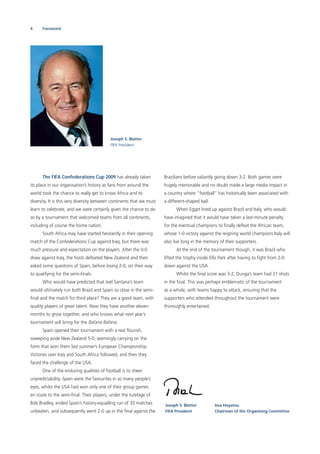
Joseph S. Blatter
FIFA President
Brazilians before valiantly going down 3-2. Both games were
hugely memorable and no doubt made a large media impact in
a country where “football” has historically been associated with
a different-shaped ball.
When Egypt lined up against Brazil and Italy, who would
have imagined that it would have taken a last-minute penalty
for the eventual champions to finally defeat the African team,
whose 1-0 victory against the reigning world champions Italy will
also live long in the memory of their supporters.
At the end of the tournament though, it was Brazil who
lifted the trophy inside Ellis Park after having to fight from 2-0
down against the USA.
Whilst the final score was 3-2, Dunga’s team had 31 shots
in the final. This was perhaps emblematic of the tournament
as a whole, with teams happy to attack, ensuring that the
supporters who attended throughout the tournament were
thoroughly entertained.
Joseph S. Blatter
FIFA President
Issa Hayatou
Chairman of the Organising Committee
5FIFA Confederations Cup South Africa 2009
La Coupe des Confédérations de la FIFA 2009 est une
compétition qui restera dans nos annales, tant les supporters
du monde entier sont venus nombreux découvrir l’Afrique et sa
diversité. C’est justement cette diversité entre les continents que
nous devons apprendre à célébrer, et quelle meilleure occasion
pour ce faire qu’un tournoi qui rassemble des équipes de tous
les continents et, bien sûr, celle du pays hôte.
L’Afrique du Sud a débuté timidement la compétition,
avec beaucoup de pression et d’attentes de la part du public
lors du match d’ouverture. Après un résultat nul contre l’Irak,
les Bafana Bafana se sont imposés face à la Nouvelle-Zélande,
et ont ensuite dû s’incliner face à l’Espagne 2-0 malgré une belle
résistance. La qualification pour le dernier carré était néanmoins
acquise.
Qui aurait pu croire que les hommes de Joel Santana
allaient causer tant de problèmes au Brésil en demi-finale et
à l’Espagne lors du match pour la troisième place ? C’est une
équipe de qualité composée de joueurs doués et auxquels il
reste maintenant onze mois pour grandir ensemble. Et Dieu
sait ce que cette sélection sud-africaine peut nous réserver en
2010...
De son côté, l’Espagne a débuté la compétition en
fanfare, balayant la Nouvelle-Zélande 5-0 avec cette facilité
qu’on lui avait connue lors de l’EURO 2008, puis l’Irak, puis
l’Afrique du Sud. Survinrent alors les États-Unis.
Ce que le football a de merveilleux, c’est son côté
imprévisible. Qualifiés que sur le fil pour les demies, les US Boys
ont joué sans complexe face aux favoris espagnols et ont mis
fin à leur série de trente-cinq matches sans défaite. Ils sont
même allés jusqu’à mener 2-0 face au Brésil avant de se faire
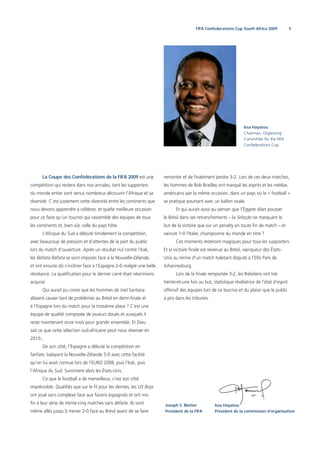
Issa Hayatou
Chairman, Organising
Committee for the FIFA
Confederations Cup
remonter et de finalement perdre 3-2. Lors de ces deux matches,
les hommes de Bob Bradley ont marqué les esprits et les médias
américains par la même occasion, dans un pays où le « football »
se pratique pourtant avec un ballon ovale.
Et qui aurait aussi pu penser que l’Égypte allait pousser
le Brésil dans ses retranchements – la Seleção ne marquant le
but de la victoire que sur un penalty en toute fin de match – et
vaincre 1-0 l’Italie, championne du monde en titre ?
Ces moments resteront magiques pour tous les supporters.
Et la victoire finale est revenue au Brésil, vainqueur des États-
Unis au terme d’un match haletant disputé à l’Ellis Park de
Johannesburg.
Lors de la finale remportée 3-2, les Brésiliens ont tiré
trente-et-une fois au but, statistique révélatrice de l’état d’esprit
offensif des équipes lors de ce tournoi et du plaisir que le public
a pris dans les tribunes.
Joseph S. Blatter
Président de la FIFA
Issa Hayatou
Président de la commission d‘organisation
6 Foreword
La Copa FIFA Confederaciones 2009 se ha ganado un
lugar a pulso dentro de nuestras competiciones después de que
aficionados de todo el mundo aprovechasen la oportunidad
de conocer realmente África y su diversidad. Es precisamente
de esta vasta diversidad entre continentes que tenemos que
aprender, y lo hicimos al presenciar un torneo que congregó
a equipos de todos los continentes, incluida por supuesto la
nación anfitriona.
Con tanta presión y expectativas sobre los hombros de sus
jugadores, Sudáfrica empezó vacilante en el partido inaugural
contra Irak. Después del empate sin goles, los anfitriones
vencieron a Nueva Zelanda y pusieron en aprietos a España,
antes de perder por 2 a 0, en su camino a la semifinal.
¿Quién hubiera pronosticado que el equipo de Joel
Santana se enfrentaría a Brasil y a España en la semifinal y el
partido por el tercer lugar? Son un buen equipo, con jugadores
de calidad y de gran talento. Ahora tienen once meses para
crecer juntos como grupo, y quién sabe lo que el torneo del
próximo año deparará a los Bafana Bafana.
España abrió el torneo de manera impetuosa, vapuleando
a Nueva Zelanda con un 5 a 0, demostrando las cualidades que
le hicieron ganar la Eurocopa del año pasado. Los españoles
también lograron aplacar su sed de victoria ante Irak y Sudáfrica,
hasta que se toparon con EE UU.
Una de las cualidades más intrínsecas del fútbol es su
auténtica impredecibilidad. Para muchos, los ibéricos eran los
favoritos, mientras que los norteamericanos solo habían ganado
uno de sus partidos de grupo en su camino a la semifinal. Los
pupilos de Bob Bradley pusieron fin al récord de los españoles
(35 partidos consecutivos sin perder), y con mucha garra en
la final anotaron 2 goles a los brasileños, antes de que estos
últimos voltearan el partido y ganaran por 3-2. Ambos partidos
fueron memorables y sin duda tuvieron un gran impacto en los
medios de comunicación del país norteño, en donde siempre se
ha relacionado con otra disciplina la palabra “fútbol“.
Cuando Egipto se enfrentó ante Brasil e Italia, ¿quién
hubiera imaginado que solo gracias a un penal a último minuto
los futuros ganadores del torneo podrían vencer al equipo
africano? También perdurará en la memoria de sus seguidores
la victoria por 1 a 0 del equipo egipcio sobre los campeones
mundiales, Italia.
Sin embargo, al final del torneo, fue Brasil quien levantó el
trofeo en el Ellis Park, después de vencer a duras penas a EE UU
y remontar el marcador de 2 a 0.
Cuando terminó el encuentro por 3 a 2, el equipo de
Dunga había intentado marcar en 31 oportunidades. Este
desempeño caracterizó en realidad a todo el torneo, pues los
equipos tuvieron una táctica más bien ofensiva, para las delicias
de todos los aficionados que asistieron a la competición.
Joseph S. Blatter
Presidente de la FIFA
Issa Hayatou
Presidente de la Comisión Organizadora
7FIFA Confederations Cup South Africa 2009
Der FIFA Konföderationen-Pokal 2009 hat unsere
Herzen im Sturm erobert. Anders und einzigartig war er, genau
wie Afrika selbst. Und genau diese Andersartigkeit macht den
Reiz solcher Veranstaltungen aus. Dieses Turnier mit Teams aller
Kontinente, einschliesslich des Gastgebers, war die perfekte
Gelegenheit, diese Einzigartigkeit zu entdecken.
Gross war der Druck auf Gastgeber Südafrika, der denn
auch eher verhalten ins Turnier startete. Lediglich 0:0 spielten
die Südafrikaner gegen den Irak. Danach vermochten sie sich
aber von Spiel zu Spiel zu steigern. Es folgten ein Sieg gegen
Neuseeland, eine 0:2-Niederlage nach couragierter Leistung
gegen Spanien und letztlich der Einzug ins Halbfinale.
Wer hätte gedacht, dass Joel Santanas Team sowohl
Brasilien im Halbfinale als auch Spanien im Spiel um Platz drei
an den Rand einer Niederlage bringen würde? Die Südafrikaner
haben gezeigt, dass sie viel Talent haben. Wenn sie in den
nächsten elf Monaten als Team noch stärker zusammenwachsen,
ist für die Bafana Bafana viel möglich.
Einen Traumstart legten dahingegen die Spanier hin. Mit
dem 5:0 gegen Neuseeland schienen sie nahtlos an ihren Erfolg
bei der Europameisterschaft im Sommer 2008 anzuknüpfen.
Es folgten zwei Siege gegen Irak und Südafrika und damit die
Qualifikation fürs Halbfinale.
Dort warteten die USA, die nur wenige Experten für einen
echten Gradmesser hielten, zumal sie bislang lediglich einen
Sieg auf dem Konto hatten. Doch die Mannschaft von Bob
Bradley schaffte das Unmögliche und beendete Spaniens Serie
von 35 Spielen ohne Niederlage. 2:0 siegten die Amerikaner
und qualifizierten sich damit fürs Finale gegen Brasilien, dem sie
sich nach bravourösem Kampf schliesslich 2:3 geschlagen geben
mussten. Es waren denkwürdige Spiele, die in einem Land,
in dem „Football“ während Jahren Synonym für Rugby war,
zweifellos ihre Spuren hinterlassen werden.
Für eine faustdicke Überraschung sorgten auch die
Ägypter. Nachdem sie bereits die Brasilianer in arge Bedrängnis
gebracht hatten und sich nach einem Strafstoss in den Schluss-
minuten nur knapp geschlagen geben mussten, bezwangen sie
den amtierenden Weltmeister Italien mit 1:0, was in der Heimat
ein wahres Erdbeben auslöste.
Zum Ende hatte indes doch einer der Favoriten die Nase
vorn – wenn auch nur knapp. Nach einem 0:2-Rückstand
mussten die Brasilianer im Ellis Park mächtig aufdrehen, um
die USA kurz vor der Ziellinie noch abzufangen.
31 Mal hatten die Schützlinge von Dunga im Finale auf
das amerikanische Tor geschossen. Dieser Offensivdrang war
typisch für das Turnier, das damit beste Unterhaltung bot.
Joseph S. Blatter
FIFA-Präsident
Issa Hayatou
Vorsitzender der Organisationskommission
Story of the
tournament
10 Story of the tournament
Author: KWOK Ka Ming
GROUP STAGE
GROUP A
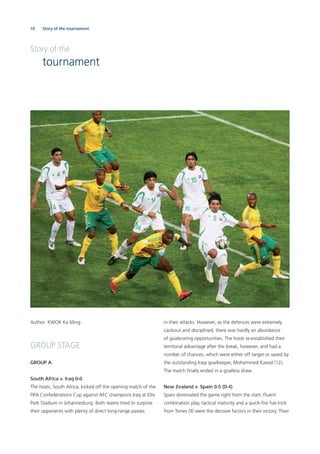
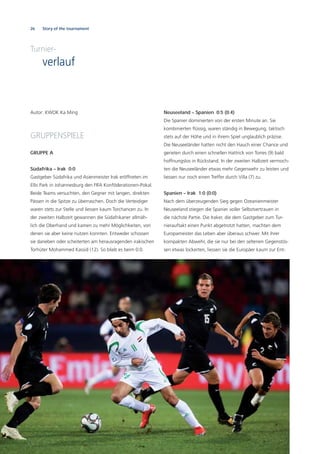
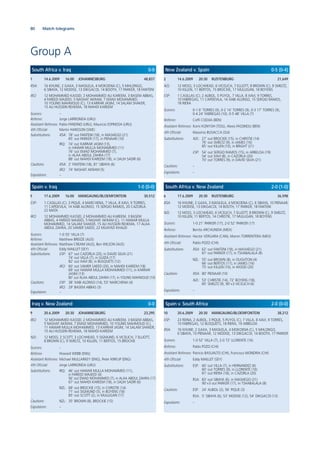
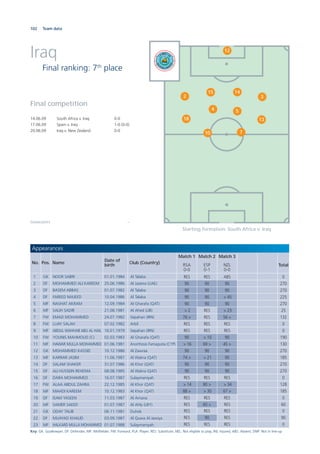
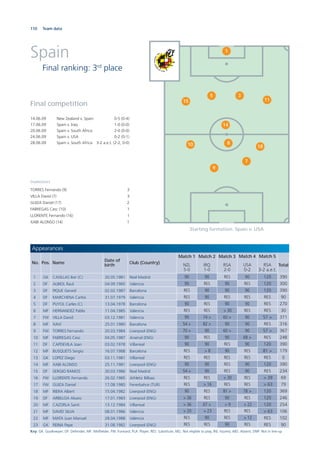
South Africa v. Iraq 0-0
The hosts, South Africa, kicked off the opening match of the
FIFA Confederations Cup against AFC champions Iraq at Ellis
Park Stadium in Johannesburg. Both teams tried to surprise
their opponents with plenty of direct long-range passes
Story of the
tournament
in their attacks. However, as the defences were extremely
cautious and disciplined, there was hardly an abundance
of goalscoring opportunities. The hosts re-established their
territorial advantage after the break, however, and had a
number of chances, which were either off target or saved by
the outstanding Iraqi goalkeeper, Mohammed Kassid (12).
The match finally ended in a goalless draw.
New Zealand v. Spain 0-5 (0-4)
Spain dominated the game right from the start. Fluent
combination play, tactical maturity and a quick-fire hat-trick
from Torres (9) were the decisive factors in their victory. Their
11FIFA Confederations Cup South Africa 2009
opponents had no answer to their continuous movement
and accurate passing. New Zealand improved defensively in
the second period, keeping Spain’s chances to a minimum
and only conceding one more goal to Villa (7).
Spain v. Iraq 1-0 (0-0)
Spain began their second match full of confidence after their
convincing win over OFC champions New Zealand. However,
the Iraqis, who had shared the spoils with the host nation
just a few days earlier, made life difficult for the Europeans
as they dropped deep with an extremely compact defence
and only occasionally produced a few counterattacks. In the
end, it was left to Villa to break the deadlock and seal victory
for Spain thanks to a perfectly-placed header from a superb
cross from the left-back Capdevila (11).
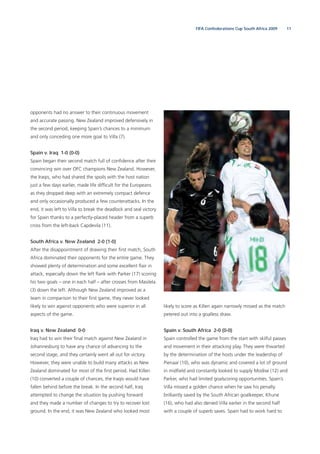
South Africa v. New Zealand 2-0 (1-0)
After the disappointment of drawing their first match, South
Africa dominated their opponents for the entire game. They
showed plenty of determination and some excellent flair in
attack, especially down the left flank with Parker (17) scoring
his two goals – one in each half – after crosses from Masilela
(3) down the left. Although New Zealand improved as a
team in comparison to their first game, they never looked
likely to win against opponents who were superior in all
aspects of the game.
Iraq v. New Zealand 0-0
Iraq had to win their final match against New Zealand in
Johannesburg to have any chance of advancing to the
second stage, and they certainly went all out for victory.
However, they were unable to build many attacks as New
Zealand dominated for most of the first period. Had Killen
(10) converted a couple of chances, the Iraqis would have
fallen behind before the break. In the second half, Iraq
attempted to change the situation by pushing forward
and they made a number of changes to try to recover lost
ground. In the end, it was New Zealand who looked most
likely to score as Killen again narrowly missed as the match
petered out into a goalless draw.
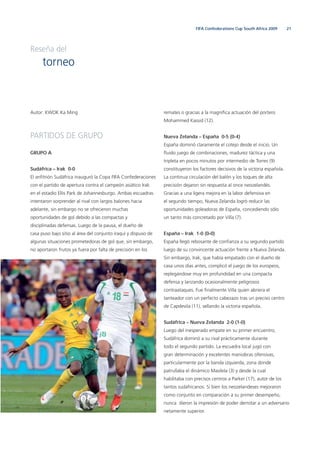
Spain v. South Africa 2-0 (0-0)
Spain controlled the game from the start with skilful passes
and movement in their attacking play. They were thwarted
by the determination of the hosts under the leadership of
Pienaar (10), who was dynamic and covered a lot of ground
in midfield and constantly looked to supply Modise (12) and
Parker, who had limited goalscoring opportunities. Spain’s
Villa missed a golden chance when he saw his penalty
brilliantly saved by the South African goalkeeper, Khune
(16), who had also denied Villa earlier in the second half
with a couple of superb saves. Spain had to work hard to
12 Story of the tournament
maintain their record winning streak, but finally both Villa
and Llorente (16), a second-half substitute, found the net to
complete Spain’s third victory of the group stage and secure
passage into the semi-final stage of the tournament without
conceding a single goal.
GROUP B
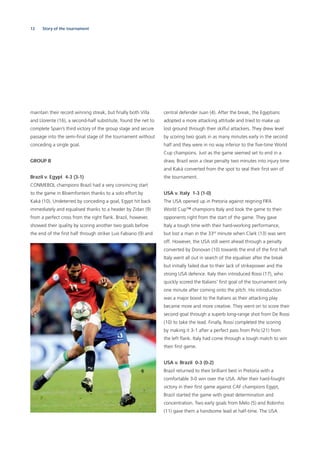
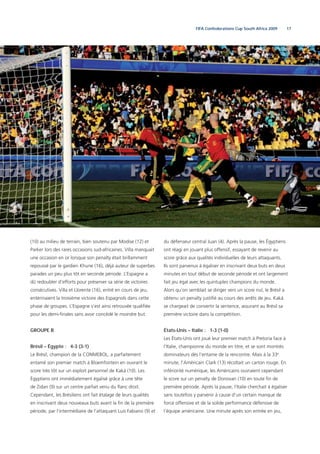
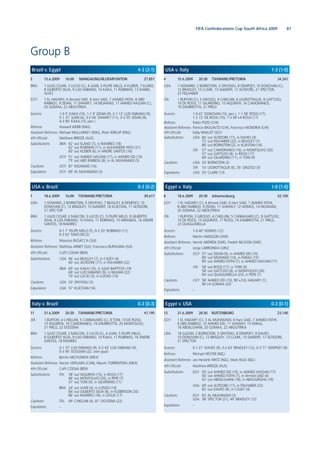
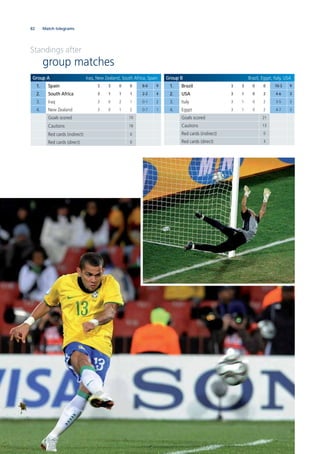
Brazil v. Egypt 4-3 (3-1)
CONMEBOL champions Brazil had a very convincing start
to the game in Bloemfontein thanks to a solo effort by
Kaká (10). Undeterred by conceding a goal, Egypt hit back
immediately and equalised thanks to a header by Zidan (9)
from a perfect cross from the right flank. Brazil, however,
showed their quality by scoring another two goals before
the end of the first half through striker Luis Fabiano (9) and
central defender Juan (4). After the break, the Egyptians
adopted a more attacking attitude and tried to make up
lost ground through their skilful attackers. They drew level
by scoring two goals in as many minutes early in the second
half and they were in no way inferior to the five-time World
Cup champions. Just as the game seemed set to end in a
draw, Brazil won a clear penalty two minutes into injury time
and Kaká converted from the spot to seal their first win of
the tournament.
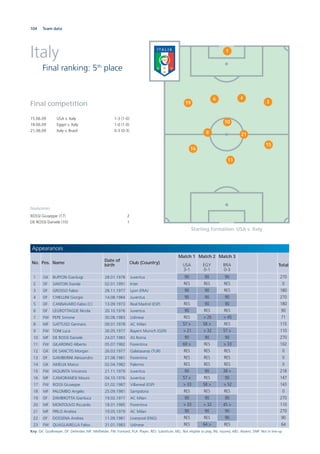
USA v. Italy 1-3 (1-0)
The USA opened up in Pretoria against reigning FIFA
World Cup™ champions Italy and took the game to their
opponents right from the start of the game. They gave
Italy a tough time with their hard-working performance,
but lost a man in the 33rd
minute when Clark (13) was sent
off. However, the USA still went ahead through a penalty
converted by Donovan (10) towards the end of the first half.
Italy went all out in search of the equaliser after the break
but initially failed due to their lack of strikepower and the
strong USA defence. Italy then introduced Rossi (17), who
quickly scored the Italians’ first goal of the tournament only
one minute after coming onto the pitch. His introduction
was a major boost to the Italians as their attacking play
became more and more creative. They went on to score their
second goal through a superb long-range shot from De Rossi
(10) to take the lead. Finally, Rossi completed the scoring
by making it 3-1 after a perfect pass from Pirlo (21) from
the left flank. Italy had come through a tough match to win
their first game.
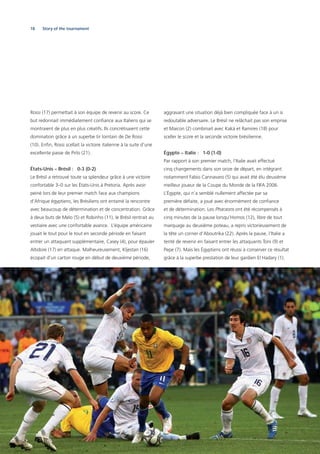
USA v. Brazil 0-3 (0-2)
Brazil returned to their brilliant best in Pretoria with a
comfortable 3-0 win over the USA. After their hard-fought
victory in their first game against CAF champions Egypt,
Brazil started the game with great determination and
concentration. Two early goals from Melo (5) and Robinho
(11) gave them a handsome lead at half-time. The USA
13FIFA Confederations Cup South Africa 2009
tried very hard in the second period, introducing a second
striker, Casey (4), into the attack alongside Altidore (17).
Unfortunately, Kljestan (16) received a red card early in the
second half, leaving the USA in another difficult situation
against their mighty opponents. Brazil kept their rhythm,
Maicon (2) combined well with Kaká, and finally Ramires
(18) completed the scoring from the left-hand side to wrap
up Brazil’s second victory.
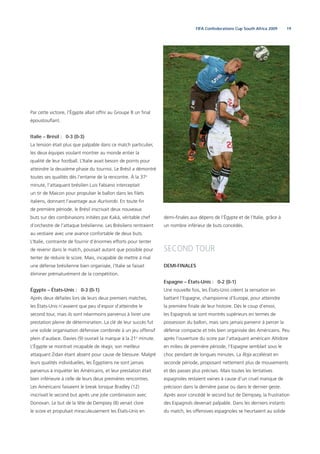
Egypt v. Italy 1-0 (1-0)
Italy made five changes to the team that began their first
match, bringing back Cannavaro (5), FIFA World Player of
the Year in 2006, to lead their defence. Egypt showed no
negative effects from their first dramatic defeat and played
with full confidence and determination. They scored five
minutes before the break, Homos (12) heading home after
being left unmarked on the far post at a corner. After the
break, Italy strived for a quick equaliser and brought on
attacking reinforcements in the shape of Toni (9) and Pepe
(7). However, the Egyptians held on thanks to a superb
performance from their goalkeeper, El Hadary (1). This
victory meant that Egypt had set up a dramatic final day in
Group B.
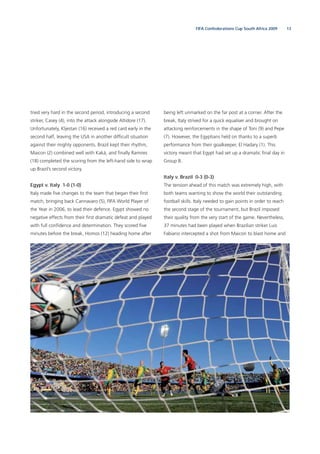
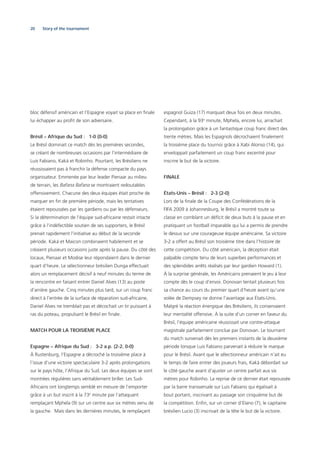
Italy v. Brazil 0-3 (0-3)
The tension ahead of this match was extremely high, with
both teams wanting to show the world their outstanding
football skills. Italy needed to gain points in order to reach
the second stage of the tournament, but Brazil imposed
their quality from the very start of the game. Nevertheless,
37 minutes had been played when Brazilian striker Luis
Fabiano intercepted a shot from Maicon to blast home and
14 Story of the tournament
give Brazil the lead. Finally, in the closing minutes of the first
half, Brazil, led by Kaká, who was predictably at the heart of
the majority of his side’s breaks and combining well with his
colleagues, scored another two goals to take a comfortable
lead at half-time. Italy had to put in extra effort to recover
after the break, and they pushed forward in search of their
first goal of the game. However, their lack of strikepower
up front saw them fail to break through the well-organised
Brazilian defence and they bowed out of the tournament at
an early stage.
Egypt v. USA 0-3 (0-1)
The USA, with two defeats in their first two matches, did
not have much hope of advancing to the second stage,
but they performed with great focus. A solid, organised
defence combined with determined attacking play was the
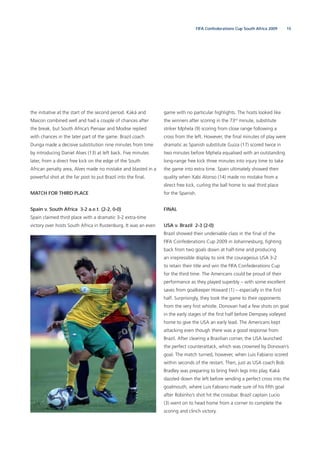
key to their success. Davies (9) opened the scoring in the 21st
minute. Egypt were unable to respond as their key striker,
Zidan, was missing due to injury. Despite their individual
ability, they were never able to put the USA in trouble and
they did not perform as well as they had in their first two
matches. The USA took their chance, Bradley (12) combining
well with Donovan to score the second goal. A header from
Dempsey (8) completed the scoring and dramatically put the
USA into the semi-finals ahead of Italy on goals scored.
SECOND ROUND
SEMI-FINALS
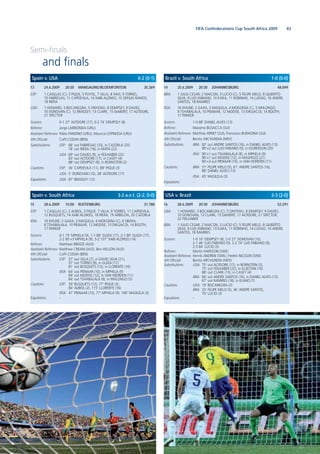
Spain v. USA 0-2 (0-1)
The USA caused another sensation by beating European
champions Spain 2-0 to book a place in their first-ever
final of a senior FIFA men’s event. The Spanish controlled
possession from the beginning but could not break through
the well-organised and compact American defence. After
USA striker Altidore had scored halfway through the first
half, leaving the Spanish reeling for a while, Spain lifted their
game after the break with plenty of movement and accurate
passes. However, it was all in vain and they failed to release
their strikers for shots on goal. Frustration took over when
they conceded their second goal to Dempsey. Spain’s attacks
in the last phase of the match failed to penetrate the solid
USA defensive block, and it was the USA who advanced to
the final.
Brazil v. South Africa 1-0 (0-0)
Brazil dominated the match from the start and they had a
number of goalscoring opportunities through Luis Fabiano,
Kaká and Robinho. However, they could not get past the
compact defence of the host nation. Led by key player
Pienaar in midfield, Bafana Bafana proved to be strong
opponents. Both sides nearly scored towards the end of the
first period but their shots were either saved or blocked by
defenders. South Africa remained determined thanks to the
support of their enthusiastic fans, but Brazil swiftly regained
15FIFA Confederations Cup South Africa 2009
the initiative at the start of the second period. Kaká and
Maicon combined well and had a couple of chances after
the break, but South Africa’s Pienaar and Modise replied
with chances in the later part of the game. Brazil coach
Dunga made a decisive substitution nine minutes from time
by introducing Daniel Alves (13) at left back. Five minutes
later, from a direct free kick on the edge of the South
African penalty area, Alves made no mistake and blasted in a
powerful shot at the far post to put Brazil into the final.
MATCH FOR THIRD PLACE
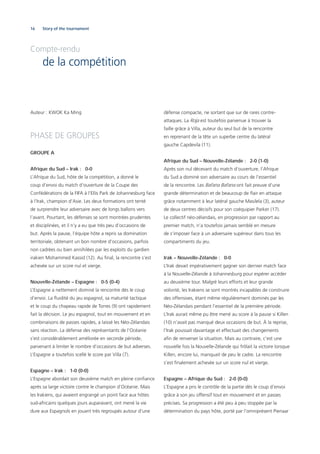
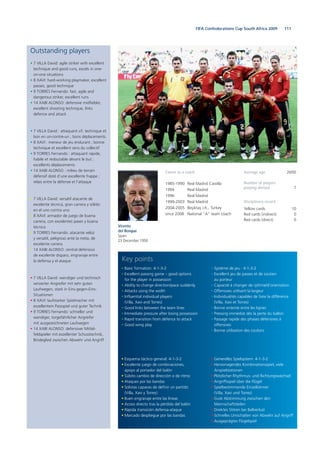
Spain v. South Africa 3-2 a.e.t. (2-2, 0-0)
Spain claimed third place with a dramatic 3-2 extra-time
victory over hosts South Africa in Rustenburg. It was an even
game with no particular highlights. The hosts looked like
the winners after scoring in the 73rd
minute, substitute
striker Mphela (9) scoring from close range following a
cross from the left. However, the final minutes of play were
dramatic as Spanish substitute Guiza (17) scored twice in
two minutes before Mphela equalised with an outstanding
long-range free kick three minutes into injury time to take
the game into extra time. Spain ultimately showed their
quality when Xabi Alonso (14) made no mistake from a
direct free kick, curling the ball home to seal third place
for the Spanish.
FINAL
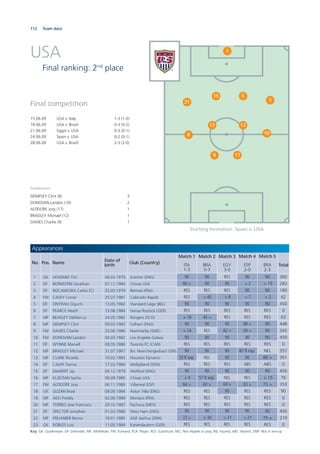
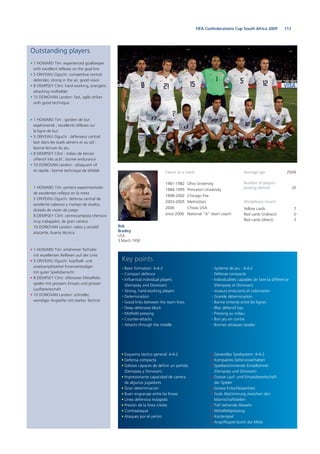
USA v. Brazil 2-3 (2-0)
Brazil showed their undeniable class in the final of the
FIFA Confederations Cup 2009 in Johannesburg, fighting
back from two goals down at half-time and producing
an irrepressible display to sink the courageous USA 3-2
to retain their title and win the FIFA Confederations Cup
for the third time. The Americans could be proud of their
performance as they played superbly – with some excellent
saves from goalkeeper Howard (1) – especially in the first
half. Surprisingly, they took the game to their opponents
from the very first whistle. Donovan had a few shots on goal
in the early stages of the first half before Dempsey volleyed
home to give the USA an early lead. The Americans kept
attacking even though there was a good response from
Brazil. After clearing a Brazilian corner, the USA launched
the perfect counterattack, which was crowned by Donovan’s
goal. The match turned, however, when Luis Fabiano scored
within seconds of the restart. Then, just as USA coach Bob
Bradley was preparing to bring fresh legs into play, Kaká
dazzled down the left before sending a perfect cross into the
goalmouth, where Luis Fabiano made sure of his fifth goal
after Robinho’s shot hit the crossbar. Brazil captain Lucio
(3) went on to head home from a corner to complete the
scoring and clinch victory.
16 Story of the tournament
Auteur : KWOK Ka Ming
PHASE DE GROUPES
GROUPE A
Afrique du Sud – Irak : 0-0
L’Afrique du Sud, hôte de la compétition, a donné le
coup d’envoi du match d’ouverture de la Coupe des
Confédérations de la FIFA à l’Ellis Park de Johannesburg face
à l’Irak, champion d’Asie. Les deux formations ont tenté
de surprendre leur adversaire avec de longs ballons vers
l’avant. Pourtant, les défenses se sont montrées prudentes
et disciplinées, et il n’y a eu que très peu d’occasions de
but. Après la pause, l’équipe hôte a repris sa domination
territoriale, obtenant un bon nombre d’occasions, parfois
non cadrées ou bien annihilées par les exploits du gardien
irakien Mohammed Kassid (12). Au final, la rencontre s’est
achevée sur un score nul et vierge.
Nouvelle-Zélande – Espagne : 0-5 (0-4)
L’Espagne a nettement dominé la rencontre dès le coup
d’envoi. La fluidité du jeu espagnol, sa maturité tactique
et le coup du chapeau rapide de Torres (9) ont rapidement
fait la décision. Le jeu espagnol, tout en mouvement et en
combinaisons de passes rapides, a laissé les Néo-Zélandais
sans réaction. La défense des représentants de l’Océanie
s’est considérablement améliorée en seconde période,
parvenant à limiter le nombre d’occasions de but adverses.
L’Espagne a toutefois scellé le score par Villa (7).
Espagne – Irak : 1-0 (0-0)
L’Espagne abordait son deuxième match en pleine confiance
après sa large victoire contre le champion d’Océanie. Mais
les Irakiens, qui avaient engrangé un point face aux hôtes
sud-africains quelques jours auparavant, ont mené la vie
dure aux Espagnols en jouant très regroupés autour d’une
défense compacte, ne sortant que sur de rares contre-
attaques. La Roja est toutefois parvenue à trouver la
faille grâce à Villa, auteur du seul but de la rencontre
en reprenant de la tête un superbe centre du latéral
gauche Capdevila (11).
Afrique du Sud – Nouvelle-Zélande : 2-0 (1-0)
Après son nul décevant du match d’ouverture, l’Afrique
du Sud a dominé son adversaire au cours de l’essentiel
de la rencontre. Les Bafana Bafana ont fait preuve d’une
grande détermination et de beaucoup de flair en attaque
grâce notamment à leur latéral gauche Masilela (3), auteur
de deux centres décisifs pour son coéquipier Parker (17).
Le collectif néo-zélandais, en progression par rapport au
premier match, n’a toutefois jamais semblé en mesure
de s’imposer face à un adversaire supérieur dans tous les
compartiments du jeu.
Irak – Nouvelle-Zélande : 0-0
L’Irak devait impérativement gagner son dernier match face
à la Nouvelle-Zélande à Johannesburg pour espérer accéder
au deuxième tour. Malgré leurs efforts et leur grande
volonté, les Irakiens se sont montrés incapables de construire
des offensives, étant même régulièrement dominés par les
Néo-Zélandais pendant l’essentiel de la première période.
L’Irak aurait même pu être mené au score à la pause si Killen
(10) n’avait pas manqué deux occasions de but. À la reprise,
l’Irak poussait davantage et effectuait des changements
afin de renverser la situation. Mais au contraire, c’est une
nouvelle fois la Nouvelle-Zélande qui frôlait la victoire lorsque
Killen, encore lui, manquait de peu le cadre. La rencontre
s’est finalement achevée sur un score nul et vierge.
Espagne – Afrique du Sud : 2-0 (0-0)
L’Espagne a pris le contrôle de la partie dès le coup d’envoi
grâce à son jeu offensif tout en mouvement et en passes
précises. Sa progression a été peu à peu stoppée par la
détermination du pays hôte, porté par l’omniprésent Pienaar
Compte-rendu
de la compétition
17FIFA Confederations Cup South Africa 2009
(10) au milieu de terrain, bien soutenu par Modise (12) et
Parker lors des rares occasions sud-africaines. Villa manquait
une occasion en or lorsque son penalty était brillamment
repoussé par le gardien Khune (16), déjà auteur de superbes
parades un peu plus tôt en seconde période. L’Espagne a
dû redoubler d’efforts pour préserver sa série de victoires
consécutives. Villa et Llorente (16), entré en cours de jeu,
entérinaient la troisième victoire des Espagnols dans cette
phase de groupes. L’Espagne s’est ainsi retrouvée qualifiée
pour les demi-finales sans avoir concédé le moindre but.
GROUPE B
Brésil – Égypte : 4-3 (3-1)
Le Brésil, champion de la CONMEBOL, a parfaitement
entamé son premier match à Bloemfontein en ouvrant le
score très tôt sur un exploit personnel de Kaká (10). Les
Égyptiens ont immédiatement égalisé grâce à une tête
de Zidan (9) sur un centre parfait venu du flanc droit.
Cependant, les Brésiliens ont fait étalage de leurs qualités
en inscrivant deux nouveaux buts avant la fin de la première
période, par l’intermédiaire de l’attaquant Luis Fabiano (9) et
du défenseur central Juan (4). Après la pause, les Égyptiens
ont réagi en jouant plus offensif, essayant de revenir au
score grâce aux qualités individuelles de leurs attaquants.
Ils sont parvenus à égaliser en inscrivant deux buts en deux
minutes en tout début de seconde période et ont largement
fait jeu égal avec les quintuples champions du monde.
Alors qu’on semblait se diriger vers un score nul, le Brésil a
obtenu un penalty justifié au cours des arrêts de jeu. Kaká
se chargeait de convertir la sentence, assurant au Brésil sa
première victoire dans la compétition.
États-Unis – Italie : 1-3 (1-0)
Les États-Unis ont joué leur premier match à Pretoria face à
l’Italie, championne du monde en titre, et se sont montrés
dominateurs dès l’entame de la rencontre. Mais à la 33e
minute, l’Américain Clark (13) récoltait un carton rouge. En
infériorité numérique, les Américains ouvraient cependant
le score sur un penalty de Donovan (10) en toute fin de
première période. Après la pause, l’Italie cherchait à égaliser
sans toutefois y parvenir à cause d’un certain manque de
force offensive et de la solide performance défensive de
l’équipe américaine. Une minute après son entrée en jeu,
18 Story of the tournament
Rossi (17) permettait à son équipe de revenir au score. Ce
but redonnait immédiatement confiance aux Italiens qui se
montraient de plus en plus créatifs. Ils concrétisaient cette
domination grâce à un superbe tir lointain de De Rossi
(10). Enfin, Rossi scellait la victoire italienne à la suite d’une
excellente passe de Pirlo (21).
États-Unis – Brésil : 0-3 (0-2)
Le Brésil a retrouvé toute sa splendeur grâce à une victoire
confortable 3–0 sur les États-Unis à Pretoria. Après avoir
peiné lors de leur premier match face aux champions
d’Afrique égyptiens, les Brésiliens ont entamé la rencontre
avec beaucoup de détermination et de concentration. Grâce
à deux buts de Melo (5) et Robinho (11), le Brésil rentrait au
vestiaire avec une confortable avance. L’équipe américaine
jouait le tout pour le tout en seconde période en faisant
entrer un attaquant supplémentaire, Casey (4), pour épauler
Altidore (17) en attaque. Malheureusement, Kljestan (16)
écopait d’un carton rouge en début de deuxième période,
aggravant une situation déjà bien compliquée face à un si
redoutable adversaire. Le Brésil ne relâchait pas son emprise
et Maicon (2) combinait avec Kaká et Ramires (18) pour
sceller le score et la seconde victoire brésilienne.
Égypte – Italie : 1-0 (1-0)
Par rapport à son premier match, l’Italie avait effectué
cinq changements dans son onze de départ, en intégrant
notamment Fabio Cannavaro (5) qui avait été élu deuxième
meilleur joueur de la Coupe du Monde de la FIFA 2006.
L’Égypte, qui n’a semblé nullement affectée par sa
première défaite, a joué avec énormément de confiance
et de détermination. Les Pharaons ont été récompensés à
cinq minutes de la pause lorsqu’Homos (12), libre de tout
marquage au deuxième poteau, a repris victorieusement de
la tête un corner d’Aboutrika (22). Après la pause, l’Italie a
tenté de revenir en faisant entrer les attaquants Toni (9) et
Pepe (7). Mais les Égyptiens ont réussi à conserver ce résultat
grâce à la superbe prestation de leur gardien El Hadary (1).
19FIFA Confederations Cup South Africa 2009
Par cette victoire, l’Égypte allait offrir au Groupe B un final
époustouflant.
Italie – Brésil : 0-3 (0-3)
La tension était plus que palpable dans ce match particulier,
les deux équipes voulant montrer au monde entier la
qualité de leur football. L’Italie avait besoin de points pour
atteindre la deuxième phase du tournoi. Le Brésil a démontré
toutes ses qualités dès l’entame de la rencontre. À la 37e
minute, l’attaquant brésilien Luis Fabiano interceptait
un tir de Maicon pour propulser le ballon dans les filets
italiens, donnant l’avantage aux Auriverde. En toute fin
de première période, le Brésil inscrivait deux nouveaux
buts sur des combinaisons initiées par Kaká, véritable chef
d’orchestre de l’attaque brésilienne. Les Brésiliens rentraient
au vestiaire avec une avance confortable de deux buts.
L’Italie, contrainte de fournir d’énormes efforts pour tenter
de revenir dans le match, poussait autant que possible pour
tenter de réduire le score. Mais, incapable de mettre à mal
une défense brésilienne bien organisée, l’Italie se faisait
éliminer prématurément de la compétition.
Égypte – États-Unis : 0-3 (0-1)
Après deux défaites lors de leurs deux premiers matches,
les États-Unis n’avaient que peu d’espoir d’atteindre le
second tour, mais ils sont néanmoins parvenus à livrer une
prestation pleine de détermination. La clé de leur succès fut
une solide organisation défensive combinée à un jeu offensif
plein d’audace. Davies (9) ouvrait la marque à la 21e
minute.
L’Égypte se montrait incapable de réagir, son meilleur
attaquant Zidan étant absent pour cause de blessure. Malgré
leurs qualités individuelles, les Égyptiens ne sont jamais
parvenus à inquiéter les Américains, et leur prestation était
bien inférieure à celle de leurs deux premières rencontres.
Les Américains faisaient le break lorsque Bradley (12)
inscrivait le second but après une jolie combinaison avec
Donovan. Le but de la tête de Dempsey (8) venait clore
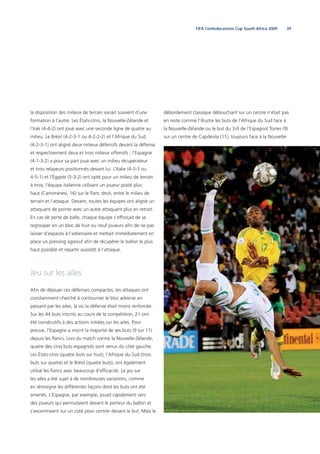
le score et propulsait miraculeusement les États-Unis en
demi-finales aux dépens de l’Égypte et de l’Italie, grâce à
un nombre inférieur de buts concédés.
SECOND TOUR
DEMI-FINALES
Espagne – États-Unis : 0-2 (0-1)
Une nouvelle fois, les États-Unis créent la sensation en
battant l’Espagne, championne d’Europe, pour atteindre
la première finale de leur histoire. Dès le coup d’envoi,
les Espagnols se sont montrés supérieurs en termes de
possession du ballon, mais sans jamais parvenir à percer la
défense compacte et très bien organisée des Américains. Peu
après l’ouverture du score par l’attaquant américain Altidore
en milieu de première période, l’Espagne semblait sous le
choc pendant de longues minutes. La Roja accélérait en
seconde période, proposant nettement plus de mouvements
et des passes plus précises. Mais toutes les tentatives
espagnoles restaient vaines à cause d’un cruel manque de
précision dans la dernière passe ou dans le dernier geste.
Après avoir concédé le second but de Dempsey, la frustration
des Espagnols devenait palpable. Dans les derniers instants
du match, les offensives espagnoles se heurtaient au solide
20 Story of the tournament
bloc défensif américain et l’Espagne voyait sa place en finale
lui échapper au profit de son adversaire.
Brésil – Afrique du Sud : 1-0 (0-0)
Le Brésil dominait ce match dès les premières secondes,
se créant de nombreuses occasions par l’intermédiaire de
Luis Fabiano, Kaká et Robinho. Pourtant, les Brésiliens ne
réussissaient pas à franchir la défense compacte du pays
organisateur. Emmenée par leur leader Pienaar au milieu
de terrain, les Bafana Bafana se montraient redoutables
offensivement. Chacune des deux équipes était proche de
marquer en fin de première période, mais les tentatives
étaient repoussées par les gardiens ou par les défenseurs.
Si la détermination de l’équipe sud-africaine restait intacte
grâce à l’indéfectible soutien de ses supporters, le Brésil
prenait rapidement l’initiative au début de la seconde
période. Kaká et Maicon combinaient habilement et se
créaient plusieurs occasions juste après la pause. Du côté des
locaux, Pienaar et Modise leur répondaient dans le dernier
quart d’heure. Le sélectionneur brésilien Dunga effectuait
alors un remplacement décisif à neuf minutes du terme de
la rencontre en faisant entrer Daniel Alves (13) au poste
d’arrière gauche. Cinq minutes plus tard, sur un coup franc
direct à l’entrée de la surface de réparation sud-africaine,
Daniel Alves ne tremblait pas et décochait un tir puissant à
ras du poteau, propulsant le Brésil en finale.
MATCH POUR LA TROISIÈME PLACE
Espagne – Afrique du Sud : 3-2 a.p. (2-2, 0-0)
À Rustenburg, l’Espagne a décroché la troisième place à
l’issue d’une victoire spectaculaire 3-2 après prolongations
sur le pays hôte, l’Afrique du Sud. Les deux équipes se sont
montrées régulières sans véritablement briller. Les Sud-
Africains ont longtemps semblé en mesure de l’emporter
grâce à un but inscrit à la 73e
minute par l’attaquant
remplaçant Mphela (9) sur un centre aux six mètres venu de
la gauche. Mais dans les dernières minutes, le remplaçant
espagnol Guiza (17) marquait deux fois en deux minutes.
Cependant, à la 93e
minute, Mphela, encore lui, arrachait
la prolongation grâce à un fantastique coup franc direct des
trente mètres. Mais les Espagnols décrochaient finalement
la troisième place du tournoi grâce à Xabi Alonso (14), qui
enveloppait parfaitement un coup franc excentré pour
inscrire le but de la victoire.
FINALE
États-Unis – Brésil : 2-3 (2-0)
Lors de la finale de la Coupe des Confédérations de la
FIFA 2009 à Johannesburg, le Brésil a montré toute sa
classe en comblant un déficit de deux buts à la pause et en
pratiquant un football imparable qui lui a permis de prendre
le dessus sur une courageuse équipe américaine. Sa victoire
3-2 a offert au Brésil son troisième titre dans l’histoire de
cette compétition. Du côté américain, la déception était
palpable compte tenu de leurs superbes performances et
des splendides arrêts réalisés par leur gardien Howard (1).
À la surprise générale, les Américains prenaient le jeu à leur
compte dès le coup d’envoi. Donovan tentait plusieurs fois
sa chance au cours du premier quart d’heure avant qu’une
volée de Dempsey ne donne l’avantage aux États-Unis.
Malgré la réaction énergique des Brésiliens, ils conservaient
leur mentalité offensive. À la suite d’un corner en faveur du
Brésil, l’équipe américaine réussissait une contre-attaque
magistrale parfaitement conclue par Donovan. Le tournant
du match survenait dès les premiers instants de la deuxième
période lorsque Luis Fabiano parvenait à réduire le marque
pour le Brésil. Avant que le sélectionneur américain n’ait eu
le temps de faire entrer des joueurs frais, Kaká débordait sur
le côté gauche avant d’ajuster un centre parfait aux six
mètres pour Robinho. La reprise de ce dernier était repoussée
par la barre transversale sur Luis Fabiano qui égalisait à
bout portant, inscrivant au passage son cinquième but de
la compétition. Enfin, sur un corner d’Elano (7), le capitaine
brésilien Lucio (3) inscrivait de la tête le but de la victoire.
21FIFA Confederations Cup South Africa 2009
Autor: KWOK Ka Ming
PARTIDOS DE GRUPO
GRUPO A
Sudáfrica – Irak 0-0
El anfitrión Sudáfrica inauguró la Copa FIFA Confederaciones
con el partido de apertura contra el campeón asiático Irak
en el estadio Ellis Park de Johannesburgo. Ambas escuadras
intentaron sorprender al rival con largos balones hacia
adelante, sin embargo no se ofrecieron muchas
oportunidades de gol debido a las compactas y
disciplinadas defensas. Luego de la pausa, el dueño de
casa puso bajo sitio al área del conjunto iraquí y dispuso de
algunas situaciones prometedoras de gol que, sin embargo,
no aportaron frutos ya fuera por falta de precisión en los
remates o gracias a la magnífica actuación del portero
Mohammed Kassid (12).
Nueva Zelanda – España 0-5 (0-4)
España dominó claramente el cotejo desde el inicio. Un
fluido juego de combinaciones, madurez táctica y una
tripleta en pocos minutos por intermedio de Torres (9)
constituyeron los factores decisivos de la victoria española.
La continua circulación del balón y los toques de alta
precisión dejaron sin respuesta al once neozelandés.
Gracias a una ligera mejora en la labor defensiva en
el segundo tiempo, Nueva Zelanda logró reducir las
oportunidades goleadoras de España, concediendo sólo
un tanto más concretado por Villa (7).
España – Irak 1-0 (0-0)
España llegó rebosante de confianza a su segundo partido
luego de su convincente actuación frente a Nueva Zelanda.
Sin embargo, Irak, que había empatado con el dueño de
casa unos días antes, complicó el juego de los europeos,
replegándose muy en profundidad en una compacta
defensa y lanzando ocasionalmente peligrosos
contraataques. Fue finalmente Villa quien abriera el
tanteador con un perfecto cabezazo tras un preciso centro
de Capdevila (11), sellando la victoria española.
Sudáfrica – Nueva Zelanda 2-0 (1-0)
Luego del inesperado empate en su primer encuentro,
Sudáfrica dominó a su rival prácticamente durante
todo el segundo partido. La escuadra local jugó con
gran determinación y excelentes maniobras ofensivas,
particularmente por la banda izquierda, zona donde
patrullaba el dinámico Masilela (3) y desde la cual
habilitaba con precisos centros a Parker (17), autor de los
tantos sudafricanos. Si bien los neozelandeses mejoraron
como conjunto en comparación a su primer desempeño,
nunca dieron la impresión de poder derrotar a un adversario
netamente superior.
Reseña del
torneo
22 Story of the tournament
Irak – Nueva Zelanda 0-0
Irak, que debía ganar su tercer y último partido de
grupo contra Nueva Zelanda para poder progresar a la
segunda fase, arrancó con total determinación y entrega.
Sin embargo, no se halló en condición de desarrollar
plenamente su ataque debido al fuerte dominio neozelandés
en el primer tiempo, e incluso se hubiera encontrado en
desventaja de no mediar la imprecisión goleadora de Killen
(10) en determinadas ocasiones. En la segunda mitad,
Irak intentó subir con mayor frecuencia, y efectuó algunos
cambios para darle mayor peso a su juego ofensivo.
No obstante, Nueva Zelanda estuvo a punto de abrir el
tanteador, de no haber sido por Killen, quien volvió a fallar
una gran oportunidad. Finalmente, el cotejo concluyó con el
marcador en tablas.
España – Sudáfrica 2-0 (0-0)
España controló el juego desde el comienzo con hábiles
pases y un juego ofensivo muy movido. Sin embargo, todos
sus intentos fueron truncados por un dueño de casa pleno
de determinación, dirigido magistralmente por Pienaar (10),
generoso en el despliegue físico en la zona de gestación,
quien creaba prometedoras situaciones de gol a Modise (12)
y Parker en la vanguardia. Villa falló una gran oportunidad
de pasar adelante cuando su penal fue salvado con gran
destreza por el portero local Khune (16), quien se lució varias
veces con sus grandiosas paradas. El conjunto español hubo
de esforzarse a fondo para mantener su racha de triunfos,
siendo finalmente Villa y su sustituto Llorente (16) quienes
concretaron la tercera victoria, pasando a semifinales sin
haber concedido un solo tanto.
GRUPO B
Brasil – Egipto 4-3 (3-1)
El arranque del campeón de la CONMEBOL Brasil parecía el
presagio de un triunfo contundente cuando Kaká (10) abrió
el tanteador a pocos minutos del inicio, tras una perfecta
jugada individual. Sin embargo, los egipcios reaccionaron
inmediatamente con un brillante frentazo de Zidan (9) luego
de un perfecto centro desde la banda derecha. Brasil no se
dejó impresionar y sacó a relucir sus cualidades, anotando
el ariete Luís Fabiano (9) y el defensor central Juan (4) dos
tantos más antes de la pausa. Luego del receso, la escuadra
faraona reaccionó con una actitud más ofensiva y dispuesta
a remontar el resultado, confiando en la habilidad individual
de sus delanteros. Lograron efectivamente igualar el
tanteador con dos goles en dos minutos, desempeñándose
de igual a igual frente al pentacampeón mundial. El
partido parecía finalizar con empate a tres, sin embargo
Brasil obtuvo un justificado penal en el descuento, pena
concretada por Kaká que así sellaba la primera victoria del
once auriverde en el torneo.
EE UU – Italia 1-3 (1-0)
EE UU disputó su primer partido en Pretoria contra el actual
campeón mundial Italia, saliendo a presionar desde el inicio,
particularmente por la banda derecha. Tuvo contra las
cuerdas a Italia hasta el minuto 33, cuando Clark (13) fue
expulsado del terreno de juego. No obstante este revés,
EE UU pasó adelante con penal de Donovan (10) al final del
primer tiempo. Tras la pausa, Italia se esmeró a fondo para
volcar el partido, fallando empero debido a su incapacidad
23FIFA Confederations Cup South Africa 2009
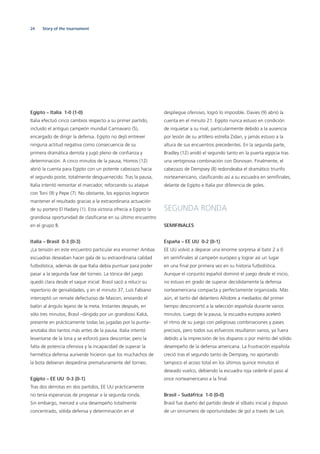
goleadora y a la sólida defensa rival. Todo cambió con el
ingreso de Rossi (17), quien al minuto de estar en la cancha
logró la tan ansiada paridad, y dio al ataque italiano la
creatividad y fuerza necesarias. Con un potente remate de
distancia, De Rossi (10) amplió el marcador a favor de los
italianos y, finalmente, Rossi aumentó su cuenta particular
al culminar una brillante acción de Pirlo (21) por la banda
izquierda en el descuento, sellando con 3 a 1 la primera
victoria italiana en el torneo.
EE UU – Brasil 0-3 (0-2)
Brasil volvió a dar lo mejor de sí en Pretoria al derrotar
claramente a EE UU por 3 a 0. Tras su angustiosa victoria
contra Egipto, el conjunto canarinho planteó un partido
pleno de determinación y concentración contra los
campeones de la CONCACAF. Dos goles madrugadores de
Melo (5) y Robinho (11) le dieron una cómoda ventaja en el
primer tiempo. En la segunda parte, EE UU intentó ejercer
mayor presión con el ingreso de Casey (4) como segundo
delantero junto a Altidore (17). Desafortunadamente,
Kljestan (16) fue sancionado con la tarjeta roja, con lo cual
dificultó aún más la labor de sus compañeros. El conjunto
brasileño mantuvo su ritmo de juego y tras una hermosa
combinación entre Maicon (2), Kaká y Ramires (18) en
la banda izquierda, el nº 2 concluyó la jugada con un
estupendo gol y la segunda victoria auriverde.
24 Story of the tournament
Egipto – Italia 1-0 (1-0)
Italia efectuó cinco cambios respecto a su primer partido,
incluido el antiguo campeón mundial Cannavaro (5),
encargado de dirigir la defensa. Egipto no dejó entrever
ninguna actitud negativa como consecuencia de su
primera dramática derrota y jugó pleno de confianza y
determinación. A cinco minutos de la pausa, Homos (12)
abrió la cuenta para Egipto con un potente cabezazo hacia
el segundo poste, totalmente desguarnecido. Tras la pausa,
Italia intentó remontar el marcador, reforzando su ataque
con Toni (9) y Pepe (7). No obstante, los egipcios lograron
mantener el resultado gracias a la extraordinaria actuación
de su portero El Hadary (1). Esta victoria ofrecía a Egipto la
grandiosa oportunidad de clasificarse en su último encuentro
en el grupo B.
Italia – Brasil 0-3 (0-3)
¡La tensión en este encuentro particular era enorme! Ambas
escuadras deseaban hacer gala de su extraordinaria calidad
futbolística, además de que Italia debía puntuar para poder
pasar a la segunda fase del torneo. La tónica del juego
quedó clara desde el saque inicial: Brasil sacó a relucir su
repertorio de genialidades, y en el minuto 37, Luís Fabiano
interceptó un remate defectuoso de Maicon, enviando el
balón al ángulo lejano de la meta. Instantes después, en
sólo tres minutos, Brasil –dirigido por un grandioso Kaká,
presente en prácticamente todas las jugadas por la punta–
anotaba dos tantos más antes de la pausa. Italia intentó
levantarse de la lona y se esforzó para descontar, pero la
falta de potencia ofensiva y la incapacidad de superar la
hermética defensa auriverde hicieron que los muchachos de
la bota debieran despedirse prematuramente del torneo.
Egipto – EE UU 0-3 (0-1)
Tras dos derrotas en dos partidos, EE UU prácticamente
no tenía esperanzas de progresar a la segunda ronda.
Sin embargo, merced a una desempeño totalmente
concentrado, sólida defensa y determinación en el
despliegue ofensivo, logró lo imposible. Davies (9) abrió la
cuenta en el minuto 21. Egipto nunca estuvo en condición
de inquietar a su rival, particularmente debido a la ausencia
por lesión de su artillero estrella Zidan, y jamás estuvo a la
altura de sus encuentros precedentes. En la segunda parte,
Bradley (12) anidó el segundo tanto en la puerta egipcia tras
una vertiginosa combinación con Donovan. Finalmente, el
cabezazo de Dempsey (8) redondeaba el dramático triunfo
norteamericano, clasificando así a su escuadra en semifinales,
delante de Egipto e Italia por diferencia de goles.
SEGUNDA RONDA
SEMIFINALES
España – EE UU 0-2 (0-1)
EE UU volvió a deparar una enorme sorpresa al batir 2 a 0
en semifinales al campeón europeo y lograr así un lugar
en una final por primera vez en su historia futbolística.
Aunque el conjunto español dominó el juego desde el inicio,
no estuvo en grado de superar decididamente la defensa
norteamericana compacta y perfectamente organizada. Más
aún, el tanto del delantero Altidore a mediados del primer
tiempo desconcertó a la selección española durante varios
minutos. Luego de la pausa, la escuadra europea aceleró
el ritmo de su juego con peligrosas combinaciones y pases
precisos, pero todos sus esfuerzos resultaron vanos, ya fuera
debido a la imprecisión de los disparos o por mérito del sólido
desempeño de la defensa americana. La frustración española
creció tras el segundo tanto de Dempsey, no aportando
tampoco el acoso total en los últimos quince minutos el
deseado vuelco, debiendo la escuadra roja cederle el paso al
once norteamericano a la final.
Brasil – Sudáfrica 1-0 (0-0)
Brasil fue dueño del partido desde el silbato inicial y dispuso
de un sinnúmero de oportunidades de gol a través de Luís
25FIFA Confederations Cup South Africa 2009
Fabiano, Kaká y Robinho. Sin embargo, no supo superar
la compacta defensa de los dueños de casa, los cuales,
dirigidos por Pienaar –figura clave en la línea media–,
demostraron ser un rival parejo en cuanto a juego
ofensivo. Ambas escuadras se encontraban a un paso
de abrir el tanteador en los minutos finales del primer
tiempo, pero sus tiros fueron bloqueados ya sea por
los respectivos porteros o defensores. A la vuelta de los
vestuarios, Sudáfrica mantuvo su determinación alentada
por su entusiasta hinchada, a la vez que Brasil comenzaba
a ejercer un ligero dominio sobre su rival. Kaká y Maicon
hicieron gala de algunas finas combinaciones, pero
también Pienaar y Modise angustiaron a la zaga brasileña
con algunas prometedoras maniobras. A nueve minutos
del término, el técnico Dunga realizó una sustitución
decisiva al integrar a Daniel Alves (13) en la zaga izquierda.
Cinco minutos más tarde, Alves introdujo el esférico en la
meta sudafricana tras un potentísimo tiro libre, abriendo
así las puertas de la final para Brasil.
PARTIDO POR EL TERCER PUESTO
España – Sudáfrica 3-2 t. pr. (2-2, 0-0)
España se aseguró el tercer puesto final al imponerse a
la selección anfitriona por 3 a 2 en un dramático partido
con alargue en Rustenburgo. Fue un partido parejo, sin
grandes momentos, con el cuadro local como potencial
ganador tras adelantarse en el minuto 73 con gol del
suplente Mphela (9) sobre un soberbio centro desde
la banda izquierda. No obstante, los cinco minutos
concluyentes fueron signados por un dramatismo sin igual:
el suplente Güiza (17) anotó dos veces consecutivas en
dos minutos, y Mphela subía nuevamente la paridad en
el descuento con un potentísimo tiro libre, llevando así el
encuentro al alargue. En la segunda parte suplementaria,
Xabi Alonso (14) puso de manifiesto toda su técnica al
enviar a las redes un tiro libre imparable, sellando así la
victoria española y el tercer puesto en el torneo.
FINAL
EE UU – Brasil 2-3 (2-0)
Brasil dio prueba de su extraordinaria clase en la final de
la Copa FIFA Confederaciones 2009 en Johannesburgo
al remontar dos goles tras el medio tiempo y batir por 3
a 2 a la valerosa escuadra norteamericana en un alarde
de grandeza en los últimos 45 minutos. Con este triunfo,
se adjudicaba por tercera vez el título en la historia de
esta competición. Los norteamericanos no se sintieron
avergonzados, sino decepcionados luego de haber
disputado un grandioso encuentro, con extraordinarias
atajadas del portero Howard (1), particularmente en el
primer tiempo. Le tomaron sorprendentemente la mano
al juego desde el comienzo, y ya en los minutos iniciales
Donovan dispuso de algunas buenas oportunidades
antes de que Dempsey abriera el marcador en el minuto
10. No obstante la inmediata reacción brasileña, los
norteamericanos mantuvieron su enfoque ofensivo. Tras
un saque de esquina auriverde, el conjunto de EE UU
dio muestra de un fulminante y perfecto contragolpe
coronado por el gol de Donovan. Sin embargo, el partido
se volcó con el tanto de Luís Fabiano inmediatamente
después del inicio del segundo tiempo. Antes de que
el técnico Bob Bradley pudiera efectuar sus cambios,
Kaká sacó a relucir una de sus genialidades en el flanco
izquierdo al enviar un pase de precisión milimétrica
a la boca de la meta contraria, donde Luís Fabiano
contabilizara su 5º gol en el torneo. Y para terminar,
el capitán Lúcio (3) cerró el tanteador con un potente
frentazo en los compases finales del encuentro.
26 Story of the tournament
Turnier-
verlauf
Autor: KWOK Ka Ming
GRUPPENSPIELE
GRUPPE A
Südafrika – Irak 0:0
Gastgeber Südafrika und Asienmeister Irak eröffneten im
Ellis Park in Johannesburg den FIFA Konföderationen-Pokal.
Beide Teams versuchten, den Gegner mit langen, direkten
Pässen in die Spitze zu überraschen. Doch die Verteidiger
waren stets zur Stelle und liessen kaum Torchancen zu. In
der zweiten Halbzeit gewannen die Südafrikaner allmäh-
lich die Oberhand und kamen zu mehr Möglichkeiten, von
denen sie aber keine nutzen konnten. Entweder schossen
sie daneben oder scheiterten am herausragenden irakischen
Torhüter Mohammed Kassid (12). So blieb es beim 0:0.
Neuseeland – Spanien 0:5 (0:4)
Die Spanier dominierten von der ersten Minute an. Sie
kombinierten flüssig, waren ständig in Bewegung, taktisch
stets auf der Höhe und in ihrem Spiel unglaublich präzise.
Die Neuseeländer hatten nicht den Hauch einer Chance und
gerieten durch einen schnellen Hattrick von Torres (9) bald
hoffnungslos in Rückstand. In der zweiten Halbzeit vermoch-
ten die Neuseeländer etwas mehr Gegenwehr zu leisten und
liessen nur noch einen Treffer durch Villa (7) zu.
Spanien – Irak 1:0 (0:0)
Nach dem überzeugenden Sieg gegen Ozeanienmeister
Neuseeland stiegen die Spanier voller Selbstvertrauen in
die nächste Partie. Die Iraker, die dem Gastgeber zum Tur-
nierauftakt einen Punkt abgetrotzt hatten, machten dem
Europameister das Leben aber überaus schwer. Mit ihrer
kompakten Abwehr, die sie nur bei den seltenen Gegenstös-
sen etwas lockerten, liessen sie die Europäer kaum zur Ent-
27FIFA Confederations Cup South Africa 2009
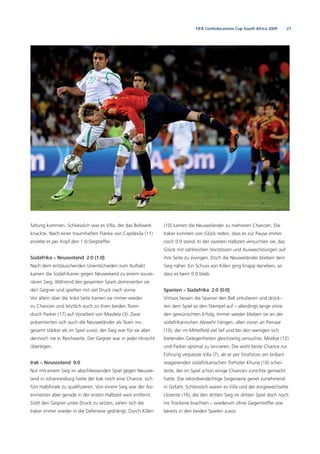
faltung kommen. Schliesslich war es Villa, der das Bollwerk
knackte. Nach einer traumhaften Flanke von Capdevila (11)
erzielte er per Kopf den 1:0-Siegtreffer.
Südafrika – Neuseeland 2:0 (1:0)
Nach dem enttäuschenden Unentschieden zum Auftakt
kamen die Südafrikaner gegen Neuseeland zu einem souve-
ränen Sieg. Während des gesamten Spiels dominierten sie
den Gegner und spielten mit viel Druck nach vorne.
Vor allem über die linke Seite kamen sie immer wieder
zu Chancen und letztlich auch zu ihren beiden Toren
durch Parker (17) auf Vorarbeit von Masilela (3). Zwar
präsentierten sich auch die Neuseeländer als Team ins-
gesamt stärker als im Spiel zuvor, der Sieg war für sie aber
dennoch nie in Reichweite. Der Gegner war in jeder Hinsicht
überlegen.
Irak – Neuseeland 0:0
Nur mit einem Sieg im abschliessenden Spiel gegen Neusee-
land in Johannesburg hatte der Irak noch eine Chance, sich
fürs Halbfinale zu qualifizieren. Von einem Sieg war der Asi-
enmeister aber gerade in der ersten Halbzeit weit entfernt.
Statt den Gegner unter Druck zu setzen, sahen sich die
Iraker immer wieder in die Defensive gedrängt. Durch Killen
(10) kamen die Neuseeländer zu mehreren Chancen. Die
Iraker konnten von Glück reden, dass es zur Pause immer
noch 0:0 stand. In der zweiten Halbzeit versuchten sie, das
Glück mit zahlreichen Vorstössen und Auswechslungen auf
ihre Seite zu zwingen. Doch die Neuseeländer blieben dem
Sieg näher. Ein Schuss von Killen ging knapp daneben, so
dass es beim 0:0 blieb.
Spanien – Südafrika 2:0 (0:0)
Virtuos liessen die Spanier den Ball zirkulieren und drück-
ten dem Spiel so den Stempel auf – allerdings lange ohne
den gewünschten Erfolg. Immer wieder blieben sie an der
südafrikanischen Abwehr hängen, allen voran an Pienaar
(10), der im Mittelfeld viel lief und bei den wenigen sich
bietenden Gelegenheiten gleichzeitig versuchte, Modise (12)
und Parker optimal zu lancieren. Die wohl beste Chance zur
Führung verpasste Villa (7), als er per Strafstoss am brillant
reagierenden südafrikanischen Torhüter Khune (16) schei-
terte, der im Spiel schon einige Chancen zunichte gemacht
hatte. Die rekordverdächtige Siegesserie geriet zunehmend
in Gefahr. Schliesslich waren es Villa und der eingewechselte
Llorente (16), die den dritten Sieg im dritten Spiel doch noch
ins Trockene brachten – wiederum ohne Gegentreffer wie
bereits in den beiden Spielen zuvor.
28 Story of the tournament
GRUPPE B
Brasilien – Ägypten 4:3 (3:1)
Brasilien hätte nicht besser ins Turnier starten können.
Nach einem Solo von Kaká (10) ging der Sieger der Copa
América in Bloemfontein schon nach wenigen Minuten in
Führung. Kurz darauf gelang Ägypten durch Zidan (9) aber
der Ausgleich. Die Brasilianer zeigten nun ihre ganze Klasse
und erhöhten durch Stürmer Luis Fabiano (9) und Innenver-
teidiger Juan (4) bis zur Pause auf 3:1. Die Ägypter fanden
aber wiederum die passende Antwort. Sie agierten nun
deutlich offensiver und kamen dank der individuellen Klasse
ihrer Angreifer kurz nach der Pause binnen zwei Minuten
zum neuerlichen Ausgleich. Von einem Klassenunterschied
konnte keine Rede sein. Als schon alle fest mit einem Unent-
schieden rechneten, gelang dem fünffachen Weltmeister in
der Nachspielzeit per Strafstoss durch Kaká doch noch der
Siegtreffer.
USA – Italien 1:3 (1:0)
Mit Weltmeister Italien trafen die USA zum Auftakt in Pre-
toria auf einen schwierigen Gegner. Doch die Amerikaner
zeigten keinerlei Respekt und setzten die Italiener gehörig
unter Druck. Nicht einmal die rote Karte gegen Clark (13)
in der 33. Minute vermochte sie zu stoppen. Donovan (10)
brachte die USA gegen Ende der ersten Halbzeit per
Elfmeter schliesslich in Führung. Nach der Pause setzte
Italien alles daran, den Rückstand wettzumachen, war
im Angriff jedoch zu wenig durchschlagskräftig und
blieb immer wieder an den geschickt verteidigenden
Amerikanern hängen. Erst der eingewechselte Rossi (17)
brach schliesslich den Bann. Kaum eine Minute im Spiel
erzielte er den Ausgleich. Die Italiener wirkten nun plötzlich
wie befreit und spielten viel variantenreicher. Dank einem
herrlichen Distanzschuss von De Rossi (10) und einem
weiteren Treffer von Rossi nach perfekter Vorarbeit von
Pirlo (21) auf der linken Seite sicherten sie sich letztlich
doch noch den Sieg.
USA – Brasilien 0:3 (0:2)
Brasilien legte gegen die USA in Pretoria eine Galavorstel-
lung hin und landete einen souveränen 3:0-Sieg. Nach
dem hart umkämpften Erfolg im ersten Spiel gegen Afrika-
meister Ägypten zeigten sich die Südamerikaner von Beginn
an überaus entschlossen und konzentriert. Zwei frühe Tore
von Melo (5) und Robinho (11) sicherten ihnen eine kom-
fortable Führung. Die US-Amerikaner liessen in der zweiten
Halbzeit nichts unversucht und brachten neben Altidore (17)
mit Casey (4) einen zusätzlichen Stürmer. Nach der roten
Karte gegen Kljestan (16) kurz nach der Pause wurde das
Unterfangen indes noch schwieriger, zumal Brasilien nicht
nachliess und durch Maicon (2) nach einer perfekten Kombi-
nation mit Kaká und Ramires (18) auf der linken Seite noch
auf 3:0 erhöhte.
Ägypten – Italien 1:0 (1:0)
Gleich fünf neue Spieler, darunter der ehemalige FIFA-Welt-
fussballer Cannavaro (5) als Abwehrchef, standen in Italiens
Startaufstellung gegen Ägypten. Trotz der Auftaktniederlage
gingen die Afrikaner äusserst selbstbewusst und entschlos-
sen zur Sache und erzielten fünf Minuten vor der Pause die
Führung. Völlig unbedrängt konnte Homos (12) nach einem
Eckstoss auf den langen Pfosten einköpfen. Nach der Pause
suchten die Italiener vehement den Ausgleich. Mit Toni (9)
und Pepe (7) brachten sie zwei neue Offensivkräfte, doch die
ägyptische Verteidigung und insbesondere der überragende
El Hadary (1) hielten dicht. Damit blieb der Ausgang in der
Gruppe B bis zuletzt spannend.
Italien – Brasilien 0:3 (0:3)
Die Spannung war unbeschreiblich, denn beide wollten
dieses Prestigeduell unbedingt gewinnen. Italien war zudem
dringend auf Punkte angewiesen, um doch noch die nächste
Runde zu erreichen. Doch Brasilien machte schnell deutlich,
wer hier und heute der Herr auf dem Platz war. Nach 37
Minuten landete ein Schussversuch von Maicon bei Luis
Fabiano, der den Ball kurzerhand in die lange Ecke drosch.
29FIFA Confederations Cup South Africa 2009
Kurz vor der Pause machten die Brasilianer, angeführt von
Kaká, der seine Mitspieler Mal für Mal optimal lancierte,
durch zwei Tore binnen drei Minuten schliesslich alles klar.
Die Italiener warfen nun alles nach vorne, doch der Welt-
meister fand an diesem Tag kein Rezept gegen die brasilia-
nische Übermacht und musste nach den Gruppenspielen
bereits die Koffer packen.
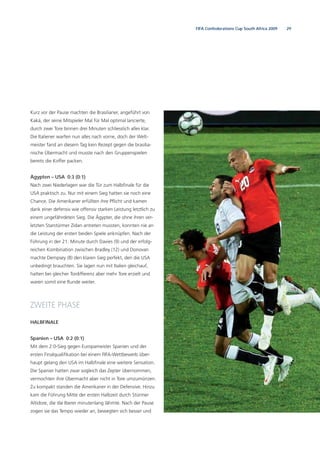
Ägypten – USA 0:3 (0:1)
Nach zwei Niederlagen war die Tür zum Halbfinale für die
USA praktisch zu. Nur mit einem Sieg hatten sie noch eine
Chance. Die Amerikaner erfüllten ihre Pflicht und kamen
dank einer defensiv wie offensiv starken Leistung letztlich zu
einem ungefährdeten Sieg. Die Ägypter, die ohne ihren ver-
letzten Starstürmer Zidan antreten mussten, konnten nie an
die Leistung der ersten beiden Spiele anknüpfen. Nach der
Führung in der 21. Minute durch Davies (9) und der erfolg-
reichen Kombination zwischen Bradley (12) und Donovan
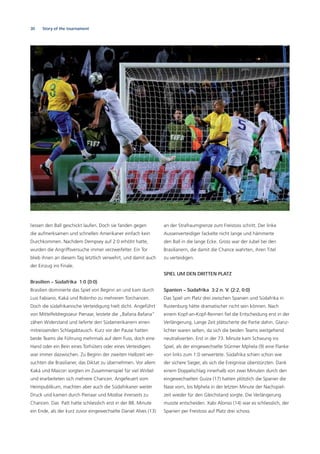
machte Dempsey (8) den klaren Sieg perfekt, den die USA
unbedingt brauchten. Sie lagen nun mit Italien gleichauf,
hatten bei gleicher Tordifferenz aber mehr Tore erzielt und
waren somit eine Runde weiter.
ZWEITE PHASE
HALBFINALE
Spanien – USA 0:2 (0:1)
Mit dem 2:0-Sieg gegen Europameister Spanien und der
ersten Finalqualifikation bei einem FIFA-Wettbewerb über-
haupt gelang den USA im Halbfinale eine weitere Sensation.
Die Spanier hatten zwar sogleich das Zepter übernommen,
vermochten ihre Übermacht aber nicht in Tore umzumünzen.
Zu kompakt standen die Amerikaner in der Defensive. Hinzu
kam die Führung Mitte der ersten Halbzeit durch Stürmer
Altidore, die die Iberer minutenlang lähmte. Nach der Pause
zogen sie das Tempo wieder an, bewegten sich besser und
30 Story of the tournament
liessen den Ball geschickt laufen. Doch sie fanden gegen
die aufmerksamen und schnellen Amerikaner einfach kein
Durchkommen. Nachdem Dempsey auf 2:0 erhöht hatte,
wurden die Angriffsversuche immer verzweifelter. Ein Tor
blieb ihnen an diesem Tag letztlich verwehrt, und damit auch
der Einzug ins Finale.
Brasilien – Südafrika 1:0 (0:0)
Brasilien dominierte das Spiel von Beginn an und kam durch
Luis Fabiano, Kaká und Robinho zu mehreren Torchancen.
Doch die südafrikanische Verteidigung hielt dicht. Angeführt
von Mittelfeldregisseur Pienaar, leistete die „Bafana Bafana“
zähen Widerstand und lieferte den Südamerikanern einen
mitreissenden Schlagabtausch. Kurz vor der Pause hatten
beide Teams die Führung mehrmals auf dem Fuss, doch eine
Hand oder ein Bein eines Torhüters oder eines Verteidigers
war immer dazwischen. Zu Beginn der zweiten Halbzeit ver-
suchten die Brasilianer, das Diktat zu übernehmen. Vor allem
Kaká und Maicon sorgten im Zusammenspiel für viel Wirbel
und erarbeiteten sich mehrere Chancen. Angefeuert vom
Heimpublikum, machten aber auch die Südafrikaner weiter
Druck und kamen durch Pienaar und Modise ihrerseits zu
Chancen. Das Patt hatte schliesslich erst in der 88. Minute
ein Ende, als der kurz zuvor eingewechselte Daniel Alves (13)
an der Strafraumgrenze zum Freistoss schritt. Der linke
Aussenverteidiger fackelte nicht lange und hämmerte
den Ball in die lange Ecke. Gross war der Jubel bei den
Brasilianern, die damit die Chance wahrten, ihren Titel
zu verteidigen.
SPIEL UM DEN DRITTEN PLATZ
Spanien – Südafrika 3:2 n. V. (2:2, 0:0)
Das Spiel um Platz drei zwischen Spanien und Südafrika in
Rustenburg hätte dramatischer nicht sein können. Nach
einem Kopf-an-Kopf-Rennen fiel die Entscheidung erst in der
Verlängerung. Lange Zeit plätscherte die Partie dahin. Glanz-
lichter waren selten, da sich die beiden Teams weitgehend
neutralisierten. Erst in der 73. Minute kam Schwung ins
Spiel, als der eingewechselte Stürmer Mphela (9) eine Flanke
von links zum 1:0 verwertete. Südafrika schien schon wie
der sichere Sieger, als sich die Ereignisse überstürzten. Dank
einem Doppelschlag innerhalb von zwei Minuten durch den
eingewechselten Guiza (17) hatten plötzlich die Spanier die
Nase vorn, bis Mphela in der letzten Minute der Nachspiel-
zeit wieder für den Gleichstand sorgte. Die Verlängerung
musste entscheiden. Xabi Alonso (14) war es schliesslich, der
Spanien per Freistoss auf Platz drei schoss.
31FIFA Confederations Cup South Africa 2009
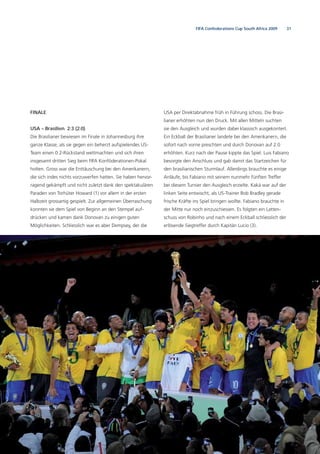
FINALE
USA – Brasilien 2:3 (2:0)
Die Brasilianer bewiesen im Finale in Johannesburg ihre
ganze Klasse, als sie gegen ein beherzt aufspielendes US-
Team einen 0:2-Rückstand wettmachten und sich ihren
insgesamt dritten Sieg beim FIFA Konföderationen-Pokal
holten. Gross war die Enttäuschung bei den Amerikanern,
die sich indes nichts vorzuwerfen hatten. Sie haben hervor-
ragend gekämpft und nicht zuletzt dank den spektakulären
Paraden von Torhüter Howard (1) vor allem in der ersten
Halbzeit grossartig gespielt. Zur allgemeinen Überraschung
konnten sie dem Spiel von Beginn an den Stempel auf-
drücken und kamen dank Donovan zu einigen guten
Möglichkeiten. Schliesslich war es aber Dempsey, der die
USA per Direktabnahme früh in Führung schoss. Die Brasi-
lianer erhöhten nun den Druck. Mit allen Mitteln suchten
sie den Ausgleich und wurden dabei klassisch ausgekontert.
Ein Eckball der Brasilianer landete bei den Amerikanern, die
sofort nach vorne preschten und durch Donovan auf 2:0
erhöhten. Kurz nach der Pause kippte das Spiel. Luis Fabiano
besorgte den Anschluss und gab damit das Startzeichen für
den brasilianischen Sturmlauf. Allerdings brauchte es einige
Anläufe, bis Fabiano mit seinem nunmehr fünften Treffer
bei diesem Turnier den Ausgleich erzielte. Kaká war auf der
linken Seite entwischt, als US-Trainer Bob Bradley gerade
frische Kräfte ins Spiel bringen wollte. Fabiano brauchte in
der Mitte nur noch einzuschiessen. Es folgten ein Latten-
schuss von Robinho und nach einem Eckball schliesslich der
erlösende Siegtreffer durch Kapitän Lucio (3).
Technical
and tactical analysis
34 Technical and tactical analysis
Author: Holger Osieck
Introduction
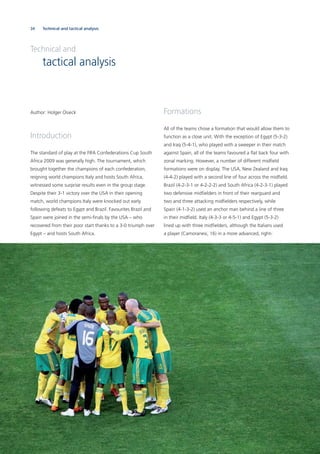
The standard of play at the FIFA Confederations Cup South
Africa 2009 was generally high. The tournament, which
brought together the champions of each confederation,
reigning world champions Italy and hosts South Africa,
witnessed some surprise results even in the group stage.
Despite their 3-1 victory over the USA in their opening
match, world champions Italy were knocked out early
following defeats to Egypt and Brazil. Favourites Brazil and
Spain were joined in the semi-finals by the USA – who
recovered from their poor start thanks to a 3-0 triumph over
Egypt – and hosts South Africa.
Formations
All of the teams chose a formation that would allow them to
function as a close unit. With the exception of Egypt (5-3-2)
and Iraq (5-4-1), who played with a sweeper in their match
against Spain, all of the teams favoured a flat back four with
zonal marking. However, a number of different midfield
formations were on display. The USA, New Zealand and Iraq
(4-4-2) played with a second line of four across the midfield.
Brazil (4-2-3-1 or 4-2-2-2) and South Africa (4-2-3-1) played
two defensive midfielders in front of their rearguard and
two and three attacking midfielders respectively, while
Spain (4-1-3-2) used an anchor man behind a line of three
in their midfield. Italy (4-3-3 or 4-5-1) and Egypt (5-3-2)
lined up with three midfielders, although the Italians used
a player (Camoranesi, 16) in a more advanced, right-
Technical and
tactical analysis
35FIFA Confederations Cup South Africa 2009
sided position between midfield and attack. All of the
teams played with one striker up front and another in a
slightly more withdrawn role. They quickly attempted to
form a defensive barrier of eight or nine players when the
opposing team was in possession in order to limit the space
available to attack, or tried to win the ball back by closing
down their opponents in midfield and launching their own
counterattacks.
Wing play
Defences were packed so tightly that teams had to attempt
to play around them. The favoured option was therefore
to attack via the wings, where defences were less tightly
packed than in the centre. Of the 44 goals scored, 21
originated on the wing. The majority (9 out of 11) of
Spain’s goals in particular came after build-up play down
the outside channels. In the Iberians’ match against New
Zealand, four of their five goals came from the left-hand side
of the pitch. The USA (four from eight goals), South Africa
(three from four goals) and Brazil (four goals) also used the
wings effectively. The variation in wing play was shown by
the different ways in which the goals were created. One
tactic, used predominantly by Spain, was to play passes
forward quickly, with players switching positions in front of
the ball before it was crossed into the middle from the wing.
However, traditional wing play culminating in a cross was
also in evidence, such as in South Africa’s goals against New
Zealand or Spain’s third goal against New Zealand, scored by
Torres (9) after a cross by Capdevila (11). Other tactics were
for a player to dribble at high speed to the goal line before
cutting the ball back into the middle, such as the goal by
Rossi (17) to make it 3-1 to Italy against the USA following
build-up play by Pirlo (21), or for a diagonal pass to be
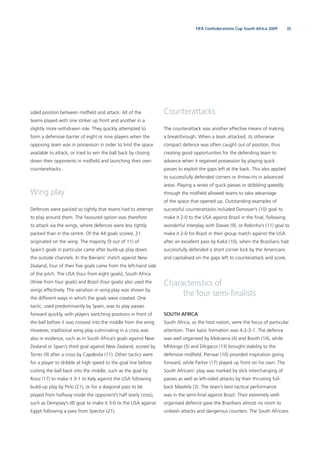
played from halfway inside the opponent’s half (early cross),
such as Dempsey’s (8) goal to make it 3-0 to the USA against
Egypt following a pass from Spector (21).
Counterattacks
The counterattack was another effective means of making
a breakthrough. When a team attacked, its otherwise
compact defence was often caught out of position, thus
creating good opportunities for the defending team to
advance when it regained possession by playing quick
passes to exploit the gaps left at the back. This also applied
to successfully defended corners or throw-ins in advanced
areas. Playing a series of quick passes or dribbling speedily
through the midfield allowed teams to take advantage
of the space that opened up. Outstanding examples of
successful counterattacks included Donovan’s (10) goal to
make it 2-0 to the USA against Brazil in the final, following
wonderful interplay with Davies (9), or Robinho’s (11) goal to
make it 2-0 for Brazil in their group match against the USA
after an excellent pass by Kaká (10), when the Brazilians had
successfully defended a short corner kick by the Americans
and capitalised on the gaps left to counterattack and score.
Characteristics of
the four semi-finalists
SOUTH AFRICA
South Africa, as the host nation, were the focus of particular
attention. Their basic formation was 4-2-3-1. The defence
was well organised by Mokoena (4) and Booth (14), while
Mhlongo (5) and Dikgacoi (13) brought stability to the
defensive midfield. Pienaar (10) provided inspiration going
forward, while Parker (17) played up front on his own. The
South Africans’ play was marked by slick interchanging of
passes as well as left-sided attacks by their thrusting full-
back Masilela (3). The team’s best tactical performance
was in the semi-final against Brazil. Their extremely well-
organised defence gave the Brazilians almost no room to
unleash attacks and dangerous counters. The South Africans
36 Technical and tactical analysis
were adventurous going forward and were only narrowly
beaten 1-0 following a direct free kick by Daniel Alves
(13). Bafana Bafana earned great respect and recognition
with their fourth-place finish and will go into next year’s
tournament with greater confidence.
SPAIN
European champions Spain lived up to the widely-held
expectations of them in the group stages, reaching the semi-
finals impressively with three victories and an aggregate
score of 8-0. The Iberians used a 4-1-3-2 formation, with
defensive midfielder Xabi Alonso (14) acting as an anchor
man in front of the back four. The offensive midfield trio of
Xavi (8), Fabregas (10) and Riera (18) provided the impetus
for the team’s attacks and brought deadly strike duo Villa
(7) and Torres into the game. A recurring feature of the
Spaniards’ play was their eagerness to shift their midfield
line to the left to gain a numerical advantage, where the
attacking full-back Capdevila was an additional livewire.
Consequently, seven of Spain’s 11 goals came from the left
flank. Spain lost the semi-final against the well-organised
defence of the USA despite enjoying the majority of
possession. They succeeded in dominating the match
(29-9 shots on goal and 17-3 corners) but were ultimately
unable to make the defence-splitting pass or score the
goal that would have made the difference. However, they
achieved some consolation with a 3-2 victory over South
Africa in the match for third place.
USA
After a poor start, with defeats against Italy and Brazil,
the USA achieved a miraculous comeback with a 3-0
victory over Egypt in their third group match to secure a
spot in the semi-finals. They then went on to achieve the
biggest shock of the tournament with an astonishing 2-0
victory over Spain, who had previously been undefeated for
35 matches. In the final, the USA played an excellent first
half and led 2-0, before eventually succumbing to a 3-2
defeat to the increasingly strong Brazilians. The USA’s basic
formation was a clearly structured 4-4-2. In their back four,
central defenders Onyewu (5) and DeMerit (15) impressed
in particular with their work-rate and aerial strength. Behind
the defence, Howard (1) was named as the best goalkeeper
of the tournament and received the adidas Golden Glove.
Donovan and Dempsey stood out on the edges of the
four-man midfield on account of their speed, vision, energy
and goal threat, while Bradley (12) was extremely effective
in central midfield. He regained possession many times
and in doing so kick-started many of his team’s attacks. He
was also frequently involved in the USA’s attacks. Up front,
Altidore (17) and Davies formed a hard-working strike duo.
37FIFA Confederations Cup South Africa 2009
Alongside their defensive unity, the USA impressed above
all through their speedy counterattacks led by Donovan.
BRAZIL
Brazil fully lived up to their reputation as one of the
tournament favourites and, with an overall record of five
victories and 14 goals, deservedly won this year’s FIFA
Confederations Cup. Their formation was a mixture of
4-2-3-1 and 4-2-2-2. In the former, Robinho (11) tended to
play on the left side of midfield, while in the more attacking
line-up, he played as a second striker alongside Luis Fabiano
(9). The back four, led by captain Lucio (3), and the excellent
goalkeeper Julio Cesar (1) grew in confidence from game to
game after conceding three goals to Egypt in the first match.
The defensive midfield was controlled by Gilberto Silva (8)
and Felipe Melo (5), while Kaká was the team’s linchpin
going forward. With his high-tempo runs, vision and precise
passes to front players, he was the catalyst for the Brazilians’
play. Full-back Maicon (2) made an outstanding contribution
on the right channel thanks to his tireless running and
crossing ability. Up front, Luis Fabiano was the tournament’s
top marksman with five goals, and was supported
effectively by Robinho with his element of surprise. The
Brazilians have changed their style under coach Dunga, with
counterattacking now a key part of their philosophy.
They gave a perfect demonstration of how to switch
quickly to attack after gaining possession, move the
ball quickly through midfield and play a killer final
ball. Robinho’s goal to make it 2-0 after the team had
successfully defended a corner-kick against the USA was
a classic example of how to launch and finish off a direct
counterattack.
Conclusion
The signs from the FIFA Confederations Cup South Africa
2009 were encouraging and the tournament provided a
successful dress rehearsal for next year’s FIFA World Cup
South Africa. The participating teams had the opportunity
to familiarise themselves with the general conditions in
the country, such as stadiums, training facilities, climate
and transport, and gained useful insights. Even nations
not taking part such as England, France, Germany and
Switzerland sent delegations including their national
coaches to gain first-hand local knowledge. Without a
doubt, this tournament further whetted appetites for
the 2010 FIFA World Cup South Africa™.
38 Technical and tactical analysis
Auteur : Holger Osieck
Introduction
Dans l’ensemble, le niveau de jeu de la Coupe des
Confédérations de la FIFA, Afrique du Sud 2009, a été
assez élevé. Au cours de cet événement rassemblant les
champions de toutes les confédérations, le champion du
monde italien et l’hôte sud-africain, des surprises sont
survenues dès le premier tour. Après sa victoire initiale 3-1
face aux États-Unis, l’Italie, championne du monde en titre, a
été éliminée prématurément suite à deux défaites concédées
face à l’Égypte et au Brésil. Malgré leur mauvais départ, les
États-Unis sont parvenus à rejoindre les favoris brésiliens et
espagnols en demi-finales grâce à leur victoire 3-0 contre
l’Égypte, les hôtes sud-africains complétant le dernier carré.
Systèmes de jeu
En ce qui concerne les systèmes de jeu utilisés, toutes
les formations présentes ont mis l’accent sur la cohésion
collective. À l’exception de l’Égypte (5-3-2) et de l’Irak
(5-4-1) lors de son match contre l’Espagne, qui ont joué
avec un libéro, toutes les autres équipes ont opté pour une
défense à quatre avec marquage de zone. En revanche,
Analyse
technico-tactique
39FIFA Confederations Cup South Africa 2009
la disposition des milieux de terrain variait souvent d’une
formation à l’autre. Les États-Unis, la Nouvelle-Zélande et
l’Irak (4-4-2) ont joué avec une seconde ligne de quatre au
milieu. Le Brésil (4-2-3-1 ou 4-2-2-2) et l’Afrique du Sud
(4-2-3-1) ont aligné deux milieux défensifs devant la défense
et respectivement deux et trois milieux offensifs ; l’Espagne
(4-1-3-2) a pour sa part joué avec un milieu récupérateur
et trois relayeurs positionnés devant lui. L’Italie (4-3-3 ou
4-5-1) et l’Égypte (5-3-2) ont opté pour un milieu de terrain
à trois, l’équipe italienne utilisant un joueur posté plus
haut (Camoranesi, 16) sur le flanc droit, entre le milieu de
terrain et l’attaque. Devant, toutes les équipes ont aligné un
attaquant de pointe avec un autre attaquant plus en retrait.
En cas de perte de balle, chaque équipe s’efforçait de se
regrouper en un bloc de huit ou neuf joueurs afin de ne pas
laisser d’espaces à l’adversaire et mettait immédiatement en
place un pressing agressif afin de récupérer le ballon le plus
haut possible et repartir aussitôt à l’attaque.
Jeu sur les ailes
Afin de déjouer ces défenses compactes, les attaques ont
constamment cherché à contourner le bloc adverse en
passant par les ailes, là où la défense était moins renforcée.
Sur les 44 buts inscrits au cours de la compétition, 21 ont
été consécutifs à des actions initiées sur les ailes. Pour
preuve, l’Espagne a inscrit la majorité de ses buts (9 sur 11)
depuis les flancs. Lors du match contre la Nouvelle-Zélande,
quatre des cinq buts espagnols sont venus du côté gauche.
Les États-Unis (quatre buts sur huit), l’Afrique du Sud (trois
buts sur quatre) et le Brésil (quatre buts), ont également
utilisé les flancs avec beaucoup d’efficacité. Le jeu sur
les ailes a été sujet à de nombreuses variations, comme
en témoigne les différentes façons dont les buts ont été
amenés. L’Espagne, par exemple, jouait rapidement vers
des joueurs qui permutaient devant le porteur du ballon et
s’excentraient sur un coté pour centrer devant le but. Mais le
débordement classique débouchant sur un centre n’était pas
en reste comme l’illustre les buts de l’Afrique du Sud face à
la Nouvelle-Zélande ou le but du 3-0 de l’Espagnol Torres (9)
sur un centre de Capdevila (11), toujours face à la Nouvelle-
40
Zélande. Une autre tactique fréquemment utilisée était de
dribbler jusqu’à la ligne de but afin d’effectuer un centre en
retrait, à l’image du but du 3-1 de l’Italien Rossi (17) face
aux États-Unis suite à un travail préparatoire de Pirlo (21), ou
des transversales depuis le milieu du terrain comme le but
de l’Américain Dempsey (8) contre l’Égypte, consécutif à une
longue passe de Spector (21).
Jeu en contre
La contre-attaque fut une autre option offensive redoutable.
L’équipe qui développait sa propre attaque relâchait parfois
sa cohésion défensive, offrant à l’équipe adverse l’occasion
de mener à bien des contres rapides et tranchants. Certains
corners repoussés et des rentrées de touche avancées
ont également initié des contres dangereux. Grâce à une
succession de passes rapides ou un enchaînement de
dribbles au milieu du terrain, les espaces créés ont ainsi
pu être exploités. Parmi les exemples de contre-attaques
réussies, on peut citer le deuxième but des États-Unis inscrit
par Donovan (10) en finale face au Brésil, à la suite d’une
magnifique combinaison avec Davies (9), ou le deuxième but
du Brésilien Robinho (11) consécutif à une superbe passe
de Kaká (10) lors du match de groupe face à ces mêmes
Américains.
Qualités particulières
des quatre demi-finalistes
AFRIQUE DU SUD
En tant que pays organisateur, l’Afrique du Sud était l’une
des attractions de la compétition. Sa formation de base était
un système en 4-2-3-1. La défense a été bien dirigée par
Mokoena (4) et Booth (14). Dans l’entrejeu, Mhlongo (5) et
Dikgacoi (13) ont apporté de la stabilité. Pienaar (10) était
le principal animateur offensif du milieu de terrain, avec
devant lui le seul Parker (17) en attaque. Le jeu des Sud-
africains était caractérisé par des combinaisons fluides et
des attaques sur le flanc gauche souvent initiées par le très
actif Masilela (3). L’équipe a livré sa meilleure prestation
tactique en demi-finales face au Brésil. Leur défense très
sûre n’a laissé que très peu d’espaces aux attaquants
brésiliens, ce qui leur a permis de se créer des opportunités
en contre. Grâce à son courage et son jeu orienté vers
l’avant, l’Afrique du Sud a frôlé l’exploit, ne s’inclinant que
de justesse 1-0 sur un coup franc direct de Daniel Alves
(13). Avec cette belle quatrième place, les Bafana Bafana
ont acquis beaucoup de respect et de reconnaissance,
et aborderont la compétition de l’an prochain avec une
grande confiance en eux.
ESPAGNE
L’Espagne, championne d’Europe, a répondu aux attentes
au cours de la phase de groupes. Avec trois victoires et
un score cumulé de 8-0, la Roja a facilement atteint les
demi-finales. Les Espagnols ont évolué en 4-1-3-2. Devant
la défense à quatre, Xabi Alonso (14) était chargé de
stabiliser l’entrejeu. Xavi (8), Fabregas (10) et Riera (18)
ont constitué une ligne à vocation offensive qui devait
animer le jeu et alimenter le redoutable duo d’attaquants
composé de Villa (7) et Torres. Souvent, cette ligne axiale
a glissé vers la gauche afin de décaler des joueurs venus
de l’arrière. Le défenseur latéral offensif Capdevila est
régulièrement venu apporter le surnombre sur son aile. En
conséquence, sept des onze buts espagnols ont été initiés
sur le côté gauche. Lors de la demi-finale face aux États-
Unis, les Espagnols ont largement dominé la rencontre
mais se sont finalement inclinés face à un adversaire très
bien organisé défensivement. Malgré un net déséquilibre
statistique (29-9 au nombre de tirs et 17-3 au nombre
de corners), la dernière passe ou le dernier geste ont fait
défaut aux Espagnols dans les moments clés. Grâce à sa
victoire 3-2 contre l’Afrique du Sud lors de la « petite finale
», l’Espagne s’est consolée avec la troisième place, quittant
la compétition sur une note plutôt satisfaisante.
Technical and tactical analysis
41FIFA Confederations Cup South Africa 2009
ÉTATS-UNIS
Après un mauvais départ et deux défaites face à l’Italie et au
Brésil, les États-Unis ont réussi un surprenant « come-back »
grâce à leur victoire 3-0 face à l’Egypte lors de leur troisième
et dernier match de groupe, se qualifiant ainsi pour les
demi-finales. Les Américains ont ensuite créé la sensation de
ce tournoi en dominant les Espagnols, pourtant invaincus
depuis 35 matches, à la surprise générale (2-0). En finale,
une excellente première période a permis aux Américains
de rentrer au vestiaire avec une avance de deux buts, mais
ils ont finalement du s’incliner 3-2 face à des Brésiliens de
plus en plus dominateurs au fil des minutes. La formation de
base des États-Unis était un 4-4-2 clairement structuré. Les
deux défenseurs centraux, Onyewu (5) et DeMerit (15), ont
dominé les débats grâce à leur engagement et leur excellent
jeu de tête. Derrière la défense, Howard (1) a démontré des
qualités supérieures à la moyenne, décrochant même le Gant
d’Or adidas, la récompense couronnant le meilleur gardien
de la compétition. Devant, les milieux offensifs latéraux
Donovan, par sa vitesse et sa vision du jeu, et Dempsey,
par son explosivité et le danger qu’il apporte devant les
buts, ont été convaincants. Au centre, Bradley (12) a
effectué un travail très efficace. Grâce à son énorme
engagement, il a récupéré de nombreux ballons et initié
de nombreuses attaques pour son équipe. Il a même
souvent pris part aux offensives. À l’avant, Altidore (17) et
Davies n’ont pas ménagé leur efforts. Outre leur cohésion
défensive, les États-Unis ont surtout impressionné par
leurs contres rapides, souvent emmenés par Donovan
BRÉSIL
Le Brésil a parfaitement justifié son statut de favori du
tournoi. Avec cinq victoires et quatorze buts inscrits, les
Auriverde ont largement mérité leur victoire lors de cette
Coupe des Confédérations de la FIFA. Les Brésiliens ont opté
pour un schéma tactique oscillant entre un 4-2-3-1 et un
4-2-2-2. Dans la première variation, Robinho évoluait plutôt
comme milieu gauche, alors que dans la disposition plus
offensive, il venait épauler Luis Fabiano (9) en attaque. Après
avoir encaissé trois buts lors dès son premier match, face
à l’Égypte, la défense brésilienne, bâtie autour du capitaine
Lucio (3) et du solide gardien Julio Cesar (1), est devenue
plus sûre match après match. Si Gilberto Silva (8) et Felipe
Melo (5) ont contrôlé l’entrejeu, Kaká a été le véritable chef
d’orchestre du secteur offensif. Ses courses incessantes, sa
vision du jeu et sa lucidité en ont été le moteur de l’attaque
brésilienne. Sur le flanc droit, le défenseur latéral Maicon
(2) a joué un rôle déterminant grâce à son explosivité et
à la précision de ses centres. En attaque, Luis Fabiano a
terminé meilleur buteur de la compétition grâce à ses
cinq réalisations, souvent servi par l’imprévisible Robinho.
Sous l’égide de leur sélectionneur Dunga, les Brésiliens ont
modifié leur style de jeu. La contre-attaque est devenue un
élément essentiel de leur philosophie. Leur jeu de transition
offensif a été un modèle du genre : récupération du ballon,
soutien omniprésent des milieux de terrain, précision de
la dernière passe, tout y était. Le deuxième but brésilien
lors du match de groupe contre les États-Unis, inscrit par
Robinho à la suite d’un corner américain repoussé, est
l’exemple type d’un contre rondement mené et brillamment
conclu.
Conclusion
Le bilan de la Coupe des Confédérations de la FIFA, Afrique
du Sud 2009 est très positif. Cette répétition grandeur
nature de la Coupe du Monde de la FIFA de l’an prochain est
assurément réussie. Les équipes en lice ont pu s’acclimater
à l’environnement général, comme les stades, les
infrastructures d’entraînement, le climat, les transports, etc.
Même des nations non concernées par l’événement, telles
que l’Angleterre, la France, l’Allemagne et la Suisse, avaient
dépêché des délégations, dans lesquelles figuraient leurs
sélectionneurs, afin de recueillir les premières impressions sur
place. Cette compétition a sans aucun doute encore accru
l’enthousiasme que suscite déjà la Coupe du Monde de la
FIFA, Afrique du Sud 2010.
42
Autor: Holger Osieck
Introducción
La Copa FIFA Confederaciones Sudáfrica 2009 se caracterizó
en general por un alto nivel de juego. En los choques entre
los campeones de todas las confederaciones, así como del
campeón mundial Italia y el anfitrión Sudáfrica se dieron
algunos resultados sorprendentes ya en la primera ronda:
Italia, pese a su victoria inicial por 3 a 1 contra EE UU,
quedó prematuramente eliminada luego de dos derrotas
contra Egipto y Brasil. Además de los favoritos Brasil y
España, lograron clasificarse para semifinales EE UU –tras
un arranque poco prometedor y la decisiva victoria por 3 a
0 contra Egipto en el último desenlace– y el dueño de casa
Sudáfrica.
Sistemas de juego
En el planteamiento de los sistemas de juego, todos los
participantes concedieron gran importancia al juego
colectivo. A excepción de Egipto (5-3-2) e Irak (5-4-1) –en
el partido contra España–, ambos con un líbero, todos los
demás equipos optaron por una línea de contención de
cuatro hombres que marcaban en zona. No obstante, en
la zona de gestación, las escuadras se presentaron con
diferentes formaciones. EE UU, Nueva Zelanda e Irak (4-4-
2) maniobraron con una segunda línea de cuatro hombres
en el medio campo. Brasil (4-2-3-1 o 4-2-2-2) y Sudáfrica
(4-2-3-1) utilizaron dos centrocampistas defensivos delante
de la defensa y dos o tres volantes de corte más ofensivo.
España (4-1-3-2) jugó con un volante de cierre y tres
compañeros delante de él, Italia (4-3-3 o 4-5-1) y Egipto
Technical and tactical analysis
Análisis técnico
y táctico
43FIFA Confederations Cup South Africa 2009
(5-3-2) plantearon una línea media de tres hombres y un
volante ligeramente adelantado (Camoranesi, 16) entre
la línea media y el ataque, que subía por la derecha. En el
ataque, todas las escuadras operaron con un atacante neto
y un delantero ligeramente rezagado. Cuando el rival se
hallaba en posesión del balón, todas las escuadras formaban
bloques defensivos de ocho a nueve jugadores con la
finalidad de achicar espacios y de buscar el quite del balón
mediante una fuerte presión activa ya en la media cancha.
El despliegue por las puntas
El sólido y compacto juego defensivo general obligó a todos
los equipos a buscar cómo superar tales herméticos bloques
de contención. Así, las zonas de ataque preferidas resultaron
ser las puntas, donde la defensa no se concentraba tanto
como en el centro. De los 44 goles anotados durante todo
el torneo, 21 fueron producto de acciones armadas por
las puntas. Particularmente España hilvanó la mayoría de
sus tantos (9 de 11) desde las bandas. En el choque contra
Nueva Zelanda, cuatro de las cinco anotaciones provinieron
de la punta izquierda. De la misma manera, EE UU anotó
cuatro de sus ocho tantos de acciones provenientes de
los extremos, al igual que Sudáfrica (tres de cuatro tantos)
y Brasil (cuatro goles). La gran variedad del juego por las
puntas se reflejó en las diferentes formas de anotar los
tantos. Una variante eran las veloces combinaciones en
profundidad, con cambios de posición delante del balón y
pases laterales hacia el medio, practicado particularmente
por España. De la misma manera, se pudo observar también
el clásico despliegue por las puntas con el típico centro sobre
la boca de la meta contraria (los goles de Sudáfrica contra
Nueva Zelanda, o el 3 a 0 de España –también contra Nueva
Zelanda– concretado por Torres (9) tras centro de Capdevila
(11)). Otra variante táctica empleada fue la vertiginosa
gambeta hasta la línea de fondo con pase hacia atrás (el 3
a 1 de Italia contra EE UU mediante Rossi (17) tras pase de
Pirlo (21)) o los balones diagonales de tres cuartos de cancha
en adelante (centros adelantados), como el 3 a 0 de EE UU
contra Egipto, concretado por Dempsey (8) tras pase de
Spector (21).
Contraataques
Una de las opciones de ataque más eficaces fueron
los contragolpes. Cuando una escuadra se adelantaba
demasiado durante su ataque, aflojando así su bloque
defensivo, el equipo defensor obtenía una magnífica
oportunidad de contraataque en caso de recuperación
de pelota para superar rápidamente al rival adelantado.
Lo mismo ocurría en caso de despejes después de saques
de esquina o de banda. Con rápidas secuencias de pases
o veloces gambetas en la zona de la línea media se
aprovechaba el espacio a disposición. Como ejemplos
de contragolpes exitosos cabe señalar el 2 a 0 de EE UU,
gestado por Donovan (10) en la final contra Brasil tras una
magnífica combinación con Davies (9), o el 2 a 0 de Brasil a
través de Robinho (11) luego de un magnífico pase de Kaká
(10) en el partido de grupo contra EE UU, tras interceptar
un saque de esquina corto de EE UU y aprovechar el
subsiguiente contragolpe para modificar el tanteador.
Características de los
cuatro semifinalistas
SUDÁFRICA
En calidad de anfitrión, Sudáfrica se hallaba particularmente
en el centro de atención. Su planteamiento básico fue
un 4-2-3-1. Mokoena (4) y Booth (14) organizaron
perfectamente la línea defensiva, mientras que Mhlongo
(5) y Dikgacoi (13) otorgaban estabilidad a la zona de
gestación. La figura creativa en el juego ofensivo fue Pienaar
44
(10), desenvolviéndose Parker (17) como único punta de
lanza. El juego sudafricano estuvo marcado por un fluido
juego de combinaciones y particularmente por las veloces
subidas del habilidoso zaguero lateral Masilela (3) por la
banda izquierda. El conjunto africano hizo gala de su mejor
actuación en la semifinal contra Brasil. Gracias a una defensa
perfectamente organizada, que prácticamente no ofreció
espacio alguno para el peligroso juego de ataque brasileño,
y el valeroso juego ofensivo de la propia escuadra, Sudáfrica
debió darse por vencida únicamente tras un tiro libre directo
de Daniel Álves (13) por el exiguo resultado de 1 a 0. Con el
cuarto puesto final se granjearon mucha simpatía y respeto,
pudiendo así visualizar con creciente confianza en sí mismos
el torneo del próximo año.
ESPAÑA
La campeona europea España respondió a las expectativas
depositadas en ella en los partidos de grupo. Con tres
victorias y 8 goles a favor y 0 en contra pasó a semifinales
con bombos y platillos. Su sistema de juego se basó en un
4-1-3-2, siendo Xabi Alonso (14) la figura estabilizadora
delante del bloque defensivo de cuatro hombres en la línea
media defensiva. En la zona de gestación maniobraron Xavi
(8), Fábregas (10) y Riera (18), tres volantes de enorme corte
ofensivo, alimentando constantemente al dúo letal Villa (7)
y Torres en la delantera. Un aspecto característico del juego
español fue que la línea media se desplazaba generalmente
hacia el flanco izquierdo, creando así superioridad
numérica en dicha parte de la cancha. El zaguero lateral
Capdevila constituyó un factor adicional de peligro merced
a sus vertiginosas subidas por la misma banda. Como
consecuencia, siete de los once goles españoles se iniciaron
por el extremo izquierdo. Pese a un aparente dominio visual
en la semifinal, la escuadra española perdió el choque contra
un EE UU óptimamente organizado en la defensa. Si bien
la superioridad española resultó evidente (29:9 remates al
arco y 17:3 saques de banda), faltó no obstante el último
pase decisivo o la determinación en el remate a la meta. La
victoria por 3 a 2 contra Sudáfrica en la “pequeña final“ y el
tercer puesto del torneo fueron, en definitiva, un resultado
consolador.
EE UU
Tras un inicio totalmente débil con dos derrotas contra
Italia y Brasil, EE UU se alzó milagrosamente de la lona con
un triunfo por 3 a 0 contra Egipto en el último partido
y la clasificación para las semifinales. Más aún: con una
inesperada victoria por 2 a 0 contra la escuadra española,
invicta en 35 partidos, EE UU deparó la mayor sorpresa
de todo el torneo. Con todo, debieron doblegarse en la
final por 3 a 2 ante una escuadra brasileña cada vez más
dominante, a pesar de un extraordinario primer tiempo
y de una ventaja transitoria de 2 a 0. EE UU planteó un
sistema básico de 4-4-2, claramente estructurado. En la
defensa de cuatro hombres, destacaron los marcadores
centrales Onyewu (5) y DeMerit (15) merced a su entrega
y potencia en el juego aéreo. Detrás del bloque defensivo,
Howard (1) fue la gran figura del choque, adjudicándose
con sus extraordinarias atajadas el Guante de Oro de adidas
como mejor portero del torneo. En la línea media de cuatro
hombres se lucieron los volantes laterales Donovan, por
su velocidad y visión de juego, y Dempsey por su juego
dinámico y peligrosidad ante la meta contraria. En la línea
media central, Bradley (12) manejaba los hilos de la escuadra
norteamericana, participando frecuentemente en las
maniobras ofensivas. En la vanguardia, destacaron Altidore
(17) y Davies merced a su arrojo, espíritu de lucha y decisión
de ataque. Además de llamar la atención por lo compacto
de su defensa, el conjunto de EE UU destacó, ante todo, por
sus vertiginosos contraataques, armados generalmente por
Donovan.
BRASIL
Brasil justificó su reputación de favorito del torneo. Con
cinco victorias y 14 goles se alzó merecidamente con la
Copa FIFA Confederaciones de este año. Su sistema de
Technical and tactical analysis
45FIFA Confederations Cup South Africa 2009
juego se basó en una combinación de 4-2-3-1 y 4-2-2-2.
En la primera variante, Robinho maniobraba en la banda
izquierda de la zona de gestación, mientras que en la
variante más ofensiva actuaba como segundo atacante junto
a Luís Fabiano (9). El bloque defensivo de cuatro hombres,
con el capitán Lúcio (3) y el portero Júlio César (1) se fue
afianzando luego de los tres goles recibidos contra Egipto
en el primer partido. Gilberto Silva (8) y Felipe Melo (5) se
encargaron de dominar la línea media, y en el ataque Kaká
se erigió en el ariete que decidía los partidos, siendo el
motor del elenco brasileño gracias a su extrema velocidad,
visión de juego y pases precisos. El zaguero lateral Maicon
(2) se desdoblaba por la banda derecha con gran dinámica,
y lanzando centros de máxima precisión. En la vanguardia,
Luís Fabiano fue el artillero más exitoso del torneo con cinco
tantos, apoyado con gran eficacia por el desconcertante
Robinho. El conjunto auriverde modificó su estilo de
juego bajo la dirección del técnico Dunga, convirtiéndose
el contraataque en parte esencial de su filosofía de
juego. Demostraron con maestría este aspecto del juego,
permutando velozmente al ataque tras la recuperación de la
pelota, superando rápidamente la media cancha y lanzando
el pase decisivo en profundidad. El 2 a 0 de Robinho tras un
saque de esquina interceptado en el partido de grupo contra
EE UU constituyó un típico ejemplo de un contraataque de
carácter sistemático y exitoso.
Observaciones finales
El resultado final de la Copa FIFA Confederaciones Sudáfrica
2009 arrojó un balance positivo. Sin duda alguna, se superó
la prueba para la Copa Mundial de la FIFA a disputarse el
próximo año. Los equipos participantes pudieron adecuarse
a las condiciones generales como estadios, posibilidades
de entrenamiento, clima, transporte, etc., y acumular
importantes experiencias. Equipos no participantes, tales
como Inglaterra, Francia, Alemania y Suiza enviaron
delegaciones junto con sus entrenadores nacionales a fin
de obtener impresiones de primera mano. Sin duda alguna,
el presente torneo ha contribuido a acrecentar la alegría
anticipada por la Copa Mundial de la FIFA Sudáfrica 2010.
46 Technical and tactical analysis
Technisch-taktische
Analyse
Autor: Holger Osieck
Einführung
Der FIFA Konföderationen-Pokal Südafrika 2009 stand
insgesamt auf einem hohen spielerischen Niveau. Beim
Aufeinandertreffen der Meister aller Konföderationen sowie
des amtierenden Weltmeisters Italien und Gastgebers Süd-
afrika gab es bereits in der Vorrunde einige Überraschun-
gen. Weltmeister Italien schied nach dem 3:1-Auftaktsieg
gegen die USA und zwei Niederlagen gegen Ägypten und
Brasilien vorzeitig aus. Neben den Favoriten Brasilien und
Spanien gelangen noch den USA – nach einem schwachen
Start durch einen 3:0-Erfolg über Ägypten – und Gastgeber
Südafrika der Einzug ins Halbfinale.
Spielsysteme
Bei der Anwendung der Spielsysteme wurde bei allen Teil-
nehmern Wert auf mannschaftliche Geschlossenheit gelegt.
Bis auf Ägypten (5-3-2) und den Irak (5-4-1) im Spiel gegen
Spanien, die mit einem Libero spielten, entschieden sich
alle Mannschaften für eine in der Raumdeckung angeord-
nete Viererabwehrkette. In der Mittelfeldanordnung gab
es jedoch unterschiedliche Formationen zu beobachten.
Die USA, Neuseeland und der Irak (4-4-2) spielten mit einer
zweiten Viererlinie im Mittelfeld. Brasilien (4-2-3-1 bzw. 4-2-
2-2) und Südafrika (4-2-3-1) boten zwei defensive Mittelfeld-
spieler vor der Abwehr und zwei respektive drei offensive
Mittelfeldspieler auf; Spanien (4-1-3-2) spielte mit einem
Ankerspieler und einer Dreierreihe davor. Italien (4-3-3 bzw.
4-5-1) und Ägypten (5-3-2) entschieden sich für eine Dreier-
mittelfeldanordnung, wobei in der Italienischen Mannschaft
auf der rechten Seite ein weiterer vorgezogener Spieler
(Camoranesi, 16) zwischen Mittelfeld und Angriff agierte. Im
Angriff wurden bei allen Mannschaften eine vordere
Spitze und ein etwas zurückgezogener Angreifer aufge-
boten. Bei Ballbesitz des Gegners versuchte man, schnell
einen defensiven Block von acht oder neun Spielern zu
bilden, um dessen Angriffsraum einzuschränken oder
bereits im Mittelfeld durch aktives Pressing den Ball zu
erkämpfen und so selbst einen Angriff einzuleiten.
Das Spiel über die Flügel
Das kompakte Abwehrverhalten hatte zur Folge, dass
man versuchen musste, diesen Abwehrblock zu umgehen.
Der bevorzugte Angriffsraum war daher auf den Seiten zu
finden, weil hier die Abwehr weniger stark besetzt war als
im Zentrum. Von den insgesamt 44 Toren wurden 21 über
die Flügel erzielt. Besonders Spanien bereitete die Mehrzahl
seiner Tore (9 von 11) über die Seiten vor. Im Spiel gegen
Neuseeland hatten vier der fünf Tore ihren Ursprung auf
links. Auch die USA mit vier ihrer acht Tore, Südafrika mit
drei von vier und Brasilien mit vier Toren nutzten die Seiten
effizient. Wie variabel das Spiel über die Flügel gestaltet
wurde, zeigte sich an der unterschiedlichen Entstehungs-
weise der Tore. Eine Variante war das schnelle Kombinations-
spiel in die Tiefe mit entsprechenden Positionswechseln vor
dem Ball und seitlichem Zuspiel in die Mitte, das insbeson-
dere von Spanien praktiziert wurde. Aber auch das klassische
Flügelspiel mit abschliessender Flanke war zu beobachten
(Südafrikas Tore gegen Neuseeland oder das Tor zum 3:0
von Spaniens Torres (9) auf Flanke von Capdevila (11)
ebenfalls gegen Neuseeland). Weitere taktische Mittel
waren das Tempodribbling bis zur Grundlinie mit
anschliessendem Rückpass (Italiens 3:1 gegen die USA
durch Rossi (17) nach Vorarbeit von Pirlo (21)) oder diago-
nale Bälle aus dem Halbfeld (frühe Flanken) wie das 3:0
der USA gegen Ägypten durch Dempsey (8) auf Zuspiel
von Spector (21).
47FIFA Confederations Cup South Africa 2009
Konterangriffe
Eine andere wirkungsvolle Angriffsoption war das Konter-
spiel. Rückte eine Mannschaft bei eigenem Angriff vor und
lockerte somit den Abwehrverbund, ergaben sich für die
verteidigende Mannschaft bei Ballgewinn gute Möglich-
keiten, mit schnellen Vorstössen gegen den aufgerückten
Gegner zum Erfolg zu kommen. Dasselbe galt auch bei ab-
gewehrten Eckbällen oder Einwürfen im vorderen Bereich.
Mit schnellen Passfolgen oder Tempodribblings durchs Mit-
telfeld wurde der sich bietende Angriffsraum genutzt. Her-
vorragende Beispiele für erfolgreiche Konterangriffe waren
unter anderem das 2:0 der USA durch Donovan (10) im
Finale gegen Brasilien nach ausgezeichnetem Zusammenspiel
mit Davies (9) oder das 2:0 für Brasilien durch Robinho (11)
nach sehr gutem Zuspiel von Kaká (10) im Gruppenspiel
gegen die USA, nachdem man eine zu kurz ausgeführte
Ecke der Amerikaner abwehren und die daraus entstandene
Kontermöglichkeit zum Torerfolg nutzen konnte.
Charakteristische Eigenschaften
der vier Halbfinalisten
SÜDAFRIKA
Als Gastgeber stand die Mannschaft Südafrikas besonders
im Blickpunkt. Die Grundformation war ein 4-2-3-1-System.
Die Abwehr wurde von Mokoena (4) und Booth (14) gut
organisiert. Im defensiven Mittelfeld sorgten Mhlongo (5)
und Dikgacoi (13) für Stabilität. Der Kreativfaktor im Spiel
48 Technical and tactical analysis
nach vorne war Pienaar (10), während Parker (17) als
alleinige Spitze agierte. Flüssiges Kombinationsspiel und
besonders die Angriffe über die linke Seite mit dem
aktiven Aussenverteidiger Masilela (3) bestimmten das
Spiel der Südafrikaner. Ihre beste taktische Leistung bot die
Mannschaft im Halbfinale gegen Brasilien. Mit einer sehr gut
eingestellten Defensive, die den Brasilianern kaum Raum für
ihr Angriffsspiel und ihre gefährlichen Konter gab, und mit
eigenem couragiertem Spiel nach vorne musste man sich
nur knapp mit 0:1 nach einem direkt verwandelten Freistoss
von Daniel Alves (13) geschlagen geben. Mit dem vierten
Platz hat man sich viel Respekt und Anerkennung erworben
und wird mit gestärktem Selbstbewusstsein in das Turnier im
kommenden Jahr gehen.
SPANIEN
Europameister Spanien wurde in der Gruppenphase den
allgemeinen Erwartungen gerecht. Mit drei Siegen und
8:0-Toren zogen die Spanier in überzeugender Manier
ins Halbfinale ein. Das angewandte Spielsystem war ein
4-1-3-2. Vor der Viererabwehr war Xabi Alonso (14) der
stabilisierende Faktor im defensiven Mittelfeld. Mit Xavi (8),
Fabregas (10) und Riera (18) gestaltete eine offensiv aus-
gerichtete Dreierreihe das Angriffsspiel, die das torgefährli-
che Sturmduo Villa (7) und Torres in Szene setzen sollte. Die
Besonderheit im spanischen Spiel war, dass sich diese Mit-
telfeldreihe vornehmlich nach links verschob, um dort Über-
zahlsituationen zu schaffen. Der offensive Aussenverteidiger
Capdevila war ein zusätzlicher Aktivposten auf dieser Seite.
Als Folge wurden sieben der elf spanischen Tore über links
eingeleitet. Im Halbfinale gegen die USA verlor man trotz
optischer Dominanz gegen einen defensiv gut organisierten
Gegner. Zwar konnten die Spanier ein klares Übergewicht
herstellen (29:9-Torschüsse und 17:3-Eckbälle), der letzte
entscheidende Pass oder der entschlossene Abschluss fehlte
aber. Durch den 3:2-Sieg über Südafrika im „kleinen Finale“
und den damit verbundenen 3. Platz im Endklassement
gelang ein versöhnlicher Abschluss.
USA
Nach einem schwachen Start mit zwei Niederlagen gegen
Italien und Brasilien gelang den USA ein überraschendes
„Comeback“ mit einem 3:0-Sieg gegen Ägypten im
dritten Gruppenspiel – gleichbedeutend mit dem Einzug
ins Halb-finale. Mit einem nicht zu erwartenden 2:0-Sieg
gegen die seit 35 Spielen unbesiegten Spanier gelang
der US-Mannschaft sicher die grösste Überraschung
des Turniers. Im Finale musste man sich nach einer sehr
guten ersten Halbzeit und einer 2:0-Führung den immer
stärker werdenden Brasilianern mit 2:3 beugen. Die
Grundformation der USA war ein klar strukturiertes
4-4-2. In der Viererabwehr ragten die Innenverteidiger
Onyewu (5) und DeMerit (15) mit Einsatz und Kopfball-
stärke heraus. Hinter der Abwehr glänzte Howard (1),
der als bester Torhüter mit dem Goldenen Handschuh
von adidas ausgezeichnet wurde. In der Vierermittel-
feldreihe überzeugten die Aussenspieler Donovan und
Dempsey mit Schnelligkeit und Spielübersicht bzw.
Dynamik und Torgefährlichkeit. Im zentralen Mittelfeld
wirkte Bradley (12) sehr erfolgreich. Mit grossem Einsatz
erkämpfte er viele Bälle und leitete damit zahlreiche Angriffe
seiner Mannschaft ein. Häufig beteiligte er sich auch selbst
am Offensivspiel. Vorne bildeten Altidore (17) und Davies
ein hart arbeitendes Sturmduo. Neben der mannschaftlichen
Geschlossenheit in der Defensive beeindruckten die USA
vor allem durch ihre schnellen Konter, die meist über
Donovan liefen.
BRASILIEN
Brasilien wurde seinem Ruf als einer der Turnierfavoriten
absolut gerecht. Mit 5 Siegen und 14 Toren gewannen
die Brasilianer verdient den diesjährigen FIFA Konföde-
rationen-Pokal. Das Spielsystem war eine Mischung aus
4-2-3-1 und 4-2-2-2. In der ersten Variante spielte Robinho
auf der linken Seite mehr aus dem Mittelfeld, während er
in der offensiveren Spielanlage als zweite Spitze neben Luis
Fabiano (9) auftrat. Die Viererabwehr um Kapitän Lucio (3)
49FIFA Confederations Cup South Africa 2009
und den starken Torhüter Julio Cesar (1) wurde nach
den drei Gegentoren im ersten Spiel gegen Ägypten von
Spiel zu Spiel sicherer. Das defensive Mittelfeld wurde
von Gilberto Silva (8) und Felipe Melo (5) kontrolliert.
Im Angriffsspiel war Kaká der spielentscheidende Mann.
Mit seinen Tempoläufen, seiner Übersicht und seinen
präzisen Pässen in die Spitze war er der Motor des
brasilianischen Spiels. Auf der rechten Seite spielte
Aussenverteidiger Maicon (2) mit seiner Dynamik und
Flankentechnik eine überragende Rolle. In der Spitze war
Luis Fabiano mit seinen fünf Treffern der erfolgreichste
Schütze des Turniers. Dieser wurde von dem oft unberechen-
baren Robinho wirkungsvoll unterstützt. Unter Trainer Dunga
haben die Brasilianer ihren Stil umgestellt. Das Konterspiel
ist zu einem wesentlichen Bestandteil ihrer Spielphilophie
geworden. Schnelles Umschalten auf Angriff nach Ball-
gewinn, das schnelle Überbrücken des Mittelfelds und
der genaue abschliessende Pass wurden meisterhaft
demonstriert. Das 2:0 durch Robinho nach einer abge-
wehrten Ecke im Gruppenspiel gegen die USA war ein
Musterbeispiel für einen zielstrebigen und erfolgreich
abgeschlossenen Konterangriff.
Schlussbemerkung
Das Fazit des FIFA Konföderationen-Pokals Südafrika 2009
ist positiv. Der Test für die im nächsten Jahr stattfindende
FIFA Fussball-Weltmeisterschaft™ ist sicher gelungen.
Die teilnehmenden Mannschaften konnten sich mit den
allgemeinen Bedingungen wie Stadien, Trainingsmöglich-
keiten, Klima, Transport usw. vertraut machen und wichtige
Erkenntnisse sammeln. Auch nicht beteiligte Nationen wie
England, Frankreich, Deutschland oder die Schweiz hatten
Delegationen mit ihren Nationaltrainern entsandt, um aus
erster Hand Eindrücke vor Ort zu gewinnen. Dieses Turnier
hat ohne Zweifel die Vorfreude auf die FIFA Fussball-Welt-
meisterschaft Südafrika 2010™ noch gesteigert.
Trends
and remarks
52
Authors: Jean-Paul Brigger, Abdel Moneim Hussein
and Christofer Clemens
Trends
With just one year to go until the start of the 2010
FIFA World Cup South Africa™, the “championship
of champions” was the perfect opportunity for the
participating teams to take stock of their preparations.
The tournament also further backed up a general
Trends and
remarks
Trends and remarks
observation since the 2006 FIFA World Cup Germany™:
attacking football is still the key element in the modern
game!
With the exception of Iraq and New Zealand, all of
the teams tried to play attacking football. The logical
outcome was matches such as Brazil 4-3 Egypt and the
two encounters that ended 3-2 towards the end of the
tournament, with Spain overcoming South Africa and Brazil
beating the USA. The tournament was a prime example
of teams trying to outscore their opponents rather than
concentrating on defence. All eight teams were well
organised at the back, so it is fair to say that in modern
football, every team has to be built around a solid defence.
The differences between the teams lay in the detail. Brazil,
Italy and especially Spain were all able to gain an advantage
over their opponents by taking a good first touch. These
teams boasted players with excellent technique who would
always control the ball so that their next touch could be
a creative, attacking pass. Spain’s ability to move the ball
around in preparation for a shot on goal was perhaps the
most striking example of this.
The quality of a team’s counterattacks is another vital
element of modern, attacking football. In these attacks,
teams switch rapidly between defence and attack, using
four or five players (and not just one or two) who all know
their role. This created a number of situations in which the
opposition had not been able to organise their defence
correctly, leaving them more vulnerable and open to attacks.
Teams were prepared to run the risk of losing possession and
being hit on the counterattack, which proves that attacking
play has been drilled into the players. Brazil, Spain, Italy and
the USA all looked to play the ball forward as quickly as
possible, trying whenever they could to play a deep ball in
between the opposition’s defence and midfield, a tactic
that can take out several opposition players with just a
53FIFA Confederations Cup South Africa 2009
single pass. If they could not play such a direct pass, they
simply concentrated on retaining possession. Spain, Italy
and Brazil were all adventurous in their use of this tactic,
but the USA, on the other hand, kept it simple and more
direct, even though there was more danger of surrendering
possession.
To be able to play the ball forward quickly, teams need
central defenders with the ability to launch attacks, but
also a “number 10”, and by this we mean the position on
the pitch rather than an actual playmaker, a role expertly
performed by stars such as Xavi, Rossi and Kaká. As soon
as their teams had possession, these players moved into
space between the opposition’s lines (midfield and defence)
and made themselves available for a pass. Thanks to their
close control, they were usually able to spin and face the
opponent’s goal before playing the final ball to their strikers.
Remarks by FIFA’s Technical Study Group (TSG)
Better performances
thanks to mild temperatures
The mild temperatures during the evening matches helped
the teams put in some very good performances as they
were able to play at a higher tempo. Eleven of the 16
matches kicked off at 20.30 local time. The temperatures
in the afternoon were also pleasant, ranging from 15o
C
to 20o
C.
Effect of altitude on the ball
The members of the Technical Study Group were of the
opinion that at this altitude (1,350 to 1,750m above sea
level), the ball sped up when passed or played in a long
diagonal (in the air) due to the lower level of air resistance,
and as a result, the players needed time to adapt. The ball
also picked up significant speed on long-range shots.
Fitness
In our opinion, the fitness levels of the participating
teams will be a key factor in the 2010 FIFA World Cup
South Africa™. Every team at the FIFA Confederations
Cup 2009 had to cope with fluctuations in performance
levels. This could obviously be attributed in part to the
fact that players were not “fresh” having just finished a
long season of football, but the need to acclimatise to
the altitude at the four venues of Johannesburg (1,750m
above sea level), Rustenburg (1,500m), Tshwane/Pretoria
(1,350m) and Mangaung/Bloemfontein (1,400m) also had
an effect. For the 2010 FIFA World Cup™, teams should not
underestimate the importance of preparing as thoroughly
as possible for the conditions in the various venues and the
differences in altitude (Durban, Nelson Mandela Bay/Port
Elizabeth and Cape Town are all at sea level).
The quality of set pieces also had a telling effect on many
matches. Brazil, in particular, were efficient and precise so
it came as little surprise when the decisive goal in the final
came from a corner kick. Four of Brazil’s ten goals in the
group stage came from dead-ball situations, and a direct
free kick from Daniel Alves in the semi-final against South
Africa paved the way for Brazil’s march into the final. Egypt,
meanwhile, became the first African team to defeat world
champions Italy in a FIFA competition thanks to a header
from a corner. In the match for third place, South Africa
forced extra time thanks to a spectacular free kick from 25
metres in the third minute of additional time. The decisive
goal in this match was, rather aptly, scored from another set
piece, this time by Spain.
Only time will tell whether this brand of attacking football
will also be prevalent at the 2010 FIFA World Cup™.
54
Tendances et
remarques
Auteurs : Jean-Paul Brigger, Abdel Moneim Hussein
et Christofer Clemens
Tendances
Le festival des champions, scène idéale pour s’affirmer à un
an de la Coupe du Monde de la FIFA, Afrique du Sud 2010,
a finalement livré ses enseignements. Si la compétition a
certes répondu à quelques interrogations concernant les
forces en présence, elle a surtout confirmé une tendance
qui s’était considérablement développée après la Coupe du
Monde de la FIFA, Allemagne 2006 : le jeu offensif demeure
l’élément fondamental du football moderne !
À l’exception de l’Irak et de la Nouvelle-Zélande, toutes les
équipes engagées ont cherché à s’imposer en pratiquant
un football offensif. Ainsi, c’est sans grand étonnement
que nous avons assisté à des rencontres prolifiques en
buts, comme le 4-3 du match Brésil – Égypte ou encore les
deux victoires 3-2 du dernier jour, respectivement en faveur
de l’Espagne (face à l’Afrique du Sud) et du Brésil (face
aux États-Unis). La devise « Marquer un but de plus que
l’adversaire plutôt que rester derrière » résume parfaitement
les événements. En effet, chacune des huit équipes
engagées a affiché une solide organisation défensive.
Dans cette mesure, ces tendances offensives peuvent
assurément être désignées comme la base du football
moderne.
Trends and remarks
Remarques du Groupe d’Étude Technique de la FIFA
De meilleures performances sous des températures
plus clémentes
Les températures plus clémentes lors des matches disputés
en soirée ont eu une influence positive sur les performances
des joueurs, en favorisant un rythme plus soutenu. Onze des
seize rencontres ont eu lieu à 20h30. Même l’après-midi,
les températures, mesurées entre 15 et 20°C, sont restées
agréables.
Influence de l’altitude sur le ballon
Au cours de l’analyse des matches, les membres du Groupe
d’Étude Technique de la FIFA ont observé qu’à cette altitude
(entre 1 350 à 1 750 mètres), le ballon utilisé pour le tournoi
est plus rapide, notamment dans le jeu de passes et lors de
longues transversales (aériennes) en raison d’une plus faible
résistance de l’air, ce qui demande aux joueurs un certain
temps d’adaptation. De plus, la trajectoire du ballon sur les
tirs lointains est assez imprévisible.
Forme physique
Selon nos estimations, la forme physique des équipes en lice
lors de la Coupe du Monde de la FIFA, Afrique du Sud 2010
jouera un rôle prépondérant. Nous avons pu constater, lors
de cette édition de la Coupe des Confédérations de la FIFA,
que toutes les équipes ont vu leurs performances fluctuer
assez nettement. À l’évidence, cette fluctuation s’explique
en partie par le manque de fraîcheur des joueurs après
une longue saison. En outre, l’adaptation à l’altitude des
quatre sites de la compétition, Johannesburg (1 750 mètres),
Rustenburg (1 500 mètres), Tshwane/Pretoria (1 350
mètres) et Mangaung/Bloemfontein (1 400 mètres) a eu
une influence certaine. Lors de la Coupe du Monde de la
FIFA l’année prochaine, l’importance de la préparation des
joueurs vis-à-vis des variations d’altitude des différents
sites (Durban, Nelson Mandela Bay/Port Elizabeth et le
Cap se situent au niveau de la mer) ne devra pas être
sous-estimée.
55FIFA Confederations Cup South Africa 2009
La différence entre les équipes s’est principalement
faite sur des détails. C’est ainsi que le Brésil, l’Italie et
surtout l’Espagne ont pris l’ascendant grâce à la qualité
exceptionnelle de leur première touche de balle. Ces
formations se sont appuyées sur d’excellents techniciens,
avec une qualité de passe et de contrôle telle que sur leur
deuxième touche de balle, ils pouvaient d’ores et déjà
orienter le jeu vers l’avant. En ce sens, la circulation du ballon
proposée par les Espagnols a sans aucun doute été la plus
précise et efficace.
La qualité du jeu en contre est un autre élément fondamental
du football offensif moderne. Sa réussite passe par un jeu de
transition très rapide impliquant quatre à cinq joueurs (et non
un ou deux seulement), où chacun sait pertinemment ce qu’il
a à faire. Le jeu en contre empêche fréquemment la défense
adverse de se replier comme elle le souhaiterait, la rendant
d’autant plus vulnérable. Cette tendance a été privilégiée
malgré le risque encouru, car en cas de perte de balle,
l’équipe attaquante est à son tour à la merci d’une contre-
attaque. Ce penchant pour le jeu offensif est indéniablement
ancré dans la tête des joueurs. Le Brésil, l’Espagne, l’Italie
et même les États-Unis ont systématiquement cherché à
jouer vers l’avant. Dès que possible, le ballon était joué en
profondeur entre les lignes défensives adverses. De cette
façon, il devenait possible d’éliminer plusieurs adversaires en
une seule passe. Si la passe directe n’était pas réalisable, les
équipes faisaient alors circuler le ballon entre leurs propres
lignes. L’Espagne, l’Italie ou encore le Brésil ont privilégié des
actions plus construites, au contraire des États-Unis qui ont
misé sur des offensives directes et sans fioritures, au risque
de perdre immédiatement le ballon.
Outre les qualités de relance de la défense centrale, la
mise en place d’un jeu offensif de qualité s’est appuyée
sur un autre élément prépondérant, à savoir l’utilisation
d’un numéro 10, positionné comme tel sur le terrain sans
véritablement assumer le rôle de meneur de jeu. Ce rôle a
été tenu par de brillantes individualités telles que Xavi, Rossi
ou Kaká, même si, en phase offensive, ils devaient en priorité
se ruer dans les espaces entre les lignes adverses, afin de
se rendre à nouveau disponibles. Grâce à la qualité de leurs
contrôles, ils parvenaient à se tourner vers le but adverse
afin d’adresser la dernière passe à leurs attaquants.
Dernier point mais non des moindres, la qualité des coups
de pied arrêtés a très souvent fait la différence durant cette
compétition. Le Brésil s’est montré d’une efficacité et d’une
précision encore jamais vues dans cet exercice. Il n’est guère
étonnant de voir que le but du titre a été inscrit sur corner.
Mais avant d’atteindre la finale, les Brésiliens avaient déjà
inscrit quatre de leurs onze buts sur coups de pied arrêtés.
C’est notamment un coup franc direct transformé par Daniel
Alves en demi-finales face à l’Afrique du Sud qui a ouvert les
portes de la finale aux Auriverde. C’est grâce à un but de la
tête sur corner que l’Égypte a battu l’Italie, championne du
monde en titre (les Pharaons sont même la première équipe
africaine à vaincre la Squadra Azzurra dans une compétition
de la FIFA). À la dernière minute du temps additionnel,
l’Afrique du Sud a arraché les prolongations lors du match
pour la troisième place grâce à un but exceptionnel sur un
coup franc à 25 mètres des buts espagnols. Enfin, dans ce
même match, l’Espagne s’est finalement imposée grâce à un
nouveau but sur coup de pied arrêté.
Il faudra désormais attendre pour voir si ce penchant pour
le football offensif se confirmera lors de la Coupe du Monde
de la FIFA 2010. En conclusion, cette tendance actuelle
n’est jamais qu’une réaction face à la qualité du jeu défensif
développé lors de la dernière édition de la Coupe du Monde
de la FIFA.
Suite au bon déroulement de la Coupe des Confédérations
de la FIFA, Afrique du Sud 2009, on ne peut que se réjouir
à l’avance du football flamboyant et offensif qui nous sera
proposé l’an prochain !
56
Autores: Jean-Paul Brigger, Abdel Moneim Hussein y
Christofer Clemens
Tendencias
A un año del inicio de la Copa Mundial de la FIFA Sudáfrica
2010, el “festival de campeones”, el punto de referencia
más importante para los equipos que participarán en el
torneo supremo, ha confirmado, ante todo y al margen de
las interrogantes respecto a la potencia de los ocho equipos,
una tendencia que venía desarrollándose consecuentemente
desde la Copa Mundial de la FIFA Alemania 2006: ¡el fútbol
de ataque sigue siendo el elemento fundamental del juego
moderno!
Con excepción de Nueva Zelanda e Irak, todos los demás
equipos recurrieron a un fútbol ofensivo. De modo que no
fue sorprendente que se registraran resultados abultados
como el 4 a 3 de Brasil contra Egipto, o las victorias por
3 a 2 de España contra Sudáfrica y de Brasil contra EE
UU en la final y el partido por el tercer puesto. El lema de
“Es preferible anotar un gol más que el rival a mantener
la valla imbatida“ refleja claramente dicha tendencia. No
obstante, las ocho selecciones se presentaron con una sólida
organización defensiva, que se considera la base decisiva del
fútbol moderno.
Las diferencias entre los equipos resaltaron en los detalles.
Así, las selecciones de Brasil, Italia y, sobre todo, España
pudieron beneficiarse de la calidad de su primer toque.
Estas escuadras dispusieron de jugadores dotados
de excelente técnica, capaces de dominar cada pase
de tal manera que el siguiente toque equivalía igualmente
a un pase preciso hacia delante. “La circulación“
–jugada preparatoria del remate al arco– demostrada
por los españoles fue una de las variantes de juego más
impactantes de todo el torneo.
La calidad del contraataque constituye un elemento
adicional del moderno fútbol de ataque. El contragolpe se
iniciaba tras una rápida permutación ofensiva con cuatro o
cinco jugadores (y no únicamente con uno o dos), quienes
sabían exactamente cómo proceder. Esta súbita permuta
conducía a que el rival no se hallara en condición de ordenar
a tiempo su defensa y se encontrara en una posición
vulnerable. Dicha oportunidad de contragolpe se considera
mucho más importante que el propio riesgo de ser a su
vez sorprendidos con un contraataque en caso de pérdida
de balón, reflejando ello claramente el arraigamiento del
fútbol ofensivo en la mente de los jugadores. Brasil, España,
Italia y EE UU destacaron por un juego ofensivo rectilíneo.
Siempre que se ofrecía la oportunidad, lanzaban largos
pases en profundidad a través de la línea media y defensiva
del rival, superando así a varios jugadores con un único pase.
De no poder suministrar un pase directo, se circulaba la
pelota en las propias filas. España, Italia y Brasil dominaron
magistralmente estos toques, los norteamericanos, en
cambio, optaron por jugadas más directas, sin muchas
gambetas, con el riesgo de perder el balón con mayor
facilidad.
Decisiva para este juego en profundidad era –además de un
armado exacto desde la defensa central– la función de un
número 10. No se trataba de un auténtico orquestador de
juego, sino más bien del posicionamiento en la cancha. Si
bien algunas figuras individuales como Xavi, Rossi o Kaká
cumplían esta misión perfectamente, lo más importante
era, que estuvieran en condición de ubicarse en los espacios
vacíos entre la línea media y la defensa contraria para
recibir el pase. Gracias a su dominio de pelota, se hallaban
en grado de girar sobre sí mismos hacia la meta contraria
para habilitar así a sus respectivos compañeros con el pase
decisivo.
Como último punto concluyente, cabe señalar la importancia
de la calidad de los tiros en situaciones decisivas a balón
Tendencias de los equipos y
observaciones
Trends and remarks
57FIFA Confederations Cup South Africa 2009
parado. Brasil demostró una vez más su extraordinaria
eficacia y precisión. Así, el gol decisivo del torneo provino
de un saque de esquina, aunque ya en la primera ronda, los
brasileños marcaron cuatro de sus diez goles de situaciones
a balón parado, como por ejemplo el tiro libre directo
anotado por Daniel Alves en la semifinal contra Sudáfrica,
que significó el pase a la final para Brasil. Egipto fue el
Observaciones del Grupo de Estudio Técnico de la FIFA
Mejores rendimientos gracias a temperaturas
bajas y templadas
Las temperaturas relativamente bajas en los partidos
nocturnos condujo a muy buenos rendimientos, con un
alto ritmo de juego. Once de los dieciséis partidos se
disputaron a las 20.30 horas. También por las tardes se
registraron temperaturas sumamente agradables entre
15º y 20º C.
Influencia de la altitud sobre el balón
Los miembros del Grupo de Estudio Técnico de la FIFA
observaron que a esta altitud (1,350 hasta 1,750 m.s.n.m)
el balón se deslizaba más rápidamente en los pases o en
los saques altos diagonales debido a la menor resistencia
del aire y, por consecuencia, los jugadores se vieron obli-
gados a adaptarse a esta situación. Por la misma razón, el
balón obtenía un increíble “efecto“ en tiros de distancia.
Condición física
A nuestro parecer, la condición física de los equipos par-
ticipantes en la Copa Mundial de la FIFA Sudáfrica 2010
tendrá una enorme importancia. Se ha constatado que en
la presente Copa FIFA Confederaciones todas las selecciones
evidenciaron ciertas fluctuaciones en su condición física. Es
cierto que ello puede también atribuirse a una cierta fatiga
por parte de los jugadores tras una larga temporada fut-
bolística, además del hecho de que hubieron de adaptarse
a la altitud de las cuatro sedes en Johannesburgo (1,750
m.s.n.m), Rustenburgo (1,500 m.s.n.m), Tshwane/Pretoria
(1,350 m.s.n.m) y Mangaung/Bloemfontein (1,400 metros
m.s.n.m). Sin duda alguna, la preparación de los jugadores
acorde a las diferentes sedes y altitudes (Durbán, Bahía
Nelson Mandela/Puerto Elizabeth y Ciudad del Cabo se
hallan a la altura del mar) será sumamente importante en la
Copa Mundial de la FIFA el próximo año.
primer equipo africano que logró batir a Italia en un torneo
de la FIFA gracias a un gol de cabeza tras un saque de
esquina. Sudáfrica consiguió pasar al tiempo suplementario
del partido por el tercer puesto merced a un tiro libre de
película de 25 metros de distancia en el último minuto del
descuento. Y el gol decisivo en este choque provino también
de una situación a balón parado –a favor de España.
Cabrá ahora preguntarse si el fútbol ofensivo proseguirá
en la Copa Mundial de la FIFA 2010. Después de todo, esta
tendencia actual refleja una reacción a la calidad del juego
defensivo observado en la última Copa Mundial de la FIFA.
El positivo desarrollo de la Copa FIFA Confederaciones
Sudáfrica 2009 ha despertado anticipadamente expectativa
de un fútbol hermoso y ofensivo el próximo año.
58
Trends und
Anmerkungen
Autoren: Jean-Paul Brigger, Abdel Moneim Hussein
und Christofer Clemens
Trends
Das Festival der Meister war für die teilnehmenden Teams
ein Jahr vor dem Start der FIFA Fussball-Weltmeisterschaft
Südafrika 2010™ eine wichtige Standortbestimmung und
hat vor allem den seit der FIFA Fussball-Weltmeisterschaft
Deutschland 2006™ anhaltenden Trend bestätigt. Der
Offensivfussball bleibt das zentrale Element des modernen
Spiels!
Mit Ausnahme von Irak und Neuseeland wollten sämtliche
Teams über die Offensive zum Erfolg kommen. Spiele wie
das 4:3 von Brasilien gegen Ägypten oder auch die beiden
3:2-Siege zum Turnierschluss von Spanien (gegen Südafrika)
und Brasilien (gegen die USA) waren daher nur logisch. Das
Motto „lieber ein Tor mehr erzielen als der Gegner, anstatt
hinten zu null zu spielen“ könnte es kaum besser umschrei-
ben. Defensiv waren alle acht Mannschaften gut organisiert.
Insofern kann man dies getrost als die unverzichtbare Basis
des modernen Fussballs bezeichnen.
Die Unterschiede zwischen den Teams lagen im Detail. So
konnten sich Brasilien, Italien und vor allem Spanien durch
die Qualität des ersten Ballkontakts Vorteile verschaffen.
Diese Teams verfügten über exzellente Techniker, die jeden
Pass und jede Annahme so kontrollieren konnten, dass der
nächste Kontakt schon wieder ein konstruktiver Pass nach
vorne sein konnte. „La circulation“, d. h. die Ballzirkulation
Trends and remarks
Anmerkungen der technischen Studiengruppe der FIFA
Leistungsvorteile dank kühlen bis milden
Temperaturen
Begünstigt wurden die sehr guten Leistungen auch
durch die kühleren Temperaturen bei den Abendspielen,
die ein höheres Spieltempo ermöglichten. 11 von 16
Spielen fanden um 20.30 Uhr statt! Mit 15–20 °C
herrschten auch nachmittags angenehme Temperaturen.
Einfluss der Höhe auf den Ball
Die Mitglieder der technischen Studiengruppe der
FIFA waren der Ansicht, dass in dieser Höhenlage
(1350 bis 1750 Meter über Meer) und aufgrund des
kleineren Luftwiderstands der Ball beim Passspiel oder
bei langen diagonalen Bällen (in der Luft) schneller
und dadurch für die Spieler gewöhnungsbedürftig war.
Der Ball hatte auch einen unglaublichen „Drive“ bei
Weitschüssen.
Fitness
Nach unserer Einschätzung wird der Fitnesszustand der
teilnehmenden Mannschaften bei der FIFA Fussball-Welt-
meisterschaft Südafrika 2010™ eine wichtige Rolle spielen.
Beim diesjährigen FIFA Konföderationen-Pokal waren alle
Teams gewissen Leistungsschwankungen unterworfen.
Teilweise ist dies sicher auf die fehlende Frische der Spieler
nach einer langen Saison zurückzuführen. Zudem hatte die
Anpassung an die Höhe der vier Spielorte Johannesburg
(1750 Meter über Meer), Rustenburg (1500 Meter),
Tshwane/Pretoria (1350 Meter) und Mangaung/Bloem-
fontein (1400 Meter) einen gewissen Einfluss. Für die
FIFA Fussball-Weltmeisterschaft™ im nächsten Jahr
ist die optimale Vorbereitung der Spieler auf die unter-
schiedlichen Spielorte und Höhenlagen (Durban, Nelson
Mandela Bay/Port Elizabeth und Kapstadt liegen auf
Meereshöhe) nicht zu unterschätzen.
59FIFA Confederations Cup South Africa 2009
als Vorbereitung des Abschlusses, wie sie die Spanier zeig-
ten, war die vielleicht prägnanteste Variante, die zu sehen
war.
Die Qualität des Konterspiels ist ein weiterer Baustein im
modernen offensiven Fussball. Dieses erfolgt durch rasches
Umschalten auf Angriff mit vier bis fünf Spielern (und nicht
nur mit ein bis zwei Spielern), von denen jeder weiss, was er
zu tun hat. Dadurch kam es oftmals zu Situationen, in denen
der Gegner seine Abwehr nicht wie gewünscht aufstellen
konnte und dadurch leichter verwundbar war. Das Risiko,
bei Ballverlust selber überrascht zu werden und einen Kon-
terangriff einzufangen, spielte dabei eine untergeordnete
Rolle. Dies zeigt, dass das offensive Spiel in den Köpfen der
Spieler fest verankert ist! Brasilien, Spanien, Italien und auch
die USA zeigten ein direkt nach vorne gerichtetes vertikales
Spiel. Wenn möglich wurde der Ball tief und zwischen die
Abwehr- und Mittelfeldreihe des Gegners gepasst. Damit
konnten mit einem Pass mehrere Gegenspieler ausgespielt
werden. War der direkte Pass nicht möglich, so zirkulierte
der Ball in den eigenen Reihen. Spanien, Italien oder auch
Brasilien agierten dort etwas „verspielter“, die USA hinge-
gen schnörkelloser und direkter, auch mit der Gefahr des
direkten Ballverlusts.
Entscheidend für die Qualität des vertikalen Spiels – neben
einer guten Spielauslösung aus der Innenverteidigung – war
die Besetzung einer Position 10, wobei damit die Positionie-
rung auf dem Feld und nicht die Rolle eines Spielmachers,
wie sie so exzellente Einzelkönner wie Xavi, Rossi oder Kaká
ausfüllten, gemeint ist. Wichtig war, dass sich die betref-
fenden Spieler bei Ballbesitz schnell in den (freien) Raum
zwischen den gegnerischen Mannschaftsreihen (Mittelfeld
und Abwehr) verschoben und sich dort als Anspielstationen
anboten. Dank einer guten Ballannahme waren sie so auch
meist in der Lage, sich zum Tor des Gegners zu drehen und
damit den finalen Pass in die Spitze zu spielen.
In vielen entscheidenden Momenten gab indes die Qualität
der stehenden Bälle den Ausschlag! Brasilien zeigte dabei
eine ungeahnte Effizienz und Präzision. Kein Wunder, dass
das entscheidende Tor des Turniers nach einem Eckball fiel.
Schon in den Gruppenspielen hatte Brasilien vier seiner zehn
Tore nach ruhenden Bällen erzielt. Erst ein direkt verwandel-
ter Freistoss von Daniel Alves im Halbfinale gegen Südafrika
öffnete Brasilien die Tür zum Finale. Ägypten konnte dank
einem Kopfballtor nach einem Eckball als erstes afrikanisches
Team bei einem FIFA-Wettbewerb Weltmeister Italien besie-
gen. Südafrika erreichte im Spiel um Platz 3 in der letzten
Minute der Nachspielzeit dank einem traumhaften Freistoss-
tor aus 25 Metern die Verlängerung. Sinnigerweise fiel die
Entscheidung in diesem Spiel ebenfalls nach einem ruhenden
Ball, diesmal zu Gunsten von Spanien.
Es bleibt abzuwarten, ob sich dieser Offensivtrend bei der
FIFA Fussball-Weltmeisterschaft 2010™ bestätigen wird.
60 Foreword
Refereeing
report
62 Refereeing report
brief them on technical matters. The players and technical
staff showed great interest. Following their arrival in South
Africa, all the referees took part in theoretical and practical
activities on a daily basis, which were carried out with a high
degree of professionalism and state-of-the-art technology by
a team of FIFA instructors. The director of the FIFA Technical
Study Group, Jean-Paul Brigger, also helped to familiarise
the referees with the teams and players taking part in the
tournament. In addition to the technical, physical and
psychological activities, a thorough medical examination
was also carried out on the referees. After the matches,
meetings were held to analyse the major incidents.
The referees’ performances were meticulously supervised
by members of the Referees Committee at the various
venues, as well as by the FIFA Refereeing Department
and the instructors. The Referees Committee was highly
satisfied with the quality of refereeing at the tournament.
The referees’ control of discipline was excellent and a
very high number of their technical decisions were
correct.
Refereeing
report
Author: José María García-Aranda Encinar
Thirty referees and assistant referees were appointed by the
FIFA Referees Committee for this competition: one trio from
the AFC, one from CAF, one from CONCACAF, two from
CONMEBOL, one from the OFC, three from UEFA and a
reserve trio from CAF. All the referees and assistant referees
appointed are candidates for selection for the 2010 FIFA
World Cup South Africa™.
As part of the FIFA Refereeing Assistance Programme (RAP),
the referees took part in various preparation activities and
also received instruction and training. The FIFA instructors
began the instruction and monitoring of the referees several
months prior to the competition using the FIFA electronic
refereeing platform. The refereeing teams also underwent
fitness tests before travelling to Africa. The tests were
conducted by FIFA fitness instructors from the respective
confederations with very positive results. The members of
the Referees Committee and the instructors met all the
participating teams prior to the start of the tournament to
63FIFA Confederations Cup South Africa 2009
Rapport sur
l’arbitrage
Auteur : José María García-Aranda Encinar
Trente arbitres et arbitres assistants ont été sélectionnés
par la Commission des Arbitres de la FIFA afin d’officier
lors de la compétition : un trio de l’AFC, un de la CAF, un
de la CONCACAF, deux de la CONMEBOL, un de l’OFC,
trois de l’UEFA et un trio de réserve de la CAF. Tous sont
candidats en vue de la Coupe du Monde de la FIFA, Afrique
du Sud 2010.
À travers le Programme d’assistance à l’arbitrage de la FIFA
(RAP), ces arbitres ont pu suivre diverses activités, formations
et enseignements. Les instructeurs de la FIFA ont commencé
la formation et le suivi de ces arbitres il y a plusieurs mois
grâce à une plateforme d’apprentissage en ligne. Les trios
d’arbitres ont dû passer des tests physiques avant de se
rendre en Afrique du Sud. Ces tests – dont tous les résultats
ont été très positifs – ont été dirigés par les instructeurs
physiques de la FIFA au sein des confédérations respectives.
Avant le début de la compétition, la Commission des
Arbitres et les instructeurs ont rencontré toutes les équipes
engagées afin de les informer des directives techniques
relatives à l’arbitrage. Les joueurs et les sélectionneurs se
sont montrés très intéressés et concernés. À leur arrivée en
Afrique du Sud, tous les officiels de match ont participé à des
sessions quotidiennes théoriques et pratiques. Ces activités,
organisées avec beaucoup de professionnalisme à l’aide
d’outils technologiques modernes, ont été dirigées par une
équipe d’instructeurs de la FIFA. Le responsable du Groupe
d’Étude Technique de la compétition, Jean-Paul Brigger,
a apporté sa contribution en fournissant des informations
complémentaires sur les équipes et les joueurs participant
à la compétition. Les activités techniques, physiques et
psychologiques ont été complétées par un suivi médical
exhaustif. À l’issue des matches, des réunions d’analyse des
situations les plus importantes ont été organisées.
Le comportement des arbitres sur les différents sites a été
supervisé avec minutie par la Commission des Arbitres, par
les instructeurs et par le département de l’Arbitrage de
la FIFA. La Commission des Arbitres est très satisfaite des
performances réalisées par les arbitres lors de ce tournoi. Le
contrôle disciplinaire a été excellent et les officiels de match
ont le plus souvent pris les décisions qui s’imposaient.
64 Refereeing report
Autor: José María García-Aranda Encinar
30 árbitros y árbitros asistentes fueron nombrados por la
Comisión de Árbitros de la FIFA para esta competición. 1
trío de AFC, 1 de CAF, 1 de CONCACAF, 2 de CONMEBOL,
1 de OFC, 3 de UEFA, y un trío de reserva de CAF. Todos los
árbitros y árbitros asistentes nombrados son candidatos a
la Copa Mundial de la FIFA Sudáfrica 2010.
Dentro del programa RAP (Programa de Asistencia al
Arbitraje) de la FIFA, se han realizado diversas actividades
de preparación, instrucción y enseñanza con todos
estos árbitros. Los instructores de la FIFA comenzaron la
instrucción y seguimiento de estos colegiados con meses de
antelación a través de la plataforma electrónica arbitral de
la FIFA. Los tríos arbitrales pasaron las pruebas de condición
física antes de su llegada a Sudáfrica. Las pruebas fueron
conducidas por instructores de condición física de la FIFA
en las respectivas confederaciones y todos los resultados
obtenidos fueron muy positivos.
Los miembros de la comisión de árbitros y los instructores
se reunieron con todos los equipos participantes antes del
comienzo del torneo para informarles de asuntos técnicos
arbitrales. Los jugadores y técnicos se mostraron muy
interesados y participativos. A su llegada a Sudáfrica, todos
los colegiados tomaron parte en actividades diarias teóricas
y prácticas desarrolladas con alto nivel de profesionalidad
y la más moderna tecnología y dirigidas por un equipo
de instructores de la FIFA. El director del GET de la FIFA,
Jean-Paul Brigger, contribuyó con su intervención a que
hubiese un mejor conocimiento de los equipos y jugadores
del torneo. Las actividades técnicas, físicas y psicológicas
se complementaron con un exhaustivo control médico.
Después de los partidos se realizaban reuniones para analizar
las situaciones más importantes.
La actuación de los árbitros fue minuciosamente supervisada
por miembros de la comisión de árbitros en las diferentes
sedes, así como por el Departamento de Arbitraje de la FIFA
y los instructores. La comisión de árbitros está muy satisfecha
con la calidad del arbitraje que se constató en este torneo.
El control disciplinario fue excelente y el número de aciertos
en todas las decisiones técnicas tomadas fue muy elevado.
Informe
de arbitraje
65FIFA Confederations Cup South Africa 2009
Schiedsrichter-
bericht
Autor: José María García-Aranda Encinar
30 Schiedsrichter und Schiedsrichterassistenten wurden von
der FIFA-Schiedsrichterkommission aufgeboten, darunter
je ein Trio aus der AFC, der CAF, der CONCACAF und der
OFC, zwei Trios aus der CONMEBOL, deren drei aus der
UEFA sowie ein Reservetrio aus der CAF. Sie sind allesamt
Kandidaten für die FIFA Fussball-Weltmeisterschaft Südafrika
2010™.
Im Rahmen des Schiedsrichter-Unterstützungsprogramms
der FIFA (RAP) wurden die Unparteiischen von FIFA-Instruk-
teuren intensiv auf ihre Aufgabe vorbereitet. Bereits Monate
im Voraus wurde über die elektronische Schiedsrichterplatt-
form mit der Aus- und Weiterbildung begonnen. Vor Abreise
nach Südafrika mussten sämtliche Schiedsrichtertrios unter
der Anleitung der FIFA-Fitnessinstrukteure in den jeweiligen
Konföderationen mehrere Leistungstests absolvieren, die in
allen Fällen sehr positive Ergebnisse lieferten.
Vor Beginn des Turniers trafen sich die Mitglieder der
Schiedsrichterkommission und die Instrukteure mit allen teil-
nehmenden Mannschaften, um sie über technische Aspekte
der Spielleitung zu informieren. Die Spieler und Trainer
waren sehr interessiert. Nach ihrer Ankunft in Südafrika
absolvierten die Unparteiischen unter der Leitung der FIFA-
Instrukteure täglich anspruchsvolle theoretische und prakti-
sche Übungen, wobei ihnen moderne Technologie zur Verfü-
gung stand. Der Direktor der technischen Studiengruppe der
FIFA, Jean-Paul Brigger, machte die Unparteiischen darüber
hinaus mit den Teams und den Spielern bei diesem Turnier
vertraut. Neben Technik-, Fitness- und Mentallektionen
standen auch eingehende medizinische Untersuchungen
auf dem Programm, ebenso gemeinsame Auswertungen
von wichtigen Spielsituationen nach den einzelnen Partien.
Die Schiedsrichter wurden von den Mitgliedern der Schieds-
richterkommission, der FIFA-Schiedsrichterabteilung und den
Instrukteuren bei ihren Einsätzen eingehend beobachtet.
Die Schiedsrichterkommission war mit ihren Leistungen sehr
zufrieden. Die disziplinarische Kontrolle war hervorragend,
die Trefferquote bei technischen Entscheiden sehr hoch.
Medical
report
68 Medical report
Authors: Prof. Jiri Dvorak, Dr Astrid Junge
After two workshops, the FIFA Medical Department had
established a close working relationship with the LOC
Medical Office and the Venue Medical Officers at the
four FIFA Confederations Cup venues. Prof. Jiri Dvorak,
FIFA Chief Medical Officer, and Dr Victor Ramathesele,
LOC General Medical Officer, led the two groups.
Study into players’ symptoms
On the initiative of the FIFA Medical Centre of Excellence in
Cape Town led by Prof. Martin Schwellnus, all players were
asked to complete a questionnaire on their medical history
and current symptoms and diseases prior to the start
of the competition. The purpose of the study was to
determine how common medical conditions were in
football players during the FIFA Confederations Cup
2009. It is known that athletes who train hard and
participate in strenuous competition suffer more often
from respiratory tract symptoms, possibly enhanced
by changes in climate when travelling to competitions.
Gastrointestinal symptoms are also frequently reported,
but the exact incidence of these diseases in football players
and their causes are not known.
Medical
report
69FIFA Confederations Cup South Africa 2009
The questionnaire data is currently being analysed and will
be published in due course.
Injury-recording study
After the experiences with daily data collection from
all sports at the Beijing Olympic Games 2008, a revised
reporting form was used for the first time at a FIFA
competition, asking not only for information on injuries,
but also on illnesses suffered by players during the
competition. Dr Astrid Junge, Head of Research at
F-MARC, analysed the data reported daily by the team
physicians. The overall injury rate of 2.6 injuries per match
was higher than in previous FIFA Confederations Cups but
similar to the average rate at all FIFA competitions. The
incidence of time-loss injuries (0.9 per match) was slightly
lower than in the FIFA Confederations Cup 2005 (1.2) but
similar to 2003 and 2001 (both 0.8). With regard to the
location of the injuries, the lower extremity was the most
frequently injured body part, as in previous competitions.
The most frequent type of injury was a contusion (48%),
whereas the most severe injuries were two thigh strains
and a knee sprain resulting in seven to ten days absent
from training and match play.
In addition, there were reports of seven illnesses that
prevented the player from participating in training or play.
Almost all illnesses were classified as acute infective sinusitis
or influenza and they were resolved within one or two days.
The most severe illness (allergic dermatitis) restricted the
participation of the player for four days.
Out-of-competition doping control
The FIFA Medical Officers visited all teams prior to the start
of the competition to conduct no-advance-notice controls
at the team hotels. As defined in FIFA’s plan for out-of-
competition controls within the Pre-Competition Testing
Pool 2009, eight players were drawn by lots and had to
provide urine samples. All of the 64 samples tested negative
for prohibited substances.
In-competition doping control
Following the routine in-competition procedure as described
in the FIFA Anti-Doping Regulations 2009, two players per
team were randomly selected for doping control after each
of the 16 matches to provide urine samples. All samples
collected were tested for erythropoietin. After the final of
the competition, the four players drawn by lots also had to
provide blood samples, although one player failed to do so.
Altogether, 64 urine samples and three blood samples were
collected and analysed at the WADA-accredited laboratory in
Bloemfontein. None of these tests returned a positive result,
once more confirming the success of FIFA’s anti-doping
strategy to keep the game clean. Collaboration with the
laboratory was excellent, with all routine reports received
within 24 hours.
This means that since 1994, 6,544 doping tests have been
performed during the final rounds of FIFA competitions. Of
these, only three samples have tested positive: one each
for ephedrine, cannabis and nandrolone, accounting for an
incidence of 0.05%.
Injuries at the FIFA Confederations Cups 2001, 2003, 2005 and 2009
(blue = overall incidence; grey = time loss due to injuries)
0.0
0.5
1.0
1.5
2.0
2.5
3.0
2009200520032001
70 Medical report
Auteur : Prof. Jiri Dvorak, Dr Astrid Junge
Grâce à deux ateliers, le département Médical de la FIFA a
établi une étroite collaboration avec le bureau médical du
COL et les officiels médicaux présents sur les quatre sites
de la Coupe des Confédérations de la FIFA. Le professeur
Jiri Dvorak, médecin en chef de la FIFA et le docteur Victor
Ramathesele, officiel médical général du COL, ont pris en
charge la coopération de deux groupes.
Étude des symptômes des joueurs
À l’initiative du Centre médical d’excellence de la FIFA
du Cap, dirigé par le professeur Martin Schwellnus, tous
les joueurs ont dû remplir un questionnaire sur leurs
antécédents médicaux, leurs maladies et symptômes actuels
avant le début de la compétition. L’objectif de cette étude
était de déterminer l’état de santé général des joueurs
participant à la Coupe des Confédérations de la FIFA 2009.
Il est de notoriété publique que les athlètes qui s’entraînent
dur et qui participent à des compétitions éprouvantes
souffrent plus fréquemment de problèmes respiratoires. Ces
troubles peuvent s’aggraver en raison des changements
climatiques générés par les voyages liés aux compétitions.
Des troubles gastro-intestinaux sont régulièrement signalés
chez les footballeurs, mais les causes et les conséquences
précises de ces maladies ne sont pas connues.
Les données du questionnaire sont en cours d’analyse et
seront publiées en temps voulu.
Étude sur le recensement des blessures
Après les expériences menées lors des Jeux Olympiques
de Pékin 2008, consistant à recueillir des données
quotidiennes tous sports confondus, un nouveau formulaire
de recensement a été utilisé pour la première fois dans
une compétition de la FIFA. Ce formulaire demandait
non seulement des informations sur les blessures, mais
également sur les maladies contractées par les joueurs
au cours de la compétition. Le Dr Astrid Junge, chef du
département recherche du F-MARC, a analysé les données
collectées chaque jour par les médecins des équipes. Le taux
moyen de 2,6 blessures par match est supérieur aux taux
enregistrés lors des précédentes éditions de la Coupe des
Confédérations de la FIFA mais équivalent au taux moyen
de toutes les compétitions de la FIFA. La fréquence des
blessures nécessitant l’interruption du jeu (0,9 par match) a
été légèrement moins importante que lors de la Coupe des
Confédérations de la FIFA 2005 (1,2) mais équivalente aux
éditions 2003 et 2001 (0,8). Comme lors des compétitions
précédentes, la majorité des blessures a touché les membres
inférieurs. Les contusions ont été le type de blessure le plus
fréquent (48%), alors que les blessures les plus graves –
deux contractures à la cuisse et une entorse du genou – ont
contraint les joueurs à être mis au repos complet pour une
durée de sept à dix jours.
De plus, sept cas de maladies ayant contraint un joueur
à manquer un match ou une session d’entraînement ont
été signalés. Presque tous ces cas ont été recensés dans la
catégorie sinusite infectieuse grave ou grippe, et ont été
Raport
médical
Blessures en Coupes des confédérations de la FIFA 2001-2003-2005-2009
(bleu : toutes blessures, gris : blessures entraînant interruption du jeu)
0.0
0.5
1.0
1.5
2.0
2.5
3.0
2009200520032001
71FIFA Confederations Cup South Africa 2009
traités en un ou deux jours. Le cas le plus grave (dermatite
allergique) a contraint le joueur à être absent de la
compétition pendant quatre jours.
Contrôle de dopage hors-compétition
Avant le début de la compétition, les médecins de la FIFA
ont rendu visite à toutes les équipes dans leur hôtel afin de
procéder à des contrôles inopinés. Comme défini dans le
plan de contrôle de dopage hors-compétition, dans le cadre
« du groupe cible pré-compétition 2009 de la FIFA », huit
joueurs par équipe ont été tirés au sort et ont dû fournir des
échantillons d’urine. Les soixante-quatre échantillons testés
se sont révélés négatifs aux substances interdites.
Contrôles de dopage durant la compétition
Dans le cadre de la procédure de routine effectuée pendant
la compétition, comme défini dans le Règlement antidopage
2009 de la FIFA, à l’issue de chacun des seize matches, deux
joueurs par équipe ont été tirés au sort pour être soumis à
un contrôle de dopage et fournir des échantillons d’urine.
Tous les échantillons recueillis ont subi un test pour détecter
la présence d’EPO. À l’issue de la finale de la compétition,
les quatre joueurs tirés au sort ont également dû fournir un
échantillon sanguin, ce qui n’a cependant pas été possible
pour un des joueurs. Au total, soixante-quatre échantillons
d’urine et trois échantillons sanguins ont été recueillis et
analysés par le laboratoire de Bloemfontein, agréé par
l’Agence mondiale antidopage. Aucun de ces tests ne s’est
révélé positif, démontrant une nouvelle fois que la stratégie
de la FIFA parvient à préserver le football du dopage. La
collaboration avec le laboratoire a été excellente et tous
les rapports de routine ont été délivrés dans les 24 heures
suivant le contrôle.
Ce qui signifie que depuis 1994, 6 544 contrôles de dopage
ont été effectués lors des phases finales de compétitions
de la FIFA. Au cours de ces contrôles, trois échantillons
se sont révélés positifs (à l’éphédrine, au cannabis et à la
nandrolone), ce qui représente 0,05% du nombre total de
contrôles.
72 Medical report
Autor: Dr. Jiri Dvorak, Dra. Astrid Junge
Merced a la realización de dos talleres, el Departamento
Médico de la FIFA estableció una estrecha relación laboral
con la Oficina Médica del COL y los médicos responsables
en las cuatro sedes de la Copa FIFA Confederaciones. El
Dr. Jiri Dvorak, Médico en jefe de la FIFA, y el Dr. Victor
Ramathesele, médico general del COL, tuvieron a su cargo la
cooperación entre ambos grupos.
Estudio de los síntomas de los jugadores
Por iniciativa del Centro Médico de Excelencia de la FIFA en
Ciudad del Cabo, dirigido por el profesor Martin Schwellnus,
se solicitó a todos los jugadores completar un cuestionario
sobre su historial médico, así como respecto a síntomas y
enfermedades que tuviesen o padeciesen antes de comenzar
la competición. La finalidad del estudio era determinar cuán
frecuentes fueron los casos médicos entre los futbolistas
durante la Copa FIFA Confederaciones 2009. Es conocido
que los atletas que entrenan intensamente y participan en
competiciones extenuantes sufren más a menudo síntomas
del tracto respiratorio, posiblemente a causa de los cambios
de clima cuando viajan a las competiciones. Asimismo se
informa frecuentemente sobre síntomas gastrointestinales,
aunque la incidencia exacta de estas enfermedades en
futbolistas y sus causas son desconocidas. Actualmente se
Informe
médico
73FIFA Confederations Cup South Africa 2009
están analizando los datos de los cuestionarios, los cuales se
publicarán oportunamente.
Estudio del registro de lesiones
Tras la experiencia adquirida con la recopilación diaria
de datos de todos los deportes durante los JJ OO Pekín
2008, se utilizó por primera vez un formulario de informe
modificado en una competición de la FIFA, en el cual se
inquirió no sólo respecto a lesiones, sino igualmente sobre
enfermedades contraídas por jugadores durante el torneo.
La Dra. Astrid Junge, Jefa de Investigaciones del F-MARC,
evaluó los datos comunicados diariamente por los médicos
de los equipos. La tasa total de 2.6 lesiones por partido
fue superior al promedio general en anteriores copas de
confederaciones, pero similar a la media en todos los
torneos de la FIFA. La incidencia de lesiones con pérdida de
tiempo (0.9 por partido) resultó ligeramente inferior que en
la Copa FIFA Confederaciones 2005 (1.2), aunque similar a
la de 2003 y 2005 (ambas 0.8). Respecto a la localización
de las lesiones, las extremidades inferiores fueron la
parte más afectada del cuerpo, tal cual se constatara en
competiciones previas. Como lesión más frecuente figura
la contusión (48%), mientras que las lesiones más graves
fueron dos esguinces de muslo y una distensión de rodilla,
resultando en una baja de diez días de todo entrenamiento
y partido. Adicionalmente se registraron siete enfermedades
que impidieron que los jugadores afectados pudiesen
entrenar o jugar. Prácticamente todas las enfermedades
fueron clasificadas como agudas sinusitis infecciosas o gripe
de corta duración. La enfermedad más grave (dermatitis
alérgica) impidió la participación del jugador durante 4 días.
Controles de dopaje fuera de competición
Los médicos de la FIFA visitaron a los equipos antes del inicio
de la competición a fin de realizar controles al azar de los
equipos en sus hoteles. Para ello se eligieron ocho jugadores
por equipo, a quienes se les tomaron muestras de orina. Las
64 muestras estuvieron exentas de sustancias prohibidas.
Controles de dopaje en competición
Tal cual se prescribe en el Reglamento Antidopaje de la
FIFA 2009, se eligieron dos jugadores por equipo para
el control después de cada uno de los 16 partidos, a
quienes se les tomaron muestras de orina. En todas las
muestras se controló la eritropoyetina. En la final, se
eligieron cuatro jugadores al azar para la toma de
muestras de sangre, pero no se pudo realizar la
toma de sangre a uno de ellos. En total, se tomaron
64 muestras de orina y tres de sangre y se analizaron
todas en el laboratorio acreditado de la AMA en Bloem-
fontein. Ninguna de las muestras arrojó un resultado
positivo, y la colaboración con el laboratorio fue excelente,
ya que todos los resultados se recibieron en el transcurso
de 24 horas.
Esto significa que desde 1994, se han llevado a cabo
6,544 controles de dopaje durante las competiciones
finales de la FIFA. De todos ellos, únicamente tres han
dado positivo: uno por efedrina, otro por cannabis y
otro por nandrolona, lo cual equivale a una incidencia
del 0.05%.
Lesiones en la Copa FIFA Confederaciones 2001-2003-2005-2009
(azul = incidencia general; gris = pérdida de tiempo debido a la lesión)
0.0
0.5
1.0
1.5
2.0
2.5
3.0
2009200520032001
74 Medical report
Medizinischer
Bericht
Autor: Prof. Jiri Dvorak, Dr. Astrid Junge
Zwei Seminare legten den Grundstein für die enge Zusam-
menarbeit zwischen der FIFA-Abteilung Medizin unter der
Leitung von Prof. Jiri Dvorak und dem medizinischen Stab
des LOC, angeführt vom leitenden medizinischen Koordi-
nator, Dr. Victor Ramathesele, einschliesslich der medizini-
schen Koordinatoren an den vier Spielorten des FIFA Kon-
föderationen-Pokals.
Analyse der Beschwerden der Spieler
Auf Initiative des medizinischen FIFA-Zentrums in Kapstadt
unter der Leitung von Prof. Martin Schwellnus mussten
vor Turnierbeginn alle Spieler einen Fragebogen zu ihrer
Krankengeschichte und zu aktuellen Beschwerden und
Erkrankungen ausfüllen. Die Angaben sollten Aufschluss
über den Gesundheitszustand der Spieler beim FIFA Konfö-
derationen-Pokal 2009 geben. Es ist bekannt, dass Athleten,
die hart trainieren und anstrengende Wettkämpfe bestreiten,
häufiger an Atemwegsbeschwerden leiden. Durch Klimaver-
änderungen, hervorgerufen durch die Reisen zu den Wett-
kämpfen, können diese noch verstärkt werden. Ebenfalls
verbreitet sind Magen-Darm-Beschwerden. Wie häufig und
warum Fussballer unter den genannten Beschwerden leiden,
ist noch unklar.
Die Fragebogen werden derzeit ausgewertet. Die Ergebnisse
werden zu gegebener Zeit veröffentlicht.
Verletzungserhebung
Analog zur täglichen Datenerhebung bei allen Sportarten bei
den Olympischen Spielen 2008 in Peking wurden bei diesem
FIFA-Wettbewerb erstmals nicht nur die Verletzungen, son-
dern auch die Krankheiten der Spieler während des Turniers
erhoben. Dr. Astrid Junge, F-MARC-Forschungsleiterin,
wertete die von den Teamärzten gemeldeten Daten täglich
aus. Die 2,6 Verletzungen pro Spiel lagen etwas über dem
Schnitt des letzten FIFA Konföderationen-Pokals, aber im
Rahmen des längjährigen Mittels aller FIFA-Wettbewerbe.
Die Quote der Verletzungen, die, da wohl gravierender, zu
einer Spielverzögerung führten, lag mit 0,9 Verletzungen pro
Spiel etwas unter dem Wert von 2005, aber auf der Höhe
von 2003 und 2001 (je 0,8). Am meisten betroffen von
Verletzungen waren wie schon bei früheren Wettbewerben
die unteren Extremitäten. Mit Abstand am häufigsten waren
Prellungen (48 %). Die schwersten Fälle waren zwei Ober-
schenkelzerrungen und ein verstauchtes Knie, verbunden
mit einer sieben- bis zehntätigen Trainings- und Spielpause.
Gemeldet wurden zudem sieben Erkrankungen, die Trai-
nings- oder Spieleinsätze verunmöglichten. Es handelte sich
dabei fast durchwegs um akute ansteckende Sinusitis oder
Influenza, die nach spätestens zwei Tagen wieder abge-
klungen waren. Die schwersten Fälle (allergische Dermatitis)
zwangen die Spieler zu einer viertägigen Pause.
Dopingkontrollen ausserhalb von Wettbewerben
Die medizinischen FIFA-Koordinatoren suchten vor dem
Beginn des Wettbewerbs für unangekündigte Kontrollen
alle Teams in den Teamhotels auf. Gemäss dem Kontrollver-
0.0
0.5
1.0
1.5
2.0
2.5
3.0
2009200520032001
Verletzungen bei den FIFA Konföderationen-Pokalen 2001, 2003, 2005 und
2009 (blau: insgesamt, grau: mit Spielverzögerung).
75FIFA Confederations Cup South Africa 2009
teilungsplan für die Kontrollen ausserhalb von Wettbewer-
ben für den Vorwettbewerbs-Testpool wurden acht Spieler
für Urintests ausgelost. Alle 64 Proben ergaben einen nega-
tiven Befund.
Dopingkontrollen bei Wettbewerben
Gemäss dem Standardverfahren des FIFA-Anti-Doping-Regle-
ments wurden bei jedem der 16 Spiele zwei Spieler je Team
für Urintests ausgelost. Alle Proben wurden u. a. auf Ery-
thropoietin untersucht. Nach dem Finale des Wettbewerbs
mussten die vier gezogenen Spieler zusätzlich eine Blutprobe
abgeben. Bei einem Spieler war dies jedoch nicht möglich.
Die 64 Urin- und 3 Blutproben wurden im von der WADA
akkreditierten Labor in Bloemfontein analysiert. Die Analyse
ergab bei allen Proben einen negativen Befund, womit die
FIFA-Strategie zur Dopingbekämpfung im Fussball einen
weiteren Erfolg verbuchen konnte. Die Zusammenarbeit
mit dem Labor klappte hervorragend. Alle Routineberichte
wurden der FIFA binnen 24 Stunden zugestellt.
Seit 1994 wurden bei Endrunden von FIFA-Wettbewerben
6544 Dopingkontrollen durchgeführt. Nur deren drei fielen
positiv aus: je einmal auf Ephedrin, Cannabis und Nandro-
lon. Das entspricht einer Quote von gerade einmal 0,05 %.
Statistics
and team data
78 Results and rankings
Second
round
First
round
Overall
ranking
Group A Iraq, New Zealand, South Africa, Spain
14.06. South Africa v. Iraq Johannesburg 0-0
14.06. New Zealand v. Spain Rustenburg 0-5 (0-4)
17.06. Spain v. Iraq Mangaung/Bloemfontein 1-0 (0-0)
17.06. South Africa v. New Zealand Rustenburg 2-0 (1-0)
20.06. Iraq v. New Zealand Johannesburg 0-0
20.06. Spain v. South Africa Mangaung/Bloemfontein 2-0 (0-0)
1. Spain 3 3 0 0 8-0 9
2. South Africa 3 1 1 1 2-2 4
3. Iraq 3 0 2 1 0-1 2
4. New Zealand 3 0 1 2 0-7 1
Semi-finals
24.06. Spain v. USA Mangaung/Bloemfontein 0-2 (0-1)
25.06. Brazil v. South Africa Johannesburg 1-0 (0-0)
Match for third place
28.06. Spain v. South Africa Rustenburg
3-2 a.e.t.
(2-2, 0-0)
Final
28.06. USA v. Brazil Johannesburg 2-3 (2-0)
Group B Brazil, Egypt, Italy, USA
15.06. Brazil v. Egypt Mangaung/Bloemfontein 4-3 (3-1)
15.06. USA v. Italy Tshwane/Pretoria 1-3 (1-0)
18.06. USA v. Brazil Tshwane/Pretoria 0-3 (0-2)
18.06. Egypt v. Italy Johannesburg 1-0 (1-0)
21.06. Italy v. Brazil Tshwane/Pretoria 0-3 (0-3)
21.06. Egypt v. USA Rustenburg 0-3 (0-1)
1. Brazil 3 3 0 0 10-3 9
2. USA 3 1 0 2 4-6 3
3. Italy 3 1 0 2 3-5 3
4. Egypt 3 1 0 2 4-7 3
1. Brazil
2. USA
3. Spain
4. South Africa
5. Italy
6. Egypt
7. Iraq
8. New Zealand
79FIFA Confederations Cup South Africa 2009
Venues and
stadiums
SOUTH AFRICA
Rustenburg
Tshwane/Pretoria
Johannesburg
Mangaung/Bloemfontein
Johannesburg: Ellis Park Stadium
Capacity 60,000
Matches 5
Tshwane/Pretoria: Loftus Versfeld Stadium
Capacity 50,000
Matches 3
Rustenburg: Royal Bafokeng Stadium
Capacity 42,000
Matches 4
Mangaung/Bloemfontein: Free State Stadium
Capacity 48,000
Matches 4
80 Match telegrams
Group A
2 14.6.2009 20:30 RUSTENBURG 21,649
NZL: 12 MOSS; 3 LOCHHEAD, 6 VICELICH, 7 ELLIOTT, 8 BROWN (C), 9 SMELTZ,
10 KILLEN, 11 BERTOS, 15 BROCKIE, 17 MULLIGAN, 18 BOYENS
ESP: 1 CASILLAS (C); 2 ALBIOL, 5 PUYOL, 7 VILLA, 8 XAVI, 9 TORRES,
10 FABREGAS, 11 CAPDEVILA, 14 XABI ALONSO, 15 SERGIO RAMOS,
18 RIERA
Scorers: 0-1 6‘ TORRES (9), 0-2 14‘ TORRES (9), 0-3 17‘ TORRES (9),
0-4 24‘ FABREGAS (10), 0-5 48‘ VILLA (7)
Referee: Coffi CODJIA (BEN)
Assistant Referees: Komi KONYOH (TOG), Alexis FASSINOU (BEN)
4th Official: Massimo BUSACCA (SUI)
Substitutions: NZL: 27‘ out BROCKIE (15), in CHRISTIE (14)
76‘ out SMELTZ (9), in JAMES (16)
85‘ out KILLEN (10), in BRIGHT (21)
ESP: 54‘ out SERGIO RAMOS (15), in ARBELOA (19)
54‘ out XAVI (8), in CAZORLA (20)
70‘ out TORRES (9), in DAVID SILVA (21)
Cautions: –
Expulsions: –
New Zealand v. Spain 0-5 (0-4)
1 14.6.2009 16:00 JOHANNESBURG 48,837
RSA: 16 KHUNE; 2 GAXA, 3 MASILELA, 4 MOKOENA (C), 5 MHLONGO,
6 SIBAYA, 12 MODISE, 13 DIKGACOI, 14 BOOTH, 17 PARKER, 18 FANTENI
IRQ: 12 MOHAMMED KASSID; 2 MOHAMMED ALI KAREEM, 3 BASEM ABBAS,
4 FAREED MAJEED, 5 NASHAT AKRAM, 7 EMAD MOHAMMED,
10 YOUNIS MAHMOUD (C), 13 KARRAR JASIM, 14 SALAM SHAKER,
15 ALI HUSSEIN REHEMA, 18 MAHDI KAREEM
Scorers: –
Referee: Jorge LARRIONDA (URU)
Assistant Referees: Pablo FANDINO (URU), Mauricio ESPINOSA (URU)
4th Official: Martin HANSSON (SWE)
Substitutions: RSA: 78‘ out FANTENI (18), in MASHEGO (21)
85‘ out PARKER (17), in PIENAAR (10)
IRQ: 74‘ out KARRAR JASIM (13),
in HAWAR MULLA MOHAMMED (11)
76‘ out EMAD MOHAMMED (7),
in ALAA ABDUL ZAHRA (17)
88‘ out MAHDI KAREEM (18), in SALIH SADIR (6)
Cautions: RSA: 2‘ FANTENI (18), 81‘ SIBAYA (6)
IRQ: 74‘ NASHAT AKRAM (5)
Expulsions: –
South Africa v. Iraq 0-0
6 17.6.2009 20:30 RUSTENBURG 36,598
RSA: 16 KHUNE; 2 GAXA, 3 MASILELA, 4 MOKOENA (C), 6 SIBAYA, 10 PIENAAR,
12 MODISE, 13 DIKGACOI, 14 BOOTH, 17 PARKER, 18 FANTENI
NZL: 12 MOSS; 3 LOCHHEAD, 6 VICELICH, 7 ELLIOTT, 8 BROWN (C), 9 SMELTZ,
10 KILLEN, 11 BERTOS, 14 CHRISTIE, 17 MULLIGAN, 18 BOYENS
Scorers: 1-0 21‘ PARKER (17), 2-0 52‘ PARKER (17)
Referee: Benito ARCHUNDIA (MEX)
Assistant Referees: Hector VERGARA (CAN), Marvin TORRENTERA (MEX)
4th Official: Pablo POZO (CHI)
Substitutions: RSA: 62‘ out FANTENI (18), in MASHEGO (21)
81‘ out PARKER (17), in TSHABALALA (8)
NZL: 55‘ out BROWN (8), in OUGHTON (4)
66‘ out BERTOS (11), in JAMES (16)
75‘ out KILLEN (10), in WOOD (20)
Cautions: RSA: 80‘ PIENAAR (10)
NZL: 53‘ CHRISTIE (14), 72‘ BOYENS (18),
85‘ SMELTZ (9), 90‘+3 VICELICH (6)
Expulsions: –
South Africa v. New Zealand 2-0 (1-0)
5 17.6.2009 16:00 MANGAUNG/BLOEMFONTEIN 30,512
ESP: 1 CASILLAS (C); 3 PIQUE, 4 MARCHENA, 7 VILLA, 8 XAVI, 9 TORRES,
11 CAPDEVILA, 14 XABI ALONSO, 15 SERGIO RAMOS, 20 CAZORLA,
22 MATA
IRQ: 12 MOHAMMED KASSID; 2 MOHAMMED ALI KAREEM, 3 BASEM
ABBAS, 4 FAREED MAJEED, 5 NASHAT AKRAM (C), 11 HAWAR MULLA
MOHAMMED, 14 SALAM SHAKER, 15 ALI HUSSEIN REHEMA, 17 ALAA
ABDUL ZAHRA, 20 SAMER SAEED, 22 MUAYAD KHALID
Scorers: 1-0 55‘ VILLA (7)
Referee: Matthew BREEZE (AUS)
Assistant Referees: Matthew CREAM (AUS), Ben WILSON (AUS)
4th Official: Eddy MAILLET (SEY)
Substitutions: ESP: 67‘ out CAZORLA (20), in DAVID SILVA (21)
74‘ out VILLA (7), in GUIZA (17)
82‘ out XAVI (8), in BUSQUETS (12)
IRQ: 60‘ out SAMER SAEED (20), in MAHDI KAREEM (18)
69‘ out HAWAR MULLA MOHAMMED (11), in KARRAR
JASIM (13)
80‘ out ALAA ABDUL ZAHRA (17), in YOUNIS MAHMOUD (10)
Cautions: ESP: 38‘ XABI ALONSO (14), 53‘ MARCHENA (4)
IRQ: 29‘ BASEM ABBAS (3)
Expulsions: –
Spain v. Iraq 1-0 (0-0)
10 20.6.2009 20:30 MANGAUNG/BLOEMFONTEIN 38,212
ESP: 23 REINA; 2 ALBIOL, 3 PIQUE, 5 PUYOL (C), 7 VILLA, 8 XAVI, 9 TORRES,
10 FABREGAS, 12 BUSQUETS, 18 RIERA, 19 ARBELOA
RSA: 16 KHUNE; 2 GAXA, 3 MASILELA, 4 MOKOENA (C), 5 MHLONGO,
6 SIBAYA, 10 PIENAAR, 12 MODISE, 13 DIKGACOI, 14 BOOTH, 17 PARKER
Scorers: 1-0 52‘ VILLA (7), 2-0 72‘ LLORENTE (16)
Referee: Pablo POZO (CHI)
Assistant Referees: Patricio BASUALTO (CHI), Francisco MONDRIA (CHI)
4th Official: Eddy MAILLET (SEY)
Substitutions: ESP: 60‘ out VILLA (7), in HERNANDEZ (6)
60‘ out TORRES (9), in LLORENTE (16)
81‘ out RIERA (18), in CAZORLA (20)
RSA: 83‘ out SIBAYA (6), in MASHEGO (21)
90‘+3 out PARKER (17), in TSHABALALA (8)
Cautions: ESP: 24‘ ALBIOL (2), 56‘ PIQUE (3)
RSA: 5‘ SIBAYA (6), 53‘ MODISE (12), 54‘ DIKGACOI (13)
Expulsions: –
Spain v. South Africa 2-0 (0-0)
9 20.6.2009 20:30 JOHANNESBURG 23,295
IRQ: 12 MOHAMMED KASSID; 2 MOHAMMED ALI KAREEM, 3 BASEM ABBAS,
5 NASHAT AKRAM, 7 EMAD MOHAMMED, 10 YOUNIS MAHMOUD (C),
11 HAWAR MULLA MOHAMMED, 13 KARRAR JASIM, 14 SALAM SHAKER,
15 ALI HUSSEIN REHEMA, 18 MAHDI KAREEM
NZL: 12 MOSS; 2 SCOTT, 3 LOCHHEAD, 5 SIGMUND, 6 VICELICH, 7 ELLIOTT,
8 BROWN (C), 9 SMELTZ, 10 KILLEN, 11 BERTOS, 15 BROCKIE
Scorers: –
Referee: Howard WEBB (ENG)
Assistant Referees: Michael MULLARKEY (ENG), Peter KIRKUP (ENG)
4th Official: Jorge LARRIONDA (URU)
Substitutions: IRQ: 46‘ out HAWAR MULLA MOHAMMED (11),
in FAREED MAJEED (4)
56‘ out EMAD MOHAMMED (7), in ALAA ABDUL ZAHRA (17)
67‘ out MAHDI KAREEM (18), in SALIH SADIR (6)
NZL: 68‘ out BROCKIE (15), in CHRISTIE (14)
71‘ out SIGMUND (5), in BOYENS (18)
85‘ out SCOTT (2), in MULLIGAN (17)
Cautions: NZL: 35‘ BROWN (8), BROCKIE (15)
Expulsions: –
Iraq v. New Zealand 0-0
81FIFA Confederations Cup South Africa 2009
Group B
4 15.6.2009 20:30 TSHWANE/PRETORIA 34,341
USA: 1 HOWARD; 2 BORNSTEIN, 5 ONYEWU, 8 DEMPSEY, 10 DONOVAN (C),
12 BRADLEY, 13 CLARK, 15 DeMERIT, 17 ALTIDORE, 21 SPECTOR,
22 FEILHABER
ITA: 1 BUFFON (C); 3 GROSSO, 4 CHIELLINI, 6 LEGROTTAGLIE, 8 GATTUSO,
10 DE ROSSI, 11 GILARDINO, 15 IAQUINTA, 16 CAMORANESI,
19 ZAMBROTTA, 21 PIRLO
Scorers: 1-0 41‘ DONOVAN (10, pen.), 1-1 58‘ ROSSI (17),
1-2 72‘ DE ROSSI (10), 1-3 90‘+4 ROSSI (17)
Referee: Pablo POZO (CHI)
Assistant Referees: Patricio BASUALTO (CHI), Francisco MONDRIA (CHI)
4th Official: Eddy MAILLET (SEY)
Substitutions: USA: 66‘ out ALTIDORE (17), in DAVIES (9)
72‘ out FEILHABER (22), in BEASLEY (7)
86‘ out BORNSTEIN (2), in KLJESTAN (16)
ITA: 57‘ out CAMORANESI (16), in MONTOLIVO (20)
57‘ out GATTUSO (8), in ROSSI (17)
69‘ out GILARDINO (11), in TONI (9)
Cautions: USA: 20‘ BORNSTEIN (2)
ITA: 10‘ LEGROTTAGLIE (6), 35‘ GROSSO (3)
Expulsions: USA: 33‘ CLARK (13)
USA v. Italy 1-3 (1-0)
3 15.6.2009 16:00 MANGAUNG/BLOEMFONTEIN 27,851
BRA: 1 JULIO CESAR; 3 LUCIO (C), 4 JUAN, 5 FELIPE MELO, 6 KLEBER, 7 ELANO,
8 GILBERTO SILVA, 9 LUIS FABIANO, 10 KAKA, 11 ROBINHO, 13 DANIEL
ALVES
EGY: 1 EL HADARY; 4 Ahmed SAID, 6 Hani SAID, 7 AHMED FATHI, 8 ABD
RABBOU, 9 ZIDAN, 11 SHAWKY, 14 MOAWAD, 17 AHMED HASSAN (C),
20 GOMAA, 22 ABOUTRIKA
Scorers: 1-0 5‘ KAKA (10), 1-1 9‘ ZIDAN (9), 2-1 12‘ LUIS FABIANO (9),
3-1 37‘ JUAN (4), 3-2 54‘ SHAWKY (11), 3-3 55‘ ZIDAN (9),
4-3 90‘ KAKA (10, pen.)
Referee: Howard WEBB (ENG)
Assistant Referees: Michael MULLARKEY (ENG), Peter KIRKUP (ENG)
4th Official: Matthew BREEZE (AUS)
Substitutions BRA: 62‘ out ELANO (7), in RAMIRES (18)
62‘ out ROBINHO (11), in ALEXANDRE PATO (21)
83‘ out KLEBER (6), in ANDRE SANTOS (16)
EGY: 51‘ out AHMED HASSAN (17), in AHMED EID (10)
75‘ out ABD RABBOU (8), in AL MUHAMADI (3)
Cautions: EGY: 87‘ MOAWAD (14)
Expulsions: EGY: 89‘ AL MUHAMADI (3)
Brazil v. Egypt 4-3 (3-1)
8 18.6.2009 20:30 Johannesburg 52,150
EGY: 1 EL HADARY (C); 4 Ahmed SAID, 6 Hani SAID, 7 AHMED FATHI,
8 ABD RABBOU, 9 ZIDAN, 11 SHAWKY, 12 HOMOS, 14 MOAWAD,
20 GOMAA, 22 ABOUTRIKA
ITA: 1 BUFFON; 3 GROSSO, 4 CHIELLINI, 5 CANNAVARO (C), 8 GATTUSO,
10 DE ROSSI, 15 IAQUINTA, 17 ROSSI, 19 ZAMBROTTA, 21 PIRLO,
23 QUAGLIARELLA
Scorers: 1-0 40‘ HOMOS (12)
Referee: Martin HANSSON (SWE)
Assistant Referees: Henrik ANDREN (SWE), Fredrik NILSSON (SWE)
4th Official: Jorge LARRIONDA (URU)
Substitutions: EGY: 57‘ out ZIDAN (9), in AHMED EID (10)
69‘ out MOAWAD (14), in FARAG (15)
80‘ out AHMED FATHI (7), in AHMED HASSAN (17)
ITA: 58‘ out ROSSI (17), in TONI (9)
58’ out GATTUSO (8), in MONTOLIVO (20)
64‘ out QUAGLIARELLA (23), in PEPE (7)
Cautions: EGY: 58‘ AHMED EID (10), 90‘+3 EL HADARY (1),
90‘+4 GOMAA (20)
Expulsions: –
Egypt v. Italy 1-0 (1-0)
7 18.6.2009 16:00 TSHWANE/PRETORIA 39,617
USA: 1 HOWARD; 2 BORNSTEIN, 5 ONYEWU, 7 BEASLEY, 8 DEMPSEY, 10
DONOVAN (C), 12 BRADLEY, 15 DeMERIT, 16 KLJESTAN, 17 ALTIDORE,
21 SPECTOR
BRA: 1 JULIO CESAR; 2 MAICON, 3 LUCIO (C), 5 FELIPE MELO, 8 GILBERTO
SILVA, 9 LUIS FABIANO, 10 KAKA, 11 ROBINHO, 15 MIRANDA, 16 ANDRE
SANTOS, 18 RAMIRES
Scorers: 0-1 7‘ FELIPE MELO (5), 0-2 20‘ ROBINHO (11),
0-3 62‘ MAICON (2)
Referee: Massimo BUSACCA (SUI)
Assistant Referees: Matthias ARNET (SUI), Francesco BURAGINA (SUI)
4th Official: Coffi CODJIA (BEN)
Substitutions: USA: 46‘ out BEASLEY (7), in CASEY (4)
60‘ out ALTIDORE (17), in FEILHABER (22)
BRA: 69‘ out KAKA (10), in JULIO BAPTISTA (19)
69‘ out LUIS FABIANO (9), in NILMAR (22)
70‘ out LUCIO (3), in LUISAO (14)
Cautions: USA: 33‘ ONYEWU (5)
Expulsions: USA: 57‘ KLJESTAN (16)
USA v. Brazil 0-3 (0-2)
12 21.6.2009 20:30 RUSTENBURG 23,140
EGY: 1 EL HADARY (C); 3 AL MUHAMADI, 6 Hani SAID, 7 AHMED FATHI,
8 ABD RABBOU, 10 AHMED EID, 11 SHAWKY, 15 FARAG,
18 ABDELGHANI, 20 GOMAA, 22 ABOUTRIKA
USA: 18 GUZAN; 2 BORNSTEIN, 5 ONYEWU, 8 DEMPSEY, 9 DAVIES,
10 DONOVAN (C), 12 BRADLEY, 13 CLARK, 15 DeMERIT, 17 ALTIDORE,
21 SPECTOR
Scorers: 0-1 21‘ DAVIES (9), 0-2 63‘ BRADLEY (12), 0-3 71‘ DEMPSEY (8)
Referee: Michael HESTER (NZL)
Assistant Referees: Jan-Hendrik HINTZ (NZL), Mark RULE (NZL)
4th Official: Matthew BREEZE (AUS)
Substitutions: EGY: 50‘ out AHMED EID (10), in AHMED HASSAN (17)
56‘ out AHMED FATHI (7), in Ahmed SAID (4)
62‘ out ABDELGHANI (18), in ABOUGRISHA (19)
USA: 69‘ out ALTIDORE (17), in FEILHABER (22)
82‘ out DAVIES (9), in CASEY (4)
Cautions: EGY: 83‘ AL MUHAMADI (3)
USA: 38‘ SPECTOR (21), 49‘ BRADLEY (12)
Expulsions: –
Egypt v. USA 0-3 (0-1)
11 21.6.2009 20:30 TSHWANE/PRETORIA 41,195
ITA: 1 BUFFON; 4 CHIELLINI, 5 CANNAVARO (C), 9 TONI, 10 DE ROSSI,
15 IAQUINTA, 16 CAMORANESI, 19 ZAMBROTTA, 20 MONTOLIVO,
21 PIRLO, 22 DOSSENA
BRA: 1 JULIO CESAR; 2 MAICON, 3 LUCIO (C), 4 JUAN, 5 FELIPE MELO,
8 GILBERTO SILVA, 9 LUIS FABIANO, 10 KAKA, 11 ROBINHO, 16 ANDRE
SANTOS, 18 RAMIRES
Scorers: 0-1 37‘ LUIS FABIANO (9), 0-2 43‘ LUIS FABIANO (9),
0-3 45‘ DOSSENA (22, own goal)
Referee: Benito ARCHUNDIA (MEX)
Assistant Referees: Hector VERGARA (CAN), Marvin TORRENTERA (MEX)
4th Official: Coffi CODJIA (BEN)
Substitutions: ITA: 38‘ out IAQUINTA (15), in ROSSI (17)
46‘ out MONTOLIVO (20), in PEPE (7)
57‘ out TONI (9), in GILARDINO (11)
BRA: 24‘ out JUAN (4), in LUISAO (14)
84‘ out GILBERTO SILVA (8), in KLEBERSON (20)
86‘ out RAMIRES (18), in JOSUE (17)
Cautions: ITA: 49‘ CHIELLINI (4), 81‘ DOSSENA (22)
Expulsions: –
Italy v. Brazil 0-3 (0-3)
82 Match telegrams
Standings after
group matches
Group A Iraq, New Zealand, South Africa, Spain
1. Spain 3 3 0 0 8-0 9
2. South Africa 3 1 1 1 2-2 4
3. Iraq 3 0 2 1 0-1 2
4. New Zealand 3 0 1 2 0-7 1
Goals scored 10
Cautions 18
Red cards (indirect) 0
Red cards (direct) 0
Group B Brazil, Egypt, Italy, USA
1. Brazil 3 3 0 0 10-3 9
2. USA 3 1 0 2 4-6 3
3. Italy 3 1 0 2 3-5 3
4. Egypt 3 1 0 2 4-7 3
Goals scored 21
Cautions 13
Red cards (indirect) 0
Red cards (direct) 3
83FIFA Confederations Cup South Africa 2009
Semi-finals
and finals
14 25.6.2009 20:30 JOHANNESBURG 48,049
BRA: 1 JULIO CESAR; 2 MAICON, 3 LUCIO (C), 5 FELIPE MELO, 8 GILBERTO
SILVA, 9 LUIS FABIANO, 10 KAKA, 11 ROBINHO, 14 LUISAO, 16 ANDRE
SANTOS, 18 RAMIRES
RSA: 16 KHUNE; 2 GAXA, 3 MASILELA, 4 MOKOENA (C), 5 MHLONGO,
8 TSHABALALA, 10 PIENAAR, 12 MODISE, 13 DIKGACOI, 14 BOOTH,
17 PARKER
Scorers: 1-0 88‘ DANIEL ALVES (13)
Referee: Massimo BUSACCA (SUI)
Assistant Referees: Matthias ARNET (SUI), Francesco BURAGINA (SUI)
4th Official: Benito ARCHUNDIA (MEX)
Substitutions: BRA: 82‘ out ANDRE SANTOS (16), in DANIEL ALVES (13)
90‘+2 out LUIS FABIANO (9), in KLEBERSON (20)
RSA: 90‘+1 out TSHABALALA (8), in MPHELA (9)
90‘+1 out MODISE (12), in MASHEGO (21)
90‘+3 out PIENAAR (10), in VAN HEERDEN (11)
Cautions: BRA: 31‘ FELIPE MELO (5), 61‘ ANDRE SANTOS (16),
88‘ DANIEL ALVES (13)
RSA: 45‘ MASILELA (3)
Expulsions: –
Brazil v. South Africa 1-0 (0-0)
13 24.6.2009 20:30 MANGAUNG/BLOEMFONTEIN 35,369
ESP: 1 CASILLAS (C); 3 PIQUE, 5 PUYOL, 7 VILLA, 8 XAVI, 9 TORRES,
10 FABREGAS, 11 CAPDEVILA, 14 XABI ALONSO, 15 SERGIO RAMOS,
18 RIERA
USA: 1 HOWARD; 3 BOCANEGRA, 5 ONYEWU, 8 DEMPSEY, 9 DAVIES,
10 DONOVAN (C), 12 BRADLEY, 13 CLARK, 15 DeMERIT, 17 ALTIDORE,
21 SPECTOR
Scorers: 0-1 27‘ ALTIDORE (17), 0-2 74‘ DEMPSEY (8)
Referee: Jorge LARRIONDA (URU)
Assistant Referees: Pablo FANDINO (URU), Mauricio ESPINOSA (URU)
4th Official: Coffi CODJIA (BEN)
Substitutions: ESP: 68‘ out FABREGAS (10), in CAZORLA (20)
78’ out RIERA (18), in MATA (22)
USA: 69‘ out DAVIES (9), in FEILHABER (22)
83‘ out ALTIDORE (17), in CASEY (4)
88‘ out DEMPSEY (8), in BORNSTEIN (2)
Cautions: ESP: 36‘ CAPDEVILA (11), 89‘ PIQUE (3)
USA: 5‘ DONOVAN (10), 28‘ ALTIDORE (17)
Expulsions: USA: 87‘ BRADLEY (12)
Spain v. USA 0-2 (0-1)
16 28.6.2009 20:30 JOHANNESBURG 52,291
USA: 1 HOWARD; 3 BOCANEGRA (C), 5 ONYEWU, 8 DEMPSEY, 9 DAVIES,
10 DONOVAN, 13 CLARK, 15 DeMERIT, 17 ALTIDORE, 21 SPECTOR,
22 FEILHABER
BRA: 1 JULIO CESAR; 2 MAICON, 3 LUCIO (C), 5 FELIPE MELO, 8 GILBERTO
SILVA, 9 LUIS FABIANO, 10 KAKA, 11 ROBINHO, 14 LUISAO, 16 ANDRE
SANTOS, 18 RAMIRES
Scorers: 1-0 10‘ DEMPSEY (8), 2-0 27‘ DONOVAN (10),
2-1 46‘ LUIS FABIANO (9), 2-2 74‘ LUIS FABIANO (9),
2-3 84‘ LUCIO (3)
Referee: Martin HANSSON (SWE)
Assistant Referees: Henrik ANDREN (SWE), Fredrik NILSSON (SWE)
4th Official: Benito ARCHUNDIA (MEX)
Substitutions: USA: 75‘ out ALTIDORE (17), in BORNSTEIN (2),
75‘ out FEILHABER (22), in KLJESTAN (16)
88‘ out CLARK (13), in CASEY (4)
BRA: 66‘ out ANDRE SANTOS (16), in DANIEL ALVES (13),
67‘ out RAMIRES (18), in ELANO (7)
Cautions: USA: 19‘ BOCANEGRA (3)
BRA: 25‘ FELIPE MELO (5), 36‘ ANDRE SANTOS,
70‘ LUCIO (3)
Expulsions: –
USA v. Brazil 2-3 (2-0)
15 28.6.2009 15:00 RUSTENBURG 31,788
ESP: 1 CASILLAS (C); 2 ALBIOL, 3 PIQUE, 7 VILLA, 9 TORRES, 11 CAPDEVILA,
12 BUSQUETS, 14 XABI ALONSO, 18 RIERA, 19 ARBELOA, 20 CAZORLA
RSA: 16 KHUNE; 2 GAXA, 3 MASILELA, 4 MOKOENA (C), 6 SIBAYA,
8 TSHABALALA, 10 PIENAAR, 12 MODISE, 13 DIKGACOI, 14 BOOTH,
17 PARKER
Scorers: 0-1 73‘ MPHELA (9), 1-1 88‘ GUIZA (17), 2-1 89‘ GUIZA (17),
2-2 90‘+3 MPHELA (9), 3-2 107‘ XABI ALONSO (14)
Referee: Matthew BREEZE (AUS)
Assistant Referees: Matthew CREAM (AUS), Ben WILSON (AUS)
4th Official: Coffi CODJIA (BEN)
Substitutions: ESP: 57‘ out VILLA (7), in DAVID SILVA (21),
57‘ out TORRES (9), in GUIZA (17)
81‘ out BUSQUETS (12), in LLORENTE (16)
RSA: 64‘ out PIENAAR (10), in MPHELA (9)
69‘ out MODISE (12), in VAN HEERDEN (11)
84‘ out TSHABALALA (8), in MHLONGO (5)
Cautions: ESP: 39‘ BUSQUETS (12), 77‘ PIQUE (3),
84‘ ALBIOL (2), 115‘ LLORENTE (16)
RSA: 47‘ PIENAAR (10), 77‘ MPHELA (9), 108‘ MASILELA (3)
Expulsions: –
Spain v. South Africa 3-2 a.e.t. (2-2, 0-0)
84
FIFA Fair Play Award
1. Brazil
2. Spain
3. Iraq
adidas Golden Glove
1. HOWARD Tim (USA)
The FIFA Fair Play Award is awarded by the FIFA Technical
Study Group to the team with the best fair play record,
according to a points system and criteria specified by the
competition regulations.
“Golden Glove”: The top goalkeeper award at the FIFA
Confederations Cup South Africa 2009 is given by the
FIFA Technical Study Group based on the performances
throughout the final competition.
adidas Golden Ball
1. KAKA (BRA)
2. LUIS FABIANO (BRA)
3. DEMPSEY Clint (USA)
This award goes to the outstanding player of the competition, as voted for by the media
at the FIFA Confederations Cup South Africa 2009.
Official FIFA awards
85FIFA Confederations Cup South Africa 2009
adidas Golden Shoe
1. LUIS FABIANO (BRA)
2. TORRES Fernando (ESP)
3. VILLA David (ESP)
Man of the match
1. South Africa v. Iraq MODISE Teko (RSA, 12)
2. New Zealand v. Spain TORRES Fernando (ESP, 9)
3. Brazil v. Egypt ZIDAN Mohamed (EGY, 9)
4. USA v. Italy DE ROSSI Daniele (ITA, 10)
5. Spain v. Iraq XABI ALONSO (ESP, 14)
6. South Africa v. New Zealand PARKER Bernhard (RSA, 17)
7. USA v. Brazil MAICON (BRA, 2)
8. Egypt v. Italy HOMOS Mohamed (EGY,12)
9. Iraq v. New Zealand SMELTZ Shane (NZL, 9)
10. Spain v. South Africa XAVI (ESP, 8)
11. Italy v. Brazil LUIS FABIANO (BRA, 9)
12. Egypt v. USA DEMPSEY Clint (USA, 8)
13. Spain v. USA DEMPSEY Clint (USA, 8)
14. Brazil v. South Africa PIENAAR Steven (RSA, 10)
15. Spain v. South Africa XABI ALONSO (ESP, 14)
16. USA v. Brazil KAKA (BRA, 10)
This award went to the top goalscorer
of the FIFA Confederations Cup South
Africa 2009. Assists were included if
two or more players were equal on goals
scored. The FIFA Technical Study Group,
which was represented at each match,
decided whether an assist was to be
counted. If two or more players remained
equal, the player who had played fewer
minutes in the final competition was
ranked first.
86 Statistics
Comparison Germany ‘05
and South Africa ‘09
RSA 09 GER 05
Number of goals scored: 44 56
Average per match: 2.75 3.50
Number of wins: 14 12
Number of draws: 2 4
Number of penalty shootouts (PSO): 0 1
Number of penalties awarded: 3 8
Number of matches ending 1-0: 3 2
Number of matches ending 0-0: 2 1
Highest score: 4-3 4-3
(BRA v. EGY) (GER v. AUS)
Number of goals scored by substitutes: 8 5
Number of matches won by
numerically inferior teams: 1 2
Number of wins after conceding 1st
goal: 3 2
List of goalscorers and assists
Player Goals Assists
1 LUIS FABIANO (BRA, 9) 5 0
2 DEMPSEY Clint (USA, 8) 3 1
TORRES Fernando (ESP, 9) 3 1
VILLA David (ESP, 7) 3 1
5 KAKA (BRA, 10) 2 2
6 DONOVAN Landon (USA, 10) 2 1
7 GUIZA Daniel (ESP, 17) 2 0
MPHELA Katlego (RSA, 9) 2 0
PARKER Bernard (RSA, 17) 2 0
ROSSI Giuseppe (ITA, 17) 2 0
ZIDAN Mohamed (EGY, 9) 2 0
12 MAICON (BRA, 2) 1 3
13 FABREGAS Cesc (ESP, 10) 1 2
ROBINHO (BRA, 11) 1 2
15 DAVIES Charlie (USA, 9) 1 1
16 ALTIDORE Jozy (USA, 17) 1 0
BRADLEY Michael (USA, 12) 1 0
DANIEL ALVES (BRA, 13) 1 0
DE ROSSI Daniele (ITA, 10) 1 0
FELIPE MELO (BRA, 5) 1 0
HOMOS Mohamed (EGY, 12) 1 0
JUAN (BRA, 4) 1 0
LLORENTE Fernando (ESP, 16) 1 0
LUCIO (BRA, 3) 1 0
SHAWKY Mohamed (EGY, 11) 1 0
XABI ALONSO (ESP, 14) 1 0
27 ABOUTRIKA Mohamed (EGY, 22) 0 3
CAPDEVILA Joan (ESP, 11) 0 3
ELANO (BRA, 7) 0 3
30 MASILELA Tsepo (RSA, 3) 0 2
SPECTOR Jonathan (USA, 21) 0 2
32 ARBELOA Alvaro (ESP, 19) 0 1
CAZORLA Santi (ESP, 20) 0 1
MOAWAD Sayed (EGY, 14) 0 1
PIRLO Andrea (ITA, 21) 0 1
RAMIRES (BRA, 18) 0 1
TSHABALALA Siphiwe (RSA, 8) 0 1
Own goals: 1
Total goals scored: 44
Average per match: 2.75
How the goals were scored
Group matches (12 matches) 31
From open play 24
Combination play 5
Wing play 10
– on left side (9)
– on right side (1)
Defence-splitting pass 2
Diagonal ball into penalty area 2
Solo effort 2
Exceptional finish 2
Defensive error 0
Rebound 0
Own goal 1
From set pieces 7
After a corner kick 2
87FIFA Confederations Cup South Africa 2009
– left side (0)
– right side (2)
Direct from a free kick 0
Following a free kick 3
Penalty 2
Throw-in 0
Shots 20
Headers 8
Penalties 2
Own goals 1
Semi-finals, match for third place
and final (4 matches) 13
From open play 9
Combination play 0
Wing play 2
– on left side (2)
– on right side (0)
Defence-splitting pass 1
Diagonal ball into penalty area 2
Solo effort 1
Exceptional finish 1
Defensive error 1
Rebound 1
Own goal 0
From set pieces 4
After a corner kick 1
– left side (0)
– right side (1)
Direct from a free kick 3
Following a free kick 0
Penalty 0
Throw-in 0
Shots 11
Headers 2
Penalties 0
Own goals 0
Overall (16 matches) 44
From open play 33
Combination play 5
Wing play 12
– on left side (11)
– on right side (1)
Defence-splitting pass 3
Diagonal ball into penalty area 4
Solo effort 3
Exceptional finish 3
Defensive error 1
Rebound 1
Own goal 1
From set pieces 11
After a corner kick 3
– left side (0)
– right side (3)
Direct from a free kick 3
Following a free kick 3
Penalty 2
Throw-in 0
Shots 31
Headers 10
Penalties 2
Own goals 1
Who scored the goals
Group matches (12 matches) 31
– Strikers 17
– Midfielders 11
– Defenders 2
– Own goals 1
Semi-finals, match for third place
and final (4 matches) 13
– Strikers 8
– Midfielders 3
– Defenders 2
– Own goals 0
Overall (16 matches) 44
– Strikers 25
– Midfielders 14
– Defenders 4
– Own goals 1
88 Statistics
When the goals were scored
Group matches (12 matches) 31
– 1st
to 15th
minute: 6
– 16th
to 30th
minute: 5
– 31st
to 45th
minute: 6
– 46th
to 60th
minute: 7
– 61st
to 75th
minute: 5
– 76th
to 90th
minute: 2
Number of goals scored in additional time:
– 1st
half (after 45 minutes): 0
– 2nd
half (after 90 minutes): 1
Semi-finals, match for third place
and final (4 matches) 13
– 1st
to 15th
minute: 1
– 16th
to 30th
minute: 2
– 31st
to 45th
minute: 0
– 46th
to 60th
minute: 1
– 61st
to 75th
minute: 3
– 76th
to 90th
minute: 5
– 91st
to 105th
minute: 0
– 106th
to 120th
minute: 1
Number of goals scored in additional time:
– 1st
half (after 45 minutes): 0
– 2nd
half (after 90 minutes): 1
– 1st
half extra time: 0
– 2nd
half extra time: 0
Overall (16 matches) 44
– 1st
to 15th
minute: 7
– 16th
to 30th
minute: 7
– 31st
to 45th
minute: 6
– 46th
to 60th
minute: 8
– 61st
to 75th
minute: 8
– 76th
to 90th
minute: 7
– 91st
to 105th
minute: 0
– 106th
to 120th
minute: 1
Number of goals scored in additional time:
– 1st
half (after 45 minutes): 0
– 2nd
half (after 90 minutes): 2
– 1st
half extra time: 0
– 2nd
half extra time: 0
Penalties
Date Match No. Name
15.06. BRA v. EGY 3 KAKA (BRA, 10) scored
15.06. USA v. ITA 4 DONOVAN Landon (USA, 10) scored
20.06. ESP v. RSA 10 VILLA David (ESP, 7) saved
Number of penalties awarded 3
– converted 2
– missed 0
– saved by goalkeeper 1
From what distance
the goals were scored
Group matches (12 matches) 31
– Inside the goal area 6
– Inside the penalty area 19
– Outside the penalty area 4
– Penalties 2
Semi-finals, match for third place,
final (4 matches) 13
– Inside the goal area 3
– Inside the penalty area 8
– Outside the penalty area 2
– Penalties 0
Overall (16 matches) 44
– Inside the goal area 9
– Inside the penalty area 27
– Outside the penalty area 6
– Penalties 2
Classic hat-tricks
TORRES Fernando (ESP)
14.06.2009 NZL v. ESP 0-5 3
89FIFA Confederations Cup South Africa 2009
Goals scored by substitutes
Match Player Came on Scored Score
min. min.
USA v. ITA ROSSI Giuseppe (ITA, 17) 57’ 58’ 1-1
90’+4‘ 1-3
ESP v. RSA LLORENTE Fernando (ESP, 16) 60‘ 72‘ 2-0
BRA v. RSA DANIEL ALVES (BRA, 13) 82‘ 88‘ 1-0
ESP v. RSA GUIZA Daniel (ESP, 17) 57‘ 88‘ 1-1
89‘ 2-1
ESP v. RSA MPHELA Katlego (RSA, 9) 64‘ 73‘ 0-1
90+3‘ 2-2
Teams and players
Average age Average height
Team (years/months) (cm)
Brazil 27/06 182
Egypt 28/00 179
Iraq 24/08 177
Italy 28/07 183
New Zealand 27/01 184
South Africa 26/05 178
Spain 26/00 182
USA 25/04 180
Average of
all the teams 26/08 180.62
Youngest player: WOOD Chris (NZL, 20) 07.12.1991
Oldest player: EL HADARY Essam (EGY, 1) 15.01.1973
Yellow and red cards
Yellow cards Group stage 31
Knockout stage 19
Red cards (indirect) Group stage 0
Knockout stage 0
Red cards (direct) Group stage 3
Knockout stage 1
Overall Yellow cards 50
Red cards (indirect) 0
Red cards (direct) 4
Highest-scoring matches
Total Score Match Date Competition
10 8-2 BRA v. KSA 01.08.1999 Mexico 1999
7 5-2 USA v. CIV 19.10.1992 Saudi Arabia 1992
7 1-6 UAE v. CZE 17.12.1997 Saudia Arabia 1997
7 4-3 URU v. RSA 17.12.1997 Saudia Arabia 1997
7 4-3 MEX v. BRA 04.08.1999 Mexico 1999
7 4-3 GER v. AUS 15.06.2005 Germany 2005
7 4-3 GER v. MEX 29.06.2005 Germany 2005
6 1-5 JPN v. ARG 08.01.1995 Saudia Arabia 1995
6 6-0 BRA v. AUS 21.12.1997 Saudia Arabia 1997
6 5-1 MEX v. KSA 25.07.1999 Mexico 1999
6 1-5 EGY v. KSA 29.07.1999 Mexico 1999
6 2-4 AUS v. ARG 18.06.2005 Germany 2005
Attendances
Group matches
Date Venue Match Attendance
14.06. Johannesburg South Africa v. Iraq 48,837
14.06. Rustenburg New Zealand v. Spain 21,649
15.06. Mangaung/Bloemfontein
Brazil v. Egypt 27,851
15.06. Tshwane/Pretoria
USA v. Italy 34,341
17.06. Mangaung/Bloemfontein
Spain v. Iraq 30,512
17.06. Rustenburg South Africa v. New Zealand 36,598
18.06. Tshwane/Pretoria
USA v. Brazil 39,617
18.06. Johannesburg Egypt v. Italy 52,150
20.06. Johannesburg Iraq v. New Zealand 23,295
20.06. Mangaung/Bloemfontein
Spain v. South Africa 38,212
21.06. Tshwane/Pretoria
Italy v. Brazil 41,195
21.06. Rustenburg Egypt v. USA 23,140
Semi-finals
24.06. Mangaung/Bloemfontein
Spain v. USA 35,369
90 Statistics
25.06. Johannesburg Brazil v. South Africa 48,049
Match for third place
28.06 Rustenburg Spain v. South Africa 31,788
Final
28.06. Johannesburg USA v. Brazil 52,291
Total attendance – matches 1 to 12 417,397
Average attendance 34,783
Total attendance – matches 13 to 16 167,497
Average attendance 41,874
Total attendance – matches 1 to 16 584,894
Average attendance 36,556
Attendance per venue/stadium
Venue/Stadium Total Total Average
matches attendance attendance
Johannesburg 5 224,622 44,924
Mangaung/Bloemfontein 4 131,944 32,986
Rustenburg 4 113,175 28,294
Tshwane/Pretoria 3 115,153 38,384
Total 16 584,894 36,556
Attendances in Confederations
Cups 1992-2009
Year Country Total Total Average
spectators matches per match
1992* Saudi Arabia 169,500 4 42,375
1995* Saudi Arabia 110,000 8 13,750
1997 Saudi Arabia 293,500 16 18,344
1999 Mexico 970,000 16 60,625
2001 Korea/Japan 556,766 16 34,798
2003 France 491,700 16 30,731
2005 Germany 603,106 16 37,694
2009 South Africa 584,894 16 36,556
Total 3,779,466 108 34,995
* The tournaments in 1992 and 1995 were held under the
title of Intercontinental Championship.
Goals scored in Confederations
Cups 1992-2009
Year Country Total Total Avg. Winner
matches goals per match
1992* Saudi Arabia 18 4 4.50 Argentina
1995* Saudi Arabia 19 8 2.38 Denmark
1997 Saudi Arabia 52 16 3.25 Brazil
1999 Mexico 55 16 3.44 Mexico
2001 Korea/Japan 31 16 1.94 France
2003 France 37 16 2.31 France
2005 Germany 56 16 3.50 Brazil
2009 South Africa 44 16 2.75 Brazil
Total 312 108 2.88
* The tournaments in 1992 and 1995 were held under the
title of Intercontinental Championship.
Actual playing time
Group matches
Date Venue Match Actual playing time
14.06. Johannesburg RSA v. IRQ 65 min.
14.06. Rustenburg NZL v. ESP 64 min.
15.06. Mangaung/Bloemfontein BRA v. EGY 68 min.
15.06. Tshwane/Pretoria USA v. ITA 62 min.
17.06. Mangaung/Bloemfontein ESP v. IRQ 73 min.
17.06. Rustenburg RSA v. NZL 62 min.
18.06. Tshwane/Pretoria USA v. BRA 65 min.
18.06. Johannesburg EGY v. ITA 78 min.
20.06. Johannesburg IRQ v. NZL 65 min.
91FIFA Confederations Cup South Africa 2009
20.06. Mangaung/Bloemfontein ESP v. RSA 75 min.
21.06. Tshwane/Pretoria ITA v. BRA 65 min.
21.06. Rustenburg EGY v. USA 60 min.
Semi-finals
24.06. Mangaung/Bloemfontein ESP v. USA 66 min.
25.06. Johannesburg BRA v. RSA 77 min.
Match for third place
28.06. Rustenburg ESP v. RSA 79 min.*
Final
28.06. Johannesburg USA v. BRA 67 min.
Average actual playing time – matches 1 to 16 68 min.
* = including extra time
92 Statistics
Players who participated
in previous FIFA competitions
Brazil
ALEXANDRE PATO (02.09.1989)
OFT 08, FU20WC 07, FCC 06
DANIEL ALVES (06.05.1983)
FU20WC 03
GILBERTO SILVA (07.10.1976)
FWC 06, FCC 05, FWC 02
GOMES (15.02.1981)
FCC 05
JOSUE (19.07.1979)
FWC 05
JUAN (01.02.1979)
FWC 06, FCC 05, FCC 03, FU20WC 99, FU17WC 95
JULIO BAPTISTA (01.10.1981)
FCC 05, FU20WC 01, FCC 01
JULIO CESAR (03.09.1979)
FWC 06, FCC 03, OFT 00, FU20WC 99, FU17WC 95
KAKA (22.04.1982)
FCC 07, FWC 06, FCC 05, FWC 02, FU20WC 01
KLEBER (01.04.1980)
FCC 03, CFWC 00
KLEBERSON (19.06.1979)
FCC 03, FWC 02
LUCIO (08.05.1978)
FWC 06, FCC 05, FCC 03, FWC 02, FCC 01, OFT 00
LUIS FABIANO (08.11.1980)
FCC 03
LUISAO (13.02.1981)
FWC 06, FCC 05, FU20WC 01
MAICON (26.07.1981)
FCC 05, FU20WC 01
RAMIRES (24.03.1987)
OFT 08
ROBINHO (25.01.1984)
FWC 06, FCC 05
Egypt
FARAG Ahmed (20.05.1986)
FU20WC 07, FU20WC 03
GOMAA Wael (03.08.1975)
CFWC 08, CFWC 06, CFWC 05
HOMOS Mohamed (01.01.1979)
FU20WC 07
MOAWAD Sayed (25.05.1979)
CFWC 08
SAID Hani (22.04.1980)
FU17WC 97
SHAWKY Mohamed (05.10.1981)
CFWC 06, CFWC 05, FU20WC 01
SOBHI Mohamed (30.08.1981)
FU20WC 01
TAWFIK Abdelaziz (24.05.1986)
FU20WC 07
Iraq
EMAD MOHAMMED (24.07.1982)
CFWC 07, OFT 04, FU20WC 01
HAWAR MULLA MOHAMMED (01.06.1981)
OFT 04
NASHAT AKRAM (12.09.1984)
OFT 04, FU20WC 01
SALIH SADIR (21.08.1981)
OFT 04
YOUNIS MAHMOUD (02.03.1983)
OFT 04
Italy
AMELIA Marco (02.04.1982)
FWC 06, OFT 04
BUFFON Gianluigi (28.01.1978)
FWC 06, FWC 02, FWC 98, OFT 96, U-17 FWC 93
CAMORANESI Mauro (04.10.1976)
FWC 06
CANNAVARO Fabio (13.09.1973)
FWC 06, FWC 02, FWC 98, OFT 96
CHIELLINI Giorgio (14.08.1984)
OFT 04
DE ROSSI Daniele (24.07.1983)
FWC 06, OFT 04
DE SANCTIS Morgan (26.03.1977)
OFT 00
GATTUSO Gennaro (09.01.1978)
CFWC 07, FWC 06, FWC 02, OFT 00
GILARDINO Alberto (05.07.1982)
CFWC 07, FWC 06, OFT 04
GROSSO Fabio (28.11.1977)
FWC 06
IAQUINTA Vincenzo (21.11.1979)
FWC 06
MONTOLIVO Riardo (18.01.1985)
OFT 08
PALOMBO Angelo (25.09.1981)
OFT 04
PIRLO Andrea (19.05.1979)
CFWC 07, FWC 06, OFT 04, OFT 00
93FIFA Confederations Cup South Africa 2009
ROSSI Giuseppe (01.02.1987)
OFT 08
TONI Luca (26.05.1977)
FWC 06
ZAMBROTTA Gianluca (19.02.1977)
CFWC 06, FWC 06, FWC 02, OFT 00
New Zealand
BROCKIE Jeremy (07.10.1987)
OFT 08, FU20WC 07
CHRISTIE Jeremy (22.05.1983)
FU17WC 99
ELLIOTT Simon (10.06.1974)
OFT 08, FCC 03
JAMES Chris (04.07.1987)
FU20WC 07
KILLEN Chris (08.10.1981)
OFT 08, FCC 03
LOCHHEAD Tony (12.01.1982)
FU17WC 99, FCC 03, FU17WC 99
OLD Steven (17.02.1986)
OFT 08
OUGHTON Duncan (14.06.1977)
FCC 03
PASTON Mark (13.12.1976)
FCC 03
SCOTT Aaron (18.07.1986)
CFWC 08, OFT 08
SIGMUND Ben (03.02.1981)
CFWC 06, FU17WC 97
SMELTZ Shane (29.09.1981)
FCC 03
VICELICH Ivan (03.09.1976)
FCC 03, FCC 99
WOOD Chris (07.12.1991)
FU17WC 07
South Africa
BALOYI Brian (16.03.1974)
OFT 00, FWC 98, FCC 97
BOOTH Matthew (14.03.1977)
OFT 00, FU20WC 97
FERNANDEZ Rowen (28.02.1978)
OFT 00
MOKOENA Aaron (25.11.1980)
FWC 02, OFT 00
MPHELA Katlego (29.11.1984)
FWC 02
SIBAYA MacBeth (25.11.1977)
FWC 02
Spain
ALBIOL Raul (04.09.1985)
FU20WC 07
CAPDEVILA Joan (03.02.1978)
OFT 00
CASILLAS Iker (20.05.1981)
FWC 06, FWC 02, FCC 00, FU20WC 99, FU17WC 97
DAVID SILVA (08.01.1986)
FU20WC 07, FU17WC 03
FABREGAS Cesc (04.05.1987)
FWC 06, FU20WC 07, FU17WC 03
LLORENTE Fernando (26.02.1985)
FU20WC 07
MARCHENA Carlos (31.07.1979)
FWC 06, OFT 00, FU20WC 99
MATA Juan Manuel (28.04.1988)
FU20WC 07
PIQUE Gerard (02.02.1987)
FU20WC 07
PUYOL Carles (13.04.1978)
CFWC 06, FWC 06, FWC 02, OFT 00
REINA Pepe (31.08.1982)
FWC 06, CFWC 05, FU17WC 99
SERGIO RAMOS (30.03.1986)
FWC 06
TORRES Fernando (20.03.1984)
FWC 06, FU17WC 01
VILLA David (03.12.1981)
FWC 06
XABI ALONSO (25.11.1981)
FWC 06, CFWC 05
XAVI (25.01.1980)
CFWC 06, FWC 06, FWC 02, OFT 00, FU20WC 99,
FU17WC 97
USA
ADU Freddy (02.06.1989)
OFT 08, FU20WC 07, FU20WC 07, FU20WC 03,
FU17WC 03
ALTIDORE Jozy (06.11.1989)
OFT 08, FU20WC 07, FU17WC 05
BEASLEY DaMarcus (24.05.1982)
FWC 06, FCC 03, FWC 02, FU20WC 01, OFT 00,
FU17WC 99
BOCANEGRA Carlos (25.05.1979)
FWC 06, FCC 03, FU20WC 99
BRADLEY Michael (31.07.1987)
OFT 08, FU20WC 07
CALIFF Danny (17.03.1980)
FCC 03, OFT 00, FU20WC 99, FU17WC 97
94 Statistics
CASEY Conor (25.07.1981)
FU20WC 01, OFT 00
CLARK Ricardo (10.02.1983)
FU20WC 03
DAVIES Charlie (25.06.1986)
OFT 08
DEMPSEY Clint (09.03.1983)
FWC 06, FU20WC 03
DONOVAN Landon (04.03.1982)
FWC 06, FCC 03, FWC 02, FU20WC 01, OFT 00,
FU17WC 99
FEILHABER Benny (19.01.1985)
OFT 08, FU20WC 07
GUZAN Brad (09.09.1984)
OFT 08
HOWARD Tim (06.03.1979)
FWC 06, FCC 03, OFT 00, FU20WC 99, FU17WC 95
KLJESTAN Sacha (09.09.1985)
OFT 08, FU20WC 07
ONYEWU Oguchi (13.05.1982)
FWC 06, FU20WC 01, FU17WC 99
SPECTOR Jonathan (01.03.1986)
FU20WC 07, FU17WC 03
TORRES Francisco (29.10.1987)
CFWC 08
WYNNE Marvell (08.05.1986)
OFT 08, FU20WC 07
FWC FIFA World Cup
FCC FIFA Confederations Cup
FCWC FIFA Club World Cup
FU20WC FIFA U-20 World Cup
FU17WC FIFA U-17 World Cup
OFT Olympic Football Tournament
95FIFA Confederations Cup South Africa 2009
All-time
ranking
Key:
Overall matches played 80
Overall goals scored 228
Avg. goals per match 2.85
MP Matches played
W Wins
DF Draws
L Losses
GF Goals for
GA Goals against
Pts. Points
Avg. Pts. Average points per match
Part. Number of participations in competition
Rank Team MP W D L GF-GA Pts. Avg. Pts. Part.
1 Brazil 28 18 5 5 64-25 59 2.11 6 1 2 4 5 1 1
2 Mexico 19 8 5 6 33-28 29 1.53 5 3 5 1 8 4
3 France 10 9 0 1 24-5 27 2.70 2 1 1
4 USA 15 6 1 8 20-20 19 1.27 4 3 3 7 2
5 Argentina 10 5 3 2 22-14 18 1.80 3 1 2 2
6 Japan 13 5 2 6 15-16 17 1.31 4 6 2 6 5
7 Australia 13 5 1 7 13-20 16 1.23 3 2 3 8
8 Germany 8 4 1 3 17-17 13 1.62 2 5 3
9 Cameroon 8 4 1 3 5-5 13 1.62 2 6 2
10 Spain 5 4 0 1 11-4 12 2.40 1 3
11 Saudi Arabia 12 3 1 8 13-31 10 0.83 4 2 5 7 4
12 Uruguay 5 3 0 2 8-6 9 1.80 1 4
13 Denmark 3 2 1 0 5-1 7 2.33 1 1
14 Czech Rep. 5 2 1 2 10-7 7 1.40 1 3
15 Turkey 5 2 1 2 8-8 7 1.40 1 3
16 Korea Rep. 3 2 0 1 3-6 6 2 1 5
17 Colombia 5 2 0 3 5-5 6 1.20 1 4
18 Nigeria 3 1 2 0 4-1 5 1.67 1 4
19 Egypt 6 1 2 3 9-16 5 0.83 2 7 6
20 South Africa 8 1 2 5 9-13 5 0.62 2 8 4
21 Tunisia 3 1 0 2 3-5 3 1 1 6
Italy 3 1 0 2 3-5 3 1 1 5
23 UAE 3 1 0 2 2-8 3 1 1 6
24 Bolivia 3 0 2 1 2-3 2 0.67 1 6
25 Iraq 3 0 2 1 0-1 2 0.67 1 7
26 Greece 3 0 1 2 0-4 1 0.33 1 7
27 Canada 3 0 1 2 0-5 1 0.33 1 7
28 New Zealand 9 0 1 8 2-24 1 0.11 3 8 8 8
29 Côte d’Ivoire 2 0 0 2 2-9 0 0 1 4
SaudiArabia1992
SaudiArabia1995
SaudiArabia1997
Mexico1999
Korea/Japan2001
France2003
Germany2005
SouthAfrica2009
96 Statistics
Finals 1992-2009
Championship Teams Final Result Referee
1992 Saudi Arabia 4 Saudi Arabia v. Argentina 1-3 (0-2) An-Yan Lim Kee Chong (MRI)
1995 Saudi Arabia 6 Argentina v. Denmark 0-2 (0-1) Ali Mohamed Bujsaim (UAE)
1997 Saudi Arabia 8 Brazil v. Australia 6-0 (3-0) Pirom Un Prasert (THA)
1999 Mexico 8 Mexico v. Brazil 4-3 (2-1) Anders Frisk (SWE)
2001 Korea/Japan 8 Japan v. France 0-1 (0-1) Ali Mohamed Bujsaim (UAE)
2003 France 8 Cameroon v. France 0-1, Golden Goal Valentin Ivanov (RUS)
2005 Germany 8 Brazil v. Argentina 4-1 (2-0) Lubos Michel (SVK)
2009 South Africa 8 USA v. Brazil 2-3 (2-0) Martin Hansson (SWE)
Milestone goals scored in FIFA Confederations Cup
Goalscorer Match Goal Result Venue
1st
Goal Fahad Al-Bishi (KSA) Saudi Arabia v. USA 1-0 3-0 Riyadh, 15.10.1992
50th
Goal Helman Mkhalele (RSA) South Africa v. Czech Rep. 2-2 2-2 Riyadh, 13.12.1997
100th
Goal Yasser Radwan (EGY) Bolivia v. Egypt 2-2 2-2 Mexico City, 25.07.1999
150th
Goal Shaun Murphy (AUS) Mexico v. Australia 0-1 0-2 Suwon, 30.05.2001
200th
Goal Gokdeniz Karadeniz (TUR) Brazil v. Turkey 1-1 2-2 St. Etienne, 23.06.2003
250th
Goal Adriano (BRA) Germany v. Brazil 1-0 3-2 Nuremberg, 25.06.2005
300th
Goal Jozy Altidore (USA) Spain v. USA 0-1 0-2 Mangaung/Bloemfontein, 24.06.2005
Ranking of teams by confederation
AFC CAF CONCACAF CONMEBOL OFC UEFA
1992 2 4 3 1
1995
5
6
4
6
3 2 1
1997
6
7
8 5 1
4
2 3
1999
4 7 1
3
2
6
8 5
2001
2
5
6 7
8
4 3 1
2003
6 2 7 4
5
8 1
3
2005
5 6 4 1
2
8 3
7
2009 7
4
6
2 1 8
3
5
97FIFA Confederations Cup South Africa 2009Referees and Assistant Referees
Referees
Confed. Name Birthday Association
AFC BREEZE Matthew 10.06.72 Australia
CAF CODJIA Coffi 09.12.67 Benin
MAILLET Eddy 19.10.67 Seychelles
CONCACAF ARCHUNDIA Benito 21.03.66 Mexico
CONMEBOL LARRIONDA Jorge 09.03.68 Uruguay
POZO Pablo 27.03.73 Chile
OFC HESTER Michael 02.05.72 New Zealand
UEFA BUSACCA Massimo 06.02.69 Switzerland
HANSSON Martin 06.04.71 Sweden
WEBB Howard 14.07.71 England
Assistant referees
Confed. Name Birthday Association
AFC CREAM Matthew 19.06.75 Australia
WILSON Ben 26.06.75 Australia
CAF FASSINOU Alexis 13.08.78 Benin
HASSANI Bechir 22.09.69 Tunisia
CAF KONYOH Komi 18.12.72 Togo
MENKOUANDE Evarist 14.11.74 Cameroon
CONCACAF TORRENTERA Marvin 25.02.71 Mexico
VERGARA Hector 15.12.66 Canada
CONMEBOL BASUALTO Patricio 02.09.72 Chile
ESPINOSA Mauricio 06.05.72 Uruguay
FANDINO Pablo 11.10.66 Uruguay
MONDRIA Francisco 22.07.72 Chile
OFC HINTZ Jan-Hendrik 24.06.76 New Zealand
RULE Mark 08.06.81 New Zealand
UEFA ANDREN Henrik 21.07.68 Sweden
ARNET Matthias 02.06.68 Switzerland
BURAGINA Francesco 07.01.66 Switzerland
KIRKUP Peter 22.08.70 England
MULLARKEY Michael 03.05.70 England
NILSSON Fredrik 17.01.72 Sweden
The referees and the assistant referees of the FIFA Confederations Cup South Africa 2009
98 Team data
Brazil
Final ranking: 1st
place
Final competition
15.06.09 Brazil v. Egypt 4-3 (3-1)
18.06.09 USA v. Brazil 0-3 (0-2)
21.06.09 Italy v. Brazil 0-3 (0-3)
25.06.09 Brazil v. South Africa 1-0 (0-0)
28.06.09 USA v. Brazil 2-3 (2-0)
1
3
2
8 5
9
10
11
1 GK JULIO CESAR 03.09.1979 Inter (ITA)
2 DF MAICON 26.07.1981 Inter (ITA)
3 DF LUCIO (C) 08.05.1978 Bayern Munich (GER)
4 DF JUAN 01.02.1979 AS Roma (ITA)
5 MF FELIPE MELO 26.08.1983 Fiorentina (ITA)
6 DF KLEBER 01.04.1980 Internacional
7 MF ELANO 14.06.1981 Manchester City (ENG)
8 MF GILBERTO SILVA 07.10.1976 Panathinaikos (GRE)
9 FW LUIS FABIANO 08.11.1980 Sevilla FC (ESP)
10 MF KAKA 22.04.1982 AC Milan (ITA)
11 FW ROBINHO 25.01.1984 Manchester City (ENG)
12 GK VICTOR 21.01.1983 Gremio
13 DF DANIEL ALVES 06.05.1983 Barcelona (ESP)
14 DF LUISAO 13.02.1981 Benfica (POR)
15 DF MIRANDA 07.09.1984 Sao Paulo
16 DF ANDRE SANTOS 08.03.1983 Corinthians
17 MF JOSUE 19.07.1979 Wolfsburg (GER)
18 MF RAMIRES 24.03.1987 Cruzeiro
19 MF JULIO BAPTISTA 01.10.1981 AS Roma (ITA)
20 MF KLEBERSON 19.06.1979 Flamengo
21 FW ALEXANDRE PATO 02.09.1989 AC Milan (ITA)
22 FW NILMAR 14.07.1984 Internacional
23 GK GOMES 15.02.1981 Tottenham Hotspur (ENG)
Goalscorers
LUIS FABIANO (9) 5
KAKA (10) 2
DANIEL ALVES (13) 1
FELIPE MELO (5) 1
JUAN (4) 1
LUCIO (3) 1
MAICON (2) 1
ROBINHO (11) 1
own goal (ITA) 1
Tottenham Hotspur (ENG)15.02.1981GOMESGK23
Internacional14.07.1984NILMARFW22
AC Milan (ITA)02.09.1989ALEXANDRE PATOFW21
Flamengo19.06.1979KLEBERSONMF20
AS Roma (ITA)01.10.1981JULIO BAPTISTAMF19
Cruzeiro24.03.1987RAMIRESMF18
Wolfsburg (GER)19.07.1979JOSUEMF17
Corinthians08.03.1983ANDRE SANTOSDF16
Sao Paulo07.09.1984MIRANDADF15
Benfica (POR)13.02.1981LUISAODF14
Barcelona (ESP)06.05.1983DANIEL ALVESDF13
12 Gremio21.01.1983VICTORGK
Manchester City (ENG)25.01.1984ROBINHOFW11
AC Milan (ITA)22.04.1982KAKAMF10
Sevilla FC (ESP)08.11.1980LUIS FABIANOFW9
Panathinaikos (GRE)07.10.1976GILBERTO SILVAMF8
Manchester City (ENG)14.06.1981ELANOMF7
Internacional01.04.1980KLEBERDF6
Fiorentina (ITA)26.08.1983FELIPE MELOMF5
AS Roma (ITA)01.02.1979JUANDF4
Bayern Munich (GER)08.05.1978LUCIO (C)DF3
Inter (ITA)26.07.1981MAICONDF2
Inter (ITA)03.09.1979JULIO CESARGK1
Appearances
No. Pos. Name
Date of
birth
Club (Country)
Match 1
EGY
4-3
Match 2
USA
3-0
Match 3
ITA
3-0
Match 4
RSA
1-0
Match 5
USA
3-2
Total
90 90 90 90 90 450
RES 90 90 90 90 360
90 70 > 90 90 90 430
90 INJ 24 > INJ INJ 114
90 90 90 90 90 450
83 > RES RES RES RES 83
62 > RES RES RES > 23 85
90 90 84 > 90 90 444
90 69 > 90 89 > 90 428
90 69 > 90 90 90 429
62 > 90 90 90 90 422
RES RES RES RES RES 0
90 RES RES > 8 > 24 122
RES > 20 > 66 90 90 266
RES 90 RES RES RES 90
> 7 90 90 82 > 66 > 335
INJ RES > 4 RES RES 4
> 28 90 86 > 90 67 > 361
RES > 21 RES RES RES 21
RES RES > 6 > 1 RES 7
> 28 RES RES RES RES 28
RES > 21 RES RES RES 21
RES RES RES RES RES 0
Key: GK: Goalkeeper; DF: Defender; MF: Midfielder; FW: Forward; PLA: Player; RES: Substitute; NEL: Not eligible to play; INJ: Injured; ABS: Absent; DNP: Not in line-up
14
16
18
Starting formation: USA v. Brazil (Final)
99FIFA Confederations Cup South Africa 2009
Outstanding players
• 1 JULIO CESAR: experienced goalkeeper,
excellent reflexes on the goal line, good
positional sense
• 2 MAICON: hard-working, competitive
right-back, good crosses
• 9 LUIS FABIANO: dangerous striker,
good technique, good runs
• 10 KAKA: hard-working playmaker with
excellent technique and vision
• 11 ROBINHO: agile striker with good
dribbling skills and excellent technique
• 1 JULIO CESAR : gardien de but
expérimenté doté d’excellents réflexes
sur sa ligne de but ; bon placement
• 2 MAICON : arrière latéral droit très
actif et bon dans les duels ; bonne
technique de centres
• 9 LUIS FABIANO : attaquant technique
et redoutable devant le but ; bons
déplacements
• 10 KAKÁ : meneur de jeu très actif ;
excellente technique et très bonne
vision du jeu
• 11 ROBINHO : attaquant vif et bon
dribbleur ; excellente technique
• 1 JÚLIO CÉSAR: guardameta
experimentado de excelentes reflejos
en la línea de meta y buena colocación
• 2 MAICON: defensa derecho de carrera
infatigable y bueno en el uno contra uno,
de buena técnica de centros
• 9 LUÍS FABIANO: atacante muy peligroso
ante la portería, con buena técnica y
carrera
• 10 KAKÁ: armador de juego de ágil
carrera, con excelente técnica y visión
de juego
• 11 ROBINHO: versátil atacante de
excelente gambeta y buena técnica
• 1 JULIO CESAR: erfahrener Torhüter
mit ausgezeichneten Reflexen auf der
Torlinie und gutem Stellungsspiel
• 2 MAICON: lauf- und zweikampfstarker
rechter Verteidiger mit guter Flanken-
technik
• 9 LUIS FABIANO: torgefährlicher Angreifer
mit guter Technik und guten Laufwegen
• 10 KAKÁ: laufstarker Spielmacher mit
ausgezeichneter Technik und grosser
Übersicht
• 11 ROBINHO: wendiger, dribbelstarker
Angreifer mit ausgezeichneter Technik
Carlos
Dunga
Brazil
31 October 1963
Career as a coach
since 2006 National “A” team and
Olympic team coach
Average age 27/06
Number of players
playing abroad 16
Disciplinary record
Yellow cards 6
Red cards (indirect) 0
Red cards (direct) 0
• Esquema táctico general: 4-2-3-1
• Defensa compacta
• Contraataque
• Ataques por las bandas
• Intervención eficiente de los zagueros laterales
• Excelente técnica individual
• Paciente armado de juego desde la
retaguardia, pasando por el medio campo
• Ataques por el centro
• Especialistas en tiros libres
(Kaká y Daniel Alves)
• Excelente espíritu de equipo
• Basic formation: 4-2-3-1
• Compact defence
• Counter-attacks
• Attacks using the width
• Effective use of full-backs
• Good individual technique
• Patient build-up play from the back
through the midfield
• Attacks through the middle
• Free-kick specialists
(Kaka and Daniel Alves)
• Excellent team spirit
• Generelles Spielsystem: 4-2-3-1
• Kompaktes Defensivverhalten
• Konterspiel
• Angriffsspiel über die Flügel
• Effektives Einschalten der Aussenverteidiger
• Gute individuelle Technik
• Geduldiger Spielaufbau aus der Verteidigung
über das Mittelfeld
• Angriffsspiel durch die Mitte
• Freistossspezialisten
(Kaká und Daniel Alves)
• Stark ausgeprägter Teamgeist
• Système de jeu : 4-2-3-1
• Défense compacte
• Bon jeu en contre
• Offensives utilisant la largeur
• Participation active des latéraux
• Bonne technique individuelle
• Construction patiente depuis
l’arrière et passant par le milieu
• Bonnes attaques axiales
• Spécialistes du coup franc
(Kaká et Daniel Alves)
• Excellent esprit d’équipe
Key points
100 Team data
Egypt
Final ranking: 6th
place
Final competition
15.06.09 Brazil v. Egypt 4-3 (3-1)
18.06.09 Egypt v. Italy 1-0 (0-0)
21.06.09 Egypt v. USA 0-3 (0-1)
Goalscorers
ZIDAN Mohamed (9) 2
HOMOS Mohamed (12) 1
SHAWKY Mohamed (11) 1
Appearances
No. Pos. Name
Date of
birth
Club (Country)
Match 1
BRA
3-4
Match 2
ITA
1-0
Match 3
USA
0-3
Total
90 90 90 270
RES RES RES 0
> 14 R exp. NEL 90 104
90 90 > 34 214
RES RES RES 0
90 90 90 270
90 80 > 56 > 226
75 > 90 90 255
90 57 > ABS 147
> 39 > 33 50 > 122
90 90 90 270
RES 90 RES 90
RES RES RES 0
90 69 > RES 159
RES > 21 90 111
RES RES RES 0
51 > > 10 > 40 101
RES RES 62 > 62
RES RES > 28 28
90 90 90 270
RES RES RES 0
90 90 90 270
RES RES RES 0
Key: GK: Goalkeeper; DF: Defender; MF: Midfielder; FW: Forward; PLA: Player; RES: Substitute; NEL: Not eligible to play; INJ: Injured; ABS: Absent; DNP: Not in line-up
1 GK EL HADARY Essam (C) 15.01.1973 Sion (SUI)
2 DF FATHALLA Mahmoud 13.02.1982 Zamalek
3 MF AL MUHAMADI Ahmed 09.09.1987 Enppi
4 DF SAID Ahmed 13.03.1984 Haras El Hedood
5 DF KHAIRY Ahmed 01.10.1987 Ismaily
6 DF SAID Hani 22.04.1980 Zamalek
7 MF AHMED FATHI 10.11.1984 Al Ahly
8 MF ABD RABBOU Hosni 01.11.1984 Al Ahli (UAE)
9 FW ZIDAN Mohamed 11.12.1981 Borussia Dortmund (GER)
10 MF AHMED EID 15.05.1980 Haras El Hedood
11 MF SHAWKY Mohamed 05.10.1981 Middlesbrough (ENG)
12 MF HOMOS Mohamed 01.01.1979 Ismaily
13 MF TAWFIK Abdelaziz 24.05.1986 Enppi
14 MF MOAWAD Sayed 25.05.1979 Al Ahly
15 DF FARAG Ahmed 20.05.1986 Ismaily
16 GK WAHID 03.06.1977 Zamalek
17 DF AHMED HASSAN 02.05.1975 Al Ahly
18 DF ABDELGHANI Ahmed 01.12.1981 Haras El Hedood
19 FW ABOUGRISHA Mohamed 04.08.1981 Ismaily
20 FW GOMAA Wael 03.08.1975 Al Ahly
21 FW RAOUF Ahmed 15.09.1982 Enppi
22 FW ABOUTRIKA Mohamed 07.11.1978 Al Ahly
23 GK SOBHI Mohamed 30.08.1981 Ismaily
22
4
1
17
6
20
11
147
8
9
Starting formation: Brazil v. Egypt
101FIFA Confederations Cup South Africa 2009
Outstanding players
• 9 ZIDAN Mohamed: fast striker, quick off
the mark, makes good runs, dangerous
in front of goal, excels in one-on-ones
• 11 SHAWKY Mohamed: competitive,
dynamic defensive midfielder, good
shooting technique, focal point for the
team’s attacks
• 22 ABOUTRIKA Mohamed: attacker with
excellent technique and understanding of
tactics, good vision and range of passes
• 9 ZIDAN Mohamed : attaquant rapide,
redoutable devant le but et bon en
un-contre-un ; démarrages rapides,
bons déplacements
• 11 SHAWKY Mohamed : milieu de terrain
défensif dynamique et bon dans les duels ;
bonne frappe, bonne construction du jeu
offensif
• 22 ABOUTRIKA Mohamed : attaquant
techniquement et tactiquement
polyvalent ; bonne lecture du jeu et
bonne qualité de passes
• 9 ZIDAN Mohamed: delantero rápido,
sabe desmarcarse, buena carrera,
peligroso ante la portería, excelente
en el uno contra uno
• 11 SHAWKY Mohamed: competitivo,
dinámico centrocampista defensivo,
buena técnica de disparo, punto central
de los ataques del equipo
• 22 ABOUTRIKA Mohamed: atacante de
excelente técnica y comprensión de las
tácticas, buena visión y alcance de los
pases
• 9 ZIDAN Mohamed: schneller und
antrittsstarker Angreifer mit guten
Laufwegen, torgefährlich und stark
in Eins-gegen-eins-Situationen
• 11 SHAWKY Mohamed: zweikampfstarker,
dynamischer defensiver Mittelfeldspieler
mit guter Schusstechnik, Antreiber im
Spiel nach vorne
• 12 ABOUTRIKA Mohamed: technisch
und taktisch versierter Angreifer mit
guter Spielübersicht und gutem Passspiel
• Esquema táctico general: 5-3-2
• Línea defensiva rezagada
• Paciente armado de juego desde la
retaguardia, pasando por el medio campo
• Excelente técnica individual
• Excelente espíritu de equipo
• Buenas sustituciones del entrenador
• Defensa compacta
• Basic formation: 5-3-2
• Deep defensive block
• Patient build-up play from the back
through the midfield
• Good individual technique
• Excellent team spirit
• Good substitutions by the coach
• Compact defence
• Generelles Spielsystem: 5-3-2
• Tief stehende Abwehr
• Geduldiger Spielaufbau aus
der Verteidigung über das Mittelfeld
• Gute individuelle Technik
• Stark ausgeprägter Teamgeist
• Entscheidende Einwechslungen des Trainers
• Kompaktes Defensivverhalten
• Système de jeu : 5-3-2
• Bloc défensif bas
• Construction patiente depuis
l’arrière et passant par le milieu
• Bonne technique individuelle
• Excellent esprit d’équipe
• Remplacements judicieux
• Défense compacte
Key points
Hassan
Shehata
Egypt
19 June 1949
Career as a coach
1986-1988 Al Wasl SC, UAE
1989-1990 Al-Merreikh, Sudan
1990-1992 Shourta, Oman
1992-1993 El Ittihad
1993-1994 Shourta, Oman
1996-1997 Menia
1997-1998 Sharqeya
1998-1999 El Shams
1999 Al-Ahly Benghazi, Libya
1999-2000 Suez
2001-2003 U-20 national team
2003-2004 Al-Mokawloon al-Arab
since 2004 National “A” team coach
Average age 28/00
Number of players
playing abroad 4
Disciplinary record
Yellow cards 5
Red cards (indirect) 0
Red cards (direct) 1
102 Team data
Iraq
Final ranking: 7th
place
Final competition
14.06.09 South Africa v. Iraq 0-0
17.06.09 Spain v. Iraq 1-0 (0-0)
20.06.09 Iraq v. New Zealand 0-0
Goalscorers –
Appearances
No. Pos. Name
Date of
birth
Club (Country)
Match 1
RSA
0-0
Match 2
ESP
0-1
Match 3
NZL
0-0
Total
RES RES ABS 0
90 90 90 270
90 90 90 270
90 90 > 45 225
90 90 90 270
> 2 RES > 23 25
76 > RES 56 > 132
RES RES RES 0
RES RES RES 0
90 > 10 90 190
> 16 69 > 45 > 130
90 90 90 270
74 > > 21 90 185
90 90 90 270
90 90 90 270
RES RES RES 0
> 14 80 > > 34 128
88 > > 30 67 > 185
RES RES RES 0
RES 60 > RES 60
RES RES RES 0
RES 90 RES 90
RES RES RES 0
Key: GK: Goalkeeper; DF: Defender; MF: Midfielder; FW: Forward; PLA: Player; RES: Substitute; NEL: Not eligible to play; INJ: Injured; ABS: Absent; DNP: Not in line-up
1 GK NOOR SABRI 01.01.1984 Al Talaba
2 DF MOHAMMED ALI KAREEM 25.06.1986 Al Jazeira (UAE)
3 DF BASEM ABBAS 01.07.1982 Al Talaba
4 DF FAREED MAJEED 10.04.1986 Al Talaba
5 MF NASHAT AKRAM 12.09.1984 Al Gharafa (QAT)
6 MF SALIH SADIR 21.08.1981 Al Ahed (LIB)
7 FW EMAD MOHAMMED 24.07.1982 Sepahan (IRN)
8 FW LUAY SALAH 07.02.1982 Arbil
9 MF ABDUL WAHHAB ABU AL HAIL 16.01.1979 Sepahan (IRN)
10 FW YOUNIS MAHMOUD (C) 02.03.1983 Al Gharafa (QAT)
11 MF HAWAR MULLA MOHAMMED 01.06.1981 Anorthosis Famagusta (CYP)
12 GK MOHAMMED KASSID 10.12.1986 Al Zawraa
13 MF KARRAR JASIM 11.06.1987 Al Wakra (QAT)
14 DF SALAM SHAKER 31.07.1986 Al Khor (QAT)
15 DF ALI HUSSEIN REHEMA 08.08.1985 Al Wakra (QAT)
16 DF DARA MOHAMMED 16.07.1987 Sulaymaniyah
17 FW ALAA ABDUL ZAHRA 22.12.1985 Al Khor (QAT)
18 MF MAHDI KAREEM 10.12.1983 Al Khor (QAT)
19 DF ISAM YASEEN 11.03.1987 Al Amana
20 MF SAMER SAEED 01.07.1987 Al Ahly (LBY)
21 GK ODAY TALIB 06.11.1981 Duhok
22 DF MUAYAD KHALID 03.09.1987 Al Quwa Al Jawiya
23 MF HALKARD MULLA MOHAMMED 01.07.1988 Sulaymaniyah
13
5
3
15
2
14
18
10
12
4
7
Starting formation: South Africa v. Iraq
103FIFA Confederations Cup South Africa 2009
Outstanding players
• 3 BASEM ABBAS: competitive left-back
with good technique, likes to push
forward
• 5 NASHAT AKRAM: defensive central
midfielder, shields the defence well,
good technique and vision
• 12 MOHAMMED KASSID: goalkeeper
with excellent reactions, good positional
sense and the ability to launch attacks
• 3 BASEM ABBAS : arrière gauche bon
dans les duels ; bonne technique et bon
soutien offensif
• 5 NASHAT AKRAM : milieu de terrain
axial évoluant juste devant la défense ;
bonne technique et bonne vision du jeu
• 12 MOHAMMED KASSID : gardien
vigilant et toujours bien placé ; relances
appliquées
• 3 BASEM ABBAS: zaguero izquierdo
de buena técnica, le gusta presionar
• 5 NASHAT AKRAM: centrocampista
defensivo central, en posición adelantada
frente a la defensa, tiene buena técnica
y visión
• 12 MOHAMMED KASSID: portero de
excelente reacción, buen posicionamiento
y capacidad para lanzar ataques
• 3 BASEM ABBAS: zweikampfstarker linker
Verteidiger mit guter Technik
und Vorwärtsdrang
• 5 NASHAT AKRAM: defensiver, vor
der Abwehr agierender zentraler
Mittelfeldspieler mit guter Technik
und Spielübersicht
• 12 MOHAMMED KASSID:
reaktionsschneller Torhüter mit gutem
Stellungsspiel und sicherer Spielauslösung
• Esquema táctico general: 4-4-2 / 5-4-1
• Defensa compacta
• Línea defensiva rezagada
• Defensa disciplinada y bien organizada
• Eficaz juego aéreo defensivo ante jugadas
ensayadas
• Gran determinación
• Impresionante capacidad de carrera
de algunos jugadores
• Basic formation: 4-4-2 / 5-4-1
• Compact defence
• Deep defensive block
• Disciplined, well-organised defence
• Aerial strength used effectively at
set pieces in defence
• Determination
• Strong, hard-working players
• Generelles Spielsystem: 4-4-2 / 5-4-1
• Kompaktes Defensivverhalten
• Tief stehende Abwehr
• Disziplinierte, gut organisierte Abwehr
• Kopfballstärke bei gegnerischen
Standardsituationen
• Grosse Einsatzbereitschaft
• Grosse Lauf- und Einsatzbereitschaft
der Spieler
• Système de jeu : 4-4-2 / 5-4-1
• Défense compacte
• Bloc défensif bas
• Défense disciplinée
• Qualité du jeu de tête mise à profit
sur balles arrêtées adverses
• Grande détermination
• Joueurs endurants et volontaires
Key points
Bora
Milutinovic
Serbia
7 September 1944
Career as a coach
1977-1981 Pumas UNAM, Mexico
1983-1986 National team of Mexico
1987 San Lorenzo, Argentina
1987 Udinese Calcio, Italy
1990 National team of Costa Rica
1991-1995 National team of USA
1995-1997 National team of Mexico
1998 National team of Nigeria
1998-1999 MetroStars, USA
2000-2002 National team of China PR
2003-2004 National team of Honduras
2004-2005 Al-Sadd Sports Club, Qatar
2006-2007 National team of Jamaica
since 2009 National team of Iraq
Average age 24/08
Number of players
playing abroad 13
Disciplinary record
Yellow cards 2
Red cards (indirect) 0
Red cards (direct) 0
104 Team data
Italy
Final ranking: 5th
place
1
6 4
8
3
21
10
Final competition
15.06.09 USA v. Italy 1-3 (1-0)
18.06.09 Egypt v. Italy 1-0 (1-0)
21.06.09 Italy v. Brazil 0-3 (0-3)
Goalscorers
ROSSI Giuseppe (17) 2
DE ROSSI Daniele (10) 1
Appearances
No. Pos. Name
Date of
birth
Club (Country)
Match 1
USA
3-1
Match 2
EGY
0-1
Match 3
BRA
0-3
Total
90 90 90 270
RES RES RES 0
90 90 RES 180
90 90 90 270
RES 90 90 180
90 RES RES 90
RES > 26 > 45 71
57 > 58 > RES 115
> 21 > 32 57 > 110
90 90 90 270
69 > RES > 33 102
RES RES RES 0
RES RES RES 0
RES RES RES 0
90 90 38 > 218
57 > RES 90 147
> 33 58 > > 52 143
RES RES RES 0
90 90 90 270
> 33 > 32 45 > 110
90 90 90 270
RES RES 90 90
RES 64 > RES 64
Key: GK: Goalkeeper; DF: Defender; MF: Midfielder; FW: Forward; PLA: Player; RES: Substitute; NEL: Not eligible to play; INJ: Injured; ABS: Absent; DNP: Not in line-up
1 GK BUFFON Gianluigi 28.01.1978 Juventus
2 DF SANTON Davide 02.01.1991 Inter
3 DF GROSSO Fabio 28.11.1977 Lyon (FRA)
4 DF CHIELLINI Giorgio 14.08.1984 Juventus
5 DF CANNAVARO Fabio (C) 13.09.1973 Real Madrid (ESP)
6 DF LEGROTTAGLIE Nicola 20.10.1976 Juventus
7 FW PEPE Simone 30.08.1983 Udinese
8 MF GATTUSO Gennaro 09.01.1978 AC Milan
9 FW TONI Luca 26.05.1977 Bayern Munich (GER)
10 MF DE ROSSI Daniele 24.07.1983 AS Roma
11 FW GILARDINO Alberto 05.07.1982 Fiorentina
12 GK DE SANCTIS Morgan 26.03.1977 Galatasaray (TUR)
13 DF GAMBERINI Alessandro 27.08.1981 Fiorentina
14 GK AMELIA Marco 02.04.1982 Palermo
15 FW IAQUINTA Vincenzo 21.11.1979 Juventus
16 MF CAMORANESI Mauro 04.10.1976 Juventus
17 FW ROSSI Giuseppe 01.02.1987 Villarreal (ESP)
18 MF PALOMBO Angelo 25.09.1981 Sampdoria
19 DF ZAMBROTTA Gianluca 19.02.1977 AC Milan
20 MF MONTOLIVO Riccardo 18.01.1985 Fiorentina
21 MF PIRLO Andrea 19.05.1979 AC Milan
22 DF DOSSENA Andrea 11.09.1981 Liverpool (ENG)
23 FW QUAGLIARELLA Fabio 31.01.1983 Udinese
19
15
11
16
Starting formation: USA v. Italy
105FIFA Confederations Cup South Africa 2009
Outstanding players
• 10 DE ROSSI Daniele: hard-working
defensive midfielder, good range of
passes and shooting technique, acts
as a link between defence and attack
• 17 ROSSI Giuseppe: excellent, agile
attacker with good shots and overall
technique
• 21 PIRLO Andrea: central midfielder
with good technique, vision and passing
• 10 DE ROSSI Daniele : milieu de terrain
défensif endurant ; bonne qualité de
passes et bonne frappe, relais entre la
défense et l’attaque
• 17 ROSSI Giuseppe : attaquant habile et
technique ; bons dribbles et bonne frappe
• 21 PIRLO Andrea : milieu de terrain
technique ; bonne lecture du jeu et
bonne qualité de passes
• 10 DE ROSSI Daniele: centrocampista
defensivo tenaz, buen alcance en los
pases y buena técnica de disparo, actúa
como enlace entre la defensa y el ataque
• 17 ROSSI Giuseppe: excelente atacante
ágil, con buenos disparos y técnica
general
• 21 PIRLO Andrea: centrocampista central
de buena técnica, visión y pases
• 10 DE ROSSI Daniele: laufstarker
defensiver Mittelfeldspieler mit gutem
Passspiel und guter Schusstechnik,
Bindeglied zwischen Abwehr und Angriff
• 17 ROSSI Giuseppe: wendiger, dribbel-
und schussstarker Angreifer mit guter
Technik
• 21 PIRLO Andrea: technisch starker
zentraler Mittelfeldspieler mit guter
Spielübersicht und gutem Passspiel
• Esquema táctico general: 4-3-3
• Presión de la línea media
• Armado equilibrado
• Remates de distancia
• Defensa compacta
• Defensa disciplinada y bien organizada
• Buenas sustituciones del entrenador
• Excelente técnica individual
• Basic formation: 4-3-3
• Midfield pressing
• Constructive build-up play
• Long-range shots
• Compact defence
• Disciplined, well-organised defence
• Good substitutions by the coach
• Good individual technique
• Generelles Spielsystem: 4-3-3
• Mittelfeldpressing
• Überlegter Spielaufbau
• Distanzschüsse
• Kompaktes Defensivverhalten
• Disziplinierte, gut organisierte Abwehr
• Entscheidende Einwechslungen des Trainers
• Gute individuelle Technik
• Système de jeu: 4-3-3
• Pressing au milieu
• Jeu posé et construit
• Tirs de loin
• Défense compacte
• Défense disciplinée
• Remplacements judicieux
• Bonne technique individuelle
Key points
Marcello
Lippi
Italy
11 April 1948
Career as a coach
1985-1986 Pontedera
1986-1987 Siena
1987-1988 Pistoiese
1988-1989 Carrarese
1989-1991 Cesena
1991-1992 Lucchese
1992-1993 Atalanta
1993-1994 Napoli
1994-1999 Juventus
1999-2000 Internazionale
2001-2004 Juventus
2004-2006
and
since 2008 National “A” team coach
Average age 28/07
Number of players
playing abroad 6
Disciplinary record
Yellow cards 4
Red cards (indirect) 0
Red cards (direct) 0
106 Team data
New Zealand
Final ranking: 8th
place
Final competition
14.06.09 New Zealand v. Spain 0-5 (0-4)
17.06.09 South Africa v. New Zealand 2-0 (1-0)
20.06.09 Iraq v. New Zealand 0-0
Goalscorers –
Appearances
No. Pos. Name
Date of
birth
Club (Country)
Match 1
ESP
0-5
Match 2
RSA
0-2
Match 3
IRQ
0-0
Total
RES RES RES 0
RES RES 85 > 85
90 90 90 270
RES > 35 RES 35
RES RES 71 > 71
90 90 90 270
90 90 90 270
90 55 > 90 235
76 > 90 90 256
85 > 75 > 90 250
90 66 > 90 246
90 90 90 270
RES RES RES 0
> 63 90 > 22 175
27 > RES 68 > 95
> 14 > 24 RES 38
90 90 > 5 185
90 90 > 19 199
RES RES RES 0
RES > 15 RES 15
> 5 RES RES 5
RES RES RES 0
RES RES RES 0
Key: GK: Goalkeeper; DF: Defender; MF: Midfielder; FW: Forward; PLA: Player; RES: Substitute; NEL: Not eligible to play; INJ: Injured; ABS: Absent; DNP: Not in line-up
1 GK PASTON Mark 13.12.1976 Wellington Phoenix
2 DF SCOTT Aaron 18.07.1986 Waitakere Utd
3 DF LOCHHEAD Tony 12.01.1982 Wellington Phoenix
4 MF OUGHTON Duncan 14.06.1977 Columbus Crew (USA)
5 DF SIGMUND Ben 03.02.1981 Wellington Phoenix
6 DF VICELICH Ivan 03.09.1976 Auckland City
7 MF ELLIOTT Simon 10.06.1974 San Jose Earthquakes (USA)
8 MF BROWN Tim (C) 06.03.1981 Wellington Phoenix
9 FW SMELTZ Shane 29.09.1981 Gold Coast United (AUS)
10 FW KILLEN Chris 08.10.1981 Celtic (SCO)
11 MF BERTOS Leo 20.12.1981 Wellington Phoenix
12 GK MOSS Glen 19.01.1983 Melbourne Victory (AUS)
13 MF BARRON Andy 24.12.1980 Petone
14 MF CHRISTIE Jeremy 22.05.1983 Wellington Phoenix
15 FW BROCKIE Jeremy 07.10.1987 North Queensland Fury (AUS)
16 MF JAMES Chris 04.07.1987 Tampere Utd. (FIN)
17 DF MULLIGAN Dave 24.03.1982 Wellington Phoenix
18 DF BOYENS Andy 18.09.1983 New York Red Bulls (USA)
19 DF OLD Steven 17.02.1986 Kilmarnock (SCO)
20 FW WOOD Chris 07.12.1991 West Bromwich Albion (ENG)
21 FW BRIGHT Kris 05.09.1986 Panserraikos (GRE)
22 FW SMITH Jarrod 20.06.1984 Seattle Sounders (USA)
23 GK BANNATYNE James 30.06.1975 Petone
11
8
317 6 18
15
10
12
7
9
Starting formation: New Zealand v. Spain
107FIFA Confederations Cup South Africa 2009
Outstanding players
• 7 ELLIOTT Simon: dynamic defensive
midfielder, competitive, good in the air
• 9 SMELTZ Shane: tireless striker, good
in the air, good positional sense
• 7 ELLIOTT Simon : milieu de terrain
défensif dynamique ; bons dans les
duels et de la tête
• 9 SMELTZ Shane : attaquant infatigable ;
bon placement et bon jeu de tête
• 7 ELLIOTT Simon: dinámico
centrocampista defensivo,
competitivo, bueno en el cabeceo
• 9 SMELTZ Shane: delantero incansable,
buen cabeceo y hábil en el uno contra
uno
• 7 ELLIOTT Simon: dynamischer
defensiver Mittelfeldspieler,
zweikampf- und kopfballstark
• 9 SMELTZ Shane: unermüdlicher
kopfballstarker Angreifer mit gutem
Positionsspiel
• Esquema táctico general: 4-4-2
• Gran determinación
• Línea defensiva rezagada
• Paciente armado de juego desde la
retaguardia, pasando por el medio campo
• Impresionante capacidad de carrera de
algunos jugadores
• Basic formation: 4-4-2
• Determination
• Deep defensive block
• Patient build-up play from
the back through the midfield
• Strong, hard-working players
• Generelles Spielsystem: 4-4-2
• Grosse Einsatzbereitschaft
• Tief stehende Abwehr
• Geduldiger Spielaufbau aus
der Verteidigung über das Mittelfeld
• Grosse Lauf- und Einsatzbereitschaft
der Spieler
• Système de jeu : 4-4-2
• Grande détermination
• Bloc défensif bas
• Construction patiente depuis
l’arrière et passant par le milieu
• Joueurs endurants et volontaires
Key points
Ricki
Herbert
New Zealand
10 April 1961
Career as a coach
since 2005 National “A” team coach
2006-2007 New Zealand Knights
since 2007 Wellington Phoenix
Average age 27/01
Number of players
playing abroad 12
Disciplinary record
Yellow cards 6
Red cards (indirect) 0
Red cards (direct) 0
108 Team data
South Africa
Final ranking: 4th
place
42 3
5
14
Final competition
14.06.09 South Africa v. Iraq 0-0
17.06.09 South Africa v. New Zealand 2-0 (1-0)
20.06.09 Spain v. South Africa 2-0 (0-0)
25.06.09 Brazil v. South Africa 1-0 (0-0)
28.06.09 Spain v. South Africa 3-2 a.e.t. (2-2, 0-0)
Goalscorers
MPHELA Katlego (9) 2
PARKER Bernard (17) 2
Appearances
No. Pos. Name
Date of
birth
Club (Country)
Match 1
IRQ
0-0
Match 2
NZL
2-0
Match 3
ESP
0-2
Match 4
BRA
0-1
Match 5
ESP
2-3 a.e.t.
Total
RES RES RES RES RES 0
90 90 90 90 120 480
90 90 90 90 120 480
90 90 90 90 120 480
90 RES 90 90 > 36 306
90 90 83 > NEL 120 383
RES RES RES RES RES 0
RES > 9 > 1 89 > 84 > 183
RES RES RES > 1 > 56 57
> 5 90 90 89 > 64 > 338
RES RES RES > 1 > 51 52
90 90 90 89 > 69 > 428
90 90 90 90 120 480
90 90 90 90 120 480
RES RES RES RES RES 0
90 90 90 90 120 480
85 > 81 > 89 > 90 120 465
78 > 62 > RES RES RES 140
RES RES RES RES RES 0
> 12 > 28 > 7 > 1 RES 48
RES RES RES RES RES 0
Key: GK: Goalkeeper; DF: Defender; MF: Midfielder; FW: Forward; PLA: Player; RES: Substitute; NEL: Not eligible to play; INJ: Injured; ABS: Absent; DNP: Not in line-up
1 GK FERNANDEZ Rowen 28.02.1978 Arminia Bielefeld (GER)
2 DF GAXA Siboniso 06.04.1984 Mamelodi Sundowns
3 DF MASILELA Tsepo 05.05.1985 Maccabi Haifa (ISR)
4 DF MOKOENA Aaron (C) 25.11.1980 Blackburn Rovers (ENG)
5 MF MHLONGO Benson 09.11.1980 Orlando Pirates
6 MF SIBAYA MacBeth 25.11.1977 Rubin Kazan (RUS)
7 MF DAVIDS Lance 11.04.1985 SuperSport Utd
8 MF TSHABALALA Siphiwe 25.09.1984 Kaizer Chiefs
9 FW MPHELA Katlego 29.11.1984 Mamelodi Sundowns
10 MF PIENAAR Steven 17.03.1982 Everton (ENG)
11 MF VAN HEERDEN Elrio 11.07.1983 Club Brugge (BEL)
12 MF MODISE Teko 22.12.1982 Orlando Pirates
13 MF DIKGACOI Kagisho 24.11.1984 Golden Arrows
14 DF BOOTH Matthew 14.03.1977 Mamelodi Sundowns
15 DF MDLEDLE Innocent 11.12.1985 Orlando Pirates
16 GK KHUNE Itumeleng 20.06.1987 Kaizer Chiefs
17 FW PARKER Bernard 16.03.1986 Crvena Zvezda (SRB)
18 FW FANTENI Thembinkosi 02.02.1984 Maccabi Haifa (ISR)
19 DF MOON Bryce 06.04.1986 Panathinaikos (GRE)
20 DF KHUMALO Bongani 06.01.1987 SuperSport Utd
21 FW MASHEGO Katlego 18.05.1982 Orlando Pirates
22 GK BALOYI Brian 16.03.1974 Mamelodi Sundowns
23 DF GOULD Morgan 23.03.1983 SuperSport Utd
16
13
12 8
10
17
Starting formation: Brazil v. South Africa
109FIFA Confederations Cup South Africa 2009
Outstanding players
• 10 PIENAAR Steven: agile attacking
midfielder with good technique, excels
in one-on-one situations
• 16 KHUNE Itumeleng: young goalkeeper
with excellent reflexes and the ability to
launch attacks
• 17 PARKER Bernard: dynamic,
hard-working and energetic attacker
• 10 PIENAAR Steven : milieu de terrain
offensif habile et bon en un-contre-un ;
bonne technique
• 16 KHUNE Itumeleng : jeune gardien
de but doté de bons réflexes ; relances
appliquées
• 17 PARKER Bernard : attaquant
dynamique et pugnace ; bonne endurance
• 10 PIENAAR Steven: versátil y ofensivo
central, de buena técnica y fuerte en
situaciones de uno contra uno
• 16 KHUNE Itumeleng: guardameta joven
y de rápidos reflejos, sabe reanudar el
juego inmediatamente
• 17 PARKER Bernard: delantero dinámico
con gran capacidad de desempeño y
carrera
• 10 PIENAAR Steven: wendiger offensiver
Mittelfeldspieler mit guter Technik, stark
in Eins-gegen-Eins-Situationen
• 16 KHUNE Itumeleng: junger,
reaktionsschneller Torhüter mit guter
Spielauslösung
• 17 PARKER Bernard: dynamischer,
einsatz- und lauffreudiger Angreifer
• Esquema táctico general: 4-5-1
• Presión de la línea media
• Ataques por las bandas
• Intervención eficiente de los zagueros laterales
• Rápida transición ataque-defensa
• Intervenciones decisivas del guardameta (Khune)
• Impresionante capacidad de carrera
de algunos jugadores
• Gran determinación
• Excelente espíritu de equipo
• Basic formation: 4-5-1
• Midfield pressing
• Attacks using the width
• Effective use of full-backs
• Rapid transition from attack to defence
• Influential goalkeeper (Khune)
• Strong, hard-working players
• Determination
• Excellent team spirit
• Generelles Spielsystem: 4-5-1
• Mittelfeldpressing
• Angriffsspiel über die Flügel
• Effektives Einschalten der Aussenverteidiger
• Schnelles Umschalten von Angriff auf Abwehr
• Einflussreicher Torhüter (Khune)
• Grosse Lauf- und Einsatzbereitschaft der
Spieler
• Grosse Entschlossenheit
• Stark ausgeprägter Teamgeist
• Système de jeu : 4-5-1
• Pressing au milieu
• Offensives utilisant la largeur
• Participation active des latéraux
• Bon repli défensif
• Gardien de but décisif (Khune)
• Joueurs endurants et volontaires
• Grande détermination
• Excellent esprit d’équipe
Key points
Joel
Santana
Brazil
25 December 1948
Career as a coach
1997-1998 Botafogo
1998 Flamengo
1999-2000 Bahia
2000 Botafogo
2000-2001 Vasco da Gama
2001-2002 Coritiba
2002-2003 Vitória
2003 Fluminense
2004 Guarani
2004 Internacional
2004-2005 Vasco da Gama
2005 Brasiliense
2005 Flamengo
2006-2007 Vegalta Sendai, Japan
2007 Fluminense
2007-2008 Flamengo
since 2008 National “A” team coach
Average age 26/05
Number of players
playing abroad 9
Disciplinary record
Yellow cards 10
Red cards (indirect) 0
Red cards (direct) 0
110 Team data
Spain
Final ranking: 3rd
place
Final competition
14.06.09 New Zealand v. Spain 0-5 (0-4)
17.06.09 Spain v. Iraq 1-0 (0-0)
20.06.09 Spain v. South Africa 2-0 (0-0)
24.06.09 Spain v. USA 0-2 (0-1)
28.06.09 Spain v. South Africa 3-2 a.e.t. (2-2, 0-0)
Goalscorers
TORRES Fernando (9) 3
VILLA David (7) 3
GUIZA Daniel (17) 2
FABREGAS Cesc (10) 1
LLORENTE Fernando (16) 1
XABI ALONSO (14) 1
Appearances
No. Pos. Name
Date of
birth
Club (Country)
Match 1
NZL
5-0
Match 2
IRQ
1-0
Match 3
RSA
2-0
Match 4
USA
0-2
Match 5
RSA
3-2 a.e.t.
Total
90 90 RES 90 120 390
90 RES 90 RES 120 300
RES 90 90 90 120 390
RES 90 RES RES RES 90
90 RES 90 90 RES 270
RES RES > 30 RES RES 30
90 74 > 60 > 90 57 > 371
54 > 82 > 90 90 RES 316
70 > 90 60 > 90 57 > 367
90 RES 90 68 > RES 248
90 90 RES 90 120 390
RES > 8 90 RES 81 > 179
RES RES RES RES RES 0
90 90 RES 90 120 390
54 > 90 RES 90 RES 234
RES RES > 30 RES > 39 69
RES > 16 RES RES > 63 79
90 RES 81 > 78 > 120 369
> 36 RES 90 RES 120 246
> 36 67 > > 9 > 22 120 254
> 20 > 23 RES RES > 63 106
RES 90 RES > 12 RES 102
RES RES 90 RES RES 90
Key: GK: Goalkeeper; DF: Defender; MF: Midfielder; FW: Forward; PLA: Player; RES: Substitute; NEL: Not eligible to play; INJ: Injured; ABS: Absent; DNP: Not in line-up
1 GK CASILLAS Iker (C) 20.05.1981 Real Madrid
2 DF ALBIOL Raul 04.09.1985 Valencia
3 DF PIQUE Gerard 02.02.1987 Barcelona
4 DF MARCHENA Carlos 31.07.1979 Valencia
5 DF PUYOL Carles (C) 13.04.1978 Barcelona
6 MF HERNANDEZ Pablo 11.04.1985 Valencia
7 FW VILLA David 03.12.1981 Valencia
8 MF XAVI 25.01.1980 Barcelona
9 FW TORRES Fernando 20.03.1984 Liverpool (ENG)
10 MF FABREGAS Cesc 04.05.1987 Arsenal (ENG)
11 DF CAPDEVILA Joan 03.02.1978 Villarreal
12 MF BUSQUETS Sergio 16.07.1988 Barcelona
13 GK LOPEZ Diego 03.11.1981 Villarreal
14 MF XABI ALONSO 25.11.1981 Liverpool (ENG)
15 DF SERGIO RAMOS 30.03.1986 Real Madrid
16 FW LLORENTE Fernando 26.02.1985 Athletic Bilbao
17 FW GUIZA Daniel 17.08.1980 Fenerbahce (TUR)
18 MF RIERA Albert 15.04.1982 Liverpool (ENG)
19 DF ARBELOA Alvaro 17.01.1983 Liverpool (ENG)
20 MF CAZORLA Santi 13.12.1984 Villarreal
21 MF DAVID SILVA 08.01.1986 Valencia
22 MF MATA Juan Manuel 28.04.1988 Valencia
23 GK REINA Pepe 31.08.1982 Liverpool (ENG)
1
5
9
3
8
7
18
15 11
14
10
Starting formation: Spain v. USA
111FIFA Confederations Cup South Africa 2009
Outstanding players
• 7 VILLA David: agile striker with excellent
technique and good runs, excels in one-
on-one situations
• 8 XAVI: hard-working playmaker, excellent
passes, good technique
• 9 TORRES Fernando: fast, agile and
dangerous striker, excellent runs
• 14 XABI ALONSO: defensive midfielder,
excellent shooting technique, links
defence and attack
• 7 VILLA David : attaquant vif, technique et
bon en un-contre-un ; bons déplacements.
• 8 XAVI : meneur de jeu endurant ; bonne
technique et excellent sens du collectif
• 9 TORRES Fernando : attaquant rapide,
habile et redoutable devant le but ;
excellents déplacements
• 14 XABI ALONSO : milieu de terrain
défensif doté d’une excellente frappe ;
relais entre la défense et l’attaque
• 7 VILLA David: versátil atacante de
excelente técnica, gran carrera y sólido
en el uno contra uno
• 8 XAVI: armador de juego de buena
carrera, con excelentes pases y buena
técnica
• 9 TORRES Fernando: atacante veloz
y versátil, peligroso ante la meta, de
excelente carrera
• 14 XABI ALONSO: central defensivo
de excelente disparo, engranaje entre
la defensa y el ataque
• 7 VILLA David: wendiger und technisch
versierter Angreifer mit sehr guten
Laufwegen, stark in Eins-gegen-Eins-
Situationen
• 8 XAVI: laufstarker Spielmacher mit
exzellentem Passspiel und guter Technik
• 9 TORRES Fernando: schneller und
wendiger, torgefährlicher Angreifer
mit ausgezeichneten Laufwegen
• 14 XABI ALONSO: defensiver Mittel-
feldspieler mit exzellenter Schusstechnik,
Bindeglied zwischen Abwehr und Angriff
• Esquema táctico general: 4-1-3-2
• Excelente juego de combinaciones,
apoyo al portador del balón
• Súbito cambio de dirección o de ritmo
• Ataques por las bandas
• Solistas capaces de definir un partido
(Villa, Xavi y Torres)
• Buen engranaje entre las líneas
• Acoso directo tras la pérdida del balón
• Rápida transición defensa-ataque
• Marcado despliegue por las bandas
• Basic formation: 4-1-3-2
• Excellent passing game – good options
for the player in possession
• Ability to change direction/pace suddenly
• Attacks using the width
• Influential individual players
(Villa, Xavi and Torres)
• Good links between the team lines
• Immediate pressure after losing possession
• Rapid transition from defence to attack
• Good wing play
• Generelles Spielsystem: 4-1-3-2
• Hervorragendes Kombinationsspiel, viele
Anspielstationen
• Plötzlicher Rhythmus- und Richtungswechsel
• Angriffsspiel über die Flügel
• Spielbestimmende Einzelkönner
(Villa, Xavi und Torres)
• Gute Abstimmung zwischen den
Mannschaftsteilen
• Direktes Stören bei Ballverlust
• Schnelles Umschalten von Abwehr auf Angriff
• Ausgeprägtes Flügelspiel
• Système de jeu : 4-1-3-2
• Excellent jeu de passes et de soutien
au porteur
• Capacité à changer de rythme/d’orientation
• Offensives utilisant la largeur
• Individualités capables de faire la différence
(Villa, Xavi et Torres)
• Bonne entente entre les lignes
• Pressing immédiat dès la perte du ballon
• Passage rapide des phases défensives à
offensives
• Bonne utilisation des couloirs
Key points
Vicente
del Bosque
Spain
23 December 1950
Career as a coach
1985-1990 Real Madrid Castilla
1994 Real Madrid
1996 Real Madrid
1999-2003 Real Madrid
2004-2005 Beşiktaş J.K., Turkey
since 2008 National “A” team coach
Average age 26/00
Number of players
playing abroad 7
Disciplinary record
Yellow cards 10
Red cards (indirect) 0
Red cards (direct) 0
112 Team data
USA
Final ranking: 2nd
place
1
21
8
5
Final competition
15.06.09 USA v. Italy 1-3 (1-0)
18.06.09 USA v. Brazil 0-3 (0-2)
21.06.09 Egypt v. USA 0-3 (0-1)
24.06.09 Spain v. USA 0-2 (0-1)
28.06.09 USA v. Brazil 2-3 (2-0)
Appearances
No. Pos. Name
Date of
birth
Club (Country)
Match 1
ITA
1-3
Match 2
BRA
0-3
Match 3
EGY
3-0
Match 4
ESP
2-0
Match 5
BRA
2-3
Total
90 90 RES 90 90 360
86 > 90 90 > 2 > 15 283
RES RES RES 90 90 180
RES > 45 > 8 > 7 > 2 62
90 90 90 90 90 450
RES RES RES RES RES 0
> 18 45 > RES RES RES 63
90 90 90 88 > 90 448
> 24 RES 82 > 69 > 90 265
90 90 90 90 90 450
RES RES RES RES RES 0
90 90 90 87 R exp. NEL 357
33 R exp. NEL 90 90 88 > 301
RES RES RES ABS ABS 0
90 90 90 90 90 450
> 4 57 R exp. NEL RES > 15 76
66 > 60 > 69 > 83 > 75 > 353
RES RES 90 RES RES 90
RES RES RES RES RES 0
90 90 90 90 90 450
72 > > 30 > 21 > 21 75 > 219
RES RES RES RES RES 0
Key: GK: Goalkeeper; DF: Defender; MF: Midfielder; FW: Forward; PLA: Player; RES: Substitute; NEL: Not eligible to play; INJ: Injured; ABS: Absent; DNP: Not in line-up
1 GK HOWARD Tim 06.03.1979 Everton (ENG)
2 DF BORNSTEIN Jonathan 07.11.1984 Chivas USA
3 DF BOCANEGRA Carlos (C) 25.05.1979 Rennes (FRA)
4 FW CASEY Conor 25.07.1981 Colorado Rapids
5 DF ONYEWU Oguchi 13.05.1982 Standard Liege (BEL)
6 DF PEARCE Heath 13.08.1984 Hansa Rostock (GER)
7 MF BEASLEY DaMarcus 24.05.1982 Rangers (SCO)
8 MF DEMPSEY Clint 09.03.1983 Fulham (ENG)
9 FW DAVIES Charlie 25.06.1986 Hammarby (SWE)
10 FW DONOVAN Landon 04.03.1982 Los Angeles Galaxy
11 DF WYNNE Marvell 08.05.1986 Toronto FC (CAN)
12 MF BRADLEY Michael 31.07.1987 Bor. Moenchengladbach (GER)
13 MF CLARK Ricardo 10.02.1983 Houston Dynamo
14 DF CALIFF Danny 17.03.1980 Midtjylland (DEN)
15 DF DeMERIT Jay 04.12.1979 Watford (ENG)
16 MF KLJESTAN Sacha 09.09.1985 Chivas USA
17 FW ALTIDORE Jozy 06.11.1989 Villarreal (ESP)
18 GK GUZAN Brad 09.09.1984 Aston Villa (ENG)
19 MF ADU Freddy 02.06.1989 Monaco (FRA)
20 MF TORRES Jose Francisco 29.10.1987 Pachuca (MEX)
21 DF SPECTOR Jonathan 01.03.1986 West Ham (ENG)
22 MF FEILHABER Benny 19.01.1985 AGF Aarhus (DEN)
23 GK ROBLES Luis 11.05.1984 Kaiserslautern (GER)
Goalscorers
DEMPSEY Clint (8) 3
DONOVAN Landon (10) 2
ALTIDORE Jozy (17) 1
BRADLEY Michael (12) 1
DAVIES Charlie (9) 1
15
3
13 12
10
9 17
Starting formation: Spain v. USA
113FIFA Confederations Cup South Africa 2009
Outstanding players
• 1 HOWARD Tim: experienced goalkeeper
with excellent reflexes on the goal line
• 5 ONYEWU Oguchi: competitive central
defender, strong in the air, good vision
• 8 DEMPSEY Clint: hard-working, energetic
attacking midfielder
• 10 DONOVAN Landon: fast, agile striker
with good technique
• 1 HOWARD Tim : gardien de but
expérimenté ; excellents réflexes sur
la ligne de but
• 5 ONYEWU Oguchi : défenseur central
bon dans les duels aériens et au sol ;
bonne lecture du jeu
• 8 DEMPSEY Clint : milieu de terrain
offensif très actif ; bonne endurance
• 10 DONOVAN Landon : attaquant vif
et rapide ; bonne technique de dribble
• 1 HOWARD Tim: portero experimentado
de excelentes reflejos en la meta
• 5 ONYEWU Oguchi: defensa central de
excelente cabeceo y manejo de duelos,
dotado de visión de juego
• 8 DEMPSEY Clint: centrocampista ofensivo
muy trabajador, de gran carrera
• 10 DONOVAN Landon: veloz y versátil
atacante, buena técnica
• 1 HOWARD Tim: erfahrener Torhüter
mit exzellenten Reflexen auf der Linie
• 5 ONYEWU Oguchi: kopfball- und
zweikampfstarker lnnenverteidiger
mit guter Spielübersicht
• 8 DEMPSEY Clint: offensiver Mittelfeld-
spieler mit grossem Einsatz und grosser
Laufbereitschaft
• 10 DONOVAN Landon: schneller,
wendiger Angreifer mit starker Technik
• Esquema táctico general: 4-4-2
• Defensa compacta
• Solistas capaces de definir un partido
(Dempsey y Donovan)
• Impresionante capacidad de carrera
de algunos jugadores
• Gran determinación
• Buen engranaje entre las líneas
• Línea defensiva rezagada
• Presión de la línea media
• Contraataque
• Ataques por el centro
• Basic formation: 4-4-2
• Compact defence
• Influential individual players
(Dempsey and Donovan)
• Strong, hard-working players
• Determination
• Good links between the team lines
• Deep defensive block
• Midfield pressing
• Counter-attacks
• Attacks through the middle
• Generelles Spielsystem: 4-4-2
• Kompaktes Defensivverhalten
• Spielbestimmende Einzelkönner
(Dempsey und Donovan)
• Grosse Lauf- und Einsatzbereitschaft
der Spieler
• Grosse Entschlossenheit
• Gute Abstimmung zwischen den
Mannschaftsteilen
• Tief stehende Abwehr
• Mittelfeldpressing
• Konterspiel
• Angriffsspiel durch die Mitte
• Système de jeu : 4-4-2
• Défense compacte
• Individualités capables de faire la différence
(Dempsey et Donovan)
• Joueurs endurants et volontaires
• Grande détermination
• Bonne entente entre les lignes
• Bloc défensif bas
• Pressing au milieu
• Bon jeu en contre
• Bonnes attaques axiales
Key points
Bob
Bradley
USA
3 March 1958
Career as a coach
1981-1982 Ohio University
1984-1995 Princeton University
1998-2002 Chicago Fire
2003-2005 MetroStars
2006 Chivas USA
since 2006 National “A” team coach
Average age 25/04
Number of players
playing abroad 20
Disciplinary record
Yellow cards 7
Red cards (indirect) 0
Red cards (direct) 3
114 Statistics and team data
The FIFA
delegation
FIFA President & Secretary General
President BLATTER Joseph S., Switzerland
Secretary General VALCKE Jérôme, France
Organising Committee
Chairman HAYATOU Issa, Cameroon
Deputy Chairman TEMARII Reynald, Tahiti
Members TEIXEIRA Ricardo Terra, Brazil
ALBERTINI Demetrio, Italy
GULATI Sunil, USA
HUSSAIN Mohammed Saeed, Iraq
ZAHER Samir, Egypt
VILLAR LLONA Angel Maria, Spain
Confederations
Confederation Presidents WARNER Jack A., CONCACAF
LEOZ Nicolas, CONMEBOL
Confederation General Secretaries DELUCA Eduardo, CONMEBOL
NICHOLAS Tai, OFC
TAYLOR David, UEFA
Referees Committee
Members ALARCON Carlos, Paraguay
MIKKELSEN Peter, Denmark
LACARNE Belaid, Algeria
ORTIZ Jose Carlos, El Salvador
Disciplinary Committee
Chairman MATHIER Marcel, Switzerland
Members NAPOUT Juan A. Paraguay
OMARI Selemani, Congo DR
Appeal Committee
Chairman MUSSENDEN Larry, Bermuda
General Coordinators
FIFA General Coordinators FAHMY Mustapha, Egypt
JOHN Windsor, Malaysia
SANDROCK Helmut, Germany
TINOCO Rafael, Guatemala
Technical Study Group
TSG Members ABEDI PELE, Ghana
HOULLIER Gerard, France
HUSSEIN A. Moneim, Sudan
KENTON Rodrigo, Costa Rica
KWOK Ka-Ming, Hong Kong
OSIECK Holger, Germany
Video Analyst CLEMENS Christofer, Germany
Medical Officers
FIFA Medical Officers DVORAK Jiri, Switzerland
SINGH Gurcharan, Malaysia
MADERO Raul, Argentina
BABWAH Terence, Trinidad & Tobago
Media Officers
FIFA Media Officers BAPTISTA Jorge, Portugal
CHAOUACHI Mondher, Tunisia
DICKENS Les, Ecuador
FRANCIOLI Andre, Switzerland
GRUEN Stacy, USA
HUC Olivier, France
MARADAS Emmanuel, Chad
ODRIOZOLA Pekka, FIFA
PEREIRA Renata, Brazil
RAMRATNAM RAVI KUMAR, India
Security Officers
FIFA Security Officers GRZELLA Ulrich, Germany
KHAN Dell Akbar, Malaysia
KAPL Gerhard, Austria
SABIR David, Bermuda
Protocol Officers
FIFA Protocol Officers HILL Beverley, England
FACCHETTI Barbara, Italy
GAEBLE Sonja, FIFA
REMUS Karen, FIFA
VIP Coordinators PETERMANN Laurette, FIFA
ZICCA Laura, FIFA
Executive Office of the President
Director SALZMANN Christine
Assistants to the President MULERO Marta
LEEB Daniela
Executive Office of the President GAGG Walter
Office of the Chairman of the Organising Committee
Assistant ARAFA Shereen, Egypt
GENERAL SECRETARIAT
Executive Director of Competitions BROWN Jim
Director of Communications & PA KLAUS Hans
Director of Marketing WEIL Thierry
Director of TV ERICSON Niclas
Secretary General‘s Office
Assistants to the Secretary General SCHNEIDER Hans-Ulrich
MATT Nathalie
Competitions
Event Management
Head of Department KLOSTERKEMPER Alexander
Competitions UNGER Christian
DELMONT Ron
OSTERBERGER Karin
Refereeing
Referee Coordinator GARCIA ARANDA Jose Maria
Administration Manager PILOT Claudio
Technical Study Group
TSG Director BRIGGER Jean-Paul
Coordinator TSG BRANTSCHEN Roberto T.
TSG Report Production SIEBOTH Rolf
FIFA delegation
115FIFA Confederations Cup South Africa 2009
Security
Project Lead EL GUINDY Adnan
Observers Programme
Competitions DANILAS Fulvio
AVELLAR Julio
Member Associations & Development
Medicine & Science
Medical Coordinator KOENIG Anja
Marketing
Marketing BORN Serge
NEUHAUS Jay
JUNG Carla
NUSSBAUMER Martin
TAKAHASHI Oliver
BOYER Dominique
NUSSBAUMER Karin
SONNTAG Christopher
STRAUS Ralph
MONTEIRO Carl
TROXLER Lukas
PALLIOPPI Marc
AXER Christopher
TORII Kei
SCHETTERS Jan
NTLOKO Luntokazi
DE REDELIJKHEID Frank
ZONDI Vista
MEYER Wolfram
HOELLERL Christina
CURRAN Helen
TAKAHIKO Arima
HEUSS Sabina
Marketing Hospitality
Marketing COURCIER Jean-Edouard
KOELTGEN Jean-Pierre
PARK Myoung
REUTLINGER Heike
CRETTE Sebastien
THERON-ZEMP Sandra
FRANKLIN Simon
Marketing Commercial Legal/RPP
Marketing KORIA Rajesh P.
PORTELA Miguel
MAZIBUKO Mpumelelo
PIKET Emma
CUCH Xavier
PULLICINO John
MALLAM Mel
LEMMER Yvonne
BOSSENBROEK Auke-Jan
GUERESCIOGLU Nazan
TV
Broadcast Servicing SCHAEFFNER Sven
FORCOLIN Vanessa
Coordinator KLAMETH Daniela
FIFA Films AUSSEIL David
LIDDELL Matthew
Sales & Distribution ARAI Hidenori
Finance & Administration
Finance KUTSCHKE Evelyn
ZENELI Anita
HR & Services
Head of Department MEYER Peter
Event IT Manager VAN SOMEREN Marcel
Logistics AVILA Gualfrido
HILDENBRAND Adrian
Travel and Transportation EGGLER Barbara
BAERTSCH Manuela
BUEHLER Jasmine
Communications & Public Affairs
Media
Head of Department MAINGOT Nicolas
Media/Communications Managers STONE Alexander
LEIBLANG Alain
FISCHER Delia
EICHLER Wolfgang
Media Channel HOLT Alexander
SINI Milo
Event & Guest Management
Head of Department MARFURT Sandra
Content Management Services
Head of Department SCHNEIDER Marius
Content Management Services CALITZ Tamlyn
KELLER Monika
New Media
Head of Department STONE Matt
New Media DESCHAMPS Fabrice
FISHER Luke
VARSKY Alejandro
McDOUALL-GUY Loraine
MUELLER Ruediger
SCHAUB Christian
ZAPPIMBULSO Marc-Antoine
PFEIFER Tim
ROY Christophe
BUCOLO Salvatore
SCHERER Frank
BONNER Steven
Legal Affairs
Disciplinary Coordinator LOMBARDI Paolo
116 Statistics and team data
Editorial
Editors
Technical Study Group
Translations
Gabriela Straube (Head)
English: Stuart Makin, Andrew Loan
French: Maxime Ferréol, Nicolas Samier
Spanish: Helena Barrio, Thomas von Ubrizsy
German: Sandra Locher
Data Management
Marius Schneider (Head), Tamlyn Calitz, Monika Keller
Production and Layout
Hans-Peter Frei (Head), Rolf Sieboth
Pictures
Getty Images
Printing
Bruhin AG, Freienbach, Switzerland
(f.l.t.r.) Gérard Houllier, Rolf Sieboth, Abedi Pele, Christofer Clemens, Abdel Moneim Hussein, Rodrigo Kenton, FIFA President Joseph S. Blatter,
Roberto T. Brantschen, Jean-Paul Brigger, Holger Osieck, Kwok Ka Ming and Walter Gagg
The Technical
Study Group
Jean-Paul Brigger (FIFA, TSG Director)
Abedi Pele (Ghana, TSG Member)
Gérard Houllier (France, TSG Member)
Abdel Moneim Hussein (Sudan/CAF, TSG Member)
Rodrigo Kenton (Costa Rica, TSG Member)
Kwok Ka Ming (Hong Kong, TSG Member)
Holger Osieck (Germany, TSG Member)
Christofer Clemens (Germany, Video Analyst)
Rolf Sieboth (FIFA, TSG Report Production)
Roberto T. Brantschen (FIFA, TSG Coordinator)
Technical Study Group/Editorial

FIFA Confederations Cup 2009 - South Africa

  • 1.
    FIFA Confederations Cup SouthAfrica 2009 Technical Report and Statistics Rapport technique et statistiques Informe técnico y estadísticas Technischer Bericht und Statistik
  • 3.
    3Contents Foreword 4 Story ofthe tournament 9 Technical and tactical analysis 33 Trends and remarks 51 Refereeing report 61 Medical report 67 Statistics and team data 77 Results and ranking 78 Venues and stadiums 79 Match telegrams 80 Official FIFA awards 84 General statistics 86 Referees and assistant referees 97 Team data 98 FIFA delegation 114 Technical Study Group/Editorial 116 Table of contents
  • 4.
    4 Foreword The FIFAConfederations Cup 2009 has already taken its place in our organisation’s history as fans from around the world took the chance to really get to know Africa and its diversity. It is this very diversity between continents that we must learn to celebrate, and we were certainly given the chance to do so by a tournament that welcomed teams from all continents, including of course the home nation. South Africa may have started hesitantly in their opening match of the Confederations Cup against Iraq, but there was much pressure and expectation on the players. After the 0-0 draw against Iraq, the hosts defeated New Zealand and then asked some questions of Spain, before losing 2-0, on their way to qualifying for the semi-finals. Who would have predicted that Joel Santana’s team would ultimately run both Brazil and Spain so close in the semi- final and the match for third place? They are a good team, with quality players of great talent. Now they have another eleven months to grow together, and who knows what next year’s tournament will bring for the Bafana Bafana. Spain opened their tournament with a real flourish, sweeping aside New Zealand 5-0, seemingly carrying on the form that won them last summer’s European Championship. Victories over Iraq and South Africa followed, and then they faced the challenge of the USA. One of the enduring qualities of football is its sheer unpredictability. Spain were the favourites in so many people’s eyes, whilst the USA had won only one of their group games en route to the semi-final. Their players, under the tutelage of Bob Bradley, ended Spain’s history-equalling run of 35 matches unbeaten, and subsequently went 2-0 up in the final against the Joseph S. Blatter FIFA President Brazilians before valiantly going down 3-2. Both games were hugely memorable and no doubt made a large media impact in a country where “football” has historically been associated with a different-shaped ball. When Egypt lined up against Brazil and Italy, who would have imagined that it would have taken a last-minute penalty for the eventual champions to finally defeat the African team, whose 1-0 victory against the reigning world champions Italy will also live long in the memory of their supporters. At the end of the tournament though, it was Brazil who lifted the trophy inside Ellis Park after having to fight from 2-0 down against the USA. Whilst the final score was 3-2, Dunga’s team had 31 shots in the final. This was perhaps emblematic of the tournament as a whole, with teams happy to attack, ensuring that the supporters who attended throughout the tournament were thoroughly entertained. Joseph S. Blatter FIFA President Issa Hayatou Chairman of the Organising Committee
  • 5.
    5FIFA Confederations CupSouth Africa 2009 La Coupe des Confédérations de la FIFA 2009 est une compétition qui restera dans nos annales, tant les supporters du monde entier sont venus nombreux découvrir l’Afrique et sa diversité. C’est justement cette diversité entre les continents que nous devons apprendre à célébrer, et quelle meilleure occasion pour ce faire qu’un tournoi qui rassemble des équipes de tous les continents et, bien sûr, celle du pays hôte. L’Afrique du Sud a débuté timidement la compétition, avec beaucoup de pression et d’attentes de la part du public lors du match d’ouverture. Après un résultat nul contre l’Irak, les Bafana Bafana se sont imposés face à la Nouvelle-Zélande, et ont ensuite dû s’incliner face à l’Espagne 2-0 malgré une belle résistance. La qualification pour le dernier carré était néanmoins acquise. Qui aurait pu croire que les hommes de Joel Santana allaient causer tant de problèmes au Brésil en demi-finale et à l’Espagne lors du match pour la troisième place ? C’est une équipe de qualité composée de joueurs doués et auxquels il reste maintenant onze mois pour grandir ensemble. Et Dieu sait ce que cette sélection sud-africaine peut nous réserver en 2010... De son côté, l’Espagne a débuté la compétition en fanfare, balayant la Nouvelle-Zélande 5-0 avec cette facilité qu’on lui avait connue lors de l’EURO 2008, puis l’Irak, puis l’Afrique du Sud. Survinrent alors les États-Unis. Ce que le football a de merveilleux, c’est son côté imprévisible. Qualifiés que sur le fil pour les demies, les US Boys ont joué sans complexe face aux favoris espagnols et ont mis fin à leur série de trente-cinq matches sans défaite. Ils sont même allés jusqu’à mener 2-0 face au Brésil avant de se faire Issa Hayatou Chairman, Organising Committee for the FIFA Confederations Cup remonter et de finalement perdre 3-2. Lors de ces deux matches, les hommes de Bob Bradley ont marqué les esprits et les médias américains par la même occasion, dans un pays où le « football » se pratique pourtant avec un ballon ovale. Et qui aurait aussi pu penser que l’Égypte allait pousser le Brésil dans ses retranchements – la Seleção ne marquant le but de la victoire que sur un penalty en toute fin de match – et vaincre 1-0 l’Italie, championne du monde en titre ? Ces moments resteront magiques pour tous les supporters. Et la victoire finale est revenue au Brésil, vainqueur des États- Unis au terme d’un match haletant disputé à l’Ellis Park de Johannesburg. Lors de la finale remportée 3-2, les Brésiliens ont tiré trente-et-une fois au but, statistique révélatrice de l’état d’esprit offensif des équipes lors de ce tournoi et du plaisir que le public a pris dans les tribunes. Joseph S. Blatter Président de la FIFA Issa Hayatou Président de la commission d‘organisation
  • 6.
    6 Foreword La CopaFIFA Confederaciones 2009 se ha ganado un lugar a pulso dentro de nuestras competiciones después de que aficionados de todo el mundo aprovechasen la oportunidad de conocer realmente África y su diversidad. Es precisamente de esta vasta diversidad entre continentes que tenemos que aprender, y lo hicimos al presenciar un torneo que congregó a equipos de todos los continentes, incluida por supuesto la nación anfitriona. Con tanta presión y expectativas sobre los hombros de sus jugadores, Sudáfrica empezó vacilante en el partido inaugural contra Irak. Después del empate sin goles, los anfitriones vencieron a Nueva Zelanda y pusieron en aprietos a España, antes de perder por 2 a 0, en su camino a la semifinal. ¿Quién hubiera pronosticado que el equipo de Joel Santana se enfrentaría a Brasil y a España en la semifinal y el partido por el tercer lugar? Son un buen equipo, con jugadores de calidad y de gran talento. Ahora tienen once meses para crecer juntos como grupo, y quién sabe lo que el torneo del próximo año deparará a los Bafana Bafana. España abrió el torneo de manera impetuosa, vapuleando a Nueva Zelanda con un 5 a 0, demostrando las cualidades que le hicieron ganar la Eurocopa del año pasado. Los españoles también lograron aplacar su sed de victoria ante Irak y Sudáfrica, hasta que se toparon con EE UU. Una de las cualidades más intrínsecas del fútbol es su auténtica impredecibilidad. Para muchos, los ibéricos eran los favoritos, mientras que los norteamericanos solo habían ganado uno de sus partidos de grupo en su camino a la semifinal. Los pupilos de Bob Bradley pusieron fin al récord de los españoles (35 partidos consecutivos sin perder), y con mucha garra en la final anotaron 2 goles a los brasileños, antes de que estos últimos voltearan el partido y ganaran por 3-2. Ambos partidos fueron memorables y sin duda tuvieron un gran impacto en los medios de comunicación del país norteño, en donde siempre se ha relacionado con otra disciplina la palabra “fútbol“. Cuando Egipto se enfrentó ante Brasil e Italia, ¿quién hubiera imaginado que solo gracias a un penal a último minuto los futuros ganadores del torneo podrían vencer al equipo africano? También perdurará en la memoria de sus seguidores la victoria por 1 a 0 del equipo egipcio sobre los campeones mundiales, Italia. Sin embargo, al final del torneo, fue Brasil quien levantó el trofeo en el Ellis Park, después de vencer a duras penas a EE UU y remontar el marcador de 2 a 0. Cuando terminó el encuentro por 3 a 2, el equipo de Dunga había intentado marcar en 31 oportunidades. Este desempeño caracterizó en realidad a todo el torneo, pues los equipos tuvieron una táctica más bien ofensiva, para las delicias de todos los aficionados que asistieron a la competición. Joseph S. Blatter Presidente de la FIFA Issa Hayatou Presidente de la Comisión Organizadora
  • 7.
    7FIFA Confederations CupSouth Africa 2009 Der FIFA Konföderationen-Pokal 2009 hat unsere Herzen im Sturm erobert. Anders und einzigartig war er, genau wie Afrika selbst. Und genau diese Andersartigkeit macht den Reiz solcher Veranstaltungen aus. Dieses Turnier mit Teams aller Kontinente, einschliesslich des Gastgebers, war die perfekte Gelegenheit, diese Einzigartigkeit zu entdecken. Gross war der Druck auf Gastgeber Südafrika, der denn auch eher verhalten ins Turnier startete. Lediglich 0:0 spielten die Südafrikaner gegen den Irak. Danach vermochten sie sich aber von Spiel zu Spiel zu steigern. Es folgten ein Sieg gegen Neuseeland, eine 0:2-Niederlage nach couragierter Leistung gegen Spanien und letztlich der Einzug ins Halbfinale. Wer hätte gedacht, dass Joel Santanas Team sowohl Brasilien im Halbfinale als auch Spanien im Spiel um Platz drei an den Rand einer Niederlage bringen würde? Die Südafrikaner haben gezeigt, dass sie viel Talent haben. Wenn sie in den nächsten elf Monaten als Team noch stärker zusammenwachsen, ist für die Bafana Bafana viel möglich. Einen Traumstart legten dahingegen die Spanier hin. Mit dem 5:0 gegen Neuseeland schienen sie nahtlos an ihren Erfolg bei der Europameisterschaft im Sommer 2008 anzuknüpfen. Es folgten zwei Siege gegen Irak und Südafrika und damit die Qualifikation fürs Halbfinale. Dort warteten die USA, die nur wenige Experten für einen echten Gradmesser hielten, zumal sie bislang lediglich einen Sieg auf dem Konto hatten. Doch die Mannschaft von Bob Bradley schaffte das Unmögliche und beendete Spaniens Serie von 35 Spielen ohne Niederlage. 2:0 siegten die Amerikaner und qualifizierten sich damit fürs Finale gegen Brasilien, dem sie sich nach bravourösem Kampf schliesslich 2:3 geschlagen geben mussten. Es waren denkwürdige Spiele, die in einem Land, in dem „Football“ während Jahren Synonym für Rugby war, zweifellos ihre Spuren hinterlassen werden. Für eine faustdicke Überraschung sorgten auch die Ägypter. Nachdem sie bereits die Brasilianer in arge Bedrängnis gebracht hatten und sich nach einem Strafstoss in den Schluss- minuten nur knapp geschlagen geben mussten, bezwangen sie den amtierenden Weltmeister Italien mit 1:0, was in der Heimat ein wahres Erdbeben auslöste. Zum Ende hatte indes doch einer der Favoriten die Nase vorn – wenn auch nur knapp. Nach einem 0:2-Rückstand mussten die Brasilianer im Ellis Park mächtig aufdrehen, um die USA kurz vor der Ziellinie noch abzufangen. 31 Mal hatten die Schützlinge von Dunga im Finale auf das amerikanische Tor geschossen. Dieser Offensivdrang war typisch für das Turnier, das damit beste Unterhaltung bot. Joseph S. Blatter FIFA-Präsident Issa Hayatou Vorsitzender der Organisationskommission
  • 9.
  • 10.
    10 Story ofthe tournament Author: KWOK Ka Ming GROUP STAGE GROUP A South Africa v. Iraq 0-0 The hosts, South Africa, kicked off the opening match of the FIFA Confederations Cup against AFC champions Iraq at Ellis Park Stadium in Johannesburg. Both teams tried to surprise their opponents with plenty of direct long-range passes Story of the tournament in their attacks. However, as the defences were extremely cautious and disciplined, there was hardly an abundance of goalscoring opportunities. The hosts re-established their territorial advantage after the break, however, and had a number of chances, which were either off target or saved by the outstanding Iraqi goalkeeper, Mohammed Kassid (12). The match finally ended in a goalless draw. New Zealand v. Spain 0-5 (0-4) Spain dominated the game right from the start. Fluent combination play, tactical maturity and a quick-fire hat-trick from Torres (9) were the decisive factors in their victory. Their
  • 11.
    11FIFA Confederations CupSouth Africa 2009 opponents had no answer to their continuous movement and accurate passing. New Zealand improved defensively in the second period, keeping Spain’s chances to a minimum and only conceding one more goal to Villa (7). Spain v. Iraq 1-0 (0-0) Spain began their second match full of confidence after their convincing win over OFC champions New Zealand. However, the Iraqis, who had shared the spoils with the host nation just a few days earlier, made life difficult for the Europeans as they dropped deep with an extremely compact defence and only occasionally produced a few counterattacks. In the end, it was left to Villa to break the deadlock and seal victory for Spain thanks to a perfectly-placed header from a superb cross from the left-back Capdevila (11). South Africa v. New Zealand 2-0 (1-0) After the disappointment of drawing their first match, South Africa dominated their opponents for the entire game. They showed plenty of determination and some excellent flair in attack, especially down the left flank with Parker (17) scoring his two goals – one in each half – after crosses from Masilela (3) down the left. Although New Zealand improved as a team in comparison to their first game, they never looked likely to win against opponents who were superior in all aspects of the game. Iraq v. New Zealand 0-0 Iraq had to win their final match against New Zealand in Johannesburg to have any chance of advancing to the second stage, and they certainly went all out for victory. However, they were unable to build many attacks as New Zealand dominated for most of the first period. Had Killen (10) converted a couple of chances, the Iraqis would have fallen behind before the break. In the second half, Iraq attempted to change the situation by pushing forward and they made a number of changes to try to recover lost ground. In the end, it was New Zealand who looked most likely to score as Killen again narrowly missed as the match petered out into a goalless draw. Spain v. South Africa 2-0 (0-0) Spain controlled the game from the start with skilful passes and movement in their attacking play. They were thwarted by the determination of the hosts under the leadership of Pienaar (10), who was dynamic and covered a lot of ground in midfield and constantly looked to supply Modise (12) and Parker, who had limited goalscoring opportunities. Spain’s Villa missed a golden chance when he saw his penalty brilliantly saved by the South African goalkeeper, Khune (16), who had also denied Villa earlier in the second half with a couple of superb saves. Spain had to work hard to
  • 12.
    12 Story ofthe tournament maintain their record winning streak, but finally both Villa and Llorente (16), a second-half substitute, found the net to complete Spain’s third victory of the group stage and secure passage into the semi-final stage of the tournament without conceding a single goal. GROUP B Brazil v. Egypt 4-3 (3-1) CONMEBOL champions Brazil had a very convincing start to the game in Bloemfontein thanks to a solo effort by Kaká (10). Undeterred by conceding a goal, Egypt hit back immediately and equalised thanks to a header by Zidan (9) from a perfect cross from the right flank. Brazil, however, showed their quality by scoring another two goals before the end of the first half through striker Luis Fabiano (9) and central defender Juan (4). After the break, the Egyptians adopted a more attacking attitude and tried to make up lost ground through their skilful attackers. They drew level by scoring two goals in as many minutes early in the second half and they were in no way inferior to the five-time World Cup champions. Just as the game seemed set to end in a draw, Brazil won a clear penalty two minutes into injury time and Kaká converted from the spot to seal their first win of the tournament. USA v. Italy 1-3 (1-0) The USA opened up in Pretoria against reigning FIFA World Cup™ champions Italy and took the game to their opponents right from the start of the game. They gave Italy a tough time with their hard-working performance, but lost a man in the 33rd minute when Clark (13) was sent off. However, the USA still went ahead through a penalty converted by Donovan (10) towards the end of the first half. Italy went all out in search of the equaliser after the break but initially failed due to their lack of strikepower and the strong USA defence. Italy then introduced Rossi (17), who quickly scored the Italians’ first goal of the tournament only one minute after coming onto the pitch. His introduction was a major boost to the Italians as their attacking play became more and more creative. They went on to score their second goal through a superb long-range shot from De Rossi (10) to take the lead. Finally, Rossi completed the scoring by making it 3-1 after a perfect pass from Pirlo (21) from the left flank. Italy had come through a tough match to win their first game. USA v. Brazil 0-3 (0-2) Brazil returned to their brilliant best in Pretoria with a comfortable 3-0 win over the USA. After their hard-fought victory in their first game against CAF champions Egypt, Brazil started the game with great determination and concentration. Two early goals from Melo (5) and Robinho (11) gave them a handsome lead at half-time. The USA
  • 13.
    13FIFA Confederations CupSouth Africa 2009 tried very hard in the second period, introducing a second striker, Casey (4), into the attack alongside Altidore (17). Unfortunately, Kljestan (16) received a red card early in the second half, leaving the USA in another difficult situation against their mighty opponents. Brazil kept their rhythm, Maicon (2) combined well with Kaká, and finally Ramires (18) completed the scoring from the left-hand side to wrap up Brazil’s second victory. Egypt v. Italy 1-0 (1-0) Italy made five changes to the team that began their first match, bringing back Cannavaro (5), FIFA World Player of the Year in 2006, to lead their defence. Egypt showed no negative effects from their first dramatic defeat and played with full confidence and determination. They scored five minutes before the break, Homos (12) heading home after being left unmarked on the far post at a corner. After the break, Italy strived for a quick equaliser and brought on attacking reinforcements in the shape of Toni (9) and Pepe (7). However, the Egyptians held on thanks to a superb performance from their goalkeeper, El Hadary (1). This victory meant that Egypt had set up a dramatic final day in Group B. Italy v. Brazil 0-3 (0-3) The tension ahead of this match was extremely high, with both teams wanting to show the world their outstanding football skills. Italy needed to gain points in order to reach the second stage of the tournament, but Brazil imposed their quality from the very start of the game. Nevertheless, 37 minutes had been played when Brazilian striker Luis Fabiano intercepted a shot from Maicon to blast home and
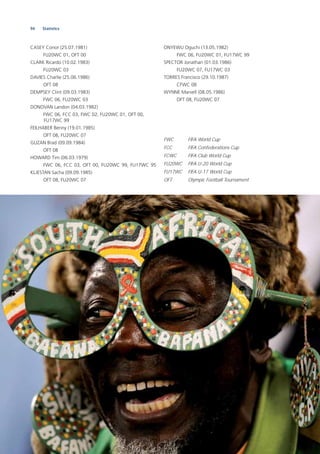
  • 14.
    14 Story ofthe tournament give Brazil the lead. Finally, in the closing minutes of the first half, Brazil, led by Kaká, who was predictably at the heart of the majority of his side’s breaks and combining well with his colleagues, scored another two goals to take a comfortable lead at half-time. Italy had to put in extra effort to recover after the break, and they pushed forward in search of their first goal of the game. However, their lack of strikepower up front saw them fail to break through the well-organised Brazilian defence and they bowed out of the tournament at an early stage. Egypt v. USA 0-3 (0-1) The USA, with two defeats in their first two matches, did not have much hope of advancing to the second stage, but they performed with great focus. A solid, organised defence combined with determined attacking play was the key to their success. Davies (9) opened the scoring in the 21st minute. Egypt were unable to respond as their key striker, Zidan, was missing due to injury. Despite their individual ability, they were never able to put the USA in trouble and they did not perform as well as they had in their first two matches. The USA took their chance, Bradley (12) combining well with Donovan to score the second goal. A header from Dempsey (8) completed the scoring and dramatically put the USA into the semi-finals ahead of Italy on goals scored. SECOND ROUND SEMI-FINALS Spain v. USA 0-2 (0-1) The USA caused another sensation by beating European champions Spain 2-0 to book a place in their first-ever final of a senior FIFA men’s event. The Spanish controlled possession from the beginning but could not break through the well-organised and compact American defence. After USA striker Altidore had scored halfway through the first half, leaving the Spanish reeling for a while, Spain lifted their game after the break with plenty of movement and accurate passes. However, it was all in vain and they failed to release their strikers for shots on goal. Frustration took over when they conceded their second goal to Dempsey. Spain’s attacks in the last phase of the match failed to penetrate the solid USA defensive block, and it was the USA who advanced to the final. Brazil v. South Africa 1-0 (0-0) Brazil dominated the match from the start and they had a number of goalscoring opportunities through Luis Fabiano, Kaká and Robinho. However, they could not get past the compact defence of the host nation. Led by key player Pienaar in midfield, Bafana Bafana proved to be strong opponents. Both sides nearly scored towards the end of the first period but their shots were either saved or blocked by defenders. South Africa remained determined thanks to the support of their enthusiastic fans, but Brazil swiftly regained
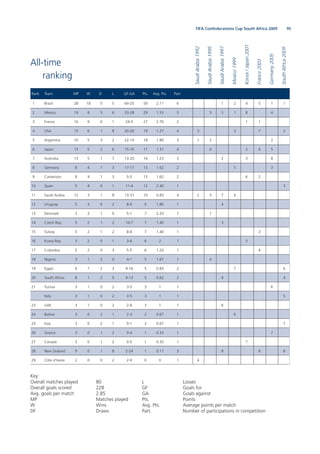
  • 15.
    15FIFA Confederations CupSouth Africa 2009 the initiative at the start of the second period. Kaká and Maicon combined well and had a couple of chances after the break, but South Africa’s Pienaar and Modise replied with chances in the later part of the game. Brazil coach Dunga made a decisive substitution nine minutes from time by introducing Daniel Alves (13) at left back. Five minutes later, from a direct free kick on the edge of the South African penalty area, Alves made no mistake and blasted in a powerful shot at the far post to put Brazil into the final. MATCH FOR THIRD PLACE Spain v. South Africa 3-2 a.e.t. (2-2, 0-0) Spain claimed third place with a dramatic 3-2 extra-time victory over hosts South Africa in Rustenburg. It was an even game with no particular highlights. The hosts looked like the winners after scoring in the 73rd minute, substitute striker Mphela (9) scoring from close range following a cross from the left. However, the final minutes of play were dramatic as Spanish substitute Guiza (17) scored twice in two minutes before Mphela equalised with an outstanding long-range free kick three minutes into injury time to take the game into extra time. Spain ultimately showed their quality when Xabi Alonso (14) made no mistake from a direct free kick, curling the ball home to seal third place for the Spanish. FINAL USA v. Brazil 2-3 (2-0) Brazil showed their undeniable class in the final of the FIFA Confederations Cup 2009 in Johannesburg, fighting back from two goals down at half-time and producing an irrepressible display to sink the courageous USA 3-2 to retain their title and win the FIFA Confederations Cup for the third time. The Americans could be proud of their performance as they played superbly – with some excellent saves from goalkeeper Howard (1) – especially in the first half. Surprisingly, they took the game to their opponents from the very first whistle. Donovan had a few shots on goal in the early stages of the first half before Dempsey volleyed home to give the USA an early lead. The Americans kept attacking even though there was a good response from Brazil. After clearing a Brazilian corner, the USA launched the perfect counterattack, which was crowned by Donovan’s goal. The match turned, however, when Luis Fabiano scored within seconds of the restart. Then, just as USA coach Bob Bradley was preparing to bring fresh legs into play, Kaká dazzled down the left before sending a perfect cross into the goalmouth, where Luis Fabiano made sure of his fifth goal after Robinho’s shot hit the crossbar. Brazil captain Lucio (3) went on to head home from a corner to complete the scoring and clinch victory.
  • 16.
    16 Story ofthe tournament Auteur : KWOK Ka Ming PHASE DE GROUPES GROUPE A Afrique du Sud – Irak : 0-0 L’Afrique du Sud, hôte de la compétition, a donné le coup d’envoi du match d’ouverture de la Coupe des Confédérations de la FIFA à l’Ellis Park de Johannesburg face à l’Irak, champion d’Asie. Les deux formations ont tenté de surprendre leur adversaire avec de longs ballons vers l’avant. Pourtant, les défenses se sont montrées prudentes et disciplinées, et il n’y a eu que très peu d’occasions de but. Après la pause, l’équipe hôte a repris sa domination territoriale, obtenant un bon nombre d’occasions, parfois non cadrées ou bien annihilées par les exploits du gardien irakien Mohammed Kassid (12). Au final, la rencontre s’est achevée sur un score nul et vierge. Nouvelle-Zélande – Espagne : 0-5 (0-4) L’Espagne a nettement dominé la rencontre dès le coup d’envoi. La fluidité du jeu espagnol, sa maturité tactique et le coup du chapeau rapide de Torres (9) ont rapidement fait la décision. Le jeu espagnol, tout en mouvement et en combinaisons de passes rapides, a laissé les Néo-Zélandais sans réaction. La défense des représentants de l’Océanie s’est considérablement améliorée en seconde période, parvenant à limiter le nombre d’occasions de but adverses. L’Espagne a toutefois scellé le score par Villa (7). Espagne – Irak : 1-0 (0-0) L’Espagne abordait son deuxième match en pleine confiance après sa large victoire contre le champion d’Océanie. Mais les Irakiens, qui avaient engrangé un point face aux hôtes sud-africains quelques jours auparavant, ont mené la vie dure aux Espagnols en jouant très regroupés autour d’une défense compacte, ne sortant que sur de rares contre- attaques. La Roja est toutefois parvenue à trouver la faille grâce à Villa, auteur du seul but de la rencontre en reprenant de la tête un superbe centre du latéral gauche Capdevila (11). Afrique du Sud – Nouvelle-Zélande : 2-0 (1-0) Après son nul décevant du match d’ouverture, l’Afrique du Sud a dominé son adversaire au cours de l’essentiel de la rencontre. Les Bafana Bafana ont fait preuve d’une grande détermination et de beaucoup de flair en attaque grâce notamment à leur latéral gauche Masilela (3), auteur de deux centres décisifs pour son coéquipier Parker (17). Le collectif néo-zélandais, en progression par rapport au premier match, n’a toutefois jamais semblé en mesure de s’imposer face à un adversaire supérieur dans tous les compartiments du jeu. Irak – Nouvelle-Zélande : 0-0 L’Irak devait impérativement gagner son dernier match face à la Nouvelle-Zélande à Johannesburg pour espérer accéder au deuxième tour. Malgré leurs efforts et leur grande volonté, les Irakiens se sont montrés incapables de construire des offensives, étant même régulièrement dominés par les Néo-Zélandais pendant l’essentiel de la première période. L’Irak aurait même pu être mené au score à la pause si Killen (10) n’avait pas manqué deux occasions de but. À la reprise, l’Irak poussait davantage et effectuait des changements afin de renverser la situation. Mais au contraire, c’est une nouvelle fois la Nouvelle-Zélande qui frôlait la victoire lorsque Killen, encore lui, manquait de peu le cadre. La rencontre s’est finalement achevée sur un score nul et vierge. Espagne – Afrique du Sud : 2-0 (0-0) L’Espagne a pris le contrôle de la partie dès le coup d’envoi grâce à son jeu offensif tout en mouvement et en passes précises. Sa progression a été peu à peu stoppée par la détermination du pays hôte, porté par l’omniprésent Pienaar Compte-rendu de la compétition
  • 17.
    17FIFA Confederations CupSouth Africa 2009 (10) au milieu de terrain, bien soutenu par Modise (12) et Parker lors des rares occasions sud-africaines. Villa manquait une occasion en or lorsque son penalty était brillamment repoussé par le gardien Khune (16), déjà auteur de superbes parades un peu plus tôt en seconde période. L’Espagne a dû redoubler d’efforts pour préserver sa série de victoires consécutives. Villa et Llorente (16), entré en cours de jeu, entérinaient la troisième victoire des Espagnols dans cette phase de groupes. L’Espagne s’est ainsi retrouvée qualifiée pour les demi-finales sans avoir concédé le moindre but. GROUPE B Brésil – Égypte : 4-3 (3-1) Le Brésil, champion de la CONMEBOL, a parfaitement entamé son premier match à Bloemfontein en ouvrant le score très tôt sur un exploit personnel de Kaká (10). Les Égyptiens ont immédiatement égalisé grâce à une tête de Zidan (9) sur un centre parfait venu du flanc droit. Cependant, les Brésiliens ont fait étalage de leurs qualités en inscrivant deux nouveaux buts avant la fin de la première période, par l’intermédiaire de l’attaquant Luis Fabiano (9) et du défenseur central Juan (4). Après la pause, les Égyptiens ont réagi en jouant plus offensif, essayant de revenir au score grâce aux qualités individuelles de leurs attaquants. Ils sont parvenus à égaliser en inscrivant deux buts en deux minutes en tout début de seconde période et ont largement fait jeu égal avec les quintuples champions du monde. Alors qu’on semblait se diriger vers un score nul, le Brésil a obtenu un penalty justifié au cours des arrêts de jeu. Kaká se chargeait de convertir la sentence, assurant au Brésil sa première victoire dans la compétition. États-Unis – Italie : 1-3 (1-0) Les États-Unis ont joué leur premier match à Pretoria face à l’Italie, championne du monde en titre, et se sont montrés dominateurs dès l’entame de la rencontre. Mais à la 33e minute, l’Américain Clark (13) récoltait un carton rouge. En infériorité numérique, les Américains ouvraient cependant le score sur un penalty de Donovan (10) en toute fin de première période. Après la pause, l’Italie cherchait à égaliser sans toutefois y parvenir à cause d’un certain manque de force offensive et de la solide performance défensive de l’équipe américaine. Une minute après son entrée en jeu,
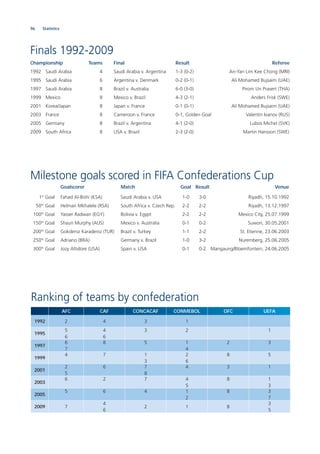
  • 18.
    18 Story ofthe tournament Rossi (17) permettait à son équipe de revenir au score. Ce but redonnait immédiatement confiance aux Italiens qui se montraient de plus en plus créatifs. Ils concrétisaient cette domination grâce à un superbe tir lointain de De Rossi (10). Enfin, Rossi scellait la victoire italienne à la suite d’une excellente passe de Pirlo (21). États-Unis – Brésil : 0-3 (0-2) Le Brésil a retrouvé toute sa splendeur grâce à une victoire confortable 3–0 sur les États-Unis à Pretoria. Après avoir peiné lors de leur premier match face aux champions d’Afrique égyptiens, les Brésiliens ont entamé la rencontre avec beaucoup de détermination et de concentration. Grâce à deux buts de Melo (5) et Robinho (11), le Brésil rentrait au vestiaire avec une confortable avance. L’équipe américaine jouait le tout pour le tout en seconde période en faisant entrer un attaquant supplémentaire, Casey (4), pour épauler Altidore (17) en attaque. Malheureusement, Kljestan (16) écopait d’un carton rouge en début de deuxième période, aggravant une situation déjà bien compliquée face à un si redoutable adversaire. Le Brésil ne relâchait pas son emprise et Maicon (2) combinait avec Kaká et Ramires (18) pour sceller le score et la seconde victoire brésilienne. Égypte – Italie : 1-0 (1-0) Par rapport à son premier match, l’Italie avait effectué cinq changements dans son onze de départ, en intégrant notamment Fabio Cannavaro (5) qui avait été élu deuxième meilleur joueur de la Coupe du Monde de la FIFA 2006. L’Égypte, qui n’a semblé nullement affectée par sa première défaite, a joué avec énormément de confiance et de détermination. Les Pharaons ont été récompensés à cinq minutes de la pause lorsqu’Homos (12), libre de tout marquage au deuxième poteau, a repris victorieusement de la tête un corner d’Aboutrika (22). Après la pause, l’Italie a tenté de revenir en faisant entrer les attaquants Toni (9) et Pepe (7). Mais les Égyptiens ont réussi à conserver ce résultat grâce à la superbe prestation de leur gardien El Hadary (1).
  • 19.
    19FIFA Confederations CupSouth Africa 2009 Par cette victoire, l’Égypte allait offrir au Groupe B un final époustouflant. Italie – Brésil : 0-3 (0-3) La tension était plus que palpable dans ce match particulier, les deux équipes voulant montrer au monde entier la qualité de leur football. L’Italie avait besoin de points pour atteindre la deuxième phase du tournoi. Le Brésil a démontré toutes ses qualités dès l’entame de la rencontre. À la 37e minute, l’attaquant brésilien Luis Fabiano interceptait un tir de Maicon pour propulser le ballon dans les filets italiens, donnant l’avantage aux Auriverde. En toute fin de première période, le Brésil inscrivait deux nouveaux buts sur des combinaisons initiées par Kaká, véritable chef d’orchestre de l’attaque brésilienne. Les Brésiliens rentraient au vestiaire avec une avance confortable de deux buts. L’Italie, contrainte de fournir d’énormes efforts pour tenter de revenir dans le match, poussait autant que possible pour tenter de réduire le score. Mais, incapable de mettre à mal une défense brésilienne bien organisée, l’Italie se faisait éliminer prématurément de la compétition. Égypte – États-Unis : 0-3 (0-1) Après deux défaites lors de leurs deux premiers matches, les États-Unis n’avaient que peu d’espoir d’atteindre le second tour, mais ils sont néanmoins parvenus à livrer une prestation pleine de détermination. La clé de leur succès fut une solide organisation défensive combinée à un jeu offensif plein d’audace. Davies (9) ouvrait la marque à la 21e minute. L’Égypte se montrait incapable de réagir, son meilleur attaquant Zidan étant absent pour cause de blessure. Malgré leurs qualités individuelles, les Égyptiens ne sont jamais parvenus à inquiéter les Américains, et leur prestation était bien inférieure à celle de leurs deux premières rencontres. Les Américains faisaient le break lorsque Bradley (12) inscrivait le second but après une jolie combinaison avec Donovan. Le but de la tête de Dempsey (8) venait clore le score et propulsait miraculeusement les États-Unis en demi-finales aux dépens de l’Égypte et de l’Italie, grâce à un nombre inférieur de buts concédés. SECOND TOUR DEMI-FINALES Espagne – États-Unis : 0-2 (0-1) Une nouvelle fois, les États-Unis créent la sensation en battant l’Espagne, championne d’Europe, pour atteindre la première finale de leur histoire. Dès le coup d’envoi, les Espagnols se sont montrés supérieurs en termes de possession du ballon, mais sans jamais parvenir à percer la défense compacte et très bien organisée des Américains. Peu après l’ouverture du score par l’attaquant américain Altidore en milieu de première période, l’Espagne semblait sous le choc pendant de longues minutes. La Roja accélérait en seconde période, proposant nettement plus de mouvements et des passes plus précises. Mais toutes les tentatives espagnoles restaient vaines à cause d’un cruel manque de précision dans la dernière passe ou dans le dernier geste. Après avoir concédé le second but de Dempsey, la frustration des Espagnols devenait palpable. Dans les derniers instants du match, les offensives espagnoles se heurtaient au solide
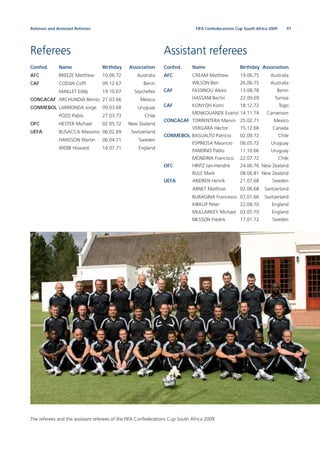
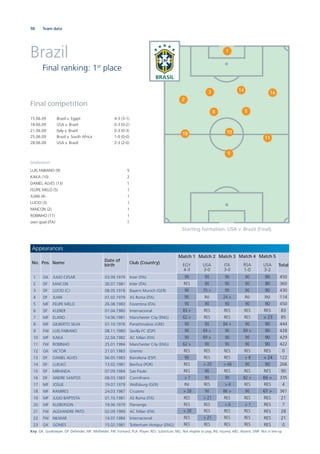
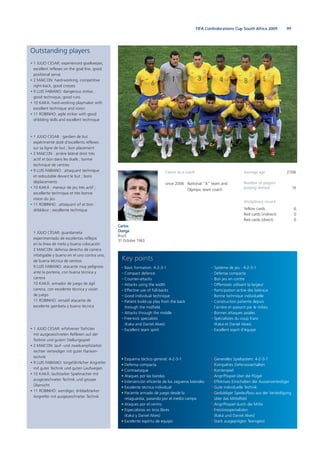
  • 20.
    20 Story ofthe tournament bloc défensif américain et l’Espagne voyait sa place en finale lui échapper au profit de son adversaire. Brésil – Afrique du Sud : 1-0 (0-0) Le Brésil dominait ce match dès les premières secondes, se créant de nombreuses occasions par l’intermédiaire de Luis Fabiano, Kaká et Robinho. Pourtant, les Brésiliens ne réussissaient pas à franchir la défense compacte du pays organisateur. Emmenée par leur leader Pienaar au milieu de terrain, les Bafana Bafana se montraient redoutables offensivement. Chacune des deux équipes était proche de marquer en fin de première période, mais les tentatives étaient repoussées par les gardiens ou par les défenseurs. Si la détermination de l’équipe sud-africaine restait intacte grâce à l’indéfectible soutien de ses supporters, le Brésil prenait rapidement l’initiative au début de la seconde période. Kaká et Maicon combinaient habilement et se créaient plusieurs occasions juste après la pause. Du côté des locaux, Pienaar et Modise leur répondaient dans le dernier quart d’heure. Le sélectionneur brésilien Dunga effectuait alors un remplacement décisif à neuf minutes du terme de la rencontre en faisant entrer Daniel Alves (13) au poste d’arrière gauche. Cinq minutes plus tard, sur un coup franc direct à l’entrée de la surface de réparation sud-africaine, Daniel Alves ne tremblait pas et décochait un tir puissant à ras du poteau, propulsant le Brésil en finale. MATCH POUR LA TROISIÈME PLACE Espagne – Afrique du Sud : 3-2 a.p. (2-2, 0-0) À Rustenburg, l’Espagne a décroché la troisième place à l’issue d’une victoire spectaculaire 3-2 après prolongations sur le pays hôte, l’Afrique du Sud. Les deux équipes se sont montrées régulières sans véritablement briller. Les Sud- Africains ont longtemps semblé en mesure de l’emporter grâce à un but inscrit à la 73e minute par l’attaquant remplaçant Mphela (9) sur un centre aux six mètres venu de la gauche. Mais dans les dernières minutes, le remplaçant espagnol Guiza (17) marquait deux fois en deux minutes. Cependant, à la 93e minute, Mphela, encore lui, arrachait la prolongation grâce à un fantastique coup franc direct des trente mètres. Mais les Espagnols décrochaient finalement la troisième place du tournoi grâce à Xabi Alonso (14), qui enveloppait parfaitement un coup franc excentré pour inscrire le but de la victoire. FINALE États-Unis – Brésil : 2-3 (2-0) Lors de la finale de la Coupe des Confédérations de la FIFA 2009 à Johannesburg, le Brésil a montré toute sa classe en comblant un déficit de deux buts à la pause et en pratiquant un football imparable qui lui a permis de prendre le dessus sur une courageuse équipe américaine. Sa victoire 3-2 a offert au Brésil son troisième titre dans l’histoire de cette compétition. Du côté américain, la déception était palpable compte tenu de leurs superbes performances et des splendides arrêts réalisés par leur gardien Howard (1). À la surprise générale, les Américains prenaient le jeu à leur compte dès le coup d’envoi. Donovan tentait plusieurs fois sa chance au cours du premier quart d’heure avant qu’une volée de Dempsey ne donne l’avantage aux États-Unis. Malgré la réaction énergique des Brésiliens, ils conservaient leur mentalité offensive. À la suite d’un corner en faveur du Brésil, l’équipe américaine réussissait une contre-attaque magistrale parfaitement conclue par Donovan. Le tournant du match survenait dès les premiers instants de la deuxième période lorsque Luis Fabiano parvenait à réduire le marque pour le Brésil. Avant que le sélectionneur américain n’ait eu le temps de faire entrer des joueurs frais, Kaká débordait sur le côté gauche avant d’ajuster un centre parfait aux six mètres pour Robinho. La reprise de ce dernier était repoussée par la barre transversale sur Luis Fabiano qui égalisait à bout portant, inscrivant au passage son cinquième but de la compétition. Enfin, sur un corner d’Elano (7), le capitaine brésilien Lucio (3) inscrivait de la tête le but de la victoire.
  • 21.
    21FIFA Confederations CupSouth Africa 2009 Autor: KWOK Ka Ming PARTIDOS DE GRUPO GRUPO A Sudáfrica – Irak 0-0 El anfitrión Sudáfrica inauguró la Copa FIFA Confederaciones con el partido de apertura contra el campeón asiático Irak en el estadio Ellis Park de Johannesburgo. Ambas escuadras intentaron sorprender al rival con largos balones hacia adelante, sin embargo no se ofrecieron muchas oportunidades de gol debido a las compactas y disciplinadas defensas. Luego de la pausa, el dueño de casa puso bajo sitio al área del conjunto iraquí y dispuso de algunas situaciones prometedoras de gol que, sin embargo, no aportaron frutos ya fuera por falta de precisión en los remates o gracias a la magnífica actuación del portero Mohammed Kassid (12). Nueva Zelanda – España 0-5 (0-4) España dominó claramente el cotejo desde el inicio. Un fluido juego de combinaciones, madurez táctica y una tripleta en pocos minutos por intermedio de Torres (9) constituyeron los factores decisivos de la victoria española. La continua circulación del balón y los toques de alta precisión dejaron sin respuesta al once neozelandés. Gracias a una ligera mejora en la labor defensiva en el segundo tiempo, Nueva Zelanda logró reducir las oportunidades goleadoras de España, concediendo sólo un tanto más concretado por Villa (7). España – Irak 1-0 (0-0) España llegó rebosante de confianza a su segundo partido luego de su convincente actuación frente a Nueva Zelanda. Sin embargo, Irak, que había empatado con el dueño de casa unos días antes, complicó el juego de los europeos, replegándose muy en profundidad en una compacta defensa y lanzando ocasionalmente peligrosos contraataques. Fue finalmente Villa quien abriera el tanteador con un perfecto cabezazo tras un preciso centro de Capdevila (11), sellando la victoria española. Sudáfrica – Nueva Zelanda 2-0 (1-0) Luego del inesperado empate en su primer encuentro, Sudáfrica dominó a su rival prácticamente durante todo el segundo partido. La escuadra local jugó con gran determinación y excelentes maniobras ofensivas, particularmente por la banda izquierda, zona donde patrullaba el dinámico Masilela (3) y desde la cual habilitaba con precisos centros a Parker (17), autor de los tantos sudafricanos. Si bien los neozelandeses mejoraron como conjunto en comparación a su primer desempeño, nunca dieron la impresión de poder derrotar a un adversario netamente superior. Reseña del torneo
  • 22.
    22 Story ofthe tournament Irak – Nueva Zelanda 0-0 Irak, que debía ganar su tercer y último partido de grupo contra Nueva Zelanda para poder progresar a la segunda fase, arrancó con total determinación y entrega. Sin embargo, no se halló en condición de desarrollar plenamente su ataque debido al fuerte dominio neozelandés en el primer tiempo, e incluso se hubiera encontrado en desventaja de no mediar la imprecisión goleadora de Killen (10) en determinadas ocasiones. En la segunda mitad, Irak intentó subir con mayor frecuencia, y efectuó algunos cambios para darle mayor peso a su juego ofensivo. No obstante, Nueva Zelanda estuvo a punto de abrir el tanteador, de no haber sido por Killen, quien volvió a fallar una gran oportunidad. Finalmente, el cotejo concluyó con el marcador en tablas. España – Sudáfrica 2-0 (0-0) España controló el juego desde el comienzo con hábiles pases y un juego ofensivo muy movido. Sin embargo, todos sus intentos fueron truncados por un dueño de casa pleno de determinación, dirigido magistralmente por Pienaar (10), generoso en el despliegue físico en la zona de gestación, quien creaba prometedoras situaciones de gol a Modise (12) y Parker en la vanguardia. Villa falló una gran oportunidad de pasar adelante cuando su penal fue salvado con gran destreza por el portero local Khune (16), quien se lució varias veces con sus grandiosas paradas. El conjunto español hubo de esforzarse a fondo para mantener su racha de triunfos, siendo finalmente Villa y su sustituto Llorente (16) quienes concretaron la tercera victoria, pasando a semifinales sin haber concedido un solo tanto. GRUPO B Brasil – Egipto 4-3 (3-1) El arranque del campeón de la CONMEBOL Brasil parecía el presagio de un triunfo contundente cuando Kaká (10) abrió el tanteador a pocos minutos del inicio, tras una perfecta jugada individual. Sin embargo, los egipcios reaccionaron inmediatamente con un brillante frentazo de Zidan (9) luego de un perfecto centro desde la banda derecha. Brasil no se dejó impresionar y sacó a relucir sus cualidades, anotando el ariete Luís Fabiano (9) y el defensor central Juan (4) dos tantos más antes de la pausa. Luego del receso, la escuadra faraona reaccionó con una actitud más ofensiva y dispuesta a remontar el resultado, confiando en la habilidad individual de sus delanteros. Lograron efectivamente igualar el tanteador con dos goles en dos minutos, desempeñándose de igual a igual frente al pentacampeón mundial. El partido parecía finalizar con empate a tres, sin embargo Brasil obtuvo un justificado penal en el descuento, pena concretada por Kaká que así sellaba la primera victoria del once auriverde en el torneo. EE UU – Italia 1-3 (1-0) EE UU disputó su primer partido en Pretoria contra el actual campeón mundial Italia, saliendo a presionar desde el inicio, particularmente por la banda derecha. Tuvo contra las cuerdas a Italia hasta el minuto 33, cuando Clark (13) fue expulsado del terreno de juego. No obstante este revés, EE UU pasó adelante con penal de Donovan (10) al final del primer tiempo. Tras la pausa, Italia se esmeró a fondo para volcar el partido, fallando empero debido a su incapacidad
  • 23.
    23FIFA Confederations CupSouth Africa 2009 goleadora y a la sólida defensa rival. Todo cambió con el ingreso de Rossi (17), quien al minuto de estar en la cancha logró la tan ansiada paridad, y dio al ataque italiano la creatividad y fuerza necesarias. Con un potente remate de distancia, De Rossi (10) amplió el marcador a favor de los italianos y, finalmente, Rossi aumentó su cuenta particular al culminar una brillante acción de Pirlo (21) por la banda izquierda en el descuento, sellando con 3 a 1 la primera victoria italiana en el torneo. EE UU – Brasil 0-3 (0-2) Brasil volvió a dar lo mejor de sí en Pretoria al derrotar claramente a EE UU por 3 a 0. Tras su angustiosa victoria contra Egipto, el conjunto canarinho planteó un partido pleno de determinación y concentración contra los campeones de la CONCACAF. Dos goles madrugadores de Melo (5) y Robinho (11) le dieron una cómoda ventaja en el primer tiempo. En la segunda parte, EE UU intentó ejercer mayor presión con el ingreso de Casey (4) como segundo delantero junto a Altidore (17). Desafortunadamente, Kljestan (16) fue sancionado con la tarjeta roja, con lo cual dificultó aún más la labor de sus compañeros. El conjunto brasileño mantuvo su ritmo de juego y tras una hermosa combinación entre Maicon (2), Kaká y Ramires (18) en la banda izquierda, el nº 2 concluyó la jugada con un estupendo gol y la segunda victoria auriverde.
  • 24.
    24 Story ofthe tournament Egipto – Italia 1-0 (1-0) Italia efectuó cinco cambios respecto a su primer partido, incluido el antiguo campeón mundial Cannavaro (5), encargado de dirigir la defensa. Egipto no dejó entrever ninguna actitud negativa como consecuencia de su primera dramática derrota y jugó pleno de confianza y determinación. A cinco minutos de la pausa, Homos (12) abrió la cuenta para Egipto con un potente cabezazo hacia el segundo poste, totalmente desguarnecido. Tras la pausa, Italia intentó remontar el marcador, reforzando su ataque con Toni (9) y Pepe (7). No obstante, los egipcios lograron mantener el resultado gracias a la extraordinaria actuación de su portero El Hadary (1). Esta victoria ofrecía a Egipto la grandiosa oportunidad de clasificarse en su último encuentro en el grupo B. Italia – Brasil 0-3 (0-3) ¡La tensión en este encuentro particular era enorme! Ambas escuadras deseaban hacer gala de su extraordinaria calidad futbolística, además de que Italia debía puntuar para poder pasar a la segunda fase del torneo. La tónica del juego quedó clara desde el saque inicial: Brasil sacó a relucir su repertorio de genialidades, y en el minuto 37, Luís Fabiano interceptó un remate defectuoso de Maicon, enviando el balón al ángulo lejano de la meta. Instantes después, en sólo tres minutos, Brasil –dirigido por un grandioso Kaká, presente en prácticamente todas las jugadas por la punta– anotaba dos tantos más antes de la pausa. Italia intentó levantarse de la lona y se esforzó para descontar, pero la falta de potencia ofensiva y la incapacidad de superar la hermética defensa auriverde hicieron que los muchachos de la bota debieran despedirse prematuramente del torneo. Egipto – EE UU 0-3 (0-1) Tras dos derrotas en dos partidos, EE UU prácticamente no tenía esperanzas de progresar a la segunda ronda. Sin embargo, merced a una desempeño totalmente concentrado, sólida defensa y determinación en el despliegue ofensivo, logró lo imposible. Davies (9) abrió la cuenta en el minuto 21. Egipto nunca estuvo en condición de inquietar a su rival, particularmente debido a la ausencia por lesión de su artillero estrella Zidan, y jamás estuvo a la altura de sus encuentros precedentes. En la segunda parte, Bradley (12) anidó el segundo tanto en la puerta egipcia tras una vertiginosa combinación con Donovan. Finalmente, el cabezazo de Dempsey (8) redondeaba el dramático triunfo norteamericano, clasificando así a su escuadra en semifinales, delante de Egipto e Italia por diferencia de goles. SEGUNDA RONDA SEMIFINALES España – EE UU 0-2 (0-1) EE UU volvió a deparar una enorme sorpresa al batir 2 a 0 en semifinales al campeón europeo y lograr así un lugar en una final por primera vez en su historia futbolística. Aunque el conjunto español dominó el juego desde el inicio, no estuvo en grado de superar decididamente la defensa norteamericana compacta y perfectamente organizada. Más aún, el tanto del delantero Altidore a mediados del primer tiempo desconcertó a la selección española durante varios minutos. Luego de la pausa, la escuadra europea aceleró el ritmo de su juego con peligrosas combinaciones y pases precisos, pero todos sus esfuerzos resultaron vanos, ya fuera debido a la imprecisión de los disparos o por mérito del sólido desempeño de la defensa americana. La frustración española creció tras el segundo tanto de Dempsey, no aportando tampoco el acoso total en los últimos quince minutos el deseado vuelco, debiendo la escuadra roja cederle el paso al once norteamericano a la final. Brasil – Sudáfrica 1-0 (0-0) Brasil fue dueño del partido desde el silbato inicial y dispuso de un sinnúmero de oportunidades de gol a través de Luís
  • 25.
    25FIFA Confederations CupSouth Africa 2009 Fabiano, Kaká y Robinho. Sin embargo, no supo superar la compacta defensa de los dueños de casa, los cuales, dirigidos por Pienaar –figura clave en la línea media–, demostraron ser un rival parejo en cuanto a juego ofensivo. Ambas escuadras se encontraban a un paso de abrir el tanteador en los minutos finales del primer tiempo, pero sus tiros fueron bloqueados ya sea por los respectivos porteros o defensores. A la vuelta de los vestuarios, Sudáfrica mantuvo su determinación alentada por su entusiasta hinchada, a la vez que Brasil comenzaba a ejercer un ligero dominio sobre su rival. Kaká y Maicon hicieron gala de algunas finas combinaciones, pero también Pienaar y Modise angustiaron a la zaga brasileña con algunas prometedoras maniobras. A nueve minutos del término, el técnico Dunga realizó una sustitución decisiva al integrar a Daniel Alves (13) en la zaga izquierda. Cinco minutos más tarde, Alves introdujo el esférico en la meta sudafricana tras un potentísimo tiro libre, abriendo así las puertas de la final para Brasil. PARTIDO POR EL TERCER PUESTO España – Sudáfrica 3-2 t. pr. (2-2, 0-0) España se aseguró el tercer puesto final al imponerse a la selección anfitriona por 3 a 2 en un dramático partido con alargue en Rustenburgo. Fue un partido parejo, sin grandes momentos, con el cuadro local como potencial ganador tras adelantarse en el minuto 73 con gol del suplente Mphela (9) sobre un soberbio centro desde la banda izquierda. No obstante, los cinco minutos concluyentes fueron signados por un dramatismo sin igual: el suplente Güiza (17) anotó dos veces consecutivas en dos minutos, y Mphela subía nuevamente la paridad en el descuento con un potentísimo tiro libre, llevando así el encuentro al alargue. En la segunda parte suplementaria, Xabi Alonso (14) puso de manifiesto toda su técnica al enviar a las redes un tiro libre imparable, sellando así la victoria española y el tercer puesto en el torneo. FINAL EE UU – Brasil 2-3 (2-0) Brasil dio prueba de su extraordinaria clase en la final de la Copa FIFA Confederaciones 2009 en Johannesburgo al remontar dos goles tras el medio tiempo y batir por 3 a 2 a la valerosa escuadra norteamericana en un alarde de grandeza en los últimos 45 minutos. Con este triunfo, se adjudicaba por tercera vez el título en la historia de esta competición. Los norteamericanos no se sintieron avergonzados, sino decepcionados luego de haber disputado un grandioso encuentro, con extraordinarias atajadas del portero Howard (1), particularmente en el primer tiempo. Le tomaron sorprendentemente la mano al juego desde el comienzo, y ya en los minutos iniciales Donovan dispuso de algunas buenas oportunidades antes de que Dempsey abriera el marcador en el minuto 10. No obstante la inmediata reacción brasileña, los norteamericanos mantuvieron su enfoque ofensivo. Tras un saque de esquina auriverde, el conjunto de EE UU dio muestra de un fulminante y perfecto contragolpe coronado por el gol de Donovan. Sin embargo, el partido se volcó con el tanto de Luís Fabiano inmediatamente después del inicio del segundo tiempo. Antes de que el técnico Bob Bradley pudiera efectuar sus cambios, Kaká sacó a relucir una de sus genialidades en el flanco izquierdo al enviar un pase de precisión milimétrica a la boca de la meta contraria, donde Luís Fabiano contabilizara su 5º gol en el torneo. Y para terminar, el capitán Lúcio (3) cerró el tanteador con un potente frentazo en los compases finales del encuentro.
  • 26.
    26 Story ofthe tournament Turnier- verlauf Autor: KWOK Ka Ming GRUPPENSPIELE GRUPPE A Südafrika – Irak 0:0 Gastgeber Südafrika und Asienmeister Irak eröffneten im Ellis Park in Johannesburg den FIFA Konföderationen-Pokal. Beide Teams versuchten, den Gegner mit langen, direkten Pässen in die Spitze zu überraschen. Doch die Verteidiger waren stets zur Stelle und liessen kaum Torchancen zu. In der zweiten Halbzeit gewannen die Südafrikaner allmäh- lich die Oberhand und kamen zu mehr Möglichkeiten, von denen sie aber keine nutzen konnten. Entweder schossen sie daneben oder scheiterten am herausragenden irakischen Torhüter Mohammed Kassid (12). So blieb es beim 0:0. Neuseeland – Spanien 0:5 (0:4) Die Spanier dominierten von der ersten Minute an. Sie kombinierten flüssig, waren ständig in Bewegung, taktisch stets auf der Höhe und in ihrem Spiel unglaublich präzise. Die Neuseeländer hatten nicht den Hauch einer Chance und gerieten durch einen schnellen Hattrick von Torres (9) bald hoffnungslos in Rückstand. In der zweiten Halbzeit vermoch- ten die Neuseeländer etwas mehr Gegenwehr zu leisten und liessen nur noch einen Treffer durch Villa (7) zu. Spanien – Irak 1:0 (0:0) Nach dem überzeugenden Sieg gegen Ozeanienmeister Neuseeland stiegen die Spanier voller Selbstvertrauen in die nächste Partie. Die Iraker, die dem Gastgeber zum Tur- nierauftakt einen Punkt abgetrotzt hatten, machten dem Europameister das Leben aber überaus schwer. Mit ihrer kompakten Abwehr, die sie nur bei den seltenen Gegenstös- sen etwas lockerten, liessen sie die Europäer kaum zur Ent-
  • 27.
    27FIFA Confederations CupSouth Africa 2009 faltung kommen. Schliesslich war es Villa, der das Bollwerk knackte. Nach einer traumhaften Flanke von Capdevila (11) erzielte er per Kopf den 1:0-Siegtreffer. Südafrika – Neuseeland 2:0 (1:0) Nach dem enttäuschenden Unentschieden zum Auftakt kamen die Südafrikaner gegen Neuseeland zu einem souve- ränen Sieg. Während des gesamten Spiels dominierten sie den Gegner und spielten mit viel Druck nach vorne. Vor allem über die linke Seite kamen sie immer wieder zu Chancen und letztlich auch zu ihren beiden Toren durch Parker (17) auf Vorarbeit von Masilela (3). Zwar präsentierten sich auch die Neuseeländer als Team ins- gesamt stärker als im Spiel zuvor, der Sieg war für sie aber dennoch nie in Reichweite. Der Gegner war in jeder Hinsicht überlegen. Irak – Neuseeland 0:0 Nur mit einem Sieg im abschliessenden Spiel gegen Neusee- land in Johannesburg hatte der Irak noch eine Chance, sich fürs Halbfinale zu qualifizieren. Von einem Sieg war der Asi- enmeister aber gerade in der ersten Halbzeit weit entfernt. Statt den Gegner unter Druck zu setzen, sahen sich die Iraker immer wieder in die Defensive gedrängt. Durch Killen (10) kamen die Neuseeländer zu mehreren Chancen. Die Iraker konnten von Glück reden, dass es zur Pause immer noch 0:0 stand. In der zweiten Halbzeit versuchten sie, das Glück mit zahlreichen Vorstössen und Auswechslungen auf ihre Seite zu zwingen. Doch die Neuseeländer blieben dem Sieg näher. Ein Schuss von Killen ging knapp daneben, so dass es beim 0:0 blieb. Spanien – Südafrika 2:0 (0:0) Virtuos liessen die Spanier den Ball zirkulieren und drück- ten dem Spiel so den Stempel auf – allerdings lange ohne den gewünschten Erfolg. Immer wieder blieben sie an der südafrikanischen Abwehr hängen, allen voran an Pienaar (10), der im Mittelfeld viel lief und bei den wenigen sich bietenden Gelegenheiten gleichzeitig versuchte, Modise (12) und Parker optimal zu lancieren. Die wohl beste Chance zur Führung verpasste Villa (7), als er per Strafstoss am brillant reagierenden südafrikanischen Torhüter Khune (16) schei- terte, der im Spiel schon einige Chancen zunichte gemacht hatte. Die rekordverdächtige Siegesserie geriet zunehmend in Gefahr. Schliesslich waren es Villa und der eingewechselte Llorente (16), die den dritten Sieg im dritten Spiel doch noch ins Trockene brachten – wiederum ohne Gegentreffer wie bereits in den beiden Spielen zuvor.
  • 28.
    28 Story ofthe tournament GRUPPE B Brasilien – Ägypten 4:3 (3:1) Brasilien hätte nicht besser ins Turnier starten können. Nach einem Solo von Kaká (10) ging der Sieger der Copa América in Bloemfontein schon nach wenigen Minuten in Führung. Kurz darauf gelang Ägypten durch Zidan (9) aber der Ausgleich. Die Brasilianer zeigten nun ihre ganze Klasse und erhöhten durch Stürmer Luis Fabiano (9) und Innenver- teidiger Juan (4) bis zur Pause auf 3:1. Die Ägypter fanden aber wiederum die passende Antwort. Sie agierten nun deutlich offensiver und kamen dank der individuellen Klasse ihrer Angreifer kurz nach der Pause binnen zwei Minuten zum neuerlichen Ausgleich. Von einem Klassenunterschied konnte keine Rede sein. Als schon alle fest mit einem Unent- schieden rechneten, gelang dem fünffachen Weltmeister in der Nachspielzeit per Strafstoss durch Kaká doch noch der Siegtreffer. USA – Italien 1:3 (1:0) Mit Weltmeister Italien trafen die USA zum Auftakt in Pre- toria auf einen schwierigen Gegner. Doch die Amerikaner zeigten keinerlei Respekt und setzten die Italiener gehörig unter Druck. Nicht einmal die rote Karte gegen Clark (13) in der 33. Minute vermochte sie zu stoppen. Donovan (10) brachte die USA gegen Ende der ersten Halbzeit per Elfmeter schliesslich in Führung. Nach der Pause setzte Italien alles daran, den Rückstand wettzumachen, war im Angriff jedoch zu wenig durchschlagskräftig und blieb immer wieder an den geschickt verteidigenden Amerikanern hängen. Erst der eingewechselte Rossi (17) brach schliesslich den Bann. Kaum eine Minute im Spiel erzielte er den Ausgleich. Die Italiener wirkten nun plötzlich wie befreit und spielten viel variantenreicher. Dank einem herrlichen Distanzschuss von De Rossi (10) und einem weiteren Treffer von Rossi nach perfekter Vorarbeit von Pirlo (21) auf der linken Seite sicherten sie sich letztlich doch noch den Sieg. USA – Brasilien 0:3 (0:2) Brasilien legte gegen die USA in Pretoria eine Galavorstel- lung hin und landete einen souveränen 3:0-Sieg. Nach dem hart umkämpften Erfolg im ersten Spiel gegen Afrika- meister Ägypten zeigten sich die Südamerikaner von Beginn an überaus entschlossen und konzentriert. Zwei frühe Tore von Melo (5) und Robinho (11) sicherten ihnen eine kom- fortable Führung. Die US-Amerikaner liessen in der zweiten Halbzeit nichts unversucht und brachten neben Altidore (17) mit Casey (4) einen zusätzlichen Stürmer. Nach der roten Karte gegen Kljestan (16) kurz nach der Pause wurde das Unterfangen indes noch schwieriger, zumal Brasilien nicht nachliess und durch Maicon (2) nach einer perfekten Kombi- nation mit Kaká und Ramires (18) auf der linken Seite noch auf 3:0 erhöhte. Ägypten – Italien 1:0 (1:0) Gleich fünf neue Spieler, darunter der ehemalige FIFA-Welt- fussballer Cannavaro (5) als Abwehrchef, standen in Italiens Startaufstellung gegen Ägypten. Trotz der Auftaktniederlage gingen die Afrikaner äusserst selbstbewusst und entschlos- sen zur Sache und erzielten fünf Minuten vor der Pause die Führung. Völlig unbedrängt konnte Homos (12) nach einem Eckstoss auf den langen Pfosten einköpfen. Nach der Pause suchten die Italiener vehement den Ausgleich. Mit Toni (9) und Pepe (7) brachten sie zwei neue Offensivkräfte, doch die ägyptische Verteidigung und insbesondere der überragende El Hadary (1) hielten dicht. Damit blieb der Ausgang in der Gruppe B bis zuletzt spannend. Italien – Brasilien 0:3 (0:3) Die Spannung war unbeschreiblich, denn beide wollten dieses Prestigeduell unbedingt gewinnen. Italien war zudem dringend auf Punkte angewiesen, um doch noch die nächste Runde zu erreichen. Doch Brasilien machte schnell deutlich, wer hier und heute der Herr auf dem Platz war. Nach 37 Minuten landete ein Schussversuch von Maicon bei Luis Fabiano, der den Ball kurzerhand in die lange Ecke drosch.
  • 29.
    29FIFA Confederations CupSouth Africa 2009 Kurz vor der Pause machten die Brasilianer, angeführt von Kaká, der seine Mitspieler Mal für Mal optimal lancierte, durch zwei Tore binnen drei Minuten schliesslich alles klar. Die Italiener warfen nun alles nach vorne, doch der Welt- meister fand an diesem Tag kein Rezept gegen die brasilia- nische Übermacht und musste nach den Gruppenspielen bereits die Koffer packen. Ägypten – USA 0:3 (0:1) Nach zwei Niederlagen war die Tür zum Halbfinale für die USA praktisch zu. Nur mit einem Sieg hatten sie noch eine Chance. Die Amerikaner erfüllten ihre Pflicht und kamen dank einer defensiv wie offensiv starken Leistung letztlich zu einem ungefährdeten Sieg. Die Ägypter, die ohne ihren ver- letzten Starstürmer Zidan antreten mussten, konnten nie an die Leistung der ersten beiden Spiele anknüpfen. Nach der Führung in der 21. Minute durch Davies (9) und der erfolg- reichen Kombination zwischen Bradley (12) und Donovan machte Dempsey (8) den klaren Sieg perfekt, den die USA unbedingt brauchten. Sie lagen nun mit Italien gleichauf, hatten bei gleicher Tordifferenz aber mehr Tore erzielt und waren somit eine Runde weiter. ZWEITE PHASE HALBFINALE Spanien – USA 0:2 (0:1) Mit dem 2:0-Sieg gegen Europameister Spanien und der ersten Finalqualifikation bei einem FIFA-Wettbewerb über- haupt gelang den USA im Halbfinale eine weitere Sensation. Die Spanier hatten zwar sogleich das Zepter übernommen, vermochten ihre Übermacht aber nicht in Tore umzumünzen. Zu kompakt standen die Amerikaner in der Defensive. Hinzu kam die Führung Mitte der ersten Halbzeit durch Stürmer Altidore, die die Iberer minutenlang lähmte. Nach der Pause zogen sie das Tempo wieder an, bewegten sich besser und
  • 30.
    30 Story ofthe tournament liessen den Ball geschickt laufen. Doch sie fanden gegen die aufmerksamen und schnellen Amerikaner einfach kein Durchkommen. Nachdem Dempsey auf 2:0 erhöht hatte, wurden die Angriffsversuche immer verzweifelter. Ein Tor blieb ihnen an diesem Tag letztlich verwehrt, und damit auch der Einzug ins Finale. Brasilien – Südafrika 1:0 (0:0) Brasilien dominierte das Spiel von Beginn an und kam durch Luis Fabiano, Kaká und Robinho zu mehreren Torchancen. Doch die südafrikanische Verteidigung hielt dicht. Angeführt von Mittelfeldregisseur Pienaar, leistete die „Bafana Bafana“ zähen Widerstand und lieferte den Südamerikanern einen mitreissenden Schlagabtausch. Kurz vor der Pause hatten beide Teams die Führung mehrmals auf dem Fuss, doch eine Hand oder ein Bein eines Torhüters oder eines Verteidigers war immer dazwischen. Zu Beginn der zweiten Halbzeit ver- suchten die Brasilianer, das Diktat zu übernehmen. Vor allem Kaká und Maicon sorgten im Zusammenspiel für viel Wirbel und erarbeiteten sich mehrere Chancen. Angefeuert vom Heimpublikum, machten aber auch die Südafrikaner weiter Druck und kamen durch Pienaar und Modise ihrerseits zu Chancen. Das Patt hatte schliesslich erst in der 88. Minute ein Ende, als der kurz zuvor eingewechselte Daniel Alves (13) an der Strafraumgrenze zum Freistoss schritt. Der linke Aussenverteidiger fackelte nicht lange und hämmerte den Ball in die lange Ecke. Gross war der Jubel bei den Brasilianern, die damit die Chance wahrten, ihren Titel zu verteidigen. SPIEL UM DEN DRITTEN PLATZ Spanien – Südafrika 3:2 n. V. (2:2, 0:0) Das Spiel um Platz drei zwischen Spanien und Südafrika in Rustenburg hätte dramatischer nicht sein können. Nach einem Kopf-an-Kopf-Rennen fiel die Entscheidung erst in der Verlängerung. Lange Zeit plätscherte die Partie dahin. Glanz- lichter waren selten, da sich die beiden Teams weitgehend neutralisierten. Erst in der 73. Minute kam Schwung ins Spiel, als der eingewechselte Stürmer Mphela (9) eine Flanke von links zum 1:0 verwertete. Südafrika schien schon wie der sichere Sieger, als sich die Ereignisse überstürzten. Dank einem Doppelschlag innerhalb von zwei Minuten durch den eingewechselten Guiza (17) hatten plötzlich die Spanier die Nase vorn, bis Mphela in der letzten Minute der Nachspiel- zeit wieder für den Gleichstand sorgte. Die Verlängerung musste entscheiden. Xabi Alonso (14) war es schliesslich, der Spanien per Freistoss auf Platz drei schoss.
  • 31.
    31FIFA Confederations CupSouth Africa 2009 FINALE USA – Brasilien 2:3 (2:0) Die Brasilianer bewiesen im Finale in Johannesburg ihre ganze Klasse, als sie gegen ein beherzt aufspielendes US- Team einen 0:2-Rückstand wettmachten und sich ihren insgesamt dritten Sieg beim FIFA Konföderationen-Pokal holten. Gross war die Enttäuschung bei den Amerikanern, die sich indes nichts vorzuwerfen hatten. Sie haben hervor- ragend gekämpft und nicht zuletzt dank den spektakulären Paraden von Torhüter Howard (1) vor allem in der ersten Halbzeit grossartig gespielt. Zur allgemeinen Überraschung konnten sie dem Spiel von Beginn an den Stempel auf- drücken und kamen dank Donovan zu einigen guten Möglichkeiten. Schliesslich war es aber Dempsey, der die USA per Direktabnahme früh in Führung schoss. Die Brasi- lianer erhöhten nun den Druck. Mit allen Mitteln suchten sie den Ausgleich und wurden dabei klassisch ausgekontert. Ein Eckball der Brasilianer landete bei den Amerikanern, die sofort nach vorne preschten und durch Donovan auf 2:0 erhöhten. Kurz nach der Pause kippte das Spiel. Luis Fabiano besorgte den Anschluss und gab damit das Startzeichen für den brasilianischen Sturmlauf. Allerdings brauchte es einige Anläufe, bis Fabiano mit seinem nunmehr fünften Treffer bei diesem Turnier den Ausgleich erzielte. Kaká war auf der linken Seite entwischt, als US-Trainer Bob Bradley gerade frische Kräfte ins Spiel bringen wollte. Fabiano brauchte in der Mitte nur noch einzuschiessen. Es folgten ein Latten- schuss von Robinho und nach einem Eckball schliesslich der erlösende Siegtreffer durch Kapitän Lucio (3).
  • 33.
  • 34.
    34 Technical andtactical analysis Author: Holger Osieck Introduction The standard of play at the FIFA Confederations Cup South Africa 2009 was generally high. The tournament, which brought together the champions of each confederation, reigning world champions Italy and hosts South Africa, witnessed some surprise results even in the group stage. Despite their 3-1 victory over the USA in their opening match, world champions Italy were knocked out early following defeats to Egypt and Brazil. Favourites Brazil and Spain were joined in the semi-finals by the USA – who recovered from their poor start thanks to a 3-0 triumph over Egypt – and hosts South Africa. Formations All of the teams chose a formation that would allow them to function as a close unit. With the exception of Egypt (5-3-2) and Iraq (5-4-1), who played with a sweeper in their match against Spain, all of the teams favoured a flat back four with zonal marking. However, a number of different midfield formations were on display. The USA, New Zealand and Iraq (4-4-2) played with a second line of four across the midfield. Brazil (4-2-3-1 or 4-2-2-2) and South Africa (4-2-3-1) played two defensive midfielders in front of their rearguard and two and three attacking midfielders respectively, while Spain (4-1-3-2) used an anchor man behind a line of three in their midfield. Italy (4-3-3 or 4-5-1) and Egypt (5-3-2) lined up with three midfielders, although the Italians used a player (Camoranesi, 16) in a more advanced, right- Technical and tactical analysis
  • 35.
    35FIFA Confederations CupSouth Africa 2009 sided position between midfield and attack. All of the teams played with one striker up front and another in a slightly more withdrawn role. They quickly attempted to form a defensive barrier of eight or nine players when the opposing team was in possession in order to limit the space available to attack, or tried to win the ball back by closing down their opponents in midfield and launching their own counterattacks. Wing play Defences were packed so tightly that teams had to attempt to play around them. The favoured option was therefore to attack via the wings, where defences were less tightly packed than in the centre. Of the 44 goals scored, 21 originated on the wing. The majority (9 out of 11) of Spain’s goals in particular came after build-up play down the outside channels. In the Iberians’ match against New Zealand, four of their five goals came from the left-hand side of the pitch. The USA (four from eight goals), South Africa (three from four goals) and Brazil (four goals) also used the wings effectively. The variation in wing play was shown by the different ways in which the goals were created. One tactic, used predominantly by Spain, was to play passes forward quickly, with players switching positions in front of the ball before it was crossed into the middle from the wing. However, traditional wing play culminating in a cross was also in evidence, such as in South Africa’s goals against New Zealand or Spain’s third goal against New Zealand, scored by Torres (9) after a cross by Capdevila (11). Other tactics were for a player to dribble at high speed to the goal line before cutting the ball back into the middle, such as the goal by Rossi (17) to make it 3-1 to Italy against the USA following build-up play by Pirlo (21), or for a diagonal pass to be played from halfway inside the opponent’s half (early cross), such as Dempsey’s (8) goal to make it 3-0 to the USA against Egypt following a pass from Spector (21). Counterattacks The counterattack was another effective means of making a breakthrough. When a team attacked, its otherwise compact defence was often caught out of position, thus creating good opportunities for the defending team to advance when it regained possession by playing quick passes to exploit the gaps left at the back. This also applied to successfully defended corners or throw-ins in advanced areas. Playing a series of quick passes or dribbling speedily through the midfield allowed teams to take advantage of the space that opened up. Outstanding examples of successful counterattacks included Donovan’s (10) goal to make it 2-0 to the USA against Brazil in the final, following wonderful interplay with Davies (9), or Robinho’s (11) goal to make it 2-0 for Brazil in their group match against the USA after an excellent pass by Kaká (10), when the Brazilians had successfully defended a short corner kick by the Americans and capitalised on the gaps left to counterattack and score. Characteristics of the four semi-finalists SOUTH AFRICA South Africa, as the host nation, were the focus of particular attention. Their basic formation was 4-2-3-1. The defence was well organised by Mokoena (4) and Booth (14), while Mhlongo (5) and Dikgacoi (13) brought stability to the defensive midfield. Pienaar (10) provided inspiration going forward, while Parker (17) played up front on his own. The South Africans’ play was marked by slick interchanging of passes as well as left-sided attacks by their thrusting full- back Masilela (3). The team’s best tactical performance was in the semi-final against Brazil. Their extremely well- organised defence gave the Brazilians almost no room to unleash attacks and dangerous counters. The South Africans
  • 36.
    36 Technical andtactical analysis were adventurous going forward and were only narrowly beaten 1-0 following a direct free kick by Daniel Alves (13). Bafana Bafana earned great respect and recognition with their fourth-place finish and will go into next year’s tournament with greater confidence. SPAIN European champions Spain lived up to the widely-held expectations of them in the group stages, reaching the semi- finals impressively with three victories and an aggregate score of 8-0. The Iberians used a 4-1-3-2 formation, with defensive midfielder Xabi Alonso (14) acting as an anchor man in front of the back four. The offensive midfield trio of Xavi (8), Fabregas (10) and Riera (18) provided the impetus for the team’s attacks and brought deadly strike duo Villa (7) and Torres into the game. A recurring feature of the Spaniards’ play was their eagerness to shift their midfield line to the left to gain a numerical advantage, where the attacking full-back Capdevila was an additional livewire. Consequently, seven of Spain’s 11 goals came from the left flank. Spain lost the semi-final against the well-organised defence of the USA despite enjoying the majority of possession. They succeeded in dominating the match (29-9 shots on goal and 17-3 corners) but were ultimately unable to make the defence-splitting pass or score the goal that would have made the difference. However, they achieved some consolation with a 3-2 victory over South Africa in the match for third place. USA After a poor start, with defeats against Italy and Brazil, the USA achieved a miraculous comeback with a 3-0 victory over Egypt in their third group match to secure a spot in the semi-finals. They then went on to achieve the biggest shock of the tournament with an astonishing 2-0 victory over Spain, who had previously been undefeated for 35 matches. In the final, the USA played an excellent first half and led 2-0, before eventually succumbing to a 3-2 defeat to the increasingly strong Brazilians. The USA’s basic formation was a clearly structured 4-4-2. In their back four, central defenders Onyewu (5) and DeMerit (15) impressed in particular with their work-rate and aerial strength. Behind the defence, Howard (1) was named as the best goalkeeper of the tournament and received the adidas Golden Glove. Donovan and Dempsey stood out on the edges of the four-man midfield on account of their speed, vision, energy and goal threat, while Bradley (12) was extremely effective in central midfield. He regained possession many times and in doing so kick-started many of his team’s attacks. He was also frequently involved in the USA’s attacks. Up front, Altidore (17) and Davies formed a hard-working strike duo.
  • 37.
    37FIFA Confederations CupSouth Africa 2009 Alongside their defensive unity, the USA impressed above all through their speedy counterattacks led by Donovan. BRAZIL Brazil fully lived up to their reputation as one of the tournament favourites and, with an overall record of five victories and 14 goals, deservedly won this year’s FIFA Confederations Cup. Their formation was a mixture of 4-2-3-1 and 4-2-2-2. In the former, Robinho (11) tended to play on the left side of midfield, while in the more attacking line-up, he played as a second striker alongside Luis Fabiano (9). The back four, led by captain Lucio (3), and the excellent goalkeeper Julio Cesar (1) grew in confidence from game to game after conceding three goals to Egypt in the first match. The defensive midfield was controlled by Gilberto Silva (8) and Felipe Melo (5), while Kaká was the team’s linchpin going forward. With his high-tempo runs, vision and precise passes to front players, he was the catalyst for the Brazilians’ play. Full-back Maicon (2) made an outstanding contribution on the right channel thanks to his tireless running and crossing ability. Up front, Luis Fabiano was the tournament’s top marksman with five goals, and was supported effectively by Robinho with his element of surprise. The Brazilians have changed their style under coach Dunga, with counterattacking now a key part of their philosophy. They gave a perfect demonstration of how to switch quickly to attack after gaining possession, move the ball quickly through midfield and play a killer final ball. Robinho’s goal to make it 2-0 after the team had successfully defended a corner-kick against the USA was a classic example of how to launch and finish off a direct counterattack. Conclusion The signs from the FIFA Confederations Cup South Africa 2009 were encouraging and the tournament provided a successful dress rehearsal for next year’s FIFA World Cup South Africa. The participating teams had the opportunity to familiarise themselves with the general conditions in the country, such as stadiums, training facilities, climate and transport, and gained useful insights. Even nations not taking part such as England, France, Germany and Switzerland sent delegations including their national coaches to gain first-hand local knowledge. Without a doubt, this tournament further whetted appetites for the 2010 FIFA World Cup South Africa™.
  • 38.
    38 Technical andtactical analysis Auteur : Holger Osieck Introduction Dans l’ensemble, le niveau de jeu de la Coupe des Confédérations de la FIFA, Afrique du Sud 2009, a été assez élevé. Au cours de cet événement rassemblant les champions de toutes les confédérations, le champion du monde italien et l’hôte sud-africain, des surprises sont survenues dès le premier tour. Après sa victoire initiale 3-1 face aux États-Unis, l’Italie, championne du monde en titre, a été éliminée prématurément suite à deux défaites concédées face à l’Égypte et au Brésil. Malgré leur mauvais départ, les États-Unis sont parvenus à rejoindre les favoris brésiliens et espagnols en demi-finales grâce à leur victoire 3-0 contre l’Égypte, les hôtes sud-africains complétant le dernier carré. Systèmes de jeu En ce qui concerne les systèmes de jeu utilisés, toutes les formations présentes ont mis l’accent sur la cohésion collective. À l’exception de l’Égypte (5-3-2) et de l’Irak (5-4-1) lors de son match contre l’Espagne, qui ont joué avec un libéro, toutes les autres équipes ont opté pour une défense à quatre avec marquage de zone. En revanche, Analyse technico-tactique
  • 39.
    39FIFA Confederations CupSouth Africa 2009 la disposition des milieux de terrain variait souvent d’une formation à l’autre. Les États-Unis, la Nouvelle-Zélande et l’Irak (4-4-2) ont joué avec une seconde ligne de quatre au milieu. Le Brésil (4-2-3-1 ou 4-2-2-2) et l’Afrique du Sud (4-2-3-1) ont aligné deux milieux défensifs devant la défense et respectivement deux et trois milieux offensifs ; l’Espagne (4-1-3-2) a pour sa part joué avec un milieu récupérateur et trois relayeurs positionnés devant lui. L’Italie (4-3-3 ou 4-5-1) et l’Égypte (5-3-2) ont opté pour un milieu de terrain à trois, l’équipe italienne utilisant un joueur posté plus haut (Camoranesi, 16) sur le flanc droit, entre le milieu de terrain et l’attaque. Devant, toutes les équipes ont aligné un attaquant de pointe avec un autre attaquant plus en retrait. En cas de perte de balle, chaque équipe s’efforçait de se regrouper en un bloc de huit ou neuf joueurs afin de ne pas laisser d’espaces à l’adversaire et mettait immédiatement en place un pressing agressif afin de récupérer le ballon le plus haut possible et repartir aussitôt à l’attaque. Jeu sur les ailes Afin de déjouer ces défenses compactes, les attaques ont constamment cherché à contourner le bloc adverse en passant par les ailes, là où la défense était moins renforcée. Sur les 44 buts inscrits au cours de la compétition, 21 ont été consécutifs à des actions initiées sur les ailes. Pour preuve, l’Espagne a inscrit la majorité de ses buts (9 sur 11) depuis les flancs. Lors du match contre la Nouvelle-Zélande, quatre des cinq buts espagnols sont venus du côté gauche. Les États-Unis (quatre buts sur huit), l’Afrique du Sud (trois buts sur quatre) et le Brésil (quatre buts), ont également utilisé les flancs avec beaucoup d’efficacité. Le jeu sur les ailes a été sujet à de nombreuses variations, comme en témoigne les différentes façons dont les buts ont été amenés. L’Espagne, par exemple, jouait rapidement vers des joueurs qui permutaient devant le porteur du ballon et s’excentraient sur un coté pour centrer devant le but. Mais le débordement classique débouchant sur un centre n’était pas en reste comme l’illustre les buts de l’Afrique du Sud face à la Nouvelle-Zélande ou le but du 3-0 de l’Espagnol Torres (9) sur un centre de Capdevila (11), toujours face à la Nouvelle-
  • 40.
    40 Zélande. Une autretactique fréquemment utilisée était de dribbler jusqu’à la ligne de but afin d’effectuer un centre en retrait, à l’image du but du 3-1 de l’Italien Rossi (17) face aux États-Unis suite à un travail préparatoire de Pirlo (21), ou des transversales depuis le milieu du terrain comme le but de l’Américain Dempsey (8) contre l’Égypte, consécutif à une longue passe de Spector (21). Jeu en contre La contre-attaque fut une autre option offensive redoutable. L’équipe qui développait sa propre attaque relâchait parfois sa cohésion défensive, offrant à l’équipe adverse l’occasion de mener à bien des contres rapides et tranchants. Certains corners repoussés et des rentrées de touche avancées ont également initié des contres dangereux. Grâce à une succession de passes rapides ou un enchaînement de dribbles au milieu du terrain, les espaces créés ont ainsi pu être exploités. Parmi les exemples de contre-attaques réussies, on peut citer le deuxième but des États-Unis inscrit par Donovan (10) en finale face au Brésil, à la suite d’une magnifique combinaison avec Davies (9), ou le deuxième but du Brésilien Robinho (11) consécutif à une superbe passe de Kaká (10) lors du match de groupe face à ces mêmes Américains. Qualités particulières des quatre demi-finalistes AFRIQUE DU SUD En tant que pays organisateur, l’Afrique du Sud était l’une des attractions de la compétition. Sa formation de base était un système en 4-2-3-1. La défense a été bien dirigée par Mokoena (4) et Booth (14). Dans l’entrejeu, Mhlongo (5) et Dikgacoi (13) ont apporté de la stabilité. Pienaar (10) était le principal animateur offensif du milieu de terrain, avec devant lui le seul Parker (17) en attaque. Le jeu des Sud- africains était caractérisé par des combinaisons fluides et des attaques sur le flanc gauche souvent initiées par le très actif Masilela (3). L’équipe a livré sa meilleure prestation tactique en demi-finales face au Brésil. Leur défense très sûre n’a laissé que très peu d’espaces aux attaquants brésiliens, ce qui leur a permis de se créer des opportunités en contre. Grâce à son courage et son jeu orienté vers l’avant, l’Afrique du Sud a frôlé l’exploit, ne s’inclinant que de justesse 1-0 sur un coup franc direct de Daniel Alves (13). Avec cette belle quatrième place, les Bafana Bafana ont acquis beaucoup de respect et de reconnaissance, et aborderont la compétition de l’an prochain avec une grande confiance en eux. ESPAGNE L’Espagne, championne d’Europe, a répondu aux attentes au cours de la phase de groupes. Avec trois victoires et un score cumulé de 8-0, la Roja a facilement atteint les demi-finales. Les Espagnols ont évolué en 4-1-3-2. Devant la défense à quatre, Xabi Alonso (14) était chargé de stabiliser l’entrejeu. Xavi (8), Fabregas (10) et Riera (18) ont constitué une ligne à vocation offensive qui devait animer le jeu et alimenter le redoutable duo d’attaquants composé de Villa (7) et Torres. Souvent, cette ligne axiale a glissé vers la gauche afin de décaler des joueurs venus de l’arrière. Le défenseur latéral offensif Capdevila est régulièrement venu apporter le surnombre sur son aile. En conséquence, sept des onze buts espagnols ont été initiés sur le côté gauche. Lors de la demi-finale face aux États- Unis, les Espagnols ont largement dominé la rencontre mais se sont finalement inclinés face à un adversaire très bien organisé défensivement. Malgré un net déséquilibre statistique (29-9 au nombre de tirs et 17-3 au nombre de corners), la dernière passe ou le dernier geste ont fait défaut aux Espagnols dans les moments clés. Grâce à sa victoire 3-2 contre l’Afrique du Sud lors de la « petite finale », l’Espagne s’est consolée avec la troisième place, quittant la compétition sur une note plutôt satisfaisante. Technical and tactical analysis
  • 41.
    41FIFA Confederations CupSouth Africa 2009 ÉTATS-UNIS Après un mauvais départ et deux défaites face à l’Italie et au Brésil, les États-Unis ont réussi un surprenant « come-back » grâce à leur victoire 3-0 face à l’Egypte lors de leur troisième et dernier match de groupe, se qualifiant ainsi pour les demi-finales. Les Américains ont ensuite créé la sensation de ce tournoi en dominant les Espagnols, pourtant invaincus depuis 35 matches, à la surprise générale (2-0). En finale, une excellente première période a permis aux Américains de rentrer au vestiaire avec une avance de deux buts, mais ils ont finalement du s’incliner 3-2 face à des Brésiliens de plus en plus dominateurs au fil des minutes. La formation de base des États-Unis était un 4-4-2 clairement structuré. Les deux défenseurs centraux, Onyewu (5) et DeMerit (15), ont dominé les débats grâce à leur engagement et leur excellent jeu de tête. Derrière la défense, Howard (1) a démontré des qualités supérieures à la moyenne, décrochant même le Gant d’Or adidas, la récompense couronnant le meilleur gardien de la compétition. Devant, les milieux offensifs latéraux Donovan, par sa vitesse et sa vision du jeu, et Dempsey, par son explosivité et le danger qu’il apporte devant les buts, ont été convaincants. Au centre, Bradley (12) a effectué un travail très efficace. Grâce à son énorme engagement, il a récupéré de nombreux ballons et initié de nombreuses attaques pour son équipe. Il a même souvent pris part aux offensives. À l’avant, Altidore (17) et Davies n’ont pas ménagé leur efforts. Outre leur cohésion défensive, les États-Unis ont surtout impressionné par leurs contres rapides, souvent emmenés par Donovan BRÉSIL Le Brésil a parfaitement justifié son statut de favori du tournoi. Avec cinq victoires et quatorze buts inscrits, les Auriverde ont largement mérité leur victoire lors de cette Coupe des Confédérations de la FIFA. Les Brésiliens ont opté pour un schéma tactique oscillant entre un 4-2-3-1 et un 4-2-2-2. Dans la première variation, Robinho évoluait plutôt comme milieu gauche, alors que dans la disposition plus offensive, il venait épauler Luis Fabiano (9) en attaque. Après avoir encaissé trois buts lors dès son premier match, face à l’Égypte, la défense brésilienne, bâtie autour du capitaine Lucio (3) et du solide gardien Julio Cesar (1), est devenue plus sûre match après match. Si Gilberto Silva (8) et Felipe Melo (5) ont contrôlé l’entrejeu, Kaká a été le véritable chef d’orchestre du secteur offensif. Ses courses incessantes, sa vision du jeu et sa lucidité en ont été le moteur de l’attaque brésilienne. Sur le flanc droit, le défenseur latéral Maicon (2) a joué un rôle déterminant grâce à son explosivité et à la précision de ses centres. En attaque, Luis Fabiano a terminé meilleur buteur de la compétition grâce à ses cinq réalisations, souvent servi par l’imprévisible Robinho. Sous l’égide de leur sélectionneur Dunga, les Brésiliens ont modifié leur style de jeu. La contre-attaque est devenue un élément essentiel de leur philosophie. Leur jeu de transition offensif a été un modèle du genre : récupération du ballon, soutien omniprésent des milieux de terrain, précision de la dernière passe, tout y était. Le deuxième but brésilien lors du match de groupe contre les États-Unis, inscrit par Robinho à la suite d’un corner américain repoussé, est l’exemple type d’un contre rondement mené et brillamment conclu. Conclusion Le bilan de la Coupe des Confédérations de la FIFA, Afrique du Sud 2009 est très positif. Cette répétition grandeur nature de la Coupe du Monde de la FIFA de l’an prochain est assurément réussie. Les équipes en lice ont pu s’acclimater à l’environnement général, comme les stades, les infrastructures d’entraînement, le climat, les transports, etc. Même des nations non concernées par l’événement, telles que l’Angleterre, la France, l’Allemagne et la Suisse, avaient dépêché des délégations, dans lesquelles figuraient leurs sélectionneurs, afin de recueillir les premières impressions sur place. Cette compétition a sans aucun doute encore accru l’enthousiasme que suscite déjà la Coupe du Monde de la FIFA, Afrique du Sud 2010.
  • 42.
    42 Autor: Holger Osieck Introducción LaCopa FIFA Confederaciones Sudáfrica 2009 se caracterizó en general por un alto nivel de juego. En los choques entre los campeones de todas las confederaciones, así como del campeón mundial Italia y el anfitrión Sudáfrica se dieron algunos resultados sorprendentes ya en la primera ronda: Italia, pese a su victoria inicial por 3 a 1 contra EE UU, quedó prematuramente eliminada luego de dos derrotas contra Egipto y Brasil. Además de los favoritos Brasil y España, lograron clasificarse para semifinales EE UU –tras un arranque poco prometedor y la decisiva victoria por 3 a 0 contra Egipto en el último desenlace– y el dueño de casa Sudáfrica. Sistemas de juego En el planteamiento de los sistemas de juego, todos los participantes concedieron gran importancia al juego colectivo. A excepción de Egipto (5-3-2) e Irak (5-4-1) –en el partido contra España–, ambos con un líbero, todos los demás equipos optaron por una línea de contención de cuatro hombres que marcaban en zona. No obstante, en la zona de gestación, las escuadras se presentaron con diferentes formaciones. EE UU, Nueva Zelanda e Irak (4-4- 2) maniobraron con una segunda línea de cuatro hombres en el medio campo. Brasil (4-2-3-1 o 4-2-2-2) y Sudáfrica (4-2-3-1) utilizaron dos centrocampistas defensivos delante de la defensa y dos o tres volantes de corte más ofensivo. España (4-1-3-2) jugó con un volante de cierre y tres compañeros delante de él, Italia (4-3-3 o 4-5-1) y Egipto Technical and tactical analysis Análisis técnico y táctico
  • 43.
    43FIFA Confederations CupSouth Africa 2009 (5-3-2) plantearon una línea media de tres hombres y un volante ligeramente adelantado (Camoranesi, 16) entre la línea media y el ataque, que subía por la derecha. En el ataque, todas las escuadras operaron con un atacante neto y un delantero ligeramente rezagado. Cuando el rival se hallaba en posesión del balón, todas las escuadras formaban bloques defensivos de ocho a nueve jugadores con la finalidad de achicar espacios y de buscar el quite del balón mediante una fuerte presión activa ya en la media cancha. El despliegue por las puntas El sólido y compacto juego defensivo general obligó a todos los equipos a buscar cómo superar tales herméticos bloques de contención. Así, las zonas de ataque preferidas resultaron ser las puntas, donde la defensa no se concentraba tanto como en el centro. De los 44 goles anotados durante todo el torneo, 21 fueron producto de acciones armadas por las puntas. Particularmente España hilvanó la mayoría de sus tantos (9 de 11) desde las bandas. En el choque contra Nueva Zelanda, cuatro de las cinco anotaciones provinieron de la punta izquierda. De la misma manera, EE UU anotó cuatro de sus ocho tantos de acciones provenientes de los extremos, al igual que Sudáfrica (tres de cuatro tantos) y Brasil (cuatro goles). La gran variedad del juego por las puntas se reflejó en las diferentes formas de anotar los tantos. Una variante eran las veloces combinaciones en profundidad, con cambios de posición delante del balón y pases laterales hacia el medio, practicado particularmente por España. De la misma manera, se pudo observar también el clásico despliegue por las puntas con el típico centro sobre la boca de la meta contraria (los goles de Sudáfrica contra Nueva Zelanda, o el 3 a 0 de España –también contra Nueva Zelanda– concretado por Torres (9) tras centro de Capdevila (11)). Otra variante táctica empleada fue la vertiginosa gambeta hasta la línea de fondo con pase hacia atrás (el 3 a 1 de Italia contra EE UU mediante Rossi (17) tras pase de Pirlo (21)) o los balones diagonales de tres cuartos de cancha en adelante (centros adelantados), como el 3 a 0 de EE UU contra Egipto, concretado por Dempsey (8) tras pase de Spector (21). Contraataques Una de las opciones de ataque más eficaces fueron los contragolpes. Cuando una escuadra se adelantaba demasiado durante su ataque, aflojando así su bloque defensivo, el equipo defensor obtenía una magnífica oportunidad de contraataque en caso de recuperación de pelota para superar rápidamente al rival adelantado. Lo mismo ocurría en caso de despejes después de saques de esquina o de banda. Con rápidas secuencias de pases o veloces gambetas en la zona de la línea media se aprovechaba el espacio a disposición. Como ejemplos de contragolpes exitosos cabe señalar el 2 a 0 de EE UU, gestado por Donovan (10) en la final contra Brasil tras una magnífica combinación con Davies (9), o el 2 a 0 de Brasil a través de Robinho (11) luego de un magnífico pase de Kaká (10) en el partido de grupo contra EE UU, tras interceptar un saque de esquina corto de EE UU y aprovechar el subsiguiente contragolpe para modificar el tanteador. Características de los cuatro semifinalistas SUDÁFRICA En calidad de anfitrión, Sudáfrica se hallaba particularmente en el centro de atención. Su planteamiento básico fue un 4-2-3-1. Mokoena (4) y Booth (14) organizaron perfectamente la línea defensiva, mientras que Mhlongo (5) y Dikgacoi (13) otorgaban estabilidad a la zona de gestación. La figura creativa en el juego ofensivo fue Pienaar
  • 44.
    44 (10), desenvolviéndose Parker(17) como único punta de lanza. El juego sudafricano estuvo marcado por un fluido juego de combinaciones y particularmente por las veloces subidas del habilidoso zaguero lateral Masilela (3) por la banda izquierda. El conjunto africano hizo gala de su mejor actuación en la semifinal contra Brasil. Gracias a una defensa perfectamente organizada, que prácticamente no ofreció espacio alguno para el peligroso juego de ataque brasileño, y el valeroso juego ofensivo de la propia escuadra, Sudáfrica debió darse por vencida únicamente tras un tiro libre directo de Daniel Álves (13) por el exiguo resultado de 1 a 0. Con el cuarto puesto final se granjearon mucha simpatía y respeto, pudiendo así visualizar con creciente confianza en sí mismos el torneo del próximo año. ESPAÑA La campeona europea España respondió a las expectativas depositadas en ella en los partidos de grupo. Con tres victorias y 8 goles a favor y 0 en contra pasó a semifinales con bombos y platillos. Su sistema de juego se basó en un 4-1-3-2, siendo Xabi Alonso (14) la figura estabilizadora delante del bloque defensivo de cuatro hombres en la línea media defensiva. En la zona de gestación maniobraron Xavi (8), Fábregas (10) y Riera (18), tres volantes de enorme corte ofensivo, alimentando constantemente al dúo letal Villa (7) y Torres en la delantera. Un aspecto característico del juego español fue que la línea media se desplazaba generalmente hacia el flanco izquierdo, creando así superioridad numérica en dicha parte de la cancha. El zaguero lateral Capdevila constituyó un factor adicional de peligro merced a sus vertiginosas subidas por la misma banda. Como consecuencia, siete de los once goles españoles se iniciaron por el extremo izquierdo. Pese a un aparente dominio visual en la semifinal, la escuadra española perdió el choque contra un EE UU óptimamente organizado en la defensa. Si bien la superioridad española resultó evidente (29:9 remates al arco y 17:3 saques de banda), faltó no obstante el último pase decisivo o la determinación en el remate a la meta. La victoria por 3 a 2 contra Sudáfrica en la “pequeña final“ y el tercer puesto del torneo fueron, en definitiva, un resultado consolador. EE UU Tras un inicio totalmente débil con dos derrotas contra Italia y Brasil, EE UU se alzó milagrosamente de la lona con un triunfo por 3 a 0 contra Egipto en el último partido y la clasificación para las semifinales. Más aún: con una inesperada victoria por 2 a 0 contra la escuadra española, invicta en 35 partidos, EE UU deparó la mayor sorpresa de todo el torneo. Con todo, debieron doblegarse en la final por 3 a 2 ante una escuadra brasileña cada vez más dominante, a pesar de un extraordinario primer tiempo y de una ventaja transitoria de 2 a 0. EE UU planteó un sistema básico de 4-4-2, claramente estructurado. En la defensa de cuatro hombres, destacaron los marcadores centrales Onyewu (5) y DeMerit (15) merced a su entrega y potencia en el juego aéreo. Detrás del bloque defensivo, Howard (1) fue la gran figura del choque, adjudicándose con sus extraordinarias atajadas el Guante de Oro de adidas como mejor portero del torneo. En la línea media de cuatro hombres se lucieron los volantes laterales Donovan, por su velocidad y visión de juego, y Dempsey por su juego dinámico y peligrosidad ante la meta contraria. En la línea media central, Bradley (12) manejaba los hilos de la escuadra norteamericana, participando frecuentemente en las maniobras ofensivas. En la vanguardia, destacaron Altidore (17) y Davies merced a su arrojo, espíritu de lucha y decisión de ataque. Además de llamar la atención por lo compacto de su defensa, el conjunto de EE UU destacó, ante todo, por sus vertiginosos contraataques, armados generalmente por Donovan. BRASIL Brasil justificó su reputación de favorito del torneo. Con cinco victorias y 14 goles se alzó merecidamente con la Copa FIFA Confederaciones de este año. Su sistema de Technical and tactical analysis
  • 45.
    45FIFA Confederations CupSouth Africa 2009 juego se basó en una combinación de 4-2-3-1 y 4-2-2-2. En la primera variante, Robinho maniobraba en la banda izquierda de la zona de gestación, mientras que en la variante más ofensiva actuaba como segundo atacante junto a Luís Fabiano (9). El bloque defensivo de cuatro hombres, con el capitán Lúcio (3) y el portero Júlio César (1) se fue afianzando luego de los tres goles recibidos contra Egipto en el primer partido. Gilberto Silva (8) y Felipe Melo (5) se encargaron de dominar la línea media, y en el ataque Kaká se erigió en el ariete que decidía los partidos, siendo el motor del elenco brasileño gracias a su extrema velocidad, visión de juego y pases precisos. El zaguero lateral Maicon (2) se desdoblaba por la banda derecha con gran dinámica, y lanzando centros de máxima precisión. En la vanguardia, Luís Fabiano fue el artillero más exitoso del torneo con cinco tantos, apoyado con gran eficacia por el desconcertante Robinho. El conjunto auriverde modificó su estilo de juego bajo la dirección del técnico Dunga, convirtiéndose el contraataque en parte esencial de su filosofía de juego. Demostraron con maestría este aspecto del juego, permutando velozmente al ataque tras la recuperación de la pelota, superando rápidamente la media cancha y lanzando el pase decisivo en profundidad. El 2 a 0 de Robinho tras un saque de esquina interceptado en el partido de grupo contra EE UU constituyó un típico ejemplo de un contraataque de carácter sistemático y exitoso. Observaciones finales El resultado final de la Copa FIFA Confederaciones Sudáfrica 2009 arrojó un balance positivo. Sin duda alguna, se superó la prueba para la Copa Mundial de la FIFA a disputarse el próximo año. Los equipos participantes pudieron adecuarse a las condiciones generales como estadios, posibilidades de entrenamiento, clima, transporte, etc., y acumular importantes experiencias. Equipos no participantes, tales como Inglaterra, Francia, Alemania y Suiza enviaron delegaciones junto con sus entrenadores nacionales a fin de obtener impresiones de primera mano. Sin duda alguna, el presente torneo ha contribuido a acrecentar la alegría anticipada por la Copa Mundial de la FIFA Sudáfrica 2010.
  • 46.
    46 Technical andtactical analysis Technisch-taktische Analyse Autor: Holger Osieck Einführung Der FIFA Konföderationen-Pokal Südafrika 2009 stand insgesamt auf einem hohen spielerischen Niveau. Beim Aufeinandertreffen der Meister aller Konföderationen sowie des amtierenden Weltmeisters Italien und Gastgebers Süd- afrika gab es bereits in der Vorrunde einige Überraschun- gen. Weltmeister Italien schied nach dem 3:1-Auftaktsieg gegen die USA und zwei Niederlagen gegen Ägypten und Brasilien vorzeitig aus. Neben den Favoriten Brasilien und Spanien gelangen noch den USA – nach einem schwachen Start durch einen 3:0-Erfolg über Ägypten – und Gastgeber Südafrika der Einzug ins Halbfinale. Spielsysteme Bei der Anwendung der Spielsysteme wurde bei allen Teil- nehmern Wert auf mannschaftliche Geschlossenheit gelegt. Bis auf Ägypten (5-3-2) und den Irak (5-4-1) im Spiel gegen Spanien, die mit einem Libero spielten, entschieden sich alle Mannschaften für eine in der Raumdeckung angeord- nete Viererabwehrkette. In der Mittelfeldanordnung gab es jedoch unterschiedliche Formationen zu beobachten. Die USA, Neuseeland und der Irak (4-4-2) spielten mit einer zweiten Viererlinie im Mittelfeld. Brasilien (4-2-3-1 bzw. 4-2- 2-2) und Südafrika (4-2-3-1) boten zwei defensive Mittelfeld- spieler vor der Abwehr und zwei respektive drei offensive Mittelfeldspieler auf; Spanien (4-1-3-2) spielte mit einem Ankerspieler und einer Dreierreihe davor. Italien (4-3-3 bzw. 4-5-1) und Ägypten (5-3-2) entschieden sich für eine Dreier- mittelfeldanordnung, wobei in der Italienischen Mannschaft auf der rechten Seite ein weiterer vorgezogener Spieler (Camoranesi, 16) zwischen Mittelfeld und Angriff agierte. Im Angriff wurden bei allen Mannschaften eine vordere Spitze und ein etwas zurückgezogener Angreifer aufge- boten. Bei Ballbesitz des Gegners versuchte man, schnell einen defensiven Block von acht oder neun Spielern zu bilden, um dessen Angriffsraum einzuschränken oder bereits im Mittelfeld durch aktives Pressing den Ball zu erkämpfen und so selbst einen Angriff einzuleiten. Das Spiel über die Flügel Das kompakte Abwehrverhalten hatte zur Folge, dass man versuchen musste, diesen Abwehrblock zu umgehen. Der bevorzugte Angriffsraum war daher auf den Seiten zu finden, weil hier die Abwehr weniger stark besetzt war als im Zentrum. Von den insgesamt 44 Toren wurden 21 über die Flügel erzielt. Besonders Spanien bereitete die Mehrzahl seiner Tore (9 von 11) über die Seiten vor. Im Spiel gegen Neuseeland hatten vier der fünf Tore ihren Ursprung auf links. Auch die USA mit vier ihrer acht Tore, Südafrika mit drei von vier und Brasilien mit vier Toren nutzten die Seiten effizient. Wie variabel das Spiel über die Flügel gestaltet wurde, zeigte sich an der unterschiedlichen Entstehungs- weise der Tore. Eine Variante war das schnelle Kombinations- spiel in die Tiefe mit entsprechenden Positionswechseln vor dem Ball und seitlichem Zuspiel in die Mitte, das insbeson- dere von Spanien praktiziert wurde. Aber auch das klassische Flügelspiel mit abschliessender Flanke war zu beobachten (Südafrikas Tore gegen Neuseeland oder das Tor zum 3:0 von Spaniens Torres (9) auf Flanke von Capdevila (11) ebenfalls gegen Neuseeland). Weitere taktische Mittel waren das Tempodribbling bis zur Grundlinie mit anschliessendem Rückpass (Italiens 3:1 gegen die USA durch Rossi (17) nach Vorarbeit von Pirlo (21)) oder diago- nale Bälle aus dem Halbfeld (frühe Flanken) wie das 3:0 der USA gegen Ägypten durch Dempsey (8) auf Zuspiel von Spector (21).
  • 47.
    47FIFA Confederations CupSouth Africa 2009 Konterangriffe Eine andere wirkungsvolle Angriffsoption war das Konter- spiel. Rückte eine Mannschaft bei eigenem Angriff vor und lockerte somit den Abwehrverbund, ergaben sich für die verteidigende Mannschaft bei Ballgewinn gute Möglich- keiten, mit schnellen Vorstössen gegen den aufgerückten Gegner zum Erfolg zu kommen. Dasselbe galt auch bei ab- gewehrten Eckbällen oder Einwürfen im vorderen Bereich. Mit schnellen Passfolgen oder Tempodribblings durchs Mit- telfeld wurde der sich bietende Angriffsraum genutzt. Her- vorragende Beispiele für erfolgreiche Konterangriffe waren unter anderem das 2:0 der USA durch Donovan (10) im Finale gegen Brasilien nach ausgezeichnetem Zusammenspiel mit Davies (9) oder das 2:0 für Brasilien durch Robinho (11) nach sehr gutem Zuspiel von Kaká (10) im Gruppenspiel gegen die USA, nachdem man eine zu kurz ausgeführte Ecke der Amerikaner abwehren und die daraus entstandene Kontermöglichkeit zum Torerfolg nutzen konnte. Charakteristische Eigenschaften der vier Halbfinalisten SÜDAFRIKA Als Gastgeber stand die Mannschaft Südafrikas besonders im Blickpunkt. Die Grundformation war ein 4-2-3-1-System. Die Abwehr wurde von Mokoena (4) und Booth (14) gut organisiert. Im defensiven Mittelfeld sorgten Mhlongo (5) und Dikgacoi (13) für Stabilität. Der Kreativfaktor im Spiel
  • 48.
    48 Technical andtactical analysis nach vorne war Pienaar (10), während Parker (17) als alleinige Spitze agierte. Flüssiges Kombinationsspiel und besonders die Angriffe über die linke Seite mit dem aktiven Aussenverteidiger Masilela (3) bestimmten das Spiel der Südafrikaner. Ihre beste taktische Leistung bot die Mannschaft im Halbfinale gegen Brasilien. Mit einer sehr gut eingestellten Defensive, die den Brasilianern kaum Raum für ihr Angriffsspiel und ihre gefährlichen Konter gab, und mit eigenem couragiertem Spiel nach vorne musste man sich nur knapp mit 0:1 nach einem direkt verwandelten Freistoss von Daniel Alves (13) geschlagen geben. Mit dem vierten Platz hat man sich viel Respekt und Anerkennung erworben und wird mit gestärktem Selbstbewusstsein in das Turnier im kommenden Jahr gehen. SPANIEN Europameister Spanien wurde in der Gruppenphase den allgemeinen Erwartungen gerecht. Mit drei Siegen und 8:0-Toren zogen die Spanier in überzeugender Manier ins Halbfinale ein. Das angewandte Spielsystem war ein 4-1-3-2. Vor der Viererabwehr war Xabi Alonso (14) der stabilisierende Faktor im defensiven Mittelfeld. Mit Xavi (8), Fabregas (10) und Riera (18) gestaltete eine offensiv aus- gerichtete Dreierreihe das Angriffsspiel, die das torgefährli- che Sturmduo Villa (7) und Torres in Szene setzen sollte. Die Besonderheit im spanischen Spiel war, dass sich diese Mit- telfeldreihe vornehmlich nach links verschob, um dort Über- zahlsituationen zu schaffen. Der offensive Aussenverteidiger Capdevila war ein zusätzlicher Aktivposten auf dieser Seite. Als Folge wurden sieben der elf spanischen Tore über links eingeleitet. Im Halbfinale gegen die USA verlor man trotz optischer Dominanz gegen einen defensiv gut organisierten Gegner. Zwar konnten die Spanier ein klares Übergewicht herstellen (29:9-Torschüsse und 17:3-Eckbälle), der letzte entscheidende Pass oder der entschlossene Abschluss fehlte aber. Durch den 3:2-Sieg über Südafrika im „kleinen Finale“ und den damit verbundenen 3. Platz im Endklassement gelang ein versöhnlicher Abschluss. USA Nach einem schwachen Start mit zwei Niederlagen gegen Italien und Brasilien gelang den USA ein überraschendes „Comeback“ mit einem 3:0-Sieg gegen Ägypten im dritten Gruppenspiel – gleichbedeutend mit dem Einzug ins Halb-finale. Mit einem nicht zu erwartenden 2:0-Sieg gegen die seit 35 Spielen unbesiegten Spanier gelang der US-Mannschaft sicher die grösste Überraschung des Turniers. Im Finale musste man sich nach einer sehr guten ersten Halbzeit und einer 2:0-Führung den immer stärker werdenden Brasilianern mit 2:3 beugen. Die Grundformation der USA war ein klar strukturiertes 4-4-2. In der Viererabwehr ragten die Innenverteidiger Onyewu (5) und DeMerit (15) mit Einsatz und Kopfball- stärke heraus. Hinter der Abwehr glänzte Howard (1), der als bester Torhüter mit dem Goldenen Handschuh von adidas ausgezeichnet wurde. In der Vierermittel- feldreihe überzeugten die Aussenspieler Donovan und Dempsey mit Schnelligkeit und Spielübersicht bzw. Dynamik und Torgefährlichkeit. Im zentralen Mittelfeld wirkte Bradley (12) sehr erfolgreich. Mit grossem Einsatz erkämpfte er viele Bälle und leitete damit zahlreiche Angriffe seiner Mannschaft ein. Häufig beteiligte er sich auch selbst am Offensivspiel. Vorne bildeten Altidore (17) und Davies ein hart arbeitendes Sturmduo. Neben der mannschaftlichen Geschlossenheit in der Defensive beeindruckten die USA vor allem durch ihre schnellen Konter, die meist über Donovan liefen. BRASILIEN Brasilien wurde seinem Ruf als einer der Turnierfavoriten absolut gerecht. Mit 5 Siegen und 14 Toren gewannen die Brasilianer verdient den diesjährigen FIFA Konföde- rationen-Pokal. Das Spielsystem war eine Mischung aus 4-2-3-1 und 4-2-2-2. In der ersten Variante spielte Robinho auf der linken Seite mehr aus dem Mittelfeld, während er in der offensiveren Spielanlage als zweite Spitze neben Luis Fabiano (9) auftrat. Die Viererabwehr um Kapitän Lucio (3)
  • 49.
    49FIFA Confederations CupSouth Africa 2009 und den starken Torhüter Julio Cesar (1) wurde nach den drei Gegentoren im ersten Spiel gegen Ägypten von Spiel zu Spiel sicherer. Das defensive Mittelfeld wurde von Gilberto Silva (8) und Felipe Melo (5) kontrolliert. Im Angriffsspiel war Kaká der spielentscheidende Mann. Mit seinen Tempoläufen, seiner Übersicht und seinen präzisen Pässen in die Spitze war er der Motor des brasilianischen Spiels. Auf der rechten Seite spielte Aussenverteidiger Maicon (2) mit seiner Dynamik und Flankentechnik eine überragende Rolle. In der Spitze war Luis Fabiano mit seinen fünf Treffern der erfolgreichste Schütze des Turniers. Dieser wurde von dem oft unberechen- baren Robinho wirkungsvoll unterstützt. Unter Trainer Dunga haben die Brasilianer ihren Stil umgestellt. Das Konterspiel ist zu einem wesentlichen Bestandteil ihrer Spielphilophie geworden. Schnelles Umschalten auf Angriff nach Ball- gewinn, das schnelle Überbrücken des Mittelfelds und der genaue abschliessende Pass wurden meisterhaft demonstriert. Das 2:0 durch Robinho nach einer abge- wehrten Ecke im Gruppenspiel gegen die USA war ein Musterbeispiel für einen zielstrebigen und erfolgreich abgeschlossenen Konterangriff. Schlussbemerkung Das Fazit des FIFA Konföderationen-Pokals Südafrika 2009 ist positiv. Der Test für die im nächsten Jahr stattfindende FIFA Fussball-Weltmeisterschaft™ ist sicher gelungen. Die teilnehmenden Mannschaften konnten sich mit den allgemeinen Bedingungen wie Stadien, Trainingsmöglich- keiten, Klima, Transport usw. vertraut machen und wichtige Erkenntnisse sammeln. Auch nicht beteiligte Nationen wie England, Frankreich, Deutschland oder die Schweiz hatten Delegationen mit ihren Nationaltrainern entsandt, um aus erster Hand Eindrücke vor Ort zu gewinnen. Dieses Turnier hat ohne Zweifel die Vorfreude auf die FIFA Fussball-Welt- meisterschaft Südafrika 2010™ noch gesteigert.
  • 51.
  • 52.
    52 Authors: Jean-Paul Brigger,Abdel Moneim Hussein and Christofer Clemens Trends With just one year to go until the start of the 2010 FIFA World Cup South Africa™, the “championship of champions” was the perfect opportunity for the participating teams to take stock of their preparations. The tournament also further backed up a general Trends and remarks Trends and remarks observation since the 2006 FIFA World Cup Germany™: attacking football is still the key element in the modern game! With the exception of Iraq and New Zealand, all of the teams tried to play attacking football. The logical outcome was matches such as Brazil 4-3 Egypt and the two encounters that ended 3-2 towards the end of the tournament, with Spain overcoming South Africa and Brazil beating the USA. The tournament was a prime example of teams trying to outscore their opponents rather than concentrating on defence. All eight teams were well organised at the back, so it is fair to say that in modern football, every team has to be built around a solid defence. The differences between the teams lay in the detail. Brazil, Italy and especially Spain were all able to gain an advantage over their opponents by taking a good first touch. These teams boasted players with excellent technique who would always control the ball so that their next touch could be a creative, attacking pass. Spain’s ability to move the ball around in preparation for a shot on goal was perhaps the most striking example of this. The quality of a team’s counterattacks is another vital element of modern, attacking football. In these attacks, teams switch rapidly between defence and attack, using four or five players (and not just one or two) who all know their role. This created a number of situations in which the opposition had not been able to organise their defence correctly, leaving them more vulnerable and open to attacks. Teams were prepared to run the risk of losing possession and being hit on the counterattack, which proves that attacking play has been drilled into the players. Brazil, Spain, Italy and the USA all looked to play the ball forward as quickly as possible, trying whenever they could to play a deep ball in between the opposition’s defence and midfield, a tactic that can take out several opposition players with just a
  • 53.
    53FIFA Confederations CupSouth Africa 2009 single pass. If they could not play such a direct pass, they simply concentrated on retaining possession. Spain, Italy and Brazil were all adventurous in their use of this tactic, but the USA, on the other hand, kept it simple and more direct, even though there was more danger of surrendering possession. To be able to play the ball forward quickly, teams need central defenders with the ability to launch attacks, but also a “number 10”, and by this we mean the position on the pitch rather than an actual playmaker, a role expertly performed by stars such as Xavi, Rossi and Kaká. As soon as their teams had possession, these players moved into space between the opposition’s lines (midfield and defence) and made themselves available for a pass. Thanks to their close control, they were usually able to spin and face the opponent’s goal before playing the final ball to their strikers. Remarks by FIFA’s Technical Study Group (TSG) Better performances thanks to mild temperatures The mild temperatures during the evening matches helped the teams put in some very good performances as they were able to play at a higher tempo. Eleven of the 16 matches kicked off at 20.30 local time. The temperatures in the afternoon were also pleasant, ranging from 15o C to 20o C. Effect of altitude on the ball The members of the Technical Study Group were of the opinion that at this altitude (1,350 to 1,750m above sea level), the ball sped up when passed or played in a long diagonal (in the air) due to the lower level of air resistance, and as a result, the players needed time to adapt. The ball also picked up significant speed on long-range shots. Fitness In our opinion, the fitness levels of the participating teams will be a key factor in the 2010 FIFA World Cup South Africa™. Every team at the FIFA Confederations Cup 2009 had to cope with fluctuations in performance levels. This could obviously be attributed in part to the fact that players were not “fresh” having just finished a long season of football, but the need to acclimatise to the altitude at the four venues of Johannesburg (1,750m above sea level), Rustenburg (1,500m), Tshwane/Pretoria (1,350m) and Mangaung/Bloemfontein (1,400m) also had an effect. For the 2010 FIFA World Cup™, teams should not underestimate the importance of preparing as thoroughly as possible for the conditions in the various venues and the differences in altitude (Durban, Nelson Mandela Bay/Port Elizabeth and Cape Town are all at sea level). The quality of set pieces also had a telling effect on many matches. Brazil, in particular, were efficient and precise so it came as little surprise when the decisive goal in the final came from a corner kick. Four of Brazil’s ten goals in the group stage came from dead-ball situations, and a direct free kick from Daniel Alves in the semi-final against South Africa paved the way for Brazil’s march into the final. Egypt, meanwhile, became the first African team to defeat world champions Italy in a FIFA competition thanks to a header from a corner. In the match for third place, South Africa forced extra time thanks to a spectacular free kick from 25 metres in the third minute of additional time. The decisive goal in this match was, rather aptly, scored from another set piece, this time by Spain. Only time will tell whether this brand of attacking football will also be prevalent at the 2010 FIFA World Cup™.
  • 54.
    54 Tendances et remarques Auteurs :Jean-Paul Brigger, Abdel Moneim Hussein et Christofer Clemens Tendances Le festival des champions, scène idéale pour s’affirmer à un an de la Coupe du Monde de la FIFA, Afrique du Sud 2010, a finalement livré ses enseignements. Si la compétition a certes répondu à quelques interrogations concernant les forces en présence, elle a surtout confirmé une tendance qui s’était considérablement développée après la Coupe du Monde de la FIFA, Allemagne 2006 : le jeu offensif demeure l’élément fondamental du football moderne ! À l’exception de l’Irak et de la Nouvelle-Zélande, toutes les équipes engagées ont cherché à s’imposer en pratiquant un football offensif. Ainsi, c’est sans grand étonnement que nous avons assisté à des rencontres prolifiques en buts, comme le 4-3 du match Brésil – Égypte ou encore les deux victoires 3-2 du dernier jour, respectivement en faveur de l’Espagne (face à l’Afrique du Sud) et du Brésil (face aux États-Unis). La devise « Marquer un but de plus que l’adversaire plutôt que rester derrière » résume parfaitement les événements. En effet, chacune des huit équipes engagées a affiché une solide organisation défensive. Dans cette mesure, ces tendances offensives peuvent assurément être désignées comme la base du football moderne. Trends and remarks Remarques du Groupe d’Étude Technique de la FIFA De meilleures performances sous des températures plus clémentes Les températures plus clémentes lors des matches disputés en soirée ont eu une influence positive sur les performances des joueurs, en favorisant un rythme plus soutenu. Onze des seize rencontres ont eu lieu à 20h30. Même l’après-midi, les températures, mesurées entre 15 et 20°C, sont restées agréables. Influence de l’altitude sur le ballon Au cours de l’analyse des matches, les membres du Groupe d’Étude Technique de la FIFA ont observé qu’à cette altitude (entre 1 350 à 1 750 mètres), le ballon utilisé pour le tournoi est plus rapide, notamment dans le jeu de passes et lors de longues transversales (aériennes) en raison d’une plus faible résistance de l’air, ce qui demande aux joueurs un certain temps d’adaptation. De plus, la trajectoire du ballon sur les tirs lointains est assez imprévisible. Forme physique Selon nos estimations, la forme physique des équipes en lice lors de la Coupe du Monde de la FIFA, Afrique du Sud 2010 jouera un rôle prépondérant. Nous avons pu constater, lors de cette édition de la Coupe des Confédérations de la FIFA, que toutes les équipes ont vu leurs performances fluctuer assez nettement. À l’évidence, cette fluctuation s’explique en partie par le manque de fraîcheur des joueurs après une longue saison. En outre, l’adaptation à l’altitude des quatre sites de la compétition, Johannesburg (1 750 mètres), Rustenburg (1 500 mètres), Tshwane/Pretoria (1 350 mètres) et Mangaung/Bloemfontein (1 400 mètres) a eu une influence certaine. Lors de la Coupe du Monde de la FIFA l’année prochaine, l’importance de la préparation des joueurs vis-à-vis des variations d’altitude des différents sites (Durban, Nelson Mandela Bay/Port Elizabeth et le Cap se situent au niveau de la mer) ne devra pas être sous-estimée.
  • 55.
    55FIFA Confederations CupSouth Africa 2009 La différence entre les équipes s’est principalement faite sur des détails. C’est ainsi que le Brésil, l’Italie et surtout l’Espagne ont pris l’ascendant grâce à la qualité exceptionnelle de leur première touche de balle. Ces formations se sont appuyées sur d’excellents techniciens, avec une qualité de passe et de contrôle telle que sur leur deuxième touche de balle, ils pouvaient d’ores et déjà orienter le jeu vers l’avant. En ce sens, la circulation du ballon proposée par les Espagnols a sans aucun doute été la plus précise et efficace. La qualité du jeu en contre est un autre élément fondamental du football offensif moderne. Sa réussite passe par un jeu de transition très rapide impliquant quatre à cinq joueurs (et non un ou deux seulement), où chacun sait pertinemment ce qu’il a à faire. Le jeu en contre empêche fréquemment la défense adverse de se replier comme elle le souhaiterait, la rendant d’autant plus vulnérable. Cette tendance a été privilégiée malgré le risque encouru, car en cas de perte de balle, l’équipe attaquante est à son tour à la merci d’une contre- attaque. Ce penchant pour le jeu offensif est indéniablement ancré dans la tête des joueurs. Le Brésil, l’Espagne, l’Italie et même les États-Unis ont systématiquement cherché à jouer vers l’avant. Dès que possible, le ballon était joué en profondeur entre les lignes défensives adverses. De cette façon, il devenait possible d’éliminer plusieurs adversaires en une seule passe. Si la passe directe n’était pas réalisable, les équipes faisaient alors circuler le ballon entre leurs propres lignes. L’Espagne, l’Italie ou encore le Brésil ont privilégié des actions plus construites, au contraire des États-Unis qui ont misé sur des offensives directes et sans fioritures, au risque de perdre immédiatement le ballon. Outre les qualités de relance de la défense centrale, la mise en place d’un jeu offensif de qualité s’est appuyée sur un autre élément prépondérant, à savoir l’utilisation d’un numéro 10, positionné comme tel sur le terrain sans véritablement assumer le rôle de meneur de jeu. Ce rôle a été tenu par de brillantes individualités telles que Xavi, Rossi ou Kaká, même si, en phase offensive, ils devaient en priorité se ruer dans les espaces entre les lignes adverses, afin de se rendre à nouveau disponibles. Grâce à la qualité de leurs contrôles, ils parvenaient à se tourner vers le but adverse afin d’adresser la dernière passe à leurs attaquants. Dernier point mais non des moindres, la qualité des coups de pied arrêtés a très souvent fait la différence durant cette compétition. Le Brésil s’est montré d’une efficacité et d’une précision encore jamais vues dans cet exercice. Il n’est guère étonnant de voir que le but du titre a été inscrit sur corner. Mais avant d’atteindre la finale, les Brésiliens avaient déjà inscrit quatre de leurs onze buts sur coups de pied arrêtés. C’est notamment un coup franc direct transformé par Daniel Alves en demi-finales face à l’Afrique du Sud qui a ouvert les portes de la finale aux Auriverde. C’est grâce à un but de la tête sur corner que l’Égypte a battu l’Italie, championne du monde en titre (les Pharaons sont même la première équipe africaine à vaincre la Squadra Azzurra dans une compétition de la FIFA). À la dernière minute du temps additionnel, l’Afrique du Sud a arraché les prolongations lors du match pour la troisième place grâce à un but exceptionnel sur un coup franc à 25 mètres des buts espagnols. Enfin, dans ce même match, l’Espagne s’est finalement imposée grâce à un nouveau but sur coup de pied arrêté. Il faudra désormais attendre pour voir si ce penchant pour le football offensif se confirmera lors de la Coupe du Monde de la FIFA 2010. En conclusion, cette tendance actuelle n’est jamais qu’une réaction face à la qualité du jeu défensif développé lors de la dernière édition de la Coupe du Monde de la FIFA. Suite au bon déroulement de la Coupe des Confédérations de la FIFA, Afrique du Sud 2009, on ne peut que se réjouir à l’avance du football flamboyant et offensif qui nous sera proposé l’an prochain !
  • 56.
    56 Autores: Jean-Paul Brigger,Abdel Moneim Hussein y Christofer Clemens Tendencias A un año del inicio de la Copa Mundial de la FIFA Sudáfrica 2010, el “festival de campeones”, el punto de referencia más importante para los equipos que participarán en el torneo supremo, ha confirmado, ante todo y al margen de las interrogantes respecto a la potencia de los ocho equipos, una tendencia que venía desarrollándose consecuentemente desde la Copa Mundial de la FIFA Alemania 2006: ¡el fútbol de ataque sigue siendo el elemento fundamental del juego moderno! Con excepción de Nueva Zelanda e Irak, todos los demás equipos recurrieron a un fútbol ofensivo. De modo que no fue sorprendente que se registraran resultados abultados como el 4 a 3 de Brasil contra Egipto, o las victorias por 3 a 2 de España contra Sudáfrica y de Brasil contra EE UU en la final y el partido por el tercer puesto. El lema de “Es preferible anotar un gol más que el rival a mantener la valla imbatida“ refleja claramente dicha tendencia. No obstante, las ocho selecciones se presentaron con una sólida organización defensiva, que se considera la base decisiva del fútbol moderno. Las diferencias entre los equipos resaltaron en los detalles. Así, las selecciones de Brasil, Italia y, sobre todo, España pudieron beneficiarse de la calidad de su primer toque. Estas escuadras dispusieron de jugadores dotados de excelente técnica, capaces de dominar cada pase de tal manera que el siguiente toque equivalía igualmente a un pase preciso hacia delante. “La circulación“ –jugada preparatoria del remate al arco– demostrada por los españoles fue una de las variantes de juego más impactantes de todo el torneo. La calidad del contraataque constituye un elemento adicional del moderno fútbol de ataque. El contragolpe se iniciaba tras una rápida permutación ofensiva con cuatro o cinco jugadores (y no únicamente con uno o dos), quienes sabían exactamente cómo proceder. Esta súbita permuta conducía a que el rival no se hallara en condición de ordenar a tiempo su defensa y se encontrara en una posición vulnerable. Dicha oportunidad de contragolpe se considera mucho más importante que el propio riesgo de ser a su vez sorprendidos con un contraataque en caso de pérdida de balón, reflejando ello claramente el arraigamiento del fútbol ofensivo en la mente de los jugadores. Brasil, España, Italia y EE UU destacaron por un juego ofensivo rectilíneo. Siempre que se ofrecía la oportunidad, lanzaban largos pases en profundidad a través de la línea media y defensiva del rival, superando así a varios jugadores con un único pase. De no poder suministrar un pase directo, se circulaba la pelota en las propias filas. España, Italia y Brasil dominaron magistralmente estos toques, los norteamericanos, en cambio, optaron por jugadas más directas, sin muchas gambetas, con el riesgo de perder el balón con mayor facilidad. Decisiva para este juego en profundidad era –además de un armado exacto desde la defensa central– la función de un número 10. No se trataba de un auténtico orquestador de juego, sino más bien del posicionamiento en la cancha. Si bien algunas figuras individuales como Xavi, Rossi o Kaká cumplían esta misión perfectamente, lo más importante era, que estuvieran en condición de ubicarse en los espacios vacíos entre la línea media y la defensa contraria para recibir el pase. Gracias a su dominio de pelota, se hallaban en grado de girar sobre sí mismos hacia la meta contraria para habilitar así a sus respectivos compañeros con el pase decisivo. Como último punto concluyente, cabe señalar la importancia de la calidad de los tiros en situaciones decisivas a balón Tendencias de los equipos y observaciones Trends and remarks
  • 57.
    57FIFA Confederations CupSouth Africa 2009 parado. Brasil demostró una vez más su extraordinaria eficacia y precisión. Así, el gol decisivo del torneo provino de un saque de esquina, aunque ya en la primera ronda, los brasileños marcaron cuatro de sus diez goles de situaciones a balón parado, como por ejemplo el tiro libre directo anotado por Daniel Alves en la semifinal contra Sudáfrica, que significó el pase a la final para Brasil. Egipto fue el Observaciones del Grupo de Estudio Técnico de la FIFA Mejores rendimientos gracias a temperaturas bajas y templadas Las temperaturas relativamente bajas en los partidos nocturnos condujo a muy buenos rendimientos, con un alto ritmo de juego. Once de los dieciséis partidos se disputaron a las 20.30 horas. También por las tardes se registraron temperaturas sumamente agradables entre 15º y 20º C. Influencia de la altitud sobre el balón Los miembros del Grupo de Estudio Técnico de la FIFA observaron que a esta altitud (1,350 hasta 1,750 m.s.n.m) el balón se deslizaba más rápidamente en los pases o en los saques altos diagonales debido a la menor resistencia del aire y, por consecuencia, los jugadores se vieron obli- gados a adaptarse a esta situación. Por la misma razón, el balón obtenía un increíble “efecto“ en tiros de distancia. Condición física A nuestro parecer, la condición física de los equipos par- ticipantes en la Copa Mundial de la FIFA Sudáfrica 2010 tendrá una enorme importancia. Se ha constatado que en la presente Copa FIFA Confederaciones todas las selecciones evidenciaron ciertas fluctuaciones en su condición física. Es cierto que ello puede también atribuirse a una cierta fatiga por parte de los jugadores tras una larga temporada fut- bolística, además del hecho de que hubieron de adaptarse a la altitud de las cuatro sedes en Johannesburgo (1,750 m.s.n.m), Rustenburgo (1,500 m.s.n.m), Tshwane/Pretoria (1,350 m.s.n.m) y Mangaung/Bloemfontein (1,400 metros m.s.n.m). Sin duda alguna, la preparación de los jugadores acorde a las diferentes sedes y altitudes (Durbán, Bahía Nelson Mandela/Puerto Elizabeth y Ciudad del Cabo se hallan a la altura del mar) será sumamente importante en la Copa Mundial de la FIFA el próximo año. primer equipo africano que logró batir a Italia en un torneo de la FIFA gracias a un gol de cabeza tras un saque de esquina. Sudáfrica consiguió pasar al tiempo suplementario del partido por el tercer puesto merced a un tiro libre de película de 25 metros de distancia en el último minuto del descuento. Y el gol decisivo en este choque provino también de una situación a balón parado –a favor de España. Cabrá ahora preguntarse si el fútbol ofensivo proseguirá en la Copa Mundial de la FIFA 2010. Después de todo, esta tendencia actual refleja una reacción a la calidad del juego defensivo observado en la última Copa Mundial de la FIFA. El positivo desarrollo de la Copa FIFA Confederaciones Sudáfrica 2009 ha despertado anticipadamente expectativa de un fútbol hermoso y ofensivo el próximo año.
  • 58.
    58 Trends und Anmerkungen Autoren: Jean-PaulBrigger, Abdel Moneim Hussein und Christofer Clemens Trends Das Festival der Meister war für die teilnehmenden Teams ein Jahr vor dem Start der FIFA Fussball-Weltmeisterschaft Südafrika 2010™ eine wichtige Standortbestimmung und hat vor allem den seit der FIFA Fussball-Weltmeisterschaft Deutschland 2006™ anhaltenden Trend bestätigt. Der Offensivfussball bleibt das zentrale Element des modernen Spiels! Mit Ausnahme von Irak und Neuseeland wollten sämtliche Teams über die Offensive zum Erfolg kommen. Spiele wie das 4:3 von Brasilien gegen Ägypten oder auch die beiden 3:2-Siege zum Turnierschluss von Spanien (gegen Südafrika) und Brasilien (gegen die USA) waren daher nur logisch. Das Motto „lieber ein Tor mehr erzielen als der Gegner, anstatt hinten zu null zu spielen“ könnte es kaum besser umschrei- ben. Defensiv waren alle acht Mannschaften gut organisiert. Insofern kann man dies getrost als die unverzichtbare Basis des modernen Fussballs bezeichnen. Die Unterschiede zwischen den Teams lagen im Detail. So konnten sich Brasilien, Italien und vor allem Spanien durch die Qualität des ersten Ballkontakts Vorteile verschaffen. Diese Teams verfügten über exzellente Techniker, die jeden Pass und jede Annahme so kontrollieren konnten, dass der nächste Kontakt schon wieder ein konstruktiver Pass nach vorne sein konnte. „La circulation“, d. h. die Ballzirkulation Trends and remarks Anmerkungen der technischen Studiengruppe der FIFA Leistungsvorteile dank kühlen bis milden Temperaturen Begünstigt wurden die sehr guten Leistungen auch durch die kühleren Temperaturen bei den Abendspielen, die ein höheres Spieltempo ermöglichten. 11 von 16 Spielen fanden um 20.30 Uhr statt! Mit 15–20 °C herrschten auch nachmittags angenehme Temperaturen. Einfluss der Höhe auf den Ball Die Mitglieder der technischen Studiengruppe der FIFA waren der Ansicht, dass in dieser Höhenlage (1350 bis 1750 Meter über Meer) und aufgrund des kleineren Luftwiderstands der Ball beim Passspiel oder bei langen diagonalen Bällen (in der Luft) schneller und dadurch für die Spieler gewöhnungsbedürftig war. Der Ball hatte auch einen unglaublichen „Drive“ bei Weitschüssen. Fitness Nach unserer Einschätzung wird der Fitnesszustand der teilnehmenden Mannschaften bei der FIFA Fussball-Welt- meisterschaft Südafrika 2010™ eine wichtige Rolle spielen. Beim diesjährigen FIFA Konföderationen-Pokal waren alle Teams gewissen Leistungsschwankungen unterworfen. Teilweise ist dies sicher auf die fehlende Frische der Spieler nach einer langen Saison zurückzuführen. Zudem hatte die Anpassung an die Höhe der vier Spielorte Johannesburg (1750 Meter über Meer), Rustenburg (1500 Meter), Tshwane/Pretoria (1350 Meter) und Mangaung/Bloem- fontein (1400 Meter) einen gewissen Einfluss. Für die FIFA Fussball-Weltmeisterschaft™ im nächsten Jahr ist die optimale Vorbereitung der Spieler auf die unter- schiedlichen Spielorte und Höhenlagen (Durban, Nelson Mandela Bay/Port Elizabeth und Kapstadt liegen auf Meereshöhe) nicht zu unterschätzen.
  • 59.
    59FIFA Confederations CupSouth Africa 2009 als Vorbereitung des Abschlusses, wie sie die Spanier zeig- ten, war die vielleicht prägnanteste Variante, die zu sehen war. Die Qualität des Konterspiels ist ein weiterer Baustein im modernen offensiven Fussball. Dieses erfolgt durch rasches Umschalten auf Angriff mit vier bis fünf Spielern (und nicht nur mit ein bis zwei Spielern), von denen jeder weiss, was er zu tun hat. Dadurch kam es oftmals zu Situationen, in denen der Gegner seine Abwehr nicht wie gewünscht aufstellen konnte und dadurch leichter verwundbar war. Das Risiko, bei Ballverlust selber überrascht zu werden und einen Kon- terangriff einzufangen, spielte dabei eine untergeordnete Rolle. Dies zeigt, dass das offensive Spiel in den Köpfen der Spieler fest verankert ist! Brasilien, Spanien, Italien und auch die USA zeigten ein direkt nach vorne gerichtetes vertikales Spiel. Wenn möglich wurde der Ball tief und zwischen die Abwehr- und Mittelfeldreihe des Gegners gepasst. Damit konnten mit einem Pass mehrere Gegenspieler ausgespielt werden. War der direkte Pass nicht möglich, so zirkulierte der Ball in den eigenen Reihen. Spanien, Italien oder auch Brasilien agierten dort etwas „verspielter“, die USA hinge- gen schnörkelloser und direkter, auch mit der Gefahr des direkten Ballverlusts. Entscheidend für die Qualität des vertikalen Spiels – neben einer guten Spielauslösung aus der Innenverteidigung – war die Besetzung einer Position 10, wobei damit die Positionie- rung auf dem Feld und nicht die Rolle eines Spielmachers, wie sie so exzellente Einzelkönner wie Xavi, Rossi oder Kaká ausfüllten, gemeint ist. Wichtig war, dass sich die betref- fenden Spieler bei Ballbesitz schnell in den (freien) Raum zwischen den gegnerischen Mannschaftsreihen (Mittelfeld und Abwehr) verschoben und sich dort als Anspielstationen anboten. Dank einer guten Ballannahme waren sie so auch meist in der Lage, sich zum Tor des Gegners zu drehen und damit den finalen Pass in die Spitze zu spielen. In vielen entscheidenden Momenten gab indes die Qualität der stehenden Bälle den Ausschlag! Brasilien zeigte dabei eine ungeahnte Effizienz und Präzision. Kein Wunder, dass das entscheidende Tor des Turniers nach einem Eckball fiel. Schon in den Gruppenspielen hatte Brasilien vier seiner zehn Tore nach ruhenden Bällen erzielt. Erst ein direkt verwandel- ter Freistoss von Daniel Alves im Halbfinale gegen Südafrika öffnete Brasilien die Tür zum Finale. Ägypten konnte dank einem Kopfballtor nach einem Eckball als erstes afrikanisches Team bei einem FIFA-Wettbewerb Weltmeister Italien besie- gen. Südafrika erreichte im Spiel um Platz 3 in der letzten Minute der Nachspielzeit dank einem traumhaften Freistoss- tor aus 25 Metern die Verlängerung. Sinnigerweise fiel die Entscheidung in diesem Spiel ebenfalls nach einem ruhenden Ball, diesmal zu Gunsten von Spanien. Es bleibt abzuwarten, ob sich dieser Offensivtrend bei der FIFA Fussball-Weltmeisterschaft 2010™ bestätigen wird.
  • 60.
  • 61.
  • 62.
    62 Refereeing report briefthem on technical matters. The players and technical staff showed great interest. Following their arrival in South Africa, all the referees took part in theoretical and practical activities on a daily basis, which were carried out with a high degree of professionalism and state-of-the-art technology by a team of FIFA instructors. The director of the FIFA Technical Study Group, Jean-Paul Brigger, also helped to familiarise the referees with the teams and players taking part in the tournament. In addition to the technical, physical and psychological activities, a thorough medical examination was also carried out on the referees. After the matches, meetings were held to analyse the major incidents. The referees’ performances were meticulously supervised by members of the Referees Committee at the various venues, as well as by the FIFA Refereeing Department and the instructors. The Referees Committee was highly satisfied with the quality of refereeing at the tournament. The referees’ control of discipline was excellent and a very high number of their technical decisions were correct. Refereeing report Author: José María García-Aranda Encinar Thirty referees and assistant referees were appointed by the FIFA Referees Committee for this competition: one trio from the AFC, one from CAF, one from CONCACAF, two from CONMEBOL, one from the OFC, three from UEFA and a reserve trio from CAF. All the referees and assistant referees appointed are candidates for selection for the 2010 FIFA World Cup South Africa™. As part of the FIFA Refereeing Assistance Programme (RAP), the referees took part in various preparation activities and also received instruction and training. The FIFA instructors began the instruction and monitoring of the referees several months prior to the competition using the FIFA electronic refereeing platform. The refereeing teams also underwent fitness tests before travelling to Africa. The tests were conducted by FIFA fitness instructors from the respective confederations with very positive results. The members of the Referees Committee and the instructors met all the participating teams prior to the start of the tournament to
  • 63.
    63FIFA Confederations CupSouth Africa 2009 Rapport sur l’arbitrage Auteur : José María García-Aranda Encinar Trente arbitres et arbitres assistants ont été sélectionnés par la Commission des Arbitres de la FIFA afin d’officier lors de la compétition : un trio de l’AFC, un de la CAF, un de la CONCACAF, deux de la CONMEBOL, un de l’OFC, trois de l’UEFA et un trio de réserve de la CAF. Tous sont candidats en vue de la Coupe du Monde de la FIFA, Afrique du Sud 2010. À travers le Programme d’assistance à l’arbitrage de la FIFA (RAP), ces arbitres ont pu suivre diverses activités, formations et enseignements. Les instructeurs de la FIFA ont commencé la formation et le suivi de ces arbitres il y a plusieurs mois grâce à une plateforme d’apprentissage en ligne. Les trios d’arbitres ont dû passer des tests physiques avant de se rendre en Afrique du Sud. Ces tests – dont tous les résultats ont été très positifs – ont été dirigés par les instructeurs physiques de la FIFA au sein des confédérations respectives. Avant le début de la compétition, la Commission des Arbitres et les instructeurs ont rencontré toutes les équipes engagées afin de les informer des directives techniques relatives à l’arbitrage. Les joueurs et les sélectionneurs se sont montrés très intéressés et concernés. À leur arrivée en Afrique du Sud, tous les officiels de match ont participé à des sessions quotidiennes théoriques et pratiques. Ces activités, organisées avec beaucoup de professionnalisme à l’aide d’outils technologiques modernes, ont été dirigées par une équipe d’instructeurs de la FIFA. Le responsable du Groupe d’Étude Technique de la compétition, Jean-Paul Brigger, a apporté sa contribution en fournissant des informations complémentaires sur les équipes et les joueurs participant à la compétition. Les activités techniques, physiques et psychologiques ont été complétées par un suivi médical exhaustif. À l’issue des matches, des réunions d’analyse des situations les plus importantes ont été organisées. Le comportement des arbitres sur les différents sites a été supervisé avec minutie par la Commission des Arbitres, par les instructeurs et par le département de l’Arbitrage de la FIFA. La Commission des Arbitres est très satisfaite des performances réalisées par les arbitres lors de ce tournoi. Le contrôle disciplinaire a été excellent et les officiels de match ont le plus souvent pris les décisions qui s’imposaient.
  • 64.
    64 Refereeing report Autor:José María García-Aranda Encinar 30 árbitros y árbitros asistentes fueron nombrados por la Comisión de Árbitros de la FIFA para esta competición. 1 trío de AFC, 1 de CAF, 1 de CONCACAF, 2 de CONMEBOL, 1 de OFC, 3 de UEFA, y un trío de reserva de CAF. Todos los árbitros y árbitros asistentes nombrados son candidatos a la Copa Mundial de la FIFA Sudáfrica 2010. Dentro del programa RAP (Programa de Asistencia al Arbitraje) de la FIFA, se han realizado diversas actividades de preparación, instrucción y enseñanza con todos estos árbitros. Los instructores de la FIFA comenzaron la instrucción y seguimiento de estos colegiados con meses de antelación a través de la plataforma electrónica arbitral de la FIFA. Los tríos arbitrales pasaron las pruebas de condición física antes de su llegada a Sudáfrica. Las pruebas fueron conducidas por instructores de condición física de la FIFA en las respectivas confederaciones y todos los resultados obtenidos fueron muy positivos. Los miembros de la comisión de árbitros y los instructores se reunieron con todos los equipos participantes antes del comienzo del torneo para informarles de asuntos técnicos arbitrales. Los jugadores y técnicos se mostraron muy interesados y participativos. A su llegada a Sudáfrica, todos los colegiados tomaron parte en actividades diarias teóricas y prácticas desarrolladas con alto nivel de profesionalidad y la más moderna tecnología y dirigidas por un equipo de instructores de la FIFA. El director del GET de la FIFA, Jean-Paul Brigger, contribuyó con su intervención a que hubiese un mejor conocimiento de los equipos y jugadores del torneo. Las actividades técnicas, físicas y psicológicas se complementaron con un exhaustivo control médico. Después de los partidos se realizaban reuniones para analizar las situaciones más importantes. La actuación de los árbitros fue minuciosamente supervisada por miembros de la comisión de árbitros en las diferentes sedes, así como por el Departamento de Arbitraje de la FIFA y los instructores. La comisión de árbitros está muy satisfecha con la calidad del arbitraje que se constató en este torneo. El control disciplinario fue excelente y el número de aciertos en todas las decisiones técnicas tomadas fue muy elevado. Informe de arbitraje
  • 65.
    65FIFA Confederations CupSouth Africa 2009 Schiedsrichter- bericht Autor: José María García-Aranda Encinar 30 Schiedsrichter und Schiedsrichterassistenten wurden von der FIFA-Schiedsrichterkommission aufgeboten, darunter je ein Trio aus der AFC, der CAF, der CONCACAF und der OFC, zwei Trios aus der CONMEBOL, deren drei aus der UEFA sowie ein Reservetrio aus der CAF. Sie sind allesamt Kandidaten für die FIFA Fussball-Weltmeisterschaft Südafrika 2010™. Im Rahmen des Schiedsrichter-Unterstützungsprogramms der FIFA (RAP) wurden die Unparteiischen von FIFA-Instruk- teuren intensiv auf ihre Aufgabe vorbereitet. Bereits Monate im Voraus wurde über die elektronische Schiedsrichterplatt- form mit der Aus- und Weiterbildung begonnen. Vor Abreise nach Südafrika mussten sämtliche Schiedsrichtertrios unter der Anleitung der FIFA-Fitnessinstrukteure in den jeweiligen Konföderationen mehrere Leistungstests absolvieren, die in allen Fällen sehr positive Ergebnisse lieferten. Vor Beginn des Turniers trafen sich die Mitglieder der Schiedsrichterkommission und die Instrukteure mit allen teil- nehmenden Mannschaften, um sie über technische Aspekte der Spielleitung zu informieren. Die Spieler und Trainer waren sehr interessiert. Nach ihrer Ankunft in Südafrika absolvierten die Unparteiischen unter der Leitung der FIFA- Instrukteure täglich anspruchsvolle theoretische und prakti- sche Übungen, wobei ihnen moderne Technologie zur Verfü- gung stand. Der Direktor der technischen Studiengruppe der FIFA, Jean-Paul Brigger, machte die Unparteiischen darüber hinaus mit den Teams und den Spielern bei diesem Turnier vertraut. Neben Technik-, Fitness- und Mentallektionen standen auch eingehende medizinische Untersuchungen auf dem Programm, ebenso gemeinsame Auswertungen von wichtigen Spielsituationen nach den einzelnen Partien. Die Schiedsrichter wurden von den Mitgliedern der Schieds- richterkommission, der FIFA-Schiedsrichterabteilung und den Instrukteuren bei ihren Einsätzen eingehend beobachtet. Die Schiedsrichterkommission war mit ihren Leistungen sehr zufrieden. Die disziplinarische Kontrolle war hervorragend, die Trefferquote bei technischen Entscheiden sehr hoch.
  • 67.
  • 68.
    68 Medical report Authors:Prof. Jiri Dvorak, Dr Astrid Junge After two workshops, the FIFA Medical Department had established a close working relationship with the LOC Medical Office and the Venue Medical Officers at the four FIFA Confederations Cup venues. Prof. Jiri Dvorak, FIFA Chief Medical Officer, and Dr Victor Ramathesele, LOC General Medical Officer, led the two groups. Study into players’ symptoms On the initiative of the FIFA Medical Centre of Excellence in Cape Town led by Prof. Martin Schwellnus, all players were asked to complete a questionnaire on their medical history and current symptoms and diseases prior to the start of the competition. The purpose of the study was to determine how common medical conditions were in football players during the FIFA Confederations Cup 2009. It is known that athletes who train hard and participate in strenuous competition suffer more often from respiratory tract symptoms, possibly enhanced by changes in climate when travelling to competitions. Gastrointestinal symptoms are also frequently reported, but the exact incidence of these diseases in football players and their causes are not known. Medical report
  • 69.
    69FIFA Confederations CupSouth Africa 2009 The questionnaire data is currently being analysed and will be published in due course. Injury-recording study After the experiences with daily data collection from all sports at the Beijing Olympic Games 2008, a revised reporting form was used for the first time at a FIFA competition, asking not only for information on injuries, but also on illnesses suffered by players during the competition. Dr Astrid Junge, Head of Research at F-MARC, analysed the data reported daily by the team physicians. The overall injury rate of 2.6 injuries per match was higher than in previous FIFA Confederations Cups but similar to the average rate at all FIFA competitions. The incidence of time-loss injuries (0.9 per match) was slightly lower than in the FIFA Confederations Cup 2005 (1.2) but similar to 2003 and 2001 (both 0.8). With regard to the location of the injuries, the lower extremity was the most frequently injured body part, as in previous competitions. The most frequent type of injury was a contusion (48%), whereas the most severe injuries were two thigh strains and a knee sprain resulting in seven to ten days absent from training and match play. In addition, there were reports of seven illnesses that prevented the player from participating in training or play. Almost all illnesses were classified as acute infective sinusitis or influenza and they were resolved within one or two days. The most severe illness (allergic dermatitis) restricted the participation of the player for four days. Out-of-competition doping control The FIFA Medical Officers visited all teams prior to the start of the competition to conduct no-advance-notice controls at the team hotels. As defined in FIFA’s plan for out-of- competition controls within the Pre-Competition Testing Pool 2009, eight players were drawn by lots and had to provide urine samples. All of the 64 samples tested negative for prohibited substances. In-competition doping control Following the routine in-competition procedure as described in the FIFA Anti-Doping Regulations 2009, two players per team were randomly selected for doping control after each of the 16 matches to provide urine samples. All samples collected were tested for erythropoietin. After the final of the competition, the four players drawn by lots also had to provide blood samples, although one player failed to do so. Altogether, 64 urine samples and three blood samples were collected and analysed at the WADA-accredited laboratory in Bloemfontein. None of these tests returned a positive result, once more confirming the success of FIFA’s anti-doping strategy to keep the game clean. Collaboration with the laboratory was excellent, with all routine reports received within 24 hours. This means that since 1994, 6,544 doping tests have been performed during the final rounds of FIFA competitions. Of these, only three samples have tested positive: one each for ephedrine, cannabis and nandrolone, accounting for an incidence of 0.05%. Injuries at the FIFA Confederations Cups 2001, 2003, 2005 and 2009 (blue = overall incidence; grey = time loss due to injuries) 0.0 0.5 1.0 1.5 2.0 2.5 3.0 2009200520032001
  • 70.
    70 Medical report Auteur: Prof. Jiri Dvorak, Dr Astrid Junge Grâce à deux ateliers, le département Médical de la FIFA a établi une étroite collaboration avec le bureau médical du COL et les officiels médicaux présents sur les quatre sites de la Coupe des Confédérations de la FIFA. Le professeur Jiri Dvorak, médecin en chef de la FIFA et le docteur Victor Ramathesele, officiel médical général du COL, ont pris en charge la coopération de deux groupes. Étude des symptômes des joueurs À l’initiative du Centre médical d’excellence de la FIFA du Cap, dirigé par le professeur Martin Schwellnus, tous les joueurs ont dû remplir un questionnaire sur leurs antécédents médicaux, leurs maladies et symptômes actuels avant le début de la compétition. L’objectif de cette étude était de déterminer l’état de santé général des joueurs participant à la Coupe des Confédérations de la FIFA 2009. Il est de notoriété publique que les athlètes qui s’entraînent dur et qui participent à des compétitions éprouvantes souffrent plus fréquemment de problèmes respiratoires. Ces troubles peuvent s’aggraver en raison des changements climatiques générés par les voyages liés aux compétitions. Des troubles gastro-intestinaux sont régulièrement signalés chez les footballeurs, mais les causes et les conséquences précises de ces maladies ne sont pas connues. Les données du questionnaire sont en cours d’analyse et seront publiées en temps voulu. Étude sur le recensement des blessures Après les expériences menées lors des Jeux Olympiques de Pékin 2008, consistant à recueillir des données quotidiennes tous sports confondus, un nouveau formulaire de recensement a été utilisé pour la première fois dans une compétition de la FIFA. Ce formulaire demandait non seulement des informations sur les blessures, mais également sur les maladies contractées par les joueurs au cours de la compétition. Le Dr Astrid Junge, chef du département recherche du F-MARC, a analysé les données collectées chaque jour par les médecins des équipes. Le taux moyen de 2,6 blessures par match est supérieur aux taux enregistrés lors des précédentes éditions de la Coupe des Confédérations de la FIFA mais équivalent au taux moyen de toutes les compétitions de la FIFA. La fréquence des blessures nécessitant l’interruption du jeu (0,9 par match) a été légèrement moins importante que lors de la Coupe des Confédérations de la FIFA 2005 (1,2) mais équivalente aux éditions 2003 et 2001 (0,8). Comme lors des compétitions précédentes, la majorité des blessures a touché les membres inférieurs. Les contusions ont été le type de blessure le plus fréquent (48%), alors que les blessures les plus graves – deux contractures à la cuisse et une entorse du genou – ont contraint les joueurs à être mis au repos complet pour une durée de sept à dix jours. De plus, sept cas de maladies ayant contraint un joueur à manquer un match ou une session d’entraînement ont été signalés. Presque tous ces cas ont été recensés dans la catégorie sinusite infectieuse grave ou grippe, et ont été Raport médical Blessures en Coupes des confédérations de la FIFA 2001-2003-2005-2009 (bleu : toutes blessures, gris : blessures entraînant interruption du jeu) 0.0 0.5 1.0 1.5 2.0 2.5 3.0 2009200520032001
  • 71.
    71FIFA Confederations CupSouth Africa 2009 traités en un ou deux jours. Le cas le plus grave (dermatite allergique) a contraint le joueur à être absent de la compétition pendant quatre jours. Contrôle de dopage hors-compétition Avant le début de la compétition, les médecins de la FIFA ont rendu visite à toutes les équipes dans leur hôtel afin de procéder à des contrôles inopinés. Comme défini dans le plan de contrôle de dopage hors-compétition, dans le cadre « du groupe cible pré-compétition 2009 de la FIFA », huit joueurs par équipe ont été tirés au sort et ont dû fournir des échantillons d’urine. Les soixante-quatre échantillons testés se sont révélés négatifs aux substances interdites. Contrôles de dopage durant la compétition Dans le cadre de la procédure de routine effectuée pendant la compétition, comme défini dans le Règlement antidopage 2009 de la FIFA, à l’issue de chacun des seize matches, deux joueurs par équipe ont été tirés au sort pour être soumis à un contrôle de dopage et fournir des échantillons d’urine. Tous les échantillons recueillis ont subi un test pour détecter la présence d’EPO. À l’issue de la finale de la compétition, les quatre joueurs tirés au sort ont également dû fournir un échantillon sanguin, ce qui n’a cependant pas été possible pour un des joueurs. Au total, soixante-quatre échantillons d’urine et trois échantillons sanguins ont été recueillis et analysés par le laboratoire de Bloemfontein, agréé par l’Agence mondiale antidopage. Aucun de ces tests ne s’est révélé positif, démontrant une nouvelle fois que la stratégie de la FIFA parvient à préserver le football du dopage. La collaboration avec le laboratoire a été excellente et tous les rapports de routine ont été délivrés dans les 24 heures suivant le contrôle. Ce qui signifie que depuis 1994, 6 544 contrôles de dopage ont été effectués lors des phases finales de compétitions de la FIFA. Au cours de ces contrôles, trois échantillons se sont révélés positifs (à l’éphédrine, au cannabis et à la nandrolone), ce qui représente 0,05% du nombre total de contrôles.
  • 72.
    72 Medical report Autor:Dr. Jiri Dvorak, Dra. Astrid Junge Merced a la realización de dos talleres, el Departamento Médico de la FIFA estableció una estrecha relación laboral con la Oficina Médica del COL y los médicos responsables en las cuatro sedes de la Copa FIFA Confederaciones. El Dr. Jiri Dvorak, Médico en jefe de la FIFA, y el Dr. Victor Ramathesele, médico general del COL, tuvieron a su cargo la cooperación entre ambos grupos. Estudio de los síntomas de los jugadores Por iniciativa del Centro Médico de Excelencia de la FIFA en Ciudad del Cabo, dirigido por el profesor Martin Schwellnus, se solicitó a todos los jugadores completar un cuestionario sobre su historial médico, así como respecto a síntomas y enfermedades que tuviesen o padeciesen antes de comenzar la competición. La finalidad del estudio era determinar cuán frecuentes fueron los casos médicos entre los futbolistas durante la Copa FIFA Confederaciones 2009. Es conocido que los atletas que entrenan intensamente y participan en competiciones extenuantes sufren más a menudo síntomas del tracto respiratorio, posiblemente a causa de los cambios de clima cuando viajan a las competiciones. Asimismo se informa frecuentemente sobre síntomas gastrointestinales, aunque la incidencia exacta de estas enfermedades en futbolistas y sus causas son desconocidas. Actualmente se Informe médico
  • 73.
    73FIFA Confederations CupSouth Africa 2009 están analizando los datos de los cuestionarios, los cuales se publicarán oportunamente. Estudio del registro de lesiones Tras la experiencia adquirida con la recopilación diaria de datos de todos los deportes durante los JJ OO Pekín 2008, se utilizó por primera vez un formulario de informe modificado en una competición de la FIFA, en el cual se inquirió no sólo respecto a lesiones, sino igualmente sobre enfermedades contraídas por jugadores durante el torneo. La Dra. Astrid Junge, Jefa de Investigaciones del F-MARC, evaluó los datos comunicados diariamente por los médicos de los equipos. La tasa total de 2.6 lesiones por partido fue superior al promedio general en anteriores copas de confederaciones, pero similar a la media en todos los torneos de la FIFA. La incidencia de lesiones con pérdida de tiempo (0.9 por partido) resultó ligeramente inferior que en la Copa FIFA Confederaciones 2005 (1.2), aunque similar a la de 2003 y 2005 (ambas 0.8). Respecto a la localización de las lesiones, las extremidades inferiores fueron la parte más afectada del cuerpo, tal cual se constatara en competiciones previas. Como lesión más frecuente figura la contusión (48%), mientras que las lesiones más graves fueron dos esguinces de muslo y una distensión de rodilla, resultando en una baja de diez días de todo entrenamiento y partido. Adicionalmente se registraron siete enfermedades que impidieron que los jugadores afectados pudiesen entrenar o jugar. Prácticamente todas las enfermedades fueron clasificadas como agudas sinusitis infecciosas o gripe de corta duración. La enfermedad más grave (dermatitis alérgica) impidió la participación del jugador durante 4 días. Controles de dopaje fuera de competición Los médicos de la FIFA visitaron a los equipos antes del inicio de la competición a fin de realizar controles al azar de los equipos en sus hoteles. Para ello se eligieron ocho jugadores por equipo, a quienes se les tomaron muestras de orina. Las 64 muestras estuvieron exentas de sustancias prohibidas. Controles de dopaje en competición Tal cual se prescribe en el Reglamento Antidopaje de la FIFA 2009, se eligieron dos jugadores por equipo para el control después de cada uno de los 16 partidos, a quienes se les tomaron muestras de orina. En todas las muestras se controló la eritropoyetina. En la final, se eligieron cuatro jugadores al azar para la toma de muestras de sangre, pero no se pudo realizar la toma de sangre a uno de ellos. En total, se tomaron 64 muestras de orina y tres de sangre y se analizaron todas en el laboratorio acreditado de la AMA en Bloem- fontein. Ninguna de las muestras arrojó un resultado positivo, y la colaboración con el laboratorio fue excelente, ya que todos los resultados se recibieron en el transcurso de 24 horas. Esto significa que desde 1994, se han llevado a cabo 6,544 controles de dopaje durante las competiciones finales de la FIFA. De todos ellos, únicamente tres han dado positivo: uno por efedrina, otro por cannabis y otro por nandrolona, lo cual equivale a una incidencia del 0.05%. Lesiones en la Copa FIFA Confederaciones 2001-2003-2005-2009 (azul = incidencia general; gris = pérdida de tiempo debido a la lesión) 0.0 0.5 1.0 1.5 2.0 2.5 3.0 2009200520032001
  • 74.
    74 Medical report Medizinischer Bericht Autor:Prof. Jiri Dvorak, Dr. Astrid Junge Zwei Seminare legten den Grundstein für die enge Zusam- menarbeit zwischen der FIFA-Abteilung Medizin unter der Leitung von Prof. Jiri Dvorak und dem medizinischen Stab des LOC, angeführt vom leitenden medizinischen Koordi- nator, Dr. Victor Ramathesele, einschliesslich der medizini- schen Koordinatoren an den vier Spielorten des FIFA Kon- föderationen-Pokals. Analyse der Beschwerden der Spieler Auf Initiative des medizinischen FIFA-Zentrums in Kapstadt unter der Leitung von Prof. Martin Schwellnus mussten vor Turnierbeginn alle Spieler einen Fragebogen zu ihrer Krankengeschichte und zu aktuellen Beschwerden und Erkrankungen ausfüllen. Die Angaben sollten Aufschluss über den Gesundheitszustand der Spieler beim FIFA Konfö- derationen-Pokal 2009 geben. Es ist bekannt, dass Athleten, die hart trainieren und anstrengende Wettkämpfe bestreiten, häufiger an Atemwegsbeschwerden leiden. Durch Klimaver- änderungen, hervorgerufen durch die Reisen zu den Wett- kämpfen, können diese noch verstärkt werden. Ebenfalls verbreitet sind Magen-Darm-Beschwerden. Wie häufig und warum Fussballer unter den genannten Beschwerden leiden, ist noch unklar. Die Fragebogen werden derzeit ausgewertet. Die Ergebnisse werden zu gegebener Zeit veröffentlicht. Verletzungserhebung Analog zur täglichen Datenerhebung bei allen Sportarten bei den Olympischen Spielen 2008 in Peking wurden bei diesem FIFA-Wettbewerb erstmals nicht nur die Verletzungen, son- dern auch die Krankheiten der Spieler während des Turniers erhoben. Dr. Astrid Junge, F-MARC-Forschungsleiterin, wertete die von den Teamärzten gemeldeten Daten täglich aus. Die 2,6 Verletzungen pro Spiel lagen etwas über dem Schnitt des letzten FIFA Konföderationen-Pokals, aber im Rahmen des längjährigen Mittels aller FIFA-Wettbewerbe. Die Quote der Verletzungen, die, da wohl gravierender, zu einer Spielverzögerung führten, lag mit 0,9 Verletzungen pro Spiel etwas unter dem Wert von 2005, aber auf der Höhe von 2003 und 2001 (je 0,8). Am meisten betroffen von Verletzungen waren wie schon bei früheren Wettbewerben die unteren Extremitäten. Mit Abstand am häufigsten waren Prellungen (48 %). Die schwersten Fälle waren zwei Ober- schenkelzerrungen und ein verstauchtes Knie, verbunden mit einer sieben- bis zehntätigen Trainings- und Spielpause. Gemeldet wurden zudem sieben Erkrankungen, die Trai- nings- oder Spieleinsätze verunmöglichten. Es handelte sich dabei fast durchwegs um akute ansteckende Sinusitis oder Influenza, die nach spätestens zwei Tagen wieder abge- klungen waren. Die schwersten Fälle (allergische Dermatitis) zwangen die Spieler zu einer viertägigen Pause. Dopingkontrollen ausserhalb von Wettbewerben Die medizinischen FIFA-Koordinatoren suchten vor dem Beginn des Wettbewerbs für unangekündigte Kontrollen alle Teams in den Teamhotels auf. Gemäss dem Kontrollver- 0.0 0.5 1.0 1.5 2.0 2.5 3.0 2009200520032001 Verletzungen bei den FIFA Konföderationen-Pokalen 2001, 2003, 2005 und 2009 (blau: insgesamt, grau: mit Spielverzögerung).
  • 75.
    75FIFA Confederations CupSouth Africa 2009 teilungsplan für die Kontrollen ausserhalb von Wettbewer- ben für den Vorwettbewerbs-Testpool wurden acht Spieler für Urintests ausgelost. Alle 64 Proben ergaben einen nega- tiven Befund. Dopingkontrollen bei Wettbewerben Gemäss dem Standardverfahren des FIFA-Anti-Doping-Regle- ments wurden bei jedem der 16 Spiele zwei Spieler je Team für Urintests ausgelost. Alle Proben wurden u. a. auf Ery- thropoietin untersucht. Nach dem Finale des Wettbewerbs mussten die vier gezogenen Spieler zusätzlich eine Blutprobe abgeben. Bei einem Spieler war dies jedoch nicht möglich. Die 64 Urin- und 3 Blutproben wurden im von der WADA akkreditierten Labor in Bloemfontein analysiert. Die Analyse ergab bei allen Proben einen negativen Befund, womit die FIFA-Strategie zur Dopingbekämpfung im Fussball einen weiteren Erfolg verbuchen konnte. Die Zusammenarbeit mit dem Labor klappte hervorragend. Alle Routineberichte wurden der FIFA binnen 24 Stunden zugestellt. Seit 1994 wurden bei Endrunden von FIFA-Wettbewerben 6544 Dopingkontrollen durchgeführt. Nur deren drei fielen positiv aus: je einmal auf Ephedrin, Cannabis und Nandro- lon. Das entspricht einer Quote von gerade einmal 0,05 %.
  • 77.
  • 78.
    78 Results andrankings Second round First round Overall ranking Group A Iraq, New Zealand, South Africa, Spain 14.06. South Africa v. Iraq Johannesburg 0-0 14.06. New Zealand v. Spain Rustenburg 0-5 (0-4) 17.06. Spain v. Iraq Mangaung/Bloemfontein 1-0 (0-0) 17.06. South Africa v. New Zealand Rustenburg 2-0 (1-0) 20.06. Iraq v. New Zealand Johannesburg 0-0 20.06. Spain v. South Africa Mangaung/Bloemfontein 2-0 (0-0) 1. Spain 3 3 0 0 8-0 9 2. South Africa 3 1 1 1 2-2 4 3. Iraq 3 0 2 1 0-1 2 4. New Zealand 3 0 1 2 0-7 1 Semi-finals 24.06. Spain v. USA Mangaung/Bloemfontein 0-2 (0-1) 25.06. Brazil v. South Africa Johannesburg 1-0 (0-0) Match for third place 28.06. Spain v. South Africa Rustenburg 3-2 a.e.t. (2-2, 0-0) Final 28.06. USA v. Brazil Johannesburg 2-3 (2-0) Group B Brazil, Egypt, Italy, USA 15.06. Brazil v. Egypt Mangaung/Bloemfontein 4-3 (3-1) 15.06. USA v. Italy Tshwane/Pretoria 1-3 (1-0) 18.06. USA v. Brazil Tshwane/Pretoria 0-3 (0-2) 18.06. Egypt v. Italy Johannesburg 1-0 (1-0) 21.06. Italy v. Brazil Tshwane/Pretoria 0-3 (0-3) 21.06. Egypt v. USA Rustenburg 0-3 (0-1) 1. Brazil 3 3 0 0 10-3 9 2. USA 3 1 0 2 4-6 3 3. Italy 3 1 0 2 3-5 3 4. Egypt 3 1 0 2 4-7 3 1. Brazil 2. USA 3. Spain 4. South Africa 5. Italy 6. Egypt 7. Iraq 8. New Zealand
  • 79.
    79FIFA Confederations CupSouth Africa 2009 Venues and stadiums SOUTH AFRICA Rustenburg Tshwane/Pretoria Johannesburg Mangaung/Bloemfontein Johannesburg: Ellis Park Stadium Capacity 60,000 Matches 5 Tshwane/Pretoria: Loftus Versfeld Stadium Capacity 50,000 Matches 3 Rustenburg: Royal Bafokeng Stadium Capacity 42,000 Matches 4 Mangaung/Bloemfontein: Free State Stadium Capacity 48,000 Matches 4
  • 80.
    80 Match telegrams GroupA 2 14.6.2009 20:30 RUSTENBURG 21,649 NZL: 12 MOSS; 3 LOCHHEAD, 6 VICELICH, 7 ELLIOTT, 8 BROWN (C), 9 SMELTZ, 10 KILLEN, 11 BERTOS, 15 BROCKIE, 17 MULLIGAN, 18 BOYENS ESP: 1 CASILLAS (C); 2 ALBIOL, 5 PUYOL, 7 VILLA, 8 XAVI, 9 TORRES, 10 FABREGAS, 11 CAPDEVILA, 14 XABI ALONSO, 15 SERGIO RAMOS, 18 RIERA Scorers: 0-1 6‘ TORRES (9), 0-2 14‘ TORRES (9), 0-3 17‘ TORRES (9), 0-4 24‘ FABREGAS (10), 0-5 48‘ VILLA (7) Referee: Coffi CODJIA (BEN) Assistant Referees: Komi KONYOH (TOG), Alexis FASSINOU (BEN) 4th Official: Massimo BUSACCA (SUI) Substitutions: NZL: 27‘ out BROCKIE (15), in CHRISTIE (14) 76‘ out SMELTZ (9), in JAMES (16) 85‘ out KILLEN (10), in BRIGHT (21) ESP: 54‘ out SERGIO RAMOS (15), in ARBELOA (19) 54‘ out XAVI (8), in CAZORLA (20) 70‘ out TORRES (9), in DAVID SILVA (21) Cautions: – Expulsions: – New Zealand v. Spain 0-5 (0-4) 1 14.6.2009 16:00 JOHANNESBURG 48,837 RSA: 16 KHUNE; 2 GAXA, 3 MASILELA, 4 MOKOENA (C), 5 MHLONGO, 6 SIBAYA, 12 MODISE, 13 DIKGACOI, 14 BOOTH, 17 PARKER, 18 FANTENI IRQ: 12 MOHAMMED KASSID; 2 MOHAMMED ALI KAREEM, 3 BASEM ABBAS, 4 FAREED MAJEED, 5 NASHAT AKRAM, 7 EMAD MOHAMMED, 10 YOUNIS MAHMOUD (C), 13 KARRAR JASIM, 14 SALAM SHAKER, 15 ALI HUSSEIN REHEMA, 18 MAHDI KAREEM Scorers: – Referee: Jorge LARRIONDA (URU) Assistant Referees: Pablo FANDINO (URU), Mauricio ESPINOSA (URU) 4th Official: Martin HANSSON (SWE) Substitutions: RSA: 78‘ out FANTENI (18), in MASHEGO (21) 85‘ out PARKER (17), in PIENAAR (10) IRQ: 74‘ out KARRAR JASIM (13), in HAWAR MULLA MOHAMMED (11) 76‘ out EMAD MOHAMMED (7), in ALAA ABDUL ZAHRA (17) 88‘ out MAHDI KAREEM (18), in SALIH SADIR (6) Cautions: RSA: 2‘ FANTENI (18), 81‘ SIBAYA (6) IRQ: 74‘ NASHAT AKRAM (5) Expulsions: – South Africa v. Iraq 0-0 6 17.6.2009 20:30 RUSTENBURG 36,598 RSA: 16 KHUNE; 2 GAXA, 3 MASILELA, 4 MOKOENA (C), 6 SIBAYA, 10 PIENAAR, 12 MODISE, 13 DIKGACOI, 14 BOOTH, 17 PARKER, 18 FANTENI NZL: 12 MOSS; 3 LOCHHEAD, 6 VICELICH, 7 ELLIOTT, 8 BROWN (C), 9 SMELTZ, 10 KILLEN, 11 BERTOS, 14 CHRISTIE, 17 MULLIGAN, 18 BOYENS Scorers: 1-0 21‘ PARKER (17), 2-0 52‘ PARKER (17) Referee: Benito ARCHUNDIA (MEX) Assistant Referees: Hector VERGARA (CAN), Marvin TORRENTERA (MEX) 4th Official: Pablo POZO (CHI) Substitutions: RSA: 62‘ out FANTENI (18), in MASHEGO (21) 81‘ out PARKER (17), in TSHABALALA (8) NZL: 55‘ out BROWN (8), in OUGHTON (4) 66‘ out BERTOS (11), in JAMES (16) 75‘ out KILLEN (10), in WOOD (20) Cautions: RSA: 80‘ PIENAAR (10) NZL: 53‘ CHRISTIE (14), 72‘ BOYENS (18), 85‘ SMELTZ (9), 90‘+3 VICELICH (6) Expulsions: – South Africa v. New Zealand 2-0 (1-0) 5 17.6.2009 16:00 MANGAUNG/BLOEMFONTEIN 30,512 ESP: 1 CASILLAS (C); 3 PIQUE, 4 MARCHENA, 7 VILLA, 8 XAVI, 9 TORRES, 11 CAPDEVILA, 14 XABI ALONSO, 15 SERGIO RAMOS, 20 CAZORLA, 22 MATA IRQ: 12 MOHAMMED KASSID; 2 MOHAMMED ALI KAREEM, 3 BASEM ABBAS, 4 FAREED MAJEED, 5 NASHAT AKRAM (C), 11 HAWAR MULLA MOHAMMED, 14 SALAM SHAKER, 15 ALI HUSSEIN REHEMA, 17 ALAA ABDUL ZAHRA, 20 SAMER SAEED, 22 MUAYAD KHALID Scorers: 1-0 55‘ VILLA (7) Referee: Matthew BREEZE (AUS) Assistant Referees: Matthew CREAM (AUS), Ben WILSON (AUS) 4th Official: Eddy MAILLET (SEY) Substitutions: ESP: 67‘ out CAZORLA (20), in DAVID SILVA (21) 74‘ out VILLA (7), in GUIZA (17) 82‘ out XAVI (8), in BUSQUETS (12) IRQ: 60‘ out SAMER SAEED (20), in MAHDI KAREEM (18) 69‘ out HAWAR MULLA MOHAMMED (11), in KARRAR JASIM (13) 80‘ out ALAA ABDUL ZAHRA (17), in YOUNIS MAHMOUD (10) Cautions: ESP: 38‘ XABI ALONSO (14), 53‘ MARCHENA (4) IRQ: 29‘ BASEM ABBAS (3) Expulsions: – Spain v. Iraq 1-0 (0-0) 10 20.6.2009 20:30 MANGAUNG/BLOEMFONTEIN 38,212 ESP: 23 REINA; 2 ALBIOL, 3 PIQUE, 5 PUYOL (C), 7 VILLA, 8 XAVI, 9 TORRES, 10 FABREGAS, 12 BUSQUETS, 18 RIERA, 19 ARBELOA RSA: 16 KHUNE; 2 GAXA, 3 MASILELA, 4 MOKOENA (C), 5 MHLONGO, 6 SIBAYA, 10 PIENAAR, 12 MODISE, 13 DIKGACOI, 14 BOOTH, 17 PARKER Scorers: 1-0 52‘ VILLA (7), 2-0 72‘ LLORENTE (16) Referee: Pablo POZO (CHI) Assistant Referees: Patricio BASUALTO (CHI), Francisco MONDRIA (CHI) 4th Official: Eddy MAILLET (SEY) Substitutions: ESP: 60‘ out VILLA (7), in HERNANDEZ (6) 60‘ out TORRES (9), in LLORENTE (16) 81‘ out RIERA (18), in CAZORLA (20) RSA: 83‘ out SIBAYA (6), in MASHEGO (21) 90‘+3 out PARKER (17), in TSHABALALA (8) Cautions: ESP: 24‘ ALBIOL (2), 56‘ PIQUE (3) RSA: 5‘ SIBAYA (6), 53‘ MODISE (12), 54‘ DIKGACOI (13) Expulsions: – Spain v. South Africa 2-0 (0-0) 9 20.6.2009 20:30 JOHANNESBURG 23,295 IRQ: 12 MOHAMMED KASSID; 2 MOHAMMED ALI KAREEM, 3 BASEM ABBAS, 5 NASHAT AKRAM, 7 EMAD MOHAMMED, 10 YOUNIS MAHMOUD (C), 11 HAWAR MULLA MOHAMMED, 13 KARRAR JASIM, 14 SALAM SHAKER, 15 ALI HUSSEIN REHEMA, 18 MAHDI KAREEM NZL: 12 MOSS; 2 SCOTT, 3 LOCHHEAD, 5 SIGMUND, 6 VICELICH, 7 ELLIOTT, 8 BROWN (C), 9 SMELTZ, 10 KILLEN, 11 BERTOS, 15 BROCKIE Scorers: – Referee: Howard WEBB (ENG) Assistant Referees: Michael MULLARKEY (ENG), Peter KIRKUP (ENG) 4th Official: Jorge LARRIONDA (URU) Substitutions: IRQ: 46‘ out HAWAR MULLA MOHAMMED (11), in FAREED MAJEED (4) 56‘ out EMAD MOHAMMED (7), in ALAA ABDUL ZAHRA (17) 67‘ out MAHDI KAREEM (18), in SALIH SADIR (6) NZL: 68‘ out BROCKIE (15), in CHRISTIE (14) 71‘ out SIGMUND (5), in BOYENS (18) 85‘ out SCOTT (2), in MULLIGAN (17) Cautions: NZL: 35‘ BROWN (8), BROCKIE (15) Expulsions: – Iraq v. New Zealand 0-0
  • 81.
    81FIFA Confederations CupSouth Africa 2009 Group B 4 15.6.2009 20:30 TSHWANE/PRETORIA 34,341 USA: 1 HOWARD; 2 BORNSTEIN, 5 ONYEWU, 8 DEMPSEY, 10 DONOVAN (C), 12 BRADLEY, 13 CLARK, 15 DeMERIT, 17 ALTIDORE, 21 SPECTOR, 22 FEILHABER ITA: 1 BUFFON (C); 3 GROSSO, 4 CHIELLINI, 6 LEGROTTAGLIE, 8 GATTUSO, 10 DE ROSSI, 11 GILARDINO, 15 IAQUINTA, 16 CAMORANESI, 19 ZAMBROTTA, 21 PIRLO Scorers: 1-0 41‘ DONOVAN (10, pen.), 1-1 58‘ ROSSI (17), 1-2 72‘ DE ROSSI (10), 1-3 90‘+4 ROSSI (17) Referee: Pablo POZO (CHI) Assistant Referees: Patricio BASUALTO (CHI), Francisco MONDRIA (CHI) 4th Official: Eddy MAILLET (SEY) Substitutions: USA: 66‘ out ALTIDORE (17), in DAVIES (9) 72‘ out FEILHABER (22), in BEASLEY (7) 86‘ out BORNSTEIN (2), in KLJESTAN (16) ITA: 57‘ out CAMORANESI (16), in MONTOLIVO (20) 57‘ out GATTUSO (8), in ROSSI (17) 69‘ out GILARDINO (11), in TONI (9) Cautions: USA: 20‘ BORNSTEIN (2) ITA: 10‘ LEGROTTAGLIE (6), 35‘ GROSSO (3) Expulsions: USA: 33‘ CLARK (13) USA v. Italy 1-3 (1-0) 3 15.6.2009 16:00 MANGAUNG/BLOEMFONTEIN 27,851 BRA: 1 JULIO CESAR; 3 LUCIO (C), 4 JUAN, 5 FELIPE MELO, 6 KLEBER, 7 ELANO, 8 GILBERTO SILVA, 9 LUIS FABIANO, 10 KAKA, 11 ROBINHO, 13 DANIEL ALVES EGY: 1 EL HADARY; 4 Ahmed SAID, 6 Hani SAID, 7 AHMED FATHI, 8 ABD RABBOU, 9 ZIDAN, 11 SHAWKY, 14 MOAWAD, 17 AHMED HASSAN (C), 20 GOMAA, 22 ABOUTRIKA Scorers: 1-0 5‘ KAKA (10), 1-1 9‘ ZIDAN (9), 2-1 12‘ LUIS FABIANO (9), 3-1 37‘ JUAN (4), 3-2 54‘ SHAWKY (11), 3-3 55‘ ZIDAN (9), 4-3 90‘ KAKA (10, pen.) Referee: Howard WEBB (ENG) Assistant Referees: Michael MULLARKEY (ENG), Peter KIRKUP (ENG) 4th Official: Matthew BREEZE (AUS) Substitutions BRA: 62‘ out ELANO (7), in RAMIRES (18) 62‘ out ROBINHO (11), in ALEXANDRE PATO (21) 83‘ out KLEBER (6), in ANDRE SANTOS (16) EGY: 51‘ out AHMED HASSAN (17), in AHMED EID (10) 75‘ out ABD RABBOU (8), in AL MUHAMADI (3) Cautions: EGY: 87‘ MOAWAD (14) Expulsions: EGY: 89‘ AL MUHAMADI (3) Brazil v. Egypt 4-3 (3-1) 8 18.6.2009 20:30 Johannesburg 52,150 EGY: 1 EL HADARY (C); 4 Ahmed SAID, 6 Hani SAID, 7 AHMED FATHI, 8 ABD RABBOU, 9 ZIDAN, 11 SHAWKY, 12 HOMOS, 14 MOAWAD, 20 GOMAA, 22 ABOUTRIKA ITA: 1 BUFFON; 3 GROSSO, 4 CHIELLINI, 5 CANNAVARO (C), 8 GATTUSO, 10 DE ROSSI, 15 IAQUINTA, 17 ROSSI, 19 ZAMBROTTA, 21 PIRLO, 23 QUAGLIARELLA Scorers: 1-0 40‘ HOMOS (12) Referee: Martin HANSSON (SWE) Assistant Referees: Henrik ANDREN (SWE), Fredrik NILSSON (SWE) 4th Official: Jorge LARRIONDA (URU) Substitutions: EGY: 57‘ out ZIDAN (9), in AHMED EID (10) 69‘ out MOAWAD (14), in FARAG (15) 80‘ out AHMED FATHI (7), in AHMED HASSAN (17) ITA: 58‘ out ROSSI (17), in TONI (9) 58’ out GATTUSO (8), in MONTOLIVO (20) 64‘ out QUAGLIARELLA (23), in PEPE (7) Cautions: EGY: 58‘ AHMED EID (10), 90‘+3 EL HADARY (1), 90‘+4 GOMAA (20) Expulsions: – Egypt v. Italy 1-0 (1-0) 7 18.6.2009 16:00 TSHWANE/PRETORIA 39,617 USA: 1 HOWARD; 2 BORNSTEIN, 5 ONYEWU, 7 BEASLEY, 8 DEMPSEY, 10 DONOVAN (C), 12 BRADLEY, 15 DeMERIT, 16 KLJESTAN, 17 ALTIDORE, 21 SPECTOR BRA: 1 JULIO CESAR; 2 MAICON, 3 LUCIO (C), 5 FELIPE MELO, 8 GILBERTO SILVA, 9 LUIS FABIANO, 10 KAKA, 11 ROBINHO, 15 MIRANDA, 16 ANDRE SANTOS, 18 RAMIRES Scorers: 0-1 7‘ FELIPE MELO (5), 0-2 20‘ ROBINHO (11), 0-3 62‘ MAICON (2) Referee: Massimo BUSACCA (SUI) Assistant Referees: Matthias ARNET (SUI), Francesco BURAGINA (SUI) 4th Official: Coffi CODJIA (BEN) Substitutions: USA: 46‘ out BEASLEY (7), in CASEY (4) 60‘ out ALTIDORE (17), in FEILHABER (22) BRA: 69‘ out KAKA (10), in JULIO BAPTISTA (19) 69‘ out LUIS FABIANO (9), in NILMAR (22) 70‘ out LUCIO (3), in LUISAO (14) Cautions: USA: 33‘ ONYEWU (5) Expulsions: USA: 57‘ KLJESTAN (16) USA v. Brazil 0-3 (0-2) 12 21.6.2009 20:30 RUSTENBURG 23,140 EGY: 1 EL HADARY (C); 3 AL MUHAMADI, 6 Hani SAID, 7 AHMED FATHI, 8 ABD RABBOU, 10 AHMED EID, 11 SHAWKY, 15 FARAG, 18 ABDELGHANI, 20 GOMAA, 22 ABOUTRIKA USA: 18 GUZAN; 2 BORNSTEIN, 5 ONYEWU, 8 DEMPSEY, 9 DAVIES, 10 DONOVAN (C), 12 BRADLEY, 13 CLARK, 15 DeMERIT, 17 ALTIDORE, 21 SPECTOR Scorers: 0-1 21‘ DAVIES (9), 0-2 63‘ BRADLEY (12), 0-3 71‘ DEMPSEY (8) Referee: Michael HESTER (NZL) Assistant Referees: Jan-Hendrik HINTZ (NZL), Mark RULE (NZL) 4th Official: Matthew BREEZE (AUS) Substitutions: EGY: 50‘ out AHMED EID (10), in AHMED HASSAN (17) 56‘ out AHMED FATHI (7), in Ahmed SAID (4) 62‘ out ABDELGHANI (18), in ABOUGRISHA (19) USA: 69‘ out ALTIDORE (17), in FEILHABER (22) 82‘ out DAVIES (9), in CASEY (4) Cautions: EGY: 83‘ AL MUHAMADI (3) USA: 38‘ SPECTOR (21), 49‘ BRADLEY (12) Expulsions: – Egypt v. USA 0-3 (0-1) 11 21.6.2009 20:30 TSHWANE/PRETORIA 41,195 ITA: 1 BUFFON; 4 CHIELLINI, 5 CANNAVARO (C), 9 TONI, 10 DE ROSSI, 15 IAQUINTA, 16 CAMORANESI, 19 ZAMBROTTA, 20 MONTOLIVO, 21 PIRLO, 22 DOSSENA BRA: 1 JULIO CESAR; 2 MAICON, 3 LUCIO (C), 4 JUAN, 5 FELIPE MELO, 8 GILBERTO SILVA, 9 LUIS FABIANO, 10 KAKA, 11 ROBINHO, 16 ANDRE SANTOS, 18 RAMIRES Scorers: 0-1 37‘ LUIS FABIANO (9), 0-2 43‘ LUIS FABIANO (9), 0-3 45‘ DOSSENA (22, own goal) Referee: Benito ARCHUNDIA (MEX) Assistant Referees: Hector VERGARA (CAN), Marvin TORRENTERA (MEX) 4th Official: Coffi CODJIA (BEN) Substitutions: ITA: 38‘ out IAQUINTA (15), in ROSSI (17) 46‘ out MONTOLIVO (20), in PEPE (7) 57‘ out TONI (9), in GILARDINO (11) BRA: 24‘ out JUAN (4), in LUISAO (14) 84‘ out GILBERTO SILVA (8), in KLEBERSON (20) 86‘ out RAMIRES (18), in JOSUE (17) Cautions: ITA: 49‘ CHIELLINI (4), 81‘ DOSSENA (22) Expulsions: – Italy v. Brazil 0-3 (0-3)
  • 82.
    82 Match telegrams Standingsafter group matches Group A Iraq, New Zealand, South Africa, Spain 1. Spain 3 3 0 0 8-0 9 2. South Africa 3 1 1 1 2-2 4 3. Iraq 3 0 2 1 0-1 2 4. New Zealand 3 0 1 2 0-7 1 Goals scored 10 Cautions 18 Red cards (indirect) 0 Red cards (direct) 0 Group B Brazil, Egypt, Italy, USA 1. Brazil 3 3 0 0 10-3 9 2. USA 3 1 0 2 4-6 3 3. Italy 3 1 0 2 3-5 3 4. Egypt 3 1 0 2 4-7 3 Goals scored 21 Cautions 13 Red cards (indirect) 0 Red cards (direct) 3
  • 83.
    83FIFA Confederations CupSouth Africa 2009 Semi-finals and finals 14 25.6.2009 20:30 JOHANNESBURG 48,049 BRA: 1 JULIO CESAR; 2 MAICON, 3 LUCIO (C), 5 FELIPE MELO, 8 GILBERTO SILVA, 9 LUIS FABIANO, 10 KAKA, 11 ROBINHO, 14 LUISAO, 16 ANDRE SANTOS, 18 RAMIRES RSA: 16 KHUNE; 2 GAXA, 3 MASILELA, 4 MOKOENA (C), 5 MHLONGO, 8 TSHABALALA, 10 PIENAAR, 12 MODISE, 13 DIKGACOI, 14 BOOTH, 17 PARKER Scorers: 1-0 88‘ DANIEL ALVES (13) Referee: Massimo BUSACCA (SUI) Assistant Referees: Matthias ARNET (SUI), Francesco BURAGINA (SUI) 4th Official: Benito ARCHUNDIA (MEX) Substitutions: BRA: 82‘ out ANDRE SANTOS (16), in DANIEL ALVES (13) 90‘+2 out LUIS FABIANO (9), in KLEBERSON (20) RSA: 90‘+1 out TSHABALALA (8), in MPHELA (9) 90‘+1 out MODISE (12), in MASHEGO (21) 90‘+3 out PIENAAR (10), in VAN HEERDEN (11) Cautions: BRA: 31‘ FELIPE MELO (5), 61‘ ANDRE SANTOS (16), 88‘ DANIEL ALVES (13) RSA: 45‘ MASILELA (3) Expulsions: – Brazil v. South Africa 1-0 (0-0) 13 24.6.2009 20:30 MANGAUNG/BLOEMFONTEIN 35,369 ESP: 1 CASILLAS (C); 3 PIQUE, 5 PUYOL, 7 VILLA, 8 XAVI, 9 TORRES, 10 FABREGAS, 11 CAPDEVILA, 14 XABI ALONSO, 15 SERGIO RAMOS, 18 RIERA USA: 1 HOWARD; 3 BOCANEGRA, 5 ONYEWU, 8 DEMPSEY, 9 DAVIES, 10 DONOVAN (C), 12 BRADLEY, 13 CLARK, 15 DeMERIT, 17 ALTIDORE, 21 SPECTOR Scorers: 0-1 27‘ ALTIDORE (17), 0-2 74‘ DEMPSEY (8) Referee: Jorge LARRIONDA (URU) Assistant Referees: Pablo FANDINO (URU), Mauricio ESPINOSA (URU) 4th Official: Coffi CODJIA (BEN) Substitutions: ESP: 68‘ out FABREGAS (10), in CAZORLA (20) 78’ out RIERA (18), in MATA (22) USA: 69‘ out DAVIES (9), in FEILHABER (22) 83‘ out ALTIDORE (17), in CASEY (4) 88‘ out DEMPSEY (8), in BORNSTEIN (2) Cautions: ESP: 36‘ CAPDEVILA (11), 89‘ PIQUE (3) USA: 5‘ DONOVAN (10), 28‘ ALTIDORE (17) Expulsions: USA: 87‘ BRADLEY (12) Spain v. USA 0-2 (0-1) 16 28.6.2009 20:30 JOHANNESBURG 52,291 USA: 1 HOWARD; 3 BOCANEGRA (C), 5 ONYEWU, 8 DEMPSEY, 9 DAVIES, 10 DONOVAN, 13 CLARK, 15 DeMERIT, 17 ALTIDORE, 21 SPECTOR, 22 FEILHABER BRA: 1 JULIO CESAR; 2 MAICON, 3 LUCIO (C), 5 FELIPE MELO, 8 GILBERTO SILVA, 9 LUIS FABIANO, 10 KAKA, 11 ROBINHO, 14 LUISAO, 16 ANDRE SANTOS, 18 RAMIRES Scorers: 1-0 10‘ DEMPSEY (8), 2-0 27‘ DONOVAN (10), 2-1 46‘ LUIS FABIANO (9), 2-2 74‘ LUIS FABIANO (9), 2-3 84‘ LUCIO (3) Referee: Martin HANSSON (SWE) Assistant Referees: Henrik ANDREN (SWE), Fredrik NILSSON (SWE) 4th Official: Benito ARCHUNDIA (MEX) Substitutions: USA: 75‘ out ALTIDORE (17), in BORNSTEIN (2), 75‘ out FEILHABER (22), in KLJESTAN (16) 88‘ out CLARK (13), in CASEY (4) BRA: 66‘ out ANDRE SANTOS (16), in DANIEL ALVES (13), 67‘ out RAMIRES (18), in ELANO (7) Cautions: USA: 19‘ BOCANEGRA (3) BRA: 25‘ FELIPE MELO (5), 36‘ ANDRE SANTOS, 70‘ LUCIO (3) Expulsions: – USA v. Brazil 2-3 (2-0) 15 28.6.2009 15:00 RUSTENBURG 31,788 ESP: 1 CASILLAS (C); 2 ALBIOL, 3 PIQUE, 7 VILLA, 9 TORRES, 11 CAPDEVILA, 12 BUSQUETS, 14 XABI ALONSO, 18 RIERA, 19 ARBELOA, 20 CAZORLA RSA: 16 KHUNE; 2 GAXA, 3 MASILELA, 4 MOKOENA (C), 6 SIBAYA, 8 TSHABALALA, 10 PIENAAR, 12 MODISE, 13 DIKGACOI, 14 BOOTH, 17 PARKER Scorers: 0-1 73‘ MPHELA (9), 1-1 88‘ GUIZA (17), 2-1 89‘ GUIZA (17), 2-2 90‘+3 MPHELA (9), 3-2 107‘ XABI ALONSO (14) Referee: Matthew BREEZE (AUS) Assistant Referees: Matthew CREAM (AUS), Ben WILSON (AUS) 4th Official: Coffi CODJIA (BEN) Substitutions: ESP: 57‘ out VILLA (7), in DAVID SILVA (21), 57‘ out TORRES (9), in GUIZA (17) 81‘ out BUSQUETS (12), in LLORENTE (16) RSA: 64‘ out PIENAAR (10), in MPHELA (9) 69‘ out MODISE (12), in VAN HEERDEN (11) 84‘ out TSHABALALA (8), in MHLONGO (5) Cautions: ESP: 39‘ BUSQUETS (12), 77‘ PIQUE (3), 84‘ ALBIOL (2), 115‘ LLORENTE (16) RSA: 47‘ PIENAAR (10), 77‘ MPHELA (9), 108‘ MASILELA (3) Expulsions: – Spain v. South Africa 3-2 a.e.t. (2-2, 0-0)
  • 84.
    84 FIFA Fair PlayAward 1. Brazil 2. Spain 3. Iraq adidas Golden Glove 1. HOWARD Tim (USA) The FIFA Fair Play Award is awarded by the FIFA Technical Study Group to the team with the best fair play record, according to a points system and criteria specified by the competition regulations. “Golden Glove”: The top goalkeeper award at the FIFA Confederations Cup South Africa 2009 is given by the FIFA Technical Study Group based on the performances throughout the final competition. adidas Golden Ball 1. KAKA (BRA) 2. LUIS FABIANO (BRA) 3. DEMPSEY Clint (USA) This award goes to the outstanding player of the competition, as voted for by the media at the FIFA Confederations Cup South Africa 2009. Official FIFA awards
  • 85.
    85FIFA Confederations CupSouth Africa 2009 adidas Golden Shoe 1. LUIS FABIANO (BRA) 2. TORRES Fernando (ESP) 3. VILLA David (ESP) Man of the match 1. South Africa v. Iraq MODISE Teko (RSA, 12) 2. New Zealand v. Spain TORRES Fernando (ESP, 9) 3. Brazil v. Egypt ZIDAN Mohamed (EGY, 9) 4. USA v. Italy DE ROSSI Daniele (ITA, 10) 5. Spain v. Iraq XABI ALONSO (ESP, 14) 6. South Africa v. New Zealand PARKER Bernhard (RSA, 17) 7. USA v. Brazil MAICON (BRA, 2) 8. Egypt v. Italy HOMOS Mohamed (EGY,12) 9. Iraq v. New Zealand SMELTZ Shane (NZL, 9) 10. Spain v. South Africa XAVI (ESP, 8) 11. Italy v. Brazil LUIS FABIANO (BRA, 9) 12. Egypt v. USA DEMPSEY Clint (USA, 8) 13. Spain v. USA DEMPSEY Clint (USA, 8) 14. Brazil v. South Africa PIENAAR Steven (RSA, 10) 15. Spain v. South Africa XABI ALONSO (ESP, 14) 16. USA v. Brazil KAKA (BRA, 10) This award went to the top goalscorer of the FIFA Confederations Cup South Africa 2009. Assists were included if two or more players were equal on goals scored. The FIFA Technical Study Group, which was represented at each match, decided whether an assist was to be counted. If two or more players remained equal, the player who had played fewer minutes in the final competition was ranked first.
  • 86.
    86 Statistics Comparison Germany‘05 and South Africa ‘09 RSA 09 GER 05 Number of goals scored: 44 56 Average per match: 2.75 3.50 Number of wins: 14 12 Number of draws: 2 4 Number of penalty shootouts (PSO): 0 1 Number of penalties awarded: 3 8 Number of matches ending 1-0: 3 2 Number of matches ending 0-0: 2 1 Highest score: 4-3 4-3 (BRA v. EGY) (GER v. AUS) Number of goals scored by substitutes: 8 5 Number of matches won by numerically inferior teams: 1 2 Number of wins after conceding 1st goal: 3 2 List of goalscorers and assists Player Goals Assists 1 LUIS FABIANO (BRA, 9) 5 0 2 DEMPSEY Clint (USA, 8) 3 1 TORRES Fernando (ESP, 9) 3 1 VILLA David (ESP, 7) 3 1 5 KAKA (BRA, 10) 2 2 6 DONOVAN Landon (USA, 10) 2 1 7 GUIZA Daniel (ESP, 17) 2 0 MPHELA Katlego (RSA, 9) 2 0 PARKER Bernard (RSA, 17) 2 0 ROSSI Giuseppe (ITA, 17) 2 0 ZIDAN Mohamed (EGY, 9) 2 0 12 MAICON (BRA, 2) 1 3 13 FABREGAS Cesc (ESP, 10) 1 2 ROBINHO (BRA, 11) 1 2 15 DAVIES Charlie (USA, 9) 1 1 16 ALTIDORE Jozy (USA, 17) 1 0 BRADLEY Michael (USA, 12) 1 0 DANIEL ALVES (BRA, 13) 1 0 DE ROSSI Daniele (ITA, 10) 1 0 FELIPE MELO (BRA, 5) 1 0 HOMOS Mohamed (EGY, 12) 1 0 JUAN (BRA, 4) 1 0 LLORENTE Fernando (ESP, 16) 1 0 LUCIO (BRA, 3) 1 0 SHAWKY Mohamed (EGY, 11) 1 0 XABI ALONSO (ESP, 14) 1 0 27 ABOUTRIKA Mohamed (EGY, 22) 0 3 CAPDEVILA Joan (ESP, 11) 0 3 ELANO (BRA, 7) 0 3 30 MASILELA Tsepo (RSA, 3) 0 2 SPECTOR Jonathan (USA, 21) 0 2 32 ARBELOA Alvaro (ESP, 19) 0 1 CAZORLA Santi (ESP, 20) 0 1 MOAWAD Sayed (EGY, 14) 0 1 PIRLO Andrea (ITA, 21) 0 1 RAMIRES (BRA, 18) 0 1 TSHABALALA Siphiwe (RSA, 8) 0 1 Own goals: 1 Total goals scored: 44 Average per match: 2.75 How the goals were scored Group matches (12 matches) 31 From open play 24 Combination play 5 Wing play 10 – on left side (9) – on right side (1) Defence-splitting pass 2 Diagonal ball into penalty area 2 Solo effort 2 Exceptional finish 2 Defensive error 0 Rebound 0 Own goal 1 From set pieces 7 After a corner kick 2
  • 87.
    87FIFA Confederations CupSouth Africa 2009 – left side (0) – right side (2) Direct from a free kick 0 Following a free kick 3 Penalty 2 Throw-in 0 Shots 20 Headers 8 Penalties 2 Own goals 1 Semi-finals, match for third place and final (4 matches) 13 From open play 9 Combination play 0 Wing play 2 – on left side (2) – on right side (0) Defence-splitting pass 1 Diagonal ball into penalty area 2 Solo effort 1 Exceptional finish 1 Defensive error 1 Rebound 1 Own goal 0 From set pieces 4 After a corner kick 1 – left side (0) – right side (1) Direct from a free kick 3 Following a free kick 0 Penalty 0 Throw-in 0 Shots 11 Headers 2 Penalties 0 Own goals 0 Overall (16 matches) 44 From open play 33 Combination play 5 Wing play 12 – on left side (11) – on right side (1) Defence-splitting pass 3 Diagonal ball into penalty area 4 Solo effort 3 Exceptional finish 3 Defensive error 1 Rebound 1 Own goal 1 From set pieces 11 After a corner kick 3 – left side (0) – right side (3) Direct from a free kick 3 Following a free kick 3 Penalty 2 Throw-in 0 Shots 31 Headers 10 Penalties 2 Own goals 1 Who scored the goals Group matches (12 matches) 31 – Strikers 17 – Midfielders 11 – Defenders 2 – Own goals 1 Semi-finals, match for third place and final (4 matches) 13 – Strikers 8 – Midfielders 3 – Defenders 2 – Own goals 0 Overall (16 matches) 44 – Strikers 25 – Midfielders 14 – Defenders 4 – Own goals 1
  • 88.
    88 Statistics When thegoals were scored Group matches (12 matches) 31 – 1st to 15th minute: 6 – 16th to 30th minute: 5 – 31st to 45th minute: 6 – 46th to 60th minute: 7 – 61st to 75th minute: 5 – 76th to 90th minute: 2 Number of goals scored in additional time: – 1st half (after 45 minutes): 0 – 2nd half (after 90 minutes): 1 Semi-finals, match for third place and final (4 matches) 13 – 1st to 15th minute: 1 – 16th to 30th minute: 2 – 31st to 45th minute: 0 – 46th to 60th minute: 1 – 61st to 75th minute: 3 – 76th to 90th minute: 5 – 91st to 105th minute: 0 – 106th to 120th minute: 1 Number of goals scored in additional time: – 1st half (after 45 minutes): 0 – 2nd half (after 90 minutes): 1 – 1st half extra time: 0 – 2nd half extra time: 0 Overall (16 matches) 44 – 1st to 15th minute: 7 – 16th to 30th minute: 7 – 31st to 45th minute: 6 – 46th to 60th minute: 8 – 61st to 75th minute: 8 – 76th to 90th minute: 7 – 91st to 105th minute: 0 – 106th to 120th minute: 1 Number of goals scored in additional time: – 1st half (after 45 minutes): 0 – 2nd half (after 90 minutes): 2 – 1st half extra time: 0 – 2nd half extra time: 0 Penalties Date Match No. Name 15.06. BRA v. EGY 3 KAKA (BRA, 10) scored 15.06. USA v. ITA 4 DONOVAN Landon (USA, 10) scored 20.06. ESP v. RSA 10 VILLA David (ESP, 7) saved Number of penalties awarded 3 – converted 2 – missed 0 – saved by goalkeeper 1 From what distance the goals were scored Group matches (12 matches) 31 – Inside the goal area 6 – Inside the penalty area 19 – Outside the penalty area 4 – Penalties 2 Semi-finals, match for third place, final (4 matches) 13 – Inside the goal area 3 – Inside the penalty area 8 – Outside the penalty area 2 – Penalties 0 Overall (16 matches) 44 – Inside the goal area 9 – Inside the penalty area 27 – Outside the penalty area 6 – Penalties 2 Classic hat-tricks TORRES Fernando (ESP) 14.06.2009 NZL v. ESP 0-5 3
  • 89.
    89FIFA Confederations CupSouth Africa 2009 Goals scored by substitutes Match Player Came on Scored Score min. min. USA v. ITA ROSSI Giuseppe (ITA, 17) 57’ 58’ 1-1 90’+4‘ 1-3 ESP v. RSA LLORENTE Fernando (ESP, 16) 60‘ 72‘ 2-0 BRA v. RSA DANIEL ALVES (BRA, 13) 82‘ 88‘ 1-0 ESP v. RSA GUIZA Daniel (ESP, 17) 57‘ 88‘ 1-1 89‘ 2-1 ESP v. RSA MPHELA Katlego (RSA, 9) 64‘ 73‘ 0-1 90+3‘ 2-2 Teams and players Average age Average height Team (years/months) (cm) Brazil 27/06 182 Egypt 28/00 179 Iraq 24/08 177 Italy 28/07 183 New Zealand 27/01 184 South Africa 26/05 178 Spain 26/00 182 USA 25/04 180 Average of all the teams 26/08 180.62 Youngest player: WOOD Chris (NZL, 20) 07.12.1991 Oldest player: EL HADARY Essam (EGY, 1) 15.01.1973 Yellow and red cards Yellow cards Group stage 31 Knockout stage 19 Red cards (indirect) Group stage 0 Knockout stage 0 Red cards (direct) Group stage 3 Knockout stage 1 Overall Yellow cards 50 Red cards (indirect) 0 Red cards (direct) 4 Highest-scoring matches Total Score Match Date Competition 10 8-2 BRA v. KSA 01.08.1999 Mexico 1999 7 5-2 USA v. CIV 19.10.1992 Saudi Arabia 1992 7 1-6 UAE v. CZE 17.12.1997 Saudia Arabia 1997 7 4-3 URU v. RSA 17.12.1997 Saudia Arabia 1997 7 4-3 MEX v. BRA 04.08.1999 Mexico 1999 7 4-3 GER v. AUS 15.06.2005 Germany 2005 7 4-3 GER v. MEX 29.06.2005 Germany 2005 6 1-5 JPN v. ARG 08.01.1995 Saudia Arabia 1995 6 6-0 BRA v. AUS 21.12.1997 Saudia Arabia 1997 6 5-1 MEX v. KSA 25.07.1999 Mexico 1999 6 1-5 EGY v. KSA 29.07.1999 Mexico 1999 6 2-4 AUS v. ARG 18.06.2005 Germany 2005 Attendances Group matches Date Venue Match Attendance 14.06. Johannesburg South Africa v. Iraq 48,837 14.06. Rustenburg New Zealand v. Spain 21,649 15.06. Mangaung/Bloemfontein Brazil v. Egypt 27,851 15.06. Tshwane/Pretoria USA v. Italy 34,341 17.06. Mangaung/Bloemfontein Spain v. Iraq 30,512 17.06. Rustenburg South Africa v. New Zealand 36,598 18.06. Tshwane/Pretoria USA v. Brazil 39,617 18.06. Johannesburg Egypt v. Italy 52,150 20.06. Johannesburg Iraq v. New Zealand 23,295 20.06. Mangaung/Bloemfontein Spain v. South Africa 38,212 21.06. Tshwane/Pretoria Italy v. Brazil 41,195 21.06. Rustenburg Egypt v. USA 23,140 Semi-finals 24.06. Mangaung/Bloemfontein Spain v. USA 35,369
  • 90.
    90 Statistics 25.06. JohannesburgBrazil v. South Africa 48,049 Match for third place 28.06 Rustenburg Spain v. South Africa 31,788 Final 28.06. Johannesburg USA v. Brazil 52,291 Total attendance – matches 1 to 12 417,397 Average attendance 34,783 Total attendance – matches 13 to 16 167,497 Average attendance 41,874 Total attendance – matches 1 to 16 584,894 Average attendance 36,556 Attendance per venue/stadium Venue/Stadium Total Total Average matches attendance attendance Johannesburg 5 224,622 44,924 Mangaung/Bloemfontein 4 131,944 32,986 Rustenburg 4 113,175 28,294 Tshwane/Pretoria 3 115,153 38,384 Total 16 584,894 36,556 Attendances in Confederations Cups 1992-2009 Year Country Total Total Average spectators matches per match 1992* Saudi Arabia 169,500 4 42,375 1995* Saudi Arabia 110,000 8 13,750 1997 Saudi Arabia 293,500 16 18,344 1999 Mexico 970,000 16 60,625 2001 Korea/Japan 556,766 16 34,798 2003 France 491,700 16 30,731 2005 Germany 603,106 16 37,694 2009 South Africa 584,894 16 36,556 Total 3,779,466 108 34,995 * The tournaments in 1992 and 1995 were held under the title of Intercontinental Championship. Goals scored in Confederations Cups 1992-2009 Year Country Total Total Avg. Winner matches goals per match 1992* Saudi Arabia 18 4 4.50 Argentina 1995* Saudi Arabia 19 8 2.38 Denmark 1997 Saudi Arabia 52 16 3.25 Brazil 1999 Mexico 55 16 3.44 Mexico 2001 Korea/Japan 31 16 1.94 France 2003 France 37 16 2.31 France 2005 Germany 56 16 3.50 Brazil 2009 South Africa 44 16 2.75 Brazil Total 312 108 2.88 * The tournaments in 1992 and 1995 were held under the title of Intercontinental Championship. Actual playing time Group matches Date Venue Match Actual playing time 14.06. Johannesburg RSA v. IRQ 65 min. 14.06. Rustenburg NZL v. ESP 64 min. 15.06. Mangaung/Bloemfontein BRA v. EGY 68 min. 15.06. Tshwane/Pretoria USA v. ITA 62 min. 17.06. Mangaung/Bloemfontein ESP v. IRQ 73 min. 17.06. Rustenburg RSA v. NZL 62 min. 18.06. Tshwane/Pretoria USA v. BRA 65 min. 18.06. Johannesburg EGY v. ITA 78 min. 20.06. Johannesburg IRQ v. NZL 65 min.
  • 91.
    91FIFA Confederations CupSouth Africa 2009 20.06. Mangaung/Bloemfontein ESP v. RSA 75 min. 21.06. Tshwane/Pretoria ITA v. BRA 65 min. 21.06. Rustenburg EGY v. USA 60 min. Semi-finals 24.06. Mangaung/Bloemfontein ESP v. USA 66 min. 25.06. Johannesburg BRA v. RSA 77 min. Match for third place 28.06. Rustenburg ESP v. RSA 79 min.* Final 28.06. Johannesburg USA v. BRA 67 min. Average actual playing time – matches 1 to 16 68 min. * = including extra time
  • 92.
    92 Statistics Players whoparticipated in previous FIFA competitions Brazil ALEXANDRE PATO (02.09.1989) OFT 08, FU20WC 07, FCC 06 DANIEL ALVES (06.05.1983) FU20WC 03 GILBERTO SILVA (07.10.1976) FWC 06, FCC 05, FWC 02 GOMES (15.02.1981) FCC 05 JOSUE (19.07.1979) FWC 05 JUAN (01.02.1979) FWC 06, FCC 05, FCC 03, FU20WC 99, FU17WC 95 JULIO BAPTISTA (01.10.1981) FCC 05, FU20WC 01, FCC 01 JULIO CESAR (03.09.1979) FWC 06, FCC 03, OFT 00, FU20WC 99, FU17WC 95 KAKA (22.04.1982) FCC 07, FWC 06, FCC 05, FWC 02, FU20WC 01 KLEBER (01.04.1980) FCC 03, CFWC 00 KLEBERSON (19.06.1979) FCC 03, FWC 02 LUCIO (08.05.1978) FWC 06, FCC 05, FCC 03, FWC 02, FCC 01, OFT 00 LUIS FABIANO (08.11.1980) FCC 03 LUISAO (13.02.1981) FWC 06, FCC 05, FU20WC 01 MAICON (26.07.1981) FCC 05, FU20WC 01 RAMIRES (24.03.1987) OFT 08 ROBINHO (25.01.1984) FWC 06, FCC 05 Egypt FARAG Ahmed (20.05.1986) FU20WC 07, FU20WC 03 GOMAA Wael (03.08.1975) CFWC 08, CFWC 06, CFWC 05 HOMOS Mohamed (01.01.1979) FU20WC 07 MOAWAD Sayed (25.05.1979) CFWC 08 SAID Hani (22.04.1980) FU17WC 97 SHAWKY Mohamed (05.10.1981) CFWC 06, CFWC 05, FU20WC 01 SOBHI Mohamed (30.08.1981) FU20WC 01 TAWFIK Abdelaziz (24.05.1986) FU20WC 07 Iraq EMAD MOHAMMED (24.07.1982) CFWC 07, OFT 04, FU20WC 01 HAWAR MULLA MOHAMMED (01.06.1981) OFT 04 NASHAT AKRAM (12.09.1984) OFT 04, FU20WC 01 SALIH SADIR (21.08.1981) OFT 04 YOUNIS MAHMOUD (02.03.1983) OFT 04 Italy AMELIA Marco (02.04.1982) FWC 06, OFT 04 BUFFON Gianluigi (28.01.1978) FWC 06, FWC 02, FWC 98, OFT 96, U-17 FWC 93 CAMORANESI Mauro (04.10.1976) FWC 06 CANNAVARO Fabio (13.09.1973) FWC 06, FWC 02, FWC 98, OFT 96 CHIELLINI Giorgio (14.08.1984) OFT 04 DE ROSSI Daniele (24.07.1983) FWC 06, OFT 04 DE SANCTIS Morgan (26.03.1977) OFT 00 GATTUSO Gennaro (09.01.1978) CFWC 07, FWC 06, FWC 02, OFT 00 GILARDINO Alberto (05.07.1982) CFWC 07, FWC 06, OFT 04 GROSSO Fabio (28.11.1977) FWC 06 IAQUINTA Vincenzo (21.11.1979) FWC 06 MONTOLIVO Riardo (18.01.1985) OFT 08 PALOMBO Angelo (25.09.1981) OFT 04 PIRLO Andrea (19.05.1979) CFWC 07, FWC 06, OFT 04, OFT 00
  • 93.
    93FIFA Confederations CupSouth Africa 2009 ROSSI Giuseppe (01.02.1987) OFT 08 TONI Luca (26.05.1977) FWC 06 ZAMBROTTA Gianluca (19.02.1977) CFWC 06, FWC 06, FWC 02, OFT 00 New Zealand BROCKIE Jeremy (07.10.1987) OFT 08, FU20WC 07 CHRISTIE Jeremy (22.05.1983) FU17WC 99 ELLIOTT Simon (10.06.1974) OFT 08, FCC 03 JAMES Chris (04.07.1987) FU20WC 07 KILLEN Chris (08.10.1981) OFT 08, FCC 03 LOCHHEAD Tony (12.01.1982) FU17WC 99, FCC 03, FU17WC 99 OLD Steven (17.02.1986) OFT 08 OUGHTON Duncan (14.06.1977) FCC 03 PASTON Mark (13.12.1976) FCC 03 SCOTT Aaron (18.07.1986) CFWC 08, OFT 08 SIGMUND Ben (03.02.1981) CFWC 06, FU17WC 97 SMELTZ Shane (29.09.1981) FCC 03 VICELICH Ivan (03.09.1976) FCC 03, FCC 99 WOOD Chris (07.12.1991) FU17WC 07 South Africa BALOYI Brian (16.03.1974) OFT 00, FWC 98, FCC 97 BOOTH Matthew (14.03.1977) OFT 00, FU20WC 97 FERNANDEZ Rowen (28.02.1978) OFT 00 MOKOENA Aaron (25.11.1980) FWC 02, OFT 00 MPHELA Katlego (29.11.1984) FWC 02 SIBAYA MacBeth (25.11.1977) FWC 02 Spain ALBIOL Raul (04.09.1985) FU20WC 07 CAPDEVILA Joan (03.02.1978) OFT 00 CASILLAS Iker (20.05.1981) FWC 06, FWC 02, FCC 00, FU20WC 99, FU17WC 97 DAVID SILVA (08.01.1986) FU20WC 07, FU17WC 03 FABREGAS Cesc (04.05.1987) FWC 06, FU20WC 07, FU17WC 03 LLORENTE Fernando (26.02.1985) FU20WC 07 MARCHENA Carlos (31.07.1979) FWC 06, OFT 00, FU20WC 99 MATA Juan Manuel (28.04.1988) FU20WC 07 PIQUE Gerard (02.02.1987) FU20WC 07 PUYOL Carles (13.04.1978) CFWC 06, FWC 06, FWC 02, OFT 00 REINA Pepe (31.08.1982) FWC 06, CFWC 05, FU17WC 99 SERGIO RAMOS (30.03.1986) FWC 06 TORRES Fernando (20.03.1984) FWC 06, FU17WC 01 VILLA David (03.12.1981) FWC 06 XABI ALONSO (25.11.1981) FWC 06, CFWC 05 XAVI (25.01.1980) CFWC 06, FWC 06, FWC 02, OFT 00, FU20WC 99, FU17WC 97 USA ADU Freddy (02.06.1989) OFT 08, FU20WC 07, FU20WC 07, FU20WC 03, FU17WC 03 ALTIDORE Jozy (06.11.1989) OFT 08, FU20WC 07, FU17WC 05 BEASLEY DaMarcus (24.05.1982) FWC 06, FCC 03, FWC 02, FU20WC 01, OFT 00, FU17WC 99 BOCANEGRA Carlos (25.05.1979) FWC 06, FCC 03, FU20WC 99 BRADLEY Michael (31.07.1987) OFT 08, FU20WC 07 CALIFF Danny (17.03.1980) FCC 03, OFT 00, FU20WC 99, FU17WC 97
  • 94.
    94 Statistics CASEY Conor(25.07.1981) FU20WC 01, OFT 00 CLARK Ricardo (10.02.1983) FU20WC 03 DAVIES Charlie (25.06.1986) OFT 08 DEMPSEY Clint (09.03.1983) FWC 06, FU20WC 03 DONOVAN Landon (04.03.1982) FWC 06, FCC 03, FWC 02, FU20WC 01, OFT 00, FU17WC 99 FEILHABER Benny (19.01.1985) OFT 08, FU20WC 07 GUZAN Brad (09.09.1984) OFT 08 HOWARD Tim (06.03.1979) FWC 06, FCC 03, OFT 00, FU20WC 99, FU17WC 95 KLJESTAN Sacha (09.09.1985) OFT 08, FU20WC 07 ONYEWU Oguchi (13.05.1982) FWC 06, FU20WC 01, FU17WC 99 SPECTOR Jonathan (01.03.1986) FU20WC 07, FU17WC 03 TORRES Francisco (29.10.1987) CFWC 08 WYNNE Marvell (08.05.1986) OFT 08, FU20WC 07 FWC FIFA World Cup FCC FIFA Confederations Cup FCWC FIFA Club World Cup FU20WC FIFA U-20 World Cup FU17WC FIFA U-17 World Cup OFT Olympic Football Tournament
  • 95.
    95FIFA Confederations CupSouth Africa 2009 All-time ranking Key: Overall matches played 80 Overall goals scored 228 Avg. goals per match 2.85 MP Matches played W Wins DF Draws L Losses GF Goals for GA Goals against Pts. Points Avg. Pts. Average points per match Part. Number of participations in competition Rank Team MP W D L GF-GA Pts. Avg. Pts. Part. 1 Brazil 28 18 5 5 64-25 59 2.11 6 1 2 4 5 1 1 2 Mexico 19 8 5 6 33-28 29 1.53 5 3 5 1 8 4 3 France 10 9 0 1 24-5 27 2.70 2 1 1 4 USA 15 6 1 8 20-20 19 1.27 4 3 3 7 2 5 Argentina 10 5 3 2 22-14 18 1.80 3 1 2 2 6 Japan 13 5 2 6 15-16 17 1.31 4 6 2 6 5 7 Australia 13 5 1 7 13-20 16 1.23 3 2 3 8 8 Germany 8 4 1 3 17-17 13 1.62 2 5 3 9 Cameroon 8 4 1 3 5-5 13 1.62 2 6 2 10 Spain 5 4 0 1 11-4 12 2.40 1 3 11 Saudi Arabia 12 3 1 8 13-31 10 0.83 4 2 5 7 4 12 Uruguay 5 3 0 2 8-6 9 1.80 1 4 13 Denmark 3 2 1 0 5-1 7 2.33 1 1 14 Czech Rep. 5 2 1 2 10-7 7 1.40 1 3 15 Turkey 5 2 1 2 8-8 7 1.40 1 3 16 Korea Rep. 3 2 0 1 3-6 6 2 1 5 17 Colombia 5 2 0 3 5-5 6 1.20 1 4 18 Nigeria 3 1 2 0 4-1 5 1.67 1 4 19 Egypt 6 1 2 3 9-16 5 0.83 2 7 6 20 South Africa 8 1 2 5 9-13 5 0.62 2 8 4 21 Tunisia 3 1 0 2 3-5 3 1 1 6 Italy 3 1 0 2 3-5 3 1 1 5 23 UAE 3 1 0 2 2-8 3 1 1 6 24 Bolivia 3 0 2 1 2-3 2 0.67 1 6 25 Iraq 3 0 2 1 0-1 2 0.67 1 7 26 Greece 3 0 1 2 0-4 1 0.33 1 7 27 Canada 3 0 1 2 0-5 1 0.33 1 7 28 New Zealand 9 0 1 8 2-24 1 0.11 3 8 8 8 29 Côte d’Ivoire 2 0 0 2 2-9 0 0 1 4 SaudiArabia1992 SaudiArabia1995 SaudiArabia1997 Mexico1999 Korea/Japan2001 France2003 Germany2005 SouthAfrica2009
  • 96.
    96 Statistics Finals 1992-2009 ChampionshipTeams Final Result Referee 1992 Saudi Arabia 4 Saudi Arabia v. Argentina 1-3 (0-2) An-Yan Lim Kee Chong (MRI) 1995 Saudi Arabia 6 Argentina v. Denmark 0-2 (0-1) Ali Mohamed Bujsaim (UAE) 1997 Saudi Arabia 8 Brazil v. Australia 6-0 (3-0) Pirom Un Prasert (THA) 1999 Mexico 8 Mexico v. Brazil 4-3 (2-1) Anders Frisk (SWE) 2001 Korea/Japan 8 Japan v. France 0-1 (0-1) Ali Mohamed Bujsaim (UAE) 2003 France 8 Cameroon v. France 0-1, Golden Goal Valentin Ivanov (RUS) 2005 Germany 8 Brazil v. Argentina 4-1 (2-0) Lubos Michel (SVK) 2009 South Africa 8 USA v. Brazil 2-3 (2-0) Martin Hansson (SWE) Milestone goals scored in FIFA Confederations Cup Goalscorer Match Goal Result Venue 1st Goal Fahad Al-Bishi (KSA) Saudi Arabia v. USA 1-0 3-0 Riyadh, 15.10.1992 50th Goal Helman Mkhalele (RSA) South Africa v. Czech Rep. 2-2 2-2 Riyadh, 13.12.1997 100th Goal Yasser Radwan (EGY) Bolivia v. Egypt 2-2 2-2 Mexico City, 25.07.1999 150th Goal Shaun Murphy (AUS) Mexico v. Australia 0-1 0-2 Suwon, 30.05.2001 200th Goal Gokdeniz Karadeniz (TUR) Brazil v. Turkey 1-1 2-2 St. Etienne, 23.06.2003 250th Goal Adriano (BRA) Germany v. Brazil 1-0 3-2 Nuremberg, 25.06.2005 300th Goal Jozy Altidore (USA) Spain v. USA 0-1 0-2 Mangaung/Bloemfontein, 24.06.2005 Ranking of teams by confederation AFC CAF CONCACAF CONMEBOL OFC UEFA 1992 2 4 3 1 1995 5 6 4 6 3 2 1 1997 6 7 8 5 1 4 2 3 1999 4 7 1 3 2 6 8 5 2001 2 5 6 7 8 4 3 1 2003 6 2 7 4 5 8 1 3 2005 5 6 4 1 2 8 3 7 2009 7 4 6 2 1 8 3 5
  • 97.
    97FIFA Confederations CupSouth Africa 2009Referees and Assistant Referees Referees Confed. Name Birthday Association AFC BREEZE Matthew 10.06.72 Australia CAF CODJIA Coffi 09.12.67 Benin MAILLET Eddy 19.10.67 Seychelles CONCACAF ARCHUNDIA Benito 21.03.66 Mexico CONMEBOL LARRIONDA Jorge 09.03.68 Uruguay POZO Pablo 27.03.73 Chile OFC HESTER Michael 02.05.72 New Zealand UEFA BUSACCA Massimo 06.02.69 Switzerland HANSSON Martin 06.04.71 Sweden WEBB Howard 14.07.71 England Assistant referees Confed. Name Birthday Association AFC CREAM Matthew 19.06.75 Australia WILSON Ben 26.06.75 Australia CAF FASSINOU Alexis 13.08.78 Benin HASSANI Bechir 22.09.69 Tunisia CAF KONYOH Komi 18.12.72 Togo MENKOUANDE Evarist 14.11.74 Cameroon CONCACAF TORRENTERA Marvin 25.02.71 Mexico VERGARA Hector 15.12.66 Canada CONMEBOL BASUALTO Patricio 02.09.72 Chile ESPINOSA Mauricio 06.05.72 Uruguay FANDINO Pablo 11.10.66 Uruguay MONDRIA Francisco 22.07.72 Chile OFC HINTZ Jan-Hendrik 24.06.76 New Zealand RULE Mark 08.06.81 New Zealand UEFA ANDREN Henrik 21.07.68 Sweden ARNET Matthias 02.06.68 Switzerland BURAGINA Francesco 07.01.66 Switzerland KIRKUP Peter 22.08.70 England MULLARKEY Michael 03.05.70 England NILSSON Fredrik 17.01.72 Sweden The referees and the assistant referees of the FIFA Confederations Cup South Africa 2009
  • 98.
    98 Team data Brazil Finalranking: 1st place Final competition 15.06.09 Brazil v. Egypt 4-3 (3-1) 18.06.09 USA v. Brazil 0-3 (0-2) 21.06.09 Italy v. Brazil 0-3 (0-3) 25.06.09 Brazil v. South Africa 1-0 (0-0) 28.06.09 USA v. Brazil 2-3 (2-0) 1 3 2 8 5 9 10 11 1 GK JULIO CESAR 03.09.1979 Inter (ITA) 2 DF MAICON 26.07.1981 Inter (ITA) 3 DF LUCIO (C) 08.05.1978 Bayern Munich (GER) 4 DF JUAN 01.02.1979 AS Roma (ITA) 5 MF FELIPE MELO 26.08.1983 Fiorentina (ITA) 6 DF KLEBER 01.04.1980 Internacional 7 MF ELANO 14.06.1981 Manchester City (ENG) 8 MF GILBERTO SILVA 07.10.1976 Panathinaikos (GRE) 9 FW LUIS FABIANO 08.11.1980 Sevilla FC (ESP) 10 MF KAKA 22.04.1982 AC Milan (ITA) 11 FW ROBINHO 25.01.1984 Manchester City (ENG) 12 GK VICTOR 21.01.1983 Gremio 13 DF DANIEL ALVES 06.05.1983 Barcelona (ESP) 14 DF LUISAO 13.02.1981 Benfica (POR) 15 DF MIRANDA 07.09.1984 Sao Paulo 16 DF ANDRE SANTOS 08.03.1983 Corinthians 17 MF JOSUE 19.07.1979 Wolfsburg (GER) 18 MF RAMIRES 24.03.1987 Cruzeiro 19 MF JULIO BAPTISTA 01.10.1981 AS Roma (ITA) 20 MF KLEBERSON 19.06.1979 Flamengo 21 FW ALEXANDRE PATO 02.09.1989 AC Milan (ITA) 22 FW NILMAR 14.07.1984 Internacional 23 GK GOMES 15.02.1981 Tottenham Hotspur (ENG) Goalscorers LUIS FABIANO (9) 5 KAKA (10) 2 DANIEL ALVES (13) 1 FELIPE MELO (5) 1 JUAN (4) 1 LUCIO (3) 1 MAICON (2) 1 ROBINHO (11) 1 own goal (ITA) 1 Tottenham Hotspur (ENG)15.02.1981GOMESGK23 Internacional14.07.1984NILMARFW22 AC Milan (ITA)02.09.1989ALEXANDRE PATOFW21 Flamengo19.06.1979KLEBERSONMF20 AS Roma (ITA)01.10.1981JULIO BAPTISTAMF19 Cruzeiro24.03.1987RAMIRESMF18 Wolfsburg (GER)19.07.1979JOSUEMF17 Corinthians08.03.1983ANDRE SANTOSDF16 Sao Paulo07.09.1984MIRANDADF15 Benfica (POR)13.02.1981LUISAODF14 Barcelona (ESP)06.05.1983DANIEL ALVESDF13 12 Gremio21.01.1983VICTORGK Manchester City (ENG)25.01.1984ROBINHOFW11 AC Milan (ITA)22.04.1982KAKAMF10 Sevilla FC (ESP)08.11.1980LUIS FABIANOFW9 Panathinaikos (GRE)07.10.1976GILBERTO SILVAMF8 Manchester City (ENG)14.06.1981ELANOMF7 Internacional01.04.1980KLEBERDF6 Fiorentina (ITA)26.08.1983FELIPE MELOMF5 AS Roma (ITA)01.02.1979JUANDF4 Bayern Munich (GER)08.05.1978LUCIO (C)DF3 Inter (ITA)26.07.1981MAICONDF2 Inter (ITA)03.09.1979JULIO CESARGK1 Appearances No. Pos. Name Date of birth Club (Country) Match 1 EGY 4-3 Match 2 USA 3-0 Match 3 ITA 3-0 Match 4 RSA 1-0 Match 5 USA 3-2 Total 90 90 90 90 90 450 RES 90 90 90 90 360 90 70 > 90 90 90 430 90 INJ 24 > INJ INJ 114 90 90 90 90 90 450 83 > RES RES RES RES 83 62 > RES RES RES > 23 85 90 90 84 > 90 90 444 90 69 > 90 89 > 90 428 90 69 > 90 90 90 429 62 > 90 90 90 90 422 RES RES RES RES RES 0 90 RES RES > 8 > 24 122 RES > 20 > 66 90 90 266 RES 90 RES RES RES 90 > 7 90 90 82 > 66 > 335 INJ RES > 4 RES RES 4 > 28 90 86 > 90 67 > 361 RES > 21 RES RES RES 21 RES RES > 6 > 1 RES 7 > 28 RES RES RES RES 28 RES > 21 RES RES RES 21 RES RES RES RES RES 0 Key: GK: Goalkeeper; DF: Defender; MF: Midfielder; FW: Forward; PLA: Player; RES: Substitute; NEL: Not eligible to play; INJ: Injured; ABS: Absent; DNP: Not in line-up 14 16 18 Starting formation: USA v. Brazil (Final)
  • 99.
    99FIFA Confederations CupSouth Africa 2009 Outstanding players • 1 JULIO CESAR: experienced goalkeeper, excellent reflexes on the goal line, good positional sense • 2 MAICON: hard-working, competitive right-back, good crosses • 9 LUIS FABIANO: dangerous striker, good technique, good runs • 10 KAKA: hard-working playmaker with excellent technique and vision • 11 ROBINHO: agile striker with good dribbling skills and excellent technique • 1 JULIO CESAR : gardien de but expérimenté doté d’excellents réflexes sur sa ligne de but ; bon placement • 2 MAICON : arrière latéral droit très actif et bon dans les duels ; bonne technique de centres • 9 LUIS FABIANO : attaquant technique et redoutable devant le but ; bons déplacements • 10 KAKÁ : meneur de jeu très actif ; excellente technique et très bonne vision du jeu • 11 ROBINHO : attaquant vif et bon dribbleur ; excellente technique • 1 JÚLIO CÉSAR: guardameta experimentado de excelentes reflejos en la línea de meta y buena colocación • 2 MAICON: defensa derecho de carrera infatigable y bueno en el uno contra uno, de buena técnica de centros • 9 LUÍS FABIANO: atacante muy peligroso ante la portería, con buena técnica y carrera • 10 KAKÁ: armador de juego de ágil carrera, con excelente técnica y visión de juego • 11 ROBINHO: versátil atacante de excelente gambeta y buena técnica • 1 JULIO CESAR: erfahrener Torhüter mit ausgezeichneten Reflexen auf der Torlinie und gutem Stellungsspiel • 2 MAICON: lauf- und zweikampfstarker rechter Verteidiger mit guter Flanken- technik • 9 LUIS FABIANO: torgefährlicher Angreifer mit guter Technik und guten Laufwegen • 10 KAKÁ: laufstarker Spielmacher mit ausgezeichneter Technik und grosser Übersicht • 11 ROBINHO: wendiger, dribbelstarker Angreifer mit ausgezeichneter Technik Carlos Dunga Brazil 31 October 1963 Career as a coach since 2006 National “A” team and Olympic team coach Average age 27/06 Number of players playing abroad 16 Disciplinary record Yellow cards 6 Red cards (indirect) 0 Red cards (direct) 0 • Esquema táctico general: 4-2-3-1 • Defensa compacta • Contraataque • Ataques por las bandas • Intervención eficiente de los zagueros laterales • Excelente técnica individual • Paciente armado de juego desde la retaguardia, pasando por el medio campo • Ataques por el centro • Especialistas en tiros libres (Kaká y Daniel Alves) • Excelente espíritu de equipo • Basic formation: 4-2-3-1 • Compact defence • Counter-attacks • Attacks using the width • Effective use of full-backs • Good individual technique • Patient build-up play from the back through the midfield • Attacks through the middle • Free-kick specialists (Kaka and Daniel Alves) • Excellent team spirit • Generelles Spielsystem: 4-2-3-1 • Kompaktes Defensivverhalten • Konterspiel • Angriffsspiel über die Flügel • Effektives Einschalten der Aussenverteidiger • Gute individuelle Technik • Geduldiger Spielaufbau aus der Verteidigung über das Mittelfeld • Angriffsspiel durch die Mitte • Freistossspezialisten (Kaká und Daniel Alves) • Stark ausgeprägter Teamgeist • Système de jeu : 4-2-3-1 • Défense compacte • Bon jeu en contre • Offensives utilisant la largeur • Participation active des latéraux • Bonne technique individuelle • Construction patiente depuis l’arrière et passant par le milieu • Bonnes attaques axiales • Spécialistes du coup franc (Kaká et Daniel Alves) • Excellent esprit d’équipe Key points
  • 100.
    100 Team data Egypt Finalranking: 6th place Final competition 15.06.09 Brazil v. Egypt 4-3 (3-1) 18.06.09 Egypt v. Italy 1-0 (0-0) 21.06.09 Egypt v. USA 0-3 (0-1) Goalscorers ZIDAN Mohamed (9) 2 HOMOS Mohamed (12) 1 SHAWKY Mohamed (11) 1 Appearances No. Pos. Name Date of birth Club (Country) Match 1 BRA 3-4 Match 2 ITA 1-0 Match 3 USA 0-3 Total 90 90 90 270 RES RES RES 0 > 14 R exp. NEL 90 104 90 90 > 34 214 RES RES RES 0 90 90 90 270 90 80 > 56 > 226 75 > 90 90 255 90 57 > ABS 147 > 39 > 33 50 > 122 90 90 90 270 RES 90 RES 90 RES RES RES 0 90 69 > RES 159 RES > 21 90 111 RES RES RES 0 51 > > 10 > 40 101 RES RES 62 > 62 RES RES > 28 28 90 90 90 270 RES RES RES 0 90 90 90 270 RES RES RES 0 Key: GK: Goalkeeper; DF: Defender; MF: Midfielder; FW: Forward; PLA: Player; RES: Substitute; NEL: Not eligible to play; INJ: Injured; ABS: Absent; DNP: Not in line-up 1 GK EL HADARY Essam (C) 15.01.1973 Sion (SUI) 2 DF FATHALLA Mahmoud 13.02.1982 Zamalek 3 MF AL MUHAMADI Ahmed 09.09.1987 Enppi 4 DF SAID Ahmed 13.03.1984 Haras El Hedood 5 DF KHAIRY Ahmed 01.10.1987 Ismaily 6 DF SAID Hani 22.04.1980 Zamalek 7 MF AHMED FATHI 10.11.1984 Al Ahly 8 MF ABD RABBOU Hosni 01.11.1984 Al Ahli (UAE) 9 FW ZIDAN Mohamed 11.12.1981 Borussia Dortmund (GER) 10 MF AHMED EID 15.05.1980 Haras El Hedood 11 MF SHAWKY Mohamed 05.10.1981 Middlesbrough (ENG) 12 MF HOMOS Mohamed 01.01.1979 Ismaily 13 MF TAWFIK Abdelaziz 24.05.1986 Enppi 14 MF MOAWAD Sayed 25.05.1979 Al Ahly 15 DF FARAG Ahmed 20.05.1986 Ismaily 16 GK WAHID 03.06.1977 Zamalek 17 DF AHMED HASSAN 02.05.1975 Al Ahly 18 DF ABDELGHANI Ahmed 01.12.1981 Haras El Hedood 19 FW ABOUGRISHA Mohamed 04.08.1981 Ismaily 20 FW GOMAA Wael 03.08.1975 Al Ahly 21 FW RAOUF Ahmed 15.09.1982 Enppi 22 FW ABOUTRIKA Mohamed 07.11.1978 Al Ahly 23 GK SOBHI Mohamed 30.08.1981 Ismaily 22 4 1 17 6 20 11 147 8 9 Starting formation: Brazil v. Egypt
  • 101.
    101FIFA Confederations CupSouth Africa 2009 Outstanding players • 9 ZIDAN Mohamed: fast striker, quick off the mark, makes good runs, dangerous in front of goal, excels in one-on-ones • 11 SHAWKY Mohamed: competitive, dynamic defensive midfielder, good shooting technique, focal point for the team’s attacks • 22 ABOUTRIKA Mohamed: attacker with excellent technique and understanding of tactics, good vision and range of passes • 9 ZIDAN Mohamed : attaquant rapide, redoutable devant le but et bon en un-contre-un ; démarrages rapides, bons déplacements • 11 SHAWKY Mohamed : milieu de terrain défensif dynamique et bon dans les duels ; bonne frappe, bonne construction du jeu offensif • 22 ABOUTRIKA Mohamed : attaquant techniquement et tactiquement polyvalent ; bonne lecture du jeu et bonne qualité de passes • 9 ZIDAN Mohamed: delantero rápido, sabe desmarcarse, buena carrera, peligroso ante la portería, excelente en el uno contra uno • 11 SHAWKY Mohamed: competitivo, dinámico centrocampista defensivo, buena técnica de disparo, punto central de los ataques del equipo • 22 ABOUTRIKA Mohamed: atacante de excelente técnica y comprensión de las tácticas, buena visión y alcance de los pases • 9 ZIDAN Mohamed: schneller und antrittsstarker Angreifer mit guten Laufwegen, torgefährlich und stark in Eins-gegen-eins-Situationen • 11 SHAWKY Mohamed: zweikampfstarker, dynamischer defensiver Mittelfeldspieler mit guter Schusstechnik, Antreiber im Spiel nach vorne • 12 ABOUTRIKA Mohamed: technisch und taktisch versierter Angreifer mit guter Spielübersicht und gutem Passspiel • Esquema táctico general: 5-3-2 • Línea defensiva rezagada • Paciente armado de juego desde la retaguardia, pasando por el medio campo • Excelente técnica individual • Excelente espíritu de equipo • Buenas sustituciones del entrenador • Defensa compacta • Basic formation: 5-3-2 • Deep defensive block • Patient build-up play from the back through the midfield • Good individual technique • Excellent team spirit • Good substitutions by the coach • Compact defence • Generelles Spielsystem: 5-3-2 • Tief stehende Abwehr • Geduldiger Spielaufbau aus der Verteidigung über das Mittelfeld • Gute individuelle Technik • Stark ausgeprägter Teamgeist • Entscheidende Einwechslungen des Trainers • Kompaktes Defensivverhalten • Système de jeu : 5-3-2 • Bloc défensif bas • Construction patiente depuis l’arrière et passant par le milieu • Bonne technique individuelle • Excellent esprit d’équipe • Remplacements judicieux • Défense compacte Key points Hassan Shehata Egypt 19 June 1949 Career as a coach 1986-1988 Al Wasl SC, UAE 1989-1990 Al-Merreikh, Sudan 1990-1992 Shourta, Oman 1992-1993 El Ittihad 1993-1994 Shourta, Oman 1996-1997 Menia 1997-1998 Sharqeya 1998-1999 El Shams 1999 Al-Ahly Benghazi, Libya 1999-2000 Suez 2001-2003 U-20 national team 2003-2004 Al-Mokawloon al-Arab since 2004 National “A” team coach Average age 28/00 Number of players playing abroad 4 Disciplinary record Yellow cards 5 Red cards (indirect) 0 Red cards (direct) 1
  • 102.
    102 Team data Iraq Finalranking: 7th place Final competition 14.06.09 South Africa v. Iraq 0-0 17.06.09 Spain v. Iraq 1-0 (0-0) 20.06.09 Iraq v. New Zealand 0-0 Goalscorers – Appearances No. Pos. Name Date of birth Club (Country) Match 1 RSA 0-0 Match 2 ESP 0-1 Match 3 NZL 0-0 Total RES RES ABS 0 90 90 90 270 90 90 90 270 90 90 > 45 225 90 90 90 270 > 2 RES > 23 25 76 > RES 56 > 132 RES RES RES 0 RES RES RES 0 90 > 10 90 190 > 16 69 > 45 > 130 90 90 90 270 74 > > 21 90 185 90 90 90 270 90 90 90 270 RES RES RES 0 > 14 80 > > 34 128 88 > > 30 67 > 185 RES RES RES 0 RES 60 > RES 60 RES RES RES 0 RES 90 RES 90 RES RES RES 0 Key: GK: Goalkeeper; DF: Defender; MF: Midfielder; FW: Forward; PLA: Player; RES: Substitute; NEL: Not eligible to play; INJ: Injured; ABS: Absent; DNP: Not in line-up 1 GK NOOR SABRI 01.01.1984 Al Talaba 2 DF MOHAMMED ALI KAREEM 25.06.1986 Al Jazeira (UAE) 3 DF BASEM ABBAS 01.07.1982 Al Talaba 4 DF FAREED MAJEED 10.04.1986 Al Talaba 5 MF NASHAT AKRAM 12.09.1984 Al Gharafa (QAT) 6 MF SALIH SADIR 21.08.1981 Al Ahed (LIB) 7 FW EMAD MOHAMMED 24.07.1982 Sepahan (IRN) 8 FW LUAY SALAH 07.02.1982 Arbil 9 MF ABDUL WAHHAB ABU AL HAIL 16.01.1979 Sepahan (IRN) 10 FW YOUNIS MAHMOUD (C) 02.03.1983 Al Gharafa (QAT) 11 MF HAWAR MULLA MOHAMMED 01.06.1981 Anorthosis Famagusta (CYP) 12 GK MOHAMMED KASSID 10.12.1986 Al Zawraa 13 MF KARRAR JASIM 11.06.1987 Al Wakra (QAT) 14 DF SALAM SHAKER 31.07.1986 Al Khor (QAT) 15 DF ALI HUSSEIN REHEMA 08.08.1985 Al Wakra (QAT) 16 DF DARA MOHAMMED 16.07.1987 Sulaymaniyah 17 FW ALAA ABDUL ZAHRA 22.12.1985 Al Khor (QAT) 18 MF MAHDI KAREEM 10.12.1983 Al Khor (QAT) 19 DF ISAM YASEEN 11.03.1987 Al Amana 20 MF SAMER SAEED 01.07.1987 Al Ahly (LBY) 21 GK ODAY TALIB 06.11.1981 Duhok 22 DF MUAYAD KHALID 03.09.1987 Al Quwa Al Jawiya 23 MF HALKARD MULLA MOHAMMED 01.07.1988 Sulaymaniyah 13 5 3 15 2 14 18 10 12 4 7 Starting formation: South Africa v. Iraq
  • 103.
    103FIFA Confederations CupSouth Africa 2009 Outstanding players • 3 BASEM ABBAS: competitive left-back with good technique, likes to push forward • 5 NASHAT AKRAM: defensive central midfielder, shields the defence well, good technique and vision • 12 MOHAMMED KASSID: goalkeeper with excellent reactions, good positional sense and the ability to launch attacks • 3 BASEM ABBAS : arrière gauche bon dans les duels ; bonne technique et bon soutien offensif • 5 NASHAT AKRAM : milieu de terrain axial évoluant juste devant la défense ; bonne technique et bonne vision du jeu • 12 MOHAMMED KASSID : gardien vigilant et toujours bien placé ; relances appliquées • 3 BASEM ABBAS: zaguero izquierdo de buena técnica, le gusta presionar • 5 NASHAT AKRAM: centrocampista defensivo central, en posición adelantada frente a la defensa, tiene buena técnica y visión • 12 MOHAMMED KASSID: portero de excelente reacción, buen posicionamiento y capacidad para lanzar ataques • 3 BASEM ABBAS: zweikampfstarker linker Verteidiger mit guter Technik und Vorwärtsdrang • 5 NASHAT AKRAM: defensiver, vor der Abwehr agierender zentraler Mittelfeldspieler mit guter Technik und Spielübersicht • 12 MOHAMMED KASSID: reaktionsschneller Torhüter mit gutem Stellungsspiel und sicherer Spielauslösung • Esquema táctico general: 4-4-2 / 5-4-1 • Defensa compacta • Línea defensiva rezagada • Defensa disciplinada y bien organizada • Eficaz juego aéreo defensivo ante jugadas ensayadas • Gran determinación • Impresionante capacidad de carrera de algunos jugadores • Basic formation: 4-4-2 / 5-4-1 • Compact defence • Deep defensive block • Disciplined, well-organised defence • Aerial strength used effectively at set pieces in defence • Determination • Strong, hard-working players • Generelles Spielsystem: 4-4-2 / 5-4-1 • Kompaktes Defensivverhalten • Tief stehende Abwehr • Disziplinierte, gut organisierte Abwehr • Kopfballstärke bei gegnerischen Standardsituationen • Grosse Einsatzbereitschaft • Grosse Lauf- und Einsatzbereitschaft der Spieler • Système de jeu : 4-4-2 / 5-4-1 • Défense compacte • Bloc défensif bas • Défense disciplinée • Qualité du jeu de tête mise à profit sur balles arrêtées adverses • Grande détermination • Joueurs endurants et volontaires Key points Bora Milutinovic Serbia 7 September 1944 Career as a coach 1977-1981 Pumas UNAM, Mexico 1983-1986 National team of Mexico 1987 San Lorenzo, Argentina 1987 Udinese Calcio, Italy 1990 National team of Costa Rica 1991-1995 National team of USA 1995-1997 National team of Mexico 1998 National team of Nigeria 1998-1999 MetroStars, USA 2000-2002 National team of China PR 2003-2004 National team of Honduras 2004-2005 Al-Sadd Sports Club, Qatar 2006-2007 National team of Jamaica since 2009 National team of Iraq Average age 24/08 Number of players playing abroad 13 Disciplinary record Yellow cards 2 Red cards (indirect) 0 Red cards (direct) 0
  • 104.
    104 Team data Italy Finalranking: 5th place 1 6 4 8 3 21 10 Final competition 15.06.09 USA v. Italy 1-3 (1-0) 18.06.09 Egypt v. Italy 1-0 (1-0) 21.06.09 Italy v. Brazil 0-3 (0-3) Goalscorers ROSSI Giuseppe (17) 2 DE ROSSI Daniele (10) 1 Appearances No. Pos. Name Date of birth Club (Country) Match 1 USA 3-1 Match 2 EGY 0-1 Match 3 BRA 0-3 Total 90 90 90 270 RES RES RES 0 90 90 RES 180 90 90 90 270 RES 90 90 180 90 RES RES 90 RES > 26 > 45 71 57 > 58 > RES 115 > 21 > 32 57 > 110 90 90 90 270 69 > RES > 33 102 RES RES RES 0 RES RES RES 0 RES RES RES 0 90 90 38 > 218 57 > RES 90 147 > 33 58 > > 52 143 RES RES RES 0 90 90 90 270 > 33 > 32 45 > 110 90 90 90 270 RES RES 90 90 RES 64 > RES 64 Key: GK: Goalkeeper; DF: Defender; MF: Midfielder; FW: Forward; PLA: Player; RES: Substitute; NEL: Not eligible to play; INJ: Injured; ABS: Absent; DNP: Not in line-up 1 GK BUFFON Gianluigi 28.01.1978 Juventus 2 DF SANTON Davide 02.01.1991 Inter 3 DF GROSSO Fabio 28.11.1977 Lyon (FRA) 4 DF CHIELLINI Giorgio 14.08.1984 Juventus 5 DF CANNAVARO Fabio (C) 13.09.1973 Real Madrid (ESP) 6 DF LEGROTTAGLIE Nicola 20.10.1976 Juventus 7 FW PEPE Simone 30.08.1983 Udinese 8 MF GATTUSO Gennaro 09.01.1978 AC Milan 9 FW TONI Luca 26.05.1977 Bayern Munich (GER) 10 MF DE ROSSI Daniele 24.07.1983 AS Roma 11 FW GILARDINO Alberto 05.07.1982 Fiorentina 12 GK DE SANCTIS Morgan 26.03.1977 Galatasaray (TUR) 13 DF GAMBERINI Alessandro 27.08.1981 Fiorentina 14 GK AMELIA Marco 02.04.1982 Palermo 15 FW IAQUINTA Vincenzo 21.11.1979 Juventus 16 MF CAMORANESI Mauro 04.10.1976 Juventus 17 FW ROSSI Giuseppe 01.02.1987 Villarreal (ESP) 18 MF PALOMBO Angelo 25.09.1981 Sampdoria 19 DF ZAMBROTTA Gianluca 19.02.1977 AC Milan 20 MF MONTOLIVO Riccardo 18.01.1985 Fiorentina 21 MF PIRLO Andrea 19.05.1979 AC Milan 22 DF DOSSENA Andrea 11.09.1981 Liverpool (ENG) 23 FW QUAGLIARELLA Fabio 31.01.1983 Udinese 19 15 11 16 Starting formation: USA v. Italy
  • 105.
    105FIFA Confederations CupSouth Africa 2009 Outstanding players • 10 DE ROSSI Daniele: hard-working defensive midfielder, good range of passes and shooting technique, acts as a link between defence and attack • 17 ROSSI Giuseppe: excellent, agile attacker with good shots and overall technique • 21 PIRLO Andrea: central midfielder with good technique, vision and passing • 10 DE ROSSI Daniele : milieu de terrain défensif endurant ; bonne qualité de passes et bonne frappe, relais entre la défense et l’attaque • 17 ROSSI Giuseppe : attaquant habile et technique ; bons dribbles et bonne frappe • 21 PIRLO Andrea : milieu de terrain technique ; bonne lecture du jeu et bonne qualité de passes • 10 DE ROSSI Daniele: centrocampista defensivo tenaz, buen alcance en los pases y buena técnica de disparo, actúa como enlace entre la defensa y el ataque • 17 ROSSI Giuseppe: excelente atacante ágil, con buenos disparos y técnica general • 21 PIRLO Andrea: centrocampista central de buena técnica, visión y pases • 10 DE ROSSI Daniele: laufstarker defensiver Mittelfeldspieler mit gutem Passspiel und guter Schusstechnik, Bindeglied zwischen Abwehr und Angriff • 17 ROSSI Giuseppe: wendiger, dribbel- und schussstarker Angreifer mit guter Technik • 21 PIRLO Andrea: technisch starker zentraler Mittelfeldspieler mit guter Spielübersicht und gutem Passspiel • Esquema táctico general: 4-3-3 • Presión de la línea media • Armado equilibrado • Remates de distancia • Defensa compacta • Defensa disciplinada y bien organizada • Buenas sustituciones del entrenador • Excelente técnica individual • Basic formation: 4-3-3 • Midfield pressing • Constructive build-up play • Long-range shots • Compact defence • Disciplined, well-organised defence • Good substitutions by the coach • Good individual technique • Generelles Spielsystem: 4-3-3 • Mittelfeldpressing • Überlegter Spielaufbau • Distanzschüsse • Kompaktes Defensivverhalten • Disziplinierte, gut organisierte Abwehr • Entscheidende Einwechslungen des Trainers • Gute individuelle Technik • Système de jeu: 4-3-3 • Pressing au milieu • Jeu posé et construit • Tirs de loin • Défense compacte • Défense disciplinée • Remplacements judicieux • Bonne technique individuelle Key points Marcello Lippi Italy 11 April 1948 Career as a coach 1985-1986 Pontedera 1986-1987 Siena 1987-1988 Pistoiese 1988-1989 Carrarese 1989-1991 Cesena 1991-1992 Lucchese 1992-1993 Atalanta 1993-1994 Napoli 1994-1999 Juventus 1999-2000 Internazionale 2001-2004 Juventus 2004-2006 and since 2008 National “A” team coach Average age 28/07 Number of players playing abroad 6 Disciplinary record Yellow cards 4 Red cards (indirect) 0 Red cards (direct) 0
  • 106.
    106 Team data NewZealand Final ranking: 8th place Final competition 14.06.09 New Zealand v. Spain 0-5 (0-4) 17.06.09 South Africa v. New Zealand 2-0 (1-0) 20.06.09 Iraq v. New Zealand 0-0 Goalscorers – Appearances No. Pos. Name Date of birth Club (Country) Match 1 ESP 0-5 Match 2 RSA 0-2 Match 3 IRQ 0-0 Total RES RES RES 0 RES RES 85 > 85 90 90 90 270 RES > 35 RES 35 RES RES 71 > 71 90 90 90 270 90 90 90 270 90 55 > 90 235 76 > 90 90 256 85 > 75 > 90 250 90 66 > 90 246 90 90 90 270 RES RES RES 0 > 63 90 > 22 175 27 > RES 68 > 95 > 14 > 24 RES 38 90 90 > 5 185 90 90 > 19 199 RES RES RES 0 RES > 15 RES 15 > 5 RES RES 5 RES RES RES 0 RES RES RES 0 Key: GK: Goalkeeper; DF: Defender; MF: Midfielder; FW: Forward; PLA: Player; RES: Substitute; NEL: Not eligible to play; INJ: Injured; ABS: Absent; DNP: Not in line-up 1 GK PASTON Mark 13.12.1976 Wellington Phoenix 2 DF SCOTT Aaron 18.07.1986 Waitakere Utd 3 DF LOCHHEAD Tony 12.01.1982 Wellington Phoenix 4 MF OUGHTON Duncan 14.06.1977 Columbus Crew (USA) 5 DF SIGMUND Ben 03.02.1981 Wellington Phoenix 6 DF VICELICH Ivan 03.09.1976 Auckland City 7 MF ELLIOTT Simon 10.06.1974 San Jose Earthquakes (USA) 8 MF BROWN Tim (C) 06.03.1981 Wellington Phoenix 9 FW SMELTZ Shane 29.09.1981 Gold Coast United (AUS) 10 FW KILLEN Chris 08.10.1981 Celtic (SCO) 11 MF BERTOS Leo 20.12.1981 Wellington Phoenix 12 GK MOSS Glen 19.01.1983 Melbourne Victory (AUS) 13 MF BARRON Andy 24.12.1980 Petone 14 MF CHRISTIE Jeremy 22.05.1983 Wellington Phoenix 15 FW BROCKIE Jeremy 07.10.1987 North Queensland Fury (AUS) 16 MF JAMES Chris 04.07.1987 Tampere Utd. (FIN) 17 DF MULLIGAN Dave 24.03.1982 Wellington Phoenix 18 DF BOYENS Andy 18.09.1983 New York Red Bulls (USA) 19 DF OLD Steven 17.02.1986 Kilmarnock (SCO) 20 FW WOOD Chris 07.12.1991 West Bromwich Albion (ENG) 21 FW BRIGHT Kris 05.09.1986 Panserraikos (GRE) 22 FW SMITH Jarrod 20.06.1984 Seattle Sounders (USA) 23 GK BANNATYNE James 30.06.1975 Petone 11 8 317 6 18 15 10 12 7 9 Starting formation: New Zealand v. Spain
  • 107.
    107FIFA Confederations CupSouth Africa 2009 Outstanding players • 7 ELLIOTT Simon: dynamic defensive midfielder, competitive, good in the air • 9 SMELTZ Shane: tireless striker, good in the air, good positional sense • 7 ELLIOTT Simon : milieu de terrain défensif dynamique ; bons dans les duels et de la tête • 9 SMELTZ Shane : attaquant infatigable ; bon placement et bon jeu de tête • 7 ELLIOTT Simon: dinámico centrocampista defensivo, competitivo, bueno en el cabeceo • 9 SMELTZ Shane: delantero incansable, buen cabeceo y hábil en el uno contra uno • 7 ELLIOTT Simon: dynamischer defensiver Mittelfeldspieler, zweikampf- und kopfballstark • 9 SMELTZ Shane: unermüdlicher kopfballstarker Angreifer mit gutem Positionsspiel • Esquema táctico general: 4-4-2 • Gran determinación • Línea defensiva rezagada • Paciente armado de juego desde la retaguardia, pasando por el medio campo • Impresionante capacidad de carrera de algunos jugadores • Basic formation: 4-4-2 • Determination • Deep defensive block • Patient build-up play from the back through the midfield • Strong, hard-working players • Generelles Spielsystem: 4-4-2 • Grosse Einsatzbereitschaft • Tief stehende Abwehr • Geduldiger Spielaufbau aus der Verteidigung über das Mittelfeld • Grosse Lauf- und Einsatzbereitschaft der Spieler • Système de jeu : 4-4-2 • Grande détermination • Bloc défensif bas • Construction patiente depuis l’arrière et passant par le milieu • Joueurs endurants et volontaires Key points Ricki Herbert New Zealand 10 April 1961 Career as a coach since 2005 National “A” team coach 2006-2007 New Zealand Knights since 2007 Wellington Phoenix Average age 27/01 Number of players playing abroad 12 Disciplinary record Yellow cards 6 Red cards (indirect) 0 Red cards (direct) 0
  • 108.
    108 Team data SouthAfrica Final ranking: 4th place 42 3 5 14 Final competition 14.06.09 South Africa v. Iraq 0-0 17.06.09 South Africa v. New Zealand 2-0 (1-0) 20.06.09 Spain v. South Africa 2-0 (0-0) 25.06.09 Brazil v. South Africa 1-0 (0-0) 28.06.09 Spain v. South Africa 3-2 a.e.t. (2-2, 0-0) Goalscorers MPHELA Katlego (9) 2 PARKER Bernard (17) 2 Appearances No. Pos. Name Date of birth Club (Country) Match 1 IRQ 0-0 Match 2 NZL 2-0 Match 3 ESP 0-2 Match 4 BRA 0-1 Match 5 ESP 2-3 a.e.t. Total RES RES RES RES RES 0 90 90 90 90 120 480 90 90 90 90 120 480 90 90 90 90 120 480 90 RES 90 90 > 36 306 90 90 83 > NEL 120 383 RES RES RES RES RES 0 RES > 9 > 1 89 > 84 > 183 RES RES RES > 1 > 56 57 > 5 90 90 89 > 64 > 338 RES RES RES > 1 > 51 52 90 90 90 89 > 69 > 428 90 90 90 90 120 480 90 90 90 90 120 480 RES RES RES RES RES 0 90 90 90 90 120 480 85 > 81 > 89 > 90 120 465 78 > 62 > RES RES RES 140 RES RES RES RES RES 0 RES RES RES RES RES 0 > 12 > 28 > 7 > 1 RES 48 RES RES RES RES RES 0 RES RES RES RES RES 0 Key: GK: Goalkeeper; DF: Defender; MF: Midfielder; FW: Forward; PLA: Player; RES: Substitute; NEL: Not eligible to play; INJ: Injured; ABS: Absent; DNP: Not in line-up 1 GK FERNANDEZ Rowen 28.02.1978 Arminia Bielefeld (GER) 2 DF GAXA Siboniso 06.04.1984 Mamelodi Sundowns 3 DF MASILELA Tsepo 05.05.1985 Maccabi Haifa (ISR) 4 DF MOKOENA Aaron (C) 25.11.1980 Blackburn Rovers (ENG) 5 MF MHLONGO Benson 09.11.1980 Orlando Pirates 6 MF SIBAYA MacBeth 25.11.1977 Rubin Kazan (RUS) 7 MF DAVIDS Lance 11.04.1985 SuperSport Utd 8 MF TSHABALALA Siphiwe 25.09.1984 Kaizer Chiefs 9 FW MPHELA Katlego 29.11.1984 Mamelodi Sundowns 10 MF PIENAAR Steven 17.03.1982 Everton (ENG) 11 MF VAN HEERDEN Elrio 11.07.1983 Club Brugge (BEL) 12 MF MODISE Teko 22.12.1982 Orlando Pirates 13 MF DIKGACOI Kagisho 24.11.1984 Golden Arrows 14 DF BOOTH Matthew 14.03.1977 Mamelodi Sundowns 15 DF MDLEDLE Innocent 11.12.1985 Orlando Pirates 16 GK KHUNE Itumeleng 20.06.1987 Kaizer Chiefs 17 FW PARKER Bernard 16.03.1986 Crvena Zvezda (SRB) 18 FW FANTENI Thembinkosi 02.02.1984 Maccabi Haifa (ISR) 19 DF MOON Bryce 06.04.1986 Panathinaikos (GRE) 20 DF KHUMALO Bongani 06.01.1987 SuperSport Utd 21 FW MASHEGO Katlego 18.05.1982 Orlando Pirates 22 GK BALOYI Brian 16.03.1974 Mamelodi Sundowns 23 DF GOULD Morgan 23.03.1983 SuperSport Utd 16 13 12 8 10 17 Starting formation: Brazil v. South Africa
  • 109.
    109FIFA Confederations CupSouth Africa 2009 Outstanding players • 10 PIENAAR Steven: agile attacking midfielder with good technique, excels in one-on-one situations • 16 KHUNE Itumeleng: young goalkeeper with excellent reflexes and the ability to launch attacks • 17 PARKER Bernard: dynamic, hard-working and energetic attacker • 10 PIENAAR Steven : milieu de terrain offensif habile et bon en un-contre-un ; bonne technique • 16 KHUNE Itumeleng : jeune gardien de but doté de bons réflexes ; relances appliquées • 17 PARKER Bernard : attaquant dynamique et pugnace ; bonne endurance • 10 PIENAAR Steven: versátil y ofensivo central, de buena técnica y fuerte en situaciones de uno contra uno • 16 KHUNE Itumeleng: guardameta joven y de rápidos reflejos, sabe reanudar el juego inmediatamente • 17 PARKER Bernard: delantero dinámico con gran capacidad de desempeño y carrera • 10 PIENAAR Steven: wendiger offensiver Mittelfeldspieler mit guter Technik, stark in Eins-gegen-Eins-Situationen • 16 KHUNE Itumeleng: junger, reaktionsschneller Torhüter mit guter Spielauslösung • 17 PARKER Bernard: dynamischer, einsatz- und lauffreudiger Angreifer • Esquema táctico general: 4-5-1 • Presión de la línea media • Ataques por las bandas • Intervención eficiente de los zagueros laterales • Rápida transición ataque-defensa • Intervenciones decisivas del guardameta (Khune) • Impresionante capacidad de carrera de algunos jugadores • Gran determinación • Excelente espíritu de equipo • Basic formation: 4-5-1 • Midfield pressing • Attacks using the width • Effective use of full-backs • Rapid transition from attack to defence • Influential goalkeeper (Khune) • Strong, hard-working players • Determination • Excellent team spirit • Generelles Spielsystem: 4-5-1 • Mittelfeldpressing • Angriffsspiel über die Flügel • Effektives Einschalten der Aussenverteidiger • Schnelles Umschalten von Angriff auf Abwehr • Einflussreicher Torhüter (Khune) • Grosse Lauf- und Einsatzbereitschaft der Spieler • Grosse Entschlossenheit • Stark ausgeprägter Teamgeist • Système de jeu : 4-5-1 • Pressing au milieu • Offensives utilisant la largeur • Participation active des latéraux • Bon repli défensif • Gardien de but décisif (Khune) • Joueurs endurants et volontaires • Grande détermination • Excellent esprit d’équipe Key points Joel Santana Brazil 25 December 1948 Career as a coach 1997-1998 Botafogo 1998 Flamengo 1999-2000 Bahia 2000 Botafogo 2000-2001 Vasco da Gama 2001-2002 Coritiba 2002-2003 Vitória 2003 Fluminense 2004 Guarani 2004 Internacional 2004-2005 Vasco da Gama 2005 Brasiliense 2005 Flamengo 2006-2007 Vegalta Sendai, Japan 2007 Fluminense 2007-2008 Flamengo since 2008 National “A” team coach Average age 26/05 Number of players playing abroad 9 Disciplinary record Yellow cards 10 Red cards (indirect) 0 Red cards (direct) 0
  • 110.
    110 Team data Spain Finalranking: 3rd place Final competition 14.06.09 New Zealand v. Spain 0-5 (0-4) 17.06.09 Spain v. Iraq 1-0 (0-0) 20.06.09 Spain v. South Africa 2-0 (0-0) 24.06.09 Spain v. USA 0-2 (0-1) 28.06.09 Spain v. South Africa 3-2 a.e.t. (2-2, 0-0) Goalscorers TORRES Fernando (9) 3 VILLA David (7) 3 GUIZA Daniel (17) 2 FABREGAS Cesc (10) 1 LLORENTE Fernando (16) 1 XABI ALONSO (14) 1 Appearances No. Pos. Name Date of birth Club (Country) Match 1 NZL 5-0 Match 2 IRQ 1-0 Match 3 RSA 2-0 Match 4 USA 0-2 Match 5 RSA 3-2 a.e.t. Total 90 90 RES 90 120 390 90 RES 90 RES 120 300 RES 90 90 90 120 390 RES 90 RES RES RES 90 90 RES 90 90 RES 270 RES RES > 30 RES RES 30 90 74 > 60 > 90 57 > 371 54 > 82 > 90 90 RES 316 70 > 90 60 > 90 57 > 367 90 RES 90 68 > RES 248 90 90 RES 90 120 390 RES > 8 90 RES 81 > 179 RES RES RES RES RES 0 90 90 RES 90 120 390 54 > 90 RES 90 RES 234 RES RES > 30 RES > 39 69 RES > 16 RES RES > 63 79 90 RES 81 > 78 > 120 369 > 36 RES 90 RES 120 246 > 36 67 > > 9 > 22 120 254 > 20 > 23 RES RES > 63 106 RES 90 RES > 12 RES 102 RES RES 90 RES RES 90 Key: GK: Goalkeeper; DF: Defender; MF: Midfielder; FW: Forward; PLA: Player; RES: Substitute; NEL: Not eligible to play; INJ: Injured; ABS: Absent; DNP: Not in line-up 1 GK CASILLAS Iker (C) 20.05.1981 Real Madrid 2 DF ALBIOL Raul 04.09.1985 Valencia 3 DF PIQUE Gerard 02.02.1987 Barcelona 4 DF MARCHENA Carlos 31.07.1979 Valencia 5 DF PUYOL Carles (C) 13.04.1978 Barcelona 6 MF HERNANDEZ Pablo 11.04.1985 Valencia 7 FW VILLA David 03.12.1981 Valencia 8 MF XAVI 25.01.1980 Barcelona 9 FW TORRES Fernando 20.03.1984 Liverpool (ENG) 10 MF FABREGAS Cesc 04.05.1987 Arsenal (ENG) 11 DF CAPDEVILA Joan 03.02.1978 Villarreal 12 MF BUSQUETS Sergio 16.07.1988 Barcelona 13 GK LOPEZ Diego 03.11.1981 Villarreal 14 MF XABI ALONSO 25.11.1981 Liverpool (ENG) 15 DF SERGIO RAMOS 30.03.1986 Real Madrid 16 FW LLORENTE Fernando 26.02.1985 Athletic Bilbao 17 FW GUIZA Daniel 17.08.1980 Fenerbahce (TUR) 18 MF RIERA Albert 15.04.1982 Liverpool (ENG) 19 DF ARBELOA Alvaro 17.01.1983 Liverpool (ENG) 20 MF CAZORLA Santi 13.12.1984 Villarreal 21 MF DAVID SILVA 08.01.1986 Valencia 22 MF MATA Juan Manuel 28.04.1988 Valencia 23 GK REINA Pepe 31.08.1982 Liverpool (ENG) 1 5 9 3 8 7 18 15 11 14 10 Starting formation: Spain v. USA
  • 111.
    111FIFA Confederations CupSouth Africa 2009 Outstanding players • 7 VILLA David: agile striker with excellent technique and good runs, excels in one- on-one situations • 8 XAVI: hard-working playmaker, excellent passes, good technique • 9 TORRES Fernando: fast, agile and dangerous striker, excellent runs • 14 XABI ALONSO: defensive midfielder, excellent shooting technique, links defence and attack • 7 VILLA David : attaquant vif, technique et bon en un-contre-un ; bons déplacements. • 8 XAVI : meneur de jeu endurant ; bonne technique et excellent sens du collectif • 9 TORRES Fernando : attaquant rapide, habile et redoutable devant le but ; excellents déplacements • 14 XABI ALONSO : milieu de terrain défensif doté d’une excellente frappe ; relais entre la défense et l’attaque • 7 VILLA David: versátil atacante de excelente técnica, gran carrera y sólido en el uno contra uno • 8 XAVI: armador de juego de buena carrera, con excelentes pases y buena técnica • 9 TORRES Fernando: atacante veloz y versátil, peligroso ante la meta, de excelente carrera • 14 XABI ALONSO: central defensivo de excelente disparo, engranaje entre la defensa y el ataque • 7 VILLA David: wendiger und technisch versierter Angreifer mit sehr guten Laufwegen, stark in Eins-gegen-Eins- Situationen • 8 XAVI: laufstarker Spielmacher mit exzellentem Passspiel und guter Technik • 9 TORRES Fernando: schneller und wendiger, torgefährlicher Angreifer mit ausgezeichneten Laufwegen • 14 XABI ALONSO: defensiver Mittel- feldspieler mit exzellenter Schusstechnik, Bindeglied zwischen Abwehr und Angriff • Esquema táctico general: 4-1-3-2 • Excelente juego de combinaciones, apoyo al portador del balón • Súbito cambio de dirección o de ritmo • Ataques por las bandas • Solistas capaces de definir un partido (Villa, Xavi y Torres) • Buen engranaje entre las líneas • Acoso directo tras la pérdida del balón • Rápida transición defensa-ataque • Marcado despliegue por las bandas • Basic formation: 4-1-3-2 • Excellent passing game – good options for the player in possession • Ability to change direction/pace suddenly • Attacks using the width • Influential individual players (Villa, Xavi and Torres) • Good links between the team lines • Immediate pressure after losing possession • Rapid transition from defence to attack • Good wing play • Generelles Spielsystem: 4-1-3-2 • Hervorragendes Kombinationsspiel, viele Anspielstationen • Plötzlicher Rhythmus- und Richtungswechsel • Angriffsspiel über die Flügel • Spielbestimmende Einzelkönner (Villa, Xavi und Torres) • Gute Abstimmung zwischen den Mannschaftsteilen • Direktes Stören bei Ballverlust • Schnelles Umschalten von Abwehr auf Angriff • Ausgeprägtes Flügelspiel • Système de jeu : 4-1-3-2 • Excellent jeu de passes et de soutien au porteur • Capacité à changer de rythme/d’orientation • Offensives utilisant la largeur • Individualités capables de faire la différence (Villa, Xavi et Torres) • Bonne entente entre les lignes • Pressing immédiat dès la perte du ballon • Passage rapide des phases défensives à offensives • Bonne utilisation des couloirs Key points Vicente del Bosque Spain 23 December 1950 Career as a coach 1985-1990 Real Madrid Castilla 1994 Real Madrid 1996 Real Madrid 1999-2003 Real Madrid 2004-2005 Beşiktaş J.K., Turkey since 2008 National “A” team coach Average age 26/00 Number of players playing abroad 7 Disciplinary record Yellow cards 10 Red cards (indirect) 0 Red cards (direct) 0
  • 112.
    112 Team data USA Finalranking: 2nd place 1 21 8 5 Final competition 15.06.09 USA v. Italy 1-3 (1-0) 18.06.09 USA v. Brazil 0-3 (0-2) 21.06.09 Egypt v. USA 0-3 (0-1) 24.06.09 Spain v. USA 0-2 (0-1) 28.06.09 USA v. Brazil 2-3 (2-0) Appearances No. Pos. Name Date of birth Club (Country) Match 1 ITA 1-3 Match 2 BRA 0-3 Match 3 EGY 3-0 Match 4 ESP 2-0 Match 5 BRA 2-3 Total 90 90 RES 90 90 360 86 > 90 90 > 2 > 15 283 RES RES RES 90 90 180 RES > 45 > 8 > 7 > 2 62 90 90 90 90 90 450 RES RES RES RES RES 0 > 18 45 > RES RES RES 63 90 90 90 88 > 90 448 > 24 RES 82 > 69 > 90 265 90 90 90 90 90 450 RES RES RES RES RES 0 90 90 90 87 R exp. NEL 357 33 R exp. NEL 90 90 88 > 301 RES RES RES ABS ABS 0 90 90 90 90 90 450 > 4 57 R exp. NEL RES > 15 76 66 > 60 > 69 > 83 > 75 > 353 RES RES 90 RES RES 90 RES RES RES RES RES 0 RES RES RES RES RES 0 90 90 90 90 90 450 72 > > 30 > 21 > 21 75 > 219 RES RES RES RES RES 0 Key: GK: Goalkeeper; DF: Defender; MF: Midfielder; FW: Forward; PLA: Player; RES: Substitute; NEL: Not eligible to play; INJ: Injured; ABS: Absent; DNP: Not in line-up 1 GK HOWARD Tim 06.03.1979 Everton (ENG) 2 DF BORNSTEIN Jonathan 07.11.1984 Chivas USA 3 DF BOCANEGRA Carlos (C) 25.05.1979 Rennes (FRA) 4 FW CASEY Conor 25.07.1981 Colorado Rapids 5 DF ONYEWU Oguchi 13.05.1982 Standard Liege (BEL) 6 DF PEARCE Heath 13.08.1984 Hansa Rostock (GER) 7 MF BEASLEY DaMarcus 24.05.1982 Rangers (SCO) 8 MF DEMPSEY Clint 09.03.1983 Fulham (ENG) 9 FW DAVIES Charlie 25.06.1986 Hammarby (SWE) 10 FW DONOVAN Landon 04.03.1982 Los Angeles Galaxy 11 DF WYNNE Marvell 08.05.1986 Toronto FC (CAN) 12 MF BRADLEY Michael 31.07.1987 Bor. Moenchengladbach (GER) 13 MF CLARK Ricardo 10.02.1983 Houston Dynamo 14 DF CALIFF Danny 17.03.1980 Midtjylland (DEN) 15 DF DeMERIT Jay 04.12.1979 Watford (ENG) 16 MF KLJESTAN Sacha 09.09.1985 Chivas USA 17 FW ALTIDORE Jozy 06.11.1989 Villarreal (ESP) 18 GK GUZAN Brad 09.09.1984 Aston Villa (ENG) 19 MF ADU Freddy 02.06.1989 Monaco (FRA) 20 MF TORRES Jose Francisco 29.10.1987 Pachuca (MEX) 21 DF SPECTOR Jonathan 01.03.1986 West Ham (ENG) 22 MF FEILHABER Benny 19.01.1985 AGF Aarhus (DEN) 23 GK ROBLES Luis 11.05.1984 Kaiserslautern (GER) Goalscorers DEMPSEY Clint (8) 3 DONOVAN Landon (10) 2 ALTIDORE Jozy (17) 1 BRADLEY Michael (12) 1 DAVIES Charlie (9) 1 15 3 13 12 10 9 17 Starting formation: Spain v. USA
  • 113.
    113FIFA Confederations CupSouth Africa 2009 Outstanding players • 1 HOWARD Tim: experienced goalkeeper with excellent reflexes on the goal line • 5 ONYEWU Oguchi: competitive central defender, strong in the air, good vision • 8 DEMPSEY Clint: hard-working, energetic attacking midfielder • 10 DONOVAN Landon: fast, agile striker with good technique • 1 HOWARD Tim : gardien de but expérimenté ; excellents réflexes sur la ligne de but • 5 ONYEWU Oguchi : défenseur central bon dans les duels aériens et au sol ; bonne lecture du jeu • 8 DEMPSEY Clint : milieu de terrain offensif très actif ; bonne endurance • 10 DONOVAN Landon : attaquant vif et rapide ; bonne technique de dribble • 1 HOWARD Tim: portero experimentado de excelentes reflejos en la meta • 5 ONYEWU Oguchi: defensa central de excelente cabeceo y manejo de duelos, dotado de visión de juego • 8 DEMPSEY Clint: centrocampista ofensivo muy trabajador, de gran carrera • 10 DONOVAN Landon: veloz y versátil atacante, buena técnica • 1 HOWARD Tim: erfahrener Torhüter mit exzellenten Reflexen auf der Linie • 5 ONYEWU Oguchi: kopfball- und zweikampfstarker lnnenverteidiger mit guter Spielübersicht • 8 DEMPSEY Clint: offensiver Mittelfeld- spieler mit grossem Einsatz und grosser Laufbereitschaft • 10 DONOVAN Landon: schneller, wendiger Angreifer mit starker Technik • Esquema táctico general: 4-4-2 • Defensa compacta • Solistas capaces de definir un partido (Dempsey y Donovan) • Impresionante capacidad de carrera de algunos jugadores • Gran determinación • Buen engranaje entre las líneas • Línea defensiva rezagada • Presión de la línea media • Contraataque • Ataques por el centro • Basic formation: 4-4-2 • Compact defence • Influential individual players (Dempsey and Donovan) • Strong, hard-working players • Determination • Good links between the team lines • Deep defensive block • Midfield pressing • Counter-attacks • Attacks through the middle • Generelles Spielsystem: 4-4-2 • Kompaktes Defensivverhalten • Spielbestimmende Einzelkönner (Dempsey und Donovan) • Grosse Lauf- und Einsatzbereitschaft der Spieler • Grosse Entschlossenheit • Gute Abstimmung zwischen den Mannschaftsteilen • Tief stehende Abwehr • Mittelfeldpressing • Konterspiel • Angriffsspiel durch die Mitte • Système de jeu : 4-4-2 • Défense compacte • Individualités capables de faire la différence (Dempsey et Donovan) • Joueurs endurants et volontaires • Grande détermination • Bonne entente entre les lignes • Bloc défensif bas • Pressing au milieu • Bon jeu en contre • Bonnes attaques axiales Key points Bob Bradley USA 3 March 1958 Career as a coach 1981-1982 Ohio University 1984-1995 Princeton University 1998-2002 Chicago Fire 2003-2005 MetroStars 2006 Chivas USA since 2006 National “A” team coach Average age 25/04 Number of players playing abroad 20 Disciplinary record Yellow cards 7 Red cards (indirect) 0 Red cards (direct) 3
  • 114.
    114 Statistics andteam data The FIFA delegation FIFA President & Secretary General President BLATTER Joseph S., Switzerland Secretary General VALCKE Jérôme, France Organising Committee Chairman HAYATOU Issa, Cameroon Deputy Chairman TEMARII Reynald, Tahiti Members TEIXEIRA Ricardo Terra, Brazil ALBERTINI Demetrio, Italy GULATI Sunil, USA HUSSAIN Mohammed Saeed, Iraq ZAHER Samir, Egypt VILLAR LLONA Angel Maria, Spain Confederations Confederation Presidents WARNER Jack A., CONCACAF LEOZ Nicolas, CONMEBOL Confederation General Secretaries DELUCA Eduardo, CONMEBOL NICHOLAS Tai, OFC TAYLOR David, UEFA Referees Committee Members ALARCON Carlos, Paraguay MIKKELSEN Peter, Denmark LACARNE Belaid, Algeria ORTIZ Jose Carlos, El Salvador Disciplinary Committee Chairman MATHIER Marcel, Switzerland Members NAPOUT Juan A. Paraguay OMARI Selemani, Congo DR Appeal Committee Chairman MUSSENDEN Larry, Bermuda General Coordinators FIFA General Coordinators FAHMY Mustapha, Egypt JOHN Windsor, Malaysia SANDROCK Helmut, Germany TINOCO Rafael, Guatemala Technical Study Group TSG Members ABEDI PELE, Ghana HOULLIER Gerard, France HUSSEIN A. Moneim, Sudan KENTON Rodrigo, Costa Rica KWOK Ka-Ming, Hong Kong OSIECK Holger, Germany Video Analyst CLEMENS Christofer, Germany Medical Officers FIFA Medical Officers DVORAK Jiri, Switzerland SINGH Gurcharan, Malaysia MADERO Raul, Argentina BABWAH Terence, Trinidad & Tobago Media Officers FIFA Media Officers BAPTISTA Jorge, Portugal CHAOUACHI Mondher, Tunisia DICKENS Les, Ecuador FRANCIOLI Andre, Switzerland GRUEN Stacy, USA HUC Olivier, France MARADAS Emmanuel, Chad ODRIOZOLA Pekka, FIFA PEREIRA Renata, Brazil RAMRATNAM RAVI KUMAR, India Security Officers FIFA Security Officers GRZELLA Ulrich, Germany KHAN Dell Akbar, Malaysia KAPL Gerhard, Austria SABIR David, Bermuda Protocol Officers FIFA Protocol Officers HILL Beverley, England FACCHETTI Barbara, Italy GAEBLE Sonja, FIFA REMUS Karen, FIFA VIP Coordinators PETERMANN Laurette, FIFA ZICCA Laura, FIFA Executive Office of the President Director SALZMANN Christine Assistants to the President MULERO Marta LEEB Daniela Executive Office of the President GAGG Walter Office of the Chairman of the Organising Committee Assistant ARAFA Shereen, Egypt GENERAL SECRETARIAT Executive Director of Competitions BROWN Jim Director of Communications & PA KLAUS Hans Director of Marketing WEIL Thierry Director of TV ERICSON Niclas Secretary General‘s Office Assistants to the Secretary General SCHNEIDER Hans-Ulrich MATT Nathalie Competitions Event Management Head of Department KLOSTERKEMPER Alexander Competitions UNGER Christian DELMONT Ron OSTERBERGER Karin Refereeing Referee Coordinator GARCIA ARANDA Jose Maria Administration Manager PILOT Claudio Technical Study Group TSG Director BRIGGER Jean-Paul Coordinator TSG BRANTSCHEN Roberto T. TSG Report Production SIEBOTH Rolf FIFA delegation
  • 115.
    115FIFA Confederations CupSouth Africa 2009 Security Project Lead EL GUINDY Adnan Observers Programme Competitions DANILAS Fulvio AVELLAR Julio Member Associations & Development Medicine & Science Medical Coordinator KOENIG Anja Marketing Marketing BORN Serge NEUHAUS Jay JUNG Carla NUSSBAUMER Martin TAKAHASHI Oliver BOYER Dominique NUSSBAUMER Karin SONNTAG Christopher STRAUS Ralph MONTEIRO Carl TROXLER Lukas PALLIOPPI Marc AXER Christopher TORII Kei SCHETTERS Jan NTLOKO Luntokazi DE REDELIJKHEID Frank ZONDI Vista MEYER Wolfram HOELLERL Christina CURRAN Helen TAKAHIKO Arima HEUSS Sabina Marketing Hospitality Marketing COURCIER Jean-Edouard KOELTGEN Jean-Pierre PARK Myoung REUTLINGER Heike CRETTE Sebastien THERON-ZEMP Sandra FRANKLIN Simon Marketing Commercial Legal/RPP Marketing KORIA Rajesh P. PORTELA Miguel MAZIBUKO Mpumelelo PIKET Emma CUCH Xavier PULLICINO John MALLAM Mel LEMMER Yvonne BOSSENBROEK Auke-Jan GUERESCIOGLU Nazan TV Broadcast Servicing SCHAEFFNER Sven FORCOLIN Vanessa Coordinator KLAMETH Daniela FIFA Films AUSSEIL David LIDDELL Matthew Sales & Distribution ARAI Hidenori Finance & Administration Finance KUTSCHKE Evelyn ZENELI Anita HR & Services Head of Department MEYER Peter Event IT Manager VAN SOMEREN Marcel Logistics AVILA Gualfrido HILDENBRAND Adrian Travel and Transportation EGGLER Barbara BAERTSCH Manuela BUEHLER Jasmine Communications & Public Affairs Media Head of Department MAINGOT Nicolas Media/Communications Managers STONE Alexander LEIBLANG Alain FISCHER Delia EICHLER Wolfgang Media Channel HOLT Alexander SINI Milo Event & Guest Management Head of Department MARFURT Sandra Content Management Services Head of Department SCHNEIDER Marius Content Management Services CALITZ Tamlyn KELLER Monika New Media Head of Department STONE Matt New Media DESCHAMPS Fabrice FISHER Luke VARSKY Alejandro McDOUALL-GUY Loraine MUELLER Ruediger SCHAUB Christian ZAPPIMBULSO Marc-Antoine PFEIFER Tim ROY Christophe BUCOLO Salvatore SCHERER Frank BONNER Steven Legal Affairs Disciplinary Coordinator LOMBARDI Paolo
  • 116.
    116 Statistics andteam data Editorial Editors Technical Study Group Translations Gabriela Straube (Head) English: Stuart Makin, Andrew Loan French: Maxime Ferréol, Nicolas Samier Spanish: Helena Barrio, Thomas von Ubrizsy German: Sandra Locher Data Management Marius Schneider (Head), Tamlyn Calitz, Monika Keller Production and Layout Hans-Peter Frei (Head), Rolf Sieboth Pictures Getty Images Printing Bruhin AG, Freienbach, Switzerland (f.l.t.r.) Gérard Houllier, Rolf Sieboth, Abedi Pele, Christofer Clemens, Abdel Moneim Hussein, Rodrigo Kenton, FIFA President Joseph S. Blatter, Roberto T. Brantschen, Jean-Paul Brigger, Holger Osieck, Kwok Ka Ming and Walter Gagg The Technical Study Group Jean-Paul Brigger (FIFA, TSG Director) Abedi Pele (Ghana, TSG Member) Gérard Houllier (France, TSG Member) Abdel Moneim Hussein (Sudan/CAF, TSG Member) Rodrigo Kenton (Costa Rica, TSG Member) Kwok Ka Ming (Hong Kong, TSG Member) Holger Osieck (Germany, TSG Member) Christofer Clemens (Germany, Video Analyst) Rolf Sieboth (FIFA, TSG Report Production) Roberto T. Brantschen (FIFA, TSG Coordinator) Technical Study Group/Editorial