E-LEARNINGMarie-Catherine Perreault
< <
DÉROULEMENT
État de la
situation //
ChiffreS industrie
Théorie d’adoption //
Comportement des
consommateurs
Bonnes pratiques &
TENDANCES FUTURES
Problématique
Enjeux
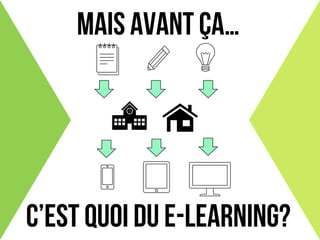
MAIS AVANT ÇA…
C’EST QUOI DU E-LEARNING?
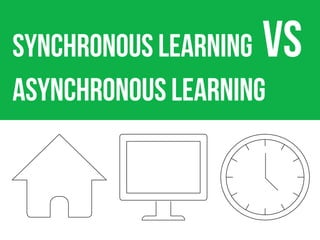
SYNCHRONOUS LEARNING VS
asynchronous learning
01 ÉTAT DE LA SITUATION
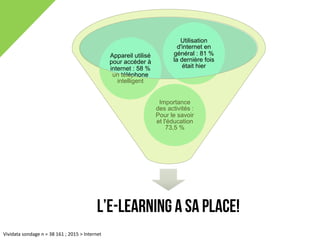
L’E-Learning a sa place!
Importance
des activités :
Pour le savoir
et l'éducation
73,5 %
Appareil utilisé
pour accéder à
internet : 58 %
un téléphone
intelligent
Utilisation
d'internet en
général : 81 %
la dernière fois
était hier
Vividata sondage	n	=	38	161	;	2015	>	Internet
Musico,	C.	(2009).	The	Evolution of	E-Learning.	Customer	Relationship	Management,	13(10),	36-41.
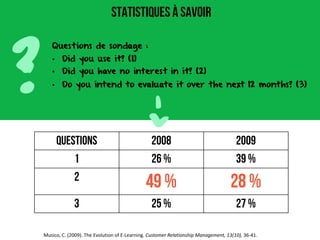
STATISTIQUES À SAVOIR
Questions de sondage :
• Did you use it? (1)
• Did you have no interest in it? (2)
• Do you intend to evaluate it over the next 12 months? (3)
Questions 2008 2009
1 26 % 39 %
2
49 % 28 %
3 25 % 27 %
?
Docebo. (2014).	E-Learning	Market Trends	&	Forecast 2014	- 2016	Report,	[En	ligne],	1-48.
CE QUE LES GENS EN PENSENT…
Docebo. (2014).	E-Learning	Market Trends	&	Forecast 2014	- 2016	Report,	[En	ligne],	1-48.
SELON LES CLIENTÈLES
Pappas,	C.	The	Top	eLearning Statistics and	Facts For	2015	You	Need To	Know.	Elearningindustry.com. (06/09/2016)
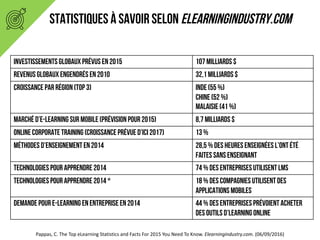
STATISTIQUES À SAVOIR selon elearningindustry.com
Investissements globaux prévus en2015 107 milliards $
Revenus globaux engendrés en2010 32,1 milliards $
Croissance par région(top 3) Inde (55 %)
Chine (52 %)
Malaisie (41 %)
Marché d’e-learning sur mobile (prévision pour 2015) 8,7 milliards $
Online Corporate Training (croissance prévue d’ici 2017) 13 %
MéthodeS d’enseignement en2014 28,5 % des heures enseignées l’ont été
faitES sans enseignant
Technologies pour apprendre 2014 74 % des entreprises utilisent LMS
Technologies pour apprendre 2014 * 18 % des compagnies utilisent des
applications mobiles
Demande pour e-learning enentreprise en2014 44 % des entreprises prévoient acheter
des outils d’learning online
AU Canada,
IL SE PASSE QUOI…
Docebo. (2014).	E-Learning	Market Trends	&	Forecast 2014	- 2016	Report,	[En	ligne],	1-48.
QUI CONNAÎT UNE
PLATEFORME OU
UNE ÉCOLE D’E-
LEARNING?
CONCRÈTEMENT, CE QUE L’ON VOIT…
McGreal,	R.	et	Anderson,	T.	(2007).	E-Learning	in	Canada.	Journal	of	Distance	Education Technologies,	5(1),	1-6.
Alberta : Leader au Canada en E-
Learning avec Athabasca
University (Open University single-
mode distance delivery)
TÉLUQ au Québec
02PROBLÉMATIQUE
A
B
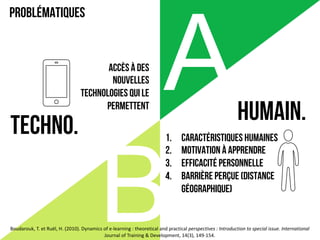
PROBLÉMATIQUES
Boudarouk,	T.	et	Ruël,	H.	(2010).	Dynamics	of	e-learning	:	theoretical and	practical perspectives	:	Introduction	to	special issue.	International	
Journal	of	Training	&	Development,	14(3),	149-154.	
Accès à des
nouvelles
technologies qui le
permettent
1. Caractéristiques humaines
2. Motivation à apprendre
3. Efficacité personnelle
4. Barrière perçue (Distance
géographique)
HUMAIN.
TECHNO.
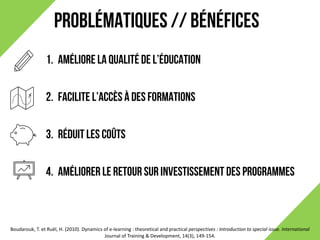
PROBLÉMATIQUES // BÉNÉFICES
Boudarouk,	T.	et	Ruël,	H.	(2010).	Dynamics	of	e-learning	:	theoretical and	practical perspectives	:	Introduction	to	special issue.	International	
Journal	of	Training	&	Development,	14(3),	149-154.	
1. Améliore la qualité de l’éducation
2. Facilite l’accès à des formations
3. Réduit les coûts
4. Améliorer le retour sur investissement des programmes
03
COMPORTEMENT
& ADOPTION
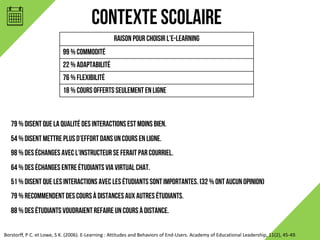
CONTEXTE SCOLAIRE
Raisonpour choisir l’e-learning
99 % commodité
22 % Adaptabilité
76 % Flexibilité
18 % Cours offerts seulement enligne
Borstorff,	P	C.	et	Lowe,	S	K.	(2006).	E-Learning	:	Attitudes	and	Behaviors of	End-Users.	Academy of	Educational Leadership,	11(2),	45-49.
79 % disent que la qualité des interactions est moins bien.
54 % disent mettre plus d’effort dans uncours enligne.
98 % des échanges avec l’instructeur se ferait par courriel.
64 % des échanges entre étudiants via virtual chat.
51 % disent que les interactions avec les étudiants sont importantes. (32 % ont aucunopinion)
79 % recommendent des cours à distances aux autres étudiants.
88 % des étudiants voudraient refaire uncours à distance.
CONTEXTE CORPORATIF
Baldwin-Evans,	K.	(2004).	Employees and	e-learning	:	what do	the	end-users think?.	Industrial and	Commercial	Training,	36(6/7),	269-274)
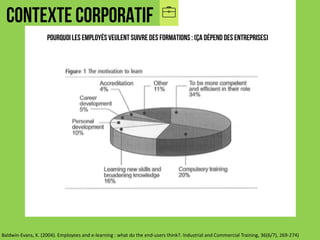
Pourquoi les employés veulent suivre des formations : (Ça dépend Des entreprises)
CONTEXTE CORPORATIF
Baldwin-Evans,	K.	(2004).	Employees and	e-learning	:	what do	the	end-users think?.	Industrial and	Commercial	Training,	36(6/7),	269-274)
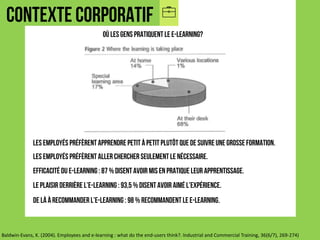
OÙ les gens pratiquent le e-learning?
LES EMPLOYÉS PRÉFÈRENT APPRENDRE PETIT À PETIT PLUTÔT QUE DE SUIVRE UNE GROSSE FORMATION.
LES EMPLOYÉS PRÉFÈRENT aller chercher seulement le nécessaire.
Efficacité du e-learning : 87 % disent avoir mis enpratique leur apprentissage.
Le plaisir derrière l’e-learning : 93,5 % disent AVOIR AIMÉ L’EXPÉRIENCE.
De là à recommander l’e-learning : 98 % recommandent le e-learning.
04BONNES PRATIQUES &
TENDANCES
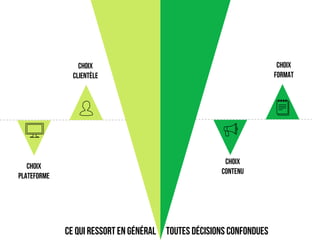
Choix
plateforme
Choix
clientèle
Choix
contenu
Choix
FORMAT
CE QUI RESSORT EN GÉNÉRAL TOUTES DÉCISIONS CONFONDUES
Watson,	J.	7	Visual	Design	Best	Practices	To	Create Effective	eLearning.	Elearningindustry.com. (06/09/2016)
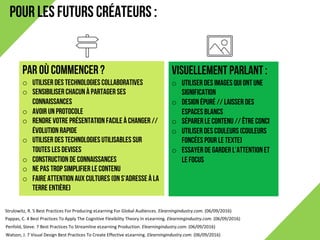
POUR LES FUTURS CRÉATEURS :
Penfold,	Steve.	7	Best	Practices	To	Streamline eLearning Production.	Elearningindustry.com. (06/09/2016)
PAR OÙ COMMENCER ?
o Utiliser des technologies collaboratives
o Sensibiliser chacunà partager ses
connaissances
o AVOIR UNPROTOCOLE
o rendre VOTRE PRÉSENTATIONFACILE À CHANGER //
ÉVOLUTIONRAPIDE
o utiliser DES TECHNOLOGIES UTILISABLES SUR
TOUTES LES DEVISES
o Constructionde connaissances
o Ne pas trop simplifier le contenu
o Faire attentionaux cultures (ons’adresse à la
terre entière)
Visuellement parlant :
o Utiliser des images qui ont une
signification
o Designépuré // Laisser des
espaces blancs
o Séparer le contenu // Être conci
o Utiliser des couleurs (couleurs
foncées pour le texte)
o Essayer de garder l’attentionet
le focus
Pappas,	C.	4	Best	Practices	To	Apply The	Cognitive	Flexibility Theory	In	eLearning.	Elearningindustry.com. (06/09/2016)
Strulowitz,	R.	5	Best	Practices	For	Producing eLearning For	Global	Audiences.	Elearningindustry.com. (06/09/2016)
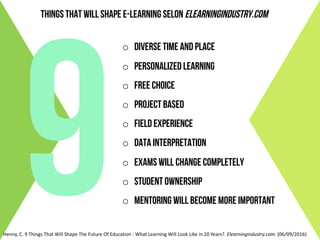
9
o Diverse time and place
o Personalized learning
o Free Choice
o Project based
o Field experience
o Data interpretation
o Exams will change completely
o Student ownership
o Mentoring will become more important
Henny,	C.	9	Things That	Will	Shape	The	Future	Of	Education :	What Learning	Will	Look	Like in	20	Years?.	Elearningindustry.com. (06/09/2016)
things that will shape e-learning selon elearningindustry.com
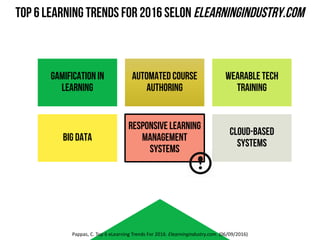
TOP 6 Learning Trends for 2016 selon elearningindustry.com
Gamification in
learning
Automated course
authoring
Wearable Tech
Training
Big Data
Responsive Learning
Management
Systems
Cloud-Based
Systems
Pappas,	C.	Top	6	eLearning Trends	For	2016.	Elearningindustry.com. (06/09/2016)
LES SOLUTIONS POUR SE LANCER…
Docebo. (2014).	E-Learning	Market Trends	&	Forecast 2014	- 2016	Report,	[En	ligne],	1-48.
POUR LE FUTUR : 100 %
E-LEARNING?
VOUS EN
PENSEZ QUOI?
QUESTIONS?
SOURCES :
Vividata sondage	n	=	38	161	;	2015	>	Internet
Musico,	C.	(2009).	The	Evolution of	E-Learning.	Customer	Relationship	Management,	13(10),	36-41.
Pappas,	C.	The	Top	eLearning Statistics and	Facts For	2015	You	Need To	Know.	Elearningindustry.com. (06/09/2016)
Pappas,	C.	Top	6	eLearning Trends	For	2016.	Elearningindustry.com. (06/09/2016)
Henny,	C.	9	Things That	Will	Shape	The	Future	Of	Education :	What Learning	Will	Look	Like in	20	Years?.	Elearningindustry.com. (06/09/2016)
McGreal,	R.	et	Anderson,	T.	(2007).	E-Learning	in	Canada.	Journal	of	Distance	Education Technologies,	5(1),	1-6.
Boudarouk,	T.	et	Ruël,	H.	(2010).	Dynamics	of	e-learning	:	theoretical and	practical perspectives	:	Introduction	to	special issue.	International	
Journal	of	Training	&	Development,	14(3),	149-154.	
Boudarouk,	T.	et	Ruël,	H.	(2010).	Dynamics	of	e-learning	:	theoretical and	practical perspectives	:	Introduction	to	special issue.	International	
Journal	of	Training	&	Development,	14(3),	149-154.	
Watson,	J.	7	Visual	Design	Best	Practices	To	Create Effective	eLearning.	Elearningindustry.com. (06/09/2016)
Penfold,	Steve.	7	Best	Practices	To	Streamline eLearning Production.	Elearningindustry.com. (06/09/2016)
Pappas,	C.	4	Best	Practices	To	Apply The	Cognitive	Flexibility Theory	In	eLearning.	Elearningindustry.com. (06/09/2016)
Strulowitz,	R.	5	Best	Practices	For	Producing eLearning For	Global	Audiences.	Elearningindustry.com. (06/09/2016)
Borstorff,	P	C.	et	Lowe,	S	K.	(2006).	E-Learning	:	Attitudes	and	Behaviors of	End-Users.	Academy of	Educational Leadership,	11(2),	45-49.
Baldwin-Evans,	K.	(2004).	Employees and	e-learning	:	what do	the	end-users think?.	Industrial and	Commercial	Training,	36(6/7),	269-274)
Docebo. (2014).	E-Learning	Market Trends	&	Forecast 2014	- 2016	Report,	[En	ligne],	1-48.

Oral individuel E-Learning

  • 1.
  • 2.
    DÉROULEMENT État de la situation// ChiffreS industrie Théorie d’adoption // Comportement des consommateurs Bonnes pratiques & TENDANCES FUTURES Problématique Enjeux
  • 3.
    MAIS AVANT ÇA… C’ESTQUOI DU E-LEARNING?
  • 4.
  • 5.
    01 ÉTAT DELA SITUATION
  • 6.
    L’E-Learning a saplace! Importance des activités : Pour le savoir et l'éducation 73,5 % Appareil utilisé pour accéder à internet : 58 % un téléphone intelligent Utilisation d'internet en général : 81 % la dernière fois était hier Vividata sondage n = 38 161 ; 2015 > Internet
  • 7.
    Musico, C. (2009). The Evolution of E-Learning. Customer Relationship Management, 13(10), 36-41. STATISTIQUES ÀSAVOIR Questions de sondage : • Did you use it? (1) • Did you have no interest in it? (2) • Do you intend to evaluate it over the next 12 months? (3) Questions 2008 2009 1 26 % 39 % 2 49 % 28 % 3 25 % 27 % ?
  • 8.
    Docebo. (2014). E-Learning Market Trends & Forecast2014 - 2016 Report, [En ligne], 1-48. CE QUE LES GENS EN PENSENT…
  • 9.
    Docebo. (2014). E-Learning Market Trends & Forecast2014 - 2016 Report, [En ligne], 1-48. SELON LES CLIENTÈLES
  • 10.
    Pappas, C. The Top eLearning Statistics and FactsFor 2015 You Need To Know. Elearningindustry.com. (06/09/2016) STATISTIQUES À SAVOIR selon elearningindustry.com Investissements globaux prévus en2015 107 milliards $ Revenus globaux engendrés en2010 32,1 milliards $ Croissance par région(top 3) Inde (55 %) Chine (52 %) Malaisie (41 %) Marché d’e-learning sur mobile (prévision pour 2015) 8,7 milliards $ Online Corporate Training (croissance prévue d’ici 2017) 13 % MéthodeS d’enseignement en2014 28,5 % des heures enseignées l’ont été faitES sans enseignant Technologies pour apprendre 2014 74 % des entreprises utilisent LMS Technologies pour apprendre 2014 * 18 % des compagnies utilisent des applications mobiles Demande pour e-learning enentreprise en2014 44 % des entreprises prévoient acheter des outils d’learning online
  • 11.
    AU Canada, IL SEPASSE QUOI… Docebo. (2014). E-Learning Market Trends & Forecast 2014 - 2016 Report, [En ligne], 1-48.
  • 12.
    QUI CONNAÎT UNE PLATEFORMEOU UNE ÉCOLE D’E- LEARNING?
  • 13.
    CONCRÈTEMENT, CE QUEL’ON VOIT… McGreal, R. et Anderson, T. (2007). E-Learning in Canada. Journal of Distance Education Technologies, 5(1), 1-6. Alberta : Leader au Canada en E- Learning avec Athabasca University (Open University single- mode distance delivery) TÉLUQ au Québec
  • 14.
  • 15.
    A B PROBLÉMATIQUES Boudarouk, T. et Ruël, H. (2010). Dynamics of e-learning : theoretical and practical perspectives : Introduction to specialissue. International Journal of Training & Development, 14(3), 149-154. Accès à des nouvelles technologies qui le permettent 1. Caractéristiques humaines 2. Motivation à apprendre 3. Efficacité personnelle 4. Barrière perçue (Distance géographique) HUMAIN. TECHNO.
  • 16.
    PROBLÉMATIQUES // BÉNÉFICES Boudarouk, T. et Ruël, H. (2010). Dynamics of e-learning : theoreticaland practical perspectives : Introduction to special issue. International Journal of Training & Development, 14(3), 149-154. 1. Améliore la qualité de l’éducation 2. Facilite l’accès à des formations 3. Réduit les coûts 4. Améliorer le retour sur investissement des programmes
  • 17.
  • 18.
    CONTEXTE SCOLAIRE Raisonpour choisirl’e-learning 99 % commodité 22 % Adaptabilité 76 % Flexibilité 18 % Cours offerts seulement enligne Borstorff, P C. et Lowe, S K. (2006). E-Learning : Attitudes and Behaviors of End-Users. Academy of Educational Leadership, 11(2), 45-49. 79 % disent que la qualité des interactions est moins bien. 54 % disent mettre plus d’effort dans uncours enligne. 98 % des échanges avec l’instructeur se ferait par courriel. 64 % des échanges entre étudiants via virtual chat. 51 % disent que les interactions avec les étudiants sont importantes. (32 % ont aucunopinion) 79 % recommendent des cours à distances aux autres étudiants. 88 % des étudiants voudraient refaire uncours à distance.
  • 19.
    CONTEXTE CORPORATIF Baldwin-Evans, K. (2004). Employees and e-learning : whatdo the end-users think?. Industrial and Commercial Training, 36(6/7), 269-274) Pourquoi les employés veulent suivre des formations : (Ça dépend Des entreprises)
  • 20.
    CONTEXTE CORPORATIF Baldwin-Evans, K. (2004). Employees and e-learning : whatdo the end-users think?. Industrial and Commercial Training, 36(6/7), 269-274) OÙ les gens pratiquent le e-learning? LES EMPLOYÉS PRÉFÈRENT APPRENDRE PETIT À PETIT PLUTÔT QUE DE SUIVRE UNE GROSSE FORMATION. LES EMPLOYÉS PRÉFÈRENT aller chercher seulement le nécessaire. Efficacité du e-learning : 87 % disent avoir mis enpratique leur apprentissage. Le plaisir derrière l’e-learning : 93,5 % disent AVOIR AIMÉ L’EXPÉRIENCE. De là à recommander l’e-learning : 98 % recommandent le e-learning.
  • 21.
  • 22.
  • 23.
    Watson, J. 7 Visual Design Best Practices To Create Effective eLearning. Elearningindustry.com. (06/09/2016) POURLES FUTURS CRÉATEURS : Penfold, Steve. 7 Best Practices To Streamline eLearning Production. Elearningindustry.com. (06/09/2016) PAR OÙ COMMENCER ? o Utiliser des technologies collaboratives o Sensibiliser chacunà partager ses connaissances o AVOIR UNPROTOCOLE o rendre VOTRE PRÉSENTATIONFACILE À CHANGER // ÉVOLUTIONRAPIDE o utiliser DES TECHNOLOGIES UTILISABLES SUR TOUTES LES DEVISES o Constructionde connaissances o Ne pas trop simplifier le contenu o Faire attentionaux cultures (ons’adresse à la terre entière) Visuellement parlant : o Utiliser des images qui ont une signification o Designépuré // Laisser des espaces blancs o Séparer le contenu // Être conci o Utiliser des couleurs (couleurs foncées pour le texte) o Essayer de garder l’attentionet le focus Pappas, C. 4 Best Practices To Apply The Cognitive Flexibility Theory In eLearning. Elearningindustry.com. (06/09/2016) Strulowitz, R. 5 Best Practices For Producing eLearning For Global Audiences. Elearningindustry.com. (06/09/2016)
  • 24.
    9 o Diverse timeand place o Personalized learning o Free Choice o Project based o Field experience o Data interpretation o Exams will change completely o Student ownership o Mentoring will become more important Henny, C. 9 Things That Will Shape The Future Of Education : What Learning Will Look Like in 20 Years?. Elearningindustry.com. (06/09/2016) things that will shape e-learning selon elearningindustry.com
  • 25.
    TOP 6 LearningTrends for 2016 selon elearningindustry.com Gamification in learning Automated course authoring Wearable Tech Training Big Data Responsive Learning Management Systems Cloud-Based Systems Pappas, C. Top 6 eLearning Trends For 2016. Elearningindustry.com. (06/09/2016)
  • 26.
    LES SOLUTIONS POURSE LANCER… Docebo. (2014). E-Learning Market Trends & Forecast 2014 - 2016 Report, [En ligne], 1-48.
  • 27.
    POUR LE FUTUR: 100 % E-LEARNING? VOUS EN PENSEZ QUOI?
  • 28.
  • 29.
    SOURCES : Vividata sondage n = 38 161 ; 2015 > Internet Musico, C. (2009). The Evolutionof E-Learning. Customer Relationship Management, 13(10), 36-41. Pappas, C. The Top eLearning Statistics and Facts For 2015 You Need To Know. Elearningindustry.com. (06/09/2016) Pappas, C. Top 6 eLearning Trends For 2016. Elearningindustry.com. (06/09/2016) Henny, C. 9 Things That Will Shape The Future Of Education : What Learning Will Look Like in 20 Years?. Elearningindustry.com. (06/09/2016) McGreal, R. et Anderson, T. (2007). E-Learning in Canada. Journal of Distance Education Technologies, 5(1), 1-6. Boudarouk, T. et Ruël, H. (2010). Dynamics of e-learning : theoretical and practical perspectives : Introduction to special issue. International Journal of Training & Development, 14(3), 149-154. Boudarouk, T. et Ruël, H. (2010). Dynamics of e-learning : theoretical and practical perspectives : Introduction to special issue. International Journal of Training & Development, 14(3), 149-154. Watson, J. 7 Visual Design Best Practices To Create Effective eLearning. Elearningindustry.com. (06/09/2016) Penfold, Steve. 7 Best Practices To Streamline eLearning Production. Elearningindustry.com. (06/09/2016) Pappas, C. 4 Best Practices To Apply The Cognitive Flexibility Theory In eLearning. Elearningindustry.com. (06/09/2016) Strulowitz, R. 5 Best Practices For Producing eLearning For Global Audiences. Elearningindustry.com. (06/09/2016) Borstorff, P C. et Lowe, S K. (2006). E-Learning : Attitudes and Behaviors of End-Users. Academy of Educational Leadership, 11(2), 45-49. Baldwin-Evans, K. (2004). Employees and e-learning : what do the end-users think?. Industrial and Commercial Training, 36(6/7), 269-274) Docebo. (2014). E-Learning Market Trends & Forecast 2014 - 2016 Report, [En ligne], 1-48.