Bienvenue en 2011 l’âge du WEB 2.0 ! Et donc de l’e-learning 2.0 fffff Jacques Folon  Forum Pédagogique du CEDHEC  24 mai 2011
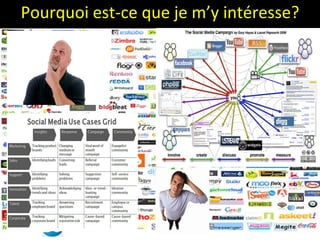
Pourquoi est-ce que je m’y intéresse?
http://spiral.univ-lyon1.fr/00-perso/marcellebrun_111107/video_conference.html PREALABLE
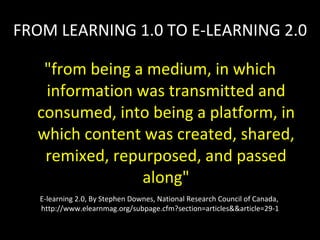
FROM LEARNING 1.0 TO E-LEARNING 2.0 "from being a medium, in which information was transmitted and consumed, into being a platform, in which content was created, shared, remixed, repurposed, and passed along" E-learning 2.0, By Stephen Downes, National Research Council of Canada,  http://www.elearnmag.org/subpage.cfm?section=articles&&article=29-1
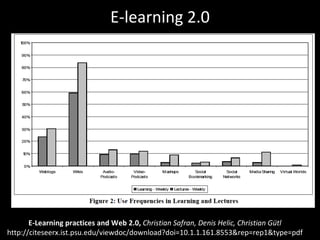
E-learning 2.0 E-Learning practices and Web 2.0,  Christian Safran, Denis Helic, Christian Gütl http://citeseerx.ist.psu.edu/viewdoc/download?doi=10.1.1.161.8553&rep=rep1&type=pdf
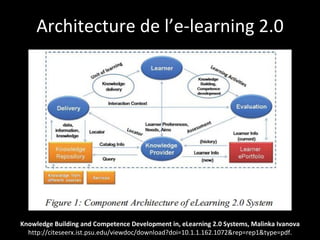
Architecture de l’e-learning 2.0 Knowledge Building and Competence Development in, eLearning 2.0 Systems, Malinka Ivanova http://citeseerx.ist.psu.edu/viewdoc/download?doi=10.1.1.162.1072&rep=rep1&type=pdf.
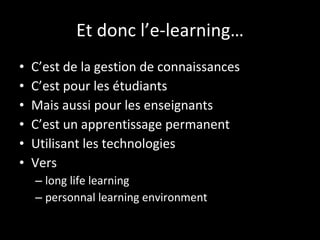
Et donc l’e-learning… C’est de la gestion de connaissances C’est pour les étudiants Mais aussi pour les enseignants C’est un apprentissage permanent Utilisant les technologies Vers long life learning  personnal learning environment
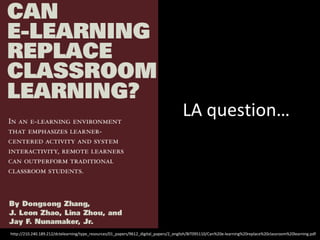
LA question… http://210.240.189.212/dctelearning/type_resources/01_papers/9612_digital_papers/2_english/BIT095110/Can%20e-learning%20replace%20classroom%20learning.pdf
QUESTION D’UN ENSEIGNANT DE L’UCL A MARCEL LEBRUN (IPM-UCL):  « L’E-LEARNING PEUT-IL ME REMPLACER? »
REPONSE:  OUI,  ET ESSENTIELLEMENT PARCE QUE VOUS VOUS POSEZ CETTE QUESTION…
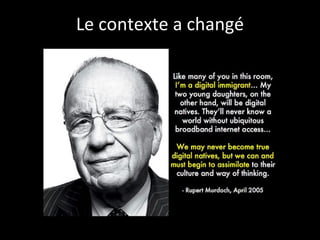
Le contexte a changé
Source: http://school.stagnesofbohemia.org/OldClass5.jpg  Mais tout n’a pas changé…
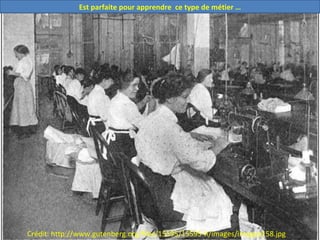
Est parfaite pour apprendre  ce type de métier … Crédit: http://www.gutenberg.org/files/15595/15595-h/images/imagep158.jpg
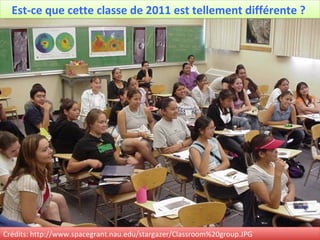
Est-ce que cette classe de 2011 est tellement différente ?  Crédits: http://www.spacegrant.nau.edu/stargazer/Classroom%20group.JPG
Crédit: http://www.faw.com/Events/images/044-2.jpg
Les quatre éléments de l’e-learning 2. 0 La génération Y L’enseignant 2.0 L’e-learning interne L’e-learning externe
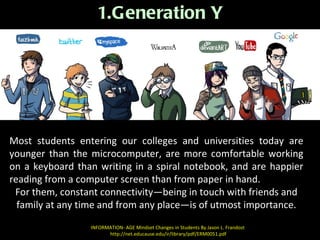
1.Generation Y Most students entering our colleges and universities today are younger than the microcomputer, are more comfortable working on a keyboard than writing in a spiral notebook, and are happier reading from a computer screen than from paper in hand.  For them, constant connectivity—being in touch with friends and family at any time and from any place—is of utmost importance. INFORMATION- AGE Mindset Changes in Students By Jason L. Frandost  http://net.educause.edu/ir/library/pdf/ERM0051.pdf
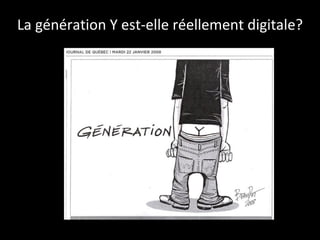
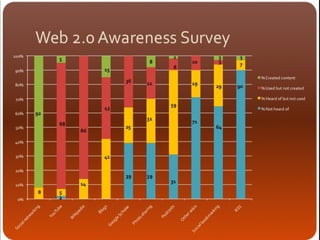
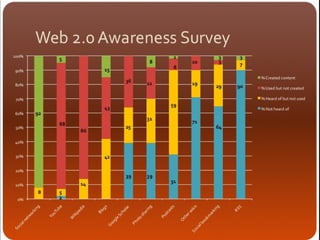
La génération Y est-elle réellement digitale?
The net generation, unplugged Technology and society: Is it really helpful to talk about a new generation of “digital natives” who have grown up with the internet?
Writing in the  British Journal of Education Technology in 2008,  a group of academics led by Sue Bennett of the University of Wollongong set out to debunk the whole idea of digital natives, arguing  that there may be “as much variation within the digital native generation as between the generations ”.
Michael Wesch, who pioneered the use of new media in his cultural anthropology classes at Kansas State University, is also sceptical, saying that many of his incoming students have only a superficial familiarity with the digital tools that they use regularly, especially when it comes to the tools’ social and political potential.  Only a small fraction of students may count as true digital natives, in other words. The rest are no better or worse at using technology than the rest of the population. Et donc comme les enseignants …
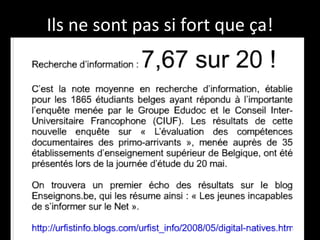
Ils ne sont pas si fort que ça!
 
Et vous ?
 
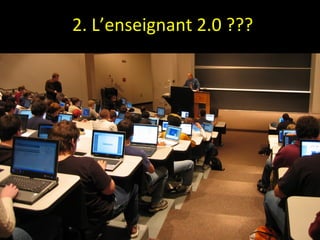
2. L’enseignant 2.0 ???
L’enseignement  ne doit pas  changer !
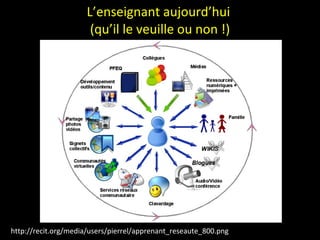
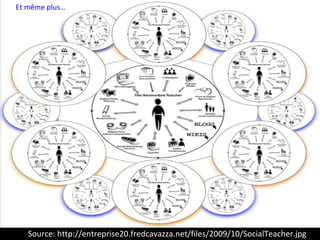
L’enseignant aujourd’hui  (qu’il le veuille ou non !) http://recit.org/media/users/pierrel/apprenant_reseaute_800.png
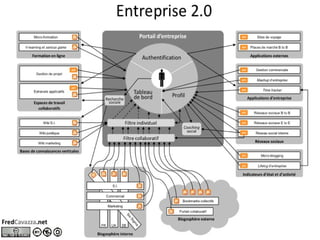
Source: http://entreprise20.fredcavazza.net/files/2009/10/SocialTeacher.jpg Et même plus…
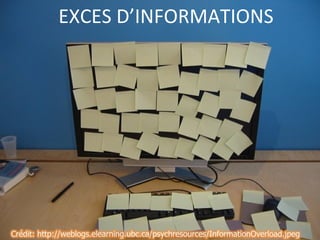
EXCES D’INFORMATIONS
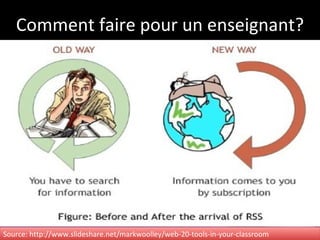
Comment faire pour un enseignant? Source: http://www.slideshare.net/markwoolley/web-20-tools-in-your-classroom
 
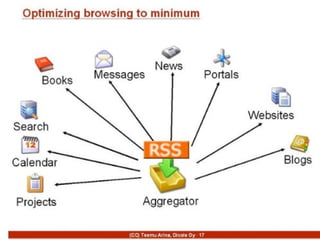
A quoi va servir le RSS pour l’enseignant? Suivre les blogs des étudiants Suivre les informations dans sa branche Partager l’information Rechercher des contenus à faire partager aux étudiants Utiliser les informations de ses pairs Recherche de podcast Créer une collaboration avec d’autres enseignants
 
A quoi sert encore l’enseignant? Guidance pour la création de son réseau Propose des modèles existants (best practices) Education quant aux façons de communiquer Assistance à la recherche de la bonne information et de l’identification des « propagandes » Assistance à la gestion des informations But: que l’étudiant soit capable de se développer dans un monde en évolution permanente
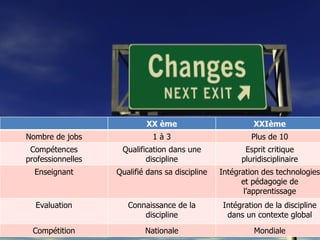
XX ème XXIème Nombre de jobs 1 à 3 Plus de 10 Compétences professionnelles Qualification dans une discipline Esprit critique pluridisciplinaire Enseignant Qualifié dans sa discipline Intégration des technologies et pédagogie de l’apprentissage Evaluation Connaissance de la discipline Intégration de la discipline dans un contexte global Compétition Nationale Mondiale
 
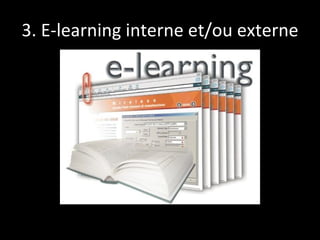
3. E-learning interne et/ou externe
 
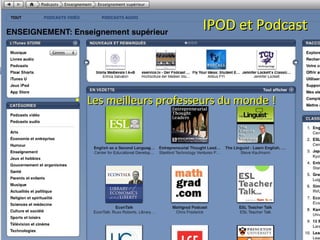
IPOD et Podcast Les meilleurs professeurs du monde !
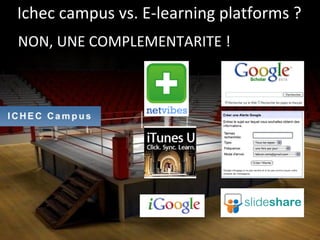
Ichec campus vs. E-learning platforms ? NON, UNE COMPLEMENTARITE !
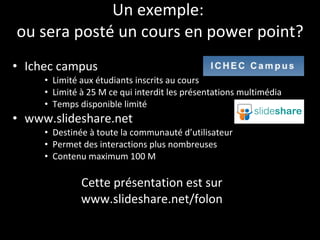
Un exemple:  ou sera posté un cours en power point? Ichec campus Limité aux étudiants inscrits au cours  Limité à 25 M ce qui interdit les présentations multimédia Temps disponible limité www.slideshare.net  Destinée à toute la communauté d’utilisateur Permet des interactions plus nombreuses Contenu maximum 100 M Cette présentation est sur  www.slideshare.net/folon
Conclusions


L’information a quitté les silos indépendants Crédit: Philippe.lemmens@jitm.eu
La gestion des connaissances est importante au niveau individuel
...  E t collectif
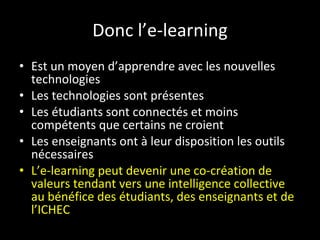
Donc l’e-learning Est un moyen d’apprendre avec les nouvelles technologies Les technologies sont présentes  Les étudiants sont connectés et moins compétents que certains ne croient Les enseignants ont à leur disposition les outils nécessaires L’e-learning peut devenir une co-création de valeurs tendant vers une intelligence collective au bénéfice des étudiants, des enseignants et de l’ICHEC
So, let’s e-learn together
- Je suis prêt à répondre à vos questions
 

Ichec cedhec 24/5/2011

  • 1.
    Bienvenue en 2011l’âge du WEB 2.0 ! Et donc de l’e-learning 2.0 fffff Jacques Folon Forum Pédagogique du CEDHEC 24 mai 2011
  • 2.
    Pourquoi est-ce queje m’y intéresse?
  • 3.
  • 4.
    FROM LEARNING 1.0TO E-LEARNING 2.0 "from being a medium, in which information was transmitted and consumed, into being a platform, in which content was created, shared, remixed, repurposed, and passed along" E-learning 2.0, By Stephen Downes, National Research Council of Canada, http://www.elearnmag.org/subpage.cfm?section=articles&&article=29-1
  • 5.
    E-learning 2.0 E-Learningpractices and Web 2.0, Christian Safran, Denis Helic, Christian Gütl http://citeseerx.ist.psu.edu/viewdoc/download?doi=10.1.1.161.8553&rep=rep1&type=pdf
  • 6.
    Architecture de l’e-learning2.0 Knowledge Building and Competence Development in, eLearning 2.0 Systems, Malinka Ivanova http://citeseerx.ist.psu.edu/viewdoc/download?doi=10.1.1.162.1072&rep=rep1&type=pdf.
  • 7.
    Et donc l’e-learning…C’est de la gestion de connaissances C’est pour les étudiants Mais aussi pour les enseignants C’est un apprentissage permanent Utilisant les technologies Vers long life learning personnal learning environment
  • 8.
  • 9.
    QUESTION D’UN ENSEIGNANTDE L’UCL A MARCEL LEBRUN (IPM-UCL): « L’E-LEARNING PEUT-IL ME REMPLACER? »
  • 10.
    REPONSE: OUI, ET ESSENTIELLEMENT PARCE QUE VOUS VOUS POSEZ CETTE QUESTION…
  • 11.
  • 12.
  • 13.
    Est parfaite pourapprendre ce type de métier … Crédit: http://www.gutenberg.org/files/15595/15595-h/images/imagep158.jpg
  • 14.
    Est-ce que cetteclasse de 2011 est tellement différente ? Crédits: http://www.spacegrant.nau.edu/stargazer/Classroom%20group.JPG
  • 15.
  • 16.
    Les quatre élémentsde l’e-learning 2. 0 La génération Y L’enseignant 2.0 L’e-learning interne L’e-learning externe
  • 17.
    1.Generation Y Moststudents entering our colleges and universities today are younger than the microcomputer, are more comfortable working on a keyboard than writing in a spiral notebook, and are happier reading from a computer screen than from paper in hand. For them, constant connectivity—being in touch with friends and family at any time and from any place—is of utmost importance. INFORMATION- AGE Mindset Changes in Students By Jason L. Frandost http://net.educause.edu/ir/library/pdf/ERM0051.pdf
  • 18.
    La génération Yest-elle réellement digitale?
  • 19.
    The net generation,unplugged Technology and society: Is it really helpful to talk about a new generation of “digital natives” who have grown up with the internet?
  • 20.
    Writing in the British Journal of Education Technology in 2008, a group of academics led by Sue Bennett of the University of Wollongong set out to debunk the whole idea of digital natives, arguing that there may be “as much variation within the digital native generation as between the generations ”.
  • 21.
    Michael Wesch, whopioneered the use of new media in his cultural anthropology classes at Kansas State University, is also sceptical, saying that many of his incoming students have only a superficial familiarity with the digital tools that they use regularly, especially when it comes to the tools’ social and political potential. Only a small fraction of students may count as true digital natives, in other words. The rest are no better or worse at using technology than the rest of the population. Et donc comme les enseignants …
  • 22.
    Ils ne sontpas si fort que ça!
  • 23.
  • 24.
  • 25.
  • 26.
  • 27.
    L’enseignement nedoit pas changer !
  • 28.
    L’enseignant aujourd’hui (qu’il le veuille ou non !) http://recit.org/media/users/pierrel/apprenant_reseaute_800.png
  • 29.
  • 30.
  • 31.
    Comment faire pourun enseignant? Source: http://www.slideshare.net/markwoolley/web-20-tools-in-your-classroom
  • 32.
  • 33.
    A quoi vaservir le RSS pour l’enseignant? Suivre les blogs des étudiants Suivre les informations dans sa branche Partager l’information Rechercher des contenus à faire partager aux étudiants Utiliser les informations de ses pairs Recherche de podcast Créer une collaboration avec d’autres enseignants
  • 34.
  • 35.
    A quoi sertencore l’enseignant? Guidance pour la création de son réseau Propose des modèles existants (best practices) Education quant aux façons de communiquer Assistance à la recherche de la bonne information et de l’identification des « propagandes » Assistance à la gestion des informations But: que l’étudiant soit capable de se développer dans un monde en évolution permanente
  • 36.
    XX ème XXIèmeNombre de jobs 1 à 3 Plus de 10 Compétences professionnelles Qualification dans une discipline Esprit critique pluridisciplinaire Enseignant Qualifié dans sa discipline Intégration des technologies et pédagogie de l’apprentissage Evaluation Connaissance de la discipline Intégration de la discipline dans un contexte global Compétition Nationale Mondiale
  • 37.
  • 38.
    3. E-learning interneet/ou externe
  • 39.
  • 40.
    IPOD et PodcastLes meilleurs professeurs du monde !
  • 41.
    Ichec campus vs.E-learning platforms ? NON, UNE COMPLEMENTARITE !
  • 42.
    Un exemple: ou sera posté un cours en power point? Ichec campus Limité aux étudiants inscrits au cours Limité à 25 M ce qui interdit les présentations multimédia Temps disponible limité www.slideshare.net Destinée à toute la communauté d’utilisateur Permet des interactions plus nombreuses Contenu maximum 100 M Cette présentation est sur www.slideshare.net/folon
  • 43.
  • 44.
  • 45.
  • 46.
  • 47.
  • 48.
    L’information a quittéles silos indépendants Crédit: Philippe.lemmens@jitm.eu
  • 49.
    La gestion desconnaissances est importante au niveau individuel
  • 50.
    ... Et collectif
  • 51.
    Donc l’e-learning Estun moyen d’apprendre avec les nouvelles technologies Les technologies sont présentes Les étudiants sont connectés et moins compétents que certains ne croient Les enseignants ont à leur disposition les outils nécessaires L’e-learning peut devenir une co-création de valeurs tendant vers une intelligence collective au bénéfice des étudiants, des enseignants et de l’ICHEC
  • 52.
  • 53.
    - Je suisprêt à répondre à vos questions
  • 54.

Notes de l'éditeur

  • #49 “ I put it somewhere safe, but now I can’t find it.” Information overload age, Information silos, Information retrieval, Information anxiety, Search engine fatigue, Scarcity of attention