Objective (s)
 By the end of this lesson, you will be able to:
 Greet people and say good-bye in French
 Find out how to ask a person’s name.
 Find out how to ask someone’s age.


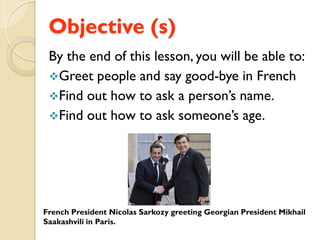
French President Nicolas Sarkozy greeting Georgian President Mikhail
Saakashvili in Paris.
Time of day affects greeting
In the morning, the greeting is
Bonjour! = Good morning! Hello!
In the evening, the greeting is
Bonsoir! = Good evening!
At night
Bonsoir OR
 Bonne nuit = Good night!
Giving Title
                      Monsieur = Sir
                      Madame = Mrs.
                      Mademoiselle = Miss

        GREETINGS
Hello          Bonjour
Good evening   Bonsoir
Good night     Bonsoir
Hi             Salut
                    Saying Good-Bye
          À bientôt = See you soon
           À demain = see you tomorrow
          À tout à l’heure = see you later
          Bonne journée = have a good day
Formal Asking
 Whether talking to one person or more than one, ask :
Comment allez-vous? (How are you?)
             Answering
        Je vais bien (I'm fine)

               Bien, merci (Fine, thanks)

            Bien, et vous?(Fine, and you?)

Je vais bien merci, et vous? (I am fine thank
you, and you?).
Informal Asking
The most common questions are:
 Ça va?(literally means, Is it going?)
 Comment vas-tu? (How are you?)
 Ça va bien? (Is it going well?)
 Comment ça va? (How's it going?)
FINDING OUT A PERSON’S NAME (FORMAL)

When you want to find out the name of a
person who is older than you, or you do
not know, you can ask:
 Comment vous appellez-vous? (What is
  your name? OR
 Vous vous appellez comment?
Answer:
 Je m’appelle (what is your name …)
Greeting
When two young people meet, They say….
 Salut! = Hi


When two older people greet each other they say…
 Bonjour! = Good morning Hello!


One addresses people as …
 Monsieur = sir.


A married lady as …..
 Madame= Mrs.


An unmarried lady as ….
 Mademoiselle = Miss
FINDING OUT A PERSON’S NAME (INFORMAL)

 When you want to find out the name of a
 person who is about the same age as you,
 or a friend, you can ask:

  Comment     tu t’appelles? (what is your name?)
              OR
  Tu t’appelles comment?

 Answer
  Je m’appelle (my name is ….)
CONVERSATION FORMAL
      Pat       Enchanté / Enchantée.                                        Dominique
                  It's nice to meet you.


 2. Bonjour                            1. Bonjour
                                        3. Comment ça va?
 4. Ça va très bien
  merci. Et vous?                       5. Ça va, merci.
                                         Comment vous appellez-
 6. Je m’appelle Pat.                   vous?
  Et vous comment                       7. Je m’appelle
  vous appellez vous?                    Dominique.
   8. Enchanté Dominique               9. Enchanté Pat.
                            http://french.about.com/library/listening/bl-begdialogue1-listen.htm
CONVERSATION INFORMAL
      Pat        Enchanté / Enchantée.                                        Dominique
                   It's nice to meet you.


 2. Bonjour                             1. Bonjour
                                         3. Comment ça va?
 4. Ça va très bien
  merci. Et toi?                         5. Ça va, merci.
                                          Comment tu t’ appelles?
 6. Je m’appelle Pat.
                                         7. Je m’appelle
  Et toi comment tu                       Dominique.
 t’ appelles?                           9. Enchanté Pat.
   8. Enchanté Dominique
                             http://french.about.com/library/listening/bl-begdialogue1-listen.htm
FINDING OUT A PERSON’S AGE (FORMAL)

To find out a person’s age who is older than
you, or you do not know, you can ask:
Vous avez quel âge? How old are you?
 OR
Quel âge avez-vous?
Answer:
J’ai (number) ans. (J’ai 21 (vingt et un) ans).
                       I am 21 years old.
Finding out a person’s age (informal)

To find out the âge of a person who is
 about the same age as you, or a friend,
 you can ask:
Tu as quel âge? (How old are you?)
     OR
Quel âge as-tu?
Answer:
J’ai (number) ans. (J’ai 25(vingt cinq) ans).
                          I am 25 years old.
Learn how to say: You are not doing well in French.


    Monsieur : Bonjour, ça va?
    Blessé : Pas très bien
    Obélix : Ça va, Astérix?
    Astérix : Comme ci, comme ça, Obélix...
   Pas très bien               Not very well
   Pas mal                     Not bad
   Ça va, Astérix?             (How is it going, Astérix?)
   Comme ci, comme ça,         So, so Obélix...or (like this. like
    Obélix...                   that, Obélix...)
Learn how to say: When you will see each other again in French.


                  Client : Au revoir!
                  Peintre : A bientôt.
                 Pierre : A demain?
                Julie : D'accord. A demain!
            Au revoir                   Bye.
            A bientôt                   See you soon
            D'accord                    Agreed! (OK)
            A demain                    Until tomorrow
Greeting people
Greeting People
Narrator:
Deux petits oiseaux
Assis sur une branche.


Je m’appelle Fifi.


Je m’appelle Blanche.
 Bonjour Fifi

Bonjour Blanche


Au revoir Fifi


Au revoir Blanche.
RÉPÉTEZ APRÈS MOI. (Repeat after me)

Bonjour!
Salut ! Ça va?
Ça va très bien, merci.
Comment t’appelles-tu? Comment vous appellez-vous
Je m’appelle ( Name) _____.
Quel âge as-tu? Quel âge avez-vous?
J’ai (number) ______ans.
Moi, j’ai (number) _____ ans.
Merci, à bientôt!
au revoir!
MAINTENANT À VOTRE TOUR
Give the English equivalent of the following words.
1. Salut =________
2. Bonjour =_______
3. Pas mal =_______
4. bien =________
5. Très bien =_____
6. Monsieur =_____
7. Madame =______
8. Mademoiselle =____
9. Bonsoir =________
10. bonne nuit =_______
11. enchanté =________
12. bonne journée =_____
13. je vais bien =_______
14. au revoir =________
15. tu t’appelles comment =______
16. Je m’apelle =________
17. Mal =_________
18. comme çi comme ça =_________
19. Très mal =_____________
20. Bien merci=____________
MAINTENANT À VOTRE TOUR
                     Practice
Matching
__1. Au revoir!                         A. What is your name
__2. Bonjour.                          B. Delighted/ Nice to meet you
__3. Enchanté(e)                        C. My name is
__4. Comment vous appellez-vous        D. See you tomorrow
__5. Je m’appelle                      E. Good-bye
__6. Á demain                          F. Hello


Put the conversation in logical order.
_____ Enchanté, Carline. Je m’appelle Joseph.
_____ Bonjour. Je m’appelle Carline.
_____ Comment vous appellez-vous?
_____ Au revoir Joseph.
MAINTENANT À VOTRE TOUR


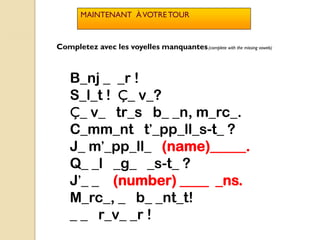
Completez avec les voyelles manquantes.(complete with the missing vowels)


    B_nj _ _r !
    S_l_t ! Ç_ v_?
    Ç_ v_ tr_s b_ _n, m_rc_.
    C_mm_nt t’_pp_ll_s-t_ ?
    J_ m’_pp_ll_ (name)_____.
    Q_ _l _g_ _s-t_ ?
    J’_ _ (number) ____ _ns.
    M_rc_, _ b_ _nt_t!
    _ _ r_v_ _r !
RESOURCES
       http://french.about.com/library/listening/bl-begdialogue1-listen.htm (Conversation)


        http://www.smartphrase.com/French/fr_general_words_phr.shtml (list of words)


     http://french.about.com/od/vocabulary/ss/greetings.htm (Quiz)

     http://highered.mcgraw-hill.com/sites/dl/free/0072560320/73840/01_01.mp3 (Les bonnes manières)


http://highered.mcgraw-hill.com/sites/0072560320/student_view0/chapitre1/__l_ecoute_sur_internet_.html   (vis à vis beginning
French Book )

French greeting go

  • 1.
    Objective (s) Bythe end of this lesson, you will be able to: Greet people and say good-bye in French Find out how to ask a person’s name. Find out how to ask someone’s age. French President Nicolas Sarkozy greeting Georgian President Mikhail Saakashvili in Paris.
  • 2.
    Time of dayaffects greeting In the morning, the greeting is Bonjour! = Good morning! Hello! In the evening, the greeting is Bonsoir! = Good evening! At night Bonsoir OR  Bonne nuit = Good night!
  • 3.
    Giving Title Monsieur = Sir Madame = Mrs. Mademoiselle = Miss GREETINGS Hello Bonjour Good evening Bonsoir Good night Bonsoir Hi Salut Saying Good-Bye À bientôt = See you soon  À demain = see you tomorrow À tout à l’heure = see you later Bonne journée = have a good day
  • 4.
    Formal Asking Whethertalking to one person or more than one, ask : Comment allez-vous? (How are you?) Answering Je vais bien (I'm fine) Bien, merci (Fine, thanks) Bien, et vous?(Fine, and you?) Je vais bien merci, et vous? (I am fine thank you, and you?).
  • 5.
    Informal Asking The mostcommon questions are:  Ça va?(literally means, Is it going?)  Comment vas-tu? (How are you?)  Ça va bien? (Is it going well?)  Comment ça va? (How's it going?)
  • 6.
    FINDING OUT APERSON’S NAME (FORMAL) When you want to find out the name of a person who is older than you, or you do not know, you can ask:  Comment vous appellez-vous? (What is your name? OR  Vous vous appellez comment? Answer:  Je m’appelle (what is your name …)
  • 7.
    Greeting When two youngpeople meet, They say….  Salut! = Hi When two older people greet each other they say…  Bonjour! = Good morning Hello! One addresses people as …  Monsieur = sir. A married lady as …..  Madame= Mrs. An unmarried lady as ….  Mademoiselle = Miss
  • 8.
    FINDING OUT APERSON’S NAME (INFORMAL) When you want to find out the name of a person who is about the same age as you, or a friend, you can ask:  Comment tu t’appelles? (what is your name?) OR  Tu t’appelles comment? Answer  Je m’appelle (my name is ….)
  • 9.
    CONVERSATION FORMAL Pat Enchanté / Enchantée. Dominique It's nice to meet you.  2. Bonjour  1. Bonjour  3. Comment ça va?  4. Ça va très bien merci. Et vous?  5. Ça va, merci. Comment vous appellez-  6. Je m’appelle Pat. vous? Et vous comment  7. Je m’appelle vous appellez vous? Dominique.  8. Enchanté Dominique  9. Enchanté Pat. http://french.about.com/library/listening/bl-begdialogue1-listen.htm
  • 10.
    CONVERSATION INFORMAL Pat Enchanté / Enchantée. Dominique It's nice to meet you.  2. Bonjour  1. Bonjour  3. Comment ça va?  4. Ça va très bien merci. Et toi?  5. Ça va, merci. Comment tu t’ appelles?  6. Je m’appelle Pat.  7. Je m’appelle Et toi comment tu Dominique.  t’ appelles?  9. Enchanté Pat.  8. Enchanté Dominique http://french.about.com/library/listening/bl-begdialogue1-listen.htm
  • 11.
    FINDING OUT APERSON’S AGE (FORMAL) To find out a person’s age who is older than you, or you do not know, you can ask: Vous avez quel âge? How old are you? OR Quel âge avez-vous? Answer: J’ai (number) ans. (J’ai 21 (vingt et un) ans). I am 21 years old.
  • 12.
    Finding out aperson’s age (informal) To find out the âge of a person who is about the same age as you, or a friend, you can ask: Tu as quel âge? (How old are you?) OR Quel âge as-tu? Answer: J’ai (number) ans. (J’ai 25(vingt cinq) ans). I am 25 years old.
  • 13.
    Learn how tosay: You are not doing well in French. Monsieur : Bonjour, ça va? Blessé : Pas très bien Obélix : Ça va, Astérix? Astérix : Comme ci, comme ça, Obélix...  Pas très bien Not very well  Pas mal Not bad  Ça va, Astérix? (How is it going, Astérix?)  Comme ci, comme ça, So, so Obélix...or (like this. like Obélix... that, Obélix...)
  • 14.
    Learn how tosay: When you will see each other again in French. Client : Au revoir! Peintre : A bientôt. Pierre : A demain? Julie : D'accord. A demain!  Au revoir Bye.  A bientôt See you soon  D'accord Agreed! (OK)  A demain Until tomorrow
  • 15.
  • 16.
  • 17.
    Narrator: Deux petits oiseaux Assissur une branche. Je m’appelle Fifi. Je m’appelle Blanche. Bonjour Fifi Bonjour Blanche Au revoir Fifi Au revoir Blanche.
  • 18.
    RÉPÉTEZ APRÈS MOI.(Repeat after me) Bonjour! Salut ! Ça va? Ça va très bien, merci. Comment t’appelles-tu? Comment vous appellez-vous Je m’appelle ( Name) _____. Quel âge as-tu? Quel âge avez-vous? J’ai (number) ______ans. Moi, j’ai (number) _____ ans. Merci, à bientôt! au revoir!
  • 19.
    MAINTENANT À VOTRETOUR Give the English equivalent of the following words. 1. Salut =________ 2. Bonjour =_______ 3. Pas mal =_______ 4. bien =________ 5. Très bien =_____ 6. Monsieur =_____ 7. Madame =______ 8. Mademoiselle =____ 9. Bonsoir =________ 10. bonne nuit =_______ 11. enchanté =________ 12. bonne journée =_____ 13. je vais bien =_______ 14. au revoir =________ 15. tu t’appelles comment =______ 16. Je m’apelle =________ 17. Mal =_________ 18. comme çi comme ça =_________ 19. Très mal =_____________ 20. Bien merci=____________
  • 20.
    MAINTENANT À VOTRETOUR Practice Matching __1. Au revoir! A. What is your name __2. Bonjour. B. Delighted/ Nice to meet you __3. Enchanté(e) C. My name is __4. Comment vous appellez-vous D. See you tomorrow __5. Je m’appelle E. Good-bye __6. Á demain F. Hello Put the conversation in logical order. _____ Enchanté, Carline. Je m’appelle Joseph. _____ Bonjour. Je m’appelle Carline. _____ Comment vous appellez-vous? _____ Au revoir Joseph.
  • 21.
    MAINTENANT À VOTRETOUR Completez avec les voyelles manquantes.(complete with the missing vowels) B_nj _ _r ! S_l_t ! Ç_ v_? Ç_ v_ tr_s b_ _n, m_rc_. C_mm_nt t’_pp_ll_s-t_ ? J_ m’_pp_ll_ (name)_____. Q_ _l _g_ _s-t_ ? J’_ _ (number) ____ _ns. M_rc_, _ b_ _nt_t! _ _ r_v_ _r !
  • 22.
    RESOURCES http://french.about.com/library/listening/bl-begdialogue1-listen.htm (Conversation) http://www.smartphrase.com/French/fr_general_words_phr.shtml (list of words) http://french.about.com/od/vocabulary/ss/greetings.htm (Quiz) http://highered.mcgraw-hill.com/sites/dl/free/0072560320/73840/01_01.mp3 (Les bonnes manières) http://highered.mcgraw-hill.com/sites/0072560320/student_view0/chapitre1/__l_ecoute_sur_internet_.html (vis à vis beginning French Book )