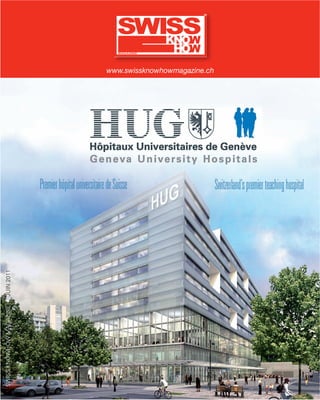
www.swissknowhowmagazine.ch
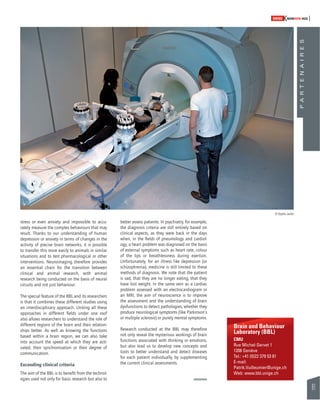
Swiss Quality in Health Care 
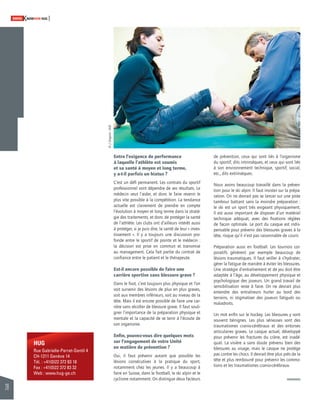
Rheumatology 
Ophthalmology 
Neurology 
www.trbchemedica.com
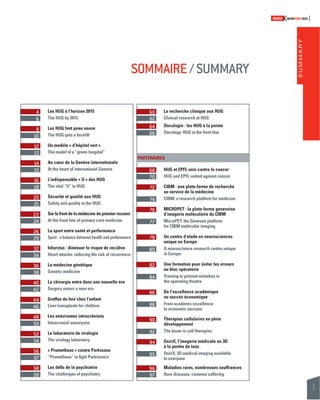
SOMMAIRE / SUMMARY 
SUMMARY 
60 La recherche clinique aux HUG 
62 Clinical research at HUG 
64 Oncologie : les HUG à la pointe 
66 Oncology: HUG in the front line 
PARTENAIRES 
68 HUG et EPFL unis contre le cancer 
70 HUG and EPFL united against cancer 
72 CIBM : une plate-forme de recherche 
au service de la médecine 
74 CIBM: a research platform for medicine 
76 MICROPET : la plate-forme genevoise 
d’imagerie moléculaire du CIBM 
77 MicroPET: the Genevan platform 
for CIBM molecular imaging 
78 Un centre d’étude en neurosciences 
unique en Europe 
80 A neuroscience research centre unique 
in Europe 
82 Une formation pour éviter les erreurs 
au bloc opératoire 
84 Training to prevent mistakes in 
the operating theatre 
86 De l’excellence académique 
au succès économique 
88 From academic excellence 
to economic success 
90 Thérapies cellulaires en plein 
développement 
92 The boom in cell therapies 
94 OsiriX, l’imagerie médicale en 3D 
à la portée de tous 
95 OsiriX, 3D medical imaging available 
to everyone 
96 Maladies rares, nombreuses souffrances 
97 Rare diseases, common suffering 
SWISSKNOWHOW HUG 
1 
4 Les HUG à l’horizon 2015 
6 The HUG by 2015 
8 Les HUG font peau neuve 
10 The HUG gets a facelift 
12 Un modèle « d’hôpital vert » 
13 The model of a “green hospital” 
14 Au coeur de la Genève internationale 
15 At the heart of international Geneva 
16 L’indispensable « U » des HUG 
18 The vital “U” in HUG 
20 Sécurité et qualité aux HUG 
21 Safety and quality at the HUG 
22 Sur le front de la médecine de premier recours 
24 At the front line of primary care medicine 
26 Le sport entre santé et performance 
29 Sport - a balance between health and performance 
32 Infarctus : diminuer le risque de récidive 
34 Heart attacks: reducing the risk of recurrence 
36 La médecine génétique 
38 Genetic medicine 
40 La chirurgie entre dans une nouvelle ère 
42 Surgery enters a new era 
44 Greffes du foie chez l’enfant 
46 Liver transplants for children 
48 Les anévrismes intracrâniens 
50 Intracranial aneurysms 
52 Le laboratoire de virologie 
54 The virology laboratory 
56 « Prometheus » contre Parkinson 
57 “Prometheus” to fi ght Parkinson’s 
58 Les défi s de la psychiatrie 
59 The challenges of psychiatry
Éditeur : GREAT MEDIA SA 
Rue des Pilettes 3 - CH-1700 Fribourg 
Tél. : +41 (0)26 422 36 83 - Fax : +41 (0)26 422 36 85 
E-mail : info@greatmedia.ch - Web : www.swissknowhowmagazine.ch 
Rédaction : M. Jean-Bernard Vuillème - Mme France-Anne Landry - M. Peter Stoeferle - M. Alessandro Pesce - 
Mme Anita Panzer - M. Generoso Chiaradonna - M. Patrick Di Lenardo 
Coordination : Imprigraphic - CE 
Impression : Imprigraphic - CE 
Photos 1re couverture : Hôpitaux Universitaires de Genève 
Juin 2011 
Toute reproduction, même partielle, des articles publiés dans ce numéro, nécessite explicitement le consentement écrit de l’éditeur. 
SWISS KNOWHOW MAGAZINE • JUIN 2011 
www.swissknowhowmagazine.ch
Swiss Quality in Health Care 
Rheumatology 
Ophthalmology 
Neurology 
www.trbchemedica.com
4 
SWISSKNOWHOW HUG 
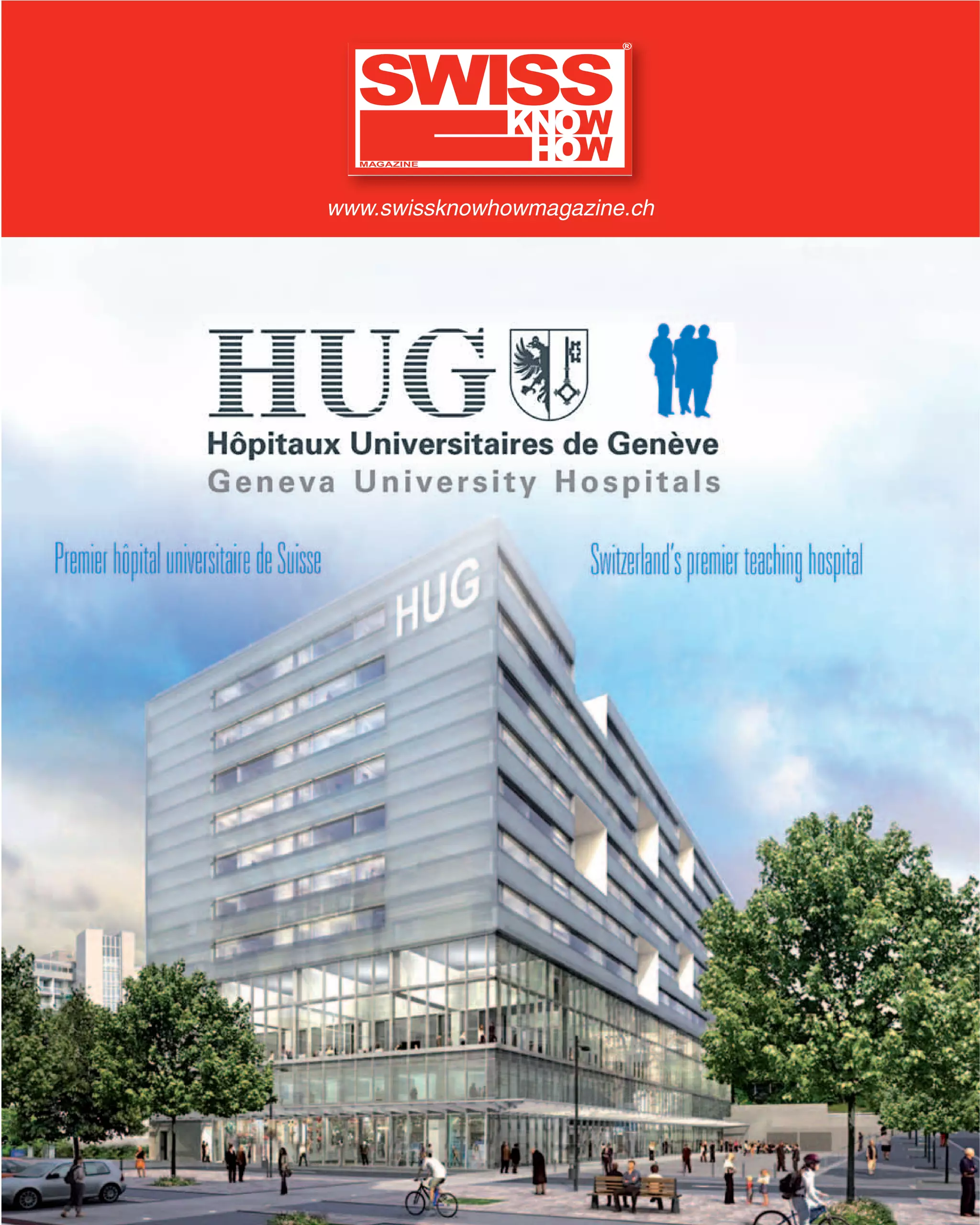
Les Hôpitaux 
Universitaires de Genève 
(HUG) sont le premier 
hôpital universitaire de Suisse. 
Directeur général depuis 
1999, Bernard Gruson tient 
la barre d’un navire imposant 
et complexe occupant 
quelque 10 000 personnes 
et s’acquittant d’une triple 
mission : assurer les soins, 
participer à la formation 
et développer des projets 
de recherche clinique. 
Les HUG jouent le rôle d’un 
hôpital de proximité en tant 
qu’hôpital général public 
et constituent un important 
pôle de compétence national 
et international. De nombreux 
défi s doivent être relevés 
en ce début de XXIe siècle, 
à commencer, en Suisse 
même, par une libéralisation 
qui va laisser dès 2012 aux 
patients le libre choix de 
l’établissement hospitalier. 
M. Bernard Gruson a bien 
voulu répondre à nos 
questions. 
LES HUG À L’HORIZON 2015 
Entretien avec M. Bernard Gruson, directeur général 
Les verbes « soigner, enseigner, 
chercher » recoupent les trois missions 
essentielles des HUG. Y a-t-il un verbe 
qui passe avant les autres dans le plan 
stratégique Vision 2015 ? 
Comme l’indique l’ordre de l’énumération, le 
soin est la première de nos missions, mais toutes 
trois sont inscrites dans la loi et sont complémen-taires. 
Mais si je devais résumer nos objectifs en 
un mot, je dirais qualité, et qualité en tout, les 
soins aussi bien que l’administration ou la logis-tique. 
La qualité est un tout. 
Quels sont les principaux défi s à relever 
par les HUG au cours des prochaines 
années ? 
Il y en a quatre : le défi de la capacité, car il faut 
faire face à l’augmentation de la population, 
plus 20 % au cours des 20 dernières années, et 
à son vieillissement ; le défi de l’attractivité, dans 
un contexte de concurrence accrue et de libre 
circulation des patients ; le défi de la coopération 
(avec le réseau de soins genevois, mais aussi les 
autres CHU au plan national et international) et 
le défi du fi nancement de nos activités et infra-structures. 
Les HUG comptent près de dix mille 
collaborateurs, ce qui en fait l’un 
des premiers employeurs du canton de 
Genève. Êtes-vous affecté par la pénurie 
de médecins, avez-vous aujourd’hui déjà 
un problème de relève ? 
Attirer – et retenir – les talents nécessaires à l’acti-vité 
qu’elle exerce est un enjeu important pour 
toute organisation. Et crucial pour un hôpital si 
l’on songe que les besoins en personnel de santé 
hospitalier vont augmenter de 13 % d’ici 2020, 
selon l’OFSP. Pour l’instant, le nombre de méde-cins 
internes est inférieur à nos besoins, il nous 
faut donc l’augmenter. L’objectif que nous nous 
sommes fi xé avec la faculté de médecine est de 
150 diplômés en pré-grade par an. Nous allons 
aussi établir des planifi cations afi n d’identifi er 
les métiers en pénurie ou à risque de le devenir, 
et favoriser le recrutement dans ces domaines. 
Outre son aspect « matériel », soit 
des constructions nouvelles, l’accueil 
des patients fait-il partie des priorités 
du plan stratégique Vision 2015 ? 
C’est essentiel. Ne dit-on pas d’ailleurs que 
l’accueil est le premier des soins ? L’accueil com-prend 
non seulement les conditions hôtelières, 
qui vont être considérablement améliorées par 
les grands projets de rénovation et de construc-tion 
que nous avons lancés, mais aussi, et surtout, 
l’information des patients et de leurs proches. On 
constate que les besoins en la matière ne cessent 
d’augmenter jusqu’à devenir un critère de satis-faction 
clé de nos patients. 
« La qualité de la communication 
patient-soignant et l’image de l’hôpital 
deviennent déterminantes », lit-on au 
début du plan stratégique Vision 2015. 
Pourquoi ? 
2012 marquera l’entrée en vigueur de la Loi 
modifi ée sur l’assurance-maladie, la LAMal. Elle 
va modifi er le paysage hospitalier, notamment 
en introduisant la libre circulation des patients, 
c’est-à-dire la possibilité pour un Genevois d’aller 
se faire soigner à Lausanne ou à Berne et la pos-sibilité 
pour un Fribourgeois ou un Valaisan de 
venir se faire soigner à Genève. Cette libre circu-lation 
va créer une concurrence inédite entre les 
hôpitaux. D’où l’importance de l’image. Le choix 
est aussi basé sur l’idée que les patients se font 
du service dont ils vont bénéfi cier. Aujourd’hui, il 
ne suffi t plus d’être bon, il faut le faire savoir. Le 
temps de la modestie est fi ni. 
M. Bernard Gruson
5 
SWISSKNOWHOW HUG 
l’enfant et l’adolescent, les affections 
hépatopancréatiques et le diabète, la 
médecine de l’appareil locomoteur et 
du sport, la médecine génétique, les 
neurosciences et enfi n l’oncologie. 
Des collaborations sont 
nécessaires dans la recherche 
clinique et la médecine de 
pointe. Lesquelles existent 
actuellement, notamment avec 
le CHUV ? Lesquelles devraient 
être développées ? 
Nos collaborations avec le CHUV 
portent notamment sur la transplan-tation, 
la neurochirurgie, la médecine 
légale, la médecine hyperbare, les 
implants cochléaires ou encore sur 
la prise en charge des grands brûlés. 
Nous sommes animés par un souci 
commun : offrir aux patients romands 
toute la palette des soins spécialisés. 
D’autres partenariats devront être 
explorés avec les CHU, les écoles d’in-génieurs 
et les grands acteurs indus-triels, 
mais aussi au plan local avec le 
réseau de soins. 
HUG 
Rue Gabrielle-Perret-Gentil 4 
1211 Genève 14 
Tél. : +41 (0)22 372 33 11 
Web : www.hug-ge.ch 
Les HUG entendent développer 
les « itinéraires cliniques ». 
De quoi s’agit-il ? 
L’itinéraire clinique est un outil au service de la 
qualité. Il vise la coordination entre profession-nels 
afi n de garantir la fl uidité de ce que nous 
appelons « la trajectoire du patient » au sein des 
structures de soins. C’est une « partition » coor-donnant 
l’ensemble des actes autour du patient 
pour une pathologie donnée, dans une vision 
transversale et multidisciplinaire. Par exemple, 
pour une opération de la prostate, on récapitule 
l’ensemble des actions à réaliser, de la prise de 
contact initiale à la fi n du traitement, avant, 
pendant et après l’hospitalisation, en prenant en 
considération les aspects de soins, de chirurgie, 
de physiothérapie. 
Il y a bien sûr la question des coûts. 
On peut lire à ce propos dans le plan 
stratégique que l’une des priorités est 
de « veiller à l’économicité des soins » et 
de « tendre à toujours plus d’effi cience ». 
Comment concilier cet impératif avec 
l’exigence d’excellence et de qualité ? 
L’effi cience, c’est précisément cela : la qualité au 
meilleur coût. Utiliser au mieux les ressources à 
disposition, afi n d’offrir le meilleur service pos-sible. 
Au cours des trois dernières années, nous 
avons économisé 85 millions de francs en repen-sant 
notre organisation, sans rien céder au plan 
de la qualité. Et nous pouvons encore améliorer 
nos processus. 
Néanmoins, en 2012, la réforme de la LAMal 
aura un impact important sur les fi nances hospi-talières. 
Prenons l’exemple des HUG. Si, en 2012, 
la valeur du point TARMED était alignée sur la 
moyenne des établissements publics, cela signi-fi 
erait une baisse de 9 millions de francs. Si, en 
2014, celle du point DRG était calquée sur la 
moyenne des hôpitaux universitaires, cela corres-pondrait 
à une coupe de 120 millions. Quant 
aux recettes pour les soins subaigus (gériatrie, 
réadaptation, etc.), avec l’application de la nou-velle 
tarifi cation, elles subiraient une diminu-tion 
de 15 % dès 2012. Au total, le budget des 
HUG serait amputé de 10 %, alors que les coûts 
salariaux – qui représentent 80 % des dépenses 
d’un hôpital – continueraient à croître. Dans ces 
conditions, comment investir pour maintenir la 
qualité des soins, améliorer le confort hospitalier, 
élargir la prise en charge des personnes âgées, 
favoriser la recherche et les soins tertiaires ? 
Demain, si la modifi cation de la LAMal n’est 
pas maîtrisée, 200 millions pourraient manquer 
chaque année dans les caisses. La diminution 
des durées de séjour, la suppression des journées 
d’hospitalisation inappropriées ou le report sur 
l’ambulatoire ne suffi ront pas pour équilibrer les 
comptes. Des choix s’imposeront. C’est la raison 
pour laquelle les HUG ont engagé une véritable 
réfl exion médico-économique. 
Quels sont les points forts des HUG 
en matière de recherche et quelles 
sont les priorités ? 
En lien étroit avec la faculté de médecine, nous 
avons atteint un niveau d’excellence reconnu 
dans plusieurs domaines de médecine de pointe. 
Nous sommes par exemple le premier CHU de 
Suisse pour les affections du foie et du pancréas. 
Notre médecine génétique a acquis une renom-mée 
mondiale, notamment grâce aux travaux sur 
le chromosome 21. Pour 2010-2015, nous avons 
défi ni 7 axes tertiaires prioritaires : les affections 
cardio-vasculaires, les affections complexes de 
Les HUG, c’est... 
- L’un des 5 hôpitaux universitaires de 
Suisse avec Bâle, Berne, Lausanne et 
Zurich, 
- quelque 680 000 journées d’hospita-lisation 
par année, 
- plus de 3 500 repas servis chaque jour, 
- près de 10 000 collaborateurs, 
- quelque 1 500 médecins, 
- un budget de plus de 1,6 milliard de 
francs, 
- 8 centres, 2 laboratoires de recherche 
clinique translationnelle et 1 institut, 
- 12 départements médicaux, 
- 65 services médicaux.
6 
SWISSKNOWHOW HUG 
Geneva University 
Hospital (HUG) is the 
premier teaching hospital in 
Switzerland. Bernard Gruson, 
Chief Executive Offi cer since 
1999, is at the helm of an 
imposing and complex ship, 
employing some 10,000 
people and fulfi lling a triple 
mission: to provide treatment, 
enable training and develop 
clinical research projects. 
As a general public hospital, 
the HUG plays the role of 
a community hospital and 
represents an important 
national and international 
centre of excellence. There 
are numerous challenges 
to be overcome now, at the 
start of the 21st century, 
starting with a liberalisation 
in Switzerland that will give 
patients the freedom to 
chose their hospital. Bernard 
Gruson kindly agreed to 
answer our questions. 
THE HUG BY 2015 
Interview with CEO Bernard Gruson 
The verbs “to treat, to teach, to pursue” 
cover the three fundamental missions 
of the HUG. Is there one verb that 
takes precedence over the others 
in the Vision 2015 strategic plan? 
As indicated by the order of the list, treatment is 
our primary mission, but all three are enshrined 
in law and complement each other. But if I could 
sum up our objectives in one word, I would 
say quality. And I mean quality in everything, 
from treatment to administration and logistics. 
Quality is everything. 
What are the main challenges that 
the HUG has to face over the next few 
years? 
There are four: the challenge of capacity, as 
we deal with a growing population that is to 
increase by 20% in the next 20 years and that 
is ageing; the challenge of attractiveness in the 
face of increased competition and the free move-ment 
of patients; the challenge of cooperation 
(with the Geneva healthcare network and also 
with other university hospitals at a national and 
international level); and the challenge of fi nanc-ing 
for our activities and infrastructure. 
The HUG has nearly 10,000 employees, 
making it one of the top employers in 
the canton of Geneva. Are you affected 
by the shortage of doctors, and do 
you already have problems fi nding 
replacements? 
Attracting – and retaining – the necessary talent 
for the tasks to be performed is an important 
issue for any organisation. And it is crucial for a 
hospital if you consider that personnel require-ments 
for hospital care are going to increase by 
13% by 2020, according to OFSP. Right now, we 
do not have enough in-house doctors to meet 
our needs, so we need to increase our numbers. 
The target that we have set with the faculty of 
medicine is 150 undergraduate graduates each 
year. We are also going to establish plans to 
identify those occupations where there is or risks 
being a shortage and will promote recruitment 
in these areas. 
Besides its “material” aspect and the 
construction of new buildings, is patient 
reception one of the priorities in the 
Vision 2015 strategic plan? 
It is essential. Isn’t it said that the reception 
provides the fi rst form of treatment? Reception 
doesn’t just include the hospital environment, 
which will be vastly improved by major renova-tion 
and construction projects that are already 
underway, but also, and above all, the provision 
of information to patients and their families. It is 
clear that requirements in this area are continu-ing 
to grow, such that they have now become a 
key factor for patient satisfaction. 
“The quality of communication between 
patients and medical staff and the 
image of the hospital are becoming 
crucial,” according to the introduction 
to the Vision 2015 strategic plan. Why is 
this? 
2012 marks the introduction of the amended law 
on health insurance, the LAMal. It will change 
the hospital landscape by allowing free move-ment 
of patients, which means that someone in 
Geneva can opt for care in Lausanne or Berne, 
and someone from Fribourg or the Valais can 
come to Geneva for their care. This free move-ment 
will introduce a previously unknown level 
of competition between hospitals. That is why 
our image is important. Patient choice will also 
be based on the impression that patients form of 
the service from which they will benefi t. So now 
Mr. Bernard Gruson
7 
SWISSKNOWHOW HUG 
disorders in children and adolescents, 
hepato-pancreatic diseases and dia-betes, 
medicine of the musculoskel-etal 
system and sports medicine, 
genetic medicine, neuroscience, and 
fi nally oncology. 
Collaborations are necessary in clini-cal 
research and cutting-edge medi-cine. 
Which collaborations do you 
have in place at present, in particular 
with the CHUV? And which need to 
be fostered in future? 
Our collaborations with the CHUV 
mainly centre on transplantation, neu-rosurgery, 
forensic medicine, hyper-baric 
medicine, cochlear implants 
and the care of third-degree burns 
patients. We are driven by a com-mon 
motive: to offer patients in the 
French-speaking part of Switzerland 
the full range of specialist care. We 
would like to explore other partner-ships 
with the university hospitals, 
engineering colleges and major 
industrial players, and also with the 
healthcare network at a local level. 
it’s no longer enough to be good at what we do, 
we have to let everyone know that we are. The 
time for modesty is over. 
The HUG intends to develop its “clinical 
itineraries”. Can you explain what this 
means? 
A clinical itinerary is a tool aimed at provid-ing 
quality. It ensures coordination between 
professionals so that what we call the “patient 
trajectory” is as smooth as possible through the 
healthcare structures. It is like a “musical score” 
that coordinates all the players involved in a 
patient’s care for a given pathology as part of an 
overarching, multidisciplinary vision. For exam-ple, 
for a prostate operation, we summarise all 
the actions to be carried out from the fi rst con-tact 
to the end of the treatment, before during 
and after the hospital care, taking account of 
all nursing, surgical, and physiotherapy aspects. 
There is naturally the question of cost. 
The strategic plan states that one of 
the priorities is to “ensure healthcare 
is economical” and to “strive towards 
increasing effi ciency”. How can you 
reconcile this requirement with the 
demand for excellence and quality? 
Effi ciency means exactly that: quality for the best 
price. Using the available resources in the best 
way so as to offer the best possible service. Over 
the last three years, we have saved 85 million 
Swiss francs by rethinking our organisation and 
without forsaking any of our quality. And there 
is still room for improvement in our processes. 
Nevertheless, the reform of the LAMal law on 
health insurance in 2012 will have a signifi cant 
effect on hospital fi nances. Let’s take the exam-ple 
of the HUG. If the value of the TARMED 
point in 2012 were to be brought into line with 
the average for public establishments, it would 
mean a reduction of 9 million francs. If, in 2014, 
the value of the DRG point is calculated on the 
average of university hospitals, it will mean a cut 
of 120 million. As for revenue for sub-acute care 
(geriatrics, rehabilitation, etc.), the application 
of the new tariff system will subject these areas 
to a reduction of 15% from 2012. In total, the 
HUG budget will be cut back by 10%, while sal-ary 
costs – which represent 80% of a hospital’s 
expenditure – will continue to grow. Under these 
conditions, how can we invest in order to main-tain 
standards of care, improve hospital comfort, 
widen the care provided for the elderly, support 
research and tertiary care? If the amendment 
to the LAMal is not overruled, there could be a 
200 million francs shortfall in the coffers every 
year. Shortening hospital stays, eliminating 
unnecessary days of hospitalisation and transfer-ring 
patients to outpatient care are not suffi cient 
measures to balance the accounts. Hard choices 
will have to be made and that is why the HUG is 
engaged in a thorough medical/economic con-sultation 
process. 
What are the HUG’s strengths in the 
area of research and what are its 
priorities? 
Together with the faculty of medicine, we have 
achieved a recognised level of excellence in many 
areas of cutting-edge medicine. For example, we 
are the top university hospital in Switzerland for 
disorders of the liver and pancreas. Our genetic 
medicine has achieved global renown, thanks in 
particular to our work on chromosome 21. For 
2010-2015, we have defi ned 7 tertiary axes as 
our priorities: cardiovascular disorders, complex 
The HUG… 
- is one of 5 university hospitals in 
Switzerland with Basle, Berne, Lausanne 
and Zurich, 
- provides some 680,000 days of 
hospitalisation every year, 
- serves more than 3,500 meals every day, 
- has nearly 10,000 employees, 
- employs some 1,500 doctors, 
- has a budget of more than 1.6 billion 
Swiss francs, 
- has 8 centres, 2 translational clinical 
research laboratories and 1 institute, 
- 12 medical departments, 
- 65 medical services. 
HUG 
Rue Gabrielle-Perret-Gentil 4 
1211 Genève 14 
Tel.: +41 (0)22 372 33 11 
Web: www.hug-ge.ch
8 
SWISSKNOWHOW HUG 
Les Hôpitaux 
Universitaires de Genève 
(HUG) représentent un parc 
immobilier de 2 milliards 
de CHF. Un tel ensemble 
architectural, développé à 
des époques différentes, 
nécessite bien sûr un entretien 
constant, avec des travaux 
pour ainsi dire permanents. 
Les chantiers actuels et futurs, 
notamment celui du nouveau 
bâtiment des lits, dépassent 
néanmoins largement 
l’entretien et la mise à niveau 
courants. Il s’agit d’investis-sements 
majeurs pour 
l’avenir qui tiennent compte 
de perspectives prévisibles 
comme l’augmentation 
du nombre d’habitants, 
le vieillissement de la 
population, l’évolution de 
certaines pathologies ou le 
développement de nouvelles 
technologies de prise en 
charge. Outre le projet central 
du nouveau bâtiment des 
lits, d’autres gros chantiers 
sont en cours ou sur le 
point de s’ouvrir : nouvelle 
maternité, nouveau bâtiment 
des laboratoires, rénovation 
de l’hôpital des enfants 
(pédiatrie). Point de la 
situation avec M. F. Taillard, 
directeur général adjoint 
des HUG. 
LES HUG FONT PEAU NEUVE 
Quatre gros chantiers simultanés 
Quel est l’objectif des HUG avec ces gros 
chantiers ? Visent-ils aussi à augmenter 
le nombre de lits, qui était précisément 
de 1 815 en 2010 ? 
Le nombre de lits LAMal est passé à 1 800 en 
2011. Il s’agit de lits dits « en service ». La struc-ture 
immobilière laisse une marge de manoeuvre 
vers le haut en cas de besoin pour faire face, 
par exemple, à une épidémie. Ces 1 800 lits se 
subdivisent en 900 lits de soins aigus (pour de 
courts séjours de moins de 10 jours), 600 lits de 
réhabilitation/réadaptation (moyens séjours de 
plus de 20 jours) et 300 lits de psychiatrie. 
Ces chantiers n’ont pas pour objectif d’augmenter 
le nombre de lits. La tendance est à la diminu-tion 
de la durée des séjours hospitaliers et au 
renforcement des prises en charge ambulatoires 
et à domicile. À l’exception probable du secteur 
de réhabilitation et de réadaptation, l’augmen-tation 
de la population devrait être à peu près 
compensée par la diminution de la durée des 
séjours hospitaliers et de l’évolution des techno-logies. 
L’objectif de ces chantiers majeurs, qui représen-tent 
au total près de 600 millions de francs inves-tis, 
est bel et bien d’offrir davantage de confort 
aux patients et d’améliorer la qualité des soins. 
Le nouveau bâtiment des lits est 
notamment considéré comme 
indispensable. 
Le Grand Conseil a voté à l’unanimité un crédit 
de 253 millions de francs. Les travaux commen-ceront 
à la fi n de l’été 2011 et le nouveau bâti-ment 
devrait être opérationnel au début 2016. 
L’actuel bâtiment, construit en 1966, ne répond 
plus du tout aux critères actuels. C’est une 
impérieuse nécessité pour le renom de Genève 
et des HUG de remédier à cette situation. Il y a 
encore des chambres communes à 7 lits avec une 
douche et un WC pour 10 patients. 
Nous n’augmentons pas le nombre de lits, mais 
nous améliorons notablement le confort : le projet 
prévoit des chambres de 1 ou 2 lits avec sani-taires, 
répondant aux normes pour handicapés. 
Nous profi tons d’autre part de ce chantier pour 
augmenter notre capacité opératoire afi n de faire 
face à un accroissement prévisible de la demande. 
Six salles d’opérations supplémentaires seront ins-tallées. 
Nous allons aussi regrouper l’ensemble 
des soins intensifs qui sont aujourd’hui dissémi-nés 
dans deux zones distinctes. 
Un autre chantier important est prévu 
sur le site principal Cluse-Roseraie, soit 
la construction d’un nouveau bâtiment 
des laboratoires. 
Les travaux devraient débuter en été 2011. 
C’est un investissement global de 65 millions 
de francs. Ce projet sera fi nancé grâce aux 
économies de fonctionnement que nous allons 
réaliser avec ce regroupement et à l’apport de 
fondations et du secteur privé pour le dévelop-pement 
de la recherche. Il s’agira d’un immeuble 
de 9 étages dont six destinés aux laboratoires 
des hôpitaux, deux au développement de la 
médecine translationnelle et un à la technique 
du bâtiment. L’ouverture probable aura lieu au 
cours du 1er semestre 2014. 
Ce nouveau bâtiment, construit à la place du 
bâtiment des séminaires, regroupera l’ensemble 
de nos laboratoires aujourd’hui disséminés sur 
une bonne trentaine de lieux différents. C’est un 
projet innovant : les patients bénéfi cieront des 
dernières découvertes de la médecine fondamen-tale 
et, inversement, la recherche se nourrira de 
l’expérience clinique. 
Il convient encore de mentionner 
les travaux en cours, à commencer 
par la rénovation de la maternité. 
La maternité est en travaux depuis 1993, selon 
un plan de rénovation et d’agrandissement éche-lonné 
en plusieurs étapes pour un coût total de 
quelque 250 millions de francs. Nous avons com-mencé 
par construire un nouveau bâtiment pour 
ensuite dégager et rénover l’immeuble ancien, 
datant de 1907. Les nouvelles chambres gagnent 
10 m2 et seront occupées par deux patientes au 
maximum, contre trois auparavant, dans des 
espaces exigus. Les salles d’accouchement seront
9 
SWISSKNOWHOW HUG 
toire n’est guère extensible. C’est pour cette 
raison, par exemple, que la rénovation de l’hôpi-tal 
des enfants et de la maternité prend autant 
de temps, car il est effectivement compliqué de 
concilier travaux et exploitation en limitant au 
mieux les perturbations pour les patients et les 
services. Cette diffi culté est aussi sensible pour 
la rénovation de la maternité. 
HUG 
Direction générale 
Rue Gabrielle-Perret-Gentil 4 
CH-1211 Genève 14 
Tél. : +41 (0)22 372 33 11 
Fax : +41 (0)22 372 60 75 
Web : www.hug-ge.ch 
aussi plus nombreuses, passant de 8 à 12, plus 
vastes et mieux équipées. 
Les HUG doivent répondre à l’augmentation du 
nombre des naissances, liée à l’augmentation de 
la population. D’une centaine de lits aujourd’hui, 
nous allons passer à 130 lits pour accueillir les 
4 000 naissances annuelles qui font de la mater-nité 
des HUG la plus grande de Suisse. 
Au terme d’une ultime étape, de 2014 à début 
2017, le dernier quart de l’ancienne maternité 
sera rénové. 
Enfi n, il y a la rénovation en cours 
de l’hôpital des enfants. 
La rénovation a commencé en 2009 et devrait 
s’achever en 2013. Ces travaux, devisés à 22 mil-lions 
de francs, répondent à la nécessité de réno-ver 
toute la partie ambulatoire de la pédiatrie, 
l’onco-hématologie ainsi que la pédopsychiatrie. 
Le bâtiment, qui date du début des années 60, 
ne répond plus aux normes actuelles, malgré une 
première extension en 1997. Les travaux actuels 
sont considérés comme un « lifting ». 
N’est-ce pas une grande diffi culté 
de mener ces travaux de modernisation 
tout en maintenant les services 
en exploitation et en limitant autant 
que possible les nuisances ? 
Il aurait évidemment été plus simple et plus 
rapide de partir de zéro, comme c’est le cas pour 
le nouveau bâtiment des lits. Tous ces travaux 
ont lieu sur le site Cluse-Roseraie, dont le terri- 
Quatre sites 
Les HUG travaillent sur quatre sites.et 
disposent d’une quarantaine de structures 
ambulatoires réparties en ville. Les 
travaux dont il est ici question concernent 
tous le site Cluse-Roseraie. 
! Cluse-Roseraie, site principal à 
Genève. Il comprend l’hôpital cantonal, 
la maternité, l’hôpital des enfants, la 
radio-oncologie, l’ophtalmologie, Beau- 
Séjour et englobe principalement les 
activités hospitalières de court séjour et 
les plateaux médico-techniques. 
! Belle-Idée comprend les services de 
psychiatrie, de médecine interne de 
réhabilitation et de gériatrie. Séjours de 
moyenne durée. Situé à Thônex. 
! Bellerive, hôpital dédié à la réa dap-tation 
et aux soins palliatifs. Situé à 
Collonge-Bellerive. 
! Loëx, hôpital de moyen et long séjour, 
réadaptation. Situé à Bernex. 
Uniquement des chambres à 1 ou 2 lits dans le futur bâtiment
10 
SWISSKNOWHOW HUG 
T What is the HUG aiming to achieve with 
this major construction work? Are you 
aiming to increase the number of beds, 
which was exactly 1,815 in 2010? 
In 2011, there are 1,800 LAMal health insurance 
beds. These are what we call “in service” beds. 
The building structure leaves room to increase 
this number if needed, in the event of an epi-demic 
for example. These 1,800 beds are divided 
into 900 acute care beds (for short stays of less 
than 10 days), 600 rehabilitation/reeduca-tion 
beds (medium-length stays of more than 
20 days) and 300 psychiatric beds. 
The aim of the construction work is not to 
increase the number of beds. There is a move 
towards shorter stays in hospital, with outpa-tient 
care and care at home being increased. 
With the probable exception of the rehabilita-tion 
and reeducation sector, the population 
increase should be more or less compensated 
for by hospital stays becoming shorter and tech-nologies 
being developed. 
The aim of the major construction work, which 
represents in total an investment of almost 600 
million Swiss francs, is really to provide patients 
with more comfort and to improve the quality 
of care. 
The new ward building is considered 
to be particularly vital. 
The Great Council voted unanimously for a credit 
of 253 million Swiss francs. Work will begin at 
the end of the summer 2011, and the new build-ing 
should be operational in early 2016. The 
current building, built in 1966, no longer meets 
current needs - it is absolutely vital for the rep-utation 
of Geneva and the HUG that this situ-ation 
is remedied. There are still 7-bed shared 
wards with one shower, and one toilet for every 
10 patients. 
We are not increasing the number of beds, but 
we are considerably improving the level of com-fort: 
the project provides for 1- or 2-bed ensuite 
rooms that meet standards for disabled people. 
We are also using this construction project to 
increase our operating capacity to deal with a 
foreseeable increase in demand. Six additional 
operating theatres will be installed. We will also 
bring together all the intensive care units, which 
are today separated into two distinct zones. 
Another large construction project is 
planned on the main Cluse-Roseraie site 
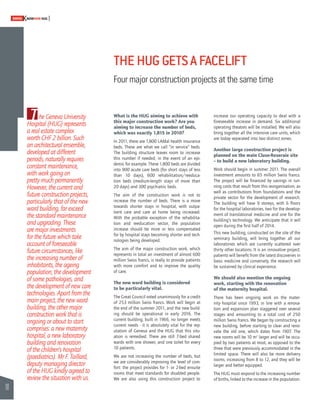
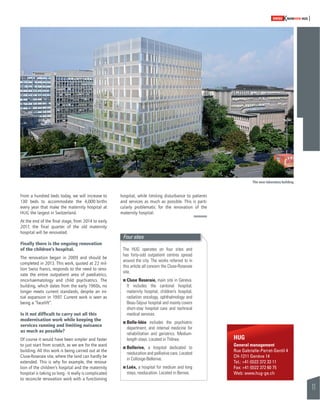
– to build a new laboratory building. 
Work should begin in summer 2011. The overall 
investment amounts to 65 million Swiss francs. 
The project will be fi nanced by savings in run-ning 
costs that result from this reorganisation, as 
well as contributions from foundations and the 
private sector for the development of research. 
The building will have 9 storeys, with 6 fl oors 
for the hospital laboratories, two for the develop-ment 
of translational medicine and one for the 
building’s technology. We anticipate that it will 
open during the fi rst half of 2014. 
This new building, constructed on the site of the 
seminary building, will bring together all our 
laboratories which are currently scattered over 
thirty other locations. It is an innovative project: 
patients will benefi t from the latest discoveries in 
basic medicine and conversely, the research will 
be sustained by clinical experience. 
We should also mention the ongoing 
work, starting with the renovation 
of the maternity hospital. 
There has been ongoing work on the mater-nity 
hospital since 1993, in line with a renova-tion 
and expansion plan staggered over several 
stages and amounting to a total cost of 250 
million Swiss francs. We began by constructing a 
new building, before starting to clear and reno-vate 
the old one, which dates from 1907. The 
new rooms will be 10 m2 larger and will be occu-pied 
by two patients at most, as opposed to the 
three that were previously accommodated in the 
limited space. There will also be more delivery 
rooms, increasing from 8 to 12, and they will be 
larger and better equipped. 
The HUG must respond to the increasing number 
of births, linked to the increase in the population. 
he Geneva University 
Hospital (HUG) represents 
a real estate complex 
worth CHF 2 billion. Such 
an architectural ensemble, 
developed at different 
periods, naturally requires 
constant maintenance, 
with work going on 
pretty much permanently. 
However, the current and 
future construction projects, 
particularly that of the new 
ward building, far exceed 
the standard maintenance 
and upgrading. These 
are major investments 
for the future which take 
account of foreseeable 
future circumstances, like 
the increasing number of 
inhabitants, the ageing 
population, the development 
of some pathologies, and 
the development of new care 
technologies. Apart from the 
main project, the new ward 
building, the other major 
construction work that is 
ongoing or about to start 
comprises: a new maternity 
hospital, a new laboratory 
building and renovation 
of the children’s hospital 
(paediatrics). Mr F. Taillard, 
deputy managing director 
of the HUG kindly agreed to 
review the situation with us. 
THE HUG GETS A FACELIFT 
Four major construction projects at the same time
11 
SWISSKNOWHOW HUG 
From a hundred beds today, we will increase to 
130 beds to accommodate the 4,000 births 
every year that make the maternity hospital at 
HUG the largest in Switzerland. 
At the end of the fi nal stage, from 2014 to early 
2017, the fi nal quarter of the old maternity 
hospital will be renovated. 
Finally there is the ongoing renovation 
of the children’s hospital. 
The renovation began in 2009 and should be 
completed in 2013. This work, quoted at 22 mil-lion 
Swiss francs, responds to the need to reno-vate 
the entire outpatient area of paediatrics, 
onco-haematology and child psychiatrics. The 
building, which dates from the early 1960s, no 
longer meets current standards, despite an ini-tial 
expansion in 1997. Current work is seen as 
being a “facelift”. 
Is it not diffi cult to carry out all this 
modernisation work while keeping the 
services running and limiting nuisance 
as much as possible? 
Of course it would have been simpler and faster 
to just start from scratch, as we are for the ward 
building. All this work is being carried out at the 
Cluse-Roseraie site, where the land can hardly be 
extended. This is why for example, the renova-tion 
of the children’s hospital and the maternity 
hospital is taking so long - it really is complicated 
to reconcile renovation work with a functioning 
hospital, while limiting disturbance to patients 
and services as much as possible. This is parti-cularly 
problematic for the renovation of the 
maternity hospital. 
HUG 
General management 
Rue Gabrielle-Perret-Gentil 4 
CH-1211 Genève 14 
Tel.: +41 (0)22 372 33 11 
Fax: +41 (0)22 372 60 75 
Web: www.hug-ge.ch 
Four sites 
The HUG operates on four sites and 
has forty-odd outpatient centres spread 
around the city. The works referred to in 
this article all concern the Cluse-Roseraie 
site. 
! Cluse Roseraie, main site in Geneva. 
It includes the cantonal hospital, 
maternity hospital, children’s hospital, 
radiation oncology, ophthalmology and 
Beau-Séjour hospital and mainly covers 
short-stay hospital care and technical 
medical services. 
! Belle-Idée includes the psychiatric 
department, and internal medicine for 
rehabilitation and geriatrics. Medium-length 
stays. Located in Thônex. 
! Bellerive, a hospital dedicated to 
reeducation and palliative care. Located 
in Collonge-Bellerive. 
! Loëx, a hospital for medium and long 
stays, reeducation. Located in Bernex. 
The new laboratory building
12 
SWISSKNOWHOW HUG 
Les HUG ont été le 
premier centre hospitalier 
universitaire européen à se 
doter d’un programme de 
développement durable. De 
nombreux projets ont été 
lancés. Ils concernent toutes 
les activités liées à l’utilisation 
des énergies, de l’eau, des 
biens de consommation, 
mais aussi le traitement des 
déchets, les déplacements 
des personnes et des biens, 
ainsi que des mesures de 
protection de l’air, de l’eau et 
des sols. Un premier Ecobilan 
a été réalisé en 2009. 
M. Christian Decurnex, 
chef du Département 
d’exploitation, et M. Alain 
Samson, responsable 
opérationnel du projet, 
détaillent cette politique pour 
un hôpital vert. 
UN MODÈLE « D’HÔPITAL VERT » 
Les HUG en pionniers européens 
1 468 000 KWh et le mandat Manger local, en 
partenariat avec les fournisseurs. Cette politique a 
permis aux HUG de développer des mandats por-teurs 
d’actions visibles et bien acceptées, parfois 
reprises par d’autres. 
Quels sont les principaux enseignements 
du premier Ecobilan des HUG ? 
Il a fait ressortir que l’impact le plus important 
des HUG sur l’environnement est généré par les 
transports, soit les déplacements de ses quelque 
10 000 collaborateurs et le fl ux de trafi c induit. 
En second lieu, il faut relever la charge environ-nementale 
des médicaments. Des mesures ont 
été mises en place pour diminuer les rejets dans 
les eaux usées. 
Le 2e Ecobilan a été planifi é pour 2013. Cela 
permettra de mesurer les premiers effets des 
mesures mises en oeuvre. 
Quelles démarches ont-elles été entreprises 
dans le domaine de la mobilité ? 
Plusieurs mesures ont été mises en oeuvre 
comme l’achat de vélos classiques et électriques 
et des aménagements pratiques au parking vélo. 
Des prêts à zéro pour cent sont accordés pour 
l’achat d’un vélo classique ou électrique. Nous 
travaillons aussi à la sécurisation du deuxième 
parking deux-roues couvert sur le site Cluse- 
Roseraie, à la création d’un parking deux-roues 
sur le site de Beau-Séjour et à l’extension de 
notre fl otte de vélos classiques et électriques en 
prêt pour les déplacements professionnels sur les 
sites de Belle-Idée et de Loëx. 
Nous testons aussi une vélothèque, système de 
prêt et de réservation automatisé de vélos pliables. 
Le covoiturage est encouragé. Nous testons un 
logiciel interactif permettant de mettre en rela-tion 
les collaborateurs effectuant les mêmes tra-jets, 
car ce concept n’est pas toujours facile à 
appliquer aux HUG, malgré le nombre important 
de collaborateurs, en raison d’horaires nombreux 
et disparates. 
Les actions engagées sont-elles bien 
acceptées par le personnel ? 
La plupart des actions réalisées dans le cadre 
du plan de mobilité sont très populaires, notam-ment 
celles concernant la promotion du vélo. 
L’octroi d’abonnements de parking facilité pour 
les équipes de covoiturage est très apprécié, 
comme la subvention de 50 % sur l’abonnement 
Unireso des Transports Publics Genevois. Le ren-forcement 
des horaires de la navette intersites, 
les réductions sur les abonnements P+R et la 
mise à disposition de véhicules mobility car-sharing 
pour les déplacements professionnels 
nécessitant la voiture sont aussi des mesures 
appréciées. 
Certaines mesures ne sont-elles pas 
perçues comme des « contraintes » ? 
Les mesures relatives à la restriction de l’accès 
aux abonnements de parkings individuels aux 
HUG ont reçu un accueil plus contrasté. Avec 
seulement 900 places disponibles pour environ 
8 000 collaborateurs sur le site Cluse-Roseraie 
et une liste d’attente qui ne cesse de grossir, il 
a fallu appliquer des critères d’octroi plus restric-tifs. 
Les nouveaux critères prennent en compte 
les besoins réels des collaborateurs et privilégient 
ceux qui n’ont pas d’autres possibilités de dépla-cement. 
Cette mesure a été saluée par un grand 
nombre d’employés inscrits depuis des années 
sur la liste d’attente et dont les contraintes 
d’horaires ajoutées à l’absence de desserte en 
transports publics étaient très diffi ciles à gérer. 
Les importants chantiers en cours ou 
en projet aux HUG vont-ils contribuer, 
une fois réalisés, à une baisse sensible 
de la consommation d’énergie ? 
Nos projets et leurs concepts énergétiques sont 
discutés avec les organes étatiques compétents 
et nous permettent d’intégrer des solutions 
viables pour limiter les consommations d’énergie 
et intégrer des énergies renouvelables. 
Le nouveau bâtiment des lits répondra à la norme 
MOPEC et la part d’énergie non renouvelable ne 
dépassera pas les 60 % des besoins admissibles 
pour le chauffage et l’eau chaude sanitaire. Pour 
y parvenir, 500 m2 de panneaux solaires seront 
installés en toiture, de même qu’un système de 
récupération de chaleur sur la production frigori-fi 
que. Par ailleurs, l’eau de pluie sera récupérée 
pour alimenter les chasses d’eau des toilettes et 
arroser les espaces verts. 
Quant au nouveau bâtiment des laboratoires, un 
soin particulier a été apporté aux installations 
techniques afi n de garantir une récupération 
maximale de la chaleur diffusée par les nom-breux 
équipements et machines. Les stores et 
éclairages seront pilotés en fonction des condi-tions 
climatiques. 
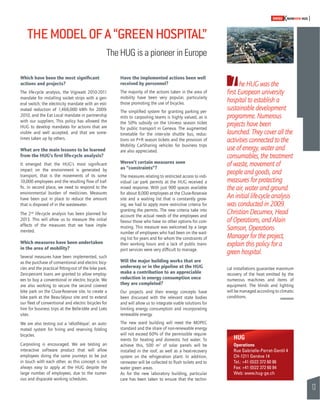
Quels ont été les actions et les 
projets les plus marquants ? 
L’Ecobilan, le mandat Vigiwatt 2010- 
2011 de pose de barrettes de prises 
électriques avec interrupteur géné-ral, 
le mandat électricité, avec une 
réduction estimée pour 2009-2010 de 
HUG 
Département d’exploitation 
Rue Gabrielle-Perret-Gentil 4 
CH-1211 Genève 14 
Tél. : +41(0)22 372 60 86 
Fax : +41(0)22 372 60 84 
E-mail : 
christian.decurnex@hcuge.ch 
Web : www.hug-ge.ch
13 
SWISSKNOWHOW HUG 
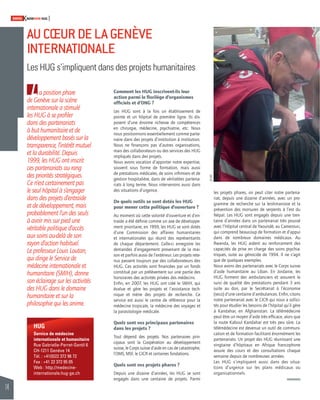
Which have been the most signifi cant 
actions and projects? 
The life-cycle analysis, the Vigiwatt 2010-2011 
mandate for installing socket strips with a gen-eral 
switch, the electricity mandate with an esti-mated 
reduction of 1,468,000 kWh for 2009- 
2010, and the Eat Local mandate in partnership 
with our suppliers. This policy has allowed the 
HUG to develop mandates for actions that are 
visible and well accepted, and that are some-times 
taken up by others. 
What are the main lessons to be learned 
from the HUG’s fi rst life-cycle analysis? 
It emerged that the HUG’s most signifi cant 
impact on the environment is generated by 
transport, that is the movements of its some 
10,000 employees and the resulting fl ow of traf-fi 
c. In second place, we need to respond to the 
environmental burden of medicines. Measures 
have been put in place to reduce the amount 
that is disposed of in the wastewater. 
The 2nd life-cycle analysis has been planned for 
2013. This will allow us to measure the initial 
effects of the measures that we have imple-mented. 
Which measures have been undertaken 
in the area of mobility? 
Several measures have been implemented, such 
as the purchase of conventional and electric bicy-cles 
and the practical fi tting-out of the bike park. 
Zero-percent loans are granted to allow employ-ees 
to buy a conventional or electric bicycle. We 
are also working to secure the second covered 
bike park on the Cluse-Roseraie site, to create a 
bike park at the Beau-Séjour site and to extend 
our fl eet of conventional and electric bicycles for 
hire for business trips at the Belle-Idée and Loëx 
sites. 
We are also testing out a ‘vélothèque’, an auto-mated 
system for hiring and reserving folding 
bicycles. 
Carpooling is encouraged. We are testing an 
interactive software product that will allow 
employees doing the same journeys to be put 
in touch with each other, as this concept is not 
always easy to apply at the HUG despite the 
large number of employees, due to the numer-ous 
and disparate working schedules. 
Have the implemented actions been well 
received by personnel? 
The majority of the actions taken in the area of 
mobility have been very popular, particularly 
those promoting the use of bicycles. 
The simplifi ed system for granting parking per-mits 
to carpooling teams is highly valued, as is 
the 50% subsidy on the Unireso season ticket 
for public transport in Geneva. The augmented 
timetable for the inter-site shuttle bus, reduc-tions 
on P+R season tickets and the provision of 
Mobility CarSharing vehicles for business trips 
are also appreciated. 
Weren’t certain measures seen 
as “constraints”? 
The measures relating to restricted access to indi-vidual 
car park permits at the HUG received a 
mixed response. With just 900 spaces available 
for about 8,000 employees at the Cluse-Roseraie 
site and a waiting list that is constantly grow-ing, 
we had to apply more restrictive criteria for 
granting the permits. The new criteria take into 
account the actual needs of the employees and 
favour those who have no other options for com-muting. 
This measure was welcomed by a large 
number of employees who had been on the wait-ing 
list for years and for whom the constraints of 
their working hours and a lack of public trans-port 
services were very diffi cult to manage. 
Will the major building works that are 
underway or in the pipeline at the HUG 
make a contribution to an appreciable 
reduction in energy consumption once 
they are completed? 
Our projects and their energy concepts have 
been discussed with the relevant state bodies 
and will allow us to integrate viable solutions for 
limiting energy consumption and incorporating 
renewable energy. 
The new ward building will meet the MOPEC 
standard and the share of non-renewable energy 
will not exceed 60% of the permissible require-ments 
for heating and domestic hot water. To 
achieve this, 500 m2 of solar panels will be 
installed in the roof, as well as a heat-recovery 
system on the refrigeration plant. In addition, 
rainwater will be collected to fl ush toilets and to 
water green areas. 
As for the new laboratory building, particular 
care has been taken to ensure that the techni- 
The HUG was the 
fi rst European university 
hospital to establish a 
sustainable development 
programme. Numerous 
projects have been 
launched. They cover all the 
activities connected to the 
use of energy, water and 
consumables, the treatment 
of waste, movement of 
people and goods, and 
measures for protecting 
the air, water and ground. 
An initial life-cycle analysis 
was conducted in 2009. 
Christian Decurnex, Head 
of Operations, and Alain 
Samson, Operations 
Manager for the project, 
explain this policy for a 
green hospital. 
THE MODEL OF A “GREEN HOSPITAL” 
The HUG is a pioneer in Europe 
cal installations guarantee maximum 
recovery of the heat emitted by the 
numerous machines and items of 
equipment. The blinds and lighting 
will be managed according to climatic 
conditions. 
HUG 
Operations 
Rue Gabrielle-Perret-Gentil 4 
CH-1211 Genève 14 
Tel.: +41 (0)22 372 60 86 
Fax: +41 (0)22 372 60 84 
Web: www.hug-ge.ch
14 
SWISSKNOWHOW HUG 
AU COEUR DE LA GENÈVE 
INTERNATIONALE 
Les HUG s’impliquent dans des projets humanitaires 
L 
a position phare 
de Genève sur la scène 
internationale a stimulé 
les HUG à se profi ler 
dans des partenariats 
à but humanitaire et de 
développement basés sur la 
transparence, l’intérêt mutuel 
et la durabilité. Depuis 
1999, les HUG ont inscrit 
ces partenariats au rang 
des priorités stratégiques. 
Ce n’est certainement pas 
le seul hôpital à s’engager 
dans des projets d’entraide 
et de développement, mais 
probablement l’un des seuls 
à avoir mis sur pied une 
véritable politique d’accès 
aux soins au-delà de son 
rayon d’action habituel. 
Le professeur Louis Loutan, 
qui dirige le Service de 
médecine internationale et 
humanitaire (SMIH), donne 
son éclairage sur les activités 
des HUG dans le domaine 
humanitaire et sur la 
philosophie qui les anime. 
HUG 
Service de médecine 
internationale et humanitaire 
Rue Gabrielle-Perret-Gentil 6 
CH-1211 Genève 14 
Tél. : +41(0)22 372 96 72 
Fax : +41 22 372 95 05 
Web : http://medecine-internationale. 
hug-ge.ch 
les projets phares, on peut citer notre partena-riat, 
depuis une dizaine d’années, avec un pro-gramme 
de recherche sur la leishmaniose et la 
prévention des morsures de serpents à l’est du 
Népal. Les HUG sont engagés depuis une tren-taine 
d’années dans un partenariat très poussé 
avec l’Hôpital central de Yaoundé, au Cameroun, 
qui comprend beaucoup de formation et d’appui 
dans de nombreux domaines médicaux. Au 
Rwanda, les HUG aident au renforcement des 
capacités de prise en charge des soins psychia-triques, 
suite au génocide de 1994. Il ne s’agit 
que de quelques exemples. 
Nous avons des partenariats avec le Corps suisse 
d’aide humanitaire au Liban. En Jordanie, les 
HUG forment des ambulanciers et assurent le 
suivi de qualité des prestations pendant 3 ans 
suite au don, par le Secrétariat à l’économie 
(seco) d’une centaine d’ambulances. Enfi n, citons 
notre partenariat avec le CICR qui nous a sollici-tés 
pour étudier les besoins de l’hôpital qu’il gère 
à Kandahar, en Afghanistan. La télémédecine 
peut être un moyen d’aide très effi cace, alors que 
la route Kaboul Kandahar est très peu sûre. La 
télémédecine est devenue un outil de communi-cation 
et de formation facilitant énormément les 
partenariats. Un projet des HUG réunissant une 
vingtaine d’hôpitaux en Afrique francophone 
assure des cours et des consultations chaque 
semaine depuis de nombreuses années. 
Les HUG s’impliquent aussi dans des situa-tions 
d’urgence sur les plans médicaux ou 
organisationnels. 
Comment les HUG inscrivent-ils leur 
action parmi le fl orilège d’organismes 
offi ciels et d’ONG ? 
Les HUG sont à la fois un établissement de 
pointe et un hôpital de première ligne. Ils dis-posent 
d’une énorme richesse de compétences 
en chirurgie, médecine, psychiatrie, etc. Nous 
nous positionnons essentiellement comme parte-naire 
dans des projets d’institution à institution. 
Nous ne fi nançons pas d’autres organisations, 
mais des collaborateurs ou des services des HUG 
impliqués dans des projets. 
Nous avons vocation d’apporter notre expertise, 
souvent sous forme de formation, mais aussi 
de prestations médicales, de soins infi rmiers et de 
gestion hospitalière, dans de véritables partena-riats 
à long terme. Nous intervenons aussi dans 
des situations d’urgence. 
De quels outils se sont dotés les HUG 
pour mener cette politique d’ouverture ? 
Au moment où cette volonté d’ouverture et d’en-traide 
a été défi nie comme un axe de développe-ment 
prioritaire, en 1999, les HUG se sont dotés 
d’une Commission des affaires humanitaires 
et internationales qui réunit des représentants 
de chaque département. Celle-ci enregistre les 
demandes d’engagement provenant de la mai-son 
et parfois aussi de l’extérieur. Les projets rete-nus 
passent toujours par des collaborateurs des 
HUG. Ces activités sont fi nancées par un fonds 
constitué par un prélèvement sur une partie des 
honoraires des activités privées des médecins. 
Enfi n, en 2007, les HUG ont créé le SMIH, qui 
évalue et gère les projets et l’assistance tech-nique 
et mène des projets de recherche. Ce 
service est aussi le centre de référence pour la 
médecine tropicale, la médecine des voyages et 
la parasitologie médicale. 
Quels sont vos principaux partenaires 
dans les projets ? 
Tout dépend des projets. Nos partenaires prin-cipaux 
sont la Coopération au développement 
suisse, le Corps suisse d’aide en cas de catastrophe, 
l’OMS, MSF, le CICR et certaines fondations. 
Quels sont vos projets phares ? 
Depuis une dizaine d’années, les HUG se sont 
engagés dans une centaine de projets. Parmi 
© DR
15 
SWISSKNOWHOW HUG 
AT THE HEART OF 
INTERNATIONAL GENEVA 
HUG gets involved in humanitarian projects 
tre for tropical medicine, travel medicine and 
medical parasitology. 
Who are your main partners in these 
projects? 
It all depends on the project. Our main part-ners 
are the Swiss Agency for Development and 
Cooperation, the Swiss Humanitarian Aid Unit, 
the WHO, MSF, the ICRC and various foundations. 
What are your fl agship projects? 
The HUG has been involved in around a hun-dred 
projects for about ten years now. Among 
our fl agship projects is our ten-year partnership 
in a research programme into leishmaniasis 
and snake-bite prevention in the east of Nepal. 
The HUG has been engaged in a very intensive 
partnership with Yaoundé Central Hospital in 
Cameroon for about thirty years, providing a 
high amount of training and support in numer-ous 
fi elds of medicine. In Rwanda, the HUG 
helps to boost psychiatric care capabilities fol-lowing 
the genocide in 1994. These are just a 
few examples. 
We have partnerships with the Swiss Huma-nitarian 
Aid Unit in the Lebanon. In Jordan, the 
HUG trains ambulance drivers and is ensuring 
the quality of service continues to be provided 
for 3 years following the donation of a hundred 
ambulances by the Swiss State Secretariat for 
Economic Affairs (SECO). Finally, I’d like to men-tion 
our partnership with the ICRC, which sought 
us out in order to study the needs of the hospi-tal 
that it manages in Kandahar in Afghanistan. 
Telemedicine can be a very effective means of 
providing aid, especially as the road from Kabul 
to Kandahar is particularly unsafe. Telemedicine 
has become a communication and training tool 
which has facilitated partnerships enormously. 
One HUG project brings together about twenty 
hospitals in French-speaking Africa and has been 
providing courses and consultations every week 
for many years now. 
The HUG also gets involved in emergency situa-tions 
at a medical or organisational level. 
Where does the HUG see itself among 
the multitude of offi cial bodies and NGOs? 
The HUG is both a high-tech establishment 
and a leading hospital. It has a great wealth of 
expertise in surgery, medicine, psychiatry, etc. 
We essentially position ourselves as a partner in 
projects between institutions. We don’t fi nance 
other organisations, but rather involve HUG 
employees or services in the projects. 
We aim to provide our expertise, often in the 
form of training, but also medical services, nurs-ing 
care and hospital management, in true long-term 
partnerships. We also get involved in emer-gency 
situations. 
What tools does the HUG have 
at its disposal to implement this policy 
of openness? 
In 1999, when this wish for openness and 
mutual aid was defi ned as a priority for develop-ment, 
the HUG established a Humanitarian and 
International Affairs Committee, which brings 
together representatives from each depart-ment. 
It receives requests for involvement from 
in-house and sometimes also from outside. The 
projects that are accepted are always carried out 
by HUG employees. These activities are fi nanced 
by a fund formed from a levy on a share of doc-tors’ 
private consultation fees. 
Then, in 2007, the HUG created SMIH, which 
evaluates and manages the projects and 
technical assistance and conducts research 
projects. This service is also the reference cen- 
Geneva’s leading position 
on the international scene 
has prompted the HUG to 
enter into partnerships with 
a humanitarian objective and 
development partnerships 
based on transparency, 
mutual interest and 
sustainability. Since 1999, 
the HUG has established 
these partnerships as part 
of its strategic priorities. 
It is certainly not the only 
hospital to engage in mutual 
aid and development 
projects, but probably one 
of the few to have set up 
an actual policy for access 
to healthcare beyond its 
usual scope. Professor 
Louis Loutan, who runs the 
Division of International 
and Humanitarian Medicine 
(SMIH), tells us about 
the HUG’s activities in the 
humanitarian domain and 
about the philosophy that 
drives them. 
HUG 
Division of International and 
Humanitarian Medicine 
Rue Gabrielle-Perret-Gentil 6 
CH-1211 Genève 14 
Tel.: +41(0)22 372 96 72 
Fax: +41 22 372 95 05 
Web: http://medecine-internationale. 
hug-ge.ch
16 
SWISSKNOWHOW HUG 
A 
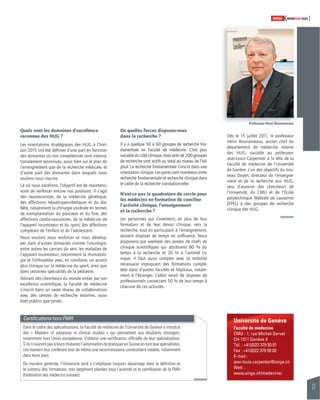
L’INDISPENSABLE « U » DES HUG 
Une interface nouvelle entre l’Hôpital et la Faculté 
près plus de deux 
ans de travail, un nouveau 
règlement défi nit et organise 
les relations entre l’Hôpital 
et l’Université depuis le 
27 janvier 2011. 
Historiquement fondées sur 
une base contractuelle, ces 
relations reposent désormais 
sur le modèle du partenariat. 
Le directeur général des 
HUG, M. Bernard Gruson, 
et le professeur Jean-Louis 
Carpentier, doyen de la 
Faculté de médecine depuis 
2003, se sont beaucoup 
engagés pour faire aboutir 
cette importante réforme. À la 
veille de remettre son mandat, 
en juillet 2011, ce dernier, 
arrivé à Genève en 1974, vice-doyen 
de la Faculté de 1999 
à 2003, nous a parlé du rôle 
et de l’importance du « U » 
dans le sigle HUG. 
l’avons préféré à celui qui intègre la Faculté de 
médecine dans l’entité hospitalière, vers lequel 
tend par exemple le CHUV. À l’inverse, il existe 
dans le monde des universités qui possèdent leur 
propre hôpital. 
Entrons un peu dans le « U ». 
Qu’en est-il du nombre de professeurs 
et du nombre d’étudiants ? 
La Faculté de médecine de l’UNIGE forme des 
médecins cliniciens et des chercheurs de haut 
niveau. Elle est divisée en trois sections, méde-cine 
fondamentale, médecine dentaire et méde-cine 
clinique, laquelle forme dorénavant une 
interface avec les HUG. 
Sur le budget de quelque 160 millions de francs 
de la Faculté de médecine, 90 proviennent 
de l’État et le solde du Fonds national de la 
recherche scientifi que, de fonds européens et de 
diverses fondations privées. 
Quelque 1 400 étudiants fréquentent la Faculté 
de médecine de l’Université de Genève, dont 
900 étudiants prégrades qui suivent une forma-tion 
de base de 6 ans, débouchant sur le diplôme 
de médecin. Les études postgrades s’étendent 
sur des durées de 4 à 6 ans au minimum, parfois 
plus selon les spécialisations. 
La relève académique est-elle assurée ? 
Il y a un manque de médecins formés en Suisse 
dans les hôpitaux universitaires. Il faut aller 
chercher de plus en plus loin les compétences, 
surtout dans certains domaines moins attractifs 
que d’autres. Un effort a été fait depuis quelques 
années afi n d’augmenter signifi cativement le 
nombre de médecins formés par nos institutions 
et il commence à porter ses fruits. Cependant, 
il faut encore parvenir à valoriser la formation 
dans divers secteurs de la médecine, notamment 
la médecine de premier recours. À un niveau plus 
général, il est clair que les médecins de premier 
recours manquent. De notre côté, nous pouvons 
par exemple rendre certaines formations plus 
attrayantes et plus valorisantes. 
Qu’est-ce qui a changé dans les relations 
entre l’Université et l’Hôpital avec 
l’adoption du nouveau règlement ? 
Avant, il y avait d’un côté l’Hôpital et, de 
l’autre, la Faculté de médecine de l’Université 
de Genève, et les relations étaient réglées de 
manière contractuelle. Nous avons opté pour un 
système de partenariat en créant une interface 
commune entre les deux institutions. 
Dans ce nouveau système, le doyen en charge 
de la Faculté de médecine devient automatique-ment 
directeur de la formation et de la recherche 
au sein des HUG. Ce rééquilibrage n’est pas 
un luxe en regard des chiffres : un budget de 
quelque 160 millions de CHF pour la Faculté de 
médecine et de 1,6 milliard pour les HUG. 
Le corps professoral fait notamment partie de 
l’interface. Au lieu de deux cahiers des charges 
pour les professeurs, il n’y en a dorénavant plus 
qu’un seul, qui est signé par les deux entités. Les 
professeurs sont payés par les HUG pour les acti-vités 
cliniques et par l’Université pour les acti-vités 
académiques. Lors des successions profes-sorales, 
une commission paritaire de prospective 
et de planifi cation hospitalo-universitaire permet 
une analyse globale de la situation et met de 
l’huile dans les rouages. 
Pourquoi le choix du partenariat 
plutôt qu’un autre choix ? 
Dans les faits, le « U » n’était pas véritablement 
sous la responsabilité du doyen dans l’ancien 
modèle, ce qui n’est plus le cas aujourd’hui. La 
nouvelle structure concrétise cette réalité que 
les deux entités forment un couple et précise ce 
que ce couple possède et doit gérer en commun. 
Leurs relations vont ainsi moins dépendre de 
l’entente personnelle des personnes exerçant les 
responsabilités de l’une et de l’autre entité. 
Le modèle contractuel, qui était le nôtre, dépend 
trop du bon vouloir de chacune des deux enti-tés 
et du poids de chacune d’elle. Pour nous, le 
modèle du partenariat est le plus équilibré. Nous 
Professeur Jean-Louis Carpentier
17 
SWISSKNOWHOW HUG 
Université de Genève 
Faculté de médecine 
CMU - 1, rue Michel-Servet 
CH-1211 Genève 4 
Tél. : +41(0)22 379 50 01 
Fax : +41(0)22 379 50 02 
E-mail : 
jean-louis.carpentier@unige.ch 
Web : 
www.unige.ch/medecine/ 
Quels sont les domaines d’excellence 
reconnue des HUG ? 
Les orientations stratégiques des HUG à l’hori-zon 
2015 ont été défi nies d’une part en fonction 
des domaines où nos compétences sont interna-tionalement 
reconnues, aussi bien sur le plan de 
l’enseignement que de la recherche médicale, et 
d’autre part des domaines dans lesquels nous 
voulons nous inscrire. 
Là où nous excellons, l’objectif est de maintenir, 
voire de renforcer encore nos positions. Il s’agit 
des neurosciences, de la médecine génétique, 
des affections hépato-pancréatiques et du dia-bète, 
notamment la chirurgie viscérale en termes 
de transplantation du pancréas et du foie, des 
affections cardio-vasculaires, de la médecine de 
l’appareil locomoteur et du sport, des affections 
complexes de l’enfant et de l’adolescent. 
Nous voulons nous renforcer et nous dévelop-per 
dans d’autres domaines comme l’oncologie, 
entre autres les cancers du sein, les maladies de 
l’appareil locomoteur, notamment la rhumatolo-gie 
et l’orthopédie avec, en corollaire, un accent 
plus clinique sur la médecine du sport, ainsi que 
dans certaines spécialités de la pédiatrie. 
Attirant des chercheurs du monde entier par son 
excellence scientifi que, la Faculté de médecine 
s’inscrit dans un vaste réseau de collaborations 
avec des centres de recherche externes, aussi 
bien publics que privés. 
De quelles forces disposez-vous 
dans la recherche ? 
Il y a quelque 50 à 60 groupes de recherche fon-damentale 
en Faculté de médecine. C’est plus 
variable du côté clinique, mais près de 200 groupes 
de recherche sont actifs au total au niveau de l’hô-pital. 
La recherche fondamentale s’inscrit dans une 
orientation clinique. Les ponts sont nombreux entre 
recherche fondamentale et recherche clinique dans 
le cadre de la recherche translationnelle. 
N’est-ce pas la quadrature du cercle pour 
les médecins en formation de concilier 
l’activité clinique, l’enseignement 
et la recherche ? 
Les personnes qui s’orientent, en plus de leur 
formation et de leur devoir clinique, vers la 
recherche, tout en participant à l’enseignement, 
doivent disposer de temps en suffi sance. Nous 
proposons par exemple des postes de chefs de 
clinique scientifi ques qui attribuent 80 % du 
temps à la recherche et 20 % à l’activité cli-nique. 
Il faut aussi compter avec la mobilité 
nécessaire impliquant des formations complé-tées 
dans d’autres facultés et hôpitaux, notam-ment 
à l’étranger. L’idéal serait de disposer de 
professionnels consacrant 50 % de leur temps à 
chacune de ces activités. 
Dès le 15 juillet 2011, le professeur 
Henri Bounameaux, ancien chef du 
département de médecine interne 
des HUG, succède au professeur 
Jean-Louis Carpentier à la tête de la 
Faculté de médecine de l’Université 
de Genève. L’un des objectifs du nou-veau 
Doyen, directeur de l’enseigne-ment 
et de la recherche aux HUG, 
sera d’associer des chercheurs de 
l’Université, du CMU et de l’École 
polytechnique fédérale de Lausanne 
(EPFL) à des groupes de recherche 
clinique des HUG. 
Certifi cations hors FMH 
Dans le cadre des spécialisations, la Faculté de médecine de l’Université de Genève a introduit 
des « Masters of advances in clinical studies » qui permettent aux étudiants étrangers, 
notamment hors Union européenne, d’obtenir une certifi cation offi cielle de leur spécialisation. 
S’ils n’ouvrent pas à leurs titulaires l’autorisation de pratiquer en Suisse en tant que spécialistes, 
ces masters leur confèrent tout de même une reconnaissance universitaire valable, notamment 
dans leurs pays. 
De manière générale, l’Université tend à s’impliquer toujours davantage dans la défi nition et 
le contenu des formations, très largement placées sous l’autorité et la certifi cation de la FMH 
(Fédération des médecins suisses). 
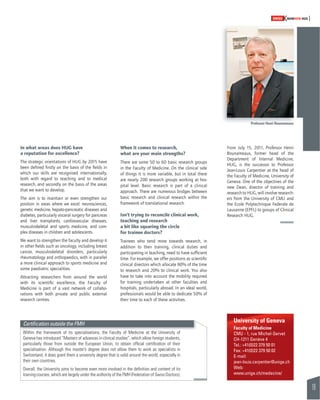
Professeur Henri Bounameaux
18 
SWISSKNOWHOW HUG 
THE VITAL “U” IN HUG 
A new interface between Hospital and Faculty 
After more than two years 
of work, since 27 January 
2011 new rules have defi ned 
and organised relations 
between the Hospital and 
the University. Historically 
founded on a contractual 
basis, henceforth these 
relations will be based on 
the partnership model. The 
Chairman of HUG (Geneva 
University Hospital), 
Mr. Bernard Gruson, 
and Professor Jean-Louis 
Carpentier, dean of the 
Faculty of Medicine since 
2003, have put a lot of 
effort into seeing this reform 
through. On the eve of 
leaving his position in July 
2011, Professor Carpentier, 
who arrived in Geneva in 
1974 and was vice-dean of 
the faculty from 1999 to 
2003, kindly agreed to talk 
to us about the role and 
importance of the “U” 
in the acronym HUG. 
towards, for example. Conversely, there are uni-versities 
around the world which own their own 
hospital. 
Let’s talk about the “U” for a bit. 
How has this affected the number 
of professors and students? 
The Faculty of Medicine at the UNIGE trains clin-ical 
doctors and top researchers. It is divided into 
three sections: basic medicine, dental medicine 
and clinical medicine, which will now form an 
interface with the HUG. 
Out of the Faculty of Medicine’s budget of 
some 160 million francs, 90 million come from 
the state, and the rest from the Swiss National 
Science Foundation, from European funds and 
various private foundations. 
The University of Geneva’s Faculty of Medicine 
has around 1,400 students, including 900 under-graduate 
students who undergo basic training of 
6 years, leading to a medical degree. Postgraduate 
studies take at least 4 to 6 years, sometimes 
longer depending on the specialisation. 
Is the academic cycle assured? 
There is a defi nite lack of doctors being trained 
in Switzerland in the university hospitals. You 
have to go further and further away to fi nd the 
right skills, particularly in some of the less attrac-tive 
fi elds. A real effort has been made over the 
last few years to signifi cantly increase the num-ber 
of doctors being trained by our institutions, 
and this is starting to bear fruit. However, we 
still need to increase the standing of training in 
various fi elds of medicine, particularly in general 
medicine. At a more general level, there is a real 
shortage of GPs. For our part, we can make some 
training more attractive and give it a higher sta-tus, 
for example. 
Now that the new rules have been 
adopted, what has changed in the 
relationship between the University 
and the Hospital? 
Before, there was the Hospital on one side, 
and the Faculty of Medicine of the University 
of Geneva on the other, and relations were 
governed on a contractual basis. We have 
chosen to move to a partnership system by 
creating a common interface between the two 
institutionzand 1.6 billion for the HUG. 
The professional body in particular is part 
of the interface. Instead of two different 
sets of specifications for professors, there is 
now only one, which is signed by both bod-ies. 
The professors are paid by the HUG for 
their clinical work, and by the University for 
their academic work. When new professors 
are appointed, a joint committee for hospital-university 
economic forecasting and planning 
performs an overall analysis of the situation 
and oils the wheels. 
Why a partnership? 
In actual fact, the “U” was not really part of the 
dean’s responsibility under the old model, but 
that is no longer the case. The new structure 
establishes the reality that the two bodies form a 
couple, and specifi es what this couple owns and 
must manage together. Their relationship will 
therefore depend less on a personal understand-ing 
between the individuals with responsibility 
for each body. 
The contractual model we had before depends 
too much on good will between the two bodies 
and on the infl uence of each one. For us, the 
partnership model is a more balanced one. We 
preferred this model to one which would have 
integrated the Faculty of Medicine within the 
hospital, a model which the CHUV is moving 
Professor Jean-Louis Carpentier
19 
SWISSKNOWHOW HUG 
When it comes to research, 
what are your main strengths? 
There are some 50 to 60 basic research groups 
in the Faculty of Medicine. On the clinical side 
of things it is more variable, but in total there 
are nearly 200 research groups working at hos-pital 
level. Basic research is part of a clinical 
approach. There are numerous bridges between 
basic research and clinical research within the 
framework of translational research. 
Isn’t trying to reconcile clinical work, 
teaching and research 
a bit like squaring the circle 
for trainee doctors? 
Trainees who tend more towards research, in 
addition to their training, clinical duties and 
participating in teaching, need to have suffi cient 
time. For example, we offer positions as scientifi c 
clinical directors which allocate 80% of the time 
to research and 20% to clinical work. You also 
have to take into account the mobility required 
for training undertaken at other faculties and 
hospitals, particularly abroad. In an ideal world, 
professionals would be able to dedicate 50% of 
their time to each of these activities. 
In what areas does HUG have 
a reputation for excellence? 
The strategic orientations of HUG by 2015 have 
been defi ned fi rstly on the basis of the fi elds in 
which our skills are recognised internationally, 
both with regard to teaching and to medical 
research, and secondly on the basis of the areas 
that we want to develop. 
The aim is to maintain or even strengthen our 
position in areas where we excel: neurosciences, 
genetic medicine, hepato-pancreatic diseases and 
diabetes, particularly visceral surgery for pancreas 
and liver transplants, cardiovascular diseases, 
musculoskeletal and sports medicine, and com-plex 
diseases in children and adolescents. 
We want to strengthen the faculty and develop it 
in other fi elds such as oncology, including breast 
cancer, musculoskeletal disorders, particularly 
rheumatology and orthopaedics, with in parallel 
a more clinical approach to sports medicine and 
some paediatric specialities. 
Attracting researchers from around the world 
with its scientifi c excellence, the Faculty of 
Medicine is part of a vast network of collabo-rations 
with both private and public external 
research centres. 
From July 15, 2011, Professor Henri 
Bounameaux, former head of the 
Department of Internal Medicine, 
HUG, is the successor to Professor 
Jean-Louis Carpentier at the head of 
the Faculty of Medicine, University of 
Geneva. One of the objectives of the 
new Dean, director of training and 
research to HUG, will involve research-ers 
from the University of CMU and 
the Ecole Polytechnique Federale de 
Lausanne (EPFL) to groups of Clinical 
Research HUG. 
University of Geneva 
Faculty of Medicine 
CMU - 1, rue Michel-Servet 
CH-1211 Genève 4 
Tel.: +41(0)22 379 50 01 
Fax: +41(0)22 379 50 02 
E-mail: 
jean-louis.carpentier@unige.ch 
Web: 
www.unige.ch/medecine/ 
Certifi cation outside the FMH 
Within the framework of its specialisations, the Faculty of Medicine at the University of 
Geneva has introduced “Masters of advances in clinical studies”, which allow foreign students, 
particularly those from outside the European Union, to obtain offi cial certifi cation of their 
specialisation. Although this master’s degree does not allow them to work as specialists in 
Switzerland, it does grant them a university degree that is valid around the world, especially in 
their own countries. 
Overall, the University aims to become even more involved in the defi nition and content of its 
training courses, which are largely under the authority of the FMH (Federation of Swiss Doctors). 
Professor Henri Bounameaux
20 
SWISSKNOWHOW HUG 
L 
HUG 
Rue Gabrielle-Perret-Gentil 4 
CH-1211 Genève 14 
Tél. : +41(0)22 372 29 056 
E-mail : qualite-des-soins. 
service@hcuge.ch 
Web : http://dg-gouvernance. 
hug-ge.ch/organisation_ 
gouvernance/direction_ 
medicale.html 
SÉCURITÉ ET QUALITÉ AUX HUG 
Souci d’excellence et outils performants 
pour réduire les risques 
e pilotage d’un hôpital 
universitaire de l’importance 
des HUG est forcément 
complexe. Deux notions clés, 
qualité et sécurité, servent 
notamment de boussole aux 
dirigeants. Les HUG y vouent 
la plus grande attention. 
Depuis le 1er janvier 2011, 
conformément au nouveau 
plan stratégique 2010- 
2015, la direction médicale, 
confi ée au professeur Pierre 
Dayer, a d’ailleurs annexé 
le mot « qualité », devenant 
ainsi la direction médicale 
et qualité. Responsable du 
service qualité des soins, 
chargé d’apporter un soutien 
méthodologique aux services 
cliniques, le Dr Pierre Chopard 
répond à nos questions. 
augmenter, ce qui témoigne de l’engagement des 
collaborateurs dans cette démarche. Il est actuel-lement 
de quelque 5 800 par année. 
Le service de prévention et de contrôle des infec-tions 
fait aussi un important travail de préven-tion, 
à la fois auprès des collaborateurs et des 
patients. Référence mondiale dans ce domaine, 
les HUG ont fait baisser en 2010 la prévalence 
des infections nosocomiales à 8,4 % (10,5 % en 
2009) et poursuivent leur action avec l’hygiène 
des mains par friction avec une solution hydro-alcoolique. 
Un programme novateur pour réduire les risques 
d’escarres des patients donne d’excellents résul-tats. 
D’autres programmes sont mis sur pied, par 
exemple pour réduire les risques d’infection liés 
aux cathéters. 
Des protocoles de contrôles croisés sont appliqués 
dans les blocs opératoires, procédures visant à évi-ter 
tout oubli. La sécurité n’est pas que l’affaire du 
chirurgien, mais aussi celle de l’anesthésiste, de 
l’instrumentiste, de toute une équipe. 
Gérer et prévenir les risques est une préoccupa-tion 
constante. Par exemple, toute chimiothéra-pie 
fait l’objet d’un protocole standardisé. 
Comment prenez-vous en compte 
la satisfaction des patients ? 
Chaque année, une enquête institutionnelle 
englobe tous les patients hospitalisés. Ils répon-dent 
à quelque 80 questions. Le taux de satisfac-tion 
est très bon. Les points à améliorer concernent 
par exemple la coordination entre les services de 
l’hôpital et les structures de soins à domicile et les 
médecins de ville. Nous y travaillons. 
Nos hôpitaux sont devenus des entreprises très 
complexes qui nécessitent la mise en oeuvre de 
milliers de processus. C’est pourquoi les HUG ont 
adopté dans un certain nombre de domaines le 
modèle de management par la qualité EFQM 
(European fondation for quality management), 
modèle provenant de l’industrie. 
La « qualité » est bien sûr un souci 
antérieur au 1er janvier 2011. 
Quel sens donner à sa soudaine 
mise en valeur nominative ? 
Cela traduit une volonté de l’institution de 
réduire encore le nombre d’infections, d’amélio-rer 
l’analyse des incidents et de mieux maîtriser 
les risques. Les structures autour du concept de 
qualité évoluent. Le Comité de direction s’est 
doté d’une délégation à la qualité. Le Directeur 
médical préside la Commission médicale d’éta-blissement. 
La responsabilité des questions 
médicales incombe aux médecins-chefs de ser-vice, 
sous l’autorité fi nale du Directeur médical, 
qui a un droit de regard sur l’ensemble des pra-tiques 
médicales des HUG. 
Quels sont les risques principaux 
que vous devez maîtriser ? 
Ce sont les risques infectieux et les risques médi-camenteux, 
avec notamment la gestion des effets 
secondaires. Plusieurs processus et programmes 
préviennent effi cacement ces risques. Des logiciels 
de prescription électronique assistent par exemple 
les médecins dans l’identifi cation des interactions. 
De quels outils disposez-vous pour 
garantir au mieux sécurité et qualité ? 
Il y en a beaucoup. Les HUG ont mis en place 
depuis plusieurs années un système de déclara-tion 
des événements indésirables et des incidents. 
Ce système différencie les événements graves, 
entraînant un préjudice pour le patient, et ceux 
qui sont mineurs. Toute personne peut annoncer 
un couac interne tel qu’un oubli sans conséquence 
d’administrer un médicament, la perte d’un tube 
sanguin, la perte d’un dossier, etc. Des groupes de 
gestion d’incidents, formés de deux à huit colla-borateurs, 
sont chargés de les analyser. L’objectif 
est de trouver des failles éventuelles dans les 
processus. Le nombre d’incidents déclarés tend à 
Quality Offi cers 
Les HUG donnent un signal fort de leur volonté de garantir la meilleure sécurité et la meilleure 
qualité possibles. Dès l’automne 2011, quatorze « quality offi cers » entreront en fonction, soit 
un par département. Sous la responsabilité des chefs de départements et de la délégation du 
Comité de direction à la qualité et à la coordination des risques, ces collaborateurs (médecins, 
infi rmiers, ingénieurs, etc., tous au bénéfi ce d’une expérience dans le domaine de la santé) 
auront pour mission de renforcer les démarches qualité (mettre en place et gérer les indicateurs, 
les actions d’amélioration, etc.). 
C’est en quelque sorte un nouveau métier. Comme d’autres, il répond aux besoins d’une 
médecine toujours plus performante et exigeante. Les HUG mettent en place une formation 
spéciale destinée à ces nouveaux collaborateurs. 
Docteur Pierre Chopard 
J. Gregorio - HUG
21 
SWISSKNOWHOW HUG 
SAFETY AND QUALITY AT THE HUG 
A focus on excellence and effective tools to reduce risks 
Doctor Pierre Chopard 
Running a university 
hospital the size of the HUG 
is naturally complex. Two key 
ideas in particular, quality 
and safety, act as a guiding 
compass for directors and the 
HUG devotes a lot of attention 
to them. Since 1 January 2011, 
in accordance with the new 
2010-2015 strategic plan, the 
medical management team, 
under the guidance of Professor 
Pierre Dayer, has furthermore 
annexed the word “quality”, 
becoming the medical 
and quality management 
department. The head of the 
quality of care department, 
responsible for providing 
clinical departments with 
methodological support, 
Dr Pierre Chopard kindly 
agreed to answer our questions. 
The department for the prevention and control 
of infections also carries out important preven-tion 
work, both with employees and patients. 
Worldwide reference in this fi eld, in 2010 the 
HUG cut the prevalence of hospital-acquired 
infections to 8.4% (10.5% in 2009) and is 
continuing to take action in this area with hand 
hygiene through rubbing them with a hydroalco-holic 
solution. 
An innovative programme to reduce the risks of 
bedsores for patients is giving excellent results. 
Other programmes are being set up, for example 
to reduce the risks of infection linked to catheters. 
Cross-checking protocols are applied in opera-ting 
theatres, procedures aiming to avoid any 
oversights. Safety is not just the concern of sur-geons, 
but also anaesthetists, theatre nurses, the 
entire team. 
Managing and preventing risks is a constant 
concern. For example, all chemotherapy is the 
subject of a standardised protocol. 
How do you take patient satisfaction 
into account? 
Every year an institutional survey includes all 
hospitalised patients who answer around 80 
questions. The rate of satisfaction is very good. 
Areas to improve include for example coordina-tion 
between the hospital departments and the 
home care structures and the city doctors. We 
are working on it. 
Our hospitals have become very complex com-panies 
which require the implementation of 
thousands of processes. This is why the HUG 
has adopted an industry model, the EFQM 
(European foundation for quality management) 
quality management model in a certain number 
of fi elds. 
“Quality” was of course a concern prior 
to 1 January 2011. What are we to make 
of this word being suddenly highlighted? 
It is an expression of the will of the institution to 
reduce the number of infections still further, to 
improve the analysis of incidents and to control 
risks better. Structures are developing around the 
concept of quality. The management committee 
has created a quality delegation. The medi-cal 
director chairs the Medical Establishment 
Commission. The responsibility for medical 
issues falls to the chiefs of staff of departments, 
under the fi nal authority of the medical director 
who has the right to examine all medical prac-tices 
at the HUG. 
What are the main risks that you have 
to control? 
Infection risks and drug risks, in particular the 
management of side effects. Several processes 
and programmes effectively prevent these risks. 
For example, electronic prescription software 
helps doctors to identify interaction. 
What tools do you have that optimally 
guarantee safety and quality? 
There are a lot. Several years ago, the HUG put in 
place a system for declaring undesirable events 
and incidents. The system differentiates between 
serious events which harm the patient and minor 
events. Anyone can declare an internal mishap, 
such as forgetting to administer a drug without 
consequences, losing a blood tube, losing a fi le, 
etc. Incident management groups, comprising 
two to eight colleagues, are responsible for 
analysing them. The aim is to fi nd any fl aws in 
the processes. The number of incidents declared 
seems to be increasing, which is evidence of the 
commitment of employees to this approach. 
Currently there are some 5,800 every year. 
Quality Offi cers 
The HUG is giving a strong signal of its will to guarantee the best possible safety and quality. 
From autumn 2011, fourteen “quality offi cers” will take up their roles – one for every department. 
Under the responsibility of the heads of departments and the management committee’s quality 
and coordination of risks delegation, these employees (doctors, nurses, engineers, etc. all with 
experience in the healthcare fi eld) will work to strengthen quality approaches (implement and 
manage indicators, improvement actions, etc.). 
It is a new job of a kind. Like others, it responds to the needs of medicine that is more and more 
effi cient and demanding. The HUG is putting in place special training for these new employees. 
HUG 
Rue Gabrielle-Perret-Gentil 4 
CH-1211 Genève 14 
Tel.: +41(0)22 372 29 056 
E-mail: qualite-des-soins. 
service@hcuge.ch 
Web: http://dg-gouvernance. 
hug-ge.ch/organisation_ 
gouvernance/direction_ 
medicale.html
22 
SWISSKNOWHOW HUG 
SUR LE FRONT DE LA MÉDECINE 
DE PREMIER RECOURS 
Les HUG assument leur rôle social en toute transparence 
Le Département de 
médecine communautaire, 
de premier recours et des 
urgences, ainsi que le 
Département de santé 
mentale et de psychiatrie, 
sont fortement impliqués 
dans un ambitieux projet 
transversal des HUG visant 
notamment à mieux orienter 
les urgences, à structurer le 
dispositif de soins de manière 
à intégrer les HUG au 
centre d’un réseau sanitaire 
genevois, à favoriser une 
meilleure coordination 
au sein des HUG et à 
développer des alternatives 
à l’hospitalisation. 
Le professeur Jean-Michel 
Gaspoz, qui dirige le 
Département de médecine 
communautaire, de premier 
recours et des urgences, 
véritable interface entre 
l’hôpital et la ville, ainsi 
que le Service de médecine 
de premier recours, très 
impliqués dans ces projets, 
en détaille quelques aspects 
et en situe les enjeux. 
tension, l’obésité, etc. risquent à terme de faire 
exploser les systèmes de santé. Des stratégies 
fondées sur l’éducation thérapeutique des 
patients, avant le grand âge, sont envisagées. 
Bien que les médecins soient encore jaloux de 
leurs prérogatives, des tâches nouvelles pour-raient 
être déléguées au personnel infi rmier, avec 
l’émergence de nouvelles professions infi rmières. 
Si les patients prennent mieux en charge leur 
maladie, et qu’ils sont mieux suivis, le nombre 
d’hospitalisations pourra être réduit. 
La même volonté de moins hospitaliser et de 
traiter davantage de manière ambulatoire existe 
dans le domaine de la psychiatrie. 
En tant qu’hôpital public, les HUG 
sont confrontés à la prise en charge 
de la précarité. 
Dans l’indemnité cantonale de fonctionnement 
versée aux HUG, fi gure une enveloppe appe-lée 
« subvention d’intérêt général » destinée à 
couvrir les missions que l’hôpital ne peut pas 
fi nancer par une facturation, soit en totalité, soit 
partiellement. Il s’agit de patients précaires, à 
l’image des quelque 15 000 femmes de ménage 
sud-américaines et indonésiennes qui s’occupent 
du ménage et parfois des enfants des Genevois. 
Elles n’ont aucune assurance. Une autre catégo-rie 
de personnes en situation de précarité est 
constituée par des migrants entrés dans la clan-destinité 
après le rejet de leur demande d’asile, 
ou des grands précaires marginalisés. 
Enfi n, les working poors, des Suisses entre 40 et 
50 ans pour la plupart, qui travaillent, mais ne 
s’en sortent pas et accumulent des retards dans 
le versement de leurs primes d’assurance mala-die. 
Depuis que les mauvais payeurs peuvent 
être déboutés de l’assurance, nous nous sommes 
Une des ambitions de ce projet concerne 
la gériatrie. De quoi s’agit-il ? 
Les patients âgés sont un peu partout dans l’hôpi-tal. 
Il s’agit, d’une part, de renforcer les compé-tences 
sur le site principal de Cluse-Roseraie et, 
d’autre part, de créer une unité d’évaluation 
gériatrique sur le site de Trois-Chêne. 
Actuellement, la porte d’entrée est principale-ment 
à Cluse-Roseraie et les gens sont ensuite 
transférés ailleurs. Cela se justifi e pour les soins 
aigus, mais derrière, il y a souvent des patholo-gies 
liées au grand âge, des problèmes typique-ment 
gériatriques qui ne peuvent être pris en 
compte autant qu’il le faudrait. Cela provoque 
un encombrement et de l’inconfort pour ces 
patients. L’idée est de créer une unité mobile de 
gériatrie sur ce site principal des HUG et une 
structure d’accueil d’urgence gériatrique sur le 
site de Trois-Chêne. 
Et qu’en est-il des soins somatiques ? 
Les HUG disposent de l’Unité de gériatrie commu-nautaire, 
rattachée au Service de médecine de 
premier recours. Deux prestations sont offertes 
en hôpital de jour aux patients âgés envoyés 
par leurs médecins traitants : contre les troubles 
de la mémoire d’une part, et d’autre part, des 
exercices pour renforcer l’équilibre. Cette unité 
traite aussi les patients qui ont un problème de 
consommation d’alcool. 
Deux structures existent aux deux extrémités 
du canton, soit le site de Belle-Idée et l’autre à 
l’Hôpi tal de Loëx, qui possèdent chacun un hôpi-tal 
de jour. 
Parallèlement, des équipes mobiles se rendent à 
domicile pour faire des évaluations et du soutien, 
également à la demande des médecins traitants. 
Les gens devenant de plus en plus âgés, des 
maladies chroniques comme le diabète, l’hyper- 
Professeur Jean-Michel Gaspoz 
HUG
23 
SWISSKNOWHOW HUG 
HUG 
Rue Gabrielle-Perret-Gentil 4 
CH-1211 Genève 14 
Tél. : +41(0)22 372 95 20 
Fax : +41(0)22 372 83 32 
E-mail : 
jean-michel.gaspoz@hcuge.ch 
Web : http://medecine-communautaire. 
hug-ge.ch/ 
retrouvés avec de nombreux patients n’ayant 
plus accès aux soins, ni aux médicaments. Les 
HUG ont dépensé en 2010 un million de francs 
pour remettre des médicaments gratuits à des 
Genevois boutés hors de l’assurance. Ce ne sont 
pas des « profi teurs », mais des gens précarisés 
par des problèmes de perte d’emploi, souvent 
des femmes seules avec charges d’enfants, ou 
des indépendants, des petits garagistes, par 
exemple, qui ont perdu pied. 
Nous voulons jouer la transparence. Ces pro-blèmes 
existent. Nous allons établir un catalogue 
complet de ces missions d’intérêt général, déter-miner 
leur coût réel et demander une subvention 
à la hauteur de cette tâche. Notre volonté est 
aussi d’optimiser l’organisation de ces activités. 
L’hôpital joue là un véritable rôle social. 
Le Service de médecine de premier recours est 
profi lé comme celui qui assume la précarité. 
Seul l’hôpital public effectue des prestations qui 
ne peuvent pas être facturées ou facturées de 
façon insuffi sante. Et si personne ne prend en 
charge ces patients, il en résultera une sorte de 
désastre. Sans insister sur le problème éthique 
que poserait le choix de ne pas donner des soins 
à des gens qui en ont besoin, ce serait une erreur 
épidémiologique génératrice de contagions et, 
rapidement, d’un problème de santé publique. 
Ce type de problème touche à peu près toutes 
les métropoles internationales. 
C’est vrai aussi pour la gériatrie. Nous sommes 
de plus en plus appelés pour des visites à domi-cile. 
Les médecins traitants le font de moins en 
moins, car cela rapporte peu et ne permet en 
aucun cas de faire tourner un cabinet, ne serait-ce 
qu’en raison du temps perdu dans les bou-chons 
genevois. Évidemment, nous pourrions 
renoncer à y aller. Que se passerait-il ? Sans 
visites, sans soutien, ces patients péricliteraient 
à domicile et devraient être bientôt hospitalisés. 
C’est typiquement une prestation d’intérêt géné-ral 
non encore reconnue comme telle. 
Qu’en est-il des réseaux de soins, 
des relations entre les HUG 
et les médecins et cliniques de la ville ? 
Les HUG veulent désengorger les urgences et 
réduire les durées d’attente. Il faut éviter que 
toute demande se transforme en urgence et 
assurer une prise en charge coordonnée pour 
les urgences vitales et de proximité pour celles 
qui sont non vitales. Depuis 2009, le Réseau des 
urgences de Genève réunit les HUG et quatre 
centres genevois privés : l’Hôpital de la Tour, la 
Clinique des Grangettes, la Clinique de Carouge 
et le Groupe médical d’Onex. 
Le premier maillon du réseau doit rester le méde-cin 
de famille, avant tout recours à l’un des 
centres d’urgence. Nous cherchons à créer un 
vrai partenariat avec ces médecins et les encou-rageons 
à créer un système de garde de quartier. 
Par ailleurs, il est important de former de jeunes 
médecins selon la palette de patients qu’ils 
auront vraiment à prendre en charge au cours 
de leur carrière, et qu’ils ne soient pas exclusi-vement 
au contact des patients en situation de 
précarité. Mon service compte actuellement une 
© J. Gregorio - HUG 
dizaine de médecins en formation à 
l’extérieur des HUG dans le cadre du 
Réseau de soins d’urgence.
24 
SWISSKNOWHOW HUG 
AT THE FRONT LINE OF PRIMARY 
CARE MEDICINE 
The HUG carries out its social role 
with complete transparency 
One of the ambitions of this project 
concerns the fi eld of geriatrics. 
Can you tell us about this? 
Elderly patients are spread out throughout the 
hospital. The project is aiming, on the one hand, 
to consolidate expertise at the main site of Cluse- 
Roseraie and, on the other, to create a geriatric 
evaluation unit at the Trois-Chêne site. 
Currently, the point of admission is usually Cluse- 
Roseraie and patients are then transferred else-where. 
This is justifi ed for acute care, but there 
are usually underlying pathologies associated 
with old age, problems that are typically geriat-ric 
in nature which cannot be taken into consid-eration 
as much as they should be. This results in 
overcrowding and discomfort for these patients. 
The idea is to create a mobile geriatric unit on 
the main HUG site and a facility to receive geri-atric 
emergencies at the Trois-Chêne site. 
And what about somatic care? 
The HUG has a community geriatric unit, 
attached to the primary care medical service. 
Two day-hospital services are offered to elderly 
patients who are sent by their doctors: one to 
assist with memory disorders and the other 
for exercises to improve balance. This unit also 
treats patients who have alcohol problems. 
Two facilities exist at the two opposite sides of 
the canton, at the Belle-Idée site and at the Loëx 
Hospital, each of which has a day hospital. 
In addition, the mobile teams make home visits 
to make assessments and provide support, also 
at the request of the patient’s doctor. 
As people get older, chronic diseases such as dia-betes, 
high blood pressure, obesity, etc. may ulti-mately 
overload healthcare systems. Strategies 
based on the therapeutic education of patients 
before they reach old age are planned. Although 
doctors still jealously guard their prerogatives, 
new tasks could be delegated to nursing staff as 
new nursing professions emerge. If patients are 
able to manage their illness better, and if they 
are better monitored, the number of hospitalisa-tions 
could be reduced. 
The same desire to hospitalise less and to pro-vide 
more outpatient treatment also exists in the 
fi eld of psychiatry. 
As a public hospital, the HUG 
is confronted by caring for people 
in precarious fi nancial situations. 
In the cantonal operational allowance paid to 
the HUG, there is budget called the “common 
interest subsidy” which is designed to cover the 
cases that the hospital cannot fi nance by invoic-ing 
for them, either in part or in full. This con-cerns 
patients in precarious fi nancial situations, 
like the 15,000 South American and Indonesian 
cleaning women who provide housekeeping and 
sometimes childcare for Geneva households. 
They don’t have any insurance. Another category 
of people in precarious situations is made up 
of immigrants who have entered the country 
illegally after their asylum request was turned 
down, or people in desperate situations margin-alised 
by society. 
And fi nally, the working poor, mostly Swiss 
natives between 40 and 50 years old who work, 
but hardly manage to get by, accumulating pay-ment 
arrears for their health insurance premi-ums. 
Since poor payers can be stripped of their 
insurance benefi ts, we are fi nding ourselves with 
numerous patients who have no access to care or 
to medication. The HUG spent one million Swiss 
francs in 2010 to provide drugs free-of-charge 
to Geneva residents who have had their health 
Professor Jean-Michel Gaspoz 
The department of 
community medicine, primary 
care and emergencies and the 
department of mental health 
and psychiatry are heavily 
involved in an ambitious 
cross-disciplinary HUG project 
that is aiming to better 
direct emergencies, structure 
the care facilities so as to 
integrate the HUG at the 
centre of a Geneva healthcare 
network, promote better 
coordination within the HUG 
and develop alternatives to 
hospitalisation. Professor 
Jean-Michel Gaspoz, who 
manages the department of 
community medicine, primary 
care and emergencies, 
a true interface between 
the hospital and the town, 
as well as the primary care 
medical service, both of which 
are very involved in these 
projects, explained some 
of the issues to us and the 
context in which the project 
is taking place. 
HUG
25 
SWISSKNOWHOW HUG 
insurance withdrawn. They are not “profi teers”, 
but people who have been put in a precarious 
situation due to loss of employment, single 
women who have dependent children, or self-employed 
workers, e.g. owners of small garages, 
who have got out of their depth. 
We want to provide transparency. These prob-lems 
exist. We will establish a complete cata-logue 
of these common interest cases, determine 
how much they actually cost and request a sub-sidy 
that matches up to the task at hand. We 
also want to optimise how these activities are 
organised. 
The hospital really has a social role 
to play. 
The primary care medical service is the service 
that takes on people in precarious situations 
and the patients that no-one else wants. Only a 
public hospital provides services where payment 
cannot be made, or not fully. And if no-one looks 
after these patients, it will prove to be a disaster. 
Without dwelling on the ethical problem that is 
posed by the choice of refusing care to people 
who need it, it would constitute an epidemio-logical 
error, causing infections to spread and 
quickly developing into a public health problem. 
This kind of problem affects nearly all interna-tional 
metropolises. 
That is also the case for geriatrics. We are increas-ingly 
required to make home visits. The patients’ 
own doctors do this less and less, because it 
doesn’t pay them much and doesn’t allow them 
to run their practice, if only because of lost 
time in the heavy Geneva traffi c. Of course, we 
could stop going. But what would happen then? 
Without visits and support, these patients would 
collapse at home and would soon be hospital-ised. 
It is a service that is in the common interest, 
but that is not typically recognised as such. 
What is the situation with the care 
network and relations between the HUG 
and the city’s doctors and clinics? 
The HUG would like to remove the bottleneck 
of emergencies and reduce waiting times. It is 
necessary to prevent every request from turning 
into an emergency and to ensure coordinated 
treatment for cases that are life-threatening and 
local care for those that are not. Since 2009, the 
Geneva emergency care network has brought 
together the HUG and four private centres in 
Geneva: the Hôpital de la Tour, the Clinique des 
Grangettes, the Clinique de Carouge and the 
Groupe médical d’Onex. 
The fi rst link in the chain must remain the fam-ily 
doctor, before any recourse is made to one of 
the emergency centres. We are looking to create a 
true partnership with these doctors and to encour-age 
them to create a district on-call system. 
In addition, it is important to train young doc-tors 
according to the range of patients that they 
will actually have to care for during their career 
and that they are not exclusively in contact with 
patients in precarious situations. My department 
currently includes a dozen or so doctors in train-ing 
outside the HUG as part of the emergency 
care network. 
HUG 
Rue Gabrielle-Perret-Gentil 4 
CH-1211 Genève 14 
Tel.: +41(0)22 372 95 20 
Fax: +41(0)22 372 83 32 
E-mail: 
jean-michel.gaspoz@hcuge.ch 
Web: http://medecine-communautaire. 
hug-ge.ch/ 
© J. Gregorio - HUG
26 
SWISSKNOWHOW HUG 
Quelles qualités faut-il faire valoir 
pour obtenir le label Swiss Olympic ? 
Il faut justifi er d’un certain volume d’activités 
et disposer d’une plate-forme technique pour 
l’investigation physiologique et les tests fonc-tionnels, 
ainsi que de ressources humaines fortes 
de personnes compétentes et expertes dans la 
médecine du sport. Genève est le pôle le plus 
important dans ce domaine en Suisse romande 
en termes de volume d’activités et de ressources 
humaines et l’un des plus importants en Suisse, 
notamment en raison de son aura universitaire. 
Huit centres sont labellisés par Swiss Olympic, 
à Genève, Lausanne, Sion et Macolin en Suisse 
romande, ainsi que deux à Bâle et deux à Zurich. 
Le Swiss Olympic Medical Center de Genève 
occupe deux sites. On trouve aux HUG l’Unité 
orthopédique et de traumatologie du sport, qui 
offre principalement des consultations et des 
tests fonctionnels. Le centre de Cressy Santé, à 
Confi gnon, offre une plate-forme technique de 
tests fonctionnels, des cabinets de consultation 
et un centre de rééducation privé, en coordina-tion 
avec les HUG. Compte tenu des consultants, 
plus de 25 personnes liées aux HUG travaillent 
dans la médecine du sport. 
Les patients sont orientés selon les nécessi tés 
thérapeutiques. Nous faisons quelque 15 000 consul-tations 
par an et nous pratiquons entre 600 et 
800 tests fonctionnels. 
Quelle part de votre activité est-elle 
dévolue aux sportifs de pointe ? 
Les sportifs professionnels représentent entre 5 
et 7 % de nos consultations. Il s’agit de footbal-leurs, 
de hockeyeurs, de quelques basketteurs, 
de quelques skieurs, ainsi que de danseurs. 
Nous sommes les référents médicaux du Genève- 
Servette Hockey Club, du Super Cross de Genève, 
du Ballet du Grand Théâtre et de quelques clubs 
de football comme Carouge, Chênois ou Stade 
Nyonnais. 
Le fait que votre discipline fasse partie 
des actuelles priorités stratégiques 
des HUG est-il important ? 
C’est d’abord une reconnaissance d’une activité 
initialement engendrée par le professeur Daniel 
Fritschy, qui a pris toujours plus d’importance, et 
de notre rayonnement. Cela nous permet d’asseoir 
différents projets de médecine du sport et d’en 
développer d’autres comme le fi tness médicalisé, 
ainsi que divers projets de recherche, et de mettre 
l’accent sur la prévention des blessures du sport. 
Quelles sont les pathologies typiques 
du sport ? 
Chaque sport génère des pathologies spécifi ques, 
soit traumatiques aiguës, soit de surcharge. Les 
sports de contact entraînent davantage de pro-blèmes 
de contusions ou d’entorses articulaires, 
les sports d’endurance des problèmes tendineux, 
musculaires, voire cartilagineux. 
À son niveau, le sport populaire engendre par-fois 
des excès de charge. Le danger de blessures 
traumatiques et de surcharge guette notamment 
les « guerriers du dimanche matin », qui n’ont 
guère d’activités physiques durant la semaine 
et qui tout à coup prennent de gros risques le 
week-end sur les pistes de ski et sur les terrains 
de sport en général. 
Le Service de 
chirurgie orthopédique et 
traumatologie de l’appareil 
moteur des HUG jouit d’une 
réputation d’excellence bien 
au-delà du pays. L’une de ses 
unités, l’Unité d’orthopédie 
et de traumatologie du 
sport (UOTS), dirigée par 
le Dr Jacques Menetrey, 
contribue grandement à cette 
réputation. C’est un centre 
de compétence fort dans le 
domaine de la médecine du 
sport, pour les amateurs de 
tout niveau aussi bien que 
pour les athlètes de pointe. 
L’UOTS est labellisée Swiss 
Olympic Medical Center. 
La médecine de l’appareil 
locomoteur et du sport fait 
par ailleurs partie des axes 
stratégiques prioritaires des 
HUG pour la période 2010- 
2015. Santé et sport font-ils 
toujours bon ménage ? 
Le Dr Menetrey répond 
à nos questions. 
LE SPORT ENTRE SANTÉ 
ET PERFORMANCE 
Une unité médicale performante 
Docteur Jacques Menetrey
27 
SWISSKNOWHOW HUG 
Quels sports engendrent le plus 
de blessures ? 
En Suisse, c’est le football. Il s’agit la plupart 
du temps de blessures bénignes, qui nécessitent 
un traitement de quelques semaines, avec un 
nombre peu important d’hospitalisations et d’in-terruptions 
de travail prolongées. Vient ensuite 
le ski, avec des lésions un peu plus sérieuses, 
bien que la plupart soient de peu de gravité. 
Ces dernières années, nous avons néanmoins 
constaté non pas une augmentation des lésions, 
mais de leur sévérité, notamment durant l’hiver 
2010-2011. 
Y a-t-il des pathologies plus spécifi ques 
aux sportifs d’élite ? 
Nous n’observons pas de grande différence. 
En gros, les pathologies sont les mêmes et 
les lésions traumatiques de même nature. Le 
problème de l’athlète professionnel tient à la 
surcharge de travail qu’il fait subir à son orga-nisme 
en raison notamment de la cadence des 
compé titions, qui devient parfois infernale. 
Le fait que des athlètes, notamment des foot-balleurs, 
participent parfois en étant blessés, 
favorise des lésions de surcharge et des lésions 
traumatiques sévères. C’est vrai pour tous les 
sports, sauf peut-être les sports dits « mineurs », 
où la couverture médiatique et les ressources 
sont moindres. 
« Le sport, c’est la santé », 
peut-on toujours le dire ? 
Le sport de loisir, c’est-à-dire l’activité physique 
régulière, est certainement gage de santé. Quant 
au sport professionnel, il n’a rien à voir avec la 
santé. Il existe deux mots dangereux dans le 
sport : spécialisation et professionnalisation. 
Le sport d’élite est souvent une affaire de pas-sion. 
J’ai moi-même toujours aimé le sport et 
j’ai été un skieur, plusieurs fois blessé. Aider 
un athlète à maintenir ses performances et sa 
technicité tout en préservant sa santé est un défi 
passionnant pour un thérapeute. Comme dans le 
sport de pointe, cela impose de rester constam-ment 
performant. Très souvent, la médecine du 
sport a servi de banc d’essai pour de nouveaux 
protocoles thérapeutiques appliqués d’abord à 
des athlètes et plus tard à M. et Mme Tout le 
monde. 
© J. Gregorio - HUG
28 
SWISSKNOWHOW HUG 
HUG 
Rue Gabrielle-Perret-Gentil 4 
CH-1211 Genève 14 
Tél. : +41(0)22 372 83 18 
Fax : +41(0)22 372 83 32 
Web : www.hug-ge.ch 
Entre l’exigence de performance 
à laquelle l’athlète est soumis 
et sa santé à moyen et long terme, 
y a-t-il parfois un hiatus ? 
C’est un défi permanent. Les contrats du sportif 
professionnel vont dépendre de ses résultats. Le 
médecin veut l’aider, et donc le faire revenir le 
plus vite possible à la compétition. La tendance 
actuelle est clairement de prendre en compte 
l’évolution à moyen et long terme dans la straté-gie 
des traitements, et donc de protéger la santé 
de l’athlète. Les clubs ont d’ailleurs intérêt aussi 
à protéger, si je puis dire, la santé de leur « inves-tissement 
». Il y a toujours une discussion pro-fonde 
entre le sportif de pointe et le médecin : 
la décision est prise en commun et transmise 
au management. Cela fait partie du contrat de 
confi ance entre le patient et le thérapeute. 
Est-il encore possible de faire une 
carrière sportive sans blessure grave ? 
Dans le foot, c’est toujours plus physique et l’on 
voit survenir des lésions de plus en plus graves, 
soit aux membres inférieurs, soit au niveau de la 
tête. Mais il est encore possible de faire une car-rière 
sans récolter de blessure grave. Il faut souli-gner 
l’importance de la préparation physique et 
mentale et la capacité de se tenir à l’écoute de 
son organisme. 
Enfi n, pouvez-vous dire quelques mots 
sur l’engagement de votre Unité 
en matière de prévention ? 
Oui, il faut prévenir autant que possible les 
lésions consécutives à la pratique du sport, 
notamment chez les jeunes. Il y a beaucoup à 
faire en Suisse, dans le football, le ski alpin et le 
cyclisme notamment. On distingue deux facteurs 
de prévention, ceux qui sont liés à l’organisme 
du sportif, dits intrinsèques, et ceux qui sont liés 
à son environnement technique, sportif, social, 
etc., dits extrinsèques. 
Nous avons beaucoup travaillé dans la préven-tion 
pour le ski alpin. Il faut insister sur la prépa-ration. 
On ne devrait pas se lancer sur une piste 
tambour battant sans la moindre préparation : 
le ski est un sport très exigeant physiquement. 
Il est aussi important de disposer d’un matériel 
technique adéquat, avec des fi xations réglées 
de façon optimale. Le port du casque est indis-pensable 
pour prévenir des blessures graves à la 
tête, risque qu’il n’est pas raisonnable de courir. 
Préparation aussi en football. Les tournois cor-poratifs 
génèrent par exemple beaucoup de 
lésions traumatiques. Il faut veiller à s’hydrater, 
gérer la fatigue de manière à éviter les blessures. 
Une stratégie d’entraînement et de jeu doit être 
adaptée à l’âge, au développement physique et 
psychologique des joueurs. Un grand travail de 
sensibilisation reste à faire. On ne devrait plus 
entendre des entraîneurs hurler au bord des 
terrains, ni stigmatiser des joueurs fatigués ou 
maladroits. 
Un mot enfi n sur le hockey. Les blessures y sont 
souvent bénignes. Les plus sérieuses sont des 
traumatismes cranio-cérébraux et des entorses 
articulaires graves. Le casque actuel, développé 
pour prévenir les fractures du crâne, est inadé-quat. 
La visière a sans doute prévenu bien des 
blessures au visage, mais le casque ne protège 
pas contre les chocs. Il devrait être plus près de la 
tête et plus rembourré pour prévenir les commo-tions 
et les traumatismes cranio-cérébraux. 
© J. Gregorio - HUG
29 
SWISSKNOWHOW HUG 
T 
Which qualities needed to be demonstrated 
in order to gain the Swiss Olympic label? 
We had to provide proof of a certain volume of 
activities, we had to have a technical platform 
for physiological investigations and functional 
tests, and a staff of sports medicine profession-als 
and experts. In this fi eld, Geneva is the most 
important area in French-speaking Switzerland 
in terms of volumes of activity and human 
resources, and one of the most important in 
Switzerland, specifi cally due to its university envi-ronment. 
Eight centres have received the Swiss 
Olympic label in Geneva, Lausanne, Sion and 
Macolin in French-speaking Switzerland, as well 
as two in Basle and two in Zurich. 
The Swiss Olympic Medical Centre of Geneva 
occupies two sites. The HUG houses the ortho-paedic 
and sports traumatology unit, which prin-cipally 
offers consultations and functional tests. 
The Cressy Santé centre at Confi gnon offers a 
technical platform for functional tests, consult-ing 
rooms and a private rehabilitation centre in 
coordination with the HUG. Including the con-sultants, 
more than 25 people connected to the 
HUG work in sports medicine. 
Patients are directed according to the treatment 
that they need. We conduct about 15,000 con-sultations 
every year and perform between 600 
and 800 functional tests. 
What proportion of your activity 
is dedicated to top-level athletes? 
Professional athletes represent between 5 and 7% of 
our consultations. They are footballers, hockey players, 
some basketball players, some skiers and also dancers. 
We are the medical specialists for the Genève-Servette 
Hockey Club, the Geneva Super Cross, the Ballet du 
Grand Théâtre and a few football clubs, including 
Carouge, Chênois and Stade Nyonnais. 
Is it important that your discipline 
is one of the current strategic priorities 
of the HUG? 
First of all, it is a recognition of an activity, ini-tially 
started up by Professor Daniel Fritschy, 
which has continued to grow in importance, 
and of our reputation. It allows us to establish 
various sports medicine projects and to develop 
other projects from them, such as in the area of 
medical fi tness, and various research projects, 
and to focus on preventing sports injuries. 
Which pathologies are typical in sport? 
Each sport causes specifi c pathologies, either 
from acute trauma or from overloading. Contact 
sports cause more problems from contusions or 
joint sprains; endurance sports tend to cause 
tendon, muscle or cartilage problems. 
At the level of amateur sports, injuries are some-times 
caused by overloading. Trauma and overload 
injuries are a particular threat to “weekend warri-ors”, 
who do hardly any physical activities during 
the week and suddenly take great risks at the week-end 
on the ski pistes and sports grounds in general. 
Which sports cause the most injuries? 
In Switzerland, it’s football. They are mostly minor 
injuries requiring a few weeks’ treatment with 
relatively few hospitalisations and prolonged 
absences from work. This is followed by skiing, 
with slightly more serious injuries, although the 
he orthopaedic 
and musculoskeletal 
traumatology department at 
Geneva University Hospital 
(HUG) enjoys a reputation 
for excellence well beyond the 
confi nes of Switzerland. One 
of its units, the orthopaedics 
and sports traumatology 
unit (UOTS), under 
Dr Jacques Menetrey, 
is making a signifi cant 
contribution to this 
reputation. It is a centre 
of expertise specialising in 
the fi eld of sports medicine, 
for amateurs of every level 
as well as for top-fl ight 
athletes. The UOTS has 
been nominated as a Swiss 
Olympic Medical Centre. 
Musculoskeletal and sports 
medicine is also one of the 
strategic priorities of the HUG 
for the 2010-2015 period. 
Do health and sport always 
go hand in hand? 
Dr Menetrey kindly agreed 
to answer our questions. 
SPORT - A BALANCE BETWEEN 
HEALTH AND PERFORMANCE 
A high-performance medical unit 
Doctor Jacques Menetrey
30 
SWISSKNOWHOW HUG 
HUG 
- Aftermedia majority are not too serious. In the last few years, 
we have however noticed not an increase in inju-ries, 
but an increase in their severity, especially 
during winter 2010-2011. 
Are there pathologies that are more 
specifi c to elite sportsmen and women? 
We don’t observe much difference. Roughly 
speaking, the pathologies are the same and 
the trauma injuries are of the same nature. The 
professional athlete’s problem stems from the 
excessive work that he puts his body through, in 
particular due to the regular frequency of com-petitions, 
which sometimes becomes impossible 
to bear. The fact that athletes, and in particular 
footballers, sometimes participate even though 
they are injured is a signifi cant factor in overload 
injuries and severe trauma injuries. This is true of 
all sports, except perhaps those “minor” sports 
where medical cover and resources are less. 
“Sport equals health” – 
is that always the case? 
Leisure sport, i.e. regular physical activity, is cer-tainly 
extremely benefi cial for your health. But 
trend is clearly to take medium- to long-term as for professional sport, that has nothing to do 
with health. There are two danger words in sport: 
specialisation and professionalisation. 
Elite sport is often a matter of passion. I have 
always loved sport myself and I used to be a 
skier, injuring myself many times. Helping an 
athlete to maintain their performance and tech-nical 
level, while conserving their health, is a 
fascinating challenge for a therapist. Just like in 
elite sports, it requires you to remain at the top 
of your game. Very often, sports medicine has 
served as a test bed for new therapeutic proce-dures 
that are fi rst applied to athletes and then 
rolled out to the rest of the world. 
Is there sometimes a discrepancy 
between the performance demands 
made on the athlete and their health 
in the medium to long term? 
It is an ongoing challenge. The contracts that 
professional sportsmen and women are offered 
will depend on their results. The doctor wants 
to help them and therefore to get them back in 
the competition as quickly as possible. The cur-rent
31 
SWISSKNOWHOW HUG 
development into account in the treatment strat-egy 
and therefore to protect the health of the 
athlete. And, if I may say, the clubs also have an 
interest in protecting the health of their “invest-ment”. 
There is always an in-depth discussion 
between the elite sportsperson and the doctor: 
the decision is taken mutually and communi-cated 
to the management. That is part of the 
confi dentiality agreement between the patient 
and the therapist. 
Is it possible to have a sporting career 
without serious injury? 
In football, the sport is becoming more and more 
physical and we are seeing increasingly serious 
injuries, either to the lower limbs or at head 
level. But it is still possible to have a sporting 
career without suffering from serious injury. We 
should underline the importance of physical and 
mental preparation and the ability to listen to 
one’s body. 
Finally, can you tell us a bit about 
your unit’s commitment to prevention? 
Yes, consecutive injuries caused by sport should 
be prevented as far as possible, especially in 
young people. There is much to be done in 
Switzerland, in football, alpine skiing and cycling 
in particular. We distinguish between two types 
of prevention factor: those that are linked to the 
body of the sportsperson – intrinsic factors – and 
those that are linked to their technical, sporting 
or social environment, etc. – extrinsic factors. 
We have done a lot of work on prevention for 
alpine skiing. We have to stress the importance 
of preparation. You shouldn’t throw yourself 
down the piste at full speed without the slightest 
preparation for example: skiing is a very physi-cally 
demanding sport. It is also important to 
have the right technical equipment with suitably 
adjusted bindings. Wearing a helmet is impor-tant 
to prevent serious head injuries, and going 
without is a risk that is not worth taking. 
Preparation is also important in football. 
Corporate tournaments generate a lot of trauma 
injuries, for instance. Players have to be careful 
to stay hydrated and manage fatigue so as to 
prevent injuries. Training and game strategies 
have to be adapted to the age and physical 
and psychological development of the players. 
There is much work still to do to raise aware-ness. 
Trainers screaming from the touchlines or 
stigmatising tired or clumsy players should be a 
thing of the past. 
A fi nal word about hockey. Injuries here are 
often minor. The most serious are the result of 
craniocerebral trauma and serious joint sprains. 
The current helmet, developed to prevent skull 
fractures, is inadequate. The visor has undoubt-edly 
prevented many facial injuries, but the hel-met 
does not protect against impacts. It needs to 
be closer fi tting to the head and more padded to 
prevent concussion and craniocerebral trauma. 
HUG 
Rue Gabrielle-Perret-Gentil 4 
CH-1211 Genève 14 
Tel.: +41(0)22 372 83 18 
Fax: +41(0)22 372 83 32 
Web: www.hug-ge.ch 
© J. Gregorio - HUG
32 
SWISSKNOWHOW HUG 
Pourquoi un nombre élevé de patients ne 
suivent-ils pas, ou mal, leur traitement 
après un infarctus ? 
Nous faisons un double constat. Il y a d’une 
part une sous-utilisation des traitements recom-mandés 
en raison d’un problème de prescription 
dans les hôpitaux, pour des raisons qui ne sont 
pas toujours justifi ées et tiennent, en partie du 
moins, à un problème d’information. Ces médica-ments, 
au nombre de cinq ou six, dont l’aspirine 
associée à un autre médicament similaire (clopi-dogrel 
ou prasugrel) pour fl uidifi er le sang, les 
statines pour le cholestérol, les bêta-bloquants 
qui agissent sur la fréquence cardiaque et les 
inhibiteurs de l’enzyme de conversion de l’angio-tensine 
qui diminuent la récidive d’infarctus, 
sont indispensables. Les statines sont notam-ment 
sous-utilisées alors que moins de 10 % de 
cette prescription doit être interrompue en raison 
d’effets secondaires. D’autre part, de nombreux 
patients n’adhèrent pas vraiment à leur traite-ment. 
En effet, 30 % des patients arrêtent totale-ment 
ou partiellement la prise des médicaments 
prescrits dans les mois qui suivent l’infarctus et 
ceux d’entre eux qui arrêtent 3 médicaments ont 
un risque augmenté de mourir dans l’année qui 
suit. 
Cette négligence relative aux médicaments n’est 
pas le seul facteur à prendre en compte, bien sûr, 
l’hygiène de vie, l’arrêt de la cigarette notam-ment, 
et une alimentation saine, jouent aussi un 
rôle important. Mais ce problème spécifi que a un 
impact certain sur la mortalité. 
Comment analyser un tel constat ? 
Il y a un décalage entre les résultats des études 
qui démontrent clairement les bénéfi ces de ces 
traitements et la mise en application des recom-mandations. 
En effet, de nombreux registres qui 
analysent la pratique hospitalière habituelle 
démontrent cette sous-utilisation des traite-ments 
recommandés pour des raisons le plus 
souvent obscures. 
Le laxisme de certains patients se comprend 
aisément. Le seul marqueur de la maladie est 
une douleur thoracique d’intensité très variable. 
Le traitement d’urgence est très performant. 
L’intervention pour déboucher l’artère obstruée 
par un caillot de sang et poser un stent (sorte 
de treillis qui garde l’artère ouverte) se fait sous 
anesthésie locale. C’est un déploiement techno-logique 
impressionnant pour le patient qui se 
trouve libéré de sa douleur. Après quelques jours 
d’hôpital, s’il ne reçoit pas une information très 
claire et qu’il y a peu de suivi, le patient rentre 
chez lui et a dans le fond de bonnes raisons de 
se croire guéri. 
Alors qu’il souffre en fait d’une maladie 
chronique. 
Oui, une maladie chronique qui s’appelle athé-rosclérose 
et nécessite un traitement à vie, et, 
presque toujours, une modifi cation des habi-tudes 
pour prévenir une récidive. Même si l’on a 
été hospitalisé et que tout s’est bien passé pen-dant 
la phase aiguë, il y a un risque de récidive 
d’événement cardio-vasculaire de 15 % dans 
l’année qui suit. 
Il n’y a pas de petits infarctus. Depuis quelques 
années, des biomarqueurs sanguins très sen-sibles 
servent à détecter des infarctus dans 
lesquels les artères ne sont pas complètement 
bouchées, mais où il y a une souffrance du myo-carde. 
Dans un tel cas, la nécessité de la prise 
en charge est moins urgente que pour les infarc-tus 
dans lesquels une artère est complètement 
bouchée. La mortalité hospitalière est moins 
élevée pour ce type d’infarctus, mais les études 
montrent qu’une année plus tard, ces infarctus a 
priori moins graves entraînent un taux de morta-lité 
tout aussi important. Globalement, le risque 
de mort à long terme est le même, parce que 
la cause est la même, l’athérosclérose, qu’il faut 
donc impérativement traiter de la même façon. 
Cette maladie chronique exige un traitement 
complexe, avec beaucoup de médicaments, un 
l’initiative des HUG, les 
À 
cinq hôpitaux universitaires 
de Suisse unissent leurs 
efforts pour la première fois 
afi n de favoriser l’adhésion à 
leur traitement des patients 
victimes d’un infarctus du 
myocarde. Les maladies 
cardio-vasculaires sont la 
première cause de mortalité 
dans le monde. En Suisse, 
chaque année, quelque 
30 000 personnes font un 
syndrome coronarien aigu 
(SCA) et 10 000 en meurent. 
Créé à Genève et déployé 
dans tous les centres de 
cardiologie universitaires 
suisses, le programme 
ELIPS® se fonde sur le fait 
qu’une personne sur sept 
rechute dans l’année et que 
seulement 70 % des patients 
suivent correctement leur 
traitement. 
Initiateur de ce programme 
national avec le soutien 
du service de cardiologie 
des HUG et de son chef, 
le professeur François Mach, 
le Dr Pierre-Frédéric Keller, 
répond à nos questions. 
INFARCTUS : 
DIMINUER LE RISQUE DE RÉCIDIVE 
Les HUG ont initié le programme ELIPS® 
à l’échelle nationale 
Docteur Pierre-Frédéric Keller 
© J. Gregorio - HUG
33 
SWISSKNOWHOW HUG 
HUG 
Service de cardiologie 
Département des spécialités 
de médecine 
Rue Gabrielle-Perret-Gentil 4 
CH- 1211 Genève 14 
Tél. : +41 (0)22 372 37 44 
Fax : +41 (0)22 372 72 29 
E-mail : elips.heart@hcuge.ch 
Web : www.elips.ch 
www.elips-e-learning.org 
régime alimentaire équilibré, une activité phy-sique 
régulière et des changements de l’hygiène 
de vie, notamment l’arrêt du tabac. Ce n’est pas 
simple de l’accepter, alors que, quelques jours 
avant l’infarctus, on se croyait en parfaite santé. 
La plupart des personnes victimes 
d’infarctus du myocarde ne 
séjournent-elles pas après les soins 
d’urgence dans un établissement 
de réadaptation spécialisé ? 
Un séjour dans une clinique de réadaptation, 
c’est indispensable, et nous en faisons la pro-motion. 
Le programme ELIPS® ne remplace pas 
la réadaptation. Il ne s’agit en aucun cas d’une 
réadaptation raccourcie à l’hôpital. Un séjour en 
réadaptation est vivement recommandé, mais 
il reste que quelque 20 % des patients, voire 
davantage selon les régions, ne vont pas en réa-daptation. 
Quels sont les objectifs 
du programme ELIPS® ? 
Nous voulons d’une part améliorer la qualité 
des traitements en milieu hospitalier et dans 
les cabinets médicaux de tous les médecins qui 
assurent le suivi de patients victimes d’infarctus. 
Il s’agit de garantir le respect des recommanda-tions. 
D’autre part, nous voulons améliorer l’édu-cation 
des patients et les motiver à devenir des 
acteurs de leur traitement. 
Et quels outils le programme ELIPS® 
propose-t-il ? 
Un matériel didactique moderne a été conçu 
pour être distribué dans les hôpitaux univer-sitaires, 
les hôpitaux régionaux et les cabinets 
médicaux. Le matériel destiné aux patients vise 
à les aider à mieux comprendre leur maladie 
coronarienne et l’importance de leur traitement 
à long terme. Les supports didactiques conçus 
pour les soignants ont pour objectif de standar-diser 
la prise en charge hospitalière et le traite-ment 
à long terme selon les dernières recomman-dations 
internationales. 
Parmi ces outils, il y a d’abord un « carnet de 
sortie », remis à tous les patients à la sortie de 
l’hôpital, qui devrait améliorer le taux de pres-cription 
des médicaments. C’est un petit carnet 
de route qui permet au patient d’évaluer ses 
facteurs de risque cardio-vasculaire et de se fi xer 
des objectifs précis pour éviter autant que pos-sible 
un nouvel infarctus et au soignant chargé 
du suivi d’en parler avec lui. 
Des outils multimédia de qualité professionnelle 
sont disponibles : fi lm (visionné par le patient 
avant son retour à domicile), site Internet, appli-cation 
pour téléphone mobile et e-learning, ce 
dernier étant destiné aux soignants. Tous ces 
supports sont traduits en plusieurs langues. Le 
patient est aussi invité à discuter devant une 
fresque murale interactive durant son séjour à 
l’hôpital. 
Vous l’avez dit, il n’est pas facile de 
motiver des patients en bonne santé 
avant leur accident cardiaque à changer 
radicalement certaines habitudes 
à long terme. Qu’en est-il des 
« entretiens motivationnels » ? 
Plus de 300 infi rmières ont déjà été formées 
dans les centres de cardiologie universitaires à 
cet entretien motivationnel. C’est une approche 
psychologique nouvelle pour mieux comprendre 
comment motiver les patients et les aider à 
mieux se motiver eux-mêmes, une « technique » 
propre à surmonter la résistance du patient. 
Cette formation spécialisée est donnée par des 
formateurs accrédités par le groupe internatio-nal 
de formation en entretien motivationnel 
et par le groupe de formation du programme 
ELIPS® des Hôpitaux Universitaires de Genève. 
Un programme inédit de e-learning a été déve-loppé 
pour compléter la formation pratique en 
entretien motivationnel. 
Une étude clinique 
Le programme ELIPS® fait 
l’objet d’une étude d’évaluation 
fi nancée par le Fonds national 
suisse de la recherche scien-tifi 
que (FNS). Il s’agit de défi nir 
son effet sur le taux de récidive 
d’événement cardio-vasculaire 
à un an après un infarctus 
du myocarde. Cette étude va 
comparer l’impact du programme 
ELIPS® sur 1 200 patients par 
rapport à 1 200 autres patients 
qui auront été traités selon le 
processus de soins habituel, 
c’est-à-dire sans le programme 
ELIPS®. Les résultats de l’étude 
sont attendus au début de 2013.
34 
SWISSKNOWHOW HUG 
At the initiative of the 
HUG, the fi ve Swiss university 
hospitals are coming 
together for the fi rst time 
to encourage patients who 
suffer a myocardial infarction 
to continue their treatment. 
Cardiovascular disease is the 
number one cause of death 
worldwide. In Switzerland, 
every year some 30,000 
people suffer from acute 
coronary syndrome (ACS), 
and 10,000 die from it. 
Created in Geneva and 
deployed in all the Swiss 
university cardiology centres, 
the ELIPS® programme 
is based on the fact that 
one patient in every seven 
relapses within the year 
and only 70% of patients 
continue their treatment 
correctly. The initiator of this 
national programme with 
the support of the HUG 
cardiology department and 
his boss Professor François 
Mach, Dr Pierre-Frédéric Keller, 
answers our questions. 
HEART ATTACKS: REDUCING 
THE RISK OF RECURRENCE 
Geneva University Hospital (HUG) launches 
the ELIPS® programme at national level 
Why do such a high number of patients 
not continue their treatment, 
or continue it incorrectly, after 
a heart attack? 
We have noticed two things: on the one hand the 
recommended treatments are under-used due to 
a problem with prescription in hospitals, for rea-sons 
that are not always justifi ed and stem at 
least partially from a lack of information. These 
medicines, of which there are fi ve or six, are vital: 
they include aspirin associated with another 
similar medicine (clopidogrel or prasugrel) to 
thin the blood, statins for cholesterol, beta block-ers 
which lower the heart rate and angiotensin-converting 
enzyme inhibitors which reduce the 
recurrence of heart attacks. Statins in particular 
are under-used, although less than 10% of pre-scriptions 
have to be stopped because of side 
effects. On the other hand, many patients do not 
actually continue with their treatment. Indeed, 
30% of patients stop taking all or some of the 
medication prescribed to them within a few 
months of the heart attack, and those of them 
who stop taking 3 types of medication have an 
increased risk of dying within a year. 
This negligent attitude towards medication is not 
the only factor to take into account – a healthy 
lifestyle, stopping smoking and a healthy diet of 
course all play an important role. But this spe-cifi 
c problem has a defi nite impact on mortality. 
How do you analyse such 
an observation? 
There is a discrepancy between the results of 
studies which clearly show the benefi ts of these 
treatments and how these recommendations 
are applied. Indeed, several of the registers that 
analyse usual hospital practice demonstrate this 
under-use of recommended treatments, for rea-sons 
that are often obscure. 
It is easy to understand why some patients are 
so lax. The only symptom of the illness is a tho-racic 
pain of highly variable intensity, and emer-gency 
treatment is very effective. The operation 
to unblock the artery obstructed by a blood clot 
and implant a stent (type of lattice that keeps 
the artery open) is performed under local anaes-thetic. 
It’s an impressive technological result for 
the patient, who is freed from their pain. After 
a few days in hospital, if the patient does not 
receive clear information and there is little moni-toring, 
they return home, and as far as they are 
concerned they have good reasons to believe 
that they are cured. 
Whereas in fact they are suffering 
from a chronic illness. 
Yes, a chronic illness called atherosclerosis which 
requires life-long treatment, and almost always 
a change of lifestyle to prevent it from recurring. 
Even if the patient was hospitalised and every-thing 
went well during the acute phase, there is 
a 15% risk of them experiencing a second cardio-vascular 
problem within a year. 
There’s no such thing as a mild heart attack. 
For the last few years, very sensitive blood bio-markers 
have been used to detect heart attacks 
where the arteries are not completely blocked 
but there is a myocardial problem. Treatment of 
such cases is less urgent than attacks where an 
artery is completely blocked. Hospital mortality 
rates are lower for this type of heart attack, but 
studies show that one year on, heart attacks that 
were initially less serious lead to an equally high 
mortality rate. Globally, the risk of death in the 
long-term is the same because the cause is the 
same – atherosclerosis – and it is vital that it be 
treated in the same way. 
This chronic illness requires complex treatment, 
with a lot of medication, a balanced diet, regular 
exercise and lifestyle changes. It is particularly 
Doctor Pierre-Frédéric Keller 
© J. Gregorio - HUG
35 
SWISSKNOWHOW HUG 
important to stop smoking. This is not easy to 
accept when a few days before the attack the 
patient thought they were perfectly healthy. 
Do not most people who suffer 
from a myocardial infarction stay 
in a specialised rehabilitation 
establishment after they leave A&E? 
We are promoting this transfer to a rehabilita-tion 
clinic, as it’s absolutely vital. The ELIPS® 
programme is not a substitute for rehabilitation, 
and it is certainly not a shortcut for rehabilita-tion 
in hospital. A spell in rehabilitation is highly 
recommended, but it remains a fact that some 
20% of patients, even more in some regions, do 
not follow any kind of rehabilitation programme. 
What are the aims 
of the ELIPS® programme? 
On the one hand we want to improve the quality 
of treatment in hospitals and in the surgeries of 
all doctors who monitor patients recovering from 
a heart attack, in order to guarantee that recom-mendations 
will be followed. On the other hand, 
we want to improve the education of patients, 
and encourage them to become actively involved 
in their treatment. 
What tools does the 
ELIPS® programme offer? 
Up-to-date educational leafl ets have been pro-duced 
for distribution in university hospitals, 
regional hospitals and doctors’ surgeries. The 
material produced for patients aims to help 
them to better understand their coronary dis-ease 
and the importance of long-term treatment. 
The teaching materials for doctors and nurses 
are designed to standardise hospital practice 
and long-term treatment in line with the latest 
international recommendations. 
These tools include an outpatient record that 
is given to all patients when they leave hospi-tal, 
which should improve the medication pre-scription 
rate. It’s a little booklet which allows 
patients to evaluate their cardiovascular risk 
factors and set themselves specifi c targets to do 
everything possible to avoid another attack, and 
it helps the doctors and nurses responsible for 
their care to discuss options with them. 
We also provide some professional-quality multi-media 
tools: a fi lm (viewed by the patient before 
they return home), a website, mobile phone app, 
and an e-learning app which is aimed at doctors 
and nurses. All these aids are translated into 
several languages. Patients are also invited to 
discuss their treatment in front of an interactive 
mural while they are in hospital. 
You said yourself that it’s not easy 
to motivate patients who were in good 
health before their heart attack 
to radically change their habits 
in the long-term. What part does 
“motivational interviewing” play? 
More than 300 nurses have already received 
training in motivational interviewing at the uni-versity 
cardiology centres. It’s a new psychologi-cal 
approach to better understanding of how to 
motivate patients and help them to motivate 
themselves better, a good “technique” for over-coming 
the patients’ resistance. This specialised 
training is run by trainers accredited by the 
international group of motivational interviewing 
trainers and by the training group of the HUG’s 
ELIPS® programme. A brand new e-learning pro-gramme 
has been developed to complement the 
practical training in motivational interviewing. 
A clinical study 
The ELIPS® programme is the 
subject of an evaluation study 
fi nanced by the Swiss National 
Science Foundation (FNS). The 
aim is to defi ne its impact on 
the rate of recurrence of cardio-vascular 
problems one year after 
a myocardial infarction. This 
study will compare the impact of 
the ELIPS® programme on 1,200 
patients compared with 1,200 
other patients who will have 
been treated according to the 
usual care process, i.e. without 
the ELIPS® programme. The 
results of the study are expected 
at the beginning of 2013. 
HUG 
Service de cardiologie 
Département des spécialités 
de médecine 
Rue Gabrielle-Perret-Gentil 4 
CH- 1211 Genève 14 
Tel.: +41 (0)22 372 37 44 
Fax: +41 (0)22 372 72 29 
E-mail: elips.heart@hcuge.ch 
Web: www.elips.ch 
www.elips-e-learning.org
36 
SWISSKNOWHOW HUG 
I 
Quelles sont les principales missions du 
service de médecine génétique ? 
Ce service remplit trois missions. Il y a d’abord 
une mission clinique, c’est-à-dire soigner les 
maladies génétiques et les maladies héréditaires 
dues à des mutations dans le génome. Nous 
avons ensuite une mission d’enseignement. 
Enfi n, notre mission de recherche consiste à 
chercher les causes des maladies génétiques et à 
comprendre les mécanismes moléculaires de ces 
maladies. Il s’agit de recherches compétitives au 
niveau international. 
Grosso modo, 60 % des personnes travaillant 
pour le service se consacrent à la recherche et 
40 % sont au service de la population dans une 
activité de consultation, de conseil clinique et de 
diagnostic moléculaire. Quelque 1 200 patients 
et familles consultent notre service chaque 
année, ce qui représente environ 2 500 tests 
cytogénétiques et 1 200 tests moléculaires. Les 
prestations augmentent chaque année. 
Pour quels types de pathologies 
êtes-vous consultés ? 
Nous sommes consultés pour diagnostiquer toutes 
sortes de maladies qui ont un composant géné-tique 
assez fort comme le dysmorphisme, le retard 
mental, les maladies métaboliques, la schizophré-nie, 
l’obésité, le diabète, etc. Nous sommes beau-coup 
consultés lors de grossesses à hauts risques. 
Le séquençage complet du génome 
humain a été annoncé en 2003. 
Quelle a été l’évolution depuis ? 
Il a fallu 15 ans et 3 milliards de dollars, soit à 
peu près un dollar par lettre, pour lire ce premier 
génome. Huit ans plus tard, on peut séquencer le 
génome entier d’une personne en un mois pour 
10 000 francs. C’est un progrès extraordinaire, 
plus rapide encore que celui de l’informatique 
elle-même. 
Petit rappel de défi nition : 
qu’est-ce que le génome ? 
Le génome est un énorme « livre » d’informations 
génétiques qui dit comment se développe un 
individu, comment il grandit, vieillit, et quelles 
sont ses susceptibilités de développer telle ou 
telle maladie. Ce « livre », appelé 
« chromoso mes » en génétique, est 
présent dans chacune de nos cellules, 
en deux copies, l’une provenant du 
père et l’autre de la mère. On parle de 
« livre » parce que cette information 
est écrite au moyen de quatre lettres 
(A, G, C, T), des substances chimiques 
qui forment l’ADN. La séquence de 
ces lettres donne le gène. Le génome 
contient 3 milliards de lettres léguées 
par le père et autant qui sont léguées 
par la mère. Un individu humain 
compte 22 chromosomes plus celui 
qui détermine le sexe. 
Une lettre sur mille est différente 
entre deux individus, ce qui induit 
une grande variabilité et l’unicité 
génétique de chaque personne, 
à l’exception, à la naissance, des 
jumeaux monozygotes. Si on lit le 
texte complet d’un individu, ce que 
nous pouvons faire aujourd’hui, nous 
disposons d’un outil très performant 
pour diagnostiquer des maladies et 
cibler des prédispositions. 
Une telle lecture « complète » 
ne va pas sans poser 
des problèmes éthiques 
en cas de forte prédisposition 
à des maladies graves. 
Oui, il y a des enjeux éthiques, 
légaux et sociaux lors de chaque 
consultation. Nous fournissons des 
informations et des options, un 
conseil neutre. À la fi n, les décisions 
sont prises par le couple s’il s’agit 
d’un diagnostic prénatal ou par la 
famille dans d’autres cas. Au-delà 
de la loi, les décisions dépendent 
des croyances, des traditions et de la 
culture des familles et des individus. 
Vous venez de créer une 
clinique du génome (The Genom 
Clinic), la première dans le 
monde. De quoi s’agit-il ? 
Il n’est pas question de « traiter le 
génome », mais de s’intéresser aux 
nscrite parmi les axes 
prioritaires du plan stratégique 
2010-2015 des HUG, la médecine 
génétique occupe une place 
de choix à Genève, où cette 
discipline a acquis une renommée 
internationale, notamment grâce 
aux travaux sur le chromosome 21 
(trisomie). Arrivé à Genève en 1993, 
le professeur Stylianos Antonarakis 
est le troisième professeur de 
génétique médicale de l’UNIGE, 
après David Klein et Eric Engel. 
« J’avais opté pour Genève en raison 
du rôle pionnier de son Université 
dans la génétique moléculaire et 
des perspectives de développement 
rendues possibles par la volonté 
politique du Conseil d’État 
genevois. » Dix-huit ans après, ce 
scientifi que de haut niveau se dit 
« très reconnaissant du soutien de 
l’Université, des HUG et du monde 
politique ». Le service de médecine 
génétique qu’il dirige, fort de 
65 personnes, est le plus important 
de Suisse et l’un des plus importants 
en Europe. Petit tour d’horizon 
avec le professeur Antonarakis. 
LA MÉDECINE GÉNÉTIQUE 
Genève au coeur d’une révolution médicale 
Professeur Stylianos Antonarakis 
© J. Gregorio - HUG
37 
SWISSKNOWHOW HUG 
Centre de médecine 
universitaire CMU 
Département de médecine 
génétique et développement 
Rue Michel-Servet 1 
CH-1211 Genève 4 
Tél. : +41 (0)22 379 57 07 
Fax : +41 (0)22 379 57 06 
E-mail : 
stylianos.antonarakis@unige.ch 
Web : http://medgen.unige.ch/ 
liens entre la variabilité dans le génome d’une 
famille et les maladies héréditaires présentes et 
prévisibles. L’objectif est de séquencer l’ADN com-plet 
de quelque 100 000 individus, démarche 
qui place l’arc lémanique au coeur de la révolu-tion 
médicale du XXIe siècle. 
Par exemple, le retard mental est un handicap 
qui peut être déterminé par 120 gènes. Jusqu’à 
présent, on prenait les trois plus fréquents. Nous 
pouvons dorénavant affi ner de telles analyses. Il 
devient possible de tout lire. 
Mais ce n’est pas parce qu’une prédisposition 
existe que la maladie va forcément se déve-lopper. 
Tout dépend de la « pénétrance » d’une 
mutation. De fortes variations de probabilités de 
mutations existent à l’intérieur des gènes. 
La médecine génétique permet de 
comprendre et donc parfois de prévenir. 
Qu’en est-il des thérapies génétiques ? 
Il y a peu de thérapies actuellement, mais de nom-breuses 
études sont en cours. Les généticiens de 
ma génération ont surtout oeuvré à la compréhen-sion 
des maladies, clé indispensable pour ouvrir la 
voie à de futures thérapies. De grands pas seront 
probablement accomplis dans le domaine théra-peutique 
par la génération suivante. 
Un centre dédié à la trisomie 21 
Les HUG ont ouvert en 2010 le premier centre en 
Suisse d’expertise clinique exclusivement dédié 
à la trisomie 21. Il a pour objectif d’améliorer le 
suivi des personnes atteintes de cette maladie 
et le développement de thérapies dans le cadre 
d’essais cliniques. La trisomie 21 est le sujet de 
recherche personnelle du professeur Antonarakis, 
qui y travaille depuis plus de vingt ans. 
Les travaux portent sur la compréhension des 
différents aspects de la trisomie comme le 
retard mental, la cardiopathie, le dysmorphisme, 
la petite taille, le vieillissement précoce, etc. Il 
s’agit d’explorer les mécanismes moléculaires de 
cette maladie découverte en 1959 : au lieu de 
compter deux chromosomes 21 (légués par le 
père et la mère), les individus touchés par cette 
maladie en comptent trois. 
Pour la première fois, il est question de la 
possi bilité de traiter le retard mental de la 
trisomie 21 avec des médicaments. Après des 
tests concluants sur des souris trisomiques créées 
en laboratoire, démontrant que six médicaments 
au moins réduisent le défaut de mémoire et amé-liorent 
le processus d’apprentissage, des essais 
cliniques sur des patients humains vont être 
entrepris au début 2012. 
Le professeur Antonarakis explique que les résul-tats 
positifs observés sur la souris autorisent des 
hypothèses optimistes. Nous avons en commun 
une grande part de notre génome avec les mam-mifères. 
Entre nous et la souris, un ancêtre com-mun 
a existé il y a 80 millions d’années, si bien 
que l’homme et la souris du XXIe siècle ont « des 
régions identiques » dans leur génome. 
La découverte de la trisomie 21 a 
joué un rôle fondamental dans les 
progrès de la génétique en 1959. 
Quand on sait que cette maladie 
concerne une naissance sur 700 et 
que le diagnostic prénatal permet 
aujourd’hui de détecter la maladie, 
et donc de décider d’un avortement, 
on mesure l’impact qu’aurait un 
médicament susceptible d’en limiter 
les effets.
38 
SWISSKNOWHOW HUG 
One of the priorities of the 2010- 
2015 strategic plan of the HUG, 
genetic medicine has prime standing 
in Geneva where this discipline has 
gained an international reputation, 
thanks in particular to work 
on chromosome 21 (trisomy). 
Professor Stylianos Antonarakis, 
who arrived in Geneva in 1993, 
is the UNIGE’s third medical genetics 
professor after David Klein and Eric 
Engel. “I chose Geneva because of 
the pioneering role of its university 
in molecular genetics and the 
development prospects that were 
made possible by the political will of 
the Geneva Council of State.” Eighteen 
years later, this top scientist says he’s 
“very grateful for the support of the 
university, the HUG and the political 
world”. With 65 members of staff, the 
Genetic Medicine department which 
he runs is the largest in Switzerland 
and one of the largest in Europe. We 
get an a short guided tour in the 
company of Professor Antonarakis. 
GENETIC MEDICINE 
Geneva, at the heart of a medical revolution 
What are the main missions of the 
genetic medicine department? 
The department has three missions. First of all, 
there’s its clinical mission – in other words trea-ting 
genetic disorders and hereditary diseases 
that stem from mutations in the genome. Then we 
have a teaching mission and fi nally our research 
mission, which involves looking for the causes of 
genetic disorders and understanding the molecu-lar 
mechanisms of these illnesses. This research 
competes at an international level. 
All in all, around 60% of the department’s staff 
focus on research and 40% work with patients: 
providing consultations, clinical advice and mole-cular 
diagnostics. Around 1,200 patients and 
families seek advice from our department every 
year, which boils down to around 2,500 cytogene-tic 
tests and 1,200 molecular tests. The number of 
services provided increases year on year. 
About which types of pathologies are 
you consulted? 
We’re consulted about the diagnosis of all kinds 
of illnesses which have a relatively strong gene-tic 
component, such as dysmorphism, mental 
retardation, metabolic diseases, schizophrenia, 
obesity, diabetes, etc. We are often asked for 
advice on high-risk pregnancies. 
It was announced in 2003 that the 
human genome had been completely 
sequenced. What developments have 
you seen since then? 
It took 15 years and 3 billion dollars – almost one 
dollar per letter – to read this fi rst genome. Eight 
years later, we can sequence the entire genome 
of an individual in one month for 10,000 Swiss 
francs. This is extraordinary progress, even faster 
than the developments in information techno-logy! 
Can you remind us: what is a genome? 
A genome is an enormous “book” of genetic 
information which determines how an indivi-dual 
will develop, how he will grow, age and 
what the likelihoods are that he will develop 
one illness or another. There are two 
copies of this “book”, called “chro-mosomes” 
in genetics, in each of 
our cells: one from the father and 
one from the mother. We talk about 
a “book” because this information is 
written using four letters (A, G, C, T), 
chemical substances that form DNA. 
The sequence of these letters makes 
up the gene. The genome contains 
3 billion letters passed on from the 
father, and the same number that are 
passed on from the mother. Humans 
have 22 chromosomes, as well as the 
one that determines their sex. 
Any two individuals differ by one let-ter 
in a thousand, which leads to great 
variability and genetic uniqueness in 
each individual, with the exception of 
monozygotic twins at birth. Reading 
an individual’s complete text, which 
we can do today, gives us an excel-lent 
tool for diagnosing illnesses and 
targeting predispositions. 
But such a “complete” 
reading poses ethical issues 
in the event of a strong 
predisposition for serious 
illnesses. 
Yes, there are ethical, legal and social 
issues with each consultation. We 
provide information and options, 
neutral advice. In the end, decisions 
are taken by the couple in the case 
of a prenatal diagnosis or by the 
family in other cases. Beyond the 
law, decisions depend on the beliefs, 
traditions and culture of families and 
individuals. 
You have just created the fi rst 
genome clinic in the world, 
“The Genom Clinic”. Can you 
explain what this clinic does? 
It’s not about “treating the genome”, 
but looking at the links between the 
Professor Stylianos Antonarakis 
© J. Gregorio - HUG
39 
SWISSKNOWHOW HUG 
variability in the genome of a family and the 
hereditary diseases that are present and fore-seeable. 
The aim is to sequence the complete 
DNA of some 100,000 individuals, a study that 
places the Geneva region at the heart of the 21st 
century medical revolution. 
For example, mental retardation is a disability 
that can be determined by 120 genes. Up to 
now, we took the three most frequent. In the 
future we will be able to refi ne these analyses; 
we can now read everything. 
However, just because a predisposition exists, it 
doesn’t mean that the disease will necessarily 
develop. It all depends on the “penetrance” of a 
mutation. There are great variations in the pro-bability 
of mutation within genes. 
Genetic medicine helps us to understand 
and sometimes prevent illnesses. 
Are there any genetic therapies? 
Currently there are very few therapies, but 
numerous ongoing studies. Geneticists of my 
generation mainly worked at understanding the 
illnesses – a vital key to opening the way up for 
future therapies. The next generation will pro-bably 
make great progress in the therapeutic 
fi eld. 
A centre dedicated to trisomy 21 
In 2010, the HUG opened the fi rst centre of clini-cal 
expertise exclusively dedicated to trisomy 21 
in Switzerland. Its purpose is to improve the moni-toring 
of sufferers of this illness and to develop 
therapies as part of clinical trials. Trisomy 21 has 
been the personal research subject of Professor 
Antonarakis for the last twenty years. 
His work aims to understand the different 
aspects of trisomy, such as mental retardation, 
cardiopathy, dysmorphism, short stature, early 
aging, etc. He explores the molecular mecha-nisms 
of this disorder discovered in 1959: ins-tead 
of having two chromosomes 21 (one from 
the father and one from the mother), individuals 
with this disorder have three. 
For the fi rst time, we might be able to treat 
trisomy 21 mental retardation with medication. 
After conclusive tests on Down’s syndrome mice 
created in the laboratory which showed that 
at least six medicines reduce poor memory 
and improve the learning process, clinical trials 
on human patients will be conducted in early 
2012. 
Professor Antonarakis explains that the positive 
results observed with the mice are good grounds 
for being optimistic. We share a large part of 
our genome with mammals; indeed we share a 
common ancestor from around 80 million years 
ago with mice, to such an extent that in the 21st 
century man and mice have “identical regions” 
in their genome. 
The discovery of trisomy 21 played a funda-mental 
role in the progress of genetics in 1959. 
Considering that one in every 700 
children are born with this disorder, 
and that prenatal diagnoses today 
enable us to detect this disorder 
and therefore elect to terminate the 
pregnancy, the potential impact of a 
medicine that might limit its effects 
is huge. 
University centre of 
medicine CMU 
Department of medicine 
and development 
Rue Michel-Servet 1 
CH-1211 Genève 4 
Tel.: +41 (0)22 379 57 07 
Fax: +41 (0)22 379 57 06 
E-mail: 
stylianos.antonarakis@unige.ch 
Web: http://medgen.unige.ch/
40 
SWISSKNOWHOW HUG 
Les HUG ont réalisé 
en mars 2011 une première 
mondiale chirurgicale en 
effectuant vingt ablations 
de vésicules biliaires au 
moyen d’un robot, ceci 
en introduisant plusieurs 
instruments par un seul 
orifi ce au niveau du nombril. 
De fait, sous l’impulsion 
du médecin-chef du service 
de chirurgie viscérale, le 
professeur Philippe Morel, 
et du directeur général, 
M. Bernard Gruson, les 
HUG ont pris en 2005 
une option stratégique 
forte dans les nouvelles 
technologies chirurgicales. 
Le professeur Morel qui, dès 
1995, a fortement développé 
aux HUG la chirurgie 
minimalement invasive, 
ne tarit pas d’éloges sur ce 
nouveau robot. « La robotique 
est l’avenir de la chirurgie », 
dit-il avec conviction. Il 
répond à nos questions. 
LA CHIRURGIE ENTRE 
DANS UNE NOUVELLE ÈRE 
Les HUG leaders en chirurgie robotique 
Dans quel contexte se situe la première 
mondiale que vous avez réalisée 
en mars 2011 ? 
Les HUG ont acquis un premier robot en 2005, 
alors qu’il en existait très peu en Europe et pas du 
tout en Suisse, puis un deuxième en 2007. Nous 
avons pu évaluer les capacités d’un nouveau 
dispositif robotique, développé par la société 
américaine Intuitive, et prendre une position de 
pointe au niveau européen et même mondial. En 
voie d’homologation aux États-Unis, ce nouveau 
dispositif a été homologué par SwissMedic. 
Ce robot, qui se présente comme une espèce de 
pieuvre venant se placer sur le malade, est munie 
de quatre bras articulés. Il est dirigé à distance 
de la table d’opération par le chirurgien depuis 
une console. Une fois formé, un chirurgien dis-pose 
d’un outil très performant qui lui permet 
de réaliser des gestes de très haute précision, et 
donc très effi caces. Le patient gagne en sécurité 
et en précision, et présente donc moins de com-plications 
postopératoires telles que les hémor-ragies, 
les infections, la hernie cicatricielle, sans 
parler d’un gain esthétique important. 
Peut-on dire que les HUG 
sont à la pointe dans ce domaine ? 
Nous avons développé aux HUG une activité de 
chirurgie robotique qui est actuellement, notam-ment 
pour la chirurgie viscérale, l’une des pre-mières 
en Europe, et la première en Suisse. Nous 
sommes un centre d’expertise d’évaluation de 
cet outil robotique. Nous avons choisi d’opérer 
avec le robot des cas très diffi ciles, par exemple 
la chirurgie pour les personnes très obèses. 
Nous avons réalisé quelque 210 opérations chez 
ces obèses, soit la série la plus importante en 
Europe. Cela nous a permis de démontrer les 
gains pour les patients, avec des complications 
postopératoires réduites à presque rien, si bien 
que l’investissement (1,5 million de francs pour 
le robot acquis en 2007) est économiquement 
judicieux. 
Nous opérions avant ces patients en chirurgie 
ouverte, puis en chirurgie minimalement invasive 
conventionnelle, avec beaucoup de diffi cultés 
en raison d’une mauvaise vision, d’une mobilité 
réduite et du fait de l’obésité des patients. 
La chirurgie robotique s’applique avec succès 
à la chirurgie viscérale surtout, mais aussi à la 
chirurgie urologique, à la chirurgie thoracique, 
à la chirurgie gynécologique et à la chirurgie 
cardiaque. 
Il faut aussi mentionner qu’avec le soutien de la 
société Intuitive, les HUG sont un centre accré-dité 
pour la formation en chirurgie robotique. 
La Fondation pour les Nouvelles Technologies 
Chirurgicales (FNTC) a acquis un troisième robot 
exclusivement dédié à la formation. Il s’agit 
bien sûr d’un changement très important et il 
faut absolument que des centres de formation 
permettent aux chirurgiens de s’entraîner. Nous 
devenons des micromécaniciens de la chirur-gie. 
Même si la facilité d’utilisation est extra-ordinaire, 
la manipulation intuitive, il faut un 
apprentissage. 
Qu’est-ce qui change, pour le chirurgien, 
avec ces nouvelles technologies ? 
Pendant des siècles, la chirurgie s’est faite en 
pratiquant une large ouverture dans le ventre et 
le chirurgien travaillait avec ses mains. Il avait 
aussi une vision normale avec, bien sûr, une 
profondeur de champ et une vision en trois 
dimensions. 
Il y a environ vingt-cinq ans, est arrivée la 
chirurgie minimalement invasive, c’est-à-dire 
une chirurgie qui, au lieu d’ouvrir largement la 
cavité abdominale, avec les inconvénients et 
dans certains cas les complications qui peuvent 
en découler, pénètre dans la cavité abdominale 
en introduisant par quelques petits trous, entre 
5 et 10 mm de diamètre, des instruments qui 
permettent le même geste opératoire que par 
voie ouverte. Un de ces instruments est une 
petite caméra de 10 mm qui fournit une image 
en deux dimensions sur un écran de télévision. 
Évidemment, on a demandé au chirurgien d’être 
tout aussi performant, voire davantage, bien qu’il 
ait beaucoup perdu en vision, rien de moins que 
la profondeur de champ, et dans la mobilité, car 
les « baguettes » au bout desquelles s’ajustent 
des instruments tels qu’une pince, un ciseau, un 
coagulateur, etc., n’autorisent que quatre mouve-ments, 
en haut, en bas, à gauche et à droite. On 
a perdu le mouvement de reptation et de torsion 
de la main.
41 
SWISSKNOWHOW HUG 
HUG 
Service de chirurgie viscérale 
Rue Gabrielle-Perret-Gentil 4 
CH- 1211 Genève 14 
Tél. : +41 (0)22 372 77 02 
Fax : +41 (0)22 372 77 55 
E-mail : 
philippe.morel@hcuge.ch 
Web : www.visceral-surgery. 
ch/visceral/ 
Cette chirurgie minimalement invasive présente 
tout de même des avantages décisifs par rapport 
à la chirurgie classique. Depuis 1995 surtout, elle 
a été largement développée aux HUG. Les chirur-giens 
ont opéré dans ces conditions techniques 
pendant une trentaine d’années, sans grande 
évolution, pour de nombreuses interventions. 
Quels avantages déterminants procure 
aujourd’hui la robotique chirurgicale ? 
Le chirurgien retrouve avec le robot, encore 
moins invasif puisqu’il est possible de passer 
par un seul orifi ce, les capacités perdues avec la 
chirurgie minimalement invasive, soit la vision 
en 3 D et un mouvement beaucoup plus délié et 
complet. Non seulement il les retrouve, mais cet 
outil lui donne la possibilité de réaliser des inter-ventions 
qui étaient jusqu’ici diffi ciles et d’amé-liorer 
encore la sécurité du patient. Il apparaît 
donc clairement que la robotique chirurgicale va 
se développer dans les années à venir. 
À quoi tiennent cette meilleure vision 
et cette meilleure mobilité de la main ? 
La caméra du robot est constituée de deux 
canaux optiques et le chirurgien regarde dans 
une lunette binoculaire. Il accède ainsi à une 
vraie vision en 3 D avec une image agrandie dix 
fois. Quant à la mobilité, le bras articulé peut 
exécuter tous les mouvements de rotation et de 
reptation d’une véritable main avec une grande 
précision. Il devient même possible de réaliser 
des gestes que la main elle-même ne peut 
accomplir. C’est le cas par exemple de l’ablation 
de la vésicule par un seul orifi ce. 
Pourquoi est-ce impossible 
au moyen d’une autre technique ? 
Cette opération était impossible à pratiquer par 
un seul orifi ce en raison du confl it des mains. 
C’est un peu comme si l’on vous demandait 
d’avaler le contenu de votre assiette avec votre 
couteau, votre fourchette et votre cuillère paral-lèlement 
passées dans un noeud de serviette. Il 
est impossible de tenir de la main droite une 
poignée manipulant un instrument qui, dans le 
champ visuel, apparaît à gauche, et qu’en même 
temps la main gauche manipule un instrument 
qui apparaît à droite. Le robot permet d’inverser 
la situation et d’établir une analogie entre la 
manipulation de la main et la vision. Le chirur-gien 
voit ainsi parfaitement ce qu’il fait. 
L’ablation de la vésicule se fait par l’orifi ce du 
nombril. L’organe est sorti, après avoir été intro-duit 
dans un petit sac, par un trou de 1,5 à 2 cm. 
Un dispositif en caoutchouc maintient l’orifi ce 
ouvert par lequel le chirurgien fait coulisser, à 
travers des canules, des mandrins métalliques 
où sont fi xés divers instruments au bras articulé 
dirigé par le chirurgien et contrôlé par le robot. 
Toutes les ablations de vésicule biliaire que nous 
avons pratiquées ont été couronnées de succès. 
Ce robot va bien sûr évoluer. Après une certaine 
stagnation technique pendant près de trois 
décennies, une perspective très prometteuse 
s’est ouverte pour la chirurgie. 
Une fondation 
pour la recherche 
Créée en 2000 par le professeur 
Philippe Morel, la Fondation 
pour les Nouvelles Technologies 
Chirurgicales (FNTC) rassemble 
actuellement les hôpitaux de 
Berne, de Fribourg, le CHUV 
et les HUG. Son but est de 
partager les idées venues aux 
praticiens en salle d’opération 
et de systématiser les projets 
de développement qui peuvent 
en découler. La fondation est 
le catalyseur d’un processus 
susceptible de donner une 
chance aux projets de déboucher 
sur des produits industriels. 
Il s’agit de mettre en commun 
l’expérience clinique des 
chirurgiens, les connaissances 
des ingénieurs et techniciens 
et le savoir-faire industriel. 
La fondation s’appuie pour 
réaliser son but sur le groupe 
de robotique de l’EPFL et sur le 
Centre Suisse d’Electronique et 
de Microtechnique (CSEM) de 
Neuchâtel. Un partenariat a été 
signé avec la société allemande 
Karl Storz. Deux projets sont 
actuellement dans le pipeline de 
la fondation, qui ambitionne de 
contribuer à mettre au point de 
nouveaux outils technologiques 
pour la chirurgie viscérale.
42 
SWISSKNOWHOW HUG 
In March 2011, the HUG 
achieved a world fi rst 
in surgery by conducting 
twenty gall-bladder 
operations using a robot 
that introduced multiple 
instruments through a single 
incision at the naval. In fact, 
spurred on by head of visceral 
surgery professor Philippe 
Morel and CEO Bernard 
Gruson, the HUG made a 
strategic choice in 2005 
to focus on new surgical 
technologies. Professor Morel, 
who has been developing 
minimally invasive surgery 
at the HUG since 1995, 
can’t stop singing the praises 
of this new robot. “Robotics 
are the future of surgery,” 
he says with conviction. 
He kindly agreed to answer 
our questions. 
SURGERY ENTERS A NEW ERA 
The HUG leads the way in robotic surgery 
What is the background to the world 
fi rst that you achieved in March 2011? 
The HUG acquired its fi rst robot in 2005, when 
very few existed in Europe and none at all in 
Switzerland, then a second in 2007. We were 
able to evaluate the abilities of a new robotic 
instrument developed by the US company 
Intuitive and take a leading position in Europe 
and in fact in the world. As part of the approval 
process in the USA, this new instrument was 
approved by SwissMedic. 
The robot, which looks like a kind of octopus 
taking up position over the patient, is equipped 
with four articulated arms. It is operated by the 
surgeon at a console away from the operating 
table. Once they have been trained, surgeons 
have a highly effective tool at their disposal, 
which allows them to make extremely accurate 
and therefore very effi cient movements. The 
patient benefi ts from increased safety and preci-sion 
and therefore presents fewer postoperative 
complications such as haemorrhages, infections, 
incisional hernias, not to mention major aes-thetic 
improvements. 
Is it fair to say that the HUG 
is at the cutting edge in this fi eld? 
We have developed a specialisation in robotic 
surgery at the HUG which is currently the fi rst 
in Switzerland and one of the fi rst in Europe, 
particularly for visceral surgery. We are a centre 
of expertise for the evaluation of this robotic 
instrument. We have chosen to operate with 
the robot in very diffi cult cases, for example for 
surgery on very obese patients. We have carried 
out some 210 operations on obese patients, 
making it the most signifi cant series in Europe. 
This has allowed us to demonstrate benefi ts for 
the patients with postoperative complications 
reduced to almost nothing, meaning that the 
investment (1.5 million Swiss francs for the robot 
purchased in 2007) has proven to be an econom-ically 
sound decision. 
In the past, we operated on these patients using 
open surgery, then using conventional minimally 
invasive surgery with great diffi culties caused by 
poor visibility, reduced mobility and the obesity 
of the patient. 
Robotic surgery can be successfully used for vis-ceral 
surgery in particular, but also for urological, 
thoracic, gynaecological and cardiac surgery. 
It is also worth mentioning that, with support 
from Intuitive, the HUG is now an accredited 
training centre for robotic surgery. The FNTC 
(Swiss foundation for new surgical technology) 
has purchased a third robot dedicated entirely 
to training. This certainly represents a signifi - 
cant change and training centres must allow 
surgeons to practise. We are becoming surgical 
microengineers. Even though it is extraordinarily 
easy to use and handling is intuitive, extensive 
training is still required. 
How are things changing for the surgeon 
with these new technologies? 
Over the centuries, surgery was conducted 
through a large incision in the abdomen and the 
surgeon worked with his hands. He also had nor-mal 
visibility with of course depth of fi eld and 
three dimensional vision. 
About twenty-fi ve years ago, we saw the arrival 
of minimally invasive surgery, i.e. surgery which, 
instead of opening up the abdominal cavity with 
the ensuing risks and occasional complications 
that it entailed, introduces instruments into the 
abdominal cavity through a few small incisions 
of 5 to 10 mm in diameter, allowing the same 
operative gestures as the open surgery method. 
One of these instruments is a small 10 mm cam-era 
that supplies a two-dimensional image to a 
television screen. 
Of course, the surgeon was expected to perform 
just as well, if not better, even though he had 
lost some of the visibility, specifi cally the depth 
of fi eld, and mobility, because the “sticks” which 
hold the instruments, such as a grasper, scissors, 
cauteriser, etc. only allow four movements – up, 
down, left and right. The sliding and twisting 
movements of the hand were lost.
43 
SWISSKNOWHOW HUG 
This minimally invasive surgery does however 
have distinct advantages over traditional sur-gery. 
Since 1995 in particular, it has been widely 
developed at the HUG. Surgeons have oper-ated 
in these technical conditions for numerous 
procedures for about thirty years without much 
changing. 
What decisive advantages are now 
provided by surgical robotics? 
The surgeon regains the capabilities that were 
lost with minimally invasive surgery, namely 
3D vision and a much more agile and complete 
range of movements, and it is even less invasive 
because it is possible to use just a single inci-sion. 
Not only are these capabilities regained, 
but the instrument makes it possible to carry out 
procedures that would have been diffi cult in the 
past and further reduces the risk to the patient. 
So it seems clear that that surgical robotics will 
develop further in the years to come. 
To what can this better visibility 
and mobility be attributed? 
The robot’s camera comprises two optical chan-nels 
and the surgeon looks through a binocu-lar 
viewer. This provides true 3D vision and an 
image that is enlarged by a factor of ten. As for 
mobility, the articulated arm can execute all the 
rotational and sliding movements of a real hand 
to a high level of precision. It also becomes pos-sible 
to make movements that the hand itself 
could not. This is the case in the procedure to 
remove the gall-bladder through a single inci-sion, 
for example. 
Why is this impossible using 
a different technique? 
It would be impossible to carry out this opera-tion 
using a single incision because the hands 
would get in the way of each other. It is a bit 
like if you were asked to eat the contents of your 
plate with your knife, fork and spoon all passed 
through a serviette ring. It is impossible to hold a 
handle in the right hand that is manipulating an 
instrument that appears on the left in the fi eld 
of vision, while at the same time the left hand 
is manipulating an instrument that appears on 
the right. The robot allows the situation to be 
reversed and an equivalence to be established 
between the hand manipulations and what 
is seen. And so the surgeon can see what he is 
doing perfectly. 
A gall-bladder is removed through a hole at the 
naval. After having been placed in a small bag, 
the organ is removed through a hole that is just 
1.5 to 2 cm wide. A rubber device keeps the inci-sion 
open, allowing the surgeon to introduce the 
metal mandrins to which various instruments 
are attached through cannulas, by means of an 
articulated arm that is operated by the surgeon 
and controlled by the robot. 
All the operations to remove gall bladders that 
we have conducted have been a great success. 
This robot will certainly evolve. After a certain 
technical stagnation for nearly three decades, 
there is a very promising outlook for surgery. 
A research foundation 
Created in 2000 by Professor 
Philippe Morel, the FNTC (Swiss 
foundation for new surgical 
technology) currently brings 
together Berne hospital, Fribourg 
hospital, the university hospitals 
and the HUG. Its aim is to share 
ideas that have come to doctors 
in the operating theatre and to 
systematise the development 
projects that could ensue. The 
foundation is the catalyst for a 
process that can give projects a 
chance of resulting in industrial 
products. 
It is about sharing the clinical 
experiences of surgeons, the 
knowledge of engineers and 
technicians, and know-how from 
industry. To achieve its objective, 
the foundation has the support 
of the EPFL robotics group and 
the Swiss centre for electronics 
and microtechnology (CESM) 
in Neuchâtel. A partnership 
agreement has been signed 
with the German company Karl 
Storz. The foundation currently 
has two projects in the pipeline, 
which are aiming to develop new 
technological tools for visceral 
surgery. 
HUG 
Division for visceral surgery 
Rue Gabrielle-Perret-Gentil 4 
CH- 1211 Genève 14 
Tel.: +41 (0)22 372 77 02 
Fax: +41 (0)22 372 77 55 
E-mail: 
philippe.morel@hcuge.ch 
Web: www.visceral-surgery. 
ch/visceral/
44 
SWISSKNOWHOW HUG 
GREFFES DU FOIE CHEZ L’ENFANT 
Les HUG à la pointe 
Le service de chirurgie 
pédiatrique des HUG est 
à la pointe des maladies 
hépatobiliaires et des 
transplantations de foie 
chez l’enfant. Les excellents 
résultats de ses programmes 
en font un centre de référence 
dans toute la Suisse. Au-delà 
des chiffres, la Dre Valérie 
McLin, le Prof. Dominique 
Belli ainsi que la Prof. 
Barbara Wildhaber, cheffe 
du service de chirurgie 
pédiatrique, tiennent à mettre 
l’accent sur le travail d’équipe 
nécessaire à la prise en 
charge globale de l’enfant. 
est de 92 % pour la série entière et elle culmine 
à 95 % pour les dix dernières années. 
La greffe, dernier recours 
L’indication la plus fréquente d’une greffe de 
foie chez l’enfant est l’atrésie des voies biliaires, 
une maladie qui mène à la destruction des voies 
biliaires du nourrisson. Chez le nouveau-né, une 
opération est tentée pour rétablir le fl ux biliaire 
sans prothèse. Cette intervention connaît un bon 
taux de réussite, mais lorsqu’elle échoue, l’enfant 
risque la cirrhose et la greffe est alors nécessaire. 
La greffe n’est que l’ultime recours pour soigner 
une maladie du foie. 
Parfois, une opération ou des médicaments 
suffi sent et redonnent une certaine qualité de 
vie. La transplantation est envisagée lorsque le 
risque de mort est plus important sans greffe 
qu’avec une greffe. 
Nul coup de baguette magique pour guérir ! Il 
s’agit encore souvent de remplacer une vie impos-sible 
par une vie très médicalisée, suspendue aux 
médicaments, alors que les enfants qui avaient des 
handicaps avant l’intervention les conserveront. 
Les effets d’une maladie du foie peuvent avoir de 
lourdes conséquences sur la qualité de vie d’un 
enfant, par exemple lorsque la fréquentation de 
l’école est rendue quasi impossible en raison des 
soins continus. Dans de tels cas, la prise de déci-sion 
implique le médecin, les parents et l’enfant. 
Les donneurs 
Le greffon vient d’un enfant ou de la réduction 
d’un foie d’adulte. 
Dans certains cas, le donneur est vivant, mais 
Genève se montre très restrictif, réservant cette 
option à des situations urgentes. Il ne peut s’agir en 
principe que du père ou de la mère, voire, exception-nellement, 
d’un autre membre jeune de la famille. 
Plus que pour la transplantation de la moelle, 
le don du foie comporte un risque mortel pour 
le donneur. C’est pour cette raison que le don 
cadavérique est privilégié. Un gros problème 
éthique se pose lorsque l’enfant survit au prix du 
décès d’un parent. Les progrès dans la maîtrise 
de l’hépa tectomie chez l’adulte permettent tou-tefois 
de recourir plus souvent à cette solution. 
La chirurgie pédiatrique est la discipline recou-vrant 
le traitement chirurgical de l’organisme en 
croissance de la naissance jusqu’à 16 ans, des 
prématurés de 25 à 26 semaines pesant 800 g 
jusqu’à des gabarits de plus de 100 kg. Elle traite 
aussi bien des malformations congénitales que 
des maladies ou des accidents. 
Cette spécialité de la médecine s’occupe de 
toutes les parties du corps, à l’exception du coeur 
et du cerveau. Au contraire du chirurgien pour 
adulte, qui se spécialise dans un domaine par-ticulier, 
le chirurgien pédiatrique demeure un 
généraliste. Par nécessité autant que par choix, 
car un enfant n’est pas un petit adulte. 
Dans un service pédiatrique, le patient est pris 
en charge dans sa globalité. En plus du traite-ment, 
des aspects comme les vaccins, la nutrition 
ou encore l’engagement des parents sont inté-grés 
dans une dynamique triangulaire soignant-enfant- 
parent. 
De plus, un bloc opératoire pédiatrique se pré-sente 
de manière différente que celui destiné 
aux adultes. Les parents peuvent accompagner 
l’enfant jusqu’à l’entrée du bloc et le trans-mettre 
à l’infi rmière. Il est important que tous 
les enfants soient opérés dans un service pédia-trique, 
même pour une « simple » appendicite. 
En Suisse, 9 services de chirurgie pédiatrique 
existent à Genève, St-Gall, Bâle, Zurich, Lucerne, 
Berne, Lausanne, Bienne et Bellinzone. Cela 
représente 50 à 60 chirurgiens pédiatriques qui 
collaborent et mènent tous les échanges néces-saires 
à la qualité des soins pour leurs jeunes 
patients. 
Un centre de référence hépatobiliaire 
Genève est reconnu en Suisse comme le centre 
de référence concernant les maladies du foie 
chez l’enfant. 
Le besoin de greffe hépatique chez l’enfant est 
d’environ 1 par million d’habitants. Les HUG ont 
effectué 114 transplantations hépatiques pédia-triques 
depuis 1989, au rythme de 5 à 10 par 
année. C’est peu par rapport à d’autres grands 
centres, mais les patients bénéfi cient ainsi d’un 
suivi très attentionné. Tous chiffres considérés, 
les résultats des HUG fi gurent parmi les meilleurs 
mondiaux en ce qui concerne le programme de 
transplantation de foie chez l’enfant ; la survie 
Professeure Barbara Wildhaber
45 
SWISSKNOWHOW HUG 
HUG 
Département de l’enfant 
et de l’adolescent 
Rue Willy-Donzé 6 
1211 Genève 14 
Tél. : 022 382 40 00 
E-mail : 
pediatrie-web@hcuge.ch 
Web : www.dea.hug-ge.ch & 
www.monenfantestmalade.ch 
Les enjeux de la transplantation 
La transplantation d’organe sollicite de nom-breuses 
spécialités. 
Toute une équipe pluridisciplinaire est réunie 
pour prendre les décisions et s’assurer du bon 
déroulement de la prise en charge. Hépatologues 
pédiatriques, chirurgiens pédiatriques, radiolo-gues, 
anesthésistes, intensivistes, assistantes 
sociales, infi rmières, physiothérapeutes, diététi-ciennes 
et pédopsychiatres unissent leurs savoirs 
et leurs efforts. 
Toute la phase avant la greffe relève du 
domaine non chirurgical. L’équipe médicale 
fait en sorte que le patient y soit préparé au 
mieux. La réussite de l’opération dépend bien 
sûr du savoir-faire du chirurgien, qui doit placer 
parfaitement le greffon au niveau des liaisons 
vasculaires et biliaires afi n que le sang et la 
bile puissent s’écouler dans des conduits irré-prochables, 
comme la nature l’aurait fait, mais 
elle tient aussi à la qualité de la préparation 
avant la greffe. 
Après l’acte chirurgical, il faut veiller au 
suivi global de l’enfant et à son déve-loppement 
suite à la transplantation. 
Les premiers jours, l’état de santé du 
foie est particulièrement surveillé. 
Sur le long terme, le développe-ment 
neurocognitif, les répercussions 
cardio-vasculaires des médicaments, 
l’infl uence sur la santé des os ou 
des reins, la nutrition, les problèmes 
d’anémie ou encore les complica-tions 
pulmonaires sont également 
vérifi és. Bon nombre d’enfants ne 
développent pas de complications. 
L’équipe cherche à les anticiper et 
veille à ce que le patient bénéfi cie 
d’une qualité de vie la plus normale 
possible. 
En dehors de la greffe elle-même, les 
HUG s’intéressent à l’enfant dans sa 
croissance, son développement psy cho-moteur, 
ses performances sco laires et 
son avenir psychiatrique. La santé de 
toute la famille est prise en considéra-tion, 
car ce genre de maladies chroniques 
peut avoir de gros impacts psychiques. 
L’accompagnement des psychiatres est 
bénéfi que ; le taux de séparation paren-tale 
dans la série de transplantations ne 
dépasse pas la moyenne de l’ensemble 
de la population. 
Objectif à long terme 
L’objectif des HUG est de permettre à 
l’enfant de retrouver une qualité de 
vie et un bien-être général sur le long 
terme. C’est pourquoi ils ont déve-loppé 
un suivi et une prise en charge 
complète de l’enfant et de sa famille. 
En se préoccupant autant des aspects 
d’excellence chirurgicale que des 
étapes médicales et spécifi quement 
pédiatriques autour de la transplan-tation, 
Genève est devenu un centre 
reconnu, tant pour ses compétences 
que pour ses résultats.
46 
SWISSKNOWHOW HUG 
LIVER TRANSPLANTS FOR CHILDREN 
The HUG in the front line 
an operation to reconstruct the bile duct without 
replacing the liver is attempted. This operation 
has a good success rate, but when it fails the 
child risks getting cirrhosis and a transplant is 
then necessary. 
The transplant is only the last resort in treating 
liver disease. 
Sometimes an operation or drugs suffi ce and 
restore a certain quality of life. Transplants are 
planned when the risk of death is greater with-out 
the transplant than with the transplant. 
We cannot just wave a magic wand to cure 
the child! In fact it is often a case of replacing 
an impossible life with a highly medicated life 
dependant on drugs, while children who had 
disabilities before surgery will still suffer from 
them. 
The effects of liver disease can have heavy con-sequences 
on the quality of life of a child, for 
example when it is almost impossible to go to 
school because of the need for continuous care. 
In these cases, decisions involve the doctor, the 
parents and the child. 
The donors 
The liver transplant comes from a child or is a 
reduced-size adult liver. 
In some cases the donor is alive, but Geneva 
is very restrictive and reserves this option for 
emergency situations. In principle the donor can 
only be the father or mother, or as an exception 
another young member of the family. 
Donating a liver carries a far greater risk for the 
donor than bone marrow transplants, which is 
why cadaveric donors are preferred. The child 
surviving at the price of the death of a parent 
is a real ethical issue. Progress in mastering the 
hepatectomy in adults however enables this 
solution to be resorted to more often. 
Transplant issues 
Organ transplants require several specialisms. 
A whole multi-discipline team comes together to 
take decisions and make sure that the care pro-gresses 
well. Radiologists, anaesthetists, inten-sivists, 
social workers, nurses, physiotherapists, 
dieticians and child psychiatrists combine their 
knowledge and their efforts. 
Paediatric surgery is a discipline that covers the 
surgical treatment of growing humans from birth 
to the age of 16, from premature babies born 
at 25 or 26 weeks weighing 800 g to sizes of 
more than 100 kg. It treats congenital disorders, 
diseases and accidents. 
This medical specialism covers all parts of the 
body apart from the heart and the brain. Unlike 
surgeons for adults who specialise in a particu-lar 
fi eld, paediatric surgeons remain general, by 
necessity as much as from choice, as children are 
not small adults. 
In a paediatric department, patients are cared 
for holistically. As well as the treatment, aspects 
such as vaccinations, nutrition or even the 
involvement of parents are integrated in a trian-gular 
carer-child-parent dynamic. 
A paediatric operating theatre also looks differ-ent 
to those for adults. Parents can accompany 
the child to the entrance of the theatre and hand 
them over to the nurse. It is important for all chil-dren 
to be operated on in a paediatrics depart-ment, 
even for “simple” appendicitis. 
In Switzerland, there are 9 paediatric surgery 
departments, in Geneva, St-Gall, Basel, Zurich, 
Lucerne, Berne, Lausanne, Bienne/Biel and 
Bellinzona. This represents 50 to 60 paediatric 
surgeons who collaborate and conduct all the 
exchanges necessary for the quality of care of 
their young patients. 
A hepatobiliary centre of reference 
Geneva is recognised in Switzerland as being the 
reference centre for liver disease in children. 
Around 1 child in every million inhabitants 
needs a liver transplant. The HUG has carried out 
114 paediatric liver transplants since 1989, with 
5 to 10 every year. This is very few compared to 
other large centres, but this means the patients 
benefi t from close monitoring. If you consider all 
fi gures, the HUG’s results are among the best in 
the world for liver transplants for children: the 
survival rate is 92% for all operations and has 
reached a peak of 95% for the last ten years. 
Transplants: the last resort 
The most common reason for a liver transplant 
for children is biliary atresia, a disease that 
blocks the bile ducts of infants. With newborns, 
Professor Barbara Wildhaber 
The paediatric surgery 
department at the HUG is in 
the front line when it comes 
to hepatobiliary diseases 
and liver transplants for 
children. The excellent results 
of these programmes make 
it a reference centre for all 
Switzerland. Beyond the 
fi gures, Dr Valérie McLin, 
Prof. Dominique Bell and 
Prof. Barbara Wildhaber, 
head of the paediatric 
surgery department, want 
to highlight the teamwork 
required for the overall care 
of a child.
47 
SWISSKNOWHOW HUG 
The whole phase before the transplant comes 
under the non-surgical fi eld. The medical team 
ensures that the patient is as prepared as pos-sible. 
The success of the operation naturally 
depends on the expertise of the surgeon, who 
must place the liver transplant on the vessel con-nections 
so that bile can fl ow through perfect 
ducts as it would have done naturally, but it also 
relies on the quality of preparation before the 
transplant. 
After surgery the child and their development 
following the transplant must be carefully moni-tored. 
For the fi rst few days, it is particularly important 
to monitor the health of the liver. 
In the long term, the neurocognitive develop-ment, 
the cardiovascular repercussions of the 
drugs, the infl uence on the health of the bones 
or kidneys, nutrition, anaemia problems or even 
pulmonary complications are also checked. A 
good number of children do not develop any 
complications. The team tries to anticipate them 
and ensure that the patient has a quality of life 
that is as normal as possible. 
Apart from the transplant itself, the HUG takes 
an interest in the growth of the child, their 
psychomotor development, their school perfor-mance 
and their psychiatric future. The health of 
the whole family is taken into account, as these 
kinds of chronic illness can have a big psycho-logical 
impact. The support of psychiatrists is 
benefi cial; the rate of parental separation during 
the transplant process does not exceed the aver-age 
of the whole population. 
Long-term objective 
The objective of the HUG is to enable the child 
to recover a quality of life and general wellbeing 
in the long term. This is why they have developed 
complete monitoring and care of the child and 
their family. 
By focusing as much on the aspects of surgical 
excellence as on the medical and specifi cally 
paediatric stages around the transplant, Geneva 
has become a centre that is recognised both for 
its skills and for its results. 
HUG 
Department of children 
and adolescents 
Rue Willy-Donzé 6 
1211 Genève 14 
Tel.: 022 382 40 00 
E-mail: 
pediatrie-web@hcuge.ch 
Web: www.dea.hug-ge.ch & 
www.monenfantestmalade.ch
48 
SWISSKNOWHOW HUG 
L 
HUG 
Neurochirurgie 
Rue Gabrielle-Perret-Gentil 4 
1211 Genève 14 
Tél. : 022 372 82 03 
Web : www.neurochirurgie. 
hug-ge.ch 
Dr Bijlenga, qu’est-ce qu’un anévrisme ? 
Un anévrisme est une dilatation d’un vaisseau 
sanguin liée à une faiblesse de la paroi vascu-laire. 
Il est susceptible de se rompre, ce qui peut 
être à l’origine d’une hémorragie interne par-fois 
fatale. Même si les anévrismes cérébraux 
concernent une part importante de la popula-tion, 
seulement 10 individus sur 100 000 en 
souffrent par année. La plupart des personnes à 
risque vivent avec cette pathologie sans le savoir. 
En fait, nous ignorons comment un anévrisme 
se forme et évolue ainsi que ce qui déclenche 
sa rupture. Mais nous comprenons de mieux 
en mieux ses aspects physiques et biologiques, 
ce qui nous permet d’espérer avoir un jour un 
moyen de prévenir les ruptures. C’est dans cette 
optique que le projet @neurIST a été lancé (lire 
l’encadré). 
Quels sont les facteurs de risque ? 
A Genève, la population touchée a une moyenne 
d’âge de 52 ans. 
Il y a trois types de facteurs de risque. Les fac-teurs 
confi rmés qui peuvent être traités, comme 
le tabagisme et l’hypertension artérielle. Ensuite, 
les facteurs sur lesquels nous avons moins 
d’infl uence, tels que le stress, le cholestérol ou 
encore les hormones. Et fi nalement, des facteurs 
de type génétique ou anomalie contre lesquels 
nous ne pouvons rien faire. 
Comment découvre-t-on 
un anévrisme cérébral ? 
Il existe deux modes de découverte dont le 
plus fréquent, 60 % des cas, est le mal de tête 
brusque, exceptionnellement violent, avec ou 
sans étourdissement et perte de connaissance. 
Un scanner peut permettre de constater une 
hémorragie due à un anévrisme. 
Entre 1980 et aujourd’hui, la proportion de 
patients découverts par céphalée brusque est 
passé de 80 à 60 %. Cette baisse s’explique par 
l’augmentation du second mode, la découverte 
fortuite. En effet, nous avons de plus en plus 
accès à l’imagerie médicale, et de nombreuses 
personnes se découvrent un anévrisme non 
rompu, alors qu’elles subissaient une IRM pour 
une autre raison. Cela devient un vrai problème 
de société. Faut-il traiter un patient chez qui on 
détecte un anévrisme par hasard ? Cette patho-logie 
n’est pas forcément fatale et un traitement 
chirurgical peut être dangereux. 
Il est nécessaire de mettre toutes les données 
dans la balance. Une fois évaluée la dangerosité 
de l’anévrisme, il faut la comparer au risque du 
traitement. Certains cas sont faciles à traiter, 
alors que d’autres présentent des risques élevés. 
Une base de données recensant tous les cas et 
les différents moyens de traitement est très utile 
pour prendre la meilleure décision. C’est aussi 
dans cette optique que le programme @neurIST 
a été lancé. 
Quels sont les traitements possibles ? 
La chirurgie et le traitement endovasculaire sont 
les deux méthodes principalement utilisées en 
fonction de la taille, du type de l’anévrisme et de 
sa localisation. 
La chirurgie avec clippage a été pratiquée en pre-mier. 
Les évolutions technologiques ont permis 
de nouveaux traitements, qui se font sans ouvrir 
le crâne, en passant par les vaisseaux sanguins. 
es anévrismes 
intracrâniens sont une 
maladie considérée comme 
fréquente qui touche entre 
2 et 3 % de la population 
et peuvent avoir une issue 
dramatique. C’est pourquoi 
le service de neurochirurgie 
des HUG s’intéresse 
particulièrement à cette 
pathologie. Le Dr Philippe 
Bijlenga a été mandaté pour 
participer au projet européen 
@neurIST chargé de fournir 
un système de décision pour 
évaluer le risque de rupture 
d’anévrisme et optimiser les 
traitements. 
LES ANÉVRISMES INTRACRÂNIENS 
@neurIST, un projet porteur d’espoir
49 
SWISSKNOWHOW HUG 
Un des traitements endovasculaires consiste à 
poser un stent, un petit dispositif métallique à 
mailles fi nes, qui fait diverger le fl ux sanguin et 
fi nalement disparaître l’anévrisme. Cette résorp-tion 
est une véritable révolution, car la méthode 
chirurgicale ne le permettait pas auparavant. 
Nous pouvons constater que morphologique-ment 
le vaisseau sanguin a repris une forme 
normale. C’est plus qu’une réparation par une 
« rustine », nous avons véritablement corrigé le 
vaisseau. Bien que plus de 5 000 patients dans 
le monde aient déjà été traités avec cette nou-velle 
technologie, pratiquée seulement depuis 
2005, nous n’avons pas encore le recul néces-saire 
pour parler d’une guérison défi nitive. 
Quel est le rôle de @neurIST 
dans ces innovations ? 
Nous avons beaucoup d’espoir dans la technique 
endovasculaire, mais malheureusement certains 
types d’anévrismes ne peuvent pas être traités 
avec un stent. Dans ces cas-là, la base de don-nées 
établie par @neurIST est appelée à jouer 
un rôle important pour déterminer quels types 
de patients pourraient profi ter au mieux des dif-férents 
traitements possibles. Malheureusement, 
ce programme n’est pas directement exploi-table 
pour le moment. Tout est en place, mais 
il manque encore des moyens fi nanciers pour 
mettre en oeuvre ce magnifi que projet, afi n qu’il 
bénéfi cie directement aux patients. 
Douze pays engagés 
Mandaté par la Commission 
européenne, le projet @neurIST 
est axé sur l’anévrisme cérébral 
et fournit un outil d’aide à la 
décision pour évaluer les risques 
de ruptures et optimiser les 
traitements. 
Doté de 17 millions d’euros de 
budget, ce projet a été mis en 
oeuvre en janvier 2006 et s’est 
terminé en mars 2010. Douze 
pays européens y ont participé, 
dont la Suisse, à travers les HUG. 
Grâce à sa base de données, 
@neurIST contribue à une meil-leure 
connaissance générale des 
anévrismes cérébraux, tout en 
améliorant le diagnostic et les 
soins aux patients. 
Actuellement, déceler un 
anévrisme cérébral peut être 
compromis par la fragmentation 
des données concernant le 
patient. @neurIST présente un 
nouveau modèle pour compren-dre 
l’anévrisme grâce à une 
infrastructure informatique spé-cifi 
quement développée pour 
la gestion et le traitement de 
l’énorme quantité de données 
acquises lors de la prise en 
charge du patient. L’outil fournit 
une meilleure planifi cation et la 
personnalisation des procédures 
d’intervention pour les patients, 
alliant les techniques modernes 
d’imagerie diagnostique à des 
outils de calcul. 
En combinant les efforts des 
chercheurs et de l’industrie, 
le projet autorise un meilleur 
diagnostic et un meilleur trai-tement. 
Grâce à la recherche, 
les médecins acquièrent une 
meilleure connaissance dans la 
compréhension de l’anévrisme, 
tandis que l’industrie peut déve-lopper 
des dispositifs médicaux 
plus appropriés pour traiter la 
maladie.
50 
SWISSKNOWHOW HUG 
INTRACRANIAL ANEURYSMS 
A glimmer of hope in the shape of @neurIST 
Intracranial aneurysms 
are a condition, considered 
to be common, which affects 
between 2% and 3% of the 
population and can have a 
dramatic outcome. This is 
why the HUG neurosurgery 
department is particularly 
interested in this pathology. 
Dr Philippe Bijlenga was 
assigned to take part in the 
European @neurIST project, 
which was charged with 
providing a decision-making 
system for evaluating the risk 
of an aneurysmal rupture 
and optimising the treatment. 
Dr Bijlenga, what is an aneurysm? 
An aneurysm is a dilation of a blood vessel linked 
to a weakness in the vascular wall. It is likely to 
burst and this could be the cause of intracranial 
bleeding, which can be lethal. A large propor-tion 
of the population has cerebral aneurysms, 
but only 10 individuals in 100,000 inhabitants 
per year suffer from it. The majority of people at 
risk live with this pathology without being aware 
of it. Indeed, we do not know how an aneurysm 
develops or what triggers the rupture. But our 
understanding of the physical and biological 
processes is improving, which gives us hope that 
one day we will be able to prevent ruptures. It 
is in this context that the @neurIST project was 
launched (see insert). 
What are the risk factors? 
In Geneva, the average age of the population 
affected is 52 years. There are three types of risk 
factors: confi rmed factors that can be treated, 
e.g. nicotine addiction and high blood pressure; 
then there are factors over which we have less 
infl uence, e.g. stress, cholesterol and hormones; 
and fi nally, there are genetical factors or devel-opmental 
abnormalities, which we can do noth-ing 
about. 
How do you diagnose 
a cerebral aneurysm? 
There are two ways of discovering the disease. 
In 60% of the cases, it is the onset of a sudden, 
particularly violent headache, with or without 
dizziness or loss of consciousness. A scanner 
then shows a typical haemorrhage caused by an 
aneurysm. Between 1980 and today, the propor-tion 
of patients diagnosed with a sudden head-ache 
has decreased from 80% to 60%. This drop 
is most probably the result of a more frequent 
access to high quality medical imaging leading 
to the increase of incidental observations of 
asymptomatic aneurysms. This is becoming a 
real problem for society. Should we treat every 
patient who has been incidentally found to have 
an aneurysm? The natural history of the disease 
is not necessarily lethal and treatments can be 
dangerous. 
Many facts need to be balanced to make the 
decision. The risk associated with each individual 
aneurysm needs to be assessed and compared 
to the estimated risk taken when treating the 
lesion. 
Some are relatively easy to treat, whilst others 
present very high risks. A database recording all 
cases, their treatment and outcome is very useful 
in helping to make the best decision. Creating 
the information environment to populate the 
database and generate knowledge was a major 
aim of the @neurIST programme. 
What are the possible treatments? 
Surgery and endovascular treatments are the 
two main methods. The choice to use one or the 
other method is taken according to the shape, 
type and location of the aneurysm. Historically 
the surgical clipping was performed fi rst. 
Technological developments have paved the 
way for new treatments, which are carried out 
without the need to open the skull but by going 
through the blood vessels. 
One of the endovascular treatments involves 
inserting a stent, a small fi ne mesh metal 
device, to divert the blood fl ow and eventually 
make the aneurysm disappear. This vessel wall 
HUG 
Neurosurgery 
Rue Gabrielle-Perret-Gentil 4 
1211 Genève 14 
Tel.: 022 372 82 03 
Web: www.neurochirurgie. 
hug-ge.ch
51 
SWISSKNOWHOW HUG 
remodeling is a real revolution. We can report 
that morphologically, the blood vessel recovers 
its normal shape. It is much more than just fi xing 
it. Although already more than 5,000 patients 
around the world have been treated with this 
new technology, introduced in 2005, we have 
not yet enough long term follow-ups to allow 
talking about a defi nitive cure. 
What is @neurIST’s role in these 
innovations? 
We are very optimistic about the effi cacy of 
endovascular techniques. However certain types 
of aneurysms cannot be treated with stents. 
In these cases, the database established by 
@neurIST plays a key role in determining which 
patients would benefi t most from one of the 
different treatments available. Unfortunately, 
this programme is still a prototype. Further funds 
are needed to develop the exploitable version 
that would directly benefi t patients. 
Twelve countries on board 
Requested by the European 
Commission, the @neurIST pro-ject 
is centred around cerebral 
aneurysms and provides a tool 
to aid in the decision-making 
process when assessing the risks 
of ruptures and for optimizing 
treatments. 
Awarded 17 million euros in 
budget, this project was launched 
in January 2006 and completed 
in March 2010. Twelve European 
countries took part in it, including 
Switzerland through the HUG. 
Through this database @neurIST 
has contributed to a better 
overall understanding of cerebral 
aneurysms, while improving the 
diagnosis and care of patients. 
At the moment, the detection 
of a cerebral aneurysm can 
be compromised by the frag-mentation 
of data concerning a 
patient. @neurIST has unveiled 
a new model for understanding 
aneurysms through a computing 
infrastructure specifi cally devel-oped 
to manage and process 
the enormous volume of data 
acquired throughout the course 
of a patient’s treatment. The 
tool allows for better planning 
and the customisation of inter - 
vention procedures for patients, 
combining modern diagnostic 
imaging techniques with compu-tational 
tools. 
By combining the efforts of 
researchers and the industry, 
the project allows for better 
diagnosis and better treatment. 
From the research, doctors 
get a better understanding of 
aneurysms, while the industry 
can develop medical tools that 
are more appropriate for treating 
the disease.
52 
SWISSKNOWHOW HUG 
L 
Parler de virus émergents, c’est un peu 
ouvrir la boîte aux fantasmes. 
Qu’est-ce qui motive les HUG 
à se profi ler dans ce domaine ? 
Cela a été une option politique de dire que 
Genève, ville internationale possédant un centre 
universitaire important, devait avoir la capacité 
de proposer un diagnostic pour certains virus 
classifi és dans les groupes 3 et 4, qui nécessitent 
des infrastructures de biosécurité et une exper-tise 
particulière. Les micro-organismes placés 
dans le groupe 3, comme le HIV ou la grippe 
aviaire, font peur, et davantage encore dans le 
groupe 4, parce que l’on n’a pas de traitements, 
comme le virus Ebola ou certaines autres fi èvres 
hémorragiques. Vous ne trouverez pas de kits de 
diagnostics commerciaux pour ce type de virus. 
Il faut une grande expertise et aucun laboratoire 
privé ne va s’engager dans une activité diffi cile 
et non rentable. Il faut aussi disposer d’un labo-ratoire 
assurant une sécurité optimale et donc 
assumer de lourdes responsabilités. 
Y a-t-il d’autres laboratoires 
de ce type en Suisse ? 
C’est l’unique centre médical fonctionnel de ce 
type en Suisse. D’autre centres universitaires 
possèdent des infrastructures semblables, 
mais les utilisent uniquement dans un but 
de recherche. Un grand laboratoire P4 est en 
construction à Spiez, sous l’égide du départe-ment 
fédéral de la défense et nous espérons pou-voir 
construire une collaboration effi cace et utile 
au pays. Mais il ne possède pas à ce jour une 
expertise véritablement médicale et ses objectifs, 
pas encore totalement défi nis, ne sont par consé-quent 
pas les mêmes. Ce laboratoire aura un rôle 
important face à certaines menaces biologiques 
potentielles et pour analyser les prélèvements de 
l’environnement. 
Qu’est-ce que ces virus émergents 
qui font peur ? 
Ce ne sont pas forcément des virus vraiment 
nouveaux. Il s’agit surtout de variantes de 
virus qui évoluent, accumulent des mutations 
et deviennent différents, plus virulents ou résis-tants 
aux médicaments. Il s’agit aussi de certains 
virus oubliés comme la rougeole. 
Il est très diffi cile de prédire quoi que ce soit, sinon 
que quelque chose va se produire. La Terre comp-tait 
2,8 milliards d’hommes en 1955 contre plus 
de 7 milliards aujourd’hui. Le réservoir animal est 
un point commun à l’émergence de plusieurs de 
ces virus, réservoir comptant des millions d’ani-maux 
d’élevage, souvent en batterie, et d’ani-maux 
sauvages qui se rapprochent de l’homme 
dans certaines régions tropicales, par exemple 
les chauves-souris. Une « soupe » d’infections de 
plus en plus importante est en train de mijoter, 
mais bien malin qui peut dire ce qui en sortira. Le 
fait qu’un virus animal s’adapte à l’homme n’est 
pas une chose certaine, il faut une conjonction 
d’événements peu probables pour que cela se 
produise. Il n’y a pas de passage obligatoire de 
l’animal à l’homme, mais de fortes probabilités 
statistiques que cela se produise parfois. Personne 
n’avait prédit le HIV, venu du singe, il y a une tren-taine 
d’années. Plus près de nous, personne non 
plus n’avait prédit le SRAS (Syndrome respiratoire 
aigu), apparu en 2003, hélas adapté à l’homme, 
qui a tué près de 800 personnes dans le monde. 
Il a aujourd’hui apparemment disparu, ce que 
personne ne comprend très bien. Quant au virus 
de la grippe A(H1N1), qui a déjoué le pronostic 
de la grippe aviaire, c’est aujourd’hui une grippe 
humaine comme les autres. 
Evidemment, ces virus émergents sont 
loin de représenter votre pain quotidien. 
Le but pour nous est de développer une exper-tise 
qui va bien au-delà de ces virus très rares et 
dangereux. Nous voulons préserver une expertise 
large et applicable rapidement. Il y a par exemple 
très peu de laboratoires qui font des diagnostics 
moléculaires de la rougeole, des oreillons, de la 
rubéole ou d’autres virus communs. En dehors 
des virus très rares, il y a quantité de virus et 
de maladies potentiellement dangereuses qui 
font partie des virus émergents ou réémergents 
e laboratoire de 
virologie des HUG réalise 
des tests diagnostiques pour 
l’ensemble de l’établissement, 
ce qui représente quelque 
130 000 analyses par année. 
Ce laboratoire assume, 
de plus, deux importants 
mandats de prestations 
pour l’Offi ce fédéral de la 
santé publique (OFSP). 
C’est le centre de compétence 
en Suisse pour les virus 
émergents, d’une part, 
et le centre national de 
référence pour la grippe, 
d’autre part. Le professeur 
Laurent Kaiser lève 
notamment le voile sur 
les activités de la plate-forme 
P4D, unique en Suisse, 
qui est adaptée aux virus 
émergents de type 4, 
très rares mais considérés 
comme les plus dangereux, 
pour le diagnostic humain. 
LE LABORATOIRE DE VIROLOGIE 
Un centre de référence national 
Professeur Laurent Kaiser 
© J. Gregorio - HUG
53 
SWISSKNOWHOW HUG 
Laboratoire 
de virologie 
Rue Gabrielle-Perret-Gentil 4 
CH-1211 Genève 14 
Tél. : +41 (0)22 372 40 96 
Web : http://virologie.hug-ge.ch/ 
ou oubliés ou encore évoluant par petites épidé-mies. 
Notre souci premier est de servir l’institu-tion 
et d’oeuvrer pour la santé publique. 
Si vous arrivez d’Afrique avec un virus exotique, 
la biosécurité commence dans l’avion, puis dans 
le bus. Elle se poursuit dans la chambre d’isole-my 
Viavac 
ment où nous vous prendrons un peu de sang 
que nous désactiverons dans un environnement 
protégé et nous ferons des tests. Nous procé-derons 
à un diagnostic dont le seul but est de 
prodiguer des soins et un traitement spécifi que 
s’il existe. 
Nouvel exemple d’innovation à la Faculté de médecine de l’Université de Genève et aux Hôpitaux 
Universitaires de Genève, la professeure Claire-Anne Siegrist, médecin adjointe agrégée, 
responsable de l’unité d’immuno-vaccinologie des HUG et présidente de la Commission fédérale 
pour les vaccinations (CFV), a lancé au printemps 2011 myViavac, un carnet de vaccination 
personnel. À partir de quelques données simples (nom, date de naissance, date des vaccins 
reçus), myViavac indique les vaccinations incomplètes et regroupe toutes les vaccinations 
recommandées en Suisse (sauf certains vaccins destinés seulement aux voyageurs). 
Particularité de ce carnet : il s’agit d’une application iPhone. Les données sont ainsi accessibles 
en tout temps et depuis toutes les régions du globe. myViavac est disponible en français, 
allemand, italien et anglais. Experte internationalement reconnue en matière de vaccinations, 
Claire-Anne Siegrist a ainsi créé un outil interactif capable d’accompagner les gens tout au long 
de leur vie. D’après plusieurs études, 30 à 40 % des jeunes adultes ne sont pas à jour avec leurs 
vaccins. Très à l’aise avec l’informatique, ce public est généralement prêt à utiliser de nouveaux 
outils pour suivre et gérer sa santé. 
myViavac est un logiciel évolutif capable d’assister patients et professionnels dans la jungle 
des vaccins. Pour ceux qui n’utilisent pas d’iPhone, un service web est à disposition : www. 
mesvaccins.ch.
54 
SWISSKNOWHOW HUG 
The HUG virology 
laboratory carries out 
diagnostic tests for the entire 
hospital, which amounts 
to some 130,000 analyses 
every year. This laboratory 
also has two important 
service mandates for the 
Federal Offi ce of Public 
Health (OFSP). It acts as 
both the centre of expertise 
in Switzerland for emerging 
viruses and the national 
reference centre for infl uenza. 
Professor Laurent Kaiser 
talks in particular about 
the activities of the P4D 
platform, unique in 
Switzerland, which is 
adapted for dealing with 
type 4 emerging viruses, 
very rare but deemed to 
be the most dangerous, 
for human diagnosis. 
THE VIROLOGY LABORATORY 
A national centre of reference 
Talking about emerging viruses is a bit 
like stepping into a fantasy novel. 
What motivated the HUG to get involved 
in this fi eld? 
It was a political choice to decide that Geneva, 
an international city with a large university cen-tre, 
should have the capacity to offer diagnosis 
for certain viruses classifi ed in the groups 3 or 
4, which call for biosecurity infrastructure and 
special expertise. Group 3 microorganisms, such 
as HIV or bird fl u, are frightening and group 4, 
such as the Ebola virus or certain other haemor-rhagic 
fevers, are even more so because there are 
no treatments available. You won’t fi nd any com-mercial 
diagnosis kits for these types of virus. A 
lot of expertise is required and no private labo-ratory 
is going get involved in such a diffi cult 
and unprofi table business. The laboratory has 
to guarantee optimum security - there is a lot of 
responsibility. 
Are there other laboratories like 
this in Switzerland? 
It is the only functional medical centre of this 
kind in Switzerland. Other university centres have 
similar infrastructure but only use it for research. 
A large P4 laboratory is being built in Spiez, 
under the aegis of the Federal Department of 
Defence, and we hope to be able to establish an 
effective collaborative relationship that is benefi - 
cial for the country. However to date it does not 
possess any real medical expertise and its objec-tives, 
not yet totally defi ned, are therefore not the 
same. The laboratory will play an important role 
against certain potential biological threats and 
will be used to analyse environmental samples. 
What are these frightening 
emerging viruses? 
They are not necessarily really new viruses. They 
are predominantly variants of viruses that are 
evolving, accumulating mutations and becom-ing 
different, more virulent or resistant to medi-cation. 
The term also includes some forgotten 
viruses like measles. 
It is very diffi cult to predict what might happen 
in the future, or even whether something will 
happen at all. The Earth had a population 
of 2,8 billion in 1955, compared with more 
than 7 billion today. The animal reservoir is a 
common factor in the emergence of several of 
these viruses; the reservoir comprises millions of 
animals that are reared, often by battery, and 
wild animals that approach humans in certain 
tropical regions, for example bats. An increas-ingly 
large “soup” of infections is currently sim-mering, 
but who can tell what will come of it. 
It is not defi nite that an animal virus will adapt 
to people - there needs to be a combination of 
unlikely events for that to happen. The viruses 
don’t become fatal when transferred from ani-mals 
to humans, but it is statistically very prob-able 
that this will occur sometimes. Thirty years 
ago nobody predicted HIV, which came from 
monkeys. More recently, nobody predicted SARS 
(Severe Acute Respiratory Syndrome) either, 
which appeared in 2003, adapted to humans 
and killed nearly 800 people around the world. 
Today it seems to have disappeared, although no 
one really understands why. As for the infl uenza 
A (H1N1) virus which thwarted the prognostics 
of bird fl u, today it is a human fl u like any other. 
Of course these emerging viruses are far 
from being what you deal with on a daily 
basis. 
Our aim is to develop expertise that goes far 
beyond these very rare and dangerous viruses. 
We want to maintain a broad expertise that can 
be applied quickly. For example, there are very 
few laboratories that conduct molecular diagno-sis 
of measles, mumps, rubella or other common 
viruses. Apart from very rare viruses, there are 
many potentially dangerous viruses and diseases 
that are also emerging, re-emerging or forgotten 
viruses, or viruses that are still evolving in small 
Professor Laurent Kaiser 
© J. Gregorio - HUG
55 
SWISSKNOWHOW HUG 
Virology 
Laboratory 
Rue Gabrielle-Perret-Gentil 4 
CH-1211 Genève 14 
Tel.: +41 (0)22 372 40 96 
Web: http://virologie.hug-ge.ch/ 
epidemics. Our fi rst concern is to serve the insti-tution 
and to work for public health. 
If you arrive with an exotic disease from Africa, 
biosecurity begins in the plane and then on the 
bus. It continues in the isolation room where we 
take some of your blood that we decontaminate 
in a protected environment and run tests. The 
sole purpose of our diagnosis is to provide the 
patient with care and specifi c treatment if it 
exists.
56 
SWISSKNOWHOW HUG 
« PROMETHEUS » CONTRE PARKINSON 
Les HUG au centre d’un vaste projet de recherche 
D oté de 2,1 millions de 
Qu’est-ce, au juste, que la maladie 
francs par le Fonds national 
suisse, le projet Prometheus 
a pour mission de développer 
une thérapie cellulaire 
de la maladie de Parkinson. 
Ce projet multidisciplinaire 
et multisite, coordonné par le 
professeur Karl-Heinz Krause, 
des HUG et de la Faculté 
de médecine de l’Université 
de Genève, implique un 
consortium de sept groupes 
de recherche, dont cinq 
à Genève, un à Fribourg 
et un à Lund (Suède). 
Ce projet fédère les 
compétences de nombreux 
spécialistes parmi lesquels 
des chercheurs, des cliniciens, 
des immunologues et des 
bio-éthiciens. Pour situer 
l’enjeu, il suffi t de rappeler 
que quelque 20 000 patients 
sont touchés par la maladie 
de Parkinson en Suisse et 6 
à 7 millions dans le monde. 
Le professeur Pierre Burkhard, 
neurologue aux HUG, fait le 
point sur les travaux en cours. 
HUG 
Rue Gabrielle-Perret-Gentil 4 
CH-1211 Genève 14 
Tél. : +41 (0)22 372 83 18 
Fax : +41 (0)22 372 83 32 
E-mail : 
pierre.burkhard@hcuge.ch 
Web : www.hug-ge.ch 
de Parkinson ? 
C’est la deuxième maladie neurodégénérative 
après la maladie d’Alzheimer. Malgré des traite-ments 
symptomatiques assez effi caces pendant 
une certaine durée, c’est une maladie incurable. 
Elle se caractérise par la perte de neurones dans 
certains systèmes cérébraux, notamment dans 
la structure appelée « substance noire », qui 
pourvoit le cerveau en dopamine, un neurotrans-metteur 
essentiel pour de nombreuses fonctions 
cérébrales, notamment la motricité. Cette baisse 
de la dopamine occasionne des troubles moteurs 
tels que des tremblements, de la rigidité et de la 
lenteur. 
Comment cette maladie est-elle traitée 
aujourd’hui ? 
Les traitements actuels agissent sur les symp-tômes. 
Ils sont basés sur le principe de la prise de 
médicaments qui remplacent la substance man-quante. 
Différentes stratégies permettent de res-taurer 
des taux fonctionnels de dopamine céré-brale. 
C’est un traitement effi cace : les patients 
présentent moins de symptômes, voire presque 
plus. Cette amélioration peut s’étendre sur une 
période de 3 à 5 ans, appelée la « lune de miel ». 
Au-delà de ces limites, les médicaments compen-sent 
de moins en moins le défi cit de dopamine, 
ils deviennent moins effi caces, alors que la mala-die, 
nullement stoppée, continue à progresser. 
L’idéal serait de passer d’un traitement sympto-matique 
à un traitement curatif, c’est-à-dire de 
trouver des thérapies pour que les neurones ne 
dégénèrent plus et parvenir ainsi à stopper la 
maladie, voire à ce qu’elle régresse. 
Est-ce l’ambition du projet Prometheus ? 
Des progrès importants ont été réalisés depuis 
2007 et le but est de parvenir à des essais 
cliniques sur l’homme. Nous en sommes à des 
essais sur des rongeurs et nous pensons passer 
en 2012 à des essais sur un modèle de singe. 
Le chemin est encore long, mais nous savons 
déjà que nous ne parviendrons pas à mettre au 
point un véritable traitement curatif. La mala-die 
de Parkinson est en fait plus complexe que 
la seule dégénérescence de la substance noire, 
d’autres systèmes dégénèrent. Ceci dit, si le pro-jet 
Prometheus est couronné de succès, il devien-drait 
possible de trai ter tous les symptômes 
moteurs à long terme, ce qui représenterait un 
gain très important sur les traitements actuels. 
Dans quel contexte scientifi que 
s’inscrivent ces recherches ? 
Nous sommes en quête d’une thérapie cellu-laire 
en utilisant des cellules souches. La base 
du projet Prometheus repose sur la dérivation de 
cellules souches en neurones dopaminergiques, 
lesquels peuvent être implantés dans le cerveau 
de patients parkinsoniens. Si ces cellules produi-sant 
de la dopamine survivent, se développent et 
fonctionnent, on aura remplacé un système neu-rologique 
défi cient par un autre plus performant 
et les patients s’en porteront nettement mieux. 
L’originalité de notre démarche est le recours 
aux cellules souches. Auparavant, les Suédois, 
puis les Américains ont eu l’idée d’utiliser des 
cellules prélevées dans des cerveaux de foetus 
pour les placer dans le cerveau de patients par-kinsoniens. 
Les résultats ont été mitigés. Une 
étude européenne est encore en cours avec cette 
approche. Sinon, deux grands axes de recherche 
existent : une thérapie moléculaire visant à 
ralentir la dégénérescence des neurones ou 
encore une thérapie génique, visant à les proté-ger. 
Elles n’ont pas donné de résultats probants. 
Quels sont les principaux obstacles 
à surmonter ? 
Le problème sur lequel planchent nos collègues 
suédois, c’est la crainte que les cellules souches, 
une fois transférées dans le cerveau des patients, 
se développent en tumeurs. Le remède serait 
alors pire que le mal. La maîtrise de ce risque est 
un challenge important. Des questions éthiques 
se posent aussi. Comment considérer ces cel-lules 
? S’agit-il d’un médicament ? Non, ce ne 
sont pas de simples molécules, mais des cellules 
produisant des molécules. Mais alors, de quoi 
s’agit-il ?
57 
SWISSKNOWHOW HUG 
“PROMETHEUS” TO FIGHT PARKINSON’S 
The HUG at the centre of a vast research project 
warded a grant of 
2.1 million Swiss francs by 
the Swiss National Science 
Foundation, the Prometheus 
project is aiming to develop a 
cellular therapy for Parkinson’s 
disease. This multidisciplinary 
and multi-site project, 
coordinated by Professor 
Karl-Heinz Krause from the 
HUG and the faculty of 
medicine at the University of 
Geneva, involves a consortium 
of seven research groups, 
fi ve of which are in Geneva, 
one in Fribourg and one in 
Lund (Sweden). This project 
brings together the expertise 
of numerous specialists, 
including researchers, 
clinicians, immunologists and 
bioethicists. To understand 
what is at stake here, we need 
only recall that some 20,000 
patients in Switzerland and 6 
to 7 million patients around 
the world are affected by 
Parkinson’s. Professor Pierre 
Burkhard, a neurologist at the 
HUG, discusses the ongoing 
work with us. 
What exactly is Parkinson’s disease? 
It is the second most prevalent neuro-degener-ative 
disease after Alzheimer’s. Despite there 
being symptomatic treatments available that 
are relatively effective for a certain length of 
time, it is an incurable disease. It is character-ised 
by a loss of neurons in certain cerebral 
systems, in particular in the structure known as 
the “substantia nigra”, which supplies the brain 
with dopamine, an essential neurotransmitter for 
numerous cerebral functions including motility 
in particular. This drop in dopamine levels causes 
motor dysfunction including tremor, rigidity and 
slowness of movement. 
How is this disease currently treated? 
Current treatments act on the symptoms. They 
are based on administering medicines to replace 
the missing substance. Various strategies can 
be used to restore functional levels of cerebral 
dopamine. It is an effective treatment: patients 
present fewer symptoms, and some even none at 
all. This improvement can last for a period of 3 
to 5 years, known as the “honeymoon” period. 
After this, the medication compensates less and 
less for the dopamine defi ciency. It becomes less 
effective and the illness, far from being halted, 
continues to advance. 
The ideal would be to progress from a sympto-matic 
treatment to a curative one, that is to fi nd 
therapies that prevent the neurons from degen-erating 
further, therefore halting the disease and 
perhaps reversing its effects. 
Is that the aim of the Prometheus 
project? 
We have made major progress since 2007 and 
the aim is to conduct successful human trials. We 
are currently conducting trials on rodents and 
we think that we will be able to move on to 
trials on a species of primate in 2012. There is 
still a long way to go, but we already know that 
we won’t succeed in developing a truly curative 
treatment. Parkinson’s disease is in fact more 
complex than just the degeneration of the sub-stantia 
nigra, as other systems also degenerate. 
That said, if the Prometheus project is successful, 
it will be possible to treat all motor symptoms 
over the long term, which will represent major 
progress over current treatments. 
What is the scientifi c context 
of this research? 
We are looking for a cellular therapy using stem 
cells. The Prometheus project is based on the 
derivation of dopaminergic neurons from stem 
cells, which could be implanted into the brain of 
Parkinson’s patients. If the dopamine-producing 
cells survive, develop and function, a defi cient 
neurological system will have been replaced by 
a better functioning one and the patient will see 
a distinct improvement. 
The original aspect of our approach is the use 
of stem cells. Previously, the Swedish then 
the Americans had the idea of taking foetal 
brain cells and placing them in the brain of 
Parkinson’s sufferers. The results were mixed. 
There is still one ongoing European study using 
this approach. Otherwise, there are two main 
lines of research: a molecular therapy aiming to 
slow neuron degeneration and a gene therapy 
aiming to protect the neurons. They haven’t yet 
provided any convincing results. 
What are the main obstacles that need 
to be overcome? 
The problem that our Swedish colleagues are 
working on is the fear that the stem cells could 
develop into tumours once they are implanted 
in the patient’s brain. The cure would then be 
worse than the disease. Overcoming this risk is 
a major challenge. There are also some ethical 
questions that need to be answered. For exam-ple, 
how should the cells be considered? They are 
not a medicine, because they are not simple mol-ecules, 
but rather cells that produce molecules. 
But then what are they? 
A 
HUG 
Rue Gabrielle-Perret-Gentil 4 
CH-1211 Genève 14 
Tel.: +41 (0)22 372 83 18 
Fax: +41 (0)22 372 83 32 
E-mail: 
pierre.burkhard@hcuge.ch 
Web: www.hug-ge.ch
58 
SWISSKNOWHOW HUG 
L 
HUG 
Département de santé 
mentale et de psychiatrie 
Ch. du Petit-Bel-Air 2 
CH-1225 Chêne-Bourg 
Tél. : +41(0)22 305 50 01 
Fax : +41(0)22 305 50 44 
Web : 
www.hug-ge.ch/psychiatrie 
Quelle est la durée moyenne de séjour 
hospitalier sur le site de l’hôpital 
psychiatrique de Belle-Idée, 
à Chêne-Bourg ? 
Le canton de Genève se caractérise par une durée 
médiane très courte des séjours hospitaliers. Elle 
est aux alentours de douze jours (médiane de 
séjour) à Belle-Idée. Les gens sont de plus en plus 
pris en charge à l’extérieur. C’est une volonté 
d’aller vers une diminution du nombre de lits 
hospitaliers pour recourir davantage encore à 
des structures ambulatoires toujours plus perfor-mantes. 
Il faut surmonter le vieux réfl exe, très 
persistant en psychiatrie, de sortir la personne 
de son milieu pour l’isoler loin de la ville. 
Nous y sommes aidés par le fait que Genève est 
un canton très sensible aux droits de l’homme ; 
les hospitalisations en milieu psychiatrique sont 
très contrôlées, ce qui pousse à imaginer d’autres 
modèles de prise en charge. Notre volonté d’inté-gration 
communautaire est aussi stimulée par 
des impératifs économiques. 
Quelles sont ces structures ambulatoires 
décentralisées de psychiatrie générale ? 
Il s’agit d’entités de consultation ambulatoire et 
de centres de thérapies brèves qui prennent en 
charge des patients en crise, avec des lits à l’exté-rieur 
de l’hôpital pour des séjours très courts. 
Ces centres sont installés dans quatre secteurs, 
soit aux Pâquis, à la Servette, aux Eaux-Vives et 
à la Jonction. Un centre ambulatoire intégrant 
différents types de traitement pour les patients 
addictologiques ouvrira ses portes au Grand-Pré 
en juillet 2011. Il s’y ajoute un service de psychia-trie 
de liaison et d’interventions dans les murs de 
l’hôpital général, qui, en plus des consultations 
de liaison et ambulatoires, dispose de 27 lits de 
psychiatrie. De plus, une unité de huit lits sera 
ouverte en ville en été 2011 pour des patients 
chroniques très atteints. Ces « lits de proximité » 
sont une manière de promouvoir l’intégration de 
ces personnes dans la communauté. 
Un des défi s de la psychiatrie 
n’est-il pas aujourd’hui, et à l’avenir, 
la prise en charge des personnes âgées ? 
Il y a dix ans, nous avions un système de soins 
avec 180 lits hospitaliers pour des personnes 
âgées. Nous en sommes aujourd’hui à moins de 
cent lits, alors que le nombre de personnes âgées 
est toujours plus important. Cela a été possible 
parce que nous avons mis en place des structures 
ambulatoires performantes. Pour les personnes 
âgées, un Centre de psychiatrie et psychothé-rapie 
ambulatoire existe aux Épinettes. Nous 
maintenons ainsi le plus possible les gens dans 
leur milieu. Il est possible de développer des 
hôpitaux de jour pour les patients âgés souffrant 
de pathologies lourdes, notamment dépressives 
associées ou non avec des troubles cognitifs, 
l’hospitalisation n’intervenant qu’en dernier 
recours. Nous avons toujours plus de demandes 
de soins et nous traitons essentiellement les 
patients ambulatoirement. 
Cela est possible grâce à l’excellente qualifi ca-tion 
des thérapeutes, aussi bien les infi rmiers 
que les psychiatres. 
Y a-t-il des catégories de population plus 
vulnérables aux maladies psychiques ? 
Pendant des années, on a surtout considéré 
comme vulnérables les personnes marginales. 
Mais peu à peu d’autres catégories de popu-lation 
ont été fragilisées, par exemple les per-sonnes 
âgées, les adolescents par rapport à 
l’abus de certaines substances, et, plus récem-ment, 
les « working poor ». 
Les maladies classiques comme la schizophrénie 
existent bien sûr toujours, mais elles sont en 
baisse en termes de nouveaux cas. La psychiatrie 
s’occupe essentiellement aujourd’hui de patients 
souffrant de pathologies plus polymorphes liées 
à la dépression et qui évoluent souvent au long 
cours avec de multiples comorbidités somatiques 
et psychiatriques. 
Peut-on dire que la psychiatrie 
est effi cace ? 
Oui, les traitements actuels sont très effi caces 
par rapport aux symptômes de la souffrance 
psychique. Du fait qu’elle a été mise en doute, 
c’est un des domaines de la médecine où l’effi - 
cacité thérapeutique est la mieux documentée. 
Les approches psychothérapeutiques, dont on 
doutait autrefois, sont très effi caces, tout autant 
que les médicaments. 
es modèles de prise 
en charge des patients en 
psychiatrie ont fortement 
évolué au cours de ces 
dernières années. La volonté 
est clairement de limiter le 
recours à l’hospitalisation 
et de privilégier les soins 
ambulatoires. Ce virage 
communautaire a été 
amorcé aux HUG depuis 
quelques années déjà 
avec la mise en place de 
structures décentralisées 
dans les quartiers. « Moins 
on hospitalise, mieux 
c’est », affi rme carrément 
le professeur Pandelis 
Giannakopoulos, chef du 
Département de santé 
mentale et de psychiatrie. 
Il répond à nos questions. 
LES DÉFIS DE LA PSYCHIATRIE 
Nouveaux modèles de prise en charge 
Professeur Pandelis Giannakopoulos
59 
SWISSKNOWHOW HUG 
Patient care models 
in psychiatry have evolved 
greatly in the last few 
years. The idea is to limit 
hospitalisation and to 
favour outpatient care. This 
change in policy in favour of 
community care was initiated 
at the HUG a few years ago 
with the implementation 
of decentralised facilities in 
local districts. “The fewer 
hospital stays the better,” 
is the straightforward 
opinion of Professor Pandelis 
Giannakopoulos, head of the 
mental health and psychiatric 
department. He kindly agreed 
to answer our questions. 
HUG 
Mental Health and 
Psychiatric Department 
Ch. du Petit-Bel-Air 2 
CH-1225 Chêne-Bourg 
Tel.: +41(0)22 305 50 01 
Fax: +41(0)22 305 50 44 
Web: 
www.hug-ge.ch/psychiatrie 
THE CHALLENGES OF PSYCHIATRY 
New patient care models 
What is the average length of hospital 
stay at the Belle-Idée psychiatric 
hospital at Chêne-Bourg? 
Geneva canton is characterised by a very short 
average hospital stay. It is around twelve (aver-age 
of stay) days at Belle-Idée. People are 
increasingly being cared for as outpatients. The 
idea is to reduce the number of hospital beds 
and to rely to a greater extent on the ever more 
effective outpatient facilities. We need to over-come 
that old instinct, which is very prevalent 
in psychiatry, to remove the person from their 
environment and isolate them far from the city. 
We are helped by the fact that Geneva canton is 
very sensitive to human rights; hospitalisations in 
the psychiatric fi eld are strictly controlled, which 
encourages us to develop alternative patient 
care models. Our wish for community-based care 
is also stimulated by economic requirements. 
What local outpatient facilities 
are there for general psychiatry? 
There are outpatient consultation units and 
short-term treatment centres which look after 
patients in crisis, with beds outside the hospital 
for very short stays. These centres are located in 
four sectors, at Pâquis, Servette, Eaux-Vives and 
Jonction. An outpatient centre offering various 
types of treatment for patients with addictive 
disorders will open its doors at Grand-Pré in July 
2011. There is also a liaison and intervention 
psychiatric service within the general hospital, 
which, in addition to conducting liaison and out-patient 
consultations, has 27 psychiatric beds. 
An eight-bed unit will also be opened in the city 
in summer 2011 for chronically ill patients. These 
“community beds” are a way of promoting the 
integration of these people into the community 
Is it true that one of the current 
and future challenges for psychiatry 
is care of the elderly? 
Ten years ago, we had a care system with 
180 hospital beds for the elderly. Today, we 
have less than a hundred beds, even though the 
number of elderly patients has increased. This 
has been made possible because we have put 
in place effective outpatient facilities. There is 
an outpatient psychiatry and psychotherapy cen-tre 
for the elderly at Épinettes. Through this, we 
keep as many people as possible in their local 
area. It is possible to develop day hospitals for 
elderly patients suffering from serious patholo-gies, 
in particular depressive disorders with or 
without cognitive impairment, and only use hos-pitalisation 
as a last resort. Demand for care is 
increasing and we mainly treat patients as out-patients. 
This is possible thanks to the outstanding lev-els 
of qualifi cation of our therapists, nurses and 
psychiatrists. 
Are there categories of the population 
that are more susceptible to mental 
illness? 
Over the years, we have considered those people 
living on the margins of society to be particularly 
vulnerable. But gradually other categories of the 
population have become more susceptible, for 
example the elderly, adolescents in terms of sub-stance 
abuse and, more recently, the “working 
poor”. 
The conventional illnesses such as schizophrenia 
still exist of course, but the number of new cases 
is falling. Nowadays, psychiatry is essentially 
concerned with patients suffering from more 
polymorphous pathologies linked to depression 
that develop over the long term with multiple 
somatic and psychiatric co-morbidities. 
Would you say that psychiatry 
is effective? 
Yes, current treatments are very effective in terms 
of the symptoms of mental suffering. Because 
there has been doubt before, it is one of the 
fi elds of medicine with the best documentation 
of therapeutic effectiveness. Psychotherapeutic 
approaches which were called into question 
in the past are very effective, as much so as 
medication. 
Professor Pandelis Giannakopoulos
60 
SWISSKNOWHOW HUG 
Dans quel cadre légal s’inscrit 
le Centre de recherche clinique ? 
Notre centre répond aux exigences de la loi sur 
les produits thérapeutiques et de l’ordonnance 
sur les essais cliniques. Il s’agit de textes récents. 
Une autre loi va s’y ajouter, qui entrera probable-ment 
en vigueur en 2014 : la loi sur la recherche. 
Il est normal que le souverain souhaite exercer 
un contrôle sur l’activité de recherche clinique, 
orientée patient, qui se distingue de la recherche 
de laboratoire impliquant des tissus et des ani-maux. 
Les procédures défi nies visent à garantir la 
sécurité du patient qui participe à une recherche 
et la solidité des résultats. 
Combien de tels centres existent-ils 
en Suisse ? 
Le Fonds national suisse de la recherche (FNS) a 
créé un réseau de centres qu’il a appuyé fi nan-cièrement 
pendant cinq ans pour favoriser leur 
établissement. Les cinq hôpitaux universitaires, 
soit ceux de Genève, Lausanne, Bâle, Berne et 
Zurich se sont dotés de tels centres, plus Saint- 
Gall. Le FNS exige certaines garanties de qualité 
et procède à des inspections périodiques. 
Comment le Centre de recherche clinique 
des HUG est-il organisé ? 
Il est organisé en deux entités, l’Unité d’appui 
méthodologique et l’Unité d’investigation cli-nique. 
La première, dirigée par le professeur 
Thomas Perneger, a pour mission d’aider les 
chercheurs à planifi er correctement l’étude et 
de fournir une assistance dans les analyses sta-tistiques 
des données. L’équipe est composée 
d’épidémiologistes, de biostatisticiens et d’une 
informaticienne. La seconde, dirigée par le pro-fesseur 
Jules Desmeules, fournit la logistique 
et l’infra structure nécessaires à la réalisation 
d’études cliniques. L’équipe est notamment 
formée d’assistants en recherche clinique et 
d’infi rmières. En plus, le centre dispose de sub-sides 
pour soutenir fi nancièrement des projets 
de recherche. 
Comment ces subsides sont-ils fi nancés ? 
Ils sont fi nancés par les HUG et par la Faculté de 
médecine. Les HUG y contribuent par le Fonds 
de péréquation nourri par un prélèvement sur 
les honoraires privés des médecins des HUG. La 
Faculté de médecine mobilise principalement 
des moyens provenant de la Fondation Jeantet 
et d’autres fondations. L’investissement est de 
l’ordre de 1,5 million de francs par an. 
Quels types de recherches bénéfi cient 
de ces fonds ? 
Nous distinguons deux types de projets. 
D’une part, des bourses allant de 20 000 à 
50 000 francs environ sont allouées pour des 
projets modestes menés surtout par des cher-cheurs 
débutants. Nous soutenons d’autre 
part des projets de recherche plus importants 
conduits par des chercheurs chevronnés, avec des 
aides jusqu’à 500 000, voire 600 000 francs. 
Ces grands projets sont administrés surtout par 
le Centre de recherche clinique, en contraste 
avec les petits projets, administrés surtout par 
la Direction médicale et qualité des HUG. Nous 
recevons beaucoup de demandes, dont seule-ment 
30 % peuvent être fi nancées. 
Par ailleurs, beaucoup d’autres projets de 
recherche clinique menés aux HUG sont fi nan-cés 
par diverses sources telles que le FNS, divers 
fonds privés, ainsi que l’industrie pharmaceu-tique. 
L’activité est intense. Ces recherches ont 
Le Centre de recherche 
clinique est opérationnel 
depuis début 2008. Il a pour 
mission de promouvoir la 
recherche clinique au sein 
des HUG et de la Faculté de 
médecine en développant 
une recherche translationnelle 
en adéquation avec les axes 
prioritaires défi nis par les 
deux institutions. Président 
du Comité de gestion du 
Centre de recherche clinique, 
le professeur Bernard Hirschel 
répond à nos questions. 
LA RECHERCHE CLINIQUE AUX HUG 
Un centre au service des chercheurs
61 
SWISSKNOWHOW HUG 
HUG 
Centre de recherche clinique 
Rue Gabrielle-Perret-Gentil 4 
CH-1211 Genève 14 
Tél. : +41(0)22 372 98 08 
Fax : +41(0)22 372 95 05 
E-mail : 
bernard.hirschel@hcuge.ch 
Web : http://crc.hug-ge.ch/ 
donné lieu pour 2010 et le premier trimestre 
2011 à quelque 600 publications. 
L’industrie pharmaceutique est bien sûr 
engagée dans la recherche. La recherche 
publique a-t-elle un rôle spécifi que ? 
L’industrie pharmaceutique investit pour prou-ver 
qu’un médicament est effi cace dans le but 
de l’exploiter à des prix élevés sous la protection 
de la patente obtenue, afi n de rentabiliser son 
investissement. Il y a de nombreuses recherches 
nécessaires qui concernent moins l’industrie, 
faute d’intérêts fi nanciers. 
La recherche publique a donc un rôle complé-mentaire 
important. Une étude compare, par 
exemple, un nouveau médicament très coûteux 
à un ancien médicament bien meilleur marché. 
Elle pourrait démontrer que l’ancien est non 
seulement meilleur marché, mais encore meil-leur, 
tout simplement, que le nouveau. Une telle 
étude, dont l’intérêt est évident pour la commu-nauté, 
n’aurait guère de chance d’être entreprise 
en dehors d’une institution publique. 
VIH, 25 médicaments 
La recherche sur le sida s’est beaucoup développée au cours des quinze dernières années. D’une 
maladie qui n’existait pas, puis qui existait sans traitement, nous sommes passés à une maladie 
traitable. L’arsenal compte aujourd’hui pas moins de 25 médicaments effi caces. Le virus est 
rendu « invisible » et le système immunitaire récupère : les gens sont toujours infectés, mais la 
maladie ne se déclare plus. Une personne identifi ée comme porteuse du virus VIH et traitée ne 
meurt plus du sida. À présent, l’enjeu majeur de la recherche est de parvenir à éliminer le virus, 
autrement dit, à trouver le chemin d’une véritable guérison.
62 
SWISSKNOWHOW HUG 
CLINICAL RESEARCH AT HUG 
A centre for researchers 
The Clinical Research 
Centre has been up and 
running since 2008. Its 
aim is to promote clinical 
research within the HUG 
and the Faculty of Medicine 
by developing translational 
research in harmony with 
the priorities defi ned by the 
two institutions. Chairman of 
the Clinical Research Centre 
Management Committee 
Professor Bernard Hirschel 
kindly agreed to answer our 
questions. 
What is the legal framework 
of the Clinical Research Centre? 
Our Centre complies with the Swiss law on thera-peutic 
products and the regulation on clinical 
trials. These are recent legislative enactments. 
Another law will be added and should enter 
into force in 2014: a law on research. It is under-standable 
that the legislature wants to exercise 
control over clinical research on patients, to be 
distinguished from laboratory research with tis-sues 
or animals. The defi ned procedures aim to 
ensure the safety of the patients who take part 
in a study and the soundness of the results. 
How many centres are there such 
in Switzerland? 
The Swiss National Science Foundation (FNS) 
has created a network of centres, and has pro-vided 
fi nancial support for fi ve years. The fi ve 
university hospitals in Geneva, Lausanne, Basle, 
Berne and Zurich each have one of these cen-tres, 
plus St. Gallen. The FNS requires certain 
guarantees of quality and conducts periodical 
inspections. 
How is the HUG Clinical Research Centre 
organised? 
It is divided into two parts – the Methodological 
Support Unit and the Clinical Investigation Unit. 
The methodological support unit is managed by 
Professor Thomas Perneger and assists research-ers 
in planning their studies. It also provides 
assistance for statistical analyses, and publica-tion 
of data. This team is made up of epidemiolo-gists, 
biostatisticians and one computer analyst. 
The clinical investigation unit, run by Professor 
Jules Desmeules, supplies the logistics and infra-structure 
needed to carry out clinical studies. 
This team is mostly made up of clinical research 
assistants and nursing assistants. 
The Centre also provides grants to fi nancially 
support research projects. 
How are these grants funded? 
They are funded by the HUG and the Faculty 
of Medicine. The HUG contributes through the 
Equalization Fund supplied by a deduction 
from the private fees of the HUG doctors. The 
Faculty of Medicine mainly raises money from 
the Jeantet Foundation and other foundations. 
The investment is around CHF 1.5 million Swiss 
francs a year. 
What types of research benefi t 
from these funds? 
There are two different types of projects. 
On the one hand, grants in the range of 
CHF 20,000 to 50,000 are allocated to mod-est 
projects undertaken by predominantly new 
researchers. On the other hand, we support 
larger research projects carried out by experi-enced 
researchers with a limit CHF 600,000. 
The major projects are mainly managed by the 
Clinical Research Centre, in contrast to the 
smaller projects, which are mainly managed 
by the HUG medical and quality management 
department. We receive many requests, of 
which 30% are funded. 
In addition, many other clinical research pro-jects 
run by HUG are fi nanced by various 
sources, such as the FNS, private foundations, 
and the pharmaceutical industry. There is a lot 
of activity; the research projects for 2010 and 
the fi rst quarter of 2011 resulted in around 
600 publications.
63 
SWISSKNOWHOW HUG 
Obviously the pharmaceutical industry 
is involved in the research. 
Does publicly funded research play 
a specifi c role? 
The pharmaceutical industry invests to prove that 
a particular drug is effective with the aim of sell-ing 
it at a high price under the protection of the 
granted patent, in order to secure a return on its 
investment. There are many research projects that 
are needed but which are of little interest to the 
industry due to the lack of fi nancial incentive. 
Government research therefore plays a key com-plementary 
role. For example, take a study that 
compares a new very expensive drug with an 
older cheaper one. It may show that the older 
drug is not just better value but is simply better 
all round than the new one. A study like this, 
which is obviously of interest to the public, has 
virtually no chance of being funded by anything 
other than a public institution. 
HUG 
Clinical Research Centre 
Rue Gabrielle-Perret-Gentil 4 
CH-1211 Genève 14 
Tel.: +41(0)22 372 98 08 
Fax: +41(0)22 372 95 05 
E-mail: 
bernard.hirschel@hcuge.ch 
Web: http://crc.hug-ge.ch/ 
HIV, 25 drugs 
AIDS research has made huge progress in the last 15 years. From a disease that didn’t exist, 
it became a disease with no available treatment. Now we have reached a point where this 
disease can be treated, with no less that 25 effective drugs. The virus is rendered “invisible” and 
the immune system has time to recover: people are still infected, but they do not become sick. 
Someone who has been diagnosed as carrying the HIV virus and receives treatment no longer 
dies of AIDS. Today, the key issue for the research is to succeed in eliminating the virus, or to put 
it another way, to succeed in discovering an actual cure.
64 
SWISSKNOWHOW HUG 
Au vu du nombre de recherches sans précédent 
actuellement en cours dans le monde, on estime 
que d’ici dix à quinze ans l’arsenal anticancer 
comprendra quelque 500 médicaments. Pour 
que ce formidable développement puisse porter 
ses fruits, il faut que les médicaments soient tes-tés 
selon des normes strictes. L’unité genevoise 
d’apprentissage des médicaments offre cette 
opportunité aux entreprises pharmaceutiques, 
soit des patients en nombre suffi sant pour 
autoriser des études statistiques, et, bien sûr, 
tout le savoir universitaire et clinique des HUG. 
Plusieurs centaines de médicaments contre le 
cancer sont en phase de test dans le monde, 
dont une trentaine dans l’unité spécialisée de 
traitement expérimental (phase 1) des HUG, la 
seconde de ce type en Suisse. 
Cette unité a été créée grâce au soutien de la 
Fondation Dr Henri Dubois-Ferrière Dinu Lipatti. 
La population genevoise et romande a ainsi 
accès à des médicaments non encore avalisés, 
mais dont les effets positifs sont évidemment 
antérieurs à cet aval indispensable pour une pro-duction 
industrielle. 
Quantité de cancers restent des maladies incura-bles, 
mais des progrès considérables ont été 
accomplis. « Chaque nouveau médicament est 
une pièce d’un gigantesque puzzle et constitue 
un petit progrès », résume le professeur Dietrich. 
La diffi culté tient au fait que la cellule maligne 
est instable génétiquement et capable de res-surgir 
ailleurs lorsqu’on croit l’avoir débusquée. 
Terriblement vivante, hélas, cette semeuse de 
mort. Mais aussi « de mieux en mieux cernée », 
ajoute le professeur Dietrich. 
Tumeurs du cerveau : la traque 
Domaine de recherche du professeur Pierre-Yves 
Dietrich, les tumeurs du cerveau représentent 2 
à 3 % des cancers chez l’adulte et constituent la 
première cause de mortalité par cancer chez l’en-fant. 
C’est une maladie particulièrement cruelle : 
non seulement elle tue, mais elle dégrade aupa-ravant 
les fonctions neurologiques des patients. 
Le professeur Dietrich et son équipe poursuivent 
depuis plusieurs années divers projets visant à 
proposer un vaccin thérapeutique ou une thérapie 
cellulaire. La stratégie mise en oeuvre consiste à 
exploiter les défenses naturelles de notre système 
immunitaire. Celui-ci protège contre les infections 
grâce à un type de globules blancs appelés lym-phocytes. 
Les cellules cancéreuses expriment des 
antigènes spécifi ques (voir interview du Dr Nicolas 
Mach), ce qui devrait permettre de bien les cibler, 
car il est évidemment indispensable que les lym-phocytes 
détruisent les cellules malades sans pro-duire 
de dégâts collatéraux sur des cellules saines 
du cerveau. Le vaccin en cours de mise au point 
agira contre le gliome malin, tumeur du cerveau 
la plus fréquente. Les premiers tests chez l’être 
humain devraient démarrer à fi n 2011. 
Deux étapes importantes viennent d’être fran-chies 
dans la longue quête des chercheurs, 
aujourd’hui capables d’une part, d’identifi er les 
cibles et, d’autre part, de commencer à compren-dre 
comment diriger les lymphocytes au bon 
endroit, c’est-à-dire vers la cellule cancéreuse au 
sein du cerveau. 
Quant à la thérapie cellulaire, il s’agit de pré-parer 
des lymphocytes en laboratoire et de les 
On utilise aujourd’hui, 
à l’échelle mondiale, 
quelque 150 médicaments 
en oncologie. L’arsenal 
anticancer ne cesse de 
se renforcer. Une unité 
d’apprentissage des 
médicaments, ouverte en 
2010, permet aux HUG de 
jouer un rôle stratégique dans 
la recherche et de participer 
à ce mouvement. « C’est tout 
bénéfi ce pour l’hôpital, mais 
surtout pour la population 
genevoise et romande », dit le 
professeur Pierre-Yves Dietrich, 
médecin-chef du service 
d’oncologie. 
ONCOLOGIE : LES HUG À LA POINTE 
Un écrin spécialisé pour la recherche 
Professeur Pierre-Yves Dietrich 
© J. Gregorio - HUG
65 
SWISSKNOWHOW HUG 
HUG 
Centre d’oncologie 
Rue Gabrielle-Perret-Gentil 4 
CH-1211 Genève 4 
Tél. : +41(0)22 372 98 61 
Fax : +41(0)22 372 98 86 
E-mail : 
pierre-yves.dietrich@hcuge.ch 
perfuser ensuite au patient. Chemin étroit, diffi - 
cile : mettre les lymphocytes en culture, faire en 
sorte qu’ils survivent, se divisent, se multiplient 
et soient acceptés par le receveur. Moins avancée 
que la stratégie du vaccin thérapeutique, la thé-rapie 
cellulaire ne constitue pas moins une voie 
de recherche prometteuse. 
Le centre du sein 
Les HUG viennent de créer un centre du sein localisé à la maternité. Ce centre fait fi gure de 
prototype pour une prise en charge pluridisciplinaire systématique. Il concrétise la volonté 
d’améliorer la coordination des soins, autrement dit de regrouper les nombreuses spécialités 
entrant en ligne de compte dans le traitement du cancer du sein, tels que la radiologie, la chirurgie, 
l’oncologie, la radio-oncologie, la psychologie, etc. Experts et spécialistes se réunissent avant 
le début du traitement afi n de proposer à la femme une approche globale tenant compte de ses 
préférences et des caractéristiques propres de sa maladie. 
C’est un premier pas pour les HUG. Désormais, tous les cancers devraient être pris en charge de 
manière pluridisciplinaire. Prochaines étapes : un centre pour les tumeurs cérébrales, un centre 
pour les cancers du poumon et un centre pour les cancers de l’appareil digestif. 
HUG
66 
SWISSKNOWHOW HUG 
T 
ONCOLOGY: HUG IN THE FRONT LINE 
A specialist showcase for research 
oday at a global level 
we use 150 different drugs in 
oncology. The arsenal against 
cancer is constantly being 
strengthened. A training 
unit for these medicines, 
opened in 2010, is allowing 
the HUG to play a strategic 
role in research and be part 
of this movement. “It’s to 
the hospital’s advantage, 
but above all benefi ts the 
people of Geneva and the 
French-speaking region of 
Switzerland,” says Professor 
Pierre-Yves Dietrich, medical 
director of the oncology 
department. 
Brain tumours: on the trail 
The fi eld of research of Professor Pierre-Yves 
Dietrich, brain tumours make up 2 to 3% of can-cers 
in adults and are the leading cause of death 
from cancer in children. It is a particularly cruel 
disease: not only does it kill; it also causes the 
neurological functions of patients to deteriorate 
fi rst. For several years, Professor Dietrich and his 
team have been carrying out various projects 
that aim to provide a therapeutic vaccine or a 
cellular therapy. The strategy adopted involves 
exploiting the natural defences of our immune 
system. This system protects our body from infec-tions 
thanks to a type of white globule called a 
lymphocyte. Cancerous cells express specifi c anti-gens 
(see interview with Dr Nicolas Mach), which 
should enable them to be properly targeted, 
because it is of course vital for the lymphocytes 
to destroy them without causing collateral dam-age 
to the healthy brain cells. The vaccine that 
is currently being developed acts against malig-nant 
glioma, the most common brain tumour. 
The fi rst tests on humans should begin towards 
the end of 2011. 
Two important hurdles have just been cleared 
in the long quest by researchers, who are today 
able to identify the targets and begin to under-stand 
how to direct the lymphocytes to the right 
place, that is to say towards the cancerous cell 
within the brain. 
As for cellular therapy, the aim is to prepare the 
lymphocytes in the laboratory and then feed 
them into the patient via a drip. However the 
path to achieving this is narrow and diffi cult: it 
Given the unprecedented amount of research 
currently underway around the world, it is 
thought that in ten or fi fteen years time the 
anti-cancer arsenal will include some 500 drugs. 
For this fantastic development to bear fruit, 
the drugs have to be tested according to strict 
standards. The Geneva training unit for these 
drugs provides pharmaceutical companies with 
this opportunity, that is, a suffi cient number 
of patients to permit statistical studies, and of 
course all the university and clinical knowledge 
of HUG. Several hundred drugs against cancer 
are currently undergoing trials around the world, 
and thirty in the specialist experimental treat-ment 
unit (phase 1) at HUG, the second of its 
kind in Switzerland. 
This unit was created with support from the 
Dr Henri Dubois-Ferrière Dinu Lipatti Foundation. 
Inhabitants of Geneva and the French-speaking 
region of Switzerland therefore have access 
to drugs that have not yet been endorsed, but 
whose positive effects are evident even before 
they receive this endorsement, which is crucial 
for industrial production. 
A number of cancers remain incurable diseases, 
but considerable progress has been made. 
“Every new drug is a piece of a gigantic puzzle 
and a small step in the right direction,” explains 
Professor Dietrich. The problem is due to the 
malignant cell being genetically instable and 
capable of resurfacing somewhere else when 
doctors think they have driven it out. This mer-chant 
of death is unfortunately terribly full of 
life. But it is also “increasingly understood,” adds 
Professor Dietrich. 
Professor Pierre-Yves Dietrich 
© J. Gregorio - HUG
67 
SWISSKNOWHOW HUG 
is necessary to cultivate the lymphocytes, ensure 
they survive, divide, multiply and are then 
accepted by the recipient. Less advanced than 
the therapeutic vaccine, cellular therapy is never-theless 
a promising course of research. 
HUG 
Oncology Center 
Rue Gabrielle-Perret-Gentil 4 
CH-1211 Genève 4 
Tel.: +41(0)22 372 98 61 
Fax: +41(0)22 372 98 86 
E-mail: 
pierre-yves.dietrich@hcuge.ch 
The breast centre 
HUG has just created a breast centre located in the Maternity department. This centre acts 
like a prototype for systematic and multidisciplinary treatment. It is the material expression of 
the wish to improve the coordination of treatment; in other words to bring together the many 
specialisms that are involved in treating breast cancer, such as radiology, surgery, oncology, 
radio-oncology, psychology, etc. Experts and specialists come together before treatment begins 
to provide women with a global approach which takes into account their preferences and the 
specifi c characteristics of their illness. 
It is the fi rst step for the HUG. In future, all cancers should be treated using this multi-discipline 
approach. The next stages: a centre for cerebral tumours, a centre for lung cancers and a centre 
for digestive system cancers. 
HUG
68 
SWISSKNOWHOW HUG 
P A R T E N A I R E S 
HUG ET EPFL UNIS 
CONTRE LE CANCER 
La stratégie du vaccin thérapeutique 
Les HUG et l’EPFL sont 
en quête d’un traitement 
novateur contre le cancer 
et ont uni leurs efforts 
dans ce but. Le concept de 
vaccination antitumorale 
cellulaire « sur mesure », 
qui fait l’objet de recherches 
depuis 2003, a pris un 
nouvel élan depuis que 
les chercheurs des HUG 
peuvent compter sur un « bio-matériel 
» conçu par l’EPFL 
pour d’autres applications, 
mais qui semble se révéler 
utile pour faire progresser ces 
recherches. Des tests cliniques 
de phase 1, les premiers du 
genre, sur une vingtaine de 
patients souffrant de cancers 
réfractaires aux traitements 
classiques, seront entrepris 
dès la fi n de l’année 2011 
aux HUG. Un pas important 
peut-il vraiment être franchi à 
Genève dans la lutte contre 
le cancer ? Le point de la 
situation avec le Dr Nicolas 
Mach, responsable du 
projet au sein du Service 
d’oncologie. 
Le mot vaccin sonne un peu bizarrement 
quand il s’agit de cancer. 
Comment le comprendre ? 
Oui, le terme vaccin est le plus souvent associé à 
la prévention de maladies infectieuses. Par ana-logie 
avec les agents infectieux contre lesquels 
il est relativement facile de se protéger, il y a de 
grands espoirs en cancérologie pour éduquer le 
système immunitaire afi n qu’il reconnaisse et 
détruise des cellules tumorales. Pour les patients 
souffrant d’un cancer, on parle de vaccination 
thérapeutique, car il faut traiter une maladie 
agressive, déjà installée ; il ne s’agit donc pas 
d’une situation de prévention. Alors qu’il est 
assez facile de vacciner contre des bactéries ou 
virus qui sont reconnus comme extérieurs et dan-gereux 
par notre organisme, il est beaucoup plus 
diffi cile de stimuler notre immunité contre des 
cellules cancéreuses issues de notre propre corps. 
De façon très schématique, les cellules tumorales 
sont trop semblables aux cellules normales pour 
que les mécanismes de surveillance les identi-fi 
ent et se mettent en action pour les éliminer. 
Néanmoins, il est maintenant bien établi que 
tous les cancers présentent des anomalies molé-culaires 
qui sont autant de cibles potentielles 
pour le système immunitaire. 
Pour espérer obtenir un effet anti-cancéreux, 
il est crucial d’augmenter la visibilité de ces 
cibles en utilisant des techniques permettant 
d’en favoriser la reconnaissance. Cette étape 
est nécessaire pour obtenir une amélioration 
des performances du système immunitaire, 
permettant ainsi d’amplifi er les mécanismes 
de défense pour détruire les cellules tumorales 
(anticorps, lymphocytes). 
Donc à détruire le cancer... mais vous 
n’avez pas encore trouvé la panacée. 
Où en sont les recherches ? 
Les recherches cliniques dans le domaine de 
l’immunothérapie anticancéreuse ont débuté 
il y a près de 30 ans. Malgré des progrès indé-niables 
dans la compréhension des mécanismes 
biologiques régissant l’équilibre entre immu-nité 
et cancer, les essais cliniques utilisant des 
approches classiques, semblables aux vaccins 
utilisés pour prévenir les maladies infectieuses, 
n’ont pas répondu aux espoirs parfois démesu-rés. 
Ces dernières années, l’amélioration des 
techniques de biologie moléculaire, notamment 
la thérapie génique, couplée à l’essor de la thé-rapie 
cellulaire, ont permis d’obtenir les premiers 
effets cliniques objectifs. 
Aux HUG, nous développons une nouvelle straté-gie 
combinant les cellules tumorales du patient 
avec un « bioreacteur » produisant un activateur 
(adjuvant) puissant du système immunitaire. La 
vaccination sous-cutanée combinant ces deux 
composants permet une production optimale de 
l’adjuvant directement sur le site de vaccination 
en présence des cellules tumorales inactivées, 
contenant les fameuses cibles. Un des avantages 
de cette stratégie « sur mesure », spécifi que à 
chaque patient, est qu’elle est potentiellement 
applicable à tout type de cancer. En effet, les 
essais précliniques chez l’animal ont montré que 
la vaccination avec l’implantation sous-cutanée 
de cellules tumorales inactivées produisant le 
même immunomodulateur permettait d’obtenir 
une réponse immunitaire dans de multiples can-cers 
(mélanome, poumon, prostate, rein, côlon, 
sein, poumon, sarcome, leucémie, lymphome, sar-come, 
cerveau). Toutes les connaissances acquises 
ces dernières années laissent entrevoir le potentiel 
important de l’immunothérapie cellulaire. Mais il 
est important de rappeler que les modèles expéri-mentaux 
chez l’animal sont distincts de la réalité 
clinique et ne reproduisent que partiellement les 
situations que l’on observe chez nos patients. 
Le passage de la souris à l’homme 
est une étape très complexe. 
Malheureusement, les essais cliniques calqués sur 
les techniques utilisées dans les modèles animaux
69 
SWISSKNOWHOW HUG 
HUG 
Service d’oncologie 
Rue Gabrielle-Perret-Gentil 4 
CH-1211 Genève 14 
Tél. : +41(0)22 372 29 01 
Fax : +41(0)22 372 29 00 
E-mail : 
nicolas.mach@hcuge.ch 
Web : http://medinter.hug-ge. 
ch/services/oncologie.html 
se sont heurtés à des diffi cultés technologies 
majeures. Malgré des résultats très intéressants 
chez l’homme dans des situations de cancers 
avancés (poumon, rein, mélanome), les outils 
biotechnologiques employés se sont révélés ina-daptés, 
freinant le développement clinique. Un 
des enjeux majeur actuel consiste à maîtriser les 
technologies nécessaires pour une application 
humaine, tout en conservant l’effi cacité démon-trée 
dans les modèles précliniques. Et c’est là que 
notre partenariat avec l’EPFL prend tout son sens. 
La nouvelle stratégie de vaccination élaborée en 
collaboration entre les HUG et l’EPFL ouvre de 
nouveaux horizons, car elle évite certaines des dif-fi 
cultés techniques observées jusqu’ici. 
Quels sont les atouts des HUG dans 
ces recherches et quels sont les risques ? 
Les HUG se sont dotés d’outils très performants 
dans les domaines de l’innovation et des nou-velles 
technologies. Pour la mise sur pied du pre-mier 
essai clinique de vaccination chez l’homme, 
nous bénéfi cions aux HUG du Laboratoire de 
Thérapies Cellulaires, une structure unique en 
Suisse qui permet de traiter les cellules humaines 
selon les normes cliniques les plus strictes, de 
l’Unité de recherche clinique de la Fondation 
Dr Henri Dubois-Ferrière Dinu Lipatti, ainsi que 
du Centre de Recherche Clinique des HUG et la 
Faculté de médecine. 
Le laboratoire des sciences de la vie de l’EPFL 
apporte ses connaissances des biomatériaux, 
en particulier une capsule biocompatible qui 
peut contenir des cellules produisant un ou plu-sieurs 
adjuvants puissants. Cette technologie est 
capable d’assurer une sécrétion stable et contrô-lée 
de l’adjuvant directement sur le site de vacci-nation. 
C’est la première fois dans le monde que 
l’on va tester une vaccination combinant bioma-tériaux 
et cellules tumorales inactivées. Bien que 
les divers composants utilisés dans cette immu-nisation 
aient déjà été évalués séparément chez 
l’homme, les analyses sur la tolérance, les effets 
secondaires éventuels ainsi que la faisabilité 
seront les principaux éléments mesurés dans le 
premier essai clinique. 
Une vingtaine de patients, hélas sans autre hori-zon 
que la médecine palliative, participeront à 
l’étude de phase I. Les paramètres de réponse 
clinique ainsi que de réponse du système immu-nitaire 
seront également analysés. Après cette 
première étape, si l’on confi rme l’absence de 
toxicité et que l’on observe des signes d’une 
immunité antitumorale, des études de phase II 
devront être mises sur pied pour évaluer l’effi - 
cacité de cette thérapeutique chez des patients 
souffrant de cancers moins avancés. Les études 
de phase III, comparant cette vaccination avec 
le traitement standard, sont le stade ultime 
avant une autorisation de mise sur le marché. Le 
développement clinique d’un nouveau mode de 
traitement est un processus très bien codifi é qui 
prend en général entre 5 et 10 ans. 
Qui fi nance ce projet ? 
Il n’y a pas de fi nancement public pour le déve-loppement 
clinique de nouveaux traitements et 
celui-ci est le plus souvent assuré par l’industrie. 
Ce projet ne fait pas exception à cette règle. 
La start-up MaxiVAX a été créée pour mener à 
bien et fi nancer le développement de ce projet. 
Après un cofi nancement initial par MaxiVAX et 
l’Offi ce Fédéral de la Technologie et de l’Innova-tion 
(KTI), la start-up MaxiVAX assure actuelle- 
P A R T E N A I R E S 
ment l’ensemble de la gestion et du 
fi nancement du projet. Il existe donc 
un partenariat public-privé entre les 
HUG, l’EPFL et la start-up pour offrir 
les meilleures chances de réussite à 
ce projet innovateur ouvrant l’accès 
à de nouvelles thérapies aux patients 
de la région genevoise.
70 
SWISSKNOWHOW HUG 
P A R T E N A I R E S 
HUG AND EPFL UNITED 
AGAINST CANCER 
The therapeutic vaccination strategy 
The word vaccine sounds a bit strange 
when we’re talking about cancer. 
Can you explain what you mean? 
Yes, the term “vaccine” is often associated with 
the prevention of infectious diseases. By analogy 
with infectious agents, against which it is rela-tively 
easy to protect oneself, the cancer research 
fi eld has high hopes of being able to educate 
the immune system so that it recognises and 
destroys tumour cells. For cancer-sufferers we 
talk about therapeutic vaccines as they treat an 
aggressive disease that is already established – it 
isn’t a question of prevention. While it is pretty 
easy to vaccinate against bacteria or viruses 
which our bodies recognise as foreign and dan-gerous, 
it is far harder to stimulate immunity 
against cancerous cells produced by our own 
bodies. Very roughly speaking, the tumour cells 
are too similar to normal cells for the surveil-lance 
mechanisms to identify them and get to 
work eliminating them. Nevertheless, it is now 
well-established that all cancers present molecu-lar 
anomalies which are also potential targets for 
the immune system. 
To have any hope of obtaining an anti-cancer 
effect, we really have to increase the visibility 
of these targets by using techniques that pro-mote 
their recognition. This stage is necessary 
to improve the performance of the immune sys-tem, 
which will then help to develop the defence 
mechanisms to destroy the tumour cells (anti-bodies, 
lymphocytes). 
So destroying cancer... but you haven’t 
yet found the panacea. 
How far have researchers got? 
Clinical research in the fi eld of anti-cancer immu-notherapy 
began almost 30 years ago. Despite 
the undeniable progress made when it comes to 
understanding the biological mechanisms that 
dictate the balance between immunity and can-cer, 
clinical trials using conventional approaches, 
similar to vaccines used to prevent infectious 
diseases, have not lived up to the sometimes 
disproportionate hope invested in them. In 
recent years, improvements in molecular biology 
technology and particularly in gene therapy, 
combined with the rapid development of cell 
therapy, have enabled researchers to obtain the 
fi rst objective clinical results. 
At the HUG, we are developing a new strategy 
that combines the tumour cells of the patient 
with a bioreactor that produces a powerful 
activator (adjuvant) in the immune system. The 
subcutaneous vaccine incorporating these two 
components enables optimum production of the 
adjuvant directly at the site of vaccination, in 
the presence of inactivated tumour cells contain-ing 
these very targets. One of the advantages 
of this “tailor-made” strategy that is specifi c to 
each patient is that it has the potential to be 
applied to all kinds of cancer. Indeed, pre-clinical 
trials with animals have shown that the vaccine 
with subcutaneous implantation of inactivated 
tumour cells producing the same immunomodu-lator 
generated an immune response in many 
cancers (melanoma, lung, prostate, kidney, 
colon, breast, sarcoma, leukaemia, lymphoma, 
brain). All the knowledge acquired in recent 
years is allowing us to catch a glimpse of the 
signifi cant potential of cellular immunotherapy. 
But it is also important to remember that the 
experimental models with animals are distinct 
from the clinical reality and only reproduce the 
situations we observe in our patients in part. 
The transition from mouse to man 
is a very complex stage. 
Unfortunately clinical trials modelled exactly 
on the techniques used with the animal mod-els 
have come up against major technological 
diffi culties. Despite very interesting results in 
people with advanced cancers (lung, kidney, 
melanoma), the biotechnological tools used 
have proven to be unsuitable, holding up clinical 
The HUG and EPFL 
are seeking an innovative 
treatment against cancer and 
have united their efforts with 
this aim in mind. The concept 
of “tailor-made” cellular anti-tumour 
vaccines, the subject 
of research since 2003, has 
gained momentum since 
researchers at the HUG 
have been able to count on 
a “bio-material” that was 
originally developed by 
EPFL for other applications; 
it appears that this bio-material 
might just help to 
make some progress in this 
fi eld. Phase 1 clinical tests, 
the fi rst of their kind, will be 
conducted on twenty patients 
suffering from cancers 
that resist conventional 
treatment from late 2011 at 
the HUG. Will researchers 
in Geneva really succeed in 
taking an important step 
in the fi ght against cancer? 
Dr Nicolas Mach, project 
manager within the oncology 
department, agreed to review 
the situation with us.
71 
SWISSKNOWHOW HUG 
P A R T E N A I R E S 
Twenty patients who unfortunately have no 
other prospective alternatives to palliative treat-ment 
will participate in the phase I study. The 
clinical response parameters and the response of 
the immune system will also be analysed. After 
this fi rst step, if the treatment is confi rmed as 
not being toxic and signs of anti-tumour immu-nity 
are observed, phase II studies should be 
set up to assess how effective this therapy is for 
patients with less advanced cancers. Phase III 
studies which compare this vaccination with the 
standard treatment are the fi nal stage before 
authorisation to launch the vaccination onto the 
market is granted. The clinical development of a 
new method of treatment is a very well-codifi ed 
process which generally takes between 5 and 
10 years. 
Who is fi nancing this project? 
There is no public fi nancing for the clinical 
development of new treatments – they are gen-erally 
fi nanced by the industry. This project is 
no exception to the rule. The start-up MaxiVAX 
was created to successfully conduct and fi nance 
the development of this project. After initial co-fi 
nancing by MaxiVAX and the Federal Offi ce for 
Technology and Innovation (KTI), the start-up is 
currently responsible for all management and 
fi nancing of the project. There is a public-private 
partnership between the HUG, the EPFL and the 
start-up to ensure that this innovative project 
which opens up new therapies for patients in the 
Geneva region has the best chance of success. 
developments. One of the current major issues is 
mastering the technologies required for human 
application while preserving the effi ciency 
shown in pre-clinical models. And this is where 
our partnership with the EPFL comes fully into 
play. The new vaccination strategy developed in 
collaboration with the HUG and EPFL opens up 
new prospects, as it avoids some of the technical 
diffi culties observed up to now. 
What are the HUG’s strengths 
in this research and what are the risks? 
The HUG is equipped with high performance 
tools in the fi elds of innovation and new technol-ogies. 
When it comes to setting up the fi rst clini-cal 
trial of the vaccine in humans, at the HUG 
we benefi t from the Cell Therapy Laboratory, a 
unique facility in Switzerland that allows human 
cells to be handled according to the strictest clin-ical 
standards, the Clinical Research Unit of the 
Dr Henri Dubois-Ferrière Dinu Lipatti Foundation 
and the Clinical Research Centre of the HUG and 
the Faculty of Medicine. 
The EPFL life sciences laboratory is providing 
its knowledge of biomaterials, specifi cally a 
biocompatible capsule which can contain cells 
that produce one or several powerful adjuvants. 
This technology ensures that the secretion of the 
adjuvant directly at the vaccination site is sta-ble 
and controlled. It’s the fi rst time worldwide 
that researchers will test a vaccine that com-bines 
biomaterials and inactivated tumour cells. 
Although the various components used in this 
vaccination have already been assessed sepa-rately 
in humans, analyses of tolerance, possible 
secondary effects and feasibility will be the main 
elements evaluated in the fi rst clinical trial. 
HUG 
Oncology Division 
Rue Gabrielle-Perret-Gentil 4 
CH-1211 Genève 14 
Tel.: +41(0)22 372 29 01 
Fax: +41(0)22 372 29 00 
E-mail: 
nicolas.mach@hcuge.ch 
Web: http://medinter.hug-ge. 
ch/services/oncologie.html
72 
SWISSKNOWHOW HUG 
Le CIBM est issu d’un programme de recherches 
partagé entre l’École polytechnique fédérale 
de Lausanne (EPFL), l’Université de Lausanne 
(UNIL), l’Université de Genève (UNIGE), le 
Centre hospitalier universitaire vaudois (CHUV) 
et les Hôpitaux Universitaires de Genève (HUG). 
Sa mission est de développer l’imagerie biomédi-cale 
grâce à de multiples techniques et de mettre 
une plate-forme au service des utilisateurs des 
institutions fondatrices. Cela leur permet de 
mener leurs recherches dans un environnement 
scientifi que de qualité en plus des activités d’en-seignement 
médical. 
La spécialité du centre est l’imagerie biomédicale 
au sens large. Contrairement à d’autres centres 
de ce type, le CIBM n’est pas dédié à une seule 
modalité d’imagerie, mais vise à développer et à 
combiner plusieurs techniques, comme l’imagerie 
par résonance magnétique (IRM), l’imagerie par 
isotopes radioactifs (PET), la cartographie par 
électroencéphalogramme (EEG) ou encore la 
tomographie à contraste de phase. 
Vingt-cinq groupes de recherche 
à Genève 
Parmi les sept modules autour desquels s’orga nise 
le CIBM, les HUG se concentrent sur l’imagerie 
par résonance magnétique (IRM), la tomographie 
par émission de positons (PET), la cartographie 
cérébrale par électroencéphalogramme (EEG) et 
le traitement des images et des signaux (SP). 
La rencontre avec le directeur du CIBM Genève, 
le Dr François Lazeyras, a permis d’apporter un 
éclairage sur une partie des activités complexes 
menées en ces lieux. 
Les locaux du module genevois dédiés à l’IRM, 
le point fort du centre, abritent une quinzaine 
de personnes, parmi lesquelles on trouve aussi 
bien des ingénieurs que différents groupes d’uti-lisateurs. 
Des ingénieurs de l’EPFL, dont 50 % sont basés 
à Genève, assurent le développement de nou-veaux 
algorithmes et de nouvelles techniques 
en collaboration avec les équipes médicales. Les 
principales lignes de recherche ont pour objet 
l’étude du cerveau et de son développement 
normal ou pathologique, ainsi que l’effet de 
l’âge. Quant aux différents groupes d’utilisateurs 
en radio logie, ils s’intéressent principalement à 
l’imagerie cardiaque et abdominale. 
Au fi nal, plus de 25 groupes de recherche utili-sent 
cet équipement ; une majorité d’entre 
eux vient des HUG ou de l’UNIGE. L’utilisation 
de la machine IRM est donc particulièrement 
intense avec un horaire de 7 h à 13 h 30 dédié 
à la clinique et la recherche qui prend le relais 
jusqu’à minuit, sans compter les week-ends. 
Des applications cliniques 
en neurologie et en oncologie 
À côté des développements techniques et théo-riques, 
de nombreux projets sont en cours sur le 
plan médical ou biologique. 
Une étude du développement cérébral se 
déroule avec le service du développement et 
croissance des HUG afi n d’observer les effets des 
naissances à risque, en particulier de la haute 
prématurité. À l’âge préscolaire, des facteurs de 
risques du développement de maladies comme 
l’autisme, des retards cognitifs ou des retards de 
croissance pourraient être associés à la prématu-rité. 
Or le nombre de plus en plus élevé d’enfants 
prématurés dans nos sociétés rend ce sujet parti-culièrement 
préoccupant. 
L’utilisation de l’IRM fonctionnelle permet l’étude 
d’autres atteintes de la fonction cérébrale comme 
la schizophrénie, l’hyperactivité, l’autisme, les 
Le site des Hôpitaux 
Universitaires de Genève 
(HUG) abrite un important 
groupe de chercheurs 
du Centre d’imagerie 
biomédicale (CIBM). 
La collaboration des 
médecins et des ingénieurs 
représente parfaitement 
l’esprit du centre qui cherche 
à encourager les synergies 
entre plusieurs institutions 
du bassin lémanique en 
optimisant l’utilisation 
d’équipements de pointe. 
CIBM : 
UNE PLATE-FORME DE RECHERCHE 
AU SERVICE DE LA MÉDECINE 
P A R T E N A I R E S
73 
SWISSKNOWHOW HUG 
tendances suicidaires ou encore les effets du 
vieillissement. Ces projets sont menés en col-laboration 
avec le laboratoire Brain-Behaviour 
Laboratory (BBL) du centre médical universitaire. 
D’autres projets sont menés sur le thème de l’on-cologie, 
autour des deux axes, les traitements 
par ultrasons focalisés de haute intensité (HIFU) 
et les biosenseurs à base de xénon. 
L’HIFU est un développement technique et 
méthodologique de grande ampleur. Il a pour 
but d’utiliser la précision de détection des 
tumeurs de l’IRM afi n d’ajuster le faisceau ultra-son 
focalisé dans le traitement du cancer du foie, 
et peut-être ultérieurement du rein. 
Deuxième axe : grâce au laboratoire nouvelle-ment 
créé avec le soutien de l’EPFL et du CIBM, 
les techniques de biosenseurs spécifi ques à 
certaines expressions biologiques de tumeurs 
sont appelées à se développer. 
D’autres activités sont menées à l’instar de 
l’imagerie cardiaque, ou encore des méthodes 
diagnostiques pour la transplantation de reins 
marginaux, des reins prélevés sur des donneurs 
après arrêt cardiaque. 
Finalement, entre la recherche et l’application 
clinique, une vaste étude du cerveau à l’état 
de « repos », c’est-à-dire en l’absence de stimuli 
extérieurs, est également menée au CIBM. Cela 
permet de déterminer comment le cerveau est 
organisé en termes de connectivité fonctionnelle, 
sur des sujets sains ainsi que sur des patients 
souffrant de pathologie telle que l’épilepsie. 
Cette maladie a d’ailleurs toujours été une ligne 
de recherche forte aux HUG, pionnier dans la 
combinaison de l’EEG et de l’IRM, et plus encore 
à l’avenir, grâce à l’acquisition simultanée du 
PET. 
Un centre unique pour la recherche 
fondamentale 
La plupart de ces projets sont soutenus soit 
par des fonds externes, soit par le Fonds natio-nal 
suisse de la recherche scientifi que. Il y a 
actuellement dix projets soutenus par des fonds 
nationaux et un projet par des fonds européens. 
Le CIBM a permis de rapprocher les différents 
groupes de recherche et a incité à présenter des 
demandes fi nancières de manière effi cace. Ainsi, 
plus de 8 millions de francs ont été récoltés 
depuis les débuts du CIBM. 
Le CIBM est unique dans le sens où il réunit 
des institutions qui, bien que séparées de 50 
à 200 km, offrent des méthodes d’imagerie et 
d’analyses inégalées grâce à des équipements et 
un savoir-faire remarquables. 
Mais la particularité principale du centre est qu’il 
rapproche les ingénieurs et les développeurs 
techniques des utilisateurs du monde médical. 
Ainsi, en apportant l’expertise technique des 
CIBM - c/o HUG 
Département d’imagerie et 
des sciences de l’information 
médicale 
Rue Gabrielle-Perret-Gentil 4 
1211 Genève 14 
Tél : +41 (0)22 37 25214 
E-mail : 
Francois.Lazeyras@unige.ch 
Web : www.medecine.unige. 
ch/organisation/services/ 
CIBM/index.php 
P A R T E N A I R E S 
ingénieurs des hautes écoles aux 
médecins, le centre fait progresser 
la recherche fondamentale et ren-force 
sa position de référence dans la 
recherche biomédicale.
74 
SWISSKNOWHOW HUG 
T The CBIM is the result of a major research initia-tive 
between the Ecole polytechnique fédérale 
de Lausanne (EPFL), the University of Lausanne 
(UNIL), the University of Geneva (UNIGE), 
Lausanne University Hospital (CHUV) and 
Geneva University Hospital (HUG). Its mission 
is to develop biomedical imaging using multiple 
techniques and to create a platform for the use 
of the founding institutions. This allows them 
to conduct their research in a quality scientifi c 
environment in addition to carrying out medical 
teaching activities. 
The centre’s speciality is biomedical engineering 
in the wider sense. In contrast to other centres of 
this type, CIBM is not dedicated to a single type 
of imaging, but aims to develop and combine 
several techniques, such as magnetic resonance 
imaging (MRI), radioactive isotope imaging 
(PET), electroencephalography mapping (EEG) 
or even phase-contrast tomography. 
Twenty-fi ve research groups in Geneva 
Among the seven units around which the CIBM 
is organised, the HUG focuses on magnetic 
resonance imaging (MRI), positron emission 
tomography (PET), electroencephalogram brain 
mapping (EEG) and image and signal process-ing 
(SP). 
A meeting with the director of CIBM Geneva, 
Dr François Lazeyras, shed some light on some 
of the complex activities carried out here. 
The premises of the Geneva unit dedicated to 
MRI, the centre’s speciality, accommodate about 
15 people, including both engineers and various 
user groups. 
Engineers from the EPFL, of whom 50% are 
based in Geneva, are developing new algorithms 
and new techniques in collaboration with the 
medical teams. The main lines of research are 
studying the brain and its normal or pathologi-cal 
development, as well as the effects of age. As 
for the various user groups in radiology, they are 
primarily interested in cardiac and abdominal 
imaging. 
All in all, more than 25 research groups use this 
equipment; the majority of them from the HUG 
or UNIGE. Use of the MRI machine therefore fol-lows 
a particularly intense timetable dedicated 
to clinical procedures from 7 am to 1.30 pm, 
with research taking over until midnight, not 
counting weekends. 
Clinical applications in neurology 
and oncology 
Alongside the technical and theoretical develop-ments, 
numerous projects are in progress at the 
medical or biological level. 
A study on cerebral development is being con-ducted 
with the HUG’s development and growth 
service to observe the effects of high-risk births, 
in particular where there is extreme prematurity. 
At preschool age, risk factors for developing 
diseases such as autism, cognitive retardation 
or growth retardation could be associated with 
prematurity. The increasing number of infants 
born prematurely in our societies makes this a 
particularly worrying subject area. 
The use of functional MRI is allowing studies to 
be conducted into other impairments to brain 
function, such as schizophrenia, hyperactivity, 
autism, suicidal tendencies or even the effects of 
ageing. These projects are run in collaboration 
with the Brain-Behaviour Laboratory (BBL) of the 
university medical centre. 
he Geneva University 
Hospital (HUG) site is 
home to a large group 
of researchers from the 
Centre for Biomedical 
Imaging (CIBM). 
The collaboration between 
the doctors and engineers 
perfectly embodies the spirit 
of the centre, which is trying 
to encourage synergies 
between several institutions 
in the Geneva region by 
optimising use of cutting-edge 
equipment. 
CIBM: 
A RESEARCH PLATFORM 
FOR MEDICINE 
P A R T E N A I R E S
75 
SWISSKNOWHOW HUG 
Other projects are being conducted in the fi eld 
of oncology with two main areas of focus: treat-ment 
using high-intensity focused ultrasound 
(HIFU) and xenon biosensors. 
HIFU is a technical and methodological devel-opment 
with a great scope. It aims to use accu-rate 
detection of tumours with MRI to adjust 
the focused ultrasound beam in the treatment 
of cancer of the liver and perhaps ultimately of 
the kidney. 
Second area of focus: Thanks to the creation of 
a new laboratory with the support of EPFL and 
CIBM, biosensor techniques specifi c to certain 
biological expressions of tumours are now being 
developed. 
Other activities are conducted in this manner, 
such as cardiac imaging, as well as diagnostic 
methods for the transplantation of marginal 
kidneys, kidneys taken from donors after cardiac 
arrest. 
Finally, between the research and the clini-cal 
application, a major study of the brain in 
its «rest» state, i.e. with no external stimuli, is 
also being carried out at CIBM. This will allow 
researchers to determine how the brain is organ-ised 
in terms of functional connectivity, on both 
healthy subjects and patients suffering from 
pathologies such as epilepsy. 
This disorder has always been a strong line of 
research at the HUG, which is a pioneer in the 
combination of EEG and MRI, and will be even 
more so in the future thanks to the simultaneous 
acquisition of PET. 
A unique centre for basic research 
Most of these projects are supported either by 
external funds or by the Swiss National Science 
Foundation. There are currently ten projects sup-ported 
by national funding and one by European 
funding. CIBM has allowed the various research 
groups to be brought together and the fi nancial 
demands to be presented in an effective way. 
More than 8 million Swiss francs have been 
secured since the CIBM was launched. 
The CIBM is unique because it brings together 
institutions that, although separated by some 
50 to 200 km, offer methods of imaging and 
analysis that are quite unparalleled, thanks to 
outstanding facilities and expertise. 
But the centre’s main characteristic is that it 
brings together engineers and technical develop-ers, 
as well as users from the medical world. By 
bringing the technical expertise of the engineers 
at the universities of applied sciences to the doc-tors, 
the centre is able to move basic research 
forward and strengthen its benchmark position 
in biomedical research. 
P A R T E N A I R E S 
CIBM - c/o HUG 
Département d’imagerie et 
des sciences de l’information 
médicale 
Rue Gabrielle-Perret-Gentil 4 
1211 Genève 14 
Tel: +41 (0)22 37 25214 
E-mail: 
Francois.Lazeyras@unige.ch 
Web: www.medecine.unige. 
ch/organisation/services/ 
CIBM/index.php
76 
SWISSKNOWHOW HUG 
CIBM - Laboratoire 
MicroPET/SPECT/CT 
Tél. : +41 22 37 27578 
E-mail : 
Yann.Seimbille@hcuge.ch 
Web : www.medecine.unige. 
ch/organisation/services/ 
CIBM/mini-pet.php 
Les HUG possèdent une plate-forme d’ima-gerie 
moléculaire préclinique dont l’objectif 
est d’accélérer et d’améliorer l’effi cience de la 
recherche translationnelle entre la préclinique 
et la clinique. À l’instar des grandes compagnies 
pharmaceutiques, on y applique le principe de 
tester sur l’animal avant de passer à l’homme. 
Un scanner offrant la possibilité de visualiser, 
caractériser et quantifi er les événements molécu-laires 
impliqués dans diverses pathologies, grâce 
à trois techniques d’imagerie différentes, est dis-ponible 
pour les chercheurs des cinq institutions 
du CIBM. Ce scanner est spécifi quement adapté 
à la petite taille des modèles animaux utilisés 
afi n de préserver la qualité de l’image. 
La cardiologie, la neurologie et l’oncologie sont 
les domaines principaux adressés à Genève, avec 
la pharmacologie, qui est un sujet à part. Selon 
les projets, les protocoles et les modèles d’ani-maux 
diffèrent considérablement, c’est pourquoi 
la plate-forme s’efforce de travailler de manière 
fl exible pour s’adapter à ces diverses demandes. 
Des outils de pointe 
Dès 2008, une machine permettant de faire de 
l’imagerie PET (positron emission tomography) 
et CT (computed tomography) était disponible 
aux HUG. Depuis fi n 2010, l’appareil intègre 
également la tomoscintigraphie, nommée SPECT 
(single photon emission computed tomography). 
Les techniques d’imagerie nucléaire PET et SPECT 
font appel à des molécules radioactives injectées 
en microquantités. Cela permet d’obtenir une 
information pharmacologique, en observant 
divers processus biologiques qui ont lieu à l’inté-rieur 
d’un organe cible. On parle alors d’image-rie 
fonctionnelle ou métabolique. L’information 
obtenue dépend principalement du produit 
radiopharmaceutique injecté et, par conséquent, 
une grande interaction avec l’équipe du cyclo-tron 
est nécessaire pour obtenir les produits adé-quats 
aux différentes études. 
Pour les informations anatomiques, on recourt à 
l’imagerie radiologique conventionnelle (CT) qui 
donne une visualisation des organes. 
L’avantage du scanner utilisé réside dans la 
possibilité de superposer les deux types d’infor-mation. 
Cette évolution dans l’imagerie biomédi-cale 
constitue un grand progrès, car elle permet 
d’obtenir une information complète et de meil-leure 
qualité. En effet, un examen unique assure 
que la juxtaposition des images sera parfaite. 
Les facettes de l’imagerie 
Pour répondre à ces questions spécifi ques, chaque 
chercheur utilise des molécules différentes qui 
vont se localiser et interagir avec les cellules 
malades. Il observe ensuite ce phénomène au 
cours du temps, sur l’échelle de quelques heures. 
L’idée est de visualiser, observer l’évolution, ou 
comprendre les mécanismes moléculaires à l’ori-gine 
des maladies. Cette technique est égale-ment 
utilisée pour prédire la réponse à un trai-tement 
et concevoir de nouvelles thérapies. Une 
des molécules les plus utilisées actuellement est 
un analogue radioactif du glucose, le fl uorodé-soxyglucose 
ou FDG. Le FDG s’accumule dans les 
régions métaboliquement actives et autorise la 
visualisation du coeur ou du cerveau, mais égale-ment 
de la plupart des tumeurs. 
La prédiction de thérapie cherche à vérifi er l’effet 
du traitement sur les tumeurs avant ou après un 
premier régime de chimiothérapie afi n de l’adap-ter 
idéalement au patient. C’est un schéma de 
personnalisation de la médecine de plus en plus 
pratiqué dans un souci d’effi cacité, de gain de 
temps et d’économie. 
L’imagerie moléculaire donne les clés pour 
compren dre comment les drogues interagissent, 
comment elles sont éliminées, comment elles se 
propagent ; elle aide à défi nir leur dosage. Par la 
suite, ces informations contribuent à développer 
les médicaments de demain. 
Une approche de développement 
intelligente 
Ces outils apportent un développement sélectif de 
nouveaux agents de diagnostic et thérapeutiques. 
L’imagerie moléculaire offre une analyse très effi - 
cace, accélère les phases d’évaluation préclinique 
et clinique et permet d’éliminer rapidement les 
produits qui n’ont aucune chance d’aboutir. C’est 
une voie innovante et prometteuse. 
Pour répondre aux 
besoins des chercheurs des 
cinq institutions du Centre 
d’Imagerie BioMédicale 
(CIBM), les HUG possèdent 
une plate-forme d’imagerie 
moléculaire, sous la direction 
du professeur Osman 
Ratib, qui met à disposition 
plusieurs types d’imagerie. 
Elle permet ainsi d’obtenir des 
examens complexes comme le 
PET, le SPECT ou le CT, voire 
une combinaison de ceux-ci. 
P A R T E N A I R E S 
MICROPET : LA PLATE-FORME 
GENEVOISE D’IMAGERIE 
MOLÉCULAIRE DU CIBM
77 
SWISSKNOWHOW HUG 
P A R T E N A I R E S 
MICROPET: THE GENEVAN 
PLATFORM FOR CIBM 
MOLECULAR IMAGING 
To meet the needs 
of researchers at the fi ve 
institutions of the Center for 
Biomedical Imaging (CIBM), 
the HUG is in possession of 
a molecular imaging 
platform, run by professor 
Osman Ratib, which makes 
several types of imaging 
available. It also allows for 
complex examinations to be 
made, such as PET, SPECT or 
CT, or a combination of these. 
CIBM - Laboratoire 
MicroPET/SPECT/CT 
Tel.: +41 22 37 27578 
E-mail: 
Yann.Seimbille@hcuge.ch 
Web: www.medecine.unige. 
ch/organisation/services/ 
CIBM/mini-pet.php 
The HUG owns a preclinical molecular imaging 
platform which aims to accelerate and improve 
the effi ciency of translational research between 
preclinical and clinical. Following in the foot-steps 
of major pharmaceutical companies, the 
HUG applies the principle of testing on animals 
before moving onto humans. A scanner provides 
the possibility of visualising, characterising and 
quantifying the molecular events involved in 
different pathologies, thanks to three different 
imaging techniques, and it is available for use 
by researchers at the fi ve CIBM institutions. This 
scanner is specifi cally adapted to the small size 
of the animal models used in order to preserve 
the quality of the image. 
Cardiology, neurology and oncology are the main 
fi elds worked on in Geneva, along with pharma-cology 
which is a separate subject. Throughout 
these projects, the protocols and animal models 
differ considerably, which is why the platform 
strives to work in a fl exible manner to meet the 
various demands. 
State-of-the-art tools 
A machine for PET (positron emission tomogra-phy) 
imaging and CT (computed tomography) 
has been available at the HUG since 2008. Since 
the end of 2010, the device also includes SPECT 
(single photon emission computed tomography). 
PET and SPECT nuclear imaging techniques need 
to have radioactive molecules injected in micro-quantities. 
This allows pharmacological infor-mation 
to be obtained by observing different 
biological processes that take place inside a spe-cifi 
c organ. We therefore talk about functional 
or metabolic imaging. Information obtained 
mainly depends on the radiopharmaceutical 
product injected, and it is therefore necessary 
to be able to interact closely with the cyclotron 
team in order to obtain suffi cient products for 
different studies. 
For anatomical information, we use conventional 
radiological imaging (CT), which enables visuali-sation 
of the organs. 
The advantage of the scanner used lies in the 
option to superimpose the two types of informa-tion. 
This development in biomedical imaging 
constitutes major progress because it allows us 
to obtain information that is complete and of 
a higher quality. In fact, a single examination 
ensures that the juxtaposition of the images is 
perfect. 
Angles of imaging 
To answer their specifi c questions, each 
researcher uses different molecules, which fi nd 
and interact with diseased cells. The researcher 
then observes this phenomenon over a period of 
a few hours. 
The idea is to visualise, observe development 
and understand the molecular mechanisms at 
the source of the illnesses. This technique is also 
used to predict the response to treatment and 
to develop new treatments. One of the most 
frequently used molecules at the moment is a 
radioactive analogue of glucose called fl uorode-oxyglucose 
or FDG. FDG accumulates in meta-bolically 
active regions and allows the heart or 
brain to be visualised, as well as most tumours. 
The therapy prediction aims to verify the effect 
of treatment on tumours before or after an initial 
chemotherapy regime in order to adapt it per-fectly 
to the patient. It is a way of customising 
medicine which is being applied increasingly fre-quently 
with the aim of increasing effi ciency and 
saving time and money. 
Molecular imaging provides clues to help under-stand 
how drugs interact, how they are expelled 
and how they spread, and it also helps to defi ne 
the drug dosage. Afterwards, this information 
contributes to the development of future drugs. 
An intelligent approach to development 
These tools pave the way for the selective devel-opment 
of new diagnosis and treatment agents. 
Molecular imaging provides a very effective 
analysis, speeds up the preclinical and clinical 
evaluation phases and allows the products to 
be quickly eliminated if they have absolutely no 
chance of success. It is an avenue that is both 
innovative and promising.
78 
SWISSKNOWHOW HUG 
Le Brain and Behaviour 
Laboratory (BBL) est un 
centre consacré à l’étude du 
cerveau et du comportement 
humain tout à fait unique 
en Europe. Grâce à ses liens 
avec l’Université (UNIGE), 
la faculté de médecine et 
les Hôpitaux universitaires 
de Genève, il propose une 
démarche interdisciplinaire 
permettant de mieux 
comprendre les phénomènes 
comportementaux, 
émotionnels et sociaux, ainsi 
que leurs dysfonctions. Le 
professeur Patrik Vuilleumier, 
co-directeur du BBL, dévoile 
les activités du laboratoire 
menées grâce un large 
éventail de techniques de 
pointe en neurosciences. 
UN CENTRE D’ÉTUDE 
EN NEUROSCIENCES 
UNIQUE EN EUROPE 
Le BBL est le fruit d’une étroite collaboration 
entre le Centre de neurosciences, le Pôle national 
en sciences affectives et les facultés de médecine 
et de psychologie de l’UNIGE. Créé en 2009, le 
complexe intègre plusieurs laboratoires pourvus 
des équipements les plus modernes sur plus 
de 400 m2. La proche collaboration de toutes 
ces unités de recherche permet de combiner 
différents modes d’observation du cerveau et 
d’étudier, dans les conditions les plus réalistes 
possibles, des éléments comme le comporte-ment, 
les émotions et la cognition ainsi que 
les relations qui les lient et les maladies qui les 
affectent. 
Pour ce faire, le BBL peut s’appuyer sur une 
unité d’imagerie fonctionnelle par résonance 
magnétique (IRM), deux laboratoires d’électro-encéphalographie 
équipés de systèmes de 
mesures physiologiques, une salle d’ordinateurs, 
un laboratoire acoustique, une salle pour les 
tests comportementaux, un cabinet de consul-tation 
ainsi qu’une salle de recherche sur le 
sommeil équipée d’un système d’enregistrement 
pour la surveillance du sommeil et de l’éveil. 
En plus de ces outils perfectionnés, le BBL com-prend 
un laboratoire de réalité virtuelle de type 
immersif et un système de stimulation olfactive 
sophistiqué. 
Cette combinaison technologique unique permet 
d’étudier de très nombreuses problématiques du 
fonctionnement cérébral et du comportement 
à de multiples niveaux. On peut ainsi mesurer 
divers aspects de la structure et du fonctionne-ment 
du cerveau, interférer avec son fonction-nement 
et mesurer les réactions corporelles et 
comportementales. 
Les principaux domaines de recherche 
En combinant plusieurs types d’imagerie avec 
différentes techniques comportementales, les 
chercheurs du BBL étudient la biologie de l’esprit 
humain sous de multiples facettes. 
Les conséquences des maladies neurologiques 
sur le fonctionnement cérébral constituent un 
important sujet d’étude. C’est le cas pour la 
sclérose en plaques, une maladie infl ammatoire 
dont le diagnostic est diffi cile à poser. Comme 
cette maladie touche les connexions entre les 
neurones, sa présence pourrait être détectée 
plus précocement par ses répercussions sur la 
coordination du fonctionnement de différentes 
régions du cerveau. C’est pourquoi le BBL a déve-loppé 
plusieurs méthodes pour en mesurer les 
connexions. Le but est de pouvoir déterminer des 
anomalies de connectivité à des stades précoces 
de la maladie, précédant l’apparition de lésions 
défi nitives, et ainsi introduire des traitements 
au plus tôt. Car il est maintenant admis que 
plus le traitement est rapide, moins la maladie 
progresse. 
En collaboration avec des neurologues, d’autres 
études utilisant des biomarqueurs cérébraux 
cherchent à détecter les signes précurseurs des 
maladies dégénératives telles qu’Alzheimer ou à 
mieux comprendre les épilepsies. 
D’autres domaines de recherche sont également 
abordés, à l’instar des différents processus men-taux 
affectés de troubles psychiatriques, comme 
l’autisme ou la dépression, les pathologies du 
sommeil, ou encore la manière dont le cerveau 
récupère après un accident vasculaire. 
L’atout des recherches interdisciplinaires 
Le centre fait le lien entre la clinique et la 
recherche pure. Le BBL bénéfi cie d’une part de sa 
proximité avec les HUG pour étudier des patients 
initialement suivis dans les services cliniques et 
il poursuit d’autre part une activité de recherche 
fondamentale dans le domaine de la cognition 
et des émotions. 
Cette recherche vise notamment à obtenir une 
meilleure compréhension des réseaux cérébraux 
liés au stress ou aux émotions, permettant une 
description des dysfonctionnements éventuels 
en termes de circuits cérébraux et non plus 
s eulement de symptômes. Il est diffi cile d’étudier 
des sentiments comme la tristesse, le stress ou 
encore l’anxiété et impossible de mesurer précisé-ment 
les comportements complexes qui peuvent 
en découler dans des modèles animaux. Grâce 
à une compréhension de la dépression humaine 
ou de l’anxiété en termes de changements d’acti-vité 
dans des réseaux cérébraux précis, il est 
possible ensuite de traduire cela plus facilement 
chez l’animal dans des situations analogues et 
de tester des interventions pharmacologiques ou 
P A R T E N A I R E S
79 
SWISSKNOWHOW HUG 
Brain and Behaviour 
Laboratory (BBL) 
CMU 
Rue Michel-Servet 1 
1206 Genève 
Tél. : +41 (0)22 379 53 81 
E-mail : 
Patrik.Vuilleumier@unige.ch 
Web : www.bbl.unige.ch 
autres. La neuroimagerie offre ainsi un maillon 
essentiel pour la translation entre clinique et 
recherche animale, cette dernière étant menée 
selon les circuits neuronaux et non seulement 
selon les comportements. 
La spécifi cité du BBL et de ses chercheurs est 
de combiner ces différentes recherches grâce 
à une approche interdisciplinaire. La réunion 
sous le même toit de toutes ces approches dans 
des domaines différents permet aussi de mieux 
comprendre le rôle des différentes régions du 
cerveau et leurs relations. En plus de connaître 
les fonctions hébergées par une région cérébrale, 
on peut également tenir compte de leur vitesse 
d’activation, de leur synchronisation ou de leur 
degré de communication. 
Dépasser les critères cliniques 
L’objectif du BBL est de bénéfi cier des tech-niques 
utilisées non seulement pour la recherche 
fondamentale, mais encore pour mieux éva-luer 
les patients. En psychiatrie, par exemple, 
les critères du diagnostic sont encore entière-ment 
basés sur des aspects cliniques, comme 
à l’époque où la pneumologie et la cardiologie 
se contentaient de diagnostiquer une maladie 
du coeur en s’appuyant sur des descriptions 
telles que la fréquence cardiaque, la couleur 
des lèvres ou l’essouffl ement lors d’un effort. 
Malheureusement, pour une maladie comme la 
dépression (ou la schizophrénie), la médecine 
se limite encore à ces moyens de diagnostic. On 
constate que le patient est triste, qu’il ne mange 
plus et qu’il perd du poids. Comme pour un 
problème cardiaque mesuré avec un électrocar-diogramme 
ou un IRM, le but des neurosciences 
est d’améliorer l’évaluation et la compréhension 
des dysfonctionnements cérébraux pour détec-ter 
des pathologies, que celles-ci produisent des 
symptômes neurologiques (comme le Parkinson 
ou la sclérose en plaques) ou purement mentaux. 
Les recherches menées au BBL pourront ainsi 
non seulement révéler les rouages mystérieux du 
fonctionnement cérébral associés à la pensée ou 
aux émotions, mais aussi amener à développer 
de nouveaux concepts et de nouveaux outils pour 
mieux comprendre et dépister les maladies, pour 
chaque patient individuellement, en complé tant 
les mesures cliniques actuelles. 
P A R T E N A I R E S 
© Sophie Jarlier
80 
SWISSKNOWHOW HUG 
P A R T E N A I R E S 
The Brain and Behaviour 
Laboratory (BBL) is a centre 
dedicated to studying the 
brain and human behaviour 
which is completely unique 
in Europe. Thanks to its 
links with the University 
(UNIGE), the Faculty of 
Medicine and the Geneva 
University Hospitals, it 
offers an interdisciplinary 
approach allowing 
behavioural, emotional and 
social phenomena and their 
dysfunctions to be better 
understood. Professor Patrik 
Vuilleumier, co-director 
of the BBL, talks about 
the work at the laboratory, 
conducted using a large 
range of cutting-edge 
neuroscience technologies. 
A NEUROSCIENCE RESEARCH 
CENTRE UNIQUE IN EUROPE 
The BBL is the fruit of close collaboration 
between the Neurosciences Centre, the Swiss 
Centre for Affective Sciences and the Faculties of 
Medicine and Psychology of the UNIGE. Created 
in 2009, the complex incorporates several labo-ratories 
equipped with the most modern facilities 
over more than 400 m2. The close collaboration 
of all these research units allows researchers to 
combine various methods of observing the brain 
and to study, in the most realistic conditions 
possible, elements such as behaviour, emotions 
and cognition as well as the relationships that 
link them and the diseases that affect them. 
In its work the BBL can use a magnetic resonance 
imaging unit (MRI), two electroencephalography 
laboratories equipped with physiological meas-urement 
systems, a computer room, an acoustic 
laboratory, a behavioural testing room, a consul-tation 
room and a sleep research room equipped 
with a recording system for monitoring sleep and 
waking. In addition to these highly-developed 
tools, the BBL includes an immersive virtual 
reality laboratory and a sophisticated olfactory 
stimulation system. 
This unique technological combination allows 
researchers to study a large number of issues 
concerning brain function and behaviour at 
several levels. This means that they can measure 
various aspects of brain structure and function, 
interfere with its function and measure any 
bodily or behavioural reactions. 
The main areas of research 
By combining several types of imaging with 
various behavioural techniques, researchers at 
the BBL study the biology of the human mind 
from several angles. 
The consequences of neurological disorders on 
brain function are an important area of research. 
One of these disorders is multiple sclerosis, an 
infl ammatory disease which is diffi cult to diag-nose. 
As this disease affects the connections 
between neurons, its presence can be detected 
earlier by observing the effect it has on coordi-nating 
the functions of different regions of the 
brain. This is why the BBL has developed several 
methods for assessing brain connections. The 
aim is to be able to determine the connectivity 
anomalies at early stages of the disease, prior 
to the appearance of defi nitive lesions, and 
therefore begin treatment earlier, as it is now 
accepted that the faster the treatment, the less 
the disease progresses. 
In collaboration with neurologists, other studies 
using brain biomarkers are seeking to detect the 
precursory signs of degenerative diseases such 
as Alzheimer’s or better understand epilepsy. 
Other areas of research are also tackled, follow-ing 
the example of the different mental pro-cesses 
modifi ed by psychiatric disorders, such 
as autism or depression, sleep pathologies or 
even the way in which the brain recovers after a 
vascular ac cident. 
The advantage of interdisciplinary 
research 
The centre acts as a link between clinical and 
pure research. On the one hand the BBL benefi ts 
from its proximity to the HUG to study patients 
initially monitored in the clinical departments, 
and on the other it conducts basic research in 
the fi eld of cognition and emotions. 
This research aims in particular to obtain a better 
understanding of the brain networks linked to 
stress and emotions, enabling a description of 
possible dysfunctions in terms of brain circuits 
and no longer just the symptoms. It is diffi cult 
to study in animal models feelings like sadness,
81 
SWISSKNOWHOW HUG 
P A R T E N A I R E S 
stress or even anxiety and impossible to accu-rately 
measure the complex behaviours that may 
result. Thanks to our understanding of human 
depression or anxiety in terms of changes in the 
activity of precise brain networks, it is possible 
to transfer this more easily to animals in similar 
situations and to test pharmacological or other 
interventions. Neuroimaging therefore provides 
an essential chain for the transition between 
clinical and animal research, with animal 
research being conducted on the basis of neural 
circuits and not just behaviour. 
The special feature of the BBL and its researchers 
is that it combines these different studies using 
an interdisciplinary approach. Uniting all these 
approaches in different fi elds under one roof 
also allows researchers to understand the role of 
different regions of the brain and their relation-ships 
better. As well as knowing the functions 
based within a brain region, we can also take 
into account the speed at which they are acti-vated, 
their synchronisation or their degree of 
communication. 
Exceeding clinical criteria 
The aim of the BBL is to benefi t from the technol-ogies 
used not only for basic research but also to 
better assess patients. In psychiatry, for example, 
the diagnosis criteria are still entirely based on 
clinical aspects, as they were back in the days 
when, in the fi elds of pneumology and cardiol-ogy, 
a heart problem was diagnosed on the basis 
of external symptoms such as heart rate, colour 
of the lips or breathlessness during exertion. 
Unfortunately, for an illness like depression (or 
schizophrenia), medicine is still limited to these 
methods of diagnosis. We note that the patient 
is sad, that they are no longer eating, that they 
have lost weight. In the same vein as a cardiac 
problem assessed with an electrocardiogram or 
an MRI, the aim of neuroscience is to improve 
the assessment and the understanding of brain 
dysfunctions to detect pathologies, whether they 
produce neurological symptoms (like Parkinson’s 
or multiple sclerosis) or purely mental symptoms. 
Research conducted at the BBL may therefore 
not only reveal the mysterious workings of brain 
functions associated with thinking or emotions, 
but also lead us to develop new concepts and 
tools to better understand and detect diseases 
for each patient individually, by supplementing 
the current clinical assessments. 
© Sophie Jarlier 
Brain and Behaviour 
Laboratory (BBL) 
CMU 
Rue Michel-Servet 1 
1206 Genève 
Tel.: +41 (0)22 379 53 81 
E-mail: 
Patrik.Vuilleumier@unige.ch 
Web: www.bbl.unige.ch
82 
SWISSKNOWHOW HUG 
Aujourd’hui, personne ne 
peut ignorer la réalité 
de l’erreur médicale. 
Aux États-Unis, elles causent 
plusieurs milliers ou dizaines 
de milliers de morts par 
année, dont la moitié 
survient dans les blocs 
opératoires. Pour améliorer 
la sécurité des soins, après 
une première expérience 
menée par le service 
d’obstétrique des Hôpitaux 
Universitaires de Genève en 
salle d’accouchement, 
le département de chirurgie 
des HUG a introduit 
en 2009 une formation, 
« Crew Resource 
Management » (CRM), 
inspirée de l’aviation. 
Le Dr Domizio Suva, 
médecin adjoint du service 
de chirurgie orthopédique 
et traumatologie de l’appareil 
locomoteur, en est l’un des 
instigateurs. Il répond à nos 
questions. 
UNE FORMATION 
POUR ÉVITER LES ERREURS 
AU BLOC OPÉRATOIRE 
Quelles sont les causes d’erreurs 
médicales ? 
Elles sont multiples. Les dernières études 
remettent en cause l’idée que le risque d’accident 
est exclusivement lié à l’habileté du chirurgien, 
à l’état de santé du patient ou à la complexité 
de l’opération. En réalité, de nombreux facteurs 
individuels ou organisationnels interviennent 
dans la survenue d’un incident au bloc. En parti-culier, 
les problèmes de travail en équipe et les 
défauts de communication sont deux causes 
majeures d’accidents. 
De vrais crashs opératoires, comme des erreurs 
de site ou de côté, par exemple opérer la mau-vaise 
jambe, sont heureusement exceptionnels. Il 
est très diffi cile de sensibiliser les chirurgiens au 
fait que cela pourrait leur arriver, car ce sont des 
événements extrêmement rares. 
Plus fréquents sont en revanche des incidents 
liés à un manque d’implants ou des boîtes d’ins-truments 
qui ne sont pas complètes, et cela 
est dû à une communication insuffi sante. Ces 
erreurs sont généralement rattrapées à temps, 
mais cela témoigne d’un fonctionnement non 
optimal, sans compter un retard possible dans le 
déroulement des interventions chirurgicales. 
L’amélioration de la cohésion des équipes et 
de la communication est donc indispensable 
pour diminuer le nombre d’incidents durant une 
procé dure c hirurgicale. 
D’où vient la formation CRM Swiss-HUG ? 
Le « Crew Resource Management » est une 
méthode de formation appliquée dans les systè-mes 
où l’erreur humaine peut avoir des effets 
dévastateurs. Utilisé principalement pour amé-liorer 
la sécurité aérienne, le CRM se concentre 
sur la communication interpersonnelle, le lea-dership 
et la prise de décision dans un cockpit. 
Ce modèle peut être appliqué à la chirurgie, car 
il y a de nombreux points communs entre la 
médecine et l’aviation. Ce sont des professions 
à haut risque, nécessitant une prise de décision 
rapide, avec des horaires irréguliers et la pression 
du stress. Sans oublier que les erreurs peuvent 
avoir des conséquences irréversibles. 
La compagnie aérienne Swiss possède une très 
grande expérience dans la gestion du risque et 
la formation des équipages. L’idée était d’utiliser 
leurs connaissances dans le CRM et de les trans-poser 
au domaine de la chirurgie. Ainsi est né le 
cours CRM Swiss-HUG qui a débuté en octobre 
2009 et est planifi é jusqu’en été 2012. Plus de 
150 collaborateurs ont déjà été formés. 
Comment se déroule la formation ? 
Axée sur les compétences sociales comme la 
communication, la coopération et le travail en 
équipe, elle n’intervient pas au niveau des capa-cités 
techniques des participants. Le CRM est un 
concept très large qui englobe aussi la gestion 
du risque, la prise de décision et le leadership. 
Pour notre formation d’une journée, nous avons 
choisi de nous concentrer sur l’aspect communi-cation 
et coopération. 
Le cours s’adresse à des groupes mixtes présen-tant 
la même confi guration que les équipes qui 
travaillent en bloc, soit des chirurgiens, des anes-thésistes, 
des infi rmier(e)s, des aides de salle, 
des instrumentistes, des transporteurs et des 
techniciens. Ils sont entre 10 et 12, encadrés par 
deux modérateurs, un instructeur-pilote de Swiss 
et moi-même, en tant que chirurgien formé en 
éducation thérapeutique. 
P A R T E N A I R E S
83 
SWISSKNOWHOW HUG 
HUG 
Département de chirurgie 
Rue Gabrielle Perret-Gentil 4 
1211 Genève 14 
Web : 
www.chirurgie.hug-ge.ch 
Nous nous référons le plus possible à des réalités 
pratiques. Sous forme d’ateliers interactifs, les 
participants discutent de situations probléma-tiques 
ou d’incidents dans lesquels ils ont été 
impliqués. Ces échanges se font sous le sceau 
de la confi dentialité et du non-jugement. Tous 
ont été confrontés de près ou de loin à des 
problèmes. Le fait de pouvoir en parler dans un 
milieu sécurisé et sans jugement permet de faire 
avancer les choses. 
Cette formation permet également de réunir des 
personnes qui travaillent ensemble dans un bloc 
opératoire dans un autre contexte que l’urgence 
ou l’intervention chirurgicale et de mettre en 
contact les différents corps de métier. Nous 
offrons ainsi la possibilité d’enrichir les contacts 
entre des gens qui, souvent, ne se connaissent 
pas. Les participants doivent avoir conscience 
qu’ils ont un but commun, soigner le patient, et 
qu’il faut laisser les tensions à l’extérieur du bloc. 
Le cours aborde aussi les problèmes de commu-nication 
qui peuvent parfois être source d’ambi-guïtés 
ou d’erreurs d’interprétation. 
Quel succès rencontre la formation ? 
D’après les premières constatations, le taux de 
satisfaction chez les participants est très élevé. 
La grande majorité des participants a apprécié le 
contenu et tous ont estimé avoir acquis de nou-velles 
notions relatives à la communication, au 
travail en équipe et à la gestion du stress. 
En résumé, nous pouvons dire que la forma-tion 
CRM améliore la collaboration entre tous 
les intervenants au bloc et diminue les risques 
techniques et logistiques. 
Cette formation initiée aux HUG connaît 
d’ailleurs un grand succès hors de nos murs. Le 
projet a été présenté dans les hôpitaux du Jura, 
à la clinique romande de réadaptation à Sion, 
au CHUV, ainsi que dans des établissements à 
l’étranger. 
P A R T E N A I R E S 
© J. Gregorio - HUG
84 
SWISSKNOWHOW HUG 
P A R T E N A I R E S 
No-one can ignore 
the reality of medical errors 
today. In the USA, they 
cause thousands or tens 
of thousands of deaths every 
year, half of which occur in 
operating theatres. Following 
an initial trial conducted 
by the obstetrics department 
of the university hospital 
in the delivery room, 
the department of surgery 
at the HUG introduced 
the “Crew Resource 
Management” (CRM) 
training programme in 2009, 
inspired by aviation practices, 
to improve the safety 
of care. Dr Domizio Suva, 
a surgeon in the orthopaedic 
and musculoskeletal 
traumatology department, 
was one of the instigators. 
He kindly agreed to answer 
our questions. 
TRAINING TO PREVENT 
MISTAKES IN THE 
OPERATING THEATRE 
What are the causes of medical errors? 
The causes are multiple. The latest studies 
challenge the idea that the risk of an accident 
is linked exclusively to the fi tness of the surgeon, 
the state of health of the patient or the com-plexity 
of the operation. In reality, there are 
numerous personal and organisational factors 
that play a part in the occurrence of an incident 
in the theatre. In particular, the problems of 
teamwork and miscommunication are two major 
causes of accidents. 
True operating disasters, such as errors of oper-ating 
site or side, e.g. operating on the wrong 
leg, are fortunately few and far between. It is 
very diffi cult to make surgeons aware that this 
could happen to them, because these incidents 
are extremely rare. 
By contrast, incidents relating to missing 
implants or incomplete surgical instrument cases 
are more frequent, and these are due to inad-equate 
communication. These errors are usually 
caught in time, but they are a sign that things 
are not functioning perfectly, not to mention the 
delay in the operating procedure that they could 
cause. 
An improvement of the team cohesion and com-munication 
is therefore indispensible in order to 
reduce the number of incidents during surgical 
procedures. 
Where does the Swiss-HUG CRM 
training come from? 
“Crew Resource Management” is a training 
method applied in systems where human error 
can have devastating effects. Used principally to 
improve air safety, CRM focuses on interpersonal 
communication, leadership and decision-making 
in a cockpit. This model can be applied to surgery 
too, as there are a number of factors that are 
shared by medicine and aviation. They are high-risk 
professions, requiring quick decision-making, 
with irregular hours and stress caused by pres-sure. 
Not forgetting the fact that any errors can 
have irreversible consequences. 
The airline Swiss has a great deal of experi-ence 
in risk management and team training. 
The idea was to use their knowledge of CRM 
and to transfer it to the area of surgery. And 
so the Swiss-HUG CRM course was born. It was 
launched in October 2009 and is intended to 
run until summer 2012. More than 150 employ-ees 
have already been trained. 
How is the training conducted? 
Focusing on social skills such as communication, 
cooperation and teamwork, it doesn’t touch on 
the technical capabilities of the participants. 
CRM is a very wide concept which also encom-passes 
risk management, decision-making and 
leadership. For our one-day training, we have 
decided to concentrate on the aspects of com-munication 
and cooperation. 
The course is aimed at mixed groups with the 
same composition as the teams that work in 
the theatre, i.e. surgeons, anaesthetists, nurses, 
scrub nurses, surgical technologists, porters and 
technicians. There are between 10 and 12 in a 
group, trained by two moderators, a pilot instruc-tor 
from Swiss and myself, in my capacity as a 
surgeon trained in therapeutic education. 
We refer as much as possible to real-life situa-tions. 
In interactive workshops, the participants 
discuss problematic situations or incidents in
85 
SWISSKNOWHOW HUG 
P A R T E N A I R E S 
which they were involved. This exchange takes 
place in a strictly confi dential and non-judge-mental 
environment. Everyone has been con-fronted 
with problems of one kind or another. 
Being able to talk about them in a safe environ-ment 
and without being judged allows things to 
be moved forward. 
This training also allows people who work 
together in an operating theatre to meet in a 
context other than an emergency or a surgical 
operation, and to bring the various professions 
together. We are therefore offering an opportu-nity 
for people, who often don’t know each other, 
to enrich their circle of contacts. The participants 
must be aware that they have a common goal, 
caring for the patient, and that they must leave 
any tensions outside the operating theatre. 
The course also tackles communication problems 
that may sometimes give rise to ambiguities or 
errors of interpretation. 
Has the training been successful? 
Based on initial observations, the satisfaction 
rate among participants is very high. The vast 
majority of participants liked the content and 
all felt that they had acquired new knowledge 
about communication, teamwork and stress 
management. 
To sum it up, we can say that the CRM training 
improves collaboration between everyone in the 
operating theatre and reduces the technical and 
logistical risks. 
This training programme that we initiated here 
at the HUG has also enjoyed great success 
outside our walls. The project has been intro-duced 
in hospitals in Jura, the Clinique Romande 
de Réadaptation in Sion, the CHUV, and some 
overseas establishments. 
HUG 
Department of Surgery 
Rue Gabrielle Perret-Gentil 4 
CH-1211 Genève 14 
Web: 
www.chirurgie.hug-ge.ch
86 
SWISSKNOWHOW HUG 
P A R T E N A I R E S 
Il y a onze ans que 
l’Université de Genève 
s’est engagée dans le 
transfert de technologies en 
créant le bureau UNITEC. 
L’inventivité et la volonté 
des chercheurs trouvaient 
ainsi des voies et des voix 
susceptibles de mener à 
bien des développements 
économiquement 
prometteurs. Très vite, il 
est apparu que l’hôpital 
était aussi un contributeur 
important, l’aspect recherche 
se conjuguant souvent à 
l’aspect clinique, et les HUG 
se sont associés à UNITEC 
en 2003. Responsable de 
cette structure depuis sa 
création, M. Laurent Mieville 
parle de ses résultats, de son 
fonctionnement et de sa 
philosophie. 
DE L’EXCELLENCE ACADÉMIQUE 
AU SUCCÈS ÉCONOMIQUE 
UNITEC, dix ans de transfert de technologies 
Comment défi nir votre mission ? 
Notre mission consiste à identifi er les décou-vertes 
qui peuvent présenter un intérêt pour 
des entreprises, dans le but de développer des 
produits. Les chercheurs s’adressent à nous en 
faisant des annonces d’inventions. Il y en a entre 
40 à 80 par année. Notre bureau évalue leur 
potentiel économique. En moyenne annuelle, 
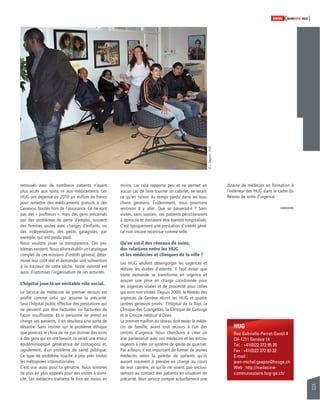
dix à quinze accords de transferts de technolo-gies 
sont conclus avec des entreprises existantes, 
tandis que deux à trois start-up sont créées. Nous 
avons actuellement quelque 150 projets en cours 
dans notre portefeuille. 
L’institution est-elle toujours 
propriétaire des découvertes 
et inventions de ses chercheurs ? 
Selon la loi, les découvertes des chercheurs appar-tiennent 
à l’institution pour laquelle ils travaillent. 
Une responsabilité est liée à cette propriété. Si 
l’institution ne fait rien pour les valoriser, les 
chercheurs peuvent demander de devenir proprié-taires 
de leurs propres découvertes. 
Vous engagez-vous souvent 
dans des demandes de brevet ? 
Après l’évaluation du potentiel, il faut détermi-ner 
au moyen de quels outils nous avons des 
chances d’intéresser des entreprises. L’existence 
d’une demande de brevet peut être un atout. 
Nous en déposons entre cinq à quinze par année. 
Une entreprise veut savoir si elle pourra bénéfi - 
cier de manière exclusive des retombées commer-ciales 
d’une invention lorsque le développement 
de celle-ci exige des investissements importants 
de sa part. 
S’il est opportun de protéger l’invention par 
un brevet, nous déposons une demande par 
l’intermédiaire d’un agent externe, sélectionné 
en fonction du sujet. C’est le début d’un long 
processus. Bien sûr, nous n’attendons pas la fi n 
de la procédure pour approcher des entreprises. 
Nous nous donnons un délai de 30 mois pour 
trouver un partenaire. Au-delà, la procédure de 
brevet devient trop coûteuse. Nous dépensons 
entre 200 000 et 250 000 francs par an en frais 
de brevets. 
Comment se présente un accord 
de transfert de technologies ? 
Il peut s’agir d’un transfert total de la propriété 
intellectuelle ou d’un transfert partiel. L’accord 
portera par exemple sur une application de la 
découverte dans un domaine de compétence 
de telle entreprise, alors qu’une application pos-sible 
dans un autre domaine sera négociée avec 
une autre entreprise. En échange du transfert 
de la propriété intellectuelle, nous demandons 
un pourcentage sur les ventes, des royalties, ou 
encore un versement annuel fi xe. 
Les institutions génèrent-elles 
ainsi des revenus importants ? 
Nous sommes dans une phase où les coûts de 
la structure UNITEC sont supérieurs aux retours 
générés par les transferts. C’est le cas de la 
majorité des universités. Ce serait parfait si 
l’Université et les HUG gagnaient de l’argent 
au moyen de ces transferts, mais ce n’est pas 
le but principal. L’impact d’UNITEC peut se mesu-rer 
autrement. UNITEC a favorisé en dix ans la 
création de 25 entreprises qui ont attiré un demi-milliard 
de francs d’investissement privé et qui 
ont généré la création de 200 postes, surtout 
dans la région genevoise. On estime que pour 
un franc investi par les pouvoirs publics dans les 
transferts de technologies, la société en récupère 
au moins trois sous forme d’impôts prélevés sur 
la vente des produits commercialisés.
87 
SWISSKNOWHOW HUG 
P A R T E N A I R E S 
HUG - UNITEC 
Offi ce of Technology Transfer 
24, rue Général-Dufour 
CH-1211 Genève 4 
Tél. : +41 (0)22 379 03 50 
E-mail : laurent.mieville@unige.ch 
Web : www.unige.ch/unitec 
Quand vos démarches aboutissent, 
il y a transfert de technologie vers une 
entreprise existante ou création 
d’une start-up. Comment s’opère 
le choix entre ces deux possibilités ? 
En matière de création d’entreprise, nous met-tons 
plus l’accent sur les personnes que sur les 
projets. Lorsque nous avons affaire à des gens 
qui ont vraiment envie de lancer leur propre 
entreprise, nous souhaitons leur donner une 
chance de réussir. 
Nous faisons actuellement un effort particulier 
en mettant en contact des jeunes en fi n d’études 
avec des entrepreneurs qui ont fait ce saut du 
monde académique à l’entreprise, et qui exercent 
leur métier avec plaisir, afi n de montrer que cela 
peut être une alternative de carrière à la banque, 
à l’administration ou à l’entreprise industrielle. 
Infos 
Parmi les sociétés récemment créées et 
issues de savoirs développés à l’UNIGE 
et aux HUG, Stemergie Biotechnology 
est une start-up qui développe une 
technologie novatrice capable de déceler 
et traiter des cellules souches cancéreuses 
situées dans le cerveau. 
GenKyoTex regroupe les efforts de 
recherche sur trois continents (Genève, 
Tokyo, Texas). C’est une société bio phar-maceutique 
de produits qui vise à mettre 
au point des médicaments innovants 
bloquant la source de production de 
radicaux libres toxiques, de façon spé-ci 
fi que, pour le traitement de maladies 
dégénératives chroniques ou aiguës et de 
maladies cardio-vasculaires. 
Sur ce thème, à lire l’ouvrage From Science 
to business, dont M. Laurent Mieville 
est co-auteur avec le professeur George 
Haour : www.fromsciencetobusiness.com
88 
SWISSKNOWHOW HUG 
P A R T E N A I R E S 
Eleven years ago 
the University of Geneva 
committed to the transfer 
of technologies and created 
UNITEC, giving researchers 
a way of fi nding the 
means and voices for their 
inventiveness and desire 
that could see through 
developments that were 
economically promising. 
It very quickly became clear 
that the hospital was also 
an important contributor, 
as research often goes hand 
in hand with clinical practice, 
so the HUG joined UNITEC 
in 2003. The director 
of this organisation since 
its creation Laurent Mieville 
agreed to talk to us about 
its results, how it works 
and its philosophy. 
FROM ACADEMIC EXCELLENCE 
TO ECONOMIC SUCCESS 
UNITEC, ten years of transferring technologies 
How do you defi ne your mission? 
Our mission involves identifying discoveries that 
may be interesting for companies, with the aim 
of developing products. Researchers contact us 
with information about their inventions – we 
receive between 40 and 80 applications every 
year – and our agency assesses their economic 
potential. Every year, on average ten to fi fteen 
technology transfer agreements are concluded 
with existing companies, and two or three 
start-ups are created. Currently we have around 
150 projects underway in our portfolio. 
Does the institute remain the owner 
of the discoveries and inventions 
of its researchers? 
According to the law, researchers’ discoveries 
belong to the institute where they work. 
However, this ownership comes with responsibil-ity; 
researchers can apply to become the owners 
of their own discoveries if an institute does noth-ing 
to develop them. 
Do you often apply for patents? 
After assessing the potential, we have to decide 
which tools might help us to interest companies. 
The existence of a patent application can be an 
advantage: we fi le fi ve to fi fteen applications 
every year. Companies want to know whether 
they can benefi t exclusively from the commercial 
consequences of an invention if they have to 
invest signifi cantly in its development. 
If it is appropriate to protect the intervention 
with a patent, we fi le an application through 
an external agent, selected depending on the 
subject. This is the beginning of a long process. 
Of course, we don’t wait until the procedure is 
over before we approach companies. We give 
ourselves a period of 30 months to fi nd a part-ner. 
Beyond that, the patent procedure becomes 
too costly. We spend between 200,000 and 
250,000 Swiss francs per year on patent costs. 
What does a technology transfer 
agreement involve? 
It may be a total or partial transfer of intellectual 
property. The agreement will cover, for example, 
the application of the discovery in a company’s 
area of expertise, while a possible application 
in another area will be negotiated with another 
company. In exchange for the transfer of intellec-tual 
property, we ask for a percentage of sales, 
royalties, or even a fi xed annual payment. 
Do institutes generate large incomes 
in this way? 
Currently the costs of the UNITEC are higher 
than the returns generated by the transfers, as is 
the case with most universities. In an ideal world, 
the University and the HUG would earn money 
through these transfers, but that’s not the main 
goal. UNITEC’s impact can be measured in other 
ways: in ten years, UNITEC has promoted the cre-ation 
of 25 companies which have attracted half 
a billion francs of private investment and cre-ated 
200 jobs, especially in the Geneva region. 
We estimate that for every franc invested by the 
authorities in technology transfers, society gets 
back at least three – in the form of tax levied on 
the sale of the products marketed. 
So when things go well, either technology 
is transferred to an existing company, 
or a start-up is created. How do you 
choose between these two options? 
When it comes to creating companies, we focus 
more on people than projects. When we deal 
with people who really want to start up their 
own company, we want to give them a chance 
to succeed.
89 
SWISSKNOWHOW HUG 
P A R T E N A I R E S 
At the moment we are making a real effort to put 
fi nal-year students in contact with entrepreneurs 
who have made the jump from the academic 
world into business, and who enjoy their job, 
to demonstrate that this can be an alternative 
career to banking, the civil service and large 
industrial companies. 
HUG - UNITEC 
Offi ce of Technology Transfer 
24, rue Général-Dufour 
CH-1211 Genève 4 
Tel.: +41 (0)22 379 03 50 
E-mail: laurent.mieville@unige.ch 
Web: www.unige.ch/unitec 
Infos 
Among the companies recently created 
using the knowledge developed at 
the UNIGE and the HUG, Stemergie 
Biotechnology is a start-up that develops 
innovative technology capable of detecting 
and treating cancerous stem cells located 
in the brain. 
GenKyoTex brings together research from 
three continents (Geneva, Tokyo, Texas). It 
is a biopharmaceutical company that aims 
to develop innovative drugs that specifi cally 
block the source producing toxic free radicals 
to treat chronic or acute degenerative 
diseases and cardiovascular diseases. 
For more on this subject, read the work From 
Science to business, which Laurent Mieville 
and Professor George Haour co-authored: 
www.fromsciencetobusiness.com
90 
SWISSKNOWHOW HUG 
S 
E R I A N E T R A P En partenariat avec des 
organisations publiques 
et privées actives dans la 
recherche cellulaire, les 
Hôpitaux universitaires de 
Genève (HUG) et la Faculté 
de médecine de Genève ont 
créé en mai 2010 le Swiss 
Institute of Cell Therapies 
(SICT). Cette fondation, 
dirigée par le professeur 
Philippe Morel, a pour objectif 
de développer des thérapies 
cellulaires innovantes et de les 
faire passer plus rapidement 
à l’application clinique. 
La Dre Marisa Jaconi, 
vice–directrice du SICT, 
répond à nos questions. 
les besoins cliniques des malades, ainsi que sur 
le développement et la commercialisation de 
thérapies cellulaires innovantes (TCI). Ensuite, 
la fondation veut réunir, coordonner et faciliter THÉRAPIES CELLULAIRES 
EN PLEIN DÉVELOPPEMENT 
SICT, une fondation qui accélère le mouvement 
Qu’est-ce que la thérapie cellulaire? 
Grâce aux cellules souches fonctionnant comme 
un réservoir, certains de nos organes se régé-nèrent 
périodiquement. Toutefois, les tissus peu-vent 
avoir été endommagés par une maladie, 
une lésion ou simplement par le vieillissement. 
Il arrive ainsi qu’ils ne puissent pas se régénérer 
correctement ou suffi samment rapidement. On 
fait alors en sorte que l’organe puisse se remo-deler 
et fonctionner à nouveau grâce l’apport de 
nouvelles cellules. 
À long terme, le rêve serait de pouvoir activer de 
manière plus optimale les processus d’autorépa-ration 
du tissu lui-même, tout en évitant les phé-nomènes 
de fi brose et cicatrisation non fonction-nelle 
qui apparaissent lors d’une lésion du tissu. 
Les premières thérapies cellulaires effectives sont 
la transplantation de cellules souches pour les 
maladies hématologiques (maladies du sang). 
Autre exemple, les greffes de moelle osseuse 
fonctionnent bien. 
Peut-on régénérer d’autres types 
de tissus ? 
De nombreuses questions se posent au sujet de 
la régénération du foie, du coeur et du tissu ner-veux 
ou encore de la peau. 
Pour le diabète, on cherche à remplacer les cel-lules 
qui produisent l’insuline. Dans le cas des 
grands brûlés, il s’agit de recréer les glandes 
sudoripares et les poils ou de rendre la peau 
souple comme à l’origine. 
Actuellement, il n’est pas possible de recréer la 
structure complexe de la peau et cela empêche la 
transpiration. Sans cette évacuation de chaleur, 
le patient souffre de surchauffage intérieur. 
La thérapie cellulaire vise également à trouver 
des alternatives à des traitements médicamen-teux 
devenus ineffi caces pour certaines maladies 
neurodégénératives du système nerveux, comme 
le Parkinson. L’objectif est ici de régénérer les cel-lules 
qui produisent la dopamine dans le cerveau. 
Pour les lésions de la moelle épinière, le rééta-blissement 
des liaisons nerveuses donnerait un 
espoir aux personnes ayant perdu l’usage de 
leurs membres. 
Les thérapies cellulaires ont de multiples appli-cations 
possibles. Il est important que tous les 
groupes de chercheurs qui travaillent sur ce sujet 
se coordonnent et collaborent grâce à des parte-nariats 
public-privé. C’est dans ce but que l’insti-tut 
suisse de thérapies cellulaires a été créé. 
Dites-nous en un peu plus au sujet 
de l’institut. 
La mise en place de thérapies effi caces requiert 
de la recherche fondamentale, de la recherche 
appliquée, ainsi que de la recherche transla-tionnelle 
qui consiste à passer de la démonstra-tion 
d’un modèle animal à des essais cliniques 
chez l’homme. Des problèmes de plus en plus 
complexes doivent être surmontés pour passer 
rapidement à l’application chez l’homme. Or, il 
manquait justement des structures favorisant 
cette transition de manière rapide et sécurisée. 
Cela a été le point de départ de l’institut qui 
cherche à fédérer en Suisse les efforts des diffé-rents 
acteurs travaillant dans le domaine. 
Les Hôpitaux Universitaires de Genève ont été 
les premiers en Suisse à créer un centre public 
de thérapies cellulaires selon les normes GMP 
(Good Manufactury Practice), contrôlées par 
Swissmedic, et en accord avec les directives 
européennes. Ces bonnes pratiques cliniques 
régissent les conditions de sécurité comme les 
conditions de fi ltration de l’air et de stérilité de 
l’environnement nécessaires à la mise en place 
de thérapies cellulaires. 
Plus précisément, quels sont 
les objectifs de l’institut ? 
Le SICT a quatre objectifs majeurs. Il s’agit pre-mièrement 
de développer un institut centré sur 
Docteure Marisa Jaconi
91 
SWISSKNOWHOW HUG 
Institut suisse de 
thérapies cellulaires 
Chemin Rieu 17 
Case postale 270 
1211 Genève 17 
Tél. : +41 22 704 36 34 
Fax : +41 22 704 36 37 
E-mail : contact@swiss-ict.ch 
Web : www.swiss-ict.ch 
les travaux réalisés par des équipes cliniques, 
groupes de recherches et entreprises privées 
impliquées en TCI. La formation de spécialistes 
en TCI constitue également un des buts primor-diaux. 
Le dernier objectif est de mettre à dispo-sition 
des ressources biologiques, techniques, 
procédurales, juridiques et éthiques pour les TCI. 
Quels sont les projets en cours au SICT ? 
Les stratégies en cours au centre de thérapie 
des HUG consistent par exemple à produire 
des préparations cellulaires purifi ées pour 
la transplantation d’îlots de Langerhans du 
pancréas dans le cadre du traitement du dia-bète 
(projet dirigé par le professeur Thierry 
Berney), qui affecte plus de 30 000 personnes 
en Suisse. Le centre de thérapie cellulaire des 
HUG a permis la transplantation du plus grand 
nombre de patients diabétiques au monde 
depuis trois ans. 
En cours, il y a le développement clinique d’une 
vaccination antitumorale à l’aide de cellules 
encapsulées (professeur Nicolas Mach). 
P A R T E N A I R E S 
L’immunothérapie antitumorale sert 
à concevoir un traitement spécifi que, 
ciblé et dirigé contre les cellules can-céreuses. 
Les avancées de la thérapie 
cellulaire ouvrent la voie à une nou-velle 
stratégie de vaccination poten-tiellement 
applicable à une grande 
variété de cancers. 
Le stockage de tissus à usage théra-peutique 
en conditions GMP est une 
autre facette des activités du centre. 
Il s’agit par exemple de cryoconserva-tion 
de tissu ovarien pour de jeunes 
patientes en attente d’une chimio-thérapie 
et pour la cryoconservation 
de membranes amniotiques pour des 
traitements ophtalmologiques. 
D’autres projets concernent la créa-tion 
de pansements cellulaires dans 
des biomatrices, notamment afi n de 
réparer des tissus pour les grands 
brûlés (professeur Wassim Raffoul, 
CHUV). Et nous mettons en place 
également des travaux novateurs sur 
la régénération de l’os et du cartilage 
et sur la régénération du muscle dans 
le cas de dystrophie musculaire. 
Quel futur voyez-vous 
pour le SICT ? 
L’institut se veut exemplaire d’une 
nouvelle manière de travailler 
en Suisse dans le domaine de la 
recherche et de la thérapie cellulaire. 
Il a comme ambition de coordonner 
les efforts scientifi ques, d’échanger 
des connaissances et de lever les 
fonds nécessaires au développement 
de nouvelles thérapies grâce à des 
partenariats public-privé. 
Ces efforts doivent être soutenus et 
poursuivis tout en travaillant à défi nir 
un cadre légal et éthique en accord 
avec la législation suisse, ainsi qu’avec 
les directives européennes. Nous y 
travaillons en établissant un code de 
conduite sous le label Swiss-ICT.
92 
SWISSKNOWHOW HUG 
P A R T E N A I R E S 
THE BOOM IN CELL THERAPIES 
SICT, a foundation that is speeding things up 
Cell therapies have many possible uses. It is 
important that all the groups of researchers who 
work on this subject coordinate with each other 
and collaborate through these public/private 
partnerships. It is with this aim in mind that the 
Swiss Institute of Cell Therapies was set up. 
Tell us more about the Institute. 
The introduction of effective therapies requires 
basic research, applied research and transla-tional 
research that involves moving from the 
demonstration of an animal model to clinical tri-als 
with humans. More and more complex prob-lems 
need to be overcome in order to quickly 
proceed to use in humans. All that was missing 
was structures that favoured this quick and safe 
transition. This was the starting point for the 
Institute, which aims to join together all of the 
efforts achieved by different players working in 
this fi eld in Switzerland. 
The Geneva University Hospital was the fi rst in 
Switzerland to create a public centre for cell 
therapy in line with good manufacturing prac-tices, 
run by Swissmedic and in accordance with 
European directives. These good clinical practices 
govern the safety conditions such as the condi-tions 
for air fi ltration and sterile environment 
required for the establishment of cell therapies. 
More precisely, what are the objectives 
of the Institute? 
The SICT has four main objectives. Firstly, to 
develop an institute that focuses on the clinical 
needs of patients as well as developing and mar-keting 
innovative cell therapies. Secondly, the 
foundation hopes to bring together, coordinate 
and facilitate work carried out by clinical teams, 
research groups and private companies involved 
in innovative cell therapies. Our third objective is 
to train innovative cell therapy specialists. And 
fi nally, our fourth objective is to make biological, 
technical, procedural, legal and ethical resources 
available for innovative cell therapies. 
What is cell therapy? 
Thanks to stem cells that act as a reservoir, some 
of our organs can regenerate themselves from 
time to time. However, tissues may have been 
damaged by an illness, injury or simply from old 
age. They therefore cannot regenerate properly 
or quickly enough. In these cases, we make sure 
that the organ can reshape itself and work again 
using the supply of new cells. 
In the long term, our dream would be to be 
able to activate the processes in a more opti-mal 
way, whereby the tissue repairs itself while 
avoiding the problems of fi brosis and incom-plete 
healing which can result from damage 
to the tissue. 
The fi rst effective cell therapies are the trans-plantation 
of stem cells for haematological dis-eases 
(blood diseases). Another example is bone 
marrow transplants, which work well. 
Can you regenerate other types 
of tissue? 
The subject of regenerating the liver, heart, nerv-ous 
tissue or even the skin raises a lot of questions. 
For diabetes, we are carrying out research into 
replacing the cells that produce insulin. For 
severe burn victims, we are working on recreat-ing 
the sudoriferous glands and the hair or mak-ing 
the skin supple like it was before. 
At the moment, it is not possible to recreate the 
complex structure of the skin and this prevents 
transpiration. If heat cannot be removed from 
the body, the patient will suffer internal overheat-ing. 
Cell therapy also aims to fi nd alternatives for 
medical treatments that have become ineffec-tive 
for certain neurodegenerative diseases of 
the nervous system, such as Parkinson’s disease. 
The objective here is to regenerate the cells that 
produce dopamine in the brain. 
For damage to the spinal cord, the re-establish-ment 
of nervous connections would give hope to 
people who have lost the use of their limbs. 
Doctor Marisa Jaconi 
In partnership 
with public and private 
organisations working on 
cell research, the Geneva 
University Hospitals (HUG) 
and the Faculty of medicine 
in Geneva set up the Swiss 
Institute of Cell Therapies 
(SICT) in May 2010. This 
foundation, managed by 
Professor Philippe Morel, 
aims to develop innovative 
cell therapies and help 
them move towards clinical 
application with greater 
speed. 
Dr Marisa Jaconi, 
vice–director of SICT, 
kindly agreed to answer 
our questions.
93 
SWISSKNOWHOW HUG 
P A R T E N A I R E S 
What projects are you currently working 
on at SICT? 
Strategies currently underway at the HUG therapy 
centre include, for example, producing purifi ed 
cell preparations for the transplantation of islets 
of Langerhans in the pancreas as part of treat-ment 
for diabetics (project managed by Professor 
Thierry Berney), which affects more than 30,000 
people in Switzerland. The HUG cell therapy 
centre has facilitated transplants in the highest 
number of diabetic patients in the world for the 
last three years. 
We are currently working on the clinical develop-ment 
of an anti-tumour vaccination using encap-sulated 
cells (Professor Nicolas Mach). 
Anti-tumour immunotherapy is used to develop 
a specifi c treatment, targeted and directed to 
fi ght against cancerous cells. Advances in cell 
therapy are paving the way for a new vaccina-tion 
strategy that could apply to a wide variety 
of cancers. 
Storing tissue for therapeutic use 
in line with good manufacturing 
practices is another of the centre’s 
activities. This involves, for example, 
the cryogenic preservation of ovar-ian 
tissue for young patients await-ing 
chemotherapy and the cryogenic 
preservation of amniotic membranes 
for ophthalmological treatments. 
Other projects concern the crea-tion 
of cell dressings in biomatrices, 
particularly in order to repair tissue 
for severe burns victims (Professor 
Wassim Raffoul, CHUV). And we are 
also working on new research into the 
regeneration of bone and cartilage 
and into the regeneration of muscle 
in the case of muscular dystrophy. 
What does the future hold 
for SICT? 
The Institute would like to set an 
example for a new way of working 
in Switzerland in the fi eld of research 
and cell therapy. Its aim is to coor-dinate 
the scientifi c efforts, transfer 
knowledge and raise the funds nec-essary 
for the development of new 
therapies using public/private part-nerships. 
These efforts need to be supported 
and continued while working to 
defi ne a legal and ethical framework 
in accordance with Swiss legislation 
and European directives. We are 
working on establishing a code of 
practice under the Swiss ICT label. 
Swiss Institute 
of Cell Therapies 
Chemin Rieu 17 
Case postale 270 
1211 Genève 17 
Tel.: +41 22 704 36 34 
Fax: +41 22 704 36 37 
E-mail: contact@swiss-ict.ch 
Web: www.swiss-ict.ch
94 
SWISSKNOWHOW HUG 
D 
éveloppé aux Hôpitaux 
universitaires de Genève, 
OsiriX présente une véritable 
révolution dans le monde 
fermé de l’imagerie 
médicale : grâce à cet 
outil gratuit, les médecins 
peuvent facilement visualiser, 
manipuler et interpréter les 
images du corps humain en 
3D sur un simple ordinateur 
de bureau. 
La Fondation OsiriX 
Web : 
www.foundation.osirixfoundation.com 
E-mail : osirix@osirixfoundation.com 
Le logiciel : www.osirix-viewer.com 
OSIRIX, L’IMAGERIE MÉDICALE EN 3D 
À LA PORTÉE DE TOUS 
Fruit de la collaboration entre Antoine Rosset, 
radiologue et chef de clinique aux HUG, et 
le professeur Osman Ratib, médecin-chef du 
service de médecine nucléaire aux HUG et chef 
du département d’imagerie et des sciences de 
l’information médicale, OsiriX est un programme 
capable de modéliser rapidement les images 
capturées par n’importe quel type de scanner, 
comme les PET, CT-scan ou encore IRM. 
L’outil est conçu pour représenter le corps humain 
en 3D, évoluant dans le temps (4D) et même 
intégrant son fonctionnement (5D) à partir des 
images de différents types de scanners. Il per-met 
également de mieux visualiser les organes, 
tissus ou portions de corps en leur attribuant 
des couleurs et des degrés d’opacité différents. 
Du coup, les images prennent un aspect très 
graphique pour une plus grande lisibilité. 
Grâce à une bourse du Fonds national pour la 
recherche scientifi que attribuée au Dr Rosset, les 
deux médecins ont lancé en 2004 une première 
version de leur logiciel en accès libre. Outre sa 
gratuité, il présente de nombreux atouts comme 
sa facilité d’utilisation, sa présentation très 
graphique et ses performances lui permettant 
de fonctionner sur n’importe quel ordinateur 
MacIntosh classique. 
Son accès aisé lui confère un tel succès qu’actuel-lement 
près de 50 000 professionnels l’utilisent 
chaque mois. 
Auparavant, l’interprétation des images médi-cales 
était réservée aux spécialistes tels que 
des radiologues. Grâce à OsiriX, le chirurgien, 
l’oncologue ou le gastroentérologue peuvent 
aujourd’hui gérer et manier eux-mêmes les 
images comme ils l’entendent depuis leur 
bureau. 
Le développement du programme repose sur 
un modèle open source et fournit bien plus 
d’avantages que la simple gratuité. L’utilisateur 
peut accéder au code source pour le modifi er et 
ainsi l’adapter à ses besoins. Afi n de garder une 
certaine unité, Antoine Rosset vérifi e et valide 
toutefois les changements proposés par les déve-loppeurs. 
Pour assurer le soutien et la promotion du 
logiciel, de ses futures versions ainsi que de 
nouveaux développements, une fondation a 
été créée en décembre 2008 avec l’appui de 
plusieurs partenaires, dont Bernard Gruson, 
directeur général des HUG, et Patrick Aebischer, 
président de l’EPFL. 
Sise à Genève, la Fondation OsiriX a notamment 
pour objectif de soutenir les développements 
open source dans le domaine de la médecine. 
Elle cherche ainsi à fi nancer de jeunes program-meurs 
en leur offrant des bourses d’études, tout 
en récompensant les meilleures contributions 
grâce à un prix, l’OsiriX Plugin Award. 
P A R T E N A I R E S 
Professeur Osman Ratib 
© J. Gregorio - HUG
95 
SWISSKNOWHOW HUG 
D 
eveloped at Geneva 
University Hospitals (HUG), 
OsiriX is a real revolution in 
the closed world of medical 
imaging: thanks to this 
free tool, doctors can easily 
visualise, move and interpret 
3D images of the human 
body on a basic offi ce 
computer. 
The OsiriX Foundation 
Web: 
www.foundation.osirixfoundation.com 
E-mail: osirix@osirixfoundation.com 
Software: www.osirix-viewer.com 
OSIRIX, 3D MEDICAL IMAGING 
AVAILABLE TO EVERYONE 
The result of collaboration between Antoine 
Rosset, radiologist and chief resident at the 
HUG, and Professor Osman Ratib, medical direc-tor 
of the nuclear medicine department at the 
HUG and head of the department of imaging 
and medical information sciences, the OsiriX 
programme is capable of quickly modelling the 
images captured by any kind of scanner, such as 
PET, CT or even MRI. 
The tool is designed to show the human body in 
3D, developing over time (4D) and even integrat-ing 
its function (5D) using images from different 
types of scanners. It also allows doctors to visu-alise 
organs, tissues or parts of the body better, 
allocating them colours and different degrees 
of opacity. As a result, the images assume a 
very graphical appearance, giving them greater 
readability. 
Thanks to a grant awarded to Dr Rosset by the 
Swiss National Science Foundation, in 2004 the 
two doctors launched an initial version of their 
software free of charge. On top of being free, it 
has numerous advantages, like its ease of use, 
its very graphical presentation and its perfor-mances 
which enable it to work on any conven-tional 
Macintosh computer. 
Its easy access has brought it such success that 
currently almost 50,000 professionals use it 
every month. 
Previously, interpreting medical images was lim-ited 
to specialists like radiologists. Today, using 
OsiriX, surgeons, oncologists and gastroenterolo-gists 
can manage and handle the images them-selves 
as they wish from their offi ce. 
The programme was developed using an open 
source model and provides a number of advan-tages 
above and beyond the fact that it is free. 
Users can access the source code to modify it and 
therefore adapt it to their needs. However, to pre-serve 
a certain level of cohesion, Antoine Rosset 
checks and confi rms any changes suggested by 
developers. 
To support and promote the software, its future 
versions and new developments, a foundation 
was created in December 2008 with the support 
of several partners, including Bernard Gruson, 
managing director of the HUG, and Patrick 
Aebischer, president of the EPFL. 
Located in Geneva, the OsiriX Foundation aims 
in particular to support open source develop-ments 
in the fi eld of medicine. It looks to fi nance 
young programmers by providing them with 
grants, while rewarding the best contributions 
with a prize, the OsiriX Plugin Award. 
P A R T E N A I R E S
96 
SWISSKNOWHOW HUG 
En février 2011 s’est tenue à 
Berne la 4e édition de la Journée 
internationale des maladies rares, 
notamment soutenue par les cinq 
hôpitaux universitaires suisses. 
De gros efforts sont consentis en 
Suisse, notamment aux HUG, 
pour faire mieux connaître ces 
maladies et aider les patients 
à briser l’isolement éprouvé du 
fait de pathologies souvent mal 
connues des professionnels de 
santé et d’un manque général 
d’information. Fortement investie 
dans les démarches visant à 
sensibiliser les institutions de 
santé, les instances politiques et 
le public à cette problématique, 
la Dre Loredana D’Amato 
Sizonenko, coordinatrice suisse 
du site Internet Orphanet, 
institutionnalisé depuis 2001 aux 
HUG, et cofondatrice de ProRaris, 
répond à nos questions. 
Service de médecine 
génétique 
Centre médical universitaire 
Rue Michel-Servet 1 
CH-1211 Genève 4 
Tél. : +41(0)22 379 56 96 
Mobile : +41 (0)79 553 35 14 
E-mail : contact@orphanet.ch 
Web : www.orphanet.ch 
Comment défi nir la notion 
de « maladie rare » ? 
On parle de maladie rare lorsqu’une pathologie 
affecte moins d’une personne sur 2 000. Plus de 
7 000 maladies rares sont répertoriées. On estime 
qu’elles touchent entre 6 à 8 % de la population, 
soit 30 millions de personnes en Europe et quelque 
500 000 en Suisse. Prises dans leur ensemble, ces 
maladies constituent un enjeu important de santé 
publique, encore largement méconnu en Suisse. 
À part leur rareté, 
qu’est-ce qui caractérise ces maladies ? 
Ces maladies ont à 80 % une origine génétique, 
les autres causes étant auto-immunes, infec-tieuses, 
dégénératives ou tumorales. Il s’agit 
souvent de maladies chroniques invalidantes qui 
entraînent des handicaps, menacent la vie des 
personnes malades ou altèrent leur qualité de vie. 
La plus connue, aujourd’hui bien documentée, 
est la myopathie de Duchenne. Vu leur nombre, 
il est diffi cile de donner des exemples : absence 
congénitale des valves pulmonaires, main et pied 
fendus, syndrome du cri du chat, rachitisme vita-mino- 
résistant, pour n’en citer que quelques-unes. 
Les patients sont confrontés aux mêmes diffi cultés : 
erreurs de diagnostic, prise en charge inappropriée, 
souffrance psychologique liée au manque d’espoir 
thérapeutique et à l’absence ou à l’insuffi sance de 
soutien pratique dans la vie quotidienne. Peu sou-tenue, 
la recherche n’ouvre guère de perspectives 
et l’industrie pharmaceutique n’est pas très moti-vée 
du fait d’un marché limité. Le terme « mala-die 
orpheline » dit bien à quel point ces patients 
sont délaissés. Il n’est pas rare que ces pathologies 
soient fi nalement qualifi ées de troubles psychiques. 
Entre les premiers symptômes et le diagnostic, il 
peut s’écouler de 5 à 35 ans en moyenne. 
Les maladies rares sont-elles aujourd’hui 
sérieusement prises en considération 
en Suisse ? 
Les choses bougent depuis deux ans. La Suisse 
suit la trace de l’Union européenne avec un 
retard de quelques années, non pas en raison 
d’une mauvaise volonté, mais de la complexité 
du système politique suisse et de son système de 
santé. En France, pays moteur dans ce domaine, 
il existe plus de 130 centres de référence labelli-sés 
dans la prise en charge de certaines maladies 
rares, alors qu’en Suisse, les quelques centres 
existants ne sont pas offi ciellement reconnus. Il 
n’y a pas non plus de programmes de recherche, 
ni de fi nancement spécifi ques soutenus par les 
pouvoirs publics. 
Néanmoins, une prise de conscience se fait. La 
loi fédérale sur les médicaments autorise une 
procédure simplifi ée de mise sur le marché des 
médicaments spécifi ques aux maladies rares. 
La conseillère nationale Ruth Humbel, membre 
de la commission de la santé, a déposé un 
postulat proposant une stratégie nationale. La 
Conférence suisse des directeurs cantonaux de 
la santé et les cantons contribuent aujourd’hui 
au fi nancement du partenaire suisse du site 
Internet de référence européen Orphanet, initié 
en France en 1997. Il existe des pôles d’expertise 
en Suisse pour certaines maladies rares, il faut 
le faire savoir. 
Un lobby comme ProRaris, Alliance 
des maladies rares - Suisse, peut-il aider 
à faire avancer les choses ? 
J’en suis convaincue. Il faut écouter les patients, 
qui sont souvent les meilleurs experts de leur 
maladie. Cette alliance s’est constituée en juin 
2010. Elle a pour mission de regrouper la cen-taine 
d’associations de maladies rares existant 
en Suisse et d’accélérer la prise de conscience 
(www.proraris.ch). Notre système de santé doit 
fournir à chaque patient des prestations de qua-lité, 
quelle que soit la fréquence de la maladie 
dont il est atteint. C’est une question d’équité. 
P A R T E N A I R E S 
MALADIES RARES, 
NOMBREUSES SOUFFRANCES 
Pour une stratégie nationale 
Un site Internet de référence 
Les maladies rares possèdent leur site Internet, précieux outil d’information à la libre disposition 
gratuite des professionnels de la santé et du public. Son but est de contribuer à améliorer le 
diagnostic, la prise en charge et le traitement. Orphanet est constitué d’une encyclopédie en 
ligne écrite par des experts européens et d’un répertoire des services à destination des malades 
et des professionnels. Ce répertoire inclut des informations sur les consultations spécialisées, 
les laboratoires de diagnostic, les projets de recherche en cours et les associations de malades 
dans 40 pays partenaires. Disponible en six langues, il offre aussi une entrée à chaque pays. 
www.orphanet.ch 
Docteure Loredana d’Amato Sizonenko
97 
SWISSKNOWHOW HUG 
P A R T E N A I R E S 
RARE DISEASES, 
COMMON SUFFERING 
For a national strategy 
Doctor Loredana d’Amato Sizonenko 
In February 2011 the fourth 
Rare Disease Day was held in 
Berne, supported by the fi ve 
Swiss university hospitals. Major 
efforts have been undertaken in 
Switzerland, particularly at the 
HUG, to make the wider public 
more aware of these illnesses 
and help patients to break out 
of the isolation experienced as 
a result of pathologies which 
health professionals often know 
little about and a general lack 
of information. Thoroughly 
committed to actions that aim 
to raise the awareness of health 
institutions, political bodies and 
the public on this subject, 
Dr Loredana D’Amato Sizonenko, 
Swiss coordinator of the website 
Orphanet, employee of the HUG 
since 2001 and co-founder 
of ProRaris, agreed to answer 
our questions. 
How do you defi ne a “rare disease”? 
A rare disease is one that affects less than one 
person in 2,000. More than 7,000 diseases have 
been classifi ed as rare. We estimate that they 
affect 6 to 8% of the population: 30 million peo-ple 
in Europe and some 500,000 in Switzerland. 
Taken together, these diseases are a signifi cant 
issue for public health, and yet are still widely 
ignored in Switzerland. 
Apart from their rarity, how else 
are these diseases characterised? 
80% of these diseases have genetic origins, with 
other causes being auto-immune problems, infec-tions, 
degenerative diseases or tumours. They 
are often incapacitating chronic diseases which 
cause disabilities, can be fatal to sufferers or 
alter their quality of life. The most famous rare 
disease, today well documented, is Duchenne 
muscular dystrophy. Given their number, it’s diffi - 
cult to give examples: congenital absence of the 
pulmonary valve, deformed hands and feet, cri 
du chat syndrome and vitamin-resistant rickets 
to name just a few. 
The patients face the same problems: incorrect 
diagnosis, inappropriate treatment, psycho-logical 
suffering as a result of a lack of hope in 
therapy and no or insuffi cient practical support 
in everyday life. With little support, research has 
hardly any prospects and the limited market does 
not provide enough motivation for the pharma-ceutical 
industry. The term “orphan disease” is 
indicative of the neglect these patients face. It is 
common for these pathologies to be fi nally clas-sifi 
ed as mental disorders. From the moment the 
fi rst symptoms appear, it can take an average 5 
to 35 years to reach a diagnosis. 
Are rare diseases seriously taken 
into consideration in Switzerland today? 
Over the last two years things have started to 
change. Switzerland is a couple of years behind 
the European Union, not because of a lack of 
will, but because of the complexity of the Swiss 
political system and its health system. In France, 
the leader in this fi eld, there are more than 130 
approved centres of reference that treat certain 
rare diseases, while in Switzerland the few exist-ing 
centres are not offi cially recognised. There 
are no research programmes and no specifi c 
fi nancing supported by the local authorities is 
available either. 
Nevertheless, the general public is becoming 
more aware. The federal law on medication 
authorises a simplifi ed procedure for launching 
medicine that is specifi c to rare diseases onto the 
market. The national councillor Ruth Humbel, a 
member of the health commission, has called 
on the government to investigate the possibil-ity 
of developing a national strategy. The Swiss 
conference of cantonal health directors and 
the cantons today contribute to fi nancing the 
Swiss partner of the European reference website 
Orphanet, launched in France in 1997. There are 
centres of expertise in Switzerland for certain 
rare diseases, we have to publicise them. 
Can a lobby like ProRaris, the Swiss 
alliance of rare diseases, help things 
to move forwards? 
Yes, I’m positive we can. We have to listen to 
the patients - they are often the best experts on 
their illness. The alliance was created in June 
2010. It aims to bring together the hundred dif-ferent 
associations for rare diseases that exist in 
Switzerland and to speed up the growing con-sciousness 
(www.proraris.ch). Our health system 
has to provide each patient with quality services, 
no matter how common the illness they are 
affected by. It’s only fair. 
A reference website 
Rare diseases have their own website, a precious information tool that is freely available to 
health professionals and the public. It aims to help improve the diagnosis, care and treatment 
of these diseases. Orphanet comprises an online encyclopaedia written by European experts 
and a directory of services for sufferers and professionals. This directory includes information 
on specialist consultations, diagnosis laboratories, current research projects and patient 
associations in 40 partner countries. Available in six languages, it also offers an entry on each 
country. 
www.orphanet.ch 
Medical genetics 
division 
University medical centre 
Rue Michel-Servet 1 
CH-1211 Genève 4 
Tel.: +41(0)22 379 56 96 
Mobile: +41 (0)79 553 35 14 
E-mail: contact@orphanet.ch 
Web: www.orphanet.ch
COMPANY PROFILE 
98 
SWISSKNOWHOW HUG
COMPANY PROFILE 
99 
SWISSKNOWHOW HUG 
Mr. Coissac, could you tell us about A 
Alexion Pharma International? 
Alexion Pharma International Sàrl, based in 
Lausanne, Switzerland, is the European head-quarters 
and the International Operations 
Center. We oversee the company’s operations 
in Europe, the Middle East and Africa (EMEA) 
and deliver worldwide services across the globe 
– with the exception of the USA & Canada – 
via our Lausanne-based global functions of 
Quality Assurance, Supply Chain, Information 
Technology, Regulatory Affairs and Finance. 
In 2005, we started our European activities with 
the goal of leading the company’s expansion 
into Europe and beyond. It took a great deal of 
work to successfully establish Alexion in EMEA 
with its diverse and complex markets. Now, six 
years later, we can be proud of our achievements 
and ability to serve patients suffering from PNH 
across the EMEA geography. Today, the Alexion 
Lausanne offi ce has close to 100 em ployees, com-prised 
of 18 different nationalities with unique 
skillsets, industry backgrounds and expertise. In 
EMEA, Alexion operates in over 20 countries and 
employs more than 240 people. This is just the 
beginning of our journey which will continue to 
take us to new countries and new endeavors. 
How is Alexion’s work refl ected in the 
company’s philosophy? 
At Alexion, we believe and act according to our 
core values. We aim to serve patients, physi-cians 
and the medical community through the 
innovation, development and commercialization 
of life-transforming therapies. We trust our part-ners 
and colaborators, and engage ourselves to 
expand the boundaries of modern healthcare. 
We respect one another, learn from the unique-ness 
of each individual and build on the strength 
of our diversity. 
Could you share more about the disease 
you have focused on until now? 
The Alexion team, led by Dr. Leonard Bell, M.D., 
Chief Executive Offi cer and principle foun der of 
the company, developed Soliris® (eculizumab) 
which, after 15 years of development, was 
approved in 2007 in the United States and 
Europe as a treatment for patients living with 
PNH, a rare and ultra-rare, debilitating and life-threatening 
blood disorder. Soliris® is the com-pany’s 
fi rst product and is a fi rst-in-class terminal 
complement inhibitor. 
Historically, one-third of patients with PNH have 
died within fi ve years of diagnosis. Before Soliris® 
was approved, there were no therapies specifi - 
cally available for the treatment of patients with 
PNH. 
Moving forward, we will continue our focus on 
ultra-rare and life-threatening diseases for which 
there are few, if any, effective treatment options. 
lexion Pharmaceuticals, 
Inc., founded in Cheshire, 
Connecticut, USA 
in 1992, is a global 
biopharmaceutical 
company focused on 
serving patients with 
severe and ultra-rare 
disorders. Alexion is the 
leader in complement 
inhibition, and has 
developed and markets 
Soliris® (eculizumab) as 
a treatment for patients 
with PNH (paroxysmal 
nocturnal hemoglobinuria), 
a debilitating, ultra-rare 
and life-threatening blood 
disorder. Today, Soliris® is 
approved in more than 
35 countries as a treatment 
for PNH. 
ALEXION PHARMA INTERNATIONAL 
An interview with Patrice Coissac, 
Corporate Sr. Vice President 
and President Alexion Pharma International Sàrl 
“Delivering hope, restoring health, enhancing life” 
In PNH, red blood cells are destroyed, by a process called 
hemolysis
COMPANY PROFILE 
100 
SWISSKNOWHOW HUG 
than 20 patients per one million of the popula-tion, 
with many, such as PNH, affecting far fewer. 
Knowledge about these diseases is often limited, 
and even skilled medical professionals may have 
diffi culty in recognizing and treating them, even 
in cases where an approved therapy exists. 
Second, the impact of ultra-rare disease on 
patients and their families can be profound. Many 
of these disorders are severe, chronic and progres-sive, 
and are marked by pain, disability and high 
Lausanne Offi ce 
mortality rates. Sadly, many of these diseases pre-dominantly 
strike infants and children. 
Third, because of their rarity, research in these 
diseases is limited and usually stretches over 
many years. There are also many operational 
hurdles associated with developing therapies for 
patients with rare and ultra-rare diseases that 
need to be considered. 
However, we at Alexion maintain our commitment 
to ultra-rare diseases despite these challenges. 
Alexion’s R&D pipeline and 
commercial activities are 
focused on ultra-rare diseases 
and indirectly, bringing hope 
to patients and their families. 
Could you elaborate on this? 
First, there is a distinction between 
rare and ultra-rare diseases. Ultra-rare 
diseases are generally considered to 
be those disorders which affect less
COMPANY PROFILE 
101 
SWISSKNOWHOW HUG 
Researchers at Alexion work hard every day with the goal of transforming the lives of patients 
denum cofactor defi ciency (MoCD) 
Type A. 
We, at Alexion, are very proud of 
our commitment to develop highly 
innovative products to treat ultra-rare 
diseases often overlooked by the 
larger community. 
Alexion Pharma 
International Sàrl 
Av. du Tribunal Fédéral 34 
CH-1005 Lausanne 
Switzerland 
Tel.: +41 21 318 40 00 
Web: www.alxn.com 
We will continue to explore potential new uses 
for Soliris® beyond PNH, and have an early-stage 
pipeline of additional product candidates 
that have the potential to bring new, break-through 
treatments to patients with other 
rare disorders. Our commitment also extends 
to working with physicians, governments and 
payers to pursue our objective that every patient 
who can benefi t from our therapies should have 
access to them. 
What is your outlook for the future? 
Which specifi c growth opportunities 
are you focusing on? 
We see many opportunities for Alexion to con-tinue 
building a high performance organization 
which will drive further expansion into EMEA 
markets to bring life-saving therapies to even 
more patients across this region. We’re expand-ing 
our research pipeline and business reach 
with continued focus on ultra-rare and life-threat-ening 
disorders. 
Today, Alexion and independent investigators 
are studying Soliris® (eculizumab) in several 
other severe and ultra-rare complement-medi-ated 
diseases. Alexion recently announced the 
marketing applications submission to the U.S. 
Food and Drug Administration (FDA) and the 
European Medicines Agency (EMA) for Soliris® as 
a treatment for patients with atypical Hemolytic 
Uremic Syndrome (aHUS). Today, approximately 
60% of patients with aHUS require dialysis or a 
kidney transplant or die within a year of diagno-sis. 
There is an urgent need for new treatments. 
Alexion’s pipeline contains several other innova-tive 
products which we believe have the ability 
to uniquely benefi t patients, including an inves-tigational 
treatment for infants with an ultra-rare 
and catastrophic genetic disease called molyb- 
Alexion Pharma International employees
COMPANY PROFILE 
102 
SWISSKNOWHOW HUG 
ATMOS MEDICAL AG 
Entretien avec M. Jacky Noll, directeur 
Quelles sont les activités de votre 
entreprise ? 
Nous distribuons les équipements médicaux 
développés et fabriqués par notre groupe, actif 
dans quatre principaux domaines. Notre spécia-lité 
première est l’ORL. Nous proposons l’équi-pement 
complet du spécialiste ORL : unité de 
diagnostic, microscope, chaise de patient, vidéo, 
endoscope et bien entendu toute l’instrumenta-tion. 
Dans ce secteur, nous détenons 60 % du 
marché suisse et comptons garder cette posi-tion 
grâce au développement de nouveaux 
produits. L’innovation nous permet aussi 
de renforcer notre présence dans d’autres 
domaines médicaux. 
Lesquels ? 
Depuis deux ans, nous nous implantons dans 
un nouveau domaine qui est celui de la gyné-cologie. 
Nous diffusons notamment des chaises 
de gynécologie, colposcopes, et évidemment 
toute l’instrumentation nécessaire. Mais nous 
avons surtout développé un produit absolument 
unique : un poste de travail médico-technique 
complet pour la dysplasie qui réunit en un seul 
bloc une caméra, un système d’aspiration d’air et 
de sécrétions, une source de lumière et un appa-reil 
à radiofréquence. Cet appareil est utilisable 
hors salle d’opération et rencontre un grand 
succès en hôpital. 
Dans quels autres secteurs médicaux 
proposez-vous des équipements? 
Notre troisième secteur d’activités est celui 
de la chirurgie. Nous sommes spécialistes de 
l’aspiration à sécrétion pour bloc opératoire. 
Mais notre produit phare est le nouveau système 
de drainage thoracique S201. Nous sommes le 
seul fabricant au monde à proposer un système 
aussi puissant et entièrement autonome. Et 
surtout beaucoup plus économique à l’emploi 
que les équipements classiques. D’ailleurs, ce 
produit est tellement bien conçu que tous les 
hôpitaux qui l’ont testé l’ont acheté immédiate-ment 
! 
Enfi n, nous sommes actifs dans le secteur de 
soins généraux et fabriquons et distribuons les 
pompes d’aspirations pour les traitements de 
plaies ainsi que toute une gamme de petits 
aspirateurs à sécrétions. 
Qui sont vos clients ? 
Dans le domaine de l’ORL et de la gynécologie, 
notre clientèle est divisée en deux parties : 40 % 
des hôpitaux et cliniques et le reste, les cabinets 
privées. En chirurgie, nous travaillons unique-ment 
avec les hôpitaux et cliniques. En soin, 
nous distribuons nos produits par l’intermédiaire 
de revendeurs. 
Où sont fabriqués vos produits ? 
Tous nos produits sont développés et fabriqués 
en Allemagne. L’usine qui emploie environ 
200 personnes se trouve à Lenzkirch, un petit 
village dans la Forêt Noire. L’Allemagne a une 
très longue tradition en matière de fabrication 
d’équipements médiaux. Nous sommes la fi liale 
suisse du groupe Atmos Germany, qui en compte 
une douzaine et s’appuie sur plus de 50 distri-buteurs 
dans le monde entier. Le groupe existe 
depuis plus de 100 ans et a toujours travaillé 
avec des partenaires suisses. En 2004 nous 
avons racheté la société Saffi ro AG qui distri- 
ATMOS S41 GYNAECOLOGY WORKSPACE 
ATMOS CHAIR 41 GYNAECOLOGY
COMPANY PROFILE 
103 
SWISSKNOWHOW HUG 
ATMOS Medical AG 
Reinacherstrasse 129 
4053 Basel 
Tél. : +41 61 691 41 51 
Fax : +41 61 691 09 92 
Web : www.atmosmed.ch 
buait les produits ATMOS depuis 1987 pour 
en faire une fi liale du groupe, mais totalement 
autonome dans ses actions et développements 
en Suisse. Ce qui est un grand avantage. 
Pour quelle raison ? 
Contrairement aux entreprises concurrentes, 
nous sommes les seuls à disposer d’une fi liale en 
Suisse, ce qui nous garantit une meilleure proxi-mité 
avec nos clients qui peuvent, par ailleurs, 
compter sur un service après-vente de qualité. 
Notre société est basée à Bâle et emploie une 
petite équipe d’une demi-douzaine de personnes, 
dont notamment des vendeurs-techniciens en 
relation directe avec les clients. Nous disposons 
d’un stock sur place ainsi que d’un atelier pour 
effectuer toutes les opérations de maintenance 
ou de réparations sur les produits de notre assor-timent. 
Quelles sont vos perspectives 
sur le marché suisse ? 
Nous sommes leaders dans le secteur ORL et 
entendons le rester. En gynécologie nous avons 
démarré en 2008. Pour le moment nous sommes 
deuxième sur le marché suisse et nous allons 
nous battre pour accéder à la première place. 
En chirurgie nous nous développons très vite 
dans le domaine de la pneumothoracie, je pense 
que dans les trois années à venir, la plupart des 
hôpitaux suisses posséderons nos S201 pneumo-thorax. 
En soin, de nouveaux produits sont en 
préparations mais nous gardons le secret pour 
le moment. 
ATMOS S61 ENT WORKSTATION
COMPANY PROFILE 
104 
SWISSKNOWHOW HUG 
What does your company do? 
We market medical equipment that is devel-oped 
and manufactured by our group, and are 
active in four principal areas. Our main speci-ality 
is ENT. We offer a full range of specialist 
ENT equipment: diagnostic units, microscopes, 
patient chairs, video systems, endoscopes and 
of course all the necessary instruments. In this 
sector, we hold 60% of the Swiss market and 
believe we can maintain this position through 
the development of new products. Innovation is 
also allowing us to strengthen our presence in 
other medical fi elds. 
Which ones? 
Two years ago, we entered a new area for us, 
the fi eld of gynaecology. Among other things, 
we market gynaecology chairs, colposcopes and 
of course all the necessary instruments. But we 
have also developed a product that is entirely 
unique: a complete medical treatment unit for 
dysplasia, which incorporates a camera, an air 
and secretion suction system, a light source and 
a radiofrequency device in a single unit. This 
equipment can be used outside an operating 
theatre and has proven to be very successful in 
hospitals. 
To which other sectors of medicine 
do you offer your equipment? 
Our third area of business is surgery. We 
specialise in secretion suction systems for oper-ating 
theatres. But our fl agship product is the 
new S201 thoracic drainage system. We are the 
only manufacturer in the world to supply such a 
powerful and entirely autonomous system. And 
it is certainly much more economical than using 
conventional equipment. I may add that this 
product has been so well designed that all the 
hospitals that have tested it have purchased one 
immediately! 
Lastly, we are active in the general care sector 
and market suction pumps for treating wounds 
as well as a full range of small secretion suction 
devices. 
Who are your customers? 
In the fi elds of ENT and gynaecology, our cus-tomers 
fall into two camps: 40% are hospitals 
ATMOS MEDICAL AG 
Interview with Jacky Noll, director 
ATMOS S201 THORACIL DRAINAGE SYSTEMS
COMPANY PROFILE 
105 
SWISSKNOWHOW HUG 
ATMOS Medical AG 
Reinacherstrasse 129 
CH-4053 Basel 
Tel.: +41 61,691 41 20 
Fax: +41 61 691 09 92 
Web: www.atmosmed.ch 
and clinics, and the remainder are private con-sultants. 
In the fi eld of surgery, we work exclu-sively 
with hospitals and clinics and in care we 
distribute our products through retailers. 
Where are your products made? 
All our products are developed and manufac-tured 
in Germany. The factory employs about 
200 staff and is located in Lenzkirch, a small 
village in the Black Forest. There is an extremely 
long tradition of manufacturing medical equip-ment 
in Germany. We are the Swiss branch of 
the Atmos Germany group, which has about 
10 subsidiaries and more than 50 distributors 
around the world. The group has been in exist-ence 
for more than 100 years and has always 
worked with Swiss partners. In 2004, it took over 
the company Saffi ro AG, which had distributed 
ATMOS products since 1987. This company has 
now become a group subsidiary but continues 
to act completely autonomously in terms of its 
business and development in Switzerland. Which 
is a great advantage. 
Why is that? 
In contrast to our competitors, we are the only 
company to have a subsidiary in Switzerland, 
which guarantees that we are closer to our 
customers, who can then rely on a high-quality 
after-sales service. Our company is based in 
Basle and employs a small team of about half a 
dozen, including sales engineers who have direct 
contact with our customers. We have on-site 
stocks and a workshop so that we can carry out 
all maintenance and repair operations on the 
products in our range. 
What are your prospects on the Swiss 
market? 
We are the market leader in the ENT sector, and 
intend to remain so. We entered the gynaecol-ogy 
market in 2008. At the moment, we are 
second on the Swiss market and we will fi ght to 
take the top spot. In surgery, we are expanding 
very quickly in the area of pneumothoracic sur-gery 
and I believe that in the next three years, 
most Swiss hospitals will be equipped 
with our S201 Thorax. We are also 
developing new products for the care 
sector, but we’re keeping them secret 
for now! 
ATMOS
COMPANY PROFILE 
106 
SWISSKNOWHOW HUG 
CIBM 
EPFL SB IPSB LIFMET 
Station 6 
CH - 1015 Lausanne 
Tél. : +41 21 693 44 67 
+41 21 693 79 81 
Fax : +41 21 693 79 60 
E-mail : info@cibm.ch 
Web : www.cibm.ch 
CENTRE D’IMAGERIE BIOMÉDICALE 
(CIBM) 
Un modèle de collaboration dans le domaine 
de la recherche 
Le Centre d’imagerie biomédi-cale, 
dirigé par le professeur Rolf 
Gruetter, est issu d’un program me 
de recherches partagé entre l’Uni-versité 
de Genève (UNIGE), les 
Hôpitaux Universitaires de Genève 
(HUG), l’École polytechnique fédé-rale 
de Lausanne (EPFL), l’Univer-sité 
de Lausanne (UNIL) et le Centre 
hospitalier universitaire vaudois 
(CHUV). Unique en Suisse romande 
et dans le monde pour ses aspects 
multisite et multiinstitutionnel, le 
CIBM cherche à encourager les 
synergies entre ses institutions en 
optimisant l’utilisation de ses équi-pements 
de pointe. 
Activité large 
Le CIBM est le résultat d’une initiative de 
recherches et d’enseignement issue du projet 
Sciences-Vie-Société entre les 5 institutions. Le 
centre est réparti sur 3 sites, les HUG, l’EPFL et 
le CHUV. Son fi nancement a été assuré par de 
généreux dons des fondations Leenards et Louis- 
Jeantet qui continuent d’ailleurs à contribuer au 
soutien fi nancier à travers des projets. Même si 
le centre aime à se défi nir à l’aide d’une simple 
équation de chiffres impairs (1 centre – 3 sites 
– 5 institutions – 7 modules de recherches – 
9 professeurs), son domaine d’activité est large 
et complexe. En effet, la spécialité du centre 
est l’imagerie biomédicale s’appuyant sur l’ima-gerie 
par résonance magnétique (IRM) avec 
le support de la tomographie à contraste de 
phase, de l’imagerie par isotopes radioactifs 
ou encore des cartes de cerveau avec électro-encéphalogramme. 
Recherche clinique 
Le CIBM s’organise autour de 7 modules de 
recherches. Il y a tout d’abord 3 modules d’IRM, 
l’un à l’EPFL qui se concentre sur l’imagerie sur 
les rongeurs et sur le développement technolo-gique. 
Autour de l’IRM, qui est le point fort du 
centre, un module de tomographie par émis-sion 
de positons est ouvert sur le site des HUG 
et de l’EPFL. La TEP est une méthode d’image-rie 
médicale pratiquée par les spécialistes en 
médecine nucléaire qui permet de mesurer en 
trois dimensions l’activité métabolique d’un 
organe. Les HUG, en collaboration étroite avec 
le CHUV, abritent également le module de carto-graphie 
cérébrale, plus connue sous son nom 
anglo-saxon de « brain mapping ». Il s’agit d’un 
ensemble de techniques de neurosciences qui 
cherchent à établir un lien entre les zones du cer-veau 
et des fonctions ou capacités. Ces modules 
expérimentaux sont complétés avec un module 
de traitement des signaux et images. 
Le Centre est unique dans le sens où il réunit 
des institutions qui, bien que séparées de 50 à 
200 km, développent en collaboration des mé tho-des 
d’imagerie et d’analyses inégalées grâce à 
des équipements et un savoir-faire remarquables. 
L’objectif commun est de devenir une référence 
reconnue dans la recherche biomédicale. 
A short bore 7Tesla magnet at CIBM, 
allowing direct patient contact 
Detection of tumor growth from stem cells. 
T2-weighted 
FL+ FL10 
T1-weighted, 
gadolinium
COMPANY PROFILE 
107 
SWISSKNOWHOW HUG 
CIBM 
EPFL SB IPSB LIFMET 
Station 6 
CH - 1015 Lausanne 
Tel.: +41 21 693 44 67 
+41 21 693 79 81 
Fax: +41 21 693 79 60 
E-mail : info@cibm.ch 
Web: www.cibm.ch 
CENTER FOR BIOMEDICAL IMAGING 
A collaboration model in the fi eld of research 
High-resolution structural MRI of the human cerebellum at 7 Tesla. From Marques et al. Radiology 2010 
The Center for Biomedical Imaging, directed by 
Professor Rolf Gruetter, is the result of a major 
research initiative between the University of 
Geneva (UNIGE), the Hôpitaux Universitaires de 
Genève (HUG), the Ecole Polytechnique Fédérale 
de Lausanne (EPFL), the University of Lausanne 
(UNIL), and Lausanne University Hospital 
(CHUV). Unique within the French-speaking area 
of Switzerland and in the world for its multi-site 
and multi-institutional aspects, the CIBM aims 
to foster synergies between these institutions by 
optimizing the use of its state-of-the-art equip-ment. 
Broad activity 
The CIBM is the outcome of a research and 
teaching initiative from the Sciences-Vie-Société 
(Science-Life-Society) project between the 5 insti-tutions. 
The Center is spread out over three sites: 
HUG, EPFL and CHUV. It has received generous 
funding from the Leenards and Louis-Jeantet 
Foundations, which continue to provide fi nan-cial 
support to all projects. Although the Center 
likes to defi ne itself using a simple equation of 
odd numbers (1 center, 3 sites, 5 institutions, 
7 research units, 9 professors), its fi eld of acti-vity 
is complex and extensive. Indeed, the Center 
specializes in biomedical imaging using magne-tic 
resonance imaging (MRI) with the support of 
phase contrast tomography, radioactive isotope 
(CIBM) 
imaging and brain mapping by electroencepha-lography 
(EEG). 
Clinical research 
The CIBM is organized around seven research 
units. There are 3 MRI units, one at the EPFL 
which concentrates on imaging on rodents and 
on technological development. Also related to 
the center’s speciality of MRI, a positron emission 
tomography unit has opened at the HUG and 
EPFL site. Positron emission tomography (PET) is 
a method of medical imaging practised by spe-cialists 
in nuclear medicine, which allows them 
to measure the metabolic activity of an organ 
in 3D. The HUG, in close collaboration with the 
CHUV, also house the brain mapping unit. This 
consists of a set of neuroscience techniques that 
seek to establish a link between the regions of 
the brain and functions or capacities. Finally, a 
signal and image processing unit completes the 
experimental units. 
The Center is unique because it brings together 
institutions which, although separated by some 
50 to 200 km, offer methods of imaging and 
analysis that are quite unparalleled, thanks to 
outstanding equipment and expertise. The com-mon 
goal is to become a recognized centre of 
excellence in the world of biomedical research. 
Somatotopy of human index 
representation following 
physiological touch 
of the individual index fi nger
COMPANY PROFILE 
108 
SWISSKNOWHOW HUG 
Jour après jour la Croix-Rouge genevoise prend 
en charge des jeunes, des familles, des per-sonnes 
âgées. Qu’ils soient nés et travaillent 
à Genève, qu’ils soient venus soutenir par leur 
travail l’économie locale ou qu’ils soient réfugiés, 
traumatisés par les exactions vécues, les béné-fi 
ciaires de la CRG reçoivent une aide qui leur 
permet de garder leur dignité, de préserver leur 
santé et d’élaborer des projets d’avenir. Ceci en 
conformité avec les principes fondamentaux du 
Mouvement Croix-Rouge. 
Pour assurer ce travail quotidien, la CRG s’est 
organisée en deux secteurs : Formation et santé 
d’une part, Migration et Intégration d’autre part, 
soutenus par le service du Bénévolat. 
Formation et santé 
Le secteur « Formation et santé » propose de 
nombreuses formations adaptées aux besoins 
de la population et des activités destinées à pro-mouvoir 
et à préserver la santé. 
Les programmes de cours visent plus particulière-ment 
trois types de publics : 
! L a formation d’auxiliaire de santé pour des 
personnes peu qualifi ées, en voie de réinser-tion 
sociale ou professionnelle. 
Cette formation, reconnue au niveau suisse, 
apporte les connaissances théoriques et prati-ques 
nécessaires pour épauler le personnel 
infi rmier dans un EMS ou dans un service de 
gériatrie. 
Un partenariat développé avec les Hôpitaux 
Universitaires de Genève (HUG), permet aux 
personnes en fi n de droits de chômage, ayant 
réussi la formation, de parfaire leurs compé-tences 
au cours d’un stage d’une année en 
milieu hospitalier et d’être engagées. 
! Les cours pour les bénévoles de l’association 
ou d’autres institutions (ex. les HUG). 
! Les cours à la population : baby-sitting, 
premiers secours, soins et santé des enfants, 
accompagnement de personnes en fi n de vie… 
Le secteur « Formation et santé » comprend 
aussi un service de garde d’enfants à domicile, 
le Chaperon Rouge, dont l’offre s’est élargie aux 
accompagnements à domicile pour les seniors, 
Présence Seniors, ainsi qu’un programme de 
soutien pour les proches de malades atteints de 
la maladie d’Alzheimer. 
Migration et intégration 
Actif auprès des populations migrantes particu-lièrement 
fragilisées, le secteur « Migration et 
intégration » soutient les personnes vulnérables 
dans leur processus d’intégration par la mise à 
disposition de structures ciblées. 
Dans ce cadre, le Service Interprétariat Commu-nautaire 
(SIC) met à disposition un réseau d’in-terprètes 
pour les institutions travaillant pour 
des migrants. 
Créé en 1993, le SIC répond aux besoins des 
HUG, du département de l’instruction publique 
ou encore d’organismes sociaux, en assurant aux 
migrants la possibilité de s’exprimer dans leur 
langue maternelle et de faciliter à chacune des 
parties l’accès à la culture de l’autre. 
Fondée le 17 mars 
1864, la Croix-Rouge 
genevoise (CRG) est la 
première association 
cantonale qui a vu le jour 
en Suisse. Actuellement, elle 
emploie 350 collaborateurs 
qui viennent en aide tous 
les jours aux personnes 
vulnérables habitant le 
canton de Genève. 
Pour sa directrice Eliane 
Babel-Guérin, malgré le 
travail accompli, l’institution 
a encore de nombreux défi s 
à relever. 
LA CROIX-ROUGE GENEVOISE, 
AU SERVICE DE LA POPULATION 
Entretien avec Mme Eliane Babel-Guérin
COMPANY PROFILE 
109 
SWISSKNOWHOW HUG 
Croix-Rouge 
genevoise 
Route des Acacias 9 
Case postale 288 
1211 Genève 4 
Tél : +41 22 304 04 04 
Fax : +41 22 300 31 83 
E-mail : info@croix-rouge-ge.ch 
Web : www.croix-rouge-ge.ch 
Aujourd’hui, le service compte plus de cent 
interprètes communautaires qui traduisent 
dans 72 langues et dialectes différents. Plus de 
20 000 heures ont été effectuées en 2010, dont 
la majorité en trialogue avec les médecins et 
patients des HUG. 
Afi n d’être également capables de « lire entre les 
lignes », c’est-à-dire de comprendre et ressentir 
ce que l’interlocuteur pense et vit, l’interprète 
est lui-même un migrant, normalement au maxi-mum 
de la 2e génération. 
À côté du SIC, toute une série de services est éga-lement 
proposée. 
Le « service d’aide au retour » soutient toute per-sonne 
ne pouvant plus rester à Genève pour des 
raisons administratives, des déboutés de l’asile 
et/ou des sans-papiers afi n de leur assurer un 
départ empreint d’humanité et de dignité. 
Le « Centre d’Intégration Culturelle» (CIC) est basé 
sur une bibliothèque de plus de 30 000 ouvrages 
dans près de 300 langues ou dialectes pour offrir 
à chacun le plaisir de lire dans sa langue mater-nelle. 
Le CIC organise aussi diverses activités de 
formation, en particulier des cours de français. 
Les « Logements Jeunes » et le « Semestre de 
Motivation » (SEMO) offrent une réintégration 
sociale et professionnelle à des jeunes en diffi cul-tés. 
Grâce à deux foyers, au café Solférino et aux 
Serres de la Croix-Rouge genevoise, ces jeunes 
peuvent retrouver un cadre de vie normal et se 
préparer concrètement aux exigences du monde 
professionnel. 
Les « Vet’ Shop » ont pour objectif de récupé-rer 
les vêtements offerts par la population et 
les entreprises genevoises et de les redistribuer 
gratuitement ou à un prix modique, tout en 
parti cipant à la réinsertion professionnelle. 
Les activités liées au bénévolat 
Chaque année, près de 600 bénévoles s’engagent 
activement pour aider la population genevoise 
au travers d’activités régulières ou ponctuelles : 
vente de mimosa, visites aux malades hospita-lisés 
et aux personnes âgées isolées, distribution 
de paniers de Noël… Ces bénévoles participent 
ainsi sur le terrain à l’amélioration de la qualité 
de vie, tout en véhiculant les valeurs du mouve-ment 
Croix-Rouge. 
Les jeunes bénévoles entre 16 et 30 ans sont 
mobilisés par la Croix-Rouge Jeunesse, qui les 
forme aux valeurs humanitaires et leur propose 
divers programmes de soutien, comme la prise 
en charge d’enfants, pendant les vacances et les 
mercredis ainsi que dans les centres de requé-rants 
d’asile. 
Un service au-delà du secteur public 
En tant qu’organisation privée et indépendante, 
la Croix-Rouge genevoise offre ses services là où 
les pouvoirs publics ou d’autres acteurs n’inter-viennent 
pas ou peu. À intervalles réguliers, 
elle veille à adapter ses prestations en fonction 
des changements et des circonstances pour se 
mettre au service de la population en conformité 
avec les valeurs qu’elle défend.
COMPANY PROFILE 
110 
SWISSKNOWHOW HUG 
Founded on March 17th, 
1864, the Geneva Red 
Cross (CRG) was the fi rst 
cantonal association 
to be set up in Switzerland. 
It currently employs 
350 members of staff who 
help vulnerable individuals 
living in the canton 
of Geneva every day. 
For its director Eliane Babel- 
Guérin, despite the work 
done, the organisation 
still has many challenges 
to face. 
THE GENEVA RED CROSS, 
AT THE SERVICE OF THE PEOPLE 
Interview with Mme Eliane Babel-Guérin 
Day after day, the Geneva Red Cross takes 
care of young people, families and the elderly. 
Whether they were born and work in Geneva, 
whether they came to work here and support 
the local economy, or whether they are refugees, 
traumatised by past violence, the benefi ciaries 
of the CRG receive assistance that helps them 
to keep their dignity, maintain their health and 
develop plans for their future. All this while res-pecting 
the fundamental principles of the Red 
Cross Movement. 
To carry out everyday work, the CRG is organised 
into two areas: Training and health on the one 
hand and Migration and integration on the 
other hand, supported by the Volunteers service. 
Training and health 
The “Training and health” area offers numerous 
training courses adapted to the needs of these 
people, and activities that aim to promote and 
maintain good health. 
The class programmes aim particularly at three 
groups: 
! A uxiliary nurse training for individuals with 
few qualifi cations undergoing social or profes-sional 
reintegration. 
This training, recognised throughout Switzer-land, 
gives them the theoretical and practi-cal 
knowledge they need to support nursing 
staff in medico-social centres, or in a geriatrics 
clinic. 
A partnership developed with the Hôpitaux 
Universitaires de Genève (HUG) enables indi-viduals 
no longer entitled to unemployment 
benefi ts who pass this training to hone their 
skills during a one-year placement in a hospi-tal 
and to be employed. 
! C lasses for volunteers of the association or 
other institutions (e.g. the HUG). 
! Social care training: babysitting, fi rst aid, child 
care and health, providing support for termi-nally- 
ill patients, etc. 
The “Training and health” area also includes 
a home childcare service, le Chaperon Rouge, 
whose range of services has been expanded to 
home help for the elderly, Présence Seniors, and 
a support programme for the family and friends 
of Alzheimer’s sufferers. 
Migration and integration 
Working with particularly vulnerable immigrant 
populations, the “Migration and integration” 
area helps vulnerable people to integrate by 
providing specially dedicated structures. 
Within this framework, the Community 
Interpreting Service (SIC) provides a network of 
interpreters for institutions that work with immi-grants. 
Created in 1993, the SIC responds to the needs 
of the HUG, the department of public education 
and social organisations, by giving immigrants 
the chance to express themselves in their native 
tongue and to facilitate both parties access to 
each other’s culture.
COMPANY PROFILE 
111 
SWISSKNOWHOW HUG 
Today, the service has more than one hundred 
community interpreters who work in 72 different 
languages and dialects. More than 20,000 hours 
were carried out in 2010, the majority of which 
were trialogues with doctors and patients at the 
HUG. 
So as to also be able to “read between the lines”, 
that is to say to understand and feel what the 
person speaking is thinking and experiencing, 
the interpreters themselves are all immigrants, 
usually 2nd generation. 
Along with the SIC, a whole range of services is 
also on offer. 
The “assisted return service” supports anyone 
who can no longer stay in Geneva for adminis-trative 
reasons, asylum seekers with no legal 
grounds to stay and/or illegal immigrants, to 
ensure that their departure is marked by huma-nity 
and dignity. 
The “Cultural Integration Centre” (CIC) is based 
around a library of more than 30,000 works in 
almost 300 languages or dialects, so that eve-ryone 
can enjoy reading in their mother tongue. 
The CIC also organises various training activities, 
particularly French classes. 
The “Young Accommodation” and the “Semester 
of Motivation” (SEMO) provide social and profes-sional 
reintegration for young people in trouble. 
Thanks to two hostels, the café Solférino and 
the Serres of the Geneva Red Cross, these young 
people can experience a normal living environ-ment 
and prepare themselves in practical terms 
for the demands of the professional world. 
The “Vet’ Shop” aims to collect clothing donated 
by the general public and Genevan companies 
and redistribute them for free or at a modest 
price, while participating in professional reinte-gration. 
Activities linked to volunteering 
Every year, almost 600 volunteers actively 
get involved in helping the people of Geneva 
through regular or occasional activities: selling 
mimosa, visiting people in hospital and isolated 
elderly people, distributing Christmas baskets, 
etc. These volunteers help to improve the qua-lity 
of life whilst spreading the values of the Red 
Cross movement. 
Young volunteers aged between 16 and 30 are 
involved in the Young Red Cross, which teaches 
them humanitarian values and offers them 
various support programmes, such as childcare 
during the holidays and on Wednesdays, and in 
asylum seeker centres. 
A service beyond the public sector 
As a private and independent organisation, the 
Geneva Red Cross offers its services where the 
local authorities or other players provide very 
little or no help at all. At regular intervals, it 
adapts its services depending on changing cir-cumstances 
so as to put itself at the service of 
the people, while respecting the values that it 
upholds. 
Croix-Rouge 
genevoise 
Route des Acacias 9 
Case postale 288 
CH-1211 Genève 4 
Tel: +41 22 304 04 04 
Fax: +41 22 300 31 83 
E-mail: info@croix-rouge-ge.ch 
Web www.croix-rouge-ge.ch
COMPANY PROFILE 
114 
SWISSKNOWHOW HUG 
Curmed SA 
Untere Zollgasse 28 
CH-3072 Ostermundigen 
Tél. : +41 (0)31 932 44 22 
Fax : +41 (0)31 932 40 29 
E-mail : info@curmed.ch 
Web : http://www.curmed.ch 
CURMED SA, OSTERMUNDIGEN 
Un partenaire fort en chirurgie de la 
main, orthopédie, et traumatologie 
Entretien avec M. David Perron, Directeur Curmed SA 
M. Perron, Curmed SA est distributeur 
dans le domaine de l’orthopédie et de la 
traumatologie. Quelle est votre gamme 
de produits ? 
Curmed propose depuis plus de 20 ans des pro-duits 
de niche aux chirurgiens du membre supé-rieur 
(spécialement de la main) mais aussi du 
membre inférieur. Notre gamme d’implants couvre 
toutes les articulations sauf celles du crâne et du 
rachis. Notre volonté est de proposer des solu-tions, 
pour les patients qui sont trop âgés pour 
un traitement biologique ou conservateur, mais 
également trop jeunes pour une prothèse totale 
ou une fusion de l’articulation (arthrodèse). 
Lors d’une session de chirurgie « live », 
vous avez présenté un nouvel implant 
Spacer en pyrocarbone pour le poignet, 
l’Amandys. Pouvez-vous nous parler du 
pyrocarbone, et de son utilisation en 
orthopédie ? 
Les propriétés spécifi ques du pyrocarbone (élas-ticité 
similaire à l’os, coeffi cient de friction extrê-mement 
bas, état de surface excellent, parfaite 
biocompatibilité) en font un matériau de choix 
pour des applications d’arthroplastie en chirurgie 
orthopédique. Le contact indolore et sans usure 
du pyrocarbone permet d’envisager des remplace-ments 
prothétiques à long terme. La nature phy-sico- 
chimique et mécanique du pyrocarbone rend 
impossible son ostéointégration et toute fi xation 
de tissus mous. Les premières applications du pyro-carbone 
en chirurgie orthopédique se sont limitées 
à la main, au poignet et au coude. Les fabricants 
travaillent aujourd’hui sur de nouveaux implants 
pour des articulations plus larges comme l’épaule. 
Quels sont les avantages de l’implant 
Amandys par rapport aux autres 
alternatives pour le poignet ? 
L’Amandys, développé par le Dr Philippe 
Bellemère, est un implant d’interposition sans 
aucune fi xation à l’os, ni même aux parties 
molles. Il est libre et à double mobilité. Ceci 
représente un avantage considérable face aux 
prothèses totales de poignet qui nécessitent 
toutes de fortes fi xations du composant radial 
et carpien. 
L’implant s’articule à la fois sur la glène radiale 
et la médiocarpienne. À l’instar des prothèses 
totales de poignet, l’Amandys ne génère aucun 
transfert de contrainte à l’intérieur des fûts 
diaphysaires. Toutes les contraintes bioméca-niques 
sont réparties sur la totalité de la surface 
de contact de l’implant. Les pressions exercées 
par l’implant sur le radius et le carpe en sont de 
fait réduites. 
Ce concept d’interposition permet de procéder 
à des résections minimales et justes. Seules les 
parties atteintes sont réséquées : scaphoïde 
proximal, tête proximale du grand os et semi-lunaire. 
Il est particulièrement important de 
préserver un stock osseux suffi sant en cas de 
réintervention. Il sera toujours possible de reve-nir 
à des alternatives plus classiques comme une 
arthrodèse de poignet, voire même une prothèse 
totale de poignet. 
Quel rôle joue le HUG par rapport 
à cet implant ? 
Une caractéristique de la mission universitaire à 
Genève est la recherche de pointe, fondamentale 
et appliquée, dans un domaine en constante évo-lution. 
Lancée par le Dr Dominique Della Santa il 
y a quelques années, puis reprise par le Dr Jean- 
Yves Beaulieu, on peut considérer l’utilisation du 
pyrocarbone à Genève comme un relais. Une fois 
que celle-ci a été validée scientifi quement par les 
spécialistes français, le Dr Beaulieu et son équipe 
proposent alors à leurs patients des implants à la 
pointe de la technologie.
COMPANY PROFILE 
115 
SWISSKNOWHOW HUG 
Pyrocarbon in Genf mit einer Stabsüber-gabe 
wie im Staffellauf vergleichen. 
Nachdem dieses Verfahren zuvor durch 
die französischen Spezialisten überprüft 
wurde, bieten Dr. Beaulieu und sein 
Team Ihren Patienten nun Implantate, 
die sich absolut auf der Höhe des tech-nologischen 
Fortschritts befi nden. 
Curmed AG 
Untere Zollgasse 28 
CH-3072 Ostermundigen 
Tel.: +41 (0)31 932 44 22 
Fax : +41 (0)31 932 40 29 
E-mail: info@curmed.ch 
Web: http://www.curmed.ch 
CURMED AG, OSTERMUNDIGEN 
ein starker Partner im Bereich Hand-chirurgie, 
Orthopädie, und Traumatologie 
Interview mit Hr. David Perron, Geschäftsführer Curmed AG 
Herr Perron, die Curmed AG ist ein 
Distributor im Bereich der Orthopädie 
und Traumatologie. Was für Produkte 
vertreiben Sie? 
Curmed bietet seit mehr als 20 Jahre chirurgi-sche 
Nischenprodukte für die obere Extremität 
(besonders der Hand), aber auch für die untere 
Extremität. Unser Angebot an Implantaten deckt 
sämtliche Gelenke mit Ausnahme des Schädels 
und der Wirbelsäule. Wir sind bestrebt, Lösungen 
für Patienten anzubieten, die entweder für eine 
biologische oder konservative Behandlung zu 
alt sind oder noch zu jung für eine komplette 
Prothese oder operative Gelenksversteifung 
(Arthrodese). 
Anlässlich einer Live-Operation haben 
Sie ein neues Spacer Implantat aus 
Pyrocarbon für das Handgelenk, die 
Amandys, vorgestellt. Können Sie uns 
etwas mehr zum Pyrocarbon und seine 
Verwendung in der Orthopädie erzählen? 
Die besonderen Eigenschaften von Pyrocarbon 
(ähnliche Elastizität wie der Knochen, ext-rem 
niedriger Reibungskoeffi zient, exzellente 
Oberfl ächenbeschaffenheit sowie perfekte Bio-kom 
patibilität) machen dieses zu einem Material 
erster Wahl für arthroplastische Anwendungen in 
der chirurgischen Orthopädie. Die schmerz- und 
verschleissfreie Haftung erlaubt es, dieses Material 
langfristig als prothetischen Ersatz ins Auge zu fas-sen. 
Die physikalisch-chemischen und die mecha-nischen 
Eigenschaften von Pyrocarbon verhindern 
seine Osseointegration und jegliche Fixierung 
der Weichteile. Die ersten Anwendungen von 
Pyrocarbon in der orthopädischen Chirurgie waren 
auf Hand, Handgelenk und Ellbogen begrenzt. 
Derzeit arbeiten die Hersteller aber auch an neuen 
Implantaten für weitere Gelenke wie beispielsweise 
der Schulter. 
Welches sind die Vorteile von Amandys 
im Vergleich zu anderen Implantaten 
und Lösungen für das Handgelenk? 
Amandys – entwickelt von Dr. Philippe Bellemère – 
ist ein zwischenliegendes Implantat ohne jegliche 
Fixierung am Knochen oder an den Weichteilen, 
vielmehr ist es frei beweglich und doppelt mobil. 
Gegenüber kompletten Handgelenks-Prothesen 
stellt dies einen erheblichen Vorteil dar, zumal 
Komplett-Prothesen starke Fixationen der radialen 
Handwurzel erfordern. 
Das Implantat baut sowohl auf der Pfanne als auch 
auf dem Mediokarpal auf. Wie bei Totalprothesen 
des Handgelenks erzeugt Amandys im Innern des 
Schaftes keine diaphysäre Übertragungsbelastung, 
sondern sämtliche biomechanischen Einwirkungen 
werden über die gesamte Kontaktfl äche des 
Implantats verteilt. Der Druck, den das Implantat 
auf Radius und Handwurzel ausübt, wird auf diese 
Weise wirksam reduziert. 
Dieses Konzept der Zwischenschaltung erlaubt ein 
Vorgehen mit minimalen, genauen Resektionen. 
Einzig die betroffenen Teile werden reseziert: 
Kahnbein, Kopfbein sowie Mondbein. Gerade die 
Erhaltung ausreichender Knochensubstanz ist 
für den Fall einer erneuten Intervention von gro-sser 
Bedeutung. Durch das Amandys-Verfahren 
ist es somit jederzeit möglich, auf klassischere 
Alternativen zurückzukommen wie eine Arthrodese 
des Handgelenks oder sogar eine gesamte 
Handgelenkprothese. 
Welche Rolle spielt das HUG in 
Zusammenhang mit diesem Implantat? 
Ein herausragendes Merkmal der wissenschaft-lichen 
Tätigkeiten in Genf ist die fortgeschrit-tene 
Grundlagen- und angewandte Forschung 
in einem sich konstant entwickelnden Gebiet. 
Ursprünglich vor einigen Jahren durch Dr. 
Dominique Della Santa ins Leben gerufen und 
anschliessend durch Dr. Jean-Yves Beaulieu 
weitergeführt, lässt sich der Einsatz von
COMPANY PROFILE 
116 
SWISSKNOWHOW HUG 
DIANALABS 
Rue de la Colline 6 
1205 Genève 
Tél. : +41 (0)22 807 12 40 
E-mail : info@dianalabs.ch 
Web : www.dianalabs.ch 
Au travers de ses publications et présentations, il 
a été reconnu internationalement pour la qualité 
de sa sérologie, particulièrement dans le suivi de 
la grossesse. Il regroupe actuellement des spé-cialistes 
médecins, biologistes, pharmaciens qui, 
en plus de leurs diplômes respectifs, disposent 
d’une formation/d’un titre supplémentaire de 
spécialiste en analyses médicales (FAMH). Fort 
de ses compétences au service des patients et du 
corps médical, Dianalabs propose une gamme 
complète d’analyses médicales pour couvrir tous 
les besoins de la médecine. Plus qu’un labora-toire 
polyvalent qui « fait tout », du fait de son 
équipe de spécialistes, il est un laboratoire multi-spécialités, 
dont la particularité est une véritable 
interface avec chaque spécialité médicale dont 
les besoins sont particuliers. 
Avant d’être une entreprise, le laboratoire est 
une association humaine de compétences pour 
garantir le meilleur suivi biologique des patients 
et offrir l’outil le plus adapté au corps médical. 
Par une association avec des entreprises régio-na 
les (Medisupport) qui partagent la même 
philosophie : 
- Aurigen à Lausanne (www.aurigen.ch), 
- Axeslab à Martigny (www.axeslab.ch), 
- BBV à La Chaux-de-Fonds (www.labobbv.ch), 
- Bio-Analytica et Bioexam à Lucerne 
(www.bioanalytica.ch, www.bioexam.ch), 
- MCL à Niederwangen (www.mcl.ch), 
- Polyanalytic à Lausanne (www.polyanalytic.ch), 
- Toggweiler à Zurich (www.toggweiler.ch). 
Nous sommes en mesure de répondre aux besoins 
régionaux à Genève, Nyon, Morges, Lausanne, 
Neuchâtel, La Chaux-de-Fonds, Martigny, Fribourg, 
Berne, Saanen, Zweisimmen, Lucerne, Zurich et 
Winterthur. 
Missions de qualité 
Les missions du laboratoire sont multiples : 
Offrir à la population les meilleures technologies 
en diagnostic de laboratoire, et développer pour 
le corps médical des services d’interprétation et 
de suivi à haute valeur ajoutée. 
Conforter les médecins dans leur démarche 
médicale par des outils taillés sur mesure pour 
correspondre à leurs besoins spécifi ques. Loin de 
l’uniformisation, la politique de l’entreprise vise 
à permettre un service individuel pour le béné-fi 
ce des patients. 
Garantir un suivi local en confi ance avec la 
population et les diverses spécialités médicales 
afi n d’améliorer chaque jour la réponse à leurs 
attentes spécifi ques. 
Assurer la formation continue de notre person-nel 
aux nouvelles technologies et le motiver à 
l’importance de sa mission pour les patients au 
travers de son service auprès des médecins. 
Travailler dans le monde de la santé est avant 
tout une vocation humaine. Notre équipe de labo-rantines, 
laborantins, secrétaires, infi rmières, méde-cins, 
pharmaciens, biologistes travaillent ensemble 
à la réussite quotidienne de notre mission. 
Philosophie 
Dianalabs, au travers de 20 ans de collabora-tion 
scientifi que avec les médecins et les centres 
universitaires, a bien compris que seule une 
entreprise régionale, qui partage des valeurs 
humaines fondamentales de qualité, d’échanges, 
de services de confi ance, et qui détient une 
connaissance locale, peut répondre effi cacement 
aux besoins de la population et des médecins. 
La qualité de l’analyse médicale, qui permet 
d’assurer un vrai diagnostic de laboratoire, ne 
se résume pas à un chiffre sur un automate, 
mais dépend bien d’une interprétation, par des 
personnes hautement qualifi ées, des résultats 
obtenus. Les métiers de la santé sont avant tout 
humains. Dianalabs souhaite être une entre-prise 
attrayante, dans laquelle le personnel 
puisse s’épanouir dans le respect et la confi ance 
en ressentant au quotidien les raisons de sa 
vocation. Le laboratoire entend contribuer à la 
détection des maladies par les méthodes biolo-giques 
en offrant aux médecins et aux patients 
des outils diagnostiques et des services à haute 
valeur ajoutée. Le laboratoire s’attache à être 
une entreprise citoyenne en apportant des servi-ces 
complémentaires à la population, notam-ment 
par la conservation de sérums à très basses 
températures pour des applications médicales et 
Dianalabs est un 
laboratoire d’analyses 
médicales genevois, à 
l’origine, en 1988, créé 
par des médecins dans le 
but d’apporter le meilleur 
suivi biologique au corps 
médical et aux patients, 
initialement dans le cadre 
de la maternité. 
DIANALABS 
Un laboratoire à l’écoute des patients et des médecins
COMPANY PROFILE 
117 
SWISSKNOWHOW HUG 
Les métiers de la santé sont avant tout humains. 
Dianalabs, c’est avant tout une équipe parta-geant 
une passion, la même philosophie et la 
même vocation au service des patients et du 
corps médical. Le laboratoire est situé dans 
le quartier de Plainpalais au coeur de Genève, 
à proximité des Hôpitaux Universitaires et du 
corps médical genevois. 
DIANALABS 
Rue de la Colline 6 
1205 Genève 
Tél. : +41 (0)22 807 12 40 
E-mail : info@dianalabs.ch 
Web : www.dianalabs.ch 
scientifi ques. Dianalabs s’associe en réseau avec 
des entreprises qui partagent la même philoso-phie 
dans leurs régions respectives. Le but est 
de garantir des pôles d’excellence dans toutes 
les spécialités médicales grâce à une équipe de 
cadres – notamment médecins, pharmaciens, 
biologistes et partenaires – dont la vocation est 
conforme à la raison d’être de l’entreprise, sans 
soumission à des groupes fi nanciers dont les 
objectifs réels ne correspondent aucunement à 
la mission.
COMPANY PROFILE 
118 
SWISSKNOWHOW HUG 
D 
Through its publications and presentations, it 
has become recognised internationally for the 
quality of its serology, particularly for screening 
services during pregnancy. Today it is a centre 
of specialist doctors, biologists and pharmacists 
who, in addition to their respective degrees, 
have supplementary training or qualifi cations as 
specialists in medical analysis (FAMH). Placing 
its expertise at the service of patients and the 
medical establishment, Dianalabs offers a com-plete 
range of medical analyses covering all med-ical 
requirements. Thanks to its team of special-ists, 
it is more than a multi-purpose laboratory 
that “does everything”: it is a laboratory with 
multiple specialisations where the distinguishing 
feature is a genuine interface with each medical 
specialisation, each with its own specifi c needs. 
Apart from being a company, the laboratory is 
fi rst and foremost a human partnership of skills 
that aims to offer the best medical screening 
services for patients and the best possible tool 
to the medical establishment. Through a part-nership 
with regional companies (Medisupport) 
who share the same philosophy: 
- Aurigen in Lausanne (www.aurigen.ch), 
- Axeslab in Martigny (www.axeslab.ch), 
- BBV in La Chaux-de-Fonds (www.labobbv.ch), 
- Bio-Analytica and Bioexam in Lucerne 
(www.bioanalytica.ch, www.bioexam.ch), 
- MCL in Niederwangen (www.mcl.ch), 
- Polyanalytic in Lausanne (www.polyanalytic.ch) 
- Toggweiler in Zurich (www.toggweiler.ch). 
Dianalabs is able to cater to regional needs in 
Geneva, Nyon, Morges, Lausanne, Neuchâtel, 
La Chaux-de-Fonds, Martigny, Fribourg, Berne, 
Saanen, Zweisimmen, Lucerne, Zurich and 
Winterthur. 
Missions of quality 
The laboratory’s missions are: 
To offer the best laboratory diagnosis technolo-gies 
to the population, and to develop interpre-tation 
services and high added-value screening 
for the medical establishment. 
To support doctors in their medical assessments 
with tools tailored to meet their specifi c needs. 
Far from aiming for standardisation, the compa-ny’s 
policy is to provide an individual service to 
benefi t patients. 
To guarantee local care with the trust of the 
population and the various medical speciali-sations 
so as to improve our response to their 
specifi c expectations every day. 
To ensure the ongoing training of our personnel 
in new technologies and to instil in them the 
importance of their mission to patients through 
the service they provide to doctors. 
Working in the world of healthcare is above all 
a human vocation. Our team of lab assistants, 
secretaries, nurses, doctors, pharmacists and 
biologists work together to ensure the day-to-day 
success of our mission. 
ianalabs is a medical 
analysis laboratory 
in Geneva which was 
originally created by doctors 
in 1988 with the aim of 
providing fi rst-class medical 
screening services to the 
medical establishment and 
to patients, initially in the 
fi eld of pregnancy care. 
DIANALABS 
A laboratory that listens 
to patients and doctors 
DIANALABS 
Rue de la Colline 6 
1205 Genève 
Tél. : +41 (0)22 807 12 40 
E-mail : info@dianalabs.ch 
Web : www.dianalabs.ch
COMPANY PROFILE 
119 
SWISSKNOWHOW HUG 
Philosophy 
Through 20 years of scientifi c collaboration 
with doctors and university centres, Dianalabs 
understands that only a regional enterprise that 
subscribes to the basic human values of quality, 
communication and reliable service, and which 
has local knowledge, can respond effectively 
to the needs of the population and of doctors. 
The quality of medical analysis that makes it 
possible to provide a true laboratory diagnosis 
cannot be provided by a number on a machine; it 
requires interpretation of the results obtained by 
a highly qualifi ed person. The skills required in 
the healthcare profession are, above all, human. 
Dianalabs aims to be an attractive company 
where employees can develop their potential in 
an atmosphere of respect and trust, while expe-riencing 
the reasons for their vocation every day. 
It is the laboratory’s intention to play a part in 
detecting disease through biological methods by 
offering doctors and patients diagnostic tools 
and high added-value services. The laboratory 
endeavours to be a socially responsible company 
by providing complementary services to the 
population, among other things by storing 
serums at extremely low temperatures for 
medical and scientifi c applications. Dianalabs 
is part of a network of companies that share 
the same philosophy in their respective regions. 
The aim is to ensure that there are centres of 
excellence in all medical specialisations through 
a team of professionals – in particular doctors, 
pharmacists, biologists and partners – whose 
vocation matches the company’s purpose, with-out 
having to defer to fi nance groups whose real 
objectives do not correspond to the company’s 
mission in any respect. 
The skills required in the healthcare profession 
are, above all, human. Dianalabs is fi rst and fore-most 
a team that shares a passion, a philosophy 
and a vocation to serve patients and the medical 
establishment. The laboratory is situated in the 
Plainpalais district in the heart of Geneva, near 
to Geneva University Hospital and the Geneva 
medical establishment. 
DIANALABS 
Rue de la Colline 6 
1205 Genève 
Tel.: +41 (0)22 807 12 40 
E-mail: info@dianalabs.ch 
Web: www.dianalabs.ch
COMPANY PROFILE 
120 
SWISSKNOWHOW HUG 
Imagerive et 
Institut de radiologie 
de la Colline 
Tél. : +41 (0) 22 818 58 58 
E-mail : institut@imadev.ch 
Web : www.imadev.ch 
Historiquement, le premier institut, Imagerive, 
s’est très rapidement fait un nom sur la place 
de Genève par une compétence reconnue en 
imagerie de la femme, où il excelle toujours 
aujourd’hui. D’autres domaines d’activité ont 
ensuite donné à la structure, par leur réussite, un 
crédit supplémentaire : au nombre de ceux-ci, on 
citera, entre autres, et sans exclusive, l’imagerie 
ORL (leader dans le privé à Genève) ou la colos-copie 
virtuelle (leader en Suisse), toutes deux 
pratiquées à La Colline. Persuadés de l’évolution 
de la médecine vers l’émergence d’équipes mul-tidisciplinaires 
réunies autour de pathologies ou 
de domaines spécifi ques, les instituts privilégient 
une approche de centre de multicompétences 
au sein de la discipline d’imagerie médicale. 
Cela permet aux équipes de radiologues de pré-tendre 
à un haut degré de compétence dans leur 
domaine respectif, tout en couvrant l’ensemble 
des secteurs d’activité grâce au nombre impor-tant 
de collaborateurs (12 radiologues). Ceci 
permet par ailleurs d’apporter au médecin pres-cripteur 
la valeur ajoutée qu’il attend. 
Perpétuelle évolution 
ID Imagerie & Développement mise sur une 
amélioration constante de ses services et des 
collaborations externes. Citons notamment : 
la volonté intangible d’atteindre le meilleur 
niveau de connaissances et de compétence et un 
désir profond d’en faire bénéfi cier le patient ; la 
volonté de fournir au prescripteur ce qu’il attend, 
en particulier par la qualité de la prise en charge, 
des diagnostics, et par la disponibilité ; la colla-boration 
avec les HUG dans le cadre d’un accord 
pour la formation pratique des assistants dans 
le domaine de l’imagerie mammaire ou encore 
la collaboration avec la Fondation genevoise 
pour la détection du cancer du sein. Créer une 
structure de très haut niveau dans le domaine de 
l’imagerie médicale, à Genève. Telle fut la volonté 
des médecins fondateurs en 2002. L’effi cience 
passe par un accueil chaleureux et de qualité, 
ainsi qu’une disponibilité à tous niveaux. Mais 
aussi par une prise en charge professionnelle par 
l’équipe soignante technique et médicale, unie, 
soudée et attentive aux besoins et à l’éventuelle 
anxiété des patients. 
2 sites 
La structure est équipée des meilleurs outils 
diagnostiques : 2 mammographes numériques 
MicroDose (permettant une dose d’irradiation 
plus faible que tout autre système de mam-mographie 
numérique), 2 IRM, 2 CT scan avec 
programme de réduction de dose, 6 ultrasons, 
3 salles de radiologie conventionnelle, un cone 
beam CT pour l’investigation dentaire et maxillo-faciale 
osseuse, une salle de scintigraphie. Un 
système performant de consultation et d’archi-vage 
électronique (PACS) assurant une liaison 
permanente entre les sites d’Imagerive et de la 
Colline, permet de bénéfi cier d’un maximum de 
compétences pour des diagnostics précis dans 
tous les domaines. Ce dispositif sera complété, 
dans le courant de cette année, par la possibi-lité 
offerte aux médecins prescripteurs d’avoir 
un accès électronique immédiat aux images de 
leurs patients. 
A la tête des instituts 
Imagerive et Radiologie 
La Colline, ID Imagerie & 
Développement couvre la 
quasi totalité des actes 
d’imagerie médicale de 
l’adulte. 
ID IMAGERIE & DÉVELOPPEMENT : 
QUALITÉ, DISPONIBILITÉ ET SERVICE
COMPANY PROFILE 
121 
SWISSKNOWHOW HUG 
A 
Imagerive et 
Institut de radiologie 
de la Colline 
Tel.: +41 (0) 22 818 58 58 
E-mail: institut@imadev.ch 
Web: www.imadev.ch 
Our fi rst institute, Imagerive, very rapidly made a 
name for itself in Geneva through its recognised 
expertise in women’s imaging, an area in which 
it still excels today. Success in other fi elds of 
activity has subsequently given the organisation 
additional renown: these include, but are not 
limited to, ENT imaging (private sector leader 
in Geneva) and virtual colonoscopies (leader 
in Switzerland), both of which are practised at 
La Colline. Convinced that medicine will evolve 
towards the creation of multidisciplinary teams 
put together to deal with specifi c pathologies 
or domains, the institutes favour a competency 
centre approach within the discipline of medical 
imaging. This allows the teams of radiologists to 
maintain a high level of expertise in their respec-tive 
fi elds, while still ensuring that all areas of 
activity are covered thanks to the high number 
of employees (12 radiologists). This also gives 
the prescribing doctor the added value that he 
or she expects. 
Perpetual evolution 
ID Imagerie & Développement believes in the 
constant improvement of its services and exter-nal 
collaborations. In par-ticular, 
this includes the 
intangible will to achieve 
the best possible level of 
knowledge and expertise 
and a profound desire to 
use these to the benefi t of 
the patient; the will to give 
prescribing doctors what 
they expect, in particular 
in terms of quality of treat-ment, 
diagnosis and avail-ability; 
the collaboration 
with the HUG under an 
agreement on the practical 
training of assistants in the 
fi eld of mammary imaging 
and the collaboration with 
the Fondation genevoise 
pour la détection du 
cancer du sein (Geneva 
foundation for breast can-cer 
detection). The wish 
of the founding doctors 
in 2002 was to create a 
very high-level facility in 
the fi eld of medical imag-ing 
in Geneva. Effi ciency is 
achieved through a warm, 
high-quality welcome and 
availability at all levels, as well as professional 
care by the technical and medical team, which 
is close-knit, and attentive to the needs and pos-sible 
anxieties of the patients. 
2 sites 
The organisation is equipped with the best 
diagnostic tools: two MicroDose digital mam-mography 
systems (enabling a much weaker 
radiation dose than any other digital mam-mography 
system), two MRIs, two CT scanners 
with dose reduction programs, six ultrasounds, 
three conventional radiology facilities, a cone 
beam CT scanner for dental and maxillofacial 
bone investigations, and a scinti graphy room. 
With an effective consultation and electronic 
archiving system (PACS) ensuring a constant link 
between the sites of Imagerive and La Colline, 
the expertise of both can be used to the full 
to provide accurate diagnoses in all domains. 
This system will be supplemented during the 
course of this year by giving prescribing doctors 
the possibility of immediate electronic access to 
the images of their patients. 
s the managing 
company for the Imagerive 
and Radiologie La Colline 
institutes, ID Imagerie & 
Développement is able 
to cover virtually the full 
range of medical imaging 
procedures for adults. 
ID IMAGERIE & DÉVELOPPEMENT: 
QUALITY, AVAILABILITY AND SERVICE
COMPANY PROFILE 
122 
SWISSKNOWHOW HUG 
J.P. Müller AG 
Tödistrasse 48 
CH - 8812 Horgen 
Tél : 043 244 10 50 
Fax : 043 244 10 51 
E-mail : info@jpmuellerag.ch 
Site : www.jpmuellerag.ch 
Elle dispose d’un réseau de vendeurs et techni-ciens 
couvrant tout le pays et travaille, depuis des 
décennies, avec les mêmes fournisseurs, répartis 
sur l’ensemble de la planète. Correspondant en 
allemand, français, anglais, italien, espagnol, 
P. Müller & Co. fut fondée en 1955 par M. Paul 
Müller et ses fi ls Roger et Jean-Pierre. La société 
fournissait alors les blanchisseries industrielles 
suisses en systèmes d’identifi cation du linge. Le 
développement de ces produits aboutit à l’infor-matisation 
de la gestion du linge et des vête-ments 
loués. Plus tard, la technique de fi xation 
du bois fut introduite. Cette branche se déve-loppa 
très rapidement et constitue aujourd’hui 
le segment principal de l’entreprise. Les compres-seurs 
et assembleuses de cadres vinrent ensuite 
compléter l’assortiment. En 1995, l’entreprise, 
qui entretemps avait changé son nom en 
J.P. Müller & Co. fut transformée en société 
anonyme. J.P. Müller AG emploie 18 personnes. 
Le 1er janvier 2001, Norbert Tüscher, directeur, a 
acquis la majorité des actions. 
Techniques de pointe 
Ce qui fait la force de cette société, c’est sa 
capacité à marier une tradition familiale vieille 
de plusieurs décennies à un savoir-faire reconnu 
au-delà des frontières locales et nationales. 
Ainsi que son catalogue de produits qui est 
certainement l’un des plus fournis de Suisse. Les 
marques incontournables sont présentes : Senco, 
Jun-Air, Cassese, Thermopatch ou encore Kress. 
Et la plupart des outils sont disponibles à des 
prix défi ant toute concurrence. On trouve aussi 
bien des agrafeuses, des visseuses, des cloueurs, 
des compresseurs silencieux ou sans huile, des 
assembleuses de cadres, des scies à double lame, 
des presses de fi xation, des systèmes de mar-quage, 
des marteaux perforateurs, que des pon-ceuses, 
aspirateurs ou des meuleuses d’angle. Le 
client est roi lorsqu’il fait appel aux services de 
la société J.P. Müller AG. Il bénéfi cie à chaque 
fois de conseils personnalisés qui permettent 
d’aiguiller le non-professionnel et surtout de 
répondre à toutes les demandes, même les plus 
exigeantes. Pour chaque situation, la société, 
basée à Horgen et disposant de nombreux 
conseillers de vente sur l’ensemble de la Suisse, 
peut proposer des solutions professionnelles et 
compétitives. 
J.P. Müller AG est une 
entreprise commerciale 
qui importe des articles 
techniques qu’elle vend 
exclusivement en Suisse. 
J.P. MÜLLER AG 
Tradition et compétences : 
le savoir-faire de J.P. Müller AG
COMPANY PROFILE 
123 
SWISSKNOWHOW HUG 
ie J.P. Müller AG 
D 
ist eine Handelsfi rma, 
die technische Produkte 
importiert und diese 
ausschließlich in der 
Schweiz vertreibt. 
J.P. Müller AG 
Tödistrasse 48 
CH - 8812 Horgen 
Tel: 043 244 10 50 
Fax: 043 244 10 51 
E-mail: info@jpmuellerag.ch 
Site: www.jpmuellerag.ch 
Das Know-how der J.P. Müller AG 
Sie verfügt über ein fl ächendeckendes Berater-und 
Servicenetz und unterhält seit Jahrzehnten 
eine erfolgreiche Zusammenarbeit mit 
Lieferwerken auf der ganzen Welt. Paul 
Müller und seine Söhne Roger und Jean- 
Pierre gründeten die Firma P. Müller & Co. 
im Jahr 1955. [Die Korrespondenz erfolgte 
in den Sprachen Deutsch, Französisch, 
Englisch, Italienisch und Spanisch.] Damals 
versorgte man Schweizer Großwäschereien mit 
Wäsche-Identifi kationssystemen. Die Weite-rentwicklung 
dieser Systeme führte zu den 
heutigen Komplettlösungen – computerge-stützte 
Textilbewirt schaftungssysteme für 
Wäschereien und Kleiderverleihfi rmen. Später 
kam der Bereich Holzverbindungstechnik 
hinzu. Diese Geschäftssparte entwickelte sich 
sehr schnell und bildet heute das wichtigste 
Produktsegment des Unternehmens. Mittlerweile 
wurde das Programm durch Kompressoren und 
Rahmenheftmaschinen weiter ausgebaut. 1995 
wurde die aus der inzwischen in J.P. Müller 
& Co. umbenannte Firma in eine Familien- 
Aktiengesellschaft umgewandelt. Sie beschäf-tigt 
heute 18 Mitarbeitende. Am 1. Januar 2001, 
übernahm Norbert Tüscher, der Geschäftsführer, 
die Aktienmehrheit. 
J.P. MÜLLER AG 
Tradition und Kompetenz: 
Hochmoderne Technik 
Was dieses Unternehmen anderen voraus hat, ist 
die Kombination einer über mehrere Jahrzehnte 
gewachsenen Familientradition mit einer techni-schen 
Kompetenz, die weit über die lokalen und 
nationalen Grenzen hinaus bekannt ist. Dazu 
kommt sein Produktkatalog, der einer der gefrag-testen 
in der ganzen Schweiz ist, zumal hier die 
renommiertesten Marken vertreten sind: Senco, 
Jun-Air, Cassese, Thermopatch und Kress. Die 
meisten Werkzeuge werden zu Preisen angebo-ten, 
bei denen die Konkurrenz nicht mithalten 
kann. Man fi ndet hier Klammergeräte, Stift- und 
Trommelnagler, Schraubengeräte, fl üsterleise und 
ölfreie Kompressoren, Rahmenheftmaschinen, 
Gehrungssägen, Handhefter und Hammertacker 
sowie Bohr- und Meißelhämmer, Schleif- und 
Absauggeräte, Winkelschleifer. Bei der J.P. Müller 
AG ist der Kunde König. Beratung und Service 
sind auf jeden einzelnen Kunden abgestimmt; 
der Nichtfachmann wird sorgfältig angewie-sen, 
und auch die kompliziertesten Fragen und 
Probleme werden fachkundig beantwortet und 
gelöst. Die in Horgen ansässige Firma, deren 
Berater schweizweit tätig sind, kann stets und 
überall professionelle und konkurrenzfähige 
Lösungen bereitstellen.
COMPANY PROFILE 
124 
SWISSKNOWHOW HUG 
MayBa.ch SA 
Ch. des Anciens Moulins 2a 
CP 431 
CH-1009 Pully 
Tél. : +41 (0)21 721 78 21 
Fax : +41 (0)21 721 78 20 
E-mail : info@mayba.ch 
Web : www.mayba.ch 
En s’appuyant sur de nombreuses années d’expé-rience 
dans le domaine de la stérilisation hos-pitalière, 
la société est devenue un partenaire 
incontournable sur l’ensemble du territoire suisse 
dans ce secteur exigeant et très spécialisé. 
Avec l’aide de treize collaborateurs qualifi és, 
MayBa.ch propose un service et des conseils 
de qualité pour tout projet de mobilier en inox 
et corian, de la planifi cation à la livraison en 
passant par le montage. Travaillant en étroite 
collaboration avec des architectes, des chefs 
de projet et des acheteurs, elle est à même de 
traiter chaque désir et besoin en fonction des 
meilleures pratiques dans le domaine. 
Une vaste gamme de produits est proposée 
aux plus de 800 clients, représentant des hôpi-taux, 
des cliniques et des laboratoires. Ainsi, 
des emballages à usage unique, des systèmes 
de containers, des soudeuses, des instruments, 
du mobilier et des désinfectants notamment 
peuvent être commandés en tout temps. De plus, 
avec une surface de stockage de 1 000 m2, la 
disponibilité des produits et la rapidité de livrai-son 
sont assurées. 
En tant que représentant exclusif des produits 
Landanger et Delacroix-Chevalier, MayBa.ch a la 
capacité de fournir des instruments chirurgicaux 
gravés avec un code Data-matrix GS1 d’origine, 
garantissant ainsi une traçabilité qui améliore la 
sécurité des patients et du personnel. 
Grâce au respect de cette exigence, l’entre-prise 
est devenue un partenaire important des 
Hôpitaux Universitaires de Genève (HUG), dont 
elle a obtenu le gravage Data-matrix GS1 du 
parc de plus de 120 000 instruments. Ainsi, les 
HUG seront les premiers en Europe à connaître 
l’origine et le parcours de tous leurs instruments. 
Mais outre les HUG et le CHUV en Suisse 
romande, la société compte au rang de ses 
clients les Servizi Centrali Biasca qui assurent au 
Tessin les services de stérilisation pour les hôpi-taux 
cantonaux tessinois. En Suisse alémanique, 
de très nombreuses institutions ont opté pour 
les prestations de MayBa.ch, à l’instar des presti-gieux 
hôpitaux de l’Île à Berne, USZ à Zürich et 
l’USB à Bâle ou des différentes cliniques répu-tées 
mondialement. 
Afi n de garantir à ses clients un suivi et une 
administration effi ciente, depuis 2005, MayBa.ch 
SA est reconnue ISO 9001 et ISO 13485, une 
certifi cation sur les dispositifs médicaux. Ainsi, 
la société oeuvre constamment à améliorer 
ses services et à renforcer la confi ance que lui 
accordent ses clients. 
MayBa.ch SA, fondée 
en mai 2005 par Stéphane 
Mayor et Ralf Bachman, 
est spécialisée dans la 
stérilisation hospitalière. 
Basée à Pully et à Saint- 
Gall, la société couvre la 
Suisse entière et offre des 
services et des conseils 
multiples. Stéphane Mayor, 
également secrétaire 
auprès du comité central 
de la Société Suisse de 
Stérilisation Hospitalière 
(SSSH), parle volontiers des 
activités de son entreprise. 
MAYBA.CH, LE SPÉCIALISTE 
EN STÉRILISATION HOSPITALIÈRE 
M. Stéphane Mayor
COMPANY PROFILE 
125 
SWISSKNOWHOW HUG 
M. Ralf Bachman 
MayBa.ch SA, founded 
in May 2005 by Stéphane 
Mayor and Ralf Bachman, 
specialises in hospital 
sterilisation. Based in 
Pully and St-Gallen, the 
company covers the whole 
of Switzerland and offers 
a range of services and 
advice. Stéphane Mayor, 
who is also the secretary 
at the central committee 
for the Société Suisse de 
Stérilisation Hospitalière 
(SSH), was happy to talk 
about his company’s work. 
MAYBA.CH, THE SPECIALIST 
IN HOSPITAL STERILISATION 
By relying on many years’ experience in the fi eld 
of hospital sterilisation, the company has become 
an important partner throughout Switzerland in 
this demanding and highly specialised sector. 
With the help of thirteen qualifi ed employees, 
MayaBa.ch provides quality service and advice 
relating to any stainless steel or Corian fi ttings, 
from planning to delivery through assembly. 
Working closely with architects, project manag-ers 
and purchasers, it can handle every wish 
and need according to the best practices in the 
fi eld. 
A vast range of products is supplied to more 
than 800 customers, representing hospitals, 
clinics and laboratories. Single-use packaging, 
container systems, welding apparatus, instru-ments, 
furniture and disinfectants in particular 
can be ordered at any time. What is more, with 
a storage space of 1,000 m2, product availability 
and quick delivery are guaranteed. 
As the exclusive representative of Landanger 
and Delacroix-Chevalier products, MayBa.ch 
has the capacity to provide surgical instruments 
engraved with a GS1 data matrix code, thus 
guaranteeing traceability which improves the 
safety of patients and staff. 
Its compliance with this requirement has led to 
the company becoming an important partner 
of the Geneva University Hospital (HUG) and it 
provided the GS1 data matrix engraving for the 
hospital’s range of more than 120,000 instru-ments. 
The HUG will now be the fi rst in Europe 
to know the origin and path of all their instru-ments. 
Besides the HUG in the French-speaking region 
of Switzerland, the company’s customers also 
include the Servizi Centrali Biasca which is 
responsible for sterilisation services for the 
Cantonal Hospital of Bellinzona in Ticino. In 
the German-speaking region of Switzerland, 
several institutions have chosen the services of 
MayBa.ch, following the example of the prestig-ious 
Hôpital de l’Ile in Bern or the Clinique des 
Tilleuls in Bienne/Biel. 
To guarantee its customers effi cient monitor-ing 
and administration, MayBa.ch SA obtained 
ISO 9001 and ISO 13485, a certifi cation relat-ing 
to medical devices, in 2003. Following these 
guidelines, the company works constantly to 
improve its services and to strengthen the trust 
shown in it by its customers. 
MayBa.ch AG 
Piccardstrasse 13 
Postfach 
CH-9015 St-Gallen 
Tel.: +41 (0)71 310 03 20 
Fax: +41 (0)71 310 03 22 
E-mail: info@mayba.ch 
Web: www.mayba.ch
MEDICAL EQUIPMENT 
Medical Equipment für die Urologie 
Wir sind ein schweizerisches Unternehmen mit Sitz in Adliswil/Zürich. 
Unser Ziel ist es, weltweit medizinische Produkte in Topqualität zu günstigen Preisen zu verkaufen. 
Wir sind auf die Bereiche Urologie und Gastroenterologie spezialisiert. 
Dank der Kooperation mit Ärzten und Professoren sind wir immer auf dem neusten Stand der Dinge. 
Das hat uns erlaubt, uns in den letzten 20 Jahren in über 70 Ländern erfolgreich zu etablieren. 
Etwa 95% unseres Umsatzes tätigen wir im Export. 
Helical 
Sphere Electrode 
(5mm Ball) 
Necklace Electrode 
Roller Electrode 
Collins Knife 
Cutting Loop 
For 30° Optic 
Cold Knife Electrode 
Kriloktrode Electrode 
Spike Roller 
Electrode 
Nelaton Standard Tip 
Couvelaire Tip 
Dufour Tip 
TURP Loop 
Electrodes 
Dormia Stone Baskets 
HAEMATURIA Catheters 
Ureter Access Sheath 
Flatwire Tipless 
Ureteral Stents Suprapubic Trocar 
126
127 
Medical Equipment for Gastroenterology 
MEDICAL EQUIPMENT 
Pull-PEG Kit 
Urology 
MEDICAL EQUIPMENT 
Marflow AG 
Soodstrasse 57 
CH-8134 Adliswil/Zurich 
Switzerland 
Phone +41 44 709 01 01 
Fax +41 44 710 21 36 
email: marflow@bluewin.ch 
www.marflow.ch 
Flush port to clean wire 
Poly pectomy Snares 
Gastroenterology 
MEDICAL EQUIPMENT 
Marflow AG 
Soodstrasse 57 
CH-8134 Adliswil/Zürich 
Switzerland 
Telefon +41 44 709 01 01 
Fax +41 44 710 21 36 
email: marflow@bluewin.ch 
www.marflow.ch 
Biliary Stone Extraction 
Balloon Catheter 
Sphincterotome 
protective 
insulation sheath 
Achalasia-Cardia 
Balloon Dilator 
We are a swiss company based in Adliswil/Zurich. 
Our goal is to provide worldwide high quality products for the medical sector. 
We are specialized in Urology and Gastroenterology. 
Thanks to the cooperation with leading medical doctors for 20 years, our products 
meet the requirements to be successful in the medical field in over 70 countries. 
About 95% of our turnover is in export. 
Titanium hydrophilic NEG Guidewire 
Mu ltibandli gator 
Order your personal catalogue 
and pricelist . 
Marflow AG 
Soodstrasse 57• CH-8134 Adliswil/Zurich 
Phone +41 44 709 01 01 
marflow@bluewin.ch • www.marf low.ch 
ISO 9001:2000 / ISO 13485 / CE 1014
»WE BELIEVE OUR FIRST RESPONSIBILITY IS 
TO THE DOCTORS, NURSES AND PATIENTS, TO 
MOTHERS AND FATHERS AND ALL OTHERS WHO 
USE OUR PRODUCTS AND SERVICES. IN MEETING 
THEIR NEEDS EVERYTHING WE DO MUST BE OF 
HIGH QUALITY.« (CREDO, JOHNSON & JOHNSON, 1ST PARAGRAPH) 
We are not an enterprise of the common sort. Our work encompasses the health of the patients as 
well as the wellbeing and success of our customers. For this reason we have a credo – which has 
remained unchanged for almost 60 years – against which we measure our services daily. 
Because we care for you. 
Johnson & Johnson AG | Rotzenbühlstrasse 55 | CH-8957 Spreitenbach | phone +41(0)56 417 33 33 | fax +41(0)56 417 35 00 | jnj@its.jnj.com | www.jnj.com
COMPANY PROFILE 
129 
SWISSKNOWHOW HUG 
MEDACTA INTERNATIONAL 
Une vie meilleure grâce aux progrès orthopédiques 
Medacta International 
SA est une PME tessinoise 
qui conçoit, fabrique et 
commercialise des prothèses 
orthopédiques et de 
l’équipement d’assistance à 
la chirurgie mini-invasive. 
Medacta International SA 
Strada Regina 
CH - 6874 Castel San Pietro 
Tel.: +41 91 696 60 60 
Fax: +41 91 696 60 66 
E-mail: info@medacta.ch 
Web: www.medacta.ch 
edacta International 
M 
SA is an SME based in 
Ticino which designs, 
manufactures and markets 
orthopaedic prostheses and 
equipment for mini-invasive 
surgery. 
Une des stratégies de développement de Medacta 
est de proposer des produits innovants liés à 
l’arthrose de la hanche et du genou. Il est bon 
de savoir que la douleur est l’une des principales 
conséquences des maladies articulaires. Une 
hanche et/ou un genou douloureux limitent 
l’activité journalière, affecte l’humeur, la santé 
et, de façon générale détériore le bien-être. 
Vaincre la douleur est aujourd’hui possible! 
Medacata International SA peut venir en aide 
dans ces deux domaines grâce à son développe- 
MEDACTA INTERNATIONAL 
A better life thanks to orthopaedic advances 
One of Medacta’s development strategies is to 
offer innovative products associated with arthri-tis 
of the hip and knee. We all know that pain 
is one of the main consequences of rheumatic 
conditions: a painful hip and/or knee restricts 
everyday activity, affects mood, health, and has 
a generally deleterious effect on wellbeing. But 
now there is a way to conquer pain! 
Medacta International SA comes to the rescue in 
both these areas by developing new orthopaedic 
ment de nouvelles technologies orthopédiques. 
Longue expérience d’entrepreneur et tradition 
familiale vivante : tels sont les points forts de 
l’entreprise Medacta International SA, qui 
fabrique et commercialise des produits médicaux 
de qualité. Le groupe Medacta se donne pour 
mission de permettre à des patients atteints de 
certaines maladies de mener à nouveau une vie 
active et satisfaisante. Elle y contribue par des 
produits et des services qui permettent de simpli-fi 
er et de raccourcir la durée des opérations et la 
période de réadaptation. 
technologies. Long entrepreneurial experience 
and a living family tradition: these are the key 
strengths of Medacta International SA, maker 
of quality medical products. The mission of the 
Medacta group is to help patients suffering from 
certain conditions to regain an active and satis-fying 
way of life. It contributes to this through 
products and services that help to simplify and 
shorten the length of operations and the reha-bilitation 
period.
COMPANY PROFILE 
130 
SWISSKNOWHOW HUG 
éparer les instruments 
R 
chirurgicaux les plus 
précis et délicats est la 
spécialité de Medicatech 
à Aubonne. En s’appuyant 
sur une trentaine d’années 
d’expérience et des 
compétences internes 
très aiguisées, la petite 
société familiale compte 
notamment parmi ses 
clients les plus grands 
hôpitaux romands, 
voire alémaniques. 
MEDICATECH SARL 
Maintenance de matériel 
chirurgical 
Rue de l’Ouriette 139 
1170 Aubonne 
Tél. : +41 21 800 42 55 
Fax : +41 21 800 43 26 
E-mail : info@medicatech.ch 
Web : www.medicatech.ch 
MEDICATECH 
Entretien avec M. Stéphane Andrist 
avant emménagement. 
(photographe David Gagnebin) 
Quel avantage y a-t-il à réparer 
des instruments chirurgicaux ? 
On peut y voir plusieurs raisons. Tout d’abord, le 
coût d’une remise à neuf est plus économique 
que le remplacement d’un instrument. Il y a 
ensuite l’aspect des délais. Nous garantissons 
des délais de 7 jours pour une remise à neuf 
(24 h pour certaines urgences). Enfi n, c’est aussi 
une manière de préserver l’environnement au 
travers d’une démarche écologique. 
Quels types d’instruments pouvez-vous 
réviser ? 
Nous remettons à neuf tous types d’instruments 
de chirurgie générale, laparoscopique, arthrosco-pique 
et de microchirurgie. Nous assurons d’ail-leurs 
le service après-vente pour la plupart des 
grandes marques de la branche. Nous faisons 
aussi de la fabrication d’instruments de chirurgie 
et du développement de prototypes. 
Qui sont vos clients ? 
Dans toute la Suisse, nous travaillons pour 
les hôpitaux, les cliniques, les médecins, les 
revendeurs. 
Comment vous démarquez-vous ? 
Nous avons l’avantage de 31 ans d’expérience 
en la matière. Nous sommes au bénéfi ce d’une 
certifi cation ISO 9001 : 2008 et ISO 13485 : 
2003. Nous offrons la garantie de tenir des 
délais serrés et d’assurer, grâce aux compétences 
de nos collaborateurs, un service de très grande 
qualité. Notre philosophie lorsque nous révisons 
un instrument est bien sûr de penser au prati-cien 
qui l’utilisera, mais aussi au patient qui sera 
opéré avec. Nous sommes par ailleurs à la pointe 
Le nouvel atelier 
de la technologie. Ainsi, lorsque les Hôpitaux 
Universitaires de Genève ont commencé à parler 
de mettre en place un système de traçabilité des 
instruments par codage Datamatrix, nous avons 
développé à l’interne un programme informa-tique 
qui nous permet de lire le code, le mémo-riser 
et le regraver sur l’instrument, si toutefois 
il était devenu illisible dû au retraitement de ce 
dernier. Nous sommes seuls capables de réaliser 
cela à l’heure où nombre d’établissements hospi-taliers 
vont devoir commencer à mettre en place 
un tel système de traçabilité. 
Comment votre société s’est-elle 
installée dans ce marché de niche ? 
Medicatech a été fondée en 1979 par M. Daniel 
Andrist, maître mécanicien. Il a répondu à une 
demande et s’est formé à la mécanique biomédi-cale. 
Il a longtemps travaillé seul, en artisan. J’ai 
commencé à travailler à ses côtés en 1996. Dès 
ce jour, j’ai contribué à développer la société que 
j’ai reprise en 2002. À ce jour, nous sommes six 
collaborateurs. 
Le marché vous permettrait-il une 
expansion de vos activités ? 
Nous avons acquis une renommée nationale 
dans un secteur où il y a beaucoup à faire. C’est 
pourquoi nous avons déménagé à Aubonne où 
nous avons conçu et fait réaliser des locaux et 
des postes de travail parfaitement adaptés à 
nos activités et qui permettraient une augmen-tation 
de notre capacité de production. Nous 
souhaitons avoir une croissance maîtrisée, tout 
en conservant une taille qui nous garantisse une 
excellente réactivité et une maîtrise de la qualité.
COMPANY PROFILE 
131 
SWISSKNOWHOW HUG 
The Aubonne-based 
company Medicatech 
specialises in repairing 
the most accurate 
and delicate surgical 
instruments. With around 
thirty years’ experience 
and some highly developed 
internal skills, this small 
family company numbers 
the largest hospitals 
in French- and German-speaking 
Switzerland 
among its customers. 
MEDICATECH SARL 
Maintenance de matériel 
chirurgical 
Rue de l’Ouriette 139 
1170 Aubonne 
Tel.: +41 21 800 42 55 
Fax: +41 21 800 43 26 
E-mail: info@medicatech.ch 
Web: www.medicatech.ch 
MEDICATECH 
Interview with Stéphane Andrist 
The new workshop before 
moving in. 
(photographer David Gagnebin) 
Why might it be advantageous to repair 
surgical instruments? 
There are many reasons. First of all, repairing 
instruments is more economical than replacing 
them. Then there are the lead times: we guaran-tee 
lead times of 7 days to make an instrument 
as good as new (24 hrs for some emergencies). 
Finally, it’s also a way of protecting the environ-ment 
by acting ecologically. 
What types of instrument can you 
service? 
We repair all kinds of instruments for general sur-gery, 
laparoscopy, arthroscopy and microsurgery. 
We provide the after-sales service for most of the 
big brands in the sector. We also produce surgi-cal 
instruments and develop prototypes. 
Who are your customers? 
We work for hospitals, clinics, doctors and retail-ers 
all over Switzerland. 
How do you set yourself apart from 
the competition? 
We have the distinct advantage of 31 years’ 
experience in the fi eld. We also benefi t from ISO 
9001: 2008 and ISO 13485: 2003 certifi cation. 
We guarantee compliance with tight deadlines 
and, thanks to the skills of our employees, a 
high-quality service. When repairing an instru-ment, 
our philosophy is of course to think about 
the surgeon who will use it, but also about the 
patient who will be operated on with it. We are 
at the cutting edge of technology after all! So 
when the Hôpitaux Universitaires de Genève 
began talking about setting up a system of 
traceability for instruments using data matrix 
coding, we developed an IT program internally 
that enabled us to read the code, store it and 
then re-engrave it on the instrument if it had 
become illegible as a result of reprocessing the 
instrument. We are the only company capable of 
doing this, at a time when many hospitals will 
have to start implementing this kind of traceabil-ity 
system. 
How did your company establish itself 
in this niche market? 
Medicatech was founded in 1979 by Daniel 
Andrist, a master mechanic. He responded to 
a demand and trained himself in biomedical 
mechanics. He worked on his own for a long 
time, as a craftsman. I began working with him 
in 1996 and since then I have helped to build 
up the company which I took over in 2002. 
Currently we have a staff of six. 
Would the market allow you to expand 
your activities? 
We have acquired a national reputation in a 
sector where there is a lot to do. That is why 
we have moved to Aubonne, where we have 
designed and built premises and workstations 
that are perfectly adapted to our activities, and 
that would enable us to increase our production 
capacity. We would like to grow the company in 
a controlled way, while preserving a size that 
guarantees us excellent reactivity and control 
over quality.
COMPANY PROFILE 
132 
SWISSKNOWHOW HUG 
Merck Sharp 
& Dohme AG 
Schaffhauserstrasse 136 
CH-8152 Opfi kon-Glattbrugg 
As of September 2011: 
Werftestrasse 4, 6003 Luzern 
Phone: +41 (0)44 828 71 11 
Fax: +41 (0)44 828 72 10 
E-mail: info@msd.ch 
Web: http://www.msd.ch 
MERCK SHARP & DOHME AG 
(MSD) SWITZERLAND 
“Well being and good health 
is our mission” 
Interview with Adriaan Ruijs, Managing Director 
Mr Ruijs, MSD belongs to the top three 
of Switzerland’s pharmaceutical 
companies for prescription-drugs. 
In which areas does MSD operate? 
With the worldwide merger between Merck & 
Co., Inc. and Schering-Plough Inc. in November 
2009, the company is moving from a pharmaceu-tical 
company of a long and historical tradition 
of research-based medicine to a healthcare com-pany. 
In fact, the understanding of disease and 
health within society has become much broader 
than in the past. At MSD patients still come fi rst. 
Remaining clearly focused on research and devel-opment 
(R&D) we have made well being and 
good health of people our mission. Through our 
prescription medicines and therapeutic biophar-maceuticals 
within human care we offer inno-vative 
healthcare solutions. Our company’s phar-maceutical 
products include therapeutic and 
preventive agents for the treatment of human 
disorders. Among these are bone, respiratory, 
immunology and dermatology, cardiovascular, 
diabetes and obesity, infectious diseases, neuro-sciences 
and ophthalmology, oncology as well as 
women’s health and endocrine.(1) 
In Switzerland, we have a very strong position 
within the hospital and specialty product segment. 
In Switzerland, approximately 
700 employees work for MSD. 
In which professions? 
Following the global merger between Merck & 
Co., Inc. and Schering Plough Inc., the operations 
of Merck & Co. Inc. in Switzerland have also joi-ned 
forces and established its center of opera-tions 
in Lucerne. This came from building on exis-ting 
Schering Plough Inc. operations in Lucerne. 
Based upon its global corporate strategy, Merck 
& Co., has decided to further build on this strong 
legacy position and establish a corporate site of 
both key strategic and operational relevance in 
Lucerne, Switzerland. In fact, as of today, around 
700 MSD employees from around the globe are 
located and working in Switzerland. Here, along 
the added-value health chain, MSD is active in 
different areas. They range from R&D to manu-facturing, 
distribution and marketing of human 
care prescription medicines to Global Functions 
like Finance, Human Resources, Information 
Technology and Shared Business Services, for 
both local and international businesses. In 
Lucerne, the Global Leadership of Human Health 
for the Emerging Markets is based as well. The 
Regional Europe and Canada marketing staff 
will also have a foot print here in Lucerne. The 
management of the entire Eastern-Europe and 
Middle East Africa (EEMEA) will continue to be 
located in Lucerne. 
Your company is also investing in R&D 
in Switzerland. In which areas is MSD 
Switzerland involved in the global 
development programs of MSD? 
Our R&D team of Werthenstein BioPharma in 
Schachen, close to Lucerne, are working in close 
co-operation with R&D at the headquarters. The 
R&D team here in Switzerland is focussing on 
manufacturing and analytical testing of bio-technological 
drug substances to be used in 
clinical trials (Phase I to early Phase III). They 
are also supplying patient kits for global clini-cal 
trials (Phases I to IV). In order to keep a lea-ding 
position in the development of medicine, 
Werthenstein BioPharma is investing each year 
into state-of-the-art equipment and facilities.(2) 
(1) Merck’s Annual Report 2010, Transforming, 2010 Form 
10-K, pag e 7. 
(2) www.werthenstein-biopharma.ch, Portrait, High Tech 
als Wettbewerbsvorteil (15/05/2011). 
(3) Merck’s CR Review 2009 – 2010, Looking Ahead, pages 
10 & 11. 
MSD is the protected name of Merck & Co., Inc. with its 
corporate headquarters in Whitehouse Station, N.J., USA. 
Interview: Peter Stöferle
COMPANY PROFILE 
133 
SWISSKNOWHOW HUG 
Working at the 200 L Fermentor at the Biotechnology Department of MSD Werthenstein BioPharma in Schachen, Lucerne 
Merck Sharp 
& Dohme AG 
Schaffhauserstrasse 136 
CH-8152 Opfi kon-Glattbrugg 
As of September 2011: 
Werftestrasse 4, 6003 Luzern 
Phone: +41 (0)44 828 71 11 
Fax: +41 (0)44 828 72 10 
E-mail: info@msd.ch 
Web: http://www.msd.ch 
What can you say about the current 
product pipeline of MSD for the 
European market? 
In fact, we are expecting two state-of-the-art 
innovations that shall soon be available on the 
European and hence on the Swiss market. One 
will be a treatment in the therapy of hepatitis C, 
the other one a treatment in the acute conver-sion 
of atrial fi brillation. 
MSD considers itself bound to improve 
access to help. Can you give us some 
example about how the company does 
improve access to medicine. 
In this respect, MSD has a tradition of more 
than 50 years and has been working in partner-ship 
for better health. I would like to mention 
three examples: In 2009, Merck joined with the 
Wellcome Trust to establish the MSD Wellcome 
Trust Hilleman Laboratories, a R&D organization 
that intends to develop affordable vaccines for 
millions of people in some of the poorest areas 
of the world. Based in India, the Hilleman Labs 
is leveraging MSD’s expertise in vaccine devel-opment 
and the Wellcome Trust’s excellence 
in global biomedical research into a sustain-able 
non-for-profi t model that has the poten-tial 
to revolutionize the way we address press-ing 
health challenges in the developing world. 
MSD has been honored to receive the Vaccine 
Industry Excellence Award for the Best Vaccine- 
Partnership/Alliance/License in 2010 for this 
innovative collaboration. 
I would also like to mention the African 
Comprehensive HIV/AIDS Partnerships. In 
2000, the Government of Botswana, The Merck 
Company Foundation/MSD and the Bill & 
Melinda Gates Foundation established the 
African Comprehensive HIV/AIDS Partnerships 
(ACHAP) to support and enhance Botswana’s 
response to the HIV/AIDS epidemic through a 
comprehensive approach to HIV/AIDS preven-tion, 
care, treatment and support. ACHAP has 
dramatically reduced mother-to-child transmis-sion 
and new infections among children, and 
halved the mortality rate from HIV/AIDS in 
adults, saving more than 50,000 lives. In 2010, 
MSD and The Gates Foundation announced con-tinued 
support of ACHAP through 2014(3). 
Speaking about HIV/AIDS, at the Lucerne 
Marathon 2010, MSD Switzerland raised sup-port 
for two charities, the Chronic Disease Clinic 
of the St Francis Designated District Hospital 
in Ifakara, Tanzania, Africa, and the children’s 
home Titlisblick in Lucerne. MSD is now an offi - 
cial partner of the Lucerne Marathon and we will 
continue with our charity activities. 
June-2012-REM-2011-CH-2992-PA
COMPANY PROFILE 
134 
SWISSKNOWHOW HUG 
(1) Merck Geschäftsbericht 2010, Umgestaltung, 2010 Form 
10-K, Seite 7 
(2) www.werthenstein-biopharma.ch, Portrait, High Tech als 
Wettbewerbsvorteil (15.05.2011) 
(3) Merck CR Bericht 2009 – 2010, Looking Ahead, Seiten 
10 u. 11 
MSD ist der geschützte Name von Merck & Co., Inc. mit 
Firmensitz in Whitehouse Station, N.J., USA. 
MERCK SHARP & DOHME AG 
(MSD) SCHWEIZ 
‘Wohlergehen und Gesundheit 
ist unsere Aufgabe’ 
Interview mit Adriaan Ruijs, Managing Director 
Herr Ruijs, MSD gehört zu den Top Three 
der pharmazeutischen Unternehmen für 
verschreibungspfl ichtige Arzneimittel 
in der Schweiz. In welchen Bereichen ist 
MSD tätig? 
Mit der weltweiten Fusion von Merck & Co., Inc. und 
Schering-Plough Inc. im November 2009 orientiert 
sich das Pharmaunternehmen mit seiner langjäh-rigen 
Tradition in der Forschung und Entwicklung 
hin zu einem Gesundheitsunternehmen. Das 
Verständnis von Krankheit und Gesundheit in der 
Gesellschaft ist viel umfassender geworden. Bei 
MSD stehen die Patienten nach wie vor an erster 
Stelle. 
Unser Schwerpunkt bleibt also weiterhin 
klar auf Forschung und Entwicklung (F&E), 
weil wir das Wohlergehen und die gute 
Gesundheit der Menschen als unsere Aufgabe 
verstehen. Mit unseren verschreibungspfl ich-tigen 
Medikamenten, und therapeutischen 
Biopharmazeutika bieten wir innovative 
Lösungen für die Gesundheitsversorgung. 
Unsere pharmazeutischen Produkte umfas-sen 
therapeutische und vorbeugend wirkende 
Mittel gegen Erkrankungen. Unter anderem 
gegen Knochen-, Atemwegs-, Immun-, Haut-, 
Herz- und Kreislauferkrankungen, Diabetes, 
Adipositas und Infektionskrankheiten sowie 
für die Bereiche der Neurowissenschaften, 
Augenheilkunde, Onkologie, Frauengesundheit 
und Endokrinologie.(1) 
In der Schweiz sind wir im Segment der für 
Spitäler und Spezialisten relevanten Produkte 
sehr gut positioniert. 
In der Schweiz beschäftigt MSD ca. 
700 Mitarbeitende. In welchen Berufen? 
Auf die weltweite Fusion von Merck & Co., Inc. 
und Schering Plough, Inc. hin haben sich auch 
die bestehenden Geschäftsbetriebe von Merck 
& Co. Inc. in der Schweiz zusammengeschlos-sen 
und konzentrieren sich in Luzern, denn hier 
haben bereits Geschäftstätigkeiten von Schering 
Plough Inc. bestanden. 
Im Zuge der globalen Unternehmensstrategie 
hatte sich Merck & Co. dazu entschieden, auf 
seiner bisherigen soliden Position aufzubauen 
und einen Firmensitz von zentraler strategischer 
und operativer Bedeutung in Luzern zu etablie-ren. 
Heute arbeiten etwa 700 Mitarbeiter aus 
der ganzen Welt für MSD in der Schweiz. Entlang 
der Wertschöpfungskette für die Gesundheit 
ist MSD hier in verschiedenen Bereichen tätig. 
Diese reichen von F&E über Herstellung, Vertrieb 
und Marketing von verschreibungspfl ichtigen 
Medikamenten der Humanmedizin bis hin zu 
globalen Funktionsbereichen wie Finanzen, 
Human Resources, Informationstechnologie und 
Shared Business Services. In Luzern befi ndet sich 
auch die globale Führungseinheit von Human 
Health für die Schwellenländer. Das regionale 
Marketing Europa und Kanada wird hier in 
Luzern vertreten sein. Auch das Management für 
die gesamte Region von Osteuropa, dem Nahen 
Osten und Afrika (EEMEA) ist nach wie vor in 
Luzern etabliert. 
Ihr Unternehmen investiert auch in F&E 
in der Schweiz. In welchen Bereichen 
ist MSD Schweiz an den globalen 
Entwicklungsprogrammen von MSD 
beteiligt? 
Unsere F&E-Abteilung bei Werthenstein 
BioPharma in Schachen in der Nähe Luzerns 
arbeitet eng mit der Forschungs- und Entwick-lungsabteilung 
am Hauptsitz unseres Unter-nehmens. 
Die Abteilung hier in der Schweiz 
fokussiert auf die Produktion und die analytische 
Überprüfung biotechnologischer Substanzen für 
die Verwendung in klinischen Proben (Phase I 
bis frühe Phase III). Sie stellen ebenso Patienten- 
Sets her für weltweite klinische Studien (Phasen I 
bis IV). Um die führende Stellung bei der 
Interview: Peter Stöferle 
Merck Sharp 
& Dohme AG 
Schaffhauserstrasse 136 
CH-8152 Opfi kon-Glattbrugg 
Ab September 2011: 
Werftestrasse 4, 6003 Luzern 
Tel.: +41 (0)44 828 71 11 
Fax: +41 (0)44 828 72 10 
E-mail: info@msd.ch 
Web: http://www.msd.ch
COMPANY PROFILE 
136 
SWISSKNOWHOW HUG 
Selectomat PL. (Foto: MMM) 
D 
MMM Sterilisatoren AG 
Grossmattstrasse 14 
CH-8964 Rudolfstetten 
Tel: +41 (0)56 204 22 20 
Fax: +41 (0)56 204 22 29 
E-mail: info@mmmgroup.ch 
Web: www.mmmgroup.ch 
Seit der Gründung im Jahre 1954 durch Johann 
Koller entwickelt, fabriziert und vermarktet 
das Unternehmen ökonomische Desinfektions-und 
Sterilisations-Lösungen von hoher 
Leistungsfähigkeit für Spitäler und Kliniken 
sowie für die pharmazeutische Industrie und 
Laboratorien. 
Herr Henni, in welchen Bereichen ist die 
MMM Sterilisatoren AG tätig? 
Die Sterilisation von medizinischen Geräten ist 
ein sehr wichtiger Teil der Spital-Hygiene. Wir 
erfüllen die Bedürfnisse unserer Kunden mit 
kreativen Anwendungen und der Integration 
zielgerichteter Technologien und entwickeln 
so komplette Lösungen von hoher Qualität im 
Bereich der Infektionskontrolle. Unsere Kunden 
profi tieren von unserem Fachwissen und unse-rem 
Service. Um das bestmögliche Resultat 
zu erzielen, arbeiten wir sehr eng mit unseren 
Kunden zusammen. 
“Die MMM Group bietet Lösungen im Bereich 
der Infektionskontrolle in der Schweiz und 
weltweit.” 
Erzählen Sie unseren Lesern etwas von 
der Sterilisation und Ihren Partnern 
in der Schweiz. 
Die Sterilisation nimmt im Bereich der Spital- 
Hygiene, wie erwähnt, einen sehr wichtigen Platz 
ein. Ihre Aufgabe ist es, Produkte zu sterilisieren, 
also medizinische Geräte und Instrumente von 
Mikro-Organismen freizuhalten. Die Sterilität ist 
für ein Spital ein strategisch wichtiger Bereich. 
Die Vielfältigkeit der Sterilisationsmethoden 
besteht aus gutem Grund, denn die Wahl der 
jeweiligen Sterilisationsmethode muss bestmög-lich 
auf das keimfrei erforderte medizinische 
Gerät angepasst sein. Unsere Hauptanliegen 
sind die Qualität und die grosse Verlässlichkeit 
unserer Produkte und folglich die Zufriedenheit 
unserer Kunden. 
Wir sind heute mit unseren Produkten in den fünf 
Universitätsspitälern sowie in über 200 Spitälern 
der Schweiz vertreten. Ein exzellenter Service von 
unseren Mitarbeitern für unsere Kunden - dies ist 
die Aufgabe unseres Unternehmens. 
“Die Sicherheit des Patienten ist nicht verhan-delbar, 
daher ist die Sterilisation immer zu 
verlässlichen Ergebnissen verpfl ichtet” 
Wie lautet Ihre Philosophie? 
Als Dienstleistungsunternehmen besteht unsere 
Herausforderung in der stetigen Verbesserung 
und Vervollständigung unserer qualitativ hoch-stehenden 
Angebote sowie in einem effi zienten 
Kundendienst und in einwandfreien Leistungen. 
Unsere Philosophie basiert darauf, dass wir auf-merksam 
die Bedürfnisse unserer Kunden entge-gennehmen, 
damit wir uns stets ihrer vollständi-gen 
Zufriedenheit versichern können. 
Wir sind in einem hart umkämpften Markt tätig. 
Dieser erfordert, dass wir unser Angebot stetig 
verbessern und vervollständigen um unseren 
Kunden immer bestmögliche Lösungen hinsicht-lich 
der Wirtschaftlichkeit und der technischen 
Anforderungen anbieten zu können. Unser Ziel 
ist die Zufriedenheit unserer Kunden und der 
Aufbau von langfristigen Partnerschaften. 
Wer ist die MMM Group? 
Die MMM Group beschäftigt heute 980 
Mitarbeitende und verfügt über Niederlassungen in 
20 Ländern. Über unser Verteilernetz sind wir sogar 
in über 80 Ländern vertreten. Unser Hauptsitz, 
unser Forschungs- und das Entwicklungszentrum 
befi nden sich in Stadlern in der Oberpfalz, 
in Planegg bei München und in Brno in der 
Tschechische Republik. 
ie MMM Sterilisatoren 
AG in Rudolfstetten ist Teil 
der MMM Group (MMM 
Münchener Medizin Mechanik 
GmbH). 
Als Familienunternehmen 
kann die MMM Group 
auf eine traditionsreiche 
Firmengeschichte zurückblicken. 
MMM STERILISATOREN AG 
TRADITION UND INNOVATION 
Ein Gespräch mit Kamel Henni, 
Geschäftsführer
COMPANY PROFILE 
137 
SWISSKNOWHOW HUG 
M 
MMM Sterilisatoren AG 
Grossmattstrasse 14 
CH-8964 Rudolfstetten 
Tel: +41 (0)56 204 22 20 
Fax: +41 (0)56 204 22 29 
E-mail: info@mmmgroup.ch 
Web: www.mmmgroup.ch 
Today we work in the fi ve university hospitals 
and more than 200 hospitals and clinics in 
Switzerland. We make it our mission to deliver 
excellence to our customers and partners. 
“Patient safety is not negotiable; when it comes 
to sterilisation, we need results.” 
What is your philosophy? 
We are a service company with an exciting chal-lenge, 
which consists of constantly improving 
and expanding our offering through quality, an 
effi cient after-sales service and impeccable ser-vices. 
Our philosophy is based on listening care-fully 
to the needs of our customers and making 
sure that they are completely satisfi ed. 
We operate in a highly competitive market which 
means that we must always offer our customers 
the specifi c solution that is most relevant to their 
needs from both a technical and fi nancial point 
of view. Our aim is to satisfy our customers and 
build long-term partnerships. 
Tell us a bit more about the MMM group. 
With a staff of 980, today the MMM group 
has branches in 20 countries and a network of 
certifi ed suppliers in more than 80 countries. 
Our main headquarters, our research and devel-opment 
centres and our production sites are 
concentrated in Munich, Stadlern in Germany 
and in Brno in the Czech Republic. 
Since it was founded in 1954 by Johann Koller, 
MMM has spent the last 55 years designing, pro-ducing 
and selling economical and high-perfor-mance 
disinfection and sterilisation solutions for 
hospitals and clinics, the pharmaceutical indus-try 
and laboratories. 
Mr Henni, what are your areas of activity? 
Sterilising medical equipment is one of the links 
in the hospital hygiene chain. We respond to 
the needs of our customers creatively, by using 
and integrating technologies that aim to provide 
complete quality solutions in the fi eld of infec-tion 
control. Our Swiss customer base benefi ts 
from our expertise and service. Together we 
move forward and make a difference. 
“The MMM group supplies solutions in the fi eld 
of infection control all over Switzerland and 
around the world.» 
Let’s talk about sterilisation 
and your Swiss partners. 
Sterilisation is an important part of hospital 
hygiene. Its aim is to deliver sterile products, 
that is to say medical equipment that is free 
from micro-organisms. The sterilisation unit is a 
strategic part of a hospital. The various sterilisa-tion 
methods must be used wisely. The sterilisa-tion 
method chosen must be the most suitable 
for the medical equipment to be sterilised. Our 
main concerns are the quality and reliability pro-vided 
by our products and the satisfaction of our 
customers. 
MM Sterilisatoren AG, 
based in Rudolfstetten, 
is part of the MMM Münchener 
Medizin Mechanik 
GmbH group. The MMM group 
can pride itself on a family 
company history that is rich 
in tradition. 
MMM STERILISATOREN AG 
TRADITION AND INNOVATION 
Interview with Kamel Henni, Managing Director 
Sterilisation at the university hospital of Geneva / Ladeseite des Sterilisationsgeräts im Universitätsspital Genf 
(Photo: MMM)
COMPANY PROFILE 
137 
SWISSKNOWHOW HUG 
M 
MMM Sterilisatoren AG 
Grossmattstrasse 14 
CH-8964 Rudolfstetten 
Tel: +41 (0)56 204 22 20 
Fax: +41 (0)56 204 22 29 
E-mail: info@mmmgroup.ch 
Web: www.mmmgroup.ch 
Today we work in the fi ve university hospitals 
and more than 200 hospitals and clinics in 
Switzerland. We make it our mission to deliver 
excellence to our customers and partners. 
“Patient safety is not negotiable; when it comes 
to sterilisation, we need results.” 
What is your philosophy? 
We are a service company with an exciting chal-lenge, 
which consists of constantly improving 
and expanding our offering through quality, an 
effi cient after-sales service and impeccable ser-vices. 
Our philosophy is based on listening care-fully 
to the needs of our customers and making 
sure that they are completely satisfi ed. 
We operate in a highly competitive market which 
means that we must always offer our customers 
the specifi c solution that is most relevant to their 
needs from both a technical and fi nancial point 
of view. Our aim is to satisfy our customers and 
build long-term partnerships. 
Tell us a bit more about the MMM group. 
With a staff of 980, today the MMM group 
has branches in 20 countries and a network of 
certifi ed suppliers in more than 80 countries. 
Our main headquarters, our research and devel-opment 
centres and our production sites are 
concentrated in Munich, Stadlern in Germany 
and in Brno in the Czech Republic. 
Since it was founded in 1954 by Johann Koller, 
MMM has spent the last 55 years designing, pro-ducing 
and selling economical and high-perfor-mance 
disinfection and sterilisation solutions for 
hospitals and clinics, the pharmaceutical indus-try 
and laboratories. 
Mr Henni, what are your areas of activity? 
Sterilising medical equipment is one of the links 
in the hospital hygiene chain. We respond to 
the needs of our customers creatively, by using 
and integrating technologies that aim to provide 
complete quality solutions in the fi eld of infec-tion 
control. Our Swiss customer base benefi ts 
from our expertise and service. Together we 
move forward and make a difference. 
“The MMM group supplies solutions in the fi eld 
of infection control all over Switzerland and 
around the world.» 
Let’s talk about sterilisation 
and your Swiss partners. 
Sterilisation is an important part of hospital 
hygiene. Its aim is to deliver sterile products, 
that is to say medical equipment that is free 
from micro-organisms. The sterilisation unit is a 
strategic part of a hospital. The various sterilisa-tion 
methods must be used wisely. The sterilisa-tion 
method chosen must be the most suitable 
for the medical equipment to be sterilised. Our 
main concerns are the quality and reliability pro-vided 
by our products and the satisfaction of our 
customers. 
MM Sterilisatoren AG, 
based in Rudolfstetten, 
is part of the MMM Münchener 
Medizin Mechanik 
GmbH group. The MMM group 
can pride itself on a family 
company history that is rich 
in tradition. 
MMM STERILISATOREN AG 
TRADITION AND INNOVATION 
Interview with Kamel Henni, Managing Director 
Sterilisation at the university hospital of Geneva / Ladeseite des Sterilisationsgeräts im Universitätsspital Genf 
(Photo: MMM)
COMPANY PROFILE 
138 
SWISSKNOWHOW HUG 
L 
PwC 
Avenue Giuseppe-Motta 50 
Case postale 
CH-1211 Genève 2 
Tél. : +41 58 792 91 00 
Fax : +41 58 792 91 10 
Web : www.pwc.ch 
En tant que responsables de la 
succursale de Genève, quels sont vos 
souhaits et ambitions ? 
Au cours des prochaines années, nous voulons 
consolider notre position de leader dans le 
secteur. Notre succursale compte 25 associés 
et emploie 420 collaborateurs. Le conseil juri-dique 
et fi scal est particulièrement important à 
Genève. Nous avons aussi de nombreux clients 
dans le secteur bancaire, notamment dans le 
private banking, et sommes bien présents dans 
le secteur public et dans le monde des PME. Le 
Conseil aux ONG est également une spécifi cité 
genevoise de PwC. Nous souhaitons développer 
nos activités à destination des PME, qui consti-tuent 
déjà 60 % de nos clients, mais aussi et 
surtout en direction du secteur public. Celui-ci 
fait en effet face à des besoins croissants en 
matière de conseils divers, notamment dans le 
cadre de la gestion des risques. 
L’analyse des risques, n’est-ce pas un peu 
le domaine qui monte ? 
C’est une activité en pleine expansion depuis 
quelques années en effet. Les incertitudes 
liées à la conjoncture ou à la géopolitique, 
les récents cas de fraudes qui ont ébranlé de 
grandes organisations ou administrations ont 
conduit les responsables de sociétés privées ou 
d’entités publiques à demander systématique-ment 
des conseils en la matière. Nous avons 
une compétence reconnue dans ce domaine. 
Habituellement, l’audit représente près de 54 % 
de nos revenus nets, avant le conseil juridique et 
fi scal (33 %) et les conseils économiques (13 %). 
Dans le conseil fi scal, le domaine de la TVA est 
très porteur pour nous 
Quels autres avantages avez-vous sur la 
concurrence ? 
Nous sommes la société leader en Suisse. Ce 
succès se caractérise par des chiffres, mais aussi 
par la qualité reconnue de nos services et une 
attractivité élevée sur le marché du travail. 
D’après le “Brand Health index”, PwC Suisse 
est la société d’audit et de conseil qui jouit 
de la meilleure réputation auprès des milieux 
économiques. Ceci est une valeur importante que 
l’ensemble des collaborateurs de PwC a créée 
depuis de nombreuses années. Nous mettons 
l’accent sur un recrutement de qualité et sur une 
formation sans faille, ce qui génère ensuite des 
services à haute valeur ajoutée et constitue pour 
nous la meilleure des cartes de visite. 
eader sur son marché, 
la société d’audit et de 
conseils PwC vient de 
changer d’identité visuelle 
et d’appellation dans 
les 154 pays où elle 
est présente. 
PwC 
Entretien avec M. Philippe Tzaud, 
associé responsable du bureau de Genève 
et M. Dominique Perron, 
responsable du secteur public pour la Romandie 
Le nouveau visage d’un groupe international 
Une nouvelle identité visuelle, plus chaleureuse et accessible vient saluer l’évolution de 
la stratégie de PwC au plan mondial. Ce nouveau logo, aux couleurs chaudes, composé de 
panneaux de couleur transparents, représente l’ensemble des idées, de l’expertise et des 
compétences mises en oeuvre par le groupe pour construire des relations avec ses clients et 
créer de la valeur individuelle. Quant à l’ancienne appellation de PricewaterhouseCoopers, elle 
fait place désormais à la simple dénomination PwC. 
Au plan Suisse, PwC est la plus importante société d’audit et de conseils. En 2009-2010, le 
chiffre d’affaires brut s’est élevé à 704 millions de francs et devrait progresser légèrement cette 
année. PwC emploie 2 623 collaborateurs dans ses 15 succursales. Le groupe est présent dans 
154 pays et emploie au plan mondial 161 000 personnes.
COMPANY PROFILE 
139 
SWISSKNOWHOW HUG 
Leading auditing and 
consulting company PwC 
has recently changed its 
visual identity and trading 
name in the 154 countries 
in which it operates. 
PwC 
Avenue Giuseppe-Motta 50 
Case postale 
CH-1211 Genève 2 
Tel.: +41 58 792 91 00 
Fax: +41 58 792 91 10 
Web: www.pwc.ch 
Interview with Mr Philippe Tzaud, 
partner responsible for the Geneva offi ce, 
public sector manager for the Romandie region 
As managers of the Geneva offi ce, what 
are your hopes and ambitions? 
Over the next few years, we would like to 
consolidate our leading position in the sector. Our 
offi ce has 25 partners and employs 420 staff. 
Legal and tax advice is particularly important in 
Geneva. We also have numerous clients in the 
banking sector, especially private banking, and 
we are well positioned in the public sector and 
the SME market. Consultancy for NGOs is also 
a specialism of PwC in Geneva. We would like 
to develop our activities for SMEs, who already 
make up 60% of our customers, but also and 
especially for the public sector, where there is an 
increasing demand for consulting services, spe-cifi 
cally in the area of risk management. 
Isn’t risk analysis in itself a growth 
area? 
Yes, it’s something that’s been expanding fast 
for a few years now. The uncertainties linked to 
the economic and geopolitical situation and the 
recent fraud cases that have shaken some major 
organisations and administrations have led man-agers 
PwC 
and Mr Dominique Perron, 
of private companies and public bodies to 
seek advice on the subject on a regular basis. 
We are recognised for our expertise in this area. 
Usually, auditing accounts for nearly 54% of our 
net revenue, followed by legal and tax advice 
(33%) and business consulting (13%). In terms 
of tax advice, VAT is one of our major areas of 
expertise. 
What other advantages do you have over 
the competition? 
We are the leading company in Switzerland. This 
success can be seen not just in the fi gures, but 
also in the recognised quality of our services 
and great attractiveness on the labour market. 
According to the “Brand Health index”, PwC 
Suisse is the auditing and consulting company 
with the best reputation in business circles. This 
is a major asset which everyone at PwC has 
worked hard to create for many years. We are 
strong on recruiting quality and providing impec-cable 
training, which in turn generates high 
added-value services and represents the best 
possible calling card for us. 
The new face of an international group 
A new visual identity, more welcoming and accessible, hails PwC’s change in strategy at global 
level. This new logo, made up of panels of warm transparent colours, represents all the ideas, 
expertise and skills deployed by the group to build relationships with its clients and create 
individual value. The old trading name PricewaterhouseCoopers has now been replaced by the 
simpler PwC. 
PwC is the largest auditing and consulting company on the Swiss market. In 2009-2010, gross 
turnover amounted to 704 million francs and is forecast to increase slightly this year. PwC 
employs 2,623 staff at its 15 offi ces. The group has a presence in 154 countries and employs 
161,000 people worldwide.
COMPANY PROFILE 
140 
SWISSKNOWHOW HUG 
C 
Reactolab SA 
Rte Cantonale 10 
1077 Servion 
Tél : +41 21 903 32 32 
Fax : +41 21 903 31 67 
E-mail : info@reactolab.ch 
Web : www.reactolab.ch 
Reactolab est une petite PME dynamique qui 
emploie 6 personnes et distribue ses produits 
dans toute la Suisse. Au bénéfi ce d’un catalogue 
très étendu avec des fournisseurs comme Merck, 
Acros Organics, Whatman, Chroma, Carlo Erba, 
Semadeni ou encore Vircell, elle est la distri-butrice 
attitrée en Suisse de la gamme Vector 
Laboratories. 
La société a des clients dans l’industrie, les labo-ratoires 
d’analyses et de recherche ainsi que ceux 
des Universités ou de l’EPFL. Mais elle sert éga-lement 
des hôpitaux ou même les laboratoires 
des collèges. 
Une vaste gamme de produits livrés 
avec une grande réactivité 
L’entreprise assure par ses propres moyens la 
gestion du stock et la distribution dans toute 
la Suisse. Chaque fois que cela est possible, elle 
dépose les commandes directement dans le labo-ratoire 
pour augmenter la rapidité de la livraison 
et entretenir les contacts avec ses clients. 
C’est pourquoi un camion part du dépôt de 
Servion chaque jour pour Lausanne et tous les 
deux jours pour les autres cantons romands. 
La société propose une grande diversité de 
produits à travers son vaste réseau de fournis-seurs. 
En plus de la souplesse et de la réacti-vité 
propre à une PME, elle offre une solution 
au meilleur prix à la plupart des demandes et 
l’avantage fi nancier n’est pas négligeable pour 
les clients. Un laboratoire peut ainsi s’adresser à 
un seul partenaire pour tout son matériel et ses 
produits chimiques, bénéfi ciant des économies 
induites par un seul transport et une unique 
facture. 
Toujours à l’écoute des demandes, l’entreprise 
met un point d’honneur à trouver une solution 
aux besoins les plus divers de ses quelque 2 000 
clients. Cela comprend évidemment la recherche 
de la qualité maximale à un prix compétitif dans 
la très grande gamme des matériaux et des 
produits pr oposés. 
réé en 1988 et basé 
à Servion (VD), Reactolab 
SA distribue en Suisse une 
vaste gamme de produits 
chimiques ainsi que toute 
la verrerie et le matériel de 
laboratoire. Pour Philippe 
Chassot, administrateur, 
l’essentiel est de pouvoir 
répondre rapidement aux 
demandes très diverses de 
ses clients. 
REACTOLAB SA 
Une distribution multiqualitative et personnalisée 
© Photoodace - Thierry Pittier
COMPANY PROFILE 
141 
SWISSKNOWHOW HUG 
Created in 1988 and 
based in Servion (VD), 
Reactolab SA supplies 
laboratories in Switzerland 
with a wide range of 
chemical products as 
well as all glassware and 
equipment. For Philippe 
Chassot, its director, it is 
vital to be able to react 
quickly to the highly diverse 
requests of his customers. 
REACTOLAB SA 
A multi-quality and personalised distribution 
Reactolab SA 
Rte Cantonale 10 
1077 Servion 
Tel: +41 21 903 32 32 
Fax: +41 21 903 31 67 
E-mail: info@reactolab.ch 
Web: www.reactolab.ch 
Reactolab is a small but dynamic company that 
employs six people and distributes its products 
all over Switzerland. Thanks to an extensive 
catalogue, with suppliers such as Merck, Acros 
Organics, Whatman, Chroma, Carlo Erba, 
Semadeni and Vircell, it is the authorised dis-tributor 
of the Vector Laboratories range in 
Switzerland. 
The company has customers in industry, in 
analytical and research laboratories as well as 
laboratories at universities and the EPFL. It also 
supplies hospitals and even school laboratories. 
A vast range of products delivered 
at speed 
The company manages its own stock and distri-bution 
for the whole of Switzerland. Wherever 
possible, it delivers orders direct to the labora-tory 
so as to increase the speed of delivery and 
maintain contact with its customers. 
Which is why a lorry leaves the depot at Servion 
every day for Lausanne, and every other day for 
the other cantons in French-speaking Switzerland. 
The company offers a wide variety of products 
through its huge network of suppliers. In addition 
to the fl exibility and responsiveness typical of an 
SME, it can offer a solution to most requests and 
at the best possible price, a not inconsiderable 
fi nancial benefi t for its customers. It means that 
a laboratory can have just one partner for all its 
equipment and chemical products and thereby 
benefi t from the savings resulting from a single 
delivery and a single invoice. 
Always ready to listen to requests, the company 
makes it a point of honour to fi nd a solution to 
the most diverse needs of its 2,000 customers. 
And that naturally includes aiming for top qual-ity 
at a competitive price in the wide range of 
equipment and products it offers.
COMPANY PROFILE 
142 
SWISSKNOWHOW HUG 
LA RADIOLOGIE EST UN SECTEUR 
MÉDICAL ULTRA-SPÉCIALISÉ 
Entretien avec le professeur Frank Pilleul, 
radiologue au sein Rive Droite SA 
Rive Droite SA 
21, Rue Chantepoulet 
1201 Genève 
Tél. : +41(0)22 545 50 50 
Fax : +41(0)22 545 50 51 
E-mail : info@cird.ch 
Web : www.cird.ch 
Pouvez-vous nous 
présenter 
votre société ? 
Notre société est une 
société d’imagerie médicale 
et de traitement percutané 
radiologique offrant un 
plateau techni que complet 
ultra moderne, et d’une 
grande disponibilité. Les 
locaux sont situés à proxi-mité 
de la gare de Cornavin 
avec un accès facilité par 
la présence des transports en communs et des 
parking publics. Le centre est organisé en trois 
secteurs ultra modernes autonomes permettant 
un grand confort et une confi dentialité pour le 
patient. Le premier étage est dédié à l’imagerie 
de la femme et au secteur échographie, le second 
étage à l’imagerie standard et à l’imagerie en 
coupes (scanner et IRM) et le dernier étage à la 
radiologie interventionnelle et angiographique 
avec chambres d’hospitalisation de jour et ainsi 
qu’une salle de conférence. Cette zone permet 
le traitement ambulatoire de la douleur ainsi 
que les traitements vasculaires et percutanés en 
oncologie. 
Quelle est la différence entre 
Rive Droite SA et les autres sociétés 
d’imagerie médicale? 
Notre centre offre aux patients du matériel 
d’ima gerie médicale très récent et renouvelé 
régulièrement. Il possède notamment le seul 
scanner low dose du canton avec reconstruc-tion 
“ASIR” permettant de réduire les doses de 
rayon X jusqu’à 70 % comparativement à un 
scanner conventionnel. Ceci ayant d’importantes 
applications notamment en pédiatrie ainsi que 
dans le dépistage (coloscopie virtuelle/scanner 
thoracique/coro-scanner) 
ou encore durant les actes 
intervention nels (biopsie…) 
ou les scanners de contrôle 
en oncologie. Nous sommes 
actuellement le seul centre 
à posséder un double 
générateur de traite ment 
percutané de lésions tumo-rales 
cou plant la radiofré-quence 
et les micro-ondes 
permettant le traitement 
par approche radiologique 
mini invasive des tumeurs 
digestives ou osseuse jusqu’à 10 cm de dia-mètre 
et cela en ambulatoire et en moins d’une 
heure. La radiologie est aujourd’hui un secteur 
médical hyper spécialisé et ainsi nous avons 
constitué un groupe de spécialiste FMH reconnu 
internationalement et ayant chacun une posi-tion 
universitaire notamment à l’HUG. Ainsi 
la radiologie ostéo-articulaire diagnostique et 
interventionnelle est réalisée par le Dr F. Kolo, 
la neuroradiologie par le Dr Martin et Schwieger, 
l’imagerie digestive par le Dr M. Quinodoz et le 
Pr F. Pilleul, l’imagerie de la femme par le Dr M. 
Quinodoz avec une implication dans la double 
lecture des clichés mamographiques par système 
CAD (dépistage informatisé automatique des 
cancers du sein). Nous proposons par ailleurs 
la réalisation et l’interprétation de coloscopie 
virtuelle. Il est le seul centre possédant un centre 
de traitement de la douleur notamment du dos 
ainsi que des traitements mini invasifs du cancer 
par technique type radiofréquence, micro-ondes, 
chimiothérapie in situ par voie vasculaire ou par 
implant. Notre centre couvre toutes les spécia-lités 
d’imagerie diagnostique avec une haute 
spécifi cité et aussi des techniques mini invasives 
selon les guidelines internationaux.
COMPANY PROFILE 
143 
SWISSKNOWHOW HUG 
RADIOLOGY IS AN ULTRA-SPECIALIST 
Interview with Professor Frank Pilleul, 
Can you tell us a bit about your 
company? 
Our company is a medical imaging and percu-taneous 
radiation therapy company operating 
with a full range of ultra-modern equipment and 
offering a high level of availability. Our premises 
are situated close to Cornavin railway station, 
with easy access from public transport and ample 
public parking. The centre is organised into three 
independent, ultra-modern areas, which offer the 
patient a high level of comfort and confi dential-ity. 
The fi rst fl oor is dedicated to medical imag-ing 
for women and ultrasound, the second fl oor 
to standard imaging and cross-sectional imaging 
(CT scans and MRI) and the last fl oor to interven-tional 
and angiographic radiology with day-care 
rooms and a meeting room. This area is used for 
outpatient pain therapy, as well as vascular and 
percutaneous treatment in oncology. 
What is the difference between Rive 
Droite SA and other medical imaging 
companies? 
Our centre offers patients the very latest medical 
imaging equipment that is regularly updated. In 
particular, it has the only low-dose CT scanner in 
the canton with “ASIR”, which allows the x-ray 
dose to be reduced by up to 70% compared to 
a conventional CT scanner. This has important 
FIELD OF MEDICINE 
radiologist at Rive Droite SA 
applications in particular in paediatrics and 
screening (virtual colonoscopy/thoracic CT/ 
cardiac CT), as well as during interventional 
procedures (biopsy, etc.) and monitoring scans 
in oncology. We are currently the only centre 
to have a double generator combining radiof-requency 
and microwaves for the percutaneous 
treatment of tumourous lesions, enabling mini-mally 
invasive treatment of digestive or bone 
tumours of up to 10 cm in diameter using radiol-ogy 
– and all as an outpatient procedure that 
takes less than an hour. Today, radiology is an 
ultra-specialist fi eld of medicine and we have 
therefore assembled a team of internationally 
renowned specialists all belonging to the Swiss 
Medical Association (FMH) and each with a uni-versity 
position, namely at the HUG. Diagnostic 
and interventional osteoarticular radiology 
is carried out by Dr F. Kolo, neuroradiology by 
Dr Martin and Dr Schwieger, digestive imaging 
by Dr M. Quinodoz and Prof. F. Pilleul, women’s 
imaging by Dr M. Quinodoz with an involvement 
in the dual reading of mammographic images by 
CAD system (Computer-Aided Detection system 
for breast cancer screening). We also carry out 
virtual colonoscopy procedures and interpret the 
results. It is the only centre with a unit for pain 
therapy, in particular for back pain, as well as 
minimally invasive cancer therapy using radiof-requency, 
microwaves and in-situ chemotherapy 
via the vascular route or via implants. Our centre 
covers all diagnostic imaging speci-alities 
to a high level of specifi city, as 
well as minimally invasive techniques 
in accordance with international 
guidelines. 
Rive Droite SA 
21, Rue Chantepoulet 
1201 Genève 
Tél. : +41(0)22 545 50 50 
Fax : +41(0)22 545 50 51 
E-mail : info@cird.ch 
Web : www.cird.ch
COMPANY PROFILE 
144 
SWISSKNOWHOW HUG 
H 
SCA 
Hygiene Products AG 
Baarerstrasse 133 
CH-6301 Zug 
Tel: +41 (0)41 768 93 10 
E-mail: info@sca.com 
Web: www.sca.com 
SCA Hygiene Products ist Weltmarktführer von 
aufsaugenden Inkontinenzprodukten, die unter 
dem Markennamen TENA angeboten werden. Da 
jeder Mensch unterschiedliche Bedürfnisse und 
Vorlieben hat und Betroffene an manchen Tagen 
einen stärkeren Schutz benötigen als an ande-ren, 
bieten wir eine grosse Palette an Vorlagen 
und Pants in verschiedenen Grössen und 
Saugstärken für Frauen, Männer und Kinder an. 
Unsere Muttergesellschaft SCA ist ein internatio-naler 
Konzern für Hygiene- und Papierprodukte. 
Mit rund 45.000 Mitarbeitern entwickelt, 
produziert und vermarktet SCA Personal Care- 
Produkte, Tissueprodukte, Verpackungslösungen, 
Druckpapiere und Massivholzprodukte. Die 
Er zeu g nisse werden in über 100 Ländern ver-kauft. 
Das Portfolio von SCA umfasst zahlreiche 
bekannte Marken – neben TENA beispielsweise 
auch Tempo, Tork und Zewa. Im vergangenen Jahr 
lag der Konzernumsatz bei rund 11,5 Milliarden 
Euro. 
Wie viele Mitarbeitende beschäftigt das 
Unternehmen in der Schweiz? 
In der Schweiz haben wir 40 Mitarbeiterinnen 
und Mitarbeiter. 
Wie präsentiert sich das Produkte-und 
Dienstleistungsportfolio der SCA 
Hygiene Products AG in der Schweiz? 
SCA Hygiene Products ist in der Schweiz der 
unangefochtene Inkontinenz-Spezialist mit dem 
breitesten Produkt-Sortiment am Markt. Mit 
über 120 verschiedenen Produkten garantieren 
wir eine umfassende Inkontinenzversorgung. 
Neben unseren innovativen Hilfsmitteln 
bieten wir praxisnahe Fortbildungen für den 
Fachhandel, die Pfl ege in Institutionen und 
Spitex-Organisationen an. Damit erhöhen wir 
die Qualifi kation der Mitarbeiter und somit 
auch die Qualität der Inkontinenzversorgung. 
Unser integriertes Gesamtangebot wird durch 
zahlreiche Zusatzleistungen abgerundet, die 
die tägliche Arbeit erleichtern und Kosten 
reduzieren sowie durch engagierte Mitarbeiter, 
die den Pfl egeeinrichtungen mit Rat und Tat 
zur Seite stehen. Alles zusammen ermögli-chen 
wir eine bessere Pfl ege bei geringeren 
Gesamtkosten. Wir nennen das „TENA 360° 
Inkontinenzmanagement“. 
Hygiene ist in Spitälern ein eminent 
wichtiges Thema. Wie arbeiten Sie 
mit den Hygienefachleuten vor Ort 
zusammen? 
Die Körperpfl ege ist ein elementarer Bestandteil 
im Kontakt und im Umgang mit Patienten 
und Heimbewohnern. Sie sollte daher für das 
gesamte Pfl egepersonal besonders wichtig 
sein. Denn oftmals können sich Patienten in 
Spitälern und Bewohner in Institutionen nicht 
mehr selbst pfl egen, sind mit ihren Bedürnissen 
und in der Pfl ege hilfsbedürftig und damit 
abhängig vom Pfl egepersonal. Deshalb haben 
wir mit Fachleuten einen Pfl egestandard 
zur Kontinenzförderung und einen weiteren 
Pfl egestandard zur Bewohnerhygiene entwickelt. 
Worauf achtet SCA bei der Produkte- 
Herstellung besonders und welche 
Bedeutung misst SCA dem Thema 
Umwelt bei? 
Nachhaltigkeit und der schonende Umgang mit 
Ressourcen ist für uns seit Jahrzehnten ein zen-trales 
Thema. Als globales Unternehmen setzen 
wir alles daran, die Umwelt zu schonen und für 
künftige Generationen zu erhalten. Deshalb 
kommen bei der Herstellung unserer TENA 
Produkte überwiegend erneuerbare Rohstoffe 
zum Einsatz. In Schweden bewirtschaften wir 
derzeit 2,6 Millionen Hektar fi rmeneigenes 
Forstland. Das macht uns zu Europas grössten 
err Cesario, wer 
sind die SCA Hygiene 
Products AG und ihre 
Muttergesellschaft Svenska 
Cellulosa Aktiebolaget 
SCA? 
SCA HYGIENE PRODUCTS AG 
DER UNANGEFOCHTENE INKONTINENZ-SPEZIALIST 
Im Gespräch mit Franco Cesario, Sales Director Schweiz
COMPANY PROFILE 
145 
SWISSKNOWHOW HUG 
SCA 
Hygiene Products AG 
Baarerstrasse 133 
CH-6301 Zug 
Tel: +41 (0)41 768 93 10 
E-mail: info@sca.com 
Web: www.sca.com 
ist es uns möglich, unsere Philosophie „essentials 
for everyday life“ aktiv umzusetzen, existierende 
Produkte – im Hinblick auf die tägliche Praxis – 
zu verbessern und neue innovative Hilfsmittel zu 
entwickeln. 
Die Kosten für das Gesundheitswesen 
sind weltweit ein wichtiges Thema. Wie 
bekommt die SCA Hygiene Products AG 
das härtere Umfeld in der Schweiz und 
im Ausland zu spüren? 
In der Schweiz wird es künftig vermehrt 
kantonale Ausschreibungen geben. Bei solchen 
Ausschreibungen verlieren alle Beteiligten: 
In erster Linie natürlich der Patient, weil er 
schlechter versorgt wird – letztendlich aber auch 
die Krankenversicherungen, die ihre Versicherten 
nachweislich schlechter versorgen und dadurch 
sogar höhere Folgekosten in Kauf nehmen 
müssen. 
Wo sehen Sie die grössten 
Herausforderungen für das 
Unternehmen in den kommenden 
Jahren? 
Wir befürchten in der Schweiz zukünftig 
Ausschreibungen, die alleine den Preis im 
Auge haben, aber nicht die Bedürfnissen der 
Patienten. In di vi duelle Versorgungsprofi le, die 
Ver sor gungsqualität der Leis tungserbringer und 
innovative Inkontinenzprodukte spielen dabei 
überhaupt keine Rolle mehr. Dies widerspricht 
sämtlichen Empfehlungen von Pfl ege-Experten, 
seien es Pfl egestandards oder ISO-Normen. 
Durch die Pauschalsenkung bleibt der Preisdruck 
im Markt und die Versorgungsqualität sinkt 
kontinuierlich. 
Herr Cesario, herzlichen Dank für das 
Interview. 
privatem Waldbesitzer. Für jeden gefällten Baum 
pfl anzen wir drei neue Setzlinge. 
„Als globales Unternehmen setzen wir alles 
daran, die Umwelt zu schonen und für künftige 
Generationen zu erhalten.“ 
Dank des Einsatzes von Spitzentechnologie 
können wir die Rohstoffe in einem sauberen, 
schlanken und energiearmen Prozess zu 
Inkontinenzprodukten verarbeiten. In den 
letzten sechs Jahren konnten wir unsere 
Abfallmenge in Europa um fast 70 Prozent 
senken. Zudem arbeiten wir seit den neunziger 
Jahren mit Hilfe einer Ökobilanz konsequent 
an der Messung und Reduzierung der ökolo-gischen 
Auswirkungen unserer Produkte. Jede 
Phase des Produktionsprozesses der TENA 
Produkte – von der Materialbeschaffung bis 
zur Entsorgung – wird einer systematischen 
Analyse unterzogen. Auf diese Weise können wir 
die CO2-Bilanz unserer Produkte ermitteln und 
ihre Umweltverträglichkeit optimieren. Für die 
Zukunft haben wir uns ehrgeizige Ziele gesetzt: 
Bis zum Jahr 2020 möchten wir unseren CO2- 
Ausstoss um 20 Prozent senken. 
Unser fest in unsere Unternehmensphilosophie 
verankertes Umwelt-Engagement fi ndet regel-mässig 
Anerkennung: Für unser nachhaltiges 
und ethisches Handeln wurden wir bereits 
zum vierten Mal in Folge vom Ethisphere 
Institute als eines der weltweit ethischsten 
Unternehmen ausgezeichnet. Und die kana-dische 
Mediengesellschaft Corporate Knights 
zählt uns bereits seit sechs Jahren zu einem der 
100 nachhaltigsten Unternehmen der Welt. 
Wie schafft es Ihr Unternehmen, 
immer auf dem aktuellsten Stand der 
Entwicklung zu sein und fl exibel und 
schnell auf die Bedürfnisse des Marktes 
zu reagieren? 
Grosse Investitionen in Forschung und 
Entwicklung sowie eine eigene Marktforschung 
sichern eine stetige Verbesserung aller 
TENA Produkte, für die immer die neuesten 
Technologien verwendet werden. Im Vordergrund 
dieser kontinuierlichen Weiterentwicklung 
standen und stehen heute noch die Bedürfnisse 
derjenigen, die TENA Produkte verwenden – 
seien es Patienten, Pfl egekräfte oder Angehörige. 
Weltweit geben Verbraucher und Pfl egende 
wichtige Anregungen zur Verbesserung der von 
ihnen verwendeten Hilfsmittel. Diese werden bei 
SCA ausgewertet und von Produktingenieuren 
umgesetzt. Durch diese Art der Verbrauchernähe 
SCA Hygiene Products garantiert mit über 
120 verschiedenen Produkten eine 
umfassende Inkontinenzversorgung.
COMPANY PROFILE 
146 
SWISSKNOWHOW HUG 
err Schneider, 
1999 hat die spanische 
Roca-Gruppe, ein weltweit 
führendes Unternehmen 
für Badeinrichtungen, 
die Keramik Laufen AG 
übernommen und 2007 
die Similor AG akquiriert. 
Sie sind Geschäftsführer 
beider Unternehmen. 
Von welchen Synergien 
können die beiden 
Firmen profi tieren? 
Keramik Laufen AG 
Wahlenstrasse 46 
CH-4242 Laufen 
Tel: +41 (0)61 765 75 75 
Fax: +41 (0)61 766 56 53 
E-mail: forum@laufen.ch 
Web: www.laufen.ch 
Wir profi tieren von der gemeinsamen Entwicklung 
kompletter, optimal auf Kundenbedürfnisse 
abgestimmter Badlösungen. Im Sinne des „Total 
Bathroom Concept“ können wir den Kunden ein 
Komplettbad aus einer Hand anbieten. Obwohl 
beide Unternehmen eigenständig am Markt 
auftreten, bilden sich ausserdem Synergien in 
den leitenden Aufgaben von Marketing, Verkauf 
und Kundendienst, der Spedition und Lagerung 
sowie dem gemeinsamen Trainingscenter. 
Können Sie unseren Lesern das „Total 
Bathroom Concept“ etwas näher 
erläutern? 
Das „Total Bathroom Concept“ bedeutet 
Sanitärkeramik, Badmöbel, Bad- und Duschwannen 
und Armaturen in einer einheitlichen Design-sprache 
von einem Komplettanbieter. 
Wie hat sich das Produkte-Portfolio 
der Keramik Laufen AG durch Similor 
erweitert? 
Da beide Unternehmen weiterhin eigenständig auf-treten, 
hat sich das Produkte-Portfolio der beiden 
Firmen nicht verändert. Allerdings entstand durch 
die Zusammenarbeit ein auf Kundenbedürfnisse 
abgestimmtes Komplettbadangebot. 
Wie wichtig ist der Standort Laufen für 
die beiden Unternehmen? 
Mit der Präsentation der Produkte von LAUFEN, 
arwa, Similor Kugler und Sanimatic im LAUFEN 
Forum, dem umfangreichen Angebot des 
Trainingscenters und nicht zuletzt mit der 
Keramik- und Armaturenproduktion in Laufen, 
wird der Standort zum Badkompetenzzentrum. 
Wir bekennen uns somit klar zur Schweizer 
Produktion und verbinden so die Marken 
LAUFEN, arwa, Similor Kugler und Sanimatic mit 
Swissness. 
Was macht das preisgekrönte 
Ausstellungs- und Besuchergebäude 
LAUFEN Forum so einzigartig? 
Die aussergewöhnliche Architektur des LAUFEN 
Forums und die ansprechende Ausstellung 
bieten Architekten, Planern, Bauherren und 
Interessierten Inspiration und Information rund 
um das Bad. Das zweigeschossige, nahezu 
fensterlose Gebäude aus Sichtbeton trägt die 
Form eines Waschtisches und erstreckt sich von 
einer Hangkante aus fast freihängend über die 
Besucherparkplätze. Das besondere daran ist, 
dass der Monolith schlussendlich nur von einer 
H 
DAS KOMPLETTBAD 
AUS EINER HAND 
Im Gespräch mit Klaus Schneider 
Managing Director Keramik Laufen AG und Similor AG 
! "
COMPANY PROFILE 
147 
SWISSKNOWHOW HUG 
Similor AG 
Wahlenstrasse 46 
CH-4242 Laufen 
Tel: +41 (0)61 765 73 33 
Fax: +41 (0)61 765 73 34 
Web: www.similorgroup.com 
einzigen schmalen Stütze getragen wird und an 
einen Brückenbau erinnert. 
Von innen präsentiert sich das LAUFEN 
Forum atriumähnlich. Dank der grosszügigen 
Innenarchitektur wird aus der eigentlichen 
Ausstellung auch ein Veranstaltungs- und 
Eventraum. Das LAUFEN Forum ist ausserdem 
nach Minergie-Standard gebaut und ermöglicht 
so einen nachhaltigen Umgang mit Ressourcen. 
Früher hatten Badeinrichtungen in 
erster Linie praktisch zu sein, heute sind 
Badezimmer immer mehr eigentliche 
Wohlfühloasen. Wie bedienen die von 
Ihnen geleiteten Unternehmen diesen 
Trend oder wie setzen sie selber Trends? 
Dank unseren unterschiedlich positionierten 
Designserien decken wir fast alle Kundenwünsche 
in Bezug auf Farben und Formen sowie Budgets 
ab. Durch die Zusammenarbeit mit nationalen 
und internationalen Designern, welche auch in 
anderen Branchen arbeiten und dort Trends spü-ren, 
können wir unsere Formensprache optimal 
den Bedürfnissen anpassen und letztlich selbst 
Trends setzen. 
Design und Moderne dürfen nicht auf 
Kosten der Funktionalität gehen. Wie 
arbeiten Designer und Entwickler bei 
Ihnen zusammen? 
Das Motto „form follows function“ stellt sicher, 
dass die Funktion im Vordergrund steht. Und dank 
dem stetigen Dialog zwischen Designern und 
unseren Leuten aus Entwicklung und Produktion 
fi nden wir Lösungen und Kompromisse, die oft 
das Unmachbare möglich machen. 
In der Schweiz ist der „LAUFEN“-Schriftzug 
auf Badeinrichtungen omnipräsent. Welchen 
Marktanteil hat die Keramik Laufen AG im Inland 
und welche Bestrebungen sind hinsichtlich einer 
Steigerung des Exportanteils im Gange? 
Mit LAUFEN wie auch mit den Armaturenmarken 
arwa, Similor Kugler und Sanimatic gehören 
wir zu den führenden Markenanbietern von 
Produkten für das Bad. 
Dank der internationalen Vermarktung von 
ausgewählten Armaturenserien aus dem beste-henden 
Portfolio und den Neuheiten, die wir 
im März 2011 an der ISH Frankfurt präsentiert 
haben, werden wir den Marktanteil auch im 
Ausland weiter steigern. 
Das LAUFEN Forum in der Form eines Waschtisches 
The LAUFEN Forum in the shape of a washbasin 
! LAUFEN Messestand in Form des LAUFEN Forums 
an der ISH 2011 
" Total Bathroom Concept: Keramikserie LAUFEN 
Palace mit Armaturen arwa-curveprime 
# Präsentation des Total Bathroom Concept 
an der ISH 2011 
$ Neue Similor-Armaturenproduktion in Laufen 
# $ New Similor Faucet production plant in Laufen
COMPANY PROFILE 
148 
SWISSKNOWHOW HUG 
THE TOTAL 
BATHROOM CONCEPT 
Interview with Klaus Schneider 
Managing Director Keramik Laufen AG 
and Similor AG 
Mr Schneider, in 1999 
the Spanish Roca Group, 
a leading international 
bathroom solutions 
company, took over Keramik 
Laufen AG and acquired 
Similor AG in 2007. 
You are Managing Director 
of both companies. What 
synergies can the two 
companies benefi t from? We benefi t from the joint development of 
Keramik Laufen AG 
Wahlenstrasse 46 
CH-4242 Laufen 
Tel: +41 (0)61 765 75 75 
Fax: +41 (0)61 766 56 53 
E-mail: forum@laufen.ch 
Web: www.laufen.ch 
! " 
complete bathroom solutions tailored to the 
customer’s exact requirements. As part of our 
“total bathroom concept” we can offer the 
customer a complete fi tted bathroom from a 
single source. Although both companies market 
themselves independently, they also form syner-gies 
in the important areas of marketing, sales 
and customer service, shipping and storage, and 
in the joint training centre. 
Can you describe this “total bathroom 
concept” to us? 
The “total bathroom concept” means the sanitary 
ware, bathroom furniture, bathtub and shower 
unit and fi ttings in a single design language 
from one total supplier. 
How has Similor added to the product 
portfolio of Keramik Laufen AG? 
Because both companies operate pretty well 
independently, the product range of both compa-nies 
has not changed. However, the cooperation 
between them has led to complete bathroom 
solutions that can be tailored to customers’ 
requirements. 
How important is Laufen as a location 
for the two companies? 
With the presentation of products from LAUFEN, 
arwa, Similor Kugler and Sanimatic in the 
LAUFEN Forum, the extensive facilities offered 
by the training centre, and last but not least the 
ceramics and fi ttings production in Laufen, the 
site has become a real bath competence centre. 
We are very conscious of our role as part of Swiss 
production, which is why we link our LAUFEN, 
arwa, Similor Kugler and Sanimatic brands with 
Swissness. 
What makes the award-winning LAUFEN 
Forum so unique as an exhibition and 
visitor centre? 
The unusual architecture of the LAUFEN Forum 
and the attractive presentation offers inspiration 
and information about bathrooms for architects, 
planners, building contractors and prospective 
customers. A two-storey, almost windowless 
building with an exposed concrete façade, the 
Forum is built in the shape of a washstand and 
sits on a slope with two thirds of the building 
projecting over a car park. What’s special about
COMPANY PROFILE 
149 
SWISSKNOWHOW HUG 
# $ Das atriumähnliche Innere des LAUFEN Forums 
it is that the monolithic structure is only sup-ported 
by a single narrow support reminiscent of 
bridge construction. 
Inside, the LAUFEN Forum feels like a huge 
atrium. The lavish scale of the interior archi-tecture 
gives the actual showroom the appear-ance 
of an exhibition and event space. The 
LAUFEN Forum is also built to the Minergy 
standard and therefore allows a sustainable 
use of resources. 
Previously, bathrooms just had to be 
practical, but now they are increasingly 
becoming oases of relaxation and 
wellbeing. How do the companies you 
run use this trend or do they set their 
own trends? 
Thanks to our differently positioned design 
series we can meet almost all customer 
demands in terms of colour, form and budget. 
By cooperating with national and international 
designers, who also work in other sectors and 
pick up the trends that are happening there, 
we are able to adapt our design vocabulary to 
the needs of our customers and even set trends 
ourselves. 
Design and innovation shouldn’t come 
at the cost of functionality. How do 
designers and developers work together 
in your business? 
The motto of “form follows function» ensures that 
function has priority. And thanks to the constant 
dialog between designers and our development 
and production people, we are able to fi nd solu-tions 
and compromises that often make the 
unfeasible feasible. 
The “LAUFEN” logo can be seen on 
bathroom fi ttings all over Switzerland. 
What market share does Keramik Laufen 
AG have of the domestic market and 
what efforts are you making to boost 
exports? 
The LAUFEN brand along with the arwa, Similor 
Kugler and Sanimatic product ranges make us 
one of the leading providers of bathroom solu-tions 
on the market. 
Thanks to our international marketing of selected 
series of fi ttings from our existing product range 
and the new products that we presented at ISH 
Frankfurt in March 2011, we are well on the way to 
growing our market share internationally as well. 
Exterior shot of Similor AG 
Aussenaufnahme der Similor AG 
! LAUFEN Booth in form of the LAUFEN Forum 
at the ISH 2011 
" Total Bathroom Concept: Ceramic range LAUFEN 
Palace with faucets arwa-curveprime 
# Presentation of Total Bathroom Concept at the ISH 2011 
$ The atrium-like interior of the LAUFEN Forum 
Similor AG 
Wahlenstrasse 46 
CH-4242 Laufen 
Tel: +41 (0)61 765 73 33 
Fax: +41 (0)61 765 73 34 
Web: www.similorgroup.com
»WE BELIEVE OUR FIRST RESPONSIBILITY IS 
TO THE DOCTORS, NURSES AND PATIENTS, TO 
MOTHERS AND FATHERS AND ALL OTHERS WHO 
USE OUR PRODUCTS AND SERVICES. IN MEETING 
THEIR NEEDS EVERYTHING WE DO MUST BE OF 
HIGH QUALITY.« (CREDO, JOHNSON & JOHNSON, 1ST PARAGRAPH) 
We are not an enterprise of the common sort. Our work encompasses the health of the patients as 
well as the wellbeing and success of our customers. For this reason we have a credo – which has 
remained unchanged for almost 60 years – against which we measure our services daily. 
Because we care for you. 
Johnson & Johnson AG | Rotzenbühlstrasse 55 | CH-8957 Spreitenbach | phone +41(0)56 417 33 33 | fax +41(0)56 417 35 00 | jnj@its.jnj.com | www.jnj.com
COMPANY PROFILE 
151 
SWISSKNOWHOW HUG 
SIPAEC SA 
1, rue Pedro-Meylan 
CH-1208 Genève 
Tél : +41 22 840 51 00 
Fax : +41 22 840 51 06 
E-mail : sipaec@sipaec.ch 
Web : www.sipaec.ch 
Fondée en 1975 par Alexandre Tollis et Georges 
A. Zannidakis, la société a tenu à garder une 
structure familiale pour pouvoir offrir à ses 
clients et partenaires des services performants 
et personnalisés, en comptant sur une équipe 
soudée et motivée. 
Grâce à ses quatre succursales, à Genève, 
Monthey (VS), Lausanne et Däniken (SO), 
SIPAEC est présente sur l’ensemble du territoire 
suisse et compte plus de 3 600 clients, principa-lement 
des entreprises de nettoyage, des régies 
immobilières, des industries, des hôpitaux et des 
homes médicalisés. Cela fait d’ailleurs plus de 
15 ans que la société travaille avec les Hôpitaux 
Universitaires de Genève (HUG). 
De plus, elle opère de nombreux partenariats 
avec des acteurs comme Ecolab, Comac, 3M ou 
NSS, tous leaders dans leur branche. 
SIPAEC propose une large gamme de 7 500 
articles dans des surfaces de vente de 2 700 m2, 
ainsi qu’un système de commande en ligne. 
Founded in 1975 by Alexandre Tollis and 
Georges A. Zannidakis, the company has main-tained 
a family structure so as to be able to offer 
high-performance services that are tailor-made 
to their customers and partners, whilst relying 
on a close-knit and motivated team. 
With four branches (in Geneva, Monthey (VS), 
Lausanne and Däniken (SO)), SIPAEC oper-ates 
all over Switzerland. Its customers number 
more than 3,600 and comprise mainly cleaning 
companies, real estate agents, industries, hospi-tals 
and nursing homes. The company has also 
worked with Geneva University Hospital (HUG) 
for over 15 years. 
It also has numerous partnerships with players 
such as Ecolab, Comac, 3M or NSS, all leaders 
in their fi eld. 
SIPAEC offers a wide range of 7,500 items in 
2,700 m2 of sales outlets and via an online 
ordering service. 
Chaque succursale bénéfi ce d’un département 
commercial, de livreurs, d’un magasin exposition-vente 
et d’un service après-vente. 
Ainsi, du personnel compétent peut offrir des 
informations sur l’utilisation des produits et des 
machines ainsi que des cours personnalisés en 
fonction des surfaces à nettoyer. Des techniciens 
qualifi és peuvent réparer toutes les marques de 
machines et assurer une maintenance compétente. 
S’appuyant sur un performant système de gestion 
informatique, la société propose à l’ensemble de 
ses clients une logistique fi ne et à la carte et cela 
dès la plus petite unité. 
SIPAEC est très présente en Suisse romande par 
son historique d’implantation dans les cantons 
de Genève, Vaud et Valais. Elle cherche mainte-nant 
à accroître le développement de sa force de 
vente en Suisse alémanique, tout en continuant 
à élargir sa gamme de produits et de prestations. 
Each branch has its own sales department, 
delivery team, showroom and sales space and 
after-sales service. 
Here, trained members of staff can provide infor-mation 
on how to use products and machines, 
and even individual classes depending on the 
surfaces to be cleaned. Qualifi ed technicians can 
repair all brands of machines and carry out thor-ough 
maintenance. 
With its high-performance IT management sys-tem, 
the company offers top-quality and tailor-made 
logistics to all its customers, whatever 
their size. 
SIPAEC has a large presence in the French-speaking 
area of Switzerland through its histori-cal 
ties with the cantons of Geneva, Vaud and 
Valais. It is now looking to continue to develop 
its sales team in the German-speaking regions, 
whilst expanding its range of products and 
services. 
B 
T 
asée à Genève, SIPAEC 
SA est une société au service 
des professionnels du nettoyage 
et de l’hygiène. Elle offre une 
gamme complète en produits 
chimiques, machines et 
accessoires de nettoyage. Pour 
Marina Tollis, sa directrice 
adjointe, la force de l’entreprise 
est d’offrir une vaste palette de 
produits et de prestations de 
grande qualité. 
he Geneva-based 
company SIPAEC SA serves 
cleaning and hygiene 
professionals. It offers a 
complete range of chemical 
products, machines and 
cleaning accessories. For Marina 
Tollis the deputy-director, the 
company’s strength resides in 
its vast range of products and 
top-quality services. 
SIPAEC SA 
Une gamme complète de produits et de machines de nettoyage 
SIPAEC SA 
A complete range of cleaning products and machines
COMPANY PROFILE 
152 
SWISSKNOWHOW HUG 
T TRB Chemedica développe, fabrique et commer-cialise 
des produits brevetés innovants dans les 
domaines thérapeutiques de l’ophtalmologie, la 
rhumatologie et la neurologie. La société a choisi 
de se concentrer sur ces trois domaines afi n de 
maîtriser parfaitement sa gamme de produits 
qui compte dans son portefeuille autant de 
dispositifs médicaux que de médicaments de 
prescription. 
L’entreprise développe, commercialise et distri-bue 
ses propres produits. Dans certains pays, la 
société commercialise également ceux d’autres 
groupes. En Europe, pour des raisons autant stra-tégiques 
que réglementaires, ce sont plutôt des 
dispositifs médicaux qui sont proposés comme 
solutions thérapeutiques aux patients. 
Globalement, TRB Chemedica a développé un 
savoir-faire in-house spécifi que dans les produits 
ophtalmiques et rhumatologiques, contenant de 
l’acide hyaluronique, obtenu par fermentation. 
En rhumatologie, l’axe de recherche est la quête 
constante de nouveaux traitements dirigés vers 
la régénération du cartilage et le ralentissement 
de la dégradation du même cartilage. En paral-lèle, 
l’attention, en médecine sportive, se porte 
sur le soin des tendons et des ligaments. 
En ophtalmologie, une palette complète et 
synergique de divers remèdes contre les patholo-gies 
du syndrome de l’oeil sec cohabite avec une 
offre originale de traitement des maladies des 
glandes meibomiennes, entre autres. 
En neurologie, un remède unique sous forme 
injectable existe pour le traitement chronique de 
la maladie de Parkinson. 
La société s’appuie sur un réseau dense de 
quatorze fi liales en Europe, en Amérique 
latine et en Asie : France, Allemagne, Autriche, 
Royaume-Uni, Hongrie, Pologne, Argentine, 
Brésil, Amérique centrale, Mexique, Hong Kong, 
Malaisie, Singapour et Thaïlande. 
De plus, TRB Chemedica est présente dans plus 
de 55 pays grâce à des partenariats divers. 
Deux usines de production, l’une à Vouvry 
(Valais) et l’autre à Buenos Aires, regroupent le 
know-how industriel du groupe et permettent 
de verticaliser et d’optimiser la production de 
certains des produits vendus et distribués par le 
groupe. 
Cette couverture commerciale ainsi que les 
deux sites de production amènent le groupe à 
compter environ 70 personnes en Suisse et plus 
de 500 collaborateurs dans le monde. 
Cette croissance organique de TRB Chemedica 
s’appuie, entre autres, sur les activités R+D 
menées à Genève par le biais de multiples 
collaborations avec divers centres d’excellence 
universitaires. Par ailleurs, la compagnie jouit 
d’une grande couverture marketing grâce à sa 
répartition géographique originale. 
Un développement à « taille humaine » 
Une des forces principales de l’entreprise réside 
dans sa spécialisation dans des produits de niche 
qui sont développés pour divers pays du monde. 
Malgré cet impressionnant développement 
interne sur plus de 30 ans, TRB Chemedica a 
gardé les caractéristiques d’une jeune PME, 
offrant au personnel un cadre de travail stimu-lant 
dans une ambiance effi cace et réactive. 
Le dynamisme du groupe s’exprime à travers 
la jeunesse de ses chercheurs qui ont de nom-breuses 
possibilités d’évolution grâce à l’impor-tant 
portefeuille de produits en développement 
et à la dispersion géographique de la société. 
RB Chemedica 
International SA, 
laboratoire spécialisé 
dans les médicaments 
et les dispositifs médicaux 
pour la rhumatologie, 
l’ophtalmologie et la 
neurologie a, dès sa 
naissance en 1980, eu un 
ancrage solide à Genève. 
Ce terreau fertile biotech/ 
pharmaceutique de l’arc 
lémanique, ainsi que le 
positionnement stratégique 
sur des produits de niche 
spécifi ques, ont permis 
et permettent à TRB 
Chemedica International 
SA de jouir d’une forte 
croissance organique. 
TRB CHEMEDICA INTERNATIONAL SA : 
LE PATIENT D’ABORD... 
La relève : Alessandro Di Napoli, 
vice-président Marketing
COMPANY PROFILE 
153 
SWISSKNOWHOW HUG 
Acide hyaluronique obtenu par fermentation bactérienne / Hyaluronic acid obtained through bacterial fermentation 
TRB Chemedica 
International SA 
12, rue Michel-Servet 
Case postale 352 
1211 Genève 12, Suisse 
Tél. : +41 (0)22 703 49 00 
Fax : +41 (0)22 703 49 01 
E-mail : 
international@trbchemedica.com 
Web : www.trbchemedica.com 
TRB Chemedica est restée une entreprise fami-liale 
qui privilégie les valeurs de pragmatisme 
et d’humanisme chères au management. Par 
exemple, la collaboration avec les HUG offre 
une grande proximité avec le corps médical et 
les patients, ce qui permet à l’entreprise de rester 
à l’écoute de ces derniers afi n de leur offrir des 
solutions thérapeutiques parfaitement adaptées. 
Un effort continu de recherche et 
développement, d’industrialisation 
au service du patient 
Indispensables au développement et à la 
croissance des activités d’une société pharma-ceutique, 
la recherche et le développement 
demandent tous deux un effort fi nancier sub-stantiel 
et continu. TRB Chemedica investit envi-ron 
15 % de son chiffre d’affaires annuel dans 
cette activité R+D primordiale. 
L’un des atouts de la société est d’être capable 
de gérer toute la chaîne de développement, de 
l’idée initiale jusqu’à la mise à disposition du 
produit au patient. 
Il est dès lors nécessaire, pour soutenir ce 
programme ambitieux, de construire, dès les 
premiers pas de la mise au point d’une molé-cule 
en laboratoire, une stratégie réglementaire 
et marketing « à géométrie variable », selon les 
spécifi cités internes à chaque marché visé. 
Une approche réglementaire claire et fl exible 
vis-à-vis de chaque autorité sanitaire locale 
compétente, ainsi que la volonté continue de 
s’assurer d’avoir la réponse appropriée aux 
attentes des patients, ont contribué et contri-buent 
au succès et à la renommée de TRB 
Chemedica. 
Un autre atout de l’entreprise est de veiller à 
impliquer tout au long du processus de dévelop-pement 
d’un nouveau produit les leaders d’opi-nions 
scientifi ques d’une part, et les associations 
de patients (« patient advocacy groups »), d’autre 
part. 
La création d’un nouveau produit est un art 
diffi cile qui requiert, entre autres, l’installation 
d’un programme d’échange d’idées entre les 
différentes fi liales sur tous les continents (« cross 
fertilization »). TRB met également en applica-tion 
pratique des brevets ou des concepts sou-vent 
élaborés dans des laboratoires de recherche 
comme ceux des HUG. 
Par ailleurs, différents concepts sont appliqués pour 
défi nir la palette de produits à venir : soit la société 
recherche à avoir le meilleur produit (« best in class ») 
ou à être la première à en disposer (« fi rst in class »), 
soit elle tente de répondre à des besoins théra-peutiques 
qui n’ont pas encore trouvé de réponse 
(« unmet medical needs »). Elle peut par ailleurs 
explorer de nouvelles thérapies pour prendre le 
reste de l’industrie à contre-pied, en questionnant 
et en redéfi nissant les critères thérapeutiques clas-siques 
(« disruptive technology »). 
Des perspectives d’avenir réjouissantes 
Dans chacun de ses secteurs-phares, TRB 
Chemedica gère au quotidien un pipeline suffi – 
samment fourni qui lui permet d’envisager 
sereinement des sorties régulières de produits 
jusqu’en 2020. Ses trois secteurs thérapeu-tiques 
d’excellence sont des marchés en pleine 
croissance, vu le vieillissement croissant de la 
population, à l’instar de la génération des baby-boomers. 
À côté de ses premières cibles thérapeutiques, 
TRB Chemedica voit dans le domaine vétérinaire 
et la dermatologie deux voies extrêmement 
prometteuses pour l’avenir. 
Le développement continu de l’entreprise se joue 
en partie à l’extérieur des frontières suisses. Ainsi, 
une extension géographique vers certains mar-chés 
émergents, avec l’installation de nouvelles 
fi liales, est envisagée par exemple en Russie, en 
Chine et dans les pays du Golfe.
COMPANY PROFILE 
154 
SWISSKNOWHOW HUG 
TRB Chemedica 
International SA, a 
laboratory specialising 
in medicines and medical 
devices for rheumatology, 
ophthalmology and 
neurology, has been fi rmly 
established in Geneva since 
it was founded in 1980. 
The ideal breeding ground 
that the Geneva region 
provides for a biotech/ 
pharmaceutical company 
and the strategic focus on 
specifi c niche products have 
enabled TRB Chemedica 
International SA to enjoy 
the strong organic growth 
that it still enjoys today. 
TRB CHEMEDICA INTERNATIONAL SA: 
THE PATIENT COMES FIRST 
TRB Chemedica develops, manufactures and 
markets innovative patented products in the 
therapeutic fi elds of ophthalmology, rheumatol-ogy 
and neurology. The company has chosen to 
concentrate on these three areas so as to give 
itself total control over its product range, which 
consists of a portfolio of medical devices as well 
as prescription medicines. 
The company develops, markets and distributes 
its own products. In certain countries the com-pany 
also markets the products of other groups. 
In Europe, for strategic reasons medical devices 
are more often offered as therapeutic solutions 
to patients. 
Globally, TR B Chemedica has developed specifi c 
in-house expertise in ophthalmological and rheu-matological 
products containing hyaluronic acid 
obtained through fermentation. 
In rheumatology, the focus of research is the 
ongoing quest for new treatments directed at 
regenerating and slowing cartilage deteriora-tion. 
In parallel, in sports medicine the attention 
is on caring for tendons and ligaments. 
In ophthalmology, a complete and synergetic 
range of diverse remedies against the patholo-gies 
of dry eye syndrome is marketed alongside 
an original offering of treatment for meibomian 
gland disorders, among others. 
In neurology, there is a unique remedy in the 
form of an injection for chronic treatment of 
Parkinson’s. 
The company relies on a dense network of 
fourteen subsidiaries in Europe, Latin America 
and Asia: France, Germany, Austria, the United 
Kingdom, Hungary, Poland, Argentina, Brazil, 
Central America, Mexico, Hong Kong, Malaysia, 
Singapore and Thailand. 
Furthermore, TRB Chemedica is present in more 
than 55 countries thanks to various partner-ships. 
Two production plants, one in Vouvry (Valais) 
and the other in Buenos Aires, bring together 
the industrial know-how of the group and allow 
the production of certain products sold and dis-tributed 
by the group to be verticalised and opti-mised. 
This commercial coverage and the two produc-tion 
sites bring the group to a total of around 
70 people in Switzerland and more than 500 
employees around the world. 
The organic growth of TRB Chemedica is 
supported, among other things, by the R&D 
activities conducted in Geneva through 
numerous collaborative projects with various 
university centres of excellence. The company 
enjoys large marketing coverage due to its 
original g eographic s pread. 
Development “on a human scale” 
One of the main strengths of the company resides 
in its specialisation in niche products which are 
developed for different countries of the world. 
Despite this impressive internal growth over 
more than 30 years, TRB Chemedica has man-aged 
to maintain the characteristics of a young 
SME, offering its staff a stimulating working 
atmosphere in an effi cient and responsive envi-ronment. 
The dynamism of the group is expressed through 
the youth of its researchers who have many 
opportunities to grow professionally thanks to 
the considerable range of products being devel-oped 
and the geographic spread of the company. 
TRB Chemedica has remained a family company 
which promotes the values of pragmatism and 
Taking over: Alessandro Di Napoli, 
vice-president, marketing
COMPANY PROFILE 
155 
SWISSKNOWHOW HUG 
humanism so dear to the management. For 
example, collaboration with the HUG provides 
real proximity with the medical profession and 
the patients, which enables the company to be 
there to listen to patients so as to offer them 
perfectly adapted therapeutic solutions. 
Continuous efforts in research 
and development, industrialisation 
to the benefi t of the patient 
Vital for the development and growth of the 
activities of a pharmaceutical company, research 
and development activities require both sub-stantial 
and continuous fi nancial outlay. TRB 
Chemedica invests around 15 % of its annual 
turnover in this crucial R&D activity. 
One of the company’s strengths is being capa-ble 
of managing the entire development chain, 
from the initial idea to provision of the product 
to patients. 
Consequently to support this ambitious project 
it is necessary, from the fi rst steps of develop-ing 
a molecule in the laboratory, to construct 
a “fl exible” regulatory and marketing strategy 
according to the specifi c characteristics within 
each market targeted. 
A clear and fl exible regulatory approach towards 
each relevant local health authority and the 
ongoing will to provide the appropriate response 
to patient expectations have contributed to the 
success and the renown of TRB Chemedica, and 
continue to do so today. 
Another of the company’s strengths is ensuring 
they involve leading scientifi c experts on the one 
hand and patient advocacy groups on the other 
throughout the process of developing a new 
product. 
Creating a new product is a diffi cult art that 
requires, among other things, a programme for 
exchanging ideas (cross fertilisation) between 
the different subsidiaries on all the continents to 
be set up. TRB also practically applies patents or 
concepts often elaborated in research laborato-ries 
like those at the HUG. 
Furthermore, various concepts are applied to 
defi ne the range of products for the future: 
either the company looks to have the “best in the 
class” product or to be the “fi rst in the class”, or 
it tries to respond to unmet medical needs. What 
is more, it can explore new therapies to catch 
the rest of the industry off guard, by question-ing 
and redefi ning the conventional therapeutic 
criteria (“disruptive technology”). 
Cheering prospects for the future 
In each of its fl agship sectors, TRB Chemedica 
manages a pipeline of products under develop-ment 
on a daily basis, that is suffi ciently sup-plied 
to enable it to confi dently plan regular 
product launches up to 2020. Its three therapeu-tic 
sectors of excellence are expanding markets, 
given the ageing population that is a result of 
the baby-boomer generation. 
The production site of TRB 
Chemedica in Switzerland 
Le site de production de 
TRB Chemedica en Suisse 
Alongside its top therapeutic targets, 
TRB Chemedica sees two extremely 
promising avenues for the future 
in the veterinary and dermatology 
fi elds. 
The continued development of the 
company is happening in part out-side 
the Swiss borders. A geographic 
expansion into certain emerging mar-kets 
with the establishment of new 
subsidiaries is planned for example 
in Russia, in China and in the Gulf 
states. 
TRB Chemedica 
International SA 
12, rue Michel-Servet 
Case postale 352 
1211 Genève 12, Suisse 
Tel.: +41 (0)22 703 49 00 
Fax: +41 (0)22 703 49 01 
E-mail: 
international@trbchemedica.com 
Web: www.trbchemedica.com
COMPANY PROFILE 
156 
SWISSKNOWHOW HUG 
D 
service de spécialistes. 
S 
es spécialistes au 
pecialists serving 
specialists. 
Tornier AG 
Alte Steinhauserstrasse 19 
CH - 6330 Cham Switzerland 
Tél. : +41 41 760 26 12 
Fax : +41 41 760 26 13 
Web : www.tornier.com 
TORNIER AG 
Entretien avec M. Christian Beyeler, directeur 
Quel est le champ d’activité 
de la société Tornier? 
Tornier conçoit, fabrique et commercialise des 
dispositifs médicaux dédiés aux indications 
orthopédiques et traumatologiques des extré-mités 
(épaule, coude, main, poignet, cheville et 
pied). « Spécialiste au service de spécialistes », 
Tornier offre un support inconditionnel à la 
communauté scientifi que et propose actuelle-ment 
plus de 70 lignes de produits distribués 
dans plus de 35 pays. 
Pouvez-vous en dire davantage sur les 
produits que vous commercialisez ? 
Tornier propose également des produits pour 
l’arthroplastie de la hanche et du genou, notam-ment 
en Suisse. Dès les années 80, Tornier a 
développé une gamme de prothèses de genou 
en partenariat avec les prestigieux chirurgiens de 
l’École Lyonnaise de chirurgie du genou tels que 
le Pr Henri Dejour. Dans les années 90, la société 
a lancé le concept original de la prothèse d’épaule 
anatomique Aequalis en association avec le Dr 
Gilles Walch (Lyon) et le Pr Pascal Boileau (Nice). 
TORNIER AG 
Interview with Mr Christian Beyeler, director 
What is Tornier’s line of business? 
Tornier designs, manufactures and markets medi-cal 
devices used in the treatment of orthopaedic 
and trauma injuries to the extremities (shoulder, 
elbow, hand, wrist, ankle and foot). An organi-sation 
of “specialists serving specialists”, Tornier 
is dedicated to supporting the scientifi c commu-nity 
and currently offers more than 70 product 
lines distributed in more than 35 countries. 
Can you tell us a bit more about the 
products you sell? 
Tornier also supplies products for joint replace-ment 
surgery of the hip and knee, especially in 
Switzerland. Since the 1980s Tornier has devel-oped 
a range of artifi cial knees in partnership 
with eminent surgeons at the Lyons School of 
Knee Surgery such as Professor Henri Dejour. In 
the 1990s, the company brought out the origi-nal 
concept of the Aequalis anatomical shoulder 
La proximité avec la ville de Lyon a favorisé la 
création de liens étroits avec de nombreux chirur-giens 
spécialistes de la Suisse romande. 
Dans un avenir proche, quelles sont 
les évolutions prévues au sein 
de votre société ? 
Tornier est une organisation portée sur l’inno-vation. 
Elle détient aujourd’hui 126 brevets et 
305 extensions déposés à travers le monde, 
alors que 117 nouveaux brevets sont en instance 
de validation. Tornier explore actuellement les 
nouvelles solutions chirurgicales offertes par 
les produits biologiques pour la réparation des 
tissus osseux ou tendineux comme les matrices 
extracellulaires, les facteurs de croissance ou 
encore les cellules souches. Elle exploite éga-lement 
la technologie unique et innovante du 
pyrocarbone, appliquée notamment à des solu-tions 
pour les extrémités. L’objectif permanent de 
Tornier est d’offrir une qualité de service irrépro-chable 
à ses clients chirurgiens et d’oeuvrer pour 
le bien-être des patients qui font confi ance en 
leurs spécialistes. 
prosthesis in association Dr Gilles Walch from 
Lyon and Professor Pascal Boileau from Nice. 
What’s next in terms of development for 
your company? 
Tornier is an organisation focused on innova-tion. 
It currently has 126 patents and 305 exten-sions 
registered around the world, plus another 
117 new patents waiting for approval. Tornier is 
currently exploring the new surgical solutions 
offered by biological products for repairing bony 
tissues and tendons like extracellular matrices, 
growth factors and stem cells. It is also working 
on the unique and innovative pyrocarbon tech-nology, 
especially as applied to solutions for the 
extremities. Tornier’s constant aim is to offer 
an impeccable quality of service to its surgical 
clients and to work for the well-being of patients 
who place their trust in their specialists.
COMPANY PROFILE 
157 
SWISSKNOWHOW HUG 
I 
Bugnion S.A. 
Conseils en Propriété 
Intellectuelle 
10, route de Florissant 
Case 375 - 1211 Genève 12 
Tel.: 022 346 87 44 
Fax: 022 346 89 60 
E-mail: bugnion@bugnion.ch 
Web: www.bugnion.ch 
In 1974, Cohen and Boyer invented DNA recom-bination 
technology, that has been used ever 
since by almost all biochemists. These research-ers 
put all their energy into being the fi rst to 
publish their discoveries, and did not even con-sider 
patenting this technology: so it fell into the 
public domain. If it had been patented, these 
researchers and their university institutes could 
have been paid the equivalent of US$ 15 billion 
in royalties. 
The commercial dispute between Medtronic and 
Siemens over the pacemakers market involved 
a legal battle over patents that lasted almost 
15 years. In the end, Medtronic won and Siemens 
had to pay US$75 million of royalties, resulting 
in its rapid exit from the market. 
Are patents a way of conquering markets or of 
freezing markets? a source of revenue or legal 
extortion? Both? Anyway, no equipment manu-facturer 
or pharmaceutical laboratory will invest 
in a new product unless they can have exclusive 
control over it. 
At various times, pressure groups and idealists 
tried to ban the patenting of medicines, medical 
technologies, software, seeds, and structures 
containing genetic information. 
American legislation has adopted a liberalap-proach 
with regard to medicines, medical treat-ments 
and technologies. European law focused 
on doctor’s freedom to act and prescribe treat-ment, 
and limited patent ownership for medical 
technologies. The pharmaceutical industry has 
succeeded in having items which seemed to be 
excluded from patents in Europe reinstated by 
successive court decisions. Recently (G2/08), 
the sophists at the European Patent Offi ce 
concluded that a medicine that is character-ised 
by its posology had nothing to do with a 
treatment consisting of administering this very 
medicine with this posology! 
The virtuous indignation concerning biological 
patents has calmed down somewhat since the 
revisions to the related European legislation 
(R26-34 CBE, directive 98/44/EC). The com-promise 
adopted may not please everyone – too 
liberal for some, not liberal enough for others – 
but at least it sets the legal framework. 
Switzerland is part of the European patents 
system (! 50,000 European patents are vali-dated 
in Switzerland every year, while the Swiss 
Federal Institute issues about800 national 
patents) and is not a “special case” from a legal 
angle . However, Switzerland takes a remarkably 
pragmatic approach to technology transfers 
between health research institutes and industry. 
More than one foreign colleague envies our 
university hospitals their autonomy in their rela-tions 
with private laboratories, and our transfer 
structures enjoy material resources (see the PSE/ 
EPFL) that are unheard of elsewhere in Europe. 
t is fashionable 
nowadays to criticise the 
patent system, be it in the 
USA, in Europe, or more 
often in emerging countries. 
China, a country that has 
launched itself into the 
21st century at full throttle, 
is using it with increasing 
effi ciency. Need we be 
reminded that in the 19th 
century, Switzerland, at that 
time an under-developed 
country compared with its 
neighbours, was opposed to 
the system? 
INDUSTRIAL PROPERTY AND HEALTH 
Interview with Mr Jean-Alain Schulz 
5 tips for researchers who rush to publish 
1. Researchers who need publications for their career should take note: a patent is a technical-scientifi 
c publication. A patent and a journal article on the same topic often share ¾ of the 
same text. Kill two birds with one stone: a patent application fi rst receives a fi ling date from 
the Patent Offi ce, is processed confi dentially over an 18-month period, and then published. 
Therefore, fi rst fi le your patent, and then send your sensational publication to The Lancet or 
Nature: the two actions are not mutually exclusive.. 
2. PhD students who are thinking about start-ups, incubators, breeding grounds, etc.: it is 
vital for you to have patents. Your scientifi c articles have no economic value without the 
corresponding patents – otherwise their content is “dedicated to the public”. 
3. File your patents before making any disclosure, including pre-publication online, posters/ 
colloquia, defence of thesis, even before submission toreferees . Forget the American 
“period of grace”; it is not recognised anywhere else in the world. Once you have written 
the rough draft of your publication, give it to your patent attorney so that he can fi nalise the 
patent version, and wait until he has fi led it. Only then do what you would normally do as a 
researcher in a hurry. 
4. Forget the American “provisional application”. If you urgently need a date, this can be done 
just as well in Europe, and at less expense. 
5. If you obtain additional scientifi c results shortly after fi ling the patent, pass them on to your 
patent attorney straight away – he will know how to include them in the patent process – just 
stay away from the Internet in the meantime!
COMPANY PROFILE 
158 
SWISSKNOWHOW HUG 
B 
à Genève, se consacre à la 
distribution des produits 
Nespresso depuis 1989. 
B 
j-coffee, entreprise sise 
j-coffee, a company 
located in Geneva, has 
been distributing Nespresso 
products since 1989. 
bj-coffee SA 
Route des Jeunes 5d 
CH-1227 Les Acacias, Geneva 
Tel.: +41 (0)22 708 08 60 
Fax: +41 (0)22 708 08 68 
E-mail: info@bj-coffee.ch 
Web: info@bj-coffee.ch 
BJ-COFFEE SA 
« Un service de qualité pour les clients les plus exigeants » 
Pour Christian Wahl, son directeur général, la 
priorité est donnée à la satisfaction des clients 
grâce à une longue expérience et aux compé-tences 
de plus de 30 collaborateurs motivés et 
dynamiques. 
Baumann-Jeanneret, société familiale créée en 
1910, a décidé en 2006 de scinder ses activités 
en deux entités distinctes, bj-offi ce SA et bj-coffee 
SA. La première entreprise est spécialisée dans 
l’aménagement d’espaces de travail, alors que la 
seconde est depuis 1997 le partenaire exclusif 
pour le canton de Genève de toute la gamme 
professionnelle Nespresso. 
Grâce aux produits Nespresso Business Solutions, 
bj-coffee est à même de proposer un large choix 
de machines à café et un assortiment de huit 
grands crus à plus de 5 000 clients, dont les 
Hôpitaux Universitaires de Genève. 
Depuis 2008, bj-coffee propose également un 
service global sur site avec des distributeurs 
BJ-COFFEE SA 
“Quality service for the most demanding customers” 
For Christian Wahl, the CEO, the priority is cus-tomer 
satisfaction, which is ensured through the 
company’s years of experience and the skills of 
its 30 plus motivated and dynamic employees. 
Baumann-Jeanneret, a family company created 
in 1910, decided in 2006 to divide its activities 
into two distinct entities, bj-offi ce SA and bj-coffee 
SA. The fi rst specialises in the fi tting out 
of work spaces, while the second has been the 
exclusive partner of Nespresso for its full busi-ness 
range in Geneva canton since 1997. 
Thanks to the products from Nespresso Business 
Solutions, bj-coffee is able to offer a large selec-tion 
of coffee machines and a range of eight 
Grand Cru coffees to more than 5 000 custom-ers, 
including Hôpitaux Universitaires de Genève 
(Geneva University Hospital). 
Since 2008, bj-coffee has also provided a full on-site 
service with partially automated Nespresso 
semi-automatiques de café Nespresso. Ce nou-veau 
système s’adapte parfaitement aux désirs 
des clients. Ainsi, il est possible de payer sa 
boisson avec un badge, un jeton ou encore de 
la monnaie. 
Dans le domaine de la restauration d’entreprise, 
la société est prête à lancer la dernière machine 
de Nespresso, l’« Aguila », qui peut servir plus 
de 400 cafés par heure en gardant toujours la 
même simplicité d’utilisation. 
bj-coffee accorde une importance primordiale à 
la satisfaction de ses clients en leur apportant 
des services de qualité alliés au plaisir de 
déguster un café reconnu pour son excellence. 
Pour cela, tous les départements ont été certifi és 
ISO 9001 depuis 2003 et garantissent un service 
attentionné et toujours à l’écoute des clients. 
coffee dispensers. This new system can be per-fectly 
adapted to the customer’s requirements, 
allowing drinks to be paid for using tags, tokens 
or cash. 
In the area of corporate catering, the company 
is ready to launch the latest Nespresso machine, 
the “Aguila”, which can serve more than 400 cof-fees 
an hour, without losing any of the simplicity 
of use. 
bj-coffee attaches a fundamental importance to 
the satisfaction of its customers, providing them 
with a high-quality service that is combined with 
the pleasure of drinking coffee renowned for its 
excellence. All its departments have been certi-fi 
ed to ISO 9001 since 2003 and guarantee an 
attentive service that is always attuned to the 
needs of its customers.
COMPANY PROFILE 
159 
SWISSKNOWHOW HUG 
Gastromer 
14, chemin du Champ-Blanchod 
1228 Plan-les-Ouates / Genève 
Tél : + 41 22 / 794 39 10 
Fax : + 41 22 / 794 39 14 
Web : www.gastromer.ch 
Poissons, coquillages et crustacés constituent 
la spécialité de la société Gastromer à Plan-les 
Ouates. L’entreprise importe et distribue la 
palette complète des produits de la mer, plus de 
900 références en produits frais, vivants, trans-formés 
ou surgelés. Gastromer livre l’hôtellerie 
et la restauration, mais aussi les collectivités, 
entreprises, hôpitaux. « La clientèle est très large 
et se répartit dans toute la Suisse romande », 
explique Laurent Isoux, fondateur en 1993 
de cette société désormais familiale, puisqu’il 
oeuvre accompagné de son épouse et de ses 
deux grands fi ls. 
Gastromer a connu un essor important et 
emploie désormais 38 personnes sur son site 
genevois, dont les locaux ultramodernes ont 
notamment obtenu l’agrégation CE pour les 
produits de la mer, garantie supplémentaire de 
qualité pour la clientèle. Car fraîcheur et qualité 
sont les maîtres-mots de l’entreprise. 
Chez Gastromer, la journée commence tôt. Vers 
3 h 30, les acheteurs contactent les mareyeurs 
directement dans les ports de pêche pour 
procéder aux achats dès le retour des pêcheurs. 
« Nous travaillons avec une trentaine de criées 
dans une vingtaine de pays », relève Laurent 
Isoux. Le poisson frais du jour est commandé à 
l’aube et emballé vers midi pour être expédié en 
direction d’une centrale logistique lyonnaise où 
les camions de Gastromer vont chercher dès le 
lendemain matin les marchandises. Une chaîne 
Fish, shellfi sh and crustaceans are the speciality 
of Gastromer at Plan-les Ouates. The company 
imports and distributes the full range of seafood, 
with a list of more than 900 fresh, live, processed 
and frozen products. Gastromer supplies the hotel 
and catering industry, as well as local authori-ties, 
companies and hospitals. “We have a very 
broad customer base that is spread throughout 
French-speaking Switzerland,” explains Laurent 
Isoux, who founded the company in 1993. Today 
his wife and his two grown-up sons have joined 
him in what is now the family business. 
Gastromer has experienced a real boom, and 
now employs 38 members of staff at its Geneva 
site, where the ultramodern premises have 
been awarded CE certifi cation for seafood – an 
additional guarantee of quality for customers. 
Freshness and quality are the company watch-words. 
At Gastromer, the day begins early. At 3:30am 
the buyers contact the fi sh traders in the fi shing 
ports directly so that they can place their orders 
as soon as the fi shermen return. “We work with 
some thirty auctions in around twenty countries,” 
says Laurent Isoux. The fi sh caught that day and 
ordered before dawn is then packed at around 
midday to be sent to a logistics centre in Lyons, 
from where the Gastromer lorries will collect the 
logistique bien tendue qui assure des délais ultra-courts 
entre le producteur et le consommateur. 
Dans le grand dépôt de Plan-les-Ouates, les 
employés réceptionnent, emballent, et prépa-rent 
les expéditions aux clients. Mais pas 
seulement. « Nous offrons aussi des services 
particuliers ». Ainsi, à la demande des clients, 
Gastromer peut préparer les poissons, les vider, 
lever les fi lets, etc. La société propose aussi des 
préparations spécifi ques à base de produits de 
la mer, fort appréciées notamment des collecti-vités. 
Les 18 camions de l’entreprise vont ensuite 
procéder aux quelque 250 livraisons quotidiennes 
habituelles. 
Pour Laurent Isoux, cette activité qu’il pratique 
depuis 1979 est devenue une vraie passion. 
« Les produits de la mer sont parmi les derniers 
que la nature nous donne. Cela mérite respect 
et éthique. Par exemple, depuis trois ans, nous 
ne faisons plus du tout de thon rouge de 
Méditerranée. » L’entreprise travaille en effet 
avec des pêcheurs ou des éleveurs qui suivent 
cette philosophie. 
Si la société a beaucoup investi ces dernières 
années sur son site genevois, c’est du côté du 
Valais qu’elle lorgne désormais. Gastromer Valais 
existe en effet depuis 2009 et dès cette année 
profi tera de nouveaux locaux à Saxon pour ali-menter 
directement toute la région en produits 
de la mer. 
merchandise the following day. The very tight 
logistics chain ensures super-short delivery times 
between the producer and the consumer. 
In the large warehouse at Plan-les-Ouates, the 
employees receive, pack and prepare deliveries 
for customers. But that’s not all they do. “We 
also offer some special services.” At customers’ 
request, Gastromer can prepare the fi sh, gut 
them and fi llet them, etc. The company also 
offers specifi c seafood-based preparations that 
are very popular, particularly with local authori-ties. 
The company’s 18 lorries then set off on 
their 250 regular daily deliveries. 
For Laurent Isoux, this business which he has run 
since 1979 has become a real passion. “Seafood 
is among the last of nature’s gifts. That deserves 
respect and ethical treatment. For example, 
three years ago we stopped selling blue fi n tuna 
from the Mediterranean.” The company works 
with fi shermen and farmers who adhere to this 
philosophy. 
While the company has invested a lot in recent 
years in its Geneva site, it now has its eye on 
the Valais region. Gastromer Valais has existed 
since 2009, and this year will be moving into 
new premises in Saxon to supply the region with 
seafood direct. 
GASTROMER
COMPANY PROFILE 
160 
SWISSKNOWHOW HUG 
Casabat SA 
Chemin des Léchères 6 
1217 Meyrin 
Tél. : 022 753 03 56 
Fax : 022 753 03 58 
Web : www.casabat.ch 
L’année 2011 sera importante pour votre 
société. 
Nous allons en effet déménager dans nos 
propres locaux que nous construisons sur une 
parcelle nous appartenant au Bois-de-Bay à 
Satigny. Nous disposerons ainsi d’un vaste dépôt 
pour tout notre matériel et de bureaux bien à 
nous. Pour une entreprise du bâtiment comme la 
nôtre, c’est un cap important et symbolique. La 
société Casabat a été fondée en 1990 par mon 
père. J’en ai repris la direction il y a cinq ans. Il 
était temps pour nous de montrer que nos bases 
sont solides. 
Quelles sont vos activités ? 
Nous oeuvrons dans toutes les activités liées à la 
construction. Dans ce secteur, des PME comme 
la nôtre dans le canton de Genève, il n’y en a 
pas beaucoup. Avec une vingtaine d’ouvriers, 
notre petite taille nous permet d’être proches de 
nos clients et de leur assurer un suivi parfait des 
chantiers, quelle que soit leur importance. Nous 
nous distinguons en effet par notre grande poly- 
2011 is going to be a big year for your 
company. 
Yes, we will be moving into our own premises 
that we are building on a plot of our land at 
Bois-de-Bay in Satigny. This will give us a huge 
warehouse for all our equipment and our own 
offi ces. For a construction company like ours, it’s 
an important and symbolic step. Casabat was 
founded in 1990 by my father; I took over the 
management side fi ve years ago. It was time to 
show that we have strong foundations. 
What are your activities? 
We work in all areas linked to construction. In 
this sector, there aren’t a lot of SMEs like ours 
in the canton of Geneva. With twenty workers, 
our size enables us to be close to our clients and 
guarantee that their sites are closely monitored, 
no matter what their size. Our versatility sets us 
apart from the competition. We are fl exible and 
valence. Nous sommes fl exibles et très réactifs et 
pouvons assurer des travaux en entreprise géné-rale 
ou totale mais procédons aussi aux petits 
travaux de réparation que nous demandent nos 
clients. 
Qui sont-ils, ces clients ? 
Du fait de la grande palette de services que 
nous assurons, ils sont très divers. Parmi les réa-lisations 
importantes, nous venons notamment 
de fi nir La Saconnésienne, un lotissement de six 
appartements et six villas au Grand-Saconnex. 
Sinon, nous travaillons beaucoup pour les ser-vices 
industriels de Genève, l’État de Genève ou 
les communes. Aussi, les HUG fi gurent parmi nos 
fi dèles clients. Nous procédons pour eux aux tra-vaux 
d’entretien courant sur leurs divers sites et 
avons notamment aménagé une piste cyclable 
entre le site des Trois Chênes et celui de Belle- 
Idée. Notre polyvalence et notre souci du client 
font que nous avons les compétences nécessaires 
pour travailler dans ce genre d’environnements 
sensibles. 
very responsive, and can take on contracting 
work or the entire construction site, but we also 
carry out small repair work on request from our 
customers. 
Who are your customers? 
The wide range of services we offer means that 
our customer base is very broad. Among our major 
work, we have just fi nished La Saconnésienne, an 
estate comprising six apartments and six villas 
in Grand-Saconnex. Otherwise we work a lot for 
the Industrial Services of Geneva (SIG), the State 
of Geneva and the local authorities. The HUG 
is also one of our loyal customers. We carry out 
standard maintenance work at its various sites, 
and in particular we built a cycle path between 
the Trois Chênes and Belle-Idée sites. Our versa-tility 
and our focus on customers mean we have 
the necessary expertise to work in these kind of 
sensitive environments. 
P 
A 
CASABAT SA 
Entretien avec M. Juan Casanova, directeur 
CASABAT SA 
Interview with Chief Executive, Mr Juan Casanova 
etite entreprise familiale, 
Casabat SA se distingue par 
sa polyvalence dans les divers 
domaines de la construction. 
La société est à même 
de procéder tant à des 
constructions d’importance 
qu’à des petites réparations 
pour le compte de ses clients. 
small family company, 
Casabat SA stands out for its 
versatility in the various fi elds 
of construction. The company 
can carry out both large 
construction projects and small 
repairs for its customers.
161 
SWISSKNOWHOW HUG 
Transferts Vidéo & 
Film SA 
43 rte des Jeunes 
CH - 1227 Carouge 
Tél. : 0041-22-342 38 39 
Fax : 0041-22-343 91 87 
Web : www.tvf.ch 
TRANSFERTS VIDÉO & FILM SA 
Entretien avec M. Eric Von Büren, directeur 
Trouver la meilleure solution pour la sauvegarde 
d’un fi lm en l’enregistrant sur un support fi able, 
moderne et durable est l’activité principale de la 
société carougeoise Transferts Vidéo & Film SA. 
« Nous faisons offi ce de plaque tournante entre 
les différents supports existants », explique Eric 
Von Büren, directeur de la société. 
Dans les faits, aucun support n’échappe au labo-ratoire 
TVF, même les plus obsolètes. Depuis les 
fi lms sur pellicule jusqu’aux bandes vidéo les 
plus diverses, en passant par les fi chiers vidéo 
les plus actuels. TVF peut presque tout relire. Et, 
grâce à un impressionnant parc de machines, la 
société peut transférer ces fi lms sur des supports 
stables. Au passage, les spécialistes peuvent 
aussi apporter des améliorations au fi lm. « Au 
moyen de fi ltres spécifi ques, nous pouvons stabi-liser 
l’image, nettoyer les poussières éventuelles, 
ou des rayures plus ou moins importantes. » 
Autre activité de la société, la gestion des 
divers formats de fi chiers. Depuis la numérisa-tion 
de la vidéo, les formats de fi chiers se sont 
développés à l’infi ni et ont ouvert tout autant 
de problèmes de compatibilité. TVF cherche dès 
lors à transformer ces fi chiers vidéo dans des 
formats plus usuels, en cherchant par ailleurs 
TRANSFERTS VIDÉO & FILM SA 
Interview with Mr Eric Von Büren, director 
Finding the best solution for saving a fi lm by 
recording it onto a medium that is reliable, 
modern and long-lasting is the main activity of 
Transferts Vidéo & Film SA, based in Carouge. 
“We act as a hub between the different exist-ing 
media,” explains Eric Von Büren, company 
director. 
In fact, no medium escapes the TVF laboratory, 
even the most redundant. From fi lms on fi lm to a 
wide range of videotapes, through to the latest 
video fi les, TVF can reread almost anything. And, 
thanks to an impressing array of machines, the 
company can transfer these fi lms onto stable 
media. At the same time, specialists can also 
improve the fi lm. “Using specifi c fi lters, we can 
stabilise the image and clean away any dust and 
big or small scratches.” 
The company also manages various fi le formats. 
Since video has been digitised, an infi nite num-ber 
of fi le formats have been developed, result-ing 
in almost as many compatibility problems. 
As a consequence, TVF is looking to transform 
these video fi les into the most common formats, 
à réduire la taille, tout en conservant la plus 
haute qualité. 
TVF compte parmi ses clients la plupart des 
chaînes de télévision romandes et nationales, 
mais aussi des sociétés de production ou de 
grandes entreprises ou institutions qui uti-lisent 
la vidéo et ont besoin de copies en grand 
nombre, sur supports adéquats. Aussi, le labora-toire 
travaille pour des particuliers, notamment 
dans le cadre de transfert de souvenirs familiaux. 
La technologie évoluant rapidement, les formats 
et standards apparaissant et disparaissant régu-lièrement, 
les activités de TVF s’intensifi ent. 
« Nous devons constamment nous adapter et 
nous allons bientôt faire face à de nouveaux 
défi s, comme la gestion de la 3D ». La société 
a commencé ses activités il y a 26 ans mainte-nant 
et fait fi gure non seulement de pionnière, 
mais aussi de référence dans son domaine. 
L’entreprise TVF est par ailleurs membre de 
l’association Memoriav pour la sauvegarde du 
patrimoine audiovisuel et à travers elle, échange, 
connaissances et compétences afi n de trouver 
des moyens communs pour assurer une longévité 
dans le support audiovisuel (fi lm, vidéo et son) ! 
whilst trying to reduce the size without affecting 
the quality. 
TVF’s customers include most of the national 
and French-speaking channels in Switzerland, 
as well as production companies and large com-panies 
or institutions that use video and need 
large numbers of copies on suitable media. The 
laboratory also works for private individuals, 
particularly when it comes to transferring family 
memories. 
With technology evolving rapidly and formats 
and standards appearing and disappearing regu-larly, 
TVF is busier than ever. “We are constantly 
having to adapt and we will soon be facing new 
challenges, like managing 3D.” The company was 
set up 26 years ago and is not only a pioneer, 
but also a reference in the fi eld. TVF is also a 
member of the Memoriav association for the con-servation 
of audiovisual heritage, and exchanges 
knowledge and skills through the association to 
fi nd common ways of guaranteeing longevity in 
audiovisual media (fi lm, video and sound). 
Pour qu’un fi lm traverse 
les années, encore faut-il 
qu’il soit enregistré sur le 
bon support. 
For a fi lm to survive 
through the years, it has 
to be stored on the right 
medium.
COMPANY PROFILE 
162 
SWISSKNOWHOW HUG 
Citroën (Suisse) S.A. 
Succursale de Genève 
Route des Acacias 27 
1211 Genève 26 
Tél. : 022 308 01 11 
Fax : 022 308 03 08 
Web : www.citroen-geneve.ch 
Votre marque a une position particulière 
sur le marché genevois 
En effet, nous sommes notamment N° 1 du 
véhicule utilitaire dans le canton de Genève 
avec près de 22 % de parts de marché. Nous 
comptons parmi nos clients divers services de 
l’État, mais aussi de grandes entreprises aux 
plus petits artisans avec un ou deux véhicules 
dans leur parc. Quant au marché des véhicules 
pour particuliers, nous sommes depuis ce début 
d’année en seconde position sur la place gene-voise. 
Pour la marque Citroën en Suisse, Genève 
représente 10 % du volume national des ventes. 
Comment expliquer ce succès 
de la marque dans le canton ? 
Vendre un produit français à proximité de la 
France peut expliquer en partie ce succès. Nous 
avons aussi la chance d’avoir l’importateur de la 
marque à Genève, mais notre force, c’est certai-nement 
notre disponibilité, notre écoute et les 
services apportés auprès de notre clientèle jour 
après jour pour satisfaire leurs demandes et 
desiderata. 
Quelle place a votre succursale 
au niveau suisse ? 
Elle fait partie des cinq succursales Citroën du 
pays, avec Zurich, Berne, Neuchâtel et Lausanne. 
Nous avons deux agents qui dépendent de nous 
sur la région genevoise, mais nous réalisons 
l’essentiel des ventes sur le canton, soit environ 
1 500 véhicules neufs et 700 occasions par an. 
Nous sommes installés aux Acacias depuis 1962 
et disposons sans doute de la plus importante 
exposition de voitures neuves à Genève avec un 
showroom de 1 100 m2 entièrement rénové il y 
a trois ans. Notre succursale emploie 65 collabo-rateurs 
et dispose d’un atelier moderne et d’une 
carrosserie à même de procéder aux réparations 
sur les véhicules de toutes marques. Enfi n, nous 
sommes dépositaires de pièces détachées de la 
marque, et ceci aussi bien pour les clients parti-culiers 
que pour nos agents et garagistes indé-pendants. 
Quelles nouveautés proposez-vous 
cette année ? 
La plus remarquable est la C-Zéro, un véhicule 
100 % électrique disponible depuis le début de 
l’année. Sinon, lors du Salon de l’automobile de 
Genève, Citroën a présenté la DS4, une suite 
logique à la DS3. Et pour la fi n de cette année, 
nous attendons la sortie de la DS5, une limou-sine 
de grand luxe qui sera dotée, entre autres, 
d’une version hybride, diesel électrique. 
Quels sont les modèles qui marchent 
le mieux ? 
Avec les problèmes de mobilité, notamment en 
ville, ce sont les voitures de petite taille, mais 
avec un équipement complet, qui fonctionnent 
actuellement le mieux. Un produit qui répond 
bien à ces attentes est la DS3, mais également la 
New C3 ou encore la C1. Les monospaces conti-nuent 
également de trouver leur clientèle parmi 
les familles ou les personnes qui ont besoin 
de place, notamment dans le cadre des loisirs, 
puisqu’ils sont multifonctionnels. 
Quels sont vos projets à court terme ? 
Nous allons procéder à des adaptations de nos 
installations, notamment de la réception après-vente 
et pièces de rechange, pour en optimiser 
l’accueil, au changement de l’image de marque 
lancé en 2010 ou le logo Citroën a en effet été 
revu et présente désormais les mythiques chevrons 
modernisés en trois dimensions. 
Pas moins de 1 500 
véhicules neufs sont 
vendus chaque année 
par la succursale Citroën 
de Genève, un des plus 
importants garages 
de la place. Si le marché 
des véhicules à particuliers 
est important, celui des 
véhicules utilitaires l’est 
encore plus et la marque 
s’est hissée en première 
position sur ce marché 
dans le canton depuis 
plusieurs années déjà. 
CITROËN SUISSE SA - Succursale de Genève 
Entretien avec M. Denis Picard, directeur
COMPANY PROFILE 
163 
SWISSKNOWHOW HUG 
No fewer than 1,500 
new vehicles are sold each 
year by Citroën’s Geneva 
branch, one of the largest 
garages in the area. While 
the private vehicle market is 
important, the commercial 
vehicle market is even more 
so and the brand has held 
the top position in the 
canton in this market for 
several years. 
Citroën (Suisse) S.A. 
Succursale de Genève 
Route des Acacias 27 
1211 Genève 26 
Tel.: 022 308 01 11 
Fax: 022 308 03 08 
Web: www.citroen-geneve.ch 
CITROËN SUISSE SA - Geneva Branch 
Interview with director Denis Picard 
Your brand has a special position 
in the Geneva market 
That’s right. Among other things, we are number 
one in the commercial vehicle sector in the can-ton 
of Geneva with a market share of nearly 22%. 
We number various public services among our 
customers, as well as companies ranging from 
major corporations to smaller businesses with 
just one or two vehicles in their fl eet. As for the 
private vehicle market, we have been in second 
position in the Geneva area since the beginning 
of the year. Geneva represents 10% of national 
sales of the Citroën brand in Switzerland. 
How do you explain the brand’s success 
in this canton? 
The fact that we’re selling a French product 
so close to France could partially explain this 
success. We are also lucky enough to have the 
importer of the brand based in Geneva, but our 
strength defi nitely lies in our availability, our 
willingness to listen and the services we provide 
to our customers day in and day out in order to 
satisfy their needs and requests. 
What position does your branch hold 
at Swiss level? 
It is one of fi ve Citroën branches in the coun-try, 
along with Zurich, Berne, Neuchâtel and 
Lausanne. We have two dealers for which we are 
responsible in the Geneva area, but we make the 
bulk of our sales in the canton, which amount 
to around 1,500 new vehicles and 700 second-hand 
vehicles a year. We have been based in the 
Les Acacias district since 1952 and have without 
doubt the largest display of new vehicles in 
Geneva with a 1,100 m2 showroom that was fully 
refurbished three years ago. Our branch employs 
65 staff and has a modern workshop and its own 
bodyshop for carrying out repairs to all makes of 
vehicle. In fact we are the spare parts stockist for 
the brand, both for private customers and for our 
independent dealers and garage owners. 
What new models are you offering 
this year? 
The one that stands out is the C-Zero, a fully 
electric vehicle that’s been available since the 
beginning of the year. Apart from that, Citroën 
presented the DS4 at the Geneva Motor Show, 
which is the logical follow up to the DS3. And 
we are eagerly awaiting the launch of the DS5 at 
the end of this year, a luxury saloon car that will 
include a hybrid diesel-electric version. 
Which models are sellin g best? 
With the transport problems we have in the city, 
it’s the more compact vehicles that are doing 
best at the moment, but customers still want 
a high spec. One model that matches these 
expectations well is the DS3, although the New 
C3 and the C1 are up there too. Minivans also 
continue to do well with families or people who 
need space, particularly for leisure activities, 
because they are multifunctional. 
What are your plans in the short term? 
We intend to continue with the alterations to 
our premises, particularly the after-sales and 
spare parts counter, in order to improve the 
reception area and adapt ourselves to the new 
brand image that was launched in 2010 – which 
updated the Citroën logo to give the legendary 
chevrons a modern, three-dimensional look.
COMPANY PROFILE 
164 
SWISSKNOWHOW HUG 
C 
’est le plus grand 
garage de la place. 
L’agence Emil Frey de 
Genève diffuse non 
seulement des marques 
du groupe, mais aussi BMW 
et Mini, deux marques 
qui connaissent un franc 
succès sur le marché 
genevois. 
Emil Frey SA 
Agence BMW - Mini 
23, route des Acacias 
1227 Genève-Acacias 
Tél. : 022 308 5 308 
Fax : 022 308 5 329 
bmw.geneve@emilfrey.ch 
GARAGE EMIL FREY SA GENÈVE 
Entretien avec M. Alexandre Farago, directeur 
Quelles marques automobiles distribuez-vous 
? 
Nous représentons les marques BMW et Mini, 
ainsi que plusieurs marques du groupe Emil Frey 
que sont Subaru, Kia, Suzuki et Dahiatsu. Notre 
agence est probablement le plus grand garage 
de toute la région genevoise. Notre bâtiment, 
sur trois niveaux, mesure 120 mètres de long. Au 
total, nous employons 147 personnes, dont 90 
pour le service après-vente. Nos ateliers sont à 
même de procéder à tous les services possibles 
et nous disposons même d’une carrosserie. Le 
garage a été fondé en 1953 par le groupe Perrot 
Duval et avait ensuite été racheté par Emil Frey, 
l’importateur automobile le plus important du 
pays en nombre de marques représentées. 
Quelles sont vos marques phares ? 
En termes de volumes, BMW et Mini constituent 
la majeure partie de nos ventes. BMW offre une 
mixité de modèles très importante pour tous les 
segments de gamme. La série des X, et notam-ment 
la X1, ont bien fonctionné récemment. 
En ce qui concerne Mini, cette marque reste 
un mythe et elle a parfaitement réussi à reve-nir 
sur le devant de la scène avec ses différents 
modèles. En ce moment, la Countryman marche 
particulièrement bien. Dans les autres marques, 
Subaru fait désormais très fort avec ses diesels 
très économiques et Kia se distingue par ses 
7 ans de garantie. Suzuki continue de séduire 
avec la Swift dont la nouvelle version vient de 
sortir, alors que Dahiatsu continue de s’imposer 
comme la parfaite petite voiture urbaine. 
Quel marché touchez-vous ? 
Pour la vente de voitures neuves, notre clientèle 
est essentiellement locale. Il en va un peu 
différemment avec le marché de l’occasion où 
un bon tiers de la clientèle provient d’ailleurs 
que Genève. A noter que notre atelier touche 
aussi une importante clientèle venant de France 
voisine, et ceci malgré l’euro. Ces clients sont 
attirés par la qualité sans faille de notre ser-vice. 
Enfi n, un marché très particulier est aussi 
représenté par le monde diplomatique, particu-lièrement 
important à Genève avec la présence 
d’ambassades et d’institutions internationales. 
La marque BMW est très prisée par ce secteur. 
Les diplomates peuvent acheter chez nous à des 
conditions spéciales, soit en euros, hors taxes et 
hors douane. Dans ce cas très particulier, nous 
jouons un peu le rôle d’intermédiaire entre le 
client et l’usine. 
Quels nouveaux modèles attendez-vous 
en 2011 ? 
Il y aura beaucoup de nouveautés. Chez BMW 
par exemple, une nouvelle Série 6 sera dispo-nible 
en coupé et cabriolet et sera présentée au 
Salon de l’auto de Genève. Mini proposera un 
coupé et un cabriolet pour le mois de septembre. 
Subaru annonce le modèle Tresia en collabora-tion 
avec Toyota qui s’avère très prometteur dans 
son segment de gamme. Et chez Kia, une berline 
se profi le. 
Comment voyez-vous l’avenir du marché 
automobile ? 
Malgré la crise, l’année 2010 a été excellente 
pour nous. Aujourd’hui, tous les marchés sont 
très ouverts et tout le monde s’accorde à dire que 
2011 sera une bonne année aussi pour le secteur 
automobile. Nous privilégions notamment le 
moment du Salon de l’auto où nombre de clients 
aiment à venir acheter leur voiture.
COMPANY PROFILE 
165 
SWISSKNOWHOW HUG 
I 
Emil Frey SA 
Agence BMW - MINI 
23, route des Acacias 
1227 Genève-Acacias 
Tel.: 022 308 5 308 
Fax: 022 308 5 329 
bmw.geneve@emilfrey.ch 
Which automobile brands do you sell? 
We represent the BMW and MINI brands, as 
well as several brands of the Emil Frey group 
including Subaru, Kia, Suzuki and Daihatsu. 
Our agency is probably the largest garage in 
the whole of the Geneva region. Our building, 
spread over three levels, measures 120 metres in 
length. Altogether, we employ 147 people, 90 of 
whom work in the after-sales department. Our 
workshops can offer all possible services and 
we even have a body repair shop. The garage 
was founded in 1953 by the Perrot Duval group, 
and was then taken over by Emil Frey, the largest 
automobile importer in the country in terms of 
the number of brands represented. 
Which are your fl agship brands? 
In terms of volume, the majority of our sales are 
BMWs and Minis. BMW offers a large range of 
models for all market segments. The X series and 
particularly the X1 have done very well recently. 
As for the Mini, it’s a brand that remains legend-ary 
and has successfully returned to the forefront 
with its different models. At the moment, the 
Countryman is selling particularly well. Among 
the other brands, Subaru is currently very popular 
with its very economical diesel engine, and Kia 
stands out with its 7-year guarantee. The Suzuki 
Swift continues to attract interest, and has just 
brought out a new version, while Daihatsu con-tinues 
to market itself as the perfect little city 
runabout. 
What is your market? 
When it comes to selling new cars, our custom-ers 
are mainly local. However, things are a little 
different in the second-hand market, where a 
good third of our customers come from outside 
Geneva. And of course, our workshop also gets a 
signifi cant amount of business from the neigh-bouring 
regions of France, despite the level of the 
euro. These customers are attracted by the fl aw-less 
quality of our service. Finally, the diplomatic 
world also represents a very special market, and 
a particularly important one in Geneva, which 
is home to a number of embassies and interna-tional 
institutions. The BMW brand is very popu-lar 
in this sector. Diplomats can purchase cars 
from us under special conditions, in euros, tax-free 
and free from customs duties. In this very 
special case, we play the role of intermediary 
between the customer and the factory. 
What new models do you expect to see 
in 2011? 
There will be a lot of new models this year. 
At BMW, for example, a new 6 Series will be 
available in Coupé and Cabriolet versions, and is 
due to be presented at the Geneva Motor Show. 
Mini will be launching a Coupé and a Cabriolet 
in September. Subaru has announced the Tresia 
model, in collaboration with Toyota, which looks 
very promising in its market segment. And at Kia, 
a saloon car is coming soon. 
How do you see the future of the car 
market? 
Despite the crisis, 2010 was an excellent year for 
us. Today all markets are very open and everyone 
is agreed that 2011 will be another good year 
for the car industry. We are particularly looking 
forward to the Motor Show, where many of our 
customers like to come to buy their car. 
t’s the largest garage 
in the area. The Emil Frey 
agency in Geneva doesn’t 
just sell the group’s brands, 
they also sell BMW and 
Mini, two brands that are 
highly successful on the 
Genevan market. 
GARAGE EMIL FREY SA GENÈVE 
Interview with Alexandre Farago, director
COMPANY PROFILE 
166 
SWISSKNOWHOW HUG 
Gets Medical Safety 
Avenue des Boveresses 52 
1010 Lausanne 
Tél : +41 21 654 27 70 
Fax : +41 21 654 27 80 
E-mail : info@gets.ch 
Quelles sont les activités principales 
de la société ? 
Gets MSS équipe tous les hôpitaux universitaires, 
la plupart des hôpitaux régionaux ainsi qu’envi-ron 
la moitié des maisons de retraite en Suisse en 
systèmes électroniques de surveillance et d’appel 
malade. Cela représente plus de 1 200 hôpitaux 
et établissements pour personnes âgées. Nous 
sommes dans une situation de quasi monopole. 
Notre société met au service de ses clients toutes 
les nouvelles technologies pour la gestion des 
alertes malade. Qu’il s’agisse d’un système 
classique d’appel ou d’un système sophistiqué 
de surveillance anti-errance, Gets peut toujours 
offrir une solution aux besoins de l’établisse-ment. 
En fait, nos produits s’adaptent véritable-ment 
à toutes les demandes. 
Nous sommes pratiquement les seuls sur le mar-ché 
suisse à offrir des produits qui correspondent 
véritablement aux besoins des clients, tout en 
étant compétitifs au niveau des prix. 
Avez-vous des perspectives 
de développement à l’étranger ? 
Actuellement, nous cherchons à développer notre 
extension géographique. Nous sommes déjà 
entrés sur les marchés français et autrichien. 
Ainsi, en France, les produits Gets équipent déjà 
350 établissements médicaux et cela n’est pas 
terminé. Nous avons de nombreuses opportunités 
pour cette année dans ces pays. L’Allemagne et 
éventuellement l’Italie en 2012 sont également 
des débouchés qui nous intéressent fortement. 
Comme nos équipements sont confi gurables sur 
le terrain, ils peuvent facilement s’adapter aux 
normes différentes de chaque pays, voire même 
de chaque établissement. 
Quels sont les principaux atouts de votre 
société ? 
Nous développons constamment de nouveaux 
produits afi n de répondre à l’évolution de la 
demande et des besoins de nos clients. Depuis le 
début, l’entreprise a toujours été à l’écoute des 
établissements médicaux pour leur offrir le meil-leur 
service possible. 
Nous sommes une petite PME qui travaille dans 
un marché de niche et qui peut réagir très vite 
à toutes les nouvelles technologies. Toutes nos 
forces sont concentrées sur l’appel malade, 
contrairement à une grande société multina-tionale 
qui gère tous les types d’alarmes, par 
exemple les incendies ou les antivols. 
La clé de notre succès réside également dans le fait 
que tous nos nouveaux produits restent compatibles 
avec les anciens. Si un hôpital souhaite améliorer 
son système de surveillance, il peut intégrer le nou-veau 
matériel au système existant. Ainsi, une instal-lation 
Gets est toujours d’actualité et les nouveaux 
besoins ne demanderont que peu d’investissement. 
Quels sont les avantages 
pour le personnel soignant ? 
Les divers systèmes (affi cheurs, hublots, télépho-nes 
DECT, SMS, etc.) permettent au personnel 
soignant de visualiser les appels et leur degré 
d’urgence, ou même de communiquer avec les 
patients via le réseau téléphonique. Cela offre 
une fl exibilité maximale dans la gestion des prio-rités 
et de la charge de travail. 
En plus de l’équipement de base de gestion des 
appels des patients, nos systèmes offrent de 
nombreuses possibilités d’extension. Plusieurs 
modules de surveillance des patients qui offrent 
un soutien pour le personnel soignant peuvent 
être rajoutés. Et cela peut être fait à tout moment, 
même longtemps après l’installation initiale. 
Toute l’activité de nos systèmes peut également 
être enregistrée. Une interface moderne permet de 
visualiser, trier, regrouper et analyser ces données. 
Quelle est votre philosophie ? 
Nous voulons transformer systématiquement des 
nouvelles technologies en produits utiles pour nos 
clients. Ainsi, nous contribuons à augmenter la 
sécurité et le bien-être des patients d’établissements 
médicaux. Les nouvelles technologies nous per-mettent 
aussi d’obtenir plus de fonctionnalités à des 
coûts toujours plus bas. Tout en nous concentrant 
sur le développement de produits innovants, nous 
pensons à nos fi dèles clients, en particulier ceux qui 
ont acheté leur installation il y a plus de vingt ans. 
Basée à Lausanne et 
créée en 1986, la société 
Gets Medical Safety 
Systems SA s’appuie sur 
ses 22 employés pour 
développer et produire des 
équipements de sécurité 
et d’appel malade pour les 
établissements médicaux. 
Stéphane Oechslin, son 
directeur, se réjouit de la 
position de leader suisse 
acquise au fi l du temps. 
GETS MEDICAL SAFETY SYSTEMS SA 
Le leader en appel malade
COMPANY PROFILE 
167 
SWISSKNOWHOW HUG 
GETS MEDICAL SAFETY SYSTEMS SA 
Leading in patient call systems 
Created in 1986 in 
Lausanne, Gets Medical 
Safety Systems SA has a 
workforce of 22 employees 
who develop and produce 
security equipment and 
patient call systems for 
medical establishments. 
CEO Stéphane Oechslin 
is proud of the company’s 
position as leader on the 
Swiss market, a position 
acquired over the years. 
Gets Medical Safety 
Avenue des Boveresses 52 
1010 Lausanne 
Tel: +41 21 654 27 70 
Fax: +41 21 654 27 80 
E-mail: info@gets.ch 
What is the company’s main area 
of business? 
Gets MSS equips all the university hospitals, 
most of the regional hospitals and around half 
of the retirement homes in Switzerland with 
electronic monitoring systems and patient call 
systems. That’s more than 1,200 hospitals and 
homes for the elderly – we more or less have a 
monopoly. 
Our company offers its customers all the latest 
technologies for managing patient call systems. 
Whether it’s a conventional call system or a 
sophisticated anti-wandering monitoring system, 
Gets can always offer a solution that meets the 
establishment’s needs. Indeed, our products can 
truly be adapted to any request. 
We are almost the only company on the Swiss 
market to offer products that can genuinely fulfi l 
the customer’s needs while remaining competi-tive 
on price. 
Do you have any plans to expand 
abroad? 
We are currently in the process of extending our 
geographical reach and we have already entered 
the French and Austrian markets. In France, Gets 
products have so far been fi tted in 350 medical 
establishments and we’ve not fi nished yet! We 
have numerous prospects for the coming year in 
France. Germany and possibly Italy in 2012 are 
also openings that interest us very much. 
Because our systems can be confi gured on the 
ground, it is easy to adapt them to the standards 
required in each country, even each establishment. 
What are your company’s main assets? 
We are constantly developing new products to 
meet changes in demand and the needs of our 
customers. Right from the start the company 
has always listened to the requests of medical 
establishments so that it can offer them the best 
possible service. 
We are a small SME working in a niche market 
and that enables us to react quickly to any new 
technology. All our resources are concentrated 
on patient call systems, unlike a large multi-national 
that manages all types of alarms, for 
example fi re alarms and burglar alarms. 
The key to our success also lies in the fact that 
all our new products remain compatible with the 
old ones. If a hospital wishes to update its moni-toring 
system, it can integrate the new equip-ment 
into the existing system. 
That means a Gets system is always up to date 
and new requirements can be added for only a 
small investment. 
What are the advantages for medical 
staff? 
The various systems (display units, portholes, 
DECT phones, SMS, etc.) allow medical staff to 
view the calls and assess their degree of urgency, 
and even communicate with patients over the 
telephone network. That offers maximum fl exibi-lity 
for managing priorities and workload. 
As well as the basic equipment for managing 
patient calls, our systems offer numerous options 
for expansion. A number of patient monitoring 
modules offering backup for medical staff can 
be added at any time, even a long time after the 
initial installation. 
All the activity in our systems can be recorded 
and a modern interface allows the data to be 
viewed, sorted, grouped and analysed. 
What is your philosophy? 
Our persistent aim is to convert new technolo-gies 
into useful products for our customers. In 
this way we contribute to increasing the safety 
and wellbeing of patients in medical establish-ments. 
New technologies are also helping us to acquire 
more functions at ever lower cost. However, 
while we focus on developing innovative pro-ducts, 
we never forget our loyal customers, in 
particular those who bought their systems more 
than twenty years ago.
COMPANY PROFILE 
168 
SWISSKNOWHOW HUG 
S 
Veltigroup 
Av. de Provence 4 
CH - 1007 Lausanne Switzerland 
Tél. : +41 22 989 44 44 
Fax : +41 22 989 44 45 
E-mail : info@veltigroup.com 
Web : www.veltigroup.com 
Pouvez-vous nous présenter votre société ? 
Acteur majeur en Suisse, Veltigroup est un 
presta taire de services ICT (Information and 
Communication Technology). Veltigroup dispose 
de la palette de compétences complète pour ana-lyser, 
réaliser et opérer l’ensemble des besoins 
ICT d’entreprises commerciales ou d’organismes 
publics. Veltigroup emploie plus de 300 spé cia-listes 
ICT en Suisse au travers de ses sociétés 
dédiées LANexpert, Pragmantic, Perhalion et ITS. 
Quelle est la différence entre Veltigroup 
et les sociétés traditionnelles 
d’informatique ? 
La plupart des sociétés d’informatique en Suisse 
sont de petite taille et spécialisées dans un 
domaine de compétences unique. En proposant 
une offre à 360° qui englobe l’ensemble des 
problématiques ICT, Veltigroup se positionne 
comme un partenaire-conseil unique pour ses 
clients. De plus, en tant qu’intégrateur indépen-dant, 
nous ne sommes pas liés à un constructeur 
ou un éditeur, ce qui nous permet de conseiller 
nos clients de manière neutre et autonome au 
plus près de leurs besoins. 
Votre société est présente sur Genève, 
mais ses antennes sont nombreuses. 
Que vous apporte cette expansion ? 
Un nombre important de nos clients sont 
présents sur plusieurs sites en Suisse, la capa-cité 
de disposer d’un réseau national d’expertise 
permet une interaction de proximité tant au 
niveau des équipes de réalisation que dans la 
gestion de la relation client. 
Que signifi e pour vous le symbole 
Swiss Made, un gage de sérieux ? 
Dans un monde où les technologies sont de 
plus en plus globalisées et standardisées, nous 
sommes persuadés que seule la proximité permet 
de développer des partenariats sur le long terme 
qui offrent à nos clients des vrais différenciateurs 
technologiques et qui respectent les spécifi cités 
locales. Dans ce sens, le symbole Swiss Made est 
pour l’acteur suisse dédié au marché suisse que 
nous sommes, un garant de cette collaboration 
de proximité, de cette compréhension optimale 
des besoins et des attentes qui sont particulière-ment 
hautes dans des secteurs d’activités à fort 
besoin ICT comme la santé, la banque ou encore 
l’administration étatique. 
Dans le futur, Veltigroup va-t-elle 
diversifi er ses activités et poursuivre 
son expansion ? 
Notre société est en croissance depuis sa créa-tion 
il y a 15 ans. En tant que leader sur la Suisse 
romande, nous continuons à croître avec un 
fort potentiel de développement sur la Suisse 
allemande où nous sommes présents à Berne 
et Zurich. En termes d’activités, nous sommes 
dans un domaine où il faut toujours réinventer 
son portefeuille de prestations pour anticiper 
les innovations technologiques. Actuellement, 
nous sommes en train de mettre en place des 
prestations autour des technologies Cloud et 
des nouveaux devices mobiles type smartphones 
et tablettes qui sont très demandées par nos 
clients. 
eule la proximité 
permet de développer 
des partenariats 
sur le long terme. 
VELTIGROUP 
Entretien avec 
M. Nicolas Fulpius, CEO
COMPANY PROFILE 
169 
SWISSKNOWHOW HUG 
I 
Veltigroup 
Av. de Provence 4 
CH - 1007 Lausanne Switzerland 
Tel.: +41 22 989 44 44 
Fax: +41 22 989 44 45 
E-mail: info@veltigroup.com 
Web: www.veltigroup.com 
VELTIGROUP 
Interview with 
Mr Nicolas Fulpius, CEO 
t is only through 
proximity that we can 
develop long-term 
partnerships. 
Can you tell us a bit about your 
company? 
A major player in Switzerland, Veltigroup 
is an ICT (Information and Communication 
Technology) service provider. Veltigroup’s com-plete 
range of skills means it can analyse, and 
then produce and operate products that cover 
all ICT needs for commercial companies or pub-lic 
organisations. Veltigroup employs more than 
300 ICT specialists in Switzerland across its 
dedicated companies: LANexpert, Pragmantic, 
Perhalion and ITS. 
What sets Veltigroup apart from 
conventional IT companies? 
Most IT companies in Switzerland are small and 
specialise in just one area of expertise. By offer-ing 
an all-encompassing service that covers all 
ICT subjects, Veltigroup acts as a single consult-ing 
partner for its customers. What is more, as 
an independent integrator, we are not linked to 
a manufacturer or editor, which means we can 
advise our customers of the best way of respond-ing 
to their needs in a neutral and independent 
manner. 
Your company has an offi ce in Geneva, 
but a multitude of branches. How have 
you benefi tted from this expansion? 
A large number of our customers are based at sev-eral 
sites around Switzerland; having a national 
network of expertise enables close interaction 
both at the production team level and when it 
comes to managing customer relations. 
What does the symbol Swiss Made mean 
to you, a guarantee of reliability? 
In a world where technologies are increasingly 
globalised and standardised, we are convinced 
that it is only through proximity that we can 
develop long-term partnerships which provide 
our customers with real technological differen-tiators 
and which respect local characteristics. In 
this sense, for the Swiss player dedicated to the 
Swiss market that we are, the Swiss Made symbol 
is a guarantee of this close collaboration, of this 
optimal understanding of needs and expecta-tions 
which are particularly high in sectors which 
rely on ICT such as healthcare, banking, or state 
administration. 
In the future, will Veltigroup diversify its 
activities and continue to expand? 
Our company has been expanding ever since it 
was created 15 years ago. As a clear leader in 
the French-speaking region of Switzerland, we 
are continuing to grow with a strong potential 
to develop within the German-speaking region of 
Switzerland, where we have branches in Berne 
and Zurich. In terms of activities, in our fi eld you 
have to constantly reinvent your service portfo-lio 
to anticipate technological innovations. At 
the moment, we are setting up services around 
Cloud technologies and new smartphones 
mobile devices and tablets which are highly 
sought after by our customers.
COMPANY PROFILE 
170 
SWISSKNOWHOW HUG 
animations personnalisées en EMS, par exemple 
à la demande des proches d’un résident lors d’un 
anniversaire. Enfi n, les circonstances nous ont 
poussé à développer en parallèle à ces activités 
un service de placement de personnel fi xe prin-cipalement 
spécialisé dans le domaine médical. 
Comment trouvez-vous du personnel ? 
Nous disposons d’une petite structure de base 
et collaborons avec un réseau de profession-nels 
qui travaillent à temps partiel et que nous 
mandatons pour des missions ponctuelles ou 
régulières. My Private Care est issu de la société 
Oneplacement spécialisée dans le placement de 
personnel médical notamment. Nous avons donc 
mis en place notre structure pour répondre à une 
demande particulière sur un terrain que nous 
connaissions déjà bien. 
Pensez-vous étendre votre service ? 
Nous avons déjà reçu des demandes pour inter-venir 
en France voisine ou du côté du canton 
de Vaud. On nous a même proposé d’ouvrir une 
succursale dans un autre canton romand. Pour 
l’instant, nous souhaitons maîtriser notre déve-loppement 
pour ne jamais remettre en cause la 
qualité de nos services. 
My Private Care Sàrl 
Rue du Contrat social 1 
1203 Genève 
Tél. : 022 340 56 56 
Fax : 022 340 56 58 
Web : www.myprivatecare.ch 
Quel est le secteur d’activités 
de My Private Care ? 
Nous sommes une institution de santé privée, 
spécialisée dans les soins à domicile, qui s’inscrit 
en complément au réseau de soins actuelle-ment 
en place sur Genève. Nous offrons des 
prestations haut de gamme à des patients qui 
souhaitent s’offrir un petit plus. Nos services ne 
sont pas remboursés par les assurances, mais 
peuvent être dispensés à la carte, selon les 
envies ou les besoins du patient. Notre philoso-phie 
est de mettre la personne au centre de nos 
attentions. 
Quels types de prestations ? 
Tout d’abord, nous offrons des prestations de 
soins à domicile classiques, avec un personnel 
infi rmier qualifi é, un suivi en continu et une 
grande souplesse dans les interventions. Nous 
complétons aussi cela par des services de bien-être, 
comme des massages, par exemple. Nous 
offrons en outre des prestations intergénéra-tionnelles 
afi n d’aider à combattre la solitude, 
en mettant en relation des personnes âgées et 
solitaires avec de jeunes étudiants qui peuvent 
leur tenir compagnie. Aussi, nous organisons des 
D 
P 
es soins à domicile 
personnalisés pour une 
clientèle exigeante, c’est ce 
que propose avec succès 
la jeune société genevoise 
My Private Care. 
ersonalised home 
care for a demanding 
clientele: that’s what the 
young Genevan company 
MyPrivateCare is offering – 
with some success. 
MY PRIVATE CARE 
Entretien avec Mme Florence Baudoin, directrice 
MY PRIVATE CARE 
Interview with Florence Baudoin, Director 
In what fi eld does My Private Care work? 
We are a private healthcare institution that 
specialises in providing care services in the home 
as a complement to the care network currently 
available in Geneva. We offer high-end services for 
patients who want a little bit extra. Our services 
are not covered by insurance policies, but can be 
tailored to the desires or needs of the patient. Our 
philosophy is to put the customer fi rst. 
What types of services do you offer? 
First of all, we offer traditional home care 
services, with qualifi ed nurses, constant monitor-ing 
and great fl exibility in the type of support. We 
can also provide well-being services, such as mas-sages 
for example. In addition, we offer intergen-erational 
services to help overcome loneliness by 
putting elderly and isolated people in touch with 
young students who can keep them company. 
We also organise personal events in hospitals 
and clinics, for example a birthday party at the 
request of a resident’s family or friends. Finally, 
circumstances have led us to develop a service 
alongside our other services that fi nds places for 
permanent staff, mainly those specialised in the 
medical fi eld. 
How do you fi nd staff? 
We have a small basic organisation and collabo-rate 
with a network of professionals who work 
part-time and who we commission for occasional 
and regular assignments. My Private Care is an 
offshoot of the Oneplacement company which 
specialises in fi nding employment for medical 
staff. We have therefore set up our organisation 
to meet a specifi c demand in an area that we are 
already very familiar with. 
Are you thinking of expanding your 
services? 
We have already received requests from clients in 
the neighbouring regions of France and the can-ton 
of Vaud. We have even been asked to open 
a branch in another canton in French-speaking 
Switzerland. But for the moment we want to 
concentrate on developing the company so that 
there can never be any doubt about the quality 
of our services. 
Florence Baudoin (à gauche) 
Sylvie Rollin (à droite)
COMPANY PROFILE 
172 
SWISSKNOWHOW HUG 
G. SCHWEIZER SA 
Le paradis des cuisiniers 
professionnels 
G. Schweizer SA 
Avenue de Morges 161 
1004 Lausanne 
Tél : 021 625 35 25 
Fax : 021 624 44 40 
E-mail : 
schweizergsa@bluewin.ch 
G. Schweizer SA est le paradis des responsables 
de cuisines professionnelles. 
Du grill aux trancheuses, en passant par les 
casseroles, la vaisselle, les presse-fruits, les centri-fugeuses, 
les coupe-légumes, les mixers et autres 
couteaux, l’entreprise propose un large choix 
dans la batterie d’équipement, digne de toute 
cuisine. 
Tous les articles sont disponibles avec leurs 
pièces de rechange pour permettre un entretien 
garantissant une exceptionnelle longévité. 
Au début de son activité, l’entreprise travaillait 
uniquement dans les équipements pour bou-cherie. 
À cette époque, le matériel proposé se 
composait donc essentiellement de hachoirs, 
poussoirs à viande, clipseuses ou encore de 
pistolets d’équarrissage. Dans les années 70, le 
savoir-faire s’est enrichi avec la fourniture des 
grandes cuisines de type restaurant et cafétéria, 
alors que l’offre s’étoffait avec les machines à 
mettre sous vide avec leurs sacs appropriés. 
Les produits s’adressent donc aujourd’hui aussi 
aux cuisines des hôtels, hôpitaux, cliniques et 
EMS. Ces derniers représentent une grande 
partie de la clientèle en tant que cuisines spécia-lisées. 
Dans les rangs des fi dèles clients, fi gurent 
toutes les collectivités publiques, des prisons aux 
administrations communales, en passant par les 
cantines scolaires. 
L‘entreprise G. SCHWEIZER SA travaille dans 
toute la Suisse romande et propose à ses clients 
des visites régulières de son représentant et 
des livraisons hebdomadaires avec son propre 
camion pour offrir un service après-vente de 
grande qualité. Un collaborateur accomplit 
toutes les démonstrations nécessaires à la 
mise en marche. Le service de réparations est 
tout aussi effi cace, et en cas de panne, dans la 
mesure du possible, une machine est prêtée pour 
le temps de la réparation. 
Pour G. Schweizer SA, la qualité des produits et 
du service sont des valeurs défendues au quoti-dien 
devant le client. 
La maison G. Schweizer 
SA, sise à Lausanne depuis 
sa création à la fi n des 
années 50, est spécialisée 
dans les machines et 
fournitures pour boucheries 
et cuisines professionnelles. 
Marie-Louise Déjardin, 
la directrice, perpétue la 
tradition des équipements 
de qualité appuyés par 
un service chaleureux et 
compétent. 
G. SCHWEIZER SA
COMPANY PROFILE 
173 
SWISSKNOWHOW HUG 
G. SCHWEIZER SA 
Heaven for professional cooks 
he company G. 
T 
Schweizer SA, based in 
Lausanne since its creation 
at the end of the 1950s, 
specialises in machines 
and supplies for butchers 
and professional kitchens. 
Marie-Louise Déjardin, the 
director, is carrying 
on the tradition of quality 
equipment backed up by 
friendly and competent 
service. 
G. Schweizer SA 
Avenue de Morges 161 
1004 Lausanne 
Tel.: 021 625 35 25 
Fax: 021 624 44 40 
E-mail: 
schweizergsa@bluewin.ch 
G. Schweizer SA is heaven for heads of profes-sional 
kitchens. 
From grills to slicers, through saucepans, crockery, 
lemon squeezers, juicers, vegetable slicers, blend-ers 
and other knives, the company offers a wide 
range of kitchen utensils worthy of any kitchen. 
All items are available with their spare parts for 
maintenance – guaranteeing an exceptionally 
long service life. 
Initially, the company only produced equipment 
for butchers. In those days, the utensils offered 
were mainly cleavers, meat stuffers, clippers and 
even slaughterhouse pistols. In the 1970s, the 
company expanded its expertise into supplying 
large restaurant and cafeteria kitchens, with its 
range being extended to include vacuum packers 
and adapted bags. 
Today the products are also aimed at hotel, 
hospital, clinic and socio-medical establishment 
kitchens, which now make up a large part of 
the customer base. The ranks of loyal customers 
include public local authorities, from prisons to 
town administrations and school canteens. 
G. Schweizer SA works all over French-speaking 
Switzerland and provides a top-quality after-sales 
service: regular visits to customers by its 
representative and weekly deliveries with its own 
lorry. A member of staff gives all the necessary 
demonstrations before customers use the equip-ment. 
The repairs department is equally effi cient, 
and should a machine break down, a replace-ment 
machine is loaned wherever possible while 
the repairs are carried out. 
For G. Schweizer SA, the quality of its products, 
delivered consistently every day, is what matters 
to its customers. 
G. SCHWEIZER SA
COMPANY PROFILE 
174 
SWISSKNOWHOW HUG 
UTC FIRE & 
SECURITY SERVICES 
ET SICLI : 
DEUX ALLIÉS CONTRE 
LES INCENDIES 
SICLI Switzerland 
UTC Fire & Security Services 
Route des Acacias, 45 
CH-1211 GENEVE 
Tél. : (41)02 23 42 18 18 
Web : www.utcfi reandsecurity.com 
Au sein d’UTC Fire and Security, les employés 
travaillent pour rendre le monde plus sûr. 
Ils offrent des solutions adaptées aux divers 
besoins en matière de sécurité incendie ainsi 
qu’en sûreté électronique à travers le monde. 
UTC Fire and Security se compose aujourd’hui de 
plusieurs marques opérant dans les domaines de 
la sécurité incendie et de la sûreté/malveillance. 
La société est responsable de la sécurité incen-die 
de sites prestigieux en Europe comme la 
tour Eiffel ou le mythique stade de Wembley. La 
vaste gamme de produits UTC Fire & Security est 
conçue pour assurer la protection de votre entre-prise, 
de votre domicile et de votre famille. Des 
produits industriels innovants reconnus comme 
leaders de leur catégorie. Engagée pour leur 
réussite auprès de ses partenaires et clients, 
UTC Fire & Security se doit de maintenir en tout 
domaine, un niveau élevé de qualité (innovation 
technologique, processus de fabrication, logis-tique 
performante). 
Prévention, extinction, 
évacuation et secours 
Quant à la société SICLI, elle peut se vanter 
d’être l’un des leaders en matière de protection 
incendie grâce à des produits innovants et sûrs. 
Le groupe SICLI est en mesure d’accompagner 
ses clients dans les différentes phases de leur 
politique de prévention. Dossier d’analyse des 
risques (document unique), audit sécurité, ou 
formation, le savoir-faire des équipes est au 
service de la sécurité pour répondre aux obliga-tions 
réglementaires et même les dépasser. Pour 
assurer la sécurité des collaborateurs et/ou du 
public, l’affi chage de sécurité est au coeur des 
problématiques de prévention. La société SICLI 
trouve en collaboration avec ses partenaires la 
solution la mieux adaptée aux divers besoins, et 
ce, en fonction de la spécifi cité de leur métier 
et des particularités de leurs installations. SICLI 
propose une offre complète de plans de sécurité, 
consignes de sécurité, registres, blocs d’éclairage 
de secours, documents et signalisation de sécu-rité. 
SICLI vous propose également une gamme 
complète de moyens d’extinction (extincteurs 
portatifs, sur roues, postes incendie…) ainsi que 
leur maintenance pour en garantir le bon fonc-tionnement. 
L’effi cacité de la lutte contre ses effets dévasta-teurs 
passe par la mise à disposition des moyens 
adéquats, permettant d’intervenir dans les 3 pre-mières 
minutes. En fonction de l’activité, du 
contrat d’assurance, des produits et machines 
utilisés, SICLI aide à dimensionner les moyens 
de lutte contre l’incendie. Et ceci en s’appuyant 
sur une longue expérience et une fi abilité dans 
le suivi rarement égalée dans le domaine de la 
protection contre l’incendie. 
UTC Fire & Security 
Services est un nouvel 
acteur sur le marché Suisse, 
récemment reconnue en tant 
qu’entreprise spécialisée en 
installations de détection 
incendie par l’AEAI, leader 
mondial dans son domaine 
d’activité : l’Offre Globale 
de la Sécurité.
COMPANY PROFILE 
175 
SWISSKNOWHOW HUG 
UTC FIRE & SECURITY 
SERVICES AND SICLI: 
TWO ALLIES UNITED 
AGAINST FIRES 
UTC Fire & Security 
Services, a new player on 
the Swiss market, was 
recently acknowledged by 
the AEAI in its capacity as 
a company specialising in 
fi re detection installations 
as the global leader in its 
fi eld of activity, namely 
global security services. 
SICLI Switzerland 
UTC Fire & Security Services 
Route des Acacias, 45 
CH-1211 GENEVE 
Tel.: (41)02 23 42 18 18 
Web: www.utcfi reandsecurity.com 
Employees of UTC Fire and Security work to 
make the world a safer place. They deliver solu-tions 
tailored to the various requirements for fi re 
safety and electronic security around the world. 
Today, UTC Fire and Security is made up of sev-eral 
brands operating in the areas of fi re safety 
and security/prevention of malicious acts. The 
company is responsible for fi re safety at pres-tigious 
sites in Europe, such as the Eiffel Tower 
and the legendary Wembley Stadium. UTC Fire 
& Security’s vast range of products has been 
designed to provide the best protection for your 
company, your home and your family. Innovative 
industrial products have been recognised as mar-ket 
leaders in their category. Committed to pro-viding 
its partners and customers with a success-ful 
service, UTC Fire & Security believes it is its 
duty to maintain a high level of quality in every 
fi eld (technological innovation, manufacturing 
processes, effi cient logistics). 
Prevention, extinction, 
evacuation & rescue 
SICLI can pride itself on being one of the leading 
companies in the area of fi re protection, thanks 
to its innovative and reliable products. The SICLI 
group is able to provide its customers with sup-port 
throughout the various phases of their 
prevention policy. When it comes to risk analy-sis 
reports (unique document), safety audits or 
training, the teams’ expertise is in responding to 
and even surpassing the regulatory requirements 
to ensure safety. In order to ensure the safety 
of employees and/or the public, safety signpost-ing 
is a key issue for prevention. In collaboration 
with its partners, SICLI fi nds the solution that is 
best adapted to their various needs based on the 
specifi cs of their fi eld and the particular features 
of their facilities. SICLI provides a complete offer 
for safety plans, safety instructions, registers, 
emergency lighting units, documents and safety 
signs. SICLI also provides a complete range of 
extinguishing devices (portable extinguishers, 
wheeled extinguishers, hose stations, etc.) and 
maintenance services to ensure they function 
correctly. 
For a fi ght against the devastating effects of fi re 
to be effective, adequate means must be avail-able 
to allow intervention within the fi rst 3 min-utes. 
Through their business activities, insurance 
contract, products and equipment used, SICLI 
helps to provide the appropriate means for fi ght-ing 
fi res. This is based on years of experience 
and reliability in monitoring that has rarely been 
equalled in the fi eld of fi re protection.
COMPANY PROFILE 
176 
SWISSKNOWHOW HUG 
AS AMBULANCES SERVICES SA 
Actif depuis 1990, AS Ambulances Services SA a su se mettre au service 
de ces partenaires pour leur apporter une prestation de qualité. 
Présent dans le domaine de l’urgence, du transport pré-hospitalier, du 
transport de patient à mobilité réduite, du rapatriement de patient, 
AS Ambulances Services SA est devenue un interlocuteur apprécié des 
différentes institutions cantonales et internationales. 
Nous intervenons chaque jour grâce à nos équipes afi n d’assurer 
à chaque patient qui nous est confi és la meilleure prise en charge 
possible. 
Nous avons obtenu dès 2010 la première certifi cation qualité IAS 
(Interassociation Suisse de Sauvetage) d’un service de sauvetage 
genevois. 
Nous entendons continuer à assurer à chacun de nos patients, institu-tions 
et partenaires les meilleures prestations possibles. 
AS AMBULANCES 
SERVICES SA 
AS AMBULANCES 
SERVICES SA 
55, rue du XXXI_Décembre 
Case postale 6274 
1211 Genève 6 
Tél. : 022 786 39 39 
Fax : 022 718 64 59 
OEufs et produits d’oeufs % Charcuterie % Produits surgelés % Conserves 
Nos segments de marchés principaux sont : 
 Les boulangers-pâtissiers-confi seurs 
 L’hôtellerie 
 Les hôpitaux et E.M.S. 
Un service personnalisé % Une entreprise familiale romande 
Des lignes de produits basées sur une alimentation saine et naturelle.
COMPANY PROFILE 
177 
SWISSKNOWHOW HUG 
CHEMIE BRUNSCHWIG AG 
Supplies for Laboratory and Production 
MEDILEG SA Entretien avec Mme Françoise de Peyerimhoff, directrice 
cipons aux principaux congrès médicaux afi n d’en faire 
la promotion. 
Ce marché est-il porteur ? 
Les perspectives sont excellentes. Ces produits seront 
de plus en plus utiles de par l’évolution de notre 
société : la population vieillit, voyage beaucoup, mais 
demeure au quotidien très statique, ce qui suppose une 
augmentation des pathologies de circulation sanguine. 
Le marché suisse est largement tenu par une grande 
marque nationale et nous sommes quelques challen-gers 
à nous imposer malgré tout. Nos produits sont effi - 
caces, faciles à mettre, esthétiques et économiquement 
bien placés, ce qui nous fait penser que nous allons 
pouvoir gagner des parts de marché. 
Comment avez-vous fondé l’entreprise ? 
Nous avons fondé cette société en 2008 avec mon 
mari à l’occasion de la disparition du marché suisse 
d’un grand acteur du bas de compression, qui avait 
fermé non seulement son unité de production en Suisse 
romande, mais aussi abandonné toute activité commer-ciale. 
Il y avait donc une place à prendre, d’autant que 
la marque que nous représentons était absente du mar-ché. 
En trois ans, nous avons réussi à offrir une grande 
proximité de services à nos clients, ce qui nous permet 
Fondée il y a trois ans, l’entreprise Medileg SA a déjà 
fait son chemin sur le marché national du bas de com-pression 
et de l’orthopédie en assurant la diffusion 
exclusive d’une marque italienne renommée. Le marché 
est porteur et les perspectives optimistes pour la petite 
société familiale. 
Quelles sont les activités de Medileg ? 
Notre société distribue des produits médicaux, essen-tiellement 
des bas de compression. Nous assurons la 
distribution exclusive en Suisse de la maison italienne 
Cizeta Medicali, sous les marques VARISAN, VIVA, 
CIZETA ORTÒ, ainsi que les produits CADENCE. Les bas 
et collants de compression sont prescrits par les méde-cins 
dans le cadre d’insuffi sances veineuses. Mais ils 
peuvent aussi être utilisés à titre préventif pour éviter 
varices, jambes lourdes et autres problèmes de circu-lation. 
Depuis quelques mois, nous avons aussi élargi 
notre offre vers les produits orthopédiques fabriqués 
par cette fi rme italienne. 
A qui revendez vous ces produits ? 
Nos clients sont des pharmacies, orthopédistes, méde-cins 
généralistes et spécialistes, hôpitaux ou homes 
pour personnes âgées. Nous organisons régulièrement 
des formations sur l’utilisation de nos produits et parti- 
d’en fi déliser de plus en plus. Notre 
installation à Domdidier, proche de 
l’autoroute, nous confère une position 
centrale qui nous permet de rayonner 
facilement dans toute la Suisse. 
Medileg 
Pra-Riond 2 
1564 DOMDIDIER 
Tél. : +41 (0)26 510 11 00 
Fax : +41 (0)26 675 13 22 
Web : www.medileg.ch 
PROF I L E 
Since its foundation in 1948, Chemie Brunschwig AG has specialised in Switzerland in promoting and 
marketing more than 300,000 products to laboratories for R&D, analysis and production. 
Based in Basle, the company employs 20 people and today has a reputation as a distributor of 
quality products and services. 
Our product range is based in three main areas: chemistry, life sciences and labware. 
Chemie Brunschwig is your partner for: 
 Organic Chemistry  Biochemistry  Histology/Cytology/IHC 
 Inorganic Chemistry  Cell Biology  Liquid Scintillation 
 Analytical Chemistry  Molecular Biology  Microbiology 
 Chromatography 
Our business consists of giving to swiss customers the benefi t of our expertise and service by offering 
them products that are adapted to their needs, and sourced from many different manufacturers from 
all over the world. 
Chemie Brunschwig AG 
Belchenstrasse 12 / PO Box 
CH-4009 Basel / Switzerland 
Tel: +41 (0)61 308 91 11 
Fax: +41 (0)61 308 91 19 
E-mail: 
info@brunschwig-ch.com 
Web: www.brunschwig-ch.com
COMPANY PROFILE 
178 
SWISSKNOWHOW HUG 
L & F 
SERRURERIE & CONSTRUCTIONS MÉTALLIQUES S.A. 
% Spécialiste dans le domaine de l’ascenseur 
et monte-charges : 
 Fabrication et pose de gaines métalliques tôlées ou vitrées en 
intérieur et extérieur. 
 Fermeture de gaines grillagées selon le règlement L 05 05.08 
concernant les ascenseurs et monte-charges. 
 Décoration tout standing de cabines d’ascenseurs 
et monte-charges. 
 Et tous autres travaux de serrurerie relatifs aux ascenseurs 
(protection de chantier pour cabine, séparation de gaine, etc.). 
% Serrurerie traditionnelle et ferronnerie d’art 
(garde-corps, barrières, mains courantes, etc.). 
% Huisseries métalliques (portes, fenêtres, etc.). 
L&F 
L & F 
Rue de Lyon 110 
1203 Genève 
Tél. : 022 340 73 04 
Fax : 022 340 73 63 
E-mail : lf-sarl@bluewin.ch
SWISS KNOWHOW MAGAZINE • JUIN 2011 
www.swissknowhowmagazine.ch
180 
SWISSKNOWHOW HUG 
INDEX 
INDEX COMPANY PROFILES 
A ALEXION PHARMA INTERNATIONAL SARL 98 à 101 & 113 
AS AMBULANCES SERVICES SA 176 
ATMOS MEDICAL AG 102 à 105 
B BINGGELI FRÈRES SA 176 
BJ-COFFEE 158 
BUGNION SA 157 
C CASABAT SA 160 
CHEMIE BRUNSCHWING AG 177 
CIBM 106-107 
CITROËN SA (SUISSE) 162-163 
CLVH CENTRE LASER VICTOR HUGO 112 
CROIX ROUGE GENEVOISE 108 à 111 
CURMED AG 114-115 
D DIANALABS 116 à 119 
E EMIL FREY SA 164-165 
G GASTROMER SA 159 
GETS MSS 166-167 
I IMAGERIVE - IMAGERIE ET DÉVELOPPEMENT 120-121 
J JOHNSON & JOHNSON MEDICAL 128 & 150 
J.P. MULLER AG 122-123 
L L & F SA 178 
M MAYBA.CH SA 124-125 
MARFLOW AG 126-127 
MEDACTA INTERNATIONAL SA 129 
MEDICATECH SARL 130-131 
MEDILEG SA 177 
MERCK SHARP & DOHME AG 132 à 135 & 171 
MMM STERILISATOREN AG 136-137 
MY PRIVATE CARE/ONE PLACEMENT SA 170 
P PRICEWATERHOUSECOOPERS SA 138-139 
R REACTOLAB SA 140-141 
RIVE DROITE SA 142-143 
S SCA HYGIÈNE PRODUCTS AG 144-145 
SCHWEIZER G. SA 172-173 
SICLI SWITZERLAND 174-175 
SIMILOR AG/KERAMIK LAUFEN AG 146 à 149 
SIPAEC SA 151 
T TORNIER AG 156 
TRANSFERTS VIDÉO FILM SA 161 
TRB CHEMEDICA 3 & 152 à 155 
V VELTIGROUP 168-169

Hugknowhow

  • 1.
  • 3.
    Swiss Quality inHealth Care Rheumatology Ophthalmology Neurology www.trbchemedica.com
  • 5.
    SOMMAIRE / SUMMARY SUMMARY 60 La recherche clinique aux HUG 62 Clinical research at HUG 64 Oncologie : les HUG à la pointe 66 Oncology: HUG in the front line PARTENAIRES 68 HUG et EPFL unis contre le cancer 70 HUG and EPFL united against cancer 72 CIBM : une plate-forme de recherche au service de la médecine 74 CIBM: a research platform for medicine 76 MICROPET : la plate-forme genevoise d’imagerie moléculaire du CIBM 77 MicroPET: the Genevan platform for CIBM molecular imaging 78 Un centre d’étude en neurosciences unique en Europe 80 A neuroscience research centre unique in Europe 82 Une formation pour éviter les erreurs au bloc opératoire 84 Training to prevent mistakes in the operating theatre 86 De l’excellence académique au succès économique 88 From academic excellence to economic success 90 Thérapies cellulaires en plein développement 92 The boom in cell therapies 94 OsiriX, l’imagerie médicale en 3D à la portée de tous 95 OsiriX, 3D medical imaging available to everyone 96 Maladies rares, nombreuses souffrances 97 Rare diseases, common suffering SWISSKNOWHOW HUG 1 4 Les HUG à l’horizon 2015 6 The HUG by 2015 8 Les HUG font peau neuve 10 The HUG gets a facelift 12 Un modèle « d’hôpital vert » 13 The model of a “green hospital” 14 Au coeur de la Genève internationale 15 At the heart of international Geneva 16 L’indispensable « U » des HUG 18 The vital “U” in HUG 20 Sécurité et qualité aux HUG 21 Safety and quality at the HUG 22 Sur le front de la médecine de premier recours 24 At the front line of primary care medicine 26 Le sport entre santé et performance 29 Sport - a balance between health and performance 32 Infarctus : diminuer le risque de récidive 34 Heart attacks: reducing the risk of recurrence 36 La médecine génétique 38 Genetic medicine 40 La chirurgie entre dans une nouvelle ère 42 Surgery enters a new era 44 Greffes du foie chez l’enfant 46 Liver transplants for children 48 Les anévrismes intracrâniens 50 Intracranial aneurysms 52 Le laboratoire de virologie 54 The virology laboratory 56 « Prometheus » contre Parkinson 57 “Prometheus” to fi ght Parkinson’s 58 Les défi s de la psychiatrie 59 The challenges of psychiatry
  • 6.
    Éditeur : GREATMEDIA SA Rue des Pilettes 3 - CH-1700 Fribourg Tél. : +41 (0)26 422 36 83 - Fax : +41 (0)26 422 36 85 E-mail : info@greatmedia.ch - Web : www.swissknowhowmagazine.ch Rédaction : M. Jean-Bernard Vuillème - Mme France-Anne Landry - M. Peter Stoeferle - M. Alessandro Pesce - Mme Anita Panzer - M. Generoso Chiaradonna - M. Patrick Di Lenardo Coordination : Imprigraphic - CE Impression : Imprigraphic - CE Photos 1re couverture : Hôpitaux Universitaires de Genève Juin 2011 Toute reproduction, même partielle, des articles publiés dans ce numéro, nécessite explicitement le consentement écrit de l’éditeur. SWISS KNOWHOW MAGAZINE • JUIN 2011 www.swissknowhowmagazine.ch
  • 7.
    Swiss Quality inHealth Care Rheumatology Ophthalmology Neurology www.trbchemedica.com
  • 8.
    4 SWISSKNOWHOW HUG Les Hôpitaux Universitaires de Genève (HUG) sont le premier hôpital universitaire de Suisse. Directeur général depuis 1999, Bernard Gruson tient la barre d’un navire imposant et complexe occupant quelque 10 000 personnes et s’acquittant d’une triple mission : assurer les soins, participer à la formation et développer des projets de recherche clinique. Les HUG jouent le rôle d’un hôpital de proximité en tant qu’hôpital général public et constituent un important pôle de compétence national et international. De nombreux défi s doivent être relevés en ce début de XXIe siècle, à commencer, en Suisse même, par une libéralisation qui va laisser dès 2012 aux patients le libre choix de l’établissement hospitalier. M. Bernard Gruson a bien voulu répondre à nos questions. LES HUG À L’HORIZON 2015 Entretien avec M. Bernard Gruson, directeur général Les verbes « soigner, enseigner, chercher » recoupent les trois missions essentielles des HUG. Y a-t-il un verbe qui passe avant les autres dans le plan stratégique Vision 2015 ? Comme l’indique l’ordre de l’énumération, le soin est la première de nos missions, mais toutes trois sont inscrites dans la loi et sont complémen-taires. Mais si je devais résumer nos objectifs en un mot, je dirais qualité, et qualité en tout, les soins aussi bien que l’administration ou la logis-tique. La qualité est un tout. Quels sont les principaux défi s à relever par les HUG au cours des prochaines années ? Il y en a quatre : le défi de la capacité, car il faut faire face à l’augmentation de la population, plus 20 % au cours des 20 dernières années, et à son vieillissement ; le défi de l’attractivité, dans un contexte de concurrence accrue et de libre circulation des patients ; le défi de la coopération (avec le réseau de soins genevois, mais aussi les autres CHU au plan national et international) et le défi du fi nancement de nos activités et infra-structures. Les HUG comptent près de dix mille collaborateurs, ce qui en fait l’un des premiers employeurs du canton de Genève. Êtes-vous affecté par la pénurie de médecins, avez-vous aujourd’hui déjà un problème de relève ? Attirer – et retenir – les talents nécessaires à l’acti-vité qu’elle exerce est un enjeu important pour toute organisation. Et crucial pour un hôpital si l’on songe que les besoins en personnel de santé hospitalier vont augmenter de 13 % d’ici 2020, selon l’OFSP. Pour l’instant, le nombre de méde-cins internes est inférieur à nos besoins, il nous faut donc l’augmenter. L’objectif que nous nous sommes fi xé avec la faculté de médecine est de 150 diplômés en pré-grade par an. Nous allons aussi établir des planifi cations afi n d’identifi er les métiers en pénurie ou à risque de le devenir, et favoriser le recrutement dans ces domaines. Outre son aspect « matériel », soit des constructions nouvelles, l’accueil des patients fait-il partie des priorités du plan stratégique Vision 2015 ? C’est essentiel. Ne dit-on pas d’ailleurs que l’accueil est le premier des soins ? L’accueil com-prend non seulement les conditions hôtelières, qui vont être considérablement améliorées par les grands projets de rénovation et de construc-tion que nous avons lancés, mais aussi, et surtout, l’information des patients et de leurs proches. On constate que les besoins en la matière ne cessent d’augmenter jusqu’à devenir un critère de satis-faction clé de nos patients. « La qualité de la communication patient-soignant et l’image de l’hôpital deviennent déterminantes », lit-on au début du plan stratégique Vision 2015. Pourquoi ? 2012 marquera l’entrée en vigueur de la Loi modifi ée sur l’assurance-maladie, la LAMal. Elle va modifi er le paysage hospitalier, notamment en introduisant la libre circulation des patients, c’est-à-dire la possibilité pour un Genevois d’aller se faire soigner à Lausanne ou à Berne et la pos-sibilité pour un Fribourgeois ou un Valaisan de venir se faire soigner à Genève. Cette libre circu-lation va créer une concurrence inédite entre les hôpitaux. D’où l’importance de l’image. Le choix est aussi basé sur l’idée que les patients se font du service dont ils vont bénéfi cier. Aujourd’hui, il ne suffi t plus d’être bon, il faut le faire savoir. Le temps de la modestie est fi ni. M. Bernard Gruson
  • 9.
    5 SWISSKNOWHOW HUG l’enfant et l’adolescent, les affections hépatopancréatiques et le diabète, la médecine de l’appareil locomoteur et du sport, la médecine génétique, les neurosciences et enfi n l’oncologie. Des collaborations sont nécessaires dans la recherche clinique et la médecine de pointe. Lesquelles existent actuellement, notamment avec le CHUV ? Lesquelles devraient être développées ? Nos collaborations avec le CHUV portent notamment sur la transplan-tation, la neurochirurgie, la médecine légale, la médecine hyperbare, les implants cochléaires ou encore sur la prise en charge des grands brûlés. Nous sommes animés par un souci commun : offrir aux patients romands toute la palette des soins spécialisés. D’autres partenariats devront être explorés avec les CHU, les écoles d’in-génieurs et les grands acteurs indus-triels, mais aussi au plan local avec le réseau de soins. HUG Rue Gabrielle-Perret-Gentil 4 1211 Genève 14 Tél. : +41 (0)22 372 33 11 Web : www.hug-ge.ch Les HUG entendent développer les « itinéraires cliniques ». De quoi s’agit-il ? L’itinéraire clinique est un outil au service de la qualité. Il vise la coordination entre profession-nels afi n de garantir la fl uidité de ce que nous appelons « la trajectoire du patient » au sein des structures de soins. C’est une « partition » coor-donnant l’ensemble des actes autour du patient pour une pathologie donnée, dans une vision transversale et multidisciplinaire. Par exemple, pour une opération de la prostate, on récapitule l’ensemble des actions à réaliser, de la prise de contact initiale à la fi n du traitement, avant, pendant et après l’hospitalisation, en prenant en considération les aspects de soins, de chirurgie, de physiothérapie. Il y a bien sûr la question des coûts. On peut lire à ce propos dans le plan stratégique que l’une des priorités est de « veiller à l’économicité des soins » et de « tendre à toujours plus d’effi cience ». Comment concilier cet impératif avec l’exigence d’excellence et de qualité ? L’effi cience, c’est précisément cela : la qualité au meilleur coût. Utiliser au mieux les ressources à disposition, afi n d’offrir le meilleur service pos-sible. Au cours des trois dernières années, nous avons économisé 85 millions de francs en repen-sant notre organisation, sans rien céder au plan de la qualité. Et nous pouvons encore améliorer nos processus. Néanmoins, en 2012, la réforme de la LAMal aura un impact important sur les fi nances hospi-talières. Prenons l’exemple des HUG. Si, en 2012, la valeur du point TARMED était alignée sur la moyenne des établissements publics, cela signi-fi erait une baisse de 9 millions de francs. Si, en 2014, celle du point DRG était calquée sur la moyenne des hôpitaux universitaires, cela corres-pondrait à une coupe de 120 millions. Quant aux recettes pour les soins subaigus (gériatrie, réadaptation, etc.), avec l’application de la nou-velle tarifi cation, elles subiraient une diminu-tion de 15 % dès 2012. Au total, le budget des HUG serait amputé de 10 %, alors que les coûts salariaux – qui représentent 80 % des dépenses d’un hôpital – continueraient à croître. Dans ces conditions, comment investir pour maintenir la qualité des soins, améliorer le confort hospitalier, élargir la prise en charge des personnes âgées, favoriser la recherche et les soins tertiaires ? Demain, si la modifi cation de la LAMal n’est pas maîtrisée, 200 millions pourraient manquer chaque année dans les caisses. La diminution des durées de séjour, la suppression des journées d’hospitalisation inappropriées ou le report sur l’ambulatoire ne suffi ront pas pour équilibrer les comptes. Des choix s’imposeront. C’est la raison pour laquelle les HUG ont engagé une véritable réfl exion médico-économique. Quels sont les points forts des HUG en matière de recherche et quelles sont les priorités ? En lien étroit avec la faculté de médecine, nous avons atteint un niveau d’excellence reconnu dans plusieurs domaines de médecine de pointe. Nous sommes par exemple le premier CHU de Suisse pour les affections du foie et du pancréas. Notre médecine génétique a acquis une renom-mée mondiale, notamment grâce aux travaux sur le chromosome 21. Pour 2010-2015, nous avons défi ni 7 axes tertiaires prioritaires : les affections cardio-vasculaires, les affections complexes de Les HUG, c’est... - L’un des 5 hôpitaux universitaires de Suisse avec Bâle, Berne, Lausanne et Zurich, - quelque 680 000 journées d’hospita-lisation par année, - plus de 3 500 repas servis chaque jour, - près de 10 000 collaborateurs, - quelque 1 500 médecins, - un budget de plus de 1,6 milliard de francs, - 8 centres, 2 laboratoires de recherche clinique translationnelle et 1 institut, - 12 départements médicaux, - 65 services médicaux.
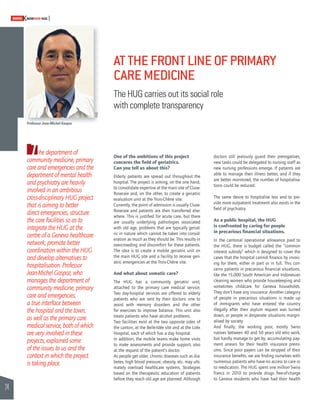
  • 10.
    6 SWISSKNOWHOW HUG Geneva University Hospital (HUG) is the premier teaching hospital in Switzerland. Bernard Gruson, Chief Executive Offi cer since 1999, is at the helm of an imposing and complex ship, employing some 10,000 people and fulfi lling a triple mission: to provide treatment, enable training and develop clinical research projects. As a general public hospital, the HUG plays the role of a community hospital and represents an important national and international centre of excellence. There are numerous challenges to be overcome now, at the start of the 21st century, starting with a liberalisation in Switzerland that will give patients the freedom to chose their hospital. Bernard Gruson kindly agreed to answer our questions. THE HUG BY 2015 Interview with CEO Bernard Gruson The verbs “to treat, to teach, to pursue” cover the three fundamental missions of the HUG. Is there one verb that takes precedence over the others in the Vision 2015 strategic plan? As indicated by the order of the list, treatment is our primary mission, but all three are enshrined in law and complement each other. But if I could sum up our objectives in one word, I would say quality. And I mean quality in everything, from treatment to administration and logistics. Quality is everything. What are the main challenges that the HUG has to face over the next few years? There are four: the challenge of capacity, as we deal with a growing population that is to increase by 20% in the next 20 years and that is ageing; the challenge of attractiveness in the face of increased competition and the free move-ment of patients; the challenge of cooperation (with the Geneva healthcare network and also with other university hospitals at a national and international level); and the challenge of fi nanc-ing for our activities and infrastructure. The HUG has nearly 10,000 employees, making it one of the top employers in the canton of Geneva. Are you affected by the shortage of doctors, and do you already have problems fi nding replacements? Attracting – and retaining – the necessary talent for the tasks to be performed is an important issue for any organisation. And it is crucial for a hospital if you consider that personnel require-ments for hospital care are going to increase by 13% by 2020, according to OFSP. Right now, we do not have enough in-house doctors to meet our needs, so we need to increase our numbers. The target that we have set with the faculty of medicine is 150 undergraduate graduates each year. We are also going to establish plans to identify those occupations where there is or risks being a shortage and will promote recruitment in these areas. Besides its “material” aspect and the construction of new buildings, is patient reception one of the priorities in the Vision 2015 strategic plan? It is essential. Isn’t it said that the reception provides the fi rst form of treatment? Reception doesn’t just include the hospital environment, which will be vastly improved by major renova-tion and construction projects that are already underway, but also, and above all, the provision of information to patients and their families. It is clear that requirements in this area are continu-ing to grow, such that they have now become a key factor for patient satisfaction. “The quality of communication between patients and medical staff and the image of the hospital are becoming crucial,” according to the introduction to the Vision 2015 strategic plan. Why is this? 2012 marks the introduction of the amended law on health insurance, the LAMal. It will change the hospital landscape by allowing free move-ment of patients, which means that someone in Geneva can opt for care in Lausanne or Berne, and someone from Fribourg or the Valais can come to Geneva for their care. This free move-ment will introduce a previously unknown level of competition between hospitals. That is why our image is important. Patient choice will also be based on the impression that patients form of the service from which they will benefi t. So now Mr. Bernard Gruson
  • 11.
    7 SWISSKNOWHOW HUG disorders in children and adolescents, hepato-pancreatic diseases and dia-betes, medicine of the musculoskel-etal system and sports medicine, genetic medicine, neuroscience, and fi nally oncology. Collaborations are necessary in clini-cal research and cutting-edge medi-cine. Which collaborations do you have in place at present, in particular with the CHUV? And which need to be fostered in future? Our collaborations with the CHUV mainly centre on transplantation, neu-rosurgery, forensic medicine, hyper-baric medicine, cochlear implants and the care of third-degree burns patients. We are driven by a com-mon motive: to offer patients in the French-speaking part of Switzerland the full range of specialist care. We would like to explore other partner-ships with the university hospitals, engineering colleges and major industrial players, and also with the healthcare network at a local level. it’s no longer enough to be good at what we do, we have to let everyone know that we are. The time for modesty is over. The HUG intends to develop its “clinical itineraries”. Can you explain what this means? A clinical itinerary is a tool aimed at provid-ing quality. It ensures coordination between professionals so that what we call the “patient trajectory” is as smooth as possible through the healthcare structures. It is like a “musical score” that coordinates all the players involved in a patient’s care for a given pathology as part of an overarching, multidisciplinary vision. For exam-ple, for a prostate operation, we summarise all the actions to be carried out from the fi rst con-tact to the end of the treatment, before during and after the hospital care, taking account of all nursing, surgical, and physiotherapy aspects. There is naturally the question of cost. The strategic plan states that one of the priorities is to “ensure healthcare is economical” and to “strive towards increasing effi ciency”. How can you reconcile this requirement with the demand for excellence and quality? Effi ciency means exactly that: quality for the best price. Using the available resources in the best way so as to offer the best possible service. Over the last three years, we have saved 85 million Swiss francs by rethinking our organisation and without forsaking any of our quality. And there is still room for improvement in our processes. Nevertheless, the reform of the LAMal law on health insurance in 2012 will have a signifi cant effect on hospital fi nances. Let’s take the exam-ple of the HUG. If the value of the TARMED point in 2012 were to be brought into line with the average for public establishments, it would mean a reduction of 9 million francs. If, in 2014, the value of the DRG point is calculated on the average of university hospitals, it will mean a cut of 120 million. As for revenue for sub-acute care (geriatrics, rehabilitation, etc.), the application of the new tariff system will subject these areas to a reduction of 15% from 2012. In total, the HUG budget will be cut back by 10%, while sal-ary costs – which represent 80% of a hospital’s expenditure – will continue to grow. Under these conditions, how can we invest in order to main-tain standards of care, improve hospital comfort, widen the care provided for the elderly, support research and tertiary care? If the amendment to the LAMal is not overruled, there could be a 200 million francs shortfall in the coffers every year. Shortening hospital stays, eliminating unnecessary days of hospitalisation and transfer-ring patients to outpatient care are not suffi cient measures to balance the accounts. Hard choices will have to be made and that is why the HUG is engaged in a thorough medical/economic con-sultation process. What are the HUG’s strengths in the area of research and what are its priorities? Together with the faculty of medicine, we have achieved a recognised level of excellence in many areas of cutting-edge medicine. For example, we are the top university hospital in Switzerland for disorders of the liver and pancreas. Our genetic medicine has achieved global renown, thanks in particular to our work on chromosome 21. For 2010-2015, we have defi ned 7 tertiary axes as our priorities: cardiovascular disorders, complex The HUG… - is one of 5 university hospitals in Switzerland with Basle, Berne, Lausanne and Zurich, - provides some 680,000 days of hospitalisation every year, - serves more than 3,500 meals every day, - has nearly 10,000 employees, - employs some 1,500 doctors, - has a budget of more than 1.6 billion Swiss francs, - has 8 centres, 2 translational clinical research laboratories and 1 institute, - 12 medical departments, - 65 medical services. HUG Rue Gabrielle-Perret-Gentil 4 1211 Genève 14 Tel.: +41 (0)22 372 33 11 Web: www.hug-ge.ch
  • 12.
    8 SWISSKNOWHOW HUG Les Hôpitaux Universitaires de Genève (HUG) représentent un parc immobilier de 2 milliards de CHF. Un tel ensemble architectural, développé à des époques différentes, nécessite bien sûr un entretien constant, avec des travaux pour ainsi dire permanents. Les chantiers actuels et futurs, notamment celui du nouveau bâtiment des lits, dépassent néanmoins largement l’entretien et la mise à niveau courants. Il s’agit d’investis-sements majeurs pour l’avenir qui tiennent compte de perspectives prévisibles comme l’augmentation du nombre d’habitants, le vieillissement de la population, l’évolution de certaines pathologies ou le développement de nouvelles technologies de prise en charge. Outre le projet central du nouveau bâtiment des lits, d’autres gros chantiers sont en cours ou sur le point de s’ouvrir : nouvelle maternité, nouveau bâtiment des laboratoires, rénovation de l’hôpital des enfants (pédiatrie). Point de la situation avec M. F. Taillard, directeur général adjoint des HUG. LES HUG FONT PEAU NEUVE Quatre gros chantiers simultanés Quel est l’objectif des HUG avec ces gros chantiers ? Visent-ils aussi à augmenter le nombre de lits, qui était précisément de 1 815 en 2010 ? Le nombre de lits LAMal est passé à 1 800 en 2011. Il s’agit de lits dits « en service ». La struc-ture immobilière laisse une marge de manoeuvre vers le haut en cas de besoin pour faire face, par exemple, à une épidémie. Ces 1 800 lits se subdivisent en 900 lits de soins aigus (pour de courts séjours de moins de 10 jours), 600 lits de réhabilitation/réadaptation (moyens séjours de plus de 20 jours) et 300 lits de psychiatrie. Ces chantiers n’ont pas pour objectif d’augmenter le nombre de lits. La tendance est à la diminu-tion de la durée des séjours hospitaliers et au renforcement des prises en charge ambulatoires et à domicile. À l’exception probable du secteur de réhabilitation et de réadaptation, l’augmen-tation de la population devrait être à peu près compensée par la diminution de la durée des séjours hospitaliers et de l’évolution des techno-logies. L’objectif de ces chantiers majeurs, qui représen-tent au total près de 600 millions de francs inves-tis, est bel et bien d’offrir davantage de confort aux patients et d’améliorer la qualité des soins. Le nouveau bâtiment des lits est notamment considéré comme indispensable. Le Grand Conseil a voté à l’unanimité un crédit de 253 millions de francs. Les travaux commen-ceront à la fi n de l’été 2011 et le nouveau bâti-ment devrait être opérationnel au début 2016. L’actuel bâtiment, construit en 1966, ne répond plus du tout aux critères actuels. C’est une impérieuse nécessité pour le renom de Genève et des HUG de remédier à cette situation. Il y a encore des chambres communes à 7 lits avec une douche et un WC pour 10 patients. Nous n’augmentons pas le nombre de lits, mais nous améliorons notablement le confort : le projet prévoit des chambres de 1 ou 2 lits avec sani-taires, répondant aux normes pour handicapés. Nous profi tons d’autre part de ce chantier pour augmenter notre capacité opératoire afi n de faire face à un accroissement prévisible de la demande. Six salles d’opérations supplémentaires seront ins-tallées. Nous allons aussi regrouper l’ensemble des soins intensifs qui sont aujourd’hui dissémi-nés dans deux zones distinctes. Un autre chantier important est prévu sur le site principal Cluse-Roseraie, soit la construction d’un nouveau bâtiment des laboratoires. Les travaux devraient débuter en été 2011. C’est un investissement global de 65 millions de francs. Ce projet sera fi nancé grâce aux économies de fonctionnement que nous allons réaliser avec ce regroupement et à l’apport de fondations et du secteur privé pour le dévelop-pement de la recherche. Il s’agira d’un immeuble de 9 étages dont six destinés aux laboratoires des hôpitaux, deux au développement de la médecine translationnelle et un à la technique du bâtiment. L’ouverture probable aura lieu au cours du 1er semestre 2014. Ce nouveau bâtiment, construit à la place du bâtiment des séminaires, regroupera l’ensemble de nos laboratoires aujourd’hui disséminés sur une bonne trentaine de lieux différents. C’est un projet innovant : les patients bénéfi cieront des dernières découvertes de la médecine fondamen-tale et, inversement, la recherche se nourrira de l’expérience clinique. Il convient encore de mentionner les travaux en cours, à commencer par la rénovation de la maternité. La maternité est en travaux depuis 1993, selon un plan de rénovation et d’agrandissement éche-lonné en plusieurs étapes pour un coût total de quelque 250 millions de francs. Nous avons com-mencé par construire un nouveau bâtiment pour ensuite dégager et rénover l’immeuble ancien, datant de 1907. Les nouvelles chambres gagnent 10 m2 et seront occupées par deux patientes au maximum, contre trois auparavant, dans des espaces exigus. Les salles d’accouchement seront
  • 13.
    9 SWISSKNOWHOW HUG toire n’est guère extensible. C’est pour cette raison, par exemple, que la rénovation de l’hôpi-tal des enfants et de la maternité prend autant de temps, car il est effectivement compliqué de concilier travaux et exploitation en limitant au mieux les perturbations pour les patients et les services. Cette diffi culté est aussi sensible pour la rénovation de la maternité. HUG Direction générale Rue Gabrielle-Perret-Gentil 4 CH-1211 Genève 14 Tél. : +41 (0)22 372 33 11 Fax : +41 (0)22 372 60 75 Web : www.hug-ge.ch aussi plus nombreuses, passant de 8 à 12, plus vastes et mieux équipées. Les HUG doivent répondre à l’augmentation du nombre des naissances, liée à l’augmentation de la population. D’une centaine de lits aujourd’hui, nous allons passer à 130 lits pour accueillir les 4 000 naissances annuelles qui font de la mater-nité des HUG la plus grande de Suisse. Au terme d’une ultime étape, de 2014 à début 2017, le dernier quart de l’ancienne maternité sera rénové. Enfi n, il y a la rénovation en cours de l’hôpital des enfants. La rénovation a commencé en 2009 et devrait s’achever en 2013. Ces travaux, devisés à 22 mil-lions de francs, répondent à la nécessité de réno-ver toute la partie ambulatoire de la pédiatrie, l’onco-hématologie ainsi que la pédopsychiatrie. Le bâtiment, qui date du début des années 60, ne répond plus aux normes actuelles, malgré une première extension en 1997. Les travaux actuels sont considérés comme un « lifting ». N’est-ce pas une grande diffi culté de mener ces travaux de modernisation tout en maintenant les services en exploitation et en limitant autant que possible les nuisances ? Il aurait évidemment été plus simple et plus rapide de partir de zéro, comme c’est le cas pour le nouveau bâtiment des lits. Tous ces travaux ont lieu sur le site Cluse-Roseraie, dont le terri- Quatre sites Les HUG travaillent sur quatre sites.et disposent d’une quarantaine de structures ambulatoires réparties en ville. Les travaux dont il est ici question concernent tous le site Cluse-Roseraie. ! Cluse-Roseraie, site principal à Genève. Il comprend l’hôpital cantonal, la maternité, l’hôpital des enfants, la radio-oncologie, l’ophtalmologie, Beau- Séjour et englobe principalement les activités hospitalières de court séjour et les plateaux médico-techniques. ! Belle-Idée comprend les services de psychiatrie, de médecine interne de réhabilitation et de gériatrie. Séjours de moyenne durée. Situé à Thônex. ! Bellerive, hôpital dédié à la réa dap-tation et aux soins palliatifs. Situé à Collonge-Bellerive. ! Loëx, hôpital de moyen et long séjour, réadaptation. Situé à Bernex. Uniquement des chambres à 1 ou 2 lits dans le futur bâtiment
  • 14.
    10 SWISSKNOWHOW HUG T What is the HUG aiming to achieve with this major construction work? Are you aiming to increase the number of beds, which was exactly 1,815 in 2010? In 2011, there are 1,800 LAMal health insurance beds. These are what we call “in service” beds. The building structure leaves room to increase this number if needed, in the event of an epi-demic for example. These 1,800 beds are divided into 900 acute care beds (for short stays of less than 10 days), 600 rehabilitation/reeduca-tion beds (medium-length stays of more than 20 days) and 300 psychiatric beds. The aim of the construction work is not to increase the number of beds. There is a move towards shorter stays in hospital, with outpa-tient care and care at home being increased. With the probable exception of the rehabilita-tion and reeducation sector, the population increase should be more or less compensated for by hospital stays becoming shorter and tech-nologies being developed. The aim of the major construction work, which represents in total an investment of almost 600 million Swiss francs, is really to provide patients with more comfort and to improve the quality of care. The new ward building is considered to be particularly vital. The Great Council voted unanimously for a credit of 253 million Swiss francs. Work will begin at the end of the summer 2011, and the new build-ing should be operational in early 2016. The current building, built in 1966, no longer meets current needs - it is absolutely vital for the rep-utation of Geneva and the HUG that this situ-ation is remedied. There are still 7-bed shared wards with one shower, and one toilet for every 10 patients. We are not increasing the number of beds, but we are considerably improving the level of com-fort: the project provides for 1- or 2-bed ensuite rooms that meet standards for disabled people. We are also using this construction project to increase our operating capacity to deal with a foreseeable increase in demand. Six additional operating theatres will be installed. We will also bring together all the intensive care units, which are today separated into two distinct zones. Another large construction project is planned on the main Cluse-Roseraie site – to build a new laboratory building. Work should begin in summer 2011. The overall investment amounts to 65 million Swiss francs. The project will be fi nanced by savings in run-ning costs that result from this reorganisation, as well as contributions from foundations and the private sector for the development of research. The building will have 9 storeys, with 6 fl oors for the hospital laboratories, two for the develop-ment of translational medicine and one for the building’s technology. We anticipate that it will open during the fi rst half of 2014. This new building, constructed on the site of the seminary building, will bring together all our laboratories which are currently scattered over thirty other locations. It is an innovative project: patients will benefi t from the latest discoveries in basic medicine and conversely, the research will be sustained by clinical experience. We should also mention the ongoing work, starting with the renovation of the maternity hospital. There has been ongoing work on the mater-nity hospital since 1993, in line with a renova-tion and expansion plan staggered over several stages and amounting to a total cost of 250 million Swiss francs. We began by constructing a new building, before starting to clear and reno-vate the old one, which dates from 1907. The new rooms will be 10 m2 larger and will be occu-pied by two patients at most, as opposed to the three that were previously accommodated in the limited space. There will also be more delivery rooms, increasing from 8 to 12, and they will be larger and better equipped. The HUG must respond to the increasing number of births, linked to the increase in the population. he Geneva University Hospital (HUG) represents a real estate complex worth CHF 2 billion. Such an architectural ensemble, developed at different periods, naturally requires constant maintenance, with work going on pretty much permanently. However, the current and future construction projects, particularly that of the new ward building, far exceed the standard maintenance and upgrading. These are major investments for the future which take account of foreseeable future circumstances, like the increasing number of inhabitants, the ageing population, the development of some pathologies, and the development of new care technologies. Apart from the main project, the new ward building, the other major construction work that is ongoing or about to start comprises: a new maternity hospital, a new laboratory building and renovation of the children’s hospital (paediatrics). Mr F. Taillard, deputy managing director of the HUG kindly agreed to review the situation with us. THE HUG GETS A FACELIFT Four major construction projects at the same time
  • 15.
    11 SWISSKNOWHOW HUG From a hundred beds today, we will increase to 130 beds to accommodate the 4,000 births every year that make the maternity hospital at HUG the largest in Switzerland. At the end of the fi nal stage, from 2014 to early 2017, the fi nal quarter of the old maternity hospital will be renovated. Finally there is the ongoing renovation of the children’s hospital. The renovation began in 2009 and should be completed in 2013. This work, quoted at 22 mil-lion Swiss francs, responds to the need to reno-vate the entire outpatient area of paediatrics, onco-haematology and child psychiatrics. The building, which dates from the early 1960s, no longer meets current standards, despite an ini-tial expansion in 1997. Current work is seen as being a “facelift”. Is it not diffi cult to carry out all this modernisation work while keeping the services running and limiting nuisance as much as possible? Of course it would have been simpler and faster to just start from scratch, as we are for the ward building. All this work is being carried out at the Cluse-Roseraie site, where the land can hardly be extended. This is why for example, the renova-tion of the children’s hospital and the maternity hospital is taking so long - it really is complicated to reconcile renovation work with a functioning hospital, while limiting disturbance to patients and services as much as possible. This is parti-cularly problematic for the renovation of the maternity hospital. HUG General management Rue Gabrielle-Perret-Gentil 4 CH-1211 Genève 14 Tel.: +41 (0)22 372 33 11 Fax: +41 (0)22 372 60 75 Web: www.hug-ge.ch Four sites The HUG operates on four sites and has forty-odd outpatient centres spread around the city. The works referred to in this article all concern the Cluse-Roseraie site. ! Cluse Roseraie, main site in Geneva. It includes the cantonal hospital, maternity hospital, children’s hospital, radiation oncology, ophthalmology and Beau-Séjour hospital and mainly covers short-stay hospital care and technical medical services. ! Belle-Idée includes the psychiatric department, and internal medicine for rehabilitation and geriatrics. Medium-length stays. Located in Thônex. ! Bellerive, a hospital dedicated to reeducation and palliative care. Located in Collonge-Bellerive. ! Loëx, a hospital for medium and long stays, reeducation. Located in Bernex. The new laboratory building
  • 16.
    12 SWISSKNOWHOW HUG Les HUG ont été le premier centre hospitalier universitaire européen à se doter d’un programme de développement durable. De nombreux projets ont été lancés. Ils concernent toutes les activités liées à l’utilisation des énergies, de l’eau, des biens de consommation, mais aussi le traitement des déchets, les déplacements des personnes et des biens, ainsi que des mesures de protection de l’air, de l’eau et des sols. Un premier Ecobilan a été réalisé en 2009. M. Christian Decurnex, chef du Département d’exploitation, et M. Alain Samson, responsable opérationnel du projet, détaillent cette politique pour un hôpital vert. UN MODÈLE « D’HÔPITAL VERT » Les HUG en pionniers européens 1 468 000 KWh et le mandat Manger local, en partenariat avec les fournisseurs. Cette politique a permis aux HUG de développer des mandats por-teurs d’actions visibles et bien acceptées, parfois reprises par d’autres. Quels sont les principaux enseignements du premier Ecobilan des HUG ? Il a fait ressortir que l’impact le plus important des HUG sur l’environnement est généré par les transports, soit les déplacements de ses quelque 10 000 collaborateurs et le fl ux de trafi c induit. En second lieu, il faut relever la charge environ-nementale des médicaments. Des mesures ont été mises en place pour diminuer les rejets dans les eaux usées. Le 2e Ecobilan a été planifi é pour 2013. Cela permettra de mesurer les premiers effets des mesures mises en oeuvre. Quelles démarches ont-elles été entreprises dans le domaine de la mobilité ? Plusieurs mesures ont été mises en oeuvre comme l’achat de vélos classiques et électriques et des aménagements pratiques au parking vélo. Des prêts à zéro pour cent sont accordés pour l’achat d’un vélo classique ou électrique. Nous travaillons aussi à la sécurisation du deuxième parking deux-roues couvert sur le site Cluse- Roseraie, à la création d’un parking deux-roues sur le site de Beau-Séjour et à l’extension de notre fl otte de vélos classiques et électriques en prêt pour les déplacements professionnels sur les sites de Belle-Idée et de Loëx. Nous testons aussi une vélothèque, système de prêt et de réservation automatisé de vélos pliables. Le covoiturage est encouragé. Nous testons un logiciel interactif permettant de mettre en rela-tion les collaborateurs effectuant les mêmes tra-jets, car ce concept n’est pas toujours facile à appliquer aux HUG, malgré le nombre important de collaborateurs, en raison d’horaires nombreux et disparates. Les actions engagées sont-elles bien acceptées par le personnel ? La plupart des actions réalisées dans le cadre du plan de mobilité sont très populaires, notam-ment celles concernant la promotion du vélo. L’octroi d’abonnements de parking facilité pour les équipes de covoiturage est très apprécié, comme la subvention de 50 % sur l’abonnement Unireso des Transports Publics Genevois. Le ren-forcement des horaires de la navette intersites, les réductions sur les abonnements P+R et la mise à disposition de véhicules mobility car-sharing pour les déplacements professionnels nécessitant la voiture sont aussi des mesures appréciées. Certaines mesures ne sont-elles pas perçues comme des « contraintes » ? Les mesures relatives à la restriction de l’accès aux abonnements de parkings individuels aux HUG ont reçu un accueil plus contrasté. Avec seulement 900 places disponibles pour environ 8 000 collaborateurs sur le site Cluse-Roseraie et une liste d’attente qui ne cesse de grossir, il a fallu appliquer des critères d’octroi plus restric-tifs. Les nouveaux critères prennent en compte les besoins réels des collaborateurs et privilégient ceux qui n’ont pas d’autres possibilités de dépla-cement. Cette mesure a été saluée par un grand nombre d’employés inscrits depuis des années sur la liste d’attente et dont les contraintes d’horaires ajoutées à l’absence de desserte en transports publics étaient très diffi ciles à gérer. Les importants chantiers en cours ou en projet aux HUG vont-ils contribuer, une fois réalisés, à une baisse sensible de la consommation d’énergie ? Nos projets et leurs concepts énergétiques sont discutés avec les organes étatiques compétents et nous permettent d’intégrer des solutions viables pour limiter les consommations d’énergie et intégrer des énergies renouvelables. Le nouveau bâtiment des lits répondra à la norme MOPEC et la part d’énergie non renouvelable ne dépassera pas les 60 % des besoins admissibles pour le chauffage et l’eau chaude sanitaire. Pour y parvenir, 500 m2 de panneaux solaires seront installés en toiture, de même qu’un système de récupération de chaleur sur la production frigori-fi que. Par ailleurs, l’eau de pluie sera récupérée pour alimenter les chasses d’eau des toilettes et arroser les espaces verts. Quant au nouveau bâtiment des laboratoires, un soin particulier a été apporté aux installations techniques afi n de garantir une récupération maximale de la chaleur diffusée par les nom-breux équipements et machines. Les stores et éclairages seront pilotés en fonction des condi-tions climatiques. Quels ont été les actions et les projets les plus marquants ? L’Ecobilan, le mandat Vigiwatt 2010- 2011 de pose de barrettes de prises électriques avec interrupteur géné-ral, le mandat électricité, avec une réduction estimée pour 2009-2010 de HUG Département d’exploitation Rue Gabrielle-Perret-Gentil 4 CH-1211 Genève 14 Tél. : +41(0)22 372 60 86 Fax : +41(0)22 372 60 84 E-mail : christian.decurnex@hcuge.ch Web : www.hug-ge.ch
  • 17.
    13 SWISSKNOWHOW HUG Which have been the most signifi cant actions and projects? The life-cycle analysis, the Vigiwatt 2010-2011 mandate for installing socket strips with a gen-eral switch, the electricity mandate with an esti-mated reduction of 1,468,000 kWh for 2009- 2010, and the Eat Local mandate in partnership with our suppliers. This policy has allowed the HUG to develop mandates for actions that are visible and well accepted, and that are some-times taken up by others. What are the main lessons to be learned from the HUG’s fi rst life-cycle analysis? It emerged that the HUG’s most signifi cant impact on the environment is generated by transport, that is the movements of its some 10,000 employees and the resulting fl ow of traf-fi c. In second place, we need to respond to the environmental burden of medicines. Measures have been put in place to reduce the amount that is disposed of in the wastewater. The 2nd life-cycle analysis has been planned for 2013. This will allow us to measure the initial effects of the measures that we have imple-mented. Which measures have been undertaken in the area of mobility? Several measures have been implemented, such as the purchase of conventional and electric bicy-cles and the practical fi tting-out of the bike park. Zero-percent loans are granted to allow employ-ees to buy a conventional or electric bicycle. We are also working to secure the second covered bike park on the Cluse-Roseraie site, to create a bike park at the Beau-Séjour site and to extend our fl eet of conventional and electric bicycles for hire for business trips at the Belle-Idée and Loëx sites. We are also testing out a ‘vélothèque’, an auto-mated system for hiring and reserving folding bicycles. Carpooling is encouraged. We are testing an interactive software product that will allow employees doing the same journeys to be put in touch with each other, as this concept is not always easy to apply at the HUG despite the large number of employees, due to the numer-ous and disparate working schedules. Have the implemented actions been well received by personnel? The majority of the actions taken in the area of mobility have been very popular, particularly those promoting the use of bicycles. The simplifi ed system for granting parking per-mits to carpooling teams is highly valued, as is the 50% subsidy on the Unireso season ticket for public transport in Geneva. The augmented timetable for the inter-site shuttle bus, reduc-tions on P+R season tickets and the provision of Mobility CarSharing vehicles for business trips are also appreciated. Weren’t certain measures seen as “constraints”? The measures relating to restricted access to indi-vidual car park permits at the HUG received a mixed response. With just 900 spaces available for about 8,000 employees at the Cluse-Roseraie site and a waiting list that is constantly grow-ing, we had to apply more restrictive criteria for granting the permits. The new criteria take into account the actual needs of the employees and favour those who have no other options for com-muting. This measure was welcomed by a large number of employees who had been on the wait-ing list for years and for whom the constraints of their working hours and a lack of public trans-port services were very diffi cult to manage. Will the major building works that are underway or in the pipeline at the HUG make a contribution to an appreciable reduction in energy consumption once they are completed? Our projects and their energy concepts have been discussed with the relevant state bodies and will allow us to integrate viable solutions for limiting energy consumption and incorporating renewable energy. The new ward building will meet the MOPEC standard and the share of non-renewable energy will not exceed 60% of the permissible require-ments for heating and domestic hot water. To achieve this, 500 m2 of solar panels will be installed in the roof, as well as a heat-recovery system on the refrigeration plant. In addition, rainwater will be collected to fl ush toilets and to water green areas. As for the new laboratory building, particular care has been taken to ensure that the techni- The HUG was the fi rst European university hospital to establish a sustainable development programme. Numerous projects have been launched. They cover all the activities connected to the use of energy, water and consumables, the treatment of waste, movement of people and goods, and measures for protecting the air, water and ground. An initial life-cycle analysis was conducted in 2009. Christian Decurnex, Head of Operations, and Alain Samson, Operations Manager for the project, explain this policy for a green hospital. THE MODEL OF A “GREEN HOSPITAL” The HUG is a pioneer in Europe cal installations guarantee maximum recovery of the heat emitted by the numerous machines and items of equipment. The blinds and lighting will be managed according to climatic conditions. HUG Operations Rue Gabrielle-Perret-Gentil 4 CH-1211 Genève 14 Tel.: +41 (0)22 372 60 86 Fax: +41 (0)22 372 60 84 Web: www.hug-ge.ch
  • 18.
    14 SWISSKNOWHOW HUG AU COEUR DE LA GENÈVE INTERNATIONALE Les HUG s’impliquent dans des projets humanitaires L a position phare de Genève sur la scène internationale a stimulé les HUG à se profi ler dans des partenariats à but humanitaire et de développement basés sur la transparence, l’intérêt mutuel et la durabilité. Depuis 1999, les HUG ont inscrit ces partenariats au rang des priorités stratégiques. Ce n’est certainement pas le seul hôpital à s’engager dans des projets d’entraide et de développement, mais probablement l’un des seuls à avoir mis sur pied une véritable politique d’accès aux soins au-delà de son rayon d’action habituel. Le professeur Louis Loutan, qui dirige le Service de médecine internationale et humanitaire (SMIH), donne son éclairage sur les activités des HUG dans le domaine humanitaire et sur la philosophie qui les anime. HUG Service de médecine internationale et humanitaire Rue Gabrielle-Perret-Gentil 6 CH-1211 Genève 14 Tél. : +41(0)22 372 96 72 Fax : +41 22 372 95 05 Web : http://medecine-internationale. hug-ge.ch les projets phares, on peut citer notre partena-riat, depuis une dizaine d’années, avec un pro-gramme de recherche sur la leishmaniose et la prévention des morsures de serpents à l’est du Népal. Les HUG sont engagés depuis une tren-taine d’années dans un partenariat très poussé avec l’Hôpital central de Yaoundé, au Cameroun, qui comprend beaucoup de formation et d’appui dans de nombreux domaines médicaux. Au Rwanda, les HUG aident au renforcement des capacités de prise en charge des soins psychia-triques, suite au génocide de 1994. Il ne s’agit que de quelques exemples. Nous avons des partenariats avec le Corps suisse d’aide humanitaire au Liban. En Jordanie, les HUG forment des ambulanciers et assurent le suivi de qualité des prestations pendant 3 ans suite au don, par le Secrétariat à l’économie (seco) d’une centaine d’ambulances. Enfi n, citons notre partenariat avec le CICR qui nous a sollici-tés pour étudier les besoins de l’hôpital qu’il gère à Kandahar, en Afghanistan. La télémédecine peut être un moyen d’aide très effi cace, alors que la route Kaboul Kandahar est très peu sûre. La télémédecine est devenue un outil de communi-cation et de formation facilitant énormément les partenariats. Un projet des HUG réunissant une vingtaine d’hôpitaux en Afrique francophone assure des cours et des consultations chaque semaine depuis de nombreuses années. Les HUG s’impliquent aussi dans des situa-tions d’urgence sur les plans médicaux ou organisationnels. Comment les HUG inscrivent-ils leur action parmi le fl orilège d’organismes offi ciels et d’ONG ? Les HUG sont à la fois un établissement de pointe et un hôpital de première ligne. Ils dis-posent d’une énorme richesse de compétences en chirurgie, médecine, psychiatrie, etc. Nous nous positionnons essentiellement comme parte-naire dans des projets d’institution à institution. Nous ne fi nançons pas d’autres organisations, mais des collaborateurs ou des services des HUG impliqués dans des projets. Nous avons vocation d’apporter notre expertise, souvent sous forme de formation, mais aussi de prestations médicales, de soins infi rmiers et de gestion hospitalière, dans de véritables partena-riats à long terme. Nous intervenons aussi dans des situations d’urgence. De quels outils se sont dotés les HUG pour mener cette politique d’ouverture ? Au moment où cette volonté d’ouverture et d’en-traide a été défi nie comme un axe de développe-ment prioritaire, en 1999, les HUG se sont dotés d’une Commission des affaires humanitaires et internationales qui réunit des représentants de chaque département. Celle-ci enregistre les demandes d’engagement provenant de la mai-son et parfois aussi de l’extérieur. Les projets rete-nus passent toujours par des collaborateurs des HUG. Ces activités sont fi nancées par un fonds constitué par un prélèvement sur une partie des honoraires des activités privées des médecins. Enfi n, en 2007, les HUG ont créé le SMIH, qui évalue et gère les projets et l’assistance tech-nique et mène des projets de recherche. Ce service est aussi le centre de référence pour la médecine tropicale, la médecine des voyages et la parasitologie médicale. Quels sont vos principaux partenaires dans les projets ? Tout dépend des projets. Nos partenaires prin-cipaux sont la Coopération au développement suisse, le Corps suisse d’aide en cas de catastrophe, l’OMS, MSF, le CICR et certaines fondations. Quels sont vos projets phares ? Depuis une dizaine d’années, les HUG se sont engagés dans une centaine de projets. Parmi © DR
  • 19.
    15 SWISSKNOWHOW HUG AT THE HEART OF INTERNATIONAL GENEVA HUG gets involved in humanitarian projects tre for tropical medicine, travel medicine and medical parasitology. Who are your main partners in these projects? It all depends on the project. Our main part-ners are the Swiss Agency for Development and Cooperation, the Swiss Humanitarian Aid Unit, the WHO, MSF, the ICRC and various foundations. What are your fl agship projects? The HUG has been involved in around a hun-dred projects for about ten years now. Among our fl agship projects is our ten-year partnership in a research programme into leishmaniasis and snake-bite prevention in the east of Nepal. The HUG has been engaged in a very intensive partnership with Yaoundé Central Hospital in Cameroon for about thirty years, providing a high amount of training and support in numer-ous fi elds of medicine. In Rwanda, the HUG helps to boost psychiatric care capabilities fol-lowing the genocide in 1994. These are just a few examples. We have partnerships with the Swiss Huma-nitarian Aid Unit in the Lebanon. In Jordan, the HUG trains ambulance drivers and is ensuring the quality of service continues to be provided for 3 years following the donation of a hundred ambulances by the Swiss State Secretariat for Economic Affairs (SECO). Finally, I’d like to men-tion our partnership with the ICRC, which sought us out in order to study the needs of the hospi-tal that it manages in Kandahar in Afghanistan. Telemedicine can be a very effective means of providing aid, especially as the road from Kabul to Kandahar is particularly unsafe. Telemedicine has become a communication and training tool which has facilitated partnerships enormously. One HUG project brings together about twenty hospitals in French-speaking Africa and has been providing courses and consultations every week for many years now. The HUG also gets involved in emergency situa-tions at a medical or organisational level. Where does the HUG see itself among the multitude of offi cial bodies and NGOs? The HUG is both a high-tech establishment and a leading hospital. It has a great wealth of expertise in surgery, medicine, psychiatry, etc. We essentially position ourselves as a partner in projects between institutions. We don’t fi nance other organisations, but rather involve HUG employees or services in the projects. We aim to provide our expertise, often in the form of training, but also medical services, nurs-ing care and hospital management, in true long-term partnerships. We also get involved in emer-gency situations. What tools does the HUG have at its disposal to implement this policy of openness? In 1999, when this wish for openness and mutual aid was defi ned as a priority for develop-ment, the HUG established a Humanitarian and International Affairs Committee, which brings together representatives from each depart-ment. It receives requests for involvement from in-house and sometimes also from outside. The projects that are accepted are always carried out by HUG employees. These activities are fi nanced by a fund formed from a levy on a share of doc-tors’ private consultation fees. Then, in 2007, the HUG created SMIH, which evaluates and manages the projects and technical assistance and conducts research projects. This service is also the reference cen- Geneva’s leading position on the international scene has prompted the HUG to enter into partnerships with a humanitarian objective and development partnerships based on transparency, mutual interest and sustainability. Since 1999, the HUG has established these partnerships as part of its strategic priorities. It is certainly not the only hospital to engage in mutual aid and development projects, but probably one of the few to have set up an actual policy for access to healthcare beyond its usual scope. Professor Louis Loutan, who runs the Division of International and Humanitarian Medicine (SMIH), tells us about the HUG’s activities in the humanitarian domain and about the philosophy that drives them. HUG Division of International and Humanitarian Medicine Rue Gabrielle-Perret-Gentil 6 CH-1211 Genève 14 Tel.: +41(0)22 372 96 72 Fax: +41 22 372 95 05 Web: http://medecine-internationale. hug-ge.ch
  • 20.
    16 SWISSKNOWHOW HUG A L’INDISPENSABLE « U » DES HUG Une interface nouvelle entre l’Hôpital et la Faculté près plus de deux ans de travail, un nouveau règlement défi nit et organise les relations entre l’Hôpital et l’Université depuis le 27 janvier 2011. Historiquement fondées sur une base contractuelle, ces relations reposent désormais sur le modèle du partenariat. Le directeur général des HUG, M. Bernard Gruson, et le professeur Jean-Louis Carpentier, doyen de la Faculté de médecine depuis 2003, se sont beaucoup engagés pour faire aboutir cette importante réforme. À la veille de remettre son mandat, en juillet 2011, ce dernier, arrivé à Genève en 1974, vice-doyen de la Faculté de 1999 à 2003, nous a parlé du rôle et de l’importance du « U » dans le sigle HUG. l’avons préféré à celui qui intègre la Faculté de médecine dans l’entité hospitalière, vers lequel tend par exemple le CHUV. À l’inverse, il existe dans le monde des universités qui possèdent leur propre hôpital. Entrons un peu dans le « U ». Qu’en est-il du nombre de professeurs et du nombre d’étudiants ? La Faculté de médecine de l’UNIGE forme des médecins cliniciens et des chercheurs de haut niveau. Elle est divisée en trois sections, méde-cine fondamentale, médecine dentaire et méde-cine clinique, laquelle forme dorénavant une interface avec les HUG. Sur le budget de quelque 160 millions de francs de la Faculté de médecine, 90 proviennent de l’État et le solde du Fonds national de la recherche scientifi que, de fonds européens et de diverses fondations privées. Quelque 1 400 étudiants fréquentent la Faculté de médecine de l’Université de Genève, dont 900 étudiants prégrades qui suivent une forma-tion de base de 6 ans, débouchant sur le diplôme de médecin. Les études postgrades s’étendent sur des durées de 4 à 6 ans au minimum, parfois plus selon les spécialisations. La relève académique est-elle assurée ? Il y a un manque de médecins formés en Suisse dans les hôpitaux universitaires. Il faut aller chercher de plus en plus loin les compétences, surtout dans certains domaines moins attractifs que d’autres. Un effort a été fait depuis quelques années afi n d’augmenter signifi cativement le nombre de médecins formés par nos institutions et il commence à porter ses fruits. Cependant, il faut encore parvenir à valoriser la formation dans divers secteurs de la médecine, notamment la médecine de premier recours. À un niveau plus général, il est clair que les médecins de premier recours manquent. De notre côté, nous pouvons par exemple rendre certaines formations plus attrayantes et plus valorisantes. Qu’est-ce qui a changé dans les relations entre l’Université et l’Hôpital avec l’adoption du nouveau règlement ? Avant, il y avait d’un côté l’Hôpital et, de l’autre, la Faculté de médecine de l’Université de Genève, et les relations étaient réglées de manière contractuelle. Nous avons opté pour un système de partenariat en créant une interface commune entre les deux institutions. Dans ce nouveau système, le doyen en charge de la Faculté de médecine devient automatique-ment directeur de la formation et de la recherche au sein des HUG. Ce rééquilibrage n’est pas un luxe en regard des chiffres : un budget de quelque 160 millions de CHF pour la Faculté de médecine et de 1,6 milliard pour les HUG. Le corps professoral fait notamment partie de l’interface. Au lieu de deux cahiers des charges pour les professeurs, il n’y en a dorénavant plus qu’un seul, qui est signé par les deux entités. Les professeurs sont payés par les HUG pour les acti-vités cliniques et par l’Université pour les acti-vités académiques. Lors des successions profes-sorales, une commission paritaire de prospective et de planifi cation hospitalo-universitaire permet une analyse globale de la situation et met de l’huile dans les rouages. Pourquoi le choix du partenariat plutôt qu’un autre choix ? Dans les faits, le « U » n’était pas véritablement sous la responsabilité du doyen dans l’ancien modèle, ce qui n’est plus le cas aujourd’hui. La nouvelle structure concrétise cette réalité que les deux entités forment un couple et précise ce que ce couple possède et doit gérer en commun. Leurs relations vont ainsi moins dépendre de l’entente personnelle des personnes exerçant les responsabilités de l’une et de l’autre entité. Le modèle contractuel, qui était le nôtre, dépend trop du bon vouloir de chacune des deux enti-tés et du poids de chacune d’elle. Pour nous, le modèle du partenariat est le plus équilibré. Nous Professeur Jean-Louis Carpentier
  • 21.
    17 SWISSKNOWHOW HUG Université de Genève Faculté de médecine CMU - 1, rue Michel-Servet CH-1211 Genève 4 Tél. : +41(0)22 379 50 01 Fax : +41(0)22 379 50 02 E-mail : jean-louis.carpentier@unige.ch Web : www.unige.ch/medecine/ Quels sont les domaines d’excellence reconnue des HUG ? Les orientations stratégiques des HUG à l’hori-zon 2015 ont été défi nies d’une part en fonction des domaines où nos compétences sont interna-tionalement reconnues, aussi bien sur le plan de l’enseignement que de la recherche médicale, et d’autre part des domaines dans lesquels nous voulons nous inscrire. Là où nous excellons, l’objectif est de maintenir, voire de renforcer encore nos positions. Il s’agit des neurosciences, de la médecine génétique, des affections hépato-pancréatiques et du dia-bète, notamment la chirurgie viscérale en termes de transplantation du pancréas et du foie, des affections cardio-vasculaires, de la médecine de l’appareil locomoteur et du sport, des affections complexes de l’enfant et de l’adolescent. Nous voulons nous renforcer et nous dévelop-per dans d’autres domaines comme l’oncologie, entre autres les cancers du sein, les maladies de l’appareil locomoteur, notamment la rhumatolo-gie et l’orthopédie avec, en corollaire, un accent plus clinique sur la médecine du sport, ainsi que dans certaines spécialités de la pédiatrie. Attirant des chercheurs du monde entier par son excellence scientifi que, la Faculté de médecine s’inscrit dans un vaste réseau de collaborations avec des centres de recherche externes, aussi bien publics que privés. De quelles forces disposez-vous dans la recherche ? Il y a quelque 50 à 60 groupes de recherche fon-damentale en Faculté de médecine. C’est plus variable du côté clinique, mais près de 200 groupes de recherche sont actifs au total au niveau de l’hô-pital. La recherche fondamentale s’inscrit dans une orientation clinique. Les ponts sont nombreux entre recherche fondamentale et recherche clinique dans le cadre de la recherche translationnelle. N’est-ce pas la quadrature du cercle pour les médecins en formation de concilier l’activité clinique, l’enseignement et la recherche ? Les personnes qui s’orientent, en plus de leur formation et de leur devoir clinique, vers la recherche, tout en participant à l’enseignement, doivent disposer de temps en suffi sance. Nous proposons par exemple des postes de chefs de clinique scientifi ques qui attribuent 80 % du temps à la recherche et 20 % à l’activité cli-nique. Il faut aussi compter avec la mobilité nécessaire impliquant des formations complé-tées dans d’autres facultés et hôpitaux, notam-ment à l’étranger. L’idéal serait de disposer de professionnels consacrant 50 % de leur temps à chacune de ces activités. Dès le 15 juillet 2011, le professeur Henri Bounameaux, ancien chef du département de médecine interne des HUG, succède au professeur Jean-Louis Carpentier à la tête de la Faculté de médecine de l’Université de Genève. L’un des objectifs du nou-veau Doyen, directeur de l’enseigne-ment et de la recherche aux HUG, sera d’associer des chercheurs de l’Université, du CMU et de l’École polytechnique fédérale de Lausanne (EPFL) à des groupes de recherche clinique des HUG. Certifi cations hors FMH Dans le cadre des spécialisations, la Faculté de médecine de l’Université de Genève a introduit des « Masters of advances in clinical studies » qui permettent aux étudiants étrangers, notamment hors Union européenne, d’obtenir une certifi cation offi cielle de leur spécialisation. S’ils n’ouvrent pas à leurs titulaires l’autorisation de pratiquer en Suisse en tant que spécialistes, ces masters leur confèrent tout de même une reconnaissance universitaire valable, notamment dans leurs pays. De manière générale, l’Université tend à s’impliquer toujours davantage dans la défi nition et le contenu des formations, très largement placées sous l’autorité et la certifi cation de la FMH (Fédération des médecins suisses). Professeur Henri Bounameaux
  • 22.
    18 SWISSKNOWHOW HUG THE VITAL “U” IN HUG A new interface between Hospital and Faculty After more than two years of work, since 27 January 2011 new rules have defi ned and organised relations between the Hospital and the University. Historically founded on a contractual basis, henceforth these relations will be based on the partnership model. The Chairman of HUG (Geneva University Hospital), Mr. Bernard Gruson, and Professor Jean-Louis Carpentier, dean of the Faculty of Medicine since 2003, have put a lot of effort into seeing this reform through. On the eve of leaving his position in July 2011, Professor Carpentier, who arrived in Geneva in 1974 and was vice-dean of the faculty from 1999 to 2003, kindly agreed to talk to us about the role and importance of the “U” in the acronym HUG. towards, for example. Conversely, there are uni-versities around the world which own their own hospital. Let’s talk about the “U” for a bit. How has this affected the number of professors and students? The Faculty of Medicine at the UNIGE trains clin-ical doctors and top researchers. It is divided into three sections: basic medicine, dental medicine and clinical medicine, which will now form an interface with the HUG. Out of the Faculty of Medicine’s budget of some 160 million francs, 90 million come from the state, and the rest from the Swiss National Science Foundation, from European funds and various private foundations. The University of Geneva’s Faculty of Medicine has around 1,400 students, including 900 under-graduate students who undergo basic training of 6 years, leading to a medical degree. Postgraduate studies take at least 4 to 6 years, sometimes longer depending on the specialisation. Is the academic cycle assured? There is a defi nite lack of doctors being trained in Switzerland in the university hospitals. You have to go further and further away to fi nd the right skills, particularly in some of the less attrac-tive fi elds. A real effort has been made over the last few years to signifi cantly increase the num-ber of doctors being trained by our institutions, and this is starting to bear fruit. However, we still need to increase the standing of training in various fi elds of medicine, particularly in general medicine. At a more general level, there is a real shortage of GPs. For our part, we can make some training more attractive and give it a higher sta-tus, for example. Now that the new rules have been adopted, what has changed in the relationship between the University and the Hospital? Before, there was the Hospital on one side, and the Faculty of Medicine of the University of Geneva on the other, and relations were governed on a contractual basis. We have chosen to move to a partnership system by creating a common interface between the two institutionzand 1.6 billion for the HUG. The professional body in particular is part of the interface. Instead of two different sets of specifications for professors, there is now only one, which is signed by both bod-ies. The professors are paid by the HUG for their clinical work, and by the University for their academic work. When new professors are appointed, a joint committee for hospital-university economic forecasting and planning performs an overall analysis of the situation and oils the wheels. Why a partnership? In actual fact, the “U” was not really part of the dean’s responsibility under the old model, but that is no longer the case. The new structure establishes the reality that the two bodies form a couple, and specifi es what this couple owns and must manage together. Their relationship will therefore depend less on a personal understand-ing between the individuals with responsibility for each body. The contractual model we had before depends too much on good will between the two bodies and on the infl uence of each one. For us, the partnership model is a more balanced one. We preferred this model to one which would have integrated the Faculty of Medicine within the hospital, a model which the CHUV is moving Professor Jean-Louis Carpentier
  • 23.
    19 SWISSKNOWHOW HUG When it comes to research, what are your main strengths? There are some 50 to 60 basic research groups in the Faculty of Medicine. On the clinical side of things it is more variable, but in total there are nearly 200 research groups working at hos-pital level. Basic research is part of a clinical approach. There are numerous bridges between basic research and clinical research within the framework of translational research. Isn’t trying to reconcile clinical work, teaching and research a bit like squaring the circle for trainee doctors? Trainees who tend more towards research, in addition to their training, clinical duties and participating in teaching, need to have suffi cient time. For example, we offer positions as scientifi c clinical directors which allocate 80% of the time to research and 20% to clinical work. You also have to take into account the mobility required for training undertaken at other faculties and hospitals, particularly abroad. In an ideal world, professionals would be able to dedicate 50% of their time to each of these activities. In what areas does HUG have a reputation for excellence? The strategic orientations of HUG by 2015 have been defi ned fi rstly on the basis of the fi elds in which our skills are recognised internationally, both with regard to teaching and to medical research, and secondly on the basis of the areas that we want to develop. The aim is to maintain or even strengthen our position in areas where we excel: neurosciences, genetic medicine, hepato-pancreatic diseases and diabetes, particularly visceral surgery for pancreas and liver transplants, cardiovascular diseases, musculoskeletal and sports medicine, and com-plex diseases in children and adolescents. We want to strengthen the faculty and develop it in other fi elds such as oncology, including breast cancer, musculoskeletal disorders, particularly rheumatology and orthopaedics, with in parallel a more clinical approach to sports medicine and some paediatric specialities. Attracting researchers from around the world with its scientifi c excellence, the Faculty of Medicine is part of a vast network of collabo-rations with both private and public external research centres. From July 15, 2011, Professor Henri Bounameaux, former head of the Department of Internal Medicine, HUG, is the successor to Professor Jean-Louis Carpentier at the head of the Faculty of Medicine, University of Geneva. One of the objectives of the new Dean, director of training and research to HUG, will involve research-ers from the University of CMU and the Ecole Polytechnique Federale de Lausanne (EPFL) to groups of Clinical Research HUG. University of Geneva Faculty of Medicine CMU - 1, rue Michel-Servet CH-1211 Genève 4 Tel.: +41(0)22 379 50 01 Fax: +41(0)22 379 50 02 E-mail: jean-louis.carpentier@unige.ch Web: www.unige.ch/medecine/ Certifi cation outside the FMH Within the framework of its specialisations, the Faculty of Medicine at the University of Geneva has introduced “Masters of advances in clinical studies”, which allow foreign students, particularly those from outside the European Union, to obtain offi cial certifi cation of their specialisation. Although this master’s degree does not allow them to work as specialists in Switzerland, it does grant them a university degree that is valid around the world, especially in their own countries. Overall, the University aims to become even more involved in the defi nition and content of its training courses, which are largely under the authority of the FMH (Federation of Swiss Doctors). Professor Henri Bounameaux
  • 24.
    20 SWISSKNOWHOW HUG L HUG Rue Gabrielle-Perret-Gentil 4 CH-1211 Genève 14 Tél. : +41(0)22 372 29 056 E-mail : qualite-des-soins. service@hcuge.ch Web : http://dg-gouvernance. hug-ge.ch/organisation_ gouvernance/direction_ medicale.html SÉCURITÉ ET QUALITÉ AUX HUG Souci d’excellence et outils performants pour réduire les risques e pilotage d’un hôpital universitaire de l’importance des HUG est forcément complexe. Deux notions clés, qualité et sécurité, servent notamment de boussole aux dirigeants. Les HUG y vouent la plus grande attention. Depuis le 1er janvier 2011, conformément au nouveau plan stratégique 2010- 2015, la direction médicale, confi ée au professeur Pierre Dayer, a d’ailleurs annexé le mot « qualité », devenant ainsi la direction médicale et qualité. Responsable du service qualité des soins, chargé d’apporter un soutien méthodologique aux services cliniques, le Dr Pierre Chopard répond à nos questions. augmenter, ce qui témoigne de l’engagement des collaborateurs dans cette démarche. Il est actuel-lement de quelque 5 800 par année. Le service de prévention et de contrôle des infec-tions fait aussi un important travail de préven-tion, à la fois auprès des collaborateurs et des patients. Référence mondiale dans ce domaine, les HUG ont fait baisser en 2010 la prévalence des infections nosocomiales à 8,4 % (10,5 % en 2009) et poursuivent leur action avec l’hygiène des mains par friction avec une solution hydro-alcoolique. Un programme novateur pour réduire les risques d’escarres des patients donne d’excellents résul-tats. D’autres programmes sont mis sur pied, par exemple pour réduire les risques d’infection liés aux cathéters. Des protocoles de contrôles croisés sont appliqués dans les blocs opératoires, procédures visant à évi-ter tout oubli. La sécurité n’est pas que l’affaire du chirurgien, mais aussi celle de l’anesthésiste, de l’instrumentiste, de toute une équipe. Gérer et prévenir les risques est une préoccupa-tion constante. Par exemple, toute chimiothéra-pie fait l’objet d’un protocole standardisé. Comment prenez-vous en compte la satisfaction des patients ? Chaque année, une enquête institutionnelle englobe tous les patients hospitalisés. Ils répon-dent à quelque 80 questions. Le taux de satisfac-tion est très bon. Les points à améliorer concernent par exemple la coordination entre les services de l’hôpital et les structures de soins à domicile et les médecins de ville. Nous y travaillons. Nos hôpitaux sont devenus des entreprises très complexes qui nécessitent la mise en oeuvre de milliers de processus. C’est pourquoi les HUG ont adopté dans un certain nombre de domaines le modèle de management par la qualité EFQM (European fondation for quality management), modèle provenant de l’industrie. La « qualité » est bien sûr un souci antérieur au 1er janvier 2011. Quel sens donner à sa soudaine mise en valeur nominative ? Cela traduit une volonté de l’institution de réduire encore le nombre d’infections, d’amélio-rer l’analyse des incidents et de mieux maîtriser les risques. Les structures autour du concept de qualité évoluent. Le Comité de direction s’est doté d’une délégation à la qualité. Le Directeur médical préside la Commission médicale d’éta-blissement. La responsabilité des questions médicales incombe aux médecins-chefs de ser-vice, sous l’autorité fi nale du Directeur médical, qui a un droit de regard sur l’ensemble des pra-tiques médicales des HUG. Quels sont les risques principaux que vous devez maîtriser ? Ce sont les risques infectieux et les risques médi-camenteux, avec notamment la gestion des effets secondaires. Plusieurs processus et programmes préviennent effi cacement ces risques. Des logiciels de prescription électronique assistent par exemple les médecins dans l’identifi cation des interactions. De quels outils disposez-vous pour garantir au mieux sécurité et qualité ? Il y en a beaucoup. Les HUG ont mis en place depuis plusieurs années un système de déclara-tion des événements indésirables et des incidents. Ce système différencie les événements graves, entraînant un préjudice pour le patient, et ceux qui sont mineurs. Toute personne peut annoncer un couac interne tel qu’un oubli sans conséquence d’administrer un médicament, la perte d’un tube sanguin, la perte d’un dossier, etc. Des groupes de gestion d’incidents, formés de deux à huit colla-borateurs, sont chargés de les analyser. L’objectif est de trouver des failles éventuelles dans les processus. Le nombre d’incidents déclarés tend à Quality Offi cers Les HUG donnent un signal fort de leur volonté de garantir la meilleure sécurité et la meilleure qualité possibles. Dès l’automne 2011, quatorze « quality offi cers » entreront en fonction, soit un par département. Sous la responsabilité des chefs de départements et de la délégation du Comité de direction à la qualité et à la coordination des risques, ces collaborateurs (médecins, infi rmiers, ingénieurs, etc., tous au bénéfi ce d’une expérience dans le domaine de la santé) auront pour mission de renforcer les démarches qualité (mettre en place et gérer les indicateurs, les actions d’amélioration, etc.). C’est en quelque sorte un nouveau métier. Comme d’autres, il répond aux besoins d’une médecine toujours plus performante et exigeante. Les HUG mettent en place une formation spéciale destinée à ces nouveaux collaborateurs. Docteur Pierre Chopard J. Gregorio - HUG
  • 25.
    21 SWISSKNOWHOW HUG SAFETY AND QUALITY AT THE HUG A focus on excellence and effective tools to reduce risks Doctor Pierre Chopard Running a university hospital the size of the HUG is naturally complex. Two key ideas in particular, quality and safety, act as a guiding compass for directors and the HUG devotes a lot of attention to them. Since 1 January 2011, in accordance with the new 2010-2015 strategic plan, the medical management team, under the guidance of Professor Pierre Dayer, has furthermore annexed the word “quality”, becoming the medical and quality management department. The head of the quality of care department, responsible for providing clinical departments with methodological support, Dr Pierre Chopard kindly agreed to answer our questions. The department for the prevention and control of infections also carries out important preven-tion work, both with employees and patients. Worldwide reference in this fi eld, in 2010 the HUG cut the prevalence of hospital-acquired infections to 8.4% (10.5% in 2009) and is continuing to take action in this area with hand hygiene through rubbing them with a hydroalco-holic solution. An innovative programme to reduce the risks of bedsores for patients is giving excellent results. Other programmes are being set up, for example to reduce the risks of infection linked to catheters. Cross-checking protocols are applied in opera-ting theatres, procedures aiming to avoid any oversights. Safety is not just the concern of sur-geons, but also anaesthetists, theatre nurses, the entire team. Managing and preventing risks is a constant concern. For example, all chemotherapy is the subject of a standardised protocol. How do you take patient satisfaction into account? Every year an institutional survey includes all hospitalised patients who answer around 80 questions. The rate of satisfaction is very good. Areas to improve include for example coordina-tion between the hospital departments and the home care structures and the city doctors. We are working on it. Our hospitals have become very complex com-panies which require the implementation of thousands of processes. This is why the HUG has adopted an industry model, the EFQM (European foundation for quality management) quality management model in a certain number of fi elds. “Quality” was of course a concern prior to 1 January 2011. What are we to make of this word being suddenly highlighted? It is an expression of the will of the institution to reduce the number of infections still further, to improve the analysis of incidents and to control risks better. Structures are developing around the concept of quality. The management committee has created a quality delegation. The medi-cal director chairs the Medical Establishment Commission. The responsibility for medical issues falls to the chiefs of staff of departments, under the fi nal authority of the medical director who has the right to examine all medical prac-tices at the HUG. What are the main risks that you have to control? Infection risks and drug risks, in particular the management of side effects. Several processes and programmes effectively prevent these risks. For example, electronic prescription software helps doctors to identify interaction. What tools do you have that optimally guarantee safety and quality? There are a lot. Several years ago, the HUG put in place a system for declaring undesirable events and incidents. The system differentiates between serious events which harm the patient and minor events. Anyone can declare an internal mishap, such as forgetting to administer a drug without consequences, losing a blood tube, losing a fi le, etc. Incident management groups, comprising two to eight colleagues, are responsible for analysing them. The aim is to fi nd any fl aws in the processes. The number of incidents declared seems to be increasing, which is evidence of the commitment of employees to this approach. Currently there are some 5,800 every year. Quality Offi cers The HUG is giving a strong signal of its will to guarantee the best possible safety and quality. From autumn 2011, fourteen “quality offi cers” will take up their roles – one for every department. Under the responsibility of the heads of departments and the management committee’s quality and coordination of risks delegation, these employees (doctors, nurses, engineers, etc. all with experience in the healthcare fi eld) will work to strengthen quality approaches (implement and manage indicators, improvement actions, etc.). It is a new job of a kind. Like others, it responds to the needs of medicine that is more and more effi cient and demanding. The HUG is putting in place special training for these new employees. HUG Rue Gabrielle-Perret-Gentil 4 CH-1211 Genève 14 Tel.: +41(0)22 372 29 056 E-mail: qualite-des-soins. service@hcuge.ch Web: http://dg-gouvernance. hug-ge.ch/organisation_ gouvernance/direction_ medicale.html
  • 26.
    22 SWISSKNOWHOW HUG SUR LE FRONT DE LA MÉDECINE DE PREMIER RECOURS Les HUG assument leur rôle social en toute transparence Le Département de médecine communautaire, de premier recours et des urgences, ainsi que le Département de santé mentale et de psychiatrie, sont fortement impliqués dans un ambitieux projet transversal des HUG visant notamment à mieux orienter les urgences, à structurer le dispositif de soins de manière à intégrer les HUG au centre d’un réseau sanitaire genevois, à favoriser une meilleure coordination au sein des HUG et à développer des alternatives à l’hospitalisation. Le professeur Jean-Michel Gaspoz, qui dirige le Département de médecine communautaire, de premier recours et des urgences, véritable interface entre l’hôpital et la ville, ainsi que le Service de médecine de premier recours, très impliqués dans ces projets, en détaille quelques aspects et en situe les enjeux. tension, l’obésité, etc. risquent à terme de faire exploser les systèmes de santé. Des stratégies fondées sur l’éducation thérapeutique des patients, avant le grand âge, sont envisagées. Bien que les médecins soient encore jaloux de leurs prérogatives, des tâches nouvelles pour-raient être déléguées au personnel infi rmier, avec l’émergence de nouvelles professions infi rmières. Si les patients prennent mieux en charge leur maladie, et qu’ils sont mieux suivis, le nombre d’hospitalisations pourra être réduit. La même volonté de moins hospitaliser et de traiter davantage de manière ambulatoire existe dans le domaine de la psychiatrie. En tant qu’hôpital public, les HUG sont confrontés à la prise en charge de la précarité. Dans l’indemnité cantonale de fonctionnement versée aux HUG, fi gure une enveloppe appe-lée « subvention d’intérêt général » destinée à couvrir les missions que l’hôpital ne peut pas fi nancer par une facturation, soit en totalité, soit partiellement. Il s’agit de patients précaires, à l’image des quelque 15 000 femmes de ménage sud-américaines et indonésiennes qui s’occupent du ménage et parfois des enfants des Genevois. Elles n’ont aucune assurance. Une autre catégo-rie de personnes en situation de précarité est constituée par des migrants entrés dans la clan-destinité après le rejet de leur demande d’asile, ou des grands précaires marginalisés. Enfi n, les working poors, des Suisses entre 40 et 50 ans pour la plupart, qui travaillent, mais ne s’en sortent pas et accumulent des retards dans le versement de leurs primes d’assurance mala-die. Depuis que les mauvais payeurs peuvent être déboutés de l’assurance, nous nous sommes Une des ambitions de ce projet concerne la gériatrie. De quoi s’agit-il ? Les patients âgés sont un peu partout dans l’hôpi-tal. Il s’agit, d’une part, de renforcer les compé-tences sur le site principal de Cluse-Roseraie et, d’autre part, de créer une unité d’évaluation gériatrique sur le site de Trois-Chêne. Actuellement, la porte d’entrée est principale-ment à Cluse-Roseraie et les gens sont ensuite transférés ailleurs. Cela se justifi e pour les soins aigus, mais derrière, il y a souvent des patholo-gies liées au grand âge, des problèmes typique-ment gériatriques qui ne peuvent être pris en compte autant qu’il le faudrait. Cela provoque un encombrement et de l’inconfort pour ces patients. L’idée est de créer une unité mobile de gériatrie sur ce site principal des HUG et une structure d’accueil d’urgence gériatrique sur le site de Trois-Chêne. Et qu’en est-il des soins somatiques ? Les HUG disposent de l’Unité de gériatrie commu-nautaire, rattachée au Service de médecine de premier recours. Deux prestations sont offertes en hôpital de jour aux patients âgés envoyés par leurs médecins traitants : contre les troubles de la mémoire d’une part, et d’autre part, des exercices pour renforcer l’équilibre. Cette unité traite aussi les patients qui ont un problème de consommation d’alcool. Deux structures existent aux deux extrémités du canton, soit le site de Belle-Idée et l’autre à l’Hôpi tal de Loëx, qui possèdent chacun un hôpi-tal de jour. Parallèlement, des équipes mobiles se rendent à domicile pour faire des évaluations et du soutien, également à la demande des médecins traitants. Les gens devenant de plus en plus âgés, des maladies chroniques comme le diabète, l’hyper- Professeur Jean-Michel Gaspoz HUG
  • 27.
    23 SWISSKNOWHOW HUG HUG Rue Gabrielle-Perret-Gentil 4 CH-1211 Genève 14 Tél. : +41(0)22 372 95 20 Fax : +41(0)22 372 83 32 E-mail : jean-michel.gaspoz@hcuge.ch Web : http://medecine-communautaire. hug-ge.ch/ retrouvés avec de nombreux patients n’ayant plus accès aux soins, ni aux médicaments. Les HUG ont dépensé en 2010 un million de francs pour remettre des médicaments gratuits à des Genevois boutés hors de l’assurance. Ce ne sont pas des « profi teurs », mais des gens précarisés par des problèmes de perte d’emploi, souvent des femmes seules avec charges d’enfants, ou des indépendants, des petits garagistes, par exemple, qui ont perdu pied. Nous voulons jouer la transparence. Ces pro-blèmes existent. Nous allons établir un catalogue complet de ces missions d’intérêt général, déter-miner leur coût réel et demander une subvention à la hauteur de cette tâche. Notre volonté est aussi d’optimiser l’organisation de ces activités. L’hôpital joue là un véritable rôle social. Le Service de médecine de premier recours est profi lé comme celui qui assume la précarité. Seul l’hôpital public effectue des prestations qui ne peuvent pas être facturées ou facturées de façon insuffi sante. Et si personne ne prend en charge ces patients, il en résultera une sorte de désastre. Sans insister sur le problème éthique que poserait le choix de ne pas donner des soins à des gens qui en ont besoin, ce serait une erreur épidémiologique génératrice de contagions et, rapidement, d’un problème de santé publique. Ce type de problème touche à peu près toutes les métropoles internationales. C’est vrai aussi pour la gériatrie. Nous sommes de plus en plus appelés pour des visites à domi-cile. Les médecins traitants le font de moins en moins, car cela rapporte peu et ne permet en aucun cas de faire tourner un cabinet, ne serait-ce qu’en raison du temps perdu dans les bou-chons genevois. Évidemment, nous pourrions renoncer à y aller. Que se passerait-il ? Sans visites, sans soutien, ces patients péricliteraient à domicile et devraient être bientôt hospitalisés. C’est typiquement une prestation d’intérêt géné-ral non encore reconnue comme telle. Qu’en est-il des réseaux de soins, des relations entre les HUG et les médecins et cliniques de la ville ? Les HUG veulent désengorger les urgences et réduire les durées d’attente. Il faut éviter que toute demande se transforme en urgence et assurer une prise en charge coordonnée pour les urgences vitales et de proximité pour celles qui sont non vitales. Depuis 2009, le Réseau des urgences de Genève réunit les HUG et quatre centres genevois privés : l’Hôpital de la Tour, la Clinique des Grangettes, la Clinique de Carouge et le Groupe médical d’Onex. Le premier maillon du réseau doit rester le méde-cin de famille, avant tout recours à l’un des centres d’urgence. Nous cherchons à créer un vrai partenariat avec ces médecins et les encou-rageons à créer un système de garde de quartier. Par ailleurs, il est important de former de jeunes médecins selon la palette de patients qu’ils auront vraiment à prendre en charge au cours de leur carrière, et qu’ils ne soient pas exclusi-vement au contact des patients en situation de précarité. Mon service compte actuellement une © J. Gregorio - HUG dizaine de médecins en formation à l’extérieur des HUG dans le cadre du Réseau de soins d’urgence.
  • 28.
    24 SWISSKNOWHOW HUG AT THE FRONT LINE OF PRIMARY CARE MEDICINE The HUG carries out its social role with complete transparency One of the ambitions of this project concerns the fi eld of geriatrics. Can you tell us about this? Elderly patients are spread out throughout the hospital. The project is aiming, on the one hand, to consolidate expertise at the main site of Cluse- Roseraie and, on the other, to create a geriatric evaluation unit at the Trois-Chêne site. Currently, the point of admission is usually Cluse- Roseraie and patients are then transferred else-where. This is justifi ed for acute care, but there are usually underlying pathologies associated with old age, problems that are typically geriat-ric in nature which cannot be taken into consid-eration as much as they should be. This results in overcrowding and discomfort for these patients. The idea is to create a mobile geriatric unit on the main HUG site and a facility to receive geri-atric emergencies at the Trois-Chêne site. And what about somatic care? The HUG has a community geriatric unit, attached to the primary care medical service. Two day-hospital services are offered to elderly patients who are sent by their doctors: one to assist with memory disorders and the other for exercises to improve balance. This unit also treats patients who have alcohol problems. Two facilities exist at the two opposite sides of the canton, at the Belle-Idée site and at the Loëx Hospital, each of which has a day hospital. In addition, the mobile teams make home visits to make assessments and provide support, also at the request of the patient’s doctor. As people get older, chronic diseases such as dia-betes, high blood pressure, obesity, etc. may ulti-mately overload healthcare systems. Strategies based on the therapeutic education of patients before they reach old age are planned. Although doctors still jealously guard their prerogatives, new tasks could be delegated to nursing staff as new nursing professions emerge. If patients are able to manage their illness better, and if they are better monitored, the number of hospitalisa-tions could be reduced. The same desire to hospitalise less and to pro-vide more outpatient treatment also exists in the fi eld of psychiatry. As a public hospital, the HUG is confronted by caring for people in precarious fi nancial situations. In the cantonal operational allowance paid to the HUG, there is budget called the “common interest subsidy” which is designed to cover the cases that the hospital cannot fi nance by invoic-ing for them, either in part or in full. This con-cerns patients in precarious fi nancial situations, like the 15,000 South American and Indonesian cleaning women who provide housekeeping and sometimes childcare for Geneva households. They don’t have any insurance. Another category of people in precarious situations is made up of immigrants who have entered the country illegally after their asylum request was turned down, or people in desperate situations margin-alised by society. And fi nally, the working poor, mostly Swiss natives between 40 and 50 years old who work, but hardly manage to get by, accumulating pay-ment arrears for their health insurance premi-ums. Since poor payers can be stripped of their insurance benefi ts, we are fi nding ourselves with numerous patients who have no access to care or to medication. The HUG spent one million Swiss francs in 2010 to provide drugs free-of-charge to Geneva residents who have had their health Professor Jean-Michel Gaspoz The department of community medicine, primary care and emergencies and the department of mental health and psychiatry are heavily involved in an ambitious cross-disciplinary HUG project that is aiming to better direct emergencies, structure the care facilities so as to integrate the HUG at the centre of a Geneva healthcare network, promote better coordination within the HUG and develop alternatives to hospitalisation. Professor Jean-Michel Gaspoz, who manages the department of community medicine, primary care and emergencies, a true interface between the hospital and the town, as well as the primary care medical service, both of which are very involved in these projects, explained some of the issues to us and the context in which the project is taking place. HUG
  • 29.
    25 SWISSKNOWHOW HUG insurance withdrawn. They are not “profi teers”, but people who have been put in a precarious situation due to loss of employment, single women who have dependent children, or self-employed workers, e.g. owners of small garages, who have got out of their depth. We want to provide transparency. These prob-lems exist. We will establish a complete cata-logue of these common interest cases, determine how much they actually cost and request a sub-sidy that matches up to the task at hand. We also want to optimise how these activities are organised. The hospital really has a social role to play. The primary care medical service is the service that takes on people in precarious situations and the patients that no-one else wants. Only a public hospital provides services where payment cannot be made, or not fully. And if no-one looks after these patients, it will prove to be a disaster. Without dwelling on the ethical problem that is posed by the choice of refusing care to people who need it, it would constitute an epidemio-logical error, causing infections to spread and quickly developing into a public health problem. This kind of problem affects nearly all interna-tional metropolises. That is also the case for geriatrics. We are increas-ingly required to make home visits. The patients’ own doctors do this less and less, because it doesn’t pay them much and doesn’t allow them to run their practice, if only because of lost time in the heavy Geneva traffi c. Of course, we could stop going. But what would happen then? Without visits and support, these patients would collapse at home and would soon be hospital-ised. It is a service that is in the common interest, but that is not typically recognised as such. What is the situation with the care network and relations between the HUG and the city’s doctors and clinics? The HUG would like to remove the bottleneck of emergencies and reduce waiting times. It is necessary to prevent every request from turning into an emergency and to ensure coordinated treatment for cases that are life-threatening and local care for those that are not. Since 2009, the Geneva emergency care network has brought together the HUG and four private centres in Geneva: the Hôpital de la Tour, the Clinique des Grangettes, the Clinique de Carouge and the Groupe médical d’Onex. The fi rst link in the chain must remain the fam-ily doctor, before any recourse is made to one of the emergency centres. We are looking to create a true partnership with these doctors and to encour-age them to create a district on-call system. In addition, it is important to train young doc-tors according to the range of patients that they will actually have to care for during their career and that they are not exclusively in contact with patients in precarious situations. My department currently includes a dozen or so doctors in train-ing outside the HUG as part of the emergency care network. HUG Rue Gabrielle-Perret-Gentil 4 CH-1211 Genève 14 Tel.: +41(0)22 372 95 20 Fax: +41(0)22 372 83 32 E-mail: jean-michel.gaspoz@hcuge.ch Web: http://medecine-communautaire. hug-ge.ch/ © J. Gregorio - HUG
  • 30.
    26 SWISSKNOWHOW HUG Quelles qualités faut-il faire valoir pour obtenir le label Swiss Olympic ? Il faut justifi er d’un certain volume d’activités et disposer d’une plate-forme technique pour l’investigation physiologique et les tests fonc-tionnels, ainsi que de ressources humaines fortes de personnes compétentes et expertes dans la médecine du sport. Genève est le pôle le plus important dans ce domaine en Suisse romande en termes de volume d’activités et de ressources humaines et l’un des plus importants en Suisse, notamment en raison de son aura universitaire. Huit centres sont labellisés par Swiss Olympic, à Genève, Lausanne, Sion et Macolin en Suisse romande, ainsi que deux à Bâle et deux à Zurich. Le Swiss Olympic Medical Center de Genève occupe deux sites. On trouve aux HUG l’Unité orthopédique et de traumatologie du sport, qui offre principalement des consultations et des tests fonctionnels. Le centre de Cressy Santé, à Confi gnon, offre une plate-forme technique de tests fonctionnels, des cabinets de consultation et un centre de rééducation privé, en coordina-tion avec les HUG. Compte tenu des consultants, plus de 25 personnes liées aux HUG travaillent dans la médecine du sport. Les patients sont orientés selon les nécessi tés thérapeutiques. Nous faisons quelque 15 000 consul-tations par an et nous pratiquons entre 600 et 800 tests fonctionnels. Quelle part de votre activité est-elle dévolue aux sportifs de pointe ? Les sportifs professionnels représentent entre 5 et 7 % de nos consultations. Il s’agit de footbal-leurs, de hockeyeurs, de quelques basketteurs, de quelques skieurs, ainsi que de danseurs. Nous sommes les référents médicaux du Genève- Servette Hockey Club, du Super Cross de Genève, du Ballet du Grand Théâtre et de quelques clubs de football comme Carouge, Chênois ou Stade Nyonnais. Le fait que votre discipline fasse partie des actuelles priorités stratégiques des HUG est-il important ? C’est d’abord une reconnaissance d’une activité initialement engendrée par le professeur Daniel Fritschy, qui a pris toujours plus d’importance, et de notre rayonnement. Cela nous permet d’asseoir différents projets de médecine du sport et d’en développer d’autres comme le fi tness médicalisé, ainsi que divers projets de recherche, et de mettre l’accent sur la prévention des blessures du sport. Quelles sont les pathologies typiques du sport ? Chaque sport génère des pathologies spécifi ques, soit traumatiques aiguës, soit de surcharge. Les sports de contact entraînent davantage de pro-blèmes de contusions ou d’entorses articulaires, les sports d’endurance des problèmes tendineux, musculaires, voire cartilagineux. À son niveau, le sport populaire engendre par-fois des excès de charge. Le danger de blessures traumatiques et de surcharge guette notamment les « guerriers du dimanche matin », qui n’ont guère d’activités physiques durant la semaine et qui tout à coup prennent de gros risques le week-end sur les pistes de ski et sur les terrains de sport en général. Le Service de chirurgie orthopédique et traumatologie de l’appareil moteur des HUG jouit d’une réputation d’excellence bien au-delà du pays. L’une de ses unités, l’Unité d’orthopédie et de traumatologie du sport (UOTS), dirigée par le Dr Jacques Menetrey, contribue grandement à cette réputation. C’est un centre de compétence fort dans le domaine de la médecine du sport, pour les amateurs de tout niveau aussi bien que pour les athlètes de pointe. L’UOTS est labellisée Swiss Olympic Medical Center. La médecine de l’appareil locomoteur et du sport fait par ailleurs partie des axes stratégiques prioritaires des HUG pour la période 2010- 2015. Santé et sport font-ils toujours bon ménage ? Le Dr Menetrey répond à nos questions. LE SPORT ENTRE SANTÉ ET PERFORMANCE Une unité médicale performante Docteur Jacques Menetrey
  • 31.
    27 SWISSKNOWHOW HUG Quels sports engendrent le plus de blessures ? En Suisse, c’est le football. Il s’agit la plupart du temps de blessures bénignes, qui nécessitent un traitement de quelques semaines, avec un nombre peu important d’hospitalisations et d’in-terruptions de travail prolongées. Vient ensuite le ski, avec des lésions un peu plus sérieuses, bien que la plupart soient de peu de gravité. Ces dernières années, nous avons néanmoins constaté non pas une augmentation des lésions, mais de leur sévérité, notamment durant l’hiver 2010-2011. Y a-t-il des pathologies plus spécifi ques aux sportifs d’élite ? Nous n’observons pas de grande différence. En gros, les pathologies sont les mêmes et les lésions traumatiques de même nature. Le problème de l’athlète professionnel tient à la surcharge de travail qu’il fait subir à son orga-nisme en raison notamment de la cadence des compé titions, qui devient parfois infernale. Le fait que des athlètes, notamment des foot-balleurs, participent parfois en étant blessés, favorise des lésions de surcharge et des lésions traumatiques sévères. C’est vrai pour tous les sports, sauf peut-être les sports dits « mineurs », où la couverture médiatique et les ressources sont moindres. « Le sport, c’est la santé », peut-on toujours le dire ? Le sport de loisir, c’est-à-dire l’activité physique régulière, est certainement gage de santé. Quant au sport professionnel, il n’a rien à voir avec la santé. Il existe deux mots dangereux dans le sport : spécialisation et professionnalisation. Le sport d’élite est souvent une affaire de pas-sion. J’ai moi-même toujours aimé le sport et j’ai été un skieur, plusieurs fois blessé. Aider un athlète à maintenir ses performances et sa technicité tout en préservant sa santé est un défi passionnant pour un thérapeute. Comme dans le sport de pointe, cela impose de rester constam-ment performant. Très souvent, la médecine du sport a servi de banc d’essai pour de nouveaux protocoles thérapeutiques appliqués d’abord à des athlètes et plus tard à M. et Mme Tout le monde. © J. Gregorio - HUG
  • 32.
    28 SWISSKNOWHOW HUG HUG Rue Gabrielle-Perret-Gentil 4 CH-1211 Genève 14 Tél. : +41(0)22 372 83 18 Fax : +41(0)22 372 83 32 Web : www.hug-ge.ch Entre l’exigence de performance à laquelle l’athlète est soumis et sa santé à moyen et long terme, y a-t-il parfois un hiatus ? C’est un défi permanent. Les contrats du sportif professionnel vont dépendre de ses résultats. Le médecin veut l’aider, et donc le faire revenir le plus vite possible à la compétition. La tendance actuelle est clairement de prendre en compte l’évolution à moyen et long terme dans la straté-gie des traitements, et donc de protéger la santé de l’athlète. Les clubs ont d’ailleurs intérêt aussi à protéger, si je puis dire, la santé de leur « inves-tissement ». Il y a toujours une discussion pro-fonde entre le sportif de pointe et le médecin : la décision est prise en commun et transmise au management. Cela fait partie du contrat de confi ance entre le patient et le thérapeute. Est-il encore possible de faire une carrière sportive sans blessure grave ? Dans le foot, c’est toujours plus physique et l’on voit survenir des lésions de plus en plus graves, soit aux membres inférieurs, soit au niveau de la tête. Mais il est encore possible de faire une car-rière sans récolter de blessure grave. Il faut souli-gner l’importance de la préparation physique et mentale et la capacité de se tenir à l’écoute de son organisme. Enfi n, pouvez-vous dire quelques mots sur l’engagement de votre Unité en matière de prévention ? Oui, il faut prévenir autant que possible les lésions consécutives à la pratique du sport, notamment chez les jeunes. Il y a beaucoup à faire en Suisse, dans le football, le ski alpin et le cyclisme notamment. On distingue deux facteurs de prévention, ceux qui sont liés à l’organisme du sportif, dits intrinsèques, et ceux qui sont liés à son environnement technique, sportif, social, etc., dits extrinsèques. Nous avons beaucoup travaillé dans la préven-tion pour le ski alpin. Il faut insister sur la prépa-ration. On ne devrait pas se lancer sur une piste tambour battant sans la moindre préparation : le ski est un sport très exigeant physiquement. Il est aussi important de disposer d’un matériel technique adéquat, avec des fi xations réglées de façon optimale. Le port du casque est indis-pensable pour prévenir des blessures graves à la tête, risque qu’il n’est pas raisonnable de courir. Préparation aussi en football. Les tournois cor-poratifs génèrent par exemple beaucoup de lésions traumatiques. Il faut veiller à s’hydrater, gérer la fatigue de manière à éviter les blessures. Une stratégie d’entraînement et de jeu doit être adaptée à l’âge, au développement physique et psychologique des joueurs. Un grand travail de sensibilisation reste à faire. On ne devrait plus entendre des entraîneurs hurler au bord des terrains, ni stigmatiser des joueurs fatigués ou maladroits. Un mot enfi n sur le hockey. Les blessures y sont souvent bénignes. Les plus sérieuses sont des traumatismes cranio-cérébraux et des entorses articulaires graves. Le casque actuel, développé pour prévenir les fractures du crâne, est inadé-quat. La visière a sans doute prévenu bien des blessures au visage, mais le casque ne protège pas contre les chocs. Il devrait être plus près de la tête et plus rembourré pour prévenir les commo-tions et les traumatismes cranio-cérébraux. © J. Gregorio - HUG
  • 33.
    29 SWISSKNOWHOW HUG T Which qualities needed to be demonstrated in order to gain the Swiss Olympic label? We had to provide proof of a certain volume of activities, we had to have a technical platform for physiological investigations and functional tests, and a staff of sports medicine profession-als and experts. In this fi eld, Geneva is the most important area in French-speaking Switzerland in terms of volumes of activity and human resources, and one of the most important in Switzerland, specifi cally due to its university envi-ronment. Eight centres have received the Swiss Olympic label in Geneva, Lausanne, Sion and Macolin in French-speaking Switzerland, as well as two in Basle and two in Zurich. The Swiss Olympic Medical Centre of Geneva occupies two sites. The HUG houses the ortho-paedic and sports traumatology unit, which prin-cipally offers consultations and functional tests. The Cressy Santé centre at Confi gnon offers a technical platform for functional tests, consult-ing rooms and a private rehabilitation centre in coordination with the HUG. Including the con-sultants, more than 25 people connected to the HUG work in sports medicine. Patients are directed according to the treatment that they need. We conduct about 15,000 con-sultations every year and perform between 600 and 800 functional tests. What proportion of your activity is dedicated to top-level athletes? Professional athletes represent between 5 and 7% of our consultations. They are footballers, hockey players, some basketball players, some skiers and also dancers. We are the medical specialists for the Genève-Servette Hockey Club, the Geneva Super Cross, the Ballet du Grand Théâtre and a few football clubs, including Carouge, Chênois and Stade Nyonnais. Is it important that your discipline is one of the current strategic priorities of the HUG? First of all, it is a recognition of an activity, ini-tially started up by Professor Daniel Fritschy, which has continued to grow in importance, and of our reputation. It allows us to establish various sports medicine projects and to develop other projects from them, such as in the area of medical fi tness, and various research projects, and to focus on preventing sports injuries. Which pathologies are typical in sport? Each sport causes specifi c pathologies, either from acute trauma or from overloading. Contact sports cause more problems from contusions or joint sprains; endurance sports tend to cause tendon, muscle or cartilage problems. At the level of amateur sports, injuries are some-times caused by overloading. Trauma and overload injuries are a particular threat to “weekend warri-ors”, who do hardly any physical activities during the week and suddenly take great risks at the week-end on the ski pistes and sports grounds in general. Which sports cause the most injuries? In Switzerland, it’s football. They are mostly minor injuries requiring a few weeks’ treatment with relatively few hospitalisations and prolonged absences from work. This is followed by skiing, with slightly more serious injuries, although the he orthopaedic and musculoskeletal traumatology department at Geneva University Hospital (HUG) enjoys a reputation for excellence well beyond the confi nes of Switzerland. One of its units, the orthopaedics and sports traumatology unit (UOTS), under Dr Jacques Menetrey, is making a signifi cant contribution to this reputation. It is a centre of expertise specialising in the fi eld of sports medicine, for amateurs of every level as well as for top-fl ight athletes. The UOTS has been nominated as a Swiss Olympic Medical Centre. Musculoskeletal and sports medicine is also one of the strategic priorities of the HUG for the 2010-2015 period. Do health and sport always go hand in hand? Dr Menetrey kindly agreed to answer our questions. SPORT - A BALANCE BETWEEN HEALTH AND PERFORMANCE A high-performance medical unit Doctor Jacques Menetrey
  • 34.
    30 SWISSKNOWHOW HUG HUG - Aftermedia majority are not too serious. In the last few years, we have however noticed not an increase in inju-ries, but an increase in their severity, especially during winter 2010-2011. Are there pathologies that are more specifi c to elite sportsmen and women? We don’t observe much difference. Roughly speaking, the pathologies are the same and the trauma injuries are of the same nature. The professional athlete’s problem stems from the excessive work that he puts his body through, in particular due to the regular frequency of com-petitions, which sometimes becomes impossible to bear. The fact that athletes, and in particular footballers, sometimes participate even though they are injured is a signifi cant factor in overload injuries and severe trauma injuries. This is true of all sports, except perhaps those “minor” sports where medical cover and resources are less. “Sport equals health” – is that always the case? Leisure sport, i.e. regular physical activity, is cer-tainly extremely benefi cial for your health. But trend is clearly to take medium- to long-term as for professional sport, that has nothing to do with health. There are two danger words in sport: specialisation and professionalisation. Elite sport is often a matter of passion. I have always loved sport myself and I used to be a skier, injuring myself many times. Helping an athlete to maintain their performance and tech-nical level, while conserving their health, is a fascinating challenge for a therapist. Just like in elite sports, it requires you to remain at the top of your game. Very often, sports medicine has served as a test bed for new therapeutic proce-dures that are fi rst applied to athletes and then rolled out to the rest of the world. Is there sometimes a discrepancy between the performance demands made on the athlete and their health in the medium to long term? It is an ongoing challenge. The contracts that professional sportsmen and women are offered will depend on their results. The doctor wants to help them and therefore to get them back in the competition as quickly as possible. The cur-rent
  • 35.
    31 SWISSKNOWHOW HUG development into account in the treatment strat-egy and therefore to protect the health of the athlete. And, if I may say, the clubs also have an interest in protecting the health of their “invest-ment”. There is always an in-depth discussion between the elite sportsperson and the doctor: the decision is taken mutually and communi-cated to the management. That is part of the confi dentiality agreement between the patient and the therapist. Is it possible to have a sporting career without serious injury? In football, the sport is becoming more and more physical and we are seeing increasingly serious injuries, either to the lower limbs or at head level. But it is still possible to have a sporting career without suffering from serious injury. We should underline the importance of physical and mental preparation and the ability to listen to one’s body. Finally, can you tell us a bit about your unit’s commitment to prevention? Yes, consecutive injuries caused by sport should be prevented as far as possible, especially in young people. There is much to be done in Switzerland, in football, alpine skiing and cycling in particular. We distinguish between two types of prevention factor: those that are linked to the body of the sportsperson – intrinsic factors – and those that are linked to their technical, sporting or social environment, etc. – extrinsic factors. We have done a lot of work on prevention for alpine skiing. We have to stress the importance of preparation. You shouldn’t throw yourself down the piste at full speed without the slightest preparation for example: skiing is a very physi-cally demanding sport. It is also important to have the right technical equipment with suitably adjusted bindings. Wearing a helmet is impor-tant to prevent serious head injuries, and going without is a risk that is not worth taking. Preparation is also important in football. Corporate tournaments generate a lot of trauma injuries, for instance. Players have to be careful to stay hydrated and manage fatigue so as to prevent injuries. Training and game strategies have to be adapted to the age and physical and psychological development of the players. There is much work still to do to raise aware-ness. Trainers screaming from the touchlines or stigmatising tired or clumsy players should be a thing of the past. A fi nal word about hockey. Injuries here are often minor. The most serious are the result of craniocerebral trauma and serious joint sprains. The current helmet, developed to prevent skull fractures, is inadequate. The visor has undoubt-edly prevented many facial injuries, but the hel-met does not protect against impacts. It needs to be closer fi tting to the head and more padded to prevent concussion and craniocerebral trauma. HUG Rue Gabrielle-Perret-Gentil 4 CH-1211 Genève 14 Tel.: +41(0)22 372 83 18 Fax: +41(0)22 372 83 32 Web: www.hug-ge.ch © J. Gregorio - HUG
  • 36.
    32 SWISSKNOWHOW HUG Pourquoi un nombre élevé de patients ne suivent-ils pas, ou mal, leur traitement après un infarctus ? Nous faisons un double constat. Il y a d’une part une sous-utilisation des traitements recom-mandés en raison d’un problème de prescription dans les hôpitaux, pour des raisons qui ne sont pas toujours justifi ées et tiennent, en partie du moins, à un problème d’information. Ces médica-ments, au nombre de cinq ou six, dont l’aspirine associée à un autre médicament similaire (clopi-dogrel ou prasugrel) pour fl uidifi er le sang, les statines pour le cholestérol, les bêta-bloquants qui agissent sur la fréquence cardiaque et les inhibiteurs de l’enzyme de conversion de l’angio-tensine qui diminuent la récidive d’infarctus, sont indispensables. Les statines sont notam-ment sous-utilisées alors que moins de 10 % de cette prescription doit être interrompue en raison d’effets secondaires. D’autre part, de nombreux patients n’adhèrent pas vraiment à leur traite-ment. En effet, 30 % des patients arrêtent totale-ment ou partiellement la prise des médicaments prescrits dans les mois qui suivent l’infarctus et ceux d’entre eux qui arrêtent 3 médicaments ont un risque augmenté de mourir dans l’année qui suit. Cette négligence relative aux médicaments n’est pas le seul facteur à prendre en compte, bien sûr, l’hygiène de vie, l’arrêt de la cigarette notam-ment, et une alimentation saine, jouent aussi un rôle important. Mais ce problème spécifi que a un impact certain sur la mortalité. Comment analyser un tel constat ? Il y a un décalage entre les résultats des études qui démontrent clairement les bénéfi ces de ces traitements et la mise en application des recom-mandations. En effet, de nombreux registres qui analysent la pratique hospitalière habituelle démontrent cette sous-utilisation des traite-ments recommandés pour des raisons le plus souvent obscures. Le laxisme de certains patients se comprend aisément. Le seul marqueur de la maladie est une douleur thoracique d’intensité très variable. Le traitement d’urgence est très performant. L’intervention pour déboucher l’artère obstruée par un caillot de sang et poser un stent (sorte de treillis qui garde l’artère ouverte) se fait sous anesthésie locale. C’est un déploiement techno-logique impressionnant pour le patient qui se trouve libéré de sa douleur. Après quelques jours d’hôpital, s’il ne reçoit pas une information très claire et qu’il y a peu de suivi, le patient rentre chez lui et a dans le fond de bonnes raisons de se croire guéri. Alors qu’il souffre en fait d’une maladie chronique. Oui, une maladie chronique qui s’appelle athé-rosclérose et nécessite un traitement à vie, et, presque toujours, une modifi cation des habi-tudes pour prévenir une récidive. Même si l’on a été hospitalisé et que tout s’est bien passé pen-dant la phase aiguë, il y a un risque de récidive d’événement cardio-vasculaire de 15 % dans l’année qui suit. Il n’y a pas de petits infarctus. Depuis quelques années, des biomarqueurs sanguins très sen-sibles servent à détecter des infarctus dans lesquels les artères ne sont pas complètement bouchées, mais où il y a une souffrance du myo-carde. Dans un tel cas, la nécessité de la prise en charge est moins urgente que pour les infarc-tus dans lesquels une artère est complètement bouchée. La mortalité hospitalière est moins élevée pour ce type d’infarctus, mais les études montrent qu’une année plus tard, ces infarctus a priori moins graves entraînent un taux de morta-lité tout aussi important. Globalement, le risque de mort à long terme est le même, parce que la cause est la même, l’athérosclérose, qu’il faut donc impérativement traiter de la même façon. Cette maladie chronique exige un traitement complexe, avec beaucoup de médicaments, un l’initiative des HUG, les À cinq hôpitaux universitaires de Suisse unissent leurs efforts pour la première fois afi n de favoriser l’adhésion à leur traitement des patients victimes d’un infarctus du myocarde. Les maladies cardio-vasculaires sont la première cause de mortalité dans le monde. En Suisse, chaque année, quelque 30 000 personnes font un syndrome coronarien aigu (SCA) et 10 000 en meurent. Créé à Genève et déployé dans tous les centres de cardiologie universitaires suisses, le programme ELIPS® se fonde sur le fait qu’une personne sur sept rechute dans l’année et que seulement 70 % des patients suivent correctement leur traitement. Initiateur de ce programme national avec le soutien du service de cardiologie des HUG et de son chef, le professeur François Mach, le Dr Pierre-Frédéric Keller, répond à nos questions. INFARCTUS : DIMINUER LE RISQUE DE RÉCIDIVE Les HUG ont initié le programme ELIPS® à l’échelle nationale Docteur Pierre-Frédéric Keller © J. Gregorio - HUG
  • 37.
    33 SWISSKNOWHOW HUG HUG Service de cardiologie Département des spécialités de médecine Rue Gabrielle-Perret-Gentil 4 CH- 1211 Genève 14 Tél. : +41 (0)22 372 37 44 Fax : +41 (0)22 372 72 29 E-mail : elips.heart@hcuge.ch Web : www.elips.ch www.elips-e-learning.org régime alimentaire équilibré, une activité phy-sique régulière et des changements de l’hygiène de vie, notamment l’arrêt du tabac. Ce n’est pas simple de l’accepter, alors que, quelques jours avant l’infarctus, on se croyait en parfaite santé. La plupart des personnes victimes d’infarctus du myocarde ne séjournent-elles pas après les soins d’urgence dans un établissement de réadaptation spécialisé ? Un séjour dans une clinique de réadaptation, c’est indispensable, et nous en faisons la pro-motion. Le programme ELIPS® ne remplace pas la réadaptation. Il ne s’agit en aucun cas d’une réadaptation raccourcie à l’hôpital. Un séjour en réadaptation est vivement recommandé, mais il reste que quelque 20 % des patients, voire davantage selon les régions, ne vont pas en réa-daptation. Quels sont les objectifs du programme ELIPS® ? Nous voulons d’une part améliorer la qualité des traitements en milieu hospitalier et dans les cabinets médicaux de tous les médecins qui assurent le suivi de patients victimes d’infarctus. Il s’agit de garantir le respect des recommanda-tions. D’autre part, nous voulons améliorer l’édu-cation des patients et les motiver à devenir des acteurs de leur traitement. Et quels outils le programme ELIPS® propose-t-il ? Un matériel didactique moderne a été conçu pour être distribué dans les hôpitaux univer-sitaires, les hôpitaux régionaux et les cabinets médicaux. Le matériel destiné aux patients vise à les aider à mieux comprendre leur maladie coronarienne et l’importance de leur traitement à long terme. Les supports didactiques conçus pour les soignants ont pour objectif de standar-diser la prise en charge hospitalière et le traite-ment à long terme selon les dernières recomman-dations internationales. Parmi ces outils, il y a d’abord un « carnet de sortie », remis à tous les patients à la sortie de l’hôpital, qui devrait améliorer le taux de pres-cription des médicaments. C’est un petit carnet de route qui permet au patient d’évaluer ses facteurs de risque cardio-vasculaire et de se fi xer des objectifs précis pour éviter autant que pos-sible un nouvel infarctus et au soignant chargé du suivi d’en parler avec lui. Des outils multimédia de qualité professionnelle sont disponibles : fi lm (visionné par le patient avant son retour à domicile), site Internet, appli-cation pour téléphone mobile et e-learning, ce dernier étant destiné aux soignants. Tous ces supports sont traduits en plusieurs langues. Le patient est aussi invité à discuter devant une fresque murale interactive durant son séjour à l’hôpital. Vous l’avez dit, il n’est pas facile de motiver des patients en bonne santé avant leur accident cardiaque à changer radicalement certaines habitudes à long terme. Qu’en est-il des « entretiens motivationnels » ? Plus de 300 infi rmières ont déjà été formées dans les centres de cardiologie universitaires à cet entretien motivationnel. C’est une approche psychologique nouvelle pour mieux comprendre comment motiver les patients et les aider à mieux se motiver eux-mêmes, une « technique » propre à surmonter la résistance du patient. Cette formation spécialisée est donnée par des formateurs accrédités par le groupe internatio-nal de formation en entretien motivationnel et par le groupe de formation du programme ELIPS® des Hôpitaux Universitaires de Genève. Un programme inédit de e-learning a été déve-loppé pour compléter la formation pratique en entretien motivationnel. Une étude clinique Le programme ELIPS® fait l’objet d’une étude d’évaluation fi nancée par le Fonds national suisse de la recherche scien-tifi que (FNS). Il s’agit de défi nir son effet sur le taux de récidive d’événement cardio-vasculaire à un an après un infarctus du myocarde. Cette étude va comparer l’impact du programme ELIPS® sur 1 200 patients par rapport à 1 200 autres patients qui auront été traités selon le processus de soins habituel, c’est-à-dire sans le programme ELIPS®. Les résultats de l’étude sont attendus au début de 2013.
  • 38.
    34 SWISSKNOWHOW HUG At the initiative of the HUG, the fi ve Swiss university hospitals are coming together for the fi rst time to encourage patients who suffer a myocardial infarction to continue their treatment. Cardiovascular disease is the number one cause of death worldwide. In Switzerland, every year some 30,000 people suffer from acute coronary syndrome (ACS), and 10,000 die from it. Created in Geneva and deployed in all the Swiss university cardiology centres, the ELIPS® programme is based on the fact that one patient in every seven relapses within the year and only 70% of patients continue their treatment correctly. The initiator of this national programme with the support of the HUG cardiology department and his boss Professor François Mach, Dr Pierre-Frédéric Keller, answers our questions. HEART ATTACKS: REDUCING THE RISK OF RECURRENCE Geneva University Hospital (HUG) launches the ELIPS® programme at national level Why do such a high number of patients not continue their treatment, or continue it incorrectly, after a heart attack? We have noticed two things: on the one hand the recommended treatments are under-used due to a problem with prescription in hospitals, for rea-sons that are not always justifi ed and stem at least partially from a lack of information. These medicines, of which there are fi ve or six, are vital: they include aspirin associated with another similar medicine (clopidogrel or prasugrel) to thin the blood, statins for cholesterol, beta block-ers which lower the heart rate and angiotensin-converting enzyme inhibitors which reduce the recurrence of heart attacks. Statins in particular are under-used, although less than 10% of pre-scriptions have to be stopped because of side effects. On the other hand, many patients do not actually continue with their treatment. Indeed, 30% of patients stop taking all or some of the medication prescribed to them within a few months of the heart attack, and those of them who stop taking 3 types of medication have an increased risk of dying within a year. This negligent attitude towards medication is not the only factor to take into account – a healthy lifestyle, stopping smoking and a healthy diet of course all play an important role. But this spe-cifi c problem has a defi nite impact on mortality. How do you analyse such an observation? There is a discrepancy between the results of studies which clearly show the benefi ts of these treatments and how these recommendations are applied. Indeed, several of the registers that analyse usual hospital practice demonstrate this under-use of recommended treatments, for rea-sons that are often obscure. It is easy to understand why some patients are so lax. The only symptom of the illness is a tho-racic pain of highly variable intensity, and emer-gency treatment is very effective. The operation to unblock the artery obstructed by a blood clot and implant a stent (type of lattice that keeps the artery open) is performed under local anaes-thetic. It’s an impressive technological result for the patient, who is freed from their pain. After a few days in hospital, if the patient does not receive clear information and there is little moni-toring, they return home, and as far as they are concerned they have good reasons to believe that they are cured. Whereas in fact they are suffering from a chronic illness. Yes, a chronic illness called atherosclerosis which requires life-long treatment, and almost always a change of lifestyle to prevent it from recurring. Even if the patient was hospitalised and every-thing went well during the acute phase, there is a 15% risk of them experiencing a second cardio-vascular problem within a year. There’s no such thing as a mild heart attack. For the last few years, very sensitive blood bio-markers have been used to detect heart attacks where the arteries are not completely blocked but there is a myocardial problem. Treatment of such cases is less urgent than attacks where an artery is completely blocked. Hospital mortality rates are lower for this type of heart attack, but studies show that one year on, heart attacks that were initially less serious lead to an equally high mortality rate. Globally, the risk of death in the long-term is the same because the cause is the same – atherosclerosis – and it is vital that it be treated in the same way. This chronic illness requires complex treatment, with a lot of medication, a balanced diet, regular exercise and lifestyle changes. It is particularly Doctor Pierre-Frédéric Keller © J. Gregorio - HUG
  • 39.
    35 SWISSKNOWHOW HUG important to stop smoking. This is not easy to accept when a few days before the attack the patient thought they were perfectly healthy. Do not most people who suffer from a myocardial infarction stay in a specialised rehabilitation establishment after they leave A&E? We are promoting this transfer to a rehabilita-tion clinic, as it’s absolutely vital. The ELIPS® programme is not a substitute for rehabilitation, and it is certainly not a shortcut for rehabilita-tion in hospital. A spell in rehabilitation is highly recommended, but it remains a fact that some 20% of patients, even more in some regions, do not follow any kind of rehabilitation programme. What are the aims of the ELIPS® programme? On the one hand we want to improve the quality of treatment in hospitals and in the surgeries of all doctors who monitor patients recovering from a heart attack, in order to guarantee that recom-mendations will be followed. On the other hand, we want to improve the education of patients, and encourage them to become actively involved in their treatment. What tools does the ELIPS® programme offer? Up-to-date educational leafl ets have been pro-duced for distribution in university hospitals, regional hospitals and doctors’ surgeries. The material produced for patients aims to help them to better understand their coronary dis-ease and the importance of long-term treatment. The teaching materials for doctors and nurses are designed to standardise hospital practice and long-term treatment in line with the latest international recommendations. These tools include an outpatient record that is given to all patients when they leave hospi-tal, which should improve the medication pre-scription rate. It’s a little booklet which allows patients to evaluate their cardiovascular risk factors and set themselves specifi c targets to do everything possible to avoid another attack, and it helps the doctors and nurses responsible for their care to discuss options with them. We also provide some professional-quality multi-media tools: a fi lm (viewed by the patient before they return home), a website, mobile phone app, and an e-learning app which is aimed at doctors and nurses. All these aids are translated into several languages. Patients are also invited to discuss their treatment in front of an interactive mural while they are in hospital. You said yourself that it’s not easy to motivate patients who were in good health before their heart attack to radically change their habits in the long-term. What part does “motivational interviewing” play? More than 300 nurses have already received training in motivational interviewing at the uni-versity cardiology centres. It’s a new psychologi-cal approach to better understanding of how to motivate patients and help them to motivate themselves better, a good “technique” for over-coming the patients’ resistance. This specialised training is run by trainers accredited by the international group of motivational interviewing trainers and by the training group of the HUG’s ELIPS® programme. A brand new e-learning pro-gramme has been developed to complement the practical training in motivational interviewing. A clinical study The ELIPS® programme is the subject of an evaluation study fi nanced by the Swiss National Science Foundation (FNS). The aim is to defi ne its impact on the rate of recurrence of cardio-vascular problems one year after a myocardial infarction. This study will compare the impact of the ELIPS® programme on 1,200 patients compared with 1,200 other patients who will have been treated according to the usual care process, i.e. without the ELIPS® programme. The results of the study are expected at the beginning of 2013. HUG Service de cardiologie Département des spécialités de médecine Rue Gabrielle-Perret-Gentil 4 CH- 1211 Genève 14 Tel.: +41 (0)22 372 37 44 Fax: +41 (0)22 372 72 29 E-mail: elips.heart@hcuge.ch Web: www.elips.ch www.elips-e-learning.org
  • 40.
    36 SWISSKNOWHOW HUG I Quelles sont les principales missions du service de médecine génétique ? Ce service remplit trois missions. Il y a d’abord une mission clinique, c’est-à-dire soigner les maladies génétiques et les maladies héréditaires dues à des mutations dans le génome. Nous avons ensuite une mission d’enseignement. Enfi n, notre mission de recherche consiste à chercher les causes des maladies génétiques et à comprendre les mécanismes moléculaires de ces maladies. Il s’agit de recherches compétitives au niveau international. Grosso modo, 60 % des personnes travaillant pour le service se consacrent à la recherche et 40 % sont au service de la population dans une activité de consultation, de conseil clinique et de diagnostic moléculaire. Quelque 1 200 patients et familles consultent notre service chaque année, ce qui représente environ 2 500 tests cytogénétiques et 1 200 tests moléculaires. Les prestations augmentent chaque année. Pour quels types de pathologies êtes-vous consultés ? Nous sommes consultés pour diagnostiquer toutes sortes de maladies qui ont un composant géné-tique assez fort comme le dysmorphisme, le retard mental, les maladies métaboliques, la schizophré-nie, l’obésité, le diabète, etc. Nous sommes beau-coup consultés lors de grossesses à hauts risques. Le séquençage complet du génome humain a été annoncé en 2003. Quelle a été l’évolution depuis ? Il a fallu 15 ans et 3 milliards de dollars, soit à peu près un dollar par lettre, pour lire ce premier génome. Huit ans plus tard, on peut séquencer le génome entier d’une personne en un mois pour 10 000 francs. C’est un progrès extraordinaire, plus rapide encore que celui de l’informatique elle-même. Petit rappel de défi nition : qu’est-ce que le génome ? Le génome est un énorme « livre » d’informations génétiques qui dit comment se développe un individu, comment il grandit, vieillit, et quelles sont ses susceptibilités de développer telle ou telle maladie. Ce « livre », appelé « chromoso mes » en génétique, est présent dans chacune de nos cellules, en deux copies, l’une provenant du père et l’autre de la mère. On parle de « livre » parce que cette information est écrite au moyen de quatre lettres (A, G, C, T), des substances chimiques qui forment l’ADN. La séquence de ces lettres donne le gène. Le génome contient 3 milliards de lettres léguées par le père et autant qui sont léguées par la mère. Un individu humain compte 22 chromosomes plus celui qui détermine le sexe. Une lettre sur mille est différente entre deux individus, ce qui induit une grande variabilité et l’unicité génétique de chaque personne, à l’exception, à la naissance, des jumeaux monozygotes. Si on lit le texte complet d’un individu, ce que nous pouvons faire aujourd’hui, nous disposons d’un outil très performant pour diagnostiquer des maladies et cibler des prédispositions. Une telle lecture « complète » ne va pas sans poser des problèmes éthiques en cas de forte prédisposition à des maladies graves. Oui, il y a des enjeux éthiques, légaux et sociaux lors de chaque consultation. Nous fournissons des informations et des options, un conseil neutre. À la fi n, les décisions sont prises par le couple s’il s’agit d’un diagnostic prénatal ou par la famille dans d’autres cas. Au-delà de la loi, les décisions dépendent des croyances, des traditions et de la culture des familles et des individus. Vous venez de créer une clinique du génome (The Genom Clinic), la première dans le monde. De quoi s’agit-il ? Il n’est pas question de « traiter le génome », mais de s’intéresser aux nscrite parmi les axes prioritaires du plan stratégique 2010-2015 des HUG, la médecine génétique occupe une place de choix à Genève, où cette discipline a acquis une renommée internationale, notamment grâce aux travaux sur le chromosome 21 (trisomie). Arrivé à Genève en 1993, le professeur Stylianos Antonarakis est le troisième professeur de génétique médicale de l’UNIGE, après David Klein et Eric Engel. « J’avais opté pour Genève en raison du rôle pionnier de son Université dans la génétique moléculaire et des perspectives de développement rendues possibles par la volonté politique du Conseil d’État genevois. » Dix-huit ans après, ce scientifi que de haut niveau se dit « très reconnaissant du soutien de l’Université, des HUG et du monde politique ». Le service de médecine génétique qu’il dirige, fort de 65 personnes, est le plus important de Suisse et l’un des plus importants en Europe. Petit tour d’horizon avec le professeur Antonarakis. LA MÉDECINE GÉNÉTIQUE Genève au coeur d’une révolution médicale Professeur Stylianos Antonarakis © J. Gregorio - HUG
  • 41.
    37 SWISSKNOWHOW HUG Centre de médecine universitaire CMU Département de médecine génétique et développement Rue Michel-Servet 1 CH-1211 Genève 4 Tél. : +41 (0)22 379 57 07 Fax : +41 (0)22 379 57 06 E-mail : stylianos.antonarakis@unige.ch Web : http://medgen.unige.ch/ liens entre la variabilité dans le génome d’une famille et les maladies héréditaires présentes et prévisibles. L’objectif est de séquencer l’ADN com-plet de quelque 100 000 individus, démarche qui place l’arc lémanique au coeur de la révolu-tion médicale du XXIe siècle. Par exemple, le retard mental est un handicap qui peut être déterminé par 120 gènes. Jusqu’à présent, on prenait les trois plus fréquents. Nous pouvons dorénavant affi ner de telles analyses. Il devient possible de tout lire. Mais ce n’est pas parce qu’une prédisposition existe que la maladie va forcément se déve-lopper. Tout dépend de la « pénétrance » d’une mutation. De fortes variations de probabilités de mutations existent à l’intérieur des gènes. La médecine génétique permet de comprendre et donc parfois de prévenir. Qu’en est-il des thérapies génétiques ? Il y a peu de thérapies actuellement, mais de nom-breuses études sont en cours. Les généticiens de ma génération ont surtout oeuvré à la compréhen-sion des maladies, clé indispensable pour ouvrir la voie à de futures thérapies. De grands pas seront probablement accomplis dans le domaine théra-peutique par la génération suivante. Un centre dédié à la trisomie 21 Les HUG ont ouvert en 2010 le premier centre en Suisse d’expertise clinique exclusivement dédié à la trisomie 21. Il a pour objectif d’améliorer le suivi des personnes atteintes de cette maladie et le développement de thérapies dans le cadre d’essais cliniques. La trisomie 21 est le sujet de recherche personnelle du professeur Antonarakis, qui y travaille depuis plus de vingt ans. Les travaux portent sur la compréhension des différents aspects de la trisomie comme le retard mental, la cardiopathie, le dysmorphisme, la petite taille, le vieillissement précoce, etc. Il s’agit d’explorer les mécanismes moléculaires de cette maladie découverte en 1959 : au lieu de compter deux chromosomes 21 (légués par le père et la mère), les individus touchés par cette maladie en comptent trois. Pour la première fois, il est question de la possi bilité de traiter le retard mental de la trisomie 21 avec des médicaments. Après des tests concluants sur des souris trisomiques créées en laboratoire, démontrant que six médicaments au moins réduisent le défaut de mémoire et amé-liorent le processus d’apprentissage, des essais cliniques sur des patients humains vont être entrepris au début 2012. Le professeur Antonarakis explique que les résul-tats positifs observés sur la souris autorisent des hypothèses optimistes. Nous avons en commun une grande part de notre génome avec les mam-mifères. Entre nous et la souris, un ancêtre com-mun a existé il y a 80 millions d’années, si bien que l’homme et la souris du XXIe siècle ont « des régions identiques » dans leur génome. La découverte de la trisomie 21 a joué un rôle fondamental dans les progrès de la génétique en 1959. Quand on sait que cette maladie concerne une naissance sur 700 et que le diagnostic prénatal permet aujourd’hui de détecter la maladie, et donc de décider d’un avortement, on mesure l’impact qu’aurait un médicament susceptible d’en limiter les effets.
  • 42.
    38 SWISSKNOWHOW HUG One of the priorities of the 2010- 2015 strategic plan of the HUG, genetic medicine has prime standing in Geneva where this discipline has gained an international reputation, thanks in particular to work on chromosome 21 (trisomy). Professor Stylianos Antonarakis, who arrived in Geneva in 1993, is the UNIGE’s third medical genetics professor after David Klein and Eric Engel. “I chose Geneva because of the pioneering role of its university in molecular genetics and the development prospects that were made possible by the political will of the Geneva Council of State.” Eighteen years later, this top scientist says he’s “very grateful for the support of the university, the HUG and the political world”. With 65 members of staff, the Genetic Medicine department which he runs is the largest in Switzerland and one of the largest in Europe. We get an a short guided tour in the company of Professor Antonarakis. GENETIC MEDICINE Geneva, at the heart of a medical revolution What are the main missions of the genetic medicine department? The department has three missions. First of all, there’s its clinical mission – in other words trea-ting genetic disorders and hereditary diseases that stem from mutations in the genome. Then we have a teaching mission and fi nally our research mission, which involves looking for the causes of genetic disorders and understanding the molecu-lar mechanisms of these illnesses. This research competes at an international level. All in all, around 60% of the department’s staff focus on research and 40% work with patients: providing consultations, clinical advice and mole-cular diagnostics. Around 1,200 patients and families seek advice from our department every year, which boils down to around 2,500 cytogene-tic tests and 1,200 molecular tests. The number of services provided increases year on year. About which types of pathologies are you consulted? We’re consulted about the diagnosis of all kinds of illnesses which have a relatively strong gene-tic component, such as dysmorphism, mental retardation, metabolic diseases, schizophrenia, obesity, diabetes, etc. We are often asked for advice on high-risk pregnancies. It was announced in 2003 that the human genome had been completely sequenced. What developments have you seen since then? It took 15 years and 3 billion dollars – almost one dollar per letter – to read this fi rst genome. Eight years later, we can sequence the entire genome of an individual in one month for 10,000 Swiss francs. This is extraordinary progress, even faster than the developments in information techno-logy! Can you remind us: what is a genome? A genome is an enormous “book” of genetic information which determines how an indivi-dual will develop, how he will grow, age and what the likelihoods are that he will develop one illness or another. There are two copies of this “book”, called “chro-mosomes” in genetics, in each of our cells: one from the father and one from the mother. We talk about a “book” because this information is written using four letters (A, G, C, T), chemical substances that form DNA. The sequence of these letters makes up the gene. The genome contains 3 billion letters passed on from the father, and the same number that are passed on from the mother. Humans have 22 chromosomes, as well as the one that determines their sex. Any two individuals differ by one let-ter in a thousand, which leads to great variability and genetic uniqueness in each individual, with the exception of monozygotic twins at birth. Reading an individual’s complete text, which we can do today, gives us an excel-lent tool for diagnosing illnesses and targeting predispositions. But such a “complete” reading poses ethical issues in the event of a strong predisposition for serious illnesses. Yes, there are ethical, legal and social issues with each consultation. We provide information and options, neutral advice. In the end, decisions are taken by the couple in the case of a prenatal diagnosis or by the family in other cases. Beyond the law, decisions depend on the beliefs, traditions and culture of families and individuals. You have just created the fi rst genome clinic in the world, “The Genom Clinic”. Can you explain what this clinic does? It’s not about “treating the genome”, but looking at the links between the Professor Stylianos Antonarakis © J. Gregorio - HUG
  • 43.
    39 SWISSKNOWHOW HUG variability in the genome of a family and the hereditary diseases that are present and fore-seeable. The aim is to sequence the complete DNA of some 100,000 individuals, a study that places the Geneva region at the heart of the 21st century medical revolution. For example, mental retardation is a disability that can be determined by 120 genes. Up to now, we took the three most frequent. In the future we will be able to refi ne these analyses; we can now read everything. However, just because a predisposition exists, it doesn’t mean that the disease will necessarily develop. It all depends on the “penetrance” of a mutation. There are great variations in the pro-bability of mutation within genes. Genetic medicine helps us to understand and sometimes prevent illnesses. Are there any genetic therapies? Currently there are very few therapies, but numerous ongoing studies. Geneticists of my generation mainly worked at understanding the illnesses – a vital key to opening the way up for future therapies. The next generation will pro-bably make great progress in the therapeutic fi eld. A centre dedicated to trisomy 21 In 2010, the HUG opened the fi rst centre of clini-cal expertise exclusively dedicated to trisomy 21 in Switzerland. Its purpose is to improve the moni-toring of sufferers of this illness and to develop therapies as part of clinical trials. Trisomy 21 has been the personal research subject of Professor Antonarakis for the last twenty years. His work aims to understand the different aspects of trisomy, such as mental retardation, cardiopathy, dysmorphism, short stature, early aging, etc. He explores the molecular mecha-nisms of this disorder discovered in 1959: ins-tead of having two chromosomes 21 (one from the father and one from the mother), individuals with this disorder have three. For the fi rst time, we might be able to treat trisomy 21 mental retardation with medication. After conclusive tests on Down’s syndrome mice created in the laboratory which showed that at least six medicines reduce poor memory and improve the learning process, clinical trials on human patients will be conducted in early 2012. Professor Antonarakis explains that the positive results observed with the mice are good grounds for being optimistic. We share a large part of our genome with mammals; indeed we share a common ancestor from around 80 million years ago with mice, to such an extent that in the 21st century man and mice have “identical regions” in their genome. The discovery of trisomy 21 played a funda-mental role in the progress of genetics in 1959. Considering that one in every 700 children are born with this disorder, and that prenatal diagnoses today enable us to detect this disorder and therefore elect to terminate the pregnancy, the potential impact of a medicine that might limit its effects is huge. University centre of medicine CMU Department of medicine and development Rue Michel-Servet 1 CH-1211 Genève 4 Tel.: +41 (0)22 379 57 07 Fax: +41 (0)22 379 57 06 E-mail: stylianos.antonarakis@unige.ch Web: http://medgen.unige.ch/
  • 44.
    40 SWISSKNOWHOW HUG Les HUG ont réalisé en mars 2011 une première mondiale chirurgicale en effectuant vingt ablations de vésicules biliaires au moyen d’un robot, ceci en introduisant plusieurs instruments par un seul orifi ce au niveau du nombril. De fait, sous l’impulsion du médecin-chef du service de chirurgie viscérale, le professeur Philippe Morel, et du directeur général, M. Bernard Gruson, les HUG ont pris en 2005 une option stratégique forte dans les nouvelles technologies chirurgicales. Le professeur Morel qui, dès 1995, a fortement développé aux HUG la chirurgie minimalement invasive, ne tarit pas d’éloges sur ce nouveau robot. « La robotique est l’avenir de la chirurgie », dit-il avec conviction. Il répond à nos questions. LA CHIRURGIE ENTRE DANS UNE NOUVELLE ÈRE Les HUG leaders en chirurgie robotique Dans quel contexte se situe la première mondiale que vous avez réalisée en mars 2011 ? Les HUG ont acquis un premier robot en 2005, alors qu’il en existait très peu en Europe et pas du tout en Suisse, puis un deuxième en 2007. Nous avons pu évaluer les capacités d’un nouveau dispositif robotique, développé par la société américaine Intuitive, et prendre une position de pointe au niveau européen et même mondial. En voie d’homologation aux États-Unis, ce nouveau dispositif a été homologué par SwissMedic. Ce robot, qui se présente comme une espèce de pieuvre venant se placer sur le malade, est munie de quatre bras articulés. Il est dirigé à distance de la table d’opération par le chirurgien depuis une console. Une fois formé, un chirurgien dis-pose d’un outil très performant qui lui permet de réaliser des gestes de très haute précision, et donc très effi caces. Le patient gagne en sécurité et en précision, et présente donc moins de com-plications postopératoires telles que les hémor-ragies, les infections, la hernie cicatricielle, sans parler d’un gain esthétique important. Peut-on dire que les HUG sont à la pointe dans ce domaine ? Nous avons développé aux HUG une activité de chirurgie robotique qui est actuellement, notam-ment pour la chirurgie viscérale, l’une des pre-mières en Europe, et la première en Suisse. Nous sommes un centre d’expertise d’évaluation de cet outil robotique. Nous avons choisi d’opérer avec le robot des cas très diffi ciles, par exemple la chirurgie pour les personnes très obèses. Nous avons réalisé quelque 210 opérations chez ces obèses, soit la série la plus importante en Europe. Cela nous a permis de démontrer les gains pour les patients, avec des complications postopératoires réduites à presque rien, si bien que l’investissement (1,5 million de francs pour le robot acquis en 2007) est économiquement judicieux. Nous opérions avant ces patients en chirurgie ouverte, puis en chirurgie minimalement invasive conventionnelle, avec beaucoup de diffi cultés en raison d’une mauvaise vision, d’une mobilité réduite et du fait de l’obésité des patients. La chirurgie robotique s’applique avec succès à la chirurgie viscérale surtout, mais aussi à la chirurgie urologique, à la chirurgie thoracique, à la chirurgie gynécologique et à la chirurgie cardiaque. Il faut aussi mentionner qu’avec le soutien de la société Intuitive, les HUG sont un centre accré-dité pour la formation en chirurgie robotique. La Fondation pour les Nouvelles Technologies Chirurgicales (FNTC) a acquis un troisième robot exclusivement dédié à la formation. Il s’agit bien sûr d’un changement très important et il faut absolument que des centres de formation permettent aux chirurgiens de s’entraîner. Nous devenons des micromécaniciens de la chirur-gie. Même si la facilité d’utilisation est extra-ordinaire, la manipulation intuitive, il faut un apprentissage. Qu’est-ce qui change, pour le chirurgien, avec ces nouvelles technologies ? Pendant des siècles, la chirurgie s’est faite en pratiquant une large ouverture dans le ventre et le chirurgien travaillait avec ses mains. Il avait aussi une vision normale avec, bien sûr, une profondeur de champ et une vision en trois dimensions. Il y a environ vingt-cinq ans, est arrivée la chirurgie minimalement invasive, c’est-à-dire une chirurgie qui, au lieu d’ouvrir largement la cavité abdominale, avec les inconvénients et dans certains cas les complications qui peuvent en découler, pénètre dans la cavité abdominale en introduisant par quelques petits trous, entre 5 et 10 mm de diamètre, des instruments qui permettent le même geste opératoire que par voie ouverte. Un de ces instruments est une petite caméra de 10 mm qui fournit une image en deux dimensions sur un écran de télévision. Évidemment, on a demandé au chirurgien d’être tout aussi performant, voire davantage, bien qu’il ait beaucoup perdu en vision, rien de moins que la profondeur de champ, et dans la mobilité, car les « baguettes » au bout desquelles s’ajustent des instruments tels qu’une pince, un ciseau, un coagulateur, etc., n’autorisent que quatre mouve-ments, en haut, en bas, à gauche et à droite. On a perdu le mouvement de reptation et de torsion de la main.
  • 45.
    41 SWISSKNOWHOW HUG HUG Service de chirurgie viscérale Rue Gabrielle-Perret-Gentil 4 CH- 1211 Genève 14 Tél. : +41 (0)22 372 77 02 Fax : +41 (0)22 372 77 55 E-mail : philippe.morel@hcuge.ch Web : www.visceral-surgery. ch/visceral/ Cette chirurgie minimalement invasive présente tout de même des avantages décisifs par rapport à la chirurgie classique. Depuis 1995 surtout, elle a été largement développée aux HUG. Les chirur-giens ont opéré dans ces conditions techniques pendant une trentaine d’années, sans grande évolution, pour de nombreuses interventions. Quels avantages déterminants procure aujourd’hui la robotique chirurgicale ? Le chirurgien retrouve avec le robot, encore moins invasif puisqu’il est possible de passer par un seul orifi ce, les capacités perdues avec la chirurgie minimalement invasive, soit la vision en 3 D et un mouvement beaucoup plus délié et complet. Non seulement il les retrouve, mais cet outil lui donne la possibilité de réaliser des inter-ventions qui étaient jusqu’ici diffi ciles et d’amé-liorer encore la sécurité du patient. Il apparaît donc clairement que la robotique chirurgicale va se développer dans les années à venir. À quoi tiennent cette meilleure vision et cette meilleure mobilité de la main ? La caméra du robot est constituée de deux canaux optiques et le chirurgien regarde dans une lunette binoculaire. Il accède ainsi à une vraie vision en 3 D avec une image agrandie dix fois. Quant à la mobilité, le bras articulé peut exécuter tous les mouvements de rotation et de reptation d’une véritable main avec une grande précision. Il devient même possible de réaliser des gestes que la main elle-même ne peut accomplir. C’est le cas par exemple de l’ablation de la vésicule par un seul orifi ce. Pourquoi est-ce impossible au moyen d’une autre technique ? Cette opération était impossible à pratiquer par un seul orifi ce en raison du confl it des mains. C’est un peu comme si l’on vous demandait d’avaler le contenu de votre assiette avec votre couteau, votre fourchette et votre cuillère paral-lèlement passées dans un noeud de serviette. Il est impossible de tenir de la main droite une poignée manipulant un instrument qui, dans le champ visuel, apparaît à gauche, et qu’en même temps la main gauche manipule un instrument qui apparaît à droite. Le robot permet d’inverser la situation et d’établir une analogie entre la manipulation de la main et la vision. Le chirur-gien voit ainsi parfaitement ce qu’il fait. L’ablation de la vésicule se fait par l’orifi ce du nombril. L’organe est sorti, après avoir été intro-duit dans un petit sac, par un trou de 1,5 à 2 cm. Un dispositif en caoutchouc maintient l’orifi ce ouvert par lequel le chirurgien fait coulisser, à travers des canules, des mandrins métalliques où sont fi xés divers instruments au bras articulé dirigé par le chirurgien et contrôlé par le robot. Toutes les ablations de vésicule biliaire que nous avons pratiquées ont été couronnées de succès. Ce robot va bien sûr évoluer. Après une certaine stagnation technique pendant près de trois décennies, une perspective très prometteuse s’est ouverte pour la chirurgie. Une fondation pour la recherche Créée en 2000 par le professeur Philippe Morel, la Fondation pour les Nouvelles Technologies Chirurgicales (FNTC) rassemble actuellement les hôpitaux de Berne, de Fribourg, le CHUV et les HUG. Son but est de partager les idées venues aux praticiens en salle d’opération et de systématiser les projets de développement qui peuvent en découler. La fondation est le catalyseur d’un processus susceptible de donner une chance aux projets de déboucher sur des produits industriels. Il s’agit de mettre en commun l’expérience clinique des chirurgiens, les connaissances des ingénieurs et techniciens et le savoir-faire industriel. La fondation s’appuie pour réaliser son but sur le groupe de robotique de l’EPFL et sur le Centre Suisse d’Electronique et de Microtechnique (CSEM) de Neuchâtel. Un partenariat a été signé avec la société allemande Karl Storz. Deux projets sont actuellement dans le pipeline de la fondation, qui ambitionne de contribuer à mettre au point de nouveaux outils technologiques pour la chirurgie viscérale.
  • 46.
    42 SWISSKNOWHOW HUG In March 2011, the HUG achieved a world fi rst in surgery by conducting twenty gall-bladder operations using a robot that introduced multiple instruments through a single incision at the naval. In fact, spurred on by head of visceral surgery professor Philippe Morel and CEO Bernard Gruson, the HUG made a strategic choice in 2005 to focus on new surgical technologies. Professor Morel, who has been developing minimally invasive surgery at the HUG since 1995, can’t stop singing the praises of this new robot. “Robotics are the future of surgery,” he says with conviction. He kindly agreed to answer our questions. SURGERY ENTERS A NEW ERA The HUG leads the way in robotic surgery What is the background to the world fi rst that you achieved in March 2011? The HUG acquired its fi rst robot in 2005, when very few existed in Europe and none at all in Switzerland, then a second in 2007. We were able to evaluate the abilities of a new robotic instrument developed by the US company Intuitive and take a leading position in Europe and in fact in the world. As part of the approval process in the USA, this new instrument was approved by SwissMedic. The robot, which looks like a kind of octopus taking up position over the patient, is equipped with four articulated arms. It is operated by the surgeon at a console away from the operating table. Once they have been trained, surgeons have a highly effective tool at their disposal, which allows them to make extremely accurate and therefore very effi cient movements. The patient benefi ts from increased safety and preci-sion and therefore presents fewer postoperative complications such as haemorrhages, infections, incisional hernias, not to mention major aes-thetic improvements. Is it fair to say that the HUG is at the cutting edge in this fi eld? We have developed a specialisation in robotic surgery at the HUG which is currently the fi rst in Switzerland and one of the fi rst in Europe, particularly for visceral surgery. We are a centre of expertise for the evaluation of this robotic instrument. We have chosen to operate with the robot in very diffi cult cases, for example for surgery on very obese patients. We have carried out some 210 operations on obese patients, making it the most signifi cant series in Europe. This has allowed us to demonstrate benefi ts for the patients with postoperative complications reduced to almost nothing, meaning that the investment (1.5 million Swiss francs for the robot purchased in 2007) has proven to be an econom-ically sound decision. In the past, we operated on these patients using open surgery, then using conventional minimally invasive surgery with great diffi culties caused by poor visibility, reduced mobility and the obesity of the patient. Robotic surgery can be successfully used for vis-ceral surgery in particular, but also for urological, thoracic, gynaecological and cardiac surgery. It is also worth mentioning that, with support from Intuitive, the HUG is now an accredited training centre for robotic surgery. The FNTC (Swiss foundation for new surgical technology) has purchased a third robot dedicated entirely to training. This certainly represents a signifi - cant change and training centres must allow surgeons to practise. We are becoming surgical microengineers. Even though it is extraordinarily easy to use and handling is intuitive, extensive training is still required. How are things changing for the surgeon with these new technologies? Over the centuries, surgery was conducted through a large incision in the abdomen and the surgeon worked with his hands. He also had nor-mal visibility with of course depth of fi eld and three dimensional vision. About twenty-fi ve years ago, we saw the arrival of minimally invasive surgery, i.e. surgery which, instead of opening up the abdominal cavity with the ensuing risks and occasional complications that it entailed, introduces instruments into the abdominal cavity through a few small incisions of 5 to 10 mm in diameter, allowing the same operative gestures as the open surgery method. One of these instruments is a small 10 mm cam-era that supplies a two-dimensional image to a television screen. Of course, the surgeon was expected to perform just as well, if not better, even though he had lost some of the visibility, specifi cally the depth of fi eld, and mobility, because the “sticks” which hold the instruments, such as a grasper, scissors, cauteriser, etc. only allow four movements – up, down, left and right. The sliding and twisting movements of the hand were lost.
  • 47.
    43 SWISSKNOWHOW HUG This minimally invasive surgery does however have distinct advantages over traditional sur-gery. Since 1995 in particular, it has been widely developed at the HUG. Surgeons have oper-ated in these technical conditions for numerous procedures for about thirty years without much changing. What decisive advantages are now provided by surgical robotics? The surgeon regains the capabilities that were lost with minimally invasive surgery, namely 3D vision and a much more agile and complete range of movements, and it is even less invasive because it is possible to use just a single inci-sion. Not only are these capabilities regained, but the instrument makes it possible to carry out procedures that would have been diffi cult in the past and further reduces the risk to the patient. So it seems clear that that surgical robotics will develop further in the years to come. To what can this better visibility and mobility be attributed? The robot’s camera comprises two optical chan-nels and the surgeon looks through a binocu-lar viewer. This provides true 3D vision and an image that is enlarged by a factor of ten. As for mobility, the articulated arm can execute all the rotational and sliding movements of a real hand to a high level of precision. It also becomes pos-sible to make movements that the hand itself could not. This is the case in the procedure to remove the gall-bladder through a single inci-sion, for example. Why is this impossible using a different technique? It would be impossible to carry out this opera-tion using a single incision because the hands would get in the way of each other. It is a bit like if you were asked to eat the contents of your plate with your knife, fork and spoon all passed through a serviette ring. It is impossible to hold a handle in the right hand that is manipulating an instrument that appears on the left in the fi eld of vision, while at the same time the left hand is manipulating an instrument that appears on the right. The robot allows the situation to be reversed and an equivalence to be established between the hand manipulations and what is seen. And so the surgeon can see what he is doing perfectly. A gall-bladder is removed through a hole at the naval. After having been placed in a small bag, the organ is removed through a hole that is just 1.5 to 2 cm wide. A rubber device keeps the inci-sion open, allowing the surgeon to introduce the metal mandrins to which various instruments are attached through cannulas, by means of an articulated arm that is operated by the surgeon and controlled by the robot. All the operations to remove gall bladders that we have conducted have been a great success. This robot will certainly evolve. After a certain technical stagnation for nearly three decades, there is a very promising outlook for surgery. A research foundation Created in 2000 by Professor Philippe Morel, the FNTC (Swiss foundation for new surgical technology) currently brings together Berne hospital, Fribourg hospital, the university hospitals and the HUG. Its aim is to share ideas that have come to doctors in the operating theatre and to systematise the development projects that could ensue. The foundation is the catalyst for a process that can give projects a chance of resulting in industrial products. It is about sharing the clinical experiences of surgeons, the knowledge of engineers and technicians, and know-how from industry. To achieve its objective, the foundation has the support of the EPFL robotics group and the Swiss centre for electronics and microtechnology (CESM) in Neuchâtel. A partnership agreement has been signed with the German company Karl Storz. The foundation currently has two projects in the pipeline, which are aiming to develop new technological tools for visceral surgery. HUG Division for visceral surgery Rue Gabrielle-Perret-Gentil 4 CH- 1211 Genève 14 Tel.: +41 (0)22 372 77 02 Fax: +41 (0)22 372 77 55 E-mail: philippe.morel@hcuge.ch Web: www.visceral-surgery. ch/visceral/
  • 48.
    44 SWISSKNOWHOW HUG GREFFES DU FOIE CHEZ L’ENFANT Les HUG à la pointe Le service de chirurgie pédiatrique des HUG est à la pointe des maladies hépatobiliaires et des transplantations de foie chez l’enfant. Les excellents résultats de ses programmes en font un centre de référence dans toute la Suisse. Au-delà des chiffres, la Dre Valérie McLin, le Prof. Dominique Belli ainsi que la Prof. Barbara Wildhaber, cheffe du service de chirurgie pédiatrique, tiennent à mettre l’accent sur le travail d’équipe nécessaire à la prise en charge globale de l’enfant. est de 92 % pour la série entière et elle culmine à 95 % pour les dix dernières années. La greffe, dernier recours L’indication la plus fréquente d’une greffe de foie chez l’enfant est l’atrésie des voies biliaires, une maladie qui mène à la destruction des voies biliaires du nourrisson. Chez le nouveau-né, une opération est tentée pour rétablir le fl ux biliaire sans prothèse. Cette intervention connaît un bon taux de réussite, mais lorsqu’elle échoue, l’enfant risque la cirrhose et la greffe est alors nécessaire. La greffe n’est que l’ultime recours pour soigner une maladie du foie. Parfois, une opération ou des médicaments suffi sent et redonnent une certaine qualité de vie. La transplantation est envisagée lorsque le risque de mort est plus important sans greffe qu’avec une greffe. Nul coup de baguette magique pour guérir ! Il s’agit encore souvent de remplacer une vie impos-sible par une vie très médicalisée, suspendue aux médicaments, alors que les enfants qui avaient des handicaps avant l’intervention les conserveront. Les effets d’une maladie du foie peuvent avoir de lourdes conséquences sur la qualité de vie d’un enfant, par exemple lorsque la fréquentation de l’école est rendue quasi impossible en raison des soins continus. Dans de tels cas, la prise de déci-sion implique le médecin, les parents et l’enfant. Les donneurs Le greffon vient d’un enfant ou de la réduction d’un foie d’adulte. Dans certains cas, le donneur est vivant, mais Genève se montre très restrictif, réservant cette option à des situations urgentes. Il ne peut s’agir en principe que du père ou de la mère, voire, exception-nellement, d’un autre membre jeune de la famille. Plus que pour la transplantation de la moelle, le don du foie comporte un risque mortel pour le donneur. C’est pour cette raison que le don cadavérique est privilégié. Un gros problème éthique se pose lorsque l’enfant survit au prix du décès d’un parent. Les progrès dans la maîtrise de l’hépa tectomie chez l’adulte permettent tou-tefois de recourir plus souvent à cette solution. La chirurgie pédiatrique est la discipline recou-vrant le traitement chirurgical de l’organisme en croissance de la naissance jusqu’à 16 ans, des prématurés de 25 à 26 semaines pesant 800 g jusqu’à des gabarits de plus de 100 kg. Elle traite aussi bien des malformations congénitales que des maladies ou des accidents. Cette spécialité de la médecine s’occupe de toutes les parties du corps, à l’exception du coeur et du cerveau. Au contraire du chirurgien pour adulte, qui se spécialise dans un domaine par-ticulier, le chirurgien pédiatrique demeure un généraliste. Par nécessité autant que par choix, car un enfant n’est pas un petit adulte. Dans un service pédiatrique, le patient est pris en charge dans sa globalité. En plus du traite-ment, des aspects comme les vaccins, la nutrition ou encore l’engagement des parents sont inté-grés dans une dynamique triangulaire soignant-enfant- parent. De plus, un bloc opératoire pédiatrique se pré-sente de manière différente que celui destiné aux adultes. Les parents peuvent accompagner l’enfant jusqu’à l’entrée du bloc et le trans-mettre à l’infi rmière. Il est important que tous les enfants soient opérés dans un service pédia-trique, même pour une « simple » appendicite. En Suisse, 9 services de chirurgie pédiatrique existent à Genève, St-Gall, Bâle, Zurich, Lucerne, Berne, Lausanne, Bienne et Bellinzone. Cela représente 50 à 60 chirurgiens pédiatriques qui collaborent et mènent tous les échanges néces-saires à la qualité des soins pour leurs jeunes patients. Un centre de référence hépatobiliaire Genève est reconnu en Suisse comme le centre de référence concernant les maladies du foie chez l’enfant. Le besoin de greffe hépatique chez l’enfant est d’environ 1 par million d’habitants. Les HUG ont effectué 114 transplantations hépatiques pédia-triques depuis 1989, au rythme de 5 à 10 par année. C’est peu par rapport à d’autres grands centres, mais les patients bénéfi cient ainsi d’un suivi très attentionné. Tous chiffres considérés, les résultats des HUG fi gurent parmi les meilleurs mondiaux en ce qui concerne le programme de transplantation de foie chez l’enfant ; la survie Professeure Barbara Wildhaber
  • 49.
    45 SWISSKNOWHOW HUG HUG Département de l’enfant et de l’adolescent Rue Willy-Donzé 6 1211 Genève 14 Tél. : 022 382 40 00 E-mail : pediatrie-web@hcuge.ch Web : www.dea.hug-ge.ch & www.monenfantestmalade.ch Les enjeux de la transplantation La transplantation d’organe sollicite de nom-breuses spécialités. Toute une équipe pluridisciplinaire est réunie pour prendre les décisions et s’assurer du bon déroulement de la prise en charge. Hépatologues pédiatriques, chirurgiens pédiatriques, radiolo-gues, anesthésistes, intensivistes, assistantes sociales, infi rmières, physiothérapeutes, diététi-ciennes et pédopsychiatres unissent leurs savoirs et leurs efforts. Toute la phase avant la greffe relève du domaine non chirurgical. L’équipe médicale fait en sorte que le patient y soit préparé au mieux. La réussite de l’opération dépend bien sûr du savoir-faire du chirurgien, qui doit placer parfaitement le greffon au niveau des liaisons vasculaires et biliaires afi n que le sang et la bile puissent s’écouler dans des conduits irré-prochables, comme la nature l’aurait fait, mais elle tient aussi à la qualité de la préparation avant la greffe. Après l’acte chirurgical, il faut veiller au suivi global de l’enfant et à son déve-loppement suite à la transplantation. Les premiers jours, l’état de santé du foie est particulièrement surveillé. Sur le long terme, le développe-ment neurocognitif, les répercussions cardio-vasculaires des médicaments, l’infl uence sur la santé des os ou des reins, la nutrition, les problèmes d’anémie ou encore les complica-tions pulmonaires sont également vérifi és. Bon nombre d’enfants ne développent pas de complications. L’équipe cherche à les anticiper et veille à ce que le patient bénéfi cie d’une qualité de vie la plus normale possible. En dehors de la greffe elle-même, les HUG s’intéressent à l’enfant dans sa croissance, son développement psy cho-moteur, ses performances sco laires et son avenir psychiatrique. La santé de toute la famille est prise en considéra-tion, car ce genre de maladies chroniques peut avoir de gros impacts psychiques. L’accompagnement des psychiatres est bénéfi que ; le taux de séparation paren-tale dans la série de transplantations ne dépasse pas la moyenne de l’ensemble de la population. Objectif à long terme L’objectif des HUG est de permettre à l’enfant de retrouver une qualité de vie et un bien-être général sur le long terme. C’est pourquoi ils ont déve-loppé un suivi et une prise en charge complète de l’enfant et de sa famille. En se préoccupant autant des aspects d’excellence chirurgicale que des étapes médicales et spécifi quement pédiatriques autour de la transplan-tation, Genève est devenu un centre reconnu, tant pour ses compétences que pour ses résultats.
  • 50.
    46 SWISSKNOWHOW HUG LIVER TRANSPLANTS FOR CHILDREN The HUG in the front line an operation to reconstruct the bile duct without replacing the liver is attempted. This operation has a good success rate, but when it fails the child risks getting cirrhosis and a transplant is then necessary. The transplant is only the last resort in treating liver disease. Sometimes an operation or drugs suffi ce and restore a certain quality of life. Transplants are planned when the risk of death is greater with-out the transplant than with the transplant. We cannot just wave a magic wand to cure the child! In fact it is often a case of replacing an impossible life with a highly medicated life dependant on drugs, while children who had disabilities before surgery will still suffer from them. The effects of liver disease can have heavy con-sequences on the quality of life of a child, for example when it is almost impossible to go to school because of the need for continuous care. In these cases, decisions involve the doctor, the parents and the child. The donors The liver transplant comes from a child or is a reduced-size adult liver. In some cases the donor is alive, but Geneva is very restrictive and reserves this option for emergency situations. In principle the donor can only be the father or mother, or as an exception another young member of the family. Donating a liver carries a far greater risk for the donor than bone marrow transplants, which is why cadaveric donors are preferred. The child surviving at the price of the death of a parent is a real ethical issue. Progress in mastering the hepatectomy in adults however enables this solution to be resorted to more often. Transplant issues Organ transplants require several specialisms. A whole multi-discipline team comes together to take decisions and make sure that the care pro-gresses well. Radiologists, anaesthetists, inten-sivists, social workers, nurses, physiotherapists, dieticians and child psychiatrists combine their knowledge and their efforts. Paediatric surgery is a discipline that covers the surgical treatment of growing humans from birth to the age of 16, from premature babies born at 25 or 26 weeks weighing 800 g to sizes of more than 100 kg. It treats congenital disorders, diseases and accidents. This medical specialism covers all parts of the body apart from the heart and the brain. Unlike surgeons for adults who specialise in a particu-lar fi eld, paediatric surgeons remain general, by necessity as much as from choice, as children are not small adults. In a paediatric department, patients are cared for holistically. As well as the treatment, aspects such as vaccinations, nutrition or even the involvement of parents are integrated in a trian-gular carer-child-parent dynamic. A paediatric operating theatre also looks differ-ent to those for adults. Parents can accompany the child to the entrance of the theatre and hand them over to the nurse. It is important for all chil-dren to be operated on in a paediatrics depart-ment, even for “simple” appendicitis. In Switzerland, there are 9 paediatric surgery departments, in Geneva, St-Gall, Basel, Zurich, Lucerne, Berne, Lausanne, Bienne/Biel and Bellinzona. This represents 50 to 60 paediatric surgeons who collaborate and conduct all the exchanges necessary for the quality of care of their young patients. A hepatobiliary centre of reference Geneva is recognised in Switzerland as being the reference centre for liver disease in children. Around 1 child in every million inhabitants needs a liver transplant. The HUG has carried out 114 paediatric liver transplants since 1989, with 5 to 10 every year. This is very few compared to other large centres, but this means the patients benefi t from close monitoring. If you consider all fi gures, the HUG’s results are among the best in the world for liver transplants for children: the survival rate is 92% for all operations and has reached a peak of 95% for the last ten years. Transplants: the last resort The most common reason for a liver transplant for children is biliary atresia, a disease that blocks the bile ducts of infants. With newborns, Professor Barbara Wildhaber The paediatric surgery department at the HUG is in the front line when it comes to hepatobiliary diseases and liver transplants for children. The excellent results of these programmes make it a reference centre for all Switzerland. Beyond the fi gures, Dr Valérie McLin, Prof. Dominique Bell and Prof. Barbara Wildhaber, head of the paediatric surgery department, want to highlight the teamwork required for the overall care of a child.
  • 51.
    47 SWISSKNOWHOW HUG The whole phase before the transplant comes under the non-surgical fi eld. The medical team ensures that the patient is as prepared as pos-sible. The success of the operation naturally depends on the expertise of the surgeon, who must place the liver transplant on the vessel con-nections so that bile can fl ow through perfect ducts as it would have done naturally, but it also relies on the quality of preparation before the transplant. After surgery the child and their development following the transplant must be carefully moni-tored. For the fi rst few days, it is particularly important to monitor the health of the liver. In the long term, the neurocognitive develop-ment, the cardiovascular repercussions of the drugs, the infl uence on the health of the bones or kidneys, nutrition, anaemia problems or even pulmonary complications are also checked. A good number of children do not develop any complications. The team tries to anticipate them and ensure that the patient has a quality of life that is as normal as possible. Apart from the transplant itself, the HUG takes an interest in the growth of the child, their psychomotor development, their school perfor-mance and their psychiatric future. The health of the whole family is taken into account, as these kinds of chronic illness can have a big psycho-logical impact. The support of psychiatrists is benefi cial; the rate of parental separation during the transplant process does not exceed the aver-age of the whole population. Long-term objective The objective of the HUG is to enable the child to recover a quality of life and general wellbeing in the long term. This is why they have developed complete monitoring and care of the child and their family. By focusing as much on the aspects of surgical excellence as on the medical and specifi cally paediatric stages around the transplant, Geneva has become a centre that is recognised both for its skills and for its results. HUG Department of children and adolescents Rue Willy-Donzé 6 1211 Genève 14 Tel.: 022 382 40 00 E-mail: pediatrie-web@hcuge.ch Web: www.dea.hug-ge.ch & www.monenfantestmalade.ch
  • 52.
    48 SWISSKNOWHOW HUG L HUG Neurochirurgie Rue Gabrielle-Perret-Gentil 4 1211 Genève 14 Tél. : 022 372 82 03 Web : www.neurochirurgie. hug-ge.ch Dr Bijlenga, qu’est-ce qu’un anévrisme ? Un anévrisme est une dilatation d’un vaisseau sanguin liée à une faiblesse de la paroi vascu-laire. Il est susceptible de se rompre, ce qui peut être à l’origine d’une hémorragie interne par-fois fatale. Même si les anévrismes cérébraux concernent une part importante de la popula-tion, seulement 10 individus sur 100 000 en souffrent par année. La plupart des personnes à risque vivent avec cette pathologie sans le savoir. En fait, nous ignorons comment un anévrisme se forme et évolue ainsi que ce qui déclenche sa rupture. Mais nous comprenons de mieux en mieux ses aspects physiques et biologiques, ce qui nous permet d’espérer avoir un jour un moyen de prévenir les ruptures. C’est dans cette optique que le projet @neurIST a été lancé (lire l’encadré). Quels sont les facteurs de risque ? A Genève, la population touchée a une moyenne d’âge de 52 ans. Il y a trois types de facteurs de risque. Les fac-teurs confi rmés qui peuvent être traités, comme le tabagisme et l’hypertension artérielle. Ensuite, les facteurs sur lesquels nous avons moins d’infl uence, tels que le stress, le cholestérol ou encore les hormones. Et fi nalement, des facteurs de type génétique ou anomalie contre lesquels nous ne pouvons rien faire. Comment découvre-t-on un anévrisme cérébral ? Il existe deux modes de découverte dont le plus fréquent, 60 % des cas, est le mal de tête brusque, exceptionnellement violent, avec ou sans étourdissement et perte de connaissance. Un scanner peut permettre de constater une hémorragie due à un anévrisme. Entre 1980 et aujourd’hui, la proportion de patients découverts par céphalée brusque est passé de 80 à 60 %. Cette baisse s’explique par l’augmentation du second mode, la découverte fortuite. En effet, nous avons de plus en plus accès à l’imagerie médicale, et de nombreuses personnes se découvrent un anévrisme non rompu, alors qu’elles subissaient une IRM pour une autre raison. Cela devient un vrai problème de société. Faut-il traiter un patient chez qui on détecte un anévrisme par hasard ? Cette patho-logie n’est pas forcément fatale et un traitement chirurgical peut être dangereux. Il est nécessaire de mettre toutes les données dans la balance. Une fois évaluée la dangerosité de l’anévrisme, il faut la comparer au risque du traitement. Certains cas sont faciles à traiter, alors que d’autres présentent des risques élevés. Une base de données recensant tous les cas et les différents moyens de traitement est très utile pour prendre la meilleure décision. C’est aussi dans cette optique que le programme @neurIST a été lancé. Quels sont les traitements possibles ? La chirurgie et le traitement endovasculaire sont les deux méthodes principalement utilisées en fonction de la taille, du type de l’anévrisme et de sa localisation. La chirurgie avec clippage a été pratiquée en pre-mier. Les évolutions technologiques ont permis de nouveaux traitements, qui se font sans ouvrir le crâne, en passant par les vaisseaux sanguins. es anévrismes intracrâniens sont une maladie considérée comme fréquente qui touche entre 2 et 3 % de la population et peuvent avoir une issue dramatique. C’est pourquoi le service de neurochirurgie des HUG s’intéresse particulièrement à cette pathologie. Le Dr Philippe Bijlenga a été mandaté pour participer au projet européen @neurIST chargé de fournir un système de décision pour évaluer le risque de rupture d’anévrisme et optimiser les traitements. LES ANÉVRISMES INTRACRÂNIENS @neurIST, un projet porteur d’espoir
  • 53.
    49 SWISSKNOWHOW HUG Un des traitements endovasculaires consiste à poser un stent, un petit dispositif métallique à mailles fi nes, qui fait diverger le fl ux sanguin et fi nalement disparaître l’anévrisme. Cette résorp-tion est une véritable révolution, car la méthode chirurgicale ne le permettait pas auparavant. Nous pouvons constater que morphologique-ment le vaisseau sanguin a repris une forme normale. C’est plus qu’une réparation par une « rustine », nous avons véritablement corrigé le vaisseau. Bien que plus de 5 000 patients dans le monde aient déjà été traités avec cette nou-velle technologie, pratiquée seulement depuis 2005, nous n’avons pas encore le recul néces-saire pour parler d’une guérison défi nitive. Quel est le rôle de @neurIST dans ces innovations ? Nous avons beaucoup d’espoir dans la technique endovasculaire, mais malheureusement certains types d’anévrismes ne peuvent pas être traités avec un stent. Dans ces cas-là, la base de don-nées établie par @neurIST est appelée à jouer un rôle important pour déterminer quels types de patients pourraient profi ter au mieux des dif-férents traitements possibles. Malheureusement, ce programme n’est pas directement exploi-table pour le moment. Tout est en place, mais il manque encore des moyens fi nanciers pour mettre en oeuvre ce magnifi que projet, afi n qu’il bénéfi cie directement aux patients. Douze pays engagés Mandaté par la Commission européenne, le projet @neurIST est axé sur l’anévrisme cérébral et fournit un outil d’aide à la décision pour évaluer les risques de ruptures et optimiser les traitements. Doté de 17 millions d’euros de budget, ce projet a été mis en oeuvre en janvier 2006 et s’est terminé en mars 2010. Douze pays européens y ont participé, dont la Suisse, à travers les HUG. Grâce à sa base de données, @neurIST contribue à une meil-leure connaissance générale des anévrismes cérébraux, tout en améliorant le diagnostic et les soins aux patients. Actuellement, déceler un anévrisme cérébral peut être compromis par la fragmentation des données concernant le patient. @neurIST présente un nouveau modèle pour compren-dre l’anévrisme grâce à une infrastructure informatique spé-cifi quement développée pour la gestion et le traitement de l’énorme quantité de données acquises lors de la prise en charge du patient. L’outil fournit une meilleure planifi cation et la personnalisation des procédures d’intervention pour les patients, alliant les techniques modernes d’imagerie diagnostique à des outils de calcul. En combinant les efforts des chercheurs et de l’industrie, le projet autorise un meilleur diagnostic et un meilleur trai-tement. Grâce à la recherche, les médecins acquièrent une meilleure connaissance dans la compréhension de l’anévrisme, tandis que l’industrie peut déve-lopper des dispositifs médicaux plus appropriés pour traiter la maladie.
  • 54.
    50 SWISSKNOWHOW HUG INTRACRANIAL ANEURYSMS A glimmer of hope in the shape of @neurIST Intracranial aneurysms are a condition, considered to be common, which affects between 2% and 3% of the population and can have a dramatic outcome. This is why the HUG neurosurgery department is particularly interested in this pathology. Dr Philippe Bijlenga was assigned to take part in the European @neurIST project, which was charged with providing a decision-making system for evaluating the risk of an aneurysmal rupture and optimising the treatment. Dr Bijlenga, what is an aneurysm? An aneurysm is a dilation of a blood vessel linked to a weakness in the vascular wall. It is likely to burst and this could be the cause of intracranial bleeding, which can be lethal. A large propor-tion of the population has cerebral aneurysms, but only 10 individuals in 100,000 inhabitants per year suffer from it. The majority of people at risk live with this pathology without being aware of it. Indeed, we do not know how an aneurysm develops or what triggers the rupture. But our understanding of the physical and biological processes is improving, which gives us hope that one day we will be able to prevent ruptures. It is in this context that the @neurIST project was launched (see insert). What are the risk factors? In Geneva, the average age of the population affected is 52 years. There are three types of risk factors: confi rmed factors that can be treated, e.g. nicotine addiction and high blood pressure; then there are factors over which we have less infl uence, e.g. stress, cholesterol and hormones; and fi nally, there are genetical factors or devel-opmental abnormalities, which we can do noth-ing about. How do you diagnose a cerebral aneurysm? There are two ways of discovering the disease. In 60% of the cases, it is the onset of a sudden, particularly violent headache, with or without dizziness or loss of consciousness. A scanner then shows a typical haemorrhage caused by an aneurysm. Between 1980 and today, the propor-tion of patients diagnosed with a sudden head-ache has decreased from 80% to 60%. This drop is most probably the result of a more frequent access to high quality medical imaging leading to the increase of incidental observations of asymptomatic aneurysms. This is becoming a real problem for society. Should we treat every patient who has been incidentally found to have an aneurysm? The natural history of the disease is not necessarily lethal and treatments can be dangerous. Many facts need to be balanced to make the decision. The risk associated with each individual aneurysm needs to be assessed and compared to the estimated risk taken when treating the lesion. Some are relatively easy to treat, whilst others present very high risks. A database recording all cases, their treatment and outcome is very useful in helping to make the best decision. Creating the information environment to populate the database and generate knowledge was a major aim of the @neurIST programme. What are the possible treatments? Surgery and endovascular treatments are the two main methods. The choice to use one or the other method is taken according to the shape, type and location of the aneurysm. Historically the surgical clipping was performed fi rst. Technological developments have paved the way for new treatments, which are carried out without the need to open the skull but by going through the blood vessels. One of the endovascular treatments involves inserting a stent, a small fi ne mesh metal device, to divert the blood fl ow and eventually make the aneurysm disappear. This vessel wall HUG Neurosurgery Rue Gabrielle-Perret-Gentil 4 1211 Genève 14 Tel.: 022 372 82 03 Web: www.neurochirurgie. hug-ge.ch
  • 55.
    51 SWISSKNOWHOW HUG remodeling is a real revolution. We can report that morphologically, the blood vessel recovers its normal shape. It is much more than just fi xing it. Although already more than 5,000 patients around the world have been treated with this new technology, introduced in 2005, we have not yet enough long term follow-ups to allow talking about a defi nitive cure. What is @neurIST’s role in these innovations? We are very optimistic about the effi cacy of endovascular techniques. However certain types of aneurysms cannot be treated with stents. In these cases, the database established by @neurIST plays a key role in determining which patients would benefi t most from one of the different treatments available. Unfortunately, this programme is still a prototype. Further funds are needed to develop the exploitable version that would directly benefi t patients. Twelve countries on board Requested by the European Commission, the @neurIST pro-ject is centred around cerebral aneurysms and provides a tool to aid in the decision-making process when assessing the risks of ruptures and for optimizing treatments. Awarded 17 million euros in budget, this project was launched in January 2006 and completed in March 2010. Twelve European countries took part in it, including Switzerland through the HUG. Through this database @neurIST has contributed to a better overall understanding of cerebral aneurysms, while improving the diagnosis and care of patients. At the moment, the detection of a cerebral aneurysm can be compromised by the frag-mentation of data concerning a patient. @neurIST has unveiled a new model for understanding aneurysms through a computing infrastructure specifi cally devel-oped to manage and process the enormous volume of data acquired throughout the course of a patient’s treatment. The tool allows for better planning and the customisation of inter - vention procedures for patients, combining modern diagnostic imaging techniques with compu-tational tools. By combining the efforts of researchers and the industry, the project allows for better diagnosis and better treatment. From the research, doctors get a better understanding of aneurysms, while the industry can develop medical tools that are more appropriate for treating the disease.
  • 56.
    52 SWISSKNOWHOW HUG L Parler de virus émergents, c’est un peu ouvrir la boîte aux fantasmes. Qu’est-ce qui motive les HUG à se profi ler dans ce domaine ? Cela a été une option politique de dire que Genève, ville internationale possédant un centre universitaire important, devait avoir la capacité de proposer un diagnostic pour certains virus classifi és dans les groupes 3 et 4, qui nécessitent des infrastructures de biosécurité et une exper-tise particulière. Les micro-organismes placés dans le groupe 3, comme le HIV ou la grippe aviaire, font peur, et davantage encore dans le groupe 4, parce que l’on n’a pas de traitements, comme le virus Ebola ou certaines autres fi èvres hémorragiques. Vous ne trouverez pas de kits de diagnostics commerciaux pour ce type de virus. Il faut une grande expertise et aucun laboratoire privé ne va s’engager dans une activité diffi cile et non rentable. Il faut aussi disposer d’un labo-ratoire assurant une sécurité optimale et donc assumer de lourdes responsabilités. Y a-t-il d’autres laboratoires de ce type en Suisse ? C’est l’unique centre médical fonctionnel de ce type en Suisse. D’autre centres universitaires possèdent des infrastructures semblables, mais les utilisent uniquement dans un but de recherche. Un grand laboratoire P4 est en construction à Spiez, sous l’égide du départe-ment fédéral de la défense et nous espérons pou-voir construire une collaboration effi cace et utile au pays. Mais il ne possède pas à ce jour une expertise véritablement médicale et ses objectifs, pas encore totalement défi nis, ne sont par consé-quent pas les mêmes. Ce laboratoire aura un rôle important face à certaines menaces biologiques potentielles et pour analyser les prélèvements de l’environnement. Qu’est-ce que ces virus émergents qui font peur ? Ce ne sont pas forcément des virus vraiment nouveaux. Il s’agit surtout de variantes de virus qui évoluent, accumulent des mutations et deviennent différents, plus virulents ou résis-tants aux médicaments. Il s’agit aussi de certains virus oubliés comme la rougeole. Il est très diffi cile de prédire quoi que ce soit, sinon que quelque chose va se produire. La Terre comp-tait 2,8 milliards d’hommes en 1955 contre plus de 7 milliards aujourd’hui. Le réservoir animal est un point commun à l’émergence de plusieurs de ces virus, réservoir comptant des millions d’ani-maux d’élevage, souvent en batterie, et d’ani-maux sauvages qui se rapprochent de l’homme dans certaines régions tropicales, par exemple les chauves-souris. Une « soupe » d’infections de plus en plus importante est en train de mijoter, mais bien malin qui peut dire ce qui en sortira. Le fait qu’un virus animal s’adapte à l’homme n’est pas une chose certaine, il faut une conjonction d’événements peu probables pour que cela se produise. Il n’y a pas de passage obligatoire de l’animal à l’homme, mais de fortes probabilités statistiques que cela se produise parfois. Personne n’avait prédit le HIV, venu du singe, il y a une tren-taine d’années. Plus près de nous, personne non plus n’avait prédit le SRAS (Syndrome respiratoire aigu), apparu en 2003, hélas adapté à l’homme, qui a tué près de 800 personnes dans le monde. Il a aujourd’hui apparemment disparu, ce que personne ne comprend très bien. Quant au virus de la grippe A(H1N1), qui a déjoué le pronostic de la grippe aviaire, c’est aujourd’hui une grippe humaine comme les autres. Evidemment, ces virus émergents sont loin de représenter votre pain quotidien. Le but pour nous est de développer une exper-tise qui va bien au-delà de ces virus très rares et dangereux. Nous voulons préserver une expertise large et applicable rapidement. Il y a par exemple très peu de laboratoires qui font des diagnostics moléculaires de la rougeole, des oreillons, de la rubéole ou d’autres virus communs. En dehors des virus très rares, il y a quantité de virus et de maladies potentiellement dangereuses qui font partie des virus émergents ou réémergents e laboratoire de virologie des HUG réalise des tests diagnostiques pour l’ensemble de l’établissement, ce qui représente quelque 130 000 analyses par année. Ce laboratoire assume, de plus, deux importants mandats de prestations pour l’Offi ce fédéral de la santé publique (OFSP). C’est le centre de compétence en Suisse pour les virus émergents, d’une part, et le centre national de référence pour la grippe, d’autre part. Le professeur Laurent Kaiser lève notamment le voile sur les activités de la plate-forme P4D, unique en Suisse, qui est adaptée aux virus émergents de type 4, très rares mais considérés comme les plus dangereux, pour le diagnostic humain. LE LABORATOIRE DE VIROLOGIE Un centre de référence national Professeur Laurent Kaiser © J. Gregorio - HUG
  • 57.
    53 SWISSKNOWHOW HUG Laboratoire de virologie Rue Gabrielle-Perret-Gentil 4 CH-1211 Genève 14 Tél. : +41 (0)22 372 40 96 Web : http://virologie.hug-ge.ch/ ou oubliés ou encore évoluant par petites épidé-mies. Notre souci premier est de servir l’institu-tion et d’oeuvrer pour la santé publique. Si vous arrivez d’Afrique avec un virus exotique, la biosécurité commence dans l’avion, puis dans le bus. Elle se poursuit dans la chambre d’isole-my Viavac ment où nous vous prendrons un peu de sang que nous désactiverons dans un environnement protégé et nous ferons des tests. Nous procé-derons à un diagnostic dont le seul but est de prodiguer des soins et un traitement spécifi que s’il existe. Nouvel exemple d’innovation à la Faculté de médecine de l’Université de Genève et aux Hôpitaux Universitaires de Genève, la professeure Claire-Anne Siegrist, médecin adjointe agrégée, responsable de l’unité d’immuno-vaccinologie des HUG et présidente de la Commission fédérale pour les vaccinations (CFV), a lancé au printemps 2011 myViavac, un carnet de vaccination personnel. À partir de quelques données simples (nom, date de naissance, date des vaccins reçus), myViavac indique les vaccinations incomplètes et regroupe toutes les vaccinations recommandées en Suisse (sauf certains vaccins destinés seulement aux voyageurs). Particularité de ce carnet : il s’agit d’une application iPhone. Les données sont ainsi accessibles en tout temps et depuis toutes les régions du globe. myViavac est disponible en français, allemand, italien et anglais. Experte internationalement reconnue en matière de vaccinations, Claire-Anne Siegrist a ainsi créé un outil interactif capable d’accompagner les gens tout au long de leur vie. D’après plusieurs études, 30 à 40 % des jeunes adultes ne sont pas à jour avec leurs vaccins. Très à l’aise avec l’informatique, ce public est généralement prêt à utiliser de nouveaux outils pour suivre et gérer sa santé. myViavac est un logiciel évolutif capable d’assister patients et professionnels dans la jungle des vaccins. Pour ceux qui n’utilisent pas d’iPhone, un service web est à disposition : www. mesvaccins.ch.
  • 58.
    54 SWISSKNOWHOW HUG The HUG virology laboratory carries out diagnostic tests for the entire hospital, which amounts to some 130,000 analyses every year. This laboratory also has two important service mandates for the Federal Offi ce of Public Health (OFSP). It acts as both the centre of expertise in Switzerland for emerging viruses and the national reference centre for infl uenza. Professor Laurent Kaiser talks in particular about the activities of the P4D platform, unique in Switzerland, which is adapted for dealing with type 4 emerging viruses, very rare but deemed to be the most dangerous, for human diagnosis. THE VIROLOGY LABORATORY A national centre of reference Talking about emerging viruses is a bit like stepping into a fantasy novel. What motivated the HUG to get involved in this fi eld? It was a political choice to decide that Geneva, an international city with a large university cen-tre, should have the capacity to offer diagnosis for certain viruses classifi ed in the groups 3 or 4, which call for biosecurity infrastructure and special expertise. Group 3 microorganisms, such as HIV or bird fl u, are frightening and group 4, such as the Ebola virus or certain other haemor-rhagic fevers, are even more so because there are no treatments available. You won’t fi nd any com-mercial diagnosis kits for these types of virus. A lot of expertise is required and no private labo-ratory is going get involved in such a diffi cult and unprofi table business. The laboratory has to guarantee optimum security - there is a lot of responsibility. Are there other laboratories like this in Switzerland? It is the only functional medical centre of this kind in Switzerland. Other university centres have similar infrastructure but only use it for research. A large P4 laboratory is being built in Spiez, under the aegis of the Federal Department of Defence, and we hope to be able to establish an effective collaborative relationship that is benefi - cial for the country. However to date it does not possess any real medical expertise and its objec-tives, not yet totally defi ned, are therefore not the same. The laboratory will play an important role against certain potential biological threats and will be used to analyse environmental samples. What are these frightening emerging viruses? They are not necessarily really new viruses. They are predominantly variants of viruses that are evolving, accumulating mutations and becom-ing different, more virulent or resistant to medi-cation. The term also includes some forgotten viruses like measles. It is very diffi cult to predict what might happen in the future, or even whether something will happen at all. The Earth had a population of 2,8 billion in 1955, compared with more than 7 billion today. The animal reservoir is a common factor in the emergence of several of these viruses; the reservoir comprises millions of animals that are reared, often by battery, and wild animals that approach humans in certain tropical regions, for example bats. An increas-ingly large “soup” of infections is currently sim-mering, but who can tell what will come of it. It is not defi nite that an animal virus will adapt to people - there needs to be a combination of unlikely events for that to happen. The viruses don’t become fatal when transferred from ani-mals to humans, but it is statistically very prob-able that this will occur sometimes. Thirty years ago nobody predicted HIV, which came from monkeys. More recently, nobody predicted SARS (Severe Acute Respiratory Syndrome) either, which appeared in 2003, adapted to humans and killed nearly 800 people around the world. Today it seems to have disappeared, although no one really understands why. As for the infl uenza A (H1N1) virus which thwarted the prognostics of bird fl u, today it is a human fl u like any other. Of course these emerging viruses are far from being what you deal with on a daily basis. Our aim is to develop expertise that goes far beyond these very rare and dangerous viruses. We want to maintain a broad expertise that can be applied quickly. For example, there are very few laboratories that conduct molecular diagno-sis of measles, mumps, rubella or other common viruses. Apart from very rare viruses, there are many potentially dangerous viruses and diseases that are also emerging, re-emerging or forgotten viruses, or viruses that are still evolving in small Professor Laurent Kaiser © J. Gregorio - HUG
  • 59.
    55 SWISSKNOWHOW HUG Virology Laboratory Rue Gabrielle-Perret-Gentil 4 CH-1211 Genève 14 Tel.: +41 (0)22 372 40 96 Web: http://virologie.hug-ge.ch/ epidemics. Our fi rst concern is to serve the insti-tution and to work for public health. If you arrive with an exotic disease from Africa, biosecurity begins in the plane and then on the bus. It continues in the isolation room where we take some of your blood that we decontaminate in a protected environment and run tests. The sole purpose of our diagnosis is to provide the patient with care and specifi c treatment if it exists.
  • 60.
    56 SWISSKNOWHOW HUG « PROMETHEUS » CONTRE PARKINSON Les HUG au centre d’un vaste projet de recherche D oté de 2,1 millions de Qu’est-ce, au juste, que la maladie francs par le Fonds national suisse, le projet Prometheus a pour mission de développer une thérapie cellulaire de la maladie de Parkinson. Ce projet multidisciplinaire et multisite, coordonné par le professeur Karl-Heinz Krause, des HUG et de la Faculté de médecine de l’Université de Genève, implique un consortium de sept groupes de recherche, dont cinq à Genève, un à Fribourg et un à Lund (Suède). Ce projet fédère les compétences de nombreux spécialistes parmi lesquels des chercheurs, des cliniciens, des immunologues et des bio-éthiciens. Pour situer l’enjeu, il suffi t de rappeler que quelque 20 000 patients sont touchés par la maladie de Parkinson en Suisse et 6 à 7 millions dans le monde. Le professeur Pierre Burkhard, neurologue aux HUG, fait le point sur les travaux en cours. HUG Rue Gabrielle-Perret-Gentil 4 CH-1211 Genève 14 Tél. : +41 (0)22 372 83 18 Fax : +41 (0)22 372 83 32 E-mail : pierre.burkhard@hcuge.ch Web : www.hug-ge.ch de Parkinson ? C’est la deuxième maladie neurodégénérative après la maladie d’Alzheimer. Malgré des traite-ments symptomatiques assez effi caces pendant une certaine durée, c’est une maladie incurable. Elle se caractérise par la perte de neurones dans certains systèmes cérébraux, notamment dans la structure appelée « substance noire », qui pourvoit le cerveau en dopamine, un neurotrans-metteur essentiel pour de nombreuses fonctions cérébrales, notamment la motricité. Cette baisse de la dopamine occasionne des troubles moteurs tels que des tremblements, de la rigidité et de la lenteur. Comment cette maladie est-elle traitée aujourd’hui ? Les traitements actuels agissent sur les symp-tômes. Ils sont basés sur le principe de la prise de médicaments qui remplacent la substance man-quante. Différentes stratégies permettent de res-taurer des taux fonctionnels de dopamine céré-brale. C’est un traitement effi cace : les patients présentent moins de symptômes, voire presque plus. Cette amélioration peut s’étendre sur une période de 3 à 5 ans, appelée la « lune de miel ». Au-delà de ces limites, les médicaments compen-sent de moins en moins le défi cit de dopamine, ils deviennent moins effi caces, alors que la mala-die, nullement stoppée, continue à progresser. L’idéal serait de passer d’un traitement sympto-matique à un traitement curatif, c’est-à-dire de trouver des thérapies pour que les neurones ne dégénèrent plus et parvenir ainsi à stopper la maladie, voire à ce qu’elle régresse. Est-ce l’ambition du projet Prometheus ? Des progrès importants ont été réalisés depuis 2007 et le but est de parvenir à des essais cliniques sur l’homme. Nous en sommes à des essais sur des rongeurs et nous pensons passer en 2012 à des essais sur un modèle de singe. Le chemin est encore long, mais nous savons déjà que nous ne parviendrons pas à mettre au point un véritable traitement curatif. La mala-die de Parkinson est en fait plus complexe que la seule dégénérescence de la substance noire, d’autres systèmes dégénèrent. Ceci dit, si le pro-jet Prometheus est couronné de succès, il devien-drait possible de trai ter tous les symptômes moteurs à long terme, ce qui représenterait un gain très important sur les traitements actuels. Dans quel contexte scientifi que s’inscrivent ces recherches ? Nous sommes en quête d’une thérapie cellu-laire en utilisant des cellules souches. La base du projet Prometheus repose sur la dérivation de cellules souches en neurones dopaminergiques, lesquels peuvent être implantés dans le cerveau de patients parkinsoniens. Si ces cellules produi-sant de la dopamine survivent, se développent et fonctionnent, on aura remplacé un système neu-rologique défi cient par un autre plus performant et les patients s’en porteront nettement mieux. L’originalité de notre démarche est le recours aux cellules souches. Auparavant, les Suédois, puis les Américains ont eu l’idée d’utiliser des cellules prélevées dans des cerveaux de foetus pour les placer dans le cerveau de patients par-kinsoniens. Les résultats ont été mitigés. Une étude européenne est encore en cours avec cette approche. Sinon, deux grands axes de recherche existent : une thérapie moléculaire visant à ralentir la dégénérescence des neurones ou encore une thérapie génique, visant à les proté-ger. Elles n’ont pas donné de résultats probants. Quels sont les principaux obstacles à surmonter ? Le problème sur lequel planchent nos collègues suédois, c’est la crainte que les cellules souches, une fois transférées dans le cerveau des patients, se développent en tumeurs. Le remède serait alors pire que le mal. La maîtrise de ce risque est un challenge important. Des questions éthiques se posent aussi. Comment considérer ces cel-lules ? S’agit-il d’un médicament ? Non, ce ne sont pas de simples molécules, mais des cellules produisant des molécules. Mais alors, de quoi s’agit-il ?
  • 61.
    57 SWISSKNOWHOW HUG “PROMETHEUS” TO FIGHT PARKINSON’S The HUG at the centre of a vast research project warded a grant of 2.1 million Swiss francs by the Swiss National Science Foundation, the Prometheus project is aiming to develop a cellular therapy for Parkinson’s disease. This multidisciplinary and multi-site project, coordinated by Professor Karl-Heinz Krause from the HUG and the faculty of medicine at the University of Geneva, involves a consortium of seven research groups, fi ve of which are in Geneva, one in Fribourg and one in Lund (Sweden). This project brings together the expertise of numerous specialists, including researchers, clinicians, immunologists and bioethicists. To understand what is at stake here, we need only recall that some 20,000 patients in Switzerland and 6 to 7 million patients around the world are affected by Parkinson’s. Professor Pierre Burkhard, a neurologist at the HUG, discusses the ongoing work with us. What exactly is Parkinson’s disease? It is the second most prevalent neuro-degener-ative disease after Alzheimer’s. Despite there being symptomatic treatments available that are relatively effective for a certain length of time, it is an incurable disease. It is character-ised by a loss of neurons in certain cerebral systems, in particular in the structure known as the “substantia nigra”, which supplies the brain with dopamine, an essential neurotransmitter for numerous cerebral functions including motility in particular. This drop in dopamine levels causes motor dysfunction including tremor, rigidity and slowness of movement. How is this disease currently treated? Current treatments act on the symptoms. They are based on administering medicines to replace the missing substance. Various strategies can be used to restore functional levels of cerebral dopamine. It is an effective treatment: patients present fewer symptoms, and some even none at all. This improvement can last for a period of 3 to 5 years, known as the “honeymoon” period. After this, the medication compensates less and less for the dopamine defi ciency. It becomes less effective and the illness, far from being halted, continues to advance. The ideal would be to progress from a sympto-matic treatment to a curative one, that is to fi nd therapies that prevent the neurons from degen-erating further, therefore halting the disease and perhaps reversing its effects. Is that the aim of the Prometheus project? We have made major progress since 2007 and the aim is to conduct successful human trials. We are currently conducting trials on rodents and we think that we will be able to move on to trials on a species of primate in 2012. There is still a long way to go, but we already know that we won’t succeed in developing a truly curative treatment. Parkinson’s disease is in fact more complex than just the degeneration of the sub-stantia nigra, as other systems also degenerate. That said, if the Prometheus project is successful, it will be possible to treat all motor symptoms over the long term, which will represent major progress over current treatments. What is the scientifi c context of this research? We are looking for a cellular therapy using stem cells. The Prometheus project is based on the derivation of dopaminergic neurons from stem cells, which could be implanted into the brain of Parkinson’s patients. If the dopamine-producing cells survive, develop and function, a defi cient neurological system will have been replaced by a better functioning one and the patient will see a distinct improvement. The original aspect of our approach is the use of stem cells. Previously, the Swedish then the Americans had the idea of taking foetal brain cells and placing them in the brain of Parkinson’s sufferers. The results were mixed. There is still one ongoing European study using this approach. Otherwise, there are two main lines of research: a molecular therapy aiming to slow neuron degeneration and a gene therapy aiming to protect the neurons. They haven’t yet provided any convincing results. What are the main obstacles that need to be overcome? The problem that our Swedish colleagues are working on is the fear that the stem cells could develop into tumours once they are implanted in the patient’s brain. The cure would then be worse than the disease. Overcoming this risk is a major challenge. There are also some ethical questions that need to be answered. For exam-ple, how should the cells be considered? They are not a medicine, because they are not simple mol-ecules, but rather cells that produce molecules. But then what are they? A HUG Rue Gabrielle-Perret-Gentil 4 CH-1211 Genève 14 Tel.: +41 (0)22 372 83 18 Fax: +41 (0)22 372 83 32 E-mail: pierre.burkhard@hcuge.ch Web: www.hug-ge.ch
  • 62.
    58 SWISSKNOWHOW HUG L HUG Département de santé mentale et de psychiatrie Ch. du Petit-Bel-Air 2 CH-1225 Chêne-Bourg Tél. : +41(0)22 305 50 01 Fax : +41(0)22 305 50 44 Web : www.hug-ge.ch/psychiatrie Quelle est la durée moyenne de séjour hospitalier sur le site de l’hôpital psychiatrique de Belle-Idée, à Chêne-Bourg ? Le canton de Genève se caractérise par une durée médiane très courte des séjours hospitaliers. Elle est aux alentours de douze jours (médiane de séjour) à Belle-Idée. Les gens sont de plus en plus pris en charge à l’extérieur. C’est une volonté d’aller vers une diminution du nombre de lits hospitaliers pour recourir davantage encore à des structures ambulatoires toujours plus perfor-mantes. Il faut surmonter le vieux réfl exe, très persistant en psychiatrie, de sortir la personne de son milieu pour l’isoler loin de la ville. Nous y sommes aidés par le fait que Genève est un canton très sensible aux droits de l’homme ; les hospitalisations en milieu psychiatrique sont très contrôlées, ce qui pousse à imaginer d’autres modèles de prise en charge. Notre volonté d’inté-gration communautaire est aussi stimulée par des impératifs économiques. Quelles sont ces structures ambulatoires décentralisées de psychiatrie générale ? Il s’agit d’entités de consultation ambulatoire et de centres de thérapies brèves qui prennent en charge des patients en crise, avec des lits à l’exté-rieur de l’hôpital pour des séjours très courts. Ces centres sont installés dans quatre secteurs, soit aux Pâquis, à la Servette, aux Eaux-Vives et à la Jonction. Un centre ambulatoire intégrant différents types de traitement pour les patients addictologiques ouvrira ses portes au Grand-Pré en juillet 2011. Il s’y ajoute un service de psychia-trie de liaison et d’interventions dans les murs de l’hôpital général, qui, en plus des consultations de liaison et ambulatoires, dispose de 27 lits de psychiatrie. De plus, une unité de huit lits sera ouverte en ville en été 2011 pour des patients chroniques très atteints. Ces « lits de proximité » sont une manière de promouvoir l’intégration de ces personnes dans la communauté. Un des défi s de la psychiatrie n’est-il pas aujourd’hui, et à l’avenir, la prise en charge des personnes âgées ? Il y a dix ans, nous avions un système de soins avec 180 lits hospitaliers pour des personnes âgées. Nous en sommes aujourd’hui à moins de cent lits, alors que le nombre de personnes âgées est toujours plus important. Cela a été possible parce que nous avons mis en place des structures ambulatoires performantes. Pour les personnes âgées, un Centre de psychiatrie et psychothé-rapie ambulatoire existe aux Épinettes. Nous maintenons ainsi le plus possible les gens dans leur milieu. Il est possible de développer des hôpitaux de jour pour les patients âgés souffrant de pathologies lourdes, notamment dépressives associées ou non avec des troubles cognitifs, l’hospitalisation n’intervenant qu’en dernier recours. Nous avons toujours plus de demandes de soins et nous traitons essentiellement les patients ambulatoirement. Cela est possible grâce à l’excellente qualifi ca-tion des thérapeutes, aussi bien les infi rmiers que les psychiatres. Y a-t-il des catégories de population plus vulnérables aux maladies psychiques ? Pendant des années, on a surtout considéré comme vulnérables les personnes marginales. Mais peu à peu d’autres catégories de popu-lation ont été fragilisées, par exemple les per-sonnes âgées, les adolescents par rapport à l’abus de certaines substances, et, plus récem-ment, les « working poor ». Les maladies classiques comme la schizophrénie existent bien sûr toujours, mais elles sont en baisse en termes de nouveaux cas. La psychiatrie s’occupe essentiellement aujourd’hui de patients souffrant de pathologies plus polymorphes liées à la dépression et qui évoluent souvent au long cours avec de multiples comorbidités somatiques et psychiatriques. Peut-on dire que la psychiatrie est effi cace ? Oui, les traitements actuels sont très effi caces par rapport aux symptômes de la souffrance psychique. Du fait qu’elle a été mise en doute, c’est un des domaines de la médecine où l’effi - cacité thérapeutique est la mieux documentée. Les approches psychothérapeutiques, dont on doutait autrefois, sont très effi caces, tout autant que les médicaments. es modèles de prise en charge des patients en psychiatrie ont fortement évolué au cours de ces dernières années. La volonté est clairement de limiter le recours à l’hospitalisation et de privilégier les soins ambulatoires. Ce virage communautaire a été amorcé aux HUG depuis quelques années déjà avec la mise en place de structures décentralisées dans les quartiers. « Moins on hospitalise, mieux c’est », affi rme carrément le professeur Pandelis Giannakopoulos, chef du Département de santé mentale et de psychiatrie. Il répond à nos questions. LES DÉFIS DE LA PSYCHIATRIE Nouveaux modèles de prise en charge Professeur Pandelis Giannakopoulos
  • 63.
    59 SWISSKNOWHOW HUG Patient care models in psychiatry have evolved greatly in the last few years. The idea is to limit hospitalisation and to favour outpatient care. This change in policy in favour of community care was initiated at the HUG a few years ago with the implementation of decentralised facilities in local districts. “The fewer hospital stays the better,” is the straightforward opinion of Professor Pandelis Giannakopoulos, head of the mental health and psychiatric department. He kindly agreed to answer our questions. HUG Mental Health and Psychiatric Department Ch. du Petit-Bel-Air 2 CH-1225 Chêne-Bourg Tel.: +41(0)22 305 50 01 Fax: +41(0)22 305 50 44 Web: www.hug-ge.ch/psychiatrie THE CHALLENGES OF PSYCHIATRY New patient care models What is the average length of hospital stay at the Belle-Idée psychiatric hospital at Chêne-Bourg? Geneva canton is characterised by a very short average hospital stay. It is around twelve (aver-age of stay) days at Belle-Idée. People are increasingly being cared for as outpatients. The idea is to reduce the number of hospital beds and to rely to a greater extent on the ever more effective outpatient facilities. We need to over-come that old instinct, which is very prevalent in psychiatry, to remove the person from their environment and isolate them far from the city. We are helped by the fact that Geneva canton is very sensitive to human rights; hospitalisations in the psychiatric fi eld are strictly controlled, which encourages us to develop alternative patient care models. Our wish for community-based care is also stimulated by economic requirements. What local outpatient facilities are there for general psychiatry? There are outpatient consultation units and short-term treatment centres which look after patients in crisis, with beds outside the hospital for very short stays. These centres are located in four sectors, at Pâquis, Servette, Eaux-Vives and Jonction. An outpatient centre offering various types of treatment for patients with addictive disorders will open its doors at Grand-Pré in July 2011. There is also a liaison and intervention psychiatric service within the general hospital, which, in addition to conducting liaison and out-patient consultations, has 27 psychiatric beds. An eight-bed unit will also be opened in the city in summer 2011 for chronically ill patients. These “community beds” are a way of promoting the integration of these people into the community Is it true that one of the current and future challenges for psychiatry is care of the elderly? Ten years ago, we had a care system with 180 hospital beds for the elderly. Today, we have less than a hundred beds, even though the number of elderly patients has increased. This has been made possible because we have put in place effective outpatient facilities. There is an outpatient psychiatry and psychotherapy cen-tre for the elderly at Épinettes. Through this, we keep as many people as possible in their local area. It is possible to develop day hospitals for elderly patients suffering from serious patholo-gies, in particular depressive disorders with or without cognitive impairment, and only use hos-pitalisation as a last resort. Demand for care is increasing and we mainly treat patients as out-patients. This is possible thanks to the outstanding lev-els of qualifi cation of our therapists, nurses and psychiatrists. Are there categories of the population that are more susceptible to mental illness? Over the years, we have considered those people living on the margins of society to be particularly vulnerable. But gradually other categories of the population have become more susceptible, for example the elderly, adolescents in terms of sub-stance abuse and, more recently, the “working poor”. The conventional illnesses such as schizophrenia still exist of course, but the number of new cases is falling. Nowadays, psychiatry is essentially concerned with patients suffering from more polymorphous pathologies linked to depression that develop over the long term with multiple somatic and psychiatric co-morbidities. Would you say that psychiatry is effective? Yes, current treatments are very effective in terms of the symptoms of mental suffering. Because there has been doubt before, it is one of the fi elds of medicine with the best documentation of therapeutic effectiveness. Psychotherapeutic approaches which were called into question in the past are very effective, as much so as medication. Professor Pandelis Giannakopoulos
  • 64.
    60 SWISSKNOWHOW HUG Dans quel cadre légal s’inscrit le Centre de recherche clinique ? Notre centre répond aux exigences de la loi sur les produits thérapeutiques et de l’ordonnance sur les essais cliniques. Il s’agit de textes récents. Une autre loi va s’y ajouter, qui entrera probable-ment en vigueur en 2014 : la loi sur la recherche. Il est normal que le souverain souhaite exercer un contrôle sur l’activité de recherche clinique, orientée patient, qui se distingue de la recherche de laboratoire impliquant des tissus et des ani-maux. Les procédures défi nies visent à garantir la sécurité du patient qui participe à une recherche et la solidité des résultats. Combien de tels centres existent-ils en Suisse ? Le Fonds national suisse de la recherche (FNS) a créé un réseau de centres qu’il a appuyé fi nan-cièrement pendant cinq ans pour favoriser leur établissement. Les cinq hôpitaux universitaires, soit ceux de Genève, Lausanne, Bâle, Berne et Zurich se sont dotés de tels centres, plus Saint- Gall. Le FNS exige certaines garanties de qualité et procède à des inspections périodiques. Comment le Centre de recherche clinique des HUG est-il organisé ? Il est organisé en deux entités, l’Unité d’appui méthodologique et l’Unité d’investigation cli-nique. La première, dirigée par le professeur Thomas Perneger, a pour mission d’aider les chercheurs à planifi er correctement l’étude et de fournir une assistance dans les analyses sta-tistiques des données. L’équipe est composée d’épidémiologistes, de biostatisticiens et d’une informaticienne. La seconde, dirigée par le pro-fesseur Jules Desmeules, fournit la logistique et l’infra structure nécessaires à la réalisation d’études cliniques. L’équipe est notamment formée d’assistants en recherche clinique et d’infi rmières. En plus, le centre dispose de sub-sides pour soutenir fi nancièrement des projets de recherche. Comment ces subsides sont-ils fi nancés ? Ils sont fi nancés par les HUG et par la Faculté de médecine. Les HUG y contribuent par le Fonds de péréquation nourri par un prélèvement sur les honoraires privés des médecins des HUG. La Faculté de médecine mobilise principalement des moyens provenant de la Fondation Jeantet et d’autres fondations. L’investissement est de l’ordre de 1,5 million de francs par an. Quels types de recherches bénéfi cient de ces fonds ? Nous distinguons deux types de projets. D’une part, des bourses allant de 20 000 à 50 000 francs environ sont allouées pour des projets modestes menés surtout par des cher-cheurs débutants. Nous soutenons d’autre part des projets de recherche plus importants conduits par des chercheurs chevronnés, avec des aides jusqu’à 500 000, voire 600 000 francs. Ces grands projets sont administrés surtout par le Centre de recherche clinique, en contraste avec les petits projets, administrés surtout par la Direction médicale et qualité des HUG. Nous recevons beaucoup de demandes, dont seule-ment 30 % peuvent être fi nancées. Par ailleurs, beaucoup d’autres projets de recherche clinique menés aux HUG sont fi nan-cés par diverses sources telles que le FNS, divers fonds privés, ainsi que l’industrie pharmaceu-tique. L’activité est intense. Ces recherches ont Le Centre de recherche clinique est opérationnel depuis début 2008. Il a pour mission de promouvoir la recherche clinique au sein des HUG et de la Faculté de médecine en développant une recherche translationnelle en adéquation avec les axes prioritaires défi nis par les deux institutions. Président du Comité de gestion du Centre de recherche clinique, le professeur Bernard Hirschel répond à nos questions. LA RECHERCHE CLINIQUE AUX HUG Un centre au service des chercheurs
  • 65.
    61 SWISSKNOWHOW HUG HUG Centre de recherche clinique Rue Gabrielle-Perret-Gentil 4 CH-1211 Genève 14 Tél. : +41(0)22 372 98 08 Fax : +41(0)22 372 95 05 E-mail : bernard.hirschel@hcuge.ch Web : http://crc.hug-ge.ch/ donné lieu pour 2010 et le premier trimestre 2011 à quelque 600 publications. L’industrie pharmaceutique est bien sûr engagée dans la recherche. La recherche publique a-t-elle un rôle spécifi que ? L’industrie pharmaceutique investit pour prou-ver qu’un médicament est effi cace dans le but de l’exploiter à des prix élevés sous la protection de la patente obtenue, afi n de rentabiliser son investissement. Il y a de nombreuses recherches nécessaires qui concernent moins l’industrie, faute d’intérêts fi nanciers. La recherche publique a donc un rôle complé-mentaire important. Une étude compare, par exemple, un nouveau médicament très coûteux à un ancien médicament bien meilleur marché. Elle pourrait démontrer que l’ancien est non seulement meilleur marché, mais encore meil-leur, tout simplement, que le nouveau. Une telle étude, dont l’intérêt est évident pour la commu-nauté, n’aurait guère de chance d’être entreprise en dehors d’une institution publique. VIH, 25 médicaments La recherche sur le sida s’est beaucoup développée au cours des quinze dernières années. D’une maladie qui n’existait pas, puis qui existait sans traitement, nous sommes passés à une maladie traitable. L’arsenal compte aujourd’hui pas moins de 25 médicaments effi caces. Le virus est rendu « invisible » et le système immunitaire récupère : les gens sont toujours infectés, mais la maladie ne se déclare plus. Une personne identifi ée comme porteuse du virus VIH et traitée ne meurt plus du sida. À présent, l’enjeu majeur de la recherche est de parvenir à éliminer le virus, autrement dit, à trouver le chemin d’une véritable guérison.
  • 66.
    62 SWISSKNOWHOW HUG CLINICAL RESEARCH AT HUG A centre for researchers The Clinical Research Centre has been up and running since 2008. Its aim is to promote clinical research within the HUG and the Faculty of Medicine by developing translational research in harmony with the priorities defi ned by the two institutions. Chairman of the Clinical Research Centre Management Committee Professor Bernard Hirschel kindly agreed to answer our questions. What is the legal framework of the Clinical Research Centre? Our Centre complies with the Swiss law on thera-peutic products and the regulation on clinical trials. These are recent legislative enactments. Another law will be added and should enter into force in 2014: a law on research. It is under-standable that the legislature wants to exercise control over clinical research on patients, to be distinguished from laboratory research with tis-sues or animals. The defi ned procedures aim to ensure the safety of the patients who take part in a study and the soundness of the results. How many centres are there such in Switzerland? The Swiss National Science Foundation (FNS) has created a network of centres, and has pro-vided fi nancial support for fi ve years. The fi ve university hospitals in Geneva, Lausanne, Basle, Berne and Zurich each have one of these cen-tres, plus St. Gallen. The FNS requires certain guarantees of quality and conducts periodical inspections. How is the HUG Clinical Research Centre organised? It is divided into two parts – the Methodological Support Unit and the Clinical Investigation Unit. The methodological support unit is managed by Professor Thomas Perneger and assists research-ers in planning their studies. It also provides assistance for statistical analyses, and publica-tion of data. This team is made up of epidemiolo-gists, biostatisticians and one computer analyst. The clinical investigation unit, run by Professor Jules Desmeules, supplies the logistics and infra-structure needed to carry out clinical studies. This team is mostly made up of clinical research assistants and nursing assistants. The Centre also provides grants to fi nancially support research projects. How are these grants funded? They are funded by the HUG and the Faculty of Medicine. The HUG contributes through the Equalization Fund supplied by a deduction from the private fees of the HUG doctors. The Faculty of Medicine mainly raises money from the Jeantet Foundation and other foundations. The investment is around CHF 1.5 million Swiss francs a year. What types of research benefi t from these funds? There are two different types of projects. On the one hand, grants in the range of CHF 20,000 to 50,000 are allocated to mod-est projects undertaken by predominantly new researchers. On the other hand, we support larger research projects carried out by experi-enced researchers with a limit CHF 600,000. The major projects are mainly managed by the Clinical Research Centre, in contrast to the smaller projects, which are mainly managed by the HUG medical and quality management department. We receive many requests, of which 30% are funded. In addition, many other clinical research pro-jects run by HUG are fi nanced by various sources, such as the FNS, private foundations, and the pharmaceutical industry. There is a lot of activity; the research projects for 2010 and the fi rst quarter of 2011 resulted in around 600 publications.
  • 67.
    63 SWISSKNOWHOW HUG Obviously the pharmaceutical industry is involved in the research. Does publicly funded research play a specifi c role? The pharmaceutical industry invests to prove that a particular drug is effective with the aim of sell-ing it at a high price under the protection of the granted patent, in order to secure a return on its investment. There are many research projects that are needed but which are of little interest to the industry due to the lack of fi nancial incentive. Government research therefore plays a key com-plementary role. For example, take a study that compares a new very expensive drug with an older cheaper one. It may show that the older drug is not just better value but is simply better all round than the new one. A study like this, which is obviously of interest to the public, has virtually no chance of being funded by anything other than a public institution. HUG Clinical Research Centre Rue Gabrielle-Perret-Gentil 4 CH-1211 Genève 14 Tel.: +41(0)22 372 98 08 Fax: +41(0)22 372 95 05 E-mail: bernard.hirschel@hcuge.ch Web: http://crc.hug-ge.ch/ HIV, 25 drugs AIDS research has made huge progress in the last 15 years. From a disease that didn’t exist, it became a disease with no available treatment. Now we have reached a point where this disease can be treated, with no less that 25 effective drugs. The virus is rendered “invisible” and the immune system has time to recover: people are still infected, but they do not become sick. Someone who has been diagnosed as carrying the HIV virus and receives treatment no longer dies of AIDS. Today, the key issue for the research is to succeed in eliminating the virus, or to put it another way, to succeed in discovering an actual cure.
  • 68.
    64 SWISSKNOWHOW HUG Au vu du nombre de recherches sans précédent actuellement en cours dans le monde, on estime que d’ici dix à quinze ans l’arsenal anticancer comprendra quelque 500 médicaments. Pour que ce formidable développement puisse porter ses fruits, il faut que les médicaments soient tes-tés selon des normes strictes. L’unité genevoise d’apprentissage des médicaments offre cette opportunité aux entreprises pharmaceutiques, soit des patients en nombre suffi sant pour autoriser des études statistiques, et, bien sûr, tout le savoir universitaire et clinique des HUG. Plusieurs centaines de médicaments contre le cancer sont en phase de test dans le monde, dont une trentaine dans l’unité spécialisée de traitement expérimental (phase 1) des HUG, la seconde de ce type en Suisse. Cette unité a été créée grâce au soutien de la Fondation Dr Henri Dubois-Ferrière Dinu Lipatti. La population genevoise et romande a ainsi accès à des médicaments non encore avalisés, mais dont les effets positifs sont évidemment antérieurs à cet aval indispensable pour une pro-duction industrielle. Quantité de cancers restent des maladies incura-bles, mais des progrès considérables ont été accomplis. « Chaque nouveau médicament est une pièce d’un gigantesque puzzle et constitue un petit progrès », résume le professeur Dietrich. La diffi culté tient au fait que la cellule maligne est instable génétiquement et capable de res-surgir ailleurs lorsqu’on croit l’avoir débusquée. Terriblement vivante, hélas, cette semeuse de mort. Mais aussi « de mieux en mieux cernée », ajoute le professeur Dietrich. Tumeurs du cerveau : la traque Domaine de recherche du professeur Pierre-Yves Dietrich, les tumeurs du cerveau représentent 2 à 3 % des cancers chez l’adulte et constituent la première cause de mortalité par cancer chez l’en-fant. C’est une maladie particulièrement cruelle : non seulement elle tue, mais elle dégrade aupa-ravant les fonctions neurologiques des patients. Le professeur Dietrich et son équipe poursuivent depuis plusieurs années divers projets visant à proposer un vaccin thérapeutique ou une thérapie cellulaire. La stratégie mise en oeuvre consiste à exploiter les défenses naturelles de notre système immunitaire. Celui-ci protège contre les infections grâce à un type de globules blancs appelés lym-phocytes. Les cellules cancéreuses expriment des antigènes spécifi ques (voir interview du Dr Nicolas Mach), ce qui devrait permettre de bien les cibler, car il est évidemment indispensable que les lym-phocytes détruisent les cellules malades sans pro-duire de dégâts collatéraux sur des cellules saines du cerveau. Le vaccin en cours de mise au point agira contre le gliome malin, tumeur du cerveau la plus fréquente. Les premiers tests chez l’être humain devraient démarrer à fi n 2011. Deux étapes importantes viennent d’être fran-chies dans la longue quête des chercheurs, aujourd’hui capables d’une part, d’identifi er les cibles et, d’autre part, de commencer à compren-dre comment diriger les lymphocytes au bon endroit, c’est-à-dire vers la cellule cancéreuse au sein du cerveau. Quant à la thérapie cellulaire, il s’agit de pré-parer des lymphocytes en laboratoire et de les On utilise aujourd’hui, à l’échelle mondiale, quelque 150 médicaments en oncologie. L’arsenal anticancer ne cesse de se renforcer. Une unité d’apprentissage des médicaments, ouverte en 2010, permet aux HUG de jouer un rôle stratégique dans la recherche et de participer à ce mouvement. « C’est tout bénéfi ce pour l’hôpital, mais surtout pour la population genevoise et romande », dit le professeur Pierre-Yves Dietrich, médecin-chef du service d’oncologie. ONCOLOGIE : LES HUG À LA POINTE Un écrin spécialisé pour la recherche Professeur Pierre-Yves Dietrich © J. Gregorio - HUG
  • 69.
    65 SWISSKNOWHOW HUG HUG Centre d’oncologie Rue Gabrielle-Perret-Gentil 4 CH-1211 Genève 4 Tél. : +41(0)22 372 98 61 Fax : +41(0)22 372 98 86 E-mail : pierre-yves.dietrich@hcuge.ch perfuser ensuite au patient. Chemin étroit, diffi - cile : mettre les lymphocytes en culture, faire en sorte qu’ils survivent, se divisent, se multiplient et soient acceptés par le receveur. Moins avancée que la stratégie du vaccin thérapeutique, la thé-rapie cellulaire ne constitue pas moins une voie de recherche prometteuse. Le centre du sein Les HUG viennent de créer un centre du sein localisé à la maternité. Ce centre fait fi gure de prototype pour une prise en charge pluridisciplinaire systématique. Il concrétise la volonté d’améliorer la coordination des soins, autrement dit de regrouper les nombreuses spécialités entrant en ligne de compte dans le traitement du cancer du sein, tels que la radiologie, la chirurgie, l’oncologie, la radio-oncologie, la psychologie, etc. Experts et spécialistes se réunissent avant le début du traitement afi n de proposer à la femme une approche globale tenant compte de ses préférences et des caractéristiques propres de sa maladie. C’est un premier pas pour les HUG. Désormais, tous les cancers devraient être pris en charge de manière pluridisciplinaire. Prochaines étapes : un centre pour les tumeurs cérébrales, un centre pour les cancers du poumon et un centre pour les cancers de l’appareil digestif. HUG
  • 70.
    66 SWISSKNOWHOW HUG T ONCOLOGY: HUG IN THE FRONT LINE A specialist showcase for research oday at a global level we use 150 different drugs in oncology. The arsenal against cancer is constantly being strengthened. A training unit for these medicines, opened in 2010, is allowing the HUG to play a strategic role in research and be part of this movement. “It’s to the hospital’s advantage, but above all benefi ts the people of Geneva and the French-speaking region of Switzerland,” says Professor Pierre-Yves Dietrich, medical director of the oncology department. Brain tumours: on the trail The fi eld of research of Professor Pierre-Yves Dietrich, brain tumours make up 2 to 3% of can-cers in adults and are the leading cause of death from cancer in children. It is a particularly cruel disease: not only does it kill; it also causes the neurological functions of patients to deteriorate fi rst. For several years, Professor Dietrich and his team have been carrying out various projects that aim to provide a therapeutic vaccine or a cellular therapy. The strategy adopted involves exploiting the natural defences of our immune system. This system protects our body from infec-tions thanks to a type of white globule called a lymphocyte. Cancerous cells express specifi c anti-gens (see interview with Dr Nicolas Mach), which should enable them to be properly targeted, because it is of course vital for the lymphocytes to destroy them without causing collateral dam-age to the healthy brain cells. The vaccine that is currently being developed acts against malig-nant glioma, the most common brain tumour. The fi rst tests on humans should begin towards the end of 2011. Two important hurdles have just been cleared in the long quest by researchers, who are today able to identify the targets and begin to under-stand how to direct the lymphocytes to the right place, that is to say towards the cancerous cell within the brain. As for cellular therapy, the aim is to prepare the lymphocytes in the laboratory and then feed them into the patient via a drip. However the path to achieving this is narrow and diffi cult: it Given the unprecedented amount of research currently underway around the world, it is thought that in ten or fi fteen years time the anti-cancer arsenal will include some 500 drugs. For this fantastic development to bear fruit, the drugs have to be tested according to strict standards. The Geneva training unit for these drugs provides pharmaceutical companies with this opportunity, that is, a suffi cient number of patients to permit statistical studies, and of course all the university and clinical knowledge of HUG. Several hundred drugs against cancer are currently undergoing trials around the world, and thirty in the specialist experimental treat-ment unit (phase 1) at HUG, the second of its kind in Switzerland. This unit was created with support from the Dr Henri Dubois-Ferrière Dinu Lipatti Foundation. Inhabitants of Geneva and the French-speaking region of Switzerland therefore have access to drugs that have not yet been endorsed, but whose positive effects are evident even before they receive this endorsement, which is crucial for industrial production. A number of cancers remain incurable diseases, but considerable progress has been made. “Every new drug is a piece of a gigantic puzzle and a small step in the right direction,” explains Professor Dietrich. The problem is due to the malignant cell being genetically instable and capable of resurfacing somewhere else when doctors think they have driven it out. This mer-chant of death is unfortunately terribly full of life. But it is also “increasingly understood,” adds Professor Dietrich. Professor Pierre-Yves Dietrich © J. Gregorio - HUG
  • 71.
    67 SWISSKNOWHOW HUG is necessary to cultivate the lymphocytes, ensure they survive, divide, multiply and are then accepted by the recipient. Less advanced than the therapeutic vaccine, cellular therapy is never-theless a promising course of research. HUG Oncology Center Rue Gabrielle-Perret-Gentil 4 CH-1211 Genève 4 Tel.: +41(0)22 372 98 61 Fax: +41(0)22 372 98 86 E-mail: pierre-yves.dietrich@hcuge.ch The breast centre HUG has just created a breast centre located in the Maternity department. This centre acts like a prototype for systematic and multidisciplinary treatment. It is the material expression of the wish to improve the coordination of treatment; in other words to bring together the many specialisms that are involved in treating breast cancer, such as radiology, surgery, oncology, radio-oncology, psychology, etc. Experts and specialists come together before treatment begins to provide women with a global approach which takes into account their preferences and the specifi c characteristics of their illness. It is the fi rst step for the HUG. In future, all cancers should be treated using this multi-discipline approach. The next stages: a centre for cerebral tumours, a centre for lung cancers and a centre for digestive system cancers. HUG
  • 72.
    68 SWISSKNOWHOW HUG P A R T E N A I R E S HUG ET EPFL UNIS CONTRE LE CANCER La stratégie du vaccin thérapeutique Les HUG et l’EPFL sont en quête d’un traitement novateur contre le cancer et ont uni leurs efforts dans ce but. Le concept de vaccination antitumorale cellulaire « sur mesure », qui fait l’objet de recherches depuis 2003, a pris un nouvel élan depuis que les chercheurs des HUG peuvent compter sur un « bio-matériel » conçu par l’EPFL pour d’autres applications, mais qui semble se révéler utile pour faire progresser ces recherches. Des tests cliniques de phase 1, les premiers du genre, sur une vingtaine de patients souffrant de cancers réfractaires aux traitements classiques, seront entrepris dès la fi n de l’année 2011 aux HUG. Un pas important peut-il vraiment être franchi à Genève dans la lutte contre le cancer ? Le point de la situation avec le Dr Nicolas Mach, responsable du projet au sein du Service d’oncologie. Le mot vaccin sonne un peu bizarrement quand il s’agit de cancer. Comment le comprendre ? Oui, le terme vaccin est le plus souvent associé à la prévention de maladies infectieuses. Par ana-logie avec les agents infectieux contre lesquels il est relativement facile de se protéger, il y a de grands espoirs en cancérologie pour éduquer le système immunitaire afi n qu’il reconnaisse et détruise des cellules tumorales. Pour les patients souffrant d’un cancer, on parle de vaccination thérapeutique, car il faut traiter une maladie agressive, déjà installée ; il ne s’agit donc pas d’une situation de prévention. Alors qu’il est assez facile de vacciner contre des bactéries ou virus qui sont reconnus comme extérieurs et dan-gereux par notre organisme, il est beaucoup plus diffi cile de stimuler notre immunité contre des cellules cancéreuses issues de notre propre corps. De façon très schématique, les cellules tumorales sont trop semblables aux cellules normales pour que les mécanismes de surveillance les identi-fi ent et se mettent en action pour les éliminer. Néanmoins, il est maintenant bien établi que tous les cancers présentent des anomalies molé-culaires qui sont autant de cibles potentielles pour le système immunitaire. Pour espérer obtenir un effet anti-cancéreux, il est crucial d’augmenter la visibilité de ces cibles en utilisant des techniques permettant d’en favoriser la reconnaissance. Cette étape est nécessaire pour obtenir une amélioration des performances du système immunitaire, permettant ainsi d’amplifi er les mécanismes de défense pour détruire les cellules tumorales (anticorps, lymphocytes). Donc à détruire le cancer... mais vous n’avez pas encore trouvé la panacée. Où en sont les recherches ? Les recherches cliniques dans le domaine de l’immunothérapie anticancéreuse ont débuté il y a près de 30 ans. Malgré des progrès indé-niables dans la compréhension des mécanismes biologiques régissant l’équilibre entre immu-nité et cancer, les essais cliniques utilisant des approches classiques, semblables aux vaccins utilisés pour prévenir les maladies infectieuses, n’ont pas répondu aux espoirs parfois démesu-rés. Ces dernières années, l’amélioration des techniques de biologie moléculaire, notamment la thérapie génique, couplée à l’essor de la thé-rapie cellulaire, ont permis d’obtenir les premiers effets cliniques objectifs. Aux HUG, nous développons une nouvelle straté-gie combinant les cellules tumorales du patient avec un « bioreacteur » produisant un activateur (adjuvant) puissant du système immunitaire. La vaccination sous-cutanée combinant ces deux composants permet une production optimale de l’adjuvant directement sur le site de vaccination en présence des cellules tumorales inactivées, contenant les fameuses cibles. Un des avantages de cette stratégie « sur mesure », spécifi que à chaque patient, est qu’elle est potentiellement applicable à tout type de cancer. En effet, les essais précliniques chez l’animal ont montré que la vaccination avec l’implantation sous-cutanée de cellules tumorales inactivées produisant le même immunomodulateur permettait d’obtenir une réponse immunitaire dans de multiples can-cers (mélanome, poumon, prostate, rein, côlon, sein, poumon, sarcome, leucémie, lymphome, sar-come, cerveau). Toutes les connaissances acquises ces dernières années laissent entrevoir le potentiel important de l’immunothérapie cellulaire. Mais il est important de rappeler que les modèles expéri-mentaux chez l’animal sont distincts de la réalité clinique et ne reproduisent que partiellement les situations que l’on observe chez nos patients. Le passage de la souris à l’homme est une étape très complexe. Malheureusement, les essais cliniques calqués sur les techniques utilisées dans les modèles animaux
  • 73.
    69 SWISSKNOWHOW HUG HUG Service d’oncologie Rue Gabrielle-Perret-Gentil 4 CH-1211 Genève 14 Tél. : +41(0)22 372 29 01 Fax : +41(0)22 372 29 00 E-mail : nicolas.mach@hcuge.ch Web : http://medinter.hug-ge. ch/services/oncologie.html se sont heurtés à des diffi cultés technologies majeures. Malgré des résultats très intéressants chez l’homme dans des situations de cancers avancés (poumon, rein, mélanome), les outils biotechnologiques employés se sont révélés ina-daptés, freinant le développement clinique. Un des enjeux majeur actuel consiste à maîtriser les technologies nécessaires pour une application humaine, tout en conservant l’effi cacité démon-trée dans les modèles précliniques. Et c’est là que notre partenariat avec l’EPFL prend tout son sens. La nouvelle stratégie de vaccination élaborée en collaboration entre les HUG et l’EPFL ouvre de nouveaux horizons, car elle évite certaines des dif-fi cultés techniques observées jusqu’ici. Quels sont les atouts des HUG dans ces recherches et quels sont les risques ? Les HUG se sont dotés d’outils très performants dans les domaines de l’innovation et des nou-velles technologies. Pour la mise sur pied du pre-mier essai clinique de vaccination chez l’homme, nous bénéfi cions aux HUG du Laboratoire de Thérapies Cellulaires, une structure unique en Suisse qui permet de traiter les cellules humaines selon les normes cliniques les plus strictes, de l’Unité de recherche clinique de la Fondation Dr Henri Dubois-Ferrière Dinu Lipatti, ainsi que du Centre de Recherche Clinique des HUG et la Faculté de médecine. Le laboratoire des sciences de la vie de l’EPFL apporte ses connaissances des biomatériaux, en particulier une capsule biocompatible qui peut contenir des cellules produisant un ou plu-sieurs adjuvants puissants. Cette technologie est capable d’assurer une sécrétion stable et contrô-lée de l’adjuvant directement sur le site de vacci-nation. C’est la première fois dans le monde que l’on va tester une vaccination combinant bioma-tériaux et cellules tumorales inactivées. Bien que les divers composants utilisés dans cette immu-nisation aient déjà été évalués séparément chez l’homme, les analyses sur la tolérance, les effets secondaires éventuels ainsi que la faisabilité seront les principaux éléments mesurés dans le premier essai clinique. Une vingtaine de patients, hélas sans autre hori-zon que la médecine palliative, participeront à l’étude de phase I. Les paramètres de réponse clinique ainsi que de réponse du système immu-nitaire seront également analysés. Après cette première étape, si l’on confi rme l’absence de toxicité et que l’on observe des signes d’une immunité antitumorale, des études de phase II devront être mises sur pied pour évaluer l’effi - cacité de cette thérapeutique chez des patients souffrant de cancers moins avancés. Les études de phase III, comparant cette vaccination avec le traitement standard, sont le stade ultime avant une autorisation de mise sur le marché. Le développement clinique d’un nouveau mode de traitement est un processus très bien codifi é qui prend en général entre 5 et 10 ans. Qui fi nance ce projet ? Il n’y a pas de fi nancement public pour le déve-loppement clinique de nouveaux traitements et celui-ci est le plus souvent assuré par l’industrie. Ce projet ne fait pas exception à cette règle. La start-up MaxiVAX a été créée pour mener à bien et fi nancer le développement de ce projet. Après un cofi nancement initial par MaxiVAX et l’Offi ce Fédéral de la Technologie et de l’Innova-tion (KTI), la start-up MaxiVAX assure actuelle- P A R T E N A I R E S ment l’ensemble de la gestion et du fi nancement du projet. Il existe donc un partenariat public-privé entre les HUG, l’EPFL et la start-up pour offrir les meilleures chances de réussite à ce projet innovateur ouvrant l’accès à de nouvelles thérapies aux patients de la région genevoise.
  • 74.
    70 SWISSKNOWHOW HUG P A R T E N A I R E S HUG AND EPFL UNITED AGAINST CANCER The therapeutic vaccination strategy The word vaccine sounds a bit strange when we’re talking about cancer. Can you explain what you mean? Yes, the term “vaccine” is often associated with the prevention of infectious diseases. By analogy with infectious agents, against which it is rela-tively easy to protect oneself, the cancer research fi eld has high hopes of being able to educate the immune system so that it recognises and destroys tumour cells. For cancer-sufferers we talk about therapeutic vaccines as they treat an aggressive disease that is already established – it isn’t a question of prevention. While it is pretty easy to vaccinate against bacteria or viruses which our bodies recognise as foreign and dan-gerous, it is far harder to stimulate immunity against cancerous cells produced by our own bodies. Very roughly speaking, the tumour cells are too similar to normal cells for the surveil-lance mechanisms to identify them and get to work eliminating them. Nevertheless, it is now well-established that all cancers present molecu-lar anomalies which are also potential targets for the immune system. To have any hope of obtaining an anti-cancer effect, we really have to increase the visibility of these targets by using techniques that pro-mote their recognition. This stage is necessary to improve the performance of the immune sys-tem, which will then help to develop the defence mechanisms to destroy the tumour cells (anti-bodies, lymphocytes). So destroying cancer... but you haven’t yet found the panacea. How far have researchers got? Clinical research in the fi eld of anti-cancer immu-notherapy began almost 30 years ago. Despite the undeniable progress made when it comes to understanding the biological mechanisms that dictate the balance between immunity and can-cer, clinical trials using conventional approaches, similar to vaccines used to prevent infectious diseases, have not lived up to the sometimes disproportionate hope invested in them. In recent years, improvements in molecular biology technology and particularly in gene therapy, combined with the rapid development of cell therapy, have enabled researchers to obtain the fi rst objective clinical results. At the HUG, we are developing a new strategy that combines the tumour cells of the patient with a bioreactor that produces a powerful activator (adjuvant) in the immune system. The subcutaneous vaccine incorporating these two components enables optimum production of the adjuvant directly at the site of vaccination, in the presence of inactivated tumour cells contain-ing these very targets. One of the advantages of this “tailor-made” strategy that is specifi c to each patient is that it has the potential to be applied to all kinds of cancer. Indeed, pre-clinical trials with animals have shown that the vaccine with subcutaneous implantation of inactivated tumour cells producing the same immunomodu-lator generated an immune response in many cancers (melanoma, lung, prostate, kidney, colon, breast, sarcoma, leukaemia, lymphoma, brain). All the knowledge acquired in recent years is allowing us to catch a glimpse of the signifi cant potential of cellular immunotherapy. But it is also important to remember that the experimental models with animals are distinct from the clinical reality and only reproduce the situations we observe in our patients in part. The transition from mouse to man is a very complex stage. Unfortunately clinical trials modelled exactly on the techniques used with the animal mod-els have come up against major technological diffi culties. Despite very interesting results in people with advanced cancers (lung, kidney, melanoma), the biotechnological tools used have proven to be unsuitable, holding up clinical The HUG and EPFL are seeking an innovative treatment against cancer and have united their efforts with this aim in mind. The concept of “tailor-made” cellular anti-tumour vaccines, the subject of research since 2003, has gained momentum since researchers at the HUG have been able to count on a “bio-material” that was originally developed by EPFL for other applications; it appears that this bio-material might just help to make some progress in this fi eld. Phase 1 clinical tests, the fi rst of their kind, will be conducted on twenty patients suffering from cancers that resist conventional treatment from late 2011 at the HUG. Will researchers in Geneva really succeed in taking an important step in the fi ght against cancer? Dr Nicolas Mach, project manager within the oncology department, agreed to review the situation with us.
  • 75.
    71 SWISSKNOWHOW HUG P A R T E N A I R E S Twenty patients who unfortunately have no other prospective alternatives to palliative treat-ment will participate in the phase I study. The clinical response parameters and the response of the immune system will also be analysed. After this fi rst step, if the treatment is confi rmed as not being toxic and signs of anti-tumour immu-nity are observed, phase II studies should be set up to assess how effective this therapy is for patients with less advanced cancers. Phase III studies which compare this vaccination with the standard treatment are the fi nal stage before authorisation to launch the vaccination onto the market is granted. The clinical development of a new method of treatment is a very well-codifi ed process which generally takes between 5 and 10 years. Who is fi nancing this project? There is no public fi nancing for the clinical development of new treatments – they are gen-erally fi nanced by the industry. This project is no exception to the rule. The start-up MaxiVAX was created to successfully conduct and fi nance the development of this project. After initial co-fi nancing by MaxiVAX and the Federal Offi ce for Technology and Innovation (KTI), the start-up is currently responsible for all management and fi nancing of the project. There is a public-private partnership between the HUG, the EPFL and the start-up to ensure that this innovative project which opens up new therapies for patients in the Geneva region has the best chance of success. developments. One of the current major issues is mastering the technologies required for human application while preserving the effi ciency shown in pre-clinical models. And this is where our partnership with the EPFL comes fully into play. The new vaccination strategy developed in collaboration with the HUG and EPFL opens up new prospects, as it avoids some of the technical diffi culties observed up to now. What are the HUG’s strengths in this research and what are the risks? The HUG is equipped with high performance tools in the fi elds of innovation and new technol-ogies. When it comes to setting up the fi rst clini-cal trial of the vaccine in humans, at the HUG we benefi t from the Cell Therapy Laboratory, a unique facility in Switzerland that allows human cells to be handled according to the strictest clin-ical standards, the Clinical Research Unit of the Dr Henri Dubois-Ferrière Dinu Lipatti Foundation and the Clinical Research Centre of the HUG and the Faculty of Medicine. The EPFL life sciences laboratory is providing its knowledge of biomaterials, specifi cally a biocompatible capsule which can contain cells that produce one or several powerful adjuvants. This technology ensures that the secretion of the adjuvant directly at the vaccination site is sta-ble and controlled. It’s the fi rst time worldwide that researchers will test a vaccine that com-bines biomaterials and inactivated tumour cells. Although the various components used in this vaccination have already been assessed sepa-rately in humans, analyses of tolerance, possible secondary effects and feasibility will be the main elements evaluated in the fi rst clinical trial. HUG Oncology Division Rue Gabrielle-Perret-Gentil 4 CH-1211 Genève 14 Tel.: +41(0)22 372 29 01 Fax: +41(0)22 372 29 00 E-mail: nicolas.mach@hcuge.ch Web: http://medinter.hug-ge. ch/services/oncologie.html
  • 76.
    72 SWISSKNOWHOW HUG Le CIBM est issu d’un programme de recherches partagé entre l’École polytechnique fédérale de Lausanne (EPFL), l’Université de Lausanne (UNIL), l’Université de Genève (UNIGE), le Centre hospitalier universitaire vaudois (CHUV) et les Hôpitaux Universitaires de Genève (HUG). Sa mission est de développer l’imagerie biomédi-cale grâce à de multiples techniques et de mettre une plate-forme au service des utilisateurs des institutions fondatrices. Cela leur permet de mener leurs recherches dans un environnement scientifi que de qualité en plus des activités d’en-seignement médical. La spécialité du centre est l’imagerie biomédicale au sens large. Contrairement à d’autres centres de ce type, le CIBM n’est pas dédié à une seule modalité d’imagerie, mais vise à développer et à combiner plusieurs techniques, comme l’imagerie par résonance magnétique (IRM), l’imagerie par isotopes radioactifs (PET), la cartographie par électroencéphalogramme (EEG) ou encore la tomographie à contraste de phase. Vingt-cinq groupes de recherche à Genève Parmi les sept modules autour desquels s’orga nise le CIBM, les HUG se concentrent sur l’imagerie par résonance magnétique (IRM), la tomographie par émission de positons (PET), la cartographie cérébrale par électroencéphalogramme (EEG) et le traitement des images et des signaux (SP). La rencontre avec le directeur du CIBM Genève, le Dr François Lazeyras, a permis d’apporter un éclairage sur une partie des activités complexes menées en ces lieux. Les locaux du module genevois dédiés à l’IRM, le point fort du centre, abritent une quinzaine de personnes, parmi lesquelles on trouve aussi bien des ingénieurs que différents groupes d’uti-lisateurs. Des ingénieurs de l’EPFL, dont 50 % sont basés à Genève, assurent le développement de nou-veaux algorithmes et de nouvelles techniques en collaboration avec les équipes médicales. Les principales lignes de recherche ont pour objet l’étude du cerveau et de son développement normal ou pathologique, ainsi que l’effet de l’âge. Quant aux différents groupes d’utilisateurs en radio logie, ils s’intéressent principalement à l’imagerie cardiaque et abdominale. Au fi nal, plus de 25 groupes de recherche utili-sent cet équipement ; une majorité d’entre eux vient des HUG ou de l’UNIGE. L’utilisation de la machine IRM est donc particulièrement intense avec un horaire de 7 h à 13 h 30 dédié à la clinique et la recherche qui prend le relais jusqu’à minuit, sans compter les week-ends. Des applications cliniques en neurologie et en oncologie À côté des développements techniques et théo-riques, de nombreux projets sont en cours sur le plan médical ou biologique. Une étude du développement cérébral se déroule avec le service du développement et croissance des HUG afi n d’observer les effets des naissances à risque, en particulier de la haute prématurité. À l’âge préscolaire, des facteurs de risques du développement de maladies comme l’autisme, des retards cognitifs ou des retards de croissance pourraient être associés à la prématu-rité. Or le nombre de plus en plus élevé d’enfants prématurés dans nos sociétés rend ce sujet parti-culièrement préoccupant. L’utilisation de l’IRM fonctionnelle permet l’étude d’autres atteintes de la fonction cérébrale comme la schizophrénie, l’hyperactivité, l’autisme, les Le site des Hôpitaux Universitaires de Genève (HUG) abrite un important groupe de chercheurs du Centre d’imagerie biomédicale (CIBM). La collaboration des médecins et des ingénieurs représente parfaitement l’esprit du centre qui cherche à encourager les synergies entre plusieurs institutions du bassin lémanique en optimisant l’utilisation d’équipements de pointe. CIBM : UNE PLATE-FORME DE RECHERCHE AU SERVICE DE LA MÉDECINE P A R T E N A I R E S
  • 77.
    73 SWISSKNOWHOW HUG tendances suicidaires ou encore les effets du vieillissement. Ces projets sont menés en col-laboration avec le laboratoire Brain-Behaviour Laboratory (BBL) du centre médical universitaire. D’autres projets sont menés sur le thème de l’on-cologie, autour des deux axes, les traitements par ultrasons focalisés de haute intensité (HIFU) et les biosenseurs à base de xénon. L’HIFU est un développement technique et méthodologique de grande ampleur. Il a pour but d’utiliser la précision de détection des tumeurs de l’IRM afi n d’ajuster le faisceau ultra-son focalisé dans le traitement du cancer du foie, et peut-être ultérieurement du rein. Deuxième axe : grâce au laboratoire nouvelle-ment créé avec le soutien de l’EPFL et du CIBM, les techniques de biosenseurs spécifi ques à certaines expressions biologiques de tumeurs sont appelées à se développer. D’autres activités sont menées à l’instar de l’imagerie cardiaque, ou encore des méthodes diagnostiques pour la transplantation de reins marginaux, des reins prélevés sur des donneurs après arrêt cardiaque. Finalement, entre la recherche et l’application clinique, une vaste étude du cerveau à l’état de « repos », c’est-à-dire en l’absence de stimuli extérieurs, est également menée au CIBM. Cela permet de déterminer comment le cerveau est organisé en termes de connectivité fonctionnelle, sur des sujets sains ainsi que sur des patients souffrant de pathologie telle que l’épilepsie. Cette maladie a d’ailleurs toujours été une ligne de recherche forte aux HUG, pionnier dans la combinaison de l’EEG et de l’IRM, et plus encore à l’avenir, grâce à l’acquisition simultanée du PET. Un centre unique pour la recherche fondamentale La plupart de ces projets sont soutenus soit par des fonds externes, soit par le Fonds natio-nal suisse de la recherche scientifi que. Il y a actuellement dix projets soutenus par des fonds nationaux et un projet par des fonds européens. Le CIBM a permis de rapprocher les différents groupes de recherche et a incité à présenter des demandes fi nancières de manière effi cace. Ainsi, plus de 8 millions de francs ont été récoltés depuis les débuts du CIBM. Le CIBM est unique dans le sens où il réunit des institutions qui, bien que séparées de 50 à 200 km, offrent des méthodes d’imagerie et d’analyses inégalées grâce à des équipements et un savoir-faire remarquables. Mais la particularité principale du centre est qu’il rapproche les ingénieurs et les développeurs techniques des utilisateurs du monde médical. Ainsi, en apportant l’expertise technique des CIBM - c/o HUG Département d’imagerie et des sciences de l’information médicale Rue Gabrielle-Perret-Gentil 4 1211 Genève 14 Tél : +41 (0)22 37 25214 E-mail : Francois.Lazeyras@unige.ch Web : www.medecine.unige. ch/organisation/services/ CIBM/index.php P A R T E N A I R E S ingénieurs des hautes écoles aux médecins, le centre fait progresser la recherche fondamentale et ren-force sa position de référence dans la recherche biomédicale.
  • 78.
    74 SWISSKNOWHOW HUG T The CBIM is the result of a major research initia-tive between the Ecole polytechnique fédérale de Lausanne (EPFL), the University of Lausanne (UNIL), the University of Geneva (UNIGE), Lausanne University Hospital (CHUV) and Geneva University Hospital (HUG). Its mission is to develop biomedical imaging using multiple techniques and to create a platform for the use of the founding institutions. This allows them to conduct their research in a quality scientifi c environment in addition to carrying out medical teaching activities. The centre’s speciality is biomedical engineering in the wider sense. In contrast to other centres of this type, CIBM is not dedicated to a single type of imaging, but aims to develop and combine several techniques, such as magnetic resonance imaging (MRI), radioactive isotope imaging (PET), electroencephalography mapping (EEG) or even phase-contrast tomography. Twenty-fi ve research groups in Geneva Among the seven units around which the CIBM is organised, the HUG focuses on magnetic resonance imaging (MRI), positron emission tomography (PET), electroencephalogram brain mapping (EEG) and image and signal process-ing (SP). A meeting with the director of CIBM Geneva, Dr François Lazeyras, shed some light on some of the complex activities carried out here. The premises of the Geneva unit dedicated to MRI, the centre’s speciality, accommodate about 15 people, including both engineers and various user groups. Engineers from the EPFL, of whom 50% are based in Geneva, are developing new algorithms and new techniques in collaboration with the medical teams. The main lines of research are studying the brain and its normal or pathologi-cal development, as well as the effects of age. As for the various user groups in radiology, they are primarily interested in cardiac and abdominal imaging. All in all, more than 25 research groups use this equipment; the majority of them from the HUG or UNIGE. Use of the MRI machine therefore fol-lows a particularly intense timetable dedicated to clinical procedures from 7 am to 1.30 pm, with research taking over until midnight, not counting weekends. Clinical applications in neurology and oncology Alongside the technical and theoretical develop-ments, numerous projects are in progress at the medical or biological level. A study on cerebral development is being con-ducted with the HUG’s development and growth service to observe the effects of high-risk births, in particular where there is extreme prematurity. At preschool age, risk factors for developing diseases such as autism, cognitive retardation or growth retardation could be associated with prematurity. The increasing number of infants born prematurely in our societies makes this a particularly worrying subject area. The use of functional MRI is allowing studies to be conducted into other impairments to brain function, such as schizophrenia, hyperactivity, autism, suicidal tendencies or even the effects of ageing. These projects are run in collaboration with the Brain-Behaviour Laboratory (BBL) of the university medical centre. he Geneva University Hospital (HUG) site is home to a large group of researchers from the Centre for Biomedical Imaging (CIBM). The collaboration between the doctors and engineers perfectly embodies the spirit of the centre, which is trying to encourage synergies between several institutions in the Geneva region by optimising use of cutting-edge equipment. CIBM: A RESEARCH PLATFORM FOR MEDICINE P A R T E N A I R E S
  • 79.
    75 SWISSKNOWHOW HUG Other projects are being conducted in the fi eld of oncology with two main areas of focus: treat-ment using high-intensity focused ultrasound (HIFU) and xenon biosensors. HIFU is a technical and methodological devel-opment with a great scope. It aims to use accu-rate detection of tumours with MRI to adjust the focused ultrasound beam in the treatment of cancer of the liver and perhaps ultimately of the kidney. Second area of focus: Thanks to the creation of a new laboratory with the support of EPFL and CIBM, biosensor techniques specifi c to certain biological expressions of tumours are now being developed. Other activities are conducted in this manner, such as cardiac imaging, as well as diagnostic methods for the transplantation of marginal kidneys, kidneys taken from donors after cardiac arrest. Finally, between the research and the clini-cal application, a major study of the brain in its «rest» state, i.e. with no external stimuli, is also being carried out at CIBM. This will allow researchers to determine how the brain is organ-ised in terms of functional connectivity, on both healthy subjects and patients suffering from pathologies such as epilepsy. This disorder has always been a strong line of research at the HUG, which is a pioneer in the combination of EEG and MRI, and will be even more so in the future thanks to the simultaneous acquisition of PET. A unique centre for basic research Most of these projects are supported either by external funds or by the Swiss National Science Foundation. There are currently ten projects sup-ported by national funding and one by European funding. CIBM has allowed the various research groups to be brought together and the fi nancial demands to be presented in an effective way. More than 8 million Swiss francs have been secured since the CIBM was launched. The CIBM is unique because it brings together institutions that, although separated by some 50 to 200 km, offer methods of imaging and analysis that are quite unparalleled, thanks to outstanding facilities and expertise. But the centre’s main characteristic is that it brings together engineers and technical develop-ers, as well as users from the medical world. By bringing the technical expertise of the engineers at the universities of applied sciences to the doc-tors, the centre is able to move basic research forward and strengthen its benchmark position in biomedical research. P A R T E N A I R E S CIBM - c/o HUG Département d’imagerie et des sciences de l’information médicale Rue Gabrielle-Perret-Gentil 4 1211 Genève 14 Tel: +41 (0)22 37 25214 E-mail: Francois.Lazeyras@unige.ch Web: www.medecine.unige. ch/organisation/services/ CIBM/index.php
  • 80.
    76 SWISSKNOWHOW HUG CIBM - Laboratoire MicroPET/SPECT/CT Tél. : +41 22 37 27578 E-mail : Yann.Seimbille@hcuge.ch Web : www.medecine.unige. ch/organisation/services/ CIBM/mini-pet.php Les HUG possèdent une plate-forme d’ima-gerie moléculaire préclinique dont l’objectif est d’accélérer et d’améliorer l’effi cience de la recherche translationnelle entre la préclinique et la clinique. À l’instar des grandes compagnies pharmaceutiques, on y applique le principe de tester sur l’animal avant de passer à l’homme. Un scanner offrant la possibilité de visualiser, caractériser et quantifi er les événements molécu-laires impliqués dans diverses pathologies, grâce à trois techniques d’imagerie différentes, est dis-ponible pour les chercheurs des cinq institutions du CIBM. Ce scanner est spécifi quement adapté à la petite taille des modèles animaux utilisés afi n de préserver la qualité de l’image. La cardiologie, la neurologie et l’oncologie sont les domaines principaux adressés à Genève, avec la pharmacologie, qui est un sujet à part. Selon les projets, les protocoles et les modèles d’ani-maux diffèrent considérablement, c’est pourquoi la plate-forme s’efforce de travailler de manière fl exible pour s’adapter à ces diverses demandes. Des outils de pointe Dès 2008, une machine permettant de faire de l’imagerie PET (positron emission tomography) et CT (computed tomography) était disponible aux HUG. Depuis fi n 2010, l’appareil intègre également la tomoscintigraphie, nommée SPECT (single photon emission computed tomography). Les techniques d’imagerie nucléaire PET et SPECT font appel à des molécules radioactives injectées en microquantités. Cela permet d’obtenir une information pharmacologique, en observant divers processus biologiques qui ont lieu à l’inté-rieur d’un organe cible. On parle alors d’image-rie fonctionnelle ou métabolique. L’information obtenue dépend principalement du produit radiopharmaceutique injecté et, par conséquent, une grande interaction avec l’équipe du cyclo-tron est nécessaire pour obtenir les produits adé-quats aux différentes études. Pour les informations anatomiques, on recourt à l’imagerie radiologique conventionnelle (CT) qui donne une visualisation des organes. L’avantage du scanner utilisé réside dans la possibilité de superposer les deux types d’infor-mation. Cette évolution dans l’imagerie biomédi-cale constitue un grand progrès, car elle permet d’obtenir une information complète et de meil-leure qualité. En effet, un examen unique assure que la juxtaposition des images sera parfaite. Les facettes de l’imagerie Pour répondre à ces questions spécifi ques, chaque chercheur utilise des molécules différentes qui vont se localiser et interagir avec les cellules malades. Il observe ensuite ce phénomène au cours du temps, sur l’échelle de quelques heures. L’idée est de visualiser, observer l’évolution, ou comprendre les mécanismes moléculaires à l’ori-gine des maladies. Cette technique est égale-ment utilisée pour prédire la réponse à un trai-tement et concevoir de nouvelles thérapies. Une des molécules les plus utilisées actuellement est un analogue radioactif du glucose, le fl uorodé-soxyglucose ou FDG. Le FDG s’accumule dans les régions métaboliquement actives et autorise la visualisation du coeur ou du cerveau, mais égale-ment de la plupart des tumeurs. La prédiction de thérapie cherche à vérifi er l’effet du traitement sur les tumeurs avant ou après un premier régime de chimiothérapie afi n de l’adap-ter idéalement au patient. C’est un schéma de personnalisation de la médecine de plus en plus pratiqué dans un souci d’effi cacité, de gain de temps et d’économie. L’imagerie moléculaire donne les clés pour compren dre comment les drogues interagissent, comment elles sont éliminées, comment elles se propagent ; elle aide à défi nir leur dosage. Par la suite, ces informations contribuent à développer les médicaments de demain. Une approche de développement intelligente Ces outils apportent un développement sélectif de nouveaux agents de diagnostic et thérapeutiques. L’imagerie moléculaire offre une analyse très effi - cace, accélère les phases d’évaluation préclinique et clinique et permet d’éliminer rapidement les produits qui n’ont aucune chance d’aboutir. C’est une voie innovante et prometteuse. Pour répondre aux besoins des chercheurs des cinq institutions du Centre d’Imagerie BioMédicale (CIBM), les HUG possèdent une plate-forme d’imagerie moléculaire, sous la direction du professeur Osman Ratib, qui met à disposition plusieurs types d’imagerie. Elle permet ainsi d’obtenir des examens complexes comme le PET, le SPECT ou le CT, voire une combinaison de ceux-ci. P A R T E N A I R E S MICROPET : LA PLATE-FORME GENEVOISE D’IMAGERIE MOLÉCULAIRE DU CIBM
  • 81.
    77 SWISSKNOWHOW HUG P A R T E N A I R E S MICROPET: THE GENEVAN PLATFORM FOR CIBM MOLECULAR IMAGING To meet the needs of researchers at the fi ve institutions of the Center for Biomedical Imaging (CIBM), the HUG is in possession of a molecular imaging platform, run by professor Osman Ratib, which makes several types of imaging available. It also allows for complex examinations to be made, such as PET, SPECT or CT, or a combination of these. CIBM - Laboratoire MicroPET/SPECT/CT Tel.: +41 22 37 27578 E-mail: Yann.Seimbille@hcuge.ch Web: www.medecine.unige. ch/organisation/services/ CIBM/mini-pet.php The HUG owns a preclinical molecular imaging platform which aims to accelerate and improve the effi ciency of translational research between preclinical and clinical. Following in the foot-steps of major pharmaceutical companies, the HUG applies the principle of testing on animals before moving onto humans. A scanner provides the possibility of visualising, characterising and quantifying the molecular events involved in different pathologies, thanks to three different imaging techniques, and it is available for use by researchers at the fi ve CIBM institutions. This scanner is specifi cally adapted to the small size of the animal models used in order to preserve the quality of the image. Cardiology, neurology and oncology are the main fi elds worked on in Geneva, along with pharma-cology which is a separate subject. Throughout these projects, the protocols and animal models differ considerably, which is why the platform strives to work in a fl exible manner to meet the various demands. State-of-the-art tools A machine for PET (positron emission tomogra-phy) imaging and CT (computed tomography) has been available at the HUG since 2008. Since the end of 2010, the device also includes SPECT (single photon emission computed tomography). PET and SPECT nuclear imaging techniques need to have radioactive molecules injected in micro-quantities. This allows pharmacological infor-mation to be obtained by observing different biological processes that take place inside a spe-cifi c organ. We therefore talk about functional or metabolic imaging. Information obtained mainly depends on the radiopharmaceutical product injected, and it is therefore necessary to be able to interact closely with the cyclotron team in order to obtain suffi cient products for different studies. For anatomical information, we use conventional radiological imaging (CT), which enables visuali-sation of the organs. The advantage of the scanner used lies in the option to superimpose the two types of informa-tion. This development in biomedical imaging constitutes major progress because it allows us to obtain information that is complete and of a higher quality. In fact, a single examination ensures that the juxtaposition of the images is perfect. Angles of imaging To answer their specifi c questions, each researcher uses different molecules, which fi nd and interact with diseased cells. The researcher then observes this phenomenon over a period of a few hours. The idea is to visualise, observe development and understand the molecular mechanisms at the source of the illnesses. This technique is also used to predict the response to treatment and to develop new treatments. One of the most frequently used molecules at the moment is a radioactive analogue of glucose called fl uorode-oxyglucose or FDG. FDG accumulates in meta-bolically active regions and allows the heart or brain to be visualised, as well as most tumours. The therapy prediction aims to verify the effect of treatment on tumours before or after an initial chemotherapy regime in order to adapt it per-fectly to the patient. It is a way of customising medicine which is being applied increasingly fre-quently with the aim of increasing effi ciency and saving time and money. Molecular imaging provides clues to help under-stand how drugs interact, how they are expelled and how they spread, and it also helps to defi ne the drug dosage. Afterwards, this information contributes to the development of future drugs. An intelligent approach to development These tools pave the way for the selective devel-opment of new diagnosis and treatment agents. Molecular imaging provides a very effective analysis, speeds up the preclinical and clinical evaluation phases and allows the products to be quickly eliminated if they have absolutely no chance of success. It is an avenue that is both innovative and promising.
  • 82.
    78 SWISSKNOWHOW HUG Le Brain and Behaviour Laboratory (BBL) est un centre consacré à l’étude du cerveau et du comportement humain tout à fait unique en Europe. Grâce à ses liens avec l’Université (UNIGE), la faculté de médecine et les Hôpitaux universitaires de Genève, il propose une démarche interdisciplinaire permettant de mieux comprendre les phénomènes comportementaux, émotionnels et sociaux, ainsi que leurs dysfonctions. Le professeur Patrik Vuilleumier, co-directeur du BBL, dévoile les activités du laboratoire menées grâce un large éventail de techniques de pointe en neurosciences. UN CENTRE D’ÉTUDE EN NEUROSCIENCES UNIQUE EN EUROPE Le BBL est le fruit d’une étroite collaboration entre le Centre de neurosciences, le Pôle national en sciences affectives et les facultés de médecine et de psychologie de l’UNIGE. Créé en 2009, le complexe intègre plusieurs laboratoires pourvus des équipements les plus modernes sur plus de 400 m2. La proche collaboration de toutes ces unités de recherche permet de combiner différents modes d’observation du cerveau et d’étudier, dans les conditions les plus réalistes possibles, des éléments comme le comporte-ment, les émotions et la cognition ainsi que les relations qui les lient et les maladies qui les affectent. Pour ce faire, le BBL peut s’appuyer sur une unité d’imagerie fonctionnelle par résonance magnétique (IRM), deux laboratoires d’électro-encéphalographie équipés de systèmes de mesures physiologiques, une salle d’ordinateurs, un laboratoire acoustique, une salle pour les tests comportementaux, un cabinet de consul-tation ainsi qu’une salle de recherche sur le sommeil équipée d’un système d’enregistrement pour la surveillance du sommeil et de l’éveil. En plus de ces outils perfectionnés, le BBL com-prend un laboratoire de réalité virtuelle de type immersif et un système de stimulation olfactive sophistiqué. Cette combinaison technologique unique permet d’étudier de très nombreuses problématiques du fonctionnement cérébral et du comportement à de multiples niveaux. On peut ainsi mesurer divers aspects de la structure et du fonctionne-ment du cerveau, interférer avec son fonction-nement et mesurer les réactions corporelles et comportementales. Les principaux domaines de recherche En combinant plusieurs types d’imagerie avec différentes techniques comportementales, les chercheurs du BBL étudient la biologie de l’esprit humain sous de multiples facettes. Les conséquences des maladies neurologiques sur le fonctionnement cérébral constituent un important sujet d’étude. C’est le cas pour la sclérose en plaques, une maladie infl ammatoire dont le diagnostic est diffi cile à poser. Comme cette maladie touche les connexions entre les neurones, sa présence pourrait être détectée plus précocement par ses répercussions sur la coordination du fonctionnement de différentes régions du cerveau. C’est pourquoi le BBL a déve-loppé plusieurs méthodes pour en mesurer les connexions. Le but est de pouvoir déterminer des anomalies de connectivité à des stades précoces de la maladie, précédant l’apparition de lésions défi nitives, et ainsi introduire des traitements au plus tôt. Car il est maintenant admis que plus le traitement est rapide, moins la maladie progresse. En collaboration avec des neurologues, d’autres études utilisant des biomarqueurs cérébraux cherchent à détecter les signes précurseurs des maladies dégénératives telles qu’Alzheimer ou à mieux comprendre les épilepsies. D’autres domaines de recherche sont également abordés, à l’instar des différents processus men-taux affectés de troubles psychiatriques, comme l’autisme ou la dépression, les pathologies du sommeil, ou encore la manière dont le cerveau récupère après un accident vasculaire. L’atout des recherches interdisciplinaires Le centre fait le lien entre la clinique et la recherche pure. Le BBL bénéfi cie d’une part de sa proximité avec les HUG pour étudier des patients initialement suivis dans les services cliniques et il poursuit d’autre part une activité de recherche fondamentale dans le domaine de la cognition et des émotions. Cette recherche vise notamment à obtenir une meilleure compréhension des réseaux cérébraux liés au stress ou aux émotions, permettant une description des dysfonctionnements éventuels en termes de circuits cérébraux et non plus s eulement de symptômes. Il est diffi cile d’étudier des sentiments comme la tristesse, le stress ou encore l’anxiété et impossible de mesurer précisé-ment les comportements complexes qui peuvent en découler dans des modèles animaux. Grâce à une compréhension de la dépression humaine ou de l’anxiété en termes de changements d’acti-vité dans des réseaux cérébraux précis, il est possible ensuite de traduire cela plus facilement chez l’animal dans des situations analogues et de tester des interventions pharmacologiques ou P A R T E N A I R E S
  • 83.
    79 SWISSKNOWHOW HUG Brain and Behaviour Laboratory (BBL) CMU Rue Michel-Servet 1 1206 Genève Tél. : +41 (0)22 379 53 81 E-mail : Patrik.Vuilleumier@unige.ch Web : www.bbl.unige.ch autres. La neuroimagerie offre ainsi un maillon essentiel pour la translation entre clinique et recherche animale, cette dernière étant menée selon les circuits neuronaux et non seulement selon les comportements. La spécifi cité du BBL et de ses chercheurs est de combiner ces différentes recherches grâce à une approche interdisciplinaire. La réunion sous le même toit de toutes ces approches dans des domaines différents permet aussi de mieux comprendre le rôle des différentes régions du cerveau et leurs relations. En plus de connaître les fonctions hébergées par une région cérébrale, on peut également tenir compte de leur vitesse d’activation, de leur synchronisation ou de leur degré de communication. Dépasser les critères cliniques L’objectif du BBL est de bénéfi cier des tech-niques utilisées non seulement pour la recherche fondamentale, mais encore pour mieux éva-luer les patients. En psychiatrie, par exemple, les critères du diagnostic sont encore entière-ment basés sur des aspects cliniques, comme à l’époque où la pneumologie et la cardiologie se contentaient de diagnostiquer une maladie du coeur en s’appuyant sur des descriptions telles que la fréquence cardiaque, la couleur des lèvres ou l’essouffl ement lors d’un effort. Malheureusement, pour une maladie comme la dépression (ou la schizophrénie), la médecine se limite encore à ces moyens de diagnostic. On constate que le patient est triste, qu’il ne mange plus et qu’il perd du poids. Comme pour un problème cardiaque mesuré avec un électrocar-diogramme ou un IRM, le but des neurosciences est d’améliorer l’évaluation et la compréhension des dysfonctionnements cérébraux pour détec-ter des pathologies, que celles-ci produisent des symptômes neurologiques (comme le Parkinson ou la sclérose en plaques) ou purement mentaux. Les recherches menées au BBL pourront ainsi non seulement révéler les rouages mystérieux du fonctionnement cérébral associés à la pensée ou aux émotions, mais aussi amener à développer de nouveaux concepts et de nouveaux outils pour mieux comprendre et dépister les maladies, pour chaque patient individuellement, en complé tant les mesures cliniques actuelles. P A R T E N A I R E S © Sophie Jarlier
  • 84.
    80 SWISSKNOWHOW HUG P A R T E N A I R E S The Brain and Behaviour Laboratory (BBL) is a centre dedicated to studying the brain and human behaviour which is completely unique in Europe. Thanks to its links with the University (UNIGE), the Faculty of Medicine and the Geneva University Hospitals, it offers an interdisciplinary approach allowing behavioural, emotional and social phenomena and their dysfunctions to be better understood. Professor Patrik Vuilleumier, co-director of the BBL, talks about the work at the laboratory, conducted using a large range of cutting-edge neuroscience technologies. A NEUROSCIENCE RESEARCH CENTRE UNIQUE IN EUROPE The BBL is the fruit of close collaboration between the Neurosciences Centre, the Swiss Centre for Affective Sciences and the Faculties of Medicine and Psychology of the UNIGE. Created in 2009, the complex incorporates several labo-ratories equipped with the most modern facilities over more than 400 m2. The close collaboration of all these research units allows researchers to combine various methods of observing the brain and to study, in the most realistic conditions possible, elements such as behaviour, emotions and cognition as well as the relationships that link them and the diseases that affect them. In its work the BBL can use a magnetic resonance imaging unit (MRI), two electroencephalography laboratories equipped with physiological meas-urement systems, a computer room, an acoustic laboratory, a behavioural testing room, a consul-tation room and a sleep research room equipped with a recording system for monitoring sleep and waking. In addition to these highly-developed tools, the BBL includes an immersive virtual reality laboratory and a sophisticated olfactory stimulation system. This unique technological combination allows researchers to study a large number of issues concerning brain function and behaviour at several levels. This means that they can measure various aspects of brain structure and function, interfere with its function and measure any bodily or behavioural reactions. The main areas of research By combining several types of imaging with various behavioural techniques, researchers at the BBL study the biology of the human mind from several angles. The consequences of neurological disorders on brain function are an important area of research. One of these disorders is multiple sclerosis, an infl ammatory disease which is diffi cult to diag-nose. As this disease affects the connections between neurons, its presence can be detected earlier by observing the effect it has on coordi-nating the functions of different regions of the brain. This is why the BBL has developed several methods for assessing brain connections. The aim is to be able to determine the connectivity anomalies at early stages of the disease, prior to the appearance of defi nitive lesions, and therefore begin treatment earlier, as it is now accepted that the faster the treatment, the less the disease progresses. In collaboration with neurologists, other studies using brain biomarkers are seeking to detect the precursory signs of degenerative diseases such as Alzheimer’s or better understand epilepsy. Other areas of research are also tackled, follow-ing the example of the different mental pro-cesses modifi ed by psychiatric disorders, such as autism or depression, sleep pathologies or even the way in which the brain recovers after a vascular ac cident. The advantage of interdisciplinary research The centre acts as a link between clinical and pure research. On the one hand the BBL benefi ts from its proximity to the HUG to study patients initially monitored in the clinical departments, and on the other it conducts basic research in the fi eld of cognition and emotions. This research aims in particular to obtain a better understanding of the brain networks linked to stress and emotions, enabling a description of possible dysfunctions in terms of brain circuits and no longer just the symptoms. It is diffi cult to study in animal models feelings like sadness,
  • 85.
    81 SWISSKNOWHOW HUG P A R T E N A I R E S stress or even anxiety and impossible to accu-rately measure the complex behaviours that may result. Thanks to our understanding of human depression or anxiety in terms of changes in the activity of precise brain networks, it is possible to transfer this more easily to animals in similar situations and to test pharmacological or other interventions. Neuroimaging therefore provides an essential chain for the transition between clinical and animal research, with animal research being conducted on the basis of neural circuits and not just behaviour. The special feature of the BBL and its researchers is that it combines these different studies using an interdisciplinary approach. Uniting all these approaches in different fi elds under one roof also allows researchers to understand the role of different regions of the brain and their relation-ships better. As well as knowing the functions based within a brain region, we can also take into account the speed at which they are acti-vated, their synchronisation or their degree of communication. Exceeding clinical criteria The aim of the BBL is to benefi t from the technol-ogies used not only for basic research but also to better assess patients. In psychiatry, for example, the diagnosis criteria are still entirely based on clinical aspects, as they were back in the days when, in the fi elds of pneumology and cardiol-ogy, a heart problem was diagnosed on the basis of external symptoms such as heart rate, colour of the lips or breathlessness during exertion. Unfortunately, for an illness like depression (or schizophrenia), medicine is still limited to these methods of diagnosis. We note that the patient is sad, that they are no longer eating, that they have lost weight. In the same vein as a cardiac problem assessed with an electrocardiogram or an MRI, the aim of neuroscience is to improve the assessment and the understanding of brain dysfunctions to detect pathologies, whether they produce neurological symptoms (like Parkinson’s or multiple sclerosis) or purely mental symptoms. Research conducted at the BBL may therefore not only reveal the mysterious workings of brain functions associated with thinking or emotions, but also lead us to develop new concepts and tools to better understand and detect diseases for each patient individually, by supplementing the current clinical assessments. © Sophie Jarlier Brain and Behaviour Laboratory (BBL) CMU Rue Michel-Servet 1 1206 Genève Tel.: +41 (0)22 379 53 81 E-mail: Patrik.Vuilleumier@unige.ch Web: www.bbl.unige.ch
  • 86.
    82 SWISSKNOWHOW HUG Aujourd’hui, personne ne peut ignorer la réalité de l’erreur médicale. Aux États-Unis, elles causent plusieurs milliers ou dizaines de milliers de morts par année, dont la moitié survient dans les blocs opératoires. Pour améliorer la sécurité des soins, après une première expérience menée par le service d’obstétrique des Hôpitaux Universitaires de Genève en salle d’accouchement, le département de chirurgie des HUG a introduit en 2009 une formation, « Crew Resource Management » (CRM), inspirée de l’aviation. Le Dr Domizio Suva, médecin adjoint du service de chirurgie orthopédique et traumatologie de l’appareil locomoteur, en est l’un des instigateurs. Il répond à nos questions. UNE FORMATION POUR ÉVITER LES ERREURS AU BLOC OPÉRATOIRE Quelles sont les causes d’erreurs médicales ? Elles sont multiples. Les dernières études remettent en cause l’idée que le risque d’accident est exclusivement lié à l’habileté du chirurgien, à l’état de santé du patient ou à la complexité de l’opération. En réalité, de nombreux facteurs individuels ou organisationnels interviennent dans la survenue d’un incident au bloc. En parti-culier, les problèmes de travail en équipe et les défauts de communication sont deux causes majeures d’accidents. De vrais crashs opératoires, comme des erreurs de site ou de côté, par exemple opérer la mau-vaise jambe, sont heureusement exceptionnels. Il est très diffi cile de sensibiliser les chirurgiens au fait que cela pourrait leur arriver, car ce sont des événements extrêmement rares. Plus fréquents sont en revanche des incidents liés à un manque d’implants ou des boîtes d’ins-truments qui ne sont pas complètes, et cela est dû à une communication insuffi sante. Ces erreurs sont généralement rattrapées à temps, mais cela témoigne d’un fonctionnement non optimal, sans compter un retard possible dans le déroulement des interventions chirurgicales. L’amélioration de la cohésion des équipes et de la communication est donc indispensable pour diminuer le nombre d’incidents durant une procé dure c hirurgicale. D’où vient la formation CRM Swiss-HUG ? Le « Crew Resource Management » est une méthode de formation appliquée dans les systè-mes où l’erreur humaine peut avoir des effets dévastateurs. Utilisé principalement pour amé-liorer la sécurité aérienne, le CRM se concentre sur la communication interpersonnelle, le lea-dership et la prise de décision dans un cockpit. Ce modèle peut être appliqué à la chirurgie, car il y a de nombreux points communs entre la médecine et l’aviation. Ce sont des professions à haut risque, nécessitant une prise de décision rapide, avec des horaires irréguliers et la pression du stress. Sans oublier que les erreurs peuvent avoir des conséquences irréversibles. La compagnie aérienne Swiss possède une très grande expérience dans la gestion du risque et la formation des équipages. L’idée était d’utiliser leurs connaissances dans le CRM et de les trans-poser au domaine de la chirurgie. Ainsi est né le cours CRM Swiss-HUG qui a débuté en octobre 2009 et est planifi é jusqu’en été 2012. Plus de 150 collaborateurs ont déjà été formés. Comment se déroule la formation ? Axée sur les compétences sociales comme la communication, la coopération et le travail en équipe, elle n’intervient pas au niveau des capa-cités techniques des participants. Le CRM est un concept très large qui englobe aussi la gestion du risque, la prise de décision et le leadership. Pour notre formation d’une journée, nous avons choisi de nous concentrer sur l’aspect communi-cation et coopération. Le cours s’adresse à des groupes mixtes présen-tant la même confi guration que les équipes qui travaillent en bloc, soit des chirurgiens, des anes-thésistes, des infi rmier(e)s, des aides de salle, des instrumentistes, des transporteurs et des techniciens. Ils sont entre 10 et 12, encadrés par deux modérateurs, un instructeur-pilote de Swiss et moi-même, en tant que chirurgien formé en éducation thérapeutique. P A R T E N A I R E S
  • 87.
    83 SWISSKNOWHOW HUG HUG Département de chirurgie Rue Gabrielle Perret-Gentil 4 1211 Genève 14 Web : www.chirurgie.hug-ge.ch Nous nous référons le plus possible à des réalités pratiques. Sous forme d’ateliers interactifs, les participants discutent de situations probléma-tiques ou d’incidents dans lesquels ils ont été impliqués. Ces échanges se font sous le sceau de la confi dentialité et du non-jugement. Tous ont été confrontés de près ou de loin à des problèmes. Le fait de pouvoir en parler dans un milieu sécurisé et sans jugement permet de faire avancer les choses. Cette formation permet également de réunir des personnes qui travaillent ensemble dans un bloc opératoire dans un autre contexte que l’urgence ou l’intervention chirurgicale et de mettre en contact les différents corps de métier. Nous offrons ainsi la possibilité d’enrichir les contacts entre des gens qui, souvent, ne se connaissent pas. Les participants doivent avoir conscience qu’ils ont un but commun, soigner le patient, et qu’il faut laisser les tensions à l’extérieur du bloc. Le cours aborde aussi les problèmes de commu-nication qui peuvent parfois être source d’ambi-guïtés ou d’erreurs d’interprétation. Quel succès rencontre la formation ? D’après les premières constatations, le taux de satisfaction chez les participants est très élevé. La grande majorité des participants a apprécié le contenu et tous ont estimé avoir acquis de nou-velles notions relatives à la communication, au travail en équipe et à la gestion du stress. En résumé, nous pouvons dire que la forma-tion CRM améliore la collaboration entre tous les intervenants au bloc et diminue les risques techniques et logistiques. Cette formation initiée aux HUG connaît d’ailleurs un grand succès hors de nos murs. Le projet a été présenté dans les hôpitaux du Jura, à la clinique romande de réadaptation à Sion, au CHUV, ainsi que dans des établissements à l’étranger. P A R T E N A I R E S © J. Gregorio - HUG
  • 88.
    84 SWISSKNOWHOW HUG P A R T E N A I R E S No-one can ignore the reality of medical errors today. In the USA, they cause thousands or tens of thousands of deaths every year, half of which occur in operating theatres. Following an initial trial conducted by the obstetrics department of the university hospital in the delivery room, the department of surgery at the HUG introduced the “Crew Resource Management” (CRM) training programme in 2009, inspired by aviation practices, to improve the safety of care. Dr Domizio Suva, a surgeon in the orthopaedic and musculoskeletal traumatology department, was one of the instigators. He kindly agreed to answer our questions. TRAINING TO PREVENT MISTAKES IN THE OPERATING THEATRE What are the causes of medical errors? The causes are multiple. The latest studies challenge the idea that the risk of an accident is linked exclusively to the fi tness of the surgeon, the state of health of the patient or the com-plexity of the operation. In reality, there are numerous personal and organisational factors that play a part in the occurrence of an incident in the theatre. In particular, the problems of teamwork and miscommunication are two major causes of accidents. True operating disasters, such as errors of oper-ating site or side, e.g. operating on the wrong leg, are fortunately few and far between. It is very diffi cult to make surgeons aware that this could happen to them, because these incidents are extremely rare. By contrast, incidents relating to missing implants or incomplete surgical instrument cases are more frequent, and these are due to inad-equate communication. These errors are usually caught in time, but they are a sign that things are not functioning perfectly, not to mention the delay in the operating procedure that they could cause. An improvement of the team cohesion and com-munication is therefore indispensible in order to reduce the number of incidents during surgical procedures. Where does the Swiss-HUG CRM training come from? “Crew Resource Management” is a training method applied in systems where human error can have devastating effects. Used principally to improve air safety, CRM focuses on interpersonal communication, leadership and decision-making in a cockpit. This model can be applied to surgery too, as there are a number of factors that are shared by medicine and aviation. They are high-risk professions, requiring quick decision-making, with irregular hours and stress caused by pres-sure. Not forgetting the fact that any errors can have irreversible consequences. The airline Swiss has a great deal of experi-ence in risk management and team training. The idea was to use their knowledge of CRM and to transfer it to the area of surgery. And so the Swiss-HUG CRM course was born. It was launched in October 2009 and is intended to run until summer 2012. More than 150 employ-ees have already been trained. How is the training conducted? Focusing on social skills such as communication, cooperation and teamwork, it doesn’t touch on the technical capabilities of the participants. CRM is a very wide concept which also encom-passes risk management, decision-making and leadership. For our one-day training, we have decided to concentrate on the aspects of com-munication and cooperation. The course is aimed at mixed groups with the same composition as the teams that work in the theatre, i.e. surgeons, anaesthetists, nurses, scrub nurses, surgical technologists, porters and technicians. There are between 10 and 12 in a group, trained by two moderators, a pilot instruc-tor from Swiss and myself, in my capacity as a surgeon trained in therapeutic education. We refer as much as possible to real-life situa-tions. In interactive workshops, the participants discuss problematic situations or incidents in
  • 89.
    85 SWISSKNOWHOW HUG P A R T E N A I R E S which they were involved. This exchange takes place in a strictly confi dential and non-judge-mental environment. Everyone has been con-fronted with problems of one kind or another. Being able to talk about them in a safe environ-ment and without being judged allows things to be moved forward. This training also allows people who work together in an operating theatre to meet in a context other than an emergency or a surgical operation, and to bring the various professions together. We are therefore offering an opportu-nity for people, who often don’t know each other, to enrich their circle of contacts. The participants must be aware that they have a common goal, caring for the patient, and that they must leave any tensions outside the operating theatre. The course also tackles communication problems that may sometimes give rise to ambiguities or errors of interpretation. Has the training been successful? Based on initial observations, the satisfaction rate among participants is very high. The vast majority of participants liked the content and all felt that they had acquired new knowledge about communication, teamwork and stress management. To sum it up, we can say that the CRM training improves collaboration between everyone in the operating theatre and reduces the technical and logistical risks. This training programme that we initiated here at the HUG has also enjoyed great success outside our walls. The project has been intro-duced in hospitals in Jura, the Clinique Romande de Réadaptation in Sion, the CHUV, and some overseas establishments. HUG Department of Surgery Rue Gabrielle Perret-Gentil 4 CH-1211 Genève 14 Web: www.chirurgie.hug-ge.ch
  • 90.
    86 SWISSKNOWHOW HUG P A R T E N A I R E S Il y a onze ans que l’Université de Genève s’est engagée dans le transfert de technologies en créant le bureau UNITEC. L’inventivité et la volonté des chercheurs trouvaient ainsi des voies et des voix susceptibles de mener à bien des développements économiquement prometteurs. Très vite, il est apparu que l’hôpital était aussi un contributeur important, l’aspect recherche se conjuguant souvent à l’aspect clinique, et les HUG se sont associés à UNITEC en 2003. Responsable de cette structure depuis sa création, M. Laurent Mieville parle de ses résultats, de son fonctionnement et de sa philosophie. DE L’EXCELLENCE ACADÉMIQUE AU SUCCÈS ÉCONOMIQUE UNITEC, dix ans de transfert de technologies Comment défi nir votre mission ? Notre mission consiste à identifi er les décou-vertes qui peuvent présenter un intérêt pour des entreprises, dans le but de développer des produits. Les chercheurs s’adressent à nous en faisant des annonces d’inventions. Il y en a entre 40 à 80 par année. Notre bureau évalue leur potentiel économique. En moyenne annuelle, dix à quinze accords de transferts de technolo-gies sont conclus avec des entreprises existantes, tandis que deux à trois start-up sont créées. Nous avons actuellement quelque 150 projets en cours dans notre portefeuille. L’institution est-elle toujours propriétaire des découvertes et inventions de ses chercheurs ? Selon la loi, les découvertes des chercheurs appar-tiennent à l’institution pour laquelle ils travaillent. Une responsabilité est liée à cette propriété. Si l’institution ne fait rien pour les valoriser, les chercheurs peuvent demander de devenir proprié-taires de leurs propres découvertes. Vous engagez-vous souvent dans des demandes de brevet ? Après l’évaluation du potentiel, il faut détermi-ner au moyen de quels outils nous avons des chances d’intéresser des entreprises. L’existence d’une demande de brevet peut être un atout. Nous en déposons entre cinq à quinze par année. Une entreprise veut savoir si elle pourra bénéfi - cier de manière exclusive des retombées commer-ciales d’une invention lorsque le développement de celle-ci exige des investissements importants de sa part. S’il est opportun de protéger l’invention par un brevet, nous déposons une demande par l’intermédiaire d’un agent externe, sélectionné en fonction du sujet. C’est le début d’un long processus. Bien sûr, nous n’attendons pas la fi n de la procédure pour approcher des entreprises. Nous nous donnons un délai de 30 mois pour trouver un partenaire. Au-delà, la procédure de brevet devient trop coûteuse. Nous dépensons entre 200 000 et 250 000 francs par an en frais de brevets. Comment se présente un accord de transfert de technologies ? Il peut s’agir d’un transfert total de la propriété intellectuelle ou d’un transfert partiel. L’accord portera par exemple sur une application de la découverte dans un domaine de compétence de telle entreprise, alors qu’une application pos-sible dans un autre domaine sera négociée avec une autre entreprise. En échange du transfert de la propriété intellectuelle, nous demandons un pourcentage sur les ventes, des royalties, ou encore un versement annuel fi xe. Les institutions génèrent-elles ainsi des revenus importants ? Nous sommes dans une phase où les coûts de la structure UNITEC sont supérieurs aux retours générés par les transferts. C’est le cas de la majorité des universités. Ce serait parfait si l’Université et les HUG gagnaient de l’argent au moyen de ces transferts, mais ce n’est pas le but principal. L’impact d’UNITEC peut se mesu-rer autrement. UNITEC a favorisé en dix ans la création de 25 entreprises qui ont attiré un demi-milliard de francs d’investissement privé et qui ont généré la création de 200 postes, surtout dans la région genevoise. On estime que pour un franc investi par les pouvoirs publics dans les transferts de technologies, la société en récupère au moins trois sous forme d’impôts prélevés sur la vente des produits commercialisés.
  • 91.
    87 SWISSKNOWHOW HUG P A R T E N A I R E S HUG - UNITEC Offi ce of Technology Transfer 24, rue Général-Dufour CH-1211 Genève 4 Tél. : +41 (0)22 379 03 50 E-mail : laurent.mieville@unige.ch Web : www.unige.ch/unitec Quand vos démarches aboutissent, il y a transfert de technologie vers une entreprise existante ou création d’une start-up. Comment s’opère le choix entre ces deux possibilités ? En matière de création d’entreprise, nous met-tons plus l’accent sur les personnes que sur les projets. Lorsque nous avons affaire à des gens qui ont vraiment envie de lancer leur propre entreprise, nous souhaitons leur donner une chance de réussir. Nous faisons actuellement un effort particulier en mettant en contact des jeunes en fi n d’études avec des entrepreneurs qui ont fait ce saut du monde académique à l’entreprise, et qui exercent leur métier avec plaisir, afi n de montrer que cela peut être une alternative de carrière à la banque, à l’administration ou à l’entreprise industrielle. Infos Parmi les sociétés récemment créées et issues de savoirs développés à l’UNIGE et aux HUG, Stemergie Biotechnology est une start-up qui développe une technologie novatrice capable de déceler et traiter des cellules souches cancéreuses situées dans le cerveau. GenKyoTex regroupe les efforts de recherche sur trois continents (Genève, Tokyo, Texas). C’est une société bio phar-maceutique de produits qui vise à mettre au point des médicaments innovants bloquant la source de production de radicaux libres toxiques, de façon spé-ci fi que, pour le traitement de maladies dégénératives chroniques ou aiguës et de maladies cardio-vasculaires. Sur ce thème, à lire l’ouvrage From Science to business, dont M. Laurent Mieville est co-auteur avec le professeur George Haour : www.fromsciencetobusiness.com
  • 92.
    88 SWISSKNOWHOW HUG P A R T E N A I R E S Eleven years ago the University of Geneva committed to the transfer of technologies and created UNITEC, giving researchers a way of fi nding the means and voices for their inventiveness and desire that could see through developments that were economically promising. It very quickly became clear that the hospital was also an important contributor, as research often goes hand in hand with clinical practice, so the HUG joined UNITEC in 2003. The director of this organisation since its creation Laurent Mieville agreed to talk to us about its results, how it works and its philosophy. FROM ACADEMIC EXCELLENCE TO ECONOMIC SUCCESS UNITEC, ten years of transferring technologies How do you defi ne your mission? Our mission involves identifying discoveries that may be interesting for companies, with the aim of developing products. Researchers contact us with information about their inventions – we receive between 40 and 80 applications every year – and our agency assesses their economic potential. Every year, on average ten to fi fteen technology transfer agreements are concluded with existing companies, and two or three start-ups are created. Currently we have around 150 projects underway in our portfolio. Does the institute remain the owner of the discoveries and inventions of its researchers? According to the law, researchers’ discoveries belong to the institute where they work. However, this ownership comes with responsibil-ity; researchers can apply to become the owners of their own discoveries if an institute does noth-ing to develop them. Do you often apply for patents? After assessing the potential, we have to decide which tools might help us to interest companies. The existence of a patent application can be an advantage: we fi le fi ve to fi fteen applications every year. Companies want to know whether they can benefi t exclusively from the commercial consequences of an invention if they have to invest signifi cantly in its development. If it is appropriate to protect the intervention with a patent, we fi le an application through an external agent, selected depending on the subject. This is the beginning of a long process. Of course, we don’t wait until the procedure is over before we approach companies. We give ourselves a period of 30 months to fi nd a part-ner. Beyond that, the patent procedure becomes too costly. We spend between 200,000 and 250,000 Swiss francs per year on patent costs. What does a technology transfer agreement involve? It may be a total or partial transfer of intellectual property. The agreement will cover, for example, the application of the discovery in a company’s area of expertise, while a possible application in another area will be negotiated with another company. In exchange for the transfer of intellec-tual property, we ask for a percentage of sales, royalties, or even a fi xed annual payment. Do institutes generate large incomes in this way? Currently the costs of the UNITEC are higher than the returns generated by the transfers, as is the case with most universities. In an ideal world, the University and the HUG would earn money through these transfers, but that’s not the main goal. UNITEC’s impact can be measured in other ways: in ten years, UNITEC has promoted the cre-ation of 25 companies which have attracted half a billion francs of private investment and cre-ated 200 jobs, especially in the Geneva region. We estimate that for every franc invested by the authorities in technology transfers, society gets back at least three – in the form of tax levied on the sale of the products marketed. So when things go well, either technology is transferred to an existing company, or a start-up is created. How do you choose between these two options? When it comes to creating companies, we focus more on people than projects. When we deal with people who really want to start up their own company, we want to give them a chance to succeed.
  • 93.
    89 SWISSKNOWHOW HUG P A R T E N A I R E S At the moment we are making a real effort to put fi nal-year students in contact with entrepreneurs who have made the jump from the academic world into business, and who enjoy their job, to demonstrate that this can be an alternative career to banking, the civil service and large industrial companies. HUG - UNITEC Offi ce of Technology Transfer 24, rue Général-Dufour CH-1211 Genève 4 Tel.: +41 (0)22 379 03 50 E-mail: laurent.mieville@unige.ch Web: www.unige.ch/unitec Infos Among the companies recently created using the knowledge developed at the UNIGE and the HUG, Stemergie Biotechnology is a start-up that develops innovative technology capable of detecting and treating cancerous stem cells located in the brain. GenKyoTex brings together research from three continents (Geneva, Tokyo, Texas). It is a biopharmaceutical company that aims to develop innovative drugs that specifi cally block the source producing toxic free radicals to treat chronic or acute degenerative diseases and cardiovascular diseases. For more on this subject, read the work From Science to business, which Laurent Mieville and Professor George Haour co-authored: www.fromsciencetobusiness.com
  • 94.
    90 SWISSKNOWHOW HUG S E R I A N E T R A P En partenariat avec des organisations publiques et privées actives dans la recherche cellulaire, les Hôpitaux universitaires de Genève (HUG) et la Faculté de médecine de Genève ont créé en mai 2010 le Swiss Institute of Cell Therapies (SICT). Cette fondation, dirigée par le professeur Philippe Morel, a pour objectif de développer des thérapies cellulaires innovantes et de les faire passer plus rapidement à l’application clinique. La Dre Marisa Jaconi, vice–directrice du SICT, répond à nos questions. les besoins cliniques des malades, ainsi que sur le développement et la commercialisation de thérapies cellulaires innovantes (TCI). Ensuite, la fondation veut réunir, coordonner et faciliter THÉRAPIES CELLULAIRES EN PLEIN DÉVELOPPEMENT SICT, une fondation qui accélère le mouvement Qu’est-ce que la thérapie cellulaire? Grâce aux cellules souches fonctionnant comme un réservoir, certains de nos organes se régé-nèrent périodiquement. Toutefois, les tissus peu-vent avoir été endommagés par une maladie, une lésion ou simplement par le vieillissement. Il arrive ainsi qu’ils ne puissent pas se régénérer correctement ou suffi samment rapidement. On fait alors en sorte que l’organe puisse se remo-deler et fonctionner à nouveau grâce l’apport de nouvelles cellules. À long terme, le rêve serait de pouvoir activer de manière plus optimale les processus d’autorépa-ration du tissu lui-même, tout en évitant les phé-nomènes de fi brose et cicatrisation non fonction-nelle qui apparaissent lors d’une lésion du tissu. Les premières thérapies cellulaires effectives sont la transplantation de cellules souches pour les maladies hématologiques (maladies du sang). Autre exemple, les greffes de moelle osseuse fonctionnent bien. Peut-on régénérer d’autres types de tissus ? De nombreuses questions se posent au sujet de la régénération du foie, du coeur et du tissu ner-veux ou encore de la peau. Pour le diabète, on cherche à remplacer les cel-lules qui produisent l’insuline. Dans le cas des grands brûlés, il s’agit de recréer les glandes sudoripares et les poils ou de rendre la peau souple comme à l’origine. Actuellement, il n’est pas possible de recréer la structure complexe de la peau et cela empêche la transpiration. Sans cette évacuation de chaleur, le patient souffre de surchauffage intérieur. La thérapie cellulaire vise également à trouver des alternatives à des traitements médicamen-teux devenus ineffi caces pour certaines maladies neurodégénératives du système nerveux, comme le Parkinson. L’objectif est ici de régénérer les cel-lules qui produisent la dopamine dans le cerveau. Pour les lésions de la moelle épinière, le rééta-blissement des liaisons nerveuses donnerait un espoir aux personnes ayant perdu l’usage de leurs membres. Les thérapies cellulaires ont de multiples appli-cations possibles. Il est important que tous les groupes de chercheurs qui travaillent sur ce sujet se coordonnent et collaborent grâce à des parte-nariats public-privé. C’est dans ce but que l’insti-tut suisse de thérapies cellulaires a été créé. Dites-nous en un peu plus au sujet de l’institut. La mise en place de thérapies effi caces requiert de la recherche fondamentale, de la recherche appliquée, ainsi que de la recherche transla-tionnelle qui consiste à passer de la démonstra-tion d’un modèle animal à des essais cliniques chez l’homme. Des problèmes de plus en plus complexes doivent être surmontés pour passer rapidement à l’application chez l’homme. Or, il manquait justement des structures favorisant cette transition de manière rapide et sécurisée. Cela a été le point de départ de l’institut qui cherche à fédérer en Suisse les efforts des diffé-rents acteurs travaillant dans le domaine. Les Hôpitaux Universitaires de Genève ont été les premiers en Suisse à créer un centre public de thérapies cellulaires selon les normes GMP (Good Manufactury Practice), contrôlées par Swissmedic, et en accord avec les directives européennes. Ces bonnes pratiques cliniques régissent les conditions de sécurité comme les conditions de fi ltration de l’air et de stérilité de l’environnement nécessaires à la mise en place de thérapies cellulaires. Plus précisément, quels sont les objectifs de l’institut ? Le SICT a quatre objectifs majeurs. Il s’agit pre-mièrement de développer un institut centré sur Docteure Marisa Jaconi
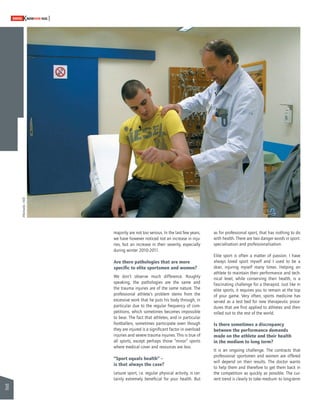
  • 95.
    91 SWISSKNOWHOW HUG Institut suisse de thérapies cellulaires Chemin Rieu 17 Case postale 270 1211 Genève 17 Tél. : +41 22 704 36 34 Fax : +41 22 704 36 37 E-mail : contact@swiss-ict.ch Web : www.swiss-ict.ch les travaux réalisés par des équipes cliniques, groupes de recherches et entreprises privées impliquées en TCI. La formation de spécialistes en TCI constitue également un des buts primor-diaux. Le dernier objectif est de mettre à dispo-sition des ressources biologiques, techniques, procédurales, juridiques et éthiques pour les TCI. Quels sont les projets en cours au SICT ? Les stratégies en cours au centre de thérapie des HUG consistent par exemple à produire des préparations cellulaires purifi ées pour la transplantation d’îlots de Langerhans du pancréas dans le cadre du traitement du dia-bète (projet dirigé par le professeur Thierry Berney), qui affecte plus de 30 000 personnes en Suisse. Le centre de thérapie cellulaire des HUG a permis la transplantation du plus grand nombre de patients diabétiques au monde depuis trois ans. En cours, il y a le développement clinique d’une vaccination antitumorale à l’aide de cellules encapsulées (professeur Nicolas Mach). P A R T E N A I R E S L’immunothérapie antitumorale sert à concevoir un traitement spécifi que, ciblé et dirigé contre les cellules can-céreuses. Les avancées de la thérapie cellulaire ouvrent la voie à une nou-velle stratégie de vaccination poten-tiellement applicable à une grande variété de cancers. Le stockage de tissus à usage théra-peutique en conditions GMP est une autre facette des activités du centre. Il s’agit par exemple de cryoconserva-tion de tissu ovarien pour de jeunes patientes en attente d’une chimio-thérapie et pour la cryoconservation de membranes amniotiques pour des traitements ophtalmologiques. D’autres projets concernent la créa-tion de pansements cellulaires dans des biomatrices, notamment afi n de réparer des tissus pour les grands brûlés (professeur Wassim Raffoul, CHUV). Et nous mettons en place également des travaux novateurs sur la régénération de l’os et du cartilage et sur la régénération du muscle dans le cas de dystrophie musculaire. Quel futur voyez-vous pour le SICT ? L’institut se veut exemplaire d’une nouvelle manière de travailler en Suisse dans le domaine de la recherche et de la thérapie cellulaire. Il a comme ambition de coordonner les efforts scientifi ques, d’échanger des connaissances et de lever les fonds nécessaires au développement de nouvelles thérapies grâce à des partenariats public-privé. Ces efforts doivent être soutenus et poursuivis tout en travaillant à défi nir un cadre légal et éthique en accord avec la législation suisse, ainsi qu’avec les directives européennes. Nous y travaillons en établissant un code de conduite sous le label Swiss-ICT.
  • 96.
    92 SWISSKNOWHOW HUG P A R T E N A I R E S THE BOOM IN CELL THERAPIES SICT, a foundation that is speeding things up Cell therapies have many possible uses. It is important that all the groups of researchers who work on this subject coordinate with each other and collaborate through these public/private partnerships. It is with this aim in mind that the Swiss Institute of Cell Therapies was set up. Tell us more about the Institute. The introduction of effective therapies requires basic research, applied research and transla-tional research that involves moving from the demonstration of an animal model to clinical tri-als with humans. More and more complex prob-lems need to be overcome in order to quickly proceed to use in humans. All that was missing was structures that favoured this quick and safe transition. This was the starting point for the Institute, which aims to join together all of the efforts achieved by different players working in this fi eld in Switzerland. The Geneva University Hospital was the fi rst in Switzerland to create a public centre for cell therapy in line with good manufacturing prac-tices, run by Swissmedic and in accordance with European directives. These good clinical practices govern the safety conditions such as the condi-tions for air fi ltration and sterile environment required for the establishment of cell therapies. More precisely, what are the objectives of the Institute? The SICT has four main objectives. Firstly, to develop an institute that focuses on the clinical needs of patients as well as developing and mar-keting innovative cell therapies. Secondly, the foundation hopes to bring together, coordinate and facilitate work carried out by clinical teams, research groups and private companies involved in innovative cell therapies. Our third objective is to train innovative cell therapy specialists. And fi nally, our fourth objective is to make biological, technical, procedural, legal and ethical resources available for innovative cell therapies. What is cell therapy? Thanks to stem cells that act as a reservoir, some of our organs can regenerate themselves from time to time. However, tissues may have been damaged by an illness, injury or simply from old age. They therefore cannot regenerate properly or quickly enough. In these cases, we make sure that the organ can reshape itself and work again using the supply of new cells. In the long term, our dream would be to be able to activate the processes in a more opti-mal way, whereby the tissue repairs itself while avoiding the problems of fi brosis and incom-plete healing which can result from damage to the tissue. The fi rst effective cell therapies are the trans-plantation of stem cells for haematological dis-eases (blood diseases). Another example is bone marrow transplants, which work well. Can you regenerate other types of tissue? The subject of regenerating the liver, heart, nerv-ous tissue or even the skin raises a lot of questions. For diabetes, we are carrying out research into replacing the cells that produce insulin. For severe burn victims, we are working on recreat-ing the sudoriferous glands and the hair or mak-ing the skin supple like it was before. At the moment, it is not possible to recreate the complex structure of the skin and this prevents transpiration. If heat cannot be removed from the body, the patient will suffer internal overheat-ing. Cell therapy also aims to fi nd alternatives for medical treatments that have become ineffec-tive for certain neurodegenerative diseases of the nervous system, such as Parkinson’s disease. The objective here is to regenerate the cells that produce dopamine in the brain. For damage to the spinal cord, the re-establish-ment of nervous connections would give hope to people who have lost the use of their limbs. Doctor Marisa Jaconi In partnership with public and private organisations working on cell research, the Geneva University Hospitals (HUG) and the Faculty of medicine in Geneva set up the Swiss Institute of Cell Therapies (SICT) in May 2010. This foundation, managed by Professor Philippe Morel, aims to develop innovative cell therapies and help them move towards clinical application with greater speed. Dr Marisa Jaconi, vice–director of SICT, kindly agreed to answer our questions.
  • 97.
    93 SWISSKNOWHOW HUG P A R T E N A I R E S What projects are you currently working on at SICT? Strategies currently underway at the HUG therapy centre include, for example, producing purifi ed cell preparations for the transplantation of islets of Langerhans in the pancreas as part of treat-ment for diabetics (project managed by Professor Thierry Berney), which affects more than 30,000 people in Switzerland. The HUG cell therapy centre has facilitated transplants in the highest number of diabetic patients in the world for the last three years. We are currently working on the clinical develop-ment of an anti-tumour vaccination using encap-sulated cells (Professor Nicolas Mach). Anti-tumour immunotherapy is used to develop a specifi c treatment, targeted and directed to fi ght against cancerous cells. Advances in cell therapy are paving the way for a new vaccina-tion strategy that could apply to a wide variety of cancers. Storing tissue for therapeutic use in line with good manufacturing practices is another of the centre’s activities. This involves, for example, the cryogenic preservation of ovar-ian tissue for young patients await-ing chemotherapy and the cryogenic preservation of amniotic membranes for ophthalmological treatments. Other projects concern the crea-tion of cell dressings in biomatrices, particularly in order to repair tissue for severe burns victims (Professor Wassim Raffoul, CHUV). And we are also working on new research into the regeneration of bone and cartilage and into the regeneration of muscle in the case of muscular dystrophy. What does the future hold for SICT? The Institute would like to set an example for a new way of working in Switzerland in the fi eld of research and cell therapy. Its aim is to coor-dinate the scientifi c efforts, transfer knowledge and raise the funds nec-essary for the development of new therapies using public/private part-nerships. These efforts need to be supported and continued while working to defi ne a legal and ethical framework in accordance with Swiss legislation and European directives. We are working on establishing a code of practice under the Swiss ICT label. Swiss Institute of Cell Therapies Chemin Rieu 17 Case postale 270 1211 Genève 17 Tel.: +41 22 704 36 34 Fax: +41 22 704 36 37 E-mail: contact@swiss-ict.ch Web: www.swiss-ict.ch
  • 98.
    94 SWISSKNOWHOW HUG D éveloppé aux Hôpitaux universitaires de Genève, OsiriX présente une véritable révolution dans le monde fermé de l’imagerie médicale : grâce à cet outil gratuit, les médecins peuvent facilement visualiser, manipuler et interpréter les images du corps humain en 3D sur un simple ordinateur de bureau. La Fondation OsiriX Web : www.foundation.osirixfoundation.com E-mail : osirix@osirixfoundation.com Le logiciel : www.osirix-viewer.com OSIRIX, L’IMAGERIE MÉDICALE EN 3D À LA PORTÉE DE TOUS Fruit de la collaboration entre Antoine Rosset, radiologue et chef de clinique aux HUG, et le professeur Osman Ratib, médecin-chef du service de médecine nucléaire aux HUG et chef du département d’imagerie et des sciences de l’information médicale, OsiriX est un programme capable de modéliser rapidement les images capturées par n’importe quel type de scanner, comme les PET, CT-scan ou encore IRM. L’outil est conçu pour représenter le corps humain en 3D, évoluant dans le temps (4D) et même intégrant son fonctionnement (5D) à partir des images de différents types de scanners. Il per-met également de mieux visualiser les organes, tissus ou portions de corps en leur attribuant des couleurs et des degrés d’opacité différents. Du coup, les images prennent un aspect très graphique pour une plus grande lisibilité. Grâce à une bourse du Fonds national pour la recherche scientifi que attribuée au Dr Rosset, les deux médecins ont lancé en 2004 une première version de leur logiciel en accès libre. Outre sa gratuité, il présente de nombreux atouts comme sa facilité d’utilisation, sa présentation très graphique et ses performances lui permettant de fonctionner sur n’importe quel ordinateur MacIntosh classique. Son accès aisé lui confère un tel succès qu’actuel-lement près de 50 000 professionnels l’utilisent chaque mois. Auparavant, l’interprétation des images médi-cales était réservée aux spécialistes tels que des radiologues. Grâce à OsiriX, le chirurgien, l’oncologue ou le gastroentérologue peuvent aujourd’hui gérer et manier eux-mêmes les images comme ils l’entendent depuis leur bureau. Le développement du programme repose sur un modèle open source et fournit bien plus d’avantages que la simple gratuité. L’utilisateur peut accéder au code source pour le modifi er et ainsi l’adapter à ses besoins. Afi n de garder une certaine unité, Antoine Rosset vérifi e et valide toutefois les changements proposés par les déve-loppeurs. Pour assurer le soutien et la promotion du logiciel, de ses futures versions ainsi que de nouveaux développements, une fondation a été créée en décembre 2008 avec l’appui de plusieurs partenaires, dont Bernard Gruson, directeur général des HUG, et Patrick Aebischer, président de l’EPFL. Sise à Genève, la Fondation OsiriX a notamment pour objectif de soutenir les développements open source dans le domaine de la médecine. Elle cherche ainsi à fi nancer de jeunes program-meurs en leur offrant des bourses d’études, tout en récompensant les meilleures contributions grâce à un prix, l’OsiriX Plugin Award. P A R T E N A I R E S Professeur Osman Ratib © J. Gregorio - HUG
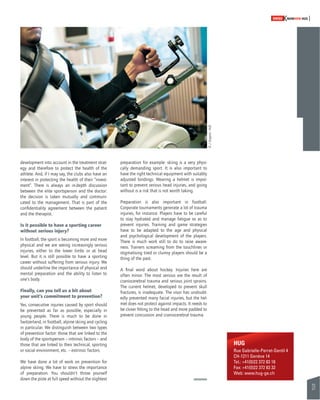
  • 99.
    95 SWISSKNOWHOW HUG D eveloped at Geneva University Hospitals (HUG), OsiriX is a real revolution in the closed world of medical imaging: thanks to this free tool, doctors can easily visualise, move and interpret 3D images of the human body on a basic offi ce computer. The OsiriX Foundation Web: www.foundation.osirixfoundation.com E-mail: osirix@osirixfoundation.com Software: www.osirix-viewer.com OSIRIX, 3D MEDICAL IMAGING AVAILABLE TO EVERYONE The result of collaboration between Antoine Rosset, radiologist and chief resident at the HUG, and Professor Osman Ratib, medical direc-tor of the nuclear medicine department at the HUG and head of the department of imaging and medical information sciences, the OsiriX programme is capable of quickly modelling the images captured by any kind of scanner, such as PET, CT or even MRI. The tool is designed to show the human body in 3D, developing over time (4D) and even integrat-ing its function (5D) using images from different types of scanners. It also allows doctors to visu-alise organs, tissues or parts of the body better, allocating them colours and different degrees of opacity. As a result, the images assume a very graphical appearance, giving them greater readability. Thanks to a grant awarded to Dr Rosset by the Swiss National Science Foundation, in 2004 the two doctors launched an initial version of their software free of charge. On top of being free, it has numerous advantages, like its ease of use, its very graphical presentation and its perfor-mances which enable it to work on any conven-tional Macintosh computer. Its easy access has brought it such success that currently almost 50,000 professionals use it every month. Previously, interpreting medical images was lim-ited to specialists like radiologists. Today, using OsiriX, surgeons, oncologists and gastroenterolo-gists can manage and handle the images them-selves as they wish from their offi ce. The programme was developed using an open source model and provides a number of advan-tages above and beyond the fact that it is free. Users can access the source code to modify it and therefore adapt it to their needs. However, to pre-serve a certain level of cohesion, Antoine Rosset checks and confi rms any changes suggested by developers. To support and promote the software, its future versions and new developments, a foundation was created in December 2008 with the support of several partners, including Bernard Gruson, managing director of the HUG, and Patrick Aebischer, president of the EPFL. Located in Geneva, the OsiriX Foundation aims in particular to support open source develop-ments in the fi eld of medicine. It looks to fi nance young programmers by providing them with grants, while rewarding the best contributions with a prize, the OsiriX Plugin Award. P A R T E N A I R E S
  • 100.
    96 SWISSKNOWHOW HUG En février 2011 s’est tenue à Berne la 4e édition de la Journée internationale des maladies rares, notamment soutenue par les cinq hôpitaux universitaires suisses. De gros efforts sont consentis en Suisse, notamment aux HUG, pour faire mieux connaître ces maladies et aider les patients à briser l’isolement éprouvé du fait de pathologies souvent mal connues des professionnels de santé et d’un manque général d’information. Fortement investie dans les démarches visant à sensibiliser les institutions de santé, les instances politiques et le public à cette problématique, la Dre Loredana D’Amato Sizonenko, coordinatrice suisse du site Internet Orphanet, institutionnalisé depuis 2001 aux HUG, et cofondatrice de ProRaris, répond à nos questions. Service de médecine génétique Centre médical universitaire Rue Michel-Servet 1 CH-1211 Genève 4 Tél. : +41(0)22 379 56 96 Mobile : +41 (0)79 553 35 14 E-mail : contact@orphanet.ch Web : www.orphanet.ch Comment défi nir la notion de « maladie rare » ? On parle de maladie rare lorsqu’une pathologie affecte moins d’une personne sur 2 000. Plus de 7 000 maladies rares sont répertoriées. On estime qu’elles touchent entre 6 à 8 % de la population, soit 30 millions de personnes en Europe et quelque 500 000 en Suisse. Prises dans leur ensemble, ces maladies constituent un enjeu important de santé publique, encore largement méconnu en Suisse. À part leur rareté, qu’est-ce qui caractérise ces maladies ? Ces maladies ont à 80 % une origine génétique, les autres causes étant auto-immunes, infec-tieuses, dégénératives ou tumorales. Il s’agit souvent de maladies chroniques invalidantes qui entraînent des handicaps, menacent la vie des personnes malades ou altèrent leur qualité de vie. La plus connue, aujourd’hui bien documentée, est la myopathie de Duchenne. Vu leur nombre, il est diffi cile de donner des exemples : absence congénitale des valves pulmonaires, main et pied fendus, syndrome du cri du chat, rachitisme vita-mino- résistant, pour n’en citer que quelques-unes. Les patients sont confrontés aux mêmes diffi cultés : erreurs de diagnostic, prise en charge inappropriée, souffrance psychologique liée au manque d’espoir thérapeutique et à l’absence ou à l’insuffi sance de soutien pratique dans la vie quotidienne. Peu sou-tenue, la recherche n’ouvre guère de perspectives et l’industrie pharmaceutique n’est pas très moti-vée du fait d’un marché limité. Le terme « mala-die orpheline » dit bien à quel point ces patients sont délaissés. Il n’est pas rare que ces pathologies soient fi nalement qualifi ées de troubles psychiques. Entre les premiers symptômes et le diagnostic, il peut s’écouler de 5 à 35 ans en moyenne. Les maladies rares sont-elles aujourd’hui sérieusement prises en considération en Suisse ? Les choses bougent depuis deux ans. La Suisse suit la trace de l’Union européenne avec un retard de quelques années, non pas en raison d’une mauvaise volonté, mais de la complexité du système politique suisse et de son système de santé. En France, pays moteur dans ce domaine, il existe plus de 130 centres de référence labelli-sés dans la prise en charge de certaines maladies rares, alors qu’en Suisse, les quelques centres existants ne sont pas offi ciellement reconnus. Il n’y a pas non plus de programmes de recherche, ni de fi nancement spécifi ques soutenus par les pouvoirs publics. Néanmoins, une prise de conscience se fait. La loi fédérale sur les médicaments autorise une procédure simplifi ée de mise sur le marché des médicaments spécifi ques aux maladies rares. La conseillère nationale Ruth Humbel, membre de la commission de la santé, a déposé un postulat proposant une stratégie nationale. La Conférence suisse des directeurs cantonaux de la santé et les cantons contribuent aujourd’hui au fi nancement du partenaire suisse du site Internet de référence européen Orphanet, initié en France en 1997. Il existe des pôles d’expertise en Suisse pour certaines maladies rares, il faut le faire savoir. Un lobby comme ProRaris, Alliance des maladies rares - Suisse, peut-il aider à faire avancer les choses ? J’en suis convaincue. Il faut écouter les patients, qui sont souvent les meilleurs experts de leur maladie. Cette alliance s’est constituée en juin 2010. Elle a pour mission de regrouper la cen-taine d’associations de maladies rares existant en Suisse et d’accélérer la prise de conscience (www.proraris.ch). Notre système de santé doit fournir à chaque patient des prestations de qua-lité, quelle que soit la fréquence de la maladie dont il est atteint. C’est une question d’équité. P A R T E N A I R E S MALADIES RARES, NOMBREUSES SOUFFRANCES Pour une stratégie nationale Un site Internet de référence Les maladies rares possèdent leur site Internet, précieux outil d’information à la libre disposition gratuite des professionnels de la santé et du public. Son but est de contribuer à améliorer le diagnostic, la prise en charge et le traitement. Orphanet est constitué d’une encyclopédie en ligne écrite par des experts européens et d’un répertoire des services à destination des malades et des professionnels. Ce répertoire inclut des informations sur les consultations spécialisées, les laboratoires de diagnostic, les projets de recherche en cours et les associations de malades dans 40 pays partenaires. Disponible en six langues, il offre aussi une entrée à chaque pays. www.orphanet.ch Docteure Loredana d’Amato Sizonenko
  • 101.
    97 SWISSKNOWHOW HUG P A R T E N A I R E S RARE DISEASES, COMMON SUFFERING For a national strategy Doctor Loredana d’Amato Sizonenko In February 2011 the fourth Rare Disease Day was held in Berne, supported by the fi ve Swiss university hospitals. Major efforts have been undertaken in Switzerland, particularly at the HUG, to make the wider public more aware of these illnesses and help patients to break out of the isolation experienced as a result of pathologies which health professionals often know little about and a general lack of information. Thoroughly committed to actions that aim to raise the awareness of health institutions, political bodies and the public on this subject, Dr Loredana D’Amato Sizonenko, Swiss coordinator of the website Orphanet, employee of the HUG since 2001 and co-founder of ProRaris, agreed to answer our questions. How do you defi ne a “rare disease”? A rare disease is one that affects less than one person in 2,000. More than 7,000 diseases have been classifi ed as rare. We estimate that they affect 6 to 8% of the population: 30 million peo-ple in Europe and some 500,000 in Switzerland. Taken together, these diseases are a signifi cant issue for public health, and yet are still widely ignored in Switzerland. Apart from their rarity, how else are these diseases characterised? 80% of these diseases have genetic origins, with other causes being auto-immune problems, infec-tions, degenerative diseases or tumours. They are often incapacitating chronic diseases which cause disabilities, can be fatal to sufferers or alter their quality of life. The most famous rare disease, today well documented, is Duchenne muscular dystrophy. Given their number, it’s diffi - cult to give examples: congenital absence of the pulmonary valve, deformed hands and feet, cri du chat syndrome and vitamin-resistant rickets to name just a few. The patients face the same problems: incorrect diagnosis, inappropriate treatment, psycho-logical suffering as a result of a lack of hope in therapy and no or insuffi cient practical support in everyday life. With little support, research has hardly any prospects and the limited market does not provide enough motivation for the pharma-ceutical industry. The term “orphan disease” is indicative of the neglect these patients face. It is common for these pathologies to be fi nally clas-sifi ed as mental disorders. From the moment the fi rst symptoms appear, it can take an average 5 to 35 years to reach a diagnosis. Are rare diseases seriously taken into consideration in Switzerland today? Over the last two years things have started to change. Switzerland is a couple of years behind the European Union, not because of a lack of will, but because of the complexity of the Swiss political system and its health system. In France, the leader in this fi eld, there are more than 130 approved centres of reference that treat certain rare diseases, while in Switzerland the few exist-ing centres are not offi cially recognised. There are no research programmes and no specifi c fi nancing supported by the local authorities is available either. Nevertheless, the general public is becoming more aware. The federal law on medication authorises a simplifi ed procedure for launching medicine that is specifi c to rare diseases onto the market. The national councillor Ruth Humbel, a member of the health commission, has called on the government to investigate the possibil-ity of developing a national strategy. The Swiss conference of cantonal health directors and the cantons today contribute to fi nancing the Swiss partner of the European reference website Orphanet, launched in France in 1997. There are centres of expertise in Switzerland for certain rare diseases, we have to publicise them. Can a lobby like ProRaris, the Swiss alliance of rare diseases, help things to move forwards? Yes, I’m positive we can. We have to listen to the patients - they are often the best experts on their illness. The alliance was created in June 2010. It aims to bring together the hundred dif-ferent associations for rare diseases that exist in Switzerland and to speed up the growing con-sciousness (www.proraris.ch). Our health system has to provide each patient with quality services, no matter how common the illness they are affected by. It’s only fair. A reference website Rare diseases have their own website, a precious information tool that is freely available to health professionals and the public. It aims to help improve the diagnosis, care and treatment of these diseases. Orphanet comprises an online encyclopaedia written by European experts and a directory of services for sufferers and professionals. This directory includes information on specialist consultations, diagnosis laboratories, current research projects and patient associations in 40 partner countries. Available in six languages, it also offers an entry on each country. www.orphanet.ch Medical genetics division University medical centre Rue Michel-Servet 1 CH-1211 Genève 4 Tel.: +41(0)22 379 56 96 Mobile: +41 (0)79 553 35 14 E-mail: contact@orphanet.ch Web: www.orphanet.ch
  • 102.
    COMPANY PROFILE 98 SWISSKNOWHOW HUG
  • 103.
    COMPANY PROFILE 99 SWISSKNOWHOW HUG Mr. Coissac, could you tell us about A Alexion Pharma International? Alexion Pharma International Sàrl, based in Lausanne, Switzerland, is the European head-quarters and the International Operations Center. We oversee the company’s operations in Europe, the Middle East and Africa (EMEA) and deliver worldwide services across the globe – with the exception of the USA & Canada – via our Lausanne-based global functions of Quality Assurance, Supply Chain, Information Technology, Regulatory Affairs and Finance. In 2005, we started our European activities with the goal of leading the company’s expansion into Europe and beyond. It took a great deal of work to successfully establish Alexion in EMEA with its diverse and complex markets. Now, six years later, we can be proud of our achievements and ability to serve patients suffering from PNH across the EMEA geography. Today, the Alexion Lausanne offi ce has close to 100 em ployees, com-prised of 18 different nationalities with unique skillsets, industry backgrounds and expertise. In EMEA, Alexion operates in over 20 countries and employs more than 240 people. This is just the beginning of our journey which will continue to take us to new countries and new endeavors. How is Alexion’s work refl ected in the company’s philosophy? At Alexion, we believe and act according to our core values. We aim to serve patients, physi-cians and the medical community through the innovation, development and commercialization of life-transforming therapies. We trust our part-ners and colaborators, and engage ourselves to expand the boundaries of modern healthcare. We respect one another, learn from the unique-ness of each individual and build on the strength of our diversity. Could you share more about the disease you have focused on until now? The Alexion team, led by Dr. Leonard Bell, M.D., Chief Executive Offi cer and principle foun der of the company, developed Soliris® (eculizumab) which, after 15 years of development, was approved in 2007 in the United States and Europe as a treatment for patients living with PNH, a rare and ultra-rare, debilitating and life-threatening blood disorder. Soliris® is the com-pany’s fi rst product and is a fi rst-in-class terminal complement inhibitor. Historically, one-third of patients with PNH have died within fi ve years of diagnosis. Before Soliris® was approved, there were no therapies specifi - cally available for the treatment of patients with PNH. Moving forward, we will continue our focus on ultra-rare and life-threatening diseases for which there are few, if any, effective treatment options. lexion Pharmaceuticals, Inc., founded in Cheshire, Connecticut, USA in 1992, is a global biopharmaceutical company focused on serving patients with severe and ultra-rare disorders. Alexion is the leader in complement inhibition, and has developed and markets Soliris® (eculizumab) as a treatment for patients with PNH (paroxysmal nocturnal hemoglobinuria), a debilitating, ultra-rare and life-threatening blood disorder. Today, Soliris® is approved in more than 35 countries as a treatment for PNH. ALEXION PHARMA INTERNATIONAL An interview with Patrice Coissac, Corporate Sr. Vice President and President Alexion Pharma International Sàrl “Delivering hope, restoring health, enhancing life” In PNH, red blood cells are destroyed, by a process called hemolysis
  • 104.
    COMPANY PROFILE 100 SWISSKNOWHOW HUG than 20 patients per one million of the popula-tion, with many, such as PNH, affecting far fewer. Knowledge about these diseases is often limited, and even skilled medical professionals may have diffi culty in recognizing and treating them, even in cases where an approved therapy exists. Second, the impact of ultra-rare disease on patients and their families can be profound. Many of these disorders are severe, chronic and progres-sive, and are marked by pain, disability and high Lausanne Offi ce mortality rates. Sadly, many of these diseases pre-dominantly strike infants and children. Third, because of their rarity, research in these diseases is limited and usually stretches over many years. There are also many operational hurdles associated with developing therapies for patients with rare and ultra-rare diseases that need to be considered. However, we at Alexion maintain our commitment to ultra-rare diseases despite these challenges. Alexion’s R&D pipeline and commercial activities are focused on ultra-rare diseases and indirectly, bringing hope to patients and their families. Could you elaborate on this? First, there is a distinction between rare and ultra-rare diseases. Ultra-rare diseases are generally considered to be those disorders which affect less
  • 105.
    COMPANY PROFILE 101 SWISSKNOWHOW HUG Researchers at Alexion work hard every day with the goal of transforming the lives of patients denum cofactor defi ciency (MoCD) Type A. We, at Alexion, are very proud of our commitment to develop highly innovative products to treat ultra-rare diseases often overlooked by the larger community. Alexion Pharma International Sàrl Av. du Tribunal Fédéral 34 CH-1005 Lausanne Switzerland Tel.: +41 21 318 40 00 Web: www.alxn.com We will continue to explore potential new uses for Soliris® beyond PNH, and have an early-stage pipeline of additional product candidates that have the potential to bring new, break-through treatments to patients with other rare disorders. Our commitment also extends to working with physicians, governments and payers to pursue our objective that every patient who can benefi t from our therapies should have access to them. What is your outlook for the future? Which specifi c growth opportunities are you focusing on? We see many opportunities for Alexion to con-tinue building a high performance organization which will drive further expansion into EMEA markets to bring life-saving therapies to even more patients across this region. We’re expand-ing our research pipeline and business reach with continued focus on ultra-rare and life-threat-ening disorders. Today, Alexion and independent investigators are studying Soliris® (eculizumab) in several other severe and ultra-rare complement-medi-ated diseases. Alexion recently announced the marketing applications submission to the U.S. Food and Drug Administration (FDA) and the European Medicines Agency (EMA) for Soliris® as a treatment for patients with atypical Hemolytic Uremic Syndrome (aHUS). Today, approximately 60% of patients with aHUS require dialysis or a kidney transplant or die within a year of diagno-sis. There is an urgent need for new treatments. Alexion’s pipeline contains several other innova-tive products which we believe have the ability to uniquely benefi t patients, including an inves-tigational treatment for infants with an ultra-rare and catastrophic genetic disease called molyb- Alexion Pharma International employees
  • 106.
    COMPANY PROFILE 102 SWISSKNOWHOW HUG ATMOS MEDICAL AG Entretien avec M. Jacky Noll, directeur Quelles sont les activités de votre entreprise ? Nous distribuons les équipements médicaux développés et fabriqués par notre groupe, actif dans quatre principaux domaines. Notre spécia-lité première est l’ORL. Nous proposons l’équi-pement complet du spécialiste ORL : unité de diagnostic, microscope, chaise de patient, vidéo, endoscope et bien entendu toute l’instrumenta-tion. Dans ce secteur, nous détenons 60 % du marché suisse et comptons garder cette posi-tion grâce au développement de nouveaux produits. L’innovation nous permet aussi de renforcer notre présence dans d’autres domaines médicaux. Lesquels ? Depuis deux ans, nous nous implantons dans un nouveau domaine qui est celui de la gyné-cologie. Nous diffusons notamment des chaises de gynécologie, colposcopes, et évidemment toute l’instrumentation nécessaire. Mais nous avons surtout développé un produit absolument unique : un poste de travail médico-technique complet pour la dysplasie qui réunit en un seul bloc une caméra, un système d’aspiration d’air et de sécrétions, une source de lumière et un appa-reil à radiofréquence. Cet appareil est utilisable hors salle d’opération et rencontre un grand succès en hôpital. Dans quels autres secteurs médicaux proposez-vous des équipements? Notre troisième secteur d’activités est celui de la chirurgie. Nous sommes spécialistes de l’aspiration à sécrétion pour bloc opératoire. Mais notre produit phare est le nouveau système de drainage thoracique S201. Nous sommes le seul fabricant au monde à proposer un système aussi puissant et entièrement autonome. Et surtout beaucoup plus économique à l’emploi que les équipements classiques. D’ailleurs, ce produit est tellement bien conçu que tous les hôpitaux qui l’ont testé l’ont acheté immédiate-ment ! Enfi n, nous sommes actifs dans le secteur de soins généraux et fabriquons et distribuons les pompes d’aspirations pour les traitements de plaies ainsi que toute une gamme de petits aspirateurs à sécrétions. Qui sont vos clients ? Dans le domaine de l’ORL et de la gynécologie, notre clientèle est divisée en deux parties : 40 % des hôpitaux et cliniques et le reste, les cabinets privées. En chirurgie, nous travaillons unique-ment avec les hôpitaux et cliniques. En soin, nous distribuons nos produits par l’intermédiaire de revendeurs. Où sont fabriqués vos produits ? Tous nos produits sont développés et fabriqués en Allemagne. L’usine qui emploie environ 200 personnes se trouve à Lenzkirch, un petit village dans la Forêt Noire. L’Allemagne a une très longue tradition en matière de fabrication d’équipements médiaux. Nous sommes la fi liale suisse du groupe Atmos Germany, qui en compte une douzaine et s’appuie sur plus de 50 distri-buteurs dans le monde entier. Le groupe existe depuis plus de 100 ans et a toujours travaillé avec des partenaires suisses. En 2004 nous avons racheté la société Saffi ro AG qui distri- ATMOS S41 GYNAECOLOGY WORKSPACE ATMOS CHAIR 41 GYNAECOLOGY
  • 107.
    COMPANY PROFILE 103 SWISSKNOWHOW HUG ATMOS Medical AG Reinacherstrasse 129 4053 Basel Tél. : +41 61 691 41 51 Fax : +41 61 691 09 92 Web : www.atmosmed.ch buait les produits ATMOS depuis 1987 pour en faire une fi liale du groupe, mais totalement autonome dans ses actions et développements en Suisse. Ce qui est un grand avantage. Pour quelle raison ? Contrairement aux entreprises concurrentes, nous sommes les seuls à disposer d’une fi liale en Suisse, ce qui nous garantit une meilleure proxi-mité avec nos clients qui peuvent, par ailleurs, compter sur un service après-vente de qualité. Notre société est basée à Bâle et emploie une petite équipe d’une demi-douzaine de personnes, dont notamment des vendeurs-techniciens en relation directe avec les clients. Nous disposons d’un stock sur place ainsi que d’un atelier pour effectuer toutes les opérations de maintenance ou de réparations sur les produits de notre assor-timent. Quelles sont vos perspectives sur le marché suisse ? Nous sommes leaders dans le secteur ORL et entendons le rester. En gynécologie nous avons démarré en 2008. Pour le moment nous sommes deuxième sur le marché suisse et nous allons nous battre pour accéder à la première place. En chirurgie nous nous développons très vite dans le domaine de la pneumothoracie, je pense que dans les trois années à venir, la plupart des hôpitaux suisses posséderons nos S201 pneumo-thorax. En soin, de nouveaux produits sont en préparations mais nous gardons le secret pour le moment. ATMOS S61 ENT WORKSTATION
  • 108.
    COMPANY PROFILE 104 SWISSKNOWHOW HUG What does your company do? We market medical equipment that is devel-oped and manufactured by our group, and are active in four principal areas. Our main speci-ality is ENT. We offer a full range of specialist ENT equipment: diagnostic units, microscopes, patient chairs, video systems, endoscopes and of course all the necessary instruments. In this sector, we hold 60% of the Swiss market and believe we can maintain this position through the development of new products. Innovation is also allowing us to strengthen our presence in other medical fi elds. Which ones? Two years ago, we entered a new area for us, the fi eld of gynaecology. Among other things, we market gynaecology chairs, colposcopes and of course all the necessary instruments. But we have also developed a product that is entirely unique: a complete medical treatment unit for dysplasia, which incorporates a camera, an air and secretion suction system, a light source and a radiofrequency device in a single unit. This equipment can be used outside an operating theatre and has proven to be very successful in hospitals. To which other sectors of medicine do you offer your equipment? Our third area of business is surgery. We specialise in secretion suction systems for oper-ating theatres. But our fl agship product is the new S201 thoracic drainage system. We are the only manufacturer in the world to supply such a powerful and entirely autonomous system. And it is certainly much more economical than using conventional equipment. I may add that this product has been so well designed that all the hospitals that have tested it have purchased one immediately! Lastly, we are active in the general care sector and market suction pumps for treating wounds as well as a full range of small secretion suction devices. Who are your customers? In the fi elds of ENT and gynaecology, our cus-tomers fall into two camps: 40% are hospitals ATMOS MEDICAL AG Interview with Jacky Noll, director ATMOS S201 THORACIL DRAINAGE SYSTEMS
  • 109.
    COMPANY PROFILE 105 SWISSKNOWHOW HUG ATMOS Medical AG Reinacherstrasse 129 CH-4053 Basel Tel.: +41 61,691 41 20 Fax: +41 61 691 09 92 Web: www.atmosmed.ch and clinics, and the remainder are private con-sultants. In the fi eld of surgery, we work exclu-sively with hospitals and clinics and in care we distribute our products through retailers. Where are your products made? All our products are developed and manufac-tured in Germany. The factory employs about 200 staff and is located in Lenzkirch, a small village in the Black Forest. There is an extremely long tradition of manufacturing medical equip-ment in Germany. We are the Swiss branch of the Atmos Germany group, which has about 10 subsidiaries and more than 50 distributors around the world. The group has been in exist-ence for more than 100 years and has always worked with Swiss partners. In 2004, it took over the company Saffi ro AG, which had distributed ATMOS products since 1987. This company has now become a group subsidiary but continues to act completely autonomously in terms of its business and development in Switzerland. Which is a great advantage. Why is that? In contrast to our competitors, we are the only company to have a subsidiary in Switzerland, which guarantees that we are closer to our customers, who can then rely on a high-quality after-sales service. Our company is based in Basle and employs a small team of about half a dozen, including sales engineers who have direct contact with our customers. We have on-site stocks and a workshop so that we can carry out all maintenance and repair operations on the products in our range. What are your prospects on the Swiss market? We are the market leader in the ENT sector, and intend to remain so. We entered the gynaecol-ogy market in 2008. At the moment, we are second on the Swiss market and we will fi ght to take the top spot. In surgery, we are expanding very quickly in the area of pneumothoracic sur-gery and I believe that in the next three years, most Swiss hospitals will be equipped with our S201 Thorax. We are also developing new products for the care sector, but we’re keeping them secret for now! ATMOS
  • 110.
    COMPANY PROFILE 106 SWISSKNOWHOW HUG CIBM EPFL SB IPSB LIFMET Station 6 CH - 1015 Lausanne Tél. : +41 21 693 44 67 +41 21 693 79 81 Fax : +41 21 693 79 60 E-mail : info@cibm.ch Web : www.cibm.ch CENTRE D’IMAGERIE BIOMÉDICALE (CIBM) Un modèle de collaboration dans le domaine de la recherche Le Centre d’imagerie biomédi-cale, dirigé par le professeur Rolf Gruetter, est issu d’un program me de recherches partagé entre l’Uni-versité de Genève (UNIGE), les Hôpitaux Universitaires de Genève (HUG), l’École polytechnique fédé-rale de Lausanne (EPFL), l’Univer-sité de Lausanne (UNIL) et le Centre hospitalier universitaire vaudois (CHUV). Unique en Suisse romande et dans le monde pour ses aspects multisite et multiinstitutionnel, le CIBM cherche à encourager les synergies entre ses institutions en optimisant l’utilisation de ses équi-pements de pointe. Activité large Le CIBM est le résultat d’une initiative de recherches et d’enseignement issue du projet Sciences-Vie-Société entre les 5 institutions. Le centre est réparti sur 3 sites, les HUG, l’EPFL et le CHUV. Son fi nancement a été assuré par de généreux dons des fondations Leenards et Louis- Jeantet qui continuent d’ailleurs à contribuer au soutien fi nancier à travers des projets. Même si le centre aime à se défi nir à l’aide d’une simple équation de chiffres impairs (1 centre – 3 sites – 5 institutions – 7 modules de recherches – 9 professeurs), son domaine d’activité est large et complexe. En effet, la spécialité du centre est l’imagerie biomédicale s’appuyant sur l’ima-gerie par résonance magnétique (IRM) avec le support de la tomographie à contraste de phase, de l’imagerie par isotopes radioactifs ou encore des cartes de cerveau avec électro-encéphalogramme. Recherche clinique Le CIBM s’organise autour de 7 modules de recherches. Il y a tout d’abord 3 modules d’IRM, l’un à l’EPFL qui se concentre sur l’imagerie sur les rongeurs et sur le développement technolo-gique. Autour de l’IRM, qui est le point fort du centre, un module de tomographie par émis-sion de positons est ouvert sur le site des HUG et de l’EPFL. La TEP est une méthode d’image-rie médicale pratiquée par les spécialistes en médecine nucléaire qui permet de mesurer en trois dimensions l’activité métabolique d’un organe. Les HUG, en collaboration étroite avec le CHUV, abritent également le module de carto-graphie cérébrale, plus connue sous son nom anglo-saxon de « brain mapping ». Il s’agit d’un ensemble de techniques de neurosciences qui cherchent à établir un lien entre les zones du cer-veau et des fonctions ou capacités. Ces modules expérimentaux sont complétés avec un module de traitement des signaux et images. Le Centre est unique dans le sens où il réunit des institutions qui, bien que séparées de 50 à 200 km, développent en collaboration des mé tho-des d’imagerie et d’analyses inégalées grâce à des équipements et un savoir-faire remarquables. L’objectif commun est de devenir une référence reconnue dans la recherche biomédicale. A short bore 7Tesla magnet at CIBM, allowing direct patient contact Detection of tumor growth from stem cells. T2-weighted FL+ FL10 T1-weighted, gadolinium
  • 111.
    COMPANY PROFILE 107 SWISSKNOWHOW HUG CIBM EPFL SB IPSB LIFMET Station 6 CH - 1015 Lausanne Tel.: +41 21 693 44 67 +41 21 693 79 81 Fax: +41 21 693 79 60 E-mail : info@cibm.ch Web: www.cibm.ch CENTER FOR BIOMEDICAL IMAGING A collaboration model in the fi eld of research High-resolution structural MRI of the human cerebellum at 7 Tesla. From Marques et al. Radiology 2010 The Center for Biomedical Imaging, directed by Professor Rolf Gruetter, is the result of a major research initiative between the University of Geneva (UNIGE), the Hôpitaux Universitaires de Genève (HUG), the Ecole Polytechnique Fédérale de Lausanne (EPFL), the University of Lausanne (UNIL), and Lausanne University Hospital (CHUV). Unique within the French-speaking area of Switzerland and in the world for its multi-site and multi-institutional aspects, the CIBM aims to foster synergies between these institutions by optimizing the use of its state-of-the-art equip-ment. Broad activity The CIBM is the outcome of a research and teaching initiative from the Sciences-Vie-Société (Science-Life-Society) project between the 5 insti-tutions. The Center is spread out over three sites: HUG, EPFL and CHUV. It has received generous funding from the Leenards and Louis-Jeantet Foundations, which continue to provide fi nan-cial support to all projects. Although the Center likes to defi ne itself using a simple equation of odd numbers (1 center, 3 sites, 5 institutions, 7 research units, 9 professors), its fi eld of acti-vity is complex and extensive. Indeed, the Center specializes in biomedical imaging using magne-tic resonance imaging (MRI) with the support of phase contrast tomography, radioactive isotope (CIBM) imaging and brain mapping by electroencepha-lography (EEG). Clinical research The CIBM is organized around seven research units. There are 3 MRI units, one at the EPFL which concentrates on imaging on rodents and on technological development. Also related to the center’s speciality of MRI, a positron emission tomography unit has opened at the HUG and EPFL site. Positron emission tomography (PET) is a method of medical imaging practised by spe-cialists in nuclear medicine, which allows them to measure the metabolic activity of an organ in 3D. The HUG, in close collaboration with the CHUV, also house the brain mapping unit. This consists of a set of neuroscience techniques that seek to establish a link between the regions of the brain and functions or capacities. Finally, a signal and image processing unit completes the experimental units. The Center is unique because it brings together institutions which, although separated by some 50 to 200 km, offer methods of imaging and analysis that are quite unparalleled, thanks to outstanding equipment and expertise. The com-mon goal is to become a recognized centre of excellence in the world of biomedical research. Somatotopy of human index representation following physiological touch of the individual index fi nger
  • 112.
    COMPANY PROFILE 108 SWISSKNOWHOW HUG Jour après jour la Croix-Rouge genevoise prend en charge des jeunes, des familles, des per-sonnes âgées. Qu’ils soient nés et travaillent à Genève, qu’ils soient venus soutenir par leur travail l’économie locale ou qu’ils soient réfugiés, traumatisés par les exactions vécues, les béné-fi ciaires de la CRG reçoivent une aide qui leur permet de garder leur dignité, de préserver leur santé et d’élaborer des projets d’avenir. Ceci en conformité avec les principes fondamentaux du Mouvement Croix-Rouge. Pour assurer ce travail quotidien, la CRG s’est organisée en deux secteurs : Formation et santé d’une part, Migration et Intégration d’autre part, soutenus par le service du Bénévolat. Formation et santé Le secteur « Formation et santé » propose de nombreuses formations adaptées aux besoins de la population et des activités destinées à pro-mouvoir et à préserver la santé. Les programmes de cours visent plus particulière-ment trois types de publics : ! L a formation d’auxiliaire de santé pour des personnes peu qualifi ées, en voie de réinser-tion sociale ou professionnelle. Cette formation, reconnue au niveau suisse, apporte les connaissances théoriques et prati-ques nécessaires pour épauler le personnel infi rmier dans un EMS ou dans un service de gériatrie. Un partenariat développé avec les Hôpitaux Universitaires de Genève (HUG), permet aux personnes en fi n de droits de chômage, ayant réussi la formation, de parfaire leurs compé-tences au cours d’un stage d’une année en milieu hospitalier et d’être engagées. ! Les cours pour les bénévoles de l’association ou d’autres institutions (ex. les HUG). ! Les cours à la population : baby-sitting, premiers secours, soins et santé des enfants, accompagnement de personnes en fi n de vie… Le secteur « Formation et santé » comprend aussi un service de garde d’enfants à domicile, le Chaperon Rouge, dont l’offre s’est élargie aux accompagnements à domicile pour les seniors, Présence Seniors, ainsi qu’un programme de soutien pour les proches de malades atteints de la maladie d’Alzheimer. Migration et intégration Actif auprès des populations migrantes particu-lièrement fragilisées, le secteur « Migration et intégration » soutient les personnes vulnérables dans leur processus d’intégration par la mise à disposition de structures ciblées. Dans ce cadre, le Service Interprétariat Commu-nautaire (SIC) met à disposition un réseau d’in-terprètes pour les institutions travaillant pour des migrants. Créé en 1993, le SIC répond aux besoins des HUG, du département de l’instruction publique ou encore d’organismes sociaux, en assurant aux migrants la possibilité de s’exprimer dans leur langue maternelle et de faciliter à chacune des parties l’accès à la culture de l’autre. Fondée le 17 mars 1864, la Croix-Rouge genevoise (CRG) est la première association cantonale qui a vu le jour en Suisse. Actuellement, elle emploie 350 collaborateurs qui viennent en aide tous les jours aux personnes vulnérables habitant le canton de Genève. Pour sa directrice Eliane Babel-Guérin, malgré le travail accompli, l’institution a encore de nombreux défi s à relever. LA CROIX-ROUGE GENEVOISE, AU SERVICE DE LA POPULATION Entretien avec Mme Eliane Babel-Guérin
  • 113.
    COMPANY PROFILE 109 SWISSKNOWHOW HUG Croix-Rouge genevoise Route des Acacias 9 Case postale 288 1211 Genève 4 Tél : +41 22 304 04 04 Fax : +41 22 300 31 83 E-mail : info@croix-rouge-ge.ch Web : www.croix-rouge-ge.ch Aujourd’hui, le service compte plus de cent interprètes communautaires qui traduisent dans 72 langues et dialectes différents. Plus de 20 000 heures ont été effectuées en 2010, dont la majorité en trialogue avec les médecins et patients des HUG. Afi n d’être également capables de « lire entre les lignes », c’est-à-dire de comprendre et ressentir ce que l’interlocuteur pense et vit, l’interprète est lui-même un migrant, normalement au maxi-mum de la 2e génération. À côté du SIC, toute une série de services est éga-lement proposée. Le « service d’aide au retour » soutient toute per-sonne ne pouvant plus rester à Genève pour des raisons administratives, des déboutés de l’asile et/ou des sans-papiers afi n de leur assurer un départ empreint d’humanité et de dignité. Le « Centre d’Intégration Culturelle» (CIC) est basé sur une bibliothèque de plus de 30 000 ouvrages dans près de 300 langues ou dialectes pour offrir à chacun le plaisir de lire dans sa langue mater-nelle. Le CIC organise aussi diverses activités de formation, en particulier des cours de français. Les « Logements Jeunes » et le « Semestre de Motivation » (SEMO) offrent une réintégration sociale et professionnelle à des jeunes en diffi cul-tés. Grâce à deux foyers, au café Solférino et aux Serres de la Croix-Rouge genevoise, ces jeunes peuvent retrouver un cadre de vie normal et se préparer concrètement aux exigences du monde professionnel. Les « Vet’ Shop » ont pour objectif de récupé-rer les vêtements offerts par la population et les entreprises genevoises et de les redistribuer gratuitement ou à un prix modique, tout en parti cipant à la réinsertion professionnelle. Les activités liées au bénévolat Chaque année, près de 600 bénévoles s’engagent activement pour aider la population genevoise au travers d’activités régulières ou ponctuelles : vente de mimosa, visites aux malades hospita-lisés et aux personnes âgées isolées, distribution de paniers de Noël… Ces bénévoles participent ainsi sur le terrain à l’amélioration de la qualité de vie, tout en véhiculant les valeurs du mouve-ment Croix-Rouge. Les jeunes bénévoles entre 16 et 30 ans sont mobilisés par la Croix-Rouge Jeunesse, qui les forme aux valeurs humanitaires et leur propose divers programmes de soutien, comme la prise en charge d’enfants, pendant les vacances et les mercredis ainsi que dans les centres de requé-rants d’asile. Un service au-delà du secteur public En tant qu’organisation privée et indépendante, la Croix-Rouge genevoise offre ses services là où les pouvoirs publics ou d’autres acteurs n’inter-viennent pas ou peu. À intervalles réguliers, elle veille à adapter ses prestations en fonction des changements et des circonstances pour se mettre au service de la population en conformité avec les valeurs qu’elle défend.
  • 114.
    COMPANY PROFILE 110 SWISSKNOWHOW HUG Founded on March 17th, 1864, the Geneva Red Cross (CRG) was the fi rst cantonal association to be set up in Switzerland. It currently employs 350 members of staff who help vulnerable individuals living in the canton of Geneva every day. For its director Eliane Babel- Guérin, despite the work done, the organisation still has many challenges to face. THE GENEVA RED CROSS, AT THE SERVICE OF THE PEOPLE Interview with Mme Eliane Babel-Guérin Day after day, the Geneva Red Cross takes care of young people, families and the elderly. Whether they were born and work in Geneva, whether they came to work here and support the local economy, or whether they are refugees, traumatised by past violence, the benefi ciaries of the CRG receive assistance that helps them to keep their dignity, maintain their health and develop plans for their future. All this while res-pecting the fundamental principles of the Red Cross Movement. To carry out everyday work, the CRG is organised into two areas: Training and health on the one hand and Migration and integration on the other hand, supported by the Volunteers service. Training and health The “Training and health” area offers numerous training courses adapted to the needs of these people, and activities that aim to promote and maintain good health. The class programmes aim particularly at three groups: ! A uxiliary nurse training for individuals with few qualifi cations undergoing social or profes-sional reintegration. This training, recognised throughout Switzer-land, gives them the theoretical and practi-cal knowledge they need to support nursing staff in medico-social centres, or in a geriatrics clinic. A partnership developed with the Hôpitaux Universitaires de Genève (HUG) enables indi-viduals no longer entitled to unemployment benefi ts who pass this training to hone their skills during a one-year placement in a hospi-tal and to be employed. ! C lasses for volunteers of the association or other institutions (e.g. the HUG). ! Social care training: babysitting, fi rst aid, child care and health, providing support for termi-nally- ill patients, etc. The “Training and health” area also includes a home childcare service, le Chaperon Rouge, whose range of services has been expanded to home help for the elderly, Présence Seniors, and a support programme for the family and friends of Alzheimer’s sufferers. Migration and integration Working with particularly vulnerable immigrant populations, the “Migration and integration” area helps vulnerable people to integrate by providing specially dedicated structures. Within this framework, the Community Interpreting Service (SIC) provides a network of interpreters for institutions that work with immi-grants. Created in 1993, the SIC responds to the needs of the HUG, the department of public education and social organisations, by giving immigrants the chance to express themselves in their native tongue and to facilitate both parties access to each other’s culture.
  • 115.
    COMPANY PROFILE 111 SWISSKNOWHOW HUG Today, the service has more than one hundred community interpreters who work in 72 different languages and dialects. More than 20,000 hours were carried out in 2010, the majority of which were trialogues with doctors and patients at the HUG. So as to also be able to “read between the lines”, that is to say to understand and feel what the person speaking is thinking and experiencing, the interpreters themselves are all immigrants, usually 2nd generation. Along with the SIC, a whole range of services is also on offer. The “assisted return service” supports anyone who can no longer stay in Geneva for adminis-trative reasons, asylum seekers with no legal grounds to stay and/or illegal immigrants, to ensure that their departure is marked by huma-nity and dignity. The “Cultural Integration Centre” (CIC) is based around a library of more than 30,000 works in almost 300 languages or dialects, so that eve-ryone can enjoy reading in their mother tongue. The CIC also organises various training activities, particularly French classes. The “Young Accommodation” and the “Semester of Motivation” (SEMO) provide social and profes-sional reintegration for young people in trouble. Thanks to two hostels, the café Solférino and the Serres of the Geneva Red Cross, these young people can experience a normal living environ-ment and prepare themselves in practical terms for the demands of the professional world. The “Vet’ Shop” aims to collect clothing donated by the general public and Genevan companies and redistribute them for free or at a modest price, while participating in professional reinte-gration. Activities linked to volunteering Every year, almost 600 volunteers actively get involved in helping the people of Geneva through regular or occasional activities: selling mimosa, visiting people in hospital and isolated elderly people, distributing Christmas baskets, etc. These volunteers help to improve the qua-lity of life whilst spreading the values of the Red Cross movement. Young volunteers aged between 16 and 30 are involved in the Young Red Cross, which teaches them humanitarian values and offers them various support programmes, such as childcare during the holidays and on Wednesdays, and in asylum seeker centres. A service beyond the public sector As a private and independent organisation, the Geneva Red Cross offers its services where the local authorities or other players provide very little or no help at all. At regular intervals, it adapts its services depending on changing cir-cumstances so as to put itself at the service of the people, while respecting the values that it upholds. Croix-Rouge genevoise Route des Acacias 9 Case postale 288 CH-1211 Genève 4 Tel: +41 22 304 04 04 Fax: +41 22 300 31 83 E-mail: info@croix-rouge-ge.ch Web www.croix-rouge-ge.ch
  • 118.
    COMPANY PROFILE 114 SWISSKNOWHOW HUG Curmed SA Untere Zollgasse 28 CH-3072 Ostermundigen Tél. : +41 (0)31 932 44 22 Fax : +41 (0)31 932 40 29 E-mail : info@curmed.ch Web : http://www.curmed.ch CURMED SA, OSTERMUNDIGEN Un partenaire fort en chirurgie de la main, orthopédie, et traumatologie Entretien avec M. David Perron, Directeur Curmed SA M. Perron, Curmed SA est distributeur dans le domaine de l’orthopédie et de la traumatologie. Quelle est votre gamme de produits ? Curmed propose depuis plus de 20 ans des pro-duits de niche aux chirurgiens du membre supé-rieur (spécialement de la main) mais aussi du membre inférieur. Notre gamme d’implants couvre toutes les articulations sauf celles du crâne et du rachis. Notre volonté est de proposer des solu-tions, pour les patients qui sont trop âgés pour un traitement biologique ou conservateur, mais également trop jeunes pour une prothèse totale ou une fusion de l’articulation (arthrodèse). Lors d’une session de chirurgie « live », vous avez présenté un nouvel implant Spacer en pyrocarbone pour le poignet, l’Amandys. Pouvez-vous nous parler du pyrocarbone, et de son utilisation en orthopédie ? Les propriétés spécifi ques du pyrocarbone (élas-ticité similaire à l’os, coeffi cient de friction extrê-mement bas, état de surface excellent, parfaite biocompatibilité) en font un matériau de choix pour des applications d’arthroplastie en chirurgie orthopédique. Le contact indolore et sans usure du pyrocarbone permet d’envisager des remplace-ments prothétiques à long terme. La nature phy-sico- chimique et mécanique du pyrocarbone rend impossible son ostéointégration et toute fi xation de tissus mous. Les premières applications du pyro-carbone en chirurgie orthopédique se sont limitées à la main, au poignet et au coude. Les fabricants travaillent aujourd’hui sur de nouveaux implants pour des articulations plus larges comme l’épaule. Quels sont les avantages de l’implant Amandys par rapport aux autres alternatives pour le poignet ? L’Amandys, développé par le Dr Philippe Bellemère, est un implant d’interposition sans aucune fi xation à l’os, ni même aux parties molles. Il est libre et à double mobilité. Ceci représente un avantage considérable face aux prothèses totales de poignet qui nécessitent toutes de fortes fi xations du composant radial et carpien. L’implant s’articule à la fois sur la glène radiale et la médiocarpienne. À l’instar des prothèses totales de poignet, l’Amandys ne génère aucun transfert de contrainte à l’intérieur des fûts diaphysaires. Toutes les contraintes bioméca-niques sont réparties sur la totalité de la surface de contact de l’implant. Les pressions exercées par l’implant sur le radius et le carpe en sont de fait réduites. Ce concept d’interposition permet de procéder à des résections minimales et justes. Seules les parties atteintes sont réséquées : scaphoïde proximal, tête proximale du grand os et semi-lunaire. Il est particulièrement important de préserver un stock osseux suffi sant en cas de réintervention. Il sera toujours possible de reve-nir à des alternatives plus classiques comme une arthrodèse de poignet, voire même une prothèse totale de poignet. Quel rôle joue le HUG par rapport à cet implant ? Une caractéristique de la mission universitaire à Genève est la recherche de pointe, fondamentale et appliquée, dans un domaine en constante évo-lution. Lancée par le Dr Dominique Della Santa il y a quelques années, puis reprise par le Dr Jean- Yves Beaulieu, on peut considérer l’utilisation du pyrocarbone à Genève comme un relais. Une fois que celle-ci a été validée scientifi quement par les spécialistes français, le Dr Beaulieu et son équipe proposent alors à leurs patients des implants à la pointe de la technologie.
  • 119.
    COMPANY PROFILE 115 SWISSKNOWHOW HUG Pyrocarbon in Genf mit einer Stabsüber-gabe wie im Staffellauf vergleichen. Nachdem dieses Verfahren zuvor durch die französischen Spezialisten überprüft wurde, bieten Dr. Beaulieu und sein Team Ihren Patienten nun Implantate, die sich absolut auf der Höhe des tech-nologischen Fortschritts befi nden. Curmed AG Untere Zollgasse 28 CH-3072 Ostermundigen Tel.: +41 (0)31 932 44 22 Fax : +41 (0)31 932 40 29 E-mail: info@curmed.ch Web: http://www.curmed.ch CURMED AG, OSTERMUNDIGEN ein starker Partner im Bereich Hand-chirurgie, Orthopädie, und Traumatologie Interview mit Hr. David Perron, Geschäftsführer Curmed AG Herr Perron, die Curmed AG ist ein Distributor im Bereich der Orthopädie und Traumatologie. Was für Produkte vertreiben Sie? Curmed bietet seit mehr als 20 Jahre chirurgi-sche Nischenprodukte für die obere Extremität (besonders der Hand), aber auch für die untere Extremität. Unser Angebot an Implantaten deckt sämtliche Gelenke mit Ausnahme des Schädels und der Wirbelsäule. Wir sind bestrebt, Lösungen für Patienten anzubieten, die entweder für eine biologische oder konservative Behandlung zu alt sind oder noch zu jung für eine komplette Prothese oder operative Gelenksversteifung (Arthrodese). Anlässlich einer Live-Operation haben Sie ein neues Spacer Implantat aus Pyrocarbon für das Handgelenk, die Amandys, vorgestellt. Können Sie uns etwas mehr zum Pyrocarbon und seine Verwendung in der Orthopädie erzählen? Die besonderen Eigenschaften von Pyrocarbon (ähnliche Elastizität wie der Knochen, ext-rem niedriger Reibungskoeffi zient, exzellente Oberfl ächenbeschaffenheit sowie perfekte Bio-kom patibilität) machen dieses zu einem Material erster Wahl für arthroplastische Anwendungen in der chirurgischen Orthopädie. Die schmerz- und verschleissfreie Haftung erlaubt es, dieses Material langfristig als prothetischen Ersatz ins Auge zu fas-sen. Die physikalisch-chemischen und die mecha-nischen Eigenschaften von Pyrocarbon verhindern seine Osseointegration und jegliche Fixierung der Weichteile. Die ersten Anwendungen von Pyrocarbon in der orthopädischen Chirurgie waren auf Hand, Handgelenk und Ellbogen begrenzt. Derzeit arbeiten die Hersteller aber auch an neuen Implantaten für weitere Gelenke wie beispielsweise der Schulter. Welches sind die Vorteile von Amandys im Vergleich zu anderen Implantaten und Lösungen für das Handgelenk? Amandys – entwickelt von Dr. Philippe Bellemère – ist ein zwischenliegendes Implantat ohne jegliche Fixierung am Knochen oder an den Weichteilen, vielmehr ist es frei beweglich und doppelt mobil. Gegenüber kompletten Handgelenks-Prothesen stellt dies einen erheblichen Vorteil dar, zumal Komplett-Prothesen starke Fixationen der radialen Handwurzel erfordern. Das Implantat baut sowohl auf der Pfanne als auch auf dem Mediokarpal auf. Wie bei Totalprothesen des Handgelenks erzeugt Amandys im Innern des Schaftes keine diaphysäre Übertragungsbelastung, sondern sämtliche biomechanischen Einwirkungen werden über die gesamte Kontaktfl äche des Implantats verteilt. Der Druck, den das Implantat auf Radius und Handwurzel ausübt, wird auf diese Weise wirksam reduziert. Dieses Konzept der Zwischenschaltung erlaubt ein Vorgehen mit minimalen, genauen Resektionen. Einzig die betroffenen Teile werden reseziert: Kahnbein, Kopfbein sowie Mondbein. Gerade die Erhaltung ausreichender Knochensubstanz ist für den Fall einer erneuten Intervention von gro-sser Bedeutung. Durch das Amandys-Verfahren ist es somit jederzeit möglich, auf klassischere Alternativen zurückzukommen wie eine Arthrodese des Handgelenks oder sogar eine gesamte Handgelenkprothese. Welche Rolle spielt das HUG in Zusammenhang mit diesem Implantat? Ein herausragendes Merkmal der wissenschaft-lichen Tätigkeiten in Genf ist die fortgeschrit-tene Grundlagen- und angewandte Forschung in einem sich konstant entwickelnden Gebiet. Ursprünglich vor einigen Jahren durch Dr. Dominique Della Santa ins Leben gerufen und anschliessend durch Dr. Jean-Yves Beaulieu weitergeführt, lässt sich der Einsatz von
  • 120.
    COMPANY PROFILE 116 SWISSKNOWHOW HUG DIANALABS Rue de la Colline 6 1205 Genève Tél. : +41 (0)22 807 12 40 E-mail : info@dianalabs.ch Web : www.dianalabs.ch Au travers de ses publications et présentations, il a été reconnu internationalement pour la qualité de sa sérologie, particulièrement dans le suivi de la grossesse. Il regroupe actuellement des spé-cialistes médecins, biologistes, pharmaciens qui, en plus de leurs diplômes respectifs, disposent d’une formation/d’un titre supplémentaire de spécialiste en analyses médicales (FAMH). Fort de ses compétences au service des patients et du corps médical, Dianalabs propose une gamme complète d’analyses médicales pour couvrir tous les besoins de la médecine. Plus qu’un labora-toire polyvalent qui « fait tout », du fait de son équipe de spécialistes, il est un laboratoire multi-spécialités, dont la particularité est une véritable interface avec chaque spécialité médicale dont les besoins sont particuliers. Avant d’être une entreprise, le laboratoire est une association humaine de compétences pour garantir le meilleur suivi biologique des patients et offrir l’outil le plus adapté au corps médical. Par une association avec des entreprises régio-na les (Medisupport) qui partagent la même philosophie : - Aurigen à Lausanne (www.aurigen.ch), - Axeslab à Martigny (www.axeslab.ch), - BBV à La Chaux-de-Fonds (www.labobbv.ch), - Bio-Analytica et Bioexam à Lucerne (www.bioanalytica.ch, www.bioexam.ch), - MCL à Niederwangen (www.mcl.ch), - Polyanalytic à Lausanne (www.polyanalytic.ch), - Toggweiler à Zurich (www.toggweiler.ch). Nous sommes en mesure de répondre aux besoins régionaux à Genève, Nyon, Morges, Lausanne, Neuchâtel, La Chaux-de-Fonds, Martigny, Fribourg, Berne, Saanen, Zweisimmen, Lucerne, Zurich et Winterthur. Missions de qualité Les missions du laboratoire sont multiples : Offrir à la population les meilleures technologies en diagnostic de laboratoire, et développer pour le corps médical des services d’interprétation et de suivi à haute valeur ajoutée. Conforter les médecins dans leur démarche médicale par des outils taillés sur mesure pour correspondre à leurs besoins spécifi ques. Loin de l’uniformisation, la politique de l’entreprise vise à permettre un service individuel pour le béné-fi ce des patients. Garantir un suivi local en confi ance avec la population et les diverses spécialités médicales afi n d’améliorer chaque jour la réponse à leurs attentes spécifi ques. Assurer la formation continue de notre person-nel aux nouvelles technologies et le motiver à l’importance de sa mission pour les patients au travers de son service auprès des médecins. Travailler dans le monde de la santé est avant tout une vocation humaine. Notre équipe de labo-rantines, laborantins, secrétaires, infi rmières, méde-cins, pharmaciens, biologistes travaillent ensemble à la réussite quotidienne de notre mission. Philosophie Dianalabs, au travers de 20 ans de collabora-tion scientifi que avec les médecins et les centres universitaires, a bien compris que seule une entreprise régionale, qui partage des valeurs humaines fondamentales de qualité, d’échanges, de services de confi ance, et qui détient une connaissance locale, peut répondre effi cacement aux besoins de la population et des médecins. La qualité de l’analyse médicale, qui permet d’assurer un vrai diagnostic de laboratoire, ne se résume pas à un chiffre sur un automate, mais dépend bien d’une interprétation, par des personnes hautement qualifi ées, des résultats obtenus. Les métiers de la santé sont avant tout humains. Dianalabs souhaite être une entre-prise attrayante, dans laquelle le personnel puisse s’épanouir dans le respect et la confi ance en ressentant au quotidien les raisons de sa vocation. Le laboratoire entend contribuer à la détection des maladies par les méthodes biolo-giques en offrant aux médecins et aux patients des outils diagnostiques et des services à haute valeur ajoutée. Le laboratoire s’attache à être une entreprise citoyenne en apportant des servi-ces complémentaires à la population, notam-ment par la conservation de sérums à très basses températures pour des applications médicales et Dianalabs est un laboratoire d’analyses médicales genevois, à l’origine, en 1988, créé par des médecins dans le but d’apporter le meilleur suivi biologique au corps médical et aux patients, initialement dans le cadre de la maternité. DIANALABS Un laboratoire à l’écoute des patients et des médecins
  • 121.
    COMPANY PROFILE 117 SWISSKNOWHOW HUG Les métiers de la santé sont avant tout humains. Dianalabs, c’est avant tout une équipe parta-geant une passion, la même philosophie et la même vocation au service des patients et du corps médical. Le laboratoire est situé dans le quartier de Plainpalais au coeur de Genève, à proximité des Hôpitaux Universitaires et du corps médical genevois. DIANALABS Rue de la Colline 6 1205 Genève Tél. : +41 (0)22 807 12 40 E-mail : info@dianalabs.ch Web : www.dianalabs.ch scientifi ques. Dianalabs s’associe en réseau avec des entreprises qui partagent la même philoso-phie dans leurs régions respectives. Le but est de garantir des pôles d’excellence dans toutes les spécialités médicales grâce à une équipe de cadres – notamment médecins, pharmaciens, biologistes et partenaires – dont la vocation est conforme à la raison d’être de l’entreprise, sans soumission à des groupes fi nanciers dont les objectifs réels ne correspondent aucunement à la mission.
  • 122.
    COMPANY PROFILE 118 SWISSKNOWHOW HUG D Through its publications and presentations, it has become recognised internationally for the quality of its serology, particularly for screening services during pregnancy. Today it is a centre of specialist doctors, biologists and pharmacists who, in addition to their respective degrees, have supplementary training or qualifi cations as specialists in medical analysis (FAMH). Placing its expertise at the service of patients and the medical establishment, Dianalabs offers a com-plete range of medical analyses covering all med-ical requirements. Thanks to its team of special-ists, it is more than a multi-purpose laboratory that “does everything”: it is a laboratory with multiple specialisations where the distinguishing feature is a genuine interface with each medical specialisation, each with its own specifi c needs. Apart from being a company, the laboratory is fi rst and foremost a human partnership of skills that aims to offer the best medical screening services for patients and the best possible tool to the medical establishment. Through a part-nership with regional companies (Medisupport) who share the same philosophy: - Aurigen in Lausanne (www.aurigen.ch), - Axeslab in Martigny (www.axeslab.ch), - BBV in La Chaux-de-Fonds (www.labobbv.ch), - Bio-Analytica and Bioexam in Lucerne (www.bioanalytica.ch, www.bioexam.ch), - MCL in Niederwangen (www.mcl.ch), - Polyanalytic in Lausanne (www.polyanalytic.ch) - Toggweiler in Zurich (www.toggweiler.ch). Dianalabs is able to cater to regional needs in Geneva, Nyon, Morges, Lausanne, Neuchâtel, La Chaux-de-Fonds, Martigny, Fribourg, Berne, Saanen, Zweisimmen, Lucerne, Zurich and Winterthur. Missions of quality The laboratory’s missions are: To offer the best laboratory diagnosis technolo-gies to the population, and to develop interpre-tation services and high added-value screening for the medical establishment. To support doctors in their medical assessments with tools tailored to meet their specifi c needs. Far from aiming for standardisation, the compa-ny’s policy is to provide an individual service to benefi t patients. To guarantee local care with the trust of the population and the various medical speciali-sations so as to improve our response to their specifi c expectations every day. To ensure the ongoing training of our personnel in new technologies and to instil in them the importance of their mission to patients through the service they provide to doctors. Working in the world of healthcare is above all a human vocation. Our team of lab assistants, secretaries, nurses, doctors, pharmacists and biologists work together to ensure the day-to-day success of our mission. ianalabs is a medical analysis laboratory in Geneva which was originally created by doctors in 1988 with the aim of providing fi rst-class medical screening services to the medical establishment and to patients, initially in the fi eld of pregnancy care. DIANALABS A laboratory that listens to patients and doctors DIANALABS Rue de la Colline 6 1205 Genève Tél. : +41 (0)22 807 12 40 E-mail : info@dianalabs.ch Web : www.dianalabs.ch
  • 123.
    COMPANY PROFILE 119 SWISSKNOWHOW HUG Philosophy Through 20 years of scientifi c collaboration with doctors and university centres, Dianalabs understands that only a regional enterprise that subscribes to the basic human values of quality, communication and reliable service, and which has local knowledge, can respond effectively to the needs of the population and of doctors. The quality of medical analysis that makes it possible to provide a true laboratory diagnosis cannot be provided by a number on a machine; it requires interpretation of the results obtained by a highly qualifi ed person. The skills required in the healthcare profession are, above all, human. Dianalabs aims to be an attractive company where employees can develop their potential in an atmosphere of respect and trust, while expe-riencing the reasons for their vocation every day. It is the laboratory’s intention to play a part in detecting disease through biological methods by offering doctors and patients diagnostic tools and high added-value services. The laboratory endeavours to be a socially responsible company by providing complementary services to the population, among other things by storing serums at extremely low temperatures for medical and scientifi c applications. Dianalabs is part of a network of companies that share the same philosophy in their respective regions. The aim is to ensure that there are centres of excellence in all medical specialisations through a team of professionals – in particular doctors, pharmacists, biologists and partners – whose vocation matches the company’s purpose, with-out having to defer to fi nance groups whose real objectives do not correspond to the company’s mission in any respect. The skills required in the healthcare profession are, above all, human. Dianalabs is fi rst and fore-most a team that shares a passion, a philosophy and a vocation to serve patients and the medical establishment. The laboratory is situated in the Plainpalais district in the heart of Geneva, near to Geneva University Hospital and the Geneva medical establishment. DIANALABS Rue de la Colline 6 1205 Genève Tel.: +41 (0)22 807 12 40 E-mail: info@dianalabs.ch Web: www.dianalabs.ch
  • 124.
    COMPANY PROFILE 120 SWISSKNOWHOW HUG Imagerive et Institut de radiologie de la Colline Tél. : +41 (0) 22 818 58 58 E-mail : institut@imadev.ch Web : www.imadev.ch Historiquement, le premier institut, Imagerive, s’est très rapidement fait un nom sur la place de Genève par une compétence reconnue en imagerie de la femme, où il excelle toujours aujourd’hui. D’autres domaines d’activité ont ensuite donné à la structure, par leur réussite, un crédit supplémentaire : au nombre de ceux-ci, on citera, entre autres, et sans exclusive, l’imagerie ORL (leader dans le privé à Genève) ou la colos-copie virtuelle (leader en Suisse), toutes deux pratiquées à La Colline. Persuadés de l’évolution de la médecine vers l’émergence d’équipes mul-tidisciplinaires réunies autour de pathologies ou de domaines spécifi ques, les instituts privilégient une approche de centre de multicompétences au sein de la discipline d’imagerie médicale. Cela permet aux équipes de radiologues de pré-tendre à un haut degré de compétence dans leur domaine respectif, tout en couvrant l’ensemble des secteurs d’activité grâce au nombre impor-tant de collaborateurs (12 radiologues). Ceci permet par ailleurs d’apporter au médecin pres-cripteur la valeur ajoutée qu’il attend. Perpétuelle évolution ID Imagerie & Développement mise sur une amélioration constante de ses services et des collaborations externes. Citons notamment : la volonté intangible d’atteindre le meilleur niveau de connaissances et de compétence et un désir profond d’en faire bénéfi cier le patient ; la volonté de fournir au prescripteur ce qu’il attend, en particulier par la qualité de la prise en charge, des diagnostics, et par la disponibilité ; la colla-boration avec les HUG dans le cadre d’un accord pour la formation pratique des assistants dans le domaine de l’imagerie mammaire ou encore la collaboration avec la Fondation genevoise pour la détection du cancer du sein. Créer une structure de très haut niveau dans le domaine de l’imagerie médicale, à Genève. Telle fut la volonté des médecins fondateurs en 2002. L’effi cience passe par un accueil chaleureux et de qualité, ainsi qu’une disponibilité à tous niveaux. Mais aussi par une prise en charge professionnelle par l’équipe soignante technique et médicale, unie, soudée et attentive aux besoins et à l’éventuelle anxiété des patients. 2 sites La structure est équipée des meilleurs outils diagnostiques : 2 mammographes numériques MicroDose (permettant une dose d’irradiation plus faible que tout autre système de mam-mographie numérique), 2 IRM, 2 CT scan avec programme de réduction de dose, 6 ultrasons, 3 salles de radiologie conventionnelle, un cone beam CT pour l’investigation dentaire et maxillo-faciale osseuse, une salle de scintigraphie. Un système performant de consultation et d’archi-vage électronique (PACS) assurant une liaison permanente entre les sites d’Imagerive et de la Colline, permet de bénéfi cier d’un maximum de compétences pour des diagnostics précis dans tous les domaines. Ce dispositif sera complété, dans le courant de cette année, par la possibi-lité offerte aux médecins prescripteurs d’avoir un accès électronique immédiat aux images de leurs patients. A la tête des instituts Imagerive et Radiologie La Colline, ID Imagerie & Développement couvre la quasi totalité des actes d’imagerie médicale de l’adulte. ID IMAGERIE & DÉVELOPPEMENT : QUALITÉ, DISPONIBILITÉ ET SERVICE
  • 125.
    COMPANY PROFILE 121 SWISSKNOWHOW HUG A Imagerive et Institut de radiologie de la Colline Tel.: +41 (0) 22 818 58 58 E-mail: institut@imadev.ch Web: www.imadev.ch Our fi rst institute, Imagerive, very rapidly made a name for itself in Geneva through its recognised expertise in women’s imaging, an area in which it still excels today. Success in other fi elds of activity has subsequently given the organisation additional renown: these include, but are not limited to, ENT imaging (private sector leader in Geneva) and virtual colonoscopies (leader in Switzerland), both of which are practised at La Colline. Convinced that medicine will evolve towards the creation of multidisciplinary teams put together to deal with specifi c pathologies or domains, the institutes favour a competency centre approach within the discipline of medical imaging. This allows the teams of radiologists to maintain a high level of expertise in their respec-tive fi elds, while still ensuring that all areas of activity are covered thanks to the high number of employees (12 radiologists). This also gives the prescribing doctor the added value that he or she expects. Perpetual evolution ID Imagerie & Développement believes in the constant improvement of its services and exter-nal collaborations. In par-ticular, this includes the intangible will to achieve the best possible level of knowledge and expertise and a profound desire to use these to the benefi t of the patient; the will to give prescribing doctors what they expect, in particular in terms of quality of treat-ment, diagnosis and avail-ability; the collaboration with the HUG under an agreement on the practical training of assistants in the fi eld of mammary imaging and the collaboration with the Fondation genevoise pour la détection du cancer du sein (Geneva foundation for breast can-cer detection). The wish of the founding doctors in 2002 was to create a very high-level facility in the fi eld of medical imag-ing in Geneva. Effi ciency is achieved through a warm, high-quality welcome and availability at all levels, as well as professional care by the technical and medical team, which is close-knit, and attentive to the needs and pos-sible anxieties of the patients. 2 sites The organisation is equipped with the best diagnostic tools: two MicroDose digital mam-mography systems (enabling a much weaker radiation dose than any other digital mam-mography system), two MRIs, two CT scanners with dose reduction programs, six ultrasounds, three conventional radiology facilities, a cone beam CT scanner for dental and maxillofacial bone investigations, and a scinti graphy room. With an effective consultation and electronic archiving system (PACS) ensuring a constant link between the sites of Imagerive and La Colline, the expertise of both can be used to the full to provide accurate diagnoses in all domains. This system will be supplemented during the course of this year by giving prescribing doctors the possibility of immediate electronic access to the images of their patients. s the managing company for the Imagerive and Radiologie La Colline institutes, ID Imagerie & Développement is able to cover virtually the full range of medical imaging procedures for adults. ID IMAGERIE & DÉVELOPPEMENT: QUALITY, AVAILABILITY AND SERVICE
  • 126.
    COMPANY PROFILE 122 SWISSKNOWHOW HUG J.P. Müller AG Tödistrasse 48 CH - 8812 Horgen Tél : 043 244 10 50 Fax : 043 244 10 51 E-mail : info@jpmuellerag.ch Site : www.jpmuellerag.ch Elle dispose d’un réseau de vendeurs et techni-ciens couvrant tout le pays et travaille, depuis des décennies, avec les mêmes fournisseurs, répartis sur l’ensemble de la planète. Correspondant en allemand, français, anglais, italien, espagnol, P. Müller & Co. fut fondée en 1955 par M. Paul Müller et ses fi ls Roger et Jean-Pierre. La société fournissait alors les blanchisseries industrielles suisses en systèmes d’identifi cation du linge. Le développement de ces produits aboutit à l’infor-matisation de la gestion du linge et des vête-ments loués. Plus tard, la technique de fi xation du bois fut introduite. Cette branche se déve-loppa très rapidement et constitue aujourd’hui le segment principal de l’entreprise. Les compres-seurs et assembleuses de cadres vinrent ensuite compléter l’assortiment. En 1995, l’entreprise, qui entretemps avait changé son nom en J.P. Müller & Co. fut transformée en société anonyme. J.P. Müller AG emploie 18 personnes. Le 1er janvier 2001, Norbert Tüscher, directeur, a acquis la majorité des actions. Techniques de pointe Ce qui fait la force de cette société, c’est sa capacité à marier une tradition familiale vieille de plusieurs décennies à un savoir-faire reconnu au-delà des frontières locales et nationales. Ainsi que son catalogue de produits qui est certainement l’un des plus fournis de Suisse. Les marques incontournables sont présentes : Senco, Jun-Air, Cassese, Thermopatch ou encore Kress. Et la plupart des outils sont disponibles à des prix défi ant toute concurrence. On trouve aussi bien des agrafeuses, des visseuses, des cloueurs, des compresseurs silencieux ou sans huile, des assembleuses de cadres, des scies à double lame, des presses de fi xation, des systèmes de mar-quage, des marteaux perforateurs, que des pon-ceuses, aspirateurs ou des meuleuses d’angle. Le client est roi lorsqu’il fait appel aux services de la société J.P. Müller AG. Il bénéfi cie à chaque fois de conseils personnalisés qui permettent d’aiguiller le non-professionnel et surtout de répondre à toutes les demandes, même les plus exigeantes. Pour chaque situation, la société, basée à Horgen et disposant de nombreux conseillers de vente sur l’ensemble de la Suisse, peut proposer des solutions professionnelles et compétitives. J.P. Müller AG est une entreprise commerciale qui importe des articles techniques qu’elle vend exclusivement en Suisse. J.P. MÜLLER AG Tradition et compétences : le savoir-faire de J.P. Müller AG
  • 127.
    COMPANY PROFILE 123 SWISSKNOWHOW HUG ie J.P. Müller AG D ist eine Handelsfi rma, die technische Produkte importiert und diese ausschließlich in der Schweiz vertreibt. J.P. Müller AG Tödistrasse 48 CH - 8812 Horgen Tel: 043 244 10 50 Fax: 043 244 10 51 E-mail: info@jpmuellerag.ch Site: www.jpmuellerag.ch Das Know-how der J.P. Müller AG Sie verfügt über ein fl ächendeckendes Berater-und Servicenetz und unterhält seit Jahrzehnten eine erfolgreiche Zusammenarbeit mit Lieferwerken auf der ganzen Welt. Paul Müller und seine Söhne Roger und Jean- Pierre gründeten die Firma P. Müller & Co. im Jahr 1955. [Die Korrespondenz erfolgte in den Sprachen Deutsch, Französisch, Englisch, Italienisch und Spanisch.] Damals versorgte man Schweizer Großwäschereien mit Wäsche-Identifi kationssystemen. Die Weite-rentwicklung dieser Systeme führte zu den heutigen Komplettlösungen – computerge-stützte Textilbewirt schaftungssysteme für Wäschereien und Kleiderverleihfi rmen. Später kam der Bereich Holzverbindungstechnik hinzu. Diese Geschäftssparte entwickelte sich sehr schnell und bildet heute das wichtigste Produktsegment des Unternehmens. Mittlerweile wurde das Programm durch Kompressoren und Rahmenheftmaschinen weiter ausgebaut. 1995 wurde die aus der inzwischen in J.P. Müller & Co. umbenannte Firma in eine Familien- Aktiengesellschaft umgewandelt. Sie beschäf-tigt heute 18 Mitarbeitende. Am 1. Januar 2001, übernahm Norbert Tüscher, der Geschäftsführer, die Aktienmehrheit. J.P. MÜLLER AG Tradition und Kompetenz: Hochmoderne Technik Was dieses Unternehmen anderen voraus hat, ist die Kombination einer über mehrere Jahrzehnte gewachsenen Familientradition mit einer techni-schen Kompetenz, die weit über die lokalen und nationalen Grenzen hinaus bekannt ist. Dazu kommt sein Produktkatalog, der einer der gefrag-testen in der ganzen Schweiz ist, zumal hier die renommiertesten Marken vertreten sind: Senco, Jun-Air, Cassese, Thermopatch und Kress. Die meisten Werkzeuge werden zu Preisen angebo-ten, bei denen die Konkurrenz nicht mithalten kann. Man fi ndet hier Klammergeräte, Stift- und Trommelnagler, Schraubengeräte, fl üsterleise und ölfreie Kompressoren, Rahmenheftmaschinen, Gehrungssägen, Handhefter und Hammertacker sowie Bohr- und Meißelhämmer, Schleif- und Absauggeräte, Winkelschleifer. Bei der J.P. Müller AG ist der Kunde König. Beratung und Service sind auf jeden einzelnen Kunden abgestimmt; der Nichtfachmann wird sorgfältig angewie-sen, und auch die kompliziertesten Fragen und Probleme werden fachkundig beantwortet und gelöst. Die in Horgen ansässige Firma, deren Berater schweizweit tätig sind, kann stets und überall professionelle und konkurrenzfähige Lösungen bereitstellen.
  • 128.
    COMPANY PROFILE 124 SWISSKNOWHOW HUG MayBa.ch SA Ch. des Anciens Moulins 2a CP 431 CH-1009 Pully Tél. : +41 (0)21 721 78 21 Fax : +41 (0)21 721 78 20 E-mail : info@mayba.ch Web : www.mayba.ch En s’appuyant sur de nombreuses années d’expé-rience dans le domaine de la stérilisation hos-pitalière, la société est devenue un partenaire incontournable sur l’ensemble du territoire suisse dans ce secteur exigeant et très spécialisé. Avec l’aide de treize collaborateurs qualifi és, MayBa.ch propose un service et des conseils de qualité pour tout projet de mobilier en inox et corian, de la planifi cation à la livraison en passant par le montage. Travaillant en étroite collaboration avec des architectes, des chefs de projet et des acheteurs, elle est à même de traiter chaque désir et besoin en fonction des meilleures pratiques dans le domaine. Une vaste gamme de produits est proposée aux plus de 800 clients, représentant des hôpi-taux, des cliniques et des laboratoires. Ainsi, des emballages à usage unique, des systèmes de containers, des soudeuses, des instruments, du mobilier et des désinfectants notamment peuvent être commandés en tout temps. De plus, avec une surface de stockage de 1 000 m2, la disponibilité des produits et la rapidité de livrai-son sont assurées. En tant que représentant exclusif des produits Landanger et Delacroix-Chevalier, MayBa.ch a la capacité de fournir des instruments chirurgicaux gravés avec un code Data-matrix GS1 d’origine, garantissant ainsi une traçabilité qui améliore la sécurité des patients et du personnel. Grâce au respect de cette exigence, l’entre-prise est devenue un partenaire important des Hôpitaux Universitaires de Genève (HUG), dont elle a obtenu le gravage Data-matrix GS1 du parc de plus de 120 000 instruments. Ainsi, les HUG seront les premiers en Europe à connaître l’origine et le parcours de tous leurs instruments. Mais outre les HUG et le CHUV en Suisse romande, la société compte au rang de ses clients les Servizi Centrali Biasca qui assurent au Tessin les services de stérilisation pour les hôpi-taux cantonaux tessinois. En Suisse alémanique, de très nombreuses institutions ont opté pour les prestations de MayBa.ch, à l’instar des presti-gieux hôpitaux de l’Île à Berne, USZ à Zürich et l’USB à Bâle ou des différentes cliniques répu-tées mondialement. Afi n de garantir à ses clients un suivi et une administration effi ciente, depuis 2005, MayBa.ch SA est reconnue ISO 9001 et ISO 13485, une certifi cation sur les dispositifs médicaux. Ainsi, la société oeuvre constamment à améliorer ses services et à renforcer la confi ance que lui accordent ses clients. MayBa.ch SA, fondée en mai 2005 par Stéphane Mayor et Ralf Bachman, est spécialisée dans la stérilisation hospitalière. Basée à Pully et à Saint- Gall, la société couvre la Suisse entière et offre des services et des conseils multiples. Stéphane Mayor, également secrétaire auprès du comité central de la Société Suisse de Stérilisation Hospitalière (SSSH), parle volontiers des activités de son entreprise. MAYBA.CH, LE SPÉCIALISTE EN STÉRILISATION HOSPITALIÈRE M. Stéphane Mayor
  • 129.
    COMPANY PROFILE 125 SWISSKNOWHOW HUG M. Ralf Bachman MayBa.ch SA, founded in May 2005 by Stéphane Mayor and Ralf Bachman, specialises in hospital sterilisation. Based in Pully and St-Gallen, the company covers the whole of Switzerland and offers a range of services and advice. Stéphane Mayor, who is also the secretary at the central committee for the Société Suisse de Stérilisation Hospitalière (SSH), was happy to talk about his company’s work. MAYBA.CH, THE SPECIALIST IN HOSPITAL STERILISATION By relying on many years’ experience in the fi eld of hospital sterilisation, the company has become an important partner throughout Switzerland in this demanding and highly specialised sector. With the help of thirteen qualifi ed employees, MayaBa.ch provides quality service and advice relating to any stainless steel or Corian fi ttings, from planning to delivery through assembly. Working closely with architects, project manag-ers and purchasers, it can handle every wish and need according to the best practices in the fi eld. A vast range of products is supplied to more than 800 customers, representing hospitals, clinics and laboratories. Single-use packaging, container systems, welding apparatus, instru-ments, furniture and disinfectants in particular can be ordered at any time. What is more, with a storage space of 1,000 m2, product availability and quick delivery are guaranteed. As the exclusive representative of Landanger and Delacroix-Chevalier products, MayBa.ch has the capacity to provide surgical instruments engraved with a GS1 data matrix code, thus guaranteeing traceability which improves the safety of patients and staff. Its compliance with this requirement has led to the company becoming an important partner of the Geneva University Hospital (HUG) and it provided the GS1 data matrix engraving for the hospital’s range of more than 120,000 instru-ments. The HUG will now be the fi rst in Europe to know the origin and path of all their instru-ments. Besides the HUG in the French-speaking region of Switzerland, the company’s customers also include the Servizi Centrali Biasca which is responsible for sterilisation services for the Cantonal Hospital of Bellinzona in Ticino. In the German-speaking region of Switzerland, several institutions have chosen the services of MayBa.ch, following the example of the prestig-ious Hôpital de l’Ile in Bern or the Clinique des Tilleuls in Bienne/Biel. To guarantee its customers effi cient monitor-ing and administration, MayBa.ch SA obtained ISO 9001 and ISO 13485, a certifi cation relat-ing to medical devices, in 2003. Following these guidelines, the company works constantly to improve its services and to strengthen the trust shown in it by its customers. MayBa.ch AG Piccardstrasse 13 Postfach CH-9015 St-Gallen Tel.: +41 (0)71 310 03 20 Fax: +41 (0)71 310 03 22 E-mail: info@mayba.ch Web: www.mayba.ch
  • 130.
    MEDICAL EQUIPMENT MedicalEquipment für die Urologie Wir sind ein schweizerisches Unternehmen mit Sitz in Adliswil/Zürich. Unser Ziel ist es, weltweit medizinische Produkte in Topqualität zu günstigen Preisen zu verkaufen. Wir sind auf die Bereiche Urologie und Gastroenterologie spezialisiert. Dank der Kooperation mit Ärzten und Professoren sind wir immer auf dem neusten Stand der Dinge. Das hat uns erlaubt, uns in den letzten 20 Jahren in über 70 Ländern erfolgreich zu etablieren. Etwa 95% unseres Umsatzes tätigen wir im Export. Helical Sphere Electrode (5mm Ball) Necklace Electrode Roller Electrode Collins Knife Cutting Loop For 30° Optic Cold Knife Electrode Kriloktrode Electrode Spike Roller Electrode Nelaton Standard Tip Couvelaire Tip Dufour Tip TURP Loop Electrodes Dormia Stone Baskets HAEMATURIA Catheters Ureter Access Sheath Flatwire Tipless Ureteral Stents Suprapubic Trocar 126
  • 131.
    127 Medical Equipmentfor Gastroenterology MEDICAL EQUIPMENT Pull-PEG Kit Urology MEDICAL EQUIPMENT Marflow AG Soodstrasse 57 CH-8134 Adliswil/Zurich Switzerland Phone +41 44 709 01 01 Fax +41 44 710 21 36 email: marflow@bluewin.ch www.marflow.ch Flush port to clean wire Poly pectomy Snares Gastroenterology MEDICAL EQUIPMENT Marflow AG Soodstrasse 57 CH-8134 Adliswil/Zürich Switzerland Telefon +41 44 709 01 01 Fax +41 44 710 21 36 email: marflow@bluewin.ch www.marflow.ch Biliary Stone Extraction Balloon Catheter Sphincterotome protective insulation sheath Achalasia-Cardia Balloon Dilator We are a swiss company based in Adliswil/Zurich. Our goal is to provide worldwide high quality products for the medical sector. We are specialized in Urology and Gastroenterology. Thanks to the cooperation with leading medical doctors for 20 years, our products meet the requirements to be successful in the medical field in over 70 countries. About 95% of our turnover is in export. Titanium hydrophilic NEG Guidewire Mu ltibandli gator Order your personal catalogue and pricelist . Marflow AG Soodstrasse 57• CH-8134 Adliswil/Zurich Phone +41 44 709 01 01 marflow@bluewin.ch • www.marf low.ch ISO 9001:2000 / ISO 13485 / CE 1014
  • 132.
    »WE BELIEVE OURFIRST RESPONSIBILITY IS TO THE DOCTORS, NURSES AND PATIENTS, TO MOTHERS AND FATHERS AND ALL OTHERS WHO USE OUR PRODUCTS AND SERVICES. IN MEETING THEIR NEEDS EVERYTHING WE DO MUST BE OF HIGH QUALITY.« (CREDO, JOHNSON & JOHNSON, 1ST PARAGRAPH) We are not an enterprise of the common sort. Our work encompasses the health of the patients as well as the wellbeing and success of our customers. For this reason we have a credo – which has remained unchanged for almost 60 years – against which we measure our services daily. Because we care for you. Johnson & Johnson AG | Rotzenbühlstrasse 55 | CH-8957 Spreitenbach | phone +41(0)56 417 33 33 | fax +41(0)56 417 35 00 | jnj@its.jnj.com | www.jnj.com
  • 133.
    COMPANY PROFILE 129 SWISSKNOWHOW HUG MEDACTA INTERNATIONAL Une vie meilleure grâce aux progrès orthopédiques Medacta International SA est une PME tessinoise qui conçoit, fabrique et commercialise des prothèses orthopédiques et de l’équipement d’assistance à la chirurgie mini-invasive. Medacta International SA Strada Regina CH - 6874 Castel San Pietro Tel.: +41 91 696 60 60 Fax: +41 91 696 60 66 E-mail: info@medacta.ch Web: www.medacta.ch edacta International M SA is an SME based in Ticino which designs, manufactures and markets orthopaedic prostheses and equipment for mini-invasive surgery. Une des stratégies de développement de Medacta est de proposer des produits innovants liés à l’arthrose de la hanche et du genou. Il est bon de savoir que la douleur est l’une des principales conséquences des maladies articulaires. Une hanche et/ou un genou douloureux limitent l’activité journalière, affecte l’humeur, la santé et, de façon générale détériore le bien-être. Vaincre la douleur est aujourd’hui possible! Medacata International SA peut venir en aide dans ces deux domaines grâce à son développe- MEDACTA INTERNATIONAL A better life thanks to orthopaedic advances One of Medacta’s development strategies is to offer innovative products associated with arthri-tis of the hip and knee. We all know that pain is one of the main consequences of rheumatic conditions: a painful hip and/or knee restricts everyday activity, affects mood, health, and has a generally deleterious effect on wellbeing. But now there is a way to conquer pain! Medacta International SA comes to the rescue in both these areas by developing new orthopaedic ment de nouvelles technologies orthopédiques. Longue expérience d’entrepreneur et tradition familiale vivante : tels sont les points forts de l’entreprise Medacta International SA, qui fabrique et commercialise des produits médicaux de qualité. Le groupe Medacta se donne pour mission de permettre à des patients atteints de certaines maladies de mener à nouveau une vie active et satisfaisante. Elle y contribue par des produits et des services qui permettent de simpli-fi er et de raccourcir la durée des opérations et la période de réadaptation. technologies. Long entrepreneurial experience and a living family tradition: these are the key strengths of Medacta International SA, maker of quality medical products. The mission of the Medacta group is to help patients suffering from certain conditions to regain an active and satis-fying way of life. It contributes to this through products and services that help to simplify and shorten the length of operations and the reha-bilitation period.
  • 134.
    COMPANY PROFILE 130 SWISSKNOWHOW HUG éparer les instruments R chirurgicaux les plus précis et délicats est la spécialité de Medicatech à Aubonne. En s’appuyant sur une trentaine d’années d’expérience et des compétences internes très aiguisées, la petite société familiale compte notamment parmi ses clients les plus grands hôpitaux romands, voire alémaniques. MEDICATECH SARL Maintenance de matériel chirurgical Rue de l’Ouriette 139 1170 Aubonne Tél. : +41 21 800 42 55 Fax : +41 21 800 43 26 E-mail : info@medicatech.ch Web : www.medicatech.ch MEDICATECH Entretien avec M. Stéphane Andrist avant emménagement. (photographe David Gagnebin) Quel avantage y a-t-il à réparer des instruments chirurgicaux ? On peut y voir plusieurs raisons. Tout d’abord, le coût d’une remise à neuf est plus économique que le remplacement d’un instrument. Il y a ensuite l’aspect des délais. Nous garantissons des délais de 7 jours pour une remise à neuf (24 h pour certaines urgences). Enfi n, c’est aussi une manière de préserver l’environnement au travers d’une démarche écologique. Quels types d’instruments pouvez-vous réviser ? Nous remettons à neuf tous types d’instruments de chirurgie générale, laparoscopique, arthrosco-pique et de microchirurgie. Nous assurons d’ail-leurs le service après-vente pour la plupart des grandes marques de la branche. Nous faisons aussi de la fabrication d’instruments de chirurgie et du développement de prototypes. Qui sont vos clients ? Dans toute la Suisse, nous travaillons pour les hôpitaux, les cliniques, les médecins, les revendeurs. Comment vous démarquez-vous ? Nous avons l’avantage de 31 ans d’expérience en la matière. Nous sommes au bénéfi ce d’une certifi cation ISO 9001 : 2008 et ISO 13485 : 2003. Nous offrons la garantie de tenir des délais serrés et d’assurer, grâce aux compétences de nos collaborateurs, un service de très grande qualité. Notre philosophie lorsque nous révisons un instrument est bien sûr de penser au prati-cien qui l’utilisera, mais aussi au patient qui sera opéré avec. Nous sommes par ailleurs à la pointe Le nouvel atelier de la technologie. Ainsi, lorsque les Hôpitaux Universitaires de Genève ont commencé à parler de mettre en place un système de traçabilité des instruments par codage Datamatrix, nous avons développé à l’interne un programme informa-tique qui nous permet de lire le code, le mémo-riser et le regraver sur l’instrument, si toutefois il était devenu illisible dû au retraitement de ce dernier. Nous sommes seuls capables de réaliser cela à l’heure où nombre d’établissements hospi-taliers vont devoir commencer à mettre en place un tel système de traçabilité. Comment votre société s’est-elle installée dans ce marché de niche ? Medicatech a été fondée en 1979 par M. Daniel Andrist, maître mécanicien. Il a répondu à une demande et s’est formé à la mécanique biomédi-cale. Il a longtemps travaillé seul, en artisan. J’ai commencé à travailler à ses côtés en 1996. Dès ce jour, j’ai contribué à développer la société que j’ai reprise en 2002. À ce jour, nous sommes six collaborateurs. Le marché vous permettrait-il une expansion de vos activités ? Nous avons acquis une renommée nationale dans un secteur où il y a beaucoup à faire. C’est pourquoi nous avons déménagé à Aubonne où nous avons conçu et fait réaliser des locaux et des postes de travail parfaitement adaptés à nos activités et qui permettraient une augmen-tation de notre capacité de production. Nous souhaitons avoir une croissance maîtrisée, tout en conservant une taille qui nous garantisse une excellente réactivité et une maîtrise de la qualité.
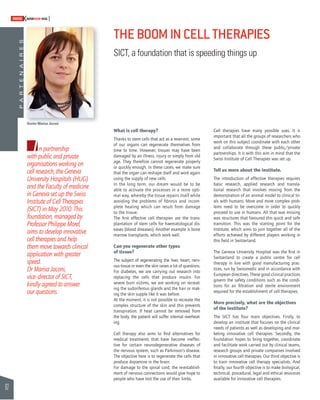
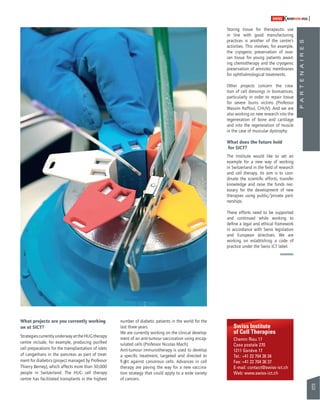
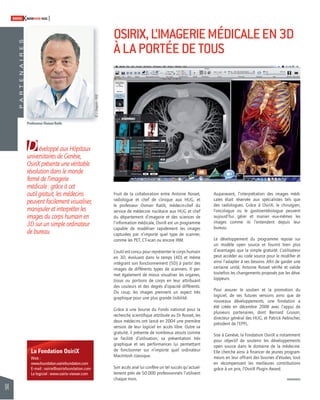
  • 135.
    COMPANY PROFILE 131 SWISSKNOWHOW HUG The Aubonne-based company Medicatech specialises in repairing the most accurate and delicate surgical instruments. With around thirty years’ experience and some highly developed internal skills, this small family company numbers the largest hospitals in French- and German-speaking Switzerland among its customers. MEDICATECH SARL Maintenance de matériel chirurgical Rue de l’Ouriette 139 1170 Aubonne Tel.: +41 21 800 42 55 Fax: +41 21 800 43 26 E-mail: info@medicatech.ch Web: www.medicatech.ch MEDICATECH Interview with Stéphane Andrist The new workshop before moving in. (photographer David Gagnebin) Why might it be advantageous to repair surgical instruments? There are many reasons. First of all, repairing instruments is more economical than replacing them. Then there are the lead times: we guaran-tee lead times of 7 days to make an instrument as good as new (24 hrs for some emergencies). Finally, it’s also a way of protecting the environ-ment by acting ecologically. What types of instrument can you service? We repair all kinds of instruments for general sur-gery, laparoscopy, arthroscopy and microsurgery. We provide the after-sales service for most of the big brands in the sector. We also produce surgi-cal instruments and develop prototypes. Who are your customers? We work for hospitals, clinics, doctors and retail-ers all over Switzerland. How do you set yourself apart from the competition? We have the distinct advantage of 31 years’ experience in the fi eld. We also benefi t from ISO 9001: 2008 and ISO 13485: 2003 certifi cation. We guarantee compliance with tight deadlines and, thanks to the skills of our employees, a high-quality service. When repairing an instru-ment, our philosophy is of course to think about the surgeon who will use it, but also about the patient who will be operated on with it. We are at the cutting edge of technology after all! So when the Hôpitaux Universitaires de Genève began talking about setting up a system of traceability for instruments using data matrix coding, we developed an IT program internally that enabled us to read the code, store it and then re-engrave it on the instrument if it had become illegible as a result of reprocessing the instrument. We are the only company capable of doing this, at a time when many hospitals will have to start implementing this kind of traceabil-ity system. How did your company establish itself in this niche market? Medicatech was founded in 1979 by Daniel Andrist, a master mechanic. He responded to a demand and trained himself in biomedical mechanics. He worked on his own for a long time, as a craftsman. I began working with him in 1996 and since then I have helped to build up the company which I took over in 2002. Currently we have a staff of six. Would the market allow you to expand your activities? We have acquired a national reputation in a sector where there is a lot to do. That is why we have moved to Aubonne, where we have designed and built premises and workstations that are perfectly adapted to our activities, and that would enable us to increase our production capacity. We would like to grow the company in a controlled way, while preserving a size that guarantees us excellent reactivity and control over quality.
  • 136.
    COMPANY PROFILE 132 SWISSKNOWHOW HUG Merck Sharp & Dohme AG Schaffhauserstrasse 136 CH-8152 Opfi kon-Glattbrugg As of September 2011: Werftestrasse 4, 6003 Luzern Phone: +41 (0)44 828 71 11 Fax: +41 (0)44 828 72 10 E-mail: info@msd.ch Web: http://www.msd.ch MERCK SHARP & DOHME AG (MSD) SWITZERLAND “Well being and good health is our mission” Interview with Adriaan Ruijs, Managing Director Mr Ruijs, MSD belongs to the top three of Switzerland’s pharmaceutical companies for prescription-drugs. In which areas does MSD operate? With the worldwide merger between Merck & Co., Inc. and Schering-Plough Inc. in November 2009, the company is moving from a pharmaceu-tical company of a long and historical tradition of research-based medicine to a healthcare com-pany. In fact, the understanding of disease and health within society has become much broader than in the past. At MSD patients still come fi rst. Remaining clearly focused on research and devel-opment (R&D) we have made well being and good health of people our mission. Through our prescription medicines and therapeutic biophar-maceuticals within human care we offer inno-vative healthcare solutions. Our company’s phar-maceutical products include therapeutic and preventive agents for the treatment of human disorders. Among these are bone, respiratory, immunology and dermatology, cardiovascular, diabetes and obesity, infectious diseases, neuro-sciences and ophthalmology, oncology as well as women’s health and endocrine.(1) In Switzerland, we have a very strong position within the hospital and specialty product segment. In Switzerland, approximately 700 employees work for MSD. In which professions? Following the global merger between Merck & Co., Inc. and Schering Plough Inc., the operations of Merck & Co. Inc. in Switzerland have also joi-ned forces and established its center of opera-tions in Lucerne. This came from building on exis-ting Schering Plough Inc. operations in Lucerne. Based upon its global corporate strategy, Merck & Co., has decided to further build on this strong legacy position and establish a corporate site of both key strategic and operational relevance in Lucerne, Switzerland. In fact, as of today, around 700 MSD employees from around the globe are located and working in Switzerland. Here, along the added-value health chain, MSD is active in different areas. They range from R&D to manu-facturing, distribution and marketing of human care prescription medicines to Global Functions like Finance, Human Resources, Information Technology and Shared Business Services, for both local and international businesses. In Lucerne, the Global Leadership of Human Health for the Emerging Markets is based as well. The Regional Europe and Canada marketing staff will also have a foot print here in Lucerne. The management of the entire Eastern-Europe and Middle East Africa (EEMEA) will continue to be located in Lucerne. Your company is also investing in R&D in Switzerland. In which areas is MSD Switzerland involved in the global development programs of MSD? Our R&D team of Werthenstein BioPharma in Schachen, close to Lucerne, are working in close co-operation with R&D at the headquarters. The R&D team here in Switzerland is focussing on manufacturing and analytical testing of bio-technological drug substances to be used in clinical trials (Phase I to early Phase III). They are also supplying patient kits for global clini-cal trials (Phases I to IV). In order to keep a lea-ding position in the development of medicine, Werthenstein BioPharma is investing each year into state-of-the-art equipment and facilities.(2) (1) Merck’s Annual Report 2010, Transforming, 2010 Form 10-K, pag e 7. (2) www.werthenstein-biopharma.ch, Portrait, High Tech als Wettbewerbsvorteil (15/05/2011). (3) Merck’s CR Review 2009 – 2010, Looking Ahead, pages 10 & 11. MSD is the protected name of Merck & Co., Inc. with its corporate headquarters in Whitehouse Station, N.J., USA. Interview: Peter Stöferle
  • 137.
    COMPANY PROFILE 133 SWISSKNOWHOW HUG Working at the 200 L Fermentor at the Biotechnology Department of MSD Werthenstein BioPharma in Schachen, Lucerne Merck Sharp & Dohme AG Schaffhauserstrasse 136 CH-8152 Opfi kon-Glattbrugg As of September 2011: Werftestrasse 4, 6003 Luzern Phone: +41 (0)44 828 71 11 Fax: +41 (0)44 828 72 10 E-mail: info@msd.ch Web: http://www.msd.ch What can you say about the current product pipeline of MSD for the European market? In fact, we are expecting two state-of-the-art innovations that shall soon be available on the European and hence on the Swiss market. One will be a treatment in the therapy of hepatitis C, the other one a treatment in the acute conver-sion of atrial fi brillation. MSD considers itself bound to improve access to help. Can you give us some example about how the company does improve access to medicine. In this respect, MSD has a tradition of more than 50 years and has been working in partner-ship for better health. I would like to mention three examples: In 2009, Merck joined with the Wellcome Trust to establish the MSD Wellcome Trust Hilleman Laboratories, a R&D organization that intends to develop affordable vaccines for millions of people in some of the poorest areas of the world. Based in India, the Hilleman Labs is leveraging MSD’s expertise in vaccine devel-opment and the Wellcome Trust’s excellence in global biomedical research into a sustain-able non-for-profi t model that has the poten-tial to revolutionize the way we address press-ing health challenges in the developing world. MSD has been honored to receive the Vaccine Industry Excellence Award for the Best Vaccine- Partnership/Alliance/License in 2010 for this innovative collaboration. I would also like to mention the African Comprehensive HIV/AIDS Partnerships. In 2000, the Government of Botswana, The Merck Company Foundation/MSD and the Bill & Melinda Gates Foundation established the African Comprehensive HIV/AIDS Partnerships (ACHAP) to support and enhance Botswana’s response to the HIV/AIDS epidemic through a comprehensive approach to HIV/AIDS preven-tion, care, treatment and support. ACHAP has dramatically reduced mother-to-child transmis-sion and new infections among children, and halved the mortality rate from HIV/AIDS in adults, saving more than 50,000 lives. In 2010, MSD and The Gates Foundation announced con-tinued support of ACHAP through 2014(3). Speaking about HIV/AIDS, at the Lucerne Marathon 2010, MSD Switzerland raised sup-port for two charities, the Chronic Disease Clinic of the St Francis Designated District Hospital in Ifakara, Tanzania, Africa, and the children’s home Titlisblick in Lucerne. MSD is now an offi - cial partner of the Lucerne Marathon and we will continue with our charity activities. June-2012-REM-2011-CH-2992-PA
  • 138.
    COMPANY PROFILE 134 SWISSKNOWHOW HUG (1) Merck Geschäftsbericht 2010, Umgestaltung, 2010 Form 10-K, Seite 7 (2) www.werthenstein-biopharma.ch, Portrait, High Tech als Wettbewerbsvorteil (15.05.2011) (3) Merck CR Bericht 2009 – 2010, Looking Ahead, Seiten 10 u. 11 MSD ist der geschützte Name von Merck & Co., Inc. mit Firmensitz in Whitehouse Station, N.J., USA. MERCK SHARP & DOHME AG (MSD) SCHWEIZ ‘Wohlergehen und Gesundheit ist unsere Aufgabe’ Interview mit Adriaan Ruijs, Managing Director Herr Ruijs, MSD gehört zu den Top Three der pharmazeutischen Unternehmen für verschreibungspfl ichtige Arzneimittel in der Schweiz. In welchen Bereichen ist MSD tätig? Mit der weltweiten Fusion von Merck & Co., Inc. und Schering-Plough Inc. im November 2009 orientiert sich das Pharmaunternehmen mit seiner langjäh-rigen Tradition in der Forschung und Entwicklung hin zu einem Gesundheitsunternehmen. Das Verständnis von Krankheit und Gesundheit in der Gesellschaft ist viel umfassender geworden. Bei MSD stehen die Patienten nach wie vor an erster Stelle. Unser Schwerpunkt bleibt also weiterhin klar auf Forschung und Entwicklung (F&E), weil wir das Wohlergehen und die gute Gesundheit der Menschen als unsere Aufgabe verstehen. Mit unseren verschreibungspfl ich-tigen Medikamenten, und therapeutischen Biopharmazeutika bieten wir innovative Lösungen für die Gesundheitsversorgung. Unsere pharmazeutischen Produkte umfas-sen therapeutische und vorbeugend wirkende Mittel gegen Erkrankungen. Unter anderem gegen Knochen-, Atemwegs-, Immun-, Haut-, Herz- und Kreislauferkrankungen, Diabetes, Adipositas und Infektionskrankheiten sowie für die Bereiche der Neurowissenschaften, Augenheilkunde, Onkologie, Frauengesundheit und Endokrinologie.(1) In der Schweiz sind wir im Segment der für Spitäler und Spezialisten relevanten Produkte sehr gut positioniert. In der Schweiz beschäftigt MSD ca. 700 Mitarbeitende. In welchen Berufen? Auf die weltweite Fusion von Merck & Co., Inc. und Schering Plough, Inc. hin haben sich auch die bestehenden Geschäftsbetriebe von Merck & Co. Inc. in der Schweiz zusammengeschlos-sen und konzentrieren sich in Luzern, denn hier haben bereits Geschäftstätigkeiten von Schering Plough Inc. bestanden. Im Zuge der globalen Unternehmensstrategie hatte sich Merck & Co. dazu entschieden, auf seiner bisherigen soliden Position aufzubauen und einen Firmensitz von zentraler strategischer und operativer Bedeutung in Luzern zu etablie-ren. Heute arbeiten etwa 700 Mitarbeiter aus der ganzen Welt für MSD in der Schweiz. Entlang der Wertschöpfungskette für die Gesundheit ist MSD hier in verschiedenen Bereichen tätig. Diese reichen von F&E über Herstellung, Vertrieb und Marketing von verschreibungspfl ichtigen Medikamenten der Humanmedizin bis hin zu globalen Funktionsbereichen wie Finanzen, Human Resources, Informationstechnologie und Shared Business Services. In Luzern befi ndet sich auch die globale Führungseinheit von Human Health für die Schwellenländer. Das regionale Marketing Europa und Kanada wird hier in Luzern vertreten sein. Auch das Management für die gesamte Region von Osteuropa, dem Nahen Osten und Afrika (EEMEA) ist nach wie vor in Luzern etabliert. Ihr Unternehmen investiert auch in F&E in der Schweiz. In welchen Bereichen ist MSD Schweiz an den globalen Entwicklungsprogrammen von MSD beteiligt? Unsere F&E-Abteilung bei Werthenstein BioPharma in Schachen in der Nähe Luzerns arbeitet eng mit der Forschungs- und Entwick-lungsabteilung am Hauptsitz unseres Unter-nehmens. Die Abteilung hier in der Schweiz fokussiert auf die Produktion und die analytische Überprüfung biotechnologischer Substanzen für die Verwendung in klinischen Proben (Phase I bis frühe Phase III). Sie stellen ebenso Patienten- Sets her für weltweite klinische Studien (Phasen I bis IV). Um die führende Stellung bei der Interview: Peter Stöferle Merck Sharp & Dohme AG Schaffhauserstrasse 136 CH-8152 Opfi kon-Glattbrugg Ab September 2011: Werftestrasse 4, 6003 Luzern Tel.: +41 (0)44 828 71 11 Fax: +41 (0)44 828 72 10 E-mail: info@msd.ch Web: http://www.msd.ch
  • 139.
    COMPANY PROFILE 136 SWISSKNOWHOW HUG Selectomat PL. (Foto: MMM) D MMM Sterilisatoren AG Grossmattstrasse 14 CH-8964 Rudolfstetten Tel: +41 (0)56 204 22 20 Fax: +41 (0)56 204 22 29 E-mail: info@mmmgroup.ch Web: www.mmmgroup.ch Seit der Gründung im Jahre 1954 durch Johann Koller entwickelt, fabriziert und vermarktet das Unternehmen ökonomische Desinfektions-und Sterilisations-Lösungen von hoher Leistungsfähigkeit für Spitäler und Kliniken sowie für die pharmazeutische Industrie und Laboratorien. Herr Henni, in welchen Bereichen ist die MMM Sterilisatoren AG tätig? Die Sterilisation von medizinischen Geräten ist ein sehr wichtiger Teil der Spital-Hygiene. Wir erfüllen die Bedürfnisse unserer Kunden mit kreativen Anwendungen und der Integration zielgerichteter Technologien und entwickeln so komplette Lösungen von hoher Qualität im Bereich der Infektionskontrolle. Unsere Kunden profi tieren von unserem Fachwissen und unse-rem Service. Um das bestmögliche Resultat zu erzielen, arbeiten wir sehr eng mit unseren Kunden zusammen. “Die MMM Group bietet Lösungen im Bereich der Infektionskontrolle in der Schweiz und weltweit.” Erzählen Sie unseren Lesern etwas von der Sterilisation und Ihren Partnern in der Schweiz. Die Sterilisation nimmt im Bereich der Spital- Hygiene, wie erwähnt, einen sehr wichtigen Platz ein. Ihre Aufgabe ist es, Produkte zu sterilisieren, also medizinische Geräte und Instrumente von Mikro-Organismen freizuhalten. Die Sterilität ist für ein Spital ein strategisch wichtiger Bereich. Die Vielfältigkeit der Sterilisationsmethoden besteht aus gutem Grund, denn die Wahl der jeweiligen Sterilisationsmethode muss bestmög-lich auf das keimfrei erforderte medizinische Gerät angepasst sein. Unsere Hauptanliegen sind die Qualität und die grosse Verlässlichkeit unserer Produkte und folglich die Zufriedenheit unserer Kunden. Wir sind heute mit unseren Produkten in den fünf Universitätsspitälern sowie in über 200 Spitälern der Schweiz vertreten. Ein exzellenter Service von unseren Mitarbeitern für unsere Kunden - dies ist die Aufgabe unseres Unternehmens. “Die Sicherheit des Patienten ist nicht verhan-delbar, daher ist die Sterilisation immer zu verlässlichen Ergebnissen verpfl ichtet” Wie lautet Ihre Philosophie? Als Dienstleistungsunternehmen besteht unsere Herausforderung in der stetigen Verbesserung und Vervollständigung unserer qualitativ hoch-stehenden Angebote sowie in einem effi zienten Kundendienst und in einwandfreien Leistungen. Unsere Philosophie basiert darauf, dass wir auf-merksam die Bedürfnisse unserer Kunden entge-gennehmen, damit wir uns stets ihrer vollständi-gen Zufriedenheit versichern können. Wir sind in einem hart umkämpften Markt tätig. Dieser erfordert, dass wir unser Angebot stetig verbessern und vervollständigen um unseren Kunden immer bestmögliche Lösungen hinsicht-lich der Wirtschaftlichkeit und der technischen Anforderungen anbieten zu können. Unser Ziel ist die Zufriedenheit unserer Kunden und der Aufbau von langfristigen Partnerschaften. Wer ist die MMM Group? Die MMM Group beschäftigt heute 980 Mitarbeitende und verfügt über Niederlassungen in 20 Ländern. Über unser Verteilernetz sind wir sogar in über 80 Ländern vertreten. Unser Hauptsitz, unser Forschungs- und das Entwicklungszentrum befi nden sich in Stadlern in der Oberpfalz, in Planegg bei München und in Brno in der Tschechische Republik. ie MMM Sterilisatoren AG in Rudolfstetten ist Teil der MMM Group (MMM Münchener Medizin Mechanik GmbH). Als Familienunternehmen kann die MMM Group auf eine traditionsreiche Firmengeschichte zurückblicken. MMM STERILISATOREN AG TRADITION UND INNOVATION Ein Gespräch mit Kamel Henni, Geschäftsführer
  • 140.
    COMPANY PROFILE 137 SWISSKNOWHOW HUG M MMM Sterilisatoren AG Grossmattstrasse 14 CH-8964 Rudolfstetten Tel: +41 (0)56 204 22 20 Fax: +41 (0)56 204 22 29 E-mail: info@mmmgroup.ch Web: www.mmmgroup.ch Today we work in the fi ve university hospitals and more than 200 hospitals and clinics in Switzerland. We make it our mission to deliver excellence to our customers and partners. “Patient safety is not negotiable; when it comes to sterilisation, we need results.” What is your philosophy? We are a service company with an exciting chal-lenge, which consists of constantly improving and expanding our offering through quality, an effi cient after-sales service and impeccable ser-vices. Our philosophy is based on listening care-fully to the needs of our customers and making sure that they are completely satisfi ed. We operate in a highly competitive market which means that we must always offer our customers the specifi c solution that is most relevant to their needs from both a technical and fi nancial point of view. Our aim is to satisfy our customers and build long-term partnerships. Tell us a bit more about the MMM group. With a staff of 980, today the MMM group has branches in 20 countries and a network of certifi ed suppliers in more than 80 countries. Our main headquarters, our research and devel-opment centres and our production sites are concentrated in Munich, Stadlern in Germany and in Brno in the Czech Republic. Since it was founded in 1954 by Johann Koller, MMM has spent the last 55 years designing, pro-ducing and selling economical and high-perfor-mance disinfection and sterilisation solutions for hospitals and clinics, the pharmaceutical indus-try and laboratories. Mr Henni, what are your areas of activity? Sterilising medical equipment is one of the links in the hospital hygiene chain. We respond to the needs of our customers creatively, by using and integrating technologies that aim to provide complete quality solutions in the fi eld of infec-tion control. Our Swiss customer base benefi ts from our expertise and service. Together we move forward and make a difference. “The MMM group supplies solutions in the fi eld of infection control all over Switzerland and around the world.» Let’s talk about sterilisation and your Swiss partners. Sterilisation is an important part of hospital hygiene. Its aim is to deliver sterile products, that is to say medical equipment that is free from micro-organisms. The sterilisation unit is a strategic part of a hospital. The various sterilisa-tion methods must be used wisely. The sterilisa-tion method chosen must be the most suitable for the medical equipment to be sterilised. Our main concerns are the quality and reliability pro-vided by our products and the satisfaction of our customers. MM Sterilisatoren AG, based in Rudolfstetten, is part of the MMM Münchener Medizin Mechanik GmbH group. The MMM group can pride itself on a family company history that is rich in tradition. MMM STERILISATOREN AG TRADITION AND INNOVATION Interview with Kamel Henni, Managing Director Sterilisation at the university hospital of Geneva / Ladeseite des Sterilisationsgeräts im Universitätsspital Genf (Photo: MMM)
  • 141.
    COMPANY PROFILE 137 SWISSKNOWHOW HUG M MMM Sterilisatoren AG Grossmattstrasse 14 CH-8964 Rudolfstetten Tel: +41 (0)56 204 22 20 Fax: +41 (0)56 204 22 29 E-mail: info@mmmgroup.ch Web: www.mmmgroup.ch Today we work in the fi ve university hospitals and more than 200 hospitals and clinics in Switzerland. We make it our mission to deliver excellence to our customers and partners. “Patient safety is not negotiable; when it comes to sterilisation, we need results.” What is your philosophy? We are a service company with an exciting chal-lenge, which consists of constantly improving and expanding our offering through quality, an effi cient after-sales service and impeccable ser-vices. Our philosophy is based on listening care-fully to the needs of our customers and making sure that they are completely satisfi ed. We operate in a highly competitive market which means that we must always offer our customers the specifi c solution that is most relevant to their needs from both a technical and fi nancial point of view. Our aim is to satisfy our customers and build long-term partnerships. Tell us a bit more about the MMM group. With a staff of 980, today the MMM group has branches in 20 countries and a network of certifi ed suppliers in more than 80 countries. Our main headquarters, our research and devel-opment centres and our production sites are concentrated in Munich, Stadlern in Germany and in Brno in the Czech Republic. Since it was founded in 1954 by Johann Koller, MMM has spent the last 55 years designing, pro-ducing and selling economical and high-perfor-mance disinfection and sterilisation solutions for hospitals and clinics, the pharmaceutical indus-try and laboratories. Mr Henni, what are your areas of activity? Sterilising medical equipment is one of the links in the hospital hygiene chain. We respond to the needs of our customers creatively, by using and integrating technologies that aim to provide complete quality solutions in the fi eld of infec-tion control. Our Swiss customer base benefi ts from our expertise and service. Together we move forward and make a difference. “The MMM group supplies solutions in the fi eld of infection control all over Switzerland and around the world.» Let’s talk about sterilisation and your Swiss partners. Sterilisation is an important part of hospital hygiene. Its aim is to deliver sterile products, that is to say medical equipment that is free from micro-organisms. The sterilisation unit is a strategic part of a hospital. The various sterilisa-tion methods must be used wisely. The sterilisa-tion method chosen must be the most suitable for the medical equipment to be sterilised. Our main concerns are the quality and reliability pro-vided by our products and the satisfaction of our customers. MM Sterilisatoren AG, based in Rudolfstetten, is part of the MMM Münchener Medizin Mechanik GmbH group. The MMM group can pride itself on a family company history that is rich in tradition. MMM STERILISATOREN AG TRADITION AND INNOVATION Interview with Kamel Henni, Managing Director Sterilisation at the university hospital of Geneva / Ladeseite des Sterilisationsgeräts im Universitätsspital Genf (Photo: MMM)
  • 142.
    COMPANY PROFILE 138 SWISSKNOWHOW HUG L PwC Avenue Giuseppe-Motta 50 Case postale CH-1211 Genève 2 Tél. : +41 58 792 91 00 Fax : +41 58 792 91 10 Web : www.pwc.ch En tant que responsables de la succursale de Genève, quels sont vos souhaits et ambitions ? Au cours des prochaines années, nous voulons consolider notre position de leader dans le secteur. Notre succursale compte 25 associés et emploie 420 collaborateurs. Le conseil juri-dique et fi scal est particulièrement important à Genève. Nous avons aussi de nombreux clients dans le secteur bancaire, notamment dans le private banking, et sommes bien présents dans le secteur public et dans le monde des PME. Le Conseil aux ONG est également une spécifi cité genevoise de PwC. Nous souhaitons développer nos activités à destination des PME, qui consti-tuent déjà 60 % de nos clients, mais aussi et surtout en direction du secteur public. Celui-ci fait en effet face à des besoins croissants en matière de conseils divers, notamment dans le cadre de la gestion des risques. L’analyse des risques, n’est-ce pas un peu le domaine qui monte ? C’est une activité en pleine expansion depuis quelques années en effet. Les incertitudes liées à la conjoncture ou à la géopolitique, les récents cas de fraudes qui ont ébranlé de grandes organisations ou administrations ont conduit les responsables de sociétés privées ou d’entités publiques à demander systématique-ment des conseils en la matière. Nous avons une compétence reconnue dans ce domaine. Habituellement, l’audit représente près de 54 % de nos revenus nets, avant le conseil juridique et fi scal (33 %) et les conseils économiques (13 %). Dans le conseil fi scal, le domaine de la TVA est très porteur pour nous Quels autres avantages avez-vous sur la concurrence ? Nous sommes la société leader en Suisse. Ce succès se caractérise par des chiffres, mais aussi par la qualité reconnue de nos services et une attractivité élevée sur le marché du travail. D’après le “Brand Health index”, PwC Suisse est la société d’audit et de conseil qui jouit de la meilleure réputation auprès des milieux économiques. Ceci est une valeur importante que l’ensemble des collaborateurs de PwC a créée depuis de nombreuses années. Nous mettons l’accent sur un recrutement de qualité et sur une formation sans faille, ce qui génère ensuite des services à haute valeur ajoutée et constitue pour nous la meilleure des cartes de visite. eader sur son marché, la société d’audit et de conseils PwC vient de changer d’identité visuelle et d’appellation dans les 154 pays où elle est présente. PwC Entretien avec M. Philippe Tzaud, associé responsable du bureau de Genève et M. Dominique Perron, responsable du secteur public pour la Romandie Le nouveau visage d’un groupe international Une nouvelle identité visuelle, plus chaleureuse et accessible vient saluer l’évolution de la stratégie de PwC au plan mondial. Ce nouveau logo, aux couleurs chaudes, composé de panneaux de couleur transparents, représente l’ensemble des idées, de l’expertise et des compétences mises en oeuvre par le groupe pour construire des relations avec ses clients et créer de la valeur individuelle. Quant à l’ancienne appellation de PricewaterhouseCoopers, elle fait place désormais à la simple dénomination PwC. Au plan Suisse, PwC est la plus importante société d’audit et de conseils. En 2009-2010, le chiffre d’affaires brut s’est élevé à 704 millions de francs et devrait progresser légèrement cette année. PwC emploie 2 623 collaborateurs dans ses 15 succursales. Le groupe est présent dans 154 pays et emploie au plan mondial 161 000 personnes.
  • 143.
    COMPANY PROFILE 139 SWISSKNOWHOW HUG Leading auditing and consulting company PwC has recently changed its visual identity and trading name in the 154 countries in which it operates. PwC Avenue Giuseppe-Motta 50 Case postale CH-1211 Genève 2 Tel.: +41 58 792 91 00 Fax: +41 58 792 91 10 Web: www.pwc.ch Interview with Mr Philippe Tzaud, partner responsible for the Geneva offi ce, public sector manager for the Romandie region As managers of the Geneva offi ce, what are your hopes and ambitions? Over the next few years, we would like to consolidate our leading position in the sector. Our offi ce has 25 partners and employs 420 staff. Legal and tax advice is particularly important in Geneva. We also have numerous clients in the banking sector, especially private banking, and we are well positioned in the public sector and the SME market. Consultancy for NGOs is also a specialism of PwC in Geneva. We would like to develop our activities for SMEs, who already make up 60% of our customers, but also and especially for the public sector, where there is an increasing demand for consulting services, spe-cifi cally in the area of risk management. Isn’t risk analysis in itself a growth area? Yes, it’s something that’s been expanding fast for a few years now. The uncertainties linked to the economic and geopolitical situation and the recent fraud cases that have shaken some major organisations and administrations have led man-agers PwC and Mr Dominique Perron, of private companies and public bodies to seek advice on the subject on a regular basis. We are recognised for our expertise in this area. Usually, auditing accounts for nearly 54% of our net revenue, followed by legal and tax advice (33%) and business consulting (13%). In terms of tax advice, VAT is one of our major areas of expertise. What other advantages do you have over the competition? We are the leading company in Switzerland. This success can be seen not just in the fi gures, but also in the recognised quality of our services and great attractiveness on the labour market. According to the “Brand Health index”, PwC Suisse is the auditing and consulting company with the best reputation in business circles. This is a major asset which everyone at PwC has worked hard to create for many years. We are strong on recruiting quality and providing impec-cable training, which in turn generates high added-value services and represents the best possible calling card for us. The new face of an international group A new visual identity, more welcoming and accessible, hails PwC’s change in strategy at global level. This new logo, made up of panels of warm transparent colours, represents all the ideas, expertise and skills deployed by the group to build relationships with its clients and create individual value. The old trading name PricewaterhouseCoopers has now been replaced by the simpler PwC. PwC is the largest auditing and consulting company on the Swiss market. In 2009-2010, gross turnover amounted to 704 million francs and is forecast to increase slightly this year. PwC employs 2,623 staff at its 15 offi ces. The group has a presence in 154 countries and employs 161,000 people worldwide.
  • 144.
    COMPANY PROFILE 140 SWISSKNOWHOW HUG C Reactolab SA Rte Cantonale 10 1077 Servion Tél : +41 21 903 32 32 Fax : +41 21 903 31 67 E-mail : info@reactolab.ch Web : www.reactolab.ch Reactolab est une petite PME dynamique qui emploie 6 personnes et distribue ses produits dans toute la Suisse. Au bénéfi ce d’un catalogue très étendu avec des fournisseurs comme Merck, Acros Organics, Whatman, Chroma, Carlo Erba, Semadeni ou encore Vircell, elle est la distri-butrice attitrée en Suisse de la gamme Vector Laboratories. La société a des clients dans l’industrie, les labo-ratoires d’analyses et de recherche ainsi que ceux des Universités ou de l’EPFL. Mais elle sert éga-lement des hôpitaux ou même les laboratoires des collèges. Une vaste gamme de produits livrés avec une grande réactivité L’entreprise assure par ses propres moyens la gestion du stock et la distribution dans toute la Suisse. Chaque fois que cela est possible, elle dépose les commandes directement dans le labo-ratoire pour augmenter la rapidité de la livraison et entretenir les contacts avec ses clients. C’est pourquoi un camion part du dépôt de Servion chaque jour pour Lausanne et tous les deux jours pour les autres cantons romands. La société propose une grande diversité de produits à travers son vaste réseau de fournis-seurs. En plus de la souplesse et de la réacti-vité propre à une PME, elle offre une solution au meilleur prix à la plupart des demandes et l’avantage fi nancier n’est pas négligeable pour les clients. Un laboratoire peut ainsi s’adresser à un seul partenaire pour tout son matériel et ses produits chimiques, bénéfi ciant des économies induites par un seul transport et une unique facture. Toujours à l’écoute des demandes, l’entreprise met un point d’honneur à trouver une solution aux besoins les plus divers de ses quelque 2 000 clients. Cela comprend évidemment la recherche de la qualité maximale à un prix compétitif dans la très grande gamme des matériaux et des produits pr oposés. réé en 1988 et basé à Servion (VD), Reactolab SA distribue en Suisse une vaste gamme de produits chimiques ainsi que toute la verrerie et le matériel de laboratoire. Pour Philippe Chassot, administrateur, l’essentiel est de pouvoir répondre rapidement aux demandes très diverses de ses clients. REACTOLAB SA Une distribution multiqualitative et personnalisée © Photoodace - Thierry Pittier
  • 145.
    COMPANY PROFILE 141 SWISSKNOWHOW HUG Created in 1988 and based in Servion (VD), Reactolab SA supplies laboratories in Switzerland with a wide range of chemical products as well as all glassware and equipment. For Philippe Chassot, its director, it is vital to be able to react quickly to the highly diverse requests of his customers. REACTOLAB SA A multi-quality and personalised distribution Reactolab SA Rte Cantonale 10 1077 Servion Tel: +41 21 903 32 32 Fax: +41 21 903 31 67 E-mail: info@reactolab.ch Web: www.reactolab.ch Reactolab is a small but dynamic company that employs six people and distributes its products all over Switzerland. Thanks to an extensive catalogue, with suppliers such as Merck, Acros Organics, Whatman, Chroma, Carlo Erba, Semadeni and Vircell, it is the authorised dis-tributor of the Vector Laboratories range in Switzerland. The company has customers in industry, in analytical and research laboratories as well as laboratories at universities and the EPFL. It also supplies hospitals and even school laboratories. A vast range of products delivered at speed The company manages its own stock and distri-bution for the whole of Switzerland. Wherever possible, it delivers orders direct to the labora-tory so as to increase the speed of delivery and maintain contact with its customers. Which is why a lorry leaves the depot at Servion every day for Lausanne, and every other day for the other cantons in French-speaking Switzerland. The company offers a wide variety of products through its huge network of suppliers. In addition to the fl exibility and responsiveness typical of an SME, it can offer a solution to most requests and at the best possible price, a not inconsiderable fi nancial benefi t for its customers. It means that a laboratory can have just one partner for all its equipment and chemical products and thereby benefi t from the savings resulting from a single delivery and a single invoice. Always ready to listen to requests, the company makes it a point of honour to fi nd a solution to the most diverse needs of its 2,000 customers. And that naturally includes aiming for top qual-ity at a competitive price in the wide range of equipment and products it offers.
  • 146.
    COMPANY PROFILE 142 SWISSKNOWHOW HUG LA RADIOLOGIE EST UN SECTEUR MÉDICAL ULTRA-SPÉCIALISÉ Entretien avec le professeur Frank Pilleul, radiologue au sein Rive Droite SA Rive Droite SA 21, Rue Chantepoulet 1201 Genève Tél. : +41(0)22 545 50 50 Fax : +41(0)22 545 50 51 E-mail : info@cird.ch Web : www.cird.ch Pouvez-vous nous présenter votre société ? Notre société est une société d’imagerie médicale et de traitement percutané radiologique offrant un plateau techni que complet ultra moderne, et d’une grande disponibilité. Les locaux sont situés à proxi-mité de la gare de Cornavin avec un accès facilité par la présence des transports en communs et des parking publics. Le centre est organisé en trois secteurs ultra modernes autonomes permettant un grand confort et une confi dentialité pour le patient. Le premier étage est dédié à l’imagerie de la femme et au secteur échographie, le second étage à l’imagerie standard et à l’imagerie en coupes (scanner et IRM) et le dernier étage à la radiologie interventionnelle et angiographique avec chambres d’hospitalisation de jour et ainsi qu’une salle de conférence. Cette zone permet le traitement ambulatoire de la douleur ainsi que les traitements vasculaires et percutanés en oncologie. Quelle est la différence entre Rive Droite SA et les autres sociétés d’imagerie médicale? Notre centre offre aux patients du matériel d’ima gerie médicale très récent et renouvelé régulièrement. Il possède notamment le seul scanner low dose du canton avec reconstruc-tion “ASIR” permettant de réduire les doses de rayon X jusqu’à 70 % comparativement à un scanner conventionnel. Ceci ayant d’importantes applications notamment en pédiatrie ainsi que dans le dépistage (coloscopie virtuelle/scanner thoracique/coro-scanner) ou encore durant les actes intervention nels (biopsie…) ou les scanners de contrôle en oncologie. Nous sommes actuellement le seul centre à posséder un double générateur de traite ment percutané de lésions tumo-rales cou plant la radiofré-quence et les micro-ondes permettant le traitement par approche radiologique mini invasive des tumeurs digestives ou osseuse jusqu’à 10 cm de dia-mètre et cela en ambulatoire et en moins d’une heure. La radiologie est aujourd’hui un secteur médical hyper spécialisé et ainsi nous avons constitué un groupe de spécialiste FMH reconnu internationalement et ayant chacun une posi-tion universitaire notamment à l’HUG. Ainsi la radiologie ostéo-articulaire diagnostique et interventionnelle est réalisée par le Dr F. Kolo, la neuroradiologie par le Dr Martin et Schwieger, l’imagerie digestive par le Dr M. Quinodoz et le Pr F. Pilleul, l’imagerie de la femme par le Dr M. Quinodoz avec une implication dans la double lecture des clichés mamographiques par système CAD (dépistage informatisé automatique des cancers du sein). Nous proposons par ailleurs la réalisation et l’interprétation de coloscopie virtuelle. Il est le seul centre possédant un centre de traitement de la douleur notamment du dos ainsi que des traitements mini invasifs du cancer par technique type radiofréquence, micro-ondes, chimiothérapie in situ par voie vasculaire ou par implant. Notre centre couvre toutes les spécia-lités d’imagerie diagnostique avec une haute spécifi cité et aussi des techniques mini invasives selon les guidelines internationaux.
  • 147.
    COMPANY PROFILE 143 SWISSKNOWHOW HUG RADIOLOGY IS AN ULTRA-SPECIALIST Interview with Professor Frank Pilleul, Can you tell us a bit about your company? Our company is a medical imaging and percu-taneous radiation therapy company operating with a full range of ultra-modern equipment and offering a high level of availability. Our premises are situated close to Cornavin railway station, with easy access from public transport and ample public parking. The centre is organised into three independent, ultra-modern areas, which offer the patient a high level of comfort and confi dential-ity. The fi rst fl oor is dedicated to medical imag-ing for women and ultrasound, the second fl oor to standard imaging and cross-sectional imaging (CT scans and MRI) and the last fl oor to interven-tional and angiographic radiology with day-care rooms and a meeting room. This area is used for outpatient pain therapy, as well as vascular and percutaneous treatment in oncology. What is the difference between Rive Droite SA and other medical imaging companies? Our centre offers patients the very latest medical imaging equipment that is regularly updated. In particular, it has the only low-dose CT scanner in the canton with “ASIR”, which allows the x-ray dose to be reduced by up to 70% compared to a conventional CT scanner. This has important FIELD OF MEDICINE radiologist at Rive Droite SA applications in particular in paediatrics and screening (virtual colonoscopy/thoracic CT/ cardiac CT), as well as during interventional procedures (biopsy, etc.) and monitoring scans in oncology. We are currently the only centre to have a double generator combining radiof-requency and microwaves for the percutaneous treatment of tumourous lesions, enabling mini-mally invasive treatment of digestive or bone tumours of up to 10 cm in diameter using radiol-ogy – and all as an outpatient procedure that takes less than an hour. Today, radiology is an ultra-specialist fi eld of medicine and we have therefore assembled a team of internationally renowned specialists all belonging to the Swiss Medical Association (FMH) and each with a uni-versity position, namely at the HUG. Diagnostic and interventional osteoarticular radiology is carried out by Dr F. Kolo, neuroradiology by Dr Martin and Dr Schwieger, digestive imaging by Dr M. Quinodoz and Prof. F. Pilleul, women’s imaging by Dr M. Quinodoz with an involvement in the dual reading of mammographic images by CAD system (Computer-Aided Detection system for breast cancer screening). We also carry out virtual colonoscopy procedures and interpret the results. It is the only centre with a unit for pain therapy, in particular for back pain, as well as minimally invasive cancer therapy using radiof-requency, microwaves and in-situ chemotherapy via the vascular route or via implants. Our centre covers all diagnostic imaging speci-alities to a high level of specifi city, as well as minimally invasive techniques in accordance with international guidelines. Rive Droite SA 21, Rue Chantepoulet 1201 Genève Tél. : +41(0)22 545 50 50 Fax : +41(0)22 545 50 51 E-mail : info@cird.ch Web : www.cird.ch
  • 148.
    COMPANY PROFILE 144 SWISSKNOWHOW HUG H SCA Hygiene Products AG Baarerstrasse 133 CH-6301 Zug Tel: +41 (0)41 768 93 10 E-mail: info@sca.com Web: www.sca.com SCA Hygiene Products ist Weltmarktführer von aufsaugenden Inkontinenzprodukten, die unter dem Markennamen TENA angeboten werden. Da jeder Mensch unterschiedliche Bedürfnisse und Vorlieben hat und Betroffene an manchen Tagen einen stärkeren Schutz benötigen als an ande-ren, bieten wir eine grosse Palette an Vorlagen und Pants in verschiedenen Grössen und Saugstärken für Frauen, Männer und Kinder an. Unsere Muttergesellschaft SCA ist ein internatio-naler Konzern für Hygiene- und Papierprodukte. Mit rund 45.000 Mitarbeitern entwickelt, produziert und vermarktet SCA Personal Care- Produkte, Tissueprodukte, Verpackungslösungen, Druckpapiere und Massivholzprodukte. Die Er zeu g nisse werden in über 100 Ländern ver-kauft. Das Portfolio von SCA umfasst zahlreiche bekannte Marken – neben TENA beispielsweise auch Tempo, Tork und Zewa. Im vergangenen Jahr lag der Konzernumsatz bei rund 11,5 Milliarden Euro. Wie viele Mitarbeitende beschäftigt das Unternehmen in der Schweiz? In der Schweiz haben wir 40 Mitarbeiterinnen und Mitarbeiter. Wie präsentiert sich das Produkte-und Dienstleistungsportfolio der SCA Hygiene Products AG in der Schweiz? SCA Hygiene Products ist in der Schweiz der unangefochtene Inkontinenz-Spezialist mit dem breitesten Produkt-Sortiment am Markt. Mit über 120 verschiedenen Produkten garantieren wir eine umfassende Inkontinenzversorgung. Neben unseren innovativen Hilfsmitteln bieten wir praxisnahe Fortbildungen für den Fachhandel, die Pfl ege in Institutionen und Spitex-Organisationen an. Damit erhöhen wir die Qualifi kation der Mitarbeiter und somit auch die Qualität der Inkontinenzversorgung. Unser integriertes Gesamtangebot wird durch zahlreiche Zusatzleistungen abgerundet, die die tägliche Arbeit erleichtern und Kosten reduzieren sowie durch engagierte Mitarbeiter, die den Pfl egeeinrichtungen mit Rat und Tat zur Seite stehen. Alles zusammen ermögli-chen wir eine bessere Pfl ege bei geringeren Gesamtkosten. Wir nennen das „TENA 360° Inkontinenzmanagement“. Hygiene ist in Spitälern ein eminent wichtiges Thema. Wie arbeiten Sie mit den Hygienefachleuten vor Ort zusammen? Die Körperpfl ege ist ein elementarer Bestandteil im Kontakt und im Umgang mit Patienten und Heimbewohnern. Sie sollte daher für das gesamte Pfl egepersonal besonders wichtig sein. Denn oftmals können sich Patienten in Spitälern und Bewohner in Institutionen nicht mehr selbst pfl egen, sind mit ihren Bedürnissen und in der Pfl ege hilfsbedürftig und damit abhängig vom Pfl egepersonal. Deshalb haben wir mit Fachleuten einen Pfl egestandard zur Kontinenzförderung und einen weiteren Pfl egestandard zur Bewohnerhygiene entwickelt. Worauf achtet SCA bei der Produkte- Herstellung besonders und welche Bedeutung misst SCA dem Thema Umwelt bei? Nachhaltigkeit und der schonende Umgang mit Ressourcen ist für uns seit Jahrzehnten ein zen-trales Thema. Als globales Unternehmen setzen wir alles daran, die Umwelt zu schonen und für künftige Generationen zu erhalten. Deshalb kommen bei der Herstellung unserer TENA Produkte überwiegend erneuerbare Rohstoffe zum Einsatz. In Schweden bewirtschaften wir derzeit 2,6 Millionen Hektar fi rmeneigenes Forstland. Das macht uns zu Europas grössten err Cesario, wer sind die SCA Hygiene Products AG und ihre Muttergesellschaft Svenska Cellulosa Aktiebolaget SCA? SCA HYGIENE PRODUCTS AG DER UNANGEFOCHTENE INKONTINENZ-SPEZIALIST Im Gespräch mit Franco Cesario, Sales Director Schweiz
  • 149.
    COMPANY PROFILE 145 SWISSKNOWHOW HUG SCA Hygiene Products AG Baarerstrasse 133 CH-6301 Zug Tel: +41 (0)41 768 93 10 E-mail: info@sca.com Web: www.sca.com ist es uns möglich, unsere Philosophie „essentials for everyday life“ aktiv umzusetzen, existierende Produkte – im Hinblick auf die tägliche Praxis – zu verbessern und neue innovative Hilfsmittel zu entwickeln. Die Kosten für das Gesundheitswesen sind weltweit ein wichtiges Thema. Wie bekommt die SCA Hygiene Products AG das härtere Umfeld in der Schweiz und im Ausland zu spüren? In der Schweiz wird es künftig vermehrt kantonale Ausschreibungen geben. Bei solchen Ausschreibungen verlieren alle Beteiligten: In erster Linie natürlich der Patient, weil er schlechter versorgt wird – letztendlich aber auch die Krankenversicherungen, die ihre Versicherten nachweislich schlechter versorgen und dadurch sogar höhere Folgekosten in Kauf nehmen müssen. Wo sehen Sie die grössten Herausforderungen für das Unternehmen in den kommenden Jahren? Wir befürchten in der Schweiz zukünftig Ausschreibungen, die alleine den Preis im Auge haben, aber nicht die Bedürfnissen der Patienten. In di vi duelle Versorgungsprofi le, die Ver sor gungsqualität der Leis tungserbringer und innovative Inkontinenzprodukte spielen dabei überhaupt keine Rolle mehr. Dies widerspricht sämtlichen Empfehlungen von Pfl ege-Experten, seien es Pfl egestandards oder ISO-Normen. Durch die Pauschalsenkung bleibt der Preisdruck im Markt und die Versorgungsqualität sinkt kontinuierlich. Herr Cesario, herzlichen Dank für das Interview. privatem Waldbesitzer. Für jeden gefällten Baum pfl anzen wir drei neue Setzlinge. „Als globales Unternehmen setzen wir alles daran, die Umwelt zu schonen und für künftige Generationen zu erhalten.“ Dank des Einsatzes von Spitzentechnologie können wir die Rohstoffe in einem sauberen, schlanken und energiearmen Prozess zu Inkontinenzprodukten verarbeiten. In den letzten sechs Jahren konnten wir unsere Abfallmenge in Europa um fast 70 Prozent senken. Zudem arbeiten wir seit den neunziger Jahren mit Hilfe einer Ökobilanz konsequent an der Messung und Reduzierung der ökolo-gischen Auswirkungen unserer Produkte. Jede Phase des Produktionsprozesses der TENA Produkte – von der Materialbeschaffung bis zur Entsorgung – wird einer systematischen Analyse unterzogen. Auf diese Weise können wir die CO2-Bilanz unserer Produkte ermitteln und ihre Umweltverträglichkeit optimieren. Für die Zukunft haben wir uns ehrgeizige Ziele gesetzt: Bis zum Jahr 2020 möchten wir unseren CO2- Ausstoss um 20 Prozent senken. Unser fest in unsere Unternehmensphilosophie verankertes Umwelt-Engagement fi ndet regel-mässig Anerkennung: Für unser nachhaltiges und ethisches Handeln wurden wir bereits zum vierten Mal in Folge vom Ethisphere Institute als eines der weltweit ethischsten Unternehmen ausgezeichnet. Und die kana-dische Mediengesellschaft Corporate Knights zählt uns bereits seit sechs Jahren zu einem der 100 nachhaltigsten Unternehmen der Welt. Wie schafft es Ihr Unternehmen, immer auf dem aktuellsten Stand der Entwicklung zu sein und fl exibel und schnell auf die Bedürfnisse des Marktes zu reagieren? Grosse Investitionen in Forschung und Entwicklung sowie eine eigene Marktforschung sichern eine stetige Verbesserung aller TENA Produkte, für die immer die neuesten Technologien verwendet werden. Im Vordergrund dieser kontinuierlichen Weiterentwicklung standen und stehen heute noch die Bedürfnisse derjenigen, die TENA Produkte verwenden – seien es Patienten, Pfl egekräfte oder Angehörige. Weltweit geben Verbraucher und Pfl egende wichtige Anregungen zur Verbesserung der von ihnen verwendeten Hilfsmittel. Diese werden bei SCA ausgewertet und von Produktingenieuren umgesetzt. Durch diese Art der Verbrauchernähe SCA Hygiene Products garantiert mit über 120 verschiedenen Produkten eine umfassende Inkontinenzversorgung.
  • 150.
    COMPANY PROFILE 146 SWISSKNOWHOW HUG err Schneider, 1999 hat die spanische Roca-Gruppe, ein weltweit führendes Unternehmen für Badeinrichtungen, die Keramik Laufen AG übernommen und 2007 die Similor AG akquiriert. Sie sind Geschäftsführer beider Unternehmen. Von welchen Synergien können die beiden Firmen profi tieren? Keramik Laufen AG Wahlenstrasse 46 CH-4242 Laufen Tel: +41 (0)61 765 75 75 Fax: +41 (0)61 766 56 53 E-mail: forum@laufen.ch Web: www.laufen.ch Wir profi tieren von der gemeinsamen Entwicklung kompletter, optimal auf Kundenbedürfnisse abgestimmter Badlösungen. Im Sinne des „Total Bathroom Concept“ können wir den Kunden ein Komplettbad aus einer Hand anbieten. Obwohl beide Unternehmen eigenständig am Markt auftreten, bilden sich ausserdem Synergien in den leitenden Aufgaben von Marketing, Verkauf und Kundendienst, der Spedition und Lagerung sowie dem gemeinsamen Trainingscenter. Können Sie unseren Lesern das „Total Bathroom Concept“ etwas näher erläutern? Das „Total Bathroom Concept“ bedeutet Sanitärkeramik, Badmöbel, Bad- und Duschwannen und Armaturen in einer einheitlichen Design-sprache von einem Komplettanbieter. Wie hat sich das Produkte-Portfolio der Keramik Laufen AG durch Similor erweitert? Da beide Unternehmen weiterhin eigenständig auf-treten, hat sich das Produkte-Portfolio der beiden Firmen nicht verändert. Allerdings entstand durch die Zusammenarbeit ein auf Kundenbedürfnisse abgestimmtes Komplettbadangebot. Wie wichtig ist der Standort Laufen für die beiden Unternehmen? Mit der Präsentation der Produkte von LAUFEN, arwa, Similor Kugler und Sanimatic im LAUFEN Forum, dem umfangreichen Angebot des Trainingscenters und nicht zuletzt mit der Keramik- und Armaturenproduktion in Laufen, wird der Standort zum Badkompetenzzentrum. Wir bekennen uns somit klar zur Schweizer Produktion und verbinden so die Marken LAUFEN, arwa, Similor Kugler und Sanimatic mit Swissness. Was macht das preisgekrönte Ausstellungs- und Besuchergebäude LAUFEN Forum so einzigartig? Die aussergewöhnliche Architektur des LAUFEN Forums und die ansprechende Ausstellung bieten Architekten, Planern, Bauherren und Interessierten Inspiration und Information rund um das Bad. Das zweigeschossige, nahezu fensterlose Gebäude aus Sichtbeton trägt die Form eines Waschtisches und erstreckt sich von einer Hangkante aus fast freihängend über die Besucherparkplätze. Das besondere daran ist, dass der Monolith schlussendlich nur von einer H DAS KOMPLETTBAD AUS EINER HAND Im Gespräch mit Klaus Schneider Managing Director Keramik Laufen AG und Similor AG ! "
  • 151.
    COMPANY PROFILE 147 SWISSKNOWHOW HUG Similor AG Wahlenstrasse 46 CH-4242 Laufen Tel: +41 (0)61 765 73 33 Fax: +41 (0)61 765 73 34 Web: www.similorgroup.com einzigen schmalen Stütze getragen wird und an einen Brückenbau erinnert. Von innen präsentiert sich das LAUFEN Forum atriumähnlich. Dank der grosszügigen Innenarchitektur wird aus der eigentlichen Ausstellung auch ein Veranstaltungs- und Eventraum. Das LAUFEN Forum ist ausserdem nach Minergie-Standard gebaut und ermöglicht so einen nachhaltigen Umgang mit Ressourcen. Früher hatten Badeinrichtungen in erster Linie praktisch zu sein, heute sind Badezimmer immer mehr eigentliche Wohlfühloasen. Wie bedienen die von Ihnen geleiteten Unternehmen diesen Trend oder wie setzen sie selber Trends? Dank unseren unterschiedlich positionierten Designserien decken wir fast alle Kundenwünsche in Bezug auf Farben und Formen sowie Budgets ab. Durch die Zusammenarbeit mit nationalen und internationalen Designern, welche auch in anderen Branchen arbeiten und dort Trends spü-ren, können wir unsere Formensprache optimal den Bedürfnissen anpassen und letztlich selbst Trends setzen. Design und Moderne dürfen nicht auf Kosten der Funktionalität gehen. Wie arbeiten Designer und Entwickler bei Ihnen zusammen? Das Motto „form follows function“ stellt sicher, dass die Funktion im Vordergrund steht. Und dank dem stetigen Dialog zwischen Designern und unseren Leuten aus Entwicklung und Produktion fi nden wir Lösungen und Kompromisse, die oft das Unmachbare möglich machen. In der Schweiz ist der „LAUFEN“-Schriftzug auf Badeinrichtungen omnipräsent. Welchen Marktanteil hat die Keramik Laufen AG im Inland und welche Bestrebungen sind hinsichtlich einer Steigerung des Exportanteils im Gange? Mit LAUFEN wie auch mit den Armaturenmarken arwa, Similor Kugler und Sanimatic gehören wir zu den führenden Markenanbietern von Produkten für das Bad. Dank der internationalen Vermarktung von ausgewählten Armaturenserien aus dem beste-henden Portfolio und den Neuheiten, die wir im März 2011 an der ISH Frankfurt präsentiert haben, werden wir den Marktanteil auch im Ausland weiter steigern. Das LAUFEN Forum in der Form eines Waschtisches The LAUFEN Forum in the shape of a washbasin ! LAUFEN Messestand in Form des LAUFEN Forums an der ISH 2011 " Total Bathroom Concept: Keramikserie LAUFEN Palace mit Armaturen arwa-curveprime # Präsentation des Total Bathroom Concept an der ISH 2011 $ Neue Similor-Armaturenproduktion in Laufen # $ New Similor Faucet production plant in Laufen
  • 152.
    COMPANY PROFILE 148 SWISSKNOWHOW HUG THE TOTAL BATHROOM CONCEPT Interview with Klaus Schneider Managing Director Keramik Laufen AG and Similor AG Mr Schneider, in 1999 the Spanish Roca Group, a leading international bathroom solutions company, took over Keramik Laufen AG and acquired Similor AG in 2007. You are Managing Director of both companies. What synergies can the two companies benefi t from? We benefi t from the joint development of Keramik Laufen AG Wahlenstrasse 46 CH-4242 Laufen Tel: +41 (0)61 765 75 75 Fax: +41 (0)61 766 56 53 E-mail: forum@laufen.ch Web: www.laufen.ch ! " complete bathroom solutions tailored to the customer’s exact requirements. As part of our “total bathroom concept” we can offer the customer a complete fi tted bathroom from a single source. Although both companies market themselves independently, they also form syner-gies in the important areas of marketing, sales and customer service, shipping and storage, and in the joint training centre. Can you describe this “total bathroom concept” to us? The “total bathroom concept” means the sanitary ware, bathroom furniture, bathtub and shower unit and fi ttings in a single design language from one total supplier. How has Similor added to the product portfolio of Keramik Laufen AG? Because both companies operate pretty well independently, the product range of both compa-nies has not changed. However, the cooperation between them has led to complete bathroom solutions that can be tailored to customers’ requirements. How important is Laufen as a location for the two companies? With the presentation of products from LAUFEN, arwa, Similor Kugler and Sanimatic in the LAUFEN Forum, the extensive facilities offered by the training centre, and last but not least the ceramics and fi ttings production in Laufen, the site has become a real bath competence centre. We are very conscious of our role as part of Swiss production, which is why we link our LAUFEN, arwa, Similor Kugler and Sanimatic brands with Swissness. What makes the award-winning LAUFEN Forum so unique as an exhibition and visitor centre? The unusual architecture of the LAUFEN Forum and the attractive presentation offers inspiration and information about bathrooms for architects, planners, building contractors and prospective customers. A two-storey, almost windowless building with an exposed concrete façade, the Forum is built in the shape of a washstand and sits on a slope with two thirds of the building projecting over a car park. What’s special about
  • 153.
    COMPANY PROFILE 149 SWISSKNOWHOW HUG # $ Das atriumähnliche Innere des LAUFEN Forums it is that the monolithic structure is only sup-ported by a single narrow support reminiscent of bridge construction. Inside, the LAUFEN Forum feels like a huge atrium. The lavish scale of the interior archi-tecture gives the actual showroom the appear-ance of an exhibition and event space. The LAUFEN Forum is also built to the Minergy standard and therefore allows a sustainable use of resources. Previously, bathrooms just had to be practical, but now they are increasingly becoming oases of relaxation and wellbeing. How do the companies you run use this trend or do they set their own trends? Thanks to our differently positioned design series we can meet almost all customer demands in terms of colour, form and budget. By cooperating with national and international designers, who also work in other sectors and pick up the trends that are happening there, we are able to adapt our design vocabulary to the needs of our customers and even set trends ourselves. Design and innovation shouldn’t come at the cost of functionality. How do designers and developers work together in your business? The motto of “form follows function» ensures that function has priority. And thanks to the constant dialog between designers and our development and production people, we are able to fi nd solu-tions and compromises that often make the unfeasible feasible. The “LAUFEN” logo can be seen on bathroom fi ttings all over Switzerland. What market share does Keramik Laufen AG have of the domestic market and what efforts are you making to boost exports? The LAUFEN brand along with the arwa, Similor Kugler and Sanimatic product ranges make us one of the leading providers of bathroom solu-tions on the market. Thanks to our international marketing of selected series of fi ttings from our existing product range and the new products that we presented at ISH Frankfurt in March 2011, we are well on the way to growing our market share internationally as well. Exterior shot of Similor AG Aussenaufnahme der Similor AG ! LAUFEN Booth in form of the LAUFEN Forum at the ISH 2011 " Total Bathroom Concept: Ceramic range LAUFEN Palace with faucets arwa-curveprime # Presentation of Total Bathroom Concept at the ISH 2011 $ The atrium-like interior of the LAUFEN Forum Similor AG Wahlenstrasse 46 CH-4242 Laufen Tel: +41 (0)61 765 73 33 Fax: +41 (0)61 765 73 34 Web: www.similorgroup.com
  • 154.
    »WE BELIEVE OURFIRST RESPONSIBILITY IS TO THE DOCTORS, NURSES AND PATIENTS, TO MOTHERS AND FATHERS AND ALL OTHERS WHO USE OUR PRODUCTS AND SERVICES. IN MEETING THEIR NEEDS EVERYTHING WE DO MUST BE OF HIGH QUALITY.« (CREDO, JOHNSON & JOHNSON, 1ST PARAGRAPH) We are not an enterprise of the common sort. Our work encompasses the health of the patients as well as the wellbeing and success of our customers. For this reason we have a credo – which has remained unchanged for almost 60 years – against which we measure our services daily. Because we care for you. Johnson & Johnson AG | Rotzenbühlstrasse 55 | CH-8957 Spreitenbach | phone +41(0)56 417 33 33 | fax +41(0)56 417 35 00 | jnj@its.jnj.com | www.jnj.com
  • 155.
    COMPANY PROFILE 151 SWISSKNOWHOW HUG SIPAEC SA 1, rue Pedro-Meylan CH-1208 Genève Tél : +41 22 840 51 00 Fax : +41 22 840 51 06 E-mail : sipaec@sipaec.ch Web : www.sipaec.ch Fondée en 1975 par Alexandre Tollis et Georges A. Zannidakis, la société a tenu à garder une structure familiale pour pouvoir offrir à ses clients et partenaires des services performants et personnalisés, en comptant sur une équipe soudée et motivée. Grâce à ses quatre succursales, à Genève, Monthey (VS), Lausanne et Däniken (SO), SIPAEC est présente sur l’ensemble du territoire suisse et compte plus de 3 600 clients, principa-lement des entreprises de nettoyage, des régies immobilières, des industries, des hôpitaux et des homes médicalisés. Cela fait d’ailleurs plus de 15 ans que la société travaille avec les Hôpitaux Universitaires de Genève (HUG). De plus, elle opère de nombreux partenariats avec des acteurs comme Ecolab, Comac, 3M ou NSS, tous leaders dans leur branche. SIPAEC propose une large gamme de 7 500 articles dans des surfaces de vente de 2 700 m2, ainsi qu’un système de commande en ligne. Founded in 1975 by Alexandre Tollis and Georges A. Zannidakis, the company has main-tained a family structure so as to be able to offer high-performance services that are tailor-made to their customers and partners, whilst relying on a close-knit and motivated team. With four branches (in Geneva, Monthey (VS), Lausanne and Däniken (SO)), SIPAEC oper-ates all over Switzerland. Its customers number more than 3,600 and comprise mainly cleaning companies, real estate agents, industries, hospi-tals and nursing homes. The company has also worked with Geneva University Hospital (HUG) for over 15 years. It also has numerous partnerships with players such as Ecolab, Comac, 3M or NSS, all leaders in their fi eld. SIPAEC offers a wide range of 7,500 items in 2,700 m2 of sales outlets and via an online ordering service. Chaque succursale bénéfi ce d’un département commercial, de livreurs, d’un magasin exposition-vente et d’un service après-vente. Ainsi, du personnel compétent peut offrir des informations sur l’utilisation des produits et des machines ainsi que des cours personnalisés en fonction des surfaces à nettoyer. Des techniciens qualifi és peuvent réparer toutes les marques de machines et assurer une maintenance compétente. S’appuyant sur un performant système de gestion informatique, la société propose à l’ensemble de ses clients une logistique fi ne et à la carte et cela dès la plus petite unité. SIPAEC est très présente en Suisse romande par son historique d’implantation dans les cantons de Genève, Vaud et Valais. Elle cherche mainte-nant à accroître le développement de sa force de vente en Suisse alémanique, tout en continuant à élargir sa gamme de produits et de prestations. Each branch has its own sales department, delivery team, showroom and sales space and after-sales service. Here, trained members of staff can provide infor-mation on how to use products and machines, and even individual classes depending on the surfaces to be cleaned. Qualifi ed technicians can repair all brands of machines and carry out thor-ough maintenance. With its high-performance IT management sys-tem, the company offers top-quality and tailor-made logistics to all its customers, whatever their size. SIPAEC has a large presence in the French-speaking area of Switzerland through its histori-cal ties with the cantons of Geneva, Vaud and Valais. It is now looking to continue to develop its sales team in the German-speaking regions, whilst expanding its range of products and services. B T asée à Genève, SIPAEC SA est une société au service des professionnels du nettoyage et de l’hygiène. Elle offre une gamme complète en produits chimiques, machines et accessoires de nettoyage. Pour Marina Tollis, sa directrice adjointe, la force de l’entreprise est d’offrir une vaste palette de produits et de prestations de grande qualité. he Geneva-based company SIPAEC SA serves cleaning and hygiene professionals. It offers a complete range of chemical products, machines and cleaning accessories. For Marina Tollis the deputy-director, the company’s strength resides in its vast range of products and top-quality services. SIPAEC SA Une gamme complète de produits et de machines de nettoyage SIPAEC SA A complete range of cleaning products and machines
  • 156.
    COMPANY PROFILE 152 SWISSKNOWHOW HUG T TRB Chemedica développe, fabrique et commer-cialise des produits brevetés innovants dans les domaines thérapeutiques de l’ophtalmologie, la rhumatologie et la neurologie. La société a choisi de se concentrer sur ces trois domaines afi n de maîtriser parfaitement sa gamme de produits qui compte dans son portefeuille autant de dispositifs médicaux que de médicaments de prescription. L’entreprise développe, commercialise et distri-bue ses propres produits. Dans certains pays, la société commercialise également ceux d’autres groupes. En Europe, pour des raisons autant stra-tégiques que réglementaires, ce sont plutôt des dispositifs médicaux qui sont proposés comme solutions thérapeutiques aux patients. Globalement, TRB Chemedica a développé un savoir-faire in-house spécifi que dans les produits ophtalmiques et rhumatologiques, contenant de l’acide hyaluronique, obtenu par fermentation. En rhumatologie, l’axe de recherche est la quête constante de nouveaux traitements dirigés vers la régénération du cartilage et le ralentissement de la dégradation du même cartilage. En paral-lèle, l’attention, en médecine sportive, se porte sur le soin des tendons et des ligaments. En ophtalmologie, une palette complète et synergique de divers remèdes contre les patholo-gies du syndrome de l’oeil sec cohabite avec une offre originale de traitement des maladies des glandes meibomiennes, entre autres. En neurologie, un remède unique sous forme injectable existe pour le traitement chronique de la maladie de Parkinson. La société s’appuie sur un réseau dense de quatorze fi liales en Europe, en Amérique latine et en Asie : France, Allemagne, Autriche, Royaume-Uni, Hongrie, Pologne, Argentine, Brésil, Amérique centrale, Mexique, Hong Kong, Malaisie, Singapour et Thaïlande. De plus, TRB Chemedica est présente dans plus de 55 pays grâce à des partenariats divers. Deux usines de production, l’une à Vouvry (Valais) et l’autre à Buenos Aires, regroupent le know-how industriel du groupe et permettent de verticaliser et d’optimiser la production de certains des produits vendus et distribués par le groupe. Cette couverture commerciale ainsi que les deux sites de production amènent le groupe à compter environ 70 personnes en Suisse et plus de 500 collaborateurs dans le monde. Cette croissance organique de TRB Chemedica s’appuie, entre autres, sur les activités R+D menées à Genève par le biais de multiples collaborations avec divers centres d’excellence universitaires. Par ailleurs, la compagnie jouit d’une grande couverture marketing grâce à sa répartition géographique originale. Un développement à « taille humaine » Une des forces principales de l’entreprise réside dans sa spécialisation dans des produits de niche qui sont développés pour divers pays du monde. Malgré cet impressionnant développement interne sur plus de 30 ans, TRB Chemedica a gardé les caractéristiques d’une jeune PME, offrant au personnel un cadre de travail stimu-lant dans une ambiance effi cace et réactive. Le dynamisme du groupe s’exprime à travers la jeunesse de ses chercheurs qui ont de nom-breuses possibilités d’évolution grâce à l’impor-tant portefeuille de produits en développement et à la dispersion géographique de la société. RB Chemedica International SA, laboratoire spécialisé dans les médicaments et les dispositifs médicaux pour la rhumatologie, l’ophtalmologie et la neurologie a, dès sa naissance en 1980, eu un ancrage solide à Genève. Ce terreau fertile biotech/ pharmaceutique de l’arc lémanique, ainsi que le positionnement stratégique sur des produits de niche spécifi ques, ont permis et permettent à TRB Chemedica International SA de jouir d’une forte croissance organique. TRB CHEMEDICA INTERNATIONAL SA : LE PATIENT D’ABORD... La relève : Alessandro Di Napoli, vice-président Marketing
  • 157.
    COMPANY PROFILE 153 SWISSKNOWHOW HUG Acide hyaluronique obtenu par fermentation bactérienne / Hyaluronic acid obtained through bacterial fermentation TRB Chemedica International SA 12, rue Michel-Servet Case postale 352 1211 Genève 12, Suisse Tél. : +41 (0)22 703 49 00 Fax : +41 (0)22 703 49 01 E-mail : international@trbchemedica.com Web : www.trbchemedica.com TRB Chemedica est restée une entreprise fami-liale qui privilégie les valeurs de pragmatisme et d’humanisme chères au management. Par exemple, la collaboration avec les HUG offre une grande proximité avec le corps médical et les patients, ce qui permet à l’entreprise de rester à l’écoute de ces derniers afi n de leur offrir des solutions thérapeutiques parfaitement adaptées. Un effort continu de recherche et développement, d’industrialisation au service du patient Indispensables au développement et à la croissance des activités d’une société pharma-ceutique, la recherche et le développement demandent tous deux un effort fi nancier sub-stantiel et continu. TRB Chemedica investit envi-ron 15 % de son chiffre d’affaires annuel dans cette activité R+D primordiale. L’un des atouts de la société est d’être capable de gérer toute la chaîne de développement, de l’idée initiale jusqu’à la mise à disposition du produit au patient. Il est dès lors nécessaire, pour soutenir ce programme ambitieux, de construire, dès les premiers pas de la mise au point d’une molé-cule en laboratoire, une stratégie réglementaire et marketing « à géométrie variable », selon les spécifi cités internes à chaque marché visé. Une approche réglementaire claire et fl exible vis-à-vis de chaque autorité sanitaire locale compétente, ainsi que la volonté continue de s’assurer d’avoir la réponse appropriée aux attentes des patients, ont contribué et contri-buent au succès et à la renommée de TRB Chemedica. Un autre atout de l’entreprise est de veiller à impliquer tout au long du processus de dévelop-pement d’un nouveau produit les leaders d’opi-nions scientifi ques d’une part, et les associations de patients (« patient advocacy groups »), d’autre part. La création d’un nouveau produit est un art diffi cile qui requiert, entre autres, l’installation d’un programme d’échange d’idées entre les différentes fi liales sur tous les continents (« cross fertilization »). TRB met également en applica-tion pratique des brevets ou des concepts sou-vent élaborés dans des laboratoires de recherche comme ceux des HUG. Par ailleurs, différents concepts sont appliqués pour défi nir la palette de produits à venir : soit la société recherche à avoir le meilleur produit (« best in class ») ou à être la première à en disposer (« fi rst in class »), soit elle tente de répondre à des besoins théra-peutiques qui n’ont pas encore trouvé de réponse (« unmet medical needs »). Elle peut par ailleurs explorer de nouvelles thérapies pour prendre le reste de l’industrie à contre-pied, en questionnant et en redéfi nissant les critères thérapeutiques clas-siques (« disruptive technology »). Des perspectives d’avenir réjouissantes Dans chacun de ses secteurs-phares, TRB Chemedica gère au quotidien un pipeline suffi – samment fourni qui lui permet d’envisager sereinement des sorties régulières de produits jusqu’en 2020. Ses trois secteurs thérapeu-tiques d’excellence sont des marchés en pleine croissance, vu le vieillissement croissant de la population, à l’instar de la génération des baby-boomers. À côté de ses premières cibles thérapeutiques, TRB Chemedica voit dans le domaine vétérinaire et la dermatologie deux voies extrêmement prometteuses pour l’avenir. Le développement continu de l’entreprise se joue en partie à l’extérieur des frontières suisses. Ainsi, une extension géographique vers certains mar-chés émergents, avec l’installation de nouvelles fi liales, est envisagée par exemple en Russie, en Chine et dans les pays du Golfe.
  • 158.
    COMPANY PROFILE 154 SWISSKNOWHOW HUG TRB Chemedica International SA, a laboratory specialising in medicines and medical devices for rheumatology, ophthalmology and neurology, has been fi rmly established in Geneva since it was founded in 1980. The ideal breeding ground that the Geneva region provides for a biotech/ pharmaceutical company and the strategic focus on specifi c niche products have enabled TRB Chemedica International SA to enjoy the strong organic growth that it still enjoys today. TRB CHEMEDICA INTERNATIONAL SA: THE PATIENT COMES FIRST TRB Chemedica develops, manufactures and markets innovative patented products in the therapeutic fi elds of ophthalmology, rheumatol-ogy and neurology. The company has chosen to concentrate on these three areas so as to give itself total control over its product range, which consists of a portfolio of medical devices as well as prescription medicines. The company develops, markets and distributes its own products. In certain countries the com-pany also markets the products of other groups. In Europe, for strategic reasons medical devices are more often offered as therapeutic solutions to patients. Globally, TR B Chemedica has developed specifi c in-house expertise in ophthalmological and rheu-matological products containing hyaluronic acid obtained through fermentation. In rheumatology, the focus of research is the ongoing quest for new treatments directed at regenerating and slowing cartilage deteriora-tion. In parallel, in sports medicine the attention is on caring for tendons and ligaments. In ophthalmology, a complete and synergetic range of diverse remedies against the patholo-gies of dry eye syndrome is marketed alongside an original offering of treatment for meibomian gland disorders, among others. In neurology, there is a unique remedy in the form of an injection for chronic treatment of Parkinson’s. The company relies on a dense network of fourteen subsidiaries in Europe, Latin America and Asia: France, Germany, Austria, the United Kingdom, Hungary, Poland, Argentina, Brazil, Central America, Mexico, Hong Kong, Malaysia, Singapore and Thailand. Furthermore, TRB Chemedica is present in more than 55 countries thanks to various partner-ships. Two production plants, one in Vouvry (Valais) and the other in Buenos Aires, bring together the industrial know-how of the group and allow the production of certain products sold and dis-tributed by the group to be verticalised and opti-mised. This commercial coverage and the two produc-tion sites bring the group to a total of around 70 people in Switzerland and more than 500 employees around the world. The organic growth of TRB Chemedica is supported, among other things, by the R&D activities conducted in Geneva through numerous collaborative projects with various university centres of excellence. The company enjoys large marketing coverage due to its original g eographic s pread. Development “on a human scale” One of the main strengths of the company resides in its specialisation in niche products which are developed for different countries of the world. Despite this impressive internal growth over more than 30 years, TRB Chemedica has man-aged to maintain the characteristics of a young SME, offering its staff a stimulating working atmosphere in an effi cient and responsive envi-ronment. The dynamism of the group is expressed through the youth of its researchers who have many opportunities to grow professionally thanks to the considerable range of products being devel-oped and the geographic spread of the company. TRB Chemedica has remained a family company which promotes the values of pragmatism and Taking over: Alessandro Di Napoli, vice-president, marketing
  • 159.
    COMPANY PROFILE 155 SWISSKNOWHOW HUG humanism so dear to the management. For example, collaboration with the HUG provides real proximity with the medical profession and the patients, which enables the company to be there to listen to patients so as to offer them perfectly adapted therapeutic solutions. Continuous efforts in research and development, industrialisation to the benefi t of the patient Vital for the development and growth of the activities of a pharmaceutical company, research and development activities require both sub-stantial and continuous fi nancial outlay. TRB Chemedica invests around 15 % of its annual turnover in this crucial R&D activity. One of the company’s strengths is being capa-ble of managing the entire development chain, from the initial idea to provision of the product to patients. Consequently to support this ambitious project it is necessary, from the fi rst steps of develop-ing a molecule in the laboratory, to construct a “fl exible” regulatory and marketing strategy according to the specifi c characteristics within each market targeted. A clear and fl exible regulatory approach towards each relevant local health authority and the ongoing will to provide the appropriate response to patient expectations have contributed to the success and the renown of TRB Chemedica, and continue to do so today. Another of the company’s strengths is ensuring they involve leading scientifi c experts on the one hand and patient advocacy groups on the other throughout the process of developing a new product. Creating a new product is a diffi cult art that requires, among other things, a programme for exchanging ideas (cross fertilisation) between the different subsidiaries on all the continents to be set up. TRB also practically applies patents or concepts often elaborated in research laborato-ries like those at the HUG. Furthermore, various concepts are applied to defi ne the range of products for the future: either the company looks to have the “best in the class” product or to be the “fi rst in the class”, or it tries to respond to unmet medical needs. What is more, it can explore new therapies to catch the rest of the industry off guard, by question-ing and redefi ning the conventional therapeutic criteria (“disruptive technology”). Cheering prospects for the future In each of its fl agship sectors, TRB Chemedica manages a pipeline of products under develop-ment on a daily basis, that is suffi ciently sup-plied to enable it to confi dently plan regular product launches up to 2020. Its three therapeu-tic sectors of excellence are expanding markets, given the ageing population that is a result of the baby-boomer generation. The production site of TRB Chemedica in Switzerland Le site de production de TRB Chemedica en Suisse Alongside its top therapeutic targets, TRB Chemedica sees two extremely promising avenues for the future in the veterinary and dermatology fi elds. The continued development of the company is happening in part out-side the Swiss borders. A geographic expansion into certain emerging mar-kets with the establishment of new subsidiaries is planned for example in Russia, in China and in the Gulf states. TRB Chemedica International SA 12, rue Michel-Servet Case postale 352 1211 Genève 12, Suisse Tel.: +41 (0)22 703 49 00 Fax: +41 (0)22 703 49 01 E-mail: international@trbchemedica.com Web: www.trbchemedica.com
  • 160.
    COMPANY PROFILE 156 SWISSKNOWHOW HUG D service de spécialistes. S es spécialistes au pecialists serving specialists. Tornier AG Alte Steinhauserstrasse 19 CH - 6330 Cham Switzerland Tél. : +41 41 760 26 12 Fax : +41 41 760 26 13 Web : www.tornier.com TORNIER AG Entretien avec M. Christian Beyeler, directeur Quel est le champ d’activité de la société Tornier? Tornier conçoit, fabrique et commercialise des dispositifs médicaux dédiés aux indications orthopédiques et traumatologiques des extré-mités (épaule, coude, main, poignet, cheville et pied). « Spécialiste au service de spécialistes », Tornier offre un support inconditionnel à la communauté scientifi que et propose actuelle-ment plus de 70 lignes de produits distribués dans plus de 35 pays. Pouvez-vous en dire davantage sur les produits que vous commercialisez ? Tornier propose également des produits pour l’arthroplastie de la hanche et du genou, notam-ment en Suisse. Dès les années 80, Tornier a développé une gamme de prothèses de genou en partenariat avec les prestigieux chirurgiens de l’École Lyonnaise de chirurgie du genou tels que le Pr Henri Dejour. Dans les années 90, la société a lancé le concept original de la prothèse d’épaule anatomique Aequalis en association avec le Dr Gilles Walch (Lyon) et le Pr Pascal Boileau (Nice). TORNIER AG Interview with Mr Christian Beyeler, director What is Tornier’s line of business? Tornier designs, manufactures and markets medi-cal devices used in the treatment of orthopaedic and trauma injuries to the extremities (shoulder, elbow, hand, wrist, ankle and foot). An organi-sation of “specialists serving specialists”, Tornier is dedicated to supporting the scientifi c commu-nity and currently offers more than 70 product lines distributed in more than 35 countries. Can you tell us a bit more about the products you sell? Tornier also supplies products for joint replace-ment surgery of the hip and knee, especially in Switzerland. Since the 1980s Tornier has devel-oped a range of artifi cial knees in partnership with eminent surgeons at the Lyons School of Knee Surgery such as Professor Henri Dejour. In the 1990s, the company brought out the origi-nal concept of the Aequalis anatomical shoulder La proximité avec la ville de Lyon a favorisé la création de liens étroits avec de nombreux chirur-giens spécialistes de la Suisse romande. Dans un avenir proche, quelles sont les évolutions prévues au sein de votre société ? Tornier est une organisation portée sur l’inno-vation. Elle détient aujourd’hui 126 brevets et 305 extensions déposés à travers le monde, alors que 117 nouveaux brevets sont en instance de validation. Tornier explore actuellement les nouvelles solutions chirurgicales offertes par les produits biologiques pour la réparation des tissus osseux ou tendineux comme les matrices extracellulaires, les facteurs de croissance ou encore les cellules souches. Elle exploite éga-lement la technologie unique et innovante du pyrocarbone, appliquée notamment à des solu-tions pour les extrémités. L’objectif permanent de Tornier est d’offrir une qualité de service irrépro-chable à ses clients chirurgiens et d’oeuvrer pour le bien-être des patients qui font confi ance en leurs spécialistes. prosthesis in association Dr Gilles Walch from Lyon and Professor Pascal Boileau from Nice. What’s next in terms of development for your company? Tornier is an organisation focused on innova-tion. It currently has 126 patents and 305 exten-sions registered around the world, plus another 117 new patents waiting for approval. Tornier is currently exploring the new surgical solutions offered by biological products for repairing bony tissues and tendons like extracellular matrices, growth factors and stem cells. It is also working on the unique and innovative pyrocarbon tech-nology, especially as applied to solutions for the extremities. Tornier’s constant aim is to offer an impeccable quality of service to its surgical clients and to work for the well-being of patients who place their trust in their specialists.
  • 161.
    COMPANY PROFILE 157 SWISSKNOWHOW HUG I Bugnion S.A. Conseils en Propriété Intellectuelle 10, route de Florissant Case 375 - 1211 Genève 12 Tel.: 022 346 87 44 Fax: 022 346 89 60 E-mail: bugnion@bugnion.ch Web: www.bugnion.ch In 1974, Cohen and Boyer invented DNA recom-bination technology, that has been used ever since by almost all biochemists. These research-ers put all their energy into being the fi rst to publish their discoveries, and did not even con-sider patenting this technology: so it fell into the public domain. If it had been patented, these researchers and their university institutes could have been paid the equivalent of US$ 15 billion in royalties. The commercial dispute between Medtronic and Siemens over the pacemakers market involved a legal battle over patents that lasted almost 15 years. In the end, Medtronic won and Siemens had to pay US$75 million of royalties, resulting in its rapid exit from the market. Are patents a way of conquering markets or of freezing markets? a source of revenue or legal extortion? Both? Anyway, no equipment manu-facturer or pharmaceutical laboratory will invest in a new product unless they can have exclusive control over it. At various times, pressure groups and idealists tried to ban the patenting of medicines, medical technologies, software, seeds, and structures containing genetic information. American legislation has adopted a liberalap-proach with regard to medicines, medical treat-ments and technologies. European law focused on doctor’s freedom to act and prescribe treat-ment, and limited patent ownership for medical technologies. The pharmaceutical industry has succeeded in having items which seemed to be excluded from patents in Europe reinstated by successive court decisions. Recently (G2/08), the sophists at the European Patent Offi ce concluded that a medicine that is character-ised by its posology had nothing to do with a treatment consisting of administering this very medicine with this posology! The virtuous indignation concerning biological patents has calmed down somewhat since the revisions to the related European legislation (R26-34 CBE, directive 98/44/EC). The com-promise adopted may not please everyone – too liberal for some, not liberal enough for others – but at least it sets the legal framework. Switzerland is part of the European patents system (! 50,000 European patents are vali-dated in Switzerland every year, while the Swiss Federal Institute issues about800 national patents) and is not a “special case” from a legal angle . However, Switzerland takes a remarkably pragmatic approach to technology transfers between health research institutes and industry. More than one foreign colleague envies our university hospitals their autonomy in their rela-tions with private laboratories, and our transfer structures enjoy material resources (see the PSE/ EPFL) that are unheard of elsewhere in Europe. t is fashionable nowadays to criticise the patent system, be it in the USA, in Europe, or more often in emerging countries. China, a country that has launched itself into the 21st century at full throttle, is using it with increasing effi ciency. Need we be reminded that in the 19th century, Switzerland, at that time an under-developed country compared with its neighbours, was opposed to the system? INDUSTRIAL PROPERTY AND HEALTH Interview with Mr Jean-Alain Schulz 5 tips for researchers who rush to publish 1. Researchers who need publications for their career should take note: a patent is a technical-scientifi c publication. A patent and a journal article on the same topic often share ¾ of the same text. Kill two birds with one stone: a patent application fi rst receives a fi ling date from the Patent Offi ce, is processed confi dentially over an 18-month period, and then published. Therefore, fi rst fi le your patent, and then send your sensational publication to The Lancet or Nature: the two actions are not mutually exclusive.. 2. PhD students who are thinking about start-ups, incubators, breeding grounds, etc.: it is vital for you to have patents. Your scientifi c articles have no economic value without the corresponding patents – otherwise their content is “dedicated to the public”. 3. File your patents before making any disclosure, including pre-publication online, posters/ colloquia, defence of thesis, even before submission toreferees . Forget the American “period of grace”; it is not recognised anywhere else in the world. Once you have written the rough draft of your publication, give it to your patent attorney so that he can fi nalise the patent version, and wait until he has fi led it. Only then do what you would normally do as a researcher in a hurry. 4. Forget the American “provisional application”. If you urgently need a date, this can be done just as well in Europe, and at less expense. 5. If you obtain additional scientifi c results shortly after fi ling the patent, pass them on to your patent attorney straight away – he will know how to include them in the patent process – just stay away from the Internet in the meantime!
  • 162.
    COMPANY PROFILE 158 SWISSKNOWHOW HUG B à Genève, se consacre à la distribution des produits Nespresso depuis 1989. B j-coffee, entreprise sise j-coffee, a company located in Geneva, has been distributing Nespresso products since 1989. bj-coffee SA Route des Jeunes 5d CH-1227 Les Acacias, Geneva Tel.: +41 (0)22 708 08 60 Fax: +41 (0)22 708 08 68 E-mail: info@bj-coffee.ch Web: info@bj-coffee.ch BJ-COFFEE SA « Un service de qualité pour les clients les plus exigeants » Pour Christian Wahl, son directeur général, la priorité est donnée à la satisfaction des clients grâce à une longue expérience et aux compé-tences de plus de 30 collaborateurs motivés et dynamiques. Baumann-Jeanneret, société familiale créée en 1910, a décidé en 2006 de scinder ses activités en deux entités distinctes, bj-offi ce SA et bj-coffee SA. La première entreprise est spécialisée dans l’aménagement d’espaces de travail, alors que la seconde est depuis 1997 le partenaire exclusif pour le canton de Genève de toute la gamme professionnelle Nespresso. Grâce aux produits Nespresso Business Solutions, bj-coffee est à même de proposer un large choix de machines à café et un assortiment de huit grands crus à plus de 5 000 clients, dont les Hôpitaux Universitaires de Genève. Depuis 2008, bj-coffee propose également un service global sur site avec des distributeurs BJ-COFFEE SA “Quality service for the most demanding customers” For Christian Wahl, the CEO, the priority is cus-tomer satisfaction, which is ensured through the company’s years of experience and the skills of its 30 plus motivated and dynamic employees. Baumann-Jeanneret, a family company created in 1910, decided in 2006 to divide its activities into two distinct entities, bj-offi ce SA and bj-coffee SA. The fi rst specialises in the fi tting out of work spaces, while the second has been the exclusive partner of Nespresso for its full busi-ness range in Geneva canton since 1997. Thanks to the products from Nespresso Business Solutions, bj-coffee is able to offer a large selec-tion of coffee machines and a range of eight Grand Cru coffees to more than 5 000 custom-ers, including Hôpitaux Universitaires de Genève (Geneva University Hospital). Since 2008, bj-coffee has also provided a full on-site service with partially automated Nespresso semi-automatiques de café Nespresso. Ce nou-veau système s’adapte parfaitement aux désirs des clients. Ainsi, il est possible de payer sa boisson avec un badge, un jeton ou encore de la monnaie. Dans le domaine de la restauration d’entreprise, la société est prête à lancer la dernière machine de Nespresso, l’« Aguila », qui peut servir plus de 400 cafés par heure en gardant toujours la même simplicité d’utilisation. bj-coffee accorde une importance primordiale à la satisfaction de ses clients en leur apportant des services de qualité alliés au plaisir de déguster un café reconnu pour son excellence. Pour cela, tous les départements ont été certifi és ISO 9001 depuis 2003 et garantissent un service attentionné et toujours à l’écoute des clients. coffee dispensers. This new system can be per-fectly adapted to the customer’s requirements, allowing drinks to be paid for using tags, tokens or cash. In the area of corporate catering, the company is ready to launch the latest Nespresso machine, the “Aguila”, which can serve more than 400 cof-fees an hour, without losing any of the simplicity of use. bj-coffee attaches a fundamental importance to the satisfaction of its customers, providing them with a high-quality service that is combined with the pleasure of drinking coffee renowned for its excellence. All its departments have been certi-fi ed to ISO 9001 since 2003 and guarantee an attentive service that is always attuned to the needs of its customers.
  • 163.
    COMPANY PROFILE 159 SWISSKNOWHOW HUG Gastromer 14, chemin du Champ-Blanchod 1228 Plan-les-Ouates / Genève Tél : + 41 22 / 794 39 10 Fax : + 41 22 / 794 39 14 Web : www.gastromer.ch Poissons, coquillages et crustacés constituent la spécialité de la société Gastromer à Plan-les Ouates. L’entreprise importe et distribue la palette complète des produits de la mer, plus de 900 références en produits frais, vivants, trans-formés ou surgelés. Gastromer livre l’hôtellerie et la restauration, mais aussi les collectivités, entreprises, hôpitaux. « La clientèle est très large et se répartit dans toute la Suisse romande », explique Laurent Isoux, fondateur en 1993 de cette société désormais familiale, puisqu’il oeuvre accompagné de son épouse et de ses deux grands fi ls. Gastromer a connu un essor important et emploie désormais 38 personnes sur son site genevois, dont les locaux ultramodernes ont notamment obtenu l’agrégation CE pour les produits de la mer, garantie supplémentaire de qualité pour la clientèle. Car fraîcheur et qualité sont les maîtres-mots de l’entreprise. Chez Gastromer, la journée commence tôt. Vers 3 h 30, les acheteurs contactent les mareyeurs directement dans les ports de pêche pour procéder aux achats dès le retour des pêcheurs. « Nous travaillons avec une trentaine de criées dans une vingtaine de pays », relève Laurent Isoux. Le poisson frais du jour est commandé à l’aube et emballé vers midi pour être expédié en direction d’une centrale logistique lyonnaise où les camions de Gastromer vont chercher dès le lendemain matin les marchandises. Une chaîne Fish, shellfi sh and crustaceans are the speciality of Gastromer at Plan-les Ouates. The company imports and distributes the full range of seafood, with a list of more than 900 fresh, live, processed and frozen products. Gastromer supplies the hotel and catering industry, as well as local authori-ties, companies and hospitals. “We have a very broad customer base that is spread throughout French-speaking Switzerland,” explains Laurent Isoux, who founded the company in 1993. Today his wife and his two grown-up sons have joined him in what is now the family business. Gastromer has experienced a real boom, and now employs 38 members of staff at its Geneva site, where the ultramodern premises have been awarded CE certifi cation for seafood – an additional guarantee of quality for customers. Freshness and quality are the company watch-words. At Gastromer, the day begins early. At 3:30am the buyers contact the fi sh traders in the fi shing ports directly so that they can place their orders as soon as the fi shermen return. “We work with some thirty auctions in around twenty countries,” says Laurent Isoux. The fi sh caught that day and ordered before dawn is then packed at around midday to be sent to a logistics centre in Lyons, from where the Gastromer lorries will collect the logistique bien tendue qui assure des délais ultra-courts entre le producteur et le consommateur. Dans le grand dépôt de Plan-les-Ouates, les employés réceptionnent, emballent, et prépa-rent les expéditions aux clients. Mais pas seulement. « Nous offrons aussi des services particuliers ». Ainsi, à la demande des clients, Gastromer peut préparer les poissons, les vider, lever les fi lets, etc. La société propose aussi des préparations spécifi ques à base de produits de la mer, fort appréciées notamment des collecti-vités. Les 18 camions de l’entreprise vont ensuite procéder aux quelque 250 livraisons quotidiennes habituelles. Pour Laurent Isoux, cette activité qu’il pratique depuis 1979 est devenue une vraie passion. « Les produits de la mer sont parmi les derniers que la nature nous donne. Cela mérite respect et éthique. Par exemple, depuis trois ans, nous ne faisons plus du tout de thon rouge de Méditerranée. » L’entreprise travaille en effet avec des pêcheurs ou des éleveurs qui suivent cette philosophie. Si la société a beaucoup investi ces dernières années sur son site genevois, c’est du côté du Valais qu’elle lorgne désormais. Gastromer Valais existe en effet depuis 2009 et dès cette année profi tera de nouveaux locaux à Saxon pour ali-menter directement toute la région en produits de la mer. merchandise the following day. The very tight logistics chain ensures super-short delivery times between the producer and the consumer. In the large warehouse at Plan-les-Ouates, the employees receive, pack and prepare deliveries for customers. But that’s not all they do. “We also offer some special services.” At customers’ request, Gastromer can prepare the fi sh, gut them and fi llet them, etc. The company also offers specifi c seafood-based preparations that are very popular, particularly with local authori-ties. The company’s 18 lorries then set off on their 250 regular daily deliveries. For Laurent Isoux, this business which he has run since 1979 has become a real passion. “Seafood is among the last of nature’s gifts. That deserves respect and ethical treatment. For example, three years ago we stopped selling blue fi n tuna from the Mediterranean.” The company works with fi shermen and farmers who adhere to this philosophy. While the company has invested a lot in recent years in its Geneva site, it now has its eye on the Valais region. Gastromer Valais has existed since 2009, and this year will be moving into new premises in Saxon to supply the region with seafood direct. GASTROMER
  • 164.
    COMPANY PROFILE 160 SWISSKNOWHOW HUG Casabat SA Chemin des Léchères 6 1217 Meyrin Tél. : 022 753 03 56 Fax : 022 753 03 58 Web : www.casabat.ch L’année 2011 sera importante pour votre société. Nous allons en effet déménager dans nos propres locaux que nous construisons sur une parcelle nous appartenant au Bois-de-Bay à Satigny. Nous disposerons ainsi d’un vaste dépôt pour tout notre matériel et de bureaux bien à nous. Pour une entreprise du bâtiment comme la nôtre, c’est un cap important et symbolique. La société Casabat a été fondée en 1990 par mon père. J’en ai repris la direction il y a cinq ans. Il était temps pour nous de montrer que nos bases sont solides. Quelles sont vos activités ? Nous oeuvrons dans toutes les activités liées à la construction. Dans ce secteur, des PME comme la nôtre dans le canton de Genève, il n’y en a pas beaucoup. Avec une vingtaine d’ouvriers, notre petite taille nous permet d’être proches de nos clients et de leur assurer un suivi parfait des chantiers, quelle que soit leur importance. Nous nous distinguons en effet par notre grande poly- 2011 is going to be a big year for your company. Yes, we will be moving into our own premises that we are building on a plot of our land at Bois-de-Bay in Satigny. This will give us a huge warehouse for all our equipment and our own offi ces. For a construction company like ours, it’s an important and symbolic step. Casabat was founded in 1990 by my father; I took over the management side fi ve years ago. It was time to show that we have strong foundations. What are your activities? We work in all areas linked to construction. In this sector, there aren’t a lot of SMEs like ours in the canton of Geneva. With twenty workers, our size enables us to be close to our clients and guarantee that their sites are closely monitored, no matter what their size. Our versatility sets us apart from the competition. We are fl exible and valence. Nous sommes fl exibles et très réactifs et pouvons assurer des travaux en entreprise géné-rale ou totale mais procédons aussi aux petits travaux de réparation que nous demandent nos clients. Qui sont-ils, ces clients ? Du fait de la grande palette de services que nous assurons, ils sont très divers. Parmi les réa-lisations importantes, nous venons notamment de fi nir La Saconnésienne, un lotissement de six appartements et six villas au Grand-Saconnex. Sinon, nous travaillons beaucoup pour les ser-vices industriels de Genève, l’État de Genève ou les communes. Aussi, les HUG fi gurent parmi nos fi dèles clients. Nous procédons pour eux aux tra-vaux d’entretien courant sur leurs divers sites et avons notamment aménagé une piste cyclable entre le site des Trois Chênes et celui de Belle- Idée. Notre polyvalence et notre souci du client font que nous avons les compétences nécessaires pour travailler dans ce genre d’environnements sensibles. very responsive, and can take on contracting work or the entire construction site, but we also carry out small repair work on request from our customers. Who are your customers? The wide range of services we offer means that our customer base is very broad. Among our major work, we have just fi nished La Saconnésienne, an estate comprising six apartments and six villas in Grand-Saconnex. Otherwise we work a lot for the Industrial Services of Geneva (SIG), the State of Geneva and the local authorities. The HUG is also one of our loyal customers. We carry out standard maintenance work at its various sites, and in particular we built a cycle path between the Trois Chênes and Belle-Idée sites. Our versa-tility and our focus on customers mean we have the necessary expertise to work in these kind of sensitive environments. P A CASABAT SA Entretien avec M. Juan Casanova, directeur CASABAT SA Interview with Chief Executive, Mr Juan Casanova etite entreprise familiale, Casabat SA se distingue par sa polyvalence dans les divers domaines de la construction. La société est à même de procéder tant à des constructions d’importance qu’à des petites réparations pour le compte de ses clients. small family company, Casabat SA stands out for its versatility in the various fi elds of construction. The company can carry out both large construction projects and small repairs for its customers.
  • 165.
    161 SWISSKNOWHOW HUG Transferts Vidéo & Film SA 43 rte des Jeunes CH - 1227 Carouge Tél. : 0041-22-342 38 39 Fax : 0041-22-343 91 87 Web : www.tvf.ch TRANSFERTS VIDÉO & FILM SA Entretien avec M. Eric Von Büren, directeur Trouver la meilleure solution pour la sauvegarde d’un fi lm en l’enregistrant sur un support fi able, moderne et durable est l’activité principale de la société carougeoise Transferts Vidéo & Film SA. « Nous faisons offi ce de plaque tournante entre les différents supports existants », explique Eric Von Büren, directeur de la société. Dans les faits, aucun support n’échappe au labo-ratoire TVF, même les plus obsolètes. Depuis les fi lms sur pellicule jusqu’aux bandes vidéo les plus diverses, en passant par les fi chiers vidéo les plus actuels. TVF peut presque tout relire. Et, grâce à un impressionnant parc de machines, la société peut transférer ces fi lms sur des supports stables. Au passage, les spécialistes peuvent aussi apporter des améliorations au fi lm. « Au moyen de fi ltres spécifi ques, nous pouvons stabi-liser l’image, nettoyer les poussières éventuelles, ou des rayures plus ou moins importantes. » Autre activité de la société, la gestion des divers formats de fi chiers. Depuis la numérisa-tion de la vidéo, les formats de fi chiers se sont développés à l’infi ni et ont ouvert tout autant de problèmes de compatibilité. TVF cherche dès lors à transformer ces fi chiers vidéo dans des formats plus usuels, en cherchant par ailleurs TRANSFERTS VIDÉO & FILM SA Interview with Mr Eric Von Büren, director Finding the best solution for saving a fi lm by recording it onto a medium that is reliable, modern and long-lasting is the main activity of Transferts Vidéo & Film SA, based in Carouge. “We act as a hub between the different exist-ing media,” explains Eric Von Büren, company director. In fact, no medium escapes the TVF laboratory, even the most redundant. From fi lms on fi lm to a wide range of videotapes, through to the latest video fi les, TVF can reread almost anything. And, thanks to an impressing array of machines, the company can transfer these fi lms onto stable media. At the same time, specialists can also improve the fi lm. “Using specifi c fi lters, we can stabilise the image and clean away any dust and big or small scratches.” The company also manages various fi le formats. Since video has been digitised, an infi nite num-ber of fi le formats have been developed, result-ing in almost as many compatibility problems. As a consequence, TVF is looking to transform these video fi les into the most common formats, à réduire la taille, tout en conservant la plus haute qualité. TVF compte parmi ses clients la plupart des chaînes de télévision romandes et nationales, mais aussi des sociétés de production ou de grandes entreprises ou institutions qui uti-lisent la vidéo et ont besoin de copies en grand nombre, sur supports adéquats. Aussi, le labora-toire travaille pour des particuliers, notamment dans le cadre de transfert de souvenirs familiaux. La technologie évoluant rapidement, les formats et standards apparaissant et disparaissant régu-lièrement, les activités de TVF s’intensifi ent. « Nous devons constamment nous adapter et nous allons bientôt faire face à de nouveaux défi s, comme la gestion de la 3D ». La société a commencé ses activités il y a 26 ans mainte-nant et fait fi gure non seulement de pionnière, mais aussi de référence dans son domaine. L’entreprise TVF est par ailleurs membre de l’association Memoriav pour la sauvegarde du patrimoine audiovisuel et à travers elle, échange, connaissances et compétences afi n de trouver des moyens communs pour assurer une longévité dans le support audiovisuel (fi lm, vidéo et son) ! whilst trying to reduce the size without affecting the quality. TVF’s customers include most of the national and French-speaking channels in Switzerland, as well as production companies and large com-panies or institutions that use video and need large numbers of copies on suitable media. The laboratory also works for private individuals, particularly when it comes to transferring family memories. With technology evolving rapidly and formats and standards appearing and disappearing regu-larly, TVF is busier than ever. “We are constantly having to adapt and we will soon be facing new challenges, like managing 3D.” The company was set up 26 years ago and is not only a pioneer, but also a reference in the fi eld. TVF is also a member of the Memoriav association for the con-servation of audiovisual heritage, and exchanges knowledge and skills through the association to fi nd common ways of guaranteeing longevity in audiovisual media (fi lm, video and sound). Pour qu’un fi lm traverse les années, encore faut-il qu’il soit enregistré sur le bon support. For a fi lm to survive through the years, it has to be stored on the right medium.
  • 166.
    COMPANY PROFILE 162 SWISSKNOWHOW HUG Citroën (Suisse) S.A. Succursale de Genève Route des Acacias 27 1211 Genève 26 Tél. : 022 308 01 11 Fax : 022 308 03 08 Web : www.citroen-geneve.ch Votre marque a une position particulière sur le marché genevois En effet, nous sommes notamment N° 1 du véhicule utilitaire dans le canton de Genève avec près de 22 % de parts de marché. Nous comptons parmi nos clients divers services de l’État, mais aussi de grandes entreprises aux plus petits artisans avec un ou deux véhicules dans leur parc. Quant au marché des véhicules pour particuliers, nous sommes depuis ce début d’année en seconde position sur la place gene-voise. Pour la marque Citroën en Suisse, Genève représente 10 % du volume national des ventes. Comment expliquer ce succès de la marque dans le canton ? Vendre un produit français à proximité de la France peut expliquer en partie ce succès. Nous avons aussi la chance d’avoir l’importateur de la marque à Genève, mais notre force, c’est certai-nement notre disponibilité, notre écoute et les services apportés auprès de notre clientèle jour après jour pour satisfaire leurs demandes et desiderata. Quelle place a votre succursale au niveau suisse ? Elle fait partie des cinq succursales Citroën du pays, avec Zurich, Berne, Neuchâtel et Lausanne. Nous avons deux agents qui dépendent de nous sur la région genevoise, mais nous réalisons l’essentiel des ventes sur le canton, soit environ 1 500 véhicules neufs et 700 occasions par an. Nous sommes installés aux Acacias depuis 1962 et disposons sans doute de la plus importante exposition de voitures neuves à Genève avec un showroom de 1 100 m2 entièrement rénové il y a trois ans. Notre succursale emploie 65 collabo-rateurs et dispose d’un atelier moderne et d’une carrosserie à même de procéder aux réparations sur les véhicules de toutes marques. Enfi n, nous sommes dépositaires de pièces détachées de la marque, et ceci aussi bien pour les clients parti-culiers que pour nos agents et garagistes indé-pendants. Quelles nouveautés proposez-vous cette année ? La plus remarquable est la C-Zéro, un véhicule 100 % électrique disponible depuis le début de l’année. Sinon, lors du Salon de l’automobile de Genève, Citroën a présenté la DS4, une suite logique à la DS3. Et pour la fi n de cette année, nous attendons la sortie de la DS5, une limou-sine de grand luxe qui sera dotée, entre autres, d’une version hybride, diesel électrique. Quels sont les modèles qui marchent le mieux ? Avec les problèmes de mobilité, notamment en ville, ce sont les voitures de petite taille, mais avec un équipement complet, qui fonctionnent actuellement le mieux. Un produit qui répond bien à ces attentes est la DS3, mais également la New C3 ou encore la C1. Les monospaces conti-nuent également de trouver leur clientèle parmi les familles ou les personnes qui ont besoin de place, notamment dans le cadre des loisirs, puisqu’ils sont multifonctionnels. Quels sont vos projets à court terme ? Nous allons procéder à des adaptations de nos installations, notamment de la réception après-vente et pièces de rechange, pour en optimiser l’accueil, au changement de l’image de marque lancé en 2010 ou le logo Citroën a en effet été revu et présente désormais les mythiques chevrons modernisés en trois dimensions. Pas moins de 1 500 véhicules neufs sont vendus chaque année par la succursale Citroën de Genève, un des plus importants garages de la place. Si le marché des véhicules à particuliers est important, celui des véhicules utilitaires l’est encore plus et la marque s’est hissée en première position sur ce marché dans le canton depuis plusieurs années déjà. CITROËN SUISSE SA - Succursale de Genève Entretien avec M. Denis Picard, directeur
  • 167.
    COMPANY PROFILE 163 SWISSKNOWHOW HUG No fewer than 1,500 new vehicles are sold each year by Citroën’s Geneva branch, one of the largest garages in the area. While the private vehicle market is important, the commercial vehicle market is even more so and the brand has held the top position in the canton in this market for several years. Citroën (Suisse) S.A. Succursale de Genève Route des Acacias 27 1211 Genève 26 Tel.: 022 308 01 11 Fax: 022 308 03 08 Web: www.citroen-geneve.ch CITROËN SUISSE SA - Geneva Branch Interview with director Denis Picard Your brand has a special position in the Geneva market That’s right. Among other things, we are number one in the commercial vehicle sector in the can-ton of Geneva with a market share of nearly 22%. We number various public services among our customers, as well as companies ranging from major corporations to smaller businesses with just one or two vehicles in their fl eet. As for the private vehicle market, we have been in second position in the Geneva area since the beginning of the year. Geneva represents 10% of national sales of the Citroën brand in Switzerland. How do you explain the brand’s success in this canton? The fact that we’re selling a French product so close to France could partially explain this success. We are also lucky enough to have the importer of the brand based in Geneva, but our strength defi nitely lies in our availability, our willingness to listen and the services we provide to our customers day in and day out in order to satisfy their needs and requests. What position does your branch hold at Swiss level? It is one of fi ve Citroën branches in the coun-try, along with Zurich, Berne, Neuchâtel and Lausanne. We have two dealers for which we are responsible in the Geneva area, but we make the bulk of our sales in the canton, which amount to around 1,500 new vehicles and 700 second-hand vehicles a year. We have been based in the Les Acacias district since 1952 and have without doubt the largest display of new vehicles in Geneva with a 1,100 m2 showroom that was fully refurbished three years ago. Our branch employs 65 staff and has a modern workshop and its own bodyshop for carrying out repairs to all makes of vehicle. In fact we are the spare parts stockist for the brand, both for private customers and for our independent dealers and garage owners. What new models are you offering this year? The one that stands out is the C-Zero, a fully electric vehicle that’s been available since the beginning of the year. Apart from that, Citroën presented the DS4 at the Geneva Motor Show, which is the logical follow up to the DS3. And we are eagerly awaiting the launch of the DS5 at the end of this year, a luxury saloon car that will include a hybrid diesel-electric version. Which models are sellin g best? With the transport problems we have in the city, it’s the more compact vehicles that are doing best at the moment, but customers still want a high spec. One model that matches these expectations well is the DS3, although the New C3 and the C1 are up there too. Minivans also continue to do well with families or people who need space, particularly for leisure activities, because they are multifunctional. What are your plans in the short term? We intend to continue with the alterations to our premises, particularly the after-sales and spare parts counter, in order to improve the reception area and adapt ourselves to the new brand image that was launched in 2010 – which updated the Citroën logo to give the legendary chevrons a modern, three-dimensional look.
  • 168.
    COMPANY PROFILE 164 SWISSKNOWHOW HUG C ’est le plus grand garage de la place. L’agence Emil Frey de Genève diffuse non seulement des marques du groupe, mais aussi BMW et Mini, deux marques qui connaissent un franc succès sur le marché genevois. Emil Frey SA Agence BMW - Mini 23, route des Acacias 1227 Genève-Acacias Tél. : 022 308 5 308 Fax : 022 308 5 329 bmw.geneve@emilfrey.ch GARAGE EMIL FREY SA GENÈVE Entretien avec M. Alexandre Farago, directeur Quelles marques automobiles distribuez-vous ? Nous représentons les marques BMW et Mini, ainsi que plusieurs marques du groupe Emil Frey que sont Subaru, Kia, Suzuki et Dahiatsu. Notre agence est probablement le plus grand garage de toute la région genevoise. Notre bâtiment, sur trois niveaux, mesure 120 mètres de long. Au total, nous employons 147 personnes, dont 90 pour le service après-vente. Nos ateliers sont à même de procéder à tous les services possibles et nous disposons même d’une carrosserie. Le garage a été fondé en 1953 par le groupe Perrot Duval et avait ensuite été racheté par Emil Frey, l’importateur automobile le plus important du pays en nombre de marques représentées. Quelles sont vos marques phares ? En termes de volumes, BMW et Mini constituent la majeure partie de nos ventes. BMW offre une mixité de modèles très importante pour tous les segments de gamme. La série des X, et notam-ment la X1, ont bien fonctionné récemment. En ce qui concerne Mini, cette marque reste un mythe et elle a parfaitement réussi à reve-nir sur le devant de la scène avec ses différents modèles. En ce moment, la Countryman marche particulièrement bien. Dans les autres marques, Subaru fait désormais très fort avec ses diesels très économiques et Kia se distingue par ses 7 ans de garantie. Suzuki continue de séduire avec la Swift dont la nouvelle version vient de sortir, alors que Dahiatsu continue de s’imposer comme la parfaite petite voiture urbaine. Quel marché touchez-vous ? Pour la vente de voitures neuves, notre clientèle est essentiellement locale. Il en va un peu différemment avec le marché de l’occasion où un bon tiers de la clientèle provient d’ailleurs que Genève. A noter que notre atelier touche aussi une importante clientèle venant de France voisine, et ceci malgré l’euro. Ces clients sont attirés par la qualité sans faille de notre ser-vice. Enfi n, un marché très particulier est aussi représenté par le monde diplomatique, particu-lièrement important à Genève avec la présence d’ambassades et d’institutions internationales. La marque BMW est très prisée par ce secteur. Les diplomates peuvent acheter chez nous à des conditions spéciales, soit en euros, hors taxes et hors douane. Dans ce cas très particulier, nous jouons un peu le rôle d’intermédiaire entre le client et l’usine. Quels nouveaux modèles attendez-vous en 2011 ? Il y aura beaucoup de nouveautés. Chez BMW par exemple, une nouvelle Série 6 sera dispo-nible en coupé et cabriolet et sera présentée au Salon de l’auto de Genève. Mini proposera un coupé et un cabriolet pour le mois de septembre. Subaru annonce le modèle Tresia en collabora-tion avec Toyota qui s’avère très prometteur dans son segment de gamme. Et chez Kia, une berline se profi le. Comment voyez-vous l’avenir du marché automobile ? Malgré la crise, l’année 2010 a été excellente pour nous. Aujourd’hui, tous les marchés sont très ouverts et tout le monde s’accorde à dire que 2011 sera une bonne année aussi pour le secteur automobile. Nous privilégions notamment le moment du Salon de l’auto où nombre de clients aiment à venir acheter leur voiture.
  • 169.
    COMPANY PROFILE 165 SWISSKNOWHOW HUG I Emil Frey SA Agence BMW - MINI 23, route des Acacias 1227 Genève-Acacias Tel.: 022 308 5 308 Fax: 022 308 5 329 bmw.geneve@emilfrey.ch Which automobile brands do you sell? We represent the BMW and MINI brands, as well as several brands of the Emil Frey group including Subaru, Kia, Suzuki and Daihatsu. Our agency is probably the largest garage in the whole of the Geneva region. Our building, spread over three levels, measures 120 metres in length. Altogether, we employ 147 people, 90 of whom work in the after-sales department. Our workshops can offer all possible services and we even have a body repair shop. The garage was founded in 1953 by the Perrot Duval group, and was then taken over by Emil Frey, the largest automobile importer in the country in terms of the number of brands represented. Which are your fl agship brands? In terms of volume, the majority of our sales are BMWs and Minis. BMW offers a large range of models for all market segments. The X series and particularly the X1 have done very well recently. As for the Mini, it’s a brand that remains legend-ary and has successfully returned to the forefront with its different models. At the moment, the Countryman is selling particularly well. Among the other brands, Subaru is currently very popular with its very economical diesel engine, and Kia stands out with its 7-year guarantee. The Suzuki Swift continues to attract interest, and has just brought out a new version, while Daihatsu con-tinues to market itself as the perfect little city runabout. What is your market? When it comes to selling new cars, our custom-ers are mainly local. However, things are a little different in the second-hand market, where a good third of our customers come from outside Geneva. And of course, our workshop also gets a signifi cant amount of business from the neigh-bouring regions of France, despite the level of the euro. These customers are attracted by the fl aw-less quality of our service. Finally, the diplomatic world also represents a very special market, and a particularly important one in Geneva, which is home to a number of embassies and interna-tional institutions. The BMW brand is very popu-lar in this sector. Diplomats can purchase cars from us under special conditions, in euros, tax-free and free from customs duties. In this very special case, we play the role of intermediary between the customer and the factory. What new models do you expect to see in 2011? There will be a lot of new models this year. At BMW, for example, a new 6 Series will be available in Coupé and Cabriolet versions, and is due to be presented at the Geneva Motor Show. Mini will be launching a Coupé and a Cabriolet in September. Subaru has announced the Tresia model, in collaboration with Toyota, which looks very promising in its market segment. And at Kia, a saloon car is coming soon. How do you see the future of the car market? Despite the crisis, 2010 was an excellent year for us. Today all markets are very open and everyone is agreed that 2011 will be another good year for the car industry. We are particularly looking forward to the Motor Show, where many of our customers like to come to buy their car. t’s the largest garage in the area. The Emil Frey agency in Geneva doesn’t just sell the group’s brands, they also sell BMW and Mini, two brands that are highly successful on the Genevan market. GARAGE EMIL FREY SA GENÈVE Interview with Alexandre Farago, director
  • 170.
    COMPANY PROFILE 166 SWISSKNOWHOW HUG Gets Medical Safety Avenue des Boveresses 52 1010 Lausanne Tél : +41 21 654 27 70 Fax : +41 21 654 27 80 E-mail : info@gets.ch Quelles sont les activités principales de la société ? Gets MSS équipe tous les hôpitaux universitaires, la plupart des hôpitaux régionaux ainsi qu’envi-ron la moitié des maisons de retraite en Suisse en systèmes électroniques de surveillance et d’appel malade. Cela représente plus de 1 200 hôpitaux et établissements pour personnes âgées. Nous sommes dans une situation de quasi monopole. Notre société met au service de ses clients toutes les nouvelles technologies pour la gestion des alertes malade. Qu’il s’agisse d’un système classique d’appel ou d’un système sophistiqué de surveillance anti-errance, Gets peut toujours offrir une solution aux besoins de l’établisse-ment. En fait, nos produits s’adaptent véritable-ment à toutes les demandes. Nous sommes pratiquement les seuls sur le mar-ché suisse à offrir des produits qui correspondent véritablement aux besoins des clients, tout en étant compétitifs au niveau des prix. Avez-vous des perspectives de développement à l’étranger ? Actuellement, nous cherchons à développer notre extension géographique. Nous sommes déjà entrés sur les marchés français et autrichien. Ainsi, en France, les produits Gets équipent déjà 350 établissements médicaux et cela n’est pas terminé. Nous avons de nombreuses opportunités pour cette année dans ces pays. L’Allemagne et éventuellement l’Italie en 2012 sont également des débouchés qui nous intéressent fortement. Comme nos équipements sont confi gurables sur le terrain, ils peuvent facilement s’adapter aux normes différentes de chaque pays, voire même de chaque établissement. Quels sont les principaux atouts de votre société ? Nous développons constamment de nouveaux produits afi n de répondre à l’évolution de la demande et des besoins de nos clients. Depuis le début, l’entreprise a toujours été à l’écoute des établissements médicaux pour leur offrir le meil-leur service possible. Nous sommes une petite PME qui travaille dans un marché de niche et qui peut réagir très vite à toutes les nouvelles technologies. Toutes nos forces sont concentrées sur l’appel malade, contrairement à une grande société multina-tionale qui gère tous les types d’alarmes, par exemple les incendies ou les antivols. La clé de notre succès réside également dans le fait que tous nos nouveaux produits restent compatibles avec les anciens. Si un hôpital souhaite améliorer son système de surveillance, il peut intégrer le nou-veau matériel au système existant. Ainsi, une instal-lation Gets est toujours d’actualité et les nouveaux besoins ne demanderont que peu d’investissement. Quels sont les avantages pour le personnel soignant ? Les divers systèmes (affi cheurs, hublots, télépho-nes DECT, SMS, etc.) permettent au personnel soignant de visualiser les appels et leur degré d’urgence, ou même de communiquer avec les patients via le réseau téléphonique. Cela offre une fl exibilité maximale dans la gestion des prio-rités et de la charge de travail. En plus de l’équipement de base de gestion des appels des patients, nos systèmes offrent de nombreuses possibilités d’extension. Plusieurs modules de surveillance des patients qui offrent un soutien pour le personnel soignant peuvent être rajoutés. Et cela peut être fait à tout moment, même longtemps après l’installation initiale. Toute l’activité de nos systèmes peut également être enregistrée. Une interface moderne permet de visualiser, trier, regrouper et analyser ces données. Quelle est votre philosophie ? Nous voulons transformer systématiquement des nouvelles technologies en produits utiles pour nos clients. Ainsi, nous contribuons à augmenter la sécurité et le bien-être des patients d’établissements médicaux. Les nouvelles technologies nous per-mettent aussi d’obtenir plus de fonctionnalités à des coûts toujours plus bas. Tout en nous concentrant sur le développement de produits innovants, nous pensons à nos fi dèles clients, en particulier ceux qui ont acheté leur installation il y a plus de vingt ans. Basée à Lausanne et créée en 1986, la société Gets Medical Safety Systems SA s’appuie sur ses 22 employés pour développer et produire des équipements de sécurité et d’appel malade pour les établissements médicaux. Stéphane Oechslin, son directeur, se réjouit de la position de leader suisse acquise au fi l du temps. GETS MEDICAL SAFETY SYSTEMS SA Le leader en appel malade
  • 171.
    COMPANY PROFILE 167 SWISSKNOWHOW HUG GETS MEDICAL SAFETY SYSTEMS SA Leading in patient call systems Created in 1986 in Lausanne, Gets Medical Safety Systems SA has a workforce of 22 employees who develop and produce security equipment and patient call systems for medical establishments. CEO Stéphane Oechslin is proud of the company’s position as leader on the Swiss market, a position acquired over the years. Gets Medical Safety Avenue des Boveresses 52 1010 Lausanne Tel: +41 21 654 27 70 Fax: +41 21 654 27 80 E-mail: info@gets.ch What is the company’s main area of business? Gets MSS equips all the university hospitals, most of the regional hospitals and around half of the retirement homes in Switzerland with electronic monitoring systems and patient call systems. That’s more than 1,200 hospitals and homes for the elderly – we more or less have a monopoly. Our company offers its customers all the latest technologies for managing patient call systems. Whether it’s a conventional call system or a sophisticated anti-wandering monitoring system, Gets can always offer a solution that meets the establishment’s needs. Indeed, our products can truly be adapted to any request. We are almost the only company on the Swiss market to offer products that can genuinely fulfi l the customer’s needs while remaining competi-tive on price. Do you have any plans to expand abroad? We are currently in the process of extending our geographical reach and we have already entered the French and Austrian markets. In France, Gets products have so far been fi tted in 350 medical establishments and we’ve not fi nished yet! We have numerous prospects for the coming year in France. Germany and possibly Italy in 2012 are also openings that interest us very much. Because our systems can be confi gured on the ground, it is easy to adapt them to the standards required in each country, even each establishment. What are your company’s main assets? We are constantly developing new products to meet changes in demand and the needs of our customers. Right from the start the company has always listened to the requests of medical establishments so that it can offer them the best possible service. We are a small SME working in a niche market and that enables us to react quickly to any new technology. All our resources are concentrated on patient call systems, unlike a large multi-national that manages all types of alarms, for example fi re alarms and burglar alarms. The key to our success also lies in the fact that all our new products remain compatible with the old ones. If a hospital wishes to update its moni-toring system, it can integrate the new equip-ment into the existing system. That means a Gets system is always up to date and new requirements can be added for only a small investment. What are the advantages for medical staff? The various systems (display units, portholes, DECT phones, SMS, etc.) allow medical staff to view the calls and assess their degree of urgency, and even communicate with patients over the telephone network. That offers maximum fl exibi-lity for managing priorities and workload. As well as the basic equipment for managing patient calls, our systems offer numerous options for expansion. A number of patient monitoring modules offering backup for medical staff can be added at any time, even a long time after the initial installation. All the activity in our systems can be recorded and a modern interface allows the data to be viewed, sorted, grouped and analysed. What is your philosophy? Our persistent aim is to convert new technolo-gies into useful products for our customers. In this way we contribute to increasing the safety and wellbeing of patients in medical establish-ments. New technologies are also helping us to acquire more functions at ever lower cost. However, while we focus on developing innovative pro-ducts, we never forget our loyal customers, in particular those who bought their systems more than twenty years ago.
  • 172.
    COMPANY PROFILE 168 SWISSKNOWHOW HUG S Veltigroup Av. de Provence 4 CH - 1007 Lausanne Switzerland Tél. : +41 22 989 44 44 Fax : +41 22 989 44 45 E-mail : info@veltigroup.com Web : www.veltigroup.com Pouvez-vous nous présenter votre société ? Acteur majeur en Suisse, Veltigroup est un presta taire de services ICT (Information and Communication Technology). Veltigroup dispose de la palette de compétences complète pour ana-lyser, réaliser et opérer l’ensemble des besoins ICT d’entreprises commerciales ou d’organismes publics. Veltigroup emploie plus de 300 spé cia-listes ICT en Suisse au travers de ses sociétés dédiées LANexpert, Pragmantic, Perhalion et ITS. Quelle est la différence entre Veltigroup et les sociétés traditionnelles d’informatique ? La plupart des sociétés d’informatique en Suisse sont de petite taille et spécialisées dans un domaine de compétences unique. En proposant une offre à 360° qui englobe l’ensemble des problématiques ICT, Veltigroup se positionne comme un partenaire-conseil unique pour ses clients. De plus, en tant qu’intégrateur indépen-dant, nous ne sommes pas liés à un constructeur ou un éditeur, ce qui nous permet de conseiller nos clients de manière neutre et autonome au plus près de leurs besoins. Votre société est présente sur Genève, mais ses antennes sont nombreuses. Que vous apporte cette expansion ? Un nombre important de nos clients sont présents sur plusieurs sites en Suisse, la capa-cité de disposer d’un réseau national d’expertise permet une interaction de proximité tant au niveau des équipes de réalisation que dans la gestion de la relation client. Que signifi e pour vous le symbole Swiss Made, un gage de sérieux ? Dans un monde où les technologies sont de plus en plus globalisées et standardisées, nous sommes persuadés que seule la proximité permet de développer des partenariats sur le long terme qui offrent à nos clients des vrais différenciateurs technologiques et qui respectent les spécifi cités locales. Dans ce sens, le symbole Swiss Made est pour l’acteur suisse dédié au marché suisse que nous sommes, un garant de cette collaboration de proximité, de cette compréhension optimale des besoins et des attentes qui sont particulière-ment hautes dans des secteurs d’activités à fort besoin ICT comme la santé, la banque ou encore l’administration étatique. Dans le futur, Veltigroup va-t-elle diversifi er ses activités et poursuivre son expansion ? Notre société est en croissance depuis sa créa-tion il y a 15 ans. En tant que leader sur la Suisse romande, nous continuons à croître avec un fort potentiel de développement sur la Suisse allemande où nous sommes présents à Berne et Zurich. En termes d’activités, nous sommes dans un domaine où il faut toujours réinventer son portefeuille de prestations pour anticiper les innovations technologiques. Actuellement, nous sommes en train de mettre en place des prestations autour des technologies Cloud et des nouveaux devices mobiles type smartphones et tablettes qui sont très demandées par nos clients. eule la proximité permet de développer des partenariats sur le long terme. VELTIGROUP Entretien avec M. Nicolas Fulpius, CEO
  • 173.
    COMPANY PROFILE 169 SWISSKNOWHOW HUG I Veltigroup Av. de Provence 4 CH - 1007 Lausanne Switzerland Tel.: +41 22 989 44 44 Fax: +41 22 989 44 45 E-mail: info@veltigroup.com Web: www.veltigroup.com VELTIGROUP Interview with Mr Nicolas Fulpius, CEO t is only through proximity that we can develop long-term partnerships. Can you tell us a bit about your company? A major player in Switzerland, Veltigroup is an ICT (Information and Communication Technology) service provider. Veltigroup’s com-plete range of skills means it can analyse, and then produce and operate products that cover all ICT needs for commercial companies or pub-lic organisations. Veltigroup employs more than 300 ICT specialists in Switzerland across its dedicated companies: LANexpert, Pragmantic, Perhalion and ITS. What sets Veltigroup apart from conventional IT companies? Most IT companies in Switzerland are small and specialise in just one area of expertise. By offer-ing an all-encompassing service that covers all ICT subjects, Veltigroup acts as a single consult-ing partner for its customers. What is more, as an independent integrator, we are not linked to a manufacturer or editor, which means we can advise our customers of the best way of respond-ing to their needs in a neutral and independent manner. Your company has an offi ce in Geneva, but a multitude of branches. How have you benefi tted from this expansion? A large number of our customers are based at sev-eral sites around Switzerland; having a national network of expertise enables close interaction both at the production team level and when it comes to managing customer relations. What does the symbol Swiss Made mean to you, a guarantee of reliability? In a world where technologies are increasingly globalised and standardised, we are convinced that it is only through proximity that we can develop long-term partnerships which provide our customers with real technological differen-tiators and which respect local characteristics. In this sense, for the Swiss player dedicated to the Swiss market that we are, the Swiss Made symbol is a guarantee of this close collaboration, of this optimal understanding of needs and expecta-tions which are particularly high in sectors which rely on ICT such as healthcare, banking, or state administration. In the future, will Veltigroup diversify its activities and continue to expand? Our company has been expanding ever since it was created 15 years ago. As a clear leader in the French-speaking region of Switzerland, we are continuing to grow with a strong potential to develop within the German-speaking region of Switzerland, where we have branches in Berne and Zurich. In terms of activities, in our fi eld you have to constantly reinvent your service portfo-lio to anticipate technological innovations. At the moment, we are setting up services around Cloud technologies and new smartphones mobile devices and tablets which are highly sought after by our customers.
  • 174.
    COMPANY PROFILE 170 SWISSKNOWHOW HUG animations personnalisées en EMS, par exemple à la demande des proches d’un résident lors d’un anniversaire. Enfi n, les circonstances nous ont poussé à développer en parallèle à ces activités un service de placement de personnel fi xe prin-cipalement spécialisé dans le domaine médical. Comment trouvez-vous du personnel ? Nous disposons d’une petite structure de base et collaborons avec un réseau de profession-nels qui travaillent à temps partiel et que nous mandatons pour des missions ponctuelles ou régulières. My Private Care est issu de la société Oneplacement spécialisée dans le placement de personnel médical notamment. Nous avons donc mis en place notre structure pour répondre à une demande particulière sur un terrain que nous connaissions déjà bien. Pensez-vous étendre votre service ? Nous avons déjà reçu des demandes pour inter-venir en France voisine ou du côté du canton de Vaud. On nous a même proposé d’ouvrir une succursale dans un autre canton romand. Pour l’instant, nous souhaitons maîtriser notre déve-loppement pour ne jamais remettre en cause la qualité de nos services. My Private Care Sàrl Rue du Contrat social 1 1203 Genève Tél. : 022 340 56 56 Fax : 022 340 56 58 Web : www.myprivatecare.ch Quel est le secteur d’activités de My Private Care ? Nous sommes une institution de santé privée, spécialisée dans les soins à domicile, qui s’inscrit en complément au réseau de soins actuelle-ment en place sur Genève. Nous offrons des prestations haut de gamme à des patients qui souhaitent s’offrir un petit plus. Nos services ne sont pas remboursés par les assurances, mais peuvent être dispensés à la carte, selon les envies ou les besoins du patient. Notre philoso-phie est de mettre la personne au centre de nos attentions. Quels types de prestations ? Tout d’abord, nous offrons des prestations de soins à domicile classiques, avec un personnel infi rmier qualifi é, un suivi en continu et une grande souplesse dans les interventions. Nous complétons aussi cela par des services de bien-être, comme des massages, par exemple. Nous offrons en outre des prestations intergénéra-tionnelles afi n d’aider à combattre la solitude, en mettant en relation des personnes âgées et solitaires avec de jeunes étudiants qui peuvent leur tenir compagnie. Aussi, nous organisons des D P es soins à domicile personnalisés pour une clientèle exigeante, c’est ce que propose avec succès la jeune société genevoise My Private Care. ersonalised home care for a demanding clientele: that’s what the young Genevan company MyPrivateCare is offering – with some success. MY PRIVATE CARE Entretien avec Mme Florence Baudoin, directrice MY PRIVATE CARE Interview with Florence Baudoin, Director In what fi eld does My Private Care work? We are a private healthcare institution that specialises in providing care services in the home as a complement to the care network currently available in Geneva. We offer high-end services for patients who want a little bit extra. Our services are not covered by insurance policies, but can be tailored to the desires or needs of the patient. Our philosophy is to put the customer fi rst. What types of services do you offer? First of all, we offer traditional home care services, with qualifi ed nurses, constant monitor-ing and great fl exibility in the type of support. We can also provide well-being services, such as mas-sages for example. In addition, we offer intergen-erational services to help overcome loneliness by putting elderly and isolated people in touch with young students who can keep them company. We also organise personal events in hospitals and clinics, for example a birthday party at the request of a resident’s family or friends. Finally, circumstances have led us to develop a service alongside our other services that fi nds places for permanent staff, mainly those specialised in the medical fi eld. How do you fi nd staff? We have a small basic organisation and collabo-rate with a network of professionals who work part-time and who we commission for occasional and regular assignments. My Private Care is an offshoot of the Oneplacement company which specialises in fi nding employment for medical staff. We have therefore set up our organisation to meet a specifi c demand in an area that we are already very familiar with. Are you thinking of expanding your services? We have already received requests from clients in the neighbouring regions of France and the can-ton of Vaud. We have even been asked to open a branch in another canton in French-speaking Switzerland. But for the moment we want to concentrate on developing the company so that there can never be any doubt about the quality of our services. Florence Baudoin (à gauche) Sylvie Rollin (à droite)
  • 176.
    COMPANY PROFILE 172 SWISSKNOWHOW HUG G. SCHWEIZER SA Le paradis des cuisiniers professionnels G. Schweizer SA Avenue de Morges 161 1004 Lausanne Tél : 021 625 35 25 Fax : 021 624 44 40 E-mail : schweizergsa@bluewin.ch G. Schweizer SA est le paradis des responsables de cuisines professionnelles. Du grill aux trancheuses, en passant par les casseroles, la vaisselle, les presse-fruits, les centri-fugeuses, les coupe-légumes, les mixers et autres couteaux, l’entreprise propose un large choix dans la batterie d’équipement, digne de toute cuisine. Tous les articles sont disponibles avec leurs pièces de rechange pour permettre un entretien garantissant une exceptionnelle longévité. Au début de son activité, l’entreprise travaillait uniquement dans les équipements pour bou-cherie. À cette époque, le matériel proposé se composait donc essentiellement de hachoirs, poussoirs à viande, clipseuses ou encore de pistolets d’équarrissage. Dans les années 70, le savoir-faire s’est enrichi avec la fourniture des grandes cuisines de type restaurant et cafétéria, alors que l’offre s’étoffait avec les machines à mettre sous vide avec leurs sacs appropriés. Les produits s’adressent donc aujourd’hui aussi aux cuisines des hôtels, hôpitaux, cliniques et EMS. Ces derniers représentent une grande partie de la clientèle en tant que cuisines spécia-lisées. Dans les rangs des fi dèles clients, fi gurent toutes les collectivités publiques, des prisons aux administrations communales, en passant par les cantines scolaires. L‘entreprise G. SCHWEIZER SA travaille dans toute la Suisse romande et propose à ses clients des visites régulières de son représentant et des livraisons hebdomadaires avec son propre camion pour offrir un service après-vente de grande qualité. Un collaborateur accomplit toutes les démonstrations nécessaires à la mise en marche. Le service de réparations est tout aussi effi cace, et en cas de panne, dans la mesure du possible, une machine est prêtée pour le temps de la réparation. Pour G. Schweizer SA, la qualité des produits et du service sont des valeurs défendues au quoti-dien devant le client. La maison G. Schweizer SA, sise à Lausanne depuis sa création à la fi n des années 50, est spécialisée dans les machines et fournitures pour boucheries et cuisines professionnelles. Marie-Louise Déjardin, la directrice, perpétue la tradition des équipements de qualité appuyés par un service chaleureux et compétent. G. SCHWEIZER SA
  • 177.
    COMPANY PROFILE 173 SWISSKNOWHOW HUG G. SCHWEIZER SA Heaven for professional cooks he company G. T Schweizer SA, based in Lausanne since its creation at the end of the 1950s, specialises in machines and supplies for butchers and professional kitchens. Marie-Louise Déjardin, the director, is carrying on the tradition of quality equipment backed up by friendly and competent service. G. Schweizer SA Avenue de Morges 161 1004 Lausanne Tel.: 021 625 35 25 Fax: 021 624 44 40 E-mail: schweizergsa@bluewin.ch G. Schweizer SA is heaven for heads of profes-sional kitchens. From grills to slicers, through saucepans, crockery, lemon squeezers, juicers, vegetable slicers, blend-ers and other knives, the company offers a wide range of kitchen utensils worthy of any kitchen. All items are available with their spare parts for maintenance – guaranteeing an exceptionally long service life. Initially, the company only produced equipment for butchers. In those days, the utensils offered were mainly cleavers, meat stuffers, clippers and even slaughterhouse pistols. In the 1970s, the company expanded its expertise into supplying large restaurant and cafeteria kitchens, with its range being extended to include vacuum packers and adapted bags. Today the products are also aimed at hotel, hospital, clinic and socio-medical establishment kitchens, which now make up a large part of the customer base. The ranks of loyal customers include public local authorities, from prisons to town administrations and school canteens. G. Schweizer SA works all over French-speaking Switzerland and provides a top-quality after-sales service: regular visits to customers by its representative and weekly deliveries with its own lorry. A member of staff gives all the necessary demonstrations before customers use the equip-ment. The repairs department is equally effi cient, and should a machine break down, a replace-ment machine is loaned wherever possible while the repairs are carried out. For G. Schweizer SA, the quality of its products, delivered consistently every day, is what matters to its customers. G. SCHWEIZER SA
  • 178.
    COMPANY PROFILE 174 SWISSKNOWHOW HUG UTC FIRE & SECURITY SERVICES ET SICLI : DEUX ALLIÉS CONTRE LES INCENDIES SICLI Switzerland UTC Fire & Security Services Route des Acacias, 45 CH-1211 GENEVE Tél. : (41)02 23 42 18 18 Web : www.utcfi reandsecurity.com Au sein d’UTC Fire and Security, les employés travaillent pour rendre le monde plus sûr. Ils offrent des solutions adaptées aux divers besoins en matière de sécurité incendie ainsi qu’en sûreté électronique à travers le monde. UTC Fire and Security se compose aujourd’hui de plusieurs marques opérant dans les domaines de la sécurité incendie et de la sûreté/malveillance. La société est responsable de la sécurité incen-die de sites prestigieux en Europe comme la tour Eiffel ou le mythique stade de Wembley. La vaste gamme de produits UTC Fire & Security est conçue pour assurer la protection de votre entre-prise, de votre domicile et de votre famille. Des produits industriels innovants reconnus comme leaders de leur catégorie. Engagée pour leur réussite auprès de ses partenaires et clients, UTC Fire & Security se doit de maintenir en tout domaine, un niveau élevé de qualité (innovation technologique, processus de fabrication, logis-tique performante). Prévention, extinction, évacuation et secours Quant à la société SICLI, elle peut se vanter d’être l’un des leaders en matière de protection incendie grâce à des produits innovants et sûrs. Le groupe SICLI est en mesure d’accompagner ses clients dans les différentes phases de leur politique de prévention. Dossier d’analyse des risques (document unique), audit sécurité, ou formation, le savoir-faire des équipes est au service de la sécurité pour répondre aux obliga-tions réglementaires et même les dépasser. Pour assurer la sécurité des collaborateurs et/ou du public, l’affi chage de sécurité est au coeur des problématiques de prévention. La société SICLI trouve en collaboration avec ses partenaires la solution la mieux adaptée aux divers besoins, et ce, en fonction de la spécifi cité de leur métier et des particularités de leurs installations. SICLI propose une offre complète de plans de sécurité, consignes de sécurité, registres, blocs d’éclairage de secours, documents et signalisation de sécu-rité. SICLI vous propose également une gamme complète de moyens d’extinction (extincteurs portatifs, sur roues, postes incendie…) ainsi que leur maintenance pour en garantir le bon fonc-tionnement. L’effi cacité de la lutte contre ses effets dévasta-teurs passe par la mise à disposition des moyens adéquats, permettant d’intervenir dans les 3 pre-mières minutes. En fonction de l’activité, du contrat d’assurance, des produits et machines utilisés, SICLI aide à dimensionner les moyens de lutte contre l’incendie. Et ceci en s’appuyant sur une longue expérience et une fi abilité dans le suivi rarement égalée dans le domaine de la protection contre l’incendie. UTC Fire & Security Services est un nouvel acteur sur le marché Suisse, récemment reconnue en tant qu’entreprise spécialisée en installations de détection incendie par l’AEAI, leader mondial dans son domaine d’activité : l’Offre Globale de la Sécurité.
  • 179.
    COMPANY PROFILE 175 SWISSKNOWHOW HUG UTC FIRE & SECURITY SERVICES AND SICLI: TWO ALLIES UNITED AGAINST FIRES UTC Fire & Security Services, a new player on the Swiss market, was recently acknowledged by the AEAI in its capacity as a company specialising in fi re detection installations as the global leader in its fi eld of activity, namely global security services. SICLI Switzerland UTC Fire & Security Services Route des Acacias, 45 CH-1211 GENEVE Tel.: (41)02 23 42 18 18 Web: www.utcfi reandsecurity.com Employees of UTC Fire and Security work to make the world a safer place. They deliver solu-tions tailored to the various requirements for fi re safety and electronic security around the world. Today, UTC Fire and Security is made up of sev-eral brands operating in the areas of fi re safety and security/prevention of malicious acts. The company is responsible for fi re safety at pres-tigious sites in Europe, such as the Eiffel Tower and the legendary Wembley Stadium. UTC Fire & Security’s vast range of products has been designed to provide the best protection for your company, your home and your family. Innovative industrial products have been recognised as mar-ket leaders in their category. Committed to pro-viding its partners and customers with a success-ful service, UTC Fire & Security believes it is its duty to maintain a high level of quality in every fi eld (technological innovation, manufacturing processes, effi cient logistics). Prevention, extinction, evacuation & rescue SICLI can pride itself on being one of the leading companies in the area of fi re protection, thanks to its innovative and reliable products. The SICLI group is able to provide its customers with sup-port throughout the various phases of their prevention policy. When it comes to risk analy-sis reports (unique document), safety audits or training, the teams’ expertise is in responding to and even surpassing the regulatory requirements to ensure safety. In order to ensure the safety of employees and/or the public, safety signpost-ing is a key issue for prevention. In collaboration with its partners, SICLI fi nds the solution that is best adapted to their various needs based on the specifi cs of their fi eld and the particular features of their facilities. SICLI provides a complete offer for safety plans, safety instructions, registers, emergency lighting units, documents and safety signs. SICLI also provides a complete range of extinguishing devices (portable extinguishers, wheeled extinguishers, hose stations, etc.) and maintenance services to ensure they function correctly. For a fi ght against the devastating effects of fi re to be effective, adequate means must be avail-able to allow intervention within the fi rst 3 min-utes. Through their business activities, insurance contract, products and equipment used, SICLI helps to provide the appropriate means for fi ght-ing fi res. This is based on years of experience and reliability in monitoring that has rarely been equalled in the fi eld of fi re protection.
  • 180.
    COMPANY PROFILE 176 SWISSKNOWHOW HUG AS AMBULANCES SERVICES SA Actif depuis 1990, AS Ambulances Services SA a su se mettre au service de ces partenaires pour leur apporter une prestation de qualité. Présent dans le domaine de l’urgence, du transport pré-hospitalier, du transport de patient à mobilité réduite, du rapatriement de patient, AS Ambulances Services SA est devenue un interlocuteur apprécié des différentes institutions cantonales et internationales. Nous intervenons chaque jour grâce à nos équipes afi n d’assurer à chaque patient qui nous est confi és la meilleure prise en charge possible. Nous avons obtenu dès 2010 la première certifi cation qualité IAS (Interassociation Suisse de Sauvetage) d’un service de sauvetage genevois. Nous entendons continuer à assurer à chacun de nos patients, institu-tions et partenaires les meilleures prestations possibles. AS AMBULANCES SERVICES SA AS AMBULANCES SERVICES SA 55, rue du XXXI_Décembre Case postale 6274 1211 Genève 6 Tél. : 022 786 39 39 Fax : 022 718 64 59 OEufs et produits d’oeufs % Charcuterie % Produits surgelés % Conserves Nos segments de marchés principaux sont :  Les boulangers-pâtissiers-confi seurs  L’hôtellerie  Les hôpitaux et E.M.S. Un service personnalisé % Une entreprise familiale romande Des lignes de produits basées sur une alimentation saine et naturelle.
  • 181.
    COMPANY PROFILE 177 SWISSKNOWHOW HUG CHEMIE BRUNSCHWIG AG Supplies for Laboratory and Production MEDILEG SA Entretien avec Mme Françoise de Peyerimhoff, directrice cipons aux principaux congrès médicaux afi n d’en faire la promotion. Ce marché est-il porteur ? Les perspectives sont excellentes. Ces produits seront de plus en plus utiles de par l’évolution de notre société : la population vieillit, voyage beaucoup, mais demeure au quotidien très statique, ce qui suppose une augmentation des pathologies de circulation sanguine. Le marché suisse est largement tenu par une grande marque nationale et nous sommes quelques challen-gers à nous imposer malgré tout. Nos produits sont effi - caces, faciles à mettre, esthétiques et économiquement bien placés, ce qui nous fait penser que nous allons pouvoir gagner des parts de marché. Comment avez-vous fondé l’entreprise ? Nous avons fondé cette société en 2008 avec mon mari à l’occasion de la disparition du marché suisse d’un grand acteur du bas de compression, qui avait fermé non seulement son unité de production en Suisse romande, mais aussi abandonné toute activité commer-ciale. Il y avait donc une place à prendre, d’autant que la marque que nous représentons était absente du mar-ché. En trois ans, nous avons réussi à offrir une grande proximité de services à nos clients, ce qui nous permet Fondée il y a trois ans, l’entreprise Medileg SA a déjà fait son chemin sur le marché national du bas de com-pression et de l’orthopédie en assurant la diffusion exclusive d’une marque italienne renommée. Le marché est porteur et les perspectives optimistes pour la petite société familiale. Quelles sont les activités de Medileg ? Notre société distribue des produits médicaux, essen-tiellement des bas de compression. Nous assurons la distribution exclusive en Suisse de la maison italienne Cizeta Medicali, sous les marques VARISAN, VIVA, CIZETA ORTÒ, ainsi que les produits CADENCE. Les bas et collants de compression sont prescrits par les méde-cins dans le cadre d’insuffi sances veineuses. Mais ils peuvent aussi être utilisés à titre préventif pour éviter varices, jambes lourdes et autres problèmes de circu-lation. Depuis quelques mois, nous avons aussi élargi notre offre vers les produits orthopédiques fabriqués par cette fi rme italienne. A qui revendez vous ces produits ? Nos clients sont des pharmacies, orthopédistes, méde-cins généralistes et spécialistes, hôpitaux ou homes pour personnes âgées. Nous organisons régulièrement des formations sur l’utilisation de nos produits et parti- d’en fi déliser de plus en plus. Notre installation à Domdidier, proche de l’autoroute, nous confère une position centrale qui nous permet de rayonner facilement dans toute la Suisse. Medileg Pra-Riond 2 1564 DOMDIDIER Tél. : +41 (0)26 510 11 00 Fax : +41 (0)26 675 13 22 Web : www.medileg.ch PROF I L E Since its foundation in 1948, Chemie Brunschwig AG has specialised in Switzerland in promoting and marketing more than 300,000 products to laboratories for R&D, analysis and production. Based in Basle, the company employs 20 people and today has a reputation as a distributor of quality products and services. Our product range is based in three main areas: chemistry, life sciences and labware. Chemie Brunschwig is your partner for:  Organic Chemistry  Biochemistry  Histology/Cytology/IHC  Inorganic Chemistry  Cell Biology  Liquid Scintillation  Analytical Chemistry  Molecular Biology  Microbiology  Chromatography Our business consists of giving to swiss customers the benefi t of our expertise and service by offering them products that are adapted to their needs, and sourced from many different manufacturers from all over the world. Chemie Brunschwig AG Belchenstrasse 12 / PO Box CH-4009 Basel / Switzerland Tel: +41 (0)61 308 91 11 Fax: +41 (0)61 308 91 19 E-mail: info@brunschwig-ch.com Web: www.brunschwig-ch.com
  • 182.
    COMPANY PROFILE 178 SWISSKNOWHOW HUG L & F SERRURERIE & CONSTRUCTIONS MÉTALLIQUES S.A. % Spécialiste dans le domaine de l’ascenseur et monte-charges :  Fabrication et pose de gaines métalliques tôlées ou vitrées en intérieur et extérieur.  Fermeture de gaines grillagées selon le règlement L 05 05.08 concernant les ascenseurs et monte-charges.  Décoration tout standing de cabines d’ascenseurs et monte-charges.  Et tous autres travaux de serrurerie relatifs aux ascenseurs (protection de chantier pour cabine, séparation de gaine, etc.). % Serrurerie traditionnelle et ferronnerie d’art (garde-corps, barrières, mains courantes, etc.). % Huisseries métalliques (portes, fenêtres, etc.). L&F L & F Rue de Lyon 110 1203 Genève Tél. : 022 340 73 04 Fax : 022 340 73 63 E-mail : lf-sarl@bluewin.ch
  • 183.
    SWISS KNOWHOW MAGAZINE• JUIN 2011 www.swissknowhowmagazine.ch
  • 184.
    180 SWISSKNOWHOW HUG INDEX INDEX COMPANY PROFILES A ALEXION PHARMA INTERNATIONAL SARL 98 à 101 & 113 AS AMBULANCES SERVICES SA 176 ATMOS MEDICAL AG 102 à 105 B BINGGELI FRÈRES SA 176 BJ-COFFEE 158 BUGNION SA 157 C CASABAT SA 160 CHEMIE BRUNSCHWING AG 177 CIBM 106-107 CITROËN SA (SUISSE) 162-163 CLVH CENTRE LASER VICTOR HUGO 112 CROIX ROUGE GENEVOISE 108 à 111 CURMED AG 114-115 D DIANALABS 116 à 119 E EMIL FREY SA 164-165 G GASTROMER SA 159 GETS MSS 166-167 I IMAGERIVE - IMAGERIE ET DÉVELOPPEMENT 120-121 J JOHNSON & JOHNSON MEDICAL 128 & 150 J.P. MULLER AG 122-123 L L & F SA 178 M MAYBA.CH SA 124-125 MARFLOW AG 126-127 MEDACTA INTERNATIONAL SA 129 MEDICATECH SARL 130-131 MEDILEG SA 177 MERCK SHARP & DOHME AG 132 à 135 & 171 MMM STERILISATOREN AG 136-137 MY PRIVATE CARE/ONE PLACEMENT SA 170 P PRICEWATERHOUSECOOPERS SA 138-139 R REACTOLAB SA 140-141 RIVE DROITE SA 142-143 S SCA HYGIÈNE PRODUCTS AG 144-145 SCHWEIZER G. SA 172-173 SICLI SWITZERLAND 174-175 SIMILOR AG/KERAMIK LAUFEN AG 146 à 149 SIPAEC SA 151 T TORNIER AG 156 TRANSFERTS VIDÉO FILM SA 161 TRB CHEMEDICA 3 & 152 à 155 V VELTIGROUP 168-169