The perfect tense (Le Pass é Composé)  1- Use and formation 2- Perfect with Avoir 3- Perfect with Etre 4-Time expressions V. Passerat
1-Use and formation  This tense is used to describe a single completed action in the past. It needs 2 parts: the  auxiliary verb  (avoir or  être in the present)  and the  past participle . V. Passerat
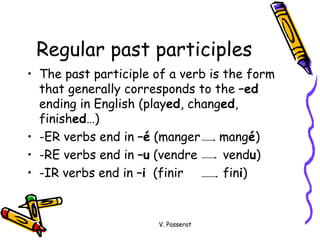
Regular past participles The past participle of a verb is the form that generally corresponds to the  –ed  ending in English (play ed , chang ed , finish ed …) -ER verbs end in  – é  (manger mang é ) -RE verbs end in  –u  (vendre  vend u ) -IR verbs end in  –i   (finir  fin i ) V. Passerat
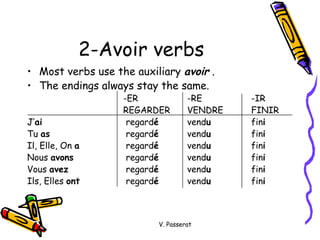
2-Avoir verbs  Most verbs use the auxiliary  avoir  .  The endings always stay the same. -ER -RE -IR REGARDER VENDRE FINIR J’ ai  regard é vend u fin i Tu  as    regard é vend u fin i Il, Elle, On  a  regard é vend u fin i Nous  avons  regard é vend u fin i Vous  avez  regard é vend u fin i Ils, Elles  ont  regard é vend u fin i V. Passerat
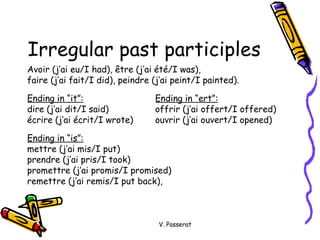
Irregular past participles Avoir (j’ai eu/I had),  être (j’ai été/I was),  faire (j’ai fait/I did), peindre (j’ai peint/I painted). Ending in “it”: Ending in “ert”: dire (j’ai dit/I said) offrir (j’ai offert/I offered)  écrire (j’ai écrit/I wrote) ouvrir (j’ai ouvert/I opened)  Ending in “is”: mettre (j’ai mis/I put) prendre (j’ai pris/I took) promettre (j’ai promis/I promised) remettre (j’ai remis/I put back), V. Passerat
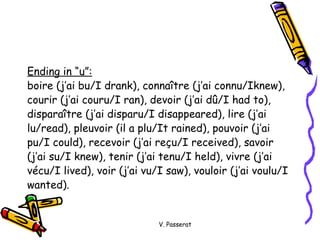
Ending in “u”:   boire (j’ai bu/I drank), conna ître (j’ai connu/Iknew),  courir (j’ai couru/I ran), devoir (j’ai dû/I had to),  disparaître (j’ai disparu/I disappeared), lire (j’ai  lu/read), pleuvoir (il a plu/It rained), pouvoir (j’ai  pu/I could), recevoir (j’ai reçu/I received), savoir  (j’ai su/I knew), tenir (j’ai tenu/I held), vivre (j’ai  vécu/I lived), voir (j’ai vu/I saw), vouloir (j’ai voulu/I  wanted). V. Passerat
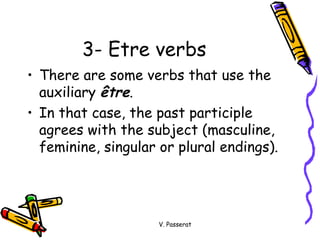
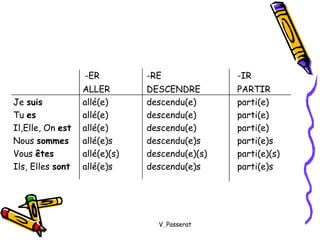
3- Etre verbs There are some verbs that use the auxiliary  être . In that case, the past participle agrees with the subject (masculine, feminine, singular or plural endings). V. Passerat
  -ER   -RE -IR   ALLER   DESCENDRE PARTIR Je  suis   all é(e)     descendu(e) parti(e) Tu  es   all é(e)     descendu(e) parti(e) Il,Elle, On  est   all é(e)     descendu(e) parti(e) Nous  sommes   all é(e)s   descendu(e)s parti(e)s Vous  êtes   all é(e)(s)   descendu(e)(s) parti(e)(s) Ils, Elles  sont   all é(e)s   descendu(e)s parti(e)s V. Passerat
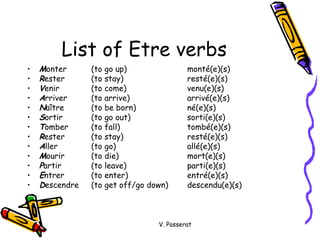
List of Etre verbs M onter (to go up) mont é(e)(s) R ester (to stay) rest é(e)(s) V enir (to come) venu(e)(s) A rriver (to arrive) arriv é (e)(s) N a ître (to be born) né(e)(s) S ortir (to go out) sorti(e)(s) T omber (to fall) tomb é (e)(s) R ester (to stay) rest é (e)(s) A ller (to go) all é (e)(s) M ourir (to die) mort(e)(s) P artir (to leave) parti(e)(s) E ntrer (to enter) entr é (e)(s) D escendre (to get off/go down) descendu(e)(s) V. Passerat
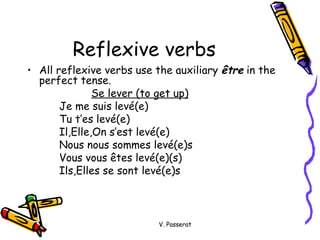
Reflexive verbs All reflexive verbs use the auxiliary  être  in the perfect tense. Se lever (to get up) Je me suis levé(e) Tu t’es levé(e) Il,Elle,On s’est levé(e) Nous nous sommes levé(e)s Vous vous êtes levé(e)(s) Ils,Elles se sont levé(e)s V. Passerat
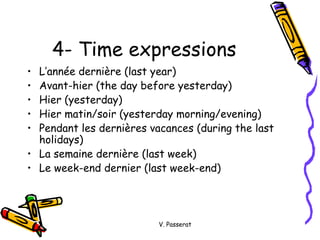
4- Time expressions L’ann ée dernière (last year) Avant-hier (the day before yesterday) Hier (yesterday) Hier matin/soir (yesterday morning/evening) Pendant les dernières vacances (during the last holidays) La semaine dernière (last week) Le week-end dernier (last week-end) V. Passerat

Passe composee

  • 1.
    The perfect tense(Le Pass é Composé) 1- Use and formation 2- Perfect with Avoir 3- Perfect with Etre 4-Time expressions V. Passerat
  • 2.
    1-Use and formation This tense is used to describe a single completed action in the past. It needs 2 parts: the auxiliary verb (avoir or être in the present) and the past participle . V. Passerat
  • 3.
    Regular past participlesThe past participle of a verb is the form that generally corresponds to the –ed ending in English (play ed , chang ed , finish ed …) -ER verbs end in – é (manger mang é ) -RE verbs end in –u (vendre vend u ) -IR verbs end in –i (finir fin i ) V. Passerat
  • 4.
    2-Avoir verbs Most verbs use the auxiliary avoir . The endings always stay the same. -ER -RE -IR REGARDER VENDRE FINIR J’ ai regard é vend u fin i Tu as regard é vend u fin i Il, Elle, On a regard é vend u fin i Nous avons regard é vend u fin i Vous avez regard é vend u fin i Ils, Elles ont regard é vend u fin i V. Passerat
  • 5.
    Irregular past participlesAvoir (j’ai eu/I had), être (j’ai été/I was), faire (j’ai fait/I did), peindre (j’ai peint/I painted). Ending in “it”: Ending in “ert”: dire (j’ai dit/I said) offrir (j’ai offert/I offered) écrire (j’ai écrit/I wrote) ouvrir (j’ai ouvert/I opened) Ending in “is”: mettre (j’ai mis/I put) prendre (j’ai pris/I took) promettre (j’ai promis/I promised) remettre (j’ai remis/I put back), V. Passerat
  • 6.
    Ending in “u”: boire (j’ai bu/I drank), conna ître (j’ai connu/Iknew), courir (j’ai couru/I ran), devoir (j’ai dû/I had to), disparaître (j’ai disparu/I disappeared), lire (j’ai lu/read), pleuvoir (il a plu/It rained), pouvoir (j’ai pu/I could), recevoir (j’ai reçu/I received), savoir (j’ai su/I knew), tenir (j’ai tenu/I held), vivre (j’ai vécu/I lived), voir (j’ai vu/I saw), vouloir (j’ai voulu/I wanted). V. Passerat
  • 7.
    3- Etre verbsThere are some verbs that use the auxiliary être . In that case, the past participle agrees with the subject (masculine, feminine, singular or plural endings). V. Passerat
  • 8.
    -ER -RE -IR ALLER DESCENDRE PARTIR Je suis all é(e) descendu(e) parti(e) Tu es all é(e) descendu(e) parti(e) Il,Elle, On est all é(e) descendu(e) parti(e) Nous sommes all é(e)s descendu(e)s parti(e)s Vous êtes all é(e)(s) descendu(e)(s) parti(e)(s) Ils, Elles sont all é(e)s descendu(e)s parti(e)s V. Passerat
  • 9.
    List of Etreverbs M onter (to go up) mont é(e)(s) R ester (to stay) rest é(e)(s) V enir (to come) venu(e)(s) A rriver (to arrive) arriv é (e)(s) N a ître (to be born) né(e)(s) S ortir (to go out) sorti(e)(s) T omber (to fall) tomb é (e)(s) R ester (to stay) rest é (e)(s) A ller (to go) all é (e)(s) M ourir (to die) mort(e)(s) P artir (to leave) parti(e)(s) E ntrer (to enter) entr é (e)(s) D escendre (to get off/go down) descendu(e)(s) V. Passerat
  • 10.
    Reflexive verbs Allreflexive verbs use the auxiliary être in the perfect tense. Se lever (to get up) Je me suis levé(e) Tu t’es levé(e) Il,Elle,On s’est levé(e) Nous nous sommes levé(e)s Vous vous êtes levé(e)(s) Ils,Elles se sont levé(e)s V. Passerat
  • 11.
    4- Time expressionsL’ann ée dernière (last year) Avant-hier (the day before yesterday) Hier (yesterday) Hier matin/soir (yesterday morning/evening) Pendant les dernières vacances (during the last holidays) La semaine dernière (last week) Le week-end dernier (last week-end) V. Passerat