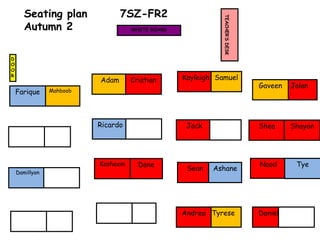
Seating plan 7SZ-FR2
Autumn 2
Kosheem
Kayleigh
WHITE BOARD
TEACHER’SDESK
D
O
O
R
Damillyon
Sean
Mahboob
Jalan
Naod
Ricardo
Samuel
Jack
Dane Tye
Gaveen
Farique
Daniela
Shea
Adam
Shayon
Ashane
TyreseAndrea
Cristian
Jeudi vingt-sept
novembre
Titre: Qui est le méchant?
On se connecte: Read the wanted poster – who is the villain?
Sentence starter: Le méchant est (Fat Albert / Shaggy / Fred)
Défi:
Justify your answer
using ‘parce que’
E.g. Le méchant est
______ parce qu’il a
les yeux noirs.
ON RECHERCHE
Un homme qui a les yeux
noirs et les cheveux noirs.
Il est assez petit.
Il est très content.
De l’aide / support
Homme = Man
Petit = Small
Content = Happy
Les devoirs:
Complete a drawing and description in
French of the villain in your story.
Due: Thursday 4th December
All – Describe his/her appearance
Most – & give them a name
Some - & describe their character
Les objectifs du jour:
ALL: Will be able to able to describe a villainous character using
accurately.‘être’, ‘avoir’
MOST : Will be able to able to describe a villainous character, using
‘être’, ‘avoir’ and a range of adjectives and quantifiers
SOME: Will be able to able to with a villainous
character, using ‘être’ and ‘avoir’
compare themselves
and connectives.
De l’aide/ support
De taille moyenne
Petit
Grande
Grand
De taille moyenne
Petite
develop
Défi:
Choose 2 villains –
describe their hair
and eyes too!
E.g. Il a les yeux…
elle a les cheveux…
Masculine Feminine
Grand = tall
De taille moyenne = average height
Petit = short
Grande = tall
De taille moyenne = average height
Petite = short
develop
Je suis petit.
J’ai les yeux blues.
Il est grand.
Il a les yeux noirs
1)What part of the sentence is green?
(Noun/adjective/verb/etc)
2)What part of the sentence is red?
3)Why have I coloured some purple
and some orange?
Avoir = To have
J’ai – I have
Tu as – You have
Il a – He has
Elle a – She has
Être = To be
Je suis – I am
Tu es – You are
Il est – He is
Elle est – She is
1. Il a
2. Elle est
3. Je suis
4. I have
5. He is
Pathway A – fill the gaps
1. Il ____ les yeux verts (avoir)
2. Elle _______ bavarde (être)
3. Je ________ paresseuse (être)
4. Tu ______ les cheveux blonds
(avoir)
5. J’___ treize ans (avoir)
Pathway B - Translate
the sentences
1. You have blue eyes
2. I am very shy
3. He is medium height
4. She is quite short.
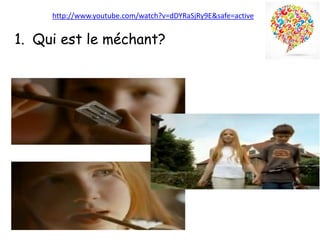
http://www.youtube.com/watch?v=dDYRaSjRy9E&safe=active
1. Qui est le méchant?
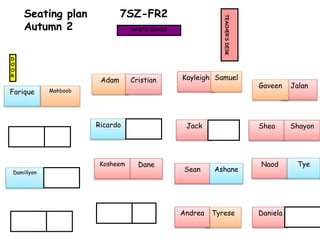
Seating plan 7SZ-FR2
Autumn 2
Kosheem
Kayleigh
WHITE BOARD
TEACHER’SDESK
D
O
O
R
Damillyon Sean
Mahboob
Jalan
Naod
Ricardo
Samuel
Jack
Dane Tye
Gaveen
Farique
Daniela
Shea
Adam
Shayon
Ashane
TyreseAndrea
Cristian
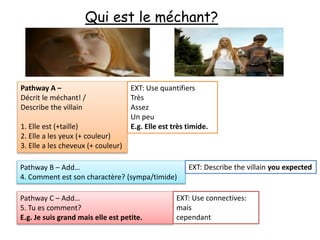
Qui est le méchant?
Pathway A –
Décrit le méchant! /
Describe the villain
1. Elle est (+taille)
2. Elle a les yeux (+ couleur)
3. Elle a les cheveux (+ couleur)
Pathway B – Add…
4. Comment est son charactère? (sympa/timide)
Pathway C – Add…
5. Tu es comment?
E.g. Je suis grand mais elle est petite.
EXT: Use quantifiers
Très
Assez
Un peu
E.g. Elle est très timide.
EXT: Describe the villain you expected
EXT: Use connectives:
mais
cependant
celebrateQui est le méchant?
delight
celebrate

Les Crayons - Villains

  • 1.
    Seating plan 7SZ-FR2 Autumn2 Kosheem Kayleigh WHITE BOARD TEACHER’SDESK D O O R Damillyon Sean Mahboob Jalan Naod Ricardo Samuel Jack Dane Tye Gaveen Farique Daniela Shea Adam Shayon Ashane TyreseAndrea Cristian
  • 2.
    Jeudi vingt-sept novembre Titre: Quiest le méchant? On se connecte: Read the wanted poster – who is the villain? Sentence starter: Le méchant est (Fat Albert / Shaggy / Fred) Défi: Justify your answer using ‘parce que’ E.g. Le méchant est ______ parce qu’il a les yeux noirs. ON RECHERCHE Un homme qui a les yeux noirs et les cheveux noirs. Il est assez petit. Il est très content. De l’aide / support Homme = Man Petit = Small Content = Happy
  • 3.
    Les devoirs: Complete adrawing and description in French of the villain in your story. Due: Thursday 4th December All – Describe his/her appearance Most – & give them a name Some - & describe their character
  • 4.
    Les objectifs dujour: ALL: Will be able to able to describe a villainous character using accurately.‘être’, ‘avoir’ MOST : Will be able to able to describe a villainous character, using ‘être’, ‘avoir’ and a range of adjectives and quantifiers SOME: Will be able to able to with a villainous character, using ‘être’ and ‘avoir’ compare themselves and connectives.
  • 8.
    De l’aide/ support Detaille moyenne Petit Grande Grand De taille moyenne Petite develop Défi: Choose 2 villains – describe their hair and eyes too! E.g. Il a les yeux… elle a les cheveux… Masculine Feminine Grand = tall De taille moyenne = average height Petit = short Grande = tall De taille moyenne = average height Petite = short
  • 9.
    develop Je suis petit. J’ailes yeux blues. Il est grand. Il a les yeux noirs 1)What part of the sentence is green? (Noun/adjective/verb/etc) 2)What part of the sentence is red? 3)Why have I coloured some purple and some orange?
  • 10.
    Avoir = Tohave J’ai – I have Tu as – You have Il a – He has Elle a – She has Être = To be Je suis – I am Tu es – You are Il est – He is Elle est – She is 1. Il a 2. Elle est 3. Je suis 4. I have 5. He is Pathway A – fill the gaps 1. Il ____ les yeux verts (avoir) 2. Elle _______ bavarde (être) 3. Je ________ paresseuse (être) 4. Tu ______ les cheveux blonds (avoir) 5. J’___ treize ans (avoir) Pathway B - Translate the sentences 1. You have blue eyes 2. I am very shy 3. He is medium height 4. She is quite short.
  • 11.
  • 12.
    Seating plan 7SZ-FR2 Autumn2 Kosheem Kayleigh WHITE BOARD TEACHER’SDESK D O O R Damillyon Sean Mahboob Jalan Naod Ricardo Samuel Jack Dane Tye Gaveen Farique Daniela Shea Adam Shayon Ashane TyreseAndrea Cristian
  • 13.
    Qui est leméchant? Pathway A – Décrit le méchant! / Describe the villain 1. Elle est (+taille) 2. Elle a les yeux (+ couleur) 3. Elle a les cheveux (+ couleur) Pathway B – Add… 4. Comment est son charactère? (sympa/timide) Pathway C – Add… 5. Tu es comment? E.g. Je suis grand mais elle est petite. EXT: Use quantifiers Très Assez Un peu E.g. Elle est très timide. EXT: Describe the villain you expected EXT: Use connectives: mais cependant
  • 14.
  • 15.
  • 16.

Notes de l'éditeur