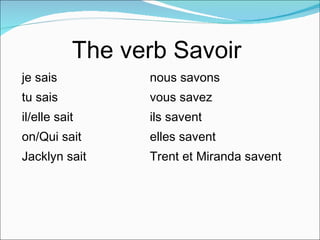
je sais nous savons tu sais vous savez il/elle sait ils savent on/Qui sait elles savent Jacklyn sait Trent et Miranda savent The verb Savoir
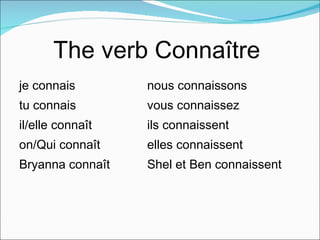
The verb Connaître  je connais nous connaissons tu connais vous connaissez il/elle connaît ils connaissent on/Qui connaît elles connaissent Bryanna connaît Shel et Ben connaissent
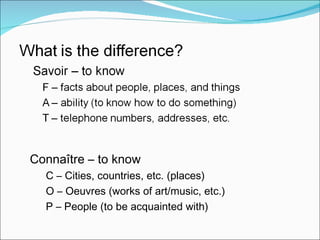
Connaître – to know C – Cities, countries, etc. (places) O – Oeuvres (works of art/music, etc.) P – People (to be acquainted with)
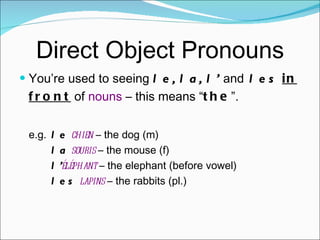
Direct Object Pronouns You’re used to seeing  le, la, l’  and  les   in front  of  nouns  – this means “ the ”. e.g. le   chien  – the dog (m) la   souris  – the mouse (f) l’ éléphant  – the elephant (before vowel) les   lapins  – the rabbits (pl.)
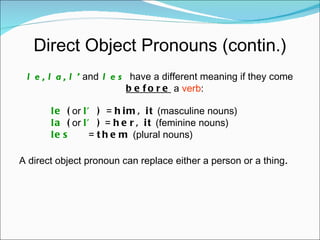
Direct Object Pronouns (contin.) le, la, l’   and   les   have a different meaning if they come  before  a  verb : le  ( or  l’ )  =  him, it  (masculine nouns) la  ( or  l’ )  =  her, it  (feminine nouns) les     =  them  (plural nouns) A direct object pronoun can replace either a person or a thing .
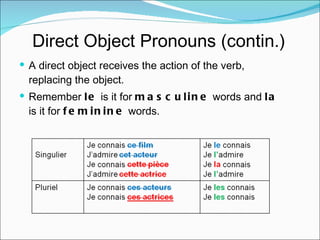
Direct Object Pronouns (contin.) A direct object receives the action of the verb, replacing the object. Remember  le  is it for  masculine  words and  la  is it for  feminine  words.
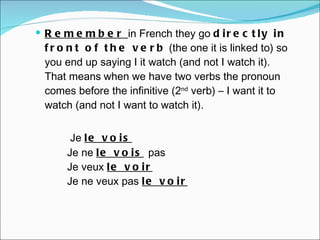
Remember  in French they go  directly in front of the verb  (the one it is linked to) so you end up saying I it watch (and not I watch it). That means   when we have two verbs the pronoun comes before the infinitive (2 nd  verb) –  I want it to watch (and not I want to watch it).    Je  le vois Je ne  le vois   pas Je veux  le voir Je ne veux pas  le voir
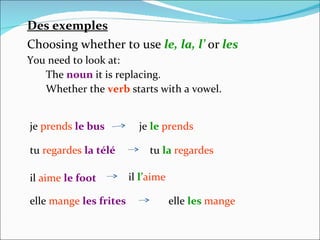
Des exemples Choosing whether to use  le, la, l’   or   les   You need to look at: The  noun  it is replacing. Whether the  verb  starts with a vowel. je  prends   le bus  je  le   prends tu  regardes   la télé   tu  la  regardes il  aime   le foot   il  l’ aime elle  mange   les frites elle  les   mange
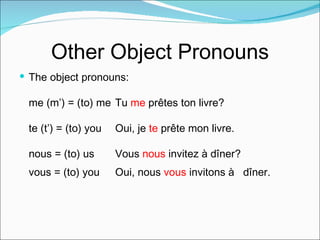
Other Object Pronouns The object pronouns: me (m’) = (to) me  Tu  me  prêtes ton livre? te (t’) = (to) you Oui, je  te  prête mon livre. nous = (to) us  Vous  nous  invitez à dîner ? vous = (to) you Oui, nous  vous  invitons à  dîner.
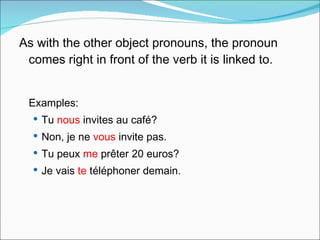
As with the other object pronouns, the pronoun comes right in front of the verb it is linked to. Examples: Tu  nous  invites au café?  Non, je ne  vous  invite pas. Tu peux  me  prêter 20 euros ? Je vais  te  téléphoner demain .
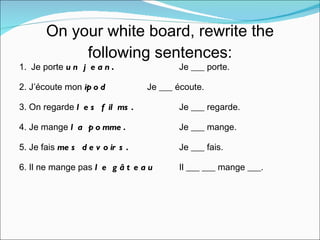
On your white board, rewrite the following sentences: 1.  Je porte  un jean .   Je ___ porte. 2. J’écoute mon  ipod   Je ___ écoute. 3. On regarde  les films. Je ___ regarde. 4. Je mange  la pomme. Je ___ mange. 5. Je fais  mes devoirs. Je ___ fais. 6. Il ne mange pas  le gâteau   Il ___ ___ mange ___.
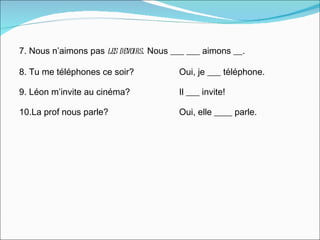
7. Nous n’aimons pas  les devoirs .  Nous ___ ___ aimons __.  8. Tu me téléphones ce soir? Oui, je ___ téléphone. 9. Léon m’invite au cinéma? Il ___ invite! 10.La prof nous parle? Oui, elle ____ parle.

French 2 chapter 1 review

  • 1.
  • 2.
    je sais noussavons tu sais vous savez il/elle sait ils savent on/Qui sait elles savent Jacklyn sait Trent et Miranda savent The verb Savoir
  • 3.
    The verb Connaître je connais nous connaissons tu connais vous connaissez il/elle connaît ils connaissent on/Qui connaît elles connaissent Bryanna connaît Shel et Ben connaissent
  • 4.
    Connaître – toknow C – Cities, countries, etc. (places) O – Oeuvres (works of art/music, etc.) P – People (to be acquainted with)
  • 5.
    Direct Object PronounsYou’re used to seeing le, la, l’ and les in front of nouns – this means “ the ”. e.g. le chien – the dog (m) la souris – the mouse (f) l’ éléphant – the elephant (before vowel) les lapins – the rabbits (pl.)
  • 6.
    Direct Object Pronouns(contin.) le, la, l’ and les have a different meaning if they come before a verb : le ( or l’ ) = him, it (masculine nouns) la ( or l’ ) = her, it (feminine nouns) les = them (plural nouns) A direct object pronoun can replace either a person or a thing .
  • 7.
    Direct Object Pronouns(contin.) A direct object receives the action of the verb, replacing the object. Remember le is it for masculine words and la is it for feminine words.
  • 8.
    Remember inFrench they go directly in front of the verb (the one it is linked to) so you end up saying I it watch (and not I watch it). That means when we have two verbs the pronoun comes before the infinitive (2 nd verb) – I want it to watch (and not I want to watch it). Je le vois Je ne le vois pas Je veux le voir Je ne veux pas le voir
  • 9.
    Des exemples Choosingwhether to use le, la, l’ or les You need to look at: The noun it is replacing. Whether the verb starts with a vowel. je prends le bus je le prends tu regardes la télé tu la regardes il aime le foot il l’ aime elle mange les frites elle les mange
  • 10.
    Other Object PronounsThe object pronouns: me (m’) = (to) me Tu me prêtes ton livre? te (t’) = (to) you Oui, je te prête mon livre. nous = (to) us Vous nous invitez à dîner ? vous = (to) you Oui, nous vous invitons à dîner.
  • 11.
    As with theother object pronouns, the pronoun comes right in front of the verb it is linked to. Examples: Tu nous invites au café? Non, je ne vous invite pas. Tu peux me prêter 20 euros ? Je vais te téléphoner demain .
  • 12.
    On your whiteboard, rewrite the following sentences: 1. Je porte un jean . Je ___ porte. 2. J’écoute mon ipod Je ___ écoute. 3. On regarde les films. Je ___ regarde. 4. Je mange la pomme. Je ___ mange. 5. Je fais mes devoirs. Je ___ fais. 6. Il ne mange pas le gâteau Il ___ ___ mange ___.
  • 13.
    7. Nous n’aimonspas les devoirs . Nous ___ ___ aimons __. 8. Tu me téléphones ce soir? Oui, je ___ téléphone. 9. Léon m’invite au cinéma? Il ___ invite! 10.La prof nous parle? Oui, elle ____ parle.