2010-2011 Traitement Numérique du Signal 1
Université Paris 13
Traitement Numérique du Signal Master 1
1. Exemple de filtres analogiques
2. Principe d’invariance et réponse impulsionnelle
3. Propriétés du produit de convolution
4. Transformée de Laplace
5. Filtres et Fonction de transfert
6. Critère de stabilité, pôle, zéro
7. Filtre à phase linéaire
8. Schéma général
2010-2011 Traitement Numérique du Signal 2
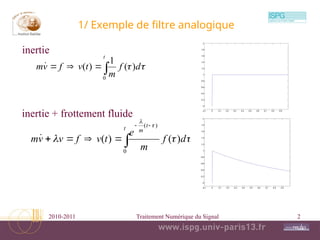
1/ Exemple de filtre analogique




t
d
f
m
t
v
f
v
m
0
)
(
1
)
( 









t t
m
d
f
m
e
t
v
f
v
v
m
0
)
(
)
(
)
( 





inertie
inertie + frottement fluide
2010-2011 Traitement Numérique du Signal 3
Exemple de filtrages
Entrée
Réponse
impulsionnelle Sorties
t
t
t
2010-2011 Traitement Numérique du Signal 4
Fonctionnement du produit de
convolution







t t
m
d
f
m
e
t
v
f
v
v
m
0
)
(
)
(
)
( 





h(t)
f(t)
v(t)
2010-2011 Traitement Numérique du Signal 5
2/ Propriétés d’invariance pour un système
physique
Invariance par translation spatiale
Invariance dans le temps
2010-2011 Traitement Numérique du Signal 6
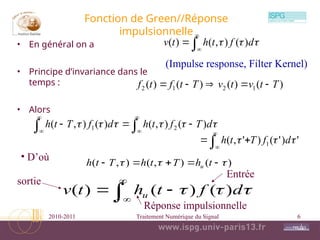
Fonction de Green//Réponse
impulsionnelle
• En général on a
• Principe d’invariance dans le
temps :
• Alors




 

 d
f
t
h
t
v )
(
)
,
(
)
(
)
(
)
(
)
(
)
( 1
2
1
2 T
t
v
t
v
T
t
f
t
f 














 




 d
T
f
t
h
d
f
T
t
h )
(
)
,
(
)
(
)
,
( 2
1





 '
)
'
(
)
'
,
( 1 

 d
f
T
t
h
• D’où )
(
)
,
(
)
,
( 

 



 t
h
T
t
h
T
t
h u





 

 d
f
t
h
t
v u )
(
)
(
)
(
(Impulse response, Filter Kernel)
Entrée
sortie
Réponse impulsionnelle
2010-2011 Traitement Numérique du Signal 7
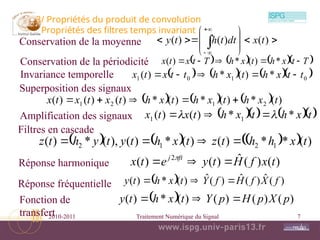
3/ Propriétés du produit de convolution
Propriétés des filtres temps invariant
      
0
1
0
1 *
)
(
*
)
( t
t
x
h
t
x
h
t
t
x
t
x 




      )
(
*
)
(
*
)
(
*
)
(
)
(
)
( 2
1
2
1 t
x
h
t
x
h
t
x
h
t
x
t
x
t
x 




  )
(
ˆ
)
(
ˆ
)
(
ˆ
)
(
*
)
( f
X
f
H
f
Y
t
x
h
t
y 


  )
(
)
(
)
(
)
(
*
)
( p
X
p
H
p
Y
t
x
h
t
y 


     
t
x
h
t
x
h
t
x
t
x *
*
)
(
)
( 1
1 
 













 



)
(
)
(
)
( t
x
dt
t
h
t
y
Conservation de la moyenne
Invariance temporelle
Superposition des signaux
Réponse fréquentielle
Fonction de
transfert
Amplification des signaux
Conservation de la périodicité       
T
t
x
h
t
x
h
T
t
x
t
x 



 *
)
(
*
)
(
     
  )
(
*
*
)
(
)
(
*
)
(
),
(
*
)
( 1
2
1
2 t
x
h
h
t
z
t
x
h
t
y
t
y
h
t
z 



Filtres en cascade
)
(
)
(
ˆ
)
(
)
( 2
t
x
f
H
t
y
e
t
x ft
j


 
Réponse harmonique
2010-2011 Traitement Numérique du Signal 8
4/ Transformée de Laplace




0
)
(
)
( dt
e
t
s
p
S pt





 dt
e
t
s
f
S ft
j 
2
)
(
)
(
ˆ
   
t
e
t
s at
[
,
0
[
1 


module
phase
p=j2f
a
p
p
S


1
)
(
signal causal
Re(p)
f
t
2010-2011 Traitement Numérique du Signal 9
Propriétés de la transformée de Laplace
 
    
0
2
2
0
f
j
p
S
p
t
s
e
TL t
f
j




   
  
      
p
Y
p
X
p
t
t
x
t
x
TL 
2
1 *
  )
(
)
](
[ 0
0 p
S
e
p
t
t
s
TL pt



Décalage fréquentiel
      )
(
)
(
)
](
[
)
(
)
](
[ p
Y
p
X
f
t
y
t
x
TL
p
aS
f
t
as
TL 



 
  
f
j
p
j
f
j
p
j
f
t
f
TF
f
j
p
f
j
p
f
t
f
TL
p
p
t
TL
p
t
TL R
R
R







2
1
2
1
2
1
2
1
)
](
1
)
2
[sin(
2
1
2
1
2
1
2
1
)
](
1
)
2
[cos(
1
1
1
)
)](
(
[ 0
0









 


    )
(
)
(
)
(
1
)
(
0
p
pS
p
s
d
d
TL
p
S
p
p
d
s
TL
t
t















 




)
(
)
( ap
aS
p
a
t
s
TL 












Retard=>déphasage
Linéarité
Dilatation/concentration
Intégration/dérivation
Produit de convolution/produit
Sinusoïdes=>hyperboles
2010-2011 Traitement Numérique du Signal 10
5/ Filtrage
 
)
(
)
( t
t
h 


    )
(
*
)
(
)
(
)
(
)
(
)
(
)
( t
u
t
t
t
y
t
t
u
t
y 





 
)
(
1 [
,
0
[ t


    )
(
*
)
(
)
(
1
)
(
)
(
)
(
)
( [
,
0
[
0
t
u
t
t
t
z
d
t
u
t
z
t





 

    t
f
j
t
f
j
e
f
H
t
e 0
0 2
0
2 ˆ
)
( 



  )
(
ˆ
)
(
ˆ
)
(
ˆ
)
(
)
(
)
( f
U
f
H
f
Y
t
t
u
t
y 



[
,
] 



t
]
[
)
( h
TL
p
H 
Réponse impulsionnelle
Réponse indicielle
Réponse harmonique ou réponse fréquentielle
Fonction de transfert
  )
(
)
(
)
(
)
(
)
(
)
( p
U
p
H
p
Y
t
t
u
t
y 



    )
(
ˆ f
h
TF
f
H 
2010-2011 Traitement Numérique du Signal 11
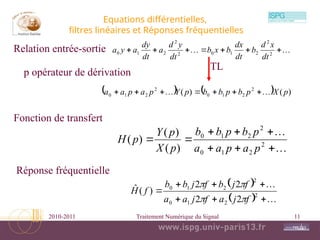
Equations différentielles,
filtres linéaires et Réponses fréquentielles

 





 2
2
2
1
0
2
2
2
1
0
dt
x
d
b
dt
dx
b
x
b
dt
y
d
a
dt
dy
a
y
a









 2
2
1
0
2
2
1
0
)
(
)
(
)
(
p
a
p
a
a
p
b
p
b
b
p
X
p
Y
p
H
 
  







 2
2
1
0
2
2
1
0
2
2
2
2
)
(
ˆ
f
j
a
f
j
a
a
f
j
b
f
j
b
b
f
H




    )
(
)
( 2
2
1
0
2
2
1
0 p
X
p
b
p
b
b
p
Y
p
a
p
a
a 
 






Relation entrée-sortie
TL
Fonction de transfert
Réponse fréquentielle
p opérateur de dérivation
2010-2011 Traitement Numérique du Signal 12
Pôles, zéros et allure de la réponse fréquentielle

 





 2
2
2
1
0
2
2
2
1
0
dt
x
d
b
dt
dx
b
x
b
dt
y
d
a
dt
dy
a
y
a









 2
2
1
0
2
2
1
0
)
(
)
(
)
(
p
a
p
a
a
p
b
p
b
b
p
X
p
Y
p
H
   
   
  









 
z
e
z
e
b f
f
j
z
R
f
f
j
z
R
f
H 1
1
0
0
0 2
)
(
arg
2
)
(
arg
1
)
(
ˆ
arg 

 
 
   
  








 p
e
p
e f
f
j
p
R
f
f
j
p
R 1
1
0
0 2
)
(
arg
2
)
(
arg 

   
   

2
1
0
2
1
0
)
(
p
p
p
p
p
p
z
p
z
p
z
p
b
p
H






 
           
           

2
2
2
2
2
1
2
2
1
2
0
2
2
0
2
2
2
2
2
2
1
2
2
1
2
0
2
2
0
2
4
4
4
4
4
4
)
(
ˆ
p
R
f
f
p
R
f
f
p
R
f
f
z
R
f
f
z
R
f
f
z
R
f
f
b
f
H
e
p
e
p
e
p
e
z
e
z
e
z




















Relation entrée-sortie
Fonction de transfert
factorisation zéros
pôles
Module de la réponse fréquentielle
Phase de la réponse fréquentielle
2010-2011 Traitement Numérique du Signal 13
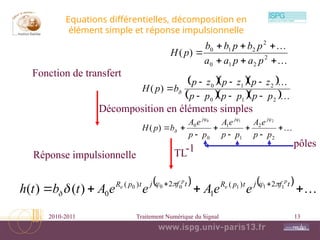
Equations différentielles, décomposition en
élément simple et réponse impulsionnelle








 2
2
1
0
2
2
1
0
)
(
p
a
p
a
a
p
b
p
b
b
p
H









2
2
1
1
0
0
2
1
0
)
(
p
p
e
A
p
p
e
A
p
p
e
A
b
p
H
j
j
j 



    



 
 t
f
j
t
p
R
t
f
j
t
p
R p
e
p
e
e
e
A
e
e
A
t
b
t
h 1
1
1
0
0
0 2
)
(
1
2
)
(
0
)
(
)
( 




   
   

2
1
0
2
1
0
)
(
p
p
p
p
p
p
z
p
z
p
z
p
b
p
H






 
Fonction de transfert
Décomposition en éléments simples
pôles
Réponse impulsionnelle TL-1
2010-2011 Traitement Numérique du Signal 14
6/ Filtres stables / Filtres à minimum de phase
  0
, 
 i
e p
R
i
  0
, 
 i
e z
R
i
Le filtre est stable si:
Le filtre est à minimum de phase si:
Re(p)
Im(p)
Zone de
stabilité
Ordre du filtre = nombre de pôles
2010-2011 Traitement Numérique du Signal 15
x
ay
dt
dy


a
p
p
Ha


1
)
(
)
(
1
)
( [
,
0
[ t
e
t
h at
a 


2
2
2
4
1
)
(
ˆ
a
f
f
Ha



 

































a
f
a
f
f
sign
f
Ha



2
arctan
2
arctan
)
(
)
(
ˆ
arg
0

a
0

a
Re(p)
Im(p)
xxxxx
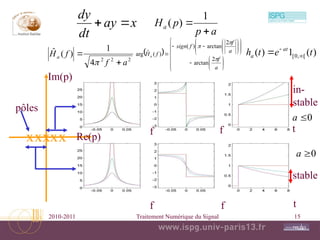
pôles
stable
in-
stable
t
t
f
f
f f
2010-2011 Traitement Numérique du Signal 16
bx
dt
dx
y
dt
dy



1
)
(



p
b
p
p
Hb )
(
1
)
1
(
)
(
)
( [
,
0
[ t
e
b
t
t
h t
b 




1
4
4
)
(
ˆ
2
2
2
2
2



f
b
f
f
Hb

  

































b
f
b
f
f
sign
f
f
Hb




2
arctan
2
arctan
)
(
)
2
arctan(
)
(
ˆ
arg
0

b
0

b
Im(p)
ooooo
zéros
min
t
t
f
f
f f
Re(p)
x
non
min
2010-2011 Traitement Numérique du Signal 17
7/ Filtre à phase linéaire
  0
)
(
ˆ
arg
df
d
t)
-
h(T
t)
(
h 

 f
H
Symétrie de la réponse impulsionnelle
 phase linéaire
2010-2011 Traitement Numérique du Signal 18
)
(t
ha
)
(t
hb
)
(t
hc
)
(t
hd
)
(
ˆ f
Ha
)
(
ˆ f
Hb
)
(
ˆ f
Hc
)
(
ˆ f
Hd
 
)
(
ˆ
arg f
Hi
 
)
(
ˆ
arg f
H
df
d
i
2010-2011 Traitement Numérique du Signal 19
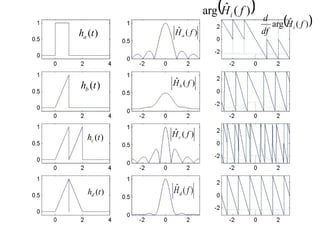
Réponse impulsionnelle symétrique => phase
linéaire
)
(
1
)
( [
1
,
0
[ t
t
ha 
)
(
1
'
)
'
(
1
)
( [
,
1
[
0
[
1
,
0
[ t
dt
t
t
h
t
b 


)
1
(
)
(
)
( 

 t
h
t
h
t
h b
b
c
))
2
(
(
)
(
)
( 


 t
h
t
h
t
h b
b
d
f
j
e
f
f
e
f
H
f
j
f
j
a


 

2
1
)
sin(
)
(
ˆ
2

 


 
2
2
2
2
4
1
2
1
2
)
(
ˆ
2
1
)
(
ˆ
f
f
j
e
f
j
e
f
H
f
j
f
H
f
j
f
j
a
b













 
f
j
b
b
f
j
b
c
e
f
H
f
H
e
f
H
f
H


2
2
1
)
(
ˆ
)
(
ˆ
)
(
ˆ
)
(
ˆ






 
f
j
b
f
j
b
f
j
b
f
j
b
d
e
f
H
e
f
H
e
f
H
e
f
H
f
H




2
2
2
4
)
(
ˆ
)
(
ˆ
)
(
ˆ
)
(
ˆ
)
(
ˆ









réelle
 linéaire
phase
non-linéaire
2010-2011 Traitement Numérique du Signal 20
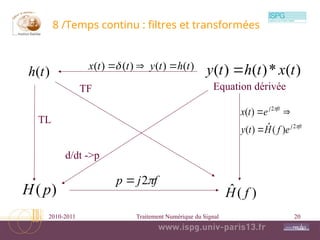
8 /Temps continu : filtres et transformées
)
(t
h )
(
*
)
(
)
( t
x
t
h
t
y 
)
( p
H )
(
ˆ f
H
)
(
)
(
)
(
)
( t
h
t
y
t
t
x 


ft
j
ft
j
e
f
H
t
y
e
t
x


2
2
)
(
ˆ
)
(
)
(



TL
f
j
p 
2

TF Equation dérivée
d/dt ->p

systeme linéaire invariant continue .ppt

  • 1.
    2010-2011 Traitement Numériquedu Signal 1 Université Paris 13 Traitement Numérique du Signal Master 1 1. Exemple de filtres analogiques 2. Principe d’invariance et réponse impulsionnelle 3. Propriétés du produit de convolution 4. Transformée de Laplace 5. Filtres et Fonction de transfert 6. Critère de stabilité, pôle, zéro 7. Filtre à phase linéaire 8. Schéma général
  • 2.
    2010-2011 Traitement Numériquedu Signal 2 1/ Exemple de filtre analogique     t d f m t v f v m 0 ) ( 1 ) (           t t m d f m e t v f v v m 0 ) ( ) ( ) (       inertie inertie + frottement fluide
  • 3.
    2010-2011 Traitement Numériquedu Signal 3 Exemple de filtrages Entrée Réponse impulsionnelle Sorties t t t
  • 4.
    2010-2011 Traitement Numériquedu Signal 4 Fonctionnement du produit de convolution        t t m d f m e t v f v v m 0 ) ( ) ( ) (       h(t) f(t) v(t)
  • 5.
    2010-2011 Traitement Numériquedu Signal 5 2/ Propriétés d’invariance pour un système physique Invariance par translation spatiale Invariance dans le temps
  • 6.
    2010-2011 Traitement Numériquedu Signal 6 Fonction de Green//Réponse impulsionnelle • En général on a • Principe d’invariance dans le temps : • Alors         d f t h t v ) ( ) , ( ) ( ) ( ) ( ) ( ) ( 1 2 1 2 T t v t v T t f t f                       d T f t h d f T t h ) ( ) , ( ) ( ) , ( 2 1       ' ) ' ( ) ' , ( 1    d f T t h • D’où ) ( ) , ( ) , (         t h T t h T t h u          d f t h t v u ) ( ) ( ) ( (Impulse response, Filter Kernel) Entrée sortie Réponse impulsionnelle
  • 7.
    2010-2011 Traitement Numériquedu Signal 7 3/ Propriétés du produit de convolution Propriétés des filtres temps invariant        0 1 0 1 * ) ( * ) ( t t x h t x h t t x t x            ) ( * ) ( * ) ( * ) ( ) ( ) ( 2 1 2 1 t x h t x h t x h t x t x t x        ) ( ˆ ) ( ˆ ) ( ˆ ) ( * ) ( f X f H f Y t x h t y      ) ( ) ( ) ( ) ( * ) ( p X p H p Y t x h t y          t x h t x h t x t x * * ) ( ) ( 1 1                      ) ( ) ( ) ( t x dt t h t y Conservation de la moyenne Invariance temporelle Superposition des signaux Réponse fréquentielle Fonction de transfert Amplification des signaux Conservation de la périodicité        T t x h t x h T t x t x      * ) ( * ) (         ) ( * * ) ( ) ( * ) ( ), ( * ) ( 1 2 1 2 t x h h t z t x h t y t y h t z     Filtres en cascade ) ( ) ( ˆ ) ( ) ( 2 t x f H t y e t x ft j     Réponse harmonique
  • 8.
    2010-2011 Traitement Numériquedu Signal 8 4/ Transformée de Laplace     0 ) ( ) ( dt e t s p S pt       dt e t s f S ft j  2 ) ( ) ( ˆ     t e t s at [ , 0 [ 1    module phase p=j2f a p p S   1 ) ( signal causal Re(p) f t
  • 9.
    2010-2011 Traitement Numériquedu Signal 9 Propriétés de la transformée de Laplace        0 2 2 0 f j p S p t s e TL t f j                   p Y p X p t t x t x TL  2 1 *   ) ( ) ]( [ 0 0 p S e p t t s TL pt    Décalage fréquentiel       ) ( ) ( ) ]( [ ) ( ) ]( [ p Y p X f t y t x TL p aS f t as TL          f j p j f j p j f t f TF f j p f j p f t f TL p p t TL p t TL R R R        2 1 2 1 2 1 2 1 ) ]( 1 ) 2 [sin( 2 1 2 1 2 1 2 1 ) ]( 1 ) 2 [cos( 1 1 1 ) )]( ( [ 0 0                  ) ( ) ( ) ( 1 ) ( 0 p pS p s d d TL p S p p d s TL t t                      ) ( ) ( ap aS p a t s TL              Retard=>déphasage Linéarité Dilatation/concentration Intégration/dérivation Produit de convolution/produit Sinusoïdes=>hyperboles
  • 10.
    2010-2011 Traitement Numériquedu Signal 10 5/ Filtrage   ) ( ) ( t t h        ) ( * ) ( ) ( ) ( ) ( ) ( ) ( t u t t t y t t u t y         ) ( 1 [ , 0 [ t       ) ( * ) ( ) ( 1 ) ( ) ( ) ( ) ( [ , 0 [ 0 t u t t t z d t u t z t             t f j t f j e f H t e 0 0 2 0 2 ˆ ) (       ) ( ˆ ) ( ˆ ) ( ˆ ) ( ) ( ) ( f U f H f Y t t u t y     [ , ]     t ] [ ) ( h TL p H  Réponse impulsionnelle Réponse indicielle Réponse harmonique ou réponse fréquentielle Fonction de transfert   ) ( ) ( ) ( ) ( ) ( ) ( p U p H p Y t t u t y         ) ( ˆ f h TF f H 
  • 11.
    2010-2011 Traitement Numériquedu Signal 11 Equations différentielles, filtres linéaires et Réponses fréquentielles          2 2 2 1 0 2 2 2 1 0 dt x d b dt dx b x b dt y d a dt dy a y a           2 2 1 0 2 2 1 0 ) ( ) ( ) ( p a p a a p b p b b p X p Y p H              2 2 1 0 2 2 1 0 2 2 2 2 ) ( ˆ f j a f j a a f j b f j b b f H         ) ( ) ( 2 2 1 0 2 2 1 0 p X p b p b b p Y p a p a a          Relation entrée-sortie TL Fonction de transfert Réponse fréquentielle p opérateur de dérivation
  • 12.
    2010-2011 Traitement Numériquedu Signal 12 Pôles, zéros et allure de la réponse fréquentielle          2 2 2 1 0 2 2 2 1 0 dt x d b dt dx b x b dt y d a dt dy a y a           2 2 1 0 2 2 1 0 ) ( ) ( ) ( p a p a a p b p b b p X p Y p H                       z e z e b f f j z R f f j z R f H 1 1 0 0 0 2 ) ( arg 2 ) ( arg 1 ) ( ˆ arg                       p e p e f f j p R f f j p R 1 1 0 0 2 ) ( arg 2 ) ( arg            2 1 0 2 1 0 ) ( p p p p p p z p z p z p b p H                                  2 2 2 2 2 1 2 2 1 2 0 2 2 0 2 2 2 2 2 2 1 2 2 1 2 0 2 2 0 2 4 4 4 4 4 4 ) ( ˆ p R f f p R f f p R f f z R f f z R f f z R f f b f H e p e p e p e z e z e z                     Relation entrée-sortie Fonction de transfert factorisation zéros pôles Module de la réponse fréquentielle Phase de la réponse fréquentielle
  • 13.
    2010-2011 Traitement Numériquedu Signal 13 Equations différentielles, décomposition en élément simple et réponse impulsionnelle          2 2 1 0 2 2 1 0 ) ( p a p a a p b p b b p H          2 2 1 1 0 0 2 1 0 ) ( p p e A p p e A p p e A b p H j j j                t f j t p R t f j t p R p e p e e e A e e A t b t h 1 1 1 0 0 0 2 ) ( 1 2 ) ( 0 ) ( ) (               2 1 0 2 1 0 ) ( p p p p p p z p z p z p b p H         Fonction de transfert Décomposition en éléments simples pôles Réponse impulsionnelle TL-1
  • 14.
    2010-2011 Traitement Numériquedu Signal 14 6/ Filtres stables / Filtres à minimum de phase   0 ,   i e p R i   0 ,   i e z R i Le filtre est stable si: Le filtre est à minimum de phase si: Re(p) Im(p) Zone de stabilité Ordre du filtre = nombre de pôles
  • 15.
    2010-2011 Traitement Numériquedu Signal 15 x ay dt dy   a p p Ha   1 ) ( ) ( 1 ) ( [ , 0 [ t e t h at a    2 2 2 4 1 ) ( ˆ a f f Ha                                       a f a f f sign f Ha    2 arctan 2 arctan ) ( ) ( ˆ arg 0  a 0  a Re(p) Im(p) xxxxx pôles stable in- stable t t f f f f
  • 16.
    2010-2011 Traitement Numériquedu Signal 16 bx dt dx y dt dy    1 ) (    p b p p Hb ) ( 1 ) 1 ( ) ( ) ( [ , 0 [ t e b t t h t b      1 4 4 ) ( ˆ 2 2 2 2 2    f b f f Hb                                      b f b f f sign f f Hb     2 arctan 2 arctan ) ( ) 2 arctan( ) ( ˆ arg 0  b 0  b Im(p) ooooo zéros min t t f f f f Re(p) x non min
  • 17.
    2010-2011 Traitement Numériquedu Signal 17 7/ Filtre à phase linéaire   0 ) ( ˆ arg df d t) - h(T t) ( h    f H Symétrie de la réponse impulsionnelle  phase linéaire
  • 18.
    2010-2011 Traitement Numériquedu Signal 18 ) (t ha ) (t hb ) (t hc ) (t hd ) ( ˆ f Ha ) ( ˆ f Hb ) ( ˆ f Hc ) ( ˆ f Hd   ) ( ˆ arg f Hi   ) ( ˆ arg f H df d i
  • 19.
    2010-2011 Traitement Numériquedu Signal 19 Réponse impulsionnelle symétrique => phase linéaire ) ( 1 ) ( [ 1 , 0 [ t t ha  ) ( 1 ' ) ' ( 1 ) ( [ , 1 [ 0 [ 1 , 0 [ t dt t t h t b    ) 1 ( ) ( ) (    t h t h t h b b c )) 2 ( ( ) ( ) (     t h t h t h b b d f j e f f e f H f j f j a      2 1 ) sin( ) ( ˆ 2        2 2 2 2 4 1 2 1 2 ) ( ˆ 2 1 ) ( ˆ f f j e f j e f H f j f H f j f j a b                f j b b f j b c e f H f H e f H f H   2 2 1 ) ( ˆ ) ( ˆ ) ( ˆ ) ( ˆ         f j b f j b f j b f j b d e f H e f H e f H e f H f H     2 2 2 4 ) ( ˆ ) ( ˆ ) ( ˆ ) ( ˆ ) ( ˆ          réelle  linéaire phase non-linéaire
  • 20.
    2010-2011 Traitement Numériquedu Signal 20 8 /Temps continu : filtres et transformées ) (t h ) ( * ) ( ) ( t x t h t y  ) ( p H ) ( ˆ f H ) ( ) ( ) ( ) ( t h t y t t x    ft j ft j e f H t y e t x   2 2 ) ( ˆ ) ( ) (    TL f j p  2  TF Equation dérivée d/dt ->p