@JosePaumard
nouvelles choses que l’on peut faire avec
Java
Questions ?
#50new8
@JosePaumard
Date
@JosePaumard#50new8
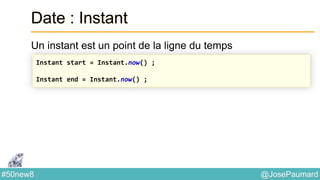
Date : Instant
Un instant est un point de la ligne du temps
Instant start = Instant.now() ;
Instant end = Instant.now() ;
@JosePaumard#50new8
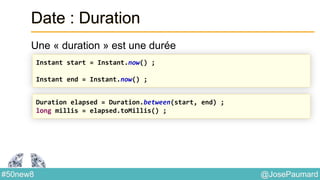
Date : Duration
Une « duration » est une durée
Instant start = Instant.now() ;
Instant end = Instant.now() ;
Duration elapsed = Duration.between(start, end) ;
long millis = elapsed.toMillis() ;
@JosePaumard#50new8
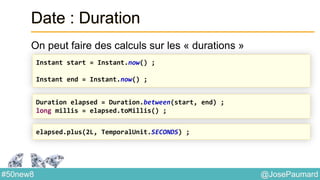
Date : Duration
On peut faire des calculs sur les « durations »
Instant start = Instant.now() ;
Instant end = Instant.now() ;
Duration elapsed = Duration.between(start, end) ;
long millis = elapsed.toMillis() ;
elapsed.plus(2L, TemporalUnit.SECONDS) ;
@JosePaumard#50new8
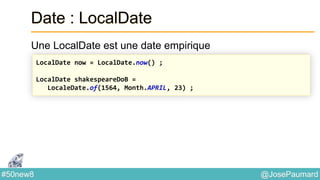
Date : LocalDate
Une LocalDate est une date empirique
LocalDate now = LocalDate.now() ;
LocalDate shakespeareDoB =
LocaleDate.of(1564, Month.APRIL, 23) ;
@JosePaumard#50new8
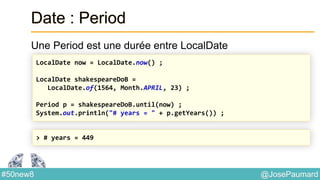
Date : Period
Une Period est une durée entre LocalDate
LocalDate now = LocalDate.now() ;
LocalDate shakespeareDoB =
LocalDate.of(1564, Month.APRIL, 23) ;
Period p = shakespeareDoB.until(now) ;
System.out.println("# years = " + p.getYears()) ;
> # years = 449
@JosePaumard#50new8
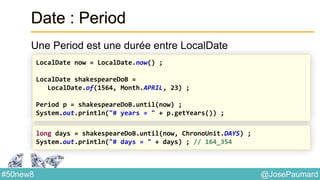
Date : Period
Une Period est une durée entre LocalDate
LocalDate now = LocalDate.now() ;
LocalDate shakespeareDoB =
LocalDate.of(1564, Month.APRIL, 23) ;
Period p = shakespeareDoB.until(now) ;
System.out.println("# years = " + p.getYears()) ;
long days = shakespeareDoB.until(now, ChronoUnit.DAYS) ;
System.out.println("# days = " + days) ; // 164_354
@JosePaumard#50new8
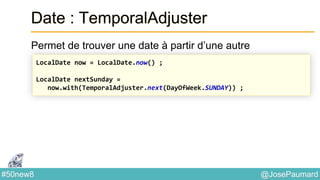
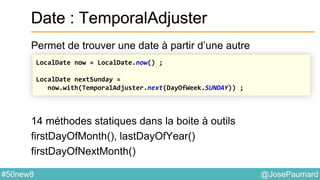
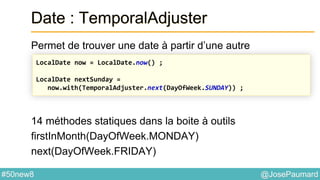
Date : TemporalAdjuster
Permet de trouver une date à partir d’une autre
LocalDate now = LocalDate.now() ;
LocalDate nextSunday =
now.with(TemporalAdjuster.next(DayOfWeek.SUNDAY)) ;
@JosePaumard#50new8
Date : TemporalAdjuster
Permet de trouver une date à partir d’une autre
14 méthodes statiques dans la boite à outils
firstDayOfMonth(), lastDayOfYear()
firstDayOfNextMonth()
LocalDate now = LocalDate.now() ;
LocalDate nextSunday =
now.with(TemporalAdjuster.next(DayOfWeek.SUNDAY)) ;
@JosePaumard#50new8
Date : TemporalAdjuster
Permet de trouver une date à partir d’une autre
14 méthodes statiques dans la boite à outils
firstInMonth(DayOfWeek.MONDAY)
next(DayOfWeek.FRIDAY)
LocalDate now = LocalDate.now() ;
LocalDate nextSunday =
now.with(TemporalAdjuster.next(DayOfWeek.SUNDAY)) ;
@JosePaumard#50new8
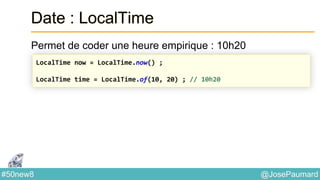
Date : LocalTime
Permet de coder une heure empirique : 10h20
LocalTime now = LocalTime.now() ;
LocalTime time = LocalTime.of(10, 20) ; // 10h20
@JosePaumard#50new8
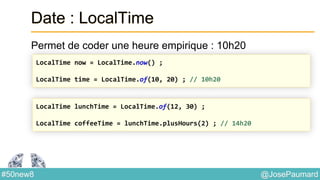
Date : LocalTime
Permet de coder une heure empirique : 10h20
LocalTime now = LocalTime.now() ;
LocalTime time = LocalTime.of(10, 20) ; // 10h20
LocalTime lunchTime = LocalTime.of(12, 30) ;
LocalTime coffeeTime = lunchTime.plusHours(2) ; // 14h20
@JosePaumard#50new8
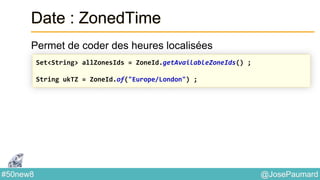
Date : ZonedTime
Permet de coder des heures localisées
Set<String> allZonesIds = ZoneId.getAvailableZoneIds() ;
String ukTZ = ZoneId.of("Europe/London") ;
@JosePaumard#50new8
Date : ZonedTime
Permet de coder des heures localisées
System.out.println(
ZonedDateTime.of(
1564, Month.APRIL.getValue(), 23, // year / month / day
10, 0, 0, 0, // h / mn / s / nanos
ZoneId.of("Europe/London"))
); // prints 1564-04-23T10:00-00:01:15[Europe/London]
@JosePaumard#50new8
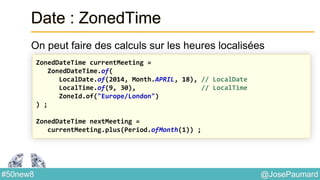
Date : ZonedTime
On peut faire des calculs sur les heures localisées
ZonedDateTime currentMeeting =
ZonedDateTime.of(
LocalDate.of(2014, Month.APRIL, 18), // LocalDate
LocalTime.of(9, 30), // LocalTime
ZoneId.of("Europe/London")
) ;
ZonedDateTime nextMeeting =
currentMeeting.plus(Period.ofMonth(1)) ;
@JosePaumard#50new8
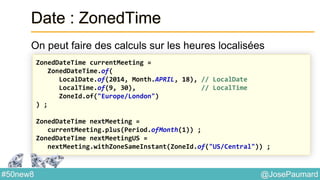
Date : ZonedTime
On peut faire des calculs sur les heures localisées
ZonedDateTime currentMeeting =
ZonedDateTime.of(
LocalDate.of(2014, Month.APRIL, 18), // LocalDate
LocalTime.of(9, 30), // LocalTime
ZoneId.of("Europe/London")
) ;
ZonedDateTime nextMeeting =
currentMeeting.plus(Period.ofMonth(1)) ;
ZonedDateTime nextMeetingUS =
nextMeeting.withZoneSameInstant(ZoneId.of("US/Central")) ;
@JosePaumard#50new8
Date : Formattage
Classe utilitaire : DateTimeFormatter
ZonedDateTime nextMeetingUS =
nextMeeting.withZoneSameInstant(ZoneId.of("US/Central"));
System.out.println(
DateTimeFormatter.ISO_DATE_TIME.format(nextMeetingUS)
);
// prints 2014-04-12T03:30:00-05:00[US/Central]
System.out.println(
DateTimeFormatter.RFC_1123_DATE_TIME.format(nextMeetingUS)
);
// prints Sat, 12 Apr 2014 03:30:00 -0500
@JosePaumard#50new8
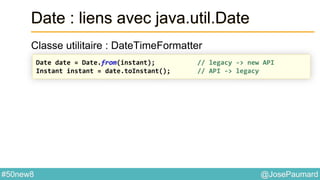
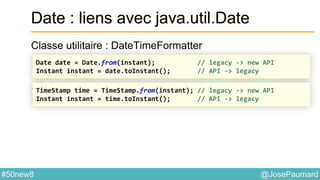
Date : liens avec java.util.Date
Classe utilitaire : DateTimeFormatter
Date date = Date.from(instant); // legacy -> new API
Instant instant = date.toInstant(); // API -> legacy
@JosePaumard#50new8
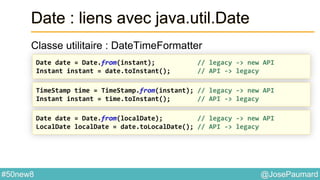
Date : liens avec java.util.Date
Classe utilitaire : DateTimeFormatter
Date date = Date.from(instant); // legacy -> new API
Instant instant = date.toInstant(); // API -> legacy
TimeStamp time = TimeStamp.from(instant); // legacy -> new API
Instant instant = time.toInstant(); // API -> legacy
@JosePaumard#50new8
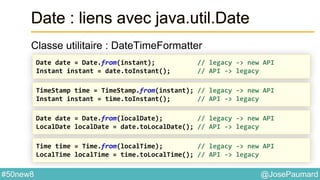
Date : liens avec java.util.Date
Classe utilitaire : DateTimeFormatter
Date date = Date.from(instant); // legacy -> new API
Instant instant = date.toInstant(); // API -> legacy
TimeStamp time = TimeStamp.from(instant); // legacy -> new API
Instant instant = time.toInstant(); // API -> legacy
Date date = Date.from(localDate); // legacy -> new API
LocalDate localDate = date.toLocalDate(); // API -> legacy
@JosePaumard#50new8
Date : liens avec java.util.Date
Classe utilitaire : DateTimeFormatter
Date date = Date.from(instant); // legacy -> new API
Instant instant = date.toInstant(); // API -> legacy
TimeStamp time = TimeStamp.from(instant); // legacy -> new API
Instant instant = time.toInstant(); // API -> legacy
Date date = Date.from(localDate); // legacy -> new API
LocalDate localDate = date.toLocalDate(); // API -> legacy
Time time = Time.from(localTime); // legacy -> new API
LocalTime localTime = time.toLocalTime(); // API -> legacy
String
@JosePaumard#50new8
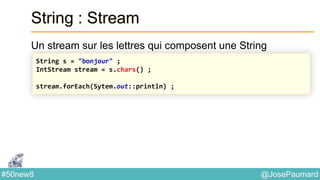
String : Stream
Un stream sur les lettres qui composent une String
String s = "bonjour" ;
IntStream stream = s.chars() ;
stream.forEach(Sytem.out::println) ;
@JosePaumard#50new8
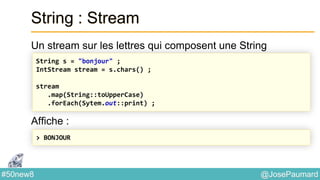
String : Stream
Un stream sur les lettres qui composent une String
Affiche :
String s = "bonjour" ;
IntStream stream = s.chars() ;
stream
.map(String::toUpperCase)
.forEach(Sytem.out::print) ;
> BONJOUR
@JosePaumard#50new8
String : expressions régulières
Construction de Stream à partir d’une regexp
// book est une grrrande chaîne
Stream<String> words =
Pattern
.compile("[^p{javaLetter}]")
.splitAsStream(book) ;
@JosePaumard#50new8
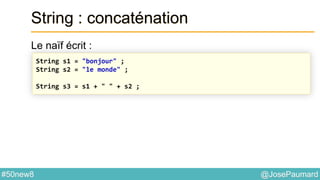
String : concaténation
Le naïf écrit :
String s1 = "bonjour" ;
String s2 = "le monde" ;
String s3 = s1 + " " + s2 ;
@JosePaumard#50new8
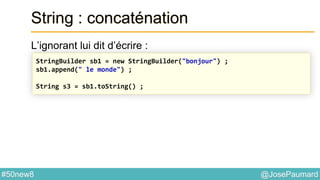
String : concaténation
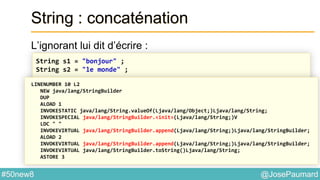
L’ignorant lui dit d’écrire :
StringBuilder sb1 = new StringBuilder("bonjour") ;
sb1.append(" le monde") ;
String s3 = sb1.toString() ;
@JosePaumard#50new8
String : concaténation
L’ignorant lui dit d’écrire :
String s1 = "bonjour" ;
String s2 = "le monde" ;
String s3 = s1 + " " + s2 ;LINENUMBER 10 L2
NEW java/lang/StringBuilder
DUP
ALOAD 1
INVOKESTATIC java/lang/String.valueOf(Ljava/lang/Object;)Ljava/lang/String;
INVOKESPECIAL java/lang/StringBuilder.<init>(Ljava/lang/String;)V
LDC " "
INVOKEVIRTUAL java/lang/StringBuilder.append(Ljava/lang/String;)Ljava/lang/StringBuilder;
ALOAD 2
INVOKEVIRTUAL java/lang/StringBuilder.append(Ljava/lang/String;)Ljava/lang/StringBuilder;
INVOKEVIRTUAL java/lang/StringBuilder.toString()Ljava/lang/String;
ASTORE 3
@JosePaumard#50new8
String : concaténation
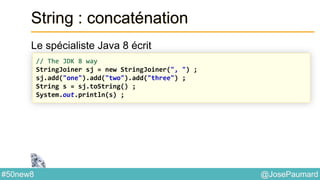
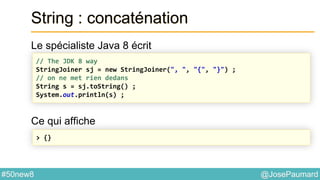
Le spécialiste Java 8 écrit
// The JDK 8 way
StringJoiner sj = new StringJoiner(", ") ;
sj.add("one").add("two").add("three") ;
String s = sj.toString() ;
System.out.println(s) ;
@JosePaumard#50new8
String : concaténation
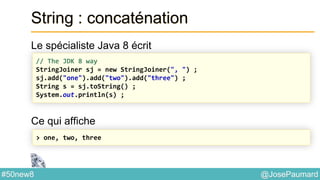
Le spécialiste Java 8 écrit
Ce qui affiche
// The JDK 8 way
StringJoiner sj = new StringJoiner(", ") ;
sj.add("one").add("two").add("three") ;
String s = sj.toString() ;
System.out.println(s) ;
> one, two, three
@JosePaumard#50new8
String : concaténation
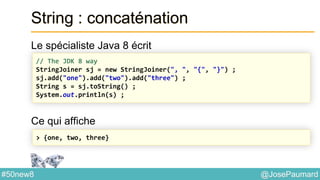
Le spécialiste Java 8 écrit
Ce qui affiche
// The JDK 8 way
StringJoiner sj = new StringJoiner(", ", "{", "}") ;
sj.add("one").add("two").add("three") ;
String s = sj.toString() ;
System.out.println(s) ;
> {one, two, three}
@JosePaumard#50new8
String : concaténation
Le spécialiste Java 8 écrit
Ce qui affiche
// The JDK 8 way
StringJoiner sj = new StringJoiner(", ", "{", "}") ;
// on ne met rien dedans
String s = sj.toString() ;
System.out.println(s) ;
> {}
@JosePaumard#50new8
String : concaténation
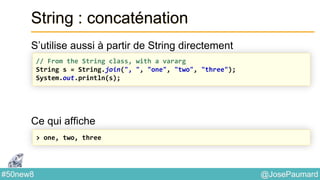
S’utilise aussi à partir de String directement
Ce qui affiche
// From the String class, with a vararg
String s = String.join(", ", "one", "two", "three");
System.out.println(s);
> one, two, three
@JosePaumard#50new8
String : concaténation
S’utilise aussi à partir de String directement
Ce qui affiche
// From the String class, with an Iterable
String [] tab = {"one", "two", "three"} ;
String s = String.join(", ", tab) ;
System.out.println(s) ;
> one, two, three
I/O
@JosePaumard#50new8
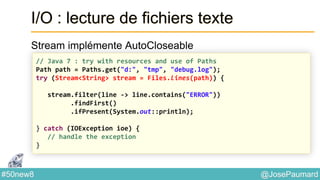
I/O : lecture de fichiers texte
Stream implémente AutoCloseable
// Java 7 : try with resources and use of Paths
Path path = Paths.get("d:", "tmp", "debug.log");
try (Stream<String> stream = Files.lines(path)) {
stream.filter(line -> line.contains("ERROR"))
.findFirst()
.ifPresent(System.out::println);
} catch (IOException ioe) {
// handle the exception
}
@JosePaumard#50new8
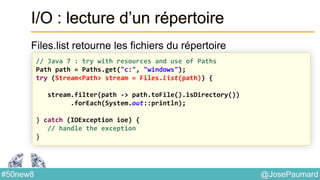
I/O : lecture d’un répertoire
Files.list retourne les fichiers du répertoire
// Java 7 : try with resources and use of Paths
Path path = Paths.get("c:", "windows");
try (Stream<Path> stream = Files.list(path)) {
stream.filter(path -> path.toFile().isDirectory())
.forEach(System.out::println);
} catch (IOException ioe) {
// handle the exception
}
@JosePaumard#50new8
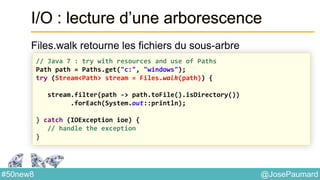
I/O : lecture d’une arborescence
Files.walk retourne les fichiers du sous-arbre
// Java 7 : try with resources and use of Paths
Path path = Paths.get("c:", "windows");
try (Stream<Path> stream = Files.walk(path)) {
stream.filter(path -> path.toFile().isDirectory())
.forEach(System.out::println);
} catch (IOException ioe) {
// handle the exception
}
@JosePaumard#50new8
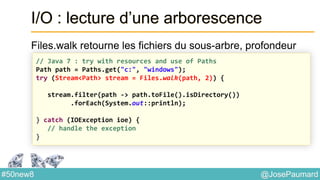
I/O : lecture d’une arborescence
Files.walk retourne les fichiers du sous-arbre, profondeur
// Java 7 : try with resources and use of Paths
Path path = Paths.get("c:", "windows");
try (Stream<Path> stream = Files.walk(path, 2)) {
stream.filter(path -> path.toFile().isDirectory())
.forEach(System.out::println);
} catch (IOException ioe) {
// handle the exception
}
List
@JosePaumard#50new8
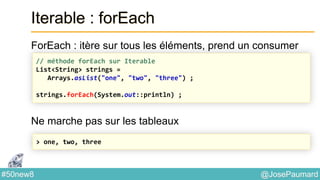
Iterable : forEach
ForEach : itère sur tous les éléments, prend un consumer
Ne marche pas sur les tableaux
// méthode forEach sur Iterable
List<String> strings =
Arrays.asList("one", "two", "three") ;
strings.forEach(System.out::println) ;
> one, two, three
@JosePaumard#50new8
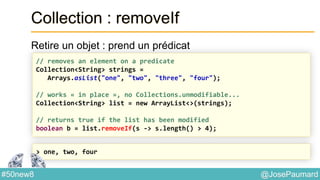
Collection : removeIf
Retire un objet : prend un prédicat
// removes an element on a predicate
Collection<String> strings =
Arrays.asList("one", "two", "three", "four");
// works « in place », no Collections.unmodifiable...
Collection<String> list = new ArrayList<>(strings);
// returns true if the list has been modified
boolean b = list.removeIf(s -> s.length() > 4);
> one, two, four
@JosePaumard#50new8
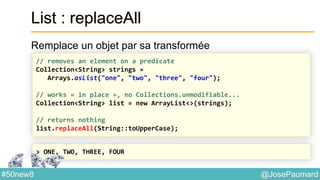
List : replaceAll
Remplace un objet par sa transformée
// removes an element on a predicate
Collection<String> strings =
Arrays.asList("one", "two", "three", "four");
// works « in place », no Collections.unmodifiable...
Collection<String> list = new ArrayList<>(strings);
// returns nothing
list.replaceAll(String::toUpperCase);
> ONE, TWO, THREE, FOUR
@JosePaumard#50new8
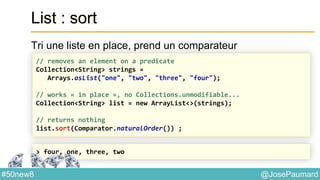
List : sort
Tri une liste en place, prend un comparateur
// removes an element on a predicate
Collection<String> strings =
Arrays.asList("one", "two", "three", "four");
// works « in place », no Collections.unmodifiable...
Collection<String> list = new ArrayList<>(strings);
// returns nothing
list.sort(Comparator.naturalOrder()) ;
> four, one, three, two
Arrays
Parallel
@JosePaumard#50new8
Parallel Arrays
Arrays.parallelSetAll
long [] array = new long [...] ;
Arrays.parallelSetAll(array, index -> index % 3) ;
System.out.println(Arrays.toString(array)) ;
@JosePaumard#50new8
Parallel Arrays
Arrays.parallelPrefix : fold right
long [] array = new long [...] ;
Arrays.parallelPrefix(array, (l1, l2) -> l1 + l2) ;
System.out.println(Arrays.toString(array)) ;
long [] array = {1L, 1L, 1L, 1L} ;
> [1, 2, 3, 4]
@JosePaumard#50new8
Parallel Arrays
Arrays.sort : tri en place
long [] array = new long [...] ;
Arrays.parallelSort(array) ;
System.out.println(Arrays.toString(array)) ;
Comparator
@JosePaumard#50new8
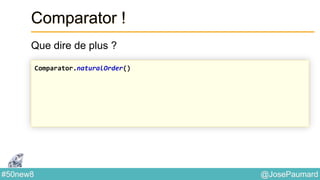
Comparator !
Que dire de plus ?
Comparator.naturalOrder()
@JosePaumard#50new8
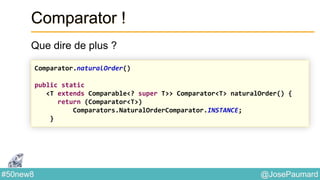
Comparator !
Que dire de plus ?
Comparator.naturalOrder()
public static
<T extends Comparable<? super T>> Comparator<T> naturalOrder() {
return (Comparator<T>)
Comparators.NaturalOrderComparator.INSTANCE;
}
@JosePaumard#50new8
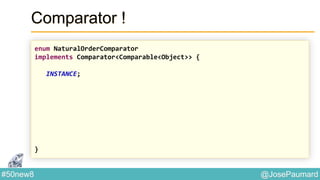
Comparator !
enum NaturalOrderComparator
implements Comparator<Comparable<Object>> {
INSTANCE;
}
@JosePaumard#50new8
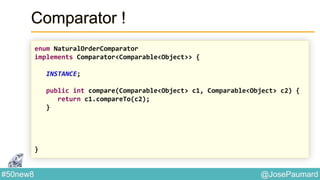
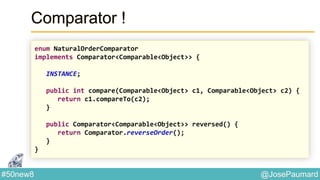
Comparator !
enum NaturalOrderComparator
implements Comparator<Comparable<Object>> {
INSTANCE;
public int compare(Comparable<Object> c1, Comparable<Object> c2) {
return c1.compareTo(c2);
}
}
@JosePaumard#50new8
Comparator !
enum NaturalOrderComparator
implements Comparator<Comparable<Object>> {
INSTANCE;
public int compare(Comparable<Object> c1, Comparable<Object> c2) {
return c1.compareTo(c2);
}
public Comparator<Comparable<Object>> reversed() {
return Comparator.reverseOrder();
}
}
@JosePaumard#50new8
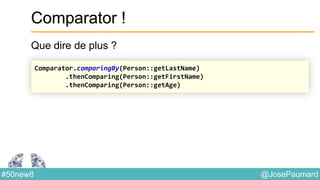
Comparator !
Que dire de plus ?
Comparator.comparingBy(Person::getLastName)
.thenComparing(Person::getFirstName)
.thenComparing(Person::getAge)
Map
@JosePaumard#50new8
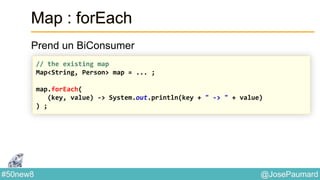
Map : forEach
Prend un BiConsumer
// the existing map
Map<String, Person> map = ... ;
map.forEach(
(key, value) -> System.out.println(key + " -> " + value)
) ;
@JosePaumard#50new8
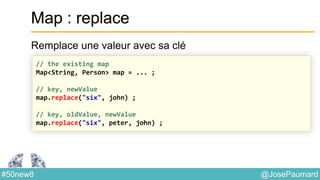
Map : replace
Remplace une valeur avec sa clé
// the existing map
Map<String, Person> map = ... ;
// key, newValue
map.replace("six", john) ;
// key, oldValue, newValue
map.replace("six", peter, john) ;
@JosePaumard#50new8
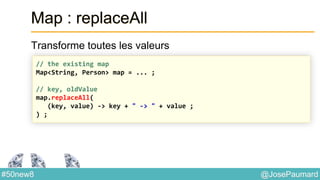
Map : replaceAll
Transforme toutes les valeurs
// the existing map
Map<String, Person> map = ... ;
// key, oldValue
map.replaceAll(
(key, value) -> key + " -> " + value ;
) ;
@JosePaumard#50new8
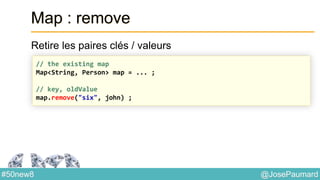
Map : remove
Retire les paires clés / valeurs
// the existing map
Map<String, Person> map = ... ;
// key, oldValue
map.remove("six", john) ;
@JosePaumard#50new8
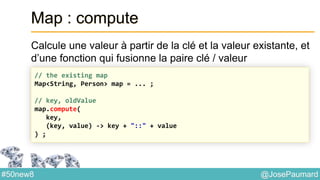
Map : compute
Calcule une valeur à partir de la clé et la valeur existante, et
d’une fonction qui fusionne la paire clé / valeur
// the existing map
Map<String, Person> map = ... ;
// key, oldValue
map.compute(
key,
(key, value) -> key + "::" + value
) ;
@JosePaumard#50new8
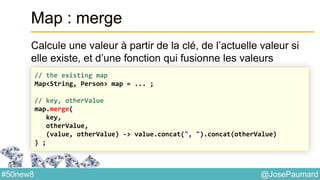
Map : merge
Calcule une valeur à partir de la clé, de l’actuelle valeur si
elle existe, et d’une fonction qui fusionne les valeurs
// the existing map
Map<String, Person> map = ... ;
// key, otherValue
map.merge(
key,
otherValue,
(value, otherValue) -> value.concat(", ").concat(otherValue)
) ;
@JosePaumard#50new8
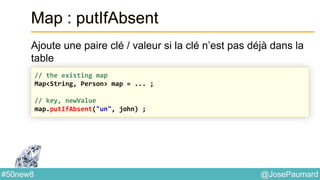
Map : putIfAbsent
Ajoute une paire clé / valeur si la clé n’est pas déjà dans la
table
// the existing map
Map<String, Person> map = ... ;
// key, newValue
map.putIfAbsent("un", john) ;
@JosePaumard#50new8
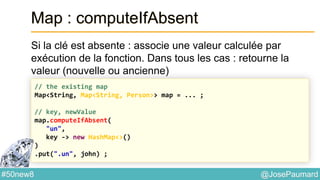
Map : computeIfAbsent
Si la clé est absente : associe une valeur calculée par
exécution de la fonction. Dans tous les cas : retourne la
valeur (nouvelle ou ancienne)
// the existing map
Map<String, Map<String, Person>> map = ... ;
// key, newValue
map.computeIfAbsent(
"un",
key -> new HashMap<>()
)
.put(".un", john) ;
@JosePaumard#50new8
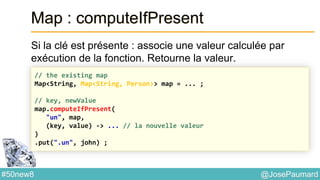
Map : computeIfPresent
Si la clé est présente : associe une valeur calculée par
exécution de la fonction. Retourne la valeur.
// the existing map
Map<String, Map<String, Person>> map = ... ;
// key, newValue
map.computeIfPresent(
"un", map,
(key, value) -> ... // la nouvelle valeur
)
.put(".un", john) ;
Completable
Future
@JosePaumard#50new8
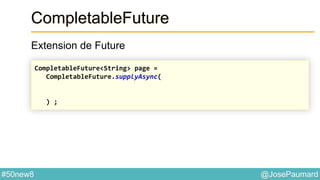
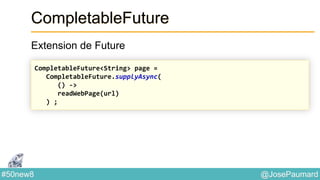
CompletableFuture
Extension de Future
CompletableFuture<String> page =
CompletableFuture.supplyAsync(
) ;
@JosePaumard#50new8
CompletableFuture
Extension de Future
CompletableFuture<String> page =
CompletableFuture.supplyAsync(
() ->
readWebPage(url)
) ;
@JosePaumard#50new8
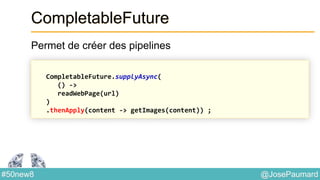
CompletableFuture
Permet de créer des pipelines
CompletableFuture.supplyAsync(
() ->
readWebPage(url)
)
.thenApply(content -> getImages(content)) ;
@JosePaumard#50new8
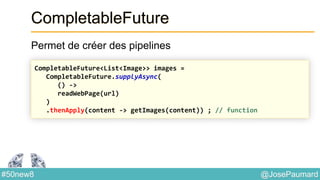
CompletableFuture
Permet de créer des pipelines
CompletableFuture<List<Image>> images =
CompletableFuture.supplyAsync(
() ->
readWebPage(url)
)
.thenApply(content -> getImages(content)) ; // function
@JosePaumard#50new8
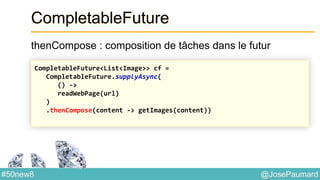
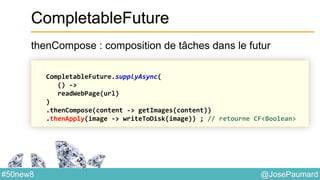
CompletableFuture
thenCompose : composition de tâches dans le futur
CompletableFuture<List<Image>> cf =
CompletableFuture.supplyAsync(
() ->
readWebPage(url)
)
.thenCompose(content -> getImages(content))
@JosePaumard#50new8
CompletableFuture
thenCompose : composition de tâches dans le futur
CompletableFuture.supplyAsync(
() ->
readWebPage(url)
)
.thenCompose(content -> getImages(content))
.thenApply(image -> writeToDisk(image)) ; // retourne CF<Boolean>
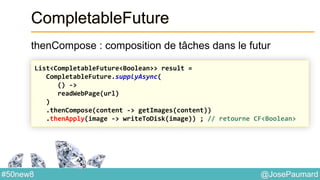
@JosePaumard#50new8
CompletableFuture
thenCompose : composition de tâches dans le futur
List<CompletableFuture<Boolean>> result =
CompletableFuture.supplyAsync(
() ->
readWebPage(url)
)
.thenCompose(content -> getImages(content))
.thenApply(image -> writeToDisk(image)) ; // retourne CF<Boolean>
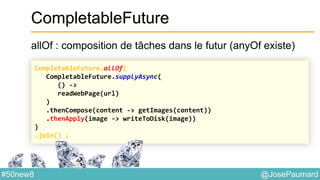
@JosePaumard#50new8
CompletableFuture
allOf : composition de tâches dans le futur (anyOf existe)
CompletableFuture.allOf(
CompletableFuture.supplyAsync(
() ->
readWebPage(url)
)
.thenCompose(content -> getImages(content))
.thenApply(image -> writeToDisk(image))
)
.join() ;
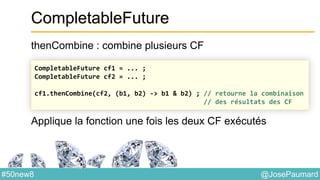
@JosePaumard#50new8
CompletableFuture
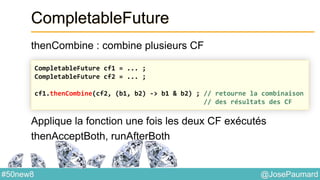
thenCombine : combine plusieurs CF
Applique la fonction une fois les deux CF exécutés
CompletableFuture cf1 = ... ;
CompletableFuture cf2 = ... ;
cf1.thenCombine(cf2, (b1, b2) -> b1 & b2) ; // retourne la combinaison
// des résultats des CF
@JosePaumard#50new8
CompletableFuture
thenCombine : combine plusieurs CF
Applique la fonction une fois les deux CF exécutés
thenAcceptBoth, runAfterBoth
CompletableFuture cf1 = ... ;
CompletableFuture cf2 = ... ;
cf1.thenCombine(cf2, (b1, b2) -> b1 & b2) ; // retourne la combinaison
// des résultats des CF
@JosePaumard#50new8
CompletableFuture
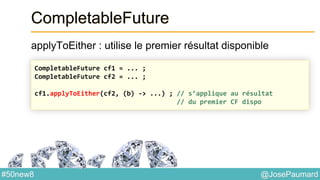
applyToEither : utilise le premier résultat disponible
CompletableFuture cf1 = ... ;
CompletableFuture cf2 = ... ;
cf1.applyToEither(cf2, (b) -> ...) ; // s’applique au résultat
// du premier CF dispo
@JosePaumard#50new8
CompletableFuture
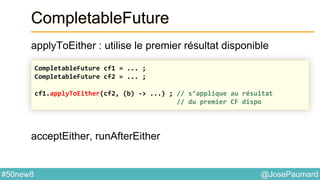
applyToEither : utilise le premier résultat disponible
acceptEither, runAfterEither
CompletableFuture cf1 = ... ;
CompletableFuture cf2 = ... ;
cf1.applyToEither(cf2, (b) -> ...) ; // s’applique au résultat
// du premier CF dispo
Concurrence
@JosePaumard#50new8
Variables atomiques
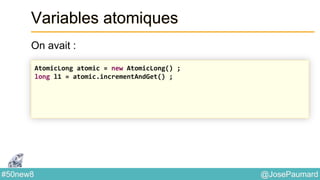
On avait :
AtomicLong atomic = new AtomicLong() ;
long l1 = atomic.incrementAndGet() ;
@JosePaumard#50new8
Variables atomiques
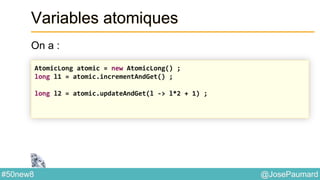
On a :
AtomicLong atomic = new AtomicLong() ;
long l1 = atomic.incrementAndGet() ;
long l2 = atomic.updateAndGet(l -> l*2 + 1) ;
@JosePaumard#50new8
Variables atomiques
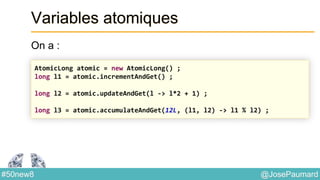
On a :
AtomicLong atomic = new AtomicLong() ;
long l1 = atomic.incrementAndGet() ;
long l2 = atomic.updateAndGet(l -> l*2 + 1) ;
long l3 = atomic.accumulateAndGet(12L, (l1, l2) -> l1 % l2) ;
@JosePaumard#50new8
LongAdder
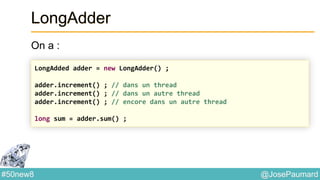
On a :
LongAdded adder = new LongAdder() ;
adder.increment() ; // dans un thread
adder.increment() ; // dans un autre thread
adder.increment() ; // encore dans un autre thread
long sum = adder.sum() ;
@JosePaumard#50new8
LongAccumulator
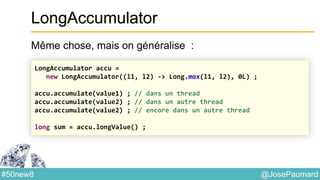
Même chose, mais on généralise :
LongAccumulator accu =
new LongAccumulator((l1, l2) -> Long.max(l1, l2), 0L) ;
accu.accumulate(value1) ; // dans un thread
accu.accumulate(value2) ; // dans un autre thread
accu.accumulate(value2) ; // encore dans un autre thread
long sum = accu.longValue() ;
@JosePaumard#50new8
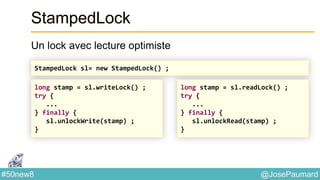
StampedLock
Un lock avec lecture optimiste
StampedLock sl= new StampedLock() ;
long stamp = sl.writeLock() ;
try {
...
} finally {
sl.unlockWrite(stamp) ;
}
long stamp = sl.readLock() ;
try {
...
} finally {
sl.unlockRead(stamp) ;
}
@JosePaumard#50new8
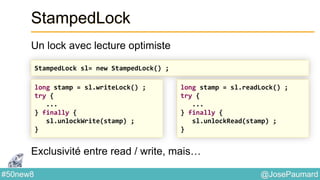
StampedLock
Un lock avec lecture optimiste
Exclusivité entre read / write, mais…
StampedLock sl= new StampedLock() ;
long stamp = sl.writeLock() ;
try {
...
} finally {
sl.unlockWrite(stamp) ;
}
long stamp = sl.readLock() ;
try {
...
} finally {
sl.unlockRead(stamp) ;
}
@JosePaumard#50new8
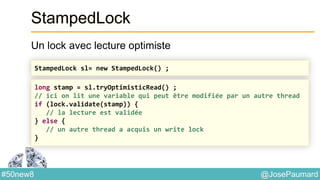
StampedLock
Un lock avec lecture optimiste
StampedLock sl= new StampedLock() ;
long stamp = sl.tryOptimisticRead() ;
// ici on lit une variable qui peut être modifiée par un autre thread
if (lock.validate(stamp)) {
// la lecture est validée
} else {
// un autre thread a acquis un write lock
}
ConcurrentConcurrent
HashMap
@JosePaumard#50new8
ConcurrentHashMap
Réécriture complète de ConcurrentHashMap V7
Complètement thread-safe
N’utilise de lock ≠ ConcurrentHashMap V7
Nouvelles méthodes
@JosePaumard#50new8
ConcurrentHashMap
6000 lignes de code
@JosePaumard#50new8
ConcurrentHashMap
6000 lignes de code
54 classes membre
@JosePaumard#50new8
ConcurrentHashMap
6000 lignes de code
54 classes membre
Pour info : 58 classes dans java.util.concurrent
@JosePaumard#50new8
ConcurrentHashMap
6000 lignes de code
54 classes membre
Pour info : 58 classes dans java.util.concurrent
Nouveaux patterns !
@JosePaumard#50new8
ConcurrentHashMap
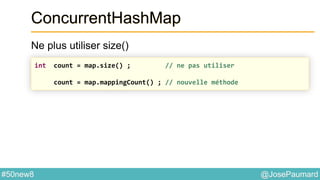
Ne plus utiliser size()
int count = map.size() ; // ne pas utiliser
count = map.mappingCount() ; // nouvelle méthode
@JosePaumard#50new8
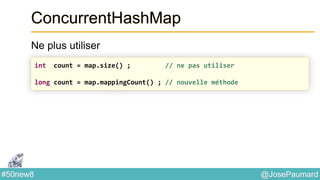
ConcurrentHashMap
Ne plus utiliser
int count = map.size() ; // ne pas utiliser
long count = map.mappingCount() ; // nouvelle méthode
@JosePaumard#50new8
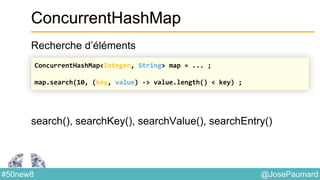
ConcurrentHashMap
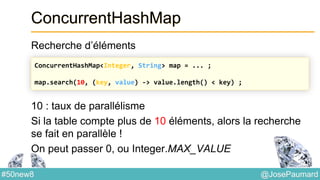
Recherche d’éléments
search(), searchKey(), searchValue(), searchEntry()
ConcurrentHashMap<Integer, String> map = ... ;
map.search(10, (key, value) -> value.length() < key) ;
@JosePaumard#50new8
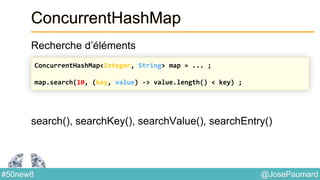
ConcurrentHashMap
Recherche d’éléments
search(), searchKey(), searchValue(), searchEntry()
ConcurrentHashMap<Integer, String> map = ... ;
map.search(10, (key, value) -> value.length() < key) ;
@JosePaumard#50new8
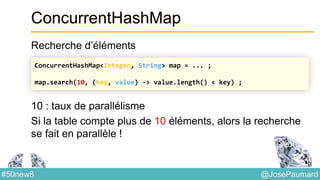
ConcurrentHashMap
Recherche d’éléments
10 : taux de parallélisme
Si la table compte plus de 10 éléments, alors la recherche
se fait en parallèle !
ConcurrentHashMap<Integer, String> map = ... ;
map.search(10, (key, value) -> value.length() < key) ;
@JosePaumard#50new8
ConcurrentHashMap
Recherche d’éléments
10 : taux de parallélisme
Si la table compte plus de 10 éléments, alors la recherche
se fait en parallèle !
On peut passer 0, ou Integer.MAX_VALUE
ConcurrentHashMap<Integer, String> map = ... ;
map.search(10, (key, value) -> value.length() < key) ;
@JosePaumard#50new8
ConcurrentHashMap
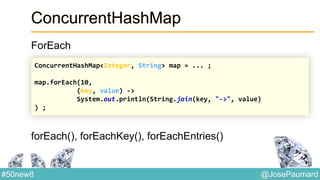
ForEach
forEach(), forEachKey(), forEachEntries()
ConcurrentHashMap<Integer, String> map = ... ;
map.forEach(10,
(key, value) ->
System.out.println(String.join(key, "->", value)
) ;
@JosePaumard#50new8
ConcurrentHashMap
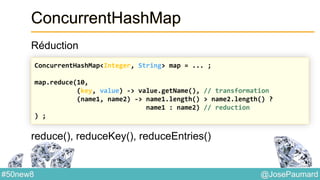
Réduction
reduce(), reduceKey(), reduceEntries()
ConcurrentHashMap<Integer, String> map = ... ;
map.reduce(10,
(key, value) -> value.getName(), // transformation
(name1, name2) -> name1.length() > name2.length() ?
name1 : name2) // reduction
) ;
@JosePaumard#50new8
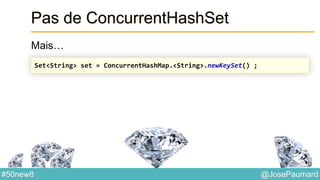
Pas de ConcurrentHashSet
Mais…
Set<String> set = ConcurrentHashMap.<String>.newKeySet() ;
@JosePaumard#50new8
Pas de ConcurrentHashSet
Mais…
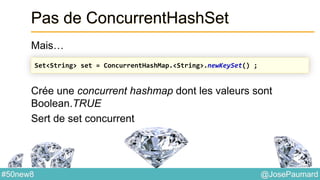
Crée une concurrent hashmap dont les valeurs sont
Boolean.TRUE
Sert de set concurrent
Set<String> set = ConcurrentHashMap.<String>.newKeySet() ;
@JosePaumard
#50new8

50 nouvelles choses que l'on peut faire avec Java 8