Early Awareness of Global Issues and
Development of Soft Skills in Engineering
Education: An Interdisciplinary Approach
to Communication
Adrian Holzer, Samuel Bendahan,
Isabelle Vornèche Cardia, Denis Gillet
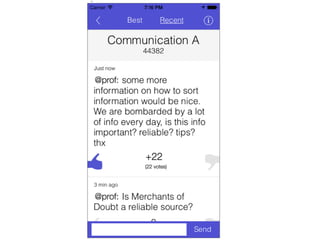
SpeakUp
www.seance.ch
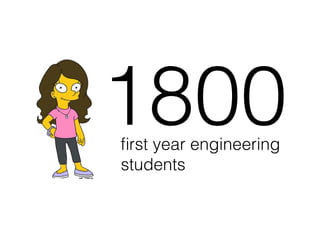
1800first year engineering
students
Challenge
Raise awareness of
interplay between
societal challenges
& technical solutions
Solution
Global Issues
Courses
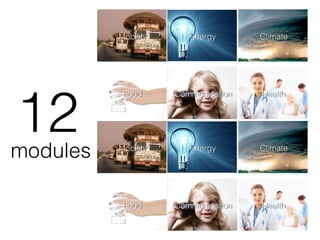
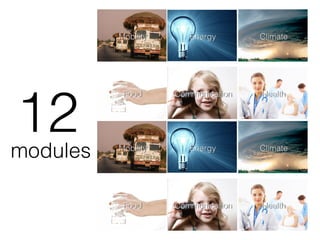
6 Global issues
Mobility
Energy
Climate
Climate
Food
Communication
Health
12modules
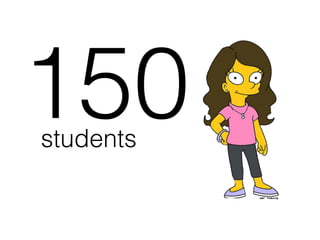
150students
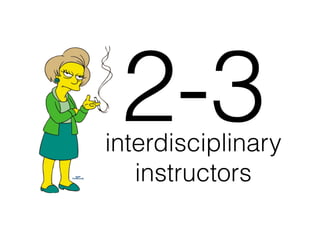
2-3interdisciplinary
instructors
12modules
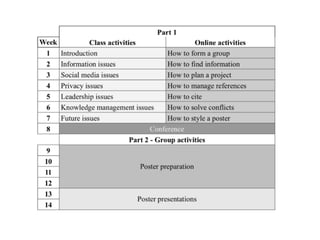
Class activities
Introduction
Week 1
Information
Issues
Week 2
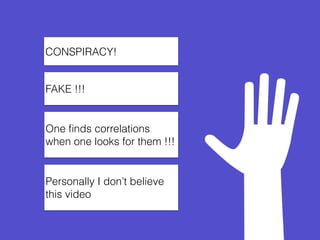
CONSPIRACY!
FAKE !!!
One finds correlations

when one looks for them !!!
Personally I don’t believe
this video
Carl Sagan
(1934-1996)
“Extraordinary
claims require
extraordinary
evidence”
“what can be
asserted without
evidence can be
dismissed without
evidence”
Christopher Hitchens
(1949-2011)
The argument from authority holds little value
Social Media
Issues
Week 3
Privacy
Issues
Week 4
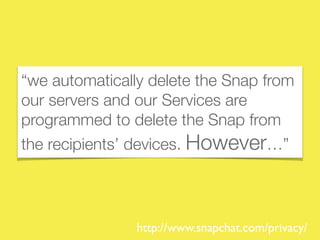
“we automatically delete the Snap from
our servers and our Services are
programmed to delete the Snap from
the recipients’ devices. However…”
http://www.snapchat.com/privacy/
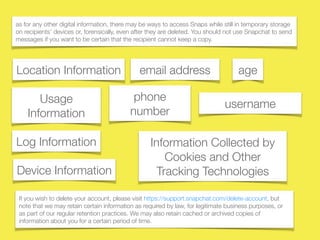
username
as for any other digital information, there may be ways to access Snaps while still in temporary storage
on recipients’ devices or, forensically, even after they are deleted. You should not use Snapchat to send
messages if you want to be certain that the recipient cannot keep a copy.
Usage
Information
Log Information
Device Information
Location Information
Information Collected by
Cookies and Other
Tracking Technologies
If you wish to delete your account, please visit https://support.snapchat.com/delete-account, but
note that we may retain certain information as required by law, for legitimate business purposes, or
as part of our regular retention practices. We may also retain cached or archived copies of
information about you for a certain period of time.
email address
phone
number
age
Leadership
Issues
Week 5
Knowledge
Management
Issues
Week 6
Future
Issues
Week 7
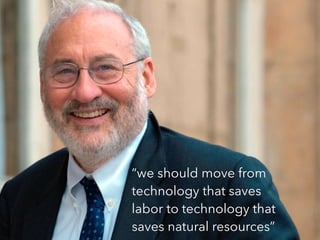
“we should move from
technology that saves
labor to technology that
saves natural resources”
Posters
VISION DU PASSÉ SUR LE FUTUR
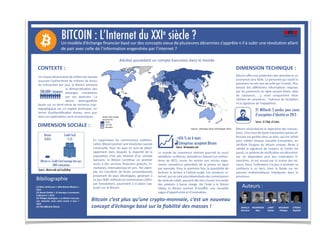
Aperçu de l’évolution du temps de communication quotidien de personne à personne
DÉFIS HUMAINS & TECHNOLOGIQUES
Ces impacts posent de nombreux défis auxquels méde-
cins, patrons, avocats et policitiens doivent essayer de
répondre. Il est en effet difficile de concilier l’omnipré-
sencedelacommunicationaveclavieprivée.Comment
éviter et gérer les addictions et leurs effets? Que faire
face aux guerres numériques? Des études et de nou-
velles lois seraient un bon début, mais il faudra surtout
attendre que la mentalité humaine s’habitue à cette
évolution. Un défi majeur, auquel le projet «Loon» de
Google essaie de répondre, est de réussir à démocra-
tiser internet et assurer son accès partout. Maintenir
des ballons dans la stratosphère pour assurer un accès
internet serait une bonne solution, mais à quels prix
(écologique, ondes en permance, etc.) ?
ET APRÈS?
Que va-t-il advenir par la suite? Il est difficle de ré-
pondre précisément à cette question. D’une part, il est
certain que cette évolution, ou plutôt cette révolution,
continue à bousculer la façon dont le monde commu-
nique, notamment avec les prochains deux milliards
d’internautes des pays émergents. D’autre part, cer-
tainestendancescommencentd’oresetdéjààmontrer
la faiblesse de certains moyens de communication et
canalisent le progès vers les vecteurs gratuits, ouverts,
multi-plateformes et multi-destinataires avec un large
rayon de diffusion.
Nicolas Eklavya Kévin Thibaut Teo
SHS HUM-122(a)
BIBLIOGRAPHIE
PAGES WEB
× ADAMS, Paul, 2010. The Real Life Social Network, SlideShare [en ligne]. 01 Juillet 2010.
Disponible à l’adresse: http://www.slideshare.net/padday/the-real-life-social-network-v2 [Consulté le 11 Mai 2014]
× ISKOLD, Alex, 2007. Evolution of Communication: From Email to Twitter and Beyond, ReadWrite [en ligne]. 30 Mai 2007.
Disponible à l’adresse: http://readwrite.com/2007/05/30/evolution_of_communication.html [Consulté le 11 Mai 2014]
× NICHOLAS, Paul, 2013. Linking Cybersecurity Policy and Performance: Microsoft Releases Special Edition Security Intelligence
Report, Microsoft Trustworthy Computing [en ligne]. 06 Février 2013.
Disponible à l’adresse: http://blogs.technet.com/b/trustworthycomputing/archive/2013/02/06/linking-cybersecurity-poli-
cy-and-performance-microsoft-releases-special-edition-security-intelligence-report.aspx [Consulté le 13 Mai 2014]
IMAGES OU INFOGRAPHIES
× AUBERT, Pierrick, 2014. Le mobile, toujours plus addictif, iGeneration.
Disponible à l’adresse: http://www.igen.fr/igeneration/le-mobile-toujours-plus-addictif-111172
× DONNELLY, Andrew, 2013. Smoke Signals to Smartphones: The Evolution of Communication, Mikogo.
Disponible à l’adresse: https://www.mikogo.com/wp-content/uploads/2013/03/evolution-of-communication-infographic
-full-size.jpg
× WILLINGHAM, Tim, 2011. The Hectic Life of a Social Media Manager, DailyInfographic.
Disponible à l’adresse: http://dailyinfographic.com/wp-content/uploads/2011/03/Socialcast_Hectic_Final.png
× WILLINGHAM, Tim, 2010. The Rise of Social Media Spending, DailyInfographic.
Disponible à l’adresse: http://dailyinfographic.com/wp-content/uploads/2010/09/riceofsocialmedia.png
× How Technology Affects Sleep. 2014. BigBrandBeds.
Disponible à l’adresse: http://www.bigbrandbeds.co.uk/blog/268/how-technology-affects-sleep/
× World Internet Users and Population Stats. 2012. Internet World Stats.
Disponible à l’adresse: http://www.internetworldstats.com/stats.htm
ARTICLES SCIENTIFIQUES OU THÈSES
× CANNARELLA, J., A. Spechler, J., 2014. Epidemiological modeling of online social network dynamics [en ligne]. Princeton,
USA: Princeton University.
Disponible à l’adresse: http://arxiv.org/pdf/1401.4208v1.pdf [Consulté le 13 Mai 2014]
teo.stocco@epfl.ch
IMPACTS DE L’ÉVOLUTION
SOCIAUX : ambiguïté de la frontière entre le réel et le
virtuel, super-connectivité.
SANTÉ : stress, sédentarité, addiction, baisse de som-
meil (mélatonine).
PRODUCTIVITÉ : démocratisation des connaissances,
rapidité de communication.
ÉCONOMIQUE: agrandissement du marché, visibilité,
réseau de partenariat.
POLITIQUE: contrôle, liberté, neutralité de l’informa-
tion, cybercriminalité.
DE NOUVEAUX MOYENS
En une décennie, le nombre de personnes ayant ac-
cès à internet a bondi d’environ 350 millions en 2000
pour atteindre plus de 2,4 milliards en 2014. Selon Mi-
crosoft, ce nombre devrait dépasser les 4 milliards en
2020. Comment cette évolution se traduit-elle dans
notre quotidien? Comment la répartition du temps
de communication a-t-elle évolué et va-t-elle encore
évoluer?
Augmentation du temps de communication journalier
QUEL ÉTAIT LE MONDE EN 2000?
Ce n’est pas toujours facile de se rappeler un monde
sans réseaux sociaux tels que nous les connaissons au-
jourd’hui. Le monde découvrait à peine les premiers
sitesdee-commerceetl’iPods’élaboraitdanslatêtede
Steve Jobs. Les téléphones portables commençaient à
se répandre tandis que MSN Messenger monopolisait
la communication d’ordinateur à ordinateur.
ET MAINTENANT?
Les avancées technologiques se sont succédées et ont
transformé notre quotidien. Cependant tous ces pro-
grès laissent des impacts positifs et négatifs ne permet-
tant plus un retour en arrière. Au diable le téléphone
et les SMS onéreux et peu ergonomiques, bonjour les
chats multi-plateformes et les appels visuels avec les
Google Glass.
MODES SOCIALES
Les réseaux sociaux ne seraient guère qu’une mode. En
effet, une fois le «boum» de lancement passé, ils se-
raient considérés comme trop généraux et ne convien-
draient ainsi pas aux utilisateurs actuels. À l’instar des
groupes d’amis réunis par intérêts, les réseaux sociaux
mettent tous nos «amis» sur le même niveau. Les utili-
sateurs se tourneraient alors vers des moyens de com-
munication ciblés par thème, l’illustration en étant par
exemple le délaissement de Facebook pour Instagram.
PETIT RAYON DE DIFFUSION
LARGE RAYON DE DIFFUSION
OUVERT AUX
REN
C
O
N
TRES
FERM
É
AUX
RENCONTRES
OUVERT A
CONTRES
M
O
N
O
-DESTINATAIRE · MONO-PLATEFORME · COÛT UNITAIRE
CIBLÉ·PARSUJET
GÉNÉRAL·PARAMIS
MULTI-DESTINATAIRES · MULTI-PLATEFORMES · «GRATU
IT
»
FERM
É
AUX
RENCO
M
O
N
O
-DESTINATATA
ATAT
IRE · MO
C
T AUX
REN
C
O
N
TRESIBLÉ·P
PAPAP
RAMIS
LATATA EFORMES · «GRATATA
U
IT
»
FORUM/BLOG
EMAIL
CHAT TEXTUEL
CHAT ORAL / VIDÉO
RÉSEAUXSOCIAUX
COURRIERPOSTAL
TÉLÉPHONESMS / MMS
70
60
50
40
30
20
10
10
20
30
40
50
60
70
2000-2004
Répartition du temps
(minutes par jour) selon les moyens
de communication, sur la base des
habitudes de 150 personnes sondées.
2010-2014
2020-2024
2000-2004 2010-2014 ?
0 heures par jour 1 2 3 4 5
0 minutes par jour 50 100 150 200 300250
LA CENSURE D'INTERNET ET SON IMPACT
T. de Cazenove
L. Bastos Vieira
L. Baligand
F. Revaz
C. Richoz
-
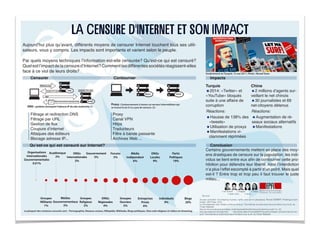
Censurer Contourner
Chine
-
-
Turquie
Réactions: Réactions:
Access controlled : the shaping of power, rights, and rule in cyberspace, Ronald DEIBERT, Politologue Cam-
bridge : MIT Press, 2010
La mondialisation des médias contre la censure: Tiers Monde et audiovisuel sans frontière/ sous la dit. de
Tristan Mattelart
http://contournerlacensure.net/wp-content/uploads/livre/ContournerLaCensure.pdf (1) ; (2)
http://surveillance.rsf.org/chine/ http://www.slate.fr/monde/82241/turquie-erdogan-controle-internet cen-
sure: Tiers Monde et audiovisuel sans frontière/ sous la dit. de Tristan Mattelart
Proxy : Contournement à travers un serveur intermédiaire qui
se trouve là où il n’y a pas de censure. (2)DNS : système renvoyant l’adresse IP du site recherché (1)
GET
Witness.org ?
DNS
WWW
216.92.171.152216.92.171.152
http://www.witness.org/index.html
WWWPROXY
Organisations
Internationales
Gouvernementales
0.01%
Académique
2%
ONGs
Internationales
2%
Gouvernement
3%
Forums
5%
Média
Indépendant
6%
ONGs
Locales
9%
Partis
Politiques
19%
Groupes
Militants
1%
Médias
Gouvernementaux
2%
Groupes
Religieux
2%
ONGs
Régionales
4%
Groupes
Ouvriers
5%
Entreprises
Privés
6%
Individuels
9%
Blogs
20%
La pluspart des contenus censurés sont : Pornographie, Réseaux sociaux, Wikipédia, Wikileaks, Blogs politiques, Sites web religieux et vidéos en streaming.
Sources
-
-
-
Soulévement en Turquie, 15 mai 2011. Photo : Murad Sezer
Evaluations
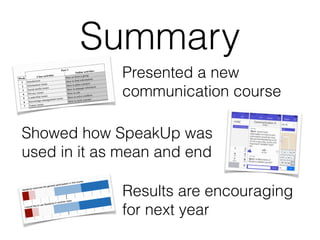
Summary
Presented a new
communication course
Showed how SpeakUp was
used in it as mean and end
Results are encouraging
for next year
Questions?

Global Issues in Communication EPFL

  • 1.
    Early Awareness ofGlobal Issues and Development of Soft Skills in Engineering Education: An Interdisciplinary Approach to Communication Adrian Holzer, Samuel Bendahan, Isabelle Vornèche Cardia, Denis Gillet
  • 2.
  • 4.
  • 5.
  • 6.
    Raise awareness of interplaybetween societal challenges & technical solutions
  • 7.
  • 8.
  • 9.
  • 10.
  • 11.
  • 12.
  • 13.
  • 14.
  • 15.
  • 16.
  • 17.
  • 18.
  • 19.
  • 22.
  • 23.
  • 24.
  • 29.
    CONSPIRACY! FAKE !!! One findscorrelations when one looks for them !!! Personally I don’t believe this video
  • 30.
  • 31.
    “what can be assertedwithout evidence can be dismissed without evidence” Christopher Hitchens (1949-2011)
  • 32.
    The argument fromauthority holds little value
  • 34.
  • 36.
  • 38.
    “we automatically deletethe Snap from our servers and our Services are programmed to delete the Snap from the recipients’ devices. However…” http://www.snapchat.com/privacy/
  • 39.
    username as for anyother digital information, there may be ways to access Snaps while still in temporary storage on recipients’ devices or, forensically, even after they are deleted. You should not use Snapchat to send messages if you want to be certain that the recipient cannot keep a copy. Usage Information Log Information Device Information Location Information Information Collected by Cookies and Other Tracking Technologies If you wish to delete your account, please visit https://support.snapchat.com/delete-account, but note that we may retain certain information as required by law, for legitimate business purposes, or as part of our regular retention practices. We may also retain cached or archived copies of information about you for a certain period of time. email address phone number age
  • 40.
  • 42.
  • 44.
  • 47.
    “we should movefrom technology that saves labor to technology that saves natural resources”
  • 48.
  • 51.
    VISION DU PASSÉSUR LE FUTUR Aperçu de l’évolution du temps de communication quotidien de personne à personne DÉFIS HUMAINS & TECHNOLOGIQUES Ces impacts posent de nombreux défis auxquels méde- cins, patrons, avocats et policitiens doivent essayer de répondre. Il est en effet difficile de concilier l’omnipré- sencedelacommunicationaveclavieprivée.Comment éviter et gérer les addictions et leurs effets? Que faire face aux guerres numériques? Des études et de nou- velles lois seraient un bon début, mais il faudra surtout attendre que la mentalité humaine s’habitue à cette évolution. Un défi majeur, auquel le projet «Loon» de Google essaie de répondre, est de réussir à démocra- tiser internet et assurer son accès partout. Maintenir des ballons dans la stratosphère pour assurer un accès internet serait une bonne solution, mais à quels prix (écologique, ondes en permance, etc.) ? ET APRÈS? Que va-t-il advenir par la suite? Il est difficle de ré- pondre précisément à cette question. D’une part, il est certain que cette évolution, ou plutôt cette révolution, continue à bousculer la façon dont le monde commu- nique, notamment avec les prochains deux milliards d’internautes des pays émergents. D’autre part, cer- tainestendancescommencentd’oresetdéjààmontrer la faiblesse de certains moyens de communication et canalisent le progès vers les vecteurs gratuits, ouverts, multi-plateformes et multi-destinataires avec un large rayon de diffusion. Nicolas Eklavya Kévin Thibaut Teo SHS HUM-122(a) BIBLIOGRAPHIE PAGES WEB × ADAMS, Paul, 2010. The Real Life Social Network, SlideShare [en ligne]. 01 Juillet 2010. Disponible à l’adresse: http://www.slideshare.net/padday/the-real-life-social-network-v2 [Consulté le 11 Mai 2014] × ISKOLD, Alex, 2007. Evolution of Communication: From Email to Twitter and Beyond, ReadWrite [en ligne]. 30 Mai 2007. Disponible à l’adresse: http://readwrite.com/2007/05/30/evolution_of_communication.html [Consulté le 11 Mai 2014] × NICHOLAS, Paul, 2013. Linking Cybersecurity Policy and Performance: Microsoft Releases Special Edition Security Intelligence Report, Microsoft Trustworthy Computing [en ligne]. 06 Février 2013. Disponible à l’adresse: http://blogs.technet.com/b/trustworthycomputing/archive/2013/02/06/linking-cybersecurity-poli- cy-and-performance-microsoft-releases-special-edition-security-intelligence-report.aspx [Consulté le 13 Mai 2014] IMAGES OU INFOGRAPHIES × AUBERT, Pierrick, 2014. Le mobile, toujours plus addictif, iGeneration. Disponible à l’adresse: http://www.igen.fr/igeneration/le-mobile-toujours-plus-addictif-111172 × DONNELLY, Andrew, 2013. Smoke Signals to Smartphones: The Evolution of Communication, Mikogo. Disponible à l’adresse: https://www.mikogo.com/wp-content/uploads/2013/03/evolution-of-communication-infographic -full-size.jpg × WILLINGHAM, Tim, 2011. The Hectic Life of a Social Media Manager, DailyInfographic. Disponible à l’adresse: http://dailyinfographic.com/wp-content/uploads/2011/03/Socialcast_Hectic_Final.png × WILLINGHAM, Tim, 2010. The Rise of Social Media Spending, DailyInfographic. Disponible à l’adresse: http://dailyinfographic.com/wp-content/uploads/2010/09/riceofsocialmedia.png × How Technology Affects Sleep. 2014. BigBrandBeds. Disponible à l’adresse: http://www.bigbrandbeds.co.uk/blog/268/how-technology-affects-sleep/ × World Internet Users and Population Stats. 2012. Internet World Stats. Disponible à l’adresse: http://www.internetworldstats.com/stats.htm ARTICLES SCIENTIFIQUES OU THÈSES × CANNARELLA, J., A. Spechler, J., 2014. Epidemiological modeling of online social network dynamics [en ligne]. Princeton, USA: Princeton University. Disponible à l’adresse: http://arxiv.org/pdf/1401.4208v1.pdf [Consulté le 13 Mai 2014] teo.stocco@epfl.ch IMPACTS DE L’ÉVOLUTION SOCIAUX : ambiguïté de la frontière entre le réel et le virtuel, super-connectivité. SANTÉ : stress, sédentarité, addiction, baisse de som- meil (mélatonine). PRODUCTIVITÉ : démocratisation des connaissances, rapidité de communication. ÉCONOMIQUE: agrandissement du marché, visibilité, réseau de partenariat. POLITIQUE: contrôle, liberté, neutralité de l’informa- tion, cybercriminalité. DE NOUVEAUX MOYENS En une décennie, le nombre de personnes ayant ac- cès à internet a bondi d’environ 350 millions en 2000 pour atteindre plus de 2,4 milliards en 2014. Selon Mi- crosoft, ce nombre devrait dépasser les 4 milliards en 2020. Comment cette évolution se traduit-elle dans notre quotidien? Comment la répartition du temps de communication a-t-elle évolué et va-t-elle encore évoluer? Augmentation du temps de communication journalier QUEL ÉTAIT LE MONDE EN 2000? Ce n’est pas toujours facile de se rappeler un monde sans réseaux sociaux tels que nous les connaissons au- jourd’hui. Le monde découvrait à peine les premiers sitesdee-commerceetl’iPods’élaboraitdanslatêtede Steve Jobs. Les téléphones portables commençaient à se répandre tandis que MSN Messenger monopolisait la communication d’ordinateur à ordinateur. ET MAINTENANT? Les avancées technologiques se sont succédées et ont transformé notre quotidien. Cependant tous ces pro- grès laissent des impacts positifs et négatifs ne permet- tant plus un retour en arrière. Au diable le téléphone et les SMS onéreux et peu ergonomiques, bonjour les chats multi-plateformes et les appels visuels avec les Google Glass. MODES SOCIALES Les réseaux sociaux ne seraient guère qu’une mode. En effet, une fois le «boum» de lancement passé, ils se- raient considérés comme trop généraux et ne convien- draient ainsi pas aux utilisateurs actuels. À l’instar des groupes d’amis réunis par intérêts, les réseaux sociaux mettent tous nos «amis» sur le même niveau. Les utili- sateurs se tourneraient alors vers des moyens de com- munication ciblés par thème, l’illustration en étant par exemple le délaissement de Facebook pour Instagram. PETIT RAYON DE DIFFUSION LARGE RAYON DE DIFFUSION OUVERT AUX REN C O N TRES FERM É AUX RENCONTRES OUVERT A CONTRES M O N O -DESTINATAIRE · MONO-PLATEFORME · COÛT UNITAIRE CIBLÉ·PARSUJET GÉNÉRAL·PARAMIS MULTI-DESTINATAIRES · MULTI-PLATEFORMES · «GRATU IT » FERM É AUX RENCO M O N O -DESTINATATA ATAT IRE · MO C T AUX REN C O N TRESIBLÉ·P PAPAP RAMIS LATATA EFORMES · «GRATATA U IT » FORUM/BLOG EMAIL CHAT TEXTUEL CHAT ORAL / VIDÉO RÉSEAUXSOCIAUX COURRIERPOSTAL TÉLÉPHONESMS / MMS 70 60 50 40 30 20 10 10 20 30 40 50 60 70 2000-2004 Répartition du temps (minutes par jour) selon les moyens de communication, sur la base des habitudes de 150 personnes sondées. 2010-2014 2020-2024 2000-2004 2010-2014 ? 0 heures par jour 1 2 3 4 5 0 minutes par jour 50 100 150 200 300250
  • 52.
    LA CENSURE D'INTERNETET SON IMPACT T. de Cazenove L. Bastos Vieira L. Baligand F. Revaz C. Richoz - Censurer Contourner Chine - - Turquie Réactions: Réactions: Access controlled : the shaping of power, rights, and rule in cyberspace, Ronald DEIBERT, Politologue Cam- bridge : MIT Press, 2010 La mondialisation des médias contre la censure: Tiers Monde et audiovisuel sans frontière/ sous la dit. de Tristan Mattelart http://contournerlacensure.net/wp-content/uploads/livre/ContournerLaCensure.pdf (1) ; (2) http://surveillance.rsf.org/chine/ http://www.slate.fr/monde/82241/turquie-erdogan-controle-internet cen- sure: Tiers Monde et audiovisuel sans frontière/ sous la dit. de Tristan Mattelart Proxy : Contournement à travers un serveur intermédiaire qui se trouve là où il n’y a pas de censure. (2)DNS : système renvoyant l’adresse IP du site recherché (1) GET Witness.org ? DNS WWW 216.92.171.152216.92.171.152 http://www.witness.org/index.html WWWPROXY Organisations Internationales Gouvernementales 0.01% Académique 2% ONGs Internationales 2% Gouvernement 3% Forums 5% Média Indépendant 6% ONGs Locales 9% Partis Politiques 19% Groupes Militants 1% Médias Gouvernementaux 2% Groupes Religieux 2% ONGs Régionales 4% Groupes Ouvriers 5% Entreprises Privés 6% Individuels 9% Blogs 20% La pluspart des contenus censurés sont : Pornographie, Réseaux sociaux, Wikipédia, Wikileaks, Blogs politiques, Sites web religieux et vidéos en streaming. Sources - - - Soulévement en Turquie, 15 mai 2011. Photo : Murad Sezer
  • 53.
  • 59.
    Summary Presented a new communicationcourse Showed how SpeakUp was used in it as mean and end Results are encouraging for next year
  • 60.