Serge Ravet 

Open Recognition Alliance
Du ePortfolio aux
Open Badges
Les	outils	de	la	reconnaissance
LES	OUTILS	DE	LA	RECONNAISSANCE	
ePortfolios	et	Open	Badges	
1
DE	LA	RECONNAISSANCE	
Reconnaissance	formelle	et	informelle
2
VERS	UNE	SOCIÉTÉ	APPRENANTE		
Le	pouvoir	d’agir	
4
DE	LA	CONFIANCE	
Economie	du	capital	humain
3
Sommaire
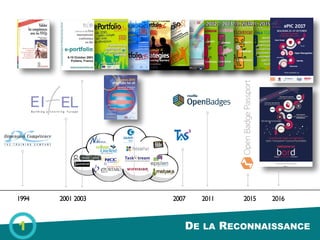
1994 2001 2003 2007 2011 2015 2016
3
CONTEXTE
4
ePortfolio
Open 

Badges
Open
Recognition
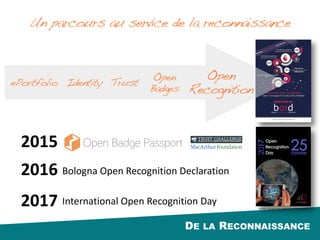
2015
2016 Bologna	Open	Recognition	Declaration
Un parcours au service de la reconnaissance
2017
CONTEXTE
TrustIdentity
International	Open	Recognition	Day
1
5
LES OUTILS DE LA RECONNAISSANCE
ePortfolios	et	Open	Badges
LES OUTILS DE LA RECONNAISSANCE
1
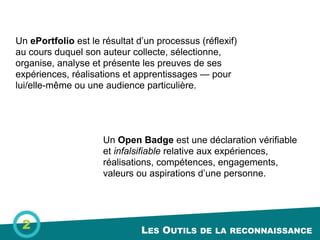
Un ePortfolio est le résultat d’un processus (réflexif)
au cours duquel son auteur collecte, sélectionne,
organise, analyse et présente les preuves de ses
expériences, réalisations et apprentissages — pour
lui/elle-même ou une audience particulière.
Un Open Badge est une déclaration vérifiable
et infalsifiable relative aux expériences,
réalisations, compétences, engagements,
valeurs ou aspirations d’une personne.
LES OUTILS DE LA RECONNAISSANCE
UNE VISION DU EPORTFOLIO
Retour	sur	une	présentation	de	2009
Qu’est-ce qu’un ePortfolio?
Portfolio: a purposeful collection of
evidence demonstrating reflective
practice and/or learning
ePORTFOLIO
PORTFOLIO
Nature
Narratifs
Propos
Usage
Durée
Dimension
Contenus
Processus
Technologies
Format
Futur
Individuel

Indépendants

Unique

Discret

Une fois

Locale

Documents

Compilation

Media

Mixed media

Sans papier
Social

Imbriqués

Multiple

Continu

Tout au long...vie

Globale

Connaissances

Agrégation

Processus

Hypermedia

Identité
PORTFOLIO
ePORTFOLIO
Innovation
Employability
QualitySocial inclusion
Learning
citizen
Learning
Organisation
Learning
Society
Learning
Community
Lifelong
learning
Ambient
learning
Autonomous
learning
Organisational
learning
Recognition
Organisational ePortfolioIndividual ePortfolioRegional ePortfolioCommunity ePortfolio
From ePortfolio to ePortfoly
“The great pleasure and feeling
in my right brain is more than
my left brain can find the words
to tell you.”
Roger Sperry
1981 Medicine Nobel prize
The ePortfolio offers the opportunity to
realise H.G.Wells' vision in his essay "The
Brain Organization of the ModernWorld":
"...a sort of mental clearing house for the
mind, a depot where knowledge and ideas
are received, sorted, summarized, digested,
clarified and compared."
World Brain: The Idea of a PermanentWorld Encyclopaedia, H.G.Wells
Contribution to the new Encyclopédie Française, August1937
The University today faces the possibility of being itself transformed
by the cyberspace culture generated by its computing centres and
networks. Just as the printing press spelled the demise of monastic
institutions and ushered in the modern university, cyberspace may
dissolve the bricks and mortar campuses of today into a de-centred
knowledge culture, a networked "virtual" site of intellectual exchange
that renders obsolete old ivied quadrangles as well as institutional and
political borders, creating something akin to H.G. Wells's vision of a
‘World Brain’.

Peter Childers & Paul Delany (1994)
World Brain: The Idea of a PermanentWorld Encyclopaedia, H.G.Wells
Contribution to the new Encyclopédie Française, August1937
http://www.eportfolio.eu/collaboration/eportfolio-green-paper
Les questions qui dérangent
Why doesn't everyone have an ePortfolio?
If ePortfolios are such a wonderful thing, we should
all have one, shouldn’t we? Why isn’t this the
case? […]
Put differently, what is the causal relationship? Is
the underdevelopment of ePortfolios an indicator of
the current underdevelopment of authentic learning
and assessment, or do we seriously believe that
any valuable ePortfolio practice can take place in
an unauthentic, artificial learning environment?
Introductory question:
• Why doesn't everyone have an ePortfolio?
ePortfolio and stakeholders:
• Who really benefits from the introduction of ePortfolios in
an organisation? Who has the real ownership?
• Are ePortfolios the authentic voice of the learner?
• Why have we not seen the emergence of community ePortfolios?
ePortfolio and learning:
• Do we need ePortfolios to learn?
• Do we need ePortfolios to reflect?
• Are ePortfolios conducive to better learning?
• Do ePortfolios motivate learners?
• Can ePortfolios be graded?
ePortfolio and technologies:
• Have ePortfolios reduced the asymmetry of the learning environment?
• Are there technologies specific to ePortfolios?
• Who are the main beneficiaries of ePortfolio technologies?
• Could ePortfolio technology be designed and managed with and by
the learners?
• What is an Open ePortfolio?
Learning, ePortfolios and innovation:
• What is the actual impact of ePortfolio on learning and teaching
practice?
• Are ePortfolios a disruptive innovation?
• What innovations in ePortfolio technologies over the last 10 years?
• Do ePortfolios encourage innovation and creativity?
• Under which conditions could the introduction of ePortfolios lead to
learning innovation?
ePortfolios & Open Badges:
• Are Open Badges a nice add-on to ePortfolios or a means to reinvent
ePortfolio technology and practice?
ePortfolio Green Paper
LES OUTILS DE LA RECONNAISSANCE17
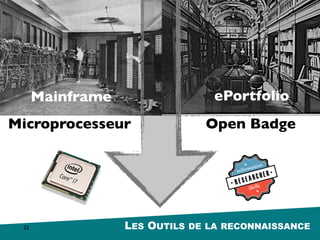
ePortfolioMainframe
Open BadgeMicroprocesseur
LES OUTILS DE LA RECONNAISSANCE18
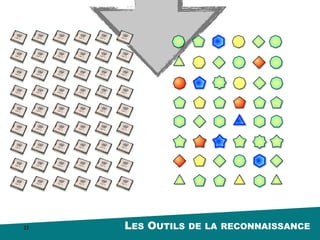
LES OUTILS DE LA RECONNAISSANCE19
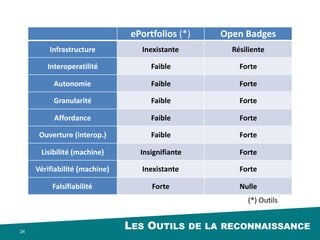
ePortfolios	(*) Open	Badges
Infrastructure Inexistante Résiliente
Interoperatilité Faible Forte
Autonomie Faible Forte
Granularité Faible Forte
Affordance Faible Forte
Ouverture	(interop.) Faible Forte
Lisibilité	(machine) Insignifiante Forte
Vérifiabilité	(machine) Inexistante Forte
Falsifiabilité Forte Nulle
(*)	Outils
LES OUTILS DE LA RECONNAISSANCE
20
Open
badges
LES OUTILS DE LA RECONNAISSANCE
21
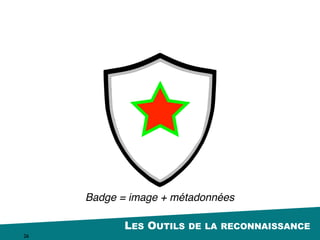
Badge = image + métadonnées
LES OUTILS DE LA RECONNAISSANCE
22
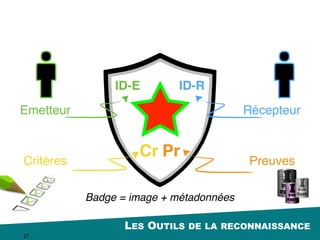
RécepteurEmetteur
Preuves
ID-E ID-R
Pr
Critères
Cr
Badge = image + métadonnées
LES OUTILS DE LA RECONNAISSANCE
23
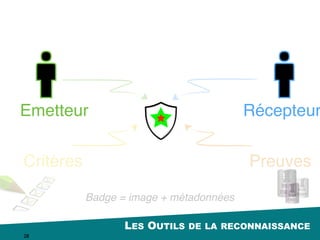
RécepteurEmetteur
PreuvesCritères
Badge = image + métadonnées
LES OUTILS DE LA RECONNAISSANCE
24
RécepteurEmetteur
PreuvesCritères
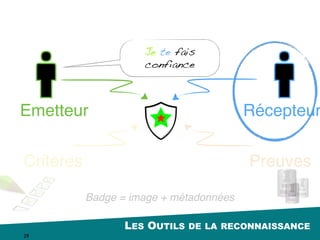
Je te fais
confiance
Badge = image + métadonnées
LES OUTILS DE LA RECONNAISSANCE
25
RécepteurEmetteur
PreuvesCritères
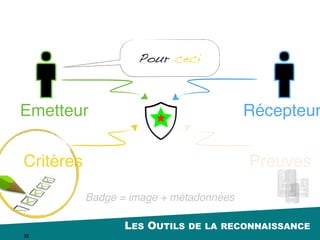
Pour ceci
Badge = image + métadonnées
LES OUTILS DE LA RECONNAISSANCE
26
RécepteurEmetteur
PreuvesCritères
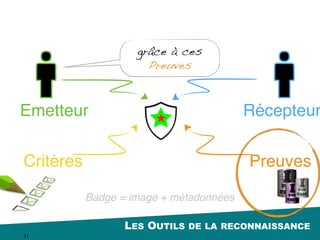
grâce à ces
Preuves
Badge = image + métadonnées
LES OUTILS DE LA RECONNAISSANCE
27
Issuer
Confiance
LES OUTILS DE LA RECONNAISSANCE
28
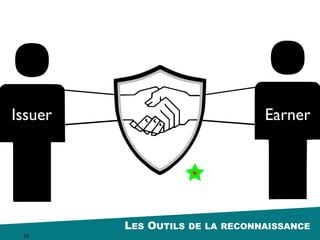
Issuer Earner
LES OUTILS DE LA RECONNAISSANCE
29
LES OUTILS DE LA RECONNAISSANCE
30
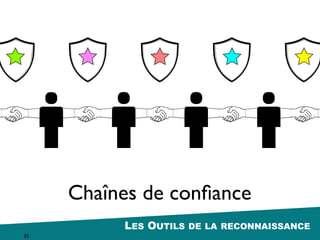
Chaînes de confiance
LES OUTILS DE LA RECONNAISSANCE
31
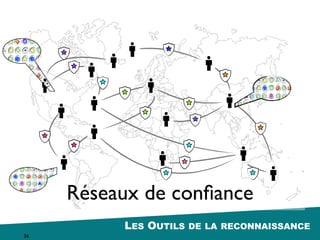
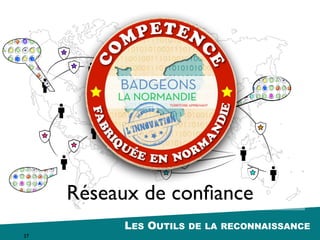
Réseaux de confiance
LES OUTILS DE LA RECONNAISSANCE
32
Réseaux de confiance
2
33
DE LA RECONNAISSANCE
Reconnaissance	formelle	et	informelle
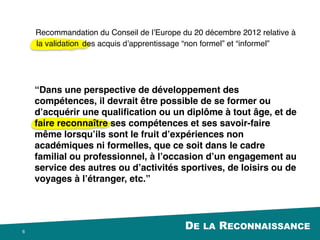
Recommandation du Conseil de l’Europe du 20 décembre 2012 relative à
DE LA RECONNAISSANCE34
“Dans une perspective de développement des
compétences, il devrait être possible de se former ou
d’acquérir une qualification ou un diplôme à tout âge, et de
faire reconnaître ses compétences et ses savoir-faire
même lorsqu’ils sont le fruit d’expériences non
académiques ni formelles, que ce soit dans le cadre
familial ou professionnel, à l’occasion d’un engagement au
service des autres ou d’activités sportives, de loisirs ou de
voyages à l’étranger, etc.”
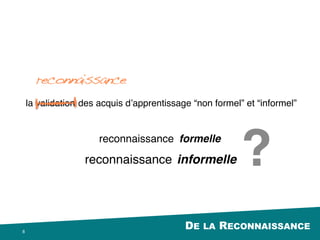
la validation des acquis d’apprentissage “non formel” et “informel”
DE LA RECONNAISSANCE35
la validation des acquis d’apprentissage “non formel” et “informel”
reconnaissancevalidation <=> formelle
la validation des acquis d’apprentissage “non formel” et “informel”
DE LA RECONNAISSANCE36
reconnaissance
reconnaissance
reconnaissance formelle
informelle ?
I
I
I
DE LA RECONNAISSANCE37
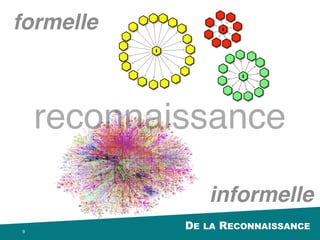
reconnaissance
formelle
informelle
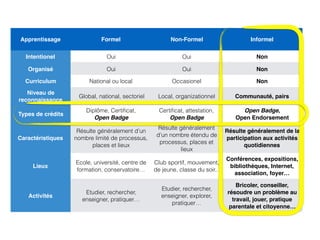
Apprentissage Formel Non-Formel Informel
Intentionel Oui Oui Non
Organisé Oui Oui Non
Curriculum National ou local Occasionel Non
Niveau de
reconnaissance
Global, national, sectoriel Local, organizationnel Communauté, pairs
Types de crédits
Diplôme, Certificat,

Open Badge
Certificat, attestation,
Open Badge
Open Badge, 

Open Endorsement
Caractéristiques
Résulte généralement d’un
nombre limité de processus,
places et lieux
Résulte généralement
d’un nombre étendu de
processus, places et
lieux
Résulte généralement de la
participation aux activités
quotidiennes
Lieux
Ecole, université, centre de
formation, conservatoire…
Club sportif, mouvement,
de jeune, classe du soir...
Conférences, expositions,
bibliothèques, Internet,
association, foyer…
Activités
Etudier, rechercher,
enseigner, pratiquer…
Etudier, rechercher,
enseigner, explorer,
pratiquer…
Bricoler, conseiller,
résoudre un problème au
travail, jouer, pratique
parentale et citoyenne…
DE LA RECONNAISSANCE39
Reconnaissance
DE LA RECONNAISSANCE
40
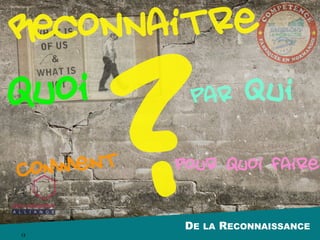
?quoi Par Qui
Comment Pour quoi faire
Reconnaitre
DE LA RECONNAISSANCE
41
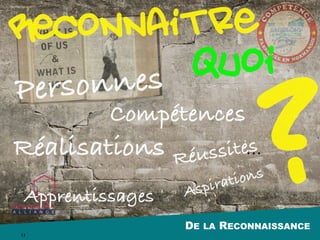
Personnes
Compétences
Réalisations
Réussites
quoi
?…
Apprentissages Aspirations
Reconnaitre
DE LA RECONNAISSANCE
42
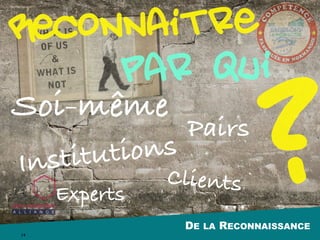
Soi-même
Pairs
Institutions
Clients
Par qui
?…Experts
Reconnaitre
DE LA RECONNAISSANCE
43
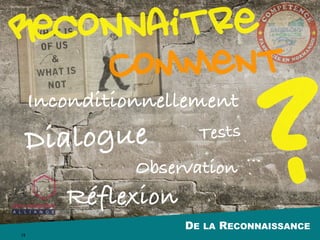
Dialogue
Inconditionnellement
Réflexion
Observation
Comment
?…
Tests
Reconnaitre
DE LA RECONNAISSANCE
44
Pourquoi
?
Reconnaitre
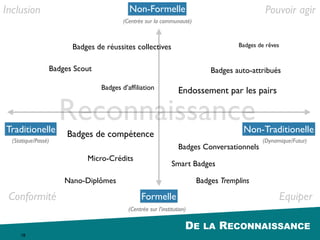
Reconnaissance
DE LA RECONNAISSANCE
45
Formelle
Non-Formelle
Traditionelle Non-Traditionelle
Badges de compétence
Micro-Crédits
Smart Badges
Badges Conversationnels
Badges auto-attribués
Endossement par les pairs
Badges Scout
(Centrée sur l’institution)
(Centrée sur la communauté)
Nano-Diplômes
(Dynamique/Futur)(Statique/Passé)
Badges Tremplins
Badges de rêvesBadges de réussites collectives
Pouvoir agir
Conformité
Inclusion
Equiper
Badges d’affiliation
DE LA RECONNAISSANCE
46
http://www.cma-lifelonglearning.org/video/Interview%20De%20Peretti.mp4
Interview d’André
de Peretti réalisé
par Anny Piau et
Bernard Liétard,
Image et montage
Claude Villereau

© CMA
DE LA RECONNAISSANCE
47
Identite
`Reconnaissance
&
DE LA RECONNAISSANCE48
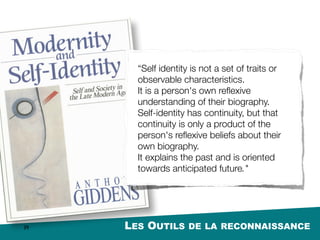
“Self identity is not a set of traits or
observable characteristics. 

It is a person's own reflexive
understanding of their biography.
Self-identity has continuity, but that
continuity is only a product of the
person's reflexive beliefs about their
own biography.
It explains the past and is oriented
towards anticipated future."
DE LA RECONNAISSANCE49
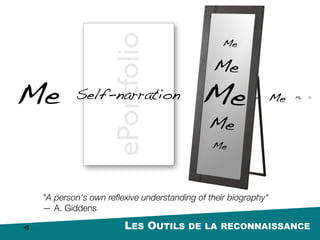
Me Self-narration Me
Me
Me
Me
Me
"A person's own reflexive understanding of their biography"
— A. Giddens
ePortfolio
Me Me Me
DE LA RECONNAISSANCE50
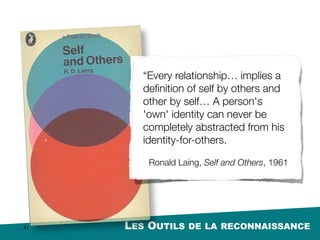
“Every relationship… implies a definition of
self by others and other by self… A person's
'own' identity can never be completely
abstracted from his identity-for-others.
Ronald Laing, Self and Others, 1961
DE LA RECONNAISSANCE51
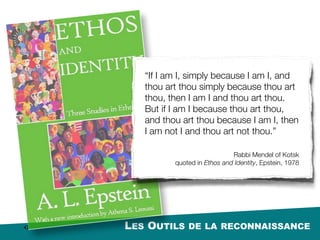
“If I am I, simply because I am I, and thou art
thou simply because thou art thou, then I am I
and thou art thou. But if I am I because thou art
thou, and thou art thou because I am I, then I
am not I and thou art not thou.”
Rabbi Mendel of Kotsk

quoted in Ethos and Identity, Epstein, 1978
DE LA RECONNAISSANCE52
“L’identité n’est pas seulement une procédure réflexive
ou narrative, elle ne se limite pas au domaine de la
représentation ou du récit. Son rôle le plus important
est ailleurs, dans un domaine où on n’a guère
l’habitude de le situer : les conditions de l’action dans
la modernité.”
Jean-Claude Kaufmann, l’invention de soi (p. 173)
DE LA RECONNAISSANCE53
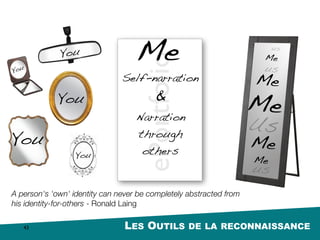
Me
Self-narration
You
You
You
You
Narration
through
others
&
You
Me
Me
Me
Me
Me
A person's 'own' identity can never be completely abstracted from
his identity-for-others - Ronald Laing
ePortfolio
us
us
Us
us
DE LA RECONNAISSANCE54
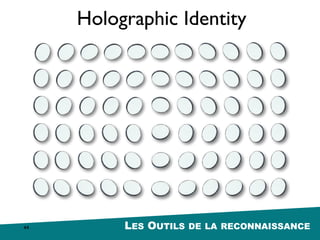
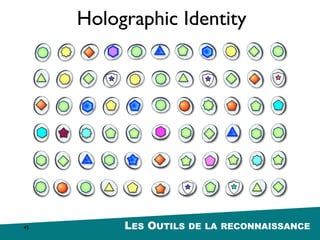
Holographic Identity
DE LA RECONNAISSANCE55
Holographic Identity
DE LA RECONNAISSANCE
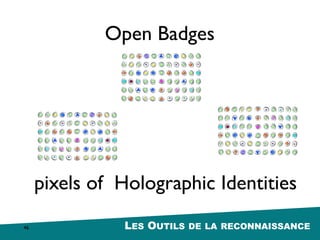
Open Badges
Holographic Identitiespixels of
56
DE LA RECONNAISSANCE57
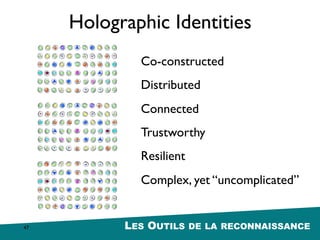
Distributed
Trustworthy
Complex, yet “uncomplicated”
Co-constructed
Connected
Resilient
Holographic Identities
3
58
DE LA CONFIANCE
Economie	du	capital	humain
DE LA CONFIANCE59
3
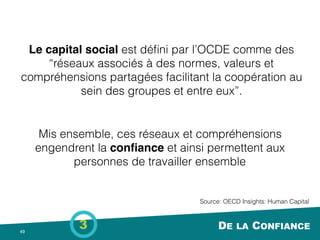
Le capital social est défini par l’OCDE comme des
“réseaux associés à des normes, valeurs et
compréhensions partagées facilitant la coopération au
sein des groupes et entre eux”.
Source: OECD Insights: Human Capital
Mis ensemble, ces réseaux et compréhensions
engendrent la confiance et ainsi permettent aux
personnes de travailler ensemble
DE LA CONFIANCE
60
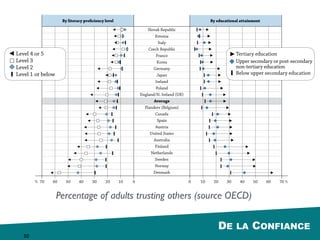
Percentage of adults trusting others (source OECD)Countries are ranked in ascending order of the proportion of people with tertiary education reporting that they trust others.
Source: OECD. Table A8.3a (L). See Annex 3 for notes (www.oecd.org/edu/eag.htm).
70 7050 5030 3010 100 060 6040 4020 20% %
By literacy proficiency level By educational attainment
Slovak Republic
Estonia
Italy
Czech Republic
France
Korea
Germany
Japan
Ireland
Poland
England/N. Ireland (UK)
Average
Flanders (Belgium)
Canada
Spain
Austria
United States
Australia
Finland
Netherlands
Sweden
Norway
Denmark
12 http://dx.doi.org/10.1787/888933116699
A8
Chart A8.4. Percentage of adults reporting that they trust others,
by educational attainment and literacy proficiency level (2012)
Survey of Adult Skills, 25-64 year-olds
Level 4 or 5
Level 3
Level 2
Level 1 or below
By literacy proficiency level By educational attainment
Below upper secondary education
Upper secondary or post-secondary
non-tertiary education
Tertiary education
Slovak Republic
Estonia
Italy
Czech Republic
France
Korea
Germany
Japan
Ireland
Poland
England/N. Ireland (UK)
Average
Flanders (Belgium)
Canada
Spain
Austria
United States
Australia
Chart A8.4. Percentage of adults reporting that they trust others,
by educational attainment and literacy proficiency level (2012)
Survey of Adult Skills, 25-64 year-olds
Level 4 or 5
Level 3
Level 2
Level 1 or below
By literacy proficiency level By educational attainment
Below upper secondary education
Upper secondary or post-secondary
non-tertiary education
Tertiary education
Slovak Republic
Estonia
Italy
Czech Republic
France
Korea
Germany
Japan
Ireland
Poland
England/N. Ireland (UK)
Average
Flanders (Belgium)
Canada
Spain
Austria
DE LA CONFIANCE61
onomiques
s enquêtes
qu’ailleurs,
rché. Cette
mmuables,
al français.
s capacités
ider de son
ques et les
nnées 1950
e déficit de
et, surtout,
e. »
ert, Le Point
tatisme. »
ti, Les Échos
5 €
78-2-7288-0396-5
SN 1951-7637
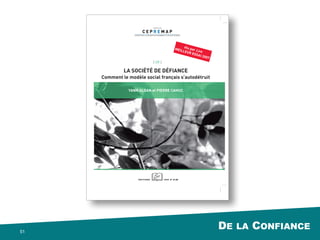
LA SOCIÉTÉ DE DÉFIANCE
Comment le modèle social français s’autodétruit
YANN ALGAN et PIERRE CAHUC
| 09 |
LASOCIÉTÉDEDÉFIANCE
09
élu par Lire
MEILLEUR ESSAI 2007
RUED’ULM
10
En toute logique, l’opinion selon laquelle on ne peut arriver au sommet
sans être corrompu devrait avoir pour contrepartie une défiance envers
Figure 1 – Part des personnes qui répondent
« Pour arriver au sommet, il est nécessaire d’être corrompu ».
Source : International Social Survey Program, 1999.
0,1 0,2 0,3 0,4 0,5 0,6 0,7 0,8 0,9
Norvège
États-Unis
Canada
Australie
Royaume-Uni
Suisse
Espagne
Allemagne
Hongrie
Portugal
République
tchèque
France
Japon
Pologne
Russie
DE LA CONFIANCE62
Figure 3 – Part des personnes qui déclarent
n’avoir « aucune confiance » dans le parlement.
Les autres réponses possibles sont : « totalement confiance », « confiance », « peu confiance ».
Source : World Values Survey, 2000.
Norvège
Pays-Bas
Suède
Danemark
Finlande
Autriche
Espagne
Suisse
Portugal
Canada
Australie
Allemagne
Royaume-Uni
Italie
Irlande
Belgique
Pologne
Japon
Hongrie
France
Grèce
République
tchèque
Turquie
Mexique
n’avoir aucune confiance en la justice. Ils ne sont précédés que par lesTurcs
et les Belges. À l’inverse, une telle défiance s’exprime uniquement chez
7 % des Allemands et 2,2 % des Danois. Si on additionne le pourcentage
Figure 2 – Part des personnes qui déclarent
n’avoir « aucune confiance » en la justice.
Les autres réponses possibles sont :« totalement confiance », « confiance », « peu de confiance ».
Source : World Values Survey, 2000.
Danemark
Norvège
Finlande
Autriche
Suède
Suisse
Allemagne
Irlande
Pays-Bas
Australie
Royaume-Uni
Espagne
Pologne
Grèce
Hongrie
Portugal
Italie
République
tchèque
France
Belgique
Turquie
France
France
DE LA CONFIANCE63
Figure 7c – Part de personnes qui déclarent « trouver injustifiable
d’accepter un pot-de-vin dans l’exercice de ses fonctions ».
Source : World Values Survey, 1980-2000.
0,5 0,55 0,6 0,65 0,7 0,75 0,8 0,85 0,9 0,95
France
Belgique
Mexique
Allemagne
Pays-Bas
Japon
Autriche
Italie
Suède
Portugal
Royaume-Uni
Canada
Espagne
Suisse
Australie
États-Unis
Norvège
Irlande
Pologne
Chine
Danemark
Figure 5 – Part des personnes qui répondent
« Il est possible de faire confiance aux autres »
à la question : « En règle générale, pensez-vous qu’il est possible
de faire confiance aux autres ou que l’on est jamais assez méfiant ? ».
Source : World Values Survey, 1990 et 2000.
0 0,1 0,2 0,3 0,4 0,5 0,6 0,7 0,8
Turquie
Portugal
France
Hongrie
Grèce
Pologne
République
tchèque
Mexique
Belgique
Autriche
Italie
Inde
Espagne
Royaume-Uni
Allemagne
Irlande
Japon
Suisse
Canada
États-Unis
Chine
Pays-Bas
Finlande
Danemark
Suède
Norvège
France
France
DE LA CONFIANCE64
Open	Badges
Reconnaissance
Confiance
DE LA CONFIANCE65
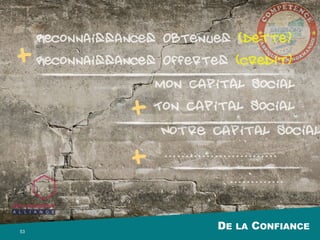
Reconnaissances Obtenues (dette) 

Reconnaissances Offertes (credit)
Mon Capital Social
Ton Capital Social
Notre Capital Social
…………………..….
………….
+
+
+
DE LA CONFIANCE66
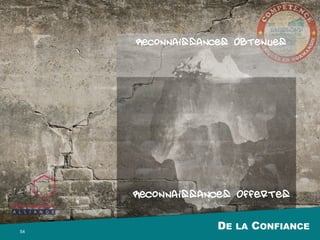
Reconnaissances Obtenues
Reconnaissances Offertes
DE LA CONFIANCE
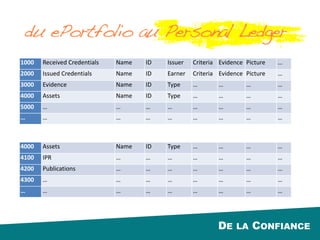
du ePortfolio au Personal Ledger
1000 Received	Credentials Name ID Issuer Criteria Evidence Picture …
2000 Issued	Credentials Name ID Earner Criteria Evidence Picture …
3000 Evidence Name ID Type … … … …
4000 Assets	 Name ID Type … … … …
5000 … … … … … … … …
… … … … … … … … …
4000 Assets	 Name ID Type … … … …
4100 IPR … … … … … … …
4200 Publications … … … … … … …
4300 … … … … … … … …
… … … … … … … … …
DE LA CONFIANCE
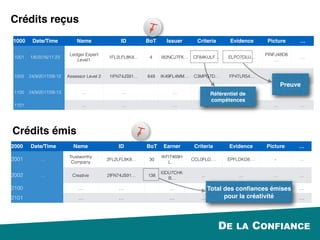
1000 Date/Time Name ID BoT Issuer Criteria Evidence Picture …
1001 1/6/2016/11:23
Ledger Expert
Level1
1FL2LFL8K8… 4 I82NCJ7FK… CF84KULF… ELPO7DUJ… PINFJ48D6… …
1002 24/9/2017/09:12 Assessor Level 2 1IFN74JS91… 849 IK49FL4MM… C3MPG7D… FP4TLRS4… null …
1100 24/9/2017/09:13 … … … … … … …
1101 … … … … … … …
Crédits reçus
Crédits émis
2000 Date/Time Name ID BoT Earner Criteria Evidence Picture …
2001 …
Trustworthy
Company
2FL2LFL8K8… 30
IKFI7469HL
…
CCL0FLD.… EPFLDKD8… - …
2002 … Creative 2IFN74JS91… 138
I0DU7CHK
B…
… … … …
2100 … … … … … … …
2101 … … … … … … …
Preuve
Référentiel de
compétences
Total des confiances émises
pour la créativité
DE LA CONFIANCE
La	“monnaie”	(infongible)	d’une	
économie	de	la	reconnaissance.
Open	Badges
DE LA CONFIANCE
Le	“porte-monnaie”	ou	“livre	de	
compte	personnel”	de	l’économie	
de	la	reconnaissance…
ePortfolios
Open	Badges La	“monnaie”	(infongible)	d’une	
économie	de	la	reconnaissance.
DE LA CONFIANCE
Les	Open	Badges	sont	plus	que	des	images	
à	coller	(ou	à	colorier	!)	dans	un	portfolio!
ePortfolios
Open	Badges
4
72
VERS UNE SOCIÉTÉ APPRENANTE
Le	pouvoir	d’agir
VERS UNE SOCIÉTÉ APPRENANTE 73
4
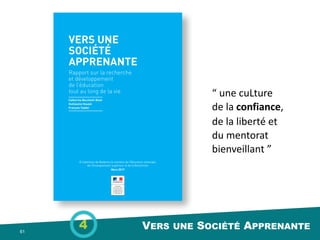
Rapport sur la recherche
et développement
de l’éducation
tout au long de la vie
Catherine Becchetti-Bizot
Guillaume Houzel
François Taddei
VERS UNE
SOCIÉTÉ
APPRENANTE
À l’attention de Madame la ministre de l’Éducation nationale,
de l’Enseignement supérieur et de la Recherche
Mars 2017
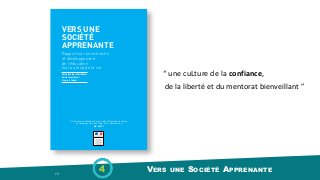
“	une	cuLture	de	la	confiance,
de	la	liberté	et	du	mentorat	bienveillant	”
VERS UNE SOCIÉTÉ APPRENANTE74
“	une	cuLture	de	la	confiance,
de	la	liberté	et	du	mentorat	bienveillant	”
[de	la	reconnaissance]
VERS UNE SOCIÉTÉ APPRENANTE 75
Reconnaissance	Souveraine
le	pouvoir	d’exprimer	sa	reconnaissance
Donner	à	chacun		
(et	pas	simplement	aux	“autorités	constituées”)	:
le	pouvoir	d’exprimer	sa	confiance
le	pouvoir	d’agir	!
VERS UNE SOCIÉTÉ APPRENANTE 76
La	reconnaissance	est	la	compétence	clé,	
celle	sous-jacente	à	toutes	les	autres
La	reconnaissance	n’intervient	pas	
qu’après	l’acte	pédagogique
Reconnaissance	Souveraine
Elle	le	fonde!
VERS UNE SOCIÉTÉ APPRENANTE 77
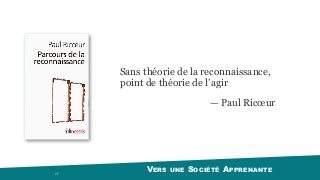
Sans théorie de la reconnaissance,
point de théorie de l’agir
— Paul Ricœur
VERS UNE SOCIÉTÉ APPRENANTE 
78
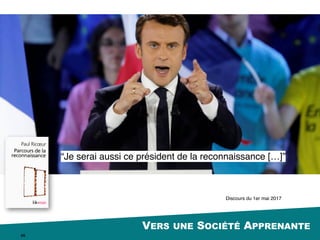
“Je serai aussi ce président de la reconnaissance […]”
Discours du 1er mai 2017
79
La reconnaissance est la
seule dette qu'un débiteur
aime à voir s'accroître.
—Friedrich Nietzsche
CONTACTS80
Merci	de	votre	
Attention	!
Serge	Ravet	
Open	Recognition	Alliance,	Bit	of	Trust	
@szerge

Réinventer le ePortfolio avec les Open Badges ? Les outils de la reconnaissance

  • 1.
    Serge Ravet 
 OpenRecognition Alliance Du ePortfolio aux Open Badges Les outils de la reconnaissance
  • 2.
  • 3.
    1994 2001 20032007 2011 2015 2016 3 CONTEXTE
  • 4.
    4 ePortfolio Open 
 Badges Open Recognition 2015 2016 Bologna Open Recognition Declaration Unparcours au service de la reconnaissance 2017 CONTEXTE TrustIdentity International Open Recognition Day
  • 5.
    1 5 LES OUTILS DELA RECONNAISSANCE ePortfolios et Open Badges
  • 6.
    LES OUTILS DELA RECONNAISSANCE 1 Un ePortfolio est le résultat d’un processus (réflexif) au cours duquel son auteur collecte, sélectionne, organise, analyse et présente les preuves de ses expériences, réalisations et apprentissages — pour lui/elle-même ou une audience particulière. Un Open Badge est une déclaration vérifiable et infalsifiable relative aux expériences, réalisations, compétences, engagements, valeurs ou aspirations d’une personne.
  • 7.
    LES OUTILS DELA RECONNAISSANCE UNE VISION DU EPORTFOLIO Retour sur une présentation de 2009
  • 8.
  • 9.
    Portfolio: a purposefulcollection of evidence demonstrating reflective practice and/or learning
  • 10.
  • 11.
    Nature Narratifs Propos Usage Durée Dimension Contenus Processus Technologies Format Futur Individuel Indépendants Unique Discret Une fois Locale Documents Compilation Media Mixed media Sanspapier Social Imbriqués Multiple Continu Tout au long...vie Globale Connaissances Agrégation Processus Hypermedia Identité PORTFOLIO ePORTFOLIO
  • 12.
  • 13.
    From ePortfolio toePortfoly “The great pleasure and feeling in my right brain is more than my left brain can find the words to tell you.” Roger Sperry 1981 Medicine Nobel prize
  • 14.
    The ePortfolio offersthe opportunity to realise H.G.Wells' vision in his essay "The Brain Organization of the ModernWorld": "...a sort of mental clearing house for the mind, a depot where knowledge and ideas are received, sorted, summarized, digested, clarified and compared." World Brain: The Idea of a PermanentWorld Encyclopaedia, H.G.Wells Contribution to the new Encyclopédie Française, August1937
  • 15.
    The University todayfaces the possibility of being itself transformed by the cyberspace culture generated by its computing centres and networks. Just as the printing press spelled the demise of monastic institutions and ushered in the modern university, cyberspace may dissolve the bricks and mortar campuses of today into a de-centred knowledge culture, a networked "virtual" site of intellectual exchange that renders obsolete old ivied quadrangles as well as institutional and political borders, creating something akin to H.G. Wells's vision of a ‘World Brain’. Peter Childers & Paul Delany (1994) World Brain: The Idea of a PermanentWorld Encyclopaedia, H.G.Wells Contribution to the new Encyclopédie Française, August1937
  • 16.
    http://www.eportfolio.eu/collaboration/eportfolio-green-paper Les questions quidérangent Why doesn't everyone have an ePortfolio? If ePortfolios are such a wonderful thing, we should all have one, shouldn’t we? Why isn’t this the case? […] Put differently, what is the causal relationship? Is the underdevelopment of ePortfolios an indicator of the current underdevelopment of authentic learning and assessment, or do we seriously believe that any valuable ePortfolio practice can take place in an unauthentic, artificial learning environment? Introductory question: • Why doesn't everyone have an ePortfolio? ePortfolio and stakeholders: • Who really benefits from the introduction of ePortfolios in an organisation? Who has the real ownership? • Are ePortfolios the authentic voice of the learner? • Why have we not seen the emergence of community ePortfolios? ePortfolio and learning: • Do we need ePortfolios to learn? • Do we need ePortfolios to reflect? • Are ePortfolios conducive to better learning? • Do ePortfolios motivate learners? • Can ePortfolios be graded? ePortfolio and technologies: • Have ePortfolios reduced the asymmetry of the learning environment? • Are there technologies specific to ePortfolios? • Who are the main beneficiaries of ePortfolio technologies? • Could ePortfolio technology be designed and managed with and by the learners? • What is an Open ePortfolio? Learning, ePortfolios and innovation: • What is the actual impact of ePortfolio on learning and teaching practice? • Are ePortfolios a disruptive innovation? • What innovations in ePortfolio technologies over the last 10 years? • Do ePortfolios encourage innovation and creativity? • Under which conditions could the introduction of ePortfolios lead to learning innovation? ePortfolios & Open Badges: • Are Open Badges a nice add-on to ePortfolios or a means to reinvent ePortfolio technology and practice? ePortfolio Green Paper
  • 17.
    LES OUTILS DELA RECONNAISSANCE17 ePortfolioMainframe Open BadgeMicroprocesseur
  • 18.
    LES OUTILS DELA RECONNAISSANCE18
  • 19.
    LES OUTILS DELA RECONNAISSANCE19 ePortfolios (*) Open Badges Infrastructure Inexistante Résiliente Interoperatilité Faible Forte Autonomie Faible Forte Granularité Faible Forte Affordance Faible Forte Ouverture (interop.) Faible Forte Lisibilité (machine) Insignifiante Forte Vérifiabilité (machine) Inexistante Forte Falsifiabilité Forte Nulle (*) Outils
  • 20.
    LES OUTILS DELA RECONNAISSANCE 20 Open badges
  • 21.
    LES OUTILS DELA RECONNAISSANCE 21 Badge = image + métadonnées
  • 22.
    LES OUTILS DELA RECONNAISSANCE 22 RécepteurEmetteur Preuves ID-E ID-R Pr Critères Cr Badge = image + métadonnées
  • 23.
    LES OUTILS DELA RECONNAISSANCE 23 RécepteurEmetteur PreuvesCritères Badge = image + métadonnées
  • 24.
    LES OUTILS DELA RECONNAISSANCE 24 RécepteurEmetteur PreuvesCritères Je te fais confiance Badge = image + métadonnées
  • 25.
    LES OUTILS DELA RECONNAISSANCE 25 RécepteurEmetteur PreuvesCritères Pour ceci Badge = image + métadonnées
  • 26.
    LES OUTILS DELA RECONNAISSANCE 26 RécepteurEmetteur PreuvesCritères grâce à ces Preuves Badge = image + métadonnées
  • 27.
    LES OUTILS DELA RECONNAISSANCE 27 Issuer Confiance
  • 28.
    LES OUTILS DELA RECONNAISSANCE 28 Issuer Earner
  • 29.
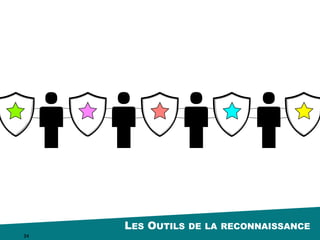
    LES OUTILS DELA RECONNAISSANCE 29
  • 30.
    LES OUTILS DELA RECONNAISSANCE 30 Chaînes de confiance
  • 31.
    LES OUTILS DELA RECONNAISSANCE 31 Réseaux de confiance
  • 32.
    LES OUTILS DELA RECONNAISSANCE 32 Réseaux de confiance
  • 33.
  • 34.
    Recommandation du Conseilde l’Europe du 20 décembre 2012 relative à DE LA RECONNAISSANCE34 “Dans une perspective de développement des compétences, il devrait être possible de se former ou d’acquérir une qualification ou un diplôme à tout âge, et de faire reconnaître ses compétences et ses savoir-faire même lorsqu’ils sont le fruit d’expériences non académiques ni formelles, que ce soit dans le cadre familial ou professionnel, à l’occasion d’un engagement au service des autres ou d’activités sportives, de loisirs ou de voyages à l’étranger, etc.” la validation des acquis d’apprentissage “non formel” et “informel”
  • 35.
    DE LA RECONNAISSANCE35 lavalidation des acquis d’apprentissage “non formel” et “informel” reconnaissancevalidation <=> formelle
  • 36.
    la validation desacquis d’apprentissage “non formel” et “informel” DE LA RECONNAISSANCE36 reconnaissance reconnaissance reconnaissance formelle informelle ?
  • 37.
  • 38.
    Apprentissage Formel Non-FormelInformel Intentionel Oui Oui Non Organisé Oui Oui Non Curriculum National ou local Occasionel Non Niveau de reconnaissance Global, national, sectoriel Local, organizationnel Communauté, pairs Types de crédits Diplôme, Certificat,
 Open Badge Certificat, attestation, Open Badge Open Badge, 
 Open Endorsement Caractéristiques Résulte généralement d’un nombre limité de processus, places et lieux Résulte généralement d’un nombre étendu de processus, places et lieux Résulte généralement de la participation aux activités quotidiennes Lieux Ecole, université, centre de formation, conservatoire… Club sportif, mouvement, de jeune, classe du soir... Conférences, expositions, bibliothèques, Internet, association, foyer… Activités Etudier, rechercher, enseigner, pratiquer… Etudier, rechercher, enseigner, explorer, pratiquer… Bricoler, conseiller, résoudre un problème au travail, jouer, pratique parentale et citoyenne…
  • 39.
  • 40.
    DE LA RECONNAISSANCE 40 ?quoiPar Qui Comment Pour quoi faire Reconnaitre
  • 41.
  • 42.
  • 43.
  • 44.
  • 45.
    Reconnaissance DE LA RECONNAISSANCE 45 Formelle Non-Formelle TraditionelleNon-Traditionelle Badges de compétence Micro-Crédits Smart Badges Badges Conversationnels Badges auto-attribués Endossement par les pairs Badges Scout (Centrée sur l’institution) (Centrée sur la communauté) Nano-Diplômes (Dynamique/Futur)(Statique/Passé) Badges Tremplins Badges de rêvesBadges de réussites collectives Pouvoir agir Conformité Inclusion Equiper Badges d’affiliation
  • 46.
    DE LA RECONNAISSANCE 46 http://www.cma-lifelonglearning.org/video/Interview%20De%20Peretti.mp4 Interviewd’André de Peretti réalisé par Anny Piau et Bernard Liétard, Image et montage Claude Villereau
 © CMA
  • 47.
  • 48.
    DE LA RECONNAISSANCE48 “Selfidentity is not a set of traits or observable characteristics. 
 It is a person's own reflexive understanding of their biography. Self-identity has continuity, but that continuity is only a product of the person's reflexive beliefs about their own biography. It explains the past and is oriented towards anticipated future."
  • 49.
    DE LA RECONNAISSANCE49 MeSelf-narration Me Me Me Me Me "A person's own reflexive understanding of their biography" — A. Giddens ePortfolio Me Me Me
  • 50.
    DE LA RECONNAISSANCE50 “Everyrelationship… implies a definition of self by others and other by self… A person's 'own' identity can never be completely abstracted from his identity-for-others. Ronald Laing, Self and Others, 1961
  • 51.
    DE LA RECONNAISSANCE51 “IfI am I, simply because I am I, and thou art thou simply because thou art thou, then I am I and thou art thou. But if I am I because thou art thou, and thou art thou because I am I, then I am not I and thou art not thou.” Rabbi Mendel of Kotsk
 quoted in Ethos and Identity, Epstein, 1978
  • 52.
    DE LA RECONNAISSANCE52 “L’identitén’est pas seulement une procédure réflexive ou narrative, elle ne se limite pas au domaine de la représentation ou du récit. Son rôle le plus important est ailleurs, dans un domaine où on n’a guère l’habitude de le situer : les conditions de l’action dans la modernité.” Jean-Claude Kaufmann, l’invention de soi (p. 173)
  • 53.
    DE LA RECONNAISSANCE53 Me Self-narration You You You You Narration through others & You Me Me Me Me Me Aperson's 'own' identity can never be completely abstracted from his identity-for-others - Ronald Laing ePortfolio us us Us us
  • 54.
  • 55.
  • 56.
    DE LA RECONNAISSANCE OpenBadges Holographic Identitiespixels of 56
  • 57.
    DE LA RECONNAISSANCE57 Distributed Trustworthy Complex,yet “uncomplicated” Co-constructed Connected Resilient Holographic Identities
  • 58.
  • 59.
    DE LA CONFIANCE59 3 Lecapital social est défini par l’OCDE comme des “réseaux associés à des normes, valeurs et compréhensions partagées facilitant la coopération au sein des groupes et entre eux”. Source: OECD Insights: Human Capital Mis ensemble, ces réseaux et compréhensions engendrent la confiance et ainsi permettent aux personnes de travailler ensemble
  • 60.
    DE LA CONFIANCE 60 Percentageof adults trusting others (source OECD)Countries are ranked in ascending order of the proportion of people with tertiary education reporting that they trust others. Source: OECD. Table A8.3a (L). See Annex 3 for notes (www.oecd.org/edu/eag.htm). 70 7050 5030 3010 100 060 6040 4020 20% % By literacy proficiency level By educational attainment Slovak Republic Estonia Italy Czech Republic France Korea Germany Japan Ireland Poland England/N. Ireland (UK) Average Flanders (Belgium) Canada Spain Austria United States Australia Finland Netherlands Sweden Norway Denmark 12 http://dx.doi.org/10.1787/888933116699 A8 Chart A8.4. Percentage of adults reporting that they trust others, by educational attainment and literacy proficiency level (2012) Survey of Adult Skills, 25-64 year-olds Level 4 or 5 Level 3 Level 2 Level 1 or below By literacy proficiency level By educational attainment Below upper secondary education Upper secondary or post-secondary non-tertiary education Tertiary education Slovak Republic Estonia Italy Czech Republic France Korea Germany Japan Ireland Poland England/N. Ireland (UK) Average Flanders (Belgium) Canada Spain Austria United States Australia Chart A8.4. Percentage of adults reporting that they trust others, by educational attainment and literacy proficiency level (2012) Survey of Adult Skills, 25-64 year-olds Level 4 or 5 Level 3 Level 2 Level 1 or below By literacy proficiency level By educational attainment Below upper secondary education Upper secondary or post-secondary non-tertiary education Tertiary education Slovak Republic Estonia Italy Czech Republic France Korea Germany Japan Ireland Poland England/N. Ireland (UK) Average Flanders (Belgium) Canada Spain Austria
  • 61.
    DE LA CONFIANCE61 onomiques senquêtes qu’ailleurs, rché. Cette mmuables, al français. s capacités ider de son ques et les nnées 1950 e déficit de et, surtout, e. » ert, Le Point tatisme. » ti, Les Échos 5 € 78-2-7288-0396-5 SN 1951-7637 LA SOCIÉTÉ DE DÉFIANCE Comment le modèle social français s’autodétruit YANN ALGAN et PIERRE CAHUC | 09 | LASOCIÉTÉDEDÉFIANCE 09 élu par Lire MEILLEUR ESSAI 2007 RUED’ULM 10 En toute logique, l’opinion selon laquelle on ne peut arriver au sommet sans être corrompu devrait avoir pour contrepartie une défiance envers Figure 1 – Part des personnes qui répondent « Pour arriver au sommet, il est nécessaire d’être corrompu ». Source : International Social Survey Program, 1999. 0,1 0,2 0,3 0,4 0,5 0,6 0,7 0,8 0,9 Norvège États-Unis Canada Australie Royaume-Uni Suisse Espagne Allemagne Hongrie Portugal République tchèque France Japon Pologne Russie
  • 62.
    DE LA CONFIANCE62 Figure3 – Part des personnes qui déclarent n’avoir « aucune confiance » dans le parlement. Les autres réponses possibles sont : « totalement confiance », « confiance », « peu confiance ». Source : World Values Survey, 2000. Norvège Pays-Bas Suède Danemark Finlande Autriche Espagne Suisse Portugal Canada Australie Allemagne Royaume-Uni Italie Irlande Belgique Pologne Japon Hongrie France Grèce République tchèque Turquie Mexique n’avoir aucune confiance en la justice. Ils ne sont précédés que par lesTurcs et les Belges. À l’inverse, une telle défiance s’exprime uniquement chez 7 % des Allemands et 2,2 % des Danois. Si on additionne le pourcentage Figure 2 – Part des personnes qui déclarent n’avoir « aucune confiance » en la justice. Les autres réponses possibles sont :« totalement confiance », « confiance », « peu de confiance ». Source : World Values Survey, 2000. Danemark Norvège Finlande Autriche Suède Suisse Allemagne Irlande Pays-Bas Australie Royaume-Uni Espagne Pologne Grèce Hongrie Portugal Italie République tchèque France Belgique Turquie France France
  • 63.
    DE LA CONFIANCE63 Figure7c – Part de personnes qui déclarent « trouver injustifiable d’accepter un pot-de-vin dans l’exercice de ses fonctions ». Source : World Values Survey, 1980-2000. 0,5 0,55 0,6 0,65 0,7 0,75 0,8 0,85 0,9 0,95 France Belgique Mexique Allemagne Pays-Bas Japon Autriche Italie Suède Portugal Royaume-Uni Canada Espagne Suisse Australie États-Unis Norvège Irlande Pologne Chine Danemark Figure 5 – Part des personnes qui répondent « Il est possible de faire confiance aux autres » à la question : « En règle générale, pensez-vous qu’il est possible de faire confiance aux autres ou que l’on est jamais assez méfiant ? ». Source : World Values Survey, 1990 et 2000. 0 0,1 0,2 0,3 0,4 0,5 0,6 0,7 0,8 Turquie Portugal France Hongrie Grèce Pologne République tchèque Mexique Belgique Autriche Italie Inde Espagne Royaume-Uni Allemagne Irlande Japon Suisse Canada États-Unis Chine Pays-Bas Finlande Danemark Suède Norvège France France
  • 64.
  • 65.
    DE LA CONFIANCE65 ReconnaissancesObtenues (dette) 
 Reconnaissances Offertes (credit) Mon Capital Social Ton Capital Social Notre Capital Social …………………..…. …………. + + +
  • 66.
    DE LA CONFIANCE66 ReconnaissancesObtenues Reconnaissances Offertes
  • 67.
    DE LA CONFIANCE duePortfolio au Personal Ledger 1000 Received Credentials Name ID Issuer Criteria Evidence Picture … 2000 Issued Credentials Name ID Earner Criteria Evidence Picture … 3000 Evidence Name ID Type … … … … 4000 Assets Name ID Type … … … … 5000 … … … … … … … … … … … … … … … … … 4000 Assets Name ID Type … … … … 4100 IPR … … … … … … … 4200 Publications … … … … … … … 4300 … … … … … … … … … … … … … … … … …
  • 68.
    DE LA CONFIANCE 1000Date/Time Name ID BoT Issuer Criteria Evidence Picture … 1001 1/6/2016/11:23 Ledger Expert Level1 1FL2LFL8K8… 4 I82NCJ7FK… CF84KULF… ELPO7DUJ… PINFJ48D6… … 1002 24/9/2017/09:12 Assessor Level 2 1IFN74JS91… 849 IK49FL4MM… C3MPG7D… FP4TLRS4… null … 1100 24/9/2017/09:13 … … … … … … … 1101 … … … … … … … Crédits reçus Crédits émis 2000 Date/Time Name ID BoT Earner Criteria Evidence Picture … 2001 … Trustworthy Company 2FL2LFL8K8… 30 IKFI7469HL … CCL0FLD.… EPFLDKD8… - … 2002 … Creative 2IFN74JS91… 138 I0DU7CHK B… … … … … 2100 … … … … … … … 2101 … … … … … … … Preuve Référentiel de compétences Total des confiances émises pour la créativité
  • 69.
  • 70.
  • 71.
  • 72.
    4 72 VERS UNE SOCIÉTÉAPPRENANTE Le pouvoir d’agir
  • 73.
    VERS UNE SOCIÉTÉAPPRENANTE 73 4 Rapport sur la recherche et développement de l’éducation tout au long de la vie Catherine Becchetti-Bizot Guillaume Houzel François Taddei VERS UNE SOCIÉTÉ APPRENANTE À l’attention de Madame la ministre de l’Éducation nationale, de l’Enseignement supérieur et de la Recherche Mars 2017 “ une cuLture de la confiance, de la liberté et du mentorat bienveillant ”
  • 74.
    VERS UNE SOCIÉTÉAPPRENANTE74 “ une cuLture de la confiance, de la liberté et du mentorat bienveillant ” [de la reconnaissance]
  • 75.
    VERS UNE SOCIÉTÉAPPRENANTE 75 Reconnaissance Souveraine le pouvoir d’exprimer sa reconnaissance Donner à chacun (et pas simplement aux “autorités constituées”) : le pouvoir d’exprimer sa confiance le pouvoir d’agir !
  • 76.
    VERS UNE SOCIÉTÉAPPRENANTE 76 La reconnaissance est la compétence clé, celle sous-jacente à toutes les autres La reconnaissance n’intervient pas qu’après l’acte pédagogique Reconnaissance Souveraine Elle le fonde!
  • 77.
    VERS UNE SOCIÉTÉAPPRENANTE 77 Sans théorie de la reconnaissance, point de théorie de l’agir — Paul Ricœur
  • 78.
    VERS UNE SOCIÉTÉAPPRENANTE  78 “Je serai aussi ce président de la reconnaissance […]” Discours du 1er mai 2017
  • 79.
    79 La reconnaissance estla seule dette qu'un débiteur aime à voir s'accroître. —Friedrich Nietzsche
  • 80.