Spark Dataframe
Spark User Group
11 Juin 2015
Julien Buret
Formateur
Twitter
@JulienBuret
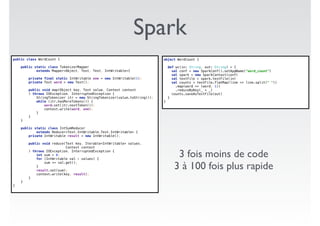
Spark
public class WordCount {


public static class TokenizerMapper

extends Mapper<Object, Text, Text, IntWritable>{


private final static IntWritable one = new IntWritable(1);

private Text word = new Text();


public void map(Object key, Text value, Context context

) throws IOException, InterruptedException {

StringTokenizer itr = new StringTokenizer(value.toString());

while (itr.hasMoreTokens()) {

word.set(itr.nextToken());

context.write(word, one);

}

}

}


public static class IntSumReducer

extends Reducer<Text,IntWritable,Text,IntWritable> {

private IntWritable result = new IntWritable();


public void reduce(Text key, Iterable<IntWritable> values,

Context context

) throws IOException, InterruptedException {

int sum = 0;

for (IntWritable val : values) {

sum += val.get();

}

result.set(sum);

context.write(key, result);

}

}

}
object WordCount {


def wc(in: String, out: String) = {

val conf = new SparkConf().setAppName("word_count")

val spark = new SparkContext(conf)

val textFile = spark.textFile(in)

val counts = textFile.flatMap(line => line.split(" "))

.map(word => (word, 1))

.reduceByKey(_ + _)

counts.saveAsTextFile(out)

}

}
3 fois moins de code
3 à 100 fois plus rapide
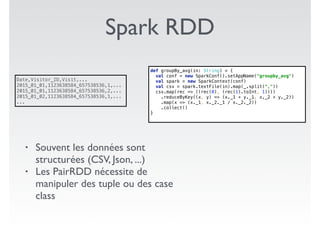
Spark RDD
def groupBy_avg(in: String) = {

val conf = new SparkConf().setAppName("groupby_avg")

val spark = new SparkContext(conf)

val csv = spark.textFile(in).map(_.split(","))

csv.map(rec => ((rec(0), (rec(1).toInt, 1))))

.reduceByKey((x, y) => (x._1 + y._1, x._2 + y._2))

.map(x => (x._1, x._2._1 / x._2._2))

.collect()

}
• Souvent les données sont
structurées (CSV, Json, ...)
• Les PairRDD nécessite de
manipuler des tuple ou des case
class
Date,Visitor_ID,Visit,...

2015_01_01,1123638584_657538536,1,...
2015_01_01,1123638584_657538536,2,...
2015_01_02,1123638584_657538536,1,...
...
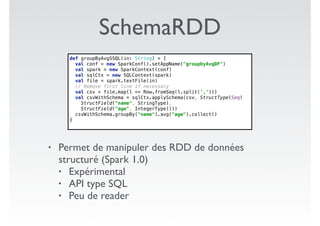
SchemaRDD
def groupByAvgSSQL(in: String) = {

val conf = new SparkConf().setAppName("groupbyAvgDF")

val spark = new SparkContext(conf)

val sqlCtx = new SQLContext(spark)

val file = spark.textFile(in)

// Remove first line if necessary

val csv = file.map(l => Row.fromSeq(l.split(',')))

val csvWithSchema = sqlCtx.applySchema(csv, StructType(Seq(

StructField("name", StringType),

StructField("age", IntegerType))))

csvWithSchema.groupBy("name").avg("age").collect()

}
• Permet de manipuler des RDD de données
structuré (Spark 1.0)
• Expérimental
• API type SQL
• Peu de reader
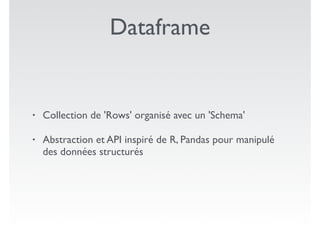
Dataframe
• Collection de 'Rows' organisé avec un 'Schema'
• Abstraction et API inspiré de R, Pandas pour manipulé
des données structurés
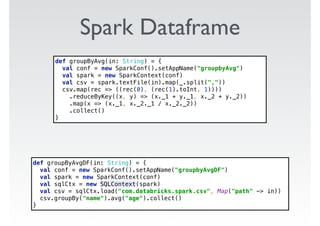
Spark Dataframe
def groupByAvgDF(in: String) = {

val conf = new SparkConf().setAppName("groupbyAvgDF")

val spark = new SparkContext(conf)

val sqlCtx = new SQLContext(spark)

val csv = sqlCtx.load("com.databricks.spark.csv", Map("path" -> in))

csv.groupBy("name").avg("age").collect()

}
def groupByAvg(in: String) = {

val conf = new SparkConf().setAppName("groupbyAvg")

val spark = new SparkContext(conf)

val csv = spark.textFile(in).map(_.split(","))

csv.map(rec => ((rec(0), (rec(1).toInt, 1))))

.reduceByKey((x, y) => (x._1 + y._1, x._2 + y._2))

.map(x => (x._1, x._2._1 / x._2._2))

.collect()

}
Spark Dataframe
• Spark pour les data-analystes
• Spark est maintenant, presque, aussi simple à utiliser que
des librairies de type Pandas
• Performance des jobs quasi identique en Java, Scala,
Python, R
• Sauf pour les udf
Spark 1.3
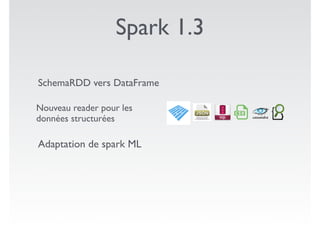
SchemaRDD vers DataFrame
Nouveau reader pour les
données structurées
Adaptation de spark ML
Demo
Spark DataFrame from the
trench
• Utilisation quasi quotidienne en "prod" depuis 3 mois
• Majoritairement de l'exploration de données parquet
ou csv avec pyspark sur notebook
• Par des profils "non développeur"
Spark DataFrame from the
trench
• Complexité cachée par Catalyst
• OutOfMemory
• Nombres de partitions à tuner très fréquemment
• StackTrace incompréhensible pour le neophyte
• Peu de documentation
Autres features
• Partition discovery
• Schema merging
• JSON / JDBC
• Passage implicite de RDD vers Dataframe
Nice to have
• Faciliter la création de nouvelles expressions, les UDAF
• Déterminer le nombre de partitions automatiquement
• Faciliter la manipulation des dataframes (drop, ...)
• Catalyst encore plus intelligent
• Utilisation des statistiques
• CBO
Quelques références
• RDDs are the new bytecode of apache spark.
O.Girardot
• Introducing Dataframes in Spark for Large Scale Data
Science. Databrick
• Deep Dive into Spark SQL’s Catalyst Optimizer.
Databrick

Spark dataframe

  • 1.
    Spark Dataframe Spark UserGroup 11 Juin 2015
  • 2.
  • 3.
    Spark public class WordCount{
 
 public static class TokenizerMapper
 extends Mapper<Object, Text, Text, IntWritable>{
 
 private final static IntWritable one = new IntWritable(1);
 private Text word = new Text();
 
 public void map(Object key, Text value, Context context
 ) throws IOException, InterruptedException {
 StringTokenizer itr = new StringTokenizer(value.toString());
 while (itr.hasMoreTokens()) {
 word.set(itr.nextToken());
 context.write(word, one);
 }
 }
 }
 
 public static class IntSumReducer
 extends Reducer<Text,IntWritable,Text,IntWritable> {
 private IntWritable result = new IntWritable();
 
 public void reduce(Text key, Iterable<IntWritable> values,
 Context context
 ) throws IOException, InterruptedException {
 int sum = 0;
 for (IntWritable val : values) {
 sum += val.get();
 }
 result.set(sum);
 context.write(key, result);
 }
 }
 } object WordCount {
 
 def wc(in: String, out: String) = {
 val conf = new SparkConf().setAppName("word_count")
 val spark = new SparkContext(conf)
 val textFile = spark.textFile(in)
 val counts = textFile.flatMap(line => line.split(" "))
 .map(word => (word, 1))
 .reduceByKey(_ + _)
 counts.saveAsTextFile(out)
 }
 } 3 fois moins de code 3 à 100 fois plus rapide
  • 4.
    Spark RDD def groupBy_avg(in:String) = {
 val conf = new SparkConf().setAppName("groupby_avg")
 val spark = new SparkContext(conf)
 val csv = spark.textFile(in).map(_.split(","))
 csv.map(rec => ((rec(0), (rec(1).toInt, 1))))
 .reduceByKey((x, y) => (x._1 + y._1, x._2 + y._2))
 .map(x => (x._1, x._2._1 / x._2._2))
 .collect()
 } • Souvent les données sont structurées (CSV, Json, ...) • Les PairRDD nécessite de manipuler des tuple ou des case class Date,Visitor_ID,Visit,...
 2015_01_01,1123638584_657538536,1,... 2015_01_01,1123638584_657538536,2,... 2015_01_02,1123638584_657538536,1,... ...
  • 5.
    SchemaRDD def groupByAvgSSQL(in: String)= {
 val conf = new SparkConf().setAppName("groupbyAvgDF")
 val spark = new SparkContext(conf)
 val sqlCtx = new SQLContext(spark)
 val file = spark.textFile(in)
 // Remove first line if necessary
 val csv = file.map(l => Row.fromSeq(l.split(',')))
 val csvWithSchema = sqlCtx.applySchema(csv, StructType(Seq(
 StructField("name", StringType),
 StructField("age", IntegerType))))
 csvWithSchema.groupBy("name").avg("age").collect()
 } • Permet de manipuler des RDD de données structuré (Spark 1.0) • Expérimental • API type SQL • Peu de reader
  • 6.
    Dataframe • Collection de'Rows' organisé avec un 'Schema' • Abstraction et API inspiré de R, Pandas pour manipulé des données structurés
  • 7.
    Spark Dataframe def groupByAvgDF(in:String) = {
 val conf = new SparkConf().setAppName("groupbyAvgDF")
 val spark = new SparkContext(conf)
 val sqlCtx = new SQLContext(spark)
 val csv = sqlCtx.load("com.databricks.spark.csv", Map("path" -> in))
 csv.groupBy("name").avg("age").collect()
 } def groupByAvg(in: String) = {
 val conf = new SparkConf().setAppName("groupbyAvg")
 val spark = new SparkContext(conf)
 val csv = spark.textFile(in).map(_.split(","))
 csv.map(rec => ((rec(0), (rec(1).toInt, 1))))
 .reduceByKey((x, y) => (x._1 + y._1, x._2 + y._2))
 .map(x => (x._1, x._2._1 / x._2._2))
 .collect()
 }
  • 8.
    Spark Dataframe • Sparkpour les data-analystes • Spark est maintenant, presque, aussi simple à utiliser que des librairies de type Pandas • Performance des jobs quasi identique en Java, Scala, Python, R • Sauf pour les udf
  • 9.
    Spark 1.3 SchemaRDD versDataFrame Nouveau reader pour les données structurées Adaptation de spark ML
  • 10.
  • 11.
    Spark DataFrame fromthe trench • Utilisation quasi quotidienne en "prod" depuis 3 mois • Majoritairement de l'exploration de données parquet ou csv avec pyspark sur notebook • Par des profils "non développeur"
  • 12.
    Spark DataFrame fromthe trench • Complexité cachée par Catalyst • OutOfMemory • Nombres de partitions à tuner très fréquemment • StackTrace incompréhensible pour le neophyte • Peu de documentation
  • 13.
    Autres features • Partitiondiscovery • Schema merging • JSON / JDBC • Passage implicite de RDD vers Dataframe
  • 14.
    Nice to have •Faciliter la création de nouvelles expressions, les UDAF • Déterminer le nombre de partitions automatiquement • Faciliter la manipulation des dataframes (drop, ...) • Catalyst encore plus intelligent • Utilisation des statistiques • CBO
  • 15.
    Quelques références • RDDsare the new bytecode of apache spark. O.Girardot • Introducing Dataframes in Spark for Large Scale Data Science. Databrick • Deep Dive into Spark SQL’s Catalyst Optimizer. Databrick