Quand les fonctions sociales s'intègrent aux processus décisionnels : IBM Cognos Collaboration Vincent Perrin  |  IBM Collaboration Solutions Architect
Agenda Comment la collaboration peut-elle aider à la prise de décision ?
Pourquoi une prise de décision collaborative ?
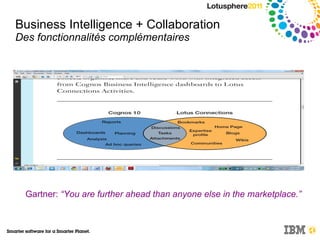
La valeur de la combinaison entre Business Intelligence et Collaboration
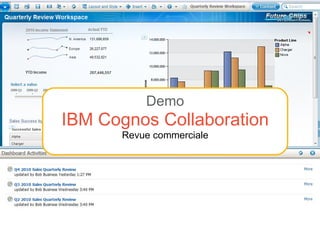
Démonstration : Cognos 10 Collaboration
Questions
Les réseaux sociaux font partie de la  “Nouvelle Intelligence” cliff_edge03 cliff_edge03 office-window alg_steve_carell MUP_130296_0569 officespaceWOW facebook_logo linkedin_logo_1 blogspot flickr myspace-logo twitter bebo ANd9GcTjokdxJ4wJklSYxdBcjt2gKziQdBvmZxKZAWM2we2yrt9PueI&t=1&usg=__kCEkR7S1LhtBMz5S5veY538BBic=
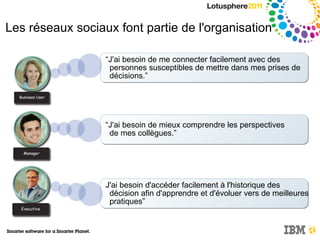
Les réseaux sociaux font partie de l'organisation J'ai besoin d'accéder facilement à l'historique des décision afin d'apprendre et d'évoluer vers de meilleures pratiques” “ J'ai besoin de me connecter facilement avec des personnes susceptibles de mettre dans mes prises de décisions.” “ J'ai besoin de mieux comprendre les perspectives de mes collègues.”  Business User 2A Manager-3A Executive-1B
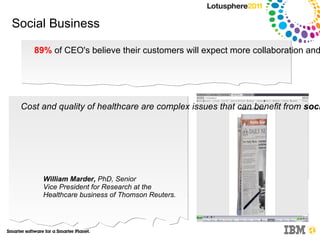
Social Business William Marder,  PhD, Senior Vice President for Research at the Healthcare business of Thomson Reuters. 89%  of CEO's believe their customers will expect more collaboration and information sharing over the next five years  Capitalizing on Complexity 2010 IBM Global CEO Study   Cost and quality of healthcare are complex issues that can benefit from  social networking tools  that  help decision makers  form a shared understanding of what the ‘system’ is doing and how to improve it.
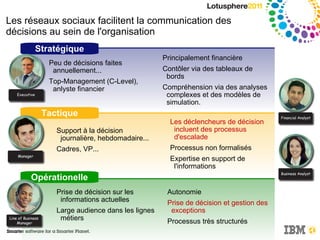
Les réseaux sociaux facilitent la communication des  décisions au sein de l'organisation Principalement financière
Contôler via des tableaux de bords
Compréhension via des analyses complexes et des modèles de simulation. Peu de décisions faites annuellement...
Top-Management (C-Level), anlyste financier Support à la décision journalière, hebdomadaire...
Cadres, VP... Les déclencheurs de décision incluent des processus d'escalade Processus non formalisés
Expertise en support de l'informations Autonomie Prise de décision et gestion des exceptions Processus très structurés Prise de décision sur les informations actuelles
Large audience dans les lignes métiers Opérationelle Tactique Stratégique
Agenda Comment la collaboration peut-elle aider à la prise de décision ?
Pourquoi une prise de décision collaborative ?
La valeur de la combinaison entre Business Intelligence et Collaboration

IBM Cognos Collaboration

  • 1.
    Quand les fonctionssociales s'intègrent aux processus décisionnels : IBM Cognos Collaboration Vincent Perrin | IBM Collaboration Solutions Architect
  • 2.
    Agenda Comment lacollaboration peut-elle aider à la prise de décision ?
  • 3.
    Pourquoi une prisede décision collaborative ?
  • 4.
    La valeur dela combinaison entre Business Intelligence et Collaboration
  • 5.
    Démonstration : Cognos10 Collaboration
  • 6.
  • 7.
    Les réseaux sociauxfont partie de la “Nouvelle Intelligence” cliff_edge03 cliff_edge03 office-window alg_steve_carell MUP_130296_0569 officespaceWOW facebook_logo linkedin_logo_1 blogspot flickr myspace-logo twitter bebo ANd9GcTjokdxJ4wJklSYxdBcjt2gKziQdBvmZxKZAWM2we2yrt9PueI&t=1&usg=__kCEkR7S1LhtBMz5S5veY538BBic=
  • 8.
    Les réseaux sociauxfont partie de l'organisation J'ai besoin d'accéder facilement à l'historique des décision afin d'apprendre et d'évoluer vers de meilleures pratiques” “ J'ai besoin de me connecter facilement avec des personnes susceptibles de mettre dans mes prises de décisions.” “ J'ai besoin de mieux comprendre les perspectives de mes collègues.” Business User 2A Manager-3A Executive-1B
  • 9.
    Social Business WilliamMarder, PhD, Senior Vice President for Research at the Healthcare business of Thomson Reuters. 89% of CEO's believe their customers will expect more collaboration and information sharing over the next five years Capitalizing on Complexity 2010 IBM Global CEO Study Cost and quality of healthcare are complex issues that can benefit from social networking tools that help decision makers form a shared understanding of what the ‘system’ is doing and how to improve it.
  • 10.
    Les réseaux sociauxfacilitent la communication des décisions au sein de l'organisation Principalement financière
  • 11.
    Contôler via destableaux de bords
  • 12.
    Compréhension via desanalyses complexes et des modèles de simulation. Peu de décisions faites annuellement...
  • 13.
    Top-Management (C-Level), anlystefinancier Support à la décision journalière, hebdomadaire...
  • 14.
    Cadres, VP... Lesdéclencheurs de décision incluent des processus d'escalade Processus non formalisés
  • 15.
    Expertise en supportde l'informations Autonomie Prise de décision et gestion des exceptions Processus très structurés Prise de décision sur les informations actuelles
  • 16.
    Large audience dansles lignes métiers Opérationelle Tactique Stratégique
  • 17.
    Agenda Comment lacollaboration peut-elle aider à la prise de décision ?
  • 18.
    Pourquoi une prisede décision collaborative ?
  • 19.
    La valeur dela combinaison entre Business Intelligence et Collaboration

Notes de l'éditeur

  • #4 Collab makes what’s happening on the right, come over to the left IBM Cognos Collaboration Allows people to use the type of collab they’re used to at home, in the workplace, along with the benefits that come with it… IBM Cognos Collaboration bridges this gap by connecting people and insights to gain alignment in your organization.
  • #5 Cognos 10 enables organizations to outperform by providing collective intelligence with built-in collaboration and social networking. Collaborating using a social networking solution in conjunction with BI allows you to: Easily connect with others for building stronger relationships with people in your organization. Ensure greater context from your information. Builds a reliable corporate memory.
  • #6 Clearly, social software for business is crucial, 89% of CEO’s believe their customers will expect more collaboration over the next 5 years Social networking tools help decision makers. Studies show that Orgs that significantly outperform their peers are likely to have deployed collaborative spaces and enabled their people to collaborate.
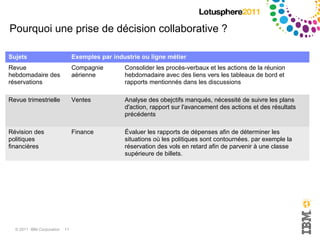
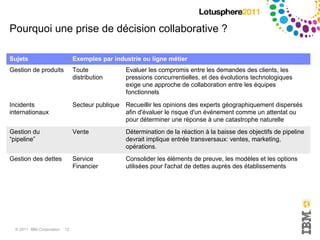
  • #7 Operational Characteristics: Minimal human intervention, Highly structured, Predictable, Repeatable, High frequency, Low individual value Example: Consider the airline industry. Each week, booking reviews are conducted to see which routes are over or under capacity. Consolidate the minutes and actions from the weekly meeting referencing reports listing which routes are above or below capacity. These kinds of reviews involve using facts from reports and collaborating across functional groups who contribute their expertise in operations, promotions and customer service on what actions need to occur. Other examples for operationally-oriented decisions include promotions planning in retail, facility planning, commercial insurance approvals or process investigations in Manufacturing. Tactical Characteristics: Knowledge-based, Unstructured, semistructured, Nonroutine activities, Moderate frequency, Medium value Product and release planning are common tactical decisions which include assessing the trade-offs between customer requests, competitive pressures, and technology shifts requires a collaborative approach between functional groups. In this situation, BI provides the quantitative information and the collaboration, the qualitative aspects that contribute to the discussion on pros and cons. Debt collection Agencies: Consolidate the evidence, models and options used to when buying debts from institutions Resource allocations Strategic Characteristics: Knowledge-intensive, Unpredictable, unstructured, End-to-end processes, Nonroutine activities, Low frequency, High-value decisions, Iterative Examples: Annual planning, goal setting, Decisions related to foreign policy is typically a collaborative effort. How about using social networking to collect the opinions of geographically-dispersed experts to assess the risk of an event such as an assassination or an election or to determine a response to a natural disaster? Another example is related to policy reviews. Expense policies may be reviewed to ascertain effectiveness. One approach might be to as sess expense reports to determine those situations where policies may be circumvented. e.g., find out who is consistently booking flights late and determine if the practice is being done in order to achieve a higher ticket class which permits using an upgrade certificate.
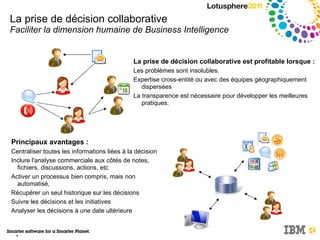
  • #9 In the BI business, we’ve said for years that it’s all about making better decisions. But really, while BI is great for identifying problems and opportunities, it doesn’t actually help you to make decisions. People make decisions. And typically, once you’ve spotted a business problem or something in the BI data that needs attention, you move away from the BI to either call a meeting, or make a phone call, or send an email to resolve the issue. But once you do that, you lose the ability to track the issue and what was decided, and the decision often becomes disconnected from the data. With collaborative decision making we want to connect the pieces – track the process of decision-making. When we’ve talked to customers about CDM, these are the types of problems they’ve told us about: Working with others who are not face to face… hard to keep everyone involved and engaged No paper trail of what was decided, by who, using what evidence What happens after a decision is made? How do you communicate and track follow-up actions? Using best practice techniques – whether it’s a formal methodology like Six Sigma or just basic business school techniques like SWOT analysis and RACI matrix Then later on…. How do you evaluate whether a decision was the right one? CDM is about addressing these challenges. Today's decision-making software doesn't support teaming Geographically dispersed teams can overlook stakeholders No single place for history, accountability or transparency Siloed, difficult to track decisions made & follow through Informal decisions not communicated Inconsistent use of best practice techniques Cannot easily evaluate decisions or decision makers Adding Collaboration makes it easier to: Facilitate the process and pieces Include business intelligence evidence for single version of truth Retrieve a single historical decision Analyze decisions as single data set Track and audit decisions and initiatives
  • #10 Typical triggers for a collaborative decision Escalation point for operational issues Responsible for tactical decisions Delivers recommendations to strategic decision makers
  • #11 Potential Usage Flow An Activity is used to track the minutes An entry for each week with To Do and comments reflecting follow up discussions Click on the link for the Customer Service dashboard When the dashboard opens, note the number of “red accounts” and the number of weeks that the same customers have been on the list Drill down to look at the list of customers contributing to the red status Select one customer – let’s find out what’s going on with this one. Drill down on a row to a customer-specific dashboard Navigate to an Activity that is being used to track discussions and contact with that customer. The customer-specific Activity could be linked to the Activity that contains the weekly Red List status review)
  • #18 Performance Management is a group activity Decisions traditionally made in meetings, email, phone calls... Now with Lotus Connections integration, IBM delivers social capabilities with business intelligence