design fiction et conception d’IHM innovantes
« Journée des labos »
26 Novembre 2013 – Angers

S2E2 – Captronic / Angers - Nov. 2013
Laurent Neyssensas

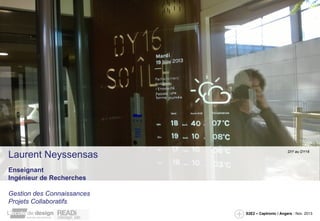
DIY au DY16

Enseignant
Ingénieur de Recherches
Gestion des Connaissances
Projets Collaboratifs 
S2E2 – Captronic / Angers - Nov. 2013
READi Design Lab
Recherches Expérimentales
Appliquée en Design d’interactivité
Design Lab
- 2nd Cycle – l’Ecole de design Nantes Atlantique
-Recherches Appliquées –
NB : Contrairement à l’idée française, le design ne se résume pas à du style …
Nous positionnons le design « industriel » dans les phases amonts d’innovation et de conception…
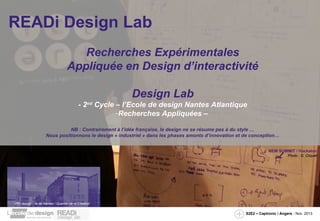
NEM SUMMIT / Hackaton
Photo : G. Cliquet

 PRI design / île de Nantes / Quartier de la Création 
 PRI design / île de Nantes / Quartier de la Création 
S2E2 – Captronic / Angers - Nov. 2013
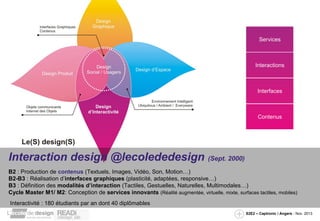
Interaction design @lecolededesign

(Sept. 2000)

B2 : Production de contenus (Textuels, Images, Vidéo, Son, Motion…)
B2-B3 : Réalisation d’interfaces graphiques (plasticité, adaptées, responsive…)
B3 : Définition des modalités d’interaction (Tactiles, Gestuelles, Naturelles, Multimodales…)
Cycle Master M1/ M2: Conception de services innovants (Réalité augmentée, virtuelle, mixte, surfaces tactiles, mobiles)
Interactivité : 180 étudiants par an dont 40 diplômables
S2E2 – Captronic / Angers - Nov. 2013
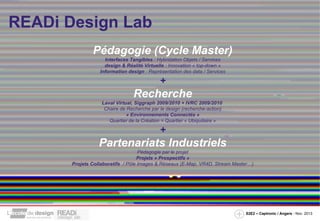
READi Design Lab
Pédagogie (Cycle Master)
Interfaces Tangibles : Hybridation Objets / Services
design & Réalité Virtuelle : Innovation « top-down »
Information design : Représentation des data / Services

+

Recherche
Laval Virtual, Siggraph 2009/2010 + IVRC 2009/2010
Chaire de Recherche par le design (recherche-action)
« Environnements Connectés »
Quartier de la Création = Quartier « Ubiquitaire »

+

Partenariats Industriels
Pédagogie par le projet
Projets « Prospectifs »
Projets Collaboratifs / Pôle Images & Réseaux (E-Map, VR4D, Stream Master…)

S2E2 – Captronic / Angers - Nov. 2013
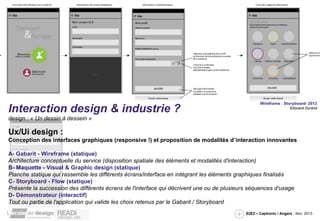
Interaction design & industrie ?

Wireframe : Storyboard- 2013
Edouard Durand

design : « Un dessin à dessein »

Ux/Ui design :
Conception des interfaces graphiques (responsive !) et proposition de modalités d’interaction innovantes
A- Gabarit - Wireframe (statique)
Architecture conceptuelle du service (disposition spatiale des éléments et modalités d'interaction)
B- Maquette - Visual & Graphic design (statique)
Planche statique qui rassemble les différents écrans/interface en intégrant les éléments graphiques finalisés
C- Storyboard - Flow (statique)
Présente la succession des différents écrans de l'interface qui décrivent une ou de plusieurs séquences d'usage
D- Démonstrateur (interactif)
Tout ou partie de l'application qui valide les choix retenus par le Gabarit / Storyboard
S2E2 – Captronic / Angers - Nov. 2013
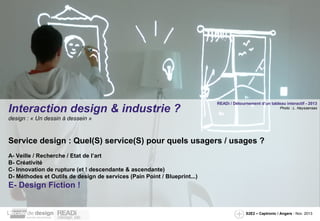
Interaction design & industrie ?

READi / Détournement d’un tableau interactif - 2013
Photo : L. Neyssensas

design : « Un dessin à dessein »

Service design : Quel(S) service(S) pour quels usagers / usages ?
A- Veille / Recherche / Etat de l’art
B- Créativité
C- Innovation de rupture (et ! descendante & ascendante)
D- Méthodes et Outils de design de services (Pain Point / Blueprint...)

E- Design Fiction !

S2E2 – Captronic / Angers - Nov. 2013
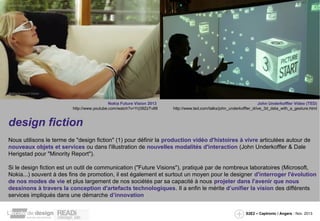
Nokia Future Vision 2013
http://www.youtube.com/watch?v=Yrj39ZzTv88

John Underkoffler Video (TED)
http://www.ted.com/talks/john_underkoffler_drive_3d_data_with_a_gesture.html

design fiction
Nous utilisons le terme de "design fiction" (1) pour définir la production vidéo d'histoires à vivre articulées autour de
nouveaux objets et services ou dans l'illustration de nouvelles modalités d'interaction (John Underkoffler & Dale
Herigstad pour "Minority Report").
Si le design fiction est un outil de communication ("Future Visions"), pratiqué par de nombreux laboratoires (Microsoft,
Nokia...) souvent à des fins de promotion, il est également et surtout un moyen pour le designer d'interroger l'évolution
de nos modes de vie et plus largement de nos sociétés par sa capacité à nous projeter dans l'avenir que nous
dessinons à travers la conception d'artefacts technologiques. Il a enfin le mérite d’unifier la vision des différents
services impliqués dans une démarche d’innovation
S2E2 – Captronic / Angers - Nov. 2013
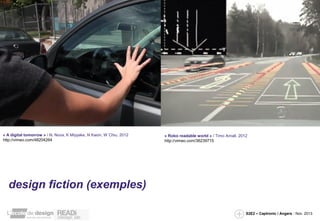
« A digital tomorrow » / N. Nova, K Miyyake, N Kwon, W Chiu, 2012
http://vimeo.com/48204264

« Robo readable world » / Timo Arnall, 2012
http://vimeo.com/36239715

design fiction (exemples)
S2E2 – Captronic / Angers - Nov. 2013
« equipop » / C. Barbo, M. Mouchard, P. Buffé 2013
http://www.youtube.com/watch?v=mWWo-K8O2L0

« hotel experience » / Victor Manselon - 2011
http://www.pimentsrouges.com

design fiction (exemples)
S2E2 – Captronic / Angers - Nov. 2013
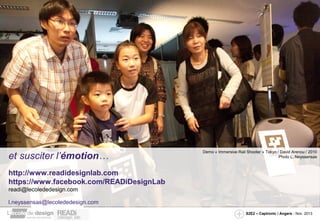
et susciter l’émotion…

Demo « Immersive Rail Shooter » Tokyo / David Arenou / 2010
Photo L. Neyssensas

http://www.readidesignlab.com
https://www.facebook.com/READiDesignLab
readi@lecolededesign.com
l.neyssensas@lecolededesign.com
S2E2 – Captronic / Angers - Nov. 2013
design fiction

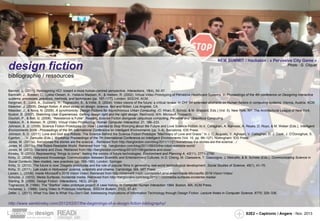
NEM SUMMIT / Hackaton : « Pervasive City Game »
Photo : G. Cliquet

bibliographie / ressources
Bannon, L. (2011). Reimagining HCI: toward a more human-centred perspective. Interactions, 18(4), 50–57.
Bardram, J., Bossen, C., Lykke-Olesen, A., Halskov Madsen, K., & Nielsen, R. (2002). Virtual Video Prototyping of Pervasive Healthcare Systems. In Proceedings of the 4th conference on Designing interactive
systems: processes, practices, methods, and techniques (pp. 167–177). London: SIGCHI: ACM.
Bergman, E., Lund, A., Dubberly, H., Tognazzini, B., & Intille, S. (2004). Video visions of the future: a critical review. In CHI ’04 extended abstracts on Human factors in computing systems. Vienna, Austria: ACM.
Bleecker, J. (2009). Design fiction: A short essay on design, science, fact and fiction. Los Angeles, CA.
Bleecker, J., & Nova, N. (2009). A synchronicity: Design Fictions for Asynchronous Urban Computing. (O. Khan, T. Scholz, & M. Shepard, Eds.) (Vol. 5). New York, NY: The Architectural League of New York.
Buxton, B. (2007). Sketching User Experiences: Getting design right and the right design. Redmond, WA: Microsoft Research.
Dourish, P., & Bell, G. (2008). “Resistence is Futile”: Reading Science Fiction alongside ubiquitous computing. Personal and Ubiquitous Computing.
Halskov, K., & Nielsen, R. (2006). Virtual Video Prototyping. Human Computer Interaction, 21, 199–233.
Johnson, B. D. (2009). Science Fiction Prototypes Or: How I Learned to Stop Worrying about the Future and Love Science Fiction. In V. Callaghan, A. Kameas, A. Reyes, D. Royo, & M. Weber (Eds.), Intelligent
Environments 2009 - Proceedings of the 5th International Conference on Intelligent Environments (pp. 3–8). Barcelona: IOS Press.
Johnson, B. D. (2011). Love and God and Robots: The Science Behind the Science Fiction Prototype “Machinery of Love and Grace.” In J. C. Augusto, V. Aghajan, V. Callaghan, D. J. Cook, J. O’Donoghue, S.
Egerton, … V. Zamudio (Eds.), Workshop Proceedings of the 7th International Conference on Intelligent Environments (Vol. 10, pp. 99–127). Nottingham: IOS Press.
Jones, M. (2011a). Sometimes the stories are the science... Retrieved from http://berglondon.com/blog/2011/11/21/sometimes-the-stories-are-the-science…/
Jones, M. (2011b). The Robot-Readable World. Retrieved from http://berglondon.com/blog/2011/08/03/the-robot-readable-world/
Jones, M. (2012). Gardens and Zoos. Retrieved from http://berglondon.com/blog/2012/01/06/gardens-and-zoos/
Kinsley, S. (2010). Representing “things to come”: feeling the visions of future technologies. Environment and Planning A, 42(11), 2771–2790.
Kirby, D. (2008). Hollywood Knowledge: Communication Between Scientific and Entertainment Cultures. In D. Cheng, M. Claessens, T. Gascoigne, J. Metcalfe, & B. Schiele (Eds.), Communicating Science in
Social Contexts: New models, new practices (pp. 165–180). London: Springer.
Kirby, D. (2010). The future is now: Diegetic prototypes and the role of popular films in generating real-world technological development. Social Studies of Science, 40(1), 41–70.
Kirby, D. (2011). Lab coats in Hollywood: science, scientists and cinema. Cambridge, MA: MIT Press.
Larsen, L. (2009). Inside Microsoft’s 2019 Vision Video. Retrieved from http://channel9.msdn.com/posts/LarryLarsen/Inside-Microsofts-2019-Vision-Video/
Schulze, J. (2010). Media Surfaces: Incidental media. Retrieved from http://berglondon.com/blog/2010/11/03/media-surfaces-incidental-media/
Sterling, B. (2009). Design Fiction. Interactions, 16(3), 20–24.
Tognazzini, B. (1994). The “Starfire” video prototype project: A case history. In Computer Human Interaction 1994. Boston, MA: ACM Press.
Vertelney, L. (1989). Using Video to Prototype Interfaces. SIGCHI Bulletin, 21(2), 57–61.
Zeller, L. (2011). What You See Is What You Don’t Get: Addressing Implications of Information Technology through Design Fiction. Lecture Notes in Computer Science, 6770, 329–336.

http://www.samkinsley.com/2012/02/07/the-beginnings-of-a-design-fiction-bibliography/
S2E2 – Captronic / Angers - Nov. 2013

Design fiction

  • 1.
    design fiction etconception d’IHM innovantes « Journée des labos » 26 Novembre 2013 – Angers S2E2 – Captronic / Angers - Nov. 2013
  • 2.
    Laurent Neyssensas DIY au DY16 Enseignant Ingénieur deRecherches Gestion des Connaissances Projets Collaboratifs  S2E2 – Captronic / Angers - Nov. 2013
  • 3.
    READi Design Lab RecherchesExpérimentales Appliquée en Design d’interactivité Design Lab - 2nd Cycle – l’Ecole de design Nantes Atlantique -Recherches Appliquées – NB : Contrairement à l’idée française, le design ne se résume pas à du style … Nous positionnons le design « industriel » dans les phases amonts d’innovation et de conception… NEM SUMMIT / Hackaton Photo : G. Cliquet  PRI design / île de Nantes / Quartier de la Création   PRI design / île de Nantes / Quartier de la Création  S2E2 – Captronic / Angers - Nov. 2013
  • 4.
    Interaction design @lecolededesign (Sept.2000) B2 : Production de contenus (Textuels, Images, Vidéo, Son, Motion…) B2-B3 : Réalisation d’interfaces graphiques (plasticité, adaptées, responsive…) B3 : Définition des modalités d’interaction (Tactiles, Gestuelles, Naturelles, Multimodales…) Cycle Master M1/ M2: Conception de services innovants (Réalité augmentée, virtuelle, mixte, surfaces tactiles, mobiles) Interactivité : 180 étudiants par an dont 40 diplômables S2E2 – Captronic / Angers - Nov. 2013
  • 5.
    READi Design Lab Pédagogie(Cycle Master) Interfaces Tangibles : Hybridation Objets / Services design & Réalité Virtuelle : Innovation « top-down » Information design : Représentation des data / Services + Recherche Laval Virtual, Siggraph 2009/2010 + IVRC 2009/2010 Chaire de Recherche par le design (recherche-action) « Environnements Connectés » Quartier de la Création = Quartier « Ubiquitaire » + Partenariats Industriels Pédagogie par le projet Projets « Prospectifs » Projets Collaboratifs / Pôle Images & Réseaux (E-Map, VR4D, Stream Master…) S2E2 – Captronic / Angers - Nov. 2013
  • 6.
    Interaction design &industrie ? Wireframe : Storyboard- 2013 Edouard Durand design : « Un dessin à dessein » Ux/Ui design : Conception des interfaces graphiques (responsive !) et proposition de modalités d’interaction innovantes A- Gabarit - Wireframe (statique) Architecture conceptuelle du service (disposition spatiale des éléments et modalités d'interaction) B- Maquette - Visual & Graphic design (statique) Planche statique qui rassemble les différents écrans/interface en intégrant les éléments graphiques finalisés C- Storyboard - Flow (statique) Présente la succession des différents écrans de l'interface qui décrivent une ou de plusieurs séquences d'usage D- Démonstrateur (interactif) Tout ou partie de l'application qui valide les choix retenus par le Gabarit / Storyboard S2E2 – Captronic / Angers - Nov. 2013
  • 7.
    Interaction design &industrie ? READi / Détournement d’un tableau interactif - 2013 Photo : L. Neyssensas design : « Un dessin à dessein » Service design : Quel(S) service(S) pour quels usagers / usages ? A- Veille / Recherche / Etat de l’art B- Créativité C- Innovation de rupture (et ! descendante & ascendante) D- Méthodes et Outils de design de services (Pain Point / Blueprint...) E- Design Fiction ! S2E2 – Captronic / Angers - Nov. 2013
  • 8.
    Nokia Future Vision2013 http://www.youtube.com/watch?v=Yrj39ZzTv88 John Underkoffler Video (TED) http://www.ted.com/talks/john_underkoffler_drive_3d_data_with_a_gesture.html design fiction Nous utilisons le terme de "design fiction" (1) pour définir la production vidéo d'histoires à vivre articulées autour de nouveaux objets et services ou dans l'illustration de nouvelles modalités d'interaction (John Underkoffler & Dale Herigstad pour "Minority Report"). Si le design fiction est un outil de communication ("Future Visions"), pratiqué par de nombreux laboratoires (Microsoft, Nokia...) souvent à des fins de promotion, il est également et surtout un moyen pour le designer d'interroger l'évolution de nos modes de vie et plus largement de nos sociétés par sa capacité à nous projeter dans l'avenir que nous dessinons à travers la conception d'artefacts technologiques. Il a enfin le mérite d’unifier la vision des différents services impliqués dans une démarche d’innovation S2E2 – Captronic / Angers - Nov. 2013
  • 9.
    « A digitaltomorrow » / N. Nova, K Miyyake, N Kwon, W Chiu, 2012 http://vimeo.com/48204264 « Robo readable world » / Timo Arnall, 2012 http://vimeo.com/36239715 design fiction (exemples) S2E2 – Captronic / Angers - Nov. 2013
  • 10.
    « equipop »/ C. Barbo, M. Mouchard, P. Buffé 2013 http://www.youtube.com/watch?v=mWWo-K8O2L0 « hotel experience » / Victor Manselon - 2011 http://www.pimentsrouges.com design fiction (exemples) S2E2 – Captronic / Angers - Nov. 2013
  • 11.
    et susciter l’émotion… Demo« Immersive Rail Shooter » Tokyo / David Arenou / 2010 Photo L. Neyssensas http://www.readidesignlab.com https://www.facebook.com/READiDesignLab readi@lecolededesign.com l.neyssensas@lecolededesign.com S2E2 – Captronic / Angers - Nov. 2013
  • 12.
    design fiction NEM SUMMIT/ Hackaton : « Pervasive City Game » Photo : G. Cliquet bibliographie / ressources Bannon, L. (2011). Reimagining HCI: toward a more human-centred perspective. Interactions, 18(4), 50–57. Bardram, J., Bossen, C., Lykke-Olesen, A., Halskov Madsen, K., & Nielsen, R. (2002). Virtual Video Prototyping of Pervasive Healthcare Systems. In Proceedings of the 4th conference on Designing interactive systems: processes, practices, methods, and techniques (pp. 167–177). London: SIGCHI: ACM. Bergman, E., Lund, A., Dubberly, H., Tognazzini, B., & Intille, S. (2004). Video visions of the future: a critical review. In CHI ’04 extended abstracts on Human factors in computing systems. Vienna, Austria: ACM. Bleecker, J. (2009). Design fiction: A short essay on design, science, fact and fiction. Los Angeles, CA. Bleecker, J., & Nova, N. (2009). A synchronicity: Design Fictions for Asynchronous Urban Computing. (O. Khan, T. Scholz, & M. Shepard, Eds.) (Vol. 5). New York, NY: The Architectural League of New York. Buxton, B. (2007). Sketching User Experiences: Getting design right and the right design. Redmond, WA: Microsoft Research. Dourish, P., & Bell, G. (2008). “Resistence is Futile”: Reading Science Fiction alongside ubiquitous computing. Personal and Ubiquitous Computing. Halskov, K., & Nielsen, R. (2006). Virtual Video Prototyping. Human Computer Interaction, 21, 199–233. Johnson, B. D. (2009). Science Fiction Prototypes Or: How I Learned to Stop Worrying about the Future and Love Science Fiction. In V. Callaghan, A. Kameas, A. Reyes, D. Royo, & M. Weber (Eds.), Intelligent Environments 2009 - Proceedings of the 5th International Conference on Intelligent Environments (pp. 3–8). Barcelona: IOS Press. Johnson, B. D. (2011). Love and God and Robots: The Science Behind the Science Fiction Prototype “Machinery of Love and Grace.” In J. C. Augusto, V. Aghajan, V. Callaghan, D. J. Cook, J. O’Donoghue, S. Egerton, … V. Zamudio (Eds.), Workshop Proceedings of the 7th International Conference on Intelligent Environments (Vol. 10, pp. 99–127). Nottingham: IOS Press. Jones, M. (2011a). Sometimes the stories are the science... Retrieved from http://berglondon.com/blog/2011/11/21/sometimes-the-stories-are-the-science…/ Jones, M. (2011b). The Robot-Readable World. Retrieved from http://berglondon.com/blog/2011/08/03/the-robot-readable-world/ Jones, M. (2012). Gardens and Zoos. Retrieved from http://berglondon.com/blog/2012/01/06/gardens-and-zoos/ Kinsley, S. (2010). Representing “things to come”: feeling the visions of future technologies. Environment and Planning A, 42(11), 2771–2790. Kirby, D. (2008). Hollywood Knowledge: Communication Between Scientific and Entertainment Cultures. In D. Cheng, M. Claessens, T. Gascoigne, J. Metcalfe, & B. Schiele (Eds.), Communicating Science in Social Contexts: New models, new practices (pp. 165–180). London: Springer. Kirby, D. (2010). The future is now: Diegetic prototypes and the role of popular films in generating real-world technological development. Social Studies of Science, 40(1), 41–70. Kirby, D. (2011). Lab coats in Hollywood: science, scientists and cinema. Cambridge, MA: MIT Press. Larsen, L. (2009). Inside Microsoft’s 2019 Vision Video. Retrieved from http://channel9.msdn.com/posts/LarryLarsen/Inside-Microsofts-2019-Vision-Video/ Schulze, J. (2010). Media Surfaces: Incidental media. Retrieved from http://berglondon.com/blog/2010/11/03/media-surfaces-incidental-media/ Sterling, B. (2009). Design Fiction. Interactions, 16(3), 20–24. Tognazzini, B. (1994). The “Starfire” video prototype project: A case history. In Computer Human Interaction 1994. Boston, MA: ACM Press. Vertelney, L. (1989). Using Video to Prototype Interfaces. SIGCHI Bulletin, 21(2), 57–61. Zeller, L. (2011). What You See Is What You Don’t Get: Addressing Implications of Information Technology through Design Fiction. Lecture Notes in Computer Science, 6770, 329–336. http://www.samkinsley.com/2012/02/07/the-beginnings-of-a-design-fiction-bibliography/ S2E2 – Captronic / Angers - Nov. 2013

Notes de l'éditeur

  • #9 http://www.internetactu.net/2013/03/07/de-la-science-fiction-au-design-fiction/ C’est une “utilisation délibérée de prototypes diégétiques pour rompre avec la défiance ou l’incrédulité à l’égard du changement” explique encore Bruce Sterling. Comme l’expliquait très clairement Philippe Gargov sur son blog, “pour le dire dans un français plus abordable, le design-fiction décrit l’utilisation de procédés narratifs pour présenter de manière *réaliste* l’utilisation potentielle d’objets et de services futuristes, le plus souvent sous forme de courtes vidéos. Comme le précise Bruce Sterling, il ne s’agit pas de fiction, mais bien de design, avec toutes les limites et contraintes que cela implique : quelle faisabilité technique ? Quelle interaction-utilisateur ? Quel modèle économique ? etc.”