WHAT IS CALLED DESIGN ?
     a few theoretical concerns

           stéphane vial
        www.reduplikation.net
              OCTOBER, 2011
1. foreword
2. introduction
3. thinking design
1
foreword
« Being the richest man in the cemetery doesn’t matter
   to me… Going to bed at night saying we’ve done
 something wonderful… that’s what matters to me. »

         Steve Jobs, Wall Street Journal, May 25, 1993
Steve Jobs
October 5, 2011 (†)
This presentation is made on a Mac.
  Let’s think fondly of him today.
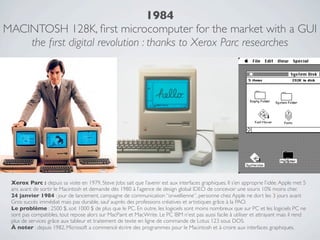
1984
MACINTOSH 128K, first microcomputer for the market with a GUI
    the first digital revolution : thanks to Xerox Parc researches


 Xerox Parc : depuis sa visite en 1979, Steve Jobs sait que l’avenir est aux interfaces graphiques. Il s’en approprie l’idée. Apple met 5
 ans avant de sortir le Macintosh et demande dès 1980 à l’agence de design global IDEO de concevoir une souris 10% moins cher.
 24 janvier 1984 : jour de lancement, campagne de communication “orwellienne”, personne chez Apple ne dort les 3 jours avant
 Gros succès immédiat mais pas durable, sauf auprès des professions créatives et artistiques grâce à la PAO.
 Le problème : 2500 $, soit 1000 $ de plus que le PC. En outre, les logiciels sont moins nombreux que sur PC et les logiciels PC ne
 sont pas compatibles, tout repose alors sur MacPaint et MacWrite. Le PC IBM n'est pas aussi facile à utiliser et attrayant mais il rend
 plus de services grâce aux tableur et traitement de texte en ligne de commande de Lotus 123 sous DOS.
 À noter : depuis 1982, Microsoft a commencé écrire des programmes pour le Macintosh et à croire aux interfaces graphiques.
2007-2011
                        mobile devices with cloud services
“le mariage d’une application client vraiment extraordinaire avec un service cloud vraiment extraordinaire
    est incroyablement puissant et plus puissant qu’un navigateur sur une machine cliente” (Steve Jobs)


   the new digital revolution : the “post-PC devices” era ?
2
introduction
WHERE AM I SPEAKING FROM ?
       Philosophy of design
Thinking has always been a characteristic of designing,
but design is unable to think about itself. It has never
       developed its own theories, unlike art.

Design is above all a function and practice of thought,
but neither designers nor philosophers have come up
          with a theoretical basis for design.
Philosophers have limited
  their concerns to the Fine Arts

and have considered decorative arts
   or applied arts as Minor Arts
The main goal of my Court traité du design
 is to set up a demarcation line between
           design and non-design.

       It is an introduction to what
     could be a philosophy of design
3
thinking design
« Design is a funny word. Some people
think design means how it looks. But of course,
   if you dig deeper, it’s really how it works. »

          Steve Jobs, Wired, February 1996
“BEAUTIFUL DESIGNER KITCHENS”
                          design as a consumer significant

•   people say : “it’s (so) design !”

    •   it means : beautiful, elegant, distinguished, “chic”

    •   it means modern, recent, new, original, trendy

    •   it means strange, freaky, crazy

•   we are consumers of the significant design as we are for all other things

•   the concept of design is not clearly defined
Jean-Louis Frechin, designer :
“design is an activity whose undefinition is acceptable”
DESIGN DOES THINK
BUT DOES NOT THINK ITSELF
          design undefinition can be explained
     designers take advantage of design undefinition

 design is nowadays trying to enter into the research field
    it’s time to invent a critical epistemology of design
            design needs theoretical foundations

      the task is to think the design, not the designer
           not design thinking but thinking design
                    design as a discipline
DɪˈZAɪN, THE WORD STORY
•   latinism : designare, « to mark out, point out, trace »
    de + signum, « a mark, token, sign, indication, proof »
    = to form signs or to sign forms = SKETCH

•   anglicism : to design, « to think, to invent, to conceive »
    according to some plan or intention
    = to make a project = CONCEPT

•   1930’s : first american agencies popularize the expression “industrial design” (R. Loewy)

•   1950’s : Jacques Viénot offers “esthétique industrielle” as a french translation for industrial
    design

•   1956 : Association for Industrial Design in Milano (disegno industriale)

•   1971 : the “Académie Française” accept the word “design”

•   1994 : french law “Toubon” wants to replace the word “design” by “stylique” (lol)

•   2000’s : everybody talks about “design thinking” (design driven innovation)
DESIGN AND INDUSTRY (1/3)
                 from rejection to assumption in the XIXth century
•   First idea of some marriage between art and industry
    1849 : Henry Cole, Journal of Design and Manufactures
    1851 : The Great Exhibition of the Works of Industry of All Nations, London (Crystal Palace)

•   Rejection of industrialisation : against social poverty & poor taste of
    industry
    1848 : Marx, The Communist Manifesto
    1849 : Ruskin, The Seven Lamps of Architecture (Crystal Palace as “serre à concombres”)
    1894, William Morris : « L'idéal du meunier moderne [...] semble être de réduire les riches grains
    de blé en une poudre blanche dont la particularité est de ressembler à de la craie, car il recherche
    avant tout la finesse et la blancheur, au détriment des qualités gustatives. Vous voyez donc qu'il est
    désormais pratiquement impossible de trouver du pain. Et cela, vous devez le comprendre, est un
    trait essentiel du processus d'édification de la société de l'ersatz : on impose à toute une
    population un ersatz quelconque, et en un laps de temps très court l'authentique, le produit
    d'origine, disparaît totalement»

•   Assumption of industriy : birth of industrial design
    1907 : Peter Behrens, art director for AEG, first collaboration art/industry
    1907 : Hermann Muthesius claims some alliance between decorative arts and industrial production
DESIGN AND INDUSTRY (2/3)
      alliance of design with industrial capitalism in the XXth century
•   1952 : Raymond Loewy, “ugly things sell badly”

•   1970 : Jean Baudrillard, The Consumer Society

•   1971: Victor Papanek, Design for a real world : « ce que les architectes, les
    designers industriels, les planificateurs, etc., pourraient faire de mieux pour
    l’humanité serait de cesser complètement leur travail »

•   1973 : Ettore Sottsass, Tout le monde dit que je suis méchant

•   1993 : Vilém Flusser : « Qui a décidé de devenir designer s’est décidé contre la
    bonté pure »

•   2002 : Hal Foster, Design et crime : « le design est l’un des principaux agents qui
    nous enferment dans le système quasi total du consumérisme contemporain »
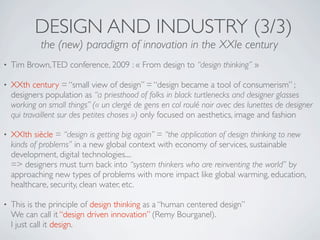
DESIGN AND INDUSTRY (3/3)
             the (new) paradigm of innovation in the XXIe century
•   Tim Brown, TED conference, 2009 : « From design to “design thinking” »

•   XXth century = “small view of design” = “design became a tool of consumerism” ;
    designers population as “a priesthood of folks in black turtlenecks and designer glasses
    working on small things” (« un clergé de gens en col roulé noir avec des lunettes de designer
    qui travaillent sur des petites choses ») only focused on aesthetics, image and fashion

•   XXIth siècle = “design is getting big again” = “the application of design thinking to new
    kinds of problems” in a new global context with economy of services, sustainable
    development, digital technologies....
    => designers must turn back into “system thinkers who are reinventing the world” by
    approaching new types of problems with more impact like global warming, education,
    healthcare, security, clean water, etc.

•   This is the principle of design thinking as a “human centered design”
    We can call it “design driven innovation” (Remy Bourganel).
    I just call it design.
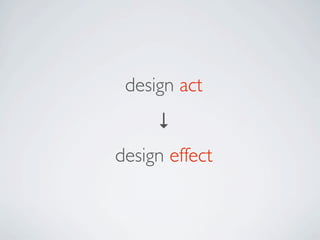
design act
     ↓
design effect
THE DESIGN EFFECT
                       a theoretical proposal for thinking design
                            DESIGN IS MOSTLY AN EFFECT
                         a design act consists in producing a design effect

                A DESIGN EFFECT IS AN EXPERIENTIAL EFFECT
                 a design effect is an event that happens in a user life-experience
un effet de design transforme un usage brut en une expérience-à-vivre qu’un sujet peut éprouver
          l’expression UX Design est un pléonasme, le design c’est penser l’expérience

                 A DESIGN EFFECT IS A CALLIMORPHIC EFFECT
                   a design effect produces a life experience through the forms
     une forme issue du design peut être spatiale, volumique, textile, graphique ou interactive
  l’effet de design est callimorphique car il produit une “prime de séduction” (beauté formelle)

                  A DESIGN EFFECT IS A SOCIOPLASTIC EFFECT
                   a design effect produces a life experience dedicated to others
      il modifie les usages, les manières de faire et de vivre en société, il réinvente le monde
 l’effet de design est socioplastique car il transforme les pratiques sociales (“sculpture sociale”)

                        WHAT IS THE GOAL OF DESIGN ?
          solving problems, simplifying life, offering new options, enchanting existence
PALDIES

   stéphane vial
www.reduplikation.net
      OCTOBER, 2011

What is Called Design ?

  • 1.
    WHAT IS CALLEDDESIGN ? a few theoretical concerns stéphane vial www.reduplikation.net OCTOBER, 2011
  • 2.
  • 3.
  • 4.
    « Being therichest man in the cemetery doesn’t matter to me… Going to bed at night saying we’ve done something wonderful… that’s what matters to me. » Steve Jobs, Wall Street Journal, May 25, 1993
  • 5.
  • 6.
    This presentation ismade on a Mac. Let’s think fondly of him today.
  • 7.
    1984 MACINTOSH 128K, firstmicrocomputer for the market with a GUI the first digital revolution : thanks to Xerox Parc researches Xerox Parc : depuis sa visite en 1979, Steve Jobs sait que l’avenir est aux interfaces graphiques. Il s’en approprie l’idée. Apple met 5 ans avant de sortir le Macintosh et demande dès 1980 à l’agence de design global IDEO de concevoir une souris 10% moins cher. 24 janvier 1984 : jour de lancement, campagne de communication “orwellienne”, personne chez Apple ne dort les 3 jours avant Gros succès immédiat mais pas durable, sauf auprès des professions créatives et artistiques grâce à la PAO. Le problème : 2500 $, soit 1000 $ de plus que le PC. En outre, les logiciels sont moins nombreux que sur PC et les logiciels PC ne sont pas compatibles, tout repose alors sur MacPaint et MacWrite. Le PC IBM n'est pas aussi facile à utiliser et attrayant mais il rend plus de services grâce aux tableur et traitement de texte en ligne de commande de Lotus 123 sous DOS. À noter : depuis 1982, Microsoft a commencé écrire des programmes pour le Macintosh et à croire aux interfaces graphiques.
  • 8.
    2007-2011 mobile devices with cloud services “le mariage d’une application client vraiment extraordinaire avec un service cloud vraiment extraordinaire est incroyablement puissant et plus puissant qu’un navigateur sur une machine cliente” (Steve Jobs) the new digital revolution : the “post-PC devices” era ?
  • 9.
  • 10.
    WHERE AM ISPEAKING FROM ? Philosophy of design
  • 11.
    Thinking has alwaysbeen a characteristic of designing, but design is unable to think about itself. It has never developed its own theories, unlike art. Design is above all a function and practice of thought, but neither designers nor philosophers have come up with a theoretical basis for design.
  • 12.
    Philosophers have limited their concerns to the Fine Arts and have considered decorative arts or applied arts as Minor Arts
  • 13.
    The main goalof my Court traité du design is to set up a demarcation line between design and non-design. It is an introduction to what could be a philosophy of design
  • 14.
  • 15.
    « Design isa funny word. Some people think design means how it looks. But of course, if you dig deeper, it’s really how it works. » Steve Jobs, Wired, February 1996
  • 16.
    “BEAUTIFUL DESIGNER KITCHENS” design as a consumer significant • people say : “it’s (so) design !” • it means : beautiful, elegant, distinguished, “chic” • it means modern, recent, new, original, trendy • it means strange, freaky, crazy • we are consumers of the significant design as we are for all other things • the concept of design is not clearly defined
  • 17.
    Jean-Louis Frechin, designer: “design is an activity whose undefinition is acceptable”
  • 18.
    DESIGN DOES THINK BUTDOES NOT THINK ITSELF design undefinition can be explained designers take advantage of design undefinition design is nowadays trying to enter into the research field it’s time to invent a critical epistemology of design design needs theoretical foundations the task is to think the design, not the designer not design thinking but thinking design design as a discipline
  • 19.
    DɪˈZAɪN, THE WORDSTORY • latinism : designare, « to mark out, point out, trace » de + signum, « a mark, token, sign, indication, proof » = to form signs or to sign forms = SKETCH • anglicism : to design, « to think, to invent, to conceive » according to some plan or intention = to make a project = CONCEPT • 1930’s : first american agencies popularize the expression “industrial design” (R. Loewy) • 1950’s : Jacques Viénot offers “esthétique industrielle” as a french translation for industrial design • 1956 : Association for Industrial Design in Milano (disegno industriale) • 1971 : the “Académie Française” accept the word “design” • 1994 : french law “Toubon” wants to replace the word “design” by “stylique” (lol) • 2000’s : everybody talks about “design thinking” (design driven innovation)
  • 20.
    DESIGN AND INDUSTRY(1/3) from rejection to assumption in the XIXth century • First idea of some marriage between art and industry 1849 : Henry Cole, Journal of Design and Manufactures 1851 : The Great Exhibition of the Works of Industry of All Nations, London (Crystal Palace) • Rejection of industrialisation : against social poverty & poor taste of industry 1848 : Marx, The Communist Manifesto 1849 : Ruskin, The Seven Lamps of Architecture (Crystal Palace as “serre à concombres”) 1894, William Morris : « L'idéal du meunier moderne [...] semble être de réduire les riches grains de blé en une poudre blanche dont la particularité est de ressembler à de la craie, car il recherche avant tout la finesse et la blancheur, au détriment des qualités gustatives. Vous voyez donc qu'il est désormais pratiquement impossible de trouver du pain. Et cela, vous devez le comprendre, est un trait essentiel du processus d'édification de la société de l'ersatz : on impose à toute une population un ersatz quelconque, et en un laps de temps très court l'authentique, le produit d'origine, disparaît totalement» • Assumption of industriy : birth of industrial design 1907 : Peter Behrens, art director for AEG, first collaboration art/industry 1907 : Hermann Muthesius claims some alliance between decorative arts and industrial production
  • 21.
    DESIGN AND INDUSTRY(2/3) alliance of design with industrial capitalism in the XXth century • 1952 : Raymond Loewy, “ugly things sell badly” • 1970 : Jean Baudrillard, The Consumer Society • 1971: Victor Papanek, Design for a real world : « ce que les architectes, les designers industriels, les planificateurs, etc., pourraient faire de mieux pour l’humanité serait de cesser complètement leur travail » • 1973 : Ettore Sottsass, Tout le monde dit que je suis méchant • 1993 : Vilém Flusser : « Qui a décidé de devenir designer s’est décidé contre la bonté pure » • 2002 : Hal Foster, Design et crime : « le design est l’un des principaux agents qui nous enferment dans le système quasi total du consumérisme contemporain »
  • 22.
    DESIGN AND INDUSTRY(3/3) the (new) paradigm of innovation in the XXIe century • Tim Brown, TED conference, 2009 : « From design to “design thinking” » • XXth century = “small view of design” = “design became a tool of consumerism” ; designers population as “a priesthood of folks in black turtlenecks and designer glasses working on small things” (« un clergé de gens en col roulé noir avec des lunettes de designer qui travaillent sur des petites choses ») only focused on aesthetics, image and fashion • XXIth siècle = “design is getting big again” = “the application of design thinking to new kinds of problems” in a new global context with economy of services, sustainable development, digital technologies.... => designers must turn back into “system thinkers who are reinventing the world” by approaching new types of problems with more impact like global warming, education, healthcare, security, clean water, etc. • This is the principle of design thinking as a “human centered design” We can call it “design driven innovation” (Remy Bourganel). I just call it design.
  • 23.
    design act ↓ design effect
  • 24.
    THE DESIGN EFFECT a theoretical proposal for thinking design DESIGN IS MOSTLY AN EFFECT a design act consists in producing a design effect A DESIGN EFFECT IS AN EXPERIENTIAL EFFECT a design effect is an event that happens in a user life-experience un effet de design transforme un usage brut en une expérience-à-vivre qu’un sujet peut éprouver l’expression UX Design est un pléonasme, le design c’est penser l’expérience A DESIGN EFFECT IS A CALLIMORPHIC EFFECT a design effect produces a life experience through the forms une forme issue du design peut être spatiale, volumique, textile, graphique ou interactive l’effet de design est callimorphique car il produit une “prime de séduction” (beauté formelle) A DESIGN EFFECT IS A SOCIOPLASTIC EFFECT a design effect produces a life experience dedicated to others il modifie les usages, les manières de faire et de vivre en société, il réinvente le monde l’effet de design est socioplastique car il transforme les pratiques sociales (“sculpture sociale”) WHAT IS THE GOAL OF DESIGN ? solving problems, simplifying life, offering new options, enchanting existence
  • 25.
    PALDIES stéphane vial www.reduplikation.net OCTOBER, 2011