SI ON A UN CHOIX A FAIRE:
ACTs OU MOUSTIQUAIRES
    (MID) EN AFRIQUE?
                              EVALUATION


                            par les FACILITATEURS


     Offianan André TOURE
           UPAL/IPCI
STRATEGIES OMS

1.Prevention
  Utilisation des moustiquaires ou rideaux imprégnés
  d’insecticides
  Prévention et Lutte contre les épidémies de paludisme
  Prévention du paludisme chez la femme enceinte

2. Traitement
   Améliorer la prise en charge des cas dans les Formations
   Sanitaires
   Améliorer la prise en charge des cas à domicile et ou dans
   les communautés
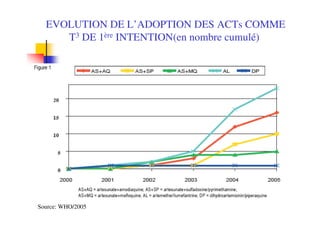
EVOLUTION DE L’ADOPTION DES ACTs COMME
     T3 DE 1ère INTENTION(en nombre cumulé)


Source: WHO/2005
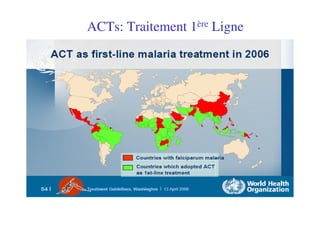
ACTs: Traitement 1ère Ligne
LIMITES DES ACTs


  Absence d’Etudes de pharmacovigilance
  Inadéquation demande:offre: Rupture de stock
  (Mondial, local)
  Péremption: ½ vie courte
  Coût élevé: Transport+Mobilisation des parents +
  Diagnostic
  Effets secondaires: Art+amodiaquine

Arrêt des subventions (Global found, Fond Bush et autres)
= effet rebond
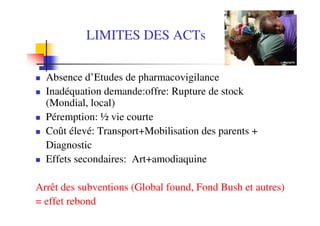
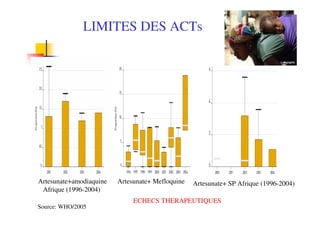
LIMITES DES ACTs


Artesunate+amodiaquine   Artesunate+ Mefloquine   Artesunate+ SP Afrique (1996-2004)
 Afrique (1996-2004)
                              ECHECS THERAPEUTIQUES
Source: WHO/2005
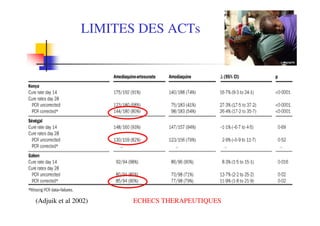
LIMITES DES ACTs


(Adjuik et al 2002)    ECHECS THERAPEUTIQUES
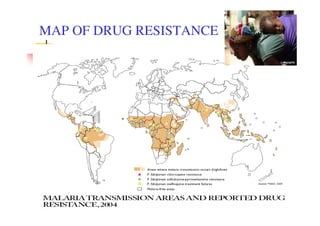
MAP OF DRUG RESISTANCE
FACTEURS DETERMINANTS LA
       RESISTANCE


  Pression médicamenteuse par l’utilisation en masse du
  médicament
  Exposition longue du parasite à des concentrations faibles
  du médicament
  Mauvaise prescription (posologie, durée, traitement
  inapproprié)
  Mauvaise observance ( abandon du traitement)
  Mauvaise qualité des médicaments

Pression médicamenteuse: Moteur extension des résistances
CONSEQUENCES DE LA
    RESISTANCE

Augmentation de la morbi-mortalité

Retard de guérison clinique

Augmentation du portage de gamétocytes

Surcoût
   "Those who cannot remember the past are
   condemned to repeat it." - Santayana
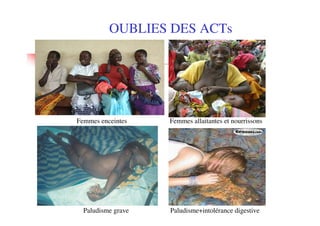
OUBLIES DES ACTs


Femmes enceintes    Femmes allaitantes et nourrissons


  Paludisme grave   Paludisme+intolérance digestive
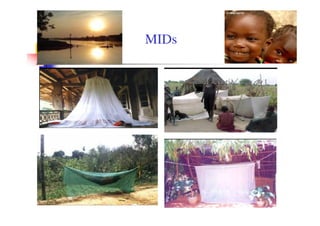
MIDs
PRINCIPE DES MIDs


Efficacité persistante: 4-5ans sans réimpregantion
malgré les lavages et usure

Action répulsive et irritante pour le vecteur, moins
toxique chez l’homme

Procédé industriel de fabrication
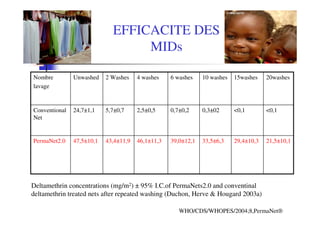
EFFICACITE DES
                                  MIDs

Nombre         Unwashed    2 Washes    4 washes    6 washes    10 washes   15washes    20washes
lavage


Conventional   24,7±1,1    5,7±0,7     2,5±0,5     0,7±0,2     0,3±02      <0,1        <0,1
Net


PermaNet2.0    47,5±10,1   43,4±11,9   46,1±11,3   39,0±12,1   33,5±6,3    29,4±10,3   21,5±10,1


Deltamethrin concentrations (mg/m2) ± 95% I.C.of PermaNets2.0 and conventinal
deltamethrin treated nets after repeated washing (Duchon, Herve & Hougard 2003a)

                                                      WHO/CDS/WHOPES/2004;8,PermaNet®
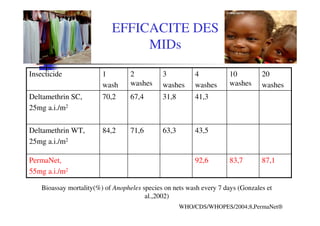
EFFICACITE DES
                                 MIDs

Insecticide              1         2          3          4            10         20
                         wash      washes     washes     washes       washes     washes
Deltamethrin SC,         70,2      67,4       31,8       41,3
25mg a.i./m2

Deltamethrin WT,         84,2      71,6       63,3       43,5
25mg a.i./m2

PermaNet,                                                92,6         83,7       87,1
55mg a.i./m2

    Bioassay mortality(%) of Anopheles species on nets wash every 7 days (Gonzales et
                                        al.,2002)
                                                     WHO/CDS/WHOPES/2004;8,PermaNet®
REDUCTION DE LA
               MORBIDITE

Curtis CF et al.(2006)
Maxwell CA et al (Tanzanie): 55-75%
Binka F et al.: (Ghana): 43%
 Abdulla et al.(Tanzanie): protec. 62% Parasit. 63%
Anemie
Nevill CG et al. (Kenya): 44%
Lengeler (2007):
- Palu simple:50% (stable) et 62% (instable)
- Palu grave: 45%, prévalence parasitaire: 13% ,
parasitemie:29% et splénomégalie:30%
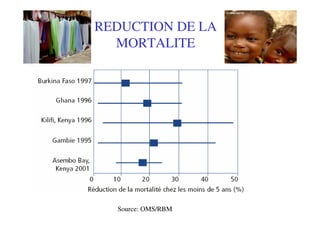
REDUCTION DE LA
  MORTALITE


  Source: OMS/RBM
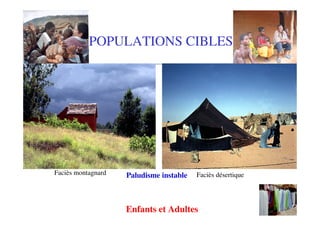
POPULATIONS CIBLES


Faciès montagnard   Paludisme instable   Faciès désertique


                    Enfants et Adultes
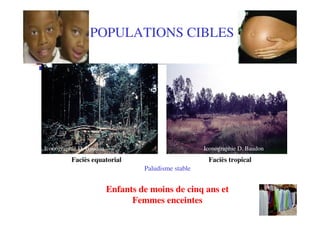
POPULATIONS CIBLES


Iconographie D. Baudon                               Iconographie D. Baudon
         Faciès equatorial                            Faciès tropical
                                  Paludisme stable


                         Enfants de moins de cinq ans et
                               Femmes enceintes
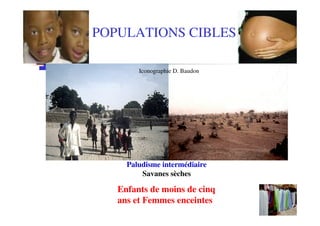
POPULATIONS CIBLES

        Iconographie D. Baudon


     Paludisme intermédiaire
         Savanes sèches

   Enfants de moins de cinq
   ans et Femmes enceintes
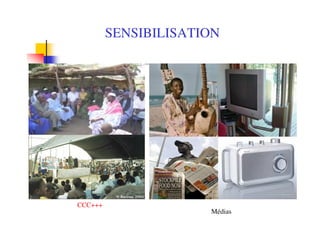
SENSIBILISATION


CCC+++
                      Médias
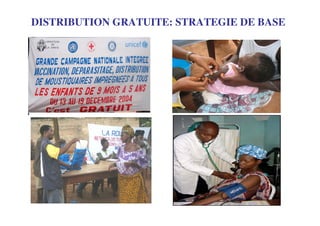
DISTRIBUTION GRATUITE: STRATEGIE DE BASE
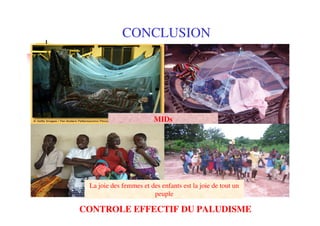
CONCLUSION


                         MIDs


 La joie des femmes et des enfants est la joie de tout un
                        peuple

CONTROLE EFFECTIF DU PALUDISME
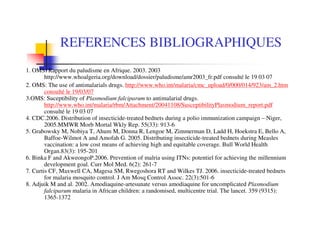
REFERENCES BIBLIOGRAPHIQUES
1. OMS: Rapport du paludisme en Afrique. 2003. 2003
        http://www.whoalgeria.org/download/dossier/paludisme/amr2003_fr.pdf consulté le 19 03 07
2. OMS: The use of antimalarials drugs. http://www.who.int/malaria/cmc_upload/0/000/014/923/am_2.htm
        consulté le 19/03/07
3.OMS: Suceptibility of Plasmodium falciparum to antimalarial drugs.
        http://www.who.int/malaria/rbm/Attachment/20041108/SusceptibilityPlasmodium_report.pdf
        consulté le 19 03 07
4. CDC.2006. Distribution of insecticide-treated bednets during a polio immunization campaign – Niger,
        2005.MMWR Morb Mortal Wkly Rep. 55(33): 913-6
5. Grabowsky M, Nobiya T, Ahum M, Donna R, Lengoe M, Zimmerman D, Ladd H, Hoekstra E, Bello A,
        Baffoe-Wilmot A and Amofah G. 2005. Distributing insecticide-treated bednets during Measles
        vaccination: a low cost means of achieving high and equitable coverage. Bull World Health
        Organ.83(3): 195-201
6. Binka F and AkweongoP.2006. Prevention of malria using ITNs: potentiel for achieving the millennium
        development goal. Curr Mol Med. 6(2): 261-7
7. Curtis CF, Maxwell CA, Magesa SM, Rwegoshora RT and Wilkes TJ. 2006. insecticide-treated bednets
        for malaria mosquito control. J Am Mosq Control Assoc. 22(3):501-6
8. Adjuik M and al. 2002. Amodiaquine-artesunate versus amodiaquine for uncomplicated Plasmodium
        falciparum malaria in African children: a randomised, multicentre trial. The lancet. 359 (9315):
        1365-1372
REFERENCES BIBLIOGRAPHIQUES
9. Rhee M, Sissoko M, Perry S, McFarland W, Parsonnet J and Doumbo O. 2005.Use of insecticide-treated
    nets (ITNs) following a malaria education intervention in Piron, Mali: a control trial with systematic
    allocation of households. Malar J. 24: 4-35
10. Maxwell CA, Msuya E, Sudi M, Njunwa KJ, Carneiro IA and Curtis CF.2002. effect of community-
    wide use of insecticide-treated nets for 3-4 years on malaria morbidity in Tanzania. Trop Med Int
    Health. 7(12): 1003-1008
11. D’Alessandro U, Olaleye B, Mc Guire W, Langerock P, bennett S, Aikins MK, Thomson MC, Cham
    MK, Cham BA and Greenwood BM. 1995. mortality and morbidity from malaria in Gambian children
    after introduction of an impregnated bednet programme. Lancet. 345(8948): 479-83.
12. Nevill CG, Some ES, Mung’ala VO, Mutemi W, New L, Marsh K, Lengeler C and Snow RW. 1996.
    Insecticide-treated bednets reduce mortality and severe morbidity from malaria among children on the
    Kenyan coast. Trop Med Int health. 1(2):137-8.
13. Duffy PE and Sibley CH.2005. Are we losing artemisinin combination tharapy already? The Lancet.
    366(9501): 1908-1909
14. Lengeler C. 2007. Insecticide-treated bed nets and curtains for preventing malria.
    http://www.mrw.interscience.Wiley.com/cochrane/clsysrev/articles/CD000363/abstract consulté le
    20/03/07
15. Abdulla S, Schellenberg JA, Nathan R, Mukasa O, Marchant T, smith T, tanner M and lengeler C.
    2001.Impact on malaria morbidity of a programme supplying insecticide treated nets in children under 2
    years in tanzania: community cross sectional study.BMJ. 322 (7281): 270-273.
16. Gamble C, Ekwaru JP and Kuile F. 2006. Insecticide- treated nets for preventing malaria in pregnancy.
    http://www.mrw.interscience.Wiley.com/cochrane/clsysrev/articles/CD0003755/abstract consulté le
    20/03/07
A TRES BIENTOT

Si on a un choix à faire: ACTs ou moustiquaires en Afrique? (MID)

  • 1.
    SI ON AUN CHOIX A FAIRE: ACTs OU MOUSTIQUAIRES (MID) EN AFRIQUE? EVALUATION par les FACILITATEURS Offianan André TOURE UPAL/IPCI
  • 2.
    STRATEGIES OMS 1.Prevention Utilisation des moustiquaires ou rideaux imprégnés d’insecticides Prévention et Lutte contre les épidémies de paludisme Prévention du paludisme chez la femme enceinte 2. Traitement Améliorer la prise en charge des cas dans les Formations Sanitaires Améliorer la prise en charge des cas à domicile et ou dans les communautés
  • 3.
    EVOLUTION DE L’ADOPTIONDES ACTs COMME T3 DE 1ère INTENTION(en nombre cumulé) Source: WHO/2005
  • 4.
  • 5.
    LIMITES DES ACTs Absence d’Etudes de pharmacovigilance Inadéquation demande:offre: Rupture de stock (Mondial, local) Péremption: ½ vie courte Coût élevé: Transport+Mobilisation des parents + Diagnostic Effets secondaires: Art+amodiaquine Arrêt des subventions (Global found, Fond Bush et autres) = effet rebond
  • 6.
    LIMITES DES ACTs Artesunate+amodiaquine Artesunate+ Mefloquine Artesunate+ SP Afrique (1996-2004) Afrique (1996-2004) ECHECS THERAPEUTIQUES Source: WHO/2005
  • 7.
    LIMITES DES ACTs (Adjuiket al 2002) ECHECS THERAPEUTIQUES
  • 8.
    MAP OF DRUGRESISTANCE
  • 9.
    FACTEURS DETERMINANTS LA RESISTANCE Pression médicamenteuse par l’utilisation en masse du médicament Exposition longue du parasite à des concentrations faibles du médicament Mauvaise prescription (posologie, durée, traitement inapproprié) Mauvaise observance ( abandon du traitement) Mauvaise qualité des médicaments Pression médicamenteuse: Moteur extension des résistances
  • 10.
    CONSEQUENCES DE LA RESISTANCE Augmentation de la morbi-mortalité Retard de guérison clinique Augmentation du portage de gamétocytes Surcoût "Those who cannot remember the past are condemned to repeat it." - Santayana
  • 11.
    OUBLIES DES ACTs Femmesenceintes Femmes allaitantes et nourrissons Paludisme grave Paludisme+intolérance digestive
  • 12.
  • 13.
    PRINCIPE DES MIDs Efficacitépersistante: 4-5ans sans réimpregantion malgré les lavages et usure Action répulsive et irritante pour le vecteur, moins toxique chez l’homme Procédé industriel de fabrication
  • 14.
    EFFICACITE DES MIDs Nombre Unwashed 2 Washes 4 washes 6 washes 10 washes 15washes 20washes lavage Conventional 24,7±1,1 5,7±0,7 2,5±0,5 0,7±0,2 0,3±02 <0,1 <0,1 Net PermaNet2.0 47,5±10,1 43,4±11,9 46,1±11,3 39,0±12,1 33,5±6,3 29,4±10,3 21,5±10,1 Deltamethrin concentrations (mg/m2) ± 95% I.C.of PermaNets2.0 and conventinal deltamethrin treated nets after repeated washing (Duchon, Herve & Hougard 2003a) WHO/CDS/WHOPES/2004;8,PermaNet®
  • 15.
    EFFICACITE DES MIDs Insecticide 1 2 3 4 10 20 wash washes washes washes washes washes Deltamethrin SC, 70,2 67,4 31,8 41,3 25mg a.i./m2 Deltamethrin WT, 84,2 71,6 63,3 43,5 25mg a.i./m2 PermaNet, 92,6 83,7 87,1 55mg a.i./m2 Bioassay mortality(%) of Anopheles species on nets wash every 7 days (Gonzales et al.,2002) WHO/CDS/WHOPES/2004;8,PermaNet®
  • 16.
    REDUCTION DE LA MORBIDITE Curtis CF et al.(2006) Maxwell CA et al (Tanzanie): 55-75% Binka F et al.: (Ghana): 43% Abdulla et al.(Tanzanie): protec. 62% Parasit. 63% Anemie Nevill CG et al. (Kenya): 44% Lengeler (2007): - Palu simple:50% (stable) et 62% (instable) - Palu grave: 45%, prévalence parasitaire: 13% , parasitemie:29% et splénomégalie:30%
  • 17.
    REDUCTION DE LA MORTALITE Source: OMS/RBM
  • 18.
    POPULATIONS CIBLES Faciès montagnard Paludisme instable Faciès désertique Enfants et Adultes
  • 19.
    POPULATIONS CIBLES Iconographie D.Baudon Iconographie D. Baudon Faciès equatorial Faciès tropical Paludisme stable Enfants de moins de cinq ans et Femmes enceintes
  • 20.
    POPULATIONS CIBLES Iconographie D. Baudon Paludisme intermédiaire Savanes sèches Enfants de moins de cinq ans et Femmes enceintes
  • 21.
  • 22.
  • 23.
    CONCLUSION MIDs La joie des femmes et des enfants est la joie de tout un peuple CONTROLE EFFECTIF DU PALUDISME
  • 24.
    REFERENCES BIBLIOGRAPHIQUES 1. OMS:Rapport du paludisme en Afrique. 2003. 2003 http://www.whoalgeria.org/download/dossier/paludisme/amr2003_fr.pdf consulté le 19 03 07 2. OMS: The use of antimalarials drugs. http://www.who.int/malaria/cmc_upload/0/000/014/923/am_2.htm consulté le 19/03/07 3.OMS: Suceptibility of Plasmodium falciparum to antimalarial drugs. http://www.who.int/malaria/rbm/Attachment/20041108/SusceptibilityPlasmodium_report.pdf consulté le 19 03 07 4. CDC.2006. Distribution of insecticide-treated bednets during a polio immunization campaign – Niger, 2005.MMWR Morb Mortal Wkly Rep. 55(33): 913-6 5. Grabowsky M, Nobiya T, Ahum M, Donna R, Lengoe M, Zimmerman D, Ladd H, Hoekstra E, Bello A, Baffoe-Wilmot A and Amofah G. 2005. Distributing insecticide-treated bednets during Measles vaccination: a low cost means of achieving high and equitable coverage. Bull World Health Organ.83(3): 195-201 6. Binka F and AkweongoP.2006. Prevention of malria using ITNs: potentiel for achieving the millennium development goal. Curr Mol Med. 6(2): 261-7 7. Curtis CF, Maxwell CA, Magesa SM, Rwegoshora RT and Wilkes TJ. 2006. insecticide-treated bednets for malaria mosquito control. J Am Mosq Control Assoc. 22(3):501-6 8. Adjuik M and al. 2002. Amodiaquine-artesunate versus amodiaquine for uncomplicated Plasmodium falciparum malaria in African children: a randomised, multicentre trial. The lancet. 359 (9315): 1365-1372
  • 25.
    REFERENCES BIBLIOGRAPHIQUES 9. RheeM, Sissoko M, Perry S, McFarland W, Parsonnet J and Doumbo O. 2005.Use of insecticide-treated nets (ITNs) following a malaria education intervention in Piron, Mali: a control trial with systematic allocation of households. Malar J. 24: 4-35 10. Maxwell CA, Msuya E, Sudi M, Njunwa KJ, Carneiro IA and Curtis CF.2002. effect of community- wide use of insecticide-treated nets for 3-4 years on malaria morbidity in Tanzania. Trop Med Int Health. 7(12): 1003-1008 11. D’Alessandro U, Olaleye B, Mc Guire W, Langerock P, bennett S, Aikins MK, Thomson MC, Cham MK, Cham BA and Greenwood BM. 1995. mortality and morbidity from malaria in Gambian children after introduction of an impregnated bednet programme. Lancet. 345(8948): 479-83. 12. Nevill CG, Some ES, Mung’ala VO, Mutemi W, New L, Marsh K, Lengeler C and Snow RW. 1996. Insecticide-treated bednets reduce mortality and severe morbidity from malaria among children on the Kenyan coast. Trop Med Int health. 1(2):137-8. 13. Duffy PE and Sibley CH.2005. Are we losing artemisinin combination tharapy already? The Lancet. 366(9501): 1908-1909 14. Lengeler C. 2007. Insecticide-treated bed nets and curtains for preventing malria. http://www.mrw.interscience.Wiley.com/cochrane/clsysrev/articles/CD000363/abstract consulté le 20/03/07 15. Abdulla S, Schellenberg JA, Nathan R, Mukasa O, Marchant T, smith T, tanner M and lengeler C. 2001.Impact on malaria morbidity of a programme supplying insecticide treated nets in children under 2 years in tanzania: community cross sectional study.BMJ. 322 (7281): 270-273. 16. Gamble C, Ekwaru JP and Kuile F. 2006. Insecticide- treated nets for preventing malaria in pregnancy. http://www.mrw.interscience.Wiley.com/cochrane/clsysrev/articles/CD0003755/abstract consulté le 20/03/07
  • 26.