Université Ibn Zohr
Master Spécialisé en Systèmes Embarqués
et Ingénierie Biomédical
Le Rythme Cardiaque
Plan
Plan
1 Definition
Rythme auriculaire
Le système de conduction cardiaque
Rythme ventriculaire
Rythme du nœud sinusal
2
3
4
5
1-Definition
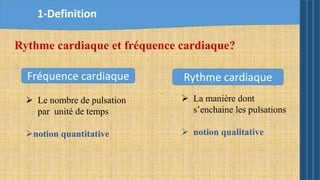
 Le nombre de pulsation
par unité de temps
notion quantitative
 La manière dont
s’enchaine les pulsations
 notion qualitative
Fréquence cardiaque Rythme cardiaque
Rythme cardiaque et fréquence cardiaque?
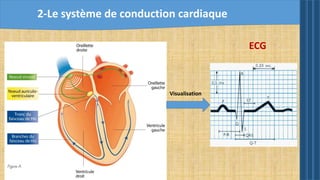
2-Le système de conduction cardiaque
ECG
Visualisation
2-Le système de conduction cardiaque
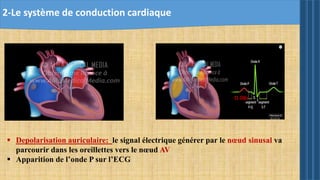
 Depolarisation auriculaire: le signal électrique générer par le nœud sinusal va
parcourir dans les oreillettes vers le nœud AV
 Apparition de l’onde P sur l’ECG
O.08s
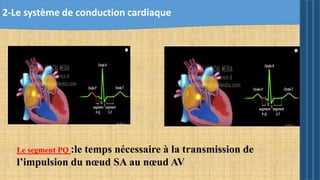
Le segment PQ :le temps nécessaire à la transmission de
l’impulsion du nœud SA au nœud AV
2-Le système de conduction cardiaque
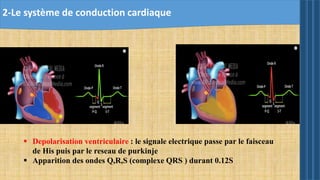
 Depolarisation ventriculaire : le signale electrique passe par le faisceau
de His puis par le reseau de purkinje
 Apparition des ondes Q,R,S (complexe QRS ) durant 0.12S
2-Le système de conduction cardiaque
Introduction
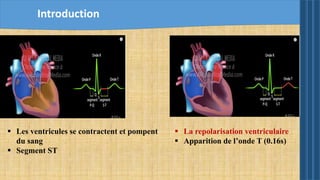
 Les ventricules se contractent et pompent
du sang
 Segment ST
 La repolarisation ventriculaire
 Apparition de l’onde T (0.16s)
2-Rythme du nœud sinusale
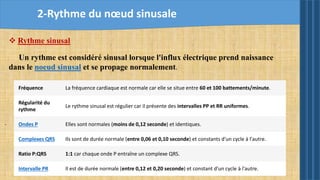
 Rythme sinusal
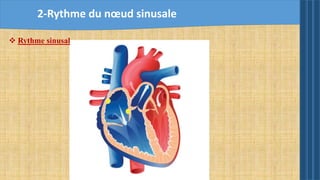
Un rythme est considéré sinusal lorsque l'influx électrique prend naissance
dans le noeud sinusal et se propage normalement.
.
Fréquence La fréquence cardiaque est normale car elle se situe entre 60 et 100 battements/minute.
Régularité du
rythme
Le rythme sinusal est régulier car il présente des intervalles PP et RR uniformes.
Ondes P Elles sont normales (moins de 0,12 seconde) et identiques.
Complexes QRS Ils sont de durée normale (entre 0,06 et 0,10 seconde) et constants d'un cycle à l'autre.
Ratio P:QRS 1:1 car chaque onde P entraîne un complexe QRS.
Intervalle PR Il est de durée normale (entre 0,12 et 0,20 seconde) et constant d'un cycle à l'autre.
 Rythme sinusal
2-Rythme du nœud sinusale
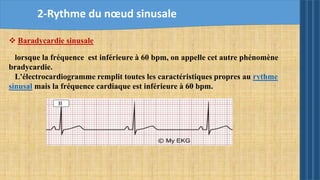
 Baradycardie sinusale
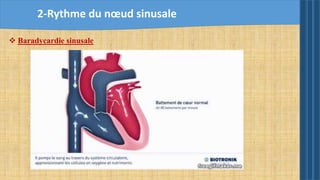
lorsque la fréquence est inférieure à 60 bpm, on appelle cet autre phénomène
bradycardie.
L'électrocardiogramme remplit toutes les caractéristiques propres au rythme
sinusal mais la fréquence cardiaque est inférieure à 60 bpm.
2-Rythme du nœud sinusale
 Baradycardie sinusale
2-Rythme du nœud sinusale
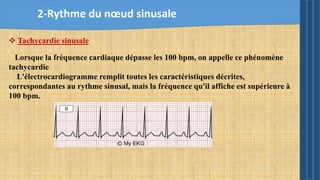
 Tachycardie sinusale
Lorsque la fréquence cardiaque dépasse les 100 bpm, on appelle ce phénomène
tachycardie
L'électrocardiogramme remplit toutes les caractéristiques décrites,
correspondantes au rythme sinusal, mais la fréquence qu'il affiche est supérieure à
100 bpm.
2-Rythme du nœud sinusale
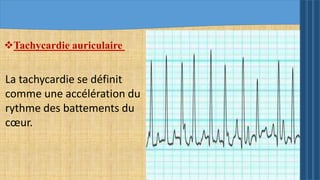
Tachycardie auriculaire
La tachycardie se définit
comme une accélération du
rythme des battements du
cœur.
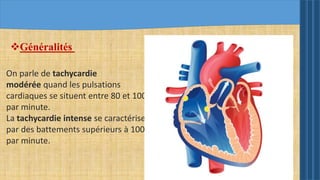
Généralités
On parle de tachycardie
modérée quand les pulsations
cardiaques se situent entre 80 et 100
par minute.
La tachycardie intense se caractérise
par des battements supérieurs à 100
par minute.
Rythme Auriculaire
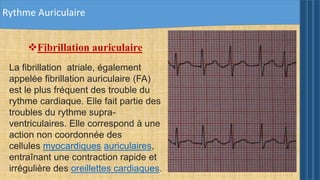
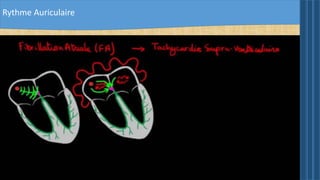
Fibrillation auriculaire
La fibrillation atriale, également
appelée fibrillation auriculaire (FA)
est le plus fréquent des trouble du
rythme cardiaque. Elle fait partie des
troubles du rythme supra-
ventriculaires. Elle correspond à une
action non coordonnée des
cellules myocardiques auriculaires,
entraînant une contraction rapide et
irrégulière des oreillettes cardiaques.
Rythme Auriculaire
Rythme Auriculaire
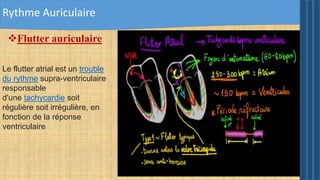
Flutter auriculaire
Le flutter atrial est un trouble
du rythme supra-ventriculaire
responsable
d'une tachycardie soit
régulière soit irrégulière, en
fonction de la réponse
ventriculaire
Rythme Auriculaire
vidéo
Tachycardie supra ventriculaire
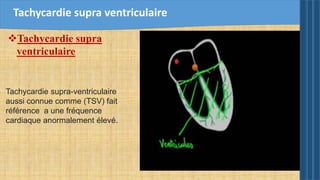
Tachycardie supra-ventriculaire
aussi connue comme (TSV) fait
référence a une fréquence
cardiaque anormalement élevé.
Tachycardie supra
ventriculaire
La Tachycardie Supra-Ventriculaire
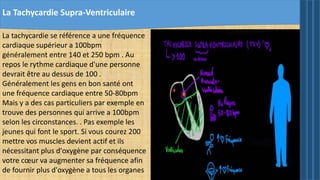
La tachycardie se référence a une fréquence
cardiaque supérieur a 100bpm
généralement entre 140 et 250 bpm . Au
repos le rythme cardiaque d'une personne
devrait être au dessus de 100 .
Généralement les gens en bon santé ont
une fréquence cardiaque entre 50-80bpm
Mais y a des cas particuliers par exemple en
trouve des personnes qui arrive a 100bpm
selon les circonstances. . Pas exemple les
jeunes qui font le sport. Si vous courez 200
mettre vos muscles devient actif et ils
nécessitant plus d'oxygène par conséquence
votre cœur va augmenter sa fréquence afin
de fournir plus d'oxygène a tous les organes
3-Rythme Ventriculaire
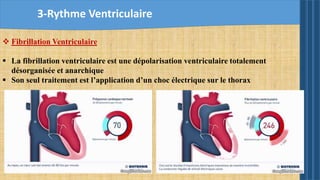
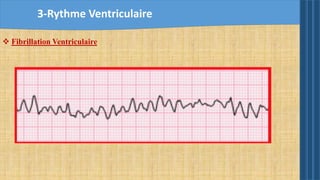
 Fibrillation Ventriculaire
 La fibrillation ventriculaire est une dépolarisation ventriculaire totalement
désorganisée et anarchique
 Son seul traitement est l’application d’un choc électrique sur le thorax
3-Rythme Ventriculaire
 Fibrillation Ventriculaire
Le rythme cardiaque
Le rythme cardiaque
Le rythme cardiaque

Le rythme cardiaque

  • 1.
    Université Ibn Zohr MasterSpécialisé en Systèmes Embarqués et Ingénierie Biomédical Le Rythme Cardiaque
  • 2.
    Plan Plan 1 Definition Rythme auriculaire Lesystème de conduction cardiaque Rythme ventriculaire Rythme du nœud sinusal 2 3 4 5
  • 3.
    1-Definition  Le nombrede pulsation par unité de temps notion quantitative  La manière dont s’enchaine les pulsations  notion qualitative Fréquence cardiaque Rythme cardiaque Rythme cardiaque et fréquence cardiaque?
  • 4.
    2-Le système deconduction cardiaque ECG Visualisation
  • 5.
    2-Le système deconduction cardiaque  Depolarisation auriculaire: le signal électrique générer par le nœud sinusal va parcourir dans les oreillettes vers le nœud AV  Apparition de l’onde P sur l’ECG O.08s
  • 6.
    Le segment PQ:le temps nécessaire à la transmission de l’impulsion du nœud SA au nœud AV 2-Le système de conduction cardiaque
  • 7.
     Depolarisation ventriculaire: le signale electrique passe par le faisceau de His puis par le reseau de purkinje  Apparition des ondes Q,R,S (complexe QRS ) durant 0.12S 2-Le système de conduction cardiaque
  • 8.
    Introduction  Les ventriculesse contractent et pompent du sang  Segment ST  La repolarisation ventriculaire  Apparition de l’onde T (0.16s)
  • 9.
    2-Rythme du nœudsinusale  Rythme sinusal Un rythme est considéré sinusal lorsque l'influx électrique prend naissance dans le noeud sinusal et se propage normalement. . Fréquence La fréquence cardiaque est normale car elle se situe entre 60 et 100 battements/minute. Régularité du rythme Le rythme sinusal est régulier car il présente des intervalles PP et RR uniformes. Ondes P Elles sont normales (moins de 0,12 seconde) et identiques. Complexes QRS Ils sont de durée normale (entre 0,06 et 0,10 seconde) et constants d'un cycle à l'autre. Ratio P:QRS 1:1 car chaque onde P entraîne un complexe QRS. Intervalle PR Il est de durée normale (entre 0,12 et 0,20 seconde) et constant d'un cycle à l'autre.
  • 10.
     Rythme sinusal 2-Rythmedu nœud sinusale
  • 11.
     Baradycardie sinusale lorsquela fréquence est inférieure à 60 bpm, on appelle cet autre phénomène bradycardie. L'électrocardiogramme remplit toutes les caractéristiques propres au rythme sinusal mais la fréquence cardiaque est inférieure à 60 bpm. 2-Rythme du nœud sinusale
  • 12.
  • 13.
     Tachycardie sinusale Lorsquela fréquence cardiaque dépasse les 100 bpm, on appelle ce phénomène tachycardie L'électrocardiogramme remplit toutes les caractéristiques décrites, correspondantes au rythme sinusal, mais la fréquence qu'il affiche est supérieure à 100 bpm. 2-Rythme du nœud sinusale
  • 14.
    Tachycardie auriculaire La tachycardiese définit comme une accélération du rythme des battements du cœur.
  • 15.
    Généralités On parle detachycardie modérée quand les pulsations cardiaques se situent entre 80 et 100 par minute. La tachycardie intense se caractérise par des battements supérieurs à 100 par minute.
  • 16.
    Rythme Auriculaire Fibrillation auriculaire Lafibrillation atriale, également appelée fibrillation auriculaire (FA) est le plus fréquent des trouble du rythme cardiaque. Elle fait partie des troubles du rythme supra- ventriculaires. Elle correspond à une action non coordonnée des cellules myocardiques auriculaires, entraînant une contraction rapide et irrégulière des oreillettes cardiaques.
  • 17.
  • 18.
    Rythme Auriculaire Flutter auriculaire Leflutter atrial est un trouble du rythme supra-ventriculaire responsable d'une tachycardie soit régulière soit irrégulière, en fonction de la réponse ventriculaire
  • 19.
  • 20.
    Tachycardie supra ventriculaire Tachycardiesupra-ventriculaire aussi connue comme (TSV) fait référence a une fréquence cardiaque anormalement élevé. Tachycardie supra ventriculaire
  • 21.
    La Tachycardie Supra-Ventriculaire Latachycardie se référence a une fréquence cardiaque supérieur a 100bpm généralement entre 140 et 250 bpm . Au repos le rythme cardiaque d'une personne devrait être au dessus de 100 . Généralement les gens en bon santé ont une fréquence cardiaque entre 50-80bpm Mais y a des cas particuliers par exemple en trouve des personnes qui arrive a 100bpm selon les circonstances. . Pas exemple les jeunes qui font le sport. Si vous courez 200 mettre vos muscles devient actif et ils nécessitant plus d'oxygène par conséquence votre cœur va augmenter sa fréquence afin de fournir plus d'oxygène a tous les organes
  • 22.
    3-Rythme Ventriculaire  FibrillationVentriculaire  La fibrillation ventriculaire est une dépolarisation ventriculaire totalement désorganisée et anarchique  Son seul traitement est l’application d’un choc électrique sur le thorax
  • 23.

Notes de l'éditeur

  • #3 When we watch celebrities, politicians, or business leaders speak on television or in public, they seem so at ease that we may wonder: are great speakers made, or are they just born that way ? While it is true that some individuals are born with this gift, many effective public speakers have trained themselves to be so. Either they have received formal media training or they have delivered so many presentations that over time they’ve learned what works for them. So
  • #4 When we watch celebrities, politicians, or business leaders speak on television or in public, they seem so at ease that we may wonder: are great speakers made, or are they just born that way ? While it is true that some individuals are born with this gift, many effective public speakers have trained themselves to be so. Either they have received formal media training or they have delivered so many presentations that over time they’ve learned what works for them. So
  • #5 When we watch celebrities, politicians, or business leaders speak on television or in public, they seem so at ease that we may wonder: are great speakers made, or are they just born that way ? While it is true that some individuals are born with this gift, many effective public speakers have trained themselves to be so. Either they have received formal media training or they have delivered so many presentations that over time they’ve learned what works for them. So
  • #7 When we watch celebrities, politicians, or business leaders speak on television or in public, they seem so at ease that we may wonder: are great speakers made, or are they just born that way ? While it is true that some individuals are born with this gift, many effective public speakers have trained themselves to be so. Either they have received formal media training or they have delivered so many presentations that over time they’ve learned what works for them. So
  • #9 When we watch celebrities, politicians, or business leaders speak on television or in public, they seem so at ease that we may wonder: are great speakers made, or are they just born that way ? While it is true that some individuals are born with this gift, many effective public speakers have trained themselves to be so. Either they have received formal media training or they have delivered so many presentations that over time they’ve learned what works for them. So
  • #10 When we watch celebrities, politicians, or business leaders speak on television or in public, they seem so at ease that we may wonder: are great speakers made, or are they just born that way ? While it is true that some individuals are born with this gift, many effective public speakers have trained themselves to be so. Either they have received formal media training or they have delivered so many presentations that over time they’ve learned what works for them. So
  • #11 When we watch celebrities, politicians, or business leaders speak on television or in public, they seem so at ease that we may wonder: are great speakers made, or are they just born that way ? While it is true that some individuals are born with this gift, many effective public speakers have trained themselves to be so. Either they have received formal media training or they have delivered so many presentations that over time they’ve learned what works for them. So
  • #12 When we watch celebrities, politicians, or business leaders speak on television or in public, they seem so at ease that we may wonder: are great speakers made, or are they just born that way ? While it is true that some individuals are born with this gift, many effective public speakers have trained themselves to be so. Either they have received formal media training or they have delivered so many presentations that over time they’ve learned what works for them. So
  • #13 When we watch celebrities, politicians, or business leaders speak on television or in public, they seem so at ease that we may wonder: are great speakers made, or are they just born that way ? While it is true that some individuals are born with this gift, many effective public speakers have trained themselves to be so. Either they have received formal media training or they have delivered so many presentations that over time they’ve learned what works for them. So
  • #14 When we watch celebrities, politicians, or business leaders speak on television or in public, they seem so at ease that we may wonder: are great speakers made, or are they just born that way ? While it is true that some individuals are born with this gift, many effective public speakers have trained themselves to be so. Either they have received formal media training or they have delivered so many presentations that over time they’ve learned what works for them. So
  • #15 When we watch celebrities, politicians, or business leaders speak on television or in public, they seem so at ease that we may wonder: are great speakers made, or are they just born that way ? While it is true that some individuals are born with this gift, many effective public speakers have trained themselves to be so. Either they have received formal media training or they have delivered so many presentations that over time they’ve learned what works for them. So
  • #16 When we watch celebrities, politicians, or business leaders speak on television or in public, they seem so at ease that we may wonder: are great speakers made, or are they just born that way ? While it is true that some individuals are born with this gift, many effective public speakers have trained themselves to be so. Either they have received formal media training or they have delivered so many presentations that over time they’ve learned what works for them. So
  • #17 When we watch celebrities, politicians, or business leaders speak on television or in public, they seem so at ease that we may wonder: are great speakers made, or are they just born that way ? While it is true that some individuals are born with this gift, many effective public speakers have trained themselves to be so. Either they have received formal media training or they have delivered so many presentations that over time they’ve learned what works for them. So
  • #19 When we watch celebrities, politicians, or business leaders speak on television or in public, they seem so at ease that we may wonder: are great speakers made, or are they just born that way ? While it is true that some individuals are born with this gift, many effective public speakers have trained themselves to be so. Either they have received formal media training or they have delivered so many presentations that over time they’ve learned what works for them. So
  • #20 When we watch celebrities, politicians, or business leaders speak on television or in public, they seem so at ease that we may wonder: are great speakers made, or are they just born that way ? While it is true that some individuals are born with this gift, many effective public speakers have trained themselves to be so. Either they have received formal media training or they have delivered so many presentations that over time they’ve learned what works for them. So
  • #21 When we watch celebrities, politicians, or business leaders speak on television or in public, they seem so at ease that we may wonder: are great speakers made, or are they just born that way ? While it is true that some individuals are born with this gift, many effective public speakers have trained themselves to be so. Either they have received formal media training or they have delivered so many presentations that over time they’ve learned what works for them. So
  • #22 When we watch celebrities, politicians, or business leaders speak on television or in public, they seem so at ease that we may wonder: are great speakers made, or are they just born that way ? While it is true that some individuals are born with this gift, many effective public speakers have trained themselves to be so. Either they have received formal media training or they have delivered so many presentations that over time they’ve learned what works for them. So
  • #23 When we watch celebrities, politicians, or business leaders speak on television or in public, they seem so at ease that we may wonder: are great speakers made, or are they just born that way ? While it is true that some individuals are born with this gift, many effective public speakers have trained themselves to be so. Either they have received formal media training or they have delivered so many presentations that over time they’ve learned what works for them. So
  • #24 When we watch celebrities, politicians, or business leaders speak on television or in public, they seem so at ease that we may wonder: are great speakers made, or are they just born that way ? While it is true that some individuals are born with this gift, many effective public speakers have trained themselves to be so. Either they have received formal media training or they have delivered so many presentations that over time they’ve learned what works for them. So
  • #25 When we watch celebrities, politicians, or business leaders speak on television or in public, they seem so at ease that we may wonder: are great speakers made, or are they just born that way ? While it is true that some individuals are born with this gift, many effective public speakers have trained themselves to be so. Either they have received formal media training or they have delivered so many presentations that over time they’ve learned what works for them. So
  • #26 When we watch celebrities, politicians, or business leaders speak on television or in public, they seem so at ease that we may wonder: are great speakers made, or are they just born that way ? While it is true that some individuals are born with this gift, many effective public speakers have trained themselves to be so. Either they have received formal media training or they have delivered so many presentations that over time they’ve learned what works for them. So
  • #27 When we watch celebrities, politicians, or business leaders speak on television or in public, they seem so at ease that we may wonder: are great speakers made, or are they just born that way ? While it is true that some individuals are born with this gift, many effective public speakers have trained themselves to be so. Either they have received formal media training or they have delivered so many presentations that over time they’ve learned what works for them. So