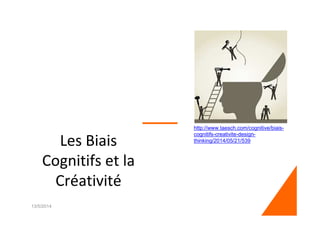
Les Biais
Cognitifs et la
Créativité
13/5/2014 1
http://www.taesch.com/cognitive/biais-
cognitifs-creativite-design-
thinking/2014/05/21/539
I. C’est quoi, un biais ?
• Le 10 eme homme
• http://goo.gl/ukTtyP
Première impression
• You never get a second chance to make a first
good impression
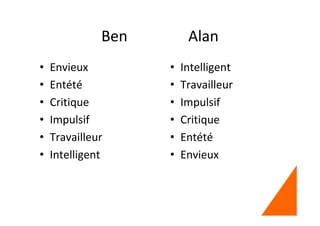
Alan
• Intelligent
• Travailleur
• Impulsif
• Critique
• Entété
• Envieux
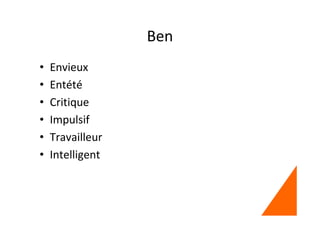
Ben
• Envieux
• Entété
• Critique
• Impulsif
• Travailleur
• Intelligent
Ben Alan
• Envieux
• Entété
• Critique
• Impulsif
• Travailleur
• Intelligent
• Intelligent
• Travailleur
• Impulsif
• Critique
• Entété
• Envieux
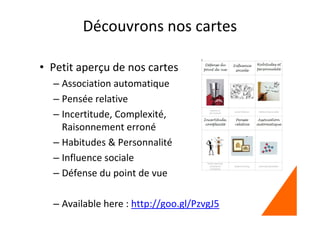
Découvrons nos cartes
• Petit aperçu de nos cartes
– Association automatique
– Pensée relative
– Incertitude, Complexité,
Raisonnement erroné
– Habitudes & Personnalité
– Influence sociale
– Défense du point de vue
– Available here : http://goo.gl/PzvgJ5
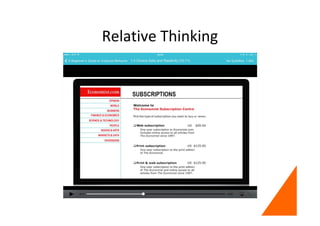
Relative Thinking
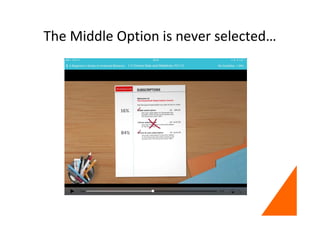
The Middle Option is never selected…
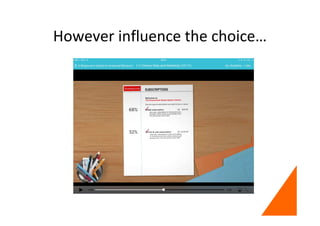
However influence the choice…
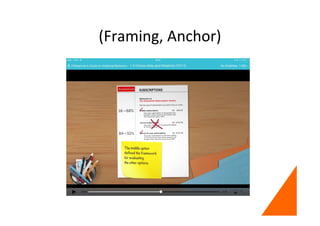
(Framing, Anchor)
Contributions
spontanées
Honesty Box
– In a somewhat spookier example, researchers staged an experiment in a
workplace kitchen wherein employees would routinely make themselves tea
or coffee in exchange for a fee that they would drop in an ‘honesty box’
– In the first stage of the experiment, the researchers planted a picture of a
flowerpot in the room, while in the second stage of the experiment they
replaced it with a picture of a pair of eyes
– The two pictures were then alternated back and forth each week, for a period
of ten weeks
– Finally, the researchers compared how much money was left in the honesty
box across the 2 situations in the experiment.
– Here’s Kahneman to explain the results: “no one commented on the new
decorations, but the contributions to the honesty box changed significantly…
– On average, the users of the kitchen contributed almost three times as much
in ‘eye weeks’ as they did in ‘flower weeks.’ Evidently, a purely symbolic
reminder of being watched prodded people into improved behavior. As we
expect at this point, the effect occurs without any awareness” . This is a very
eye-opening example of how System 1 can influence System 2, and also hints
at the frightening ways that System 1 might be exploited.
Les biais selon Kahneman
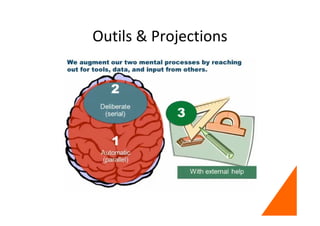
• Système 1 et System 2
– Système 1
– Système 2
– L’interaction
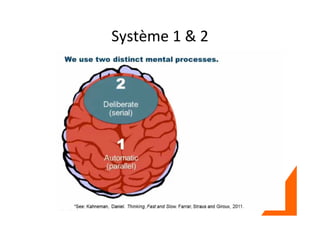
Système 1 & 2
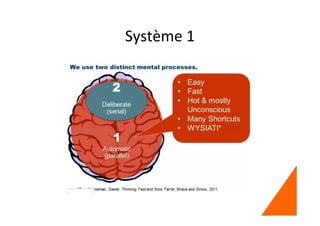
Système 1
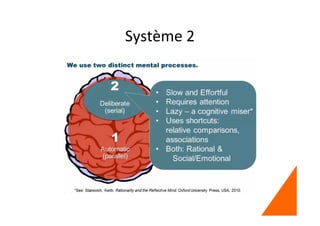
Système 2
Outils & Projections
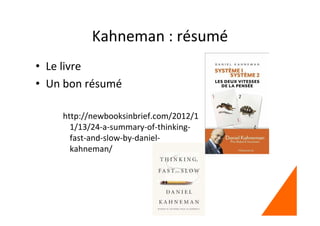
Kahneman : résumé
• Le livre
• Un bon résumé
http://newbooksinbrief.com/2012/1
1/13/24-a-summary-of-thinking-
fast-and-slow-by-daniel-
kahneman/
Cognitive Bias
• 80+ : http://en.wikipedia.org/wiki/List_of_cognitive_biases
• 300+ : https://www.recobia.eu/ ( non public)
• Many classifications
– We took an “actionable” one , inspired by the DQ 101 Stanford Mooc (Karl
Spetzler)
• DQ 101: Introduction to Decision Quality https://novoed.com/DQ101/
• Paris Meetup:
– http://www.meetup.com/Psychologie-Cognitive-et-Changement-Paris-
Meetup/
– http://www.meetup.com/Paris-Antifragile-Meetup/
• Design thinking and Cognitive Bias
– @stakken86 thesis on #DesignThinking and #CognitiveBias http://goo.gl/wHU8bc
• My curation : http://www.scoop.it/t/cognitive-bias
• Dan Ariely : Guide d'introduction au comportement irrationnel
– https://www.coursera.org/course/behavioralecon
II. Expérimenter Les Biais
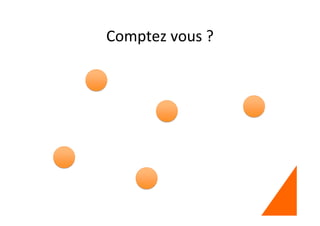
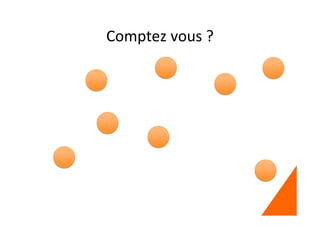
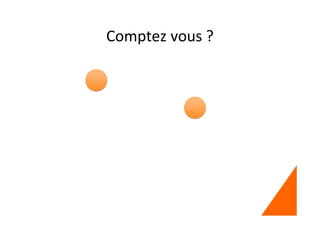
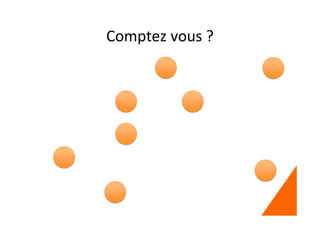
Dites le plus vite possible combien de
points vous voyez
Dites le plus vite possible combien de points vous voyez
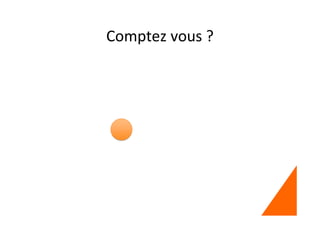
Comptez vous ?
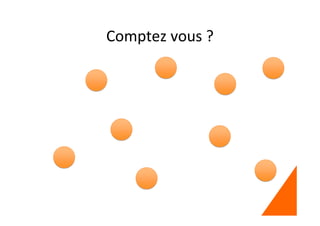
Comptez vous ?
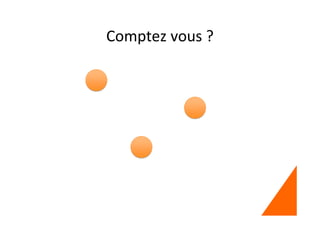
Comptez vous ?
Comptez vous ?
Comptez vous ?
Comptez vous ?
Comptez vous ?
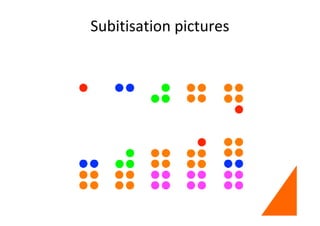
Subitization
• subitization
• (psychology) The process of, or act of,
glancing at a group of a few objects and
knowing how many there are without actually
counting.
• http://en.wikipedia.org/wiki/Subitizing
Subitisation pictures
Group think
• Voyage a Abilene
Voyage à Abilene
Quatre adultes, un couple marié et les parents de la femme, sont assis sous un
porche dans une chaleur abrutissante dans la petite ville de Coleman, au Texas,
à environ 53 miles d'Abilene. Ils sirotent tristement de la citronnade, observant
le ventilateur souffreteux et entamant de temps à autre une partie de domino.
À un moment, le père de l’épouse suggère qu'ils se rendent à Abilene pour se
restaurer dans une cafétéria.
La femme dit “ bonne idée”.
Le gendre pense que c'est une idée folle; que ca va être long et étouffant, mais
pense que ses idées sont contraires a celles du groupe, et n’ose pas contrarier sa
femme qui voit si peu ses parents. Il dit “super, j espère juste que ta maman
veut y aller”.
Les deux femmes ne semblent pas opposées à cette idée et voilà tout ce petit
monde entassé dans une Buick sans air climatisé, qui soulève sur le chemin des
nuages de poussière. À Abilene, ils mangent un déjeuner médiocre dans un
endroit glauque et reviennent à Coleman épuisés, suants, et peu satisfaits du
périple.
Un d’entre eux dis de manière malhonnête “c était super, n est ce pas”. La belle
mère dit alors “ en fait j aurais préfère rester a la maison, mais je suis venu avec
car les 3 autres avait l air enthousiaste”. Le mari dit alors, “ je n avais pas
vraiment envie d y aller; mais j essayais de vous satisfaire”. La femme dit “ je suis
juste venu avec pour être avec vous. J aurais été folle de sortir par une telle
chaleur”. Le beau père dit alors qu’il n avait suggéré ceci que parce que il
pensait que les autres s ennuyait”
http://fr.wikipedia.org/wiki/Paradoxe_d%27Abilene
Le timeboxing
– Menace ou opportunités
– L’aversion pour la perte. Aversion to loss
– Pommodoro
III. Et la Créativité dans tout ca ?
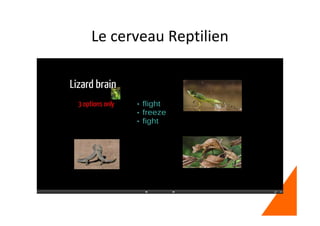
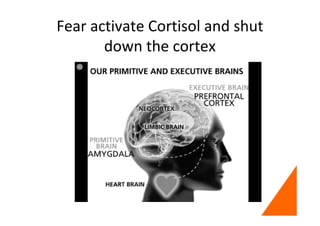
Le cerveau Reptilien
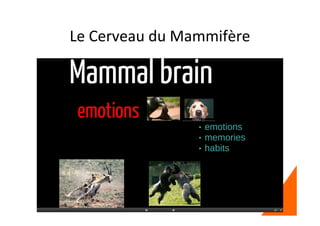
Le Cerveau du Mammifère
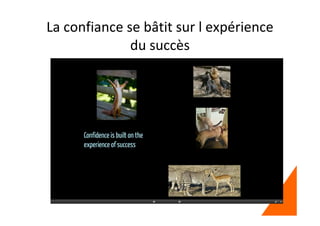
La confiance se bâtit sur l expérience
du succès
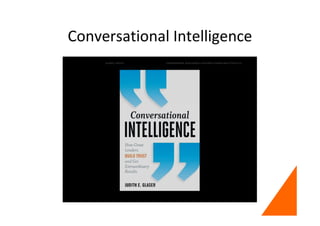
Conversational Intelligence
Fear activate Cortisol and shut
down the cortex
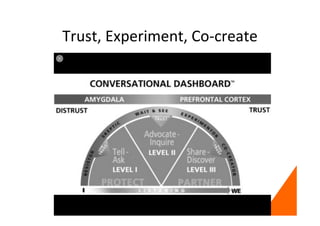
Trust, Experiment, Co-create
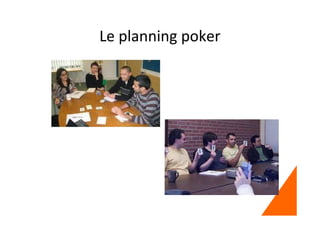
Le planning poker
Estimation relative
• Wysati : What you see is all there is.
• Sur optimisme
• Confiance exagérée
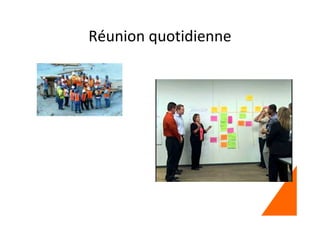
Réunion quotidienne
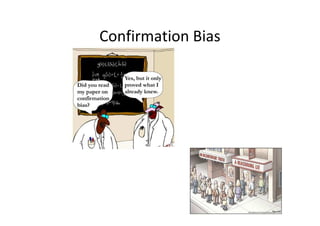
Confirmation Bias
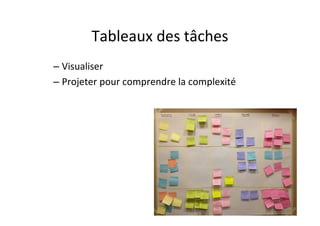
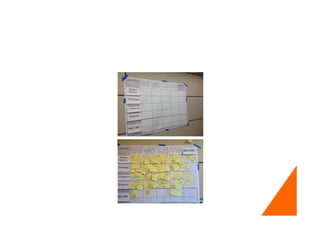
Tableaux des tâches
– Visualiser
– Projeter pour comprendre la complexité
priming
• Video
• http://m.youtube.com/watch?v=HRAKt0GakJ
M
• “the ‘Florida effect’ involves two stages of priming. First, the set of words primes thoughts of old age,
though the word old is never mentioned (“worried,” “Florida,” “old,” “lonely,” “gray,” “bingo, ); second,
these thoughts prime a behavior, walking slowly, which is associated with old age. All this happens
without any awareness. When they were questioned afterward, none of the students reported noticing
that the words had had a common theme, and they all insisted that nothing they did after the first
experiment could have been influenced by the words they had encountered. The idea of old age had not
come into their conscious awareness, but their actions changed nevertheless”
Framing
• http://m.youtube.com/watch?v=Ng9V2JneJ68
• “the five-year survival rates clearly favor surgery, but in the
short term surgery is riskier than radiation”
• When it came to the short term risks of surgery, though,
• half of the doctors were shown stats that referred to the
survival rate (which is 90% after one month),
• while the other half of the doctors were shown stats that
referred to the mortality rate (which is 10% after one month)
.
• Here’s Kahneman with the results: “you already know the
results: surgery was much more popular in the former frame
(84% of physicians chose it) than in the latter (where 50%
favored radiation).
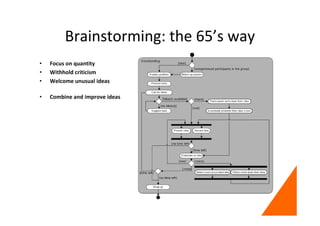
Brainstorming: the 65’s way
• Focus on quantity
• Withhold criticism
• Welcome unusual ideas
• Combine and improve ideas
Brainstorming: the challenges
• Blocking
• Collaborative fixation
• Evaluation apprehension
• Free-riding
• Personality characteristics
• Social matching
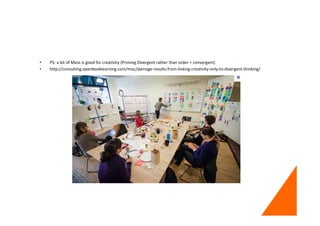
• PS: a bit of Mess is good for creativity (Priming Divergent rather than order = convergent)
• http://consulting.openbooklearning.com/misc/damage-results-from-linking-creativity-only-to-divergent-thinking/
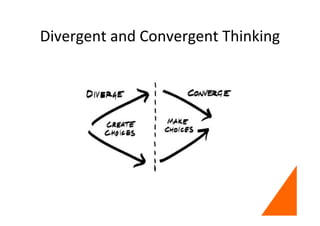
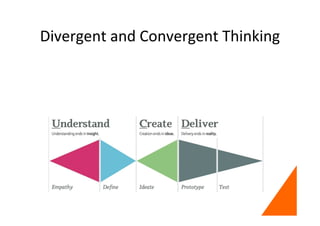
Divergent and Convergent Thinking
You already knew biases…
• Some bias are helpful in convergent and
« harmful » in divergent and vice versa,
– e.g. : association, priming, defence of the mindset,
framing…
Removing Bias ?
• Most classical techniques discovered in
brainstorming, CPS, DT are in fact either using
bias or going around bias to mitigate their
effects…
• One cannot really remove biases, because we
are human.. But we can be aware of their
effects… and knowingly either use them of
defend against them..
• This is .. Maturity …
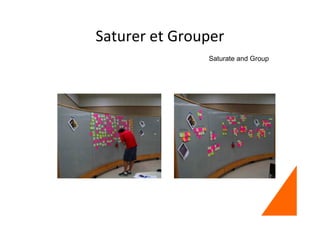
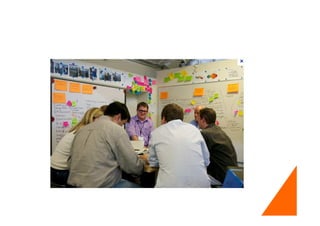
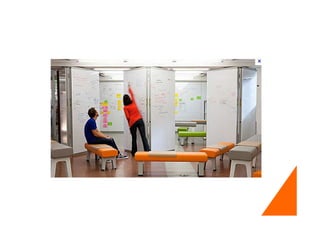
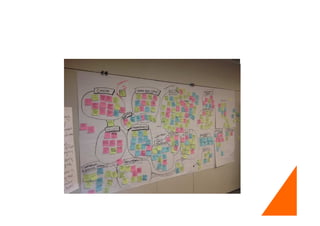
Saturer et Grouper
Saturate and Group
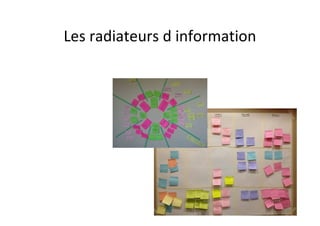
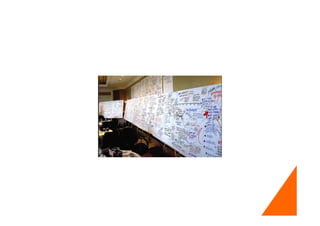
Les radiateurs d information
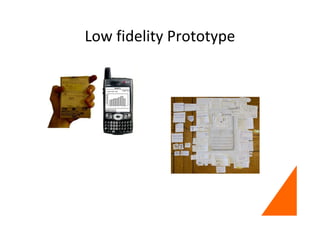
Low fidelity Prototype
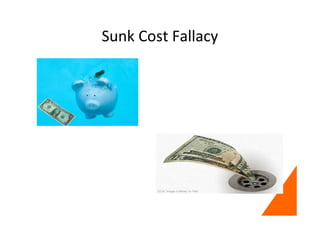
Sunk Cost Fallacy
Organiser Créativement
la créativité autour des biais
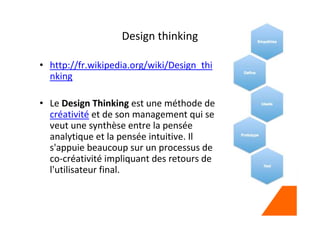
Design thinking
• http://fr.wikipedia.org/wiki/Design_thi
nking
• Le Design Thinking est une méthode de
créativité et de son management qui se
veut une synthèse entre la pensée
analytique et la pensée intuitive. Il
s'appuie beaucoup sur un processus de
co-créativité impliquant des retours de
l'utilisateur final.
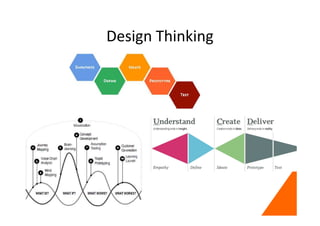
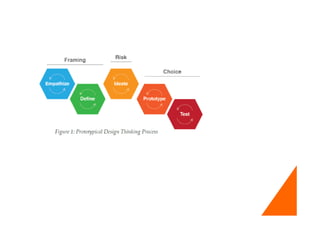
Design Thinking
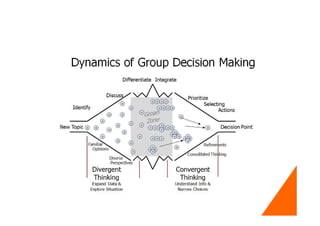
Divergent and Convergent Thinking
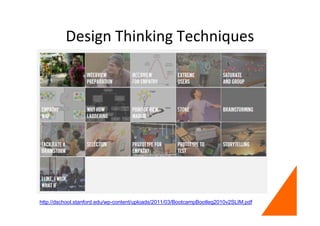
Design Thinking Techniques
http://dschool.stanford.edu/wp-content/uploads/2011/03/BootcampBootleg2010v2SLIM.pdf
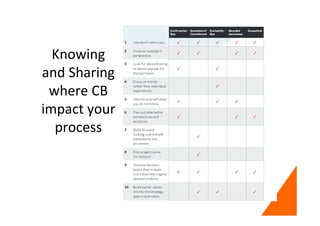
Knowing
and Sharing
where CB
impact your
process
• Loss aversion
• Confirmation bias
• Sunk cost fallacy
• Anchoring bias
• Overconfidence bias
– Above average : all the children are above average
– limited to “easy” tasks in which success is common or in which people
feel competent. For difficult tasks, the effect reverses itself and
people believe they are worse than others
– Strikes, lawsuits, and wars could arise from overplacement.
• Framing
• Deformation Professionelle
Autres Pratiques
autour des biais
Autres pratiques
• Serious games
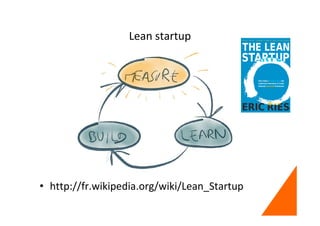
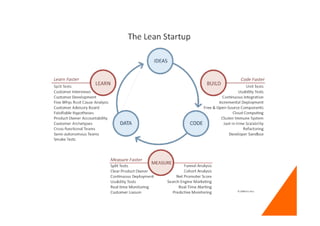
• Lean startup
• Design thinking
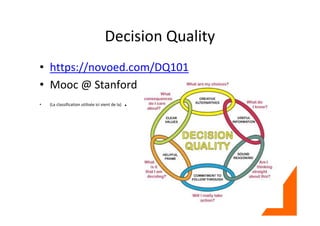
• Décision quality
Game storming / Serious games
• Jeux sérieux
• http://fr.wikipedia.org/wiki/Jeu_s%C3%A9rie
ux
Decision Quality
• https://novoed.com/DQ101
• Mooc @ Stanford
• (La classification utilisée ici vient de la) .
Lean startup
• http://fr.wikipedia.org/wiki/Lean_Startup
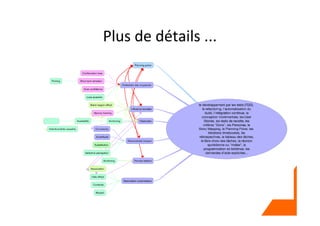
Plus de détails ...
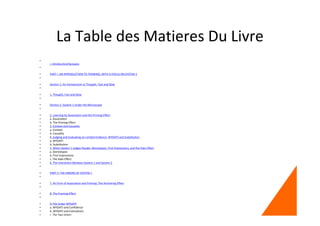
La Table des Matieres Du Livre
•
i. Introduction/Synopsis
•
• PART I: AN INTRODUCTION TO THINKING, WITH A FOCUS ON SYSTEM 1
•
• Section 1: An Introduction to Thought, Fast and Slow
•
• 1. Thought, Fast and Slow
•
• Section 2: System 1 Under the Microscope
•
• 2. Learning by Association and the Priming Effect
• a. Association
• b. The Priming Effect
• 3. Context and Causality
• a. Context
• b. Causality
• 4. Judging and Evaluating on Limited Evidence: WYSIATI and Substitution
• a. WYSIATI
• b. Substitution
• 5. When System 1 Judges People: Stereotypes, First Impressions, and the Halo Effect
• a. Stereotypes
• b. First Impressions
• c. The Halo Effect
• 6. The Interaction Between System 1 and System 2
•
• PART II: THE ERRORS OF SYSTEM 1
•
• 7. An Error of Association and Priming: The Anchoring Effect
•
• 8. The Framing Effect
•
• 9. File Under WYSIATI
• a. WYSIATI and Confidence
• b. WYSIATI and Estimations
• c. The Two Selves

Biais cognitif, creativite et Design thinking

  • 1.
    Les Biais Cognitifs etla Créativité 13/5/2014 1 http://www.taesch.com/cognitive/biais- cognitifs-creativite-design- thinking/2014/05/21/539
  • 2.
    I. C’est quoi,un biais ? • Le 10 eme homme • http://goo.gl/ukTtyP
  • 3.
    Première impression • Younever get a second chance to make a first good impression
  • 4.
    Alan • Intelligent • Travailleur •Impulsif • Critique • Entété • Envieux
  • 5.
    Ben • Envieux • Entété •Critique • Impulsif • Travailleur • Intelligent
  • 6.
    Ben Alan • Envieux •Entété • Critique • Impulsif • Travailleur • Intelligent • Intelligent • Travailleur • Impulsif • Critique • Entété • Envieux
  • 7.
    Découvrons nos cartes •Petit aperçu de nos cartes – Association automatique – Pensée relative – Incertitude, Complexité, Raisonnement erroné – Habitudes & Personnalité – Influence sociale – Défense du point de vue – Available here : http://goo.gl/PzvgJ5
  • 8.
  • 9.
    The Middle Optionis never selected…
  • 10.
  • 11.
  • 12.
    Contributions spontanées Honesty Box – Ina somewhat spookier example, researchers staged an experiment in a workplace kitchen wherein employees would routinely make themselves tea or coffee in exchange for a fee that they would drop in an ‘honesty box’ – In the first stage of the experiment, the researchers planted a picture of a flowerpot in the room, while in the second stage of the experiment they replaced it with a picture of a pair of eyes – The two pictures were then alternated back and forth each week, for a period of ten weeks – Finally, the researchers compared how much money was left in the honesty box across the 2 situations in the experiment. – Here’s Kahneman to explain the results: “no one commented on the new decorations, but the contributions to the honesty box changed significantly… – On average, the users of the kitchen contributed almost three times as much in ‘eye weeks’ as they did in ‘flower weeks.’ Evidently, a purely symbolic reminder of being watched prodded people into improved behavior. As we expect at this point, the effect occurs without any awareness” . This is a very eye-opening example of how System 1 can influence System 2, and also hints at the frightening ways that System 1 might be exploited.
  • 13.
    Les biais selonKahneman • Système 1 et System 2 – Système 1 – Système 2 – L’interaction
  • 14.
  • 15.
  • 16.
  • 17.
  • 18.
    Kahneman : résumé •Le livre • Un bon résumé http://newbooksinbrief.com/2012/1 1/13/24-a-summary-of-thinking- fast-and-slow-by-daniel- kahneman/
  • 19.
    Cognitive Bias • 80+: http://en.wikipedia.org/wiki/List_of_cognitive_biases • 300+ : https://www.recobia.eu/ ( non public) • Many classifications – We took an “actionable” one , inspired by the DQ 101 Stanford Mooc (Karl Spetzler) • DQ 101: Introduction to Decision Quality https://novoed.com/DQ101/ • Paris Meetup: – http://www.meetup.com/Psychologie-Cognitive-et-Changement-Paris- Meetup/ – http://www.meetup.com/Paris-Antifragile-Meetup/ • Design thinking and Cognitive Bias – @stakken86 thesis on #DesignThinking and #CognitiveBias http://goo.gl/wHU8bc • My curation : http://www.scoop.it/t/cognitive-bias • Dan Ariely : Guide d'introduction au comportement irrationnel – https://www.coursera.org/course/behavioralecon
  • 20.
  • 21.
    Dites le plusvite possible combien de points vous voyez Dites le plus vite possible combien de points vous voyez
  • 22.
  • 23.
  • 24.
  • 25.
  • 26.
  • 27.
  • 28.
  • 29.
    Subitization • subitization • (psychology)The process of, or act of, glancing at a group of a few objects and knowing how many there are without actually counting. • http://en.wikipedia.org/wiki/Subitizing
  • 30.
  • 31.
  • 32.
    Voyage à Abilene Quatreadultes, un couple marié et les parents de la femme, sont assis sous un porche dans une chaleur abrutissante dans la petite ville de Coleman, au Texas, à environ 53 miles d'Abilene. Ils sirotent tristement de la citronnade, observant le ventilateur souffreteux et entamant de temps à autre une partie de domino. À un moment, le père de l’épouse suggère qu'ils se rendent à Abilene pour se restaurer dans une cafétéria. La femme dit “ bonne idée”. Le gendre pense que c'est une idée folle; que ca va être long et étouffant, mais pense que ses idées sont contraires a celles du groupe, et n’ose pas contrarier sa femme qui voit si peu ses parents. Il dit “super, j espère juste que ta maman veut y aller”. Les deux femmes ne semblent pas opposées à cette idée et voilà tout ce petit monde entassé dans une Buick sans air climatisé, qui soulève sur le chemin des nuages de poussière. À Abilene, ils mangent un déjeuner médiocre dans un endroit glauque et reviennent à Coleman épuisés, suants, et peu satisfaits du périple. Un d’entre eux dis de manière malhonnête “c était super, n est ce pas”. La belle mère dit alors “ en fait j aurais préfère rester a la maison, mais je suis venu avec car les 3 autres avait l air enthousiaste”. Le mari dit alors, “ je n avais pas vraiment envie d y aller; mais j essayais de vous satisfaire”. La femme dit “ je suis juste venu avec pour être avec vous. J aurais été folle de sortir par une telle chaleur”. Le beau père dit alors qu’il n avait suggéré ceci que parce que il pensait que les autres s ennuyait” http://fr.wikipedia.org/wiki/Paradoxe_d%27Abilene
  • 33.
    Le timeboxing – Menaceou opportunités – L’aversion pour la perte. Aversion to loss – Pommodoro
  • 34.
    III. Et laCréativité dans tout ca ?
  • 35.
  • 36.
    Le Cerveau duMammifère
  • 37.
    La confiance sebâtit sur l expérience du succès
  • 38.
  • 39.
    Fear activate Cortisoland shut down the cortex
  • 40.
  • 41.
  • 42.
    Estimation relative • Wysati: What you see is all there is. • Sur optimisme • Confiance exagérée
  • 43.
  • 44.
  • 45.
    Tableaux des tâches –Visualiser – Projeter pour comprendre la complexité
  • 46.
    priming • Video • http://m.youtube.com/watch?v=HRAKt0GakJ M •“the ‘Florida effect’ involves two stages of priming. First, the set of words primes thoughts of old age, though the word old is never mentioned (“worried,” “Florida,” “old,” “lonely,” “gray,” “bingo, ); second, these thoughts prime a behavior, walking slowly, which is associated with old age. All this happens without any awareness. When they were questioned afterward, none of the students reported noticing that the words had had a common theme, and they all insisted that nothing they did after the first experiment could have been influenced by the words they had encountered. The idea of old age had not come into their conscious awareness, but their actions changed nevertheless”
  • 47.
    Framing • http://m.youtube.com/watch?v=Ng9V2JneJ68 • “thefive-year survival rates clearly favor surgery, but in the short term surgery is riskier than radiation” • When it came to the short term risks of surgery, though, • half of the doctors were shown stats that referred to the survival rate (which is 90% after one month), • while the other half of the doctors were shown stats that referred to the mortality rate (which is 10% after one month) . • Here’s Kahneman with the results: “you already know the results: surgery was much more popular in the former frame (84% of physicians chose it) than in the latter (where 50% favored radiation).
  • 48.
    Brainstorming: the 65’sway • Focus on quantity • Withhold criticism • Welcome unusual ideas • Combine and improve ideas
  • 49.
    Brainstorming: the challenges •Blocking • Collaborative fixation • Evaluation apprehension • Free-riding • Personality characteristics • Social matching
  • 50.
    • PS: abit of Mess is good for creativity (Priming Divergent rather than order = convergent) • http://consulting.openbooklearning.com/misc/damage-results-from-linking-creativity-only-to-divergent-thinking/
  • 51.
  • 53.
    You already knewbiases… • Some bias are helpful in convergent and « harmful » in divergent and vice versa, – e.g. : association, priming, defence of the mindset, framing…
  • 54.
    Removing Bias ? •Most classical techniques discovered in brainstorming, CPS, DT are in fact either using bias or going around bias to mitigate their effects… • One cannot really remove biases, because we are human.. But we can be aware of their effects… and knowingly either use them of defend against them.. • This is .. Maturity …
  • 55.
  • 59.
    Les radiateurs dinformation
  • 61.
  • 62.
  • 63.
  • 64.
    Design thinking • http://fr.wikipedia.org/wiki/Design_thi nking •Le Design Thinking est une méthode de créativité et de son management qui se veut une synthèse entre la pensée analytique et la pensée intuitive. Il s'appuie beaucoup sur un processus de co-créativité impliquant des retours de l'utilisateur final.
  • 65.
  • 67.
  • 68.
  • 69.
  • 70.
    • Loss aversion •Confirmation bias • Sunk cost fallacy • Anchoring bias • Overconfidence bias – Above average : all the children are above average – limited to “easy” tasks in which success is common or in which people feel competent. For difficult tasks, the effect reverses itself and people believe they are worse than others – Strikes, lawsuits, and wars could arise from overplacement. • Framing • Deformation Professionelle
  • 74.
  • 76.
    Autres pratiques • Seriousgames • Lean startup • Design thinking • Décision quality
  • 77.
    Game storming /Serious games • Jeux sérieux • http://fr.wikipedia.org/wiki/Jeu_s%C3%A9rie ux
  • 78.
    Decision Quality • https://novoed.com/DQ101 •Mooc @ Stanford • (La classification utilisée ici vient de la) .
  • 79.
  • 81.
  • 82.
    La Table desMatieres Du Livre • i. Introduction/Synopsis • • PART I: AN INTRODUCTION TO THINKING, WITH A FOCUS ON SYSTEM 1 • • Section 1: An Introduction to Thought, Fast and Slow • • 1. Thought, Fast and Slow • • Section 2: System 1 Under the Microscope • • 2. Learning by Association and the Priming Effect • a. Association • b. The Priming Effect • 3. Context and Causality • a. Context • b. Causality • 4. Judging and Evaluating on Limited Evidence: WYSIATI and Substitution • a. WYSIATI • b. Substitution • 5. When System 1 Judges People: Stereotypes, First Impressions, and the Halo Effect • a. Stereotypes • b. First Impressions • c. The Halo Effect • 6. The Interaction Between System 1 and System 2 • • PART II: THE ERRORS OF SYSTEM 1 • • 7. An Error of Association and Priming: The Anchoring Effect • • 8. The Framing Effect • • 9. File Under WYSIATI • a. WYSIATI and Confidence • b. WYSIATI and Estimations • c. The Two Selves