30ansd’agilité
bilanetperspectives
J’aime explorer et transme0re, voir les yeux briller
Je cherche à aider
les personnes qui ressentent une insa;sfac;on, qui ont conscience
qu’elles ont quelque chose à découvrir, à apprendre…
Christophe Keromen
www.ckti.com et www.interventionsbreves.fr
Twitter @ckeromen et mail : ckeromen@ckti.com
linkedin.com/in/christophekeromen
3
Agile&SystemicCatalyser
forhelpingnewwaysofcooperativeintelligenceemerge
h0ps://www.amazon.fr/Ce-que-
sport-appris-dagile-ebook
h0ps://www.amazon.fr/dp/
1729126030
2018 - 85 pages
https://www.slideshare.net/ckti/presentations
https://www.lesingecuivre.com/
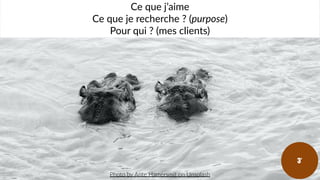
Photo by Ante Hamersmit on Unsplash
Ce que j’aime
Ce que je recherche ? (purpose)
Pour qui ? (mes clients)
3’
30ansd'agilité
bilan
Agenda?
et perspectives
Un temps/
thème
Unequestionparpersonne
Écrivez-la lisiblement sur un post-it1’
Partageons 15’
1)30ansd’agilité?
Les points sur le i d'Agile - épisode 1 "les origines"
h0ps://www.linkedin.com/pulse/les-points-sur-le-i-dagile-
%C3%A9pisode-1-origines-christophe-keromen/
L’agilité se limite-t-elle aux équipes IT
ou peut elle se concevoir au niveau de l’entreprise ?
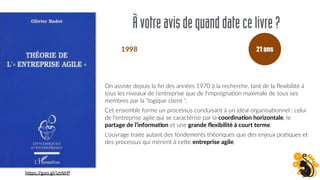
Àvotreavisdequanddatecelivre?
h0ps://goo.gl/iznVrP
On assiste depuis la fin des années 1970 à la recherche, tant de la flexibilité à
tous les niveaux de l'entreprise que de l'imprégnaFon maximale de tous ses
membres par la "logique client ".
Cet ensemble forme un processus conduisant à un idéal organisaFonnel : celui
de l'entreprise agile qui se caractérise par la coordina(on horizontale, le
partage de l'informa(on et une grande flexibilité à court terme.
L'ouvrage traite autant des fondements théoriques que des enjeux praFques et
des processus qui mènent à ceOe entreprise agile.
21 ans1998
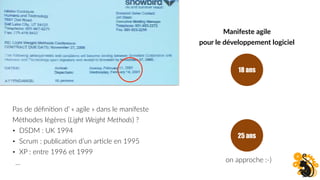
Pas de définiFon d’ « agile » dans le manifeste
Méthodes légères (Light Weight Methods) ?
• DSDM : UK 1994
• Scrum : publicaFon d’un arFcle en 1995
• XP : entre 1996 et 1999
…
18 ans
25 ans
on approche :-)
Manifeste agile
pour le développement logiciel
eXtremeProgramming(1997?)
SoAware development methodology which is intended to
improve sobware quality and responsiveness to changing
customer requirements.
Many extreme-programming prac(ces have been around for
some Fme; the methodology takes "best pracFces" to
extreme levels.
« The first Fme I was asked to lead a team, I asked them to do
a liOle bit of the things I thought were sensible, like tesFng
and reviews. The second Fme there was a lot more on the
line. I thought, "Damn the torpedoes, at least this will make a
good arFcle," [and] asked the team to crank up all the knobs
to 10 on the things I thought were essen(al and leave out
everything else. » Kent Beck
hOps://en.wikipedia.org/wiki/Extreme_programming
SoftwareCraftsmanship(2009)
The Sobware Crabsmanship Manifesto extends and challenges further the
assumpFons of the Agile Manifesto, drawing a metaphor between modern
soAware development and the apprenFceship model of medieval Europe.
« …the cra1 of using so1ware crea6vely is flourishing even more than the cra1
of wri6ng it. » » Freeman Dyson, in his essay "Science as a Crab
Industry" (1998)
«… mostly based on Extreme Programming, and with a great alignment with
Agile methodologies, Sobware Crabsmanship promises to take our industry
to the next level, promo(ng professionalism, technical excellence, the
death of the produc(on line and factory workers aHtude. »
2014, Sobware Crabsmanship : Professionalism PragmaFsm Pride was
published by Sandro Mancuso
hOps://en.wikipedia.org/wiki/Sobware_crabsmanship
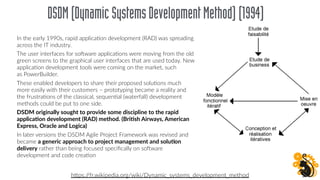
DSDM(DynamicSystemsDevelopmentMethod)(1994)
In the early 1990s, rapid applicaFon development (RAD) was spreading
across the IT industry.
The user interfaces for sobware applicaFons were moving from the old
green screens to the graphical user interfaces that are used today. New
applicaFon development tools were coming on the market, such
as PowerBuilder.
These enabled developers to share their proposed soluFons much
more easily with their customers – prototyping became a reality and
the frustraFons of the classical, sequenFal (waterfall) development
methods could be put to one side.
DSDM originally sought to provide some discipline to the rapid
applica(on development (RAD) method. (Bri(sh Airways, American
Express, Oracle and Logica)
In later versions the DSDM Agile Project Framework was revised and
became a generic approach to project management and solu(on
delivery rather than being focused specifically on sobware
development and code creaFon
hOps://fr.wikipedia.org/wiki/Dynamic_systems_development_method
TheNewNewProductDevelopmentGame(1986)
Hirotaka Takeuchi and Ikujiro Nonaka introduced the term scrum in the
context of product development in their 1986 Harvard Business
Review arFcle, 'The New New Product Development Game'.Takeuchi
and Nonaka later argued in « The Knowledge CreaFng Company » that it
is a form of "organiza(onal knowledge crea(on, [...] especially good at
bringing about innova(on con(nuously, incrementally and spirally".
The authors described a new approach to commercial product
development that would increase speed and flexibility, based on case
studies from manufacturing firms in the automo(ve, photocopier and
printer industries. They called this the holisFc or rugby approach, as the
whole process is performed by one cross-func(onal team across
mul(ple overlapping phases, in which the team "tries to go the distance
as a unit, passing the ball back and forth".
hOps://en.wikipedia.org/wiki/Scrum_(sobware_development)
hOps://hbr.org/1986/01/the-new-new-product-development-game
hOps://www.scrum.org/resources/blog/new-new-product-development-game-using-scrum
33 ans !
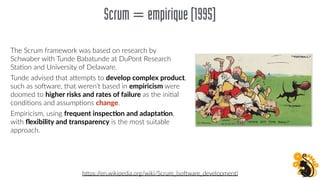
Scrum=empirique(1995)
The Scrum framework was based on research by
Schwaber with Tunde Babatunde at DuPont Research
StaFon and University of Delaware.
Tunde advised that aOempts to develop complex product,
such as sobware, that weren’t based in empiricism were
doomed to higher risks and rates of failure as the iniFal
condiFons and assumpFons change.
Empiricism, using frequent inspec(on and adapta(on,
with flexibility and transparency is the most suitable
approach.
hOps://en.wikipedia.org/wiki/Scrum_(sobware_development)
«Agile»?
Le terme agilité vient du combat aérien. Il désigne, à l’origine, la capacité à changer de
manœuvre dans le temps.
A ma connaissance, il est u;lisé pour la première fois par le « monde des affaires »
dans un rapport consacré à la stratégie des entreprises industrielles du 21ème siècle
écrit à la demande du congrès américain au début des années 1990.
Leurs auteurs (S. Goldman, K. Preiss, R. Nagel et R. Dove) suggèrent que l’améliora;on
incrémentale des organisa;ons issues du modèle organisa;onnel classique ne
perme0ra pas aux entreprises d’apporter des réponses sa;sfaisantes aux exigences
d’un nouveau monde dit « post-industriel ».
Une logique renouvelée s’impose pour relever ces défis.
Extrait de Pe/te histoire de l’agilité organisa/onnelle By Eric Delavallée - 6 June 2016
L’ORIGINE ET LES BASES DE L’AGILE BIEN AVANT LE MANIFESTE AGILE.
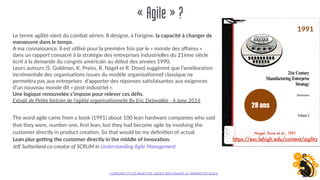
The word agile came from a book (1991) about 100 lean hardware companies who said
that they were, number one, first lean, but they had become agile by involving the
customer directly in product crea;on. So that would be my defini;on of actual.
Lean plus geHng the customer directly in the middle of innova(on.
Jeff Sutherland co-creator of SCRUM in Understanding Agile Management
Nagel, Dove et al., 1991
https://esc.lehigh.edu/content/agility
28 ans
1991
«Agile»?
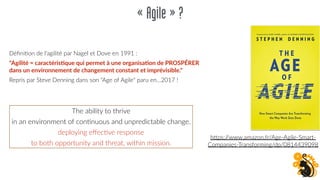
DéfiniFon de l'agilité par Nagel et Dove en 1991 :
"Agilité = caractéris(que qui permet à une organisa(on de PROSPÉRER
dans un environnement de changement constant et imprévisible."
Repris par Steve Denning dans son "Age of Agile" paru en…2017 !
hOps://www.amazon.fr/Age-Agile-Smart-
Companies-Transforming/dp/0814439098
The ability to thrive
in an environment of conFnuous and unpredictable change.
deploying effecFve response
to both opportunity and threat, within mission.
1991
« Méthodes agiles »
& Agile Manifesto
For Soqware Development
2001
Teams
Small Product 2008
@Scale
2012
Suppor;ng structures
« Spo;fy Model »
2018
Lines of Business
Enterprise - Organisa;on
as a whole
Enterprise mission
Agile Enterprise
(Rick Dove - Roger Nagel)
Whole manufacturing
enterprise
Thrive
« agile »
Soqware Development
LEAN
Produc;on
1986
Ar;cle "The
New New Product
Development Game »
Takeuchi -Nonaka
Business
Agility
« Scrum »
Flow
Teams of teams
Complex Product
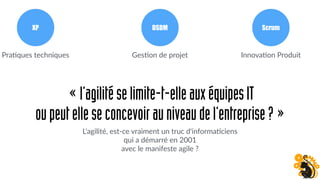
«l’agilitéselimite-t-elleauxéquipesIT
oupeutelleseconcevoirauniveaudel’entreprise?»
L'agilité, est-ce vraiment un truc d'informa;ciens
qui a démarré en 2001
avec le manifeste agile ?
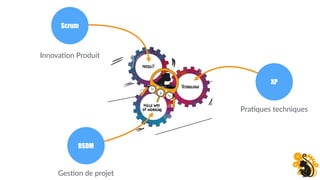
ScrumXP DSDM
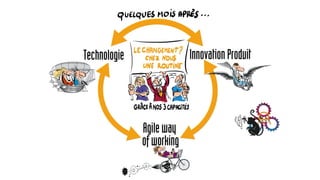
Pra;ques techniques Ges;on de projet Innova;on Produit
Liens&idéesd’application?
• Prenez quelques minutes pour idenFfier les 3-4 trucs qui ont retenu votre aOenFon
• Formez des sous-groupes
• Échangez sur vos notes, les liens avec votre acFvité, vos interrogaFons
• Idées d’applicaFons
10 mn
Cabinet de conseil IT et Agilité
Pause 5’
2)Bilan
Votre expérience de ces <votre expérience> ans d’agilité ?
65’
Equipe -> Equipes (scaling)

IT -> Département -> Entreprise
Comment on démarre ?
Comment on va plus loin ?
Des résultats ?
Lesquels ?
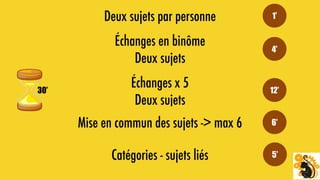
Deux sujets par personne
Échanges en binôme
Deux sujets
Échanges x 5
Deux sujets
Mise en commun des sujets -> max 6
Catégories - sujets liés
1’
4’
12’
6’
5’
30’
Échanges en binôme
Deux sujets
Échanges x 5
Deux sujets
Mise en commun des sujets -> max 6
Catégories - sujets liés
4’
12’
6’
5’
30’
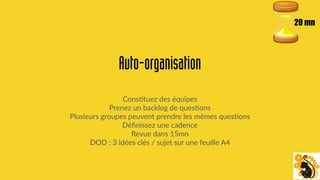
Auto-organisation
Cons;tuez des équipes
Prenez un backlog de ques;ons
Plusieurs groupes peuvent prendre les mêmes ques;ons
Définissez une cadence
Revue dans 15mn
DOD : 3 idées clés / sujet sur une feuille A4
20 mn
Revue
Présenta;on de la synthèse de vos échanges aux autres groupes
3 idées clés / sujet
2mn par groupe
15 mn
Cabinet de conseil IT et Agilité
Pause 5’
3)Perspectives
Agilité :
Dépassée ou d’actualité ?
Scrum
XP
DSDM
Pra;ques techniques
Ges;on de projet
Innova;on Produit
Notreconviction
Ce n’est pas simplement une affaire d’adopFon de
nouveaux comportements
Nos modes de pensées (modèles mentaux) condiFonnent
notre capacité à changer de comportements
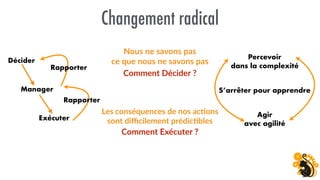
Changement radical
Décider
Exécuter
Manager
Percevoir
dans la complexité
Agir
avec agilité
S’arrêter pour apprendre
Rapporter
Rapporter
Nous ne savons pas
ce que nous ne savons pas
Comment Décider ?
Comment Exécuter ?
Les conséquences de nos ac(ons
sont difficilement prédic(bles
Un changement radical pour les personnes
Dave Snowden - CYNEFIN :
Sense - Probe - Response
Wholeness
EvoluFonary Purpose
Self-OrganizaFon
F. Laloux « ReinvenFng OrganizaFons »
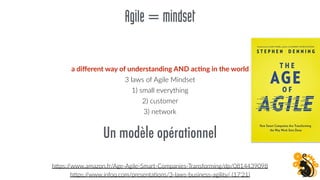
Agile=mindset
a different way of understanding AND ac(ng in the world
3 laws of Agile Mindset
1) small everything
2) customer
3) network
hOps://www.infoq.com/presentaFons/3-laws-business-agility/ (17'21)
hOps://www.amazon.fr/Age-Agile-Smart-Companies-Transforming/dp/0814439098
Un modèle opérationnel
7
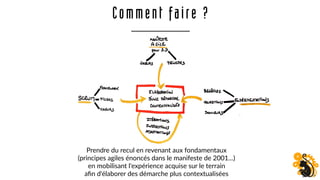
Comment faire ?
Prendre du recul en revenant aux fondamentaux
(principes agiles énoncés dans le manifeste de 2001…)
en mobilisant l'expérience acquise sur le terrain
afin d'élaborer des démarche plus contextualisées
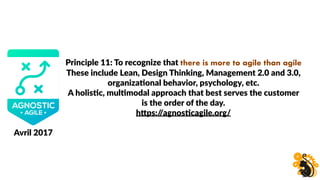
Principle 11: To recognize that there is more to agile than agile
These include Lean, Design Thinking, Management 2.0 and 3.0,
organizaBonal behavior, psychology, etc.
A holisBc, mulBmodal approach that best serves the customer
is the order of the day.
hHps://agnosBcagile.org/
Avril 2017
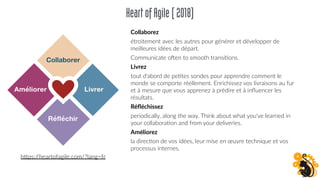
Collaborez
étroitement avec les autres pour générer et développer de
meilleures idées de départ.
Communicate oben to smooth transiFons.
Livrez
tout d'abord de peFtes sondes pour apprendre comment le
monde se comporte réellement. Enrichissez vos livraisons au fur
et à mesure que vous apprenez à prédire et à influencer les
résultats.
Réfléchissez
periodically, along the way. Think about what you've learned in
your collaboraFon and from your deliveries.
Améliorez
la direcFon de vos idées, leur mise en œuvre technique et vos
processus internes.
hOps://heartofagile.com/?lang=fr
HeartofAgile(2018)
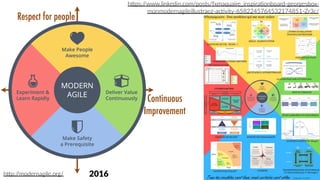
hOps://www.linkedin.com/posts/fxmaquaire_inspiraFonboard-georgesbox-
monmodernagileillustraez-acFvity-6582245764532174851-Zr3c/
Respect for people
Continuous
Improvement
hOp://modernagile.org/ 2016
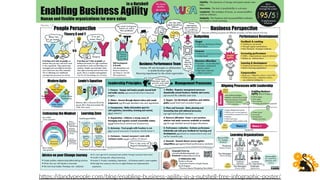
hOps://dandypeople.com/blog/enabling-business-agility-in-a-nutshell-free-infographic-poster/
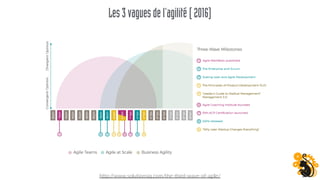
Les3vaguesdel’agilité(2016)
http://www.solutionsiq.com/the-third-wave-of-agile/
Business Agility
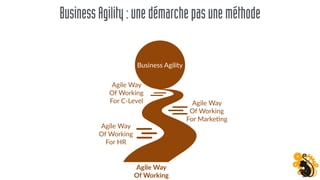
BusinessAgility:unedémarchepasuneméthode
Agile Way
Of Working
Agile Way
Of Working
For HR
Agile Way
Of Working
For Marke;ng
Agile Way
Of Working
For C-Level
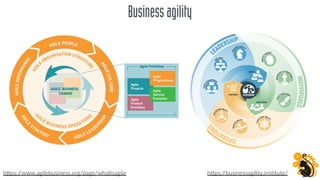
Businessagility
hOps://www.agilebusiness.org/page/whaFsagile hOps://businessagility.insFtute/
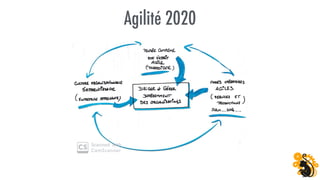
Agilité 2020
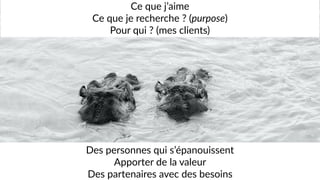
Photo by Ante Hamersmit on Unsplash
Ce que j’aime
Ce que je recherche ? (purpose)
Pour qui ? (mes clients)
Des personnes qui s’épanouissent
Apporter de la valeur
Des partenaires avec des besoins
Liens & idées d’application ?
• Prenez quelques minutes pour idenFfier les 3-4 trucs qui ont retenu votre aOenFon
• Formez des sous-groupes
• Échangez sur vos notes, les liens avec votre acFvité, vos interrogaFons
• Idées d’applicaFons
X’
Cercle de
fermeturePhoto by Phil Coffman on Unsplash

30 ans d'agilité : bilan et perspectives

  • 1.
  • 2.
    J’aime explorer ettransme0re, voir les yeux briller Je cherche à aider les personnes qui ressentent une insa;sfac;on, qui ont conscience qu’elles ont quelque chose à découvrir, à apprendre… Christophe Keromen
  • 3.
    www.ckti.com et www.interventionsbreves.fr Twitter@ckeromen et mail : ckeromen@ckti.com linkedin.com/in/christophekeromen 3 Agile&SystemicCatalyser forhelpingnewwaysofcooperativeintelligenceemerge h0ps://www.amazon.fr/Ce-que- sport-appris-dagile-ebook h0ps://www.amazon.fr/dp/ 1729126030 2018 - 85 pages https://www.slideshare.net/ckti/presentations https://www.lesingecuivre.com/
  • 4.
    Photo by AnteHamersmit on Unsplash Ce que j’aime Ce que je recherche ? (purpose) Pour qui ? (mes clients) 3’
  • 5.
  • 6.
  • 7.
    1)30ansd’agilité? Les points surle i d'Agile - épisode 1 "les origines" h0ps://www.linkedin.com/pulse/les-points-sur-le-i-dagile- %C3%A9pisode-1-origines-christophe-keromen/ L’agilité se limite-t-elle aux équipes IT ou peut elle se concevoir au niveau de l’entreprise ?
  • 8.
    Àvotreavisdequanddatecelivre? h0ps://goo.gl/iznVrP On assiste depuisla fin des années 1970 à la recherche, tant de la flexibilité à tous les niveaux de l'entreprise que de l'imprégnaFon maximale de tous ses membres par la "logique client ". Cet ensemble forme un processus conduisant à un idéal organisaFonnel : celui de l'entreprise agile qui se caractérise par la coordina(on horizontale, le partage de l'informa(on et une grande flexibilité à court terme. L'ouvrage traite autant des fondements théoriques que des enjeux praFques et des processus qui mènent à ceOe entreprise agile. 21 ans1998
  • 9.
    Pas de définiFond’ « agile » dans le manifeste Méthodes légères (Light Weight Methods) ? • DSDM : UK 1994 • Scrum : publicaFon d’un arFcle en 1995 • XP : entre 1996 et 1999 … 18 ans 25 ans on approche :-) Manifeste agile pour le développement logiciel
  • 10.
    eXtremeProgramming(1997?) SoAware development methodologywhich is intended to improve sobware quality and responsiveness to changing customer requirements. Many extreme-programming prac(ces have been around for some Fme; the methodology takes "best pracFces" to extreme levels. « The first Fme I was asked to lead a team, I asked them to do a liOle bit of the things I thought were sensible, like tesFng and reviews. The second Fme there was a lot more on the line. I thought, "Damn the torpedoes, at least this will make a good arFcle," [and] asked the team to crank up all the knobs to 10 on the things I thought were essen(al and leave out everything else. » Kent Beck hOps://en.wikipedia.org/wiki/Extreme_programming
  • 11.
    SoftwareCraftsmanship(2009) The Sobware CrabsmanshipManifesto extends and challenges further the assumpFons of the Agile Manifesto, drawing a metaphor between modern soAware development and the apprenFceship model of medieval Europe. « …the cra1 of using so1ware crea6vely is flourishing even more than the cra1 of wri6ng it. » » Freeman Dyson, in his essay "Science as a Crab Industry" (1998) «… mostly based on Extreme Programming, and with a great alignment with Agile methodologies, Sobware Crabsmanship promises to take our industry to the next level, promo(ng professionalism, technical excellence, the death of the produc(on line and factory workers aHtude. » 2014, Sobware Crabsmanship : Professionalism PragmaFsm Pride was published by Sandro Mancuso hOps://en.wikipedia.org/wiki/Sobware_crabsmanship
  • 12.
    DSDM(DynamicSystemsDevelopmentMethod)(1994) In the early1990s, rapid applicaFon development (RAD) was spreading across the IT industry. The user interfaces for sobware applicaFons were moving from the old green screens to the graphical user interfaces that are used today. New applicaFon development tools were coming on the market, such as PowerBuilder. These enabled developers to share their proposed soluFons much more easily with their customers – prototyping became a reality and the frustraFons of the classical, sequenFal (waterfall) development methods could be put to one side. DSDM originally sought to provide some discipline to the rapid applica(on development (RAD) method. (Bri(sh Airways, American Express, Oracle and Logica) In later versions the DSDM Agile Project Framework was revised and became a generic approach to project management and solu(on delivery rather than being focused specifically on sobware development and code creaFon hOps://fr.wikipedia.org/wiki/Dynamic_systems_development_method
  • 13.
    TheNewNewProductDevelopmentGame(1986) Hirotaka Takeuchi andIkujiro Nonaka introduced the term scrum in the context of product development in their 1986 Harvard Business Review arFcle, 'The New New Product Development Game'.Takeuchi and Nonaka later argued in « The Knowledge CreaFng Company » that it is a form of "organiza(onal knowledge crea(on, [...] especially good at bringing about innova(on con(nuously, incrementally and spirally". The authors described a new approach to commercial product development that would increase speed and flexibility, based on case studies from manufacturing firms in the automo(ve, photocopier and printer industries. They called this the holisFc or rugby approach, as the whole process is performed by one cross-func(onal team across mul(ple overlapping phases, in which the team "tries to go the distance as a unit, passing the ball back and forth". hOps://en.wikipedia.org/wiki/Scrum_(sobware_development) hOps://hbr.org/1986/01/the-new-new-product-development-game hOps://www.scrum.org/resources/blog/new-new-product-development-game-using-scrum 33 ans !
  • 14.
    Scrum=empirique(1995) The Scrum frameworkwas based on research by Schwaber with Tunde Babatunde at DuPont Research StaFon and University of Delaware. Tunde advised that aOempts to develop complex product, such as sobware, that weren’t based in empiricism were doomed to higher risks and rates of failure as the iniFal condiFons and assumpFons change. Empiricism, using frequent inspec(on and adapta(on, with flexibility and transparency is the most suitable approach. hOps://en.wikipedia.org/wiki/Scrum_(sobware_development)
  • 15.
    «Agile»? Le terme agilitévient du combat aérien. Il désigne, à l’origine, la capacité à changer de manœuvre dans le temps. A ma connaissance, il est u;lisé pour la première fois par le « monde des affaires » dans un rapport consacré à la stratégie des entreprises industrielles du 21ème siècle écrit à la demande du congrès américain au début des années 1990. Leurs auteurs (S. Goldman, K. Preiss, R. Nagel et R. Dove) suggèrent que l’améliora;on incrémentale des organisa;ons issues du modèle organisa;onnel classique ne perme0ra pas aux entreprises d’apporter des réponses sa;sfaisantes aux exigences d’un nouveau monde dit « post-industriel ». Une logique renouvelée s’impose pour relever ces défis. Extrait de Pe/te histoire de l’agilité organisa/onnelle By Eric Delavallée - 6 June 2016 L’ORIGINE ET LES BASES DE L’AGILE BIEN AVANT LE MANIFESTE AGILE. The word agile came from a book (1991) about 100 lean hardware companies who said that they were, number one, first lean, but they had become agile by involving the customer directly in product crea;on. So that would be my defini;on of actual. Lean plus geHng the customer directly in the middle of innova(on. Jeff Sutherland co-creator of SCRUM in Understanding Agile Management Nagel, Dove et al., 1991 https://esc.lehigh.edu/content/agility 28 ans 1991
  • 16.
    «Agile»? DéfiniFon de l'agilitépar Nagel et Dove en 1991 : "Agilité = caractéris(que qui permet à une organisa(on de PROSPÉRER dans un environnement de changement constant et imprévisible." Repris par Steve Denning dans son "Age of Agile" paru en…2017 ! hOps://www.amazon.fr/Age-Agile-Smart- Companies-Transforming/dp/0814439098 The ability to thrive in an environment of conFnuous and unpredictable change. deploying effecFve response to both opportunity and threat, within mission.
  • 17.
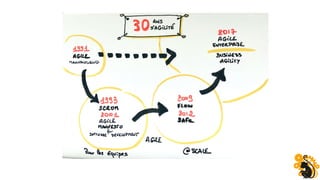
    1991 « Méthodes agiles» & Agile Manifesto For Soqware Development 2001 Teams Small Product 2008 @Scale 2012 Suppor;ng structures « Spo;fy Model » 2018 Lines of Business Enterprise - Organisa;on as a whole Enterprise mission Agile Enterprise (Rick Dove - Roger Nagel) Whole manufacturing enterprise Thrive « agile » Soqware Development LEAN Produc;on 1986 Ar;cle "The New New Product Development Game » Takeuchi -Nonaka Business Agility « Scrum » Flow Teams of teams Complex Product
  • 18.
    «l’agilitéselimite-t-elleauxéquipesIT oupeutelleseconcevoirauniveaudel’entreprise?» L'agilité, est-ce vraimentun truc d'informa;ciens qui a démarré en 2001 avec le manifeste agile ? ScrumXP DSDM Pra;ques techniques Ges;on de projet Innova;on Produit
  • 19.
    Liens&idéesd’application? • Prenez quelquesminutes pour idenFfier les 3-4 trucs qui ont retenu votre aOenFon • Formez des sous-groupes • Échangez sur vos notes, les liens avec votre acFvité, vos interrogaFons • Idées d’applicaFons 10 mn
  • 20.
    Cabinet de conseilIT et Agilité Pause 5’
  • 21.
    2)Bilan Votre expérience deces <votre expérience> ans d’agilité ? 65’
  • 22.
    Equipe -> Equipes(scaling) IT -> Département -> Entreprise Comment on démarre ? Comment on va plus loin ? Des résultats ? Lesquels ?
  • 23.
    Deux sujets parpersonne Échanges en binôme Deux sujets Échanges x 5 Deux sujets Mise en commun des sujets -> max 6 Catégories - sujets liés 1’ 4’ 12’ 6’ 5’ 30’
  • 24.
    Échanges en binôme Deuxsujets Échanges x 5 Deux sujets Mise en commun des sujets -> max 6 Catégories - sujets liés 4’ 12’ 6’ 5’ 30’
  • 25.
    Auto-organisation Cons;tuez des équipes Prenezun backlog de ques;ons Plusieurs groupes peuvent prendre les mêmes ques;ons Définissez une cadence Revue dans 15mn DOD : 3 idées clés / sujet sur une feuille A4 20 mn
  • 26.
    Revue Présenta;on de lasynthèse de vos échanges aux autres groupes 3 idées clés / sujet 2mn par groupe 15 mn
  • 27.
    Cabinet de conseilIT et Agilité Pause 5’
  • 28.
  • 33.
  • 35.
    Notreconviction Ce n’est passimplement une affaire d’adopFon de nouveaux comportements Nos modes de pensées (modèles mentaux) condiFonnent notre capacité à changer de comportements
  • 36.
    Changement radical Décider Exécuter Manager Percevoir dans lacomplexité Agir avec agilité S’arrêter pour apprendre Rapporter Rapporter Nous ne savons pas ce que nous ne savons pas Comment Décider ? Comment Exécuter ? Les conséquences de nos ac(ons sont difficilement prédic(bles
  • 37.
    Un changement radicalpour les personnes Dave Snowden - CYNEFIN : Sense - Probe - Response Wholeness EvoluFonary Purpose Self-OrganizaFon F. Laloux « ReinvenFng OrganizaFons »
  • 38.
    Agile=mindset a different wayof understanding AND ac(ng in the world 3 laws of Agile Mindset 1) small everything 2) customer 3) network hOps://www.infoq.com/presentaFons/3-laws-business-agility/ (17'21) hOps://www.amazon.fr/Age-Agile-Smart-Companies-Transforming/dp/0814439098 Un modèle opérationnel
  • 39.
    7 Comment faire ? Prendredu recul en revenant aux fondamentaux (principes agiles énoncés dans le manifeste de 2001…) en mobilisant l'expérience acquise sur le terrain afin d'élaborer des démarche plus contextualisées
  • 40.
    Principle 11: Torecognize that there is more to agile than agile These include Lean, Design Thinking, Management 2.0 and 3.0, organizaBonal behavior, psychology, etc. A holisBc, mulBmodal approach that best serves the customer is the order of the day. hHps://agnosBcagile.org/ Avril 2017
  • 41.
    Collaborez étroitement avec lesautres pour générer et développer de meilleures idées de départ. Communicate oben to smooth transiFons. Livrez tout d'abord de peFtes sondes pour apprendre comment le monde se comporte réellement. Enrichissez vos livraisons au fur et à mesure que vous apprenez à prédire et à influencer les résultats. Réfléchissez periodically, along the way. Think about what you've learned in your collaboraFon and from your deliveries. Améliorez la direcFon de vos idées, leur mise en œuvre technique et vos processus internes. hOps://heartofagile.com/?lang=fr HeartofAgile(2018)
  • 42.
  • 43.
  • 45.
  • 46.
    Business Agility BusinessAgility:unedémarchepasuneméthode Agile Way OfWorking Agile Way Of Working For HR Agile Way Of Working For Marke;ng Agile Way Of Working For C-Level
  • 47.
  • 48.
  • 49.
    Photo by AnteHamersmit on Unsplash Ce que j’aime Ce que je recherche ? (purpose) Pour qui ? (mes clients) Des personnes qui s’épanouissent Apporter de la valeur Des partenaires avec des besoins
  • 50.
    Liens & idéesd’application ? • Prenez quelques minutes pour idenFfier les 3-4 trucs qui ont retenu votre aOenFon • Formez des sous-groupes • Échangez sur vos notes, les liens avec votre acFvité, vos interrogaFons • Idées d’applicaFons X’
  • 51.
    Cercle de fermeturePhoto byPhil Coffman on Unsplash