q=-270
Groupe: IEX 05
Correction EMD 2 : Thermodynamique et Transfert de Chaleur
Exercice 1 (6 Pts)
1- Calcul de l’irradiation Totale (1Pts)
0
G G d 

  …0,5
Donc G=1450 W/m2…0,5
2- Calcul de la radiosité Totale (1.5 Pts)
On a J=E+ρG …0,5 Et d’après les données
ρ=0.4, α=0.6 …0,5  J=1180 W/m2…0,5
3- le flux radiatif net (1.5 Pts)
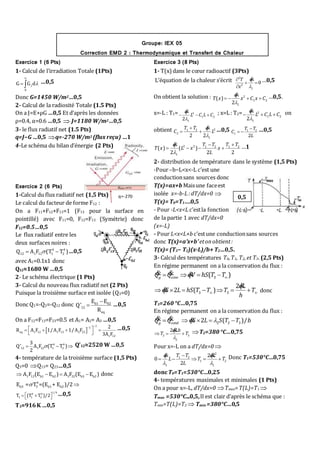
q=J−G …0,5 q=-270 W/m2 (flux reçu) …1
4-Le schéma du bilan d’énergie (2 Pts)
Exercice 2 (6 Pts)
1-Calcul du flux radiatif net (1,5 Pts)
Le calcul du facteur de forme F12 :
On a F11+F12+F13=1 (F13 pour la surface en
pointillé) avec F11=0, F12=F13 (Symétrie) donc
F12=0.5…0,5
Le flux radiatif entre les
deux surfaces noires :
4 4
12 1 12 1 2Q A F (T T )  …0,5
avec A1=0.1x1 donc
Q12≈1680 W …0,5
2- Le schéma électrique (1 Pts)
3- Calcul du nouveau flux radiatif net (2 Pts)
Puisque la troisième surface est isolée (Q3=0)
Donc Q1=-Q2=-Q12 donc b1 b2
12
eq
E E
Q'
R

 …0,5
On a F12=F13=F23=0.5 et A1= A2= A3 …0,5
 
1
1
eq 1 12 1 13 2 23
1 12
2
R A F 1/A F 1/A F
3A F


    
 
…0,5
4 4
12 1 12 1 2
3
Q' A F (T T )
2
   Q’12≈2520 W …0,5
4- température de la troisième surface (1,5 Pts)
Q3=0 Q13= Q23…0,5
1 12 b1 b2 3 32 b3 b2A F (E E ) A F (E E )    donc
4
b3 3 b1 b2E = T =(E + E )/2 
1/4
4 4
3 1 2T (T T )/2   
…0,5
T3=916K …0,5
Exercice 3 (8 Pts)
1- T(x) dans le cœur radioactif (3Pts)
L’équation de la chaleur s’écrit
2
2
1
0


 

&T q
x
…0,5
On obtient la solution : 2
1 2
1
( )
2
q
T x x C x C

   
& …0,5.
x=-L : T1= 2
1 2
12
q
L C L C

  
& ; x=L: T2= 2
1 2
12
q
L C L C

  
& on
obtient 21 2
2
12 2
T T q
C L


 
& …0,5 1 2
1
2

 
T T
C
L
…0,5
2 2 1 2 1 2
1
( ) ( )
2 2 2
T T T Tq
T x L x x
L
 
   
&
…1
2- distribution de température dans le système (1,5 Pts)
-Pour–b−L<x<-L c’est une
conductionsans sources donc
T(x)=ax+b Maisune faceest
isolée x=-b-L:dT/dx=0 
T(x)= T0=T1….0,5
- Pour -L<x<L c’estla fonction
de la partie 1 avec dT/dx=0
(x=-L)
- Pour L<x<L+b c’estune conductionsans sources
donc T(x)=a’x+b’etonobtient:
T(x)= (T3− T2)(x-L)/b+ T2…0,5.
3- Calcul des températures T0,T1, T2,et T3. (2,5 Pts)
En régime permanent on a la conservation du flux :
3( )g convQ Q qV hS T T   & & &
3 3
2
2 ( )
qL
qS L hS T T T T
h
       
&
& donc
T3=260 °C…0,75
En régime permanent on a la conservation du flux :
g condQ Q& &
2 2 32 ( )/qS L S T T b   &
2 3
2
2qLb
T T

  
& T2=380 °C…0,75
Pour x=-L on a dT/dx=0
2
1 2
1 2
1 1
2
0
2
T Tq qL
L T T
L 

    
& & Donc T1=530°C…0,75
doncT0=T1=530°C…0,25
4- températures maximales et minimales (1 Pts)
On a pour x=-L, dT/dx=0 Tmax=T(L)=T1 
Tmax =530°C...0,5,Il est clair d’après le schéma que :
Tmin=T(L)=T2  Tmin =380°C…0,5
0,5

Correction emd 2 iex 05

  • 1.
    q=-270 Groupe: IEX 05 CorrectionEMD 2 : Thermodynamique et Transfert de Chaleur Exercice 1 (6 Pts) 1- Calcul de l’irradiation Totale (1Pts) 0 G G d     …0,5 Donc G=1450 W/m2…0,5 2- Calcul de la radiosité Totale (1.5 Pts) On a J=E+ρG …0,5 Et d’après les données ρ=0.4, α=0.6 …0,5  J=1180 W/m2…0,5 3- le flux radiatif net (1.5 Pts) q=J−G …0,5 q=-270 W/m2 (flux reçu) …1 4-Le schéma du bilan d’énergie (2 Pts) Exercice 2 (6 Pts) 1-Calcul du flux radiatif net (1,5 Pts) Le calcul du facteur de forme F12 : On a F11+F12+F13=1 (F13 pour la surface en pointillé) avec F11=0, F12=F13 (Symétrie) donc F12=0.5…0,5 Le flux radiatif entre les deux surfaces noires : 4 4 12 1 12 1 2Q A F (T T )  …0,5 avec A1=0.1x1 donc Q12≈1680 W …0,5 2- Le schéma électrique (1 Pts) 3- Calcul du nouveau flux radiatif net (2 Pts) Puisque la troisième surface est isolée (Q3=0) Donc Q1=-Q2=-Q12 donc b1 b2 12 eq E E Q' R   …0,5 On a F12=F13=F23=0.5 et A1= A2= A3 …0,5   1 1 eq 1 12 1 13 2 23 1 12 2 R A F 1/A F 1/A F 3A F          …0,5 4 4 12 1 12 1 2 3 Q' A F (T T ) 2    Q’12≈2520 W …0,5 4- température de la troisième surface (1,5 Pts) Q3=0 Q13= Q23…0,5 1 12 b1 b2 3 32 b3 b2A F (E E ) A F (E E )    donc 4 b3 3 b1 b2E = T =(E + E )/2  1/4 4 4 3 1 2T (T T )/2    …0,5 T3=916K …0,5 Exercice 3 (8 Pts) 1- T(x) dans le cœur radioactif (3Pts) L’équation de la chaleur s’écrit 2 2 1 0      &T q x …0,5 On obtient la solution : 2 1 2 1 ( ) 2 q T x x C x C      & …0,5. x=-L : T1= 2 1 2 12 q L C L C     & ; x=L: T2= 2 1 2 12 q L C L C     & on obtient 21 2 2 12 2 T T q C L     & …0,5 1 2 1 2    T T C L …0,5 2 2 1 2 1 2 1 ( ) ( ) 2 2 2 T T T Tq T x L x x L       & …1 2- distribution de température dans le système (1,5 Pts) -Pour–b−L<x<-L c’est une conductionsans sources donc T(x)=ax+b Maisune faceest isolée x=-b-L:dT/dx=0  T(x)= T0=T1….0,5 - Pour -L<x<L c’estla fonction de la partie 1 avec dT/dx=0 (x=-L) - Pour L<x<L+b c’estune conductionsans sources donc T(x)=a’x+b’etonobtient: T(x)= (T3− T2)(x-L)/b+ T2…0,5. 3- Calcul des températures T0,T1, T2,et T3. (2,5 Pts) En régime permanent on a la conservation du flux : 3( )g convQ Q qV hS T T   & & & 3 3 2 2 ( ) qL qS L hS T T T T h         & & donc T3=260 °C…0,75 En régime permanent on a la conservation du flux : g condQ Q& & 2 2 32 ( )/qS L S T T b   & 2 3 2 2qLb T T     & T2=380 °C…0,75 Pour x=-L on a dT/dx=0 2 1 2 1 2 1 1 2 0 2 T Tq qL L T T L        & & Donc T1=530°C…0,75 doncT0=T1=530°C…0,25 4- températures maximales et minimales (1 Pts) On a pour x=-L, dT/dx=0 Tmax=T(L)=T1  Tmax =530°C...0,5,Il est clair d’après le schéma que : Tmin=T(L)=T2  Tmin =380°C…0,5 0,5