ARRÊT CARDIO-
RESPIRATOIRE
Dr Vincent HUBERT
Département d’Anesthésie - Réanimation
Barry J. Maron. N Engl J Med 2003 ; 349 : 1064 - 75
Principales causes et prise en
charge d’un adulte en arrêt
cardio-respiratoire
Recommandations
internationales
International Liaison Committee on
Resuscitation (ILCOR) Guidelines
Circulation 2000 ; 102
Resuscitation 2001 ; 48
Signes de l’arrêt cardio-respiratoire
Le patient est inconscient
absence de réponse aux questions simples et
aux ordres simples
Le patient est en arrêt ventilatoire
absence de mouvement ventilatoire
Le patient est en arrêt circulatoire
absence de signe de circulation
Causes d’origine cardiaque +++
• « Mort subite »
• Principale cause de mortalité
• 200.000 morts par an aux USA
• 40 à 50.000 décès / an en France
• Troubles du rythme ventriculaire +++
Principales causes de l’arrêt
cardio-respiratoire
SURVIE < 5 %
Causes cardio-vasculaires
de l’arrêt cardio-respiratoire
Atteinte primitive
– Ischémie myocardique
– Troubles du rythme ou de la conduction
– Atteintes valvulaires
– Cardiomyopathie
Atteinte secondaire
– Hypoxie, hypovolémie, états de choc
– Intoxications, troubles hydro-électrolytiques
Causes respiratoires de l’arrêt
cardio-respiratoire
Obstruction des voies aériennes
– Corps étranger, sang, débris alimentaires
– Traumatisme maxillo-facial
– Œdème, abcès
– Laryngospasme, bronchospasme
– Coma
Atteintes ventilatoires
– De la commande
– De la mécanique
– De l’échangeur
Conséquences de l’arrêt
cardio-respiratoire
0
25
50
75
100
0 1 2 3 4 5 6 7 8 9min.
SURVIE GLOBALE < 5 %
1 minute de perdue
10 % de survie en moins
Concept actuel de la
« chaîne de survie »
Cummins RO, Circulation 1991 ; 83 : 1932
Secours
Suppléance Relance
Restauration
Alerte
immédiate
RCP
précoce
Défibrillation
précoce
Rééducation
Stabilisation
Soins
spécialisés
Santé
Prévention
Signes précédant l’arrêt cardio-
respiratoire
Atteinte cardio-vasculaire
– La majorité des ACR survient chez des patients atteints d’une maladie
cardiovasculaire préexistante, connue ou méconnue, parfois silencieuse
– Les morts subites sur un cœur sain sont rares
– Importance de l’anamnèse, du terrain et des antécédents familiaux
Obstruction des voies aériennes
– Dyspnée, respiration courte, bruits anormaux, balancement thoraco-abdominal
– Imposant : libération des voies aériennes, intubation endo-trachéale
Atteinte ventilatoire
– Détresse respiratoire typique avec agitation, dyspnée, cyanose, trouble de
conscience
– Imposant : oxygène, assistance ventilatoire, traitement étiologique
Réanimation cardio-
pulmonaire de base
Basic Life Support (B.L.S.)
Basculer la tête en arrière
Surélever le menton
Regarder, écouter et sentir
Maximum 10 secondes
Quand transmettre l’alerte aux
secours médicalisés
Le sauveteur n’est pas seul
– Immédiatement un témoin transmet l’alerte pendant
que le(s) sauveteur(s) commence(nt) la RCP
Le sauveteur est seul
– La victime est un adulte (arrêt d’origine cardiaque) :
dès que l’absence de ventilation est établie
– Traumatisme, noyade, intoxication, nourrisson ou
enfant (âge < 8 ans) : commencer par 1 min de
réanimation cardio-pulmonaire avant de transmettre
l’alerte
Insuffler progressivement en 1,5 à 2 sec
Jusqu’à ce que le thorax commence à se soulever
Environ 400 à 500 ml, 10 à 12 fois par minute
RÉALISER LA VENTILATION ARTIFICIELLE AVEC UNE
PROTECTION FACIALE
La victime réagit-elle ?
Maximum 10 secondes
Déprimer verticalement
le sternum de 4 à 5 cm
Fréquence de 100 par minute
Associer 15 compressions
thoraciques pour 2 insufflations
Vérifier les signes de circulation
toutes les minutes environ
Compression / Décompression
Active (RCP – ACD)
DÈS QUE POSSIBLE, METTRE EN ŒUVRE LE DSA
ARRÊTER LA RCP ET ANALYSER LE RYTHME CARDIAQUE
DÉLIVRER UN OU PLUSIEURS CHOCS ÉLECTRIQUES
RECHERCHER LES SIGNES DE CIRCULATION
SI LES SIGNES DE
CIRCULATION SONT
ABSENTS, IL FAUT
PRATIQUER LA RCP
Réanimation cardio-
pulmonaire spécialisée
Advanced Life Support (A.L.S.)
Algorithme universel
de la réanimation cardio-
pulmonaire spécialisée de
l’adulte
Basic Life Support
Connecter le scope – défibrillateur
Le rythme analysé est
« chocable »
Rythmes « chocables »
Fibrillation ventriculaire
Rythmes « chocables »
Tachycardie ventriculaire sans pouls
Rythmes « chocables »
FV ou TV sans pouls – 1er tour
200 J
200 J
360 J
Entre les chocs, le pouls n’est
vérifié que si un tracé ECG
compatible avec un débit
cardiaque est obtenu après
un choc
Après la
première série
de 3 chocs
R.C.P. pendant 1 mn
Intubation et
ventilation assistée
Oxygénation
Identification du
rythme cardiaque
1
Rythmes « chocables »
FV ou TV sans pouls – 2ème tour
360 J
360 J
360 J
Entre les chocs, le pouls n’est
vérifié que si un tracé ECG
compatible avec un débit
cardiaque est obtenu après
un choc
Après la
seconde série
de 3 chocs
R.C.P. pendant 1 mn
Poser une voie veineuse
périphérique
Administration IV
– Adrénaline 1 mg
– Vasopressine 40 UI
Identification du rythme
cardiaque
2
Rythmes « chocables »
FV ou TV sans pouls – 3ème tour
360 J
360 J
360 J
Entre les chocs, le pouls n’est
vérifié que si un tracé ECG
compatible avec un débit
cardiaque est obtenu après
un choc
Après la
troisième série
de 3 chocs
R.C.P. pendant 1 mn
Discuter :
– Anti-arythmique
• Amiodarone : 5 mg/kg
• Lidocaïne : 1,5 mg/kg
– MgSO4 : 1,5 g
– Alcalinisation
• Bicarbonates : 1 mEq/kg
Identification du rythme
cardiaque
3
Rythmes « chocables »
FV ou TV sans pouls – tours suivants
360 J
360 J
360 J
Entre les chocs, le pouls n’est
vérifié que si un tracé ECG
compatible avec un débit
cardiaque est obtenu après
un choc
Après chaque
série suivante
de 3 chocs
Adrénaline IV
1 mg / 3 à 5 mn
Identification du rythme
cardiaque
Connecter le scope – défibrillateur
Le rythme analysé est
non « chocable »
Rythmes non « chocables »
Asystole
Rythmes non « chocables »
Rythmes électriques sans pouls
Rythmes non « chocables »
Intubation et ventilation
assistée
Oxygénation
Poser une voie veineuse
périphérique
Adrénaline IV
1 mg / 3 à 5 mn
Envisager
– Atropine : 3 mg
– Alcalinisation
– EES
Identification du rythme
cardiaque
Algorithme universel - A.L.S.
Causes curables
d’arrêt cardio-respiratoire
• Hypoxie
• Hypovolémie
• Hyper / Hypokaliémie & désordres métaboliques
• Hypothermie
• PneumoThorax suffocant
• Tamponnade
• Désordres Toxiques / Thérapeutiques
• Obstruction mécanique / Thrombo-embolique
HHHH - TTTT
Réanimation post
arrêt cardio-respiratoire
La reprise d’activité circulatoire spontanée (RACS)
marque le début d’un traitement souvent complexe.
La réanimation a pour but de :
• stabiliser l’état cardio-respiratoire pour améliorer la perfusion
tissulaire, notamment cérébrale et splanchnique
• déterminer la cause de l’arrêt cardiaque, la traiter et éviter la
récidive,
• gérer le syndrome post-ressuscitation.
Elle doit permettre d’attendre l’évaluation neurologique
dans les conditions les meilleures.
Hémodynamique
– Remplissage prudent sur cœur sain
– Dobutamine, adrénaline
Rythmique (hypoxie ? dyskaliémie ?)
– CEE
– Anti-arythmiques
• Amiodarone : seconde dose de 2,5 mg/kg IVL sur 20 mn
• Lidocaïne : seconde dose de 1 à 1,5 mg/kg, maxi 3 mg/kg IVL
• MgSO4
– Atropine : 1 mg, maxi 3 mg IVD
– Adénosine : 3 mg IVD
– EES
Réanimation cardiovasculaire
Maintenir le patient intubé
– Sédation de confort
Ventilation mécanique avec FiO2 adaptée à la
SpO2
– Normoxie, normocapnie
– Pas d’hyper ou d’hypo-ventilation
Recherche d’un pneumothorax
– Exsufflation
– Drainage, pleurotomie
Réanimation respiratoire
Sédation pharmacologique de confort
Normoglycémie (insulinothérapie)
– Perfusion : SS 0.9 %
– Pas de sérum glucosé ou hypo-osmotique (Ringer)
Convulsions (hypoxie ?)
– Benzodiazépines, phénitoïne
Protection cérébrale
– Préserver une hypothermie spontanée entre 32 et 34 °C
– Hypothermie thérapeutique
Réanimation neurologique
Hospitalisation du patient
En général
– Réanimation polyvalente
FV/TV récupérée immédiatement
– USIC ?
Salle de cathétérisme cardiaque pour
coronarographie
– si suspicion d’infarctus
– place de la thrombolyse pré-hospitalière ?
Return of spontaneous circulation
after a no-flow cardiac arrest
«  Cardiovascular and hemodynamic derangements are
common when spontaneous circulation returns (ROSC)
after a cardiac arrest. These abnormalities include
hypovolemic shock, cardiogenic shock, and the
vasodilatory shock associated with the systemic
inflammatory response syndrome (SIRS) »
International Liaison Committee
on Resuscitation (ILCOR) Guidelines
Circulation 2000 ; 102
Resuscitation 2001 ; 48
Postresuscitation disease after cardiac
arrest : a sepsis-like syndrome ?
Ischemia and reperfusion syndrome
Inflammatory response
Myocardial dysfunction
Adrenal dysfunction
Coagulopathy
Adrie C & al. Current Opinion in Crit Care. 2004
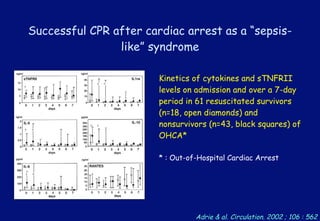
Successful CPR after cardiac arrest as a “sepsis-
like” syndrome
Kinetics of cytokines and sTNFRII
levels on admission and over a 7-day
period in 61 resuscitated survivors
(n=18, open diamonds) and
nonsurvivors (n=43, black squares) of
OHCA*
* : Out-of-Hospital Cardiac Arrest
Adrie & al. Circulation. 2002 ; 106 : 562
Successful CPR after cardiac arrest as a “sepsis-
like” syndrome
Measurement of endotoxin levels in
plasma of 35 resuscitated OHCA*
patients on admission (day 0) and the
2 days after (days 1 and 2)
* : Out-of-Hospital Cardiac Arrest
Adrie & al. Circulation. 2002 ; 106 : 562
Successful CPR after cardiac arrest as a “sepsis-
like” syndrome
Cytokines and soluble receptor
concentrations in plasma of
resuscitated OHCA* patients
according to endotoxin detection in
their plasma within first 2 days
* : Out-of-Hospital Cardiac Arrest
Adrie & al. Circulation. 2002 ; 106 : 562
Gando et al. Intensive Care
Med 2000 ; 26 : 38 - 44
• endothelial cell activation
• neutrophil activation
• endothelial injury
Out-of-hospital cardiac arrest
increases soluble vascular endothelial adhesion molecules and
neutrophil elastase associated with endothelial injury
Diastolic LV volumesLV free-wall thickness
Evolution of the stone heart after
prolonged cardiac arrest
Klouche et al. Chest 2002; 122: 1006
Myocardial dysfunction after resuscitation
from cardiac arrest : an example of global
myocardial stunning
Design : 28 domestic
swine studied before and
after CA
Myocardial
blood flow
Ejection
fraction
Base Base5 H 5 H
Pre-arrest
30 min
2 hours
5 hours
48
hours
Kern KB & al. JACC 1996
Place de la thrombolyse
dans l’arrêt cardiaque ?
Quelques études positives, mais :
– Méthodologie faible
– Manque de puissance
Aujourd’hui : non recommandée.
Étude « TROICA »
Étude multicentrique, randomisée
– 500 patients par bras
Tous les arrêts de cause cardiaque
Tenecteplase vs placebo
– administration pré-hospitalière
– bolus adapté au poids
– injection avant la 20ème minute
– sans modification des traitements hospitaliers
Critère principal : survie à 30 jours
Étude prospective, non
randomisée :
– 84 ACR d’origine cardiaque
– Survie hospitalière : 38%
– 48% des patients avaient une
occlusion coronaire récente
– ATL réussie est un facteur
indépendant de survie (OR : 5,2,
p=0,04)
Immediate coronary angiography in survivors of
out-of-hospital cardiac arrest
Spaulding et al. N Engl J Med 1997 ; 336 : 1629 - 33
Circulatory assistance : “Portable
By-pass system”
Hypothermie thérapeutique
Mild therapeutic hypothermia to improve the neurologic outcome
after cardiac arrest.
N Engl J Med 2002 ; 346 : 549 - 56
Treatment of comatose survivors of out-of-hospital cardiac arrest
with induced hypothermia
N Engl J Med 2002 ; 346 : 557 – 63
Therapeutic hypothermia after cardiac arrest. An
advisory statement by the Advanced Life Support
Task Force of the International Liaison Committee on
Resuscitation
Resuscitation 2003 ; 57 : 231 - 5
Mild therapeutic hypothermia to improve the
neurologic outcome after cardiac arrest
N Engl J Med 2002 ; 346 : 549 - 56
Mild therapeutic hypothermia to improve the
neurologic outcome after cardiac arrest
N Engl J Med 2002 ; 346 : 549 - 56
N Engl J Med 2002 ; 346 : 557 – 63
Treatment of comatose survivors of out-
of-hospital cardiac arrest with induced
hypothermia
OR 5.25 (IC 95 % = 1.47 -
18.76 ; P=0.011).
Hypothermia :
– lower cardiac index,
– higher systemic vascular
resistance,
– hyperglycemia,
– no difference in the
frequency of adverse
events.
Therapeutic hypothermia after cardiac
arrest
On the basis of the published evidence to date, the Advanced Life
Support (ALS) Task Force of the International Liaison Committee
on Resuscitation (ILCOR) made the following recommendations in
October 2002 :
– Unconscious adult patients with spontaneous circulation after out-of-
hospital cardiac arrest should be cooled to 32°C to 34°C for 12 to 24
hours when the initial rhythm was ventricular fibrillation (VF)
– Such cooling may also be beneficial for other rhythms or in-hospital
cardiac arrest.
Resuscitation 2003 ; 57 : 231 - 5
Induction of therapeutic hypothermia after
cardiac arrest in prehospital patients using ice-
cold Ringer’s solution : a pilot study
Virkkunen I & al. Resuscitation. 2004 ; 62 : 299 - 302
Induction of therapeutic hypothermia after
cardiac arrest in prehospital patients using ice-
cold Ringer’s solution : a pilot study
Virkkunen I & al. Resuscitation. 2004 ; 62 : 299 - 302
A prospective, multicenter pilot study to evaluate the feasibility
and safety of using the CoolGardTM System and IcyTM catheter
following cardiac arrest
Resuscitation. 2004 ; 62 : 143 - 50
The effect of mild therapeutic hypothermia
on renal function after CPR
Zeiner et al. Resuscitation 2004
The effect of mild therapeutic hypothermia
on renal function after CPR
Zeiner et al. Resuscitation 2004
The effect of mild therapeutic hypothermia
on renal function after CPR
Zeiner et al. Resuscitation 2004
Nouveautés
New guidelines
in may 2005
Published in Nov. 2005
Compression / Décompression
Active (RCP – ACD)
Plaisance P & al. N Engl J Med 1999 ; 341 : 569 - 75
Qualités des compressions thoraciques et
importance de la phase de décompression
Importance du retour
veineux :
– retour du poumon à sa
position de repos…
– …après légère
négativation de la
pression intra-
thoracique
DécompressionDécompression
Cardiopulmonary resuscitation by chest compression alone
or with mouth-to-mouth ventilation
Allstrom A et al. N Engl J Med 2000 ; 342 : 1546 - 53
Cardiopulmonary resuscitation
without ventilation
Kern KB. Crit Care Med 2000 ; 28 [Suppl.] : N186 – N189
«  Evidence continues to mount from many
sources including experimental work, clinical
observations, and basic life support (BLS)
training studies supporting chest compression-
only BLS cardiopulmonary resuscitation (CPR)
as a viable alternative for bystanderlayperson
CPR  »
Adverse hemodynamic effects of interrupting chest compressions
for rescue breathing during cardiopulmonary resuscitation for
ventricular fibrillation cardiac arrest
Kern KB et al. Circulation 2001 ; 104 : 2465 - 70
Adverse hemodynamic effects of interrupting chest compressions
for rescue breathing during cardiopulmonary resuscitation for
ventricular fibrillation cardiac arrest
Kern KB et al. Circulation 2001 ; 104 : 2465 - 70
Importance of continuous chest compressions
during cardiopulmonary resuscitation
Kern KB et al. Circulation 2002 ; 105 : 645 - 9
Quelle priorité : RCP, DSA ?
ACR < 4 min : « AED first »
ACR > 4 min : « CPR first »
Valve d’impédance (ResQPOD)
Lurie K al. Anesth Analg 2001 ; 93 : 649 – 55
Langhelle A & al. Resuscitation 2002 ; 52 : 39-48
Comparison of standard cardiopulmonary resuscitation versus
the combination of active compression-decompression
cardiopulmonary resuscitation and an inspiratory impedance
threshold device for out-of-hospital cardiac arrest
Wolcke BB al. Circulation. 2003 ; 108 : 2201 - 5
Evaluation of an impedance threshold device in patients receiving
active compression–decompression cardiopulmonary resuscitation
for out of hospital cardiac arrest
Plaisance P al. Resuscitation 2004 : 61 ; 265 – 71
Evaluation of LUCAS, a new device for automatic mechanical
compression and active decompression resuscitation
Steen S al. Resuscitation 2002 : 55 ; 285 - 99
Revivant™ Autopulse
Resuscitation System
Steen S al. Resuscitation 2004 ; 61 : 273 – 80
Halperin HR & al. J Am Coll Cardiol 2004 ; 44 : 2214-20
Delaying defibrillation to give basic
cardiopulmonary resuscitation to patients with
out-of hospital ventricular fibrillation
Wik L al. JAMA 2003 : 289 ; 1390 - 5
PAD
Public Access Defibrillation
BunchTJ & al. N Engl J Med 2003 ; 348 : 2626-33
N Engl J Med 2004 ; 351 : 637 – 46
Chicago Airports
Caffrey SL & al. N Engl J Med 2002 ; 347 : 1242-7
21 ACR, 18 FV/TV
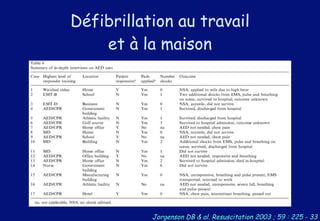
Défibrillation au travail
et à la maison
Jorgenson DB & al. Resuscitation 2003 ; 59 : 225 - 33
La défibrillation
par les non médecins en Europe
Allemagne
Andorre
Autriche
Croatie
Espagne
Finlande
France
Hongrie
Irlande
Italie
Monaco
Norvège
Pays-Bas
Pologne
Portugal
République Tchèque
Roumanie
Royaume Uni
Suisse
Suède
Yougoslavie
L’accès public à la
défibrillation en Europe
Allemagne
Autriche
Espagne
Finlande
Hongrie
Irlande
Italie
Monaco
Norvège
Pays-Bas
Pologne
Royaume Uni
Suisse
Lindner KH et al. Lancet 1997 ; 349 : 535-7
Place de la vasopressine ?
Recommandations ILCOR 2000 ( II b )
FV / TV sans pouls :
• 40 u x 1 injection unique
• à la place de 1 mg adrénaline
Wenzel V et al. N Engl J Med 2004 ; 350 : 105-13
PHRC 2003 en cours
Comparaison de l'efficacité de l'association arginine vasopressine-
adrénaline versus adrénaline seule dans le traitement de l'arret
cardiaque extra-hospitalier
Étude prospective, multicentrique nationale, randomisée en double
aveugle
Dates de l’essai : mai 2004 - novembre 2005
Promoteur : Hospices Civils de Lyon
Investigateurs : SAMU 06, 13, 14, 21, 29, 30, 31, 33, 38, 42, 44, 59,
69, 75, 92, 93
Partenariat : Aguettant Santé
Coordonnateur de l’étude : Pr Pierre-Yves GUEUGNIAUD
Comité de Pilotage : Dr Hervé HUBERT

Acr

  • 1.
    ARRÊT CARDIO- RESPIRATOIRE Dr VincentHUBERT Département d’Anesthésie - Réanimation
  • 2.
    Barry J. Maron.N Engl J Med 2003 ; 349 : 1064 - 75
  • 3.
    Principales causes etprise en charge d’un adulte en arrêt cardio-respiratoire Recommandations internationales International Liaison Committee on Resuscitation (ILCOR) Guidelines Circulation 2000 ; 102 Resuscitation 2001 ; 48
  • 4.
    Signes de l’arrêtcardio-respiratoire Le patient est inconscient absence de réponse aux questions simples et aux ordres simples Le patient est en arrêt ventilatoire absence de mouvement ventilatoire Le patient est en arrêt circulatoire absence de signe de circulation
  • 5.
    Causes d’origine cardiaque+++ • « Mort subite » • Principale cause de mortalité • 200.000 morts par an aux USA • 40 à 50.000 décès / an en France • Troubles du rythme ventriculaire +++ Principales causes de l’arrêt cardio-respiratoire SURVIE < 5 %
  • 6.
    Causes cardio-vasculaires de l’arrêtcardio-respiratoire Atteinte primitive – Ischémie myocardique – Troubles du rythme ou de la conduction – Atteintes valvulaires – Cardiomyopathie Atteinte secondaire – Hypoxie, hypovolémie, états de choc – Intoxications, troubles hydro-électrolytiques
  • 7.
    Causes respiratoires del’arrêt cardio-respiratoire Obstruction des voies aériennes – Corps étranger, sang, débris alimentaires – Traumatisme maxillo-facial – Œdème, abcès – Laryngospasme, bronchospasme – Coma Atteintes ventilatoires – De la commande – De la mécanique – De l’échangeur
  • 8.
    Conséquences de l’arrêt cardio-respiratoire 0 25 50 75 100 01 2 3 4 5 6 7 8 9min. SURVIE GLOBALE < 5 % 1 minute de perdue 10 % de survie en moins
  • 9.
    Concept actuel dela « chaîne de survie » Cummins RO, Circulation 1991 ; 83 : 1932 Secours Suppléance Relance Restauration Alerte immédiate RCP précoce Défibrillation précoce Rééducation Stabilisation Soins spécialisés Santé Prévention
  • 10.
    Signes précédant l’arrêtcardio- respiratoire Atteinte cardio-vasculaire – La majorité des ACR survient chez des patients atteints d’une maladie cardiovasculaire préexistante, connue ou méconnue, parfois silencieuse – Les morts subites sur un cœur sain sont rares – Importance de l’anamnèse, du terrain et des antécédents familiaux Obstruction des voies aériennes – Dyspnée, respiration courte, bruits anormaux, balancement thoraco-abdominal – Imposant : libération des voies aériennes, intubation endo-trachéale Atteinte ventilatoire – Détresse respiratoire typique avec agitation, dyspnée, cyanose, trouble de conscience – Imposant : oxygène, assistance ventilatoire, traitement étiologique
  • 11.
    Réanimation cardio- pulmonaire debase Basic Life Support (B.L.S.)
  • 13.
    Basculer la têteen arrière Surélever le menton Regarder, écouter et sentir Maximum 10 secondes
  • 14.
    Quand transmettre l’alerteaux secours médicalisés Le sauveteur n’est pas seul – Immédiatement un témoin transmet l’alerte pendant que le(s) sauveteur(s) commence(nt) la RCP Le sauveteur est seul – La victime est un adulte (arrêt d’origine cardiaque) : dès que l’absence de ventilation est établie – Traumatisme, noyade, intoxication, nourrisson ou enfant (âge < 8 ans) : commencer par 1 min de réanimation cardio-pulmonaire avant de transmettre l’alerte
  • 15.
    Insuffler progressivement en1,5 à 2 sec Jusqu’à ce que le thorax commence à se soulever Environ 400 à 500 ml, 10 à 12 fois par minute
  • 16.
    RÉALISER LA VENTILATIONARTIFICIELLE AVEC UNE PROTECTION FACIALE
  • 17.
    La victime réagit-elle? Maximum 10 secondes
  • 18.
    Déprimer verticalement le sternumde 4 à 5 cm Fréquence de 100 par minute
  • 19.
    Associer 15 compressions thoraciquespour 2 insufflations Vérifier les signes de circulation toutes les minutes environ
  • 21.
  • 23.
    DÈS QUE POSSIBLE,METTRE EN ŒUVRE LE DSA
  • 24.
    ARRÊTER LA RCPET ANALYSER LE RYTHME CARDIAQUE
  • 25.
    DÉLIVRER UN OUPLUSIEURS CHOCS ÉLECTRIQUES
  • 26.
    RECHERCHER LES SIGNESDE CIRCULATION SI LES SIGNES DE CIRCULATION SONT ABSENTS, IL FAUT PRATIQUER LA RCP
  • 28.
  • 29.
    Algorithme universel de laréanimation cardio- pulmonaire spécialisée de l’adulte
  • 30.
  • 31.
    Connecter le scope– défibrillateur
  • 32.
    Le rythme analyséest « chocable »
  • 33.
  • 34.
  • 35.
    Rythmes « chocables » FV ouTV sans pouls – 1er tour 200 J 200 J 360 J Entre les chocs, le pouls n’est vérifié que si un tracé ECG compatible avec un débit cardiaque est obtenu après un choc
  • 36.
    Après la première série de3 chocs R.C.P. pendant 1 mn Intubation et ventilation assistée Oxygénation Identification du rythme cardiaque 1
  • 37.
    Rythmes « chocables » FV ouTV sans pouls – 2ème tour 360 J 360 J 360 J Entre les chocs, le pouls n’est vérifié que si un tracé ECG compatible avec un débit cardiaque est obtenu après un choc
  • 38.
    Après la seconde série de3 chocs R.C.P. pendant 1 mn Poser une voie veineuse périphérique Administration IV – Adrénaline 1 mg – Vasopressine 40 UI Identification du rythme cardiaque 2
  • 39.
    Rythmes « chocables » FV ouTV sans pouls – 3ème tour 360 J 360 J 360 J Entre les chocs, le pouls n’est vérifié que si un tracé ECG compatible avec un débit cardiaque est obtenu après un choc
  • 40.
    Après la troisième série de3 chocs R.C.P. pendant 1 mn Discuter : – Anti-arythmique • Amiodarone : 5 mg/kg • Lidocaïne : 1,5 mg/kg – MgSO4 : 1,5 g – Alcalinisation • Bicarbonates : 1 mEq/kg Identification du rythme cardiaque 3
  • 41.
    Rythmes « chocables » FV ouTV sans pouls – tours suivants 360 J 360 J 360 J Entre les chocs, le pouls n’est vérifié que si un tracé ECG compatible avec un débit cardiaque est obtenu après un choc
  • 42.
    Après chaque série suivante de3 chocs Adrénaline IV 1 mg / 3 à 5 mn Identification du rythme cardiaque
  • 43.
    Connecter le scope– défibrillateur
  • 44.
    Le rythme analyséest non « chocable »
  • 45.
  • 46.
  • 47.
    Rythmes non « chocables » Intubationet ventilation assistée Oxygénation Poser une voie veineuse périphérique Adrénaline IV 1 mg / 3 à 5 mn Envisager – Atropine : 3 mg – Alcalinisation – EES Identification du rythme cardiaque
  • 48.
  • 49.
    Causes curables d’arrêt cardio-respiratoire •Hypoxie • Hypovolémie • Hyper / Hypokaliémie & désordres métaboliques • Hypothermie • PneumoThorax suffocant • Tamponnade • Désordres Toxiques / Thérapeutiques • Obstruction mécanique / Thrombo-embolique HHHH - TTTT
  • 50.
    Réanimation post arrêt cardio-respiratoire Lareprise d’activité circulatoire spontanée (RACS) marque le début d’un traitement souvent complexe. La réanimation a pour but de : • stabiliser l’état cardio-respiratoire pour améliorer la perfusion tissulaire, notamment cérébrale et splanchnique • déterminer la cause de l’arrêt cardiaque, la traiter et éviter la récidive, • gérer le syndrome post-ressuscitation. Elle doit permettre d’attendre l’évaluation neurologique dans les conditions les meilleures.
  • 51.
    Hémodynamique – Remplissage prudentsur cœur sain – Dobutamine, adrénaline Rythmique (hypoxie ? dyskaliémie ?) – CEE – Anti-arythmiques • Amiodarone : seconde dose de 2,5 mg/kg IVL sur 20 mn • Lidocaïne : seconde dose de 1 à 1,5 mg/kg, maxi 3 mg/kg IVL • MgSO4 – Atropine : 1 mg, maxi 3 mg IVD – Adénosine : 3 mg IVD – EES Réanimation cardiovasculaire
  • 52.
    Maintenir le patientintubé – Sédation de confort Ventilation mécanique avec FiO2 adaptée à la SpO2 – Normoxie, normocapnie – Pas d’hyper ou d’hypo-ventilation Recherche d’un pneumothorax – Exsufflation – Drainage, pleurotomie Réanimation respiratoire
  • 53.
    Sédation pharmacologique deconfort Normoglycémie (insulinothérapie) – Perfusion : SS 0.9 % – Pas de sérum glucosé ou hypo-osmotique (Ringer) Convulsions (hypoxie ?) – Benzodiazépines, phénitoïne Protection cérébrale – Préserver une hypothermie spontanée entre 32 et 34 °C – Hypothermie thérapeutique Réanimation neurologique
  • 54.
    Hospitalisation du patient Engénéral – Réanimation polyvalente FV/TV récupérée immédiatement – USIC ? Salle de cathétérisme cardiaque pour coronarographie – si suspicion d’infarctus – place de la thrombolyse pré-hospitalière ?
  • 55.
    Return of spontaneouscirculation after a no-flow cardiac arrest «  Cardiovascular and hemodynamic derangements are common when spontaneous circulation returns (ROSC) after a cardiac arrest. These abnormalities include hypovolemic shock, cardiogenic shock, and the vasodilatory shock associated with the systemic inflammatory response syndrome (SIRS) » International Liaison Committee on Resuscitation (ILCOR) Guidelines Circulation 2000 ; 102 Resuscitation 2001 ; 48
  • 56.
    Postresuscitation disease aftercardiac arrest : a sepsis-like syndrome ? Ischemia and reperfusion syndrome Inflammatory response Myocardial dysfunction Adrenal dysfunction Coagulopathy Adrie C & al. Current Opinion in Crit Care. 2004
  • 57.
    Successful CPR aftercardiac arrest as a “sepsis- like” syndrome Kinetics of cytokines and sTNFRII levels on admission and over a 7-day period in 61 resuscitated survivors (n=18, open diamonds) and nonsurvivors (n=43, black squares) of OHCA* * : Out-of-Hospital Cardiac Arrest Adrie & al. Circulation. 2002 ; 106 : 562
  • 58.
    Successful CPR aftercardiac arrest as a “sepsis- like” syndrome Measurement of endotoxin levels in plasma of 35 resuscitated OHCA* patients on admission (day 0) and the 2 days after (days 1 and 2) * : Out-of-Hospital Cardiac Arrest Adrie & al. Circulation. 2002 ; 106 : 562
  • 59.
    Successful CPR aftercardiac arrest as a “sepsis- like” syndrome Cytokines and soluble receptor concentrations in plasma of resuscitated OHCA* patients according to endotoxin detection in their plasma within first 2 days * : Out-of-Hospital Cardiac Arrest Adrie & al. Circulation. 2002 ; 106 : 562
  • 60.
    Gando et al.Intensive Care Med 2000 ; 26 : 38 - 44 • endothelial cell activation • neutrophil activation • endothelial injury Out-of-hospital cardiac arrest increases soluble vascular endothelial adhesion molecules and neutrophil elastase associated with endothelial injury
  • 61.
    Diastolic LV volumesLVfree-wall thickness Evolution of the stone heart after prolonged cardiac arrest Klouche et al. Chest 2002; 122: 1006
  • 62.
    Myocardial dysfunction afterresuscitation from cardiac arrest : an example of global myocardial stunning Design : 28 domestic swine studied before and after CA Myocardial blood flow Ejection fraction Base Base5 H 5 H Pre-arrest 30 min 2 hours 5 hours 48 hours Kern KB & al. JACC 1996
  • 63.
    Place de lathrombolyse dans l’arrêt cardiaque ? Quelques études positives, mais : – Méthodologie faible – Manque de puissance Aujourd’hui : non recommandée.
  • 64.
    Étude « TROICA » Étude multicentrique,randomisée – 500 patients par bras Tous les arrêts de cause cardiaque Tenecteplase vs placebo – administration pré-hospitalière – bolus adapté au poids – injection avant la 20ème minute – sans modification des traitements hospitaliers Critère principal : survie à 30 jours
  • 65.
    Étude prospective, non randomisée: – 84 ACR d’origine cardiaque – Survie hospitalière : 38% – 48% des patients avaient une occlusion coronaire récente – ATL réussie est un facteur indépendant de survie (OR : 5,2, p=0,04) Immediate coronary angiography in survivors of out-of-hospital cardiac arrest Spaulding et al. N Engl J Med 1997 ; 336 : 1629 - 33
  • 66.
    Circulatory assistance :“Portable By-pass system”
  • 67.
    Hypothermie thérapeutique Mild therapeutichypothermia to improve the neurologic outcome after cardiac arrest. N Engl J Med 2002 ; 346 : 549 - 56 Treatment of comatose survivors of out-of-hospital cardiac arrest with induced hypothermia N Engl J Med 2002 ; 346 : 557 – 63 Therapeutic hypothermia after cardiac arrest. An advisory statement by the Advanced Life Support Task Force of the International Liaison Committee on Resuscitation Resuscitation 2003 ; 57 : 231 - 5
  • 68.
    Mild therapeutic hypothermiato improve the neurologic outcome after cardiac arrest N Engl J Med 2002 ; 346 : 549 - 56
  • 69.
    Mild therapeutic hypothermiato improve the neurologic outcome after cardiac arrest N Engl J Med 2002 ; 346 : 549 - 56
  • 70.
    N Engl JMed 2002 ; 346 : 557 – 63 Treatment of comatose survivors of out- of-hospital cardiac arrest with induced hypothermia OR 5.25 (IC 95 % = 1.47 - 18.76 ; P=0.011). Hypothermia : – lower cardiac index, – higher systemic vascular resistance, – hyperglycemia, – no difference in the frequency of adverse events.
  • 71.
    Therapeutic hypothermia aftercardiac arrest On the basis of the published evidence to date, the Advanced Life Support (ALS) Task Force of the International Liaison Committee on Resuscitation (ILCOR) made the following recommendations in October 2002 : – Unconscious adult patients with spontaneous circulation after out-of- hospital cardiac arrest should be cooled to 32°C to 34°C for 12 to 24 hours when the initial rhythm was ventricular fibrillation (VF) – Such cooling may also be beneficial for other rhythms or in-hospital cardiac arrest. Resuscitation 2003 ; 57 : 231 - 5
  • 72.
    Induction of therapeutichypothermia after cardiac arrest in prehospital patients using ice- cold Ringer’s solution : a pilot study Virkkunen I & al. Resuscitation. 2004 ; 62 : 299 - 302
  • 73.
    Induction of therapeutichypothermia after cardiac arrest in prehospital patients using ice- cold Ringer’s solution : a pilot study Virkkunen I & al. Resuscitation. 2004 ; 62 : 299 - 302
  • 74.
    A prospective, multicenterpilot study to evaluate the feasibility and safety of using the CoolGardTM System and IcyTM catheter following cardiac arrest Resuscitation. 2004 ; 62 : 143 - 50
  • 76.
    The effect ofmild therapeutic hypothermia on renal function after CPR Zeiner et al. Resuscitation 2004
  • 77.
    The effect ofmild therapeutic hypothermia on renal function after CPR Zeiner et al. Resuscitation 2004
  • 78.
    The effect ofmild therapeutic hypothermia on renal function after CPR Zeiner et al. Resuscitation 2004
  • 79.
    Nouveautés New guidelines in may2005 Published in Nov. 2005
  • 80.
    Compression / Décompression Active(RCP – ACD) Plaisance P & al. N Engl J Med 1999 ; 341 : 569 - 75
  • 81.
    Qualités des compressionsthoraciques et importance de la phase de décompression Importance du retour veineux : – retour du poumon à sa position de repos… – …après légère négativation de la pression intra- thoracique DécompressionDécompression
  • 82.
    Cardiopulmonary resuscitation bychest compression alone or with mouth-to-mouth ventilation Allstrom A et al. N Engl J Med 2000 ; 342 : 1546 - 53
  • 83.
    Cardiopulmonary resuscitation without ventilation KernKB. Crit Care Med 2000 ; 28 [Suppl.] : N186 – N189 «  Evidence continues to mount from many sources including experimental work, clinical observations, and basic life support (BLS) training studies supporting chest compression- only BLS cardiopulmonary resuscitation (CPR) as a viable alternative for bystanderlayperson CPR  »
  • 84.
    Adverse hemodynamic effectsof interrupting chest compressions for rescue breathing during cardiopulmonary resuscitation for ventricular fibrillation cardiac arrest Kern KB et al. Circulation 2001 ; 104 : 2465 - 70
  • 85.
    Adverse hemodynamic effectsof interrupting chest compressions for rescue breathing during cardiopulmonary resuscitation for ventricular fibrillation cardiac arrest Kern KB et al. Circulation 2001 ; 104 : 2465 - 70
  • 86.
    Importance of continuouschest compressions during cardiopulmonary resuscitation Kern KB et al. Circulation 2002 ; 105 : 645 - 9
  • 87.
    Quelle priorité :RCP, DSA ? ACR < 4 min : « AED first » ACR > 4 min : « CPR first »
  • 88.
    Valve d’impédance (ResQPOD) LurieK al. Anesth Analg 2001 ; 93 : 649 – 55 Langhelle A & al. Resuscitation 2002 ; 52 : 39-48
  • 89.
    Comparison of standardcardiopulmonary resuscitation versus the combination of active compression-decompression cardiopulmonary resuscitation and an inspiratory impedance threshold device for out-of-hospital cardiac arrest Wolcke BB al. Circulation. 2003 ; 108 : 2201 - 5
  • 90.
    Evaluation of animpedance threshold device in patients receiving active compression–decompression cardiopulmonary resuscitation for out of hospital cardiac arrest Plaisance P al. Resuscitation 2004 : 61 ; 265 – 71
  • 91.
    Evaluation of LUCAS,a new device for automatic mechanical compression and active decompression resuscitation Steen S al. Resuscitation 2002 : 55 ; 285 - 99
  • 92.
    Revivant™ Autopulse Resuscitation System SteenS al. Resuscitation 2004 ; 61 : 273 – 80 Halperin HR & al. J Am Coll Cardiol 2004 ; 44 : 2214-20
  • 93.
    Delaying defibrillation togive basic cardiopulmonary resuscitation to patients with out-of hospital ventricular fibrillation Wik L al. JAMA 2003 : 289 ; 1390 - 5
  • 94.
    PAD Public Access Defibrillation BunchTJ& al. N Engl J Med 2003 ; 348 : 2626-33
  • 95.
    N Engl JMed 2004 ; 351 : 637 – 46
  • 96.
    Chicago Airports Caffrey SL& al. N Engl J Med 2002 ; 347 : 1242-7
  • 97.
  • 98.
    Défibrillation au travail età la maison Jorgenson DB & al. Resuscitation 2003 ; 59 : 225 - 33
  • 99.
    La défibrillation par lesnon médecins en Europe Allemagne Andorre Autriche Croatie Espagne Finlande France Hongrie Irlande Italie Monaco Norvège Pays-Bas Pologne Portugal République Tchèque Roumanie Royaume Uni Suisse Suède Yougoslavie
  • 100.
    L’accès public àla défibrillation en Europe Allemagne Autriche Espagne Finlande Hongrie Irlande Italie Monaco Norvège Pays-Bas Pologne Royaume Uni Suisse
  • 102.
    Lindner KH etal. Lancet 1997 ; 349 : 535-7 Place de la vasopressine ? Recommandations ILCOR 2000 ( II b ) FV / TV sans pouls : • 40 u x 1 injection unique • à la place de 1 mg adrénaline
  • 103.
    Wenzel V etal. N Engl J Med 2004 ; 350 : 105-13
  • 104.
    PHRC 2003 encours Comparaison de l'efficacité de l'association arginine vasopressine- adrénaline versus adrénaline seule dans le traitement de l'arret cardiaque extra-hospitalier Étude prospective, multicentrique nationale, randomisée en double aveugle Dates de l’essai : mai 2004 - novembre 2005 Promoteur : Hospices Civils de Lyon Investigateurs : SAMU 06, 13, 14, 21, 29, 30, 31, 33, 38, 42, 44, 59, 69, 75, 92, 93 Partenariat : Aguettant Santé Coordonnateur de l’étude : Pr Pierre-Yves GUEUGNIAUD Comité de Pilotage : Dr Hervé HUBERT