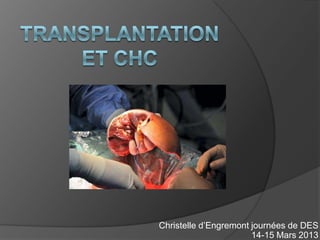
Christelle d’Engremont journées de DES
14-15 Mars 2013
INTRODUCTION
 Première transplantation hépatique en
1963
 Meilleur traitement : CHC et cause, la
cirrhose
 Pénurie des greffons
 Problème de la récidive après
transplantation
˂ 30 %
BCLC, Llovet, Lancet 2009
PLAN
 INDICATIONS ET CONTRE
INDICATIONS
 DOWN STAGING
 ACCES A LA GREFFE
 TRAITEMENTS D’ATTENTE
 CONCLUSION
PLAN
 INDICATIONS ET CONTRE
INDICATIONS
 DOWN STAGING
 ACCES A LA GREFFE
 TRAITEMENTS D’ATTENTE
 CONCLUSION
CONTRE INDICATIONS
 Extension extra-hépatique
 Vasculaire :
- veines hépatiques
- veine porte
Mazzaferro, NEJM 1996
CRITERES DE MILAN
Mazzaferro, NEJM 1996
 1 lésion ≤ 5cm
OU
 2 à 3 lésions ≤ 3 cm
chacune
sans envahissement vasculaire
ETUDES PRINCEPS
Auteurs n Selection Rec Survie
* 4-yr survival
Mazzaferro, NEJM 1996 48 1 nodule < 5cm 8% 74%*
prospective 3 nodules < 3cm
Bismuth, Semin Liver Dis 1999 45 1 nodule < 3cm 11% 74%
3 nodules < 3cm
Llovet, Hepatology 1999 79 1 nodule < 5cm 4% 75%
Jonas, Hepatology 2001 120 1 nodule < 5cm 16% 71%
3 nodules < 3cm
S’applique à < 20% des patients !
Critères de San Francisco
(UCSF)
Yao et al, Hepatology
2001
1 lésion ≤ 6,5cm
OU
3 lésions :
- la plus volumineuse
≤ 4,5cm
et
- volume tumoral total
≤ 8cm
→ 75 % de survie globale à 5 ans
UP TO SEVEN CRITERIA
Mazzafero lancet oncol 2009
7 = somme de la taille de la plus
volumineuse lésion et du nombre de
lésions
→ 71 % de SG à 5 ans
E. Hoti, R. Adam :Liver transplantation for primary and metastatic liver cancers; Journal
compilation ª 2008 European Society for Organ Transplantation 21 (2008) 1107–1117
SCORE AFP (1)
Duvoux, Gastroenterology, oct 2012
SCORE AFP (2)
Contexte :
- Sélection avec critères de Milan :
65 à 80% de survie à 5 ans,
récidive 8 à 15%
- Taux AFP lié à la récidive et au
mauvais pronostic, Yao et al, Hepatology 2001
Objectif : nouveau score à partir du taux
d’AFP
Duvoux, Gastroenterology, oct 2012
SCORE AFP (3)
Méthode :
1) Cohorte de référence 597 patients,
rétrospective
2) Cohorte de validation 435 patients,
prospective
Critère principal : taux de récidive à 5 ans
Critère secondaire : survie globale à 5 ans
Duvoux, Gastroenterology, oct 2012
SCORE AFP (4)
Caractéristiques patients
- Plus de traitements d’attente dans la
cohorte rétrospective
- Plus de récidive dans la cohorte
rétrospective 21 vs 11%
- Mortalité post-opératoire identique
Duvoux, Gastroenterology, oct 2012
SCORE AFP (6)
RESULTATS : COHORTE RETROSPECTIVE
Récidive et survie en fonction du taux d’AFP
+ 1000
100-1000
- 100
Duvoux, Gastroenterology, oct 2012
SCORE AFP (7)
Duvoux, Gastroenterology, oct 2012
SCORE AFP (8)
Récidive et survie en fonction du score
Cohorte rétrospective Cohorte prospective
Duvoux, Gastroenterology, oct 2012
Algorithme validé par l’ABM (sept 2012)
Score > 2
Down staging
Score < 2
Extented criteria
graft
Treatment
not feasible
TNM > 2
Max
waiting time
6 mths
Bridging therapy
Active
tumour
Inactivated
Tumour
TNM1
Allocation based on
MELD score
Contra-indication
And 3 mth-based follow-up
Score > 2
Drop out
PLAN
 INDICATIONS ET CONTRE
INDICATIONS
 DOWN STAGING
 ACCES A LA GREFFE
 TRAITEMENTS D’ATTENTE
 IMMUNOSUPPRESSION
 CONCLUSION
LE DOWN STAGING (1)
 Définition : obtenir une réduction tumorale grâce à
des traitements loco-régionaux permettant
d’atteindre les critères d’accés à la TH
LE DOWN STAGING (2)
LE DOWN STAGING (3)
RESULTATS
 Survie post TH après Down Staging : 60
à 70 %, comparable à la TH avec
critères de Milan, critères UCSF
 TACE : le plus utilisé, pas de preuve
d’une meilleure efficacité
 Echecs Down Staging :
progression, décès, récurrence après
TH
LE DOWN STAGING (4)
AASLD 2012
Yao, Hepatology :
Etude prospective :
- Cohorte down staging, 122 patients
- Cohorte contrôle (critères de Milan), 488 patients
Résultats :
55,7 % de LT dans la cohorte down staging
LE DOWN STAGING (5)
DOWN
STAGING CONTROL P
SG1a (%) 86,5 85,2 0,11
SG5a (%) 56,1 63,3
SSP1a (%) 95 95,9 0,31
SSP5a (%) 91,4 87,6
Yao, Hepatology , 2012
PLAN
 GENERALITES
 INDICATIONS ET CONTRE
INDICATIONS
 DOWN STAGING
 ACCES A LA GREFFE
 TRAITEMENTS D’ATTENTE
 CONCLUSION
SCORE DE MELD
 Score de 6 à 40
 3 variables pronostiques indépendantes
 MELD score = 9,57ln créatinine
(mg/dL) + 3,78 ln bilirubine (mg/dl) +
11,20 ln INR
SCORE DE MELD
En France en 2007 , nouveau score
- Score MELD
- Indication de transplantation
- Durée d’attente
- Fenêtre de transplantabilité
- Distance entre prélèvement et greffe
SCORE FOIE
2011 : SCOREFoie V4
• SCOREFoie V4 HD =
1000 . SI(CIRRH) . f1(MELD; DA; 0; 0; 100%)
ou 900 . SI(TNM1) . f1(MELD; DA; 5; 16; 60%)
ou 900 . SI(TNM2) . f5(MELD; DA; 3; 9; 70%; Ptime)
ou 900 . SI(THNC) . f1(MELD; DA; 0; 12; 60%)
ou 900 . SI(MHNC) . f1(MELD; DA; 3; 15; 80%)
ou 1000 . SI(RETR) . f1(MELD; DA; 1; 6; 90%)
ou 800 . f2(DACExpt; DélaiExpt)
+ 10 . f3(DA)
% : poids du MELD dans la fonction variant en fonction de l’indication
PLAN
 GENERALITES
 INDICATIONS ET CONTRE
INDICATIONS
 DOWN STAGING
 ACCES A LA GREFFE
 TRAITEMENTS D’ATTENTE
- la radiofréquence
- la résection
 CONCLUSION
LA RADIOFREQUENCE
Mazzafero Ann Surg 2006
LA RADIOFREQUENCE
Lu hepatology 2005
SG à 3a 76
%
morbidité
4%
LA RADIOFREQUENCE
Lu hepatology 2005
COMPLICATIONS
 Atteinte de l’artère hépatique :
hémorragie
 Perforation du grêle
 Décompensation hépatique nécessitant
une transplantation de sauvetage
LA RESECTION (1)
LA RESECTION (2)
Fuks, Belghiti, Hepatology 2012
LA RESECTION (3)
Fuks, Belghiti, Hepatology 2012
LR LT
SG 5a 77% 60%
SSR 40% 56%
Parmis les 138 patients du groupe LR
- 20 patients transplantés avant récidive
- 28 % de transplantation après récidive
- 37% répondant au Critères de Milan
n’ont pu être transplantés ( âge, co-
morbidités)
- 22% non transplanté car récidive en
dehors des critères de Milan
→ perte de chance
LA RESECTION (4)
Fuks, Belghiti, Hepatology 2012
LA RESECTION(5)
FACTEURS DE RECIDIVE DANS LE GROUPE
LR
Fuks, Belghiti, Hepatology 2012
HR P
Age ˂ 60 3,18 0,003
T ˂ 3cm 5,30 0,002
Cirrhose 3,12 0,01
Envahissement
vasculaire
microscopique
2,2 0,003
Nodules satellites
5 0,0001
Faible
différenciation 6 0,0001
LA RESECTION
Fuks, Belghiti, Hepatology 2012
Essais randomisés : résection vs traitement percutané
N SSR 3a SG
Huang Alc 38 49% 97%
R 38 61% 89%
Chen RF 90 64% 71%
R 90 69% 73%
Ann Surg 2005
Ann Surg 2006
NS
Résection vs Transplantation
Llovet, Hepatology 1999
 Essai randomisé 164 patients
- 77 patients : résection
- 87 patients : transplantation
 Survie en ITT
RESECTION TRANSPLANTATION
SG 3a (%) 62 69
SG 5a (%) 51 69
 Résultats pour la résection
Résection vs Transplantation
Llovet, Hepatology 1999
BIBili -, HTP -
SG 74%
BIBili -, HTP+
SG 50 %
IBili +, HTP+
SG 25 %
Résection vs Transplantation
Llovet, Hepatology 1999
Résultats pour la résection
GROUPE LT :
2 périodes
- 1989 1996 : temps d’attente moyen 62j
pas de sortie de liste
- 1996-1997 : 162j max 242j, 8 sorties
de liste
Résection vs Transplantation
Llovet, Hepatology 1999
Résection vs Transplantation
Llovet, Hepatology 1999
 Résultats pour la transplantation
Résultat inférieur dans la 2e période à la SG à
2a du meilleur candidat dans le groupe LR(91%
p= 0,02)
CONCLUSION
 La transplantation hépatique doit être
intégrée dans une prise en charge
globale
 Plusieurs critères d’elligibilité à la TH :
intérêt du nouveau score AFP
 Problème de la durée d’attente
 Intérêt des traitements d’attente et du
Down Staging
Transplantation et chc

Transplantation et chc

  • 1.
    Christelle d’Engremont journéesde DES 14-15 Mars 2013
  • 2.
    INTRODUCTION  Première transplantationhépatique en 1963  Meilleur traitement : CHC et cause, la cirrhose  Pénurie des greffons  Problème de la récidive après transplantation
  • 4.
    ˂ 30 % BCLC,Llovet, Lancet 2009
  • 5.
    PLAN  INDICATIONS ETCONTRE INDICATIONS  DOWN STAGING  ACCES A LA GREFFE  TRAITEMENTS D’ATTENTE  CONCLUSION
  • 6.
    PLAN  INDICATIONS ETCONTRE INDICATIONS  DOWN STAGING  ACCES A LA GREFFE  TRAITEMENTS D’ATTENTE  CONCLUSION
  • 7.
    CONTRE INDICATIONS  Extensionextra-hépatique  Vasculaire : - veines hépatiques - veine porte Mazzaferro, NEJM 1996
  • 8.
    CRITERES DE MILAN Mazzaferro,NEJM 1996  1 lésion ≤ 5cm OU  2 à 3 lésions ≤ 3 cm chacune sans envahissement vasculaire
  • 9.
    ETUDES PRINCEPS Auteurs nSelection Rec Survie * 4-yr survival Mazzaferro, NEJM 1996 48 1 nodule < 5cm 8% 74%* prospective 3 nodules < 3cm Bismuth, Semin Liver Dis 1999 45 1 nodule < 3cm 11% 74% 3 nodules < 3cm Llovet, Hepatology 1999 79 1 nodule < 5cm 4% 75% Jonas, Hepatology 2001 120 1 nodule < 5cm 16% 71% 3 nodules < 3cm S’applique à < 20% des patients !
  • 10.
    Critères de SanFrancisco (UCSF) Yao et al, Hepatology 2001 1 lésion ≤ 6,5cm OU 3 lésions : - la plus volumineuse ≤ 4,5cm et - volume tumoral total ≤ 8cm → 75 % de survie globale à 5 ans
  • 11.
    UP TO SEVENCRITERIA Mazzafero lancet oncol 2009 7 = somme de la taille de la plus volumineuse lésion et du nombre de lésions → 71 % de SG à 5 ans
  • 12.
    E. Hoti, R.Adam :Liver transplantation for primary and metastatic liver cancers; Journal compilation ª 2008 European Society for Organ Transplantation 21 (2008) 1107–1117
  • 13.
    SCORE AFP (1) Duvoux,Gastroenterology, oct 2012
  • 14.
    SCORE AFP (2) Contexte: - Sélection avec critères de Milan : 65 à 80% de survie à 5 ans, récidive 8 à 15% - Taux AFP lié à la récidive et au mauvais pronostic, Yao et al, Hepatology 2001 Objectif : nouveau score à partir du taux d’AFP Duvoux, Gastroenterology, oct 2012
  • 15.
    SCORE AFP (3) Méthode: 1) Cohorte de référence 597 patients, rétrospective 2) Cohorte de validation 435 patients, prospective Critère principal : taux de récidive à 5 ans Critère secondaire : survie globale à 5 ans Duvoux, Gastroenterology, oct 2012
  • 16.
    SCORE AFP (4) Caractéristiquespatients - Plus de traitements d’attente dans la cohorte rétrospective - Plus de récidive dans la cohorte rétrospective 21 vs 11% - Mortalité post-opératoire identique Duvoux, Gastroenterology, oct 2012
  • 17.
    SCORE AFP (6) RESULTATS: COHORTE RETROSPECTIVE Récidive et survie en fonction du taux d’AFP + 1000 100-1000 - 100 Duvoux, Gastroenterology, oct 2012
  • 18.
    SCORE AFP (7) Duvoux,Gastroenterology, oct 2012
  • 19.
    SCORE AFP (8) Récidiveet survie en fonction du score Cohorte rétrospective Cohorte prospective Duvoux, Gastroenterology, oct 2012
  • 20.
    Algorithme validé parl’ABM (sept 2012) Score > 2 Down staging Score < 2 Extented criteria graft Treatment not feasible TNM > 2 Max waiting time 6 mths Bridging therapy Active tumour Inactivated Tumour TNM1 Allocation based on MELD score Contra-indication And 3 mth-based follow-up Score > 2 Drop out
  • 21.
    PLAN  INDICATIONS ETCONTRE INDICATIONS  DOWN STAGING  ACCES A LA GREFFE  TRAITEMENTS D’ATTENTE  IMMUNOSUPPRESSION  CONCLUSION
  • 22.
    LE DOWN STAGING(1)  Définition : obtenir une réduction tumorale grâce à des traitements loco-régionaux permettant d’atteindre les critères d’accés à la TH
  • 23.
  • 24.
    LE DOWN STAGING(3) RESULTATS  Survie post TH après Down Staging : 60 à 70 %, comparable à la TH avec critères de Milan, critères UCSF  TACE : le plus utilisé, pas de preuve d’une meilleure efficacité  Echecs Down Staging : progression, décès, récurrence après TH
  • 25.
    LE DOWN STAGING(4) AASLD 2012 Yao, Hepatology : Etude prospective : - Cohorte down staging, 122 patients - Cohorte contrôle (critères de Milan), 488 patients Résultats : 55,7 % de LT dans la cohorte down staging
  • 26.
    LE DOWN STAGING(5) DOWN STAGING CONTROL P SG1a (%) 86,5 85,2 0,11 SG5a (%) 56,1 63,3 SSP1a (%) 95 95,9 0,31 SSP5a (%) 91,4 87,6 Yao, Hepatology , 2012
  • 27.
    PLAN  GENERALITES  INDICATIONSET CONTRE INDICATIONS  DOWN STAGING  ACCES A LA GREFFE  TRAITEMENTS D’ATTENTE  CONCLUSION
  • 28.
    SCORE DE MELD Score de 6 à 40  3 variables pronostiques indépendantes  MELD score = 9,57ln créatinine (mg/dL) + 3,78 ln bilirubine (mg/dl) + 11,20 ln INR
  • 29.
  • 30.
    En France en2007 , nouveau score - Score MELD - Indication de transplantation - Durée d’attente - Fenêtre de transplantabilité - Distance entre prélèvement et greffe SCORE FOIE
  • 32.
    2011 : SCOREFoieV4 • SCOREFoie V4 HD = 1000 . SI(CIRRH) . f1(MELD; DA; 0; 0; 100%) ou 900 . SI(TNM1) . f1(MELD; DA; 5; 16; 60%) ou 900 . SI(TNM2) . f5(MELD; DA; 3; 9; 70%; Ptime) ou 900 . SI(THNC) . f1(MELD; DA; 0; 12; 60%) ou 900 . SI(MHNC) . f1(MELD; DA; 3; 15; 80%) ou 1000 . SI(RETR) . f1(MELD; DA; 1; 6; 90%) ou 800 . f2(DACExpt; DélaiExpt) + 10 . f3(DA) % : poids du MELD dans la fonction variant en fonction de l’indication
  • 33.
    PLAN  GENERALITES  INDICATIONSET CONTRE INDICATIONS  DOWN STAGING  ACCES A LA GREFFE  TRAITEMENTS D’ATTENTE - la radiofréquence - la résection  CONCLUSION
  • 34.
  • 35.
    LA RADIOFREQUENCE Lu hepatology2005 SG à 3a 76 % morbidité 4%
  • 36.
    LA RADIOFREQUENCE Lu hepatology2005 COMPLICATIONS  Atteinte de l’artère hépatique : hémorragie  Perforation du grêle  Décompensation hépatique nécessitant une transplantation de sauvetage
  • 37.
  • 38.
    LA RESECTION (2) Fuks,Belghiti, Hepatology 2012
  • 39.
    LA RESECTION (3) Fuks,Belghiti, Hepatology 2012 LR LT SG 5a 77% 60% SSR 40% 56%
  • 40.
    Parmis les 138patients du groupe LR - 20 patients transplantés avant récidive - 28 % de transplantation après récidive - 37% répondant au Critères de Milan n’ont pu être transplantés ( âge, co- morbidités) - 22% non transplanté car récidive en dehors des critères de Milan → perte de chance LA RESECTION (4) Fuks, Belghiti, Hepatology 2012
  • 41.
    LA RESECTION(5) FACTEURS DERECIDIVE DANS LE GROUPE LR Fuks, Belghiti, Hepatology 2012 HR P Age ˂ 60 3,18 0,003 T ˂ 3cm 5,30 0,002 Cirrhose 3,12 0,01 Envahissement vasculaire microscopique 2,2 0,003 Nodules satellites 5 0,0001 Faible différenciation 6 0,0001
  • 42.
  • 43.
    Essais randomisés :résection vs traitement percutané N SSR 3a SG Huang Alc 38 49% 97% R 38 61% 89% Chen RF 90 64% 71% R 90 69% 73% Ann Surg 2005 Ann Surg 2006 NS
  • 44.
    Résection vs Transplantation Llovet,Hepatology 1999  Essai randomisé 164 patients - 77 patients : résection - 87 patients : transplantation  Survie en ITT RESECTION TRANSPLANTATION SG 3a (%) 62 69 SG 5a (%) 51 69
  • 45.
     Résultats pourla résection Résection vs Transplantation Llovet, Hepatology 1999
  • 46.
    BIBili -, HTP- SG 74% BIBili -, HTP+ SG 50 % IBili +, HTP+ SG 25 % Résection vs Transplantation Llovet, Hepatology 1999 Résultats pour la résection
  • 47.
    GROUPE LT : 2périodes - 1989 1996 : temps d’attente moyen 62j pas de sortie de liste - 1996-1997 : 162j max 242j, 8 sorties de liste Résection vs Transplantation Llovet, Hepatology 1999
  • 48.
    Résection vs Transplantation Llovet,Hepatology 1999  Résultats pour la transplantation Résultat inférieur dans la 2e période à la SG à 2a du meilleur candidat dans le groupe LR(91% p= 0,02)
  • 49.
    CONCLUSION  La transplantationhépatique doit être intégrée dans une prise en charge globale  Plusieurs critères d’elligibilité à la TH : intérêt du nouveau score AFP  Problème de la durée d’attente  Intérêt des traitements d’attente et du Down Staging